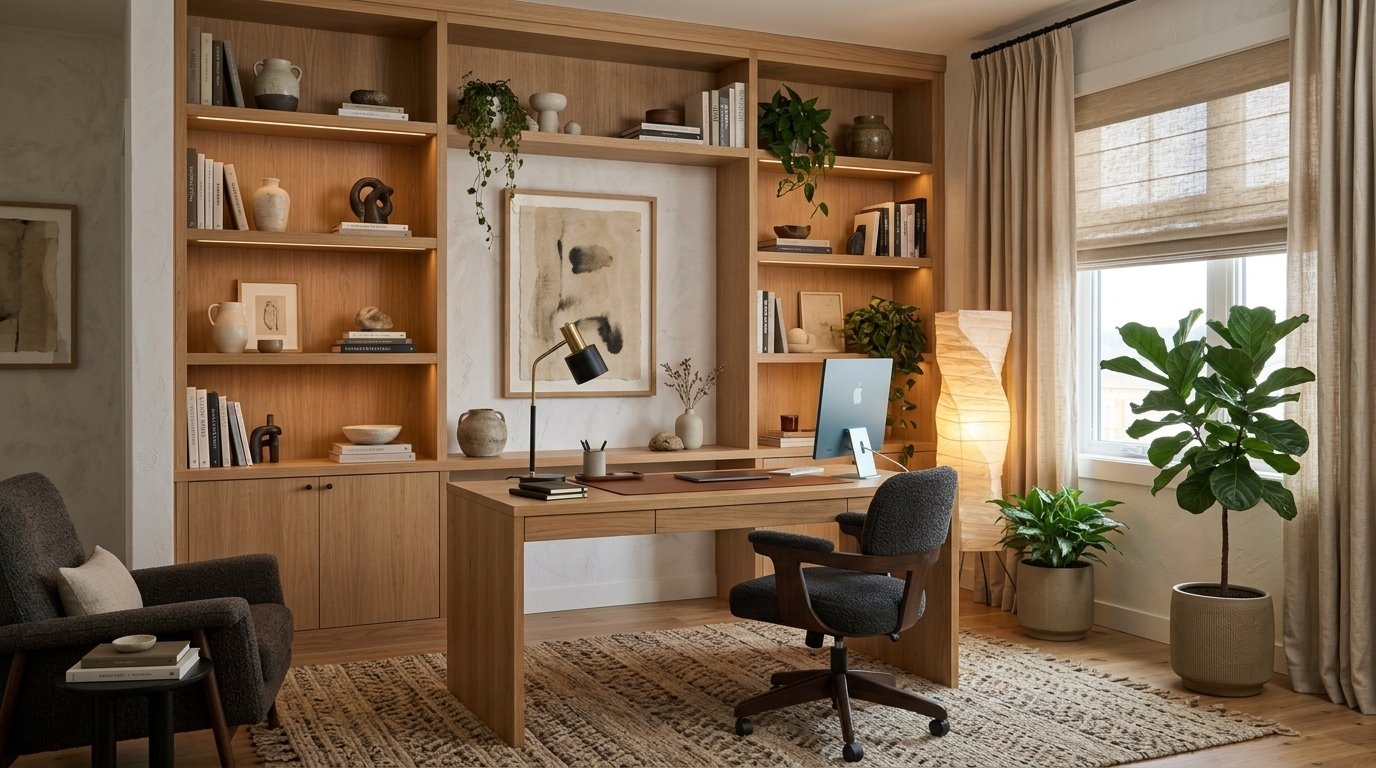
15 Japandi Home Office Ideas That Keep Desks Clear
Your desk should not be the loudest thing in the room. Yet most home offices fight for attention with cables, paper stacks, and gadgets. These japandi home office ideas show another way: warm wood, matte textures, closed storage, and a surface clear enough to think on.
I’m Emily, and my background is in plant science, not formal design, so I care about what actually works. Between my own spare-room experiments and watching my husband build cabinetry for real homes, I’ve learned that focus comes from fewer visible objects, not fewer comforts. Below you’ll find fifteen full rooms, each with exact woods, desk sizes, lighting, plants, and cable routes you can copy. Some suit a full workday, and a few are honest short-session spots. Save the ones that fit your space, then try one change this weekend.
Why Does a Japandi Office Help You Focus Without Feeling Cold?
Here’s the counterintuitive part: a Japandi office feels warm precisely because it holds fewer things. A Japandi office helps you focus without feeling cold because visual clutter competes for attention, so closed storage and a nearly empty desk surface reduce how many objects your eye must process, while natural wood and matte textures keep the room warm. Last spring I cleared a client’s desk down to one lamp, one laptop, and a single tray, and she said the room suddenly felt quieter. These japandi home office ideas solve the practical side too: where cables go, what hides, and what earns a place on the desk.
1. Smoked Oak and Limewash — A Japandi Home Office Idea
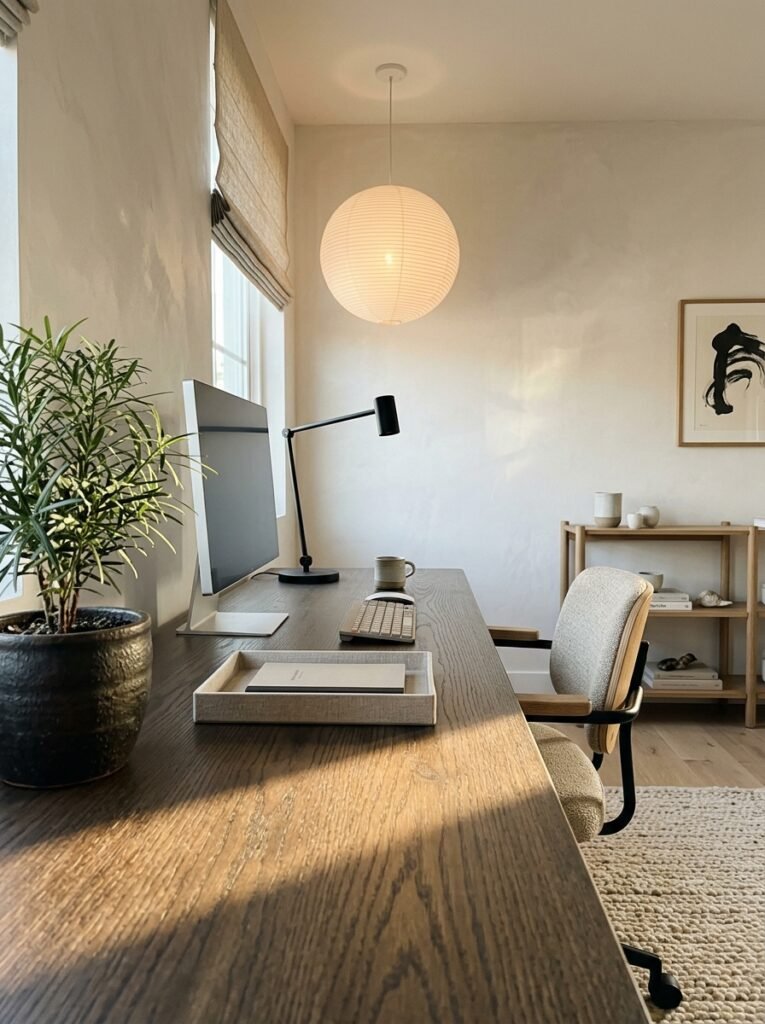
- Bone limewash with a matte, mineral finish. A flax linen Roman shade hangs just above the window frame.
- Fumed white oak slab desk, 60 x 28 inches, 29 inches tall, finished in matte hardwax oil.
- Adjustable task chair in oatmeal wool-blend with a matte black base. Set the seat so your feet rest flat. Keep the monitor an arm’s length away, with its top edge near eye level.
- Black arm task lamp on the non-writing side, 2700K bulb. A 24-inch washi pendant provides ambient light, also at 2700K.
- Wall-hung two-door cabinet, 48 x 16 x 30 inches, painted to match the wall. The only open display is a stack of three books.
- Undyed wool flatweave rug, 5 x 8 feet. One indigo-dyed cotton panel in a thin black frame.
- Podocarpus in a raw cement pot. It needs bright indirect light and a drying top inch between waterings.
- Blackened tin pulls. Cables pass through a 2-inch grommet to an under-desk tray. The desk holds a monitor, keyboard, lamp, and one tray.
Why this works: One dark, matte wood surface against pale walls gives the eye a single focal point, so the rest of the room can stay quiet.
Dark wood works hardest when it is the only dark thing in the room. A fumed white oak desk against pale limewash gives the eye one confident anchor, so everything else can stay quiet. The slab’s grain pattern is the decoration, which means nothing else on the surface has to compete with it. Keep the top almost bare: a monitor, a keyboard, a lamp, and one tray. Pushing the monitor to arm’s length and keeping its top edge near eye level reduces neck strain, and the clean surface makes that distance feel generous rather than empty.
My husband builds for a living, and he insists on one detail with solid oak: drill the cable grommet from the top with a backing board clamped underneath, or the grain tears out. Route a two-inch hole behind the monitor, then mount a cable tray under the slab so cords vanish. Wall-hung closed cabinets hide paper and chargers, which matters because open shelves invite stacking. With my plant science background, I’d pick Podocarpus for a bonsai look indoors, since juniper bonsai are outdoor trees. Give it bright indirect light and let the top inch dry between waterings.
2. Tansu and Bleached Ash
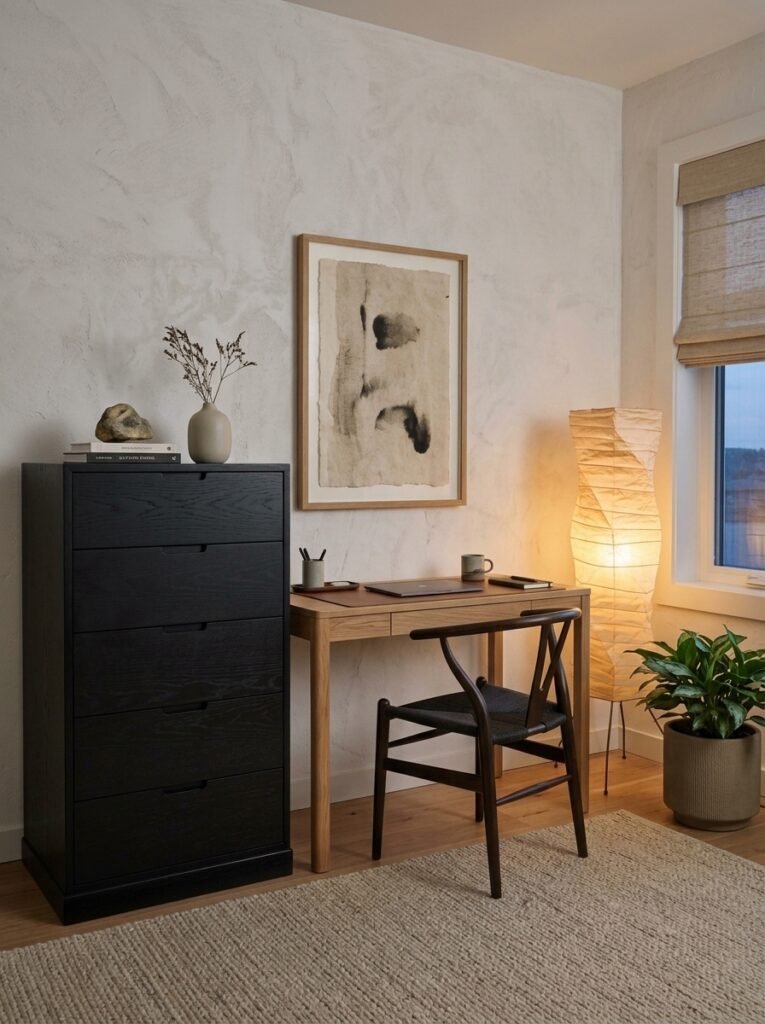
- Chalk-white mineral paint with a fine sand texture. A woven bamboo roll-up blind, half lowered to soften glare.
- Bleached ash writing table, 48 x 24 inches, 29 inches tall, matte water-based finish, one shallow center drawer.
- Bentwood armless chair with a fixed seat near 18 inches and a 1-inch wool seat pad. Best for an hour or two at a time, or as a secondary workspace.
- Matte white steel arm lamp on the left of the screen for right-handers, 2700K. A washi floor lantern, 18 x 18 x 24 inches, at 2400K.
- Closed five-drawer ebonized cherry tansu, 36 x 18 x 40 inches. The top displays a single river stone.
- 3 x 5 foot natural rush mat. One unframed sheet of hand-torn washi, pinned at the corners.
- Chinese evergreen (Aglaonema ‘Silver Bay’) in raw terracotta. It takes low to medium indirect light. Water when the top two inches are dry.
- Raw brass bail pulls. Cords run down one back leg in a fabric sleeve to a power strip in the tansu’s bottom drawer. The desk holds a laptop, lamp, and notebook.
Why this works: A dark closed chest against a pale desk adds contrast through wood alone while hiding every supply.
I learned this the hard way in my own spare room. I bought a wooden chair, sat in it for a full workday, and ended up on the floor stretching by three o’clock. Beautiful and hard-seated is fine for an hour or two, not eight. That’s why this setup pairs a bleached ash writing table, forty-eight by twenty-four inches and twenty-nine inches tall, with a bentwood chair meant for shorter sessions. A one-inch wool seat pad helps, and regular breaks matter more. Make it your secondary workspace, or add an adjustable chair if you work here full time.
Then comes the showpiece: an ebonized cherry tansu chest, thirty-six inches wide and forty inches tall, with five drawers and raw brass pulls. Closed drawers swallow printer paper, chargers, and receipts, so the only thing on top is a single river stone. When a friend stopped by last fall, she asked where I keep my work. The answer was behind five dark fronts, which is exactly the point. Pale ash against ebonized cherry gives you contrast without color. Pair it with chalk-white mineral paint, a woven bamboo blind, and a Chinese evergreen, whose shade-adapted leaves handle low light.
3. Putty Cabinet Wall
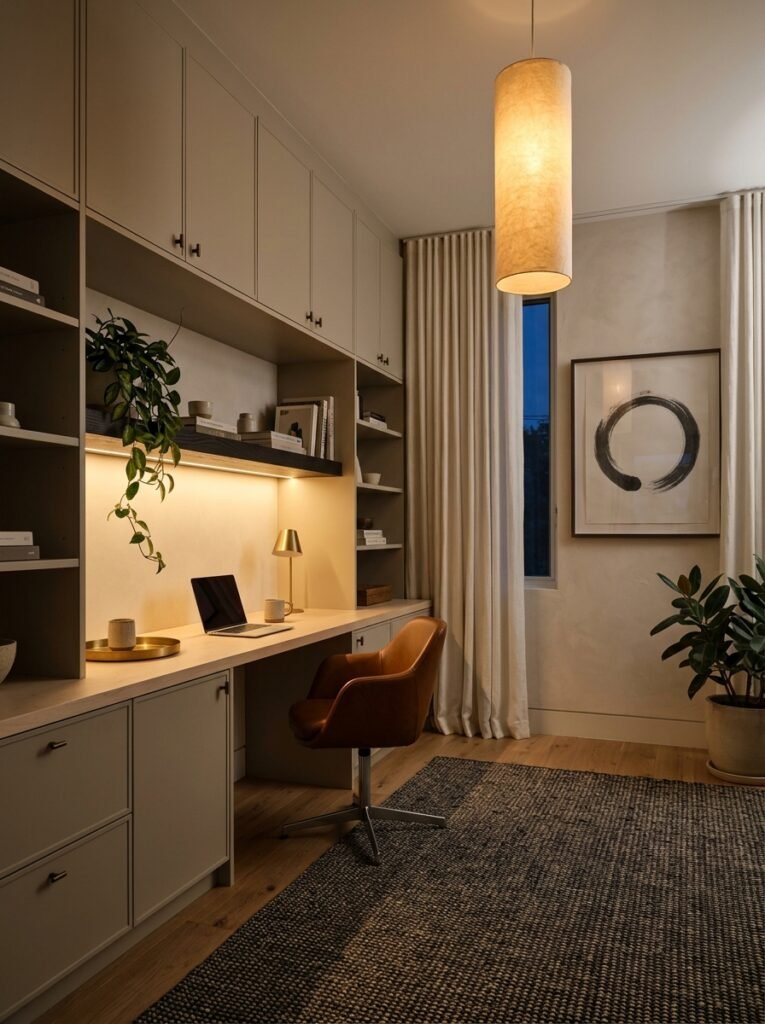
- Warm putty matte paint carried across the walls and cabinet fronts. Ivory linen curtains on a ceiling track, hung to the floor.
- Pale birch top, 60 x 26 inches, 29 inches tall, matte hardwax oil, on charcoal powder-coated steel legs.
- Adjustable swivel in undyed vegetable-tanned leather with a curved, supportive back. Feet flat, elbows near 90 degrees, screen top near eye level.
- Warm LED strip under the shelf as task light, 2700K. A tall washi cylinder pendant, 10 x 30 inches, 2700K on a dimmer.
- Floor-to-ceiling flat-front closed cabinets, push-to-open, 8 feet wide. Open display is limited to one ebonized oak shelf, 48 inches long.
- Charcoal-and-oatmeal flatweave rug, 5 x 8 feet. One framed charcoal enso drawing, 30 x 30 inches.
- Trailing Hoya carnosa on the shelf. It needs bright indirect light and likes to dry between waterings.
- Charcoal steel recessed pulls. Cords run inside the cabinet run to an interior outlet. The desk holds a monitor, keyboard, and notebook.
Why this works: Handleless closed cabinets painted the wall color make storage visually disappear, which lowers the number of objects the eye has to process.
Picture a wall of storage that reads as paint. Flat-front cabinets in warm putty, handleless, closed, run floor to ceiling, so nothing is visible until you open a door. In my experience, that is where a Japandi office succeeds or fails: the eye rests when it can’t find objects. A pale birch desk, sixty inches wide, on charcoal steel legs faces the window beside the cabinet run. The desk holds a monitor, a keyboard, and a notebook. A leather swivel chair adjusts so your feet rest flat, elbows near ninety degrees, and screen top near eye level.
The dark wood sits above, not below. An ebonized oak shelf, forty-eight inches long, floats over the desk with a warm LED strip hidden beneath it. My husband’s rule for floating shelves is simple: find the studs, usually sixteen inches apart, and drive screws into them, never just drywall. He also plans an outlet inside the cabinet run, so chargers live behind doors. Keep the shelf nearly bare, with one trailing Hoya, an epiphyte whose roots prefer drying between waterings. At night, the strip pools light on the birch and the dark oak recedes.
4. Low Walnut Writing Table
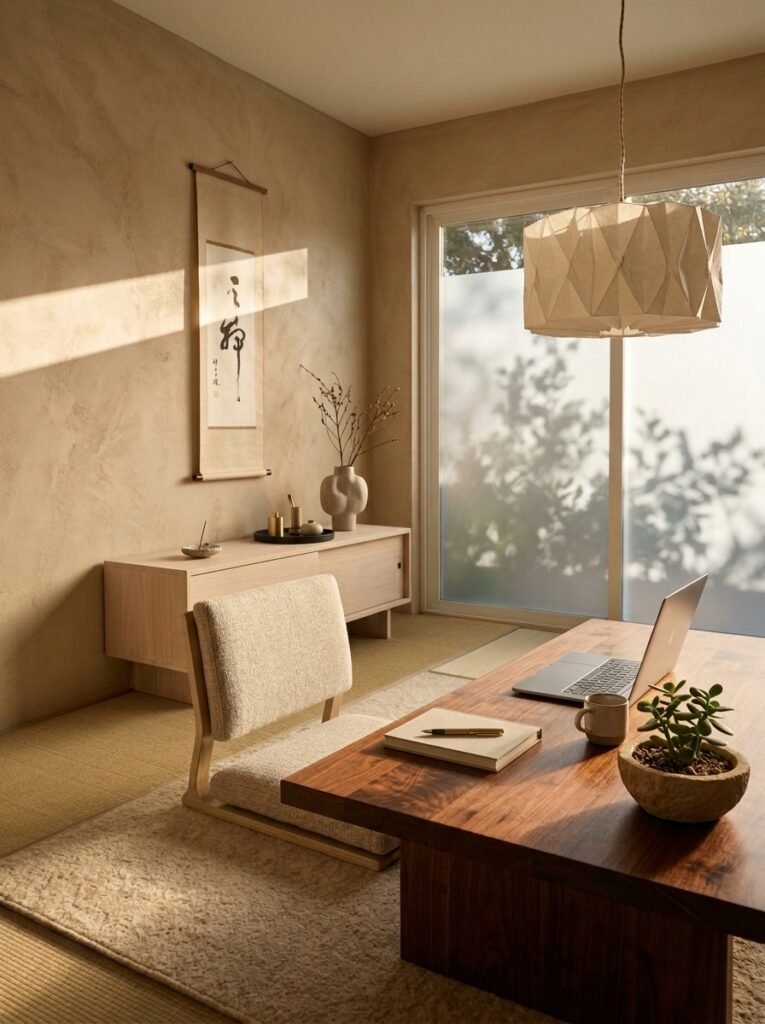
- Sand-toned clay plaster, matte. Translucent rice-paper-style window film on the lower pane diffuses glare; the upper pane stays clear.
- Black walnut low writing table, 40 x 20 inches, 15 inches tall, matte oil finish.
- Legless zaisu chair with a curved back support on a 1-inch wool-felt pad. Use it for short sessions of writing, reading, or planning. A screen sits too low for a full workday, so make this a secondary spot.
- Matte bone-white adjustable lamp on the left, 2700K. A hand-folded washi drum pendant, 18 inches wide, hangs low over the desk at 2400K.
- Closed two-door sliding credenza in pale paulownia, 60 x 16 x 24 inches. The flat top holds one shallow tray.
- 6 x 4 foot oat wool-felt pad under the cushion. One vertical ink-brush scroll, 12 x 48 inches, hung from a plain wooden dowel.
- Jade plant (Crassula ovata) in a sandstone bowl. It needs a few hours of bright light and water only when the soil is dry.
- Tarnished pewter finger pulls. One flat cable channel runs along the baseboard to a wall outlet. The table holds a laptop and notebook only.
Why this works: A low table keeps sightlines open and limits the work to short, focused sessions, which is the honest way to use floor seating.
A low desk looks easy, but physics sets its limits. Sitting on the floor gives your back little support, and a laptop on a fifteen-inch table forces your neck forward. That makes this setup ideal for short sessions: journaling, planning, reading, or handwritten notes. For a full workday, keep a standard desk elsewhere and treat this as your second spot. The reward is the material moment: black walnut with oil-rubbed depth, lit sideways by late sun. A legless zaisu chair with a curved back support, set on a wool-felt pad, keeps your spine upright and your knees cushioned.
Storage stays low, too. A pale paulownia credenza with two sliding doors, sixty inches wide, hides paper, ink, and chargers, and its flat top holds one shallow tray. Pale paulownia against dark walnut makes the contrast do the decorating. Plants should match the height: a jade plant in a sandstone bowl sits near your seated sightline. Coming from plant science, I like jade because it opens its stomata at night to save water, so a missed watering rarely hurts. Give it a few hours of bright light and water only when the soil is dry.
5. Chestnut Drafting Table
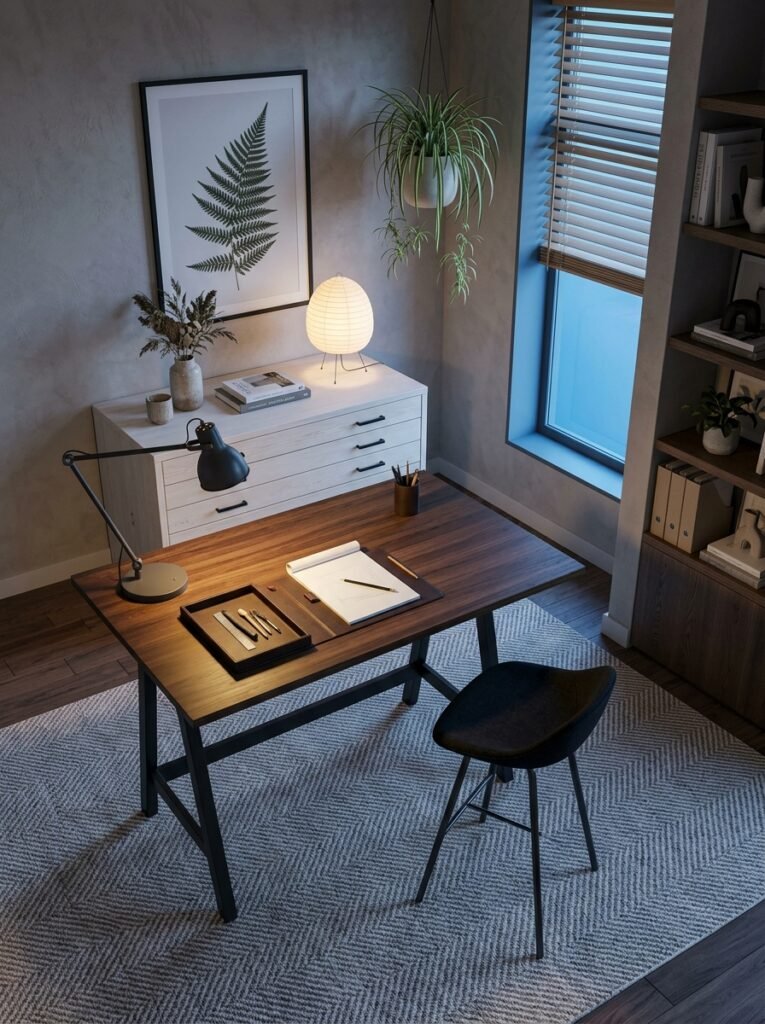
- Hand-troweled dove-gray lime plaster, matte. A 2-inch basswood slat blind in natural, tilted upward to bounce light toward the ceiling.
- Smoked chestnut drafting table, 36 x 24 inches, matte hardwax finish. It sits 29 inches tall when flat. A slight tilt brings paper closer to your eyes and eases neck bend.
- Height-adjustable drafting stool in black wool felt with a supportive back ring. Set it so your feet rest flat and your thighs stay roughly parallel to the floor.
- Counterweighted drafting lamp in matte charcoal on the right rail, 2700K. A bamboo-ribbed washi table lantern, 14 x 14 x 20 inches, sits on the plan chest at 2400K.
- Closed five-drawer plan chest in whitewashed pine, 40 x 28 x 36 inches, with one shallow drawer per project. The top holds only the lantern and the plant.
- Oatmeal wool-and-jute herringbone rug, 5 x 7 feet. One framed pressed-fern herbarium sheet, 18 x 24 inches, in a thin walnut frame.
- Spider plant (Chlorophytum comosum) on the plan chest. It needs bright indirect light and water when the top inch is dry.
- Brushed zinc bin pulls. Lamp and laptop cords run along the rear leg to a floor outlet. The surface holds a pad, a pencil, and a scale rule.
Why this works: A slight tilt brings paper closer to your eyes and reduces neck bend, and a plan chest keeps every sheet flat and out of sight.
I once watched a graphic designer stop complaining about her neck after she tilted her desk top a few degrees. Her notebook suddenly sat closer to her eyes. That’s the logic behind this chestnut drafting table, thirty-six by twenty-four inches. Tilt it for handwriting and sketching, flatten it when the laptop comes out. A smoked finish gives the wood dark, quiet depth against dove-gray lime plaster. Pair it with an adjustable stool that has a supportive back ring, set so your feet rest flat and your thighs stay roughly parallel to the floor.
Paper needs a home, so the storage is a five-drawer plan chest in whitewashed pine, forty inches wide. Shallow drawers keep sheets flat and out of sight, one drawer per project. The top holds only a bamboo-ribbed washi lantern and a spider plant, which sends out plantlets on arching stolons and rewards bright, indirect light. A framed pressed-fern sheet on the wall quietly echoes the plant. Run the lamp and laptop cords along the rear leg to a floor outlet, and keep the work surface to a pad, a pencil, and a scale rule.
6. Round Teak and Wool Felt
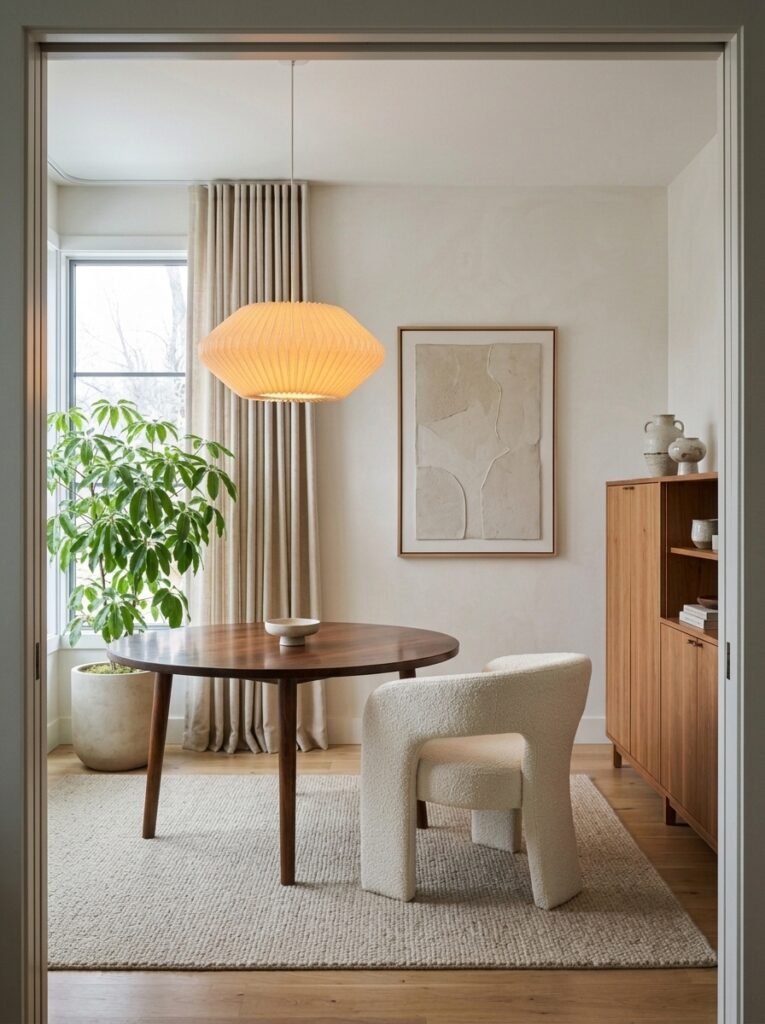
- Oyster-white matte paint. Lined oat wool-linen drapery on a black rod, hung wide so it also absorbs sound.
- Dark-oiled teak round pedestal desk, 48 inches across, 29 inches tall, matte oil finish. A hollow pedestal carries cords down to the floor.
- Height-adjustable armchair-style task chair in charcoal wool bouclé with forearm support and lumbar support. Set the seat so your feet rest flat and your forearms rest lightly.
- Bone-white metal dome lamp on a swivel, on the left for right-handers, 2700K. A hand-pleated washi accordion pendant, 28 inches long, at 2700K.
- Tall closed cabinet in natural cedar, 24 x 16 x 72 inches, with solid doors and magnetic catches. The only display is the empty cabinet top.
- Thick wool-jute rug, 8 x 10 feet. One 4 x 4 foot oatmeal wool-felt acoustic panel doubles as the wall piece.
- Dwarf umbrella tree (Schefflera arboricola) in an unglazed pot. It needs bright indirect light and water when the top two inches are dry.
- Smoked nickel door pulls. Cords stay inside the pedestal. The desk holds a laptop, lamp, and one notebook.
Why this works: Soft materials absorb the echo that hard floors and bare walls create, so the room feels quieter and the desk feels more focused.
Hard rooms echo, and echo is a form of clutter you hear. Living-room corners and spare rooms with hardwood floors and bare walls bounce sound everywhere around you, which makes concentration harder. My husband treats softening hard surfaces as step one in any quiet space: a thick wool rug, lined drapery, and one wool-felt panel on the wall behind the desk. The felt panel here is four feet square and doubles as the wall piece, so the fix looks intentional. In my experience, people notice the quiet before they notice the felt.
The desk is a forty-eight-inch round in dark-oiled teak on a hollow pedestal, which suits a corner and has no sharp edges to bump. Cords travel inside the pedestal to the floor, leaving the surface to a laptop, a lamp, and one notebook. An armchair-style task chair with adjustable height and forearm support lets you sit at the round without hunching. Round tops keep every item within easy reach, so fewer things need to live on them. Add a tall natural cedar cabinet for closed storage and a dwarf umbrella tree, whose radiating leaflets catch bright indirect light.
You’ll Also Love:15 Japandi Dining Room Ideas That Feel Intentional
7. Dark Elm Sit-Stand
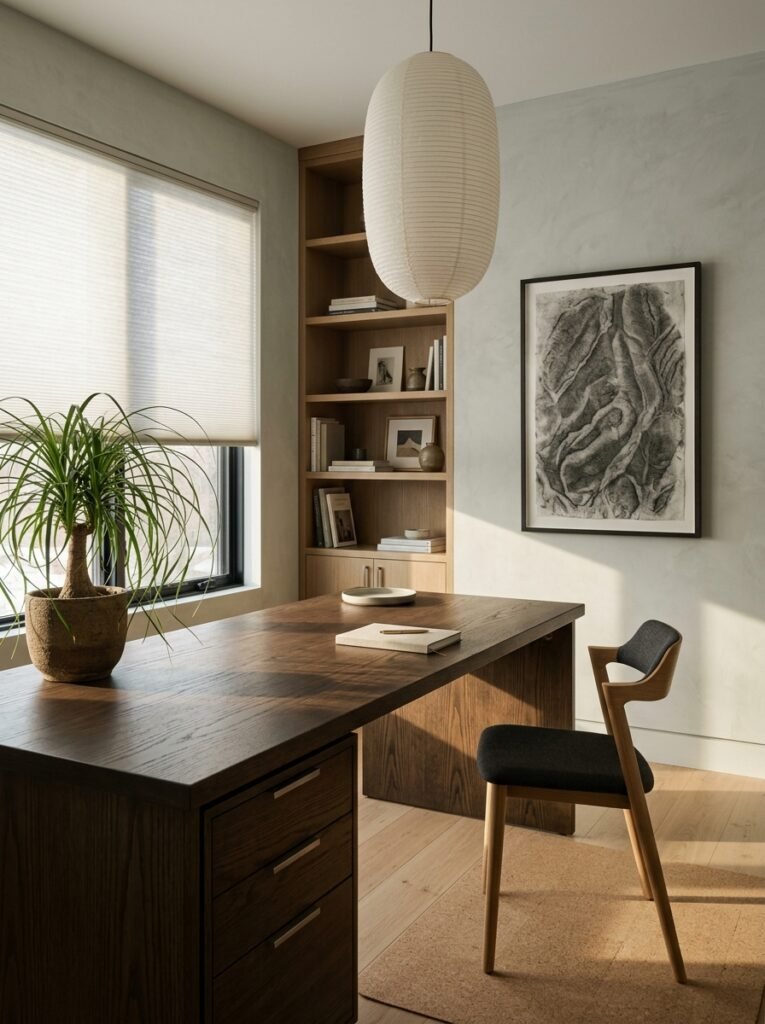
- Pale gray-green limewash, matte and low-contrast. A light-filtering cellular shade in warm white, lowered halfway to cut glare on the screen.
- Electric sit-stand desk with a dark-stained elm top, 55 x 27 inches, matte hardwax finish, on a matte graphite frame. Raise it to elbow height when standing. Lower it so your forearms rest level when seated.
- Adjustable chair in oat linen-wool with a molded beech back and lumbar support. Feet flat, screen top near eye level, screen about an arm’s length away.
- Monitor-mounted LED light bar in matte graphite, set to its warmest 2700K, so no lamp base takes up desk space. A washi lantern pendant, 14 x 14 x 36 inches, at 2700K.
- Closed three-drawer rolling pedestal in matching elm, 15 x 20 x 22 inches. Open display is one 36-inch picture ledge holding a single book.
- Cork anti-fatigue mat, 2 x 3 feet. One framed charcoal stone rubbing, 24 x 30 inches.
- Ponytail palm (Beaucarnea recurvata) on the floor by the window. It wants bright light and sparing water.
- Brushed stainless drawer pulls. Cords run into a cable tray under the top, with extra slack for height changes. The desk holds a keyboard, monitor, and one notebook.
Why this works: A sit-stand desk works best when its surface is nearly bare, because every object on it travels up and down with the desk.
The best posture is your next one, which is why ergonomists favor desks that let you switch between sitting and standing. This one tucks its motor and frame beneath a dark-stained elm top, fifty-five by twenty-seven inches, so it reads as furniture. Raise it to elbow height when standing, lower it so your forearms rest level when seated. Add a cork anti-fatigue mat for standing, and a monitor light bar clipped on top to light the keyboard without a lamp base eating surface space. The result is a bare, deep-brown plane with almost nothing on it.
Storage goes where your knees would be. A three-drawer rolling pedestal in matching elm, fifteen by twenty by twenty-two inches, tucks under the desk and holds everything you’d otherwise stack. I tried open shelving beside a standing desk once and lost a month to paper piles. A ponytail palm in a plain pot adds sculptural height; its swollen base stores water, so it forgives travel weeks, and it wants bright light. Run cords into a cable tray bolted under the top and leave slack so they don’t tug when the desk rises.
8. Charred Cypress Closet
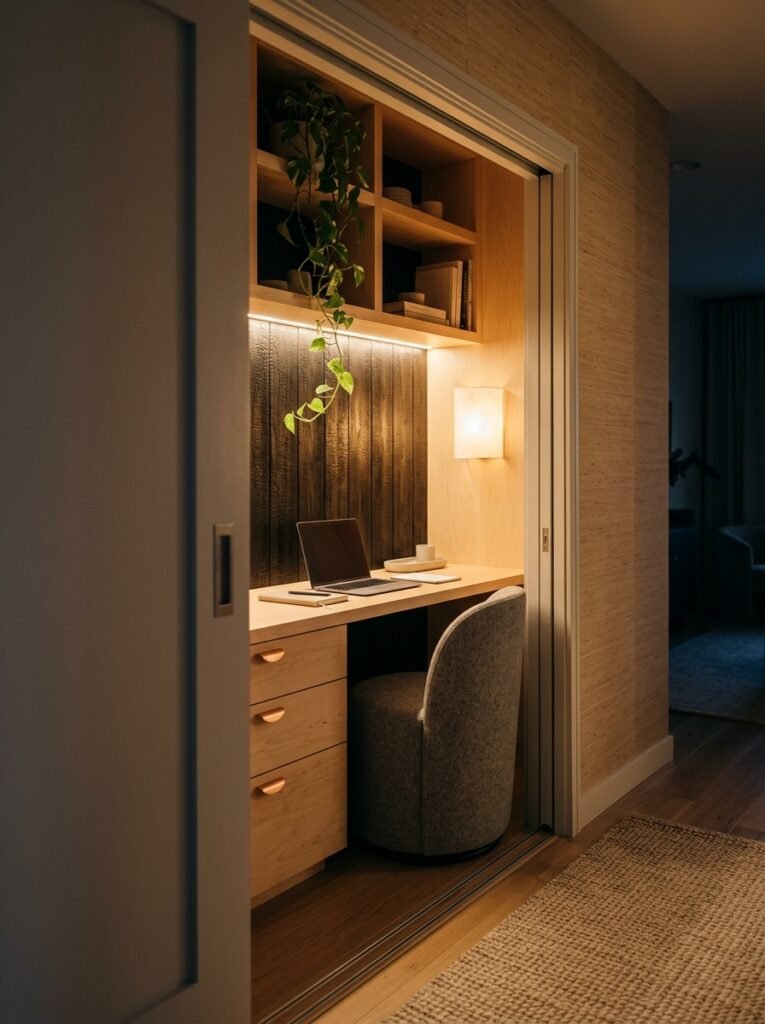
- Pale wheat grasscloth on the room’s walls. Sliding closet doors wrapped in the same grasscloth so they vanish when closed. Stone-colored linen-cotton panels at the room’s window.
- Pale hard maple desk shelf built into the closet, 60 x 24 inches, 29 inches tall, matte water-based finish. The 24-inch depth is a minimum, so pair it with a laptop on a stand and a separate keyboard.
- Compact armless swivel chair in warm gray wool-felt with adjustable height. It rolls fully inside. Feet flat, elbows near 90 degrees.
- Recessed LED strip under the overhead cabinet lip, just above eye line, 2700K. A small washi wall sconce, 8 x 6 x 16 inches, at 2400K.
- Closed overhead cabinet, 72 x 12 x 18 inches, plus two drawers beneath the shelf. Open display is one cubby holding a pothos.
- Short-pile wool runner, 3 x 8 feet, outside the doors. One framed single-line botanical drawing, 11 x 14 inches, beside the closet.
- Pothos (Epipremnum aureum) trailing from the cubby. It tolerates dimmer spots; water when the top inch is dry.
- Satin copper drawer pulls. An outlet sits inside the closet at desk height, so cords never cross the room. Doors close at day’s end.
Why this works: A closet office lets you end the workday by closing two doors, which turns a clear-desk habit into a physical ritual.
What if your office could close like a cupboard? This built-in closet, six feet wide and twenty-six inches deep, hides a pale maple desk shelf, a compact swivel chair, and everything else behind two sliding doors. At five o’clock you shut the doors, and work is literally out of sight. My husband builds these from three-quarter-inch plywood, scribes the sides to crooked walls, and puts an outlet inside at desk height so no cord ever crosses the room. In my experience, that closing ritual does more for work-life separation than any app.
Open the doors and the back panel steals the show: charred cypress, brushed to a soft black, with a warm LED strip glowing softly beneath the overhead cabinet. The strip sits just above eye line so it lights the desk without glare on the screen. Below, closed drawers hold paper, with one open cubby for a trailing pothos, a vine that tolerates dimmer corners. Pale maple against that dark char gives the clearest dark-against-light contrast in the whole room. A satin copper pull on each drawer picks up the warm glow.
9. Fluted Plaster, Carbonized Bamboo
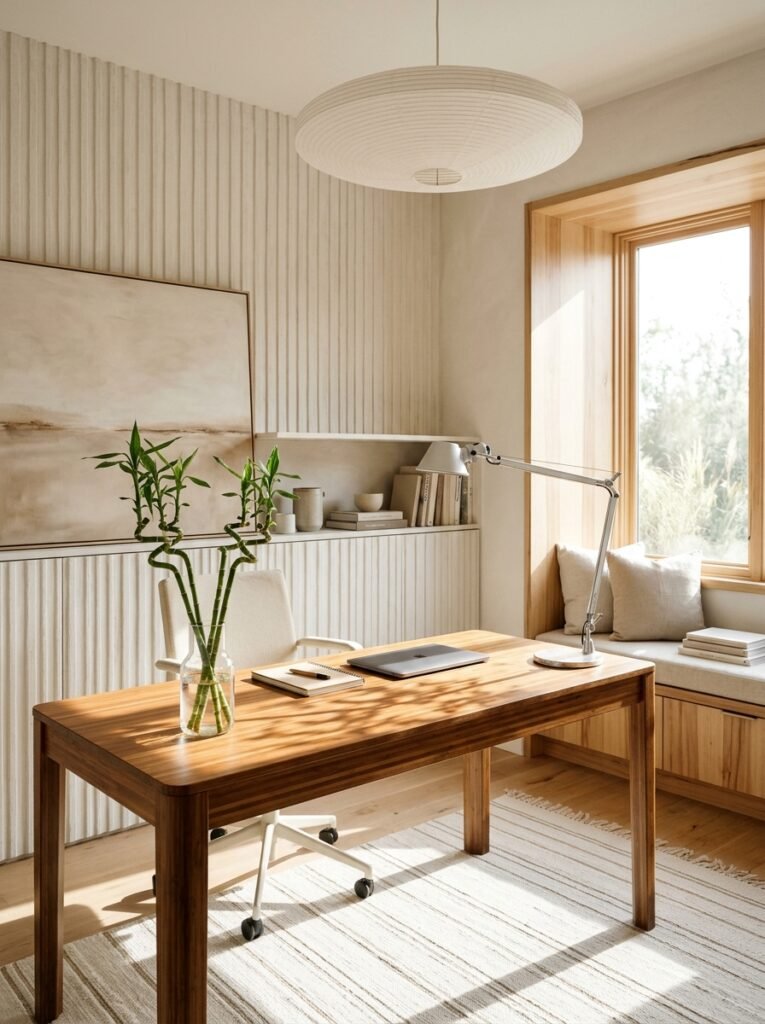
- Fluted lime plaster in pale linen, matte. A paper-fiber roller shade in natural, lowered partway to cut screen glare.
- Carbonized bamboo top, 63 x 25 inches, 29 inches tall, matte finish, on slim bleached hickory legs with one shallow drawer.
- Armless task chair in undyed cotton canvas on a matte black base, with adjustable height and tilt. Feet flat, elbows near 90 degrees, screen top near eye level.
- Raw aluminum swing-arm lamp on the left, 2700K. A 30-inch washi disc pendant, 2700K.
- Closed window bench in bleached hickory, 48 x 16 x 18 inches, with a soft-close lid. Open display is one 36-inch floating shelf holding a single book.
- Flat-woven cotton rug in undyed ivory with one charcoal stripe, 5 x 8 feet. One oversized unframed canvas of a single gray-green horizon line, 24 x 36 inches.
- Lucky bamboo (Dracaena sanderiana) in a clear glass vase of water, on the bench. Medium indirect light; refresh the water weekly.
- Bead-blasted aluminum pulls. Cords run down a back leg in a cloth sleeve to a wall outlet. The desk holds a monitor and keyboard only.
Why this works: Carbonized bamboo delivers a dark-wood look from a fast-growing grass, and a lidded bench keeps the desk bare.
I fell for bamboo the wrong way: I bought a pale one in a rush, and it looked like a school desk. Carbonized bamboo is different. Heating the strips darkens them to a deep caramel-brown, giving a dark wood look from a fast-growing grass. This desk is sixty-three by twenty-five inches and twenty-nine inches tall, against fluted plaster in pale linen. My husband notes that carbonizing also makes bamboo slightly softer, so a thin felt pad under the keyboard protects it. The desk holds a monitor, a keyboard, and nothing else.
Storage hides in a deep window bench in bleached hickory, forty-eight inches wide, with a soft-close lid that holds files, spare cables, and supplies. A paper-fiber roller shade softens glare on the screen. For lighting, pair a raw aluminum swing-arm lamp with a thirty-inch washi disc pendant, both at 2700K. Lucky bamboo, which I keep on the bench, is actually a Dracaena, not true bamboo, a detail my plant science training makes me enjoy. It grows happily in water in medium light, so a clear glass vase is all it needs.
10. L-Shaped Zelkova Desk
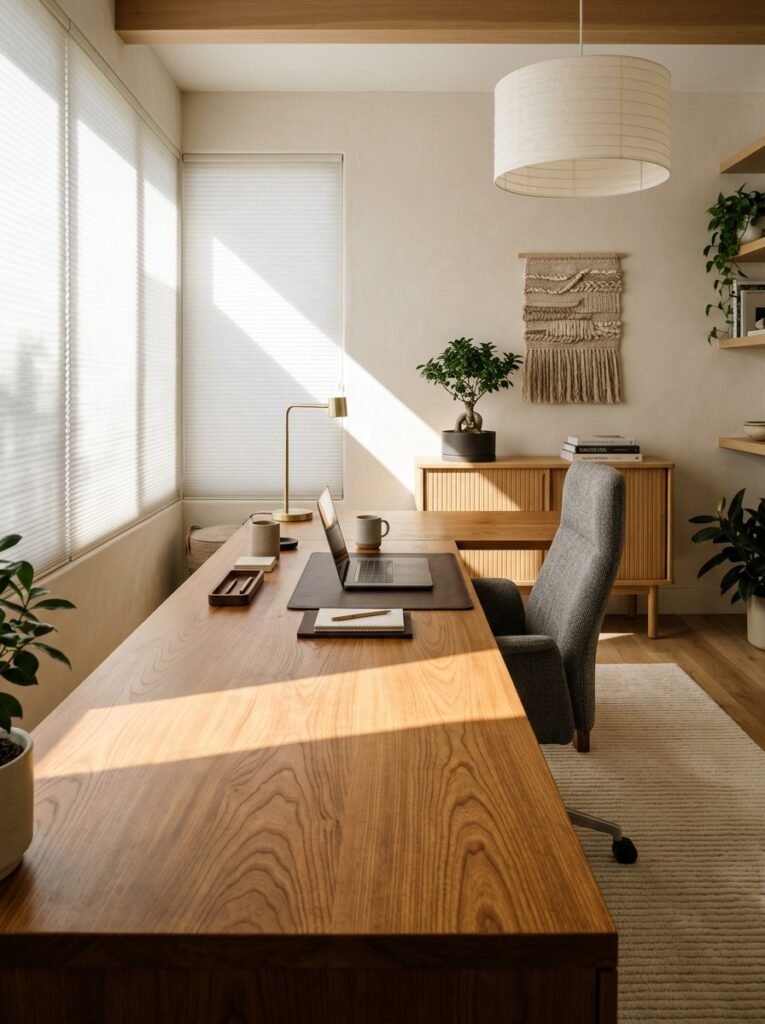
- Pale almond lime plaster, matte. A pleated sheer fabric shade in off-white, mounted inside the window frame.
- L-shaped, dark oiled zelkova, all at 29 inches tall. The main run is 66 x 26 inches with two shallow drawers. The return is 40 x 20 inches.
- High-back task chair with a headrest in mid-gray herringbone wool, with adjustable armrests. Elbows near 90 degrees, screen top near eye level, screen about an arm’s length away.
- Wall-mounted arm lamp in matte titanium over the return, 2700K. A 20-inch washi drum pendant, 2700K.
- Closed tambour-door credenza, 66 x 16 x 24 inches, painted to match the wall. The only display is one ginseng ficus on top.
- Ivory wool rug with subtle tone-on-tone ribbing, 6 x 9 feet. One undyed woven wool hanging, 30 x 40 inches.
- Ginseng ficus (Ficus microcarpa). Bright light; water when the top inch is dry.
- Matte titanium pulls. Cables run beneath the corner joint to a wall outlet. The long run holds a monitor and keyboard. The return stays clear.
Why this works: Splitting screen work and paper work across an L-shaped desk keeps one surface empty, which cuts visual clutter by design.
An L-shaped desk solves a problem most home offices ignore: screens and paper need different zones. The long run, sixty-six by twenty-six inches in oiled zelkova, holds the monitor and keyboard. The shorter return, forty by twenty inches, stays clear for handwriting and reading, so you rotate instead of pushing things aside. Zelkova, a Japanese hardwood, has bold, wavy grain that carries the whole room without decoration. Keep both surfaces at twenty-nine inches, set the chair so your elbows rest near ninety degrees, and let the return stay empty by default, so clutter has nowhere to start.
Storage runs along the window wall: a tambour-door credenza, sixty-six inches wide, painted to match the pale almond lime plaster so it recedes. Tambour fronts slide into the cabinet instead of swinging out, which helps in tight rooms. The only object on top is a ginseng ficus, whose swollen root base stores water, so it likes bright light and a dry top inch before watering. A high-back chair with a headrest suits longer sessions at the long run. Finish with a pleated sheer shade and matte titanium pulls on every drawer.
11. Paper Wall and Acacia
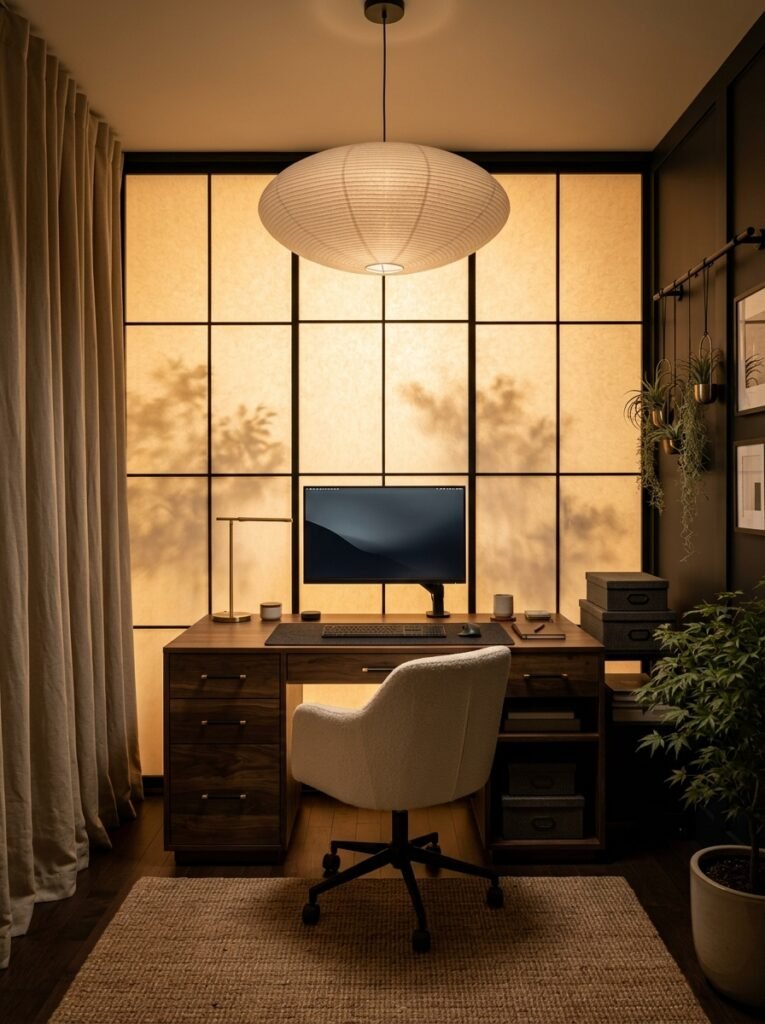
- Rice-paper panels in thin black-stained frames, 6 x 4 feet, with a dimmable 2400K LED strip set 4 inches behind. A heavy off-white cotton canvas curtain on a ceiling track.
- Smoked acacia pedestal desk, 60 x 28 inches, 29 inches tall, matte hardwax oil, with three drawers on each side.
- Adjustable chair in ribbed ivory wool with slim wooden armrests. Forearms rest lightly, feet flat, screen top near eye level.
- Slim bar lamp in blackened brass on the left, 2700K. A three-tier washi pendant, 22 inches wide, 2700K.
- Six closed desk drawers plus four lidded wooden boxes on a wall rail. The only open display is the plant.
- Natural sisal rug with cotton binding, 6 x 9 feet. One black-framed pressed Japanese maple leaf, 12 x 16 inches.
- Tillandsia on the rail near the window. Bright indirect light; soak briefly each week and shake off excess water.
- Blackened brass pulls. Cables exit through a grommet in the back panel to a floor-level power strip. The desk holds a keyboard and screen only.
Why this works: A backlit paper wall diffuses light evenly, so the room glows at night without a bright overhead bulb.
A guest once asked whether my client’s office had a hidden window. It didn’t. It had rice-paper panels in thin black frames, six feet wide and four feet tall, with a 2400K LED strip four inches behind them. At night the wall glows evenly, which removes the need for a bright overhead light. Paper diffuses the strip’s light, so glare stays low. In daylight it reads as a quiet, textured paper wall. Keep the strip dimmable, because a glowing wall is lovely at dusk and distracting at noon when you are trying to concentrate.
The desk below it is a smoked acacia pedestal desk, sixty by twenty-eight inches, with three drawers on each side, so paper, cables, and chargers disappear without a separate cabinet. Pair it with an ivory wool chair with slim wooden armrests, adjusted so your forearms rest lightly. A tillandsia perched on the rail needs no soil; it absorbs water through leaf scales, so a short weekly soak is enough. Four lidded wooden boxes on the same wall rail hold the rest, and nothing sits on the desk but a keyboard and screen.
12. Hallway Console Desk
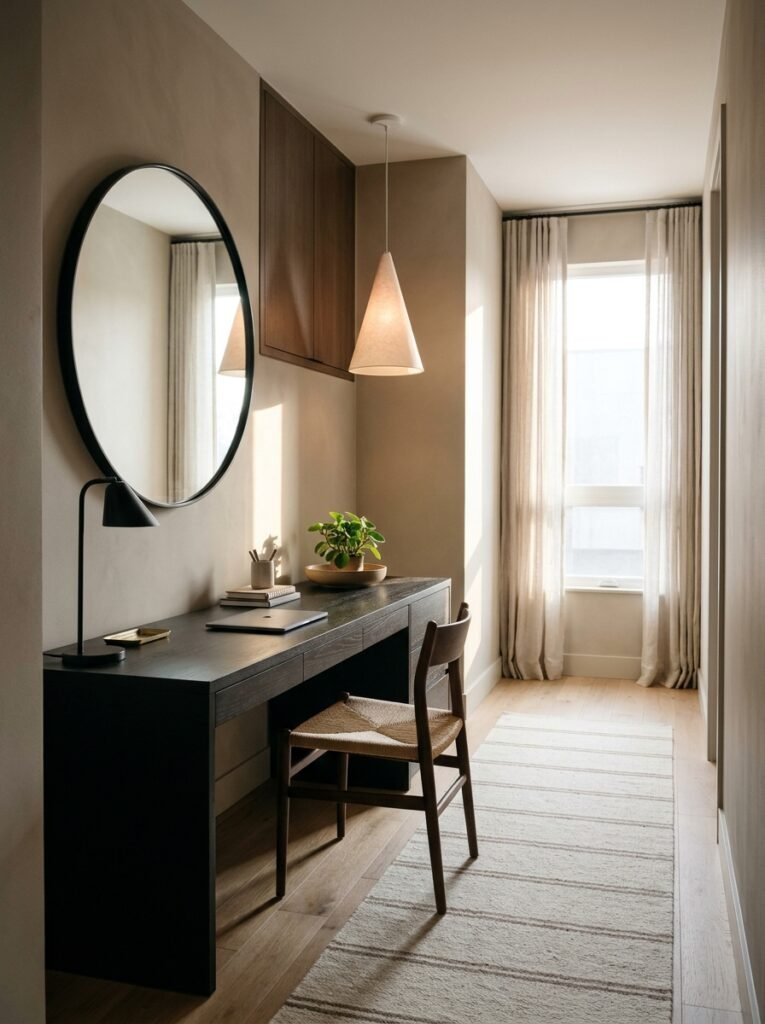
- Warm taupe matte paint. A short linen café curtain over the lower half of the end window, on a thin black rod.
- Black-stained alder console desk, 48 x 18 inches, 30 inches tall, matte oil finish, one shallow drawer. The 18-inch depth suits laptop work in short sessions only.
- Armless chair with a woven paper-cord seat and a 1-inch wool pad, fixed seat near 18 inches, tucks fully under. Best for short, focused sessions.
- Slim matte black LED lamp on the left, 2700K. A cone-shaped washi pendant, 16 x 16 x 12 inches, 2400K.
- Closed flip-down flap cabinet, 36 x 10 x 24 inches, mounted above the console. The desk drawer holds chargers. The only display is the plant.
- Cream-and-taupe striped wool runner, 2.5 x 8 feet. One 20-inch round black-framed mirror hung to the side to bounce light, never behind the screen.
- Peperomia argyreia (‘Watermelon’) in a shallow raw terracotta tray. Medium light; water when the top inch is dry.
- Unlacquered nickel-silver pulls. A cord sleeve runs along the baseboard to the outlet. The console holds a laptop on a stand and a notebook.
Why this works: A shallow console desk turns a hallway into a short-session workspace, and a flip-down cabinet hides everything above it.
Not every home has a spare room, but almost every home has a hallway. A slim black-stained alder console, forty-eight inches wide and eighteen inches deep, turns that dead hallway space into a proper workspace. The shallow depth sets a limit: with only eighteen inches of depth, a laptop sits closer than the usual arm’s length, so I’d treat this as a spot for short, focused sessions. Paired with a rush-seat chair and a one-inch wool pad, it works beautifully for answering email, paying bills, or planning the week ahead. I’ve seen this work well in apartments, too.
The wow is the finish. Black-stained alder lets the grain show through, so the surface reads as dark ink on wood rather than flat paint. Against warm taupe walls and a striped wool runner, it looks deliberate, not squeezed in. Above it, a flip-down flap cabinet, thirty-six inches wide and ten inches deep, closes over papers and chargers. A Peperomia ‘Watermelon’ sits on the console; its thick, water-holding leaves handle medium light and the dry air of a hallway. A cone-shaped washi pendant and a round framed mirror finish the nook.
13. Ginkgo Bridge Desk
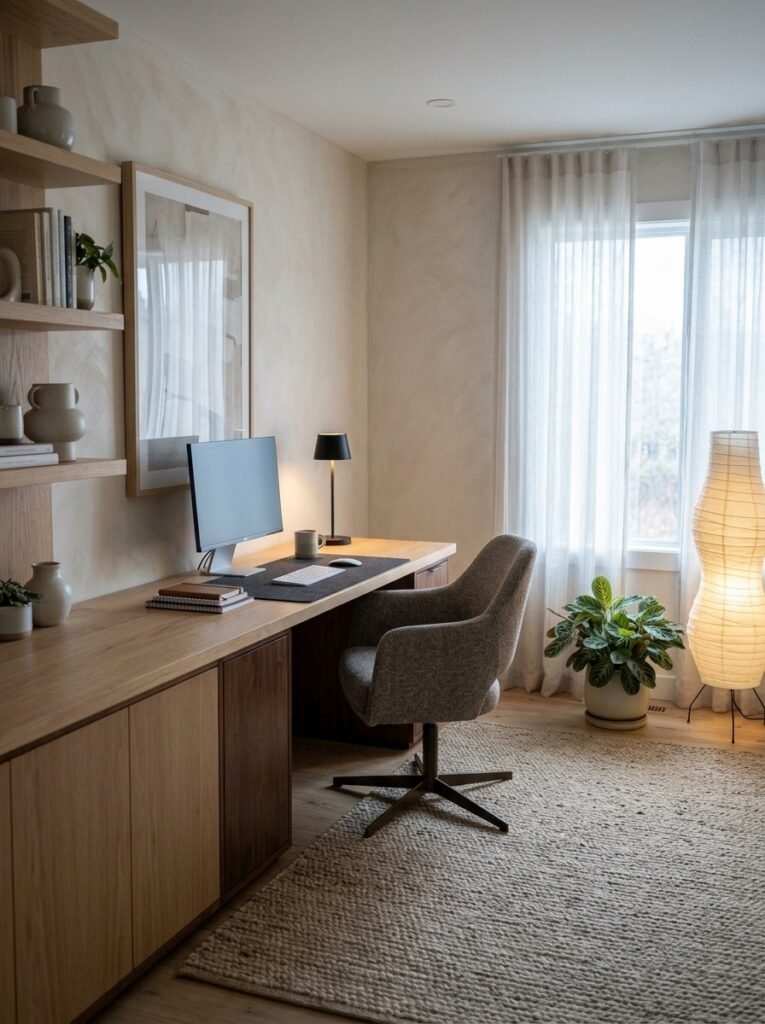
- Pale parchment limewash, matte. Natural double-gauze cotton panels, gently gathered, hung from just below the ceiling.
- Bridge desk with a pale ginkgo top, 72 x 26 inches, matte hardwax oil, resting on two cabinets. It stands 29 inches tall overall, with about 36 inches of clear knee space between the cabinets.
- Swivel in flecked ivory-and-charcoal wool tweed with a waterfall seat edge and adjustable height. Feet flat, elbows near 90 degrees, screen top near eye level.
- Cordless rechargeable LED lamp in matte black on the left, 2700K, so no cable crosses the desk. A tall washi floor lantern, 10 x 10 x 52 inches, at 2400K.
- Two closed two-door cabinets in umber-stained mahogany, each 18 x 22 x 27 inches, serving as the desk’s legs. One holds electronics, the other paper. No open display.
- Round felted wool rug, 5 feet across, pale oat. One shallow carved ginkgo-leaf relief panel, 16 x 16 inches.
- Prayer plant (Maranta leuconeura) on the floor beside the left cabinet. Medium light and evenly moist soil.
- Brushed black chrome pulls. A 2-inch cord hole in the left cabinet’s back panel leads to a power strip inside, with a small airflow gap. The desk holds a monitor and keyboard only.
Why this works: A bridge desk turns two storage cabinets into the desk’s legs, so storage and workspace share one footprint.
A bridge desk uses its storage as its legs. Two closed cabinets, each eighteen by twenty-two by twenty-seven inches, carry a seventy-two-inch ginkgo top, so desk and storage share one footprint. The umber-stained mahogany cabinets supply the dark contrast. Ginkgo is a pale, fine-grained wood long used for Japanese cutting boards and game boards, which is why its surface looks so even. Leave about thirty-six inches of clear knee space between the cabinets, set the top at twenty-nine inches overall, and keep a monitor and keyboard as the only items on the surface.
Put the electronics in the left cabinet. Drill a two-inch hole in its back panel for cords, leave a small airflow gap, and a power strip stays out of sight. The right cabinet holds paper. Closed doors mean nothing about your work is visible from the doorway. A cordless rechargeable lamp removes one cable from the desk entirely. For a living touch, a prayer plant on the floor beside the cabinet folds its leaves upward at night, a movement plant scientists call nyctinasty, and it likes medium light with evenly moist soil.
14. Drop-Leaf Hornbeam Desk
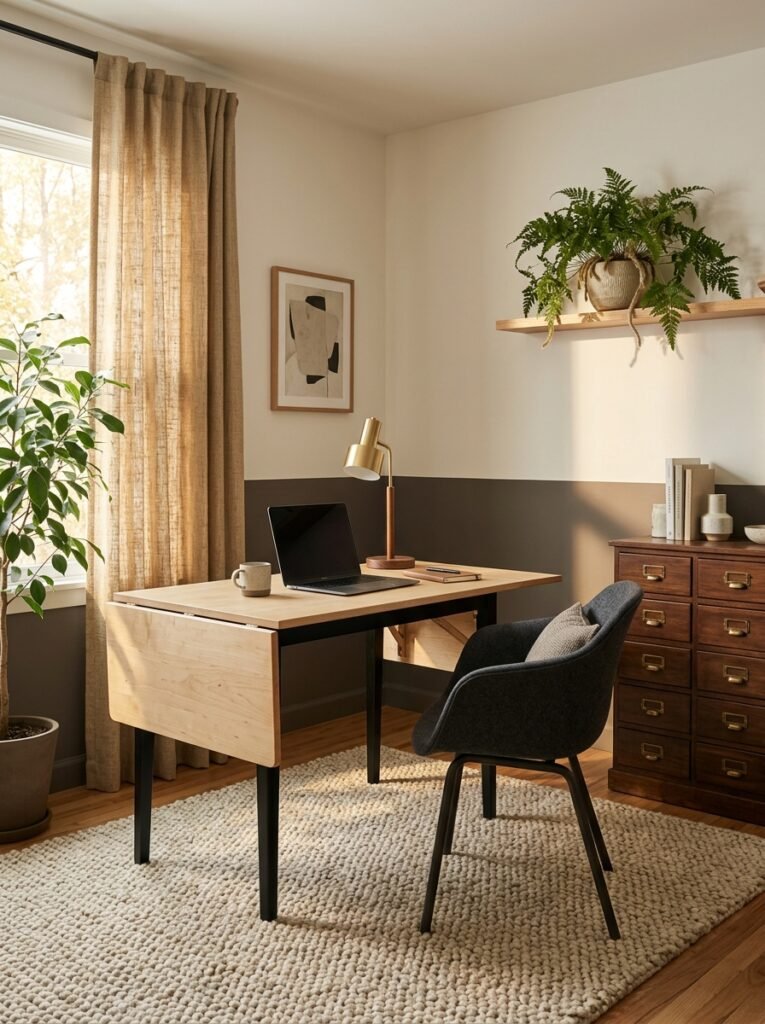
- Two-tone wall: the lower 36 inches in matte umber-gray paint, the upper wall in pale pumice-white lime paint. An unlined hemp-linen curtain on a wooden rod with rings.
- Drop-leaf desk with a pale hornbeam top and ebonized hornbeam legs, matte oil finish, 29 inches tall, one shallow drawer. Open it measures 60 x 28 inches. With both leaves folded it measures 24 x 28 inches.
- Adjustable swivel with a molded wool-felt shell in pale stone and a gas-lift seat. Feet flat, elbows near 90 degrees. It rolls fully under the folded desk.
- Adjustable lamp with an oiled wooden stem on the left, 2700K. A three-panel washi screen, 42 inches tall, lit by a hidden LED at 2400K.
- Wall-mounted 12-drawer apothecary cabinet, 30 x 8 x 24 inches, anchored into studs, plus the desk drawer. The only display is the plant.
- Loop-pile oatmeal wool rug, 5 x 8 feet. One framed linen with a single embroidered thread line, 20 x 20 inches.
- Rabbit’s foot fern (Davallia fejeensis) on a slim ledge. Bright indirect light; water when the top inch is dry.
- Hand-blackened iron hinges and pulls. One detachable power cable runs to a baseboard outlet, so you unplug before folding. Only a monitor, keyboard, and notebook live on the open desk.
Why this works: A drop-leaf desk folds down to console size, so the workspace disappears at the end of the day and the room feels like a home again.
My first drop-leaf desk lived in a studio apartment, where the office had to vanish by dinner. Open, it measures sixty by twenty-eight inches, with room for a monitor, keyboard, and notebook. Fold both leaves and it shrinks to twenty-four inches wide, slim enough to pass as a console. That daily fold is the clear-desk ritual made physical: nothing left on a leaf survives the fold, so you tidy without deciding to. Pale hornbeam on top, ebonized hornbeam legs below, and a wool-felt chair that tucks in complete the picture.
Storage is a wall-mounted apothecary cabinet, thirty inches wide and twenty-four inches tall, with twelve small closed drawers. Small drawers force sorting, which stops the junk-drawer problem before it starts. Anchor it into studs, because twelve full drawers get heavy. The two-tone wall helps too: the lower thirty-six inches in matte umber-gray visually grounds the desk, while the pale upper wall keeps the room light. A rabbit’s foot fern on a slim ledge stores water in creeping, furry rhizomes, so it tolerates the occasional missed watering and wants bright, indirect light.
15. Under-Stair Larch Nook

- Pale buff lime plaster on the side walls. The sloped soffit is lined in pale larch tongue-and-groove boards. A small 18 x 24-inch window in the end wall, with a roll-up ivory linen shade.
- Pale larch desk, 56 x 24 inches, 29 inches tall, matte oil finish, one shallow drawer. Place it at the highest point of the slope.
- Barrel-back swivel in undyed wool-mohair with adjustable height. You should sit fully upright without ducking, feet flat, elbows near 90 degrees.
- Matte black pivot-arm lamp on the side wall, 2700K. A flush washi ceiling panel, 18 x 18 inches, at 2700K.
- A stepped bank of closed drawers in heat-treated larch along the side wall, with fronts that follow the stair slope. No open display.
- Woven paper-yarn mat, 3 x 5 feet. One framed architectural section drawing of the staircase, 16 x 20 inches.
- Cast-iron plant (Aspidistra elatior), which tolerates deep shade. Water when the top two inches are dry.
- Tan leather pull straps with blackened steel screws. Cords run along the baseboard to an outlet. The desk holds a monitor and keyboard only. Never cut into stair framing; build around it.
Why this works: An under-stair desk works because the highest point of the slope gives full head clearance, and stepped drawers turn the sloped wall into storage.
Most homes waste the space under the stairs, and it can be your best desk spot. Here, a fifty-six-by-twenty-four-inch larch desk tucks beneath the staircase, with the sloped soffit lined in pale larch boards. The ergonomic rule is simple: sit where the ceiling is highest, and make sure you can sit fully upright without ducking. I’ve seen people crowd the low end and end up hunched. Never cut into a stair stringer or support to gain room; the structure above may carry more than you can see. Build around it, or ask a builder first.
The wow detail is a stepped bank of closed drawers along the side wall, its fronts following the stair’s slope, each with a tan leather pull strap. Heat-treated larch darkens through heat rather than stain, giving a richer second tone from the same species as the pale desk. A flush washi ceiling panel, eighteen inches square, lights the low space without hanging into it. A pivot-arm lamp on the side wall handles task light. Finish with an Aspidistra, the cast-iron plant, which tolerates deep shade because its broad leaves capture low light efficiently.
Styling Principles for Clear Surfaces and Closed Storage
Fifteen desks, one rule: the surface stays almost bare and everything else hides. These six principles hold the whole look together.
- Keep only daily tools on the desk. A Japandi desk setup holds what you touch every day: usually a screen, a keyboard, one light, and a notebook. Everything else earns a drawer.
- Default to closed storage. Closed storage lowers visual clutter because it removes objects from your line of sight without removing them from the room. Allow one open display spot with one to three objects.
- Give every cable a route. Run cords through a desk grommet, down a leg in a fabric sleeve, or into a cabinet with its own outlet. On a sit-stand desk, leave slack so cords don’t tug as the top rises.
- Contrast with material, not color. One dark wood against pale walls gives a room its grounding. Add a second dark wood and the focal point splits.
- Layer warm light. Place a task lamp on the side opposite your writing hand, add a washi fixture for ambient glow, and keep bulbs between 2400K and 2700K so matte surfaces glow instead of glare.
- End the day with a five-minute reset. I clear my desk down to the lamp every evening, and the next morning’s first sit-down feels like a fresh start.
Frequently Asked Questions About Japandi Home Office Ideas
What makes an office Japandi? A Japandi office combines Japanese restraint with Scandinavian warmth: natural wood, matte textures, a restrained palette, closed storage, and a nearly empty desk. It feels edited rather than empty because every object either does a job or has a home.
Is a low desk better than a standard desk? For a full workday, a standard desk at roughly 29 to 30 inches is the better choice because it supports a keyboard at elbow height and a screen near eye level. A low desk with floor seating suits short sessions of writing, reading, or planning, or a secondary spot.
What is the best storage for a minimal home office? Closed storage with flat fronts works best: a wall-hung cabinet, a credenza with sliding or tambour doors, or a rolling drawer pedestal. Closed units hide paper, chargers, and supplies, so the desk and any shelves can stay almost empty.
How can I try a Japandi desk setup on a budget? Start by removing things: clear the desk down to a screen, keyboard, lamp, and notebook. Then swap in a warm 2700K bulb, add a paper pendant shade (often $20 to $60), and refinish a plain solid-wood table instead of buying new. A fabric cable sleeve usually costs under $15.
How is a Japandi office different from a Scandinavian one? Scandinavian offices lean bright, pale, and daylight-led, with cooler whites and light woods. A Japandi workspace feels more grounded: darker wood accents against light walls, matte textures, a restrained palette, and fewer objects.
What lighting works best in a Japandi office? Use three layers: a task light on the side opposite your writing hand, a washi paper fixture for ambient glow, and warm bulbs around 2700K. Paper diffuses light, which lowers glare on screens and keeps the room warm.
Keep Exploring
- For the brighter, daylight-led take, see our Scandinavian Home Office guide.
- To see how Japandi works at the table, read our Japandi Dining Room guide.
Conclusion
The best japandi home office ideas share one quiet promise: your eyes get a place to rest, so your mind can get to work. I’ve seen how small changes like these transform a space, whether it’s a hallway console, a closet, or a full spare room. Start with one move today: clear the desk, hide the cables, or swap in a warm bulb.
Save this post on Pinterest so your favorite room is easy to find later, try one idea in your own space, and share it with a friend who’s working at a cluttered kitchen table.