15 Scandinavian Home Office Ideas to Make Your Space Brighter
Your desk might be the reason your afternoons feel foggy. Most home offices are arranged around the outlet, not the window, and that quiet mistake costs you the best free light in the house. These Scandinavian home office ideas flip the plan: daylight comes first, and everything else, from the desk to the lamp, is placed to work with it.
Inside, you’ll find 15 complete rooms, each with exact woods, colors, and measurements, plus where to put the desk, how high to set your screen, and which plants actually thrive near your glass. In my experience, one small move, like turning a desk sideways to the window, changes how a whole day feels. My husband builds homes for a living, so you’ll also find a few practical construction tips along the way. Save your favorites and pick one to try this weekend.
The most important piece of furniture in a Scandinavian office is not the desk. It’s the window. Scandinavian design puts daylight first because Nordic winters have very short days, so rooms are built to bounce every available hour of light off pale surfaces and then fill the gaps with layered, warm artificial light. That same logic helps any office with limited windows. When I turned my own desk sideways to the glass, the screen glare that used to give me afternoon headaches disappeared. This post solves the practical side: where the desk goes, how high the screen sits, and how to style each room so daylight works for you.
1. Morning Birch and Dusty Blue — A Scandinavian Home Office Idea
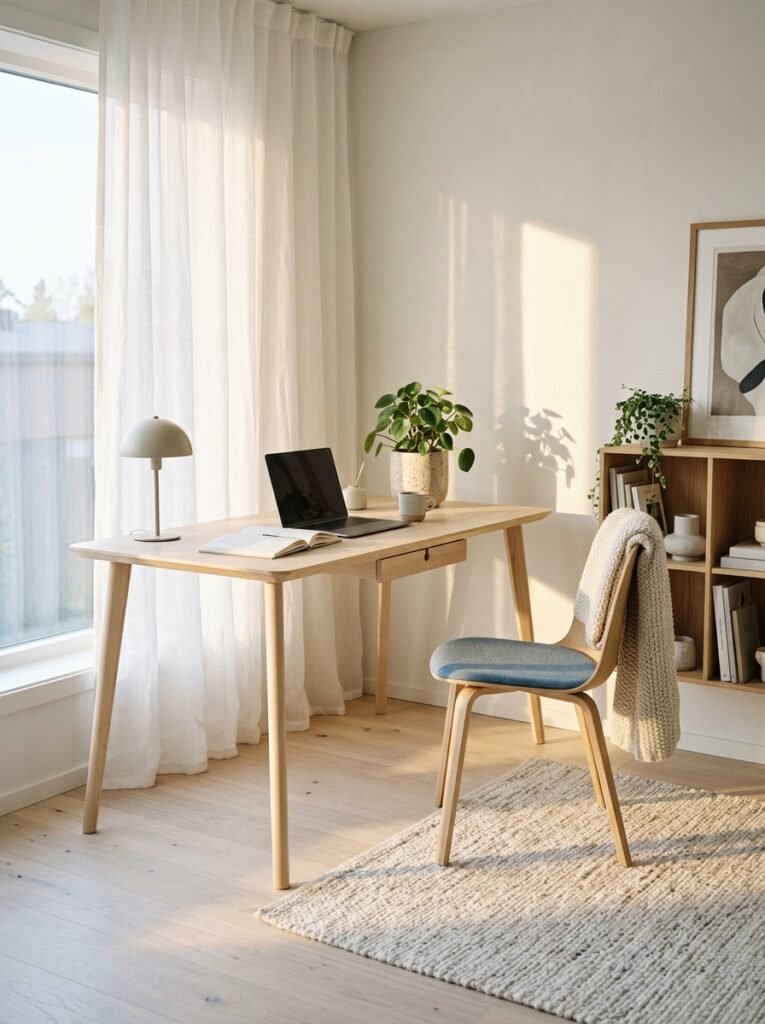
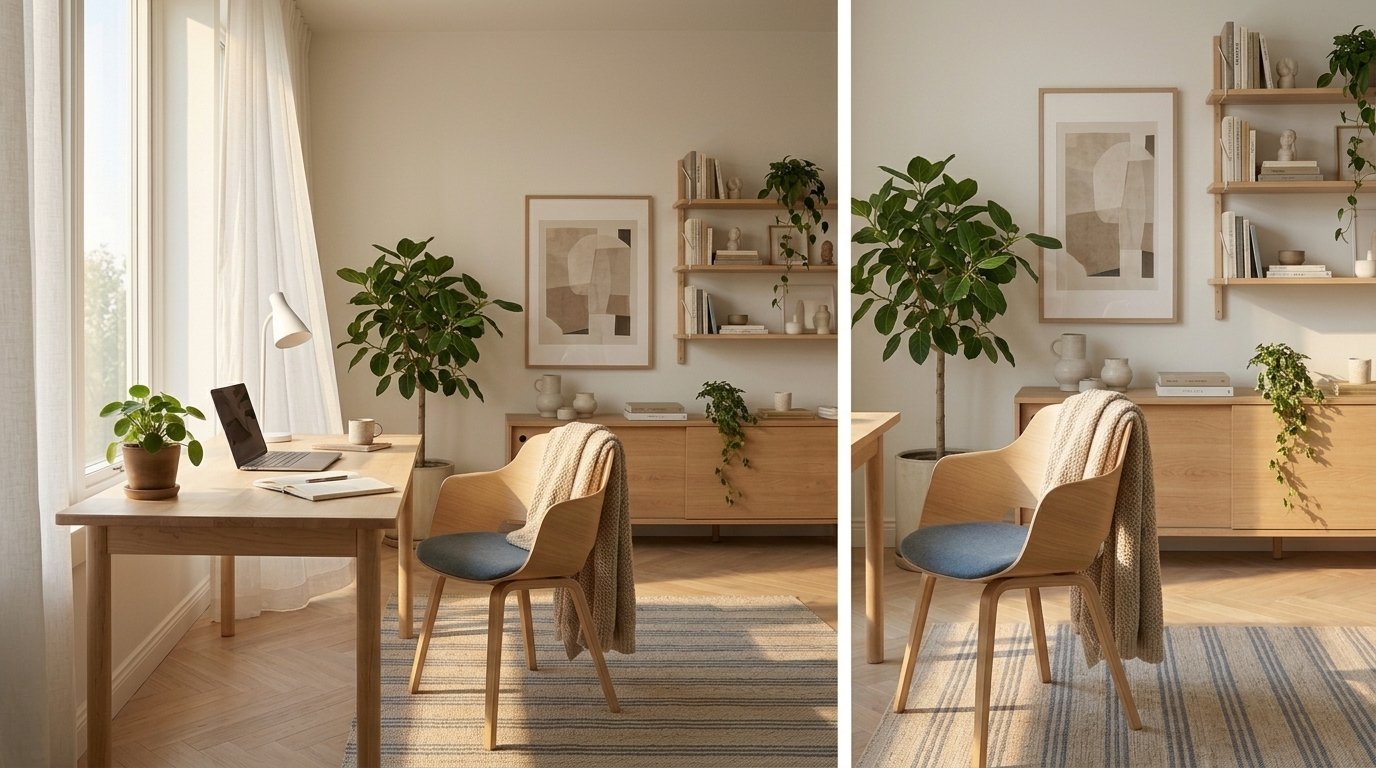
- Matte chalk-white walls with a faint warm undertone. The east window gets a floor-length white linen-cotton sheer that softens sunrise without blocking it.
- Solid birch desk, 55 x 27 inches, 29 inches high, set perpendicular to the window. The monitor top sits at or just below eye level, about an arm’s length away.
- Molded birch plywood shell chair with a dusty blue wool-felt seat pad. Adjust the pad so your feet rest flat and your forearms stay level with the desk.
- Matte white task lamp on the side away from your writing hand, with a 3000K bulb. A linen-shade table lamp on the shelf adds a 2700K evening glow.
- One open birch wall shelf holds paperbacks with spines out and a stack of notebooks. A framed botanical herbarium print hangs above it in a thin birch frame.
- 5 x 8 foot flat-weave wool rug in oat and dusty blue stripes. A Peperomia obtusifolia sits three feet from the window in bright, indirect light.
- A low duplex outlet behind the desk and a paintable cord channel in the wall color keep every line out of sight.
- A chunky oat knit throw over the chair back for cold mornings.
Why this works: Setting the desk perpendicular to an east window lets morning light cross the work surface from the side, which reduces screen glare.
East light is the gentlest light a desk can get, and this room is built to use it. I once styled a spare bedroom where the desk faced the window, and by 10 a.m. the owner was squinting at a washed-out screen. Turning the birch desk sideways fixed it in five minutes. Light now crosses the surface from the left, bounces off the chalk walls, and lands softly on the keyboard. The sheer curtain keeps the sun friendly rather than harsh. You get brightness without glare, and the whole room feels awake before the coffee kicks in.
Cables are what ruin a calm desk, so plan them first. My husband, who builds homes for a living, always tells clients to move the outlet before they buy the furniture. Here, a duplex outlet sits low behind the desk, and a paintable cord channel in the wall color carries the lines out of sight. On the desk corner, a peperomia thrives three feet from the window; its thick, waxy leaves store water, so a busy week of skipped watering won’t hurt it. Pale birch, dusty blue felt, and one green plant make a tidy, calm trio.
2. White Trestle and Sage
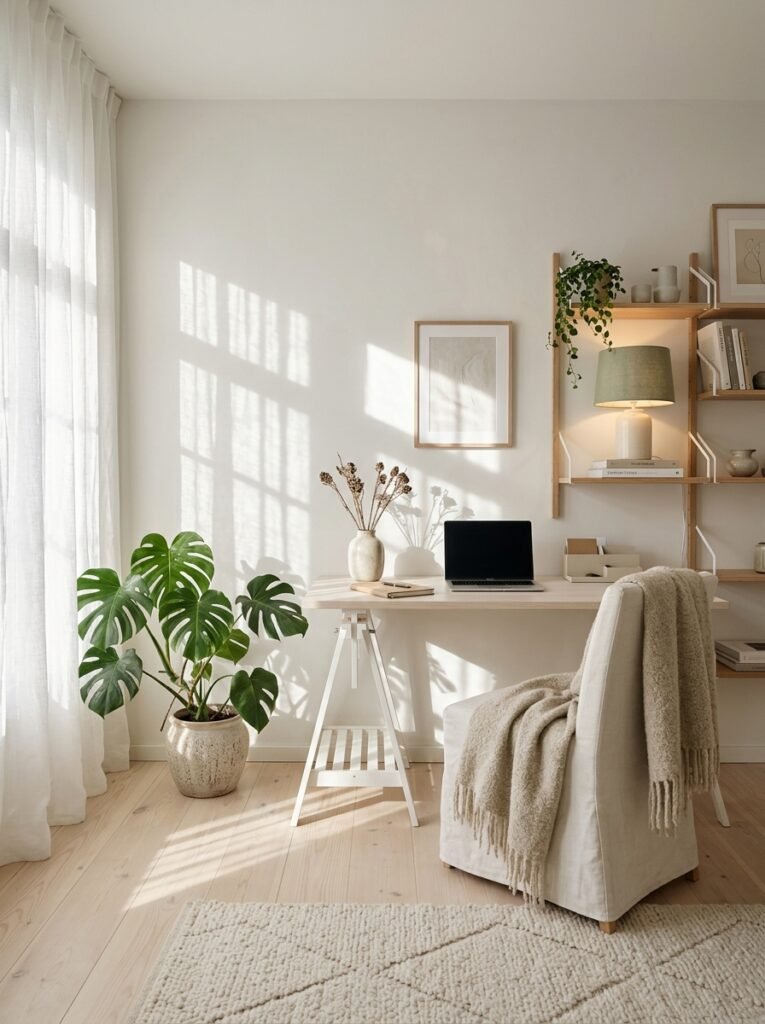
- Pearl-white eggshell walls that wipe clean. The south window gets a floor-length white linen sheer plus a clear, glare-reducing film on the glass.
- White-painted pine trestle desk with an ash top, 60 x 28 inches, 29 inches high, perpendicular to the window. Monitor top at or just below eye level, an arm’s length back.
- Ivory linen-slipcovered adjustable task chair on a pale ash-finished base. Set the seat so your feet are flat and your elbows rest near desk height.
- Matte white swing-arm lamp clamped to the right edge of the desk with a 3000K bulb. A sage linen-shade lamp on the shelf adds a 2700K ambient glow.
- Two 36-inch ash floating shelves hold white box files and a glass carafe. A large framed architectural pencil sketch hangs in a thin white frame.
- 6 x 9 foot ivory low-pile wool rug. A Monstera deliciosa stands four feet back from the window in bright, indirect light.
- A white fabric sleeve runs down the trestle leg and a wire tray under the top holds the power strip.
- A natural sheepskin draped over the chair seat.
Why this works: A sheer curtain plus clear window film cuts south-facing glare while keeping the daylight that makes the room feel open.
A south-facing window delivers the strongest light of the day, which is exactly why it causes the most trouble. Set the white trestle desk perpendicular to the glass, and direct sun lands beside the screen instead of on it. Soft pearl walls bounce that brightness back into the room, while the linen sheer scatters whatever is left. The trestle’s open base keeps sightlines clear, so the room feels wider than its 10 by 11 feet. Add an ash tabletop and the desk gains a warm top note against the white. The result is steady daylight from breakfast to mid-afternoon.
My husband has a quick fix for glare that most decor posts skip: window film. A clear, glare-reducing film goes on the glass in an afternoon, keeps the view, and leaves the daylight intact. Pair it with a monstera set four feet back from the window, where light is bright but indirect. Direct southern sun can scorch those big leaves, so the sheer curtain and the distance protect the plant as much as your eyes. By midday, the monstera throws a lacy shadow across the pearl wall, and it becomes the most photographed corner of the room.
3. Floating Oak and Mustard
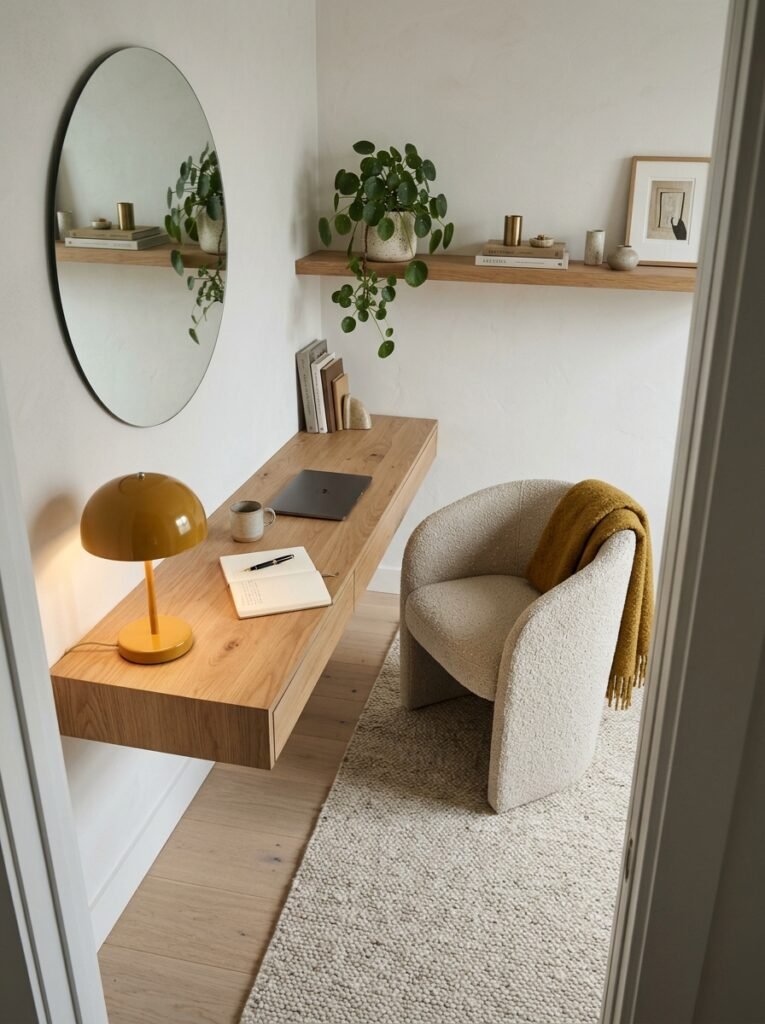
- Matte cotton-white walls. The north window wears a white cotton-voile sheer hung just above the sill line to the floor. A 30-inch round mirror on the opposite wall stretches the daylight deeper into the room.
- Floating pale oak desk, 48 x 22 inches, 29 inches high, mounted on the wall perpendicular to the window. Monitor top at or just below eye level, an arm’s length back.
- Compact gas-lift swivel chair in oatmeal bouclé with pale oak legs. Raise it until your forearms sit level with the desk.
- Mustard enamel clip-on task lamp with a 3000K bulb, positioned opposite your writing hand. A plug-in sconce with a linen shade adds a 2700K ambient glow without using desk space.
- A slim oak picture ledge holds a few books and one small framed mustard-and-cream geometric print.
- 2.5 x 8 foot cream flat-weave wool runner. A Pilea peperomioides on the ledge gets bright, indirect light from the north window.
- A cream cord cover runs straight up from the outlet behind the desk, hidden behind the desk’s back edge.
- A mustard wool throw draped over the chair back.
Why this works: North light is even and low on glare, so a mirror and pale walls can make a small, sunless room feel steadily lit.
A north-facing window never delivers direct sun, and that is its secret strength. The light is even and low on glare, which is why artists have favored north-facing studios for generations. This tiny office leans on that steadiness. A floating oak desk keeps the floor clear, a round mirror on the opposite wall stretches the daylight, and a cotton-white wall holds it. I’ve seen this layout rescue a closet-sized office that felt like a cave at 2 p.m. The mustard accents add a small warm note, so gray days still feel friendly.
A floating desk looks weightless, but it only works when it is anchored properly. My husband mounts them into wall studs, never drywall anchors alone, and checks the bracket’s rated load against the monitor, laptop, and a leaning forearm. Studs sit roughly every 16 inches in most US homes, so a 48-inch desk can catch at least two. Beneath it, a swivel chair in oatmeal bouclé tucks fully away, which frees up floor space. A pilea on the ledge leans toward the window, so give it a quarter turn each week to keep it even.
4. Curved Beech and Clay Rose
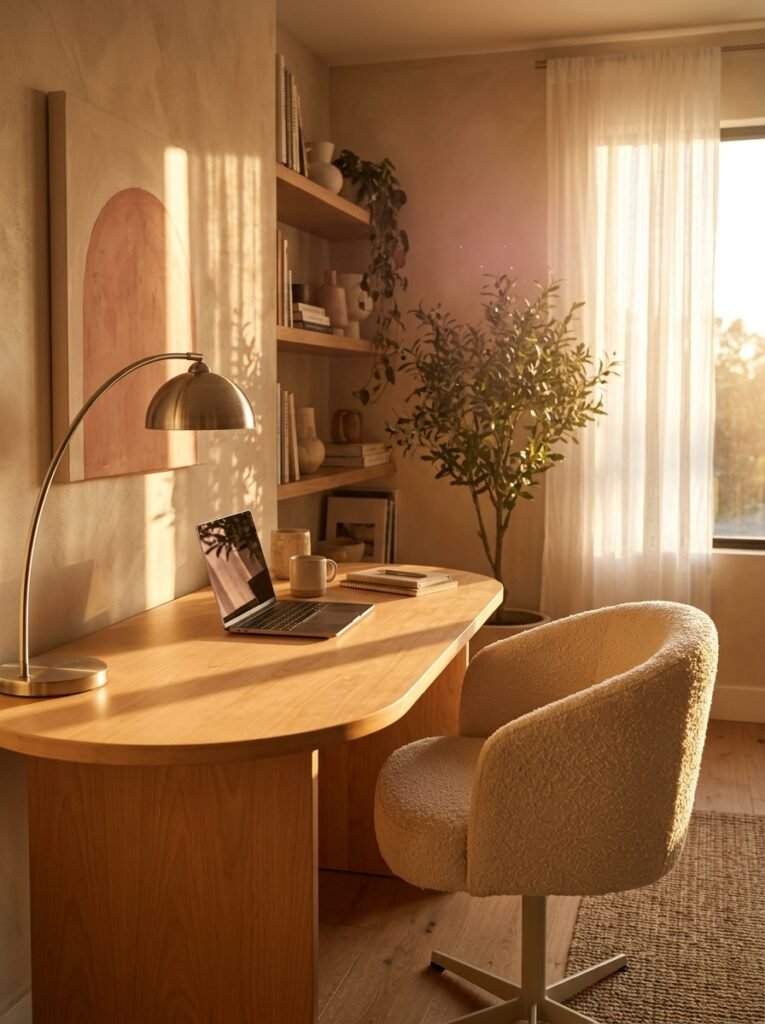
- Smooth matte plaster-finish walls in warm chalk. The west window hangs with a floor-length white linen sheer that pools slightly at the floor and softens the low afternoon sun.
- Pale beech D-shaped desk, 54 x 26 inches, 29 inches high, with a fully rounded front edge. The straight edge sits along the wall, perpendicular to the window. Monitor top at or just below eye level, an arm’s length away.
- Curved-back swivel chair in ivory bouclé on a brushed steel base with an adjustable gas lift. Feet rest flat and forearms stay level with the desk.
- Brushed stainless arc lamp with a 3000K bulb, placed on the side away from your writing hand. A frosted-glass orb lamp on the shelf adds a 2700K evening glow.
- A pale beech arched wall shelf, 36 inches wide, holds art books and a clear glass carafe. An oversized tonal arch canvas in clay rose hangs beside the window.
- 6-foot round cream wool rug with a tonal border under the chair. A fiddle-leaf fig (Ficus lyrata) stands four feet from the window in bright, indirect light.
- A cord channel painted the wall color runs from a low outlet, and a rounded desk grommet passes the monitor cable.
- A clay rose lambswool lap blanket draped over the chair back.
Why this works: A rounded desk edge removes the hard corner at the front of the work surface, so forearms rest comfortably while west light stays beside the screen.
The first time I swapped a rectangular desk for a curved one, a client’s whole office softened. Corners are what make small rooms feel busy, and a rounded edge removes them. Here, pale beech curves toward you like a harbor, while the west window sends low golden light across the surface in the afternoon. The linen sheer keeps it gentle, and smooth plaster-finish walls bounce it around the room. Clay rose shows up only in a few places, which gives the room a quiet, expensive feel. Rounded forms, one warm accent, and honest wood do all the work.
Fiddle-leaf figs are famous for sulking when moved, and the reason is light. Their large leaves adapt to the exact brightness they grow under, so a sudden change can trigger leaf drop. Pick one bright, indirect spot, here four feet from the sheer-covered window, and leave it there. The curved desk also helps your body. With no hard corner at the front edge, forearms rest more comfortably, and the swivel chair glides in. Check the west glare at 4 p.m.: tilt the monitor slightly away from the glass, and keep the lamp on the opposite side.
5. Maple Sit-Stand and Lingonberry
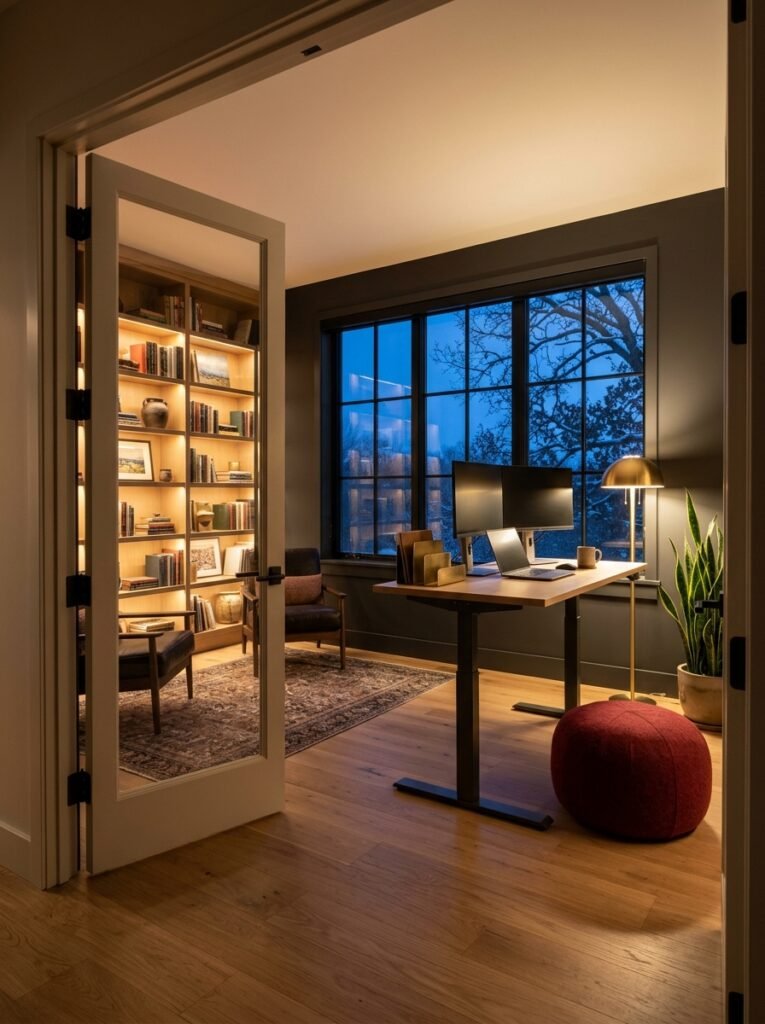
- Matte fog-white walls with a faint gray undertone and a flat white ceiling that bounces light downward. A tall window shaded by a mature tree wears a white linen sheer.
- Electric sit-stand desk with a pale maple top, rounded corners, 60 x 30 inches, on slim matte white legs, set perpendicular to the window. Seated height sits near 29 inches; raise it until your elbows stay near a right angle standing. Monitor top at or just below eye level, an arm’s length back.
- Cream wool-upholstered task chair with curved pale maple arms and soft rubber casters. Seat height lets your feet rest flat.
- Slim brushed nickel desk lamp at 3000K on the side away from your writing hand. A linen-shade floor lamp on a satin brass stem with a 2700K bulb handles dusk in the corner.
- A white 2 x 3 cube unit holds two seagrass baskets, paperbacks, and lingonberry-spined notebooks. An unframed 30 x 40 inch linen canvas in lingonberry and cream hangs beside it.
- 5 x 8 foot undyed wool rug, thick enough to stand on comfortably. A tall Dracaena trifasciata (snake plant) stands in the corner and tolerates low to bright indirect light.
- A fabric cable sleeve with a generous slack loop and an under-desk tray travel with the desk as it rises.
- A lingonberry felt pouf beside the desk and a soy candle in a white enamel tin for evenings.
Why this works: A sit-stand desk with the monitor top at or just below eye level in both positions keeps your neck neutral while daylight arrives beside the screen, not behind it.
Sitting for eight hours is the habit this room is designed to break. A sit-stand desk lets you change position through the day, but only if the screen stays right in both positions. Keep the monitor top at or just below eye level, about an arm’s length away, and set the desk so your elbows stay near a right angle. Perpendicular to a window shaded by a mature tree, the glare turns into dappled, gentle light. A white matte ceiling and pale maple top bounce what arrives, while lingonberry accents warm the white without crowding it.
Rolling chairs quietly wreck floors. My husband has repaired plenty of finished hardwood, and he says hard plastic casters leave fine scratch lines over time. Swap them for soft rubber casters and park the chair on a thick wool rug. In the corner, a snake plant copes with dim afternoons; it uses a water-saving form of photosynthesis called CAM, opening its pores at night, so low light and missed waterings rarely bother it. Raise the desk for your first call of the day, and the whole room feels like a different place.
6. Arched Alcove and Heather
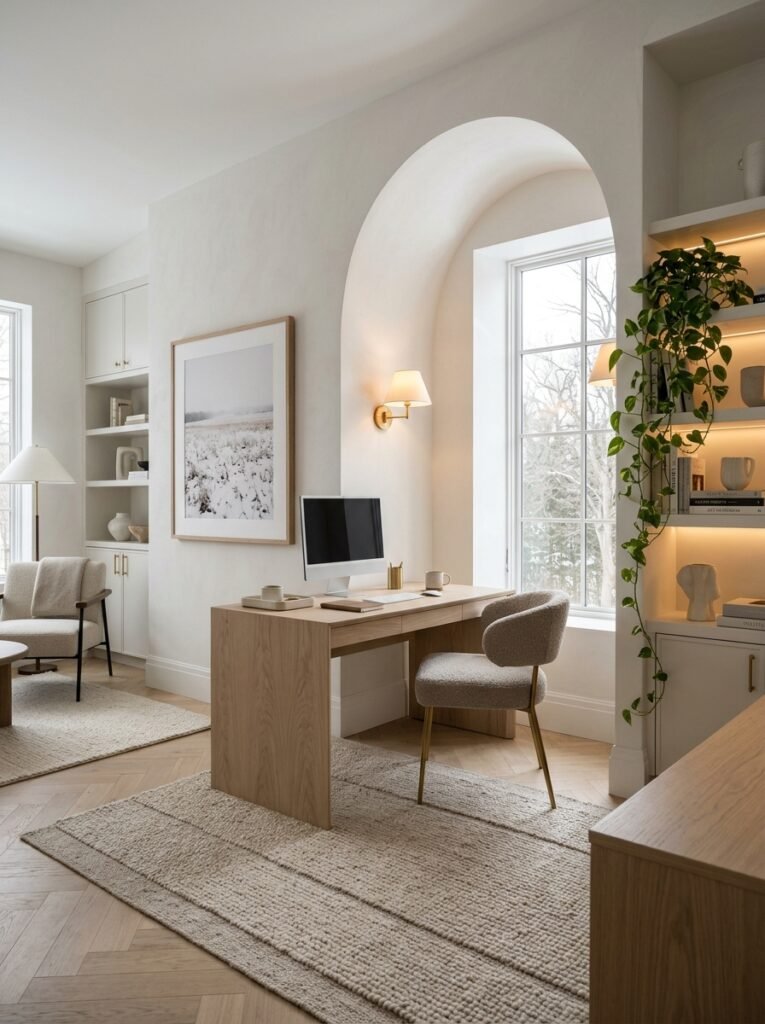
- Matte milk-white walls and satin-white splayed window reveals inside an arched alcove. A white cotton-voile sheer hangs inside the opening.
- Built-in desk with a pale elm top, 66 x 24 inches, 29 inches high, on a white-painted base with slim brass pulls. It runs along the alcove’s side wall, perpendicular to the window. Monitor top at or just below eye level, an arm’s length back.
- Armless curved-back chair in heather bouclé on slim pale elm legs, with a flat cushion. Set the seat so your feet rest flat.
- Slim brass swing-arm sconce at 3000K, mounted at the shelf side opposite your writing hand. A hidden LED strip at 2700K glows behind the shelf lip above.
- Two arched niches, 14 inches wide and 3½ inches deep, each hold a glass bud vase or small framed photo. A floating elm shelf, 11 inches deep, holds books. A 16 x 20 inch black-and-white snowy-field photograph hangs in a thin white frame.
- 3 x 5 foot flat-weave wool rug in cream with a heather stripe. A marble queen pothos trails from the shelf in bright, indirect light.
- Outlets sit inside the cabinet base behind the drawers, and a grommet hole in the desktop passes the monitor cable through.
- A heather boiled-wool lap blanket folded on the chair.
Why this works: Splayed, white-painted window reveals spread daylight wider across a room than a square-cut opening does.
Angled window reveals are a small architectural trick with a big payoff. When the sides of a window opening flare outward instead of meeting the wall at a hard right angle, they catch daylight and spread it across the room. Paint them satin white, and they act like built-in reflectors. This alcove pairs that detail with a soft arch overhead and a long pale elm desk, so a single window feels generous. The heather chair gives the eye a quiet place to land against all that white. It’s a detail you notice only when the light shifts.
I’ve watched my husband build arched niches into walls, and he always frames them between studs so nothing structural gets cut. A 14-inch-wide niche fits the gap between studs spaced 16 inches apart, and it recesses about 3½ inches, the depth of a standard 2×4 wall. That’s perfect for a bud vase and a small photo. A thin LED strip behind the shelf lip above lights the desk at 2700K, and a marble queen pothos trails down from it. Its variegated leaves hold less chlorophyll than plain green ones, so it wants bright light, which this splayed window supplies.
You’ll Also Love: 15 Cozy Scandinavian Bedroom Ideas That Feel Like Home
7. Skylit Larch and Pine Green
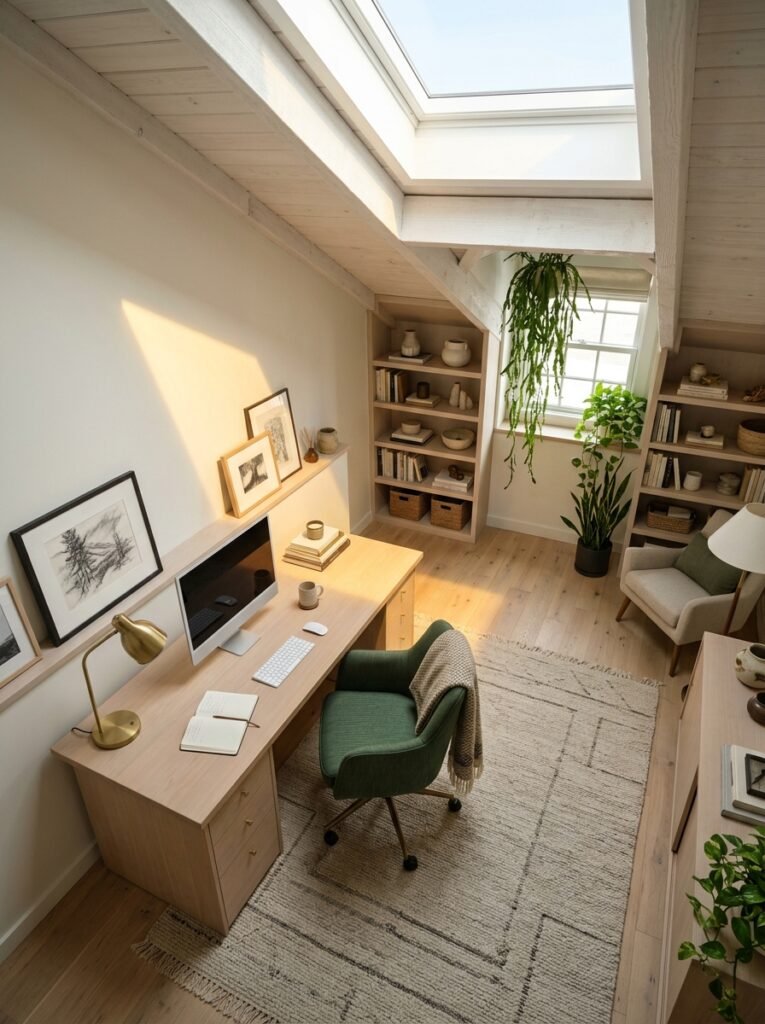
- Bone-white matte paint runs continuously over the walls and sloped ceiling, so the slope reads as one soft surface. The dormer wears a white linen sheer, and the skylight has a white pleated light-filtering shade you can pull partway.
- Pale larch pedestal desk with two drawers, 52 x 24 inches, 29 inches high, set perpendicular to the dormer under the room’s tallest ceiling. Monitor top at or just below eye level, an arm’s length away, and kept off to one side of the skylight so overhead light doesn’t bounce off the screen.
- Adjustable swivel chair with a pine green wool-twill seat and a slim pale larch frame. Feet rest flat and forearms stay level with the desk.
- Matte white clamp-on task lamp with a 3000K bulb, on the side away from your writing hand. A plug-in linen-shade sconce on the knee wall adds a 2700K glow.
- A floating larch shelf holds stacked hardcovers and a small brass desk clock. A large charcoal pine-ridge sketch hangs in a thin larch frame.
- 5 x 8 foot cream wool rug with a fine pine green border line. A mistletoe cactus (Rhipsalis baccifera) sits on the dormer sill in bright, indirect light.
- An outlet in the knee wall feeds a power strip inside the lower drawer, which has a rear cutout for the cords.
- A cream wool blanket with a pine green stripe draped over the chair back.
Why this works: Skylight and dormer light together fill an attic office evenly, as long as the monitor sits off to one side of the skylight to avoid reflections.
Light from overhead behaves differently from window light. It falls evenly on the whole room instead of from one side, which fills shadows and flattens contrast. That’s wonderful for an attic office, but only if the screen sits off to one side, away from the point directly beneath the glass. Keep the monitor top at or just below eye level, about an arm’s length away, and let the dormer supply side light. Painting walls and slope the same bone white makes the ceiling vanish, so the room feels taller than it is.
Deep accents work best in small doses, and pine green is the proof. A single wool-twill seat, one thin rug border, and a striped blanket give the pale larch and bone white a deep, forest-floor anchor without dimming the room. On the sill, a mistletoe cactus feels right at home. It’s an epiphyte, a plant that grows in tree canopies under dappled light, so it enjoys bright, indirect sun from the dormer and dislikes soggy roots. Water it only when the top inch of mix dries. Pull the skylight shade partway at noon when sun is highest.
8. Fold-Down Alder and Peach
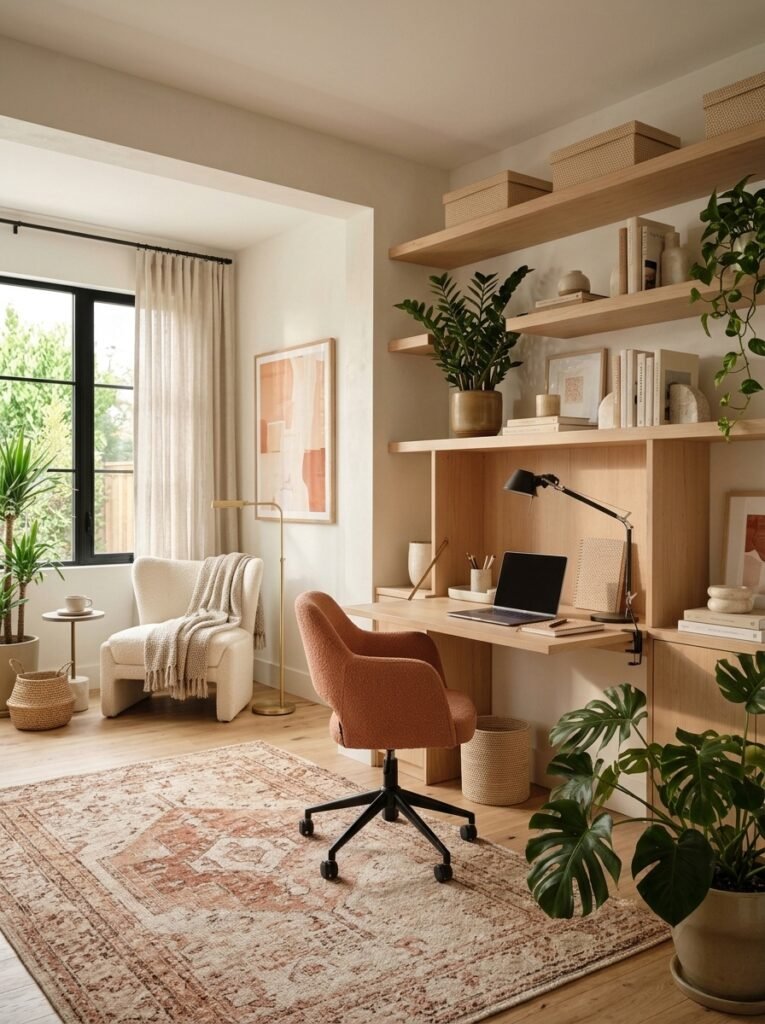
- Warm limestone-white matte walls. With no exterior window, a slim black steel-framed glass door to the next room borrows daylight, softened by a white linen café sheer on a rod.
- Wall-mounted fold-down desk in pale alder, 36 x 20 inches, 29 inches high when open, folding flat into a shallow cabinet. It sits perpendicular to the glass door. Laptop on a riser with an external keyboard, screen top at or just below eye level, an arm’s length away.
- Armless pale alder chair with a peach linen seat cushion that tucks fully under. Feet rest flat and forearms stay level with the open desk.
- Compact matte black clamp lamp with a 3000K bulb, on the side away from your writing hand. A plug-in linen-shade sconce adds a 2700K glow.
- A narrow 8-inch-deep alder rail shelf above the desk holds books and a glass pen cup. A framed 12 x 16 inch abstract in peach and cream hangs beside it.
- 2.5 x 4 foot washable cotton flat-weave rug in cream. A ZZ plant (Zamioculcas zamiifolia) sits on the shelf end in low to bright indirect light.
- A power strip mounted inside the cabinet, with one notch in the back panel for the laptop charger, so the desk closes over everything.
- A pale peach cotton waffle-weave throw folded over the chair.
Why this works: A glass interior door lets a windowless nook borrow daylight from the next room, and a fold-down desk gives that nook a flat surface only when you need one.
A friend of mine lives in a one-bedroom with no spare room and no extra window, and she still works from home five days a week. We gave her a fold-down alder desk in a shallow nook beside a glass door. The door borrows daylight from the next room, so the nook stays bright without its own window. Borrowed light is an old city-apartment trick. Glass lets daylight travel past a wall. At 5 p.m. the desk folds up, the sheer slides closed, and the work disappears. Pale peach makes the whole corner glow.
Fold-down desks only work when you plan the closing routine. Mount the desk at 29 inches so your elbows land near desk height, and add an external keyboard so the laptop screen can rise on a riser. The top of the screen should sit at or just below eye level, about an arm’s length away. The ZZ plant on the shelf is the right choice for a nook, because its fat underground rhizomes store water, so it survives dim hours and forgotten weeks. Keep the door sheer open all morning to let the borrowed light in.
9. Whitewashed Floor and Ink Blue
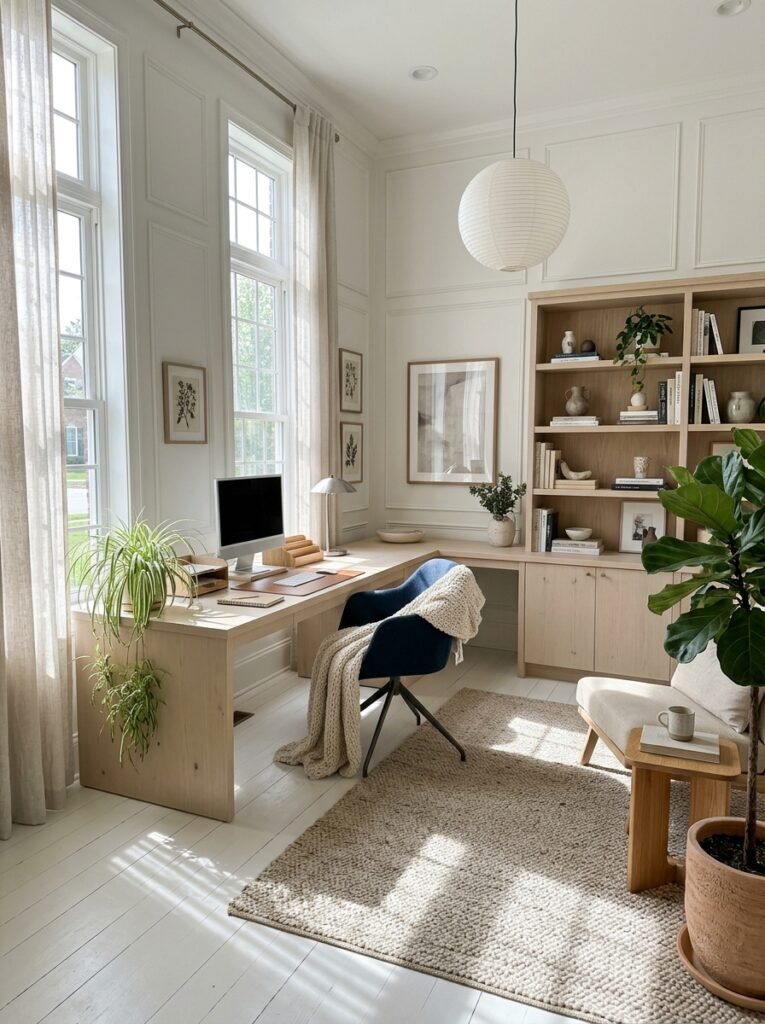
- Matte linen-white walls above floorboards painted a soft white, so daylight bounces upward. Two tall windows wear white linen sheers on a ceiling-mounted track that clears the glass fully when open.
- Pale spruce L-shaped desk, main run 60 x 24 inches and return 36 x 20 inches, 29 inches high. The main run sits perpendicular to the windows. Monitor top at or just below eye level, an arm’s length away. The return holds books and a printer.
- Adjustable task chair on a slim brushed steel frame with an ink-blue wool-felt seat. Feet rest flat and forearms stay level with the desk.
- Brushed steel swing-arm lamp with a 3000K bulb, on the side away from your writing hand. A frosted white glass table lamp on the return adds a 2700K evening glow.
- Two pale spruce wall shelves hold books with ink-blue spines. A 24 x 36 inch framed print of a pale horizon line in ink blue and white hangs above.
- 5 x 7 foot oat flat-weave wool rug with a thin ink-blue stripe. A spider plant (Chlorophytum comosum) sits on the shelf in bright, indirect light.
- A cable tray tucked under the inside corner of the L, with wire clips along the spruce edge.
- A chunky cream wool throw with an ink-blue stitched border, draped on the seat.
Why this works: A matte, pale-painted floor reflects daylight upward, which fills shadows under the desk and extends usable light deeper into the room.
Most people paint the walls and forget the floor, which is one of the biggest surfaces in the room. A pale, matte floor acts like a giant reflector, tossing daylight back up toward the ceiling and into the shadows under your desk. I painted my own floorboards a soft white years ago and noticed the room felt brighter by noon without adding a single lamp. Here, ink-blue touches stop all that white from feeling flat. The pale spruce L-shaped desk wraps the corner, giving you a main run for work and a return for books.
Glare is the trade-off with a bright floor, so set the monitor with care. Keep the main run perpendicular to the windows, the screen top at or just below eye level, and adjust the tilt if sun bounces off the floor onto the glass. The spider plant on the shelf earns its place here. Its arching leaves send out long runners that grow baby plantlets, a neat plant-science trick, and it thrives in the bright, indirect light the floor creates. Layer a 2700K glass lamp for evenings, and the white room turns amber after dark.
10. Leaning Pine Desk and Smoked Plum
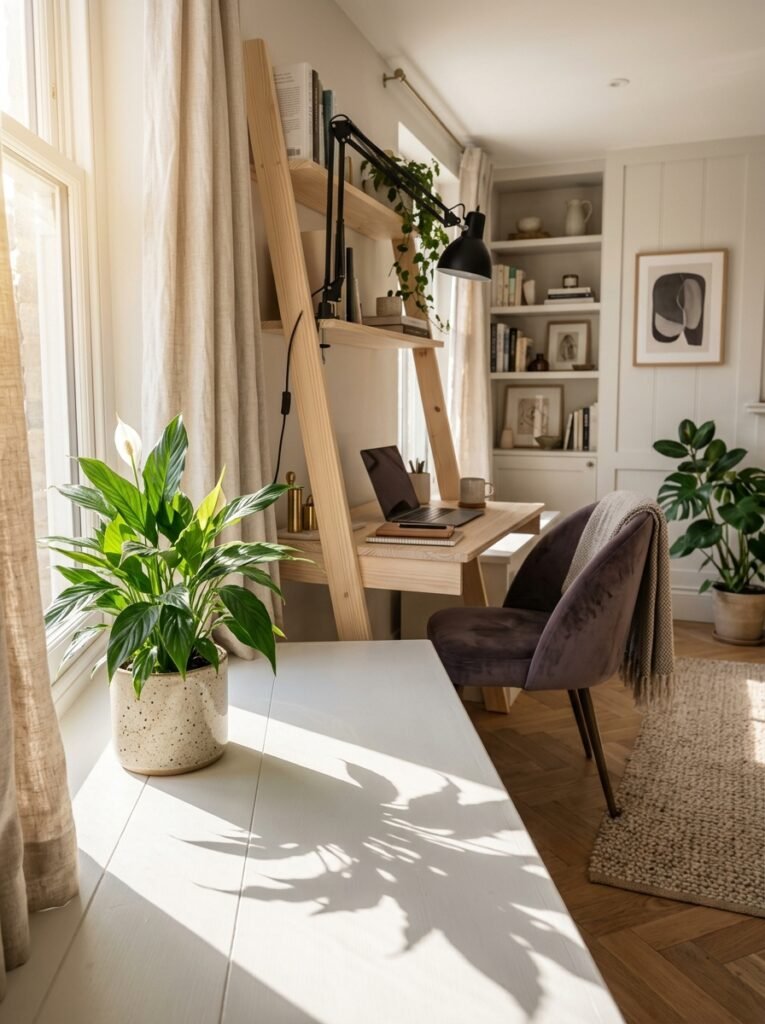
- Matte dove-white walls. The window wears a white linen sheer, and a deep sill extended 6 to 8 inches inward and painted flat white acts as a light shelf.
- Natural pine ladder desk with a 36 x 20 inch desktop at 29 inches high and a 5-shelf frame leaning on the side wall, perpendicular to the window. Monitor top at or just below eye level, an arm’s length away.
- Adjustable swivel chair with a pale pine back and a smoked plum velvet seat. Feet rest flat and forearms stay level with the desktop.
- Matte black swing-arm lamp with a 3000K bulb, on the side away from your writing hand. A glass globe floor lamp with a 2700K bulb stands in the corner.
- The ladder shelves hold books, linen boxes, and one smoked plum lidded box. A framed 20 x 24 inch graphic poster in plum and cream hangs beside it.
- 3 x 5 foot oat flat-weave wool rug. A peace lily (Spathiphyllum wallisii) sits on the sill in medium to bright indirect light.
- Cord clips along the ladder’s side rail and a ventilated, lidded cable box on the bottom shelf.
- A smoked plum mohair-blend throw over the chair back.
Why this works: A deep, flat-white sill acts like a light shelf, bouncing window light up to the ceiling so it spreads deeper into the room and evens out the glow on your screen.
A deep white sill can work like a light shelf. Architects use these horizontal reflectors to bounce window light up onto the ceiling, which then spreads it deeper into the room. At home, you can borrow the idea by extending a window sill 6 to 8 inches inward and painting it a flat, bright white. Pair it with a pine ladder desk set perpendicular to the glass, and daylight reaches the back wall instead of stopping at the desk. The result is gentler, more even light for your screen, with fewer harsh shadows across the keyboard.
Pine ladder desks stand against the wall and feel more like furniture than a workstation, which suits a corner of a bedroom or living room. The shelves keep books and a smoked plum box within reach, so the desktop stays clear. On the sill, a peace lily acts as a living gauge: it droops when thirsty and perks up within hours of watering, so you always know when to water. Smoked plum on the chair seat and mohair throw adds depth without darkening the room. Keep the lamp on the opposite side from your writing hand.
11. Twin Desks and Terracotta
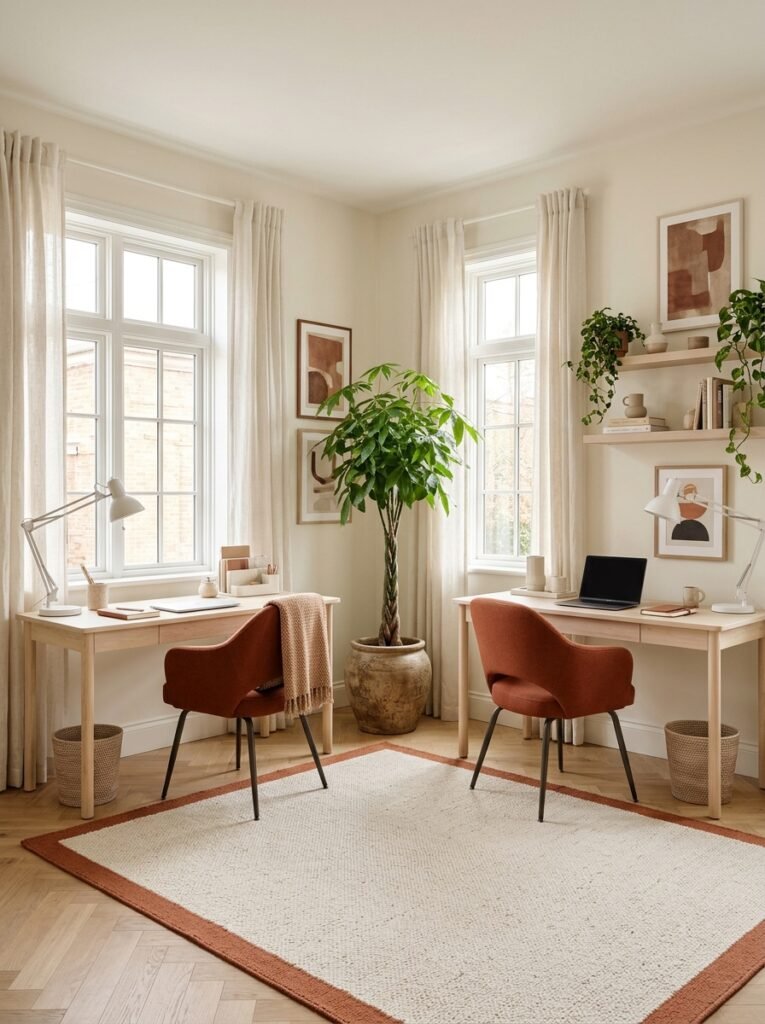
- Matte soft-ivory walls. Windows on two adjacent walls each wear a floor-length white linen sheer.
- Two matching pale aspen-plywood desks, 48 x 24 inches and 29 inches high, each against the wall beside one window so light arrives from the side. Monitor tops at or just below eye level, an arm’s length away.
- Two curved-back chairs with terracotta wool-linen upholstery on pale aspen frames and adjustable gas lifts. Feet rest flat and forearms stay level with each desk.
- Two matte white swing-arm lamps with 3000K bulbs, each opposite its user’s writing hand. A linen-shade floor lamp with a 2700K bulb stands between the stations.
- A 60 x 16 inch pale aspen credenza, 24 inches high, sits under one window and holds a printer and linen files. Two matching 16 x 20 inch terracotta-and-cream geometric prints hang above the desks.
- 6 x 9 foot cream flat-weave wool rug with a thin terracotta border. A money tree (Pachira aquatica) fills the corner between the windows in bright, indirect light.
- One shared baseboard raceway painted the wall color, with outlets at desk height beside each station.
- Two terracotta wool lap blankets, one folded on each chair.
Why this works: Windows on two walls give each desk its own side light, so two people can work in one room without anyone facing glare.
I once styled an office for two freelance designers who were fighting over the sunny desk. A corner room with windows on two walls solved it. Each desk sits perpendicular to its own window, so both people get side light and neither stares into glare. Light from two directions also softens shadows, which keeps contrast on the screens low. Matching pale aspen desks and terracotta chairs make the pair look intentional, like one design rather than two leftover tables. Each person gets their own window, and the argument over the sunny desk ended that afternoon.
Two people mean two sets of cables, so plan the power first. Run one shared raceway along the baseboard, painted the wall color, and place outlets at desk height beside each station. Between the windows, a money tree fills the corner. Its swollen trunk stores water, so it handles an occasional missed watering, and it prefers bright, indirect light like this. Set each lamp opposite its user’s writing hand, so no hand shadow falls across the page. Both screens sit with the top at or just below eye level, an arm’s length away.
12. Sunroom Poplar and Glacier Aqua
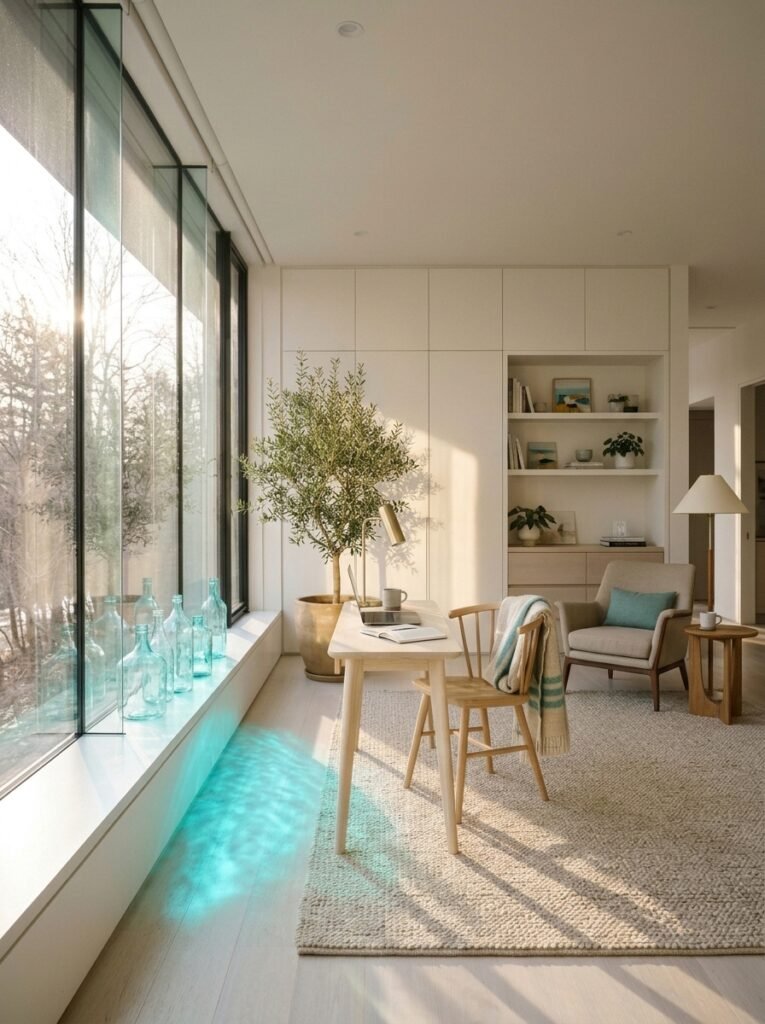
- White satin tongue-and-groove paneling on the solid wall, with glass on two sides. Each glass wall has a fixed white linen sheer and a pale linen roller shade for midday sun.
- Slim pale poplar writing table, 48 x 22 inches, 29 inches high, with one shallow drawer, set perpendicular to the glass. Monitor top at or just below eye level, an arm’s length away.
- Pale poplar slat-back chair with an upholstered glacier aqua seat. A thin wool seat pad fine-tunes the height so your feet rest flat and forearms stay level with the desk.
- Frosted glass desk lamp with a white metal arm and a 3000K bulb, on the side away from your writing hand. An opal glass pendant with a 2700K bulb handles dark winter evenings.
- A narrow 6-inch-deep poplar ledge on the solid wall holds books, and a row of glacier aqua glass bottles lines the sill. A woven white linen wall hanging with a glacier aqua stripe hangs above.
- 6 x 9 foot cream flat-weave wool rug over pale gray tile. An olive tree (Olea europaea) stands in the brightest corner and wants strong light.
- An outlet on the solid knee wall, with the cord clipped along the desk leg inside a white fabric sleeve.
- A glacier aqua and cream striped wool blanket on the chair.
Why this works: Pairing a fixed white sheer with a pale roller shade lets a glass-walled room keep its daylight while you control midday glare.
Nordic homes have long loved glazed porches because low winter sun needs every pane it can get. A sunroom office borrows that idea, but with a twist: you must control the light as well as invite it. Two layers do the job. A fixed white sheer softens everything all day, and a pale linen roller shade drops only at midday when the sun is highest. I’ve seen this combination work in rooms that were once too hot to use by noon. Suddenly the glass room becomes a place you can work in.
The wow moment here is small and glass. A row of glacier aqua bottles on the sill catches the sun and throws a turquoise patch of light across the poplar desk. Behind them, an olive tree stands in the brightest corner. Its leaves are silvery underneath, covered in tiny reflective scales that bounce strong sun, which is why it handles a sunroom better than most houseplants. The slim poplar writing table keeps the view open, so set it perpendicular to the glass, with the monitor top at or just below eye level and an arm’s length away.
13. Round Linden and Pale Butter
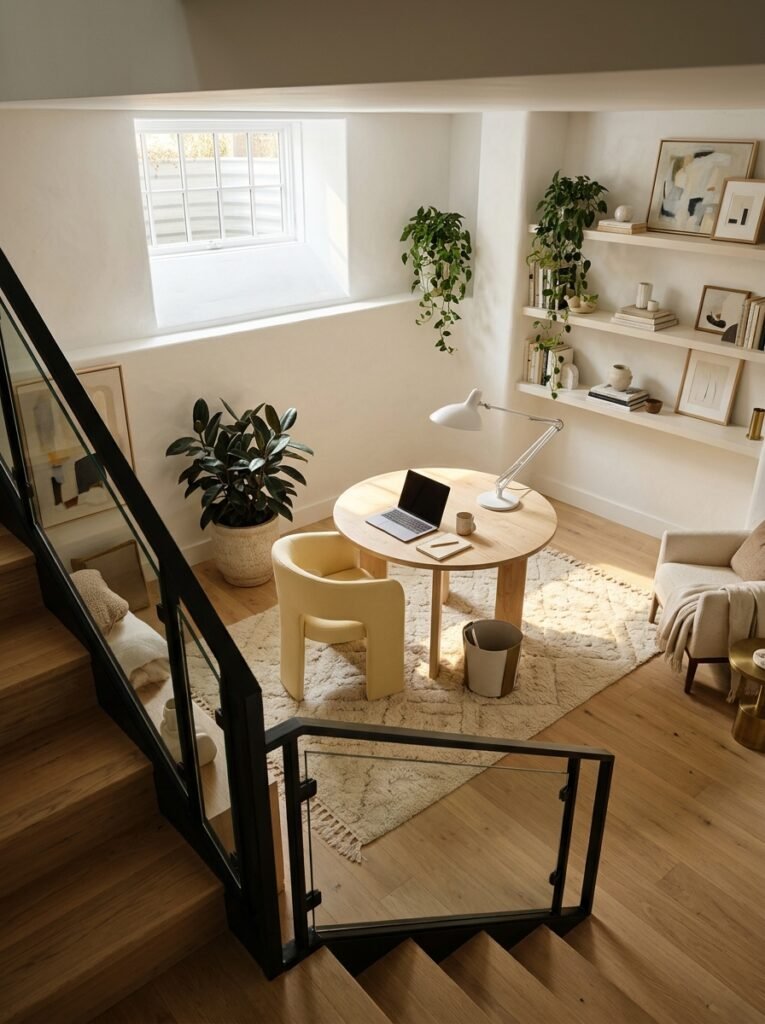
- Matte snow-white walls and ceiling. The basement window well is painted bright white and filled with white gravel, and a short white linen sheer on a slim rod leaves the glass uncovered.
- Round pale linden pedestal desk, 42 inches across and 29 inches high, set beside the window so light arrives from the side. Monitor on the half of the desk facing the room, top at or just below eye level, an arm’s length away.
- Adjustable swivel chair in pale butter wool twill. Feet rest flat and forearms stay level with the desktop.
- Matte white task lamp with a 3000K bulb, opposite your writing hand. A white flush-mount ceiling light with a 3000K bulb fills in on gray days, and a butter linen-shade table lamp with a 2700K bulb handles evenings.
- Two 30-inch pale linden floating shelves hold books and a clear glass jar. A 30 x 40 inch abstract canvas in pale butter and white hangs beside them.
- 5 x 8 foot cream wool rug over pale oak-look vinyl plank. A cast iron plant (Aspidistra elatior) stands in the corner and tolerates low light.
- Cords run down the pedestal’s back edge in a white sleeve to a surge strip tucked against the wall.
- A pale butter wool throw folded over the chair back.
Why this works: A white-painted window well and white surfaces inside pass more daylight into a basement room instead of absorbing it at the glass.
Basements are the hardest rooms to light, but a few reflective tricks go a long way. Paint the window well bright white and fill the bottom with white gravel, and the small window collects noticeably more daylight than you’d expect. A sheer instead of a heavy curtain keeps that glow in the room. Add matte snow-white walls and a white ceiling, and the light travels instead of dying at the glass. Pale butter is the only warm color here, so the whole room feels sunny even on gray winter afternoons.
I’ve styled a few basement offices, and the biggest mistake is a desk with sharp corners in a tight room. A round desk fixes the traffic flow and lets light travel around it. Set it beside the window so daylight arrives from the side, and keep the monitor on the half of the desk facing the room. The cast iron plant in the corner earns its name: it evolved in shaded forest floors, so low light and neglect barely slow it down. Finish with a pale butter twill chair that catches whatever daylight arrives.
14. Clerestory Sycamore and Slate
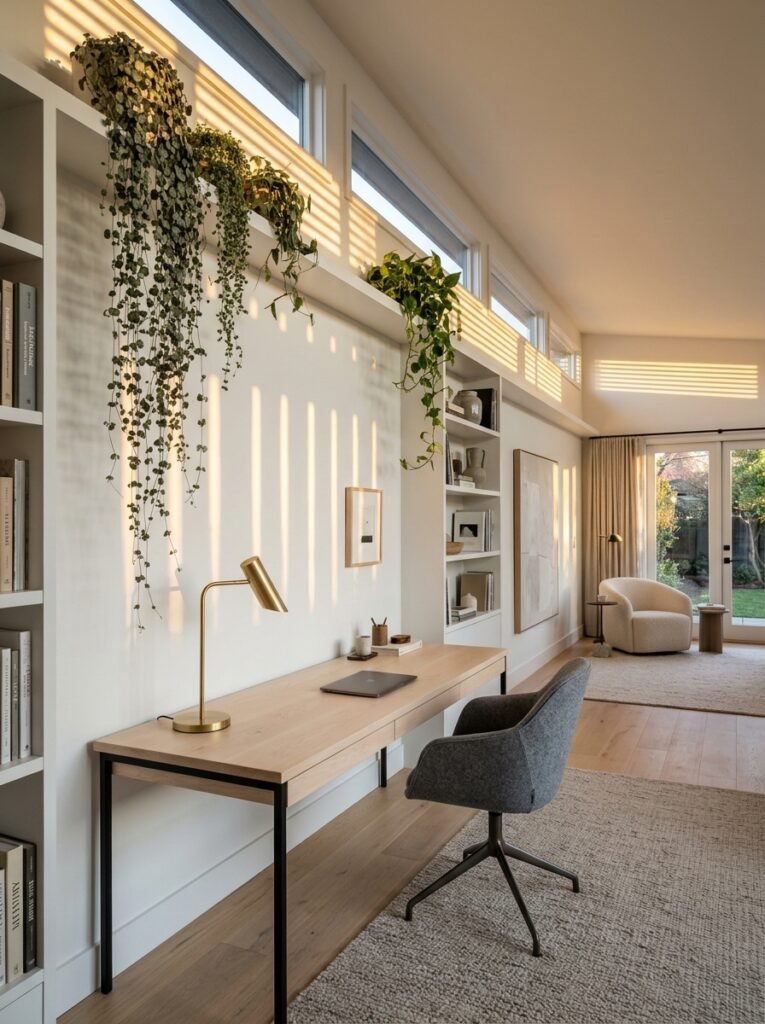
- Matte porcelain-white walls. A band of high clerestory windows on the side wall sits above eye level, each fitted with a thin white pleated shade left open to diffuse the light.
- Slim steel-framed desk with a pale sycamore top, 60 x 28 inches, 29 inches high, on black steel legs. It faces the plain wall, with the clerestory wall at your side. Monitor top at or just below eye level, an arm’s length away.
- Slate gray wool-felt swivel chair on a black steel base with an adjustable gas lift. Feet rest flat and forearms stay level with the desk.
- Brushed brass swing-arm lamp with a 3000K bulb, opposite your writing hand. A linen-shade wall sconce with a 2700K bulb adds evening warmth.
- A long pale sycamore shelf under the windows holds books with slate spines, and a high ledge beneath the glass holds the plant. A 30 x 40 inch charcoal-on-white line drawing hangs on the front wall.
- 5 x 8 foot cream wool rug with a slate stripe. A string of hearts (Ceropegia woodii) spills from the high ledge in bright, indirect light.
- A black cable sleeve runs inside the steel rail, and a power strip mounts on the underside of the desktop.
- A slate and cream herringbone wool throw draped over the chair back.
Why this works: High clerestory windows deliver daylight above eye level, so light fills the room without landing directly on your screen or in your eyes.
High windows changed how I think about glare. Light from a clerestory enters above eye level, so it rarely hits the screen or your eyes directly. I first noticed it in a client’s gallery hallway, where a row of narrow windows near the ceiling lit the whole space without a single reflection. Here, the same idea works in an office. The light travels across the porcelain-white wall, and a thin line of sun moves slowly as the day goes on, like a quiet clock. Slate gray accents keep the room crisp and graphic.
Place the desk so the clerestory wall sits to your side, perpendicular to your screen, and face the plain wall ahead. That keeps bright windows out of your direct view. Set the monitor top at or just below eye level, about an arm’s length away, and put the lamp opposite your writing hand. High windows also leave the wall below free for a long shelf. Up there, near the glass, a string of hearts trails down. Its small tubers store water along the vine, so it forgives dry spells and loves bright, indirect light.
15. Dining Table Desk and Cocoa
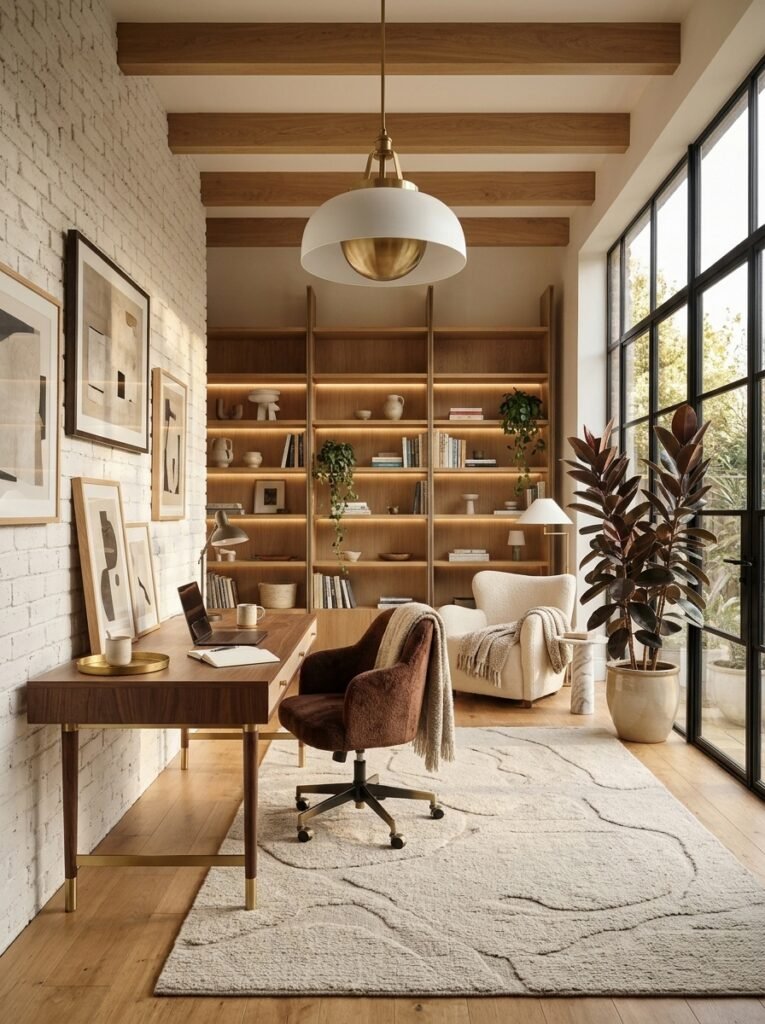
- A white-painted brick wall in flat masonry paint faces the window, and the remaining walls are matte warm white. A white linen sheer hangs on a ceiling track.
- Pale hornbeam dining table used as a desk, 63 x 32 inches, 29 inches high, set perpendicular to the window and facing the brick wall. Monitor top at or just below eye level, an arm’s length away.
- Cocoa wool-mohair adjustable task chair with sculpted hornbeam arms and soft rubber casters. Feet rest flat and forearms stay level with the tabletop.
- White enamel clamp lamp with a 3000K bulb, opposite your writing hand. A white enamel dome pendant with a 2700K bulb hangs high enough to stay out of your sightline.
- A low pale hornbeam sideboard, 55 x 16 inches, holds files and linen boxes. A 24 x 36 inch framed cocoa-and-cream textile print leans against the brick above it.
- 5 x 8 foot oat wool rug with a cocoa border. A burgundy rubber plant (Ficus elastica ‘Burgundy’) stands beside the window in bright, indirect light.
- A power strip mounted under the tabletop apron, with the cords sleeved in cocoa fabric so nothing dangles.
- A cocoa and oat wool blanket draped over the chair.
Why this works: A white-painted brick wall has enough texture to scatter reflected daylight softly, which brightens the room without mirror-like glare on your screen.
In many homes, the dining table is the office by default. Give it a proper setup and it works beautifully. Set the table perpendicular to the window, then face it toward a white-painted brick wall. Painted brick has a slight texture, so it scatters reflected daylight instead of bouncing it back like a mirror. That’s a soft, even glow behind your screen with far less glare. I’ve seen a plain brick wall and a pale hornbeam table transform a corner that used to feel like a cluttered drop-zone. Cocoa accents make it feel grown-up.
A dining table needs two small upgrades to behave like a desk: cable control and the right chair. Mount a power strip under the tabletop apron and sleeve the cords in cocoa fabric, so nothing dangles. Then swap the dining chair for an adjustable task chair, set so your feet rest flat and your forearms sit level with the 29-inch tabletop. Choose soft rubber casters if your floors are wood. Beside the window, a burgundy rubber plant adds glossy color; each new leaf unfurls from a red sheath, and it thrives in bright, indirect light.
Styling Principles for a Daylight-First Office
1. Let the window decide the layout. Place the desk before anything else. Set it perpendicular to the window so light arrives from the side, then build the room around that position. Every other choice gets easier once the desk is in the right spot.
2. Bounce light, don’t block it. Pale, matte surfaces reflect daylight deeper into a room, while dark or glossy ones absorb it or throw glare. Hang sheers instead of heavy drapes, and keep a lowered shade or window film in reserve for midday sun.
3. Fit the body before the style. A beautiful desk fails if the setup hurts. Aim for a desk height of about 28 to 30 inches, a monitor top at or just below eye level, and a screen about an arm’s length away. Your feet should rest flat and your forearms should sit level with the desk.
4. Layer three kinds of light. Daylight comes first, a task lamp second, and a warm ambient lamp third. I put the task lamp opposite my writing hand so my own shadow never falls across the page, and I add the ambient lamp for the hours when the sun has gone.
5. Keep color small and specific. Choose one wood tone, one muted accent, and one plant, then repeat the accent in two or three places. A pop of dusty blue or lingonberry reads as intentional. Five different pops read as clutter.
6. Make it cozy with texture, not clutter. Wool throws, sheepskin, linen, and a living plant warm up a white room. Hide the cables first, because a tangle of cords undoes calm faster than any color choice.
Frequently Asked Questions About Scandinavian Home Office Ideas
What makes a home office Scandinavian? A Scandinavian office puts daylight first, using pale woods, white or soft walls, simple shapes, and warm textiles. Scandinavian design prioritizes daylight because Nordic winters have very short days, so rooms are built to bounce every available hour of light. Small, muted color accents and plants keep it personal.
Where should I place my desk to avoid window glare? Place your desk perpendicular to the window so daylight arrives from the side, not in front of or behind your screen. A desk set perpendicular to a window reduces screen glare and keeps light on your work surface. A sheer curtain softens whatever remains.
What is the best bulb warmth for a home office? Warm white bulbs around 2700K suit ambient evening light. For a task lamp, many people prefer 3000K, and some choose up to 4000K for crisper daytime focus. I use 3000K at the desk and 2700K on the shelf so the room stays warm.
What are budget-friendly scandinavian home office ideas to try first? Start by turning your desk to sit perpendicular to the window, then swap heavy curtains for a white sheer. Add a clamp-on task lamp, a wool or sheepskin seat cover, and one hardy plant such as a snake plant or ZZ plant. A cord channel painted the wall color hides cables cheaply.
How do I make a small room feel Scandinavian? Use a wall-mounted or fold-down desk to free floor space, paint walls and ceiling the same pale matte color, and keep furniture on slim legs. In a room with a weak window, a mirror opposite the glass and a white window sill help daylight travel further.
How do I keep a bright white office from feeling cold? Add texture and warm light. Layer wool, linen, and sheepskin, use 2700K ambient bulbs for evenings, and repeat one muted accent color in a few places. Wood tones and a living plant add warmth that white paint alone can’t provide.
Keep Exploring
If you love a darker, cocooning workspace, read our Moody Home Office guide for the opposite approach: deep walls, low light, and rich texture.
Conclusion
A bright, calm office doesn’t need a bigger window or a bigger budget. It needs a desk turned the right way, a few pale surfaces, a sheer curtain, and a lamp that glows when the sun doesn’t. Whichever of these Scandinavian home office ideas speaks to you, start small: rotate the desk, raise the screen, add one plant.
I’ve seen how small changes like these can transform a workday. Save this post to your Pinterest board, try one idea at home this week, and share it with a friend who works from a dim corner. Your best light is already there.