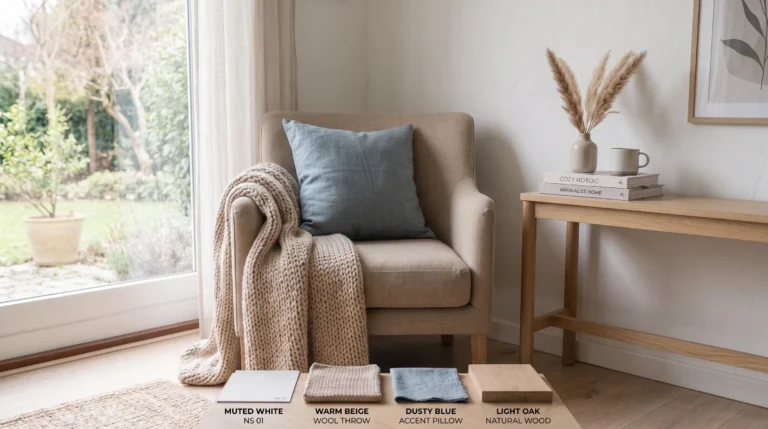
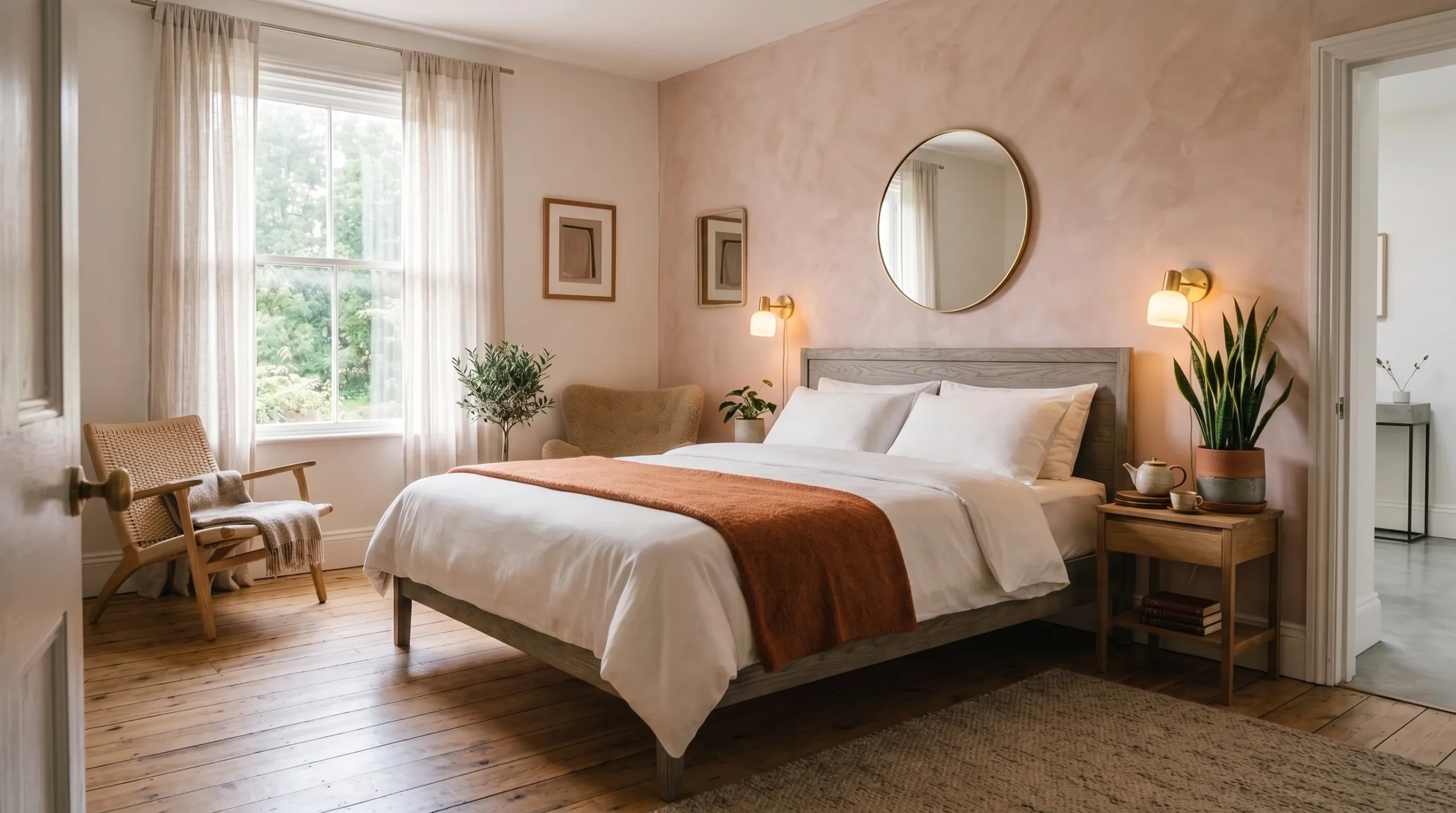
15 Cozy Scandinavian Bedroom Ideas That Feel Like Home
Not every bedroom deserves the word cozy. Most just have a bed, a lamp, and nothing that actually makes you want to linger. These 15 cozy Scandinavian bedroom ideas are built to fix that, room by room, with real color palettes, warm lighting plans, and the small rituals — a lit candle, a low sconce, a plant chosen for what it does at night — that this style has always understood better than most.
I’ve spent years studying why certain spaces feel calm, and others feel flat. It usually comes down to a handful of overlooked details: the temperature of your light, the texture under your hands, even what’s happening behind your walls. My husband builds homes for a living, and between his construction background and my plant science training, we’ve picked up a lot of practical, real-world insight most decor advice skips entirely. Each idea here is a complete room, palette, lighting, furniture, and all, ready to adapt to your own space.
1. Moody Nordic Blue — A Cozy Scandinavian Bedroom Retreat
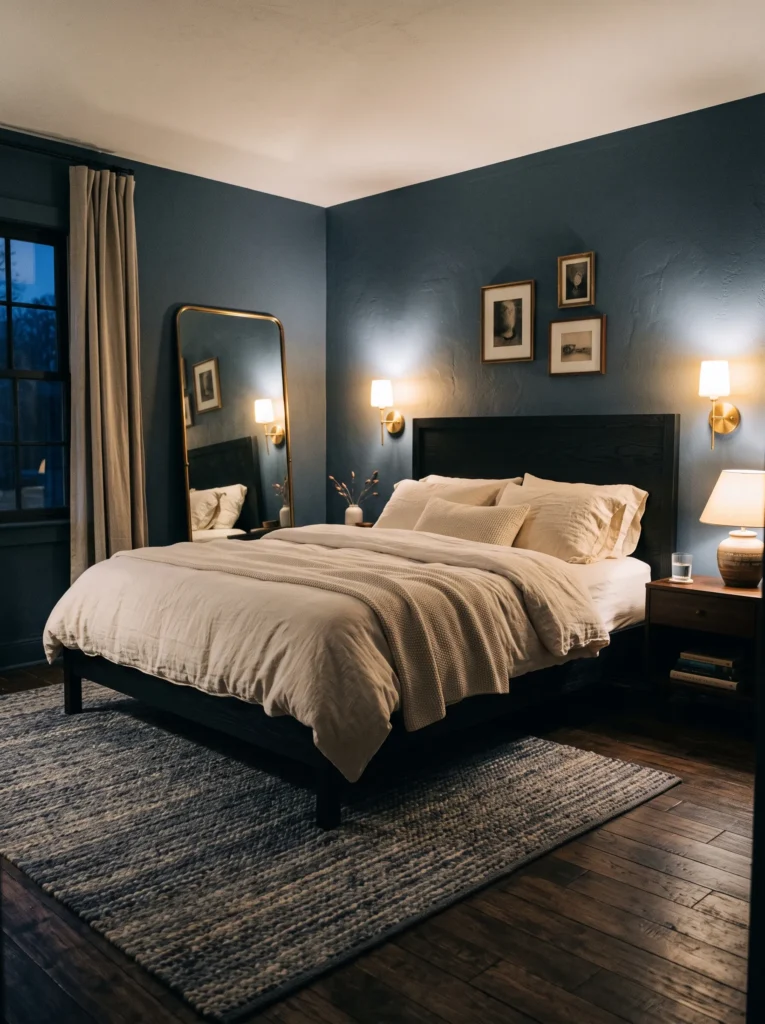
- Deep slate blue walls, cream linen bedding, blackened oak, brushed brass accents
- Wall-mounted brass sconces flanking the bed at 2700K, no overhead light; a single floor lamp in the reading corner
- Blackened oak bed frame, cream boucle armchair, wool area rug in a matching slate tone
- A single brass-framed mirror leaned against the wall, not hung
Why this works: Deep, muted blue at this saturation reads as restful rather than dramatic, and pairs with warm brass to avoid feeling cold.
Dark walls in a bedroom scare people, but a deep slate blue behaves very differently than people expect once the lighting is right. This isn’t about the color alone, it’s about removing the overhead light entirely and relying on brass sconces flanking the bed instead, so the light source sits low and warm rather than flooding down from above. I’ve noticed that rooms with only overhead lighting always feel more clinical, no matter the wall color, simply because the light falls flat and even instead of creating any depth or shadow.
Cream linen bedding against the slate walls keeps the room from feeling heavy, and the blackened oak bed frame grounds the whole look without disappearing into the dark wall behind it. A brass-framed mirror leaned against the wall rather than hung catches the sconce light at an angle each evening, adding a small flicker of warmth to an otherwise moody room. This palette works best in bedrooms that get decent natural light during the day, since the deep wall color needs some daylight balance to avoid feeling too enclosed.
2. Terracotta & Linen Warmth
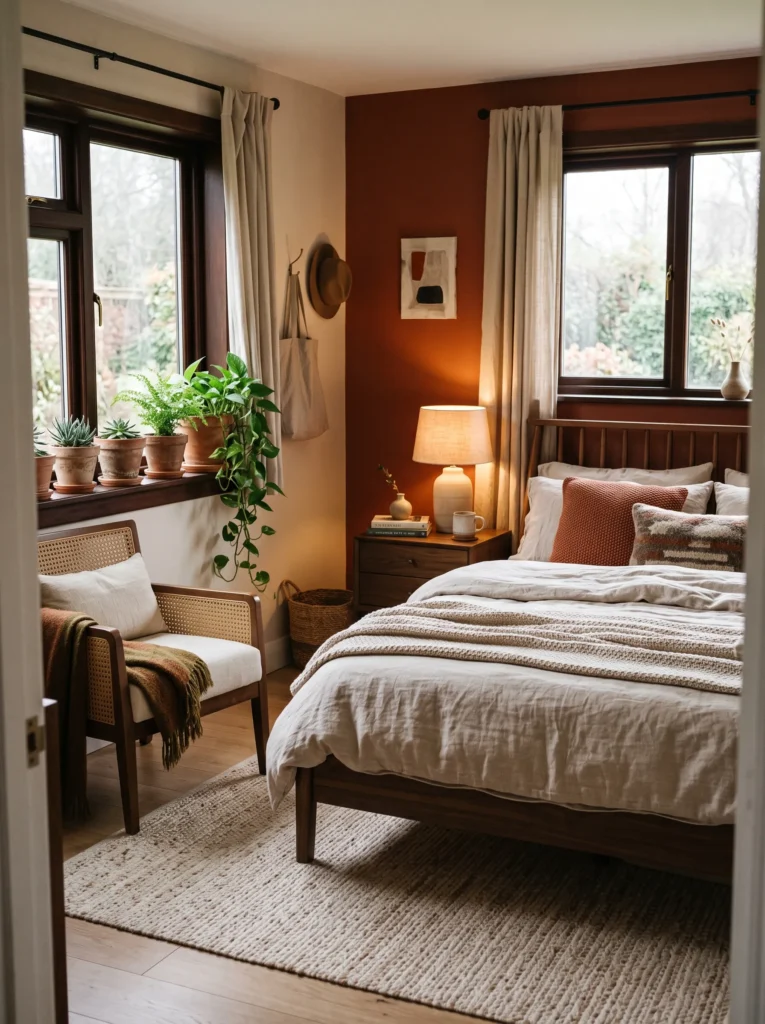
- Burnt terracotta accent wall, natural linen bedding, warm walnut, unbleached cotton
- Single warm-white table lamp at 2700K on one nightstand only, asymmetrical by design; sheer linen curtains diffuse daylight
- Walnut bed frame, cane-backed accent chair, cork-backed wool rug
- A row of unglazed terracotta pots along the windowsill, empty except for one trailing plant
Why this works: Warm terracotta absorbs and reflects light differently than gray or white walls, giving the room warmth even on overcast days.
Terracotta walls do something gray and white simply can’t: they hold onto warmth visually even when the actual light in the room is flat and overcast. This matters more than people think in climates with long gray stretches, since a cool-toned wall under weak winter light can end up feeling drained rather than calm. My husband’s crews have pointed out before that a cork-backed rug does real insulating work underfoot too, not just for comfort but for keeping cold from radiating up off the subfloor, which pairs naturally with a warm-toned room like this one.
I intentionally kept the lighting asymmetrical here, with only one lamp lit on one nightstand, rather than a matching pair. It’s a small detail, but it keeps the room from feeling too formally arranged, more like a space that evolved naturally than one styled from a catalog. The cane-backed chair adds texture without introducing a new color, and the row of terracotta pots along the windowsill, mostly empty, gives the eye a quiet resting point that doesn’t compete with the wall behind it.
3. Charcoal & Cream Rental Edit
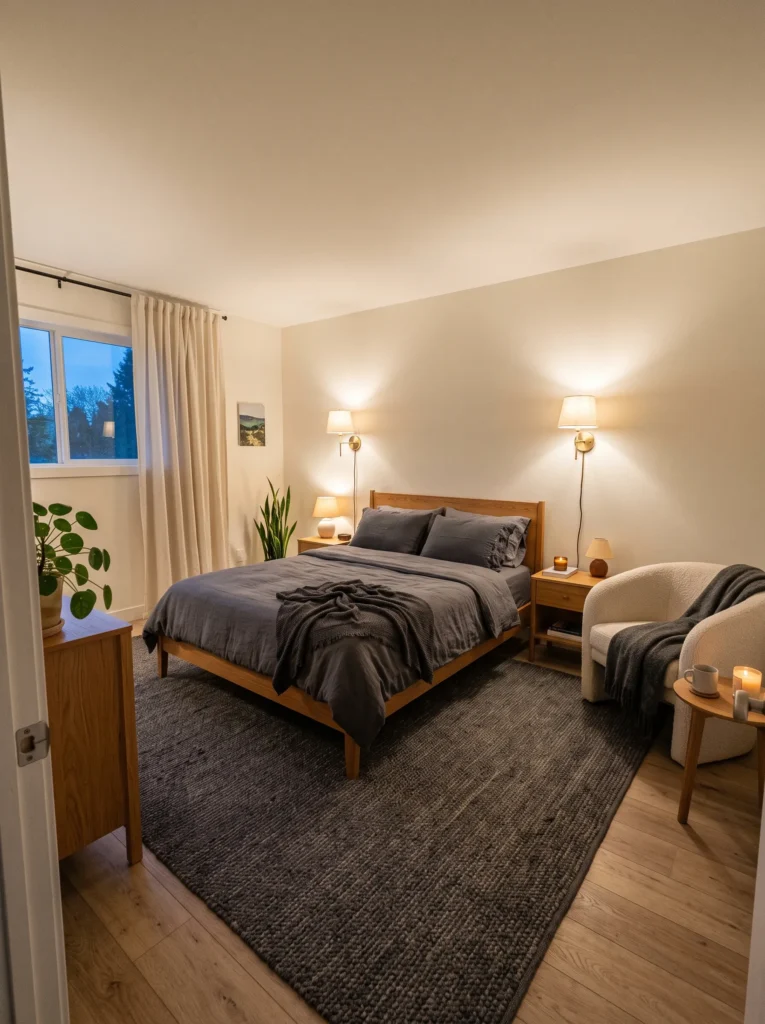
- Warm charcoal (via a large area rug and bedding, no paint), cream walls left as-is, natural oak, brass hardware
- Plug-in wall sconces on a cord, mounted with adhesive hooks, no wiring; a small clip lamp on the desk
- Freestanding oak bed frame, no built-ins, everything removable
- A charcoal wool throw draped over a cream boucle chair, both fully portable
Why this works: Color and mood are carried entirely through textiles and furniture, so the whole look can move with you between rentals.
Renters get left out of most moody, dramatic bedroom looks because they involve paint or built-ins, but the depth of a charcoal palette doesn’t actually require either. Here, the color lives in the rug, the bedding, and the throw instead of the walls, so cream walls left completely untouched still support a room that reads warm and grounded rather than plain. I’ve moved apartments with a setup almost exactly like this one, and every piece packed up and reassembled in a new bedroom within an afternoon, no patching or repainting required.
Plug-in wall sconces mounted with adhesive hooks solve the lighting half of this problem, since they give the room layered, low light without any electrician or wiring work, and they come down cleanly when you move. A small clip lamp on the desk covers task lighting without adding another cord to manage. This is proof that a fully realized, moody Scandinavian bedroom doesn’t require ownership, just the right combination of portable, textile-driven choices.
You’ll Also Love: 17 Cozy Scandinavian Living Room Ideas to Try Now
4. Sage & Bone Garden — A Cozy Scandinavian Bedroom Escape
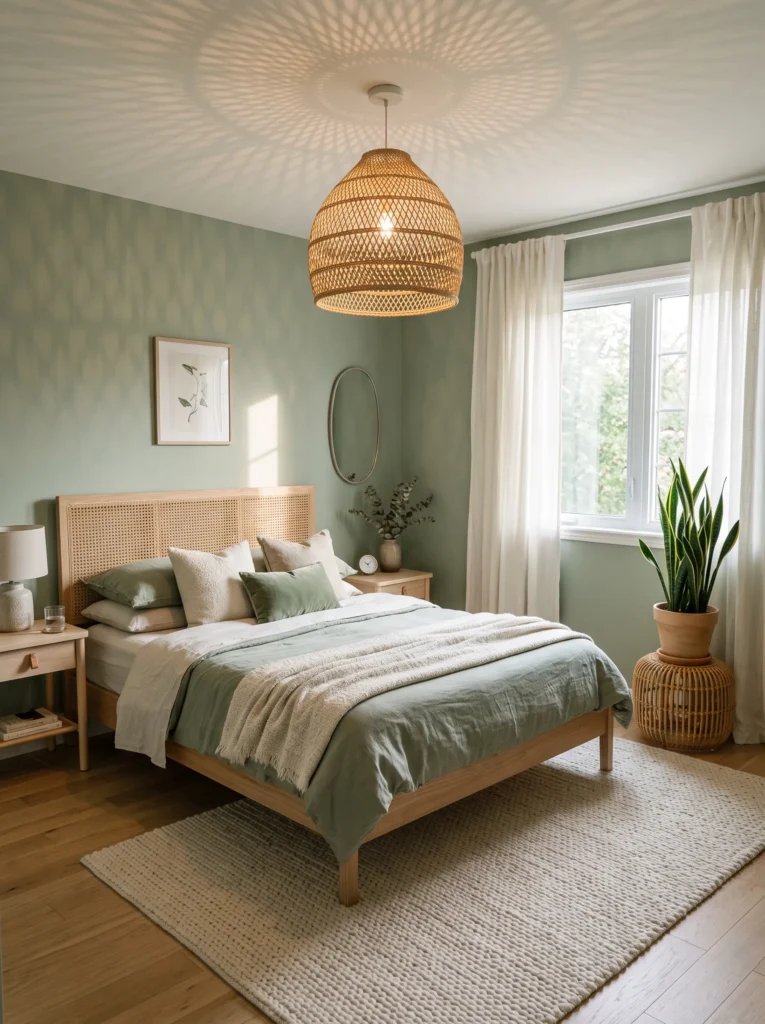
- Soft sage green, bone white, natural rattan, pale ash wood
- Woven rattan pendant at 3000K, casts dappled shadow patterns; morning light through unlined linen curtains
- Ash bed frame, rattan headboard panel, bone-toned wool rug
- A snake plant on a low rattan stool, chosen for nighttime oxygen release, not just its shape
Why this works: Sage and bone together mimic the muted tones of overcast natural landscapes, which research on biophilic design links to lower stress response.
Sage green gets used constantly in home decor right now, but most of it leans too saturated to feel calm, closer to a bold accent color than a restful one. The version that actually works in a bedroom is much softer and grayer, closer to dried sage than fresh. Paired with bone white rather than stark white, the two tones together read like an overcast landscape rather than a styled palette, which is part of why biophilic design research consistently links muted, nature-adjacent color combinations to a measurably calmer state than high-contrast rooms.
The rattan pendant overhead does something most lighting choices in this list don’t: it casts dappled shadow across the ceiling and walls as the light passes through the woven material, adding movement to the room without any extra decor. I chose the snake plant here specifically for its nighttime function, not just its sculptural shape, since it continues releasing oxygen after dark rather than absorbing it the way most houseplants do, making it one of the few genuinely useful plants for an actual sleeping space.
5. Plaster Pink & Walnut
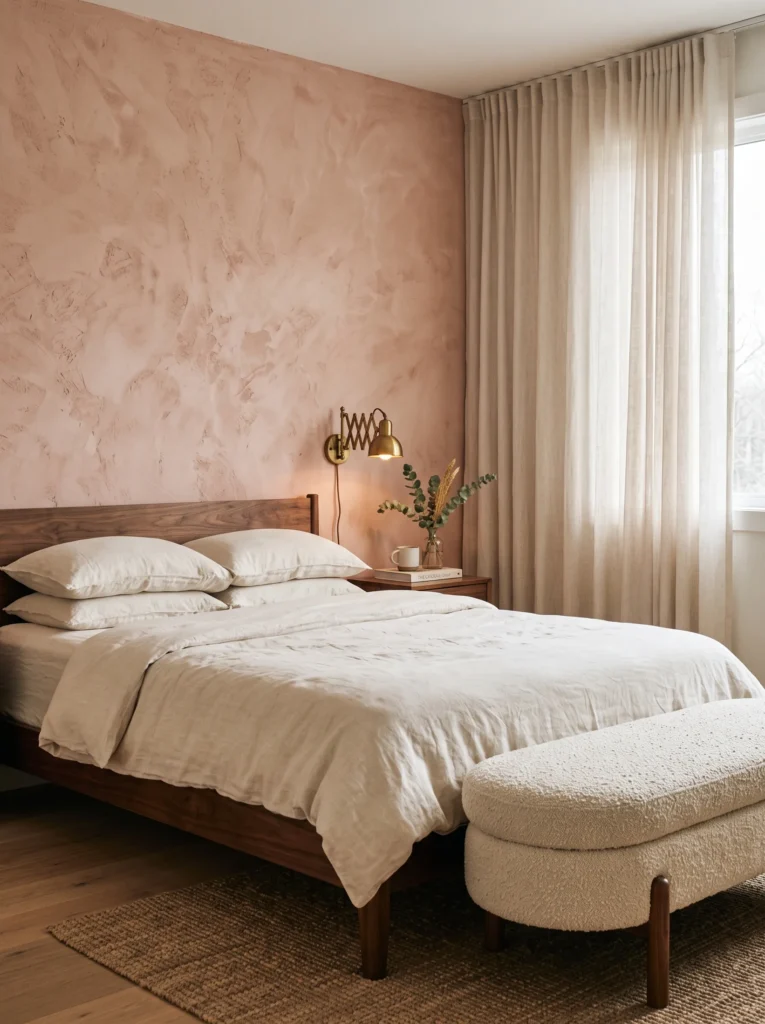
- Warm blush plaster wall, walnut wood, cream linen, muted brass
- Single brass reading sconce at 2700K mounted low; soft overcast light through a sheer linen panel by day
- Low walnut bed frame, cream boucle bench, wide-plank walnut-toned flooring
- Hand-troweled texture on the blush plaster wall, catching shadow differently morning to evening
Why this works: A warm, muted blush at this saturation reads as skin-toned and organic rather than sweet, especially against dark walnut.
Blush walls can tip into feeling overly soft or juvenile fast, but the tone matters enormously here. This isn’t a bright or cool pink, it’s a warm, muted blush closer to raw plaster or clay than anything floral, and against dark walnut furniture it reads as grounded and organic rather than delicate. My husband’s crews apply this kind of hand-troweled plaster finish on request now more than they used to, and he always notes that the visible texture, not just the color, is what makes people react to the wall, since it catches light differently depending on the time of day.
Walnut furniture throughout keeps the room from feeling too soft on its own, giving the blush something substantial to sit against. A single brass sconce, mounted low near the headboard, keeps the evening light warm and close rather than washing the whole room in even light. By day, the plaster’s texture becomes most visible under the softer, more angled light coming through a sheer linen panel, which is when this room looks its best.
6. Dusty Blue & Insulated Window Retreat
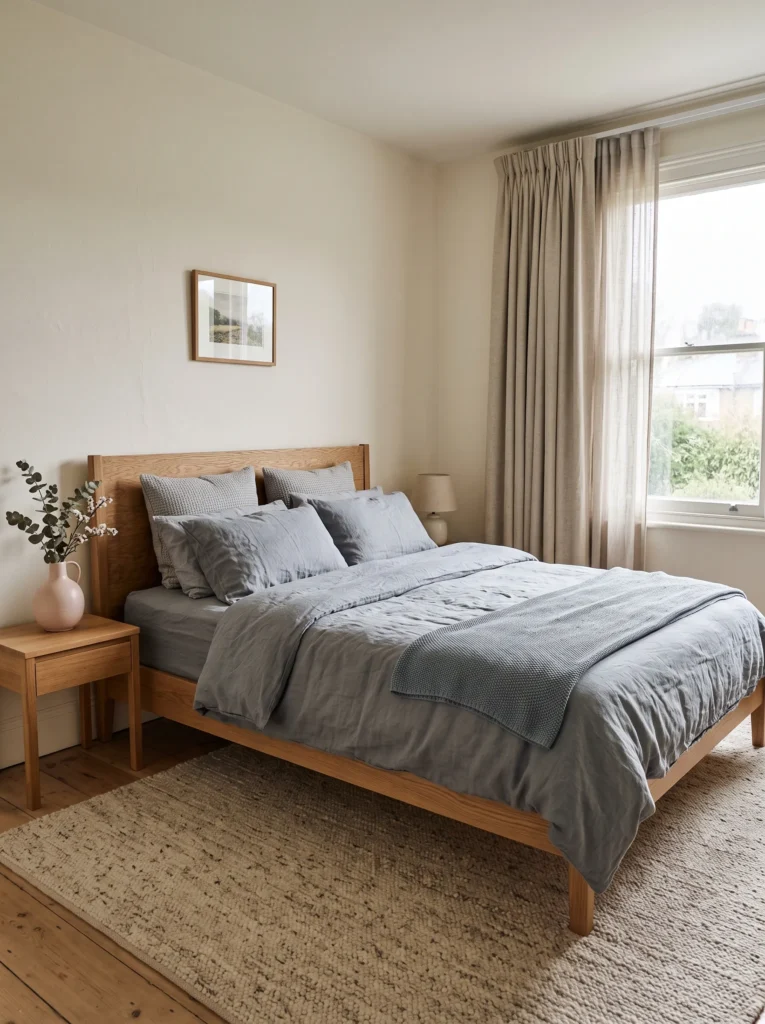
- Dusty grayed-blue bedding, ivory walls, warm oak, a single blush accent
- Swing-arm brass wall lamps at 2700K flanking the bed; heavyweight wool curtains layered over sheer linen for daytime diffusion
- Oak platform bed, cork-backed wool rug underfoot, low oak bench at the foot of the bed
- The wool curtains are functional, not just decorative, layered specifically to trap air against the window
Why this works: Muted blue reads calm rather than cold, and the layered curtain system solves the real heat-loss problem old windows create.
Blue gets a bad reputation in bedroom design because people jump straight to navy or cobalt, both of which can feel heavy rather than calming. A dusty, grayed-down blue works completely differently, sitting closer to the color of an overcast sky, which is part of why it reads as restful rather than bold. My husband spends half his workdays retrofitting older homes, and he always points out that single-pane glass loses heat fast no matter how high the thermostat runs, which is why this room’s curtains are doing real work, not just filling the window.
Layering a heavyweight wool curtain over a sheer linen panel traps a pocket of air between the fabric and the glass, functioning almost like a second window. We did exactly this in our own bedroom last winter, and the difference in how the room held warmth by morning was noticeable within days. Add one blush accent, a small vase or a single cushion, and keep everything else in the ivory-and-oak family so the blue stays the room’s clear focal point.
7. Buttery Yellow & Warm Oak Corner
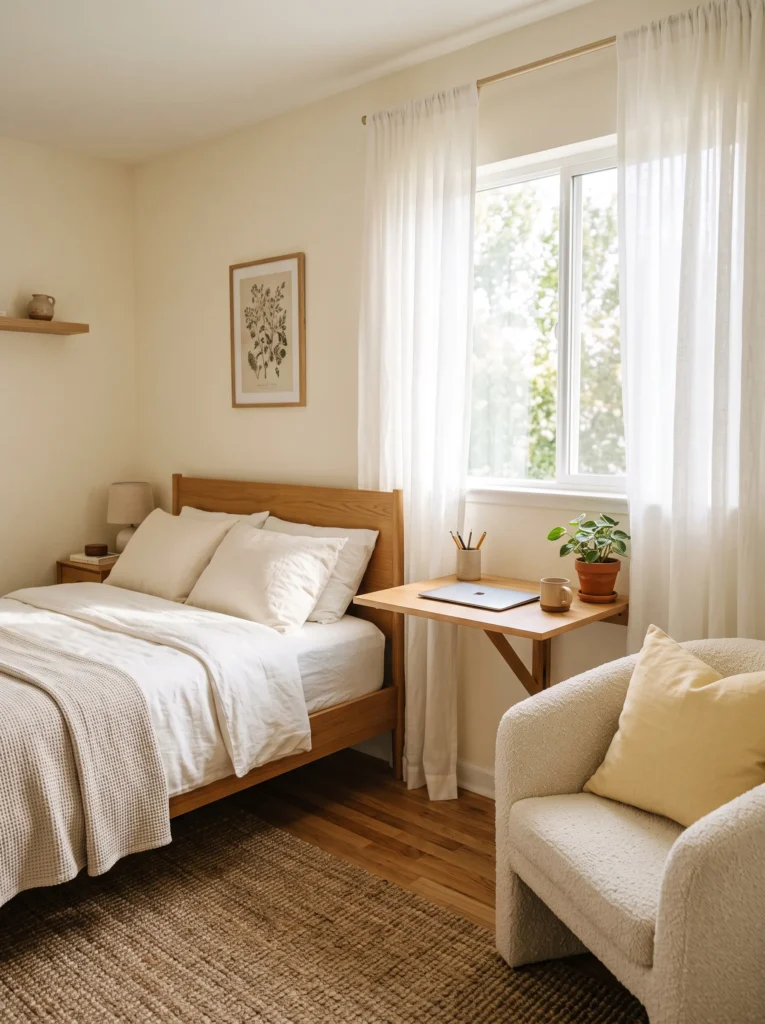
- Pale butter-yellow accents, warm oak, ivory walls, cream linen
- A ceramic table lamp with a linen drum shade at 2700K, positioned low at shoulder height; morning light through unlined sheers
- Oak platform bed, cream bouclé accent chair, fold-flat wall desk mounted beside the window
- A single pale-yellow linen cushion on the chair, the only saturated color in the room
Why this works: Milky yellow behaves more like warm light than a bold color, brightening a small room without disrupting its calm.
Yellow is the color most people avoid in a bedroom because it can read as energizing rather than restful, which is the opposite of what a Scandinavian sleep space is going for. A pale, almost milky butter-yellow avoids that problem entirely, behaving more like warm light than an actual color choice. I’ve used this exact palette in a small north-facing room that got very little direct sun, and the single yellow cushion did more to warm the space visually than an extra lamp would have, without needing to repaint a single wall.
Because the room is compact, the desk here folds flat against the wall when it isn’t in use, mounted on a French cleat so it lifts off cleanly if you move. That’s the kind of detail that matters more in a small bedroom than a large one, where every surface has to earn its place. Keep the yellow contained to one cushion, one accent, nothing more, since restraint is what keeps this look feeling calm instead of busy.
8. Lavender Dusk & Mismatched Nightstands
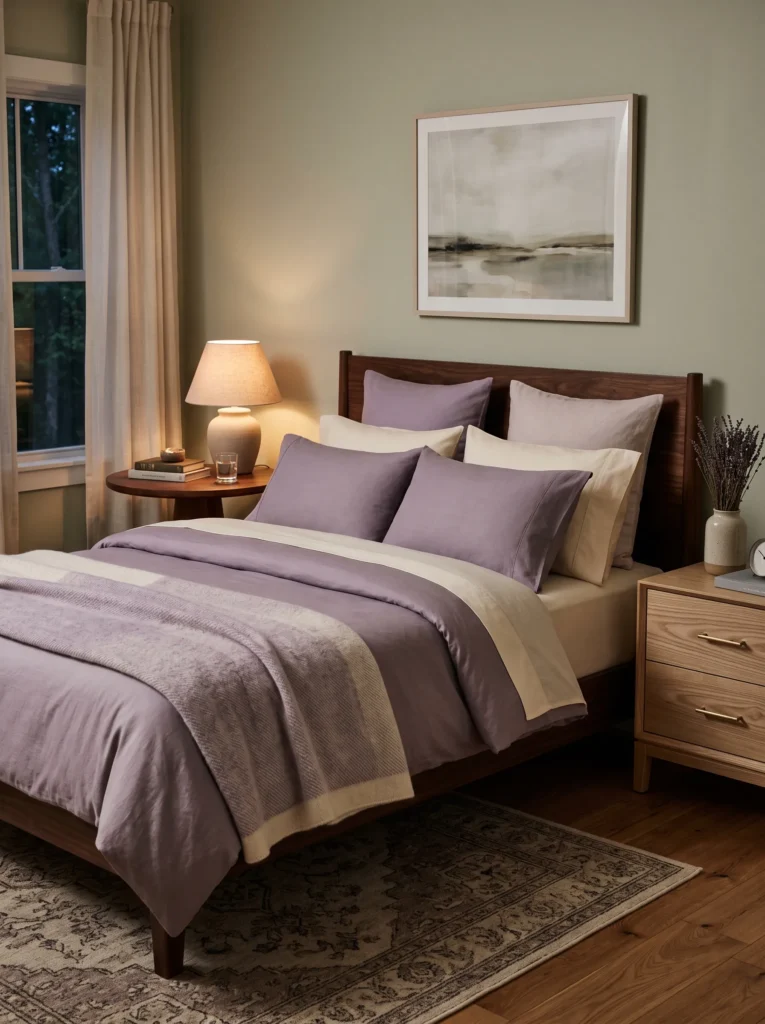
- Dusky grayed lavender bedding, warm ivory linens, walnut and ash wood, muted brass
- A single walnut-toned table lamp at 2700K on one side only; soft warm evening glow, minimal daylight reliance
- Low ash platform bed, a round walnut pedestal table on one side, a rectangular ash drawer nightstand on the other
- The two mismatched nightstands, unified by wood family rather than matching design
Why this works: Dusky lavender paired with warm ivory avoids the cold, overly sweet effect stark white creates alongside purple tones.
Lavender carries a reputation for feeling young or overly sweet, but a dusky, grayed-down version avoids that completely, reading closer to the color of sky just after sunset than anything floral. I’ve noticed the biggest mistake people make with lavender is pairing it with stark white, which pushes the whole room cooler than intended. Warm ivory linens soften that effect here and keep the palette gentle rather than cold, especially once the room’s single lamp is lit in the evening.
Matching nightstands are the easiest default, and also the flattest choice most people make. Pairing a round walnut pedestal table with a rectangular ash drawer nightstand instead gives the room a sense of having been collected over time. The two wood tones relate closely enough to stay cohesive, even though the shapes don’t match, which keeps the room from feeling like a matched furniture set and gives the lavender something warm and grounded to sit against.
9. Sage, Cream & Botanical Ledge
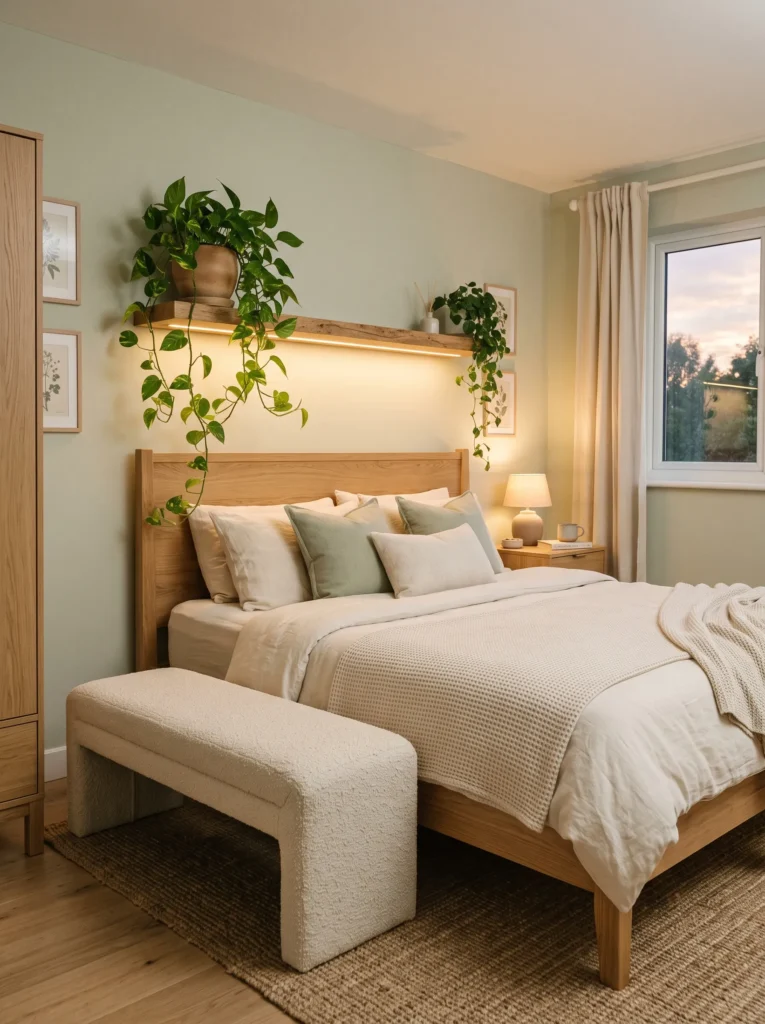
- Pale sage green, cream linen, warm oak, unglazed clay accents
- A narrow LED strip beneath a floating ledge for soft indirect glow; overcast diffused daylight through sheer curtains by day
- Oak platform bed, floating oak ledge above the headboard, low cream bouclé bench
- A trailing pothos in a clay pot on the ledge, positioned to trail down without touching the pillows
Why this works: Pothos tolerates the lower light most bedrooms get, and the ledge keeps greenery visible without taking up floor space.
Sage sits in an unusual spot on the color wheel, muted enough to feel neutral but still carrying enough color to soften a plain cream room. Used sparingly, as a single pillow and one ledge accent, it becomes one of the easiest pastel tones to work into a Scandinavian bedroom, since it never competes with the wood tones already common in the style. I’ve found that a single sage element against cream bedding does more for a room than people expect, mostly because it doesn’t read as a deliberate “color choice” the way pink or yellow might.
The floating ledge above the headboard solves a real problem in smaller rooms, where floor-standing plants eat up space nobody has to spare. I’ve kept a pothos on a ledge exactly like this for over two years now, and it’s genuinely one of the lowest-maintenance plants I’ve grown, trailing steadily downward without needing repotting. Mount the ledge high enough that the vines drift toward the pillows without reaching them, since damp leaves against fabric invite mildew over time.
10. Ivory & Exposed Beam Loft
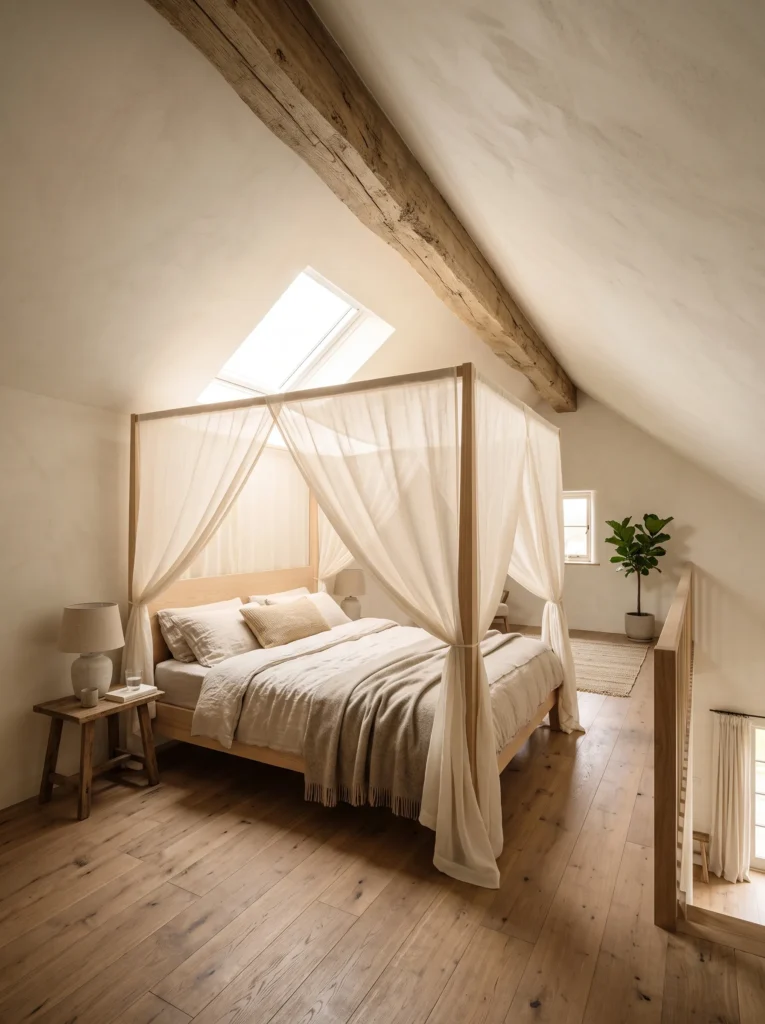
- Warm ivory walls, natural raw oak beam, oatmeal linen, weathered ash
- A freestanding linen canopy softening light from a skylight above; a single warm floor lamp at 2700K for evening
- Ash bed frame, a slim freestanding wood canopy frame draped in sheer linen, minimal additional furniture
- A single structural ceiling beam left unpainted, exposed against a matte ivory ceiling
Why this works: Leaving the beam raw adds architectural warmth for free, and the canopy brings a high loft ceiling down to human scale.
Not every cozy element needs to be added. Sometimes it’s about what you choose not to cover up. My husband has renovated enough older homes to say this is one of the most common mistakes he sees: homeowners drywall over a perfectly good structural beam because it looks unfinished, when leaving it raw and simply oiling the wood gives the room more character than any decor piece could. High, lofted ceilings look impressive in photos, but they can leave a room feeling oddly exposed without something to bring the scale back down.
That’s what the canopy is for here. A freestanding linen canopy, sheer rather than blackout, softens the light pouring in from a skylight without needing any ceiling-mounted hardware or drilling into rafters. I’ve seen this used in a loft bedroom that otherwise felt more like a warehouse than a place to sleep, and the combination of raw beam above and soft linen around the bed brought real warmth to a room that had none.
11. Rust & Woven Basket Small Space
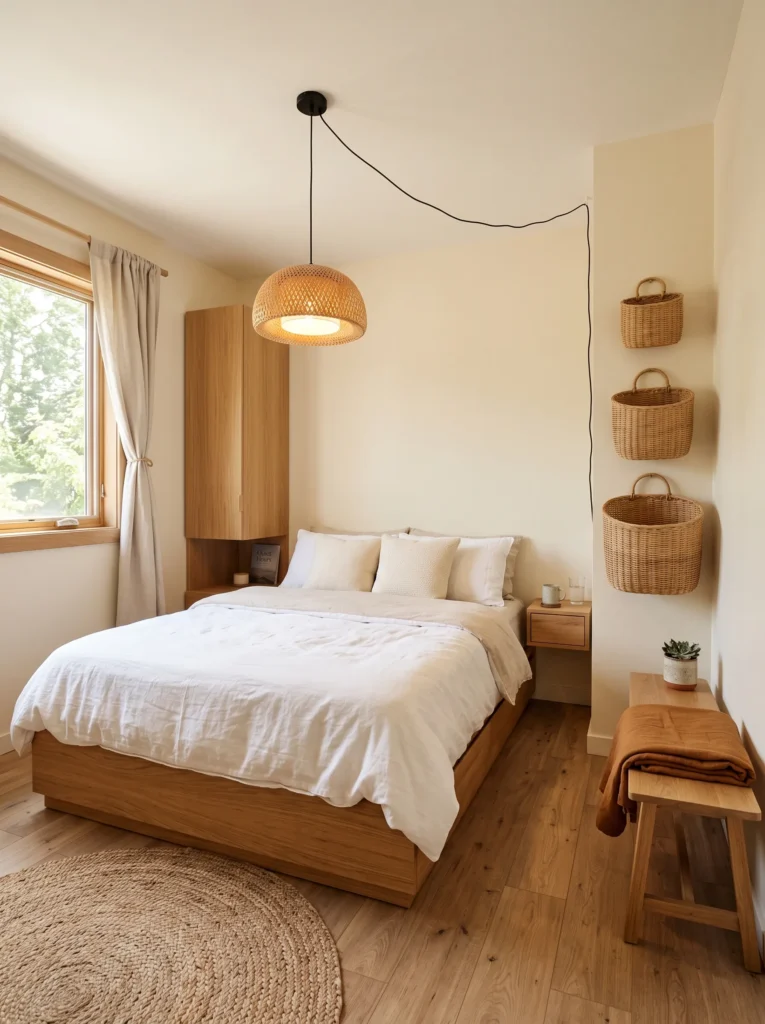
- Warm rust accents, cream walls, natural rattan, pale oak
- A single warm pendant at 2700K, hung low and off-center; soft midday light from an unseen window
- Oak platform bed with no separate dresser, a slim bench beneath the storage wall
- Wall-mounted woven rattan baskets in graduating sizes, replacing a dresser entirely
Why this works: Climbing storage up the wall instead of across the floor solves the tight-footprint problem without adding bulk.
Small bedrooms often lose their calm simply because there’s nowhere to put things without buying furniture the room doesn’t have space for. Wall-mounted rattan baskets solve this without eating floor space at all, since they climb the wall instead of taking up square footage a dresser would need. I’ve used this setup in a guest room with barely enough space for a bed, and it held everything a small dresser normally would, with room to spare beneath for a slim bench instead.
Removable hooks mean the whole wall reverts back to blank plaster the day you move out, which matters most in a rented space. Choose baskets in a natural, unstained rattan rather than a painted finish, since the raw material tone pairs better with the warm rust accents and pale oak already in the room. Graduate the sizes as they rise, largest at the bottom, so the arrangement reads as intentional rather than randomly hung, and let the rust tones do the rest of the room’s visual work.
12. Vintage Ochre & Layered Clay
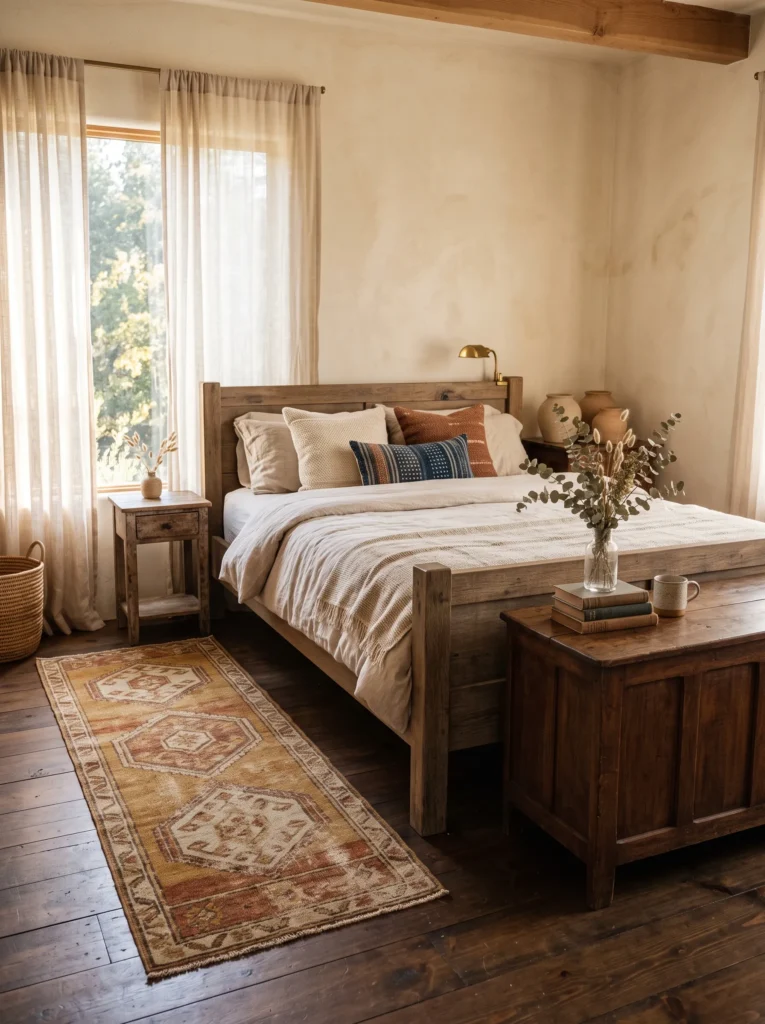
- Faded ochre and rust patterned textile, natural linen, weathered oak, unglazed stoneware
- A single ceramic lamp at 2700K positioned low on one nightstand; soft afternoon light through sheer curtains
- Weathered oak bed frame, low dresser, a narrow vintage-style wool runner along one side of the bed
- Three unglazed stoneware vessels in graduating sizes on the dresser, mostly left empty
Why this works: Worn, irregular textiles and unglazed clay both read as collected over time rather than newly styled.
A single worn-in rug does something a brand-new one can’t: it makes the room look like it has history, even if you bought it last month. A narrow vintage-style runner with a faded, slightly irregular ochre-and-rust pattern reads far warmer underfoot than a flat solid-color rug, because the pattern variation catches the eye without needing anything else nearby to compete with it. I always place it on the side of the bed you actually step out onto, not centered, since that avoids the slightly stiff, showroom look a perfectly placed rug tends to create.
The dresser follows the same logic. Three unglazed stoneware vessels in graduating sizes, rust, clay, and bone tones, sit off-center rather than symmetrically arranged, with two left completely empty. I’ve tried this arrangement in a few different rooms, and leaving vessels empty reads as intentional every time, never unfinished. Together, the runner and the vessels give the room a quiet, gathered feeling that a fully matched, newly bought set never quite achieves.
13. Warm Walnut & Sound-Soft Ceiling
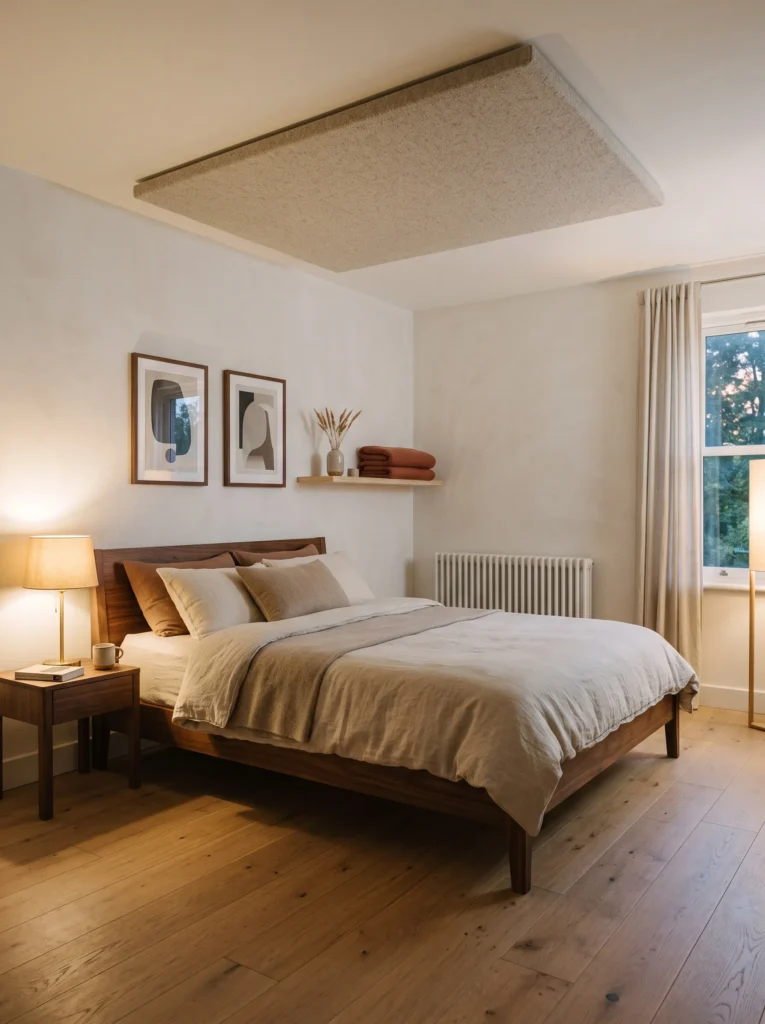
- Warm walnut wood, oatmeal linen, muted clay wool textile, brushed brass
- A slim wall shelf lamp above the radiator at 2700K; minimal daylight reliance, evening-focused room
- Low walnut bed frame, a slim ash shelf mounted above the radiator, wide-plank oak flooring
- A suspended oatmeal wool panel mounted flat against the ceiling above the bed, absorbing sound reflection
Why this works: Hard flooring and bare walls make a room feel acoustically cold even when it looks finished, and soft materials fix that a paint color can’t.
Nobody talks about how a bedroom sounds, only how it looks, but a room with bare walls, hard flooring, and a plain ceiling tends to feel colder than the decor alone explains, because sound bounces around it too sharply. A dense wool panel mounted flat against the ceiling above the bed absorbs some of that reflection, softening the room acoustically in a way that quietly supports everything else in it. My husband’s crews run into this constantly in newly renovated rooms with fresh drywall and hardwood floors, spaces that look finished but still feel oddly hollow.
The radiator shelf is a detail he pointed out to me years ago that I’ve never seen mentioned elsewhere. A slim ash shelf mounted just above a radiator keeps a folded throw or a stack of books gently warmed by rising heat throughout the day, so it’s actually warm to the touch by evening. Sealed properly, the wood tolerates the consistent warm airflow without drying out, and the shelf stays functional for years without needing to be refinished.
14. Peel-and-Stick Blush Rental Retreat
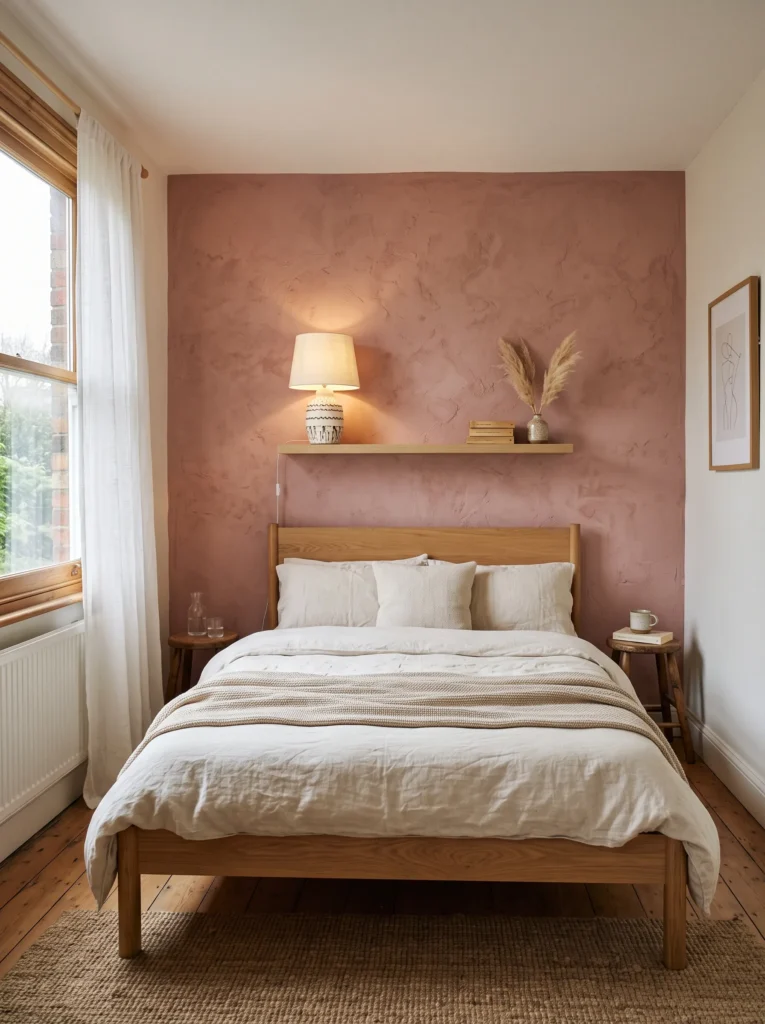
- Soft dusty rose, warm white oak, ivory linen, brushed brass
- A ceramic table lamp at 2700K on a floating shelf; overcast diffused daylight through a sheer curtain by day
- Freestanding white oak bed frame, no built-ins, everything removable
- Removable plaster-textured wallpaper behind the bed in dusty rose, paired with a floating shelf instead of a headboard
Why this works: The wallpaper mimics a built headboard wall without drilling, fully reversible for a rented space.
Renting shouldn’t mean choosing between a bare wall and losing your deposit. Removable wallpaper with a plaster-look texture behind the bed gives the illusion of a built-in headboard wall without a single nail. I’ve tried several peel-and-stick brands over the years, and the ones with a slightly raised, matte texture read far more expensive than their price suggests. A soft dusty rose reads warmer than white here, especially once the lamp is lit in the evening, and it pairs easily with warm white oak furniture already common in a Scandinavian room.
Small rooms lose a lot when you add a bulky headboard, since it eats visual space the room doesn’t have. A floating shelf mounted at pillow height does the same anchoring job a headboard would, holding a lamp and a small plant, while keeping the wall feeling open underneath. Every bracket is patchable, so it leaves no real trace when you move out, giving a small rental bedroom the finished look of a full renovation at a fraction of the cost.
15. Smoked Oak & Candlelit Frost
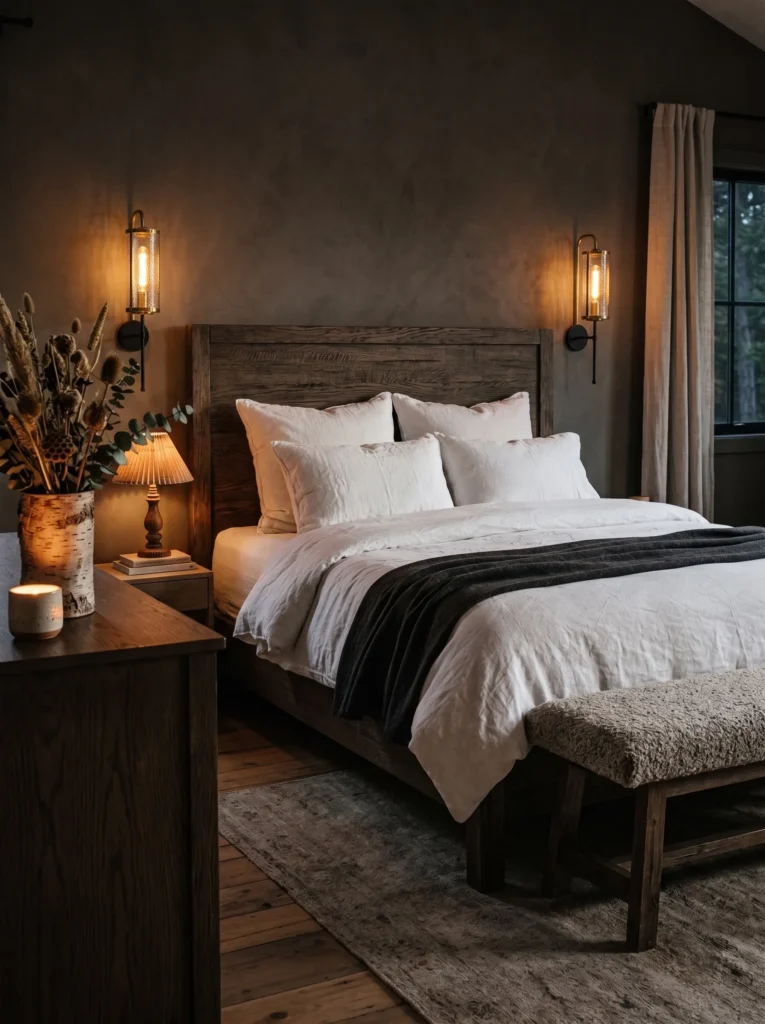
- Smoked oak (dark, fumed wood tone), frost-white linen, soft birch-bark tan, matte black iron
- A cluster of black iron taper candle sconces mounted beside the bed for a nightly wind-down ritual, plus one low floor lamp at 2700K for reading; daylight left mostly unfiltered through a bare linen shade
- Smoked oak bed frame, a boiled wool bench at the foot of the bed, birch-bark textured vase on the dresser
- Real taper candles in black iron sconces, lit each evening instead of switching on an overhead light
Why this works: Candlelight is where Scandinavian coziness actually comes from historically, and its flicker signals wind-down in a way a dimmer switch can’t replicate.
Most “hygge” content mentions candles once and moves on, without explaining why they matter beyond mood. Candlelight sits at a color temperature even warmer than a 2700K bulb, and more importantly, its slight flicker is something a steady electric bulb can’t fake. In Nordic homes, lighting a candle each evening isn’t decorative, it’s a signal, the same way dimming a light tells your body it’s time to slow down. I’ve built this into our own evening routine, and the shift from a switched-on lamp to an actual flame changes the room’s whole feel within seconds, not gradually.
Smoked oak, a wood that’s been fumed to darken its natural grain rather than stained, adds real weight against the frost-white linen without tipping the room into the moodiness a fully black frame would. The boiled wool bench brings in the same dense, felted texture that makes traditional Scandinavian outerwear so warm, translated into a piece of furniture. This is one of the more atmospheric looks on the list, built around ritual as much as material.
Final Thoughts
A cozy bedroom isn’t built overnight, and it doesn’t need a full renovation either. Sometimes it’s one warmer bulb, one layered curtain, or one plant on the right ledge. I’ve seen how small changes like these can completely transform how a room feels, even when nothing structural changes at all.
That’s really the heart of good cozy Scandinavian bedroom ideas — full, considered rooms built from a handful of intentional choices that add up to something you actually want to come home to. Save this post to Pinterest so you can revisit it whenever you’re ready to try something new, pick one look to start with this week, and pass it along to anyone else whose bedroom could use a little more warmth.
Frequently Asked Questions About Cozy Scandinavian Bedrooms
What colors work best for a Scandinavian bedroom? Muted, nature-inspired tones like slate blue, sage green, terracotta, blush, and dusty lavender work best. These colors stay calming because they’re desaturated rather than bold, and they pair naturally with warm wood tones like oak and walnut.
Can I create a Scandinavian bedroom look if I rent my home? Yes. Textiles, freestanding furniture, plug-in sconces, and removable wallpaper let you build the full look, colors, texture, and lighting, without paint, drilling, or any built-ins that would affect your deposit.
What kind of lighting suits a cozy Scandinavian bedroom? Warm, low light in the 2700K–3000K range works best, usually from sconces, table lamps, or pendants rather than a single overhead fixture. Low, layered light sources create shadow and depth instead of flat, even lighting.
How do I make a small Scandinavian bedroom feel bigger? Use vertical storage like wall-mounted baskets or floating shelves instead of floor furniture, keep the color palette limited to one or two accents, and rely on light, airy textiles like linen to keep the room from feeling cluttered.
Are plants necessary in a Scandinavian bedroom design? They’re not required, but low-maintenance plants like snake plants and pothos add texture and warmth without much upkeep. Snake plants are also useful in bedrooms specifically since they continue releasing oxygen at night.
How can I add warmth to a bedroom without repainting the walls? Layer in warm-toned textiles like wool rugs, linen bedding, and throws, add warm-white lighting instead of cool overhead light, and bring in natural wood furniture. Color and warmth can come entirely from textiles and furniture rather than the walls.