15 Minimalist Japandi Bedroom Design Ideas
What if the secret to a bigger bedroom isn’t more space, but a lower bed? That’s the idea behind minimalist japandi bedroom design, and it’s easier to try than you think. If your room feels busy, tight, or just a little off, you’re probably dealing with height and clutter, not square footage. I’ve styled and tested low-profile bedrooms in my own Austin home, and I’ve noticed that dropping the bed and editing the walls changes a room faster than any new paint color.
Below, you’ll find 15 complete bedrooms with exact woods, fabrics, lighting, and plants, so you can recreate the look. Save your favorites and start with one.
Why Does a Japandi Bedroom Feel Larger Than It Is?
A bedroom doesn’t feel bigger because you own less. It feels bigger because everything sits lower. Low furniture drops the eye line, which exposes more wall and makes the ceiling read as higher, a principle rooted in traditional Japanese interiors built around floor beds and low seating. A Japandi bedroom feels larger than it is because low-profile furniture lowers the eye line, leaving more wall and ceiling visible. I tested this in our Austin guest room: swapping a 26-inch bed for a 12-inch platform made the same 11-by-12 space feel like it gained a foot of height. This post shows fifteen buildable bedrooms that use that trick, with the joinery, materials, and lighting spelled out
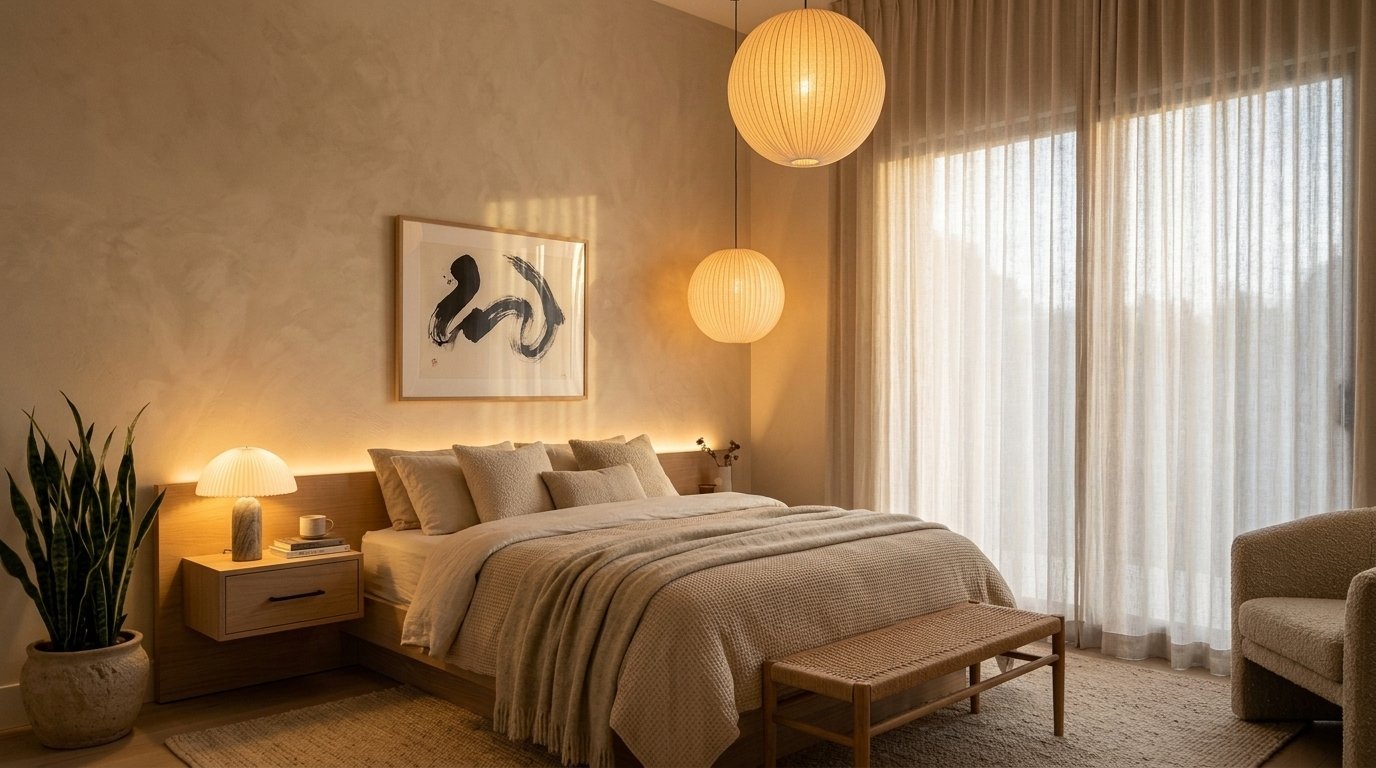
1. Limewash and Lantern Glow — A Minimalist Japandi Bedroom Design Idea
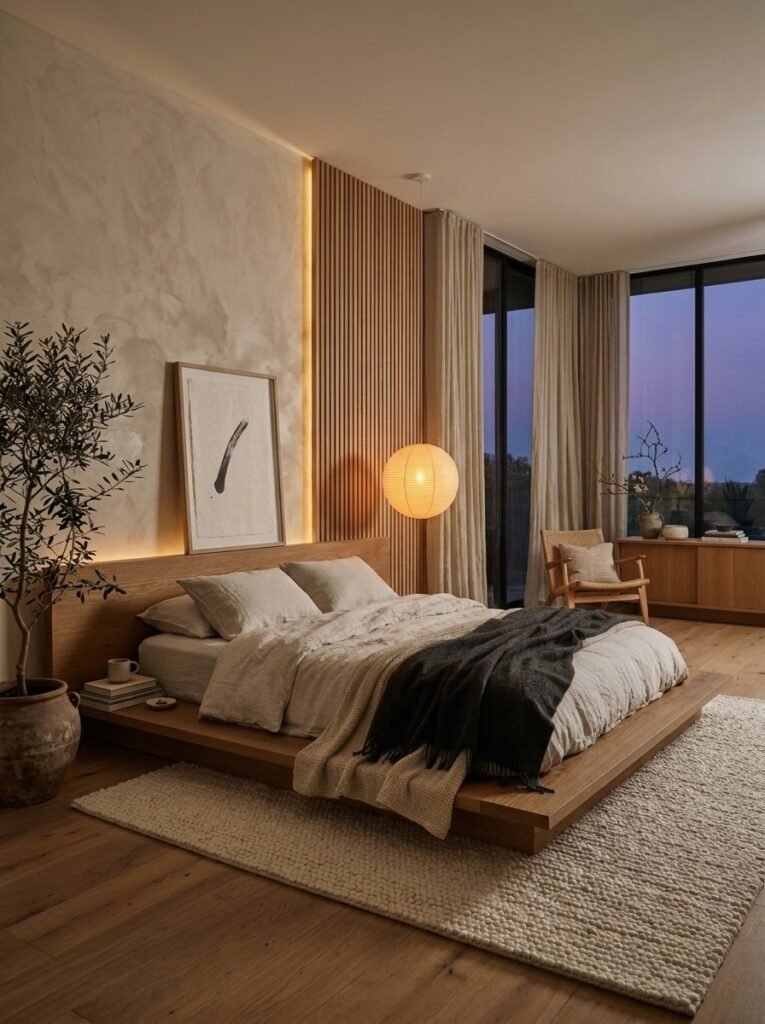
- Limewash in oat, applied in two cross-hatched coats for a soft, cloudy depth
- Low platform frame in white oak, 12 inches from floor to mattress top
- Stonewashed linen duvet in bone, one linen flat sheet, one oatmeal wool throw (three layers total)
- One sumi-style ink print on washi, 24 x 36 inches, in a thin ash frame
- Snake plant (Dracaena trifasciata) in an unglazed stoneware pot; tolerates low to medium light
- Hand-loomed wool flatweave in oat, 8 x 10 feet; sheer linen panels (about 4 oz weight) hung ceiling-high
- Wall-mounted white oak nightstand drawer with a matte black steel pull
- 16-inch washi pendant with a 2200K bulb on a dimmer, plus one plug-in linen-shade sconce, also dimmable
Why this works: Limewash scatters light instead of reflecting it, so one warm pendant makes the whole wall look lit from within.
Limewash does something flat paint cannot: it moves. Because the pigment sits in a mineral wash rather than a plastic film, the surface reads slightly cloudy, and it picks up every shift in light across the day. Paired with a 12-inch white oak platform, the oat walls give the room a soft backdrop that lets the pale wood stand out without shouting. The washi pendant does the rest, casting a warm amber halo across the plaster-like finish after sunset. Expect a room that feels deeper in the evening and gently luminous at dawn, with nothing crowding the eye line.
My husband builds houses for a living, so I asked him what makes a platform bed last. His answer: joinery and support. Mortise-and-tenon rails outlast screws alone, and any queen frame needs a center beam with a leg underneath, since slats spanning 60 inches will eventually sag. Ours uses a 2×4 spine and legs every 24 inches, and it has never creaked. That quiet matters in a minimalist room, where there are no stacked pillows to muffle sound. Build it right once, and the bed becomes the sturdy, silent anchor of the room.
2. Tatami Floor Bed
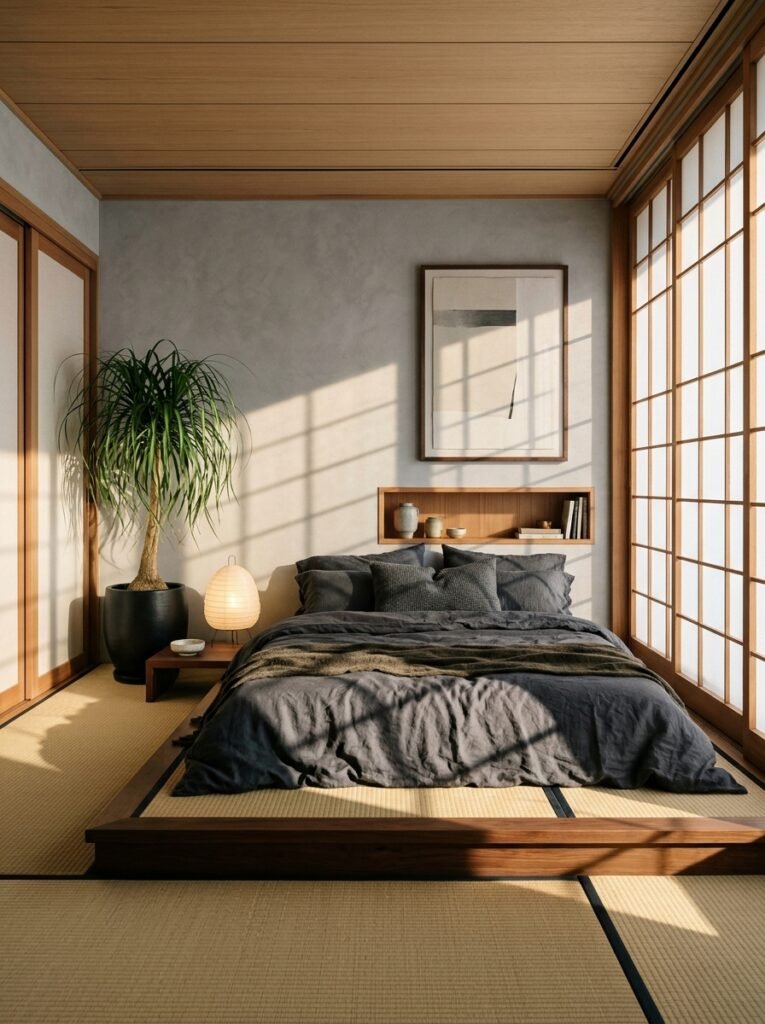
- Flat mineral paint in ash gray, no sheen
- Floor bed with a 6-inch cotton futon on a raised tatami-style platform edged in hinoki cypress, 10 inches total
- Charcoal cotton percale sheet and duvet, plus one oat hemp blanket (three layers)
- A single hand-woven panel in undyed cotton and charcoal wool, 30 inches wide
- Ponytail palm (Beaucarnea recurvata) in a matte black ceramic pot; bright light, water every two weeks
- Igusa rush mat doubles as the rug; a shoji-style sliding screen with washi panels in a cedar frame replaces curtains
- Round 14-inch hinoki stool as the nightstand, with an aged brass wall hook for a robe
- Pleated washi pendant with a 2400K bulb on a dimmer, plus a paper floor lantern with a dimmable 2200K smart bulb
Why this works: A bed that sits 10 inches off the floor keeps the eye line low, so a standard 8-foot ceiling reads taller.
The first time I slept on a tatami floor bed, I woke up and thought the ceiling had moved. It hadn’t. The bed had simply dropped to 10 inches, and everything above it suddenly felt taller. Here, a flat ash gray wall lets the straw-toned rush mat glow, while charcoal percale gives the bed a crisp, graphic outline. A shoji-style screen replaces curtains, filtering Texas afternoon sun into a soft, paper-diffused wash. It’s a bedroom that asks for very little furniture and rewards you with floor space, openness, and a surprising amount of quiet.
Here’s the construction note I wish I’d known earlier: never lay tatami-style mats directly on a concrete slab. Many Austin homes are slab-on-grade, and trapped moisture breeds mildew under rush. My husband’s fix is a 3/4-inch plywood deck on 1-inch sleepers, leaving an air gap, with a few small vent slots. On the plant side, I use a ponytail palm because it stores water in its trunk and likes bright light. Skip juniper bonsai indoors; they’re outdoor trees that need winter dormancy and will decline within months inside. My plant science background makes me firm on that.
3. Charred Slat Wall
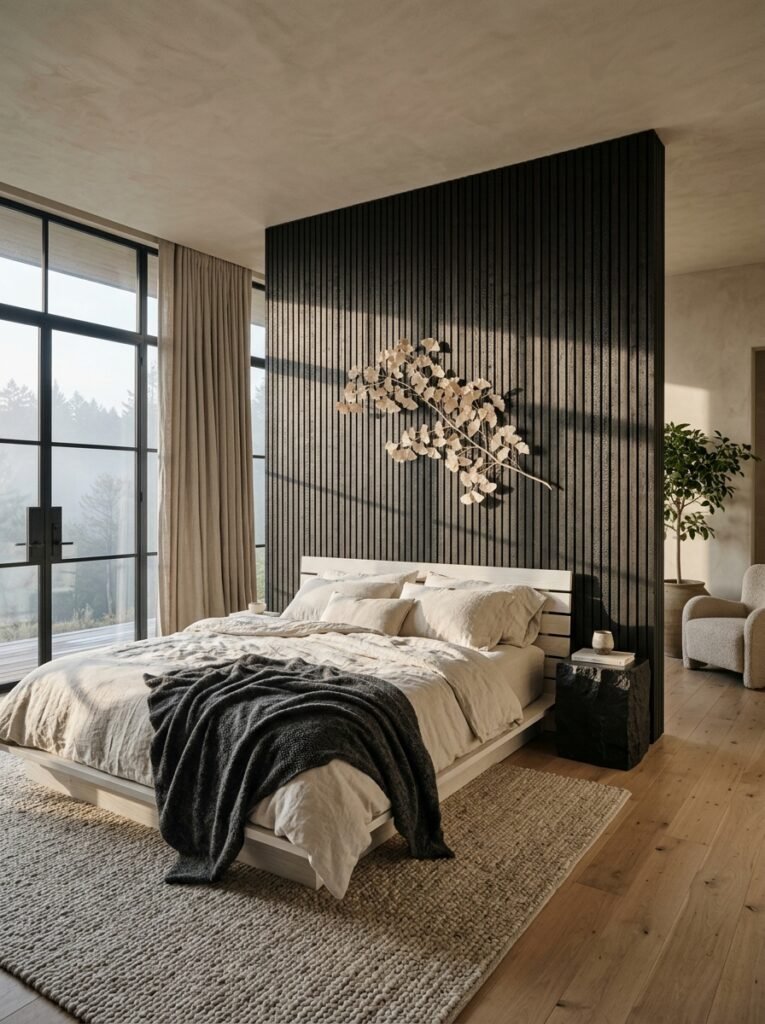
- Headboard wall in charred cedar (shou sugi ban) 1×2 slats, spaced 1/2 inch apart over black acoustic felt; remaining walls in matte bone paint
- Slatted frame in white ash, 14 inches to the mattress top
- Bone cotton-linen duvet with one charcoal merino throw (two layers)
- One bare ginkgo branch, 4 feet long, mounted horizontally on two black steel pegs
- ZZ plant (Zamioculcas zamiifolia) in a poured concrete pot; thrives in low light, water every three weeks
- Low-pile charcoal wool rug, 8 x 10 feet; heavy bone cotton canvas curtains (about 12 oz), blackout-lined
- Honed black basalt block nightstand, 12 x 12 inches, plus a low bone chest with recessed brushed stainless pulls
- Charcoal washi cylinder pendant with a 2400K bulb, plus a 2200K LED strip hidden above the slats, each on its own LED-rated dimmer
Why this works: Slats set a half-inch apart turn one hidden light source into a wall of shadow stripes that shift with the angle of the sun.
Charred cedar is not just a look; it is a centuries-old Japanese preservation method. Burning the surface seals the wood and leaves a matte, almost velvet black that drinks light. Set as 1×2 slats with half-inch gaps over black felt, the wall becomes a graphic backdrop and a mild sound absorber. A concealed LED strip at 2200K grazes the grooves, so each slat throws a thin shadow line. Against bone paint on the other walls, the contrast reads dramatic yet restrained, proof that minimalist japandi bedroom design can have real drama without extra objects.
I’ve made one dimmer mistake in this room, and it’s worth sharing. My first LED bulbs buzzed and flickered at low settings. My husband, who wires fixtures on job sites, explained that older dimmers were built for incandescent loads, and LEDs need an LED-rated trailing-edge dimmer. Swapping it took ten minutes and cost about $30. Now both the pendant and the slat strip glide down to a dim ember without a flicker. Pair them with heavy bone canvas curtains, lined for blackout, and the room goes from bright morning to near-theater dark in seconds.
4. Walnut Alcove Bed
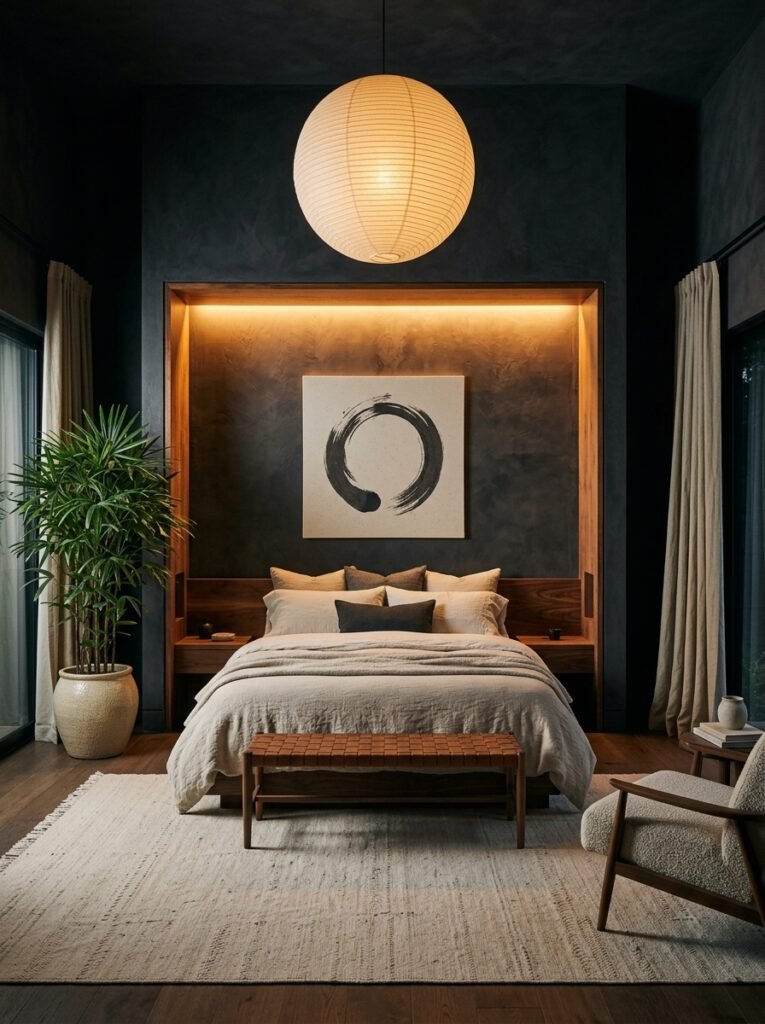
- Hand-troweled lime plaster in charcoal, left matte
- Built-in alcove bed framed in oiled American walnut, 16 inches to the mattress top, with a slatted base
- Bone cotton percale sheet, oat wool duvet, one ash linen throw (three layers)
- One unframed ensō-style brushstroke canvas, 36 inches wide, in bone paint on raw linen
- Lady palm (Rhapis excelsa) in an oat-glazed ceramic pot; medium to bright indirect light
- Bone cotton dhurrie with one charcoal stripe, 5 x 8 feet; mid-weight wool-linen curtains in charcoal on a ceiling track
- Recessed walnut niche in the alcove wall as the nightstand; oil-rubbed bronze pulls on the adjoining closet doors
- 24-inch spherical rice paper pendant at 2700K on a dimmer, plus a 2200K LED strip recessed into the alcove ceiling
Why this works: Wrapping the bed in a walnut alcove gives the room a clear focal point and hides the visual clutter of a freestanding frame.
A guest once asked if she’d checked into a boutique hotel. That was the best review this alcove bed has ever had. Walnut frames the mattress on three sides, while hand-troweled charcoal plaster pulls the eye inward like a stage set. At 16 inches high, the bed stays low, yet the framing gives it presence a bare platform can’t match. Evening is when it shines: a recessed 2200K strip washes the plaster in amber, and the spherical paper pendant adds a second, softer glow. Everything else stays bone and oat, so the alcove carries all the drama.
Enclosed beds have one hidden risk: moisture. A mattress sealed inside a box with no airflow can grow mildew, which my husband has seen in built-ins that skipped ventilation. His rule is simple. Use a slatted base with 2-inch gaps, leave a 1/2-inch reveal around the mattress, and never run solid plywood under it. We also oil the walnut with a hard-wax finish rather than a film varnish, so scratches can be spot-repaired in minutes. A built-in costs more than a freestanding frame, but it replaces a bed, nightstands, and extra shelving at once.
5. Black Wall Canopy
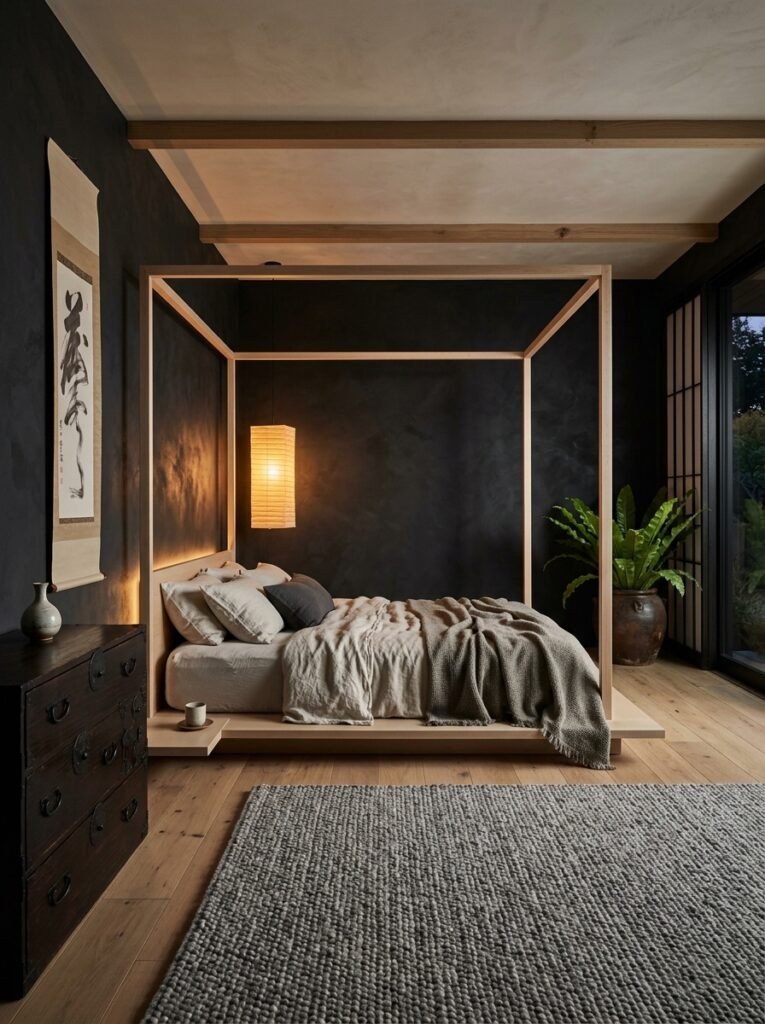
- Matte muted black paint on all four walls, with a bone ceiling to bounce light back
- Low canopy frame in pale maple, 11 inches to the mattress top, 2×2 posts rising to 6 feet
- Unbleached cotton twill duvet in bone, plus an oat quilted coverlet (two layers)
- One vertical hanging scroll, ink on paper, 12 x 48 inches, on a black wooden rod
- Bird’s nest fern (Asplenium nidus) in a cream speckled stoneware pot; bright indirect light, evenly damp soil
- Looped wool rug in ash gray, 9 x 12 feet; medium-weight hemp-linen curtains (about 7 oz) in bone
- Tansu-inspired stepped chest in paulownia, 18 inches tall, with forged iron pulls
- Akari-style rectangular washi lantern hung off-center with a 2400K bulb, plus a plug-in paper bedside lantern at 2200K, both dimmable
Why this works: Matte black paint absorbs light and blurs the wall edges, so the room reads as depth instead of boundaries.
Dark walls shrink a room, right? Not when they’re truly matte. A flat muted black absorbs light instead of bouncing it back, which blurs the corners and makes the walls recede. The result feels like depth, not enclosure. Here the pale maple canopy frame stands out like a drawing on charcoal paper, and the bone ceiling keeps the room from feeling heavy. Bone twill bedding adds a clean contrast, and a single hanging scroll draws the eye upward. Check your paint’s sheen before buying: anything above flat will show every roller mark in side light.
The canopy is deliberately low. At six feet, it frames the bed without touching the ceiling, and a sheer panel of white voile can hang from the top rail if you want privacy. I learned the hard way with the bird’s nest fern: I watered it in the center, and the crown rotted within a month. Water around the rosette instead, and keep it away from the cold air of a vent. The fern’s glossy, wavy fronds are the room’s only green, so its health matters. Dark walls make plants look brighter, which is why one is plenty.
6. Floating Plinth Bed
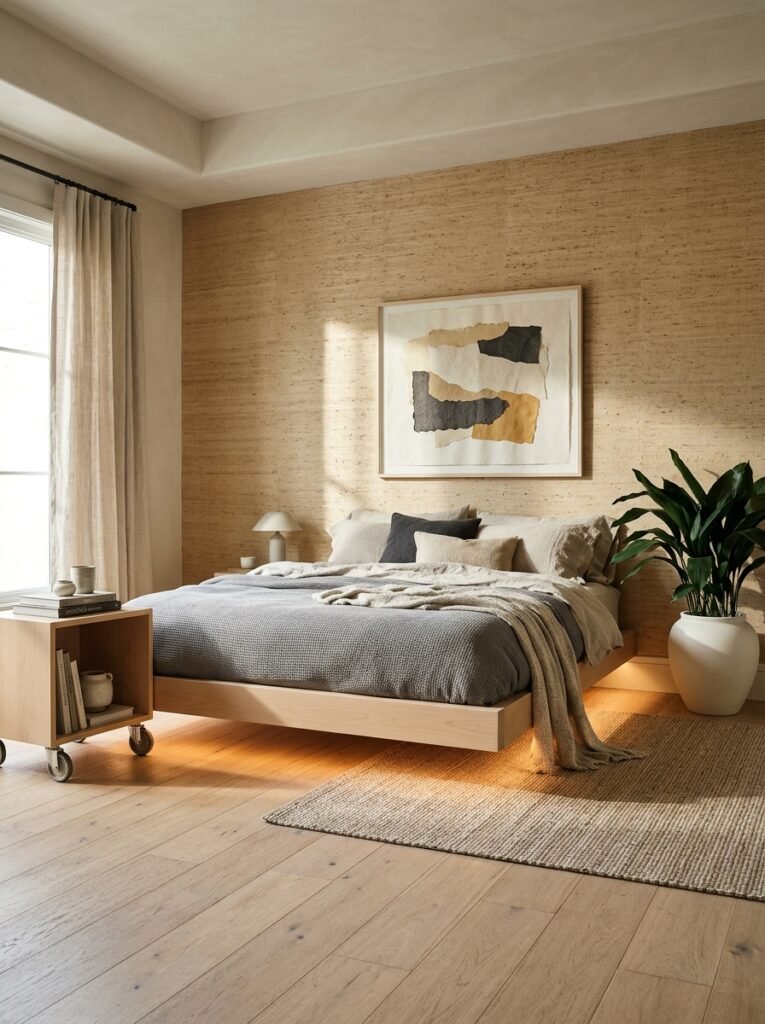
- Natural ramie grasscloth in oat-bone, hung with clear-drying paste
- Floating plinth bed in pale beech, 13 inches to the mattress top, with a recessed 4-inch shadow gap at the base and no headboard
- Ash gray cotton waffle duvet over a bone sheet (two layers)
- One hand-torn washi collage in oat and ash, 30 x 40 inches, floated in a thin beech frame
- Cast-iron plant (Aspidistra elatior) in a bone matte porcelain pot; handles low light and irregular watering
- Linen-cotton flatweave in bone, 8 x 10 feet; medium-weight linen curtains (about 6 oz) in ash gray
- Rolling pale beech cart, 16 inches tall, as the nightstand, with satin nickel casters
- Pair of oat handmade-paper drop pendants with 2700K bulbs, plus a 2200K LED strip in the plinth recess, all on dimmers
Why this works: A 4-inch shadow gap under the base makes a 13-inch bed look like it hovers, which hides bulk and reveals more floor.
Add a glowing shadow line and the bed seems to hover. This floating plinth does exactly that: a recessed 4-inch toe-kick, tucked under the pale beech base, hides a 2200K LED strip that washes the floor in warm amber. Grasscloth walls add soft texture, and in side light the ramie fibers show subtle, irregular stripes. I’ve seen this work well in small rooms, since visible floor beneath furniture is the quickest way to suggest more space. Everything above the plinth stays quiet: ash waffle cotton, a hand-torn washi collage, and one bone porcelain pot with a sturdy cast-iron plant.
Grasscloth deserves a little respect. It’s a natural fiber on paper backing, so it can stain and shouldn’t go behind a headboard that rubs it. That’s why this plinth bed has no headboard; the beech base stops at the mattress and the wall stays untouched. Hang it with a paste that dries clear, and ask the installer to hide seams at corners. For storage, the rolling beech cart tucks against the foot of the bed by day and glides bedside at night, with satin nickel casters rated for hardwood. It adds flexibility without adding a bulky nightstand.
7. Arched Niche Retreat
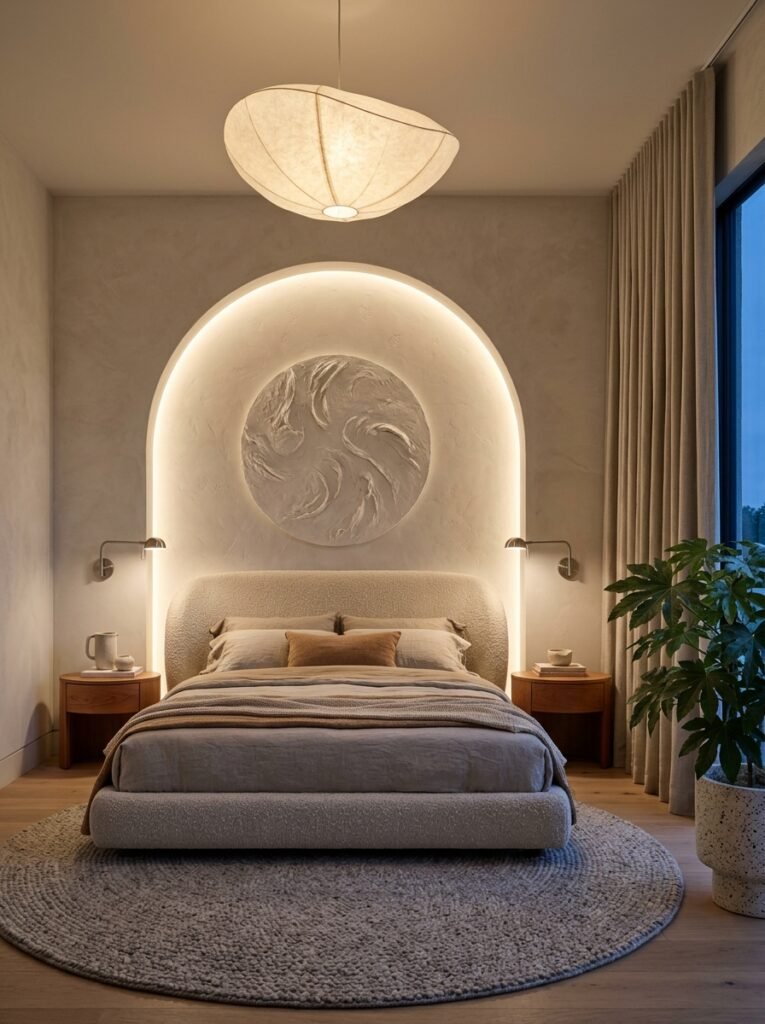
- Smooth tadelakt-finish plaster in pale stone gray, with a shallow arched niche (3 inches deep, 7 feet tall) behind the bed
- Low upholstered bed with a gently curved headboard in undyed linen, 14 inches to the mattress top, on hidden cherry legs
- Stone washed-linen duvet, bone cotton sheet, one oat merino throw (three layers)
- One large round tonal plaster relief, 30 inches wide, centered above the headboard
- Japanese aralia (Fatsia japonica) in a terrazzo planter; bright indirect light, cool room, evenly moist soil
- Round 7-foot wool rug in ash with a tonal border; soft-pleat cotton-linen curtains (about 8 oz) in stone
- Crescent-shaped nightstand in oiled cherry with brushed champagne nickel pulls
- Moon-shaped 20-inch washi pendant with a 2700K bulb, plus a swing-arm wall lamp in brushed champagne nickel with a 2200K bulb, both dimmable
Why this works: An arch softens the straight lines of a minimalist bedroom, so the room feels modern without feeling cold.
Straight lines are great, until a room starts to feel like a box. An arch fixes that. This niche, painted in the same pale stone plaster as the walls, frames the gently curved linen headboard like a quiet doorway. It adds shadow, depth, and a hint of softness that a rectangle can’t. The round rug, crescent nightstand, and moon-shaped pendant repeat the curve at three heights, so it feels planned, not decorative. I’ve noticed that one repeated shape does more for a minimalist room than five different small accessories ever could.
Arches look hard to build but aren’t. My husband frames them with a plywood template, then bends 1/4-inch drywall over it, wetting the back so it flexes without cracking. Plaster hairline cracks usually appear at the corners, so he embeds fiberglass mesh tape there before the first coat. The niche only needs 3 inches of depth, which fits inside a standard 2×4 wall, so there’s no need to move anything. Round out the look with soft-pleat cotton-linen curtains in stone, a swing-arm lamp in brushed champagne nickel, and a terrazzo planter holding a glossy Fatsia.
You’ll Also Love:23 Earthy Minimalist Bedroom Ideas for a Serene Space
8. Two-Tone Dado Daybed
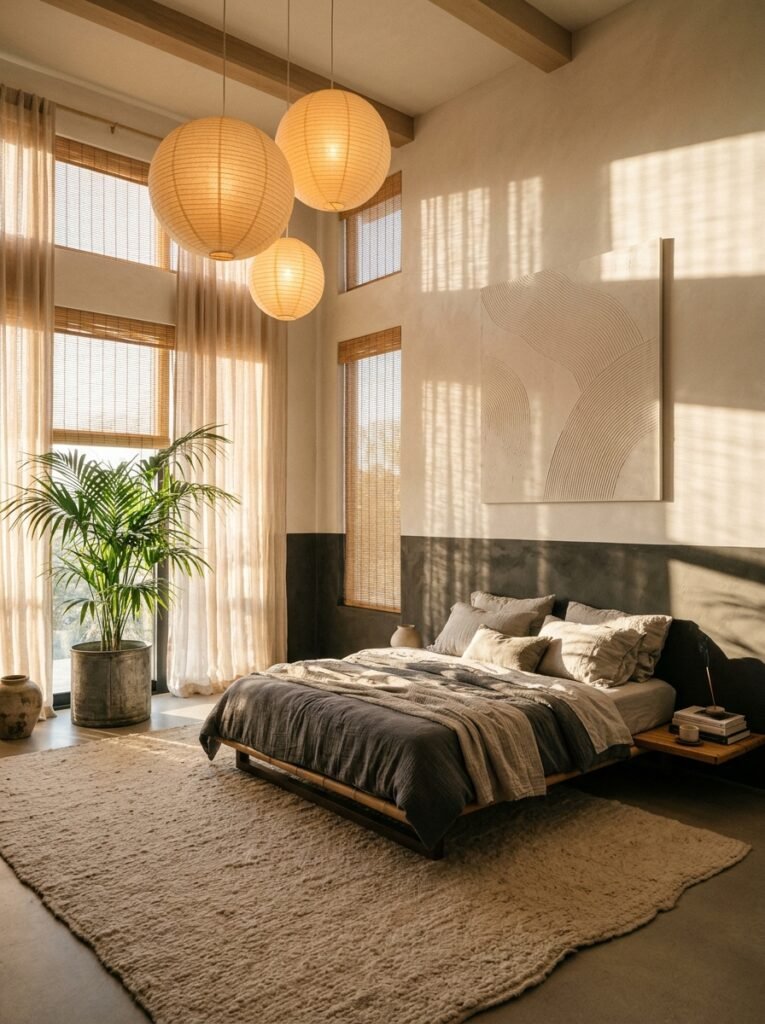
- Smooth plaster in bone above a 36-inch charcoal plaster dado, divided by a 1/2-inch shadow reveal
- Daybed-style frame in caramelized laminated bamboo with a side rail along the wall, 12 inches to the mattress top
- Double-layer ash cotton gauze duvet over a bone sheet (two layers)
- One linen-wrapped canvas, 36 x 36 inches, painted with fine charcoal raked lines in a karesansui-style pattern
- Kentia palm (Howea forsteriana) in a hammered zinc planter; low to medium light, water when the top inch of soil is dry
- Hand-felted wool rug in oat, 6 x 9 feet; natural bamboo sudare blinds layered with sheer linen
- Cantilevered bamboo ledge off the side rail as the nightstand; antique pewter pulls on a low bone dresser
- Cluster of three small washi globes at staggered heights with 2700K bulbs on one dimmer, plus a floor-standing paper lantern at 2200K
Why this works: A dado splits the wall into two bands of tone, which lifts the ceiling and ties low furniture to the wall.
Japanese interiors have used two-tone walls for many centuries, and the logic is practical. A darker lower band hides scuffs from beds, shoes, and vacuums, while a lighter upper band reflects light up and across the ceiling. Here, 36 inches of charcoal plaster anchors the caramel bamboo daybed, and the bone plaster above lifts the room. A narrow shadow reveal, about a half inch, separates the two tones, so the line looks crisp instead of painted on. The result feels modern and architectural, yet it asks for almost no extra decor.
Morning is the real show. Natural bamboo sudare blinds, layered over sheer linen, break sunlight into thin horizontal stripes that slide slowly across the bone wall. Bamboo itself is technically a grass, harder than many oaks, and caramelized laminated bamboo gets its warm honey-brown tone from steam pressure rather than stain. That makes it a smart choice for a daybed frame that sees daily use. Add a hand-felted oat rug, a kentia palm in hammered zinc, and a cluster of three small washi globes, and the full room feels layered but quiet.
9. Fluted Plaster Timber Bed
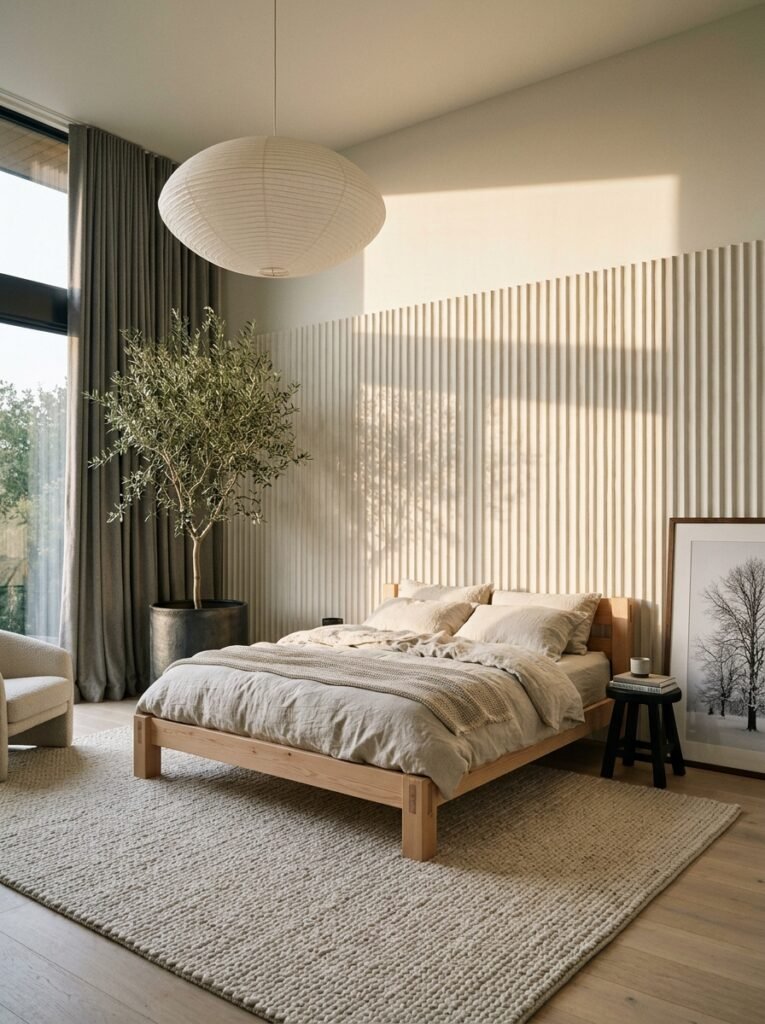
- Fluted plaster headboard wall in bone, 1-inch flutes, floor to ceiling; remaining walls in smooth matte oat paint
- Timber-frame bed in pale Douglas fir with exposed through-tenon joinery, 12 inches to the mattress top
- Oat linen duvet, bone cotton percale sheet, one charcoal wool-blend blanket folded at the foot (three layers)
- One black-and-white photograph of bare winter trees, 32 x 40 inches, in a narrow black ash frame
- Olive tree (Olea europaea) in a charcoal powder-coated steel planter; needs a window with at least six hours of direct sun
- Hand-knotted wool rug in bone with a charcoal border, 8 x 10 feet; heavy wool-flannel curtains in oat
- Single-drawer stool nightstand in ebonized oak with a raw waxed steel pull
- 28-inch ellipsoid washi pendant with a 2400K bulb, a table lamp with an oat paper shade at 2200K, and a slim 2700K up-light washing the flutes, all dimmable
Why this works: Vertical flutes catch low light and throw shadow lines, giving a flat wall real texture without adding a single object.
I put fluted plaster in the guest room as a test, and the reaction surprised me. Friends kept running their hands along the wall. Fluting does that: it invites touch and changes all day. At sunrise, light skims the 1-inch ridges and creates rhythm, like a long exhale. By night, a slim up-light turns the same wall into a gentle fan of glow. Against pale Douglas fir and bone sheets, the texture does the work of art, so just a single framed photograph is all the wall needs to feel finished.
The bed is the second feature. A timber-frame design uses mortise-and-tenon joints, with the tenons passing straight through and showing on the outside, so the structure is the decoration. Douglas fir is a good fit: it’s strong for its weight, widely available in the US, and its straight grain suits a quiet room. Seal it with a matte water-based finish so it keeps its pale, slightly peachy tone. Then add one living sculpture, an olive tree in a charcoal steel planter. Give it a window with at least six hours of direct sun, or it will drop leaves.
10. Kumiko Lattice Headboard
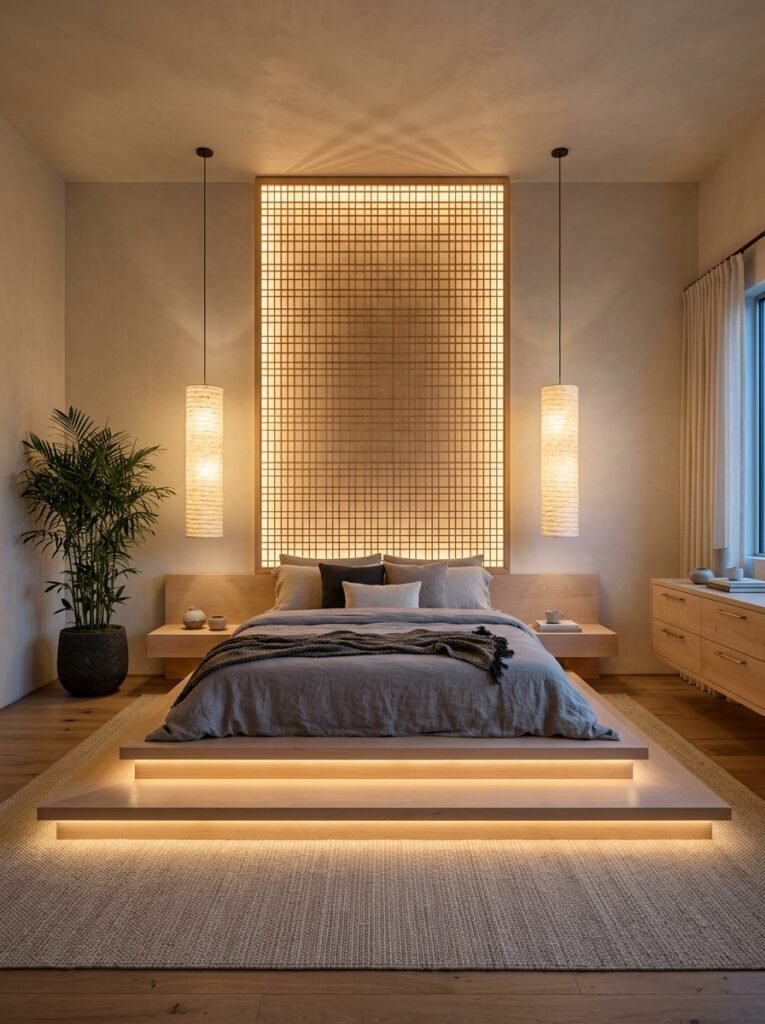
- Smooth matte paint in warm bone, with a 5 x 4 foot kumiko lattice panel in pale basswood mounted 1 inch off the wall over a hidden 2200K LED strip
- Stepped platform bed in pale sycamore, 14 inches to the mattress top, with an 18-inch-wide, 6-inch-high ledge along both sides
- Bone cotton percale sheet, ash linen duvet, one charcoal merino blanket (three layers)
- The kumiko lattice panel itself, in a simple asanoha pattern, as the room’s single statement
- Bamboo palm (Chamaedorea seifrizii) in a carved lava-stone planter; low to medium light, evenly damp soil
- Hand-loomed wool-cotton flatweave in oat, 8 x 10 feet; lightweight cotton voile curtains (about 3 oz) in bone
- The ledges replace nightstands; wall-hung sycamore drawer chest with recessed satin bronze pulls
- Pair of elongated 10 x 30-inch washi pendants at 2400K hung over each ledge, plus the 2200K LED behind the lattice, all dimmable
Why this works: Kumiko lattice is built from interlocking wood pieces without nails, so it adds fine, geometric detail that reads as craft, not pattern.
Kumiko is a Japanese woodworking technique that fits thin, grooved wood strips together without nails. The result is a geometric lattice with real depth, and it makes a striking headboard wall. Mounted 1 inch off the wall with a warm LED behind it, a 5 by 4 foot panel throws a fine grid of shadow onto the bone paint. Pale basswood keeps it light, so the panel feels delicate rather than heavy. For a modern look, choose a simple asanoha or square pattern and avoid busy, ornate designs. Let the lattice carry the room, and keep everything else quiet.
The stepped bed solves bedside clutter. A 6-inch-high, 18-inch-wide ledge runs along both sides of the mattress, so a lamp, a glass of water, and a book each have a place without any nightstand. Pale sycamore has a fine, even, quiet grain that looks smooth under linen and finishes well with matte oil. I’ve seen this work well in narrow rooms where a pair of nightstands would crowd the walkway. To finish, add satin bronze recessed pulls on a wall-hung drawer chest, and a pair of tall washi pendants over each ledge.
11. Microcement and Steel
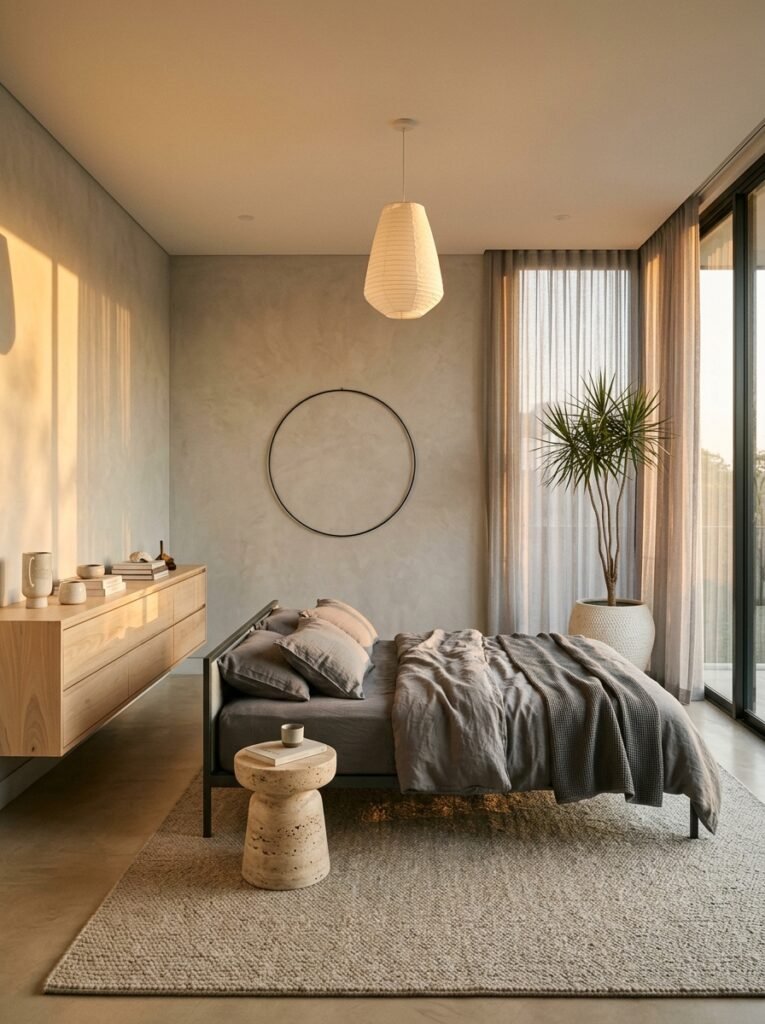
- Seamless microcement in cool pale gray with soft trowel marks on all walls, bone ceiling above
- Slim steel-rail frame in matte graphite with a pale poplar slat deck, 10 inches to the mattress top
- Pewter-gray washed cotton duvet over a bone sheet, plus one oat wool throw (three layers)
- One thin blackened-steel ring, 30 inches in diameter, hung flat against the wall
- Dragon tree (Dracaena marginata) in a bone fiber-clay planter; bright to medium light, toxic to pets
- Hand-woven wool-cotton rug in oatmeal with one charcoal stripe, 9 x 12 feet; floor-to-ceiling wool gauze curtains (about 5 oz) in ash
- Pair of honed travertine drum stools, 16 inches tall, as nightstands; floating poplar dresser with satin chrome pulls
- Tapered 18-inch washi pendant at 2700K, a satin chrome plug-in sconce at 2200K, and a hidden LED strip under the dresser, each on its own dimmer
Why this works: A single cool material on the walls lets pale wood and soft linen read as warm without any added color.
I used to think microcement was cold. Then I saw it in an Austin loft at sunset, and the pale gray walls glowed peach. That’s the trick: a cool, matte surface acts like a canvas for changing light. Here the walls stay seamless, with soft trowel marks and a bone ceiling above. The slim graphite steel frame has a lower profile than most wooden frames, at just 10 inches, so the eye reads wall first, bed second. Against pewter-gray bedding and an oat rug, the whole room feels quiet, modern, and confidently restrained.
Mixed materials keep this bedroom from feeling cold. Honed travertine drum stools replace nightstands, bringing a soft, sandy texture beside the steel, while satin chrome pulls on a floating poplar dresser add a cool, polished glint. The dragon tree gives the corner a tall, slender line, but it’s toxic to cats and dogs, so I keep mine out of reach. Lighting stays low and warm: a tapered washi pendant at 2700K, a satin chrome sconce at 2200K, and a hidden LED strip under the dresser. Layer them on separate dimmers, and the room shifts easily from morning to midnight.
12. Pill-Shaped Elm Bed
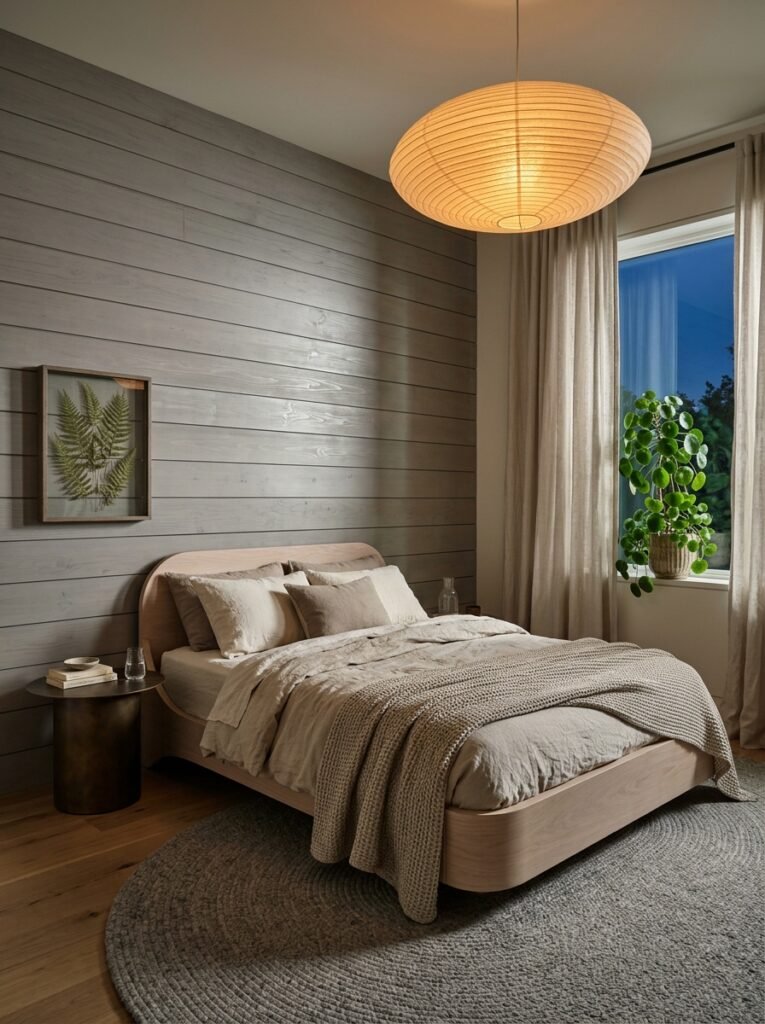
- Horizontal sugi (Japanese cedar) planks, 6 inches wide, lightly wire-brushed and finished in a bone-gray wash on the bed wall; remaining walls in matte warm white
- Stadium-shaped platform bed in pale elm with fully rounded ends, 12 inches to the mattress top
- Oatmeal cotton-linen duvet, bone percale sheet, one ash alpaca blanket (three layers)
- One pressed-fern botanical in a deep-set shadow box, 24 x 30 inches
- Chinese money plant (Pilea peperomioides) in a powder-coated aluminum pot; bright indirect light, rotate weekly
- Oval low-pile wool rug in ash gray, 7 x 10 feet; light-filtering linen-cotton curtains (about 6 oz) in pale ash
- Round floating nightstand, 14 inches wide, in smoked oak with dark brushed bronze hardware
- One oval 30-inch washi pendant at 2400K centered over the bed, plus a table lamp with a paper shade at 2200K, both dimmable
Why this works: A fully rounded bed removes corners from the room’s most visible object, softening a minimalist space without adding a single accessory.
Sharp corners are everywhere in a modern bedroom: the bed, the nightstands, the dresser. A pill-shaped bed breaks that pattern in one move. Its fully rounded ends echo the oval rug and round nightstand, giving the room a soft, organic modern rhythm that feels current rather than trendy. In pale elm, the frame’s fine grain stays quiet against the horizontal sugi wall. At 12 inches high, it keeps the room low and open. I’ve noticed that guests rarely comment on one curved piece, but they always say the room feels softer.
Horizontal planks do the opposite of vertical slats: they stretch the room sideways, which suits a narrow bedroom. Sugi is Japanese cedar, a soft, straight-grained wood with a faint natural scent. Brush it lightly with a wire brush before finishing, and the grain lifts into subtle ridges that catch evening light. A bone-gray wash keeps the tone soft instead of orange. Add a Chinese money plant in a powder-coated aluminum pot, rotating it weekly so it grows evenly toward the window. Then hang one oval washi pendant, centered over the bed at 2400K, to finish the curve.
13. Drawer Platform Nook
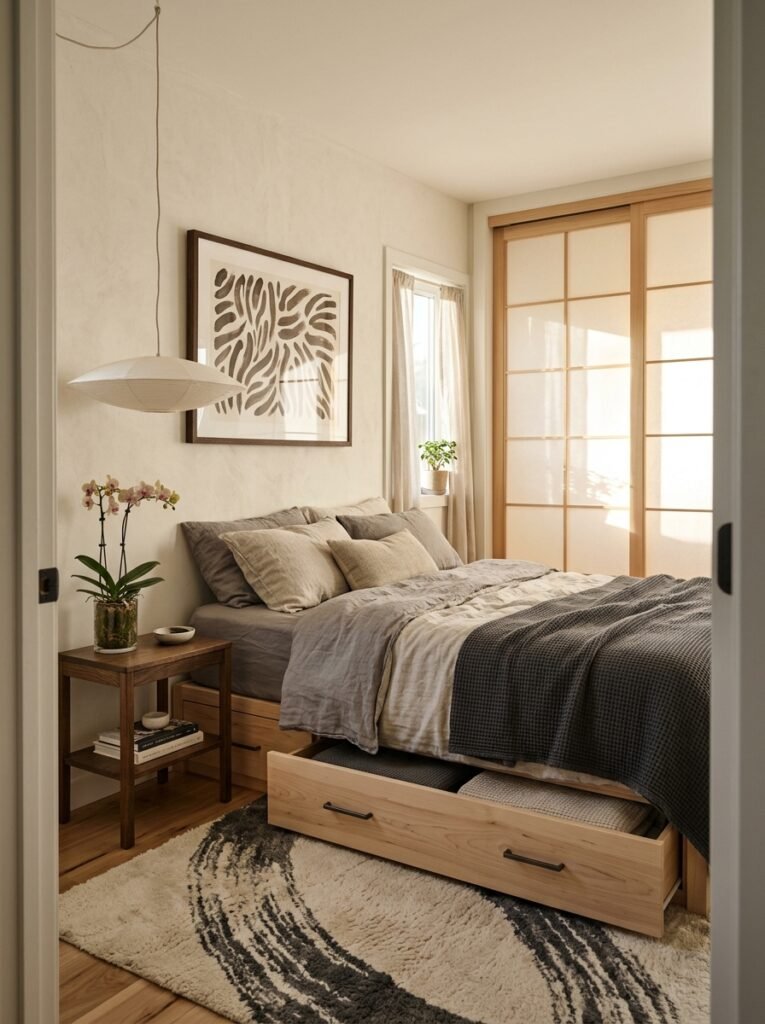
- Kozo-fiber wallcovering in bone with visible fibers on all four walls
- Drawer platform bed in pale hickory, 15 inches to the mattress top, with four soft-close drawers 7 inches deep
- Ash cotton-linen duvet, bone percale sheet, one oat waffle-weave blanket (three layers)
- One framed katazome-style stencil print in charcoal on bone, 24 x 36 inches
- Moth orchid (Phalaenopsis) in a clear glass pot; bright indirect light, soak the roots weekly
- Hand-knotted rug in pale ash with a loose charcoal brushstroke, 6 x 9 feet; shoji-style sliding closet doors with translucent panels, plus a bone linen roller shade
- Two-tier hickory bedside table with a linen-lined tray; black nickel pulls on the drawers
- 24-inch flat saucer washi pendant with a 2700K bulb, plus a wall sconce with a paper shade at 2200K, both dimmable
Why this works: Under-bed drawers replace a dresser, which clears wall space and keeps a small bedroom feeling open.
My first apartment bedroom was 10 by 11 feet, and the dresser took a whole wall. I wish I’d known about drawer platforms back then. Four soft-close drawers under a pale hickory bed hold a season’s worth of sweaters, jeans, and bedding, so the walls stay clear. Kozo-fiber wallcovering in bone adds quiet texture, and shoji-style closet doors glow softly in morning light. The room reads as one smooth, uncluttered volume. That clarity is what makes a small bedroom feel bigger, far more than any mirror or trick of paint.
Shoji-style sliding doors do more than look good. They need no swing space, so the closet wall stays usable, and the translucent panels let light bounce deeper into the room. Pair them with a Phalaenopsis orchid in a clear glass pot, and here’s the part I love as a plant scientist: the roots are green and photosynthesize, which is why clear pots work. Soak the roots for 15 minutes weekly, then drain fully. Finish with a flat saucer washi pendant at 2700K and a two-tier hickory bedside table, so every surface has a job and nothing sits idle.
14. Twin Platform Pair
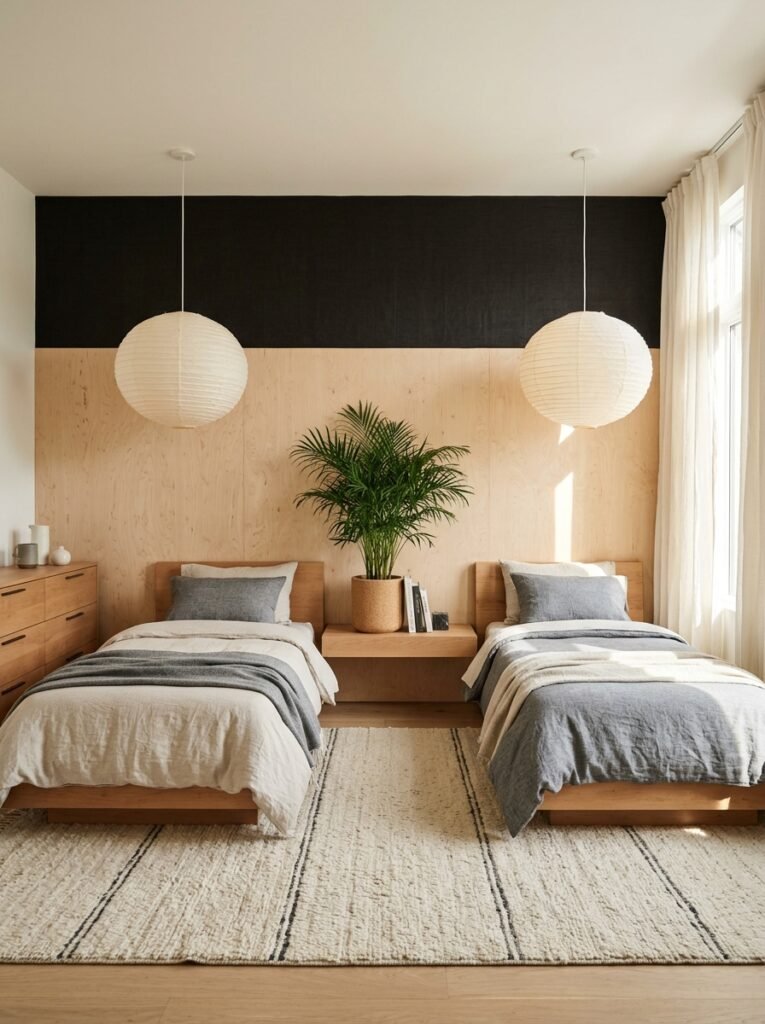
- Baltic birch plywood panels (4 x 8 foot sheets, 1/4-inch reveals, clear matte finish) on the bed wall; remaining walls in matte warm white
- Two low twin platform beds in alder, 12 inches to the mattress top, set 30 inches apart
- Bone percale sheets on both beds, one oatmeal linen duvet and one ash linen duvet
- One 48-inch muted black linen-wrapped panel centered above the shared shelf
- Parlor palm (Chamaedorea elegans) in a natural cork planter; low to medium light, non-toxic to pets
- Flatweave wool rug in bone with a charcoal center stripe, 8 x 10 feet, running between the beds; blackout-lined cotton curtains (about 10 oz) in warm white
- Shared floating alder shelf, 30 inches wide, as the nightstand; gunmetal pulls on a low shared dresser
- One 12-inch washi lantern pendant over each bed at 2400K, plus individual wall reading lights at 2200K, each on its own dimmer
Why this works: Two low beds with a shared center shelf give couples and guests separate sleeping space while the room stays symmetrical and clean.
Twin beds are having a modern moment. Sleep specialists often note that couples with different schedules, temperatures, or movement can sleep better when they have separate mattresses, and a symmetrical layout keeps the room looking intentional instead of improvised. Here two alder platform beds sit 30 inches apart, connected by a floating shelf that acts as a shared nightstand. Baltic birch panels behind them show their layered edges as a fine, graphic line, and a muted black linen panel centers the wall. Even rooms used only for guests feel more welcoming when each person gets their own bed.
Baltic birch plywood is a smart choice because it’s made of many thin, even layers with no voids, so the cut edges look clean rather than rough. Leave 1/4-inch reveals between sheets, and finish with a clear matte water-based sealer to keep the pale color. A parlor palm in a natural cork planter softens the geometry, and it’s non-toxic to cats and dogs, which matters in a guest room. Add gunmetal pulls on a shared low dresser, blackout-lined cotton curtains, and one dimmable washi lantern over each bed for personal control.
15. Felt Wall Cane Bed
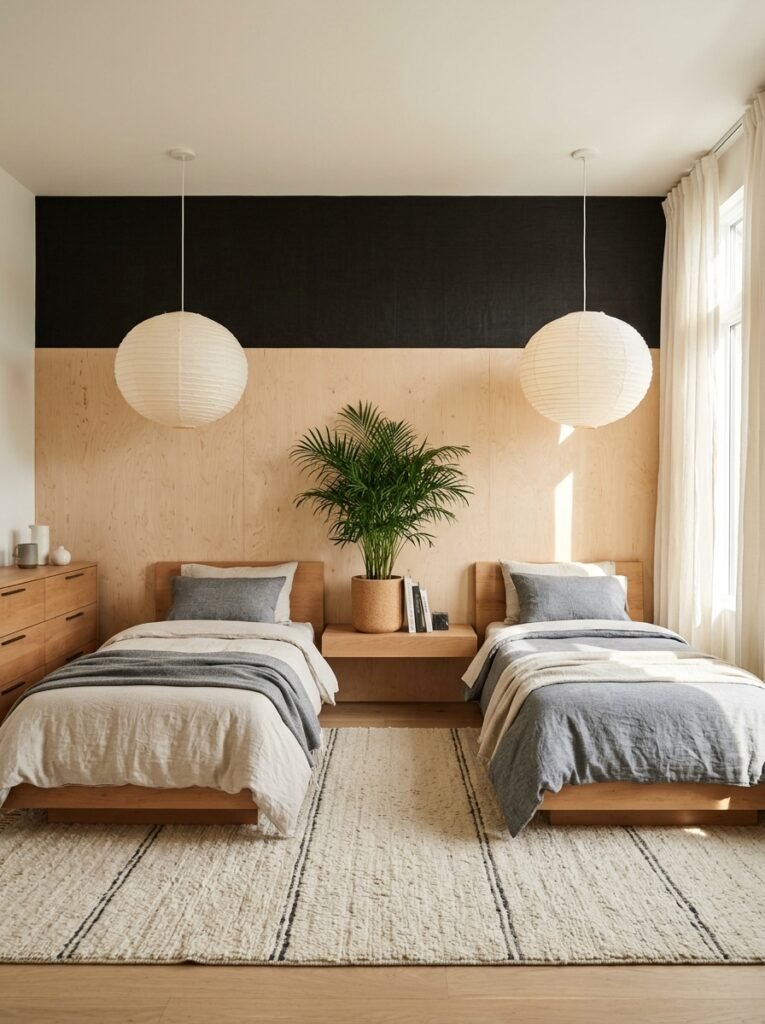
- Charcoal wool-felt acoustic panels (1/2 inch thick) forming a 7-foot-wide headboard wall; remaining walls in matte warm bone paint
- Low larch frame with woven natural cane side panels, 13 inches to the mattress top
- Oat washed-linen duvet, bone sheet, one charcoal wool blanket across the foot (three layers)
- One narrow larch ledge holding three dried lotus seed pods in a clear glass cylinder
- Rubber plant (Ficus elastica) in a woven seagrass basket with a waterproof liner; bright indirect light, mildly toxic to pets
- Undyed natural wool rug, 8 x 10 feet; sheer bone linen layered with ash cotton-velvet curtains (about 12 oz)
- Cane-fronted larch bedside cabinet, 18 inches tall, with oat leather-strap pulls
- 26-inch washi drum pendant at 2400K, plus a table lamp with a rice-paper shade at 2200K, both dimmable
Why this works: Wool felt tames echo as well as light, so the room feels hushed, a real benefit near a street or a busy hallway.
Quiet is a luxury, and felt delivers it. Wool-felt panels, half an inch thick, tame echo and soften street noise, so the room feels hushed the moment you walk in. I’ve seen charcoal felt headboard walls work especially well in rooms facing busy streets, where hard surfaces bounce every sound around. Visually, the soft, matte texture adds depth without any pattern, while the larch frame’s cane panels let light and air move through the base of the bed. It’s the kind of tactile, understated richness designers call quiet luxury, and it’s genuinely livable.
Installing felt is simple. Cut panels to size with a sharp blade, mount them on a 1/4-inch plywood backer, and leave a small reveal around the edges for a tailored look. Cane needs care: keep it out of damp spots and vacuum gently with a brush attachment. Soften the floor with an undyed wool rug, then layer sheer linen with ash cotton-velvet curtains for evening privacy. The rubber plant in a seagrass basket brings in a bold, glossy leaf, which looks beautiful against the charcoal. Finish with oat leather-strap pulls and a washi drum pendant at 2400K.
Styling Principles for Low, Edited Bedrooms
Every bedroom above follows the same short rulebook. Use it to build your own version.
- Start with bed height. The best bed height for a Japandi bedroom is 10 to 16 inches from the floor to the top of the mattress. Anything taller breaks the low eye line that makes the room feel larger.
- Keep the floor visible. One rug, one bed, and a nightstand or ledge are enough. Visible floor under and around furniture is the fastest way to suggest more space.
- Edit each wall to one move. A single material, such as plaster, slats, or a lattice panel, or a single piece of art does the work. If you want both, choose a quiet material and one quiet piece.
- Light low and warm. Bulbs between 2200K and 2700K on dimmers keep a Japandi bedroom restful, and paper shades diffuse the glow instead of casting hard shadows.
- Limit bedding to two or three layers. A sheet, a duvet, and one throw look finished. A fourth layer starts to look like clutter.
- Name your materials. Every room above uses exact woods, fabrics, and finishes. Honest materials need no extra decoration.
Frequently Asked Questions About Minimalist Japandi Bedroom Design
What makes a bedroom Japandi? A Japandi bedroom combines Japanese restraint with Scandinavian function. It has low furniture, natural materials like wood, linen, and plaster, a quiet palette, and very few objects. Each item has a clear job, and nothing is there only to fill space.
What is the best bed height for a Japandi bedroom? Aim for 10 to 16 inches from the floor to the top of the mattress. A floor bed sits at the low end, and a platform or upholstered frame at the upper end. This range keeps the eye line low without making the bed hard to get out of.
What are the best indoor plants for a Japandi bedroom? Snake plants, ZZ plants, cast-iron plants, kentia palms, and ponytail palms handle indoor conditions well. Juniper bonsai look right for the style, but they are outdoor trees that need winter dormancy and usually decline indoors within months. Check each plant’s light needs before choosing a spot.
How can I try this style on a budget? Start with changes that cost little: lower the bed by removing legs or using a floor mattress, switch to linen-look bedding in one tone, and add a paper pendant, which is often well under $100. Clear surfaces and one wall piece cost nothing and change the room the most.
How is Japandi different from Scandinavian and minimalist styles? Scandinavian bedrooms lean light, white, and layered for coziness. Minimalism is a general approach of owning less, with no set materials or culture behind it. Japandi sits between them, with low furniture, handmade textures, and darker accents like charcoal or muted black.
What lighting works best in a Japandi bedroom? Use several dimmable, warm sources at 2200K to 2700K: a paper pendant, a bedside lamp, and a wall light or hidden LED strip. Layering lights lets you shift the mood from morning to midnight. Use LED-rated dimmers to avoid flicker.
Keep Reading
If you want the wood-pairing thinking behind this style, start with our Japandi Dining Room guide. If you prefer warm, clay-toned minimalism instead, see our Earthy Minimalist Bedroom Ideas.
Conclusion
A calm, beautiful bedroom doesn’t need more furniture. It needs lower lines, honest materials, and light you can dim. Whether you choose limewash and a washi lantern, a fluted plaster wall, or a simple floor bed, minimalist japandi bedroom design works because every piece earns its place. I’ve seen how small changes like these can completely transform a space.
Pick one idea that fits your room, try it, and let it grow from there. Save this post on Pinterest so you can come back to it, and share it with a friend who is ready for a quieter bedroom.