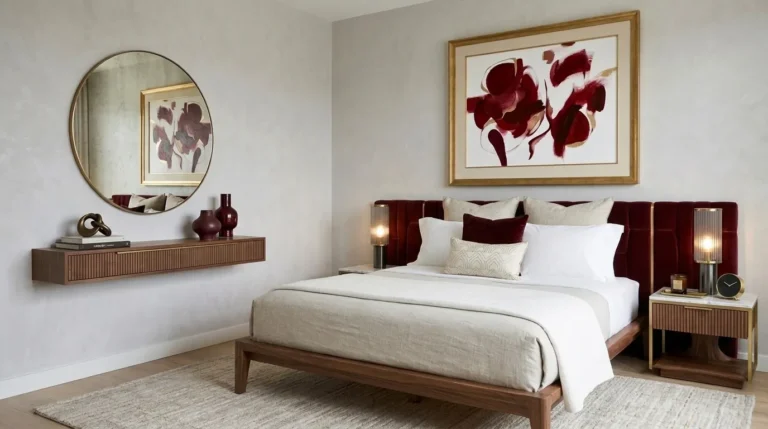
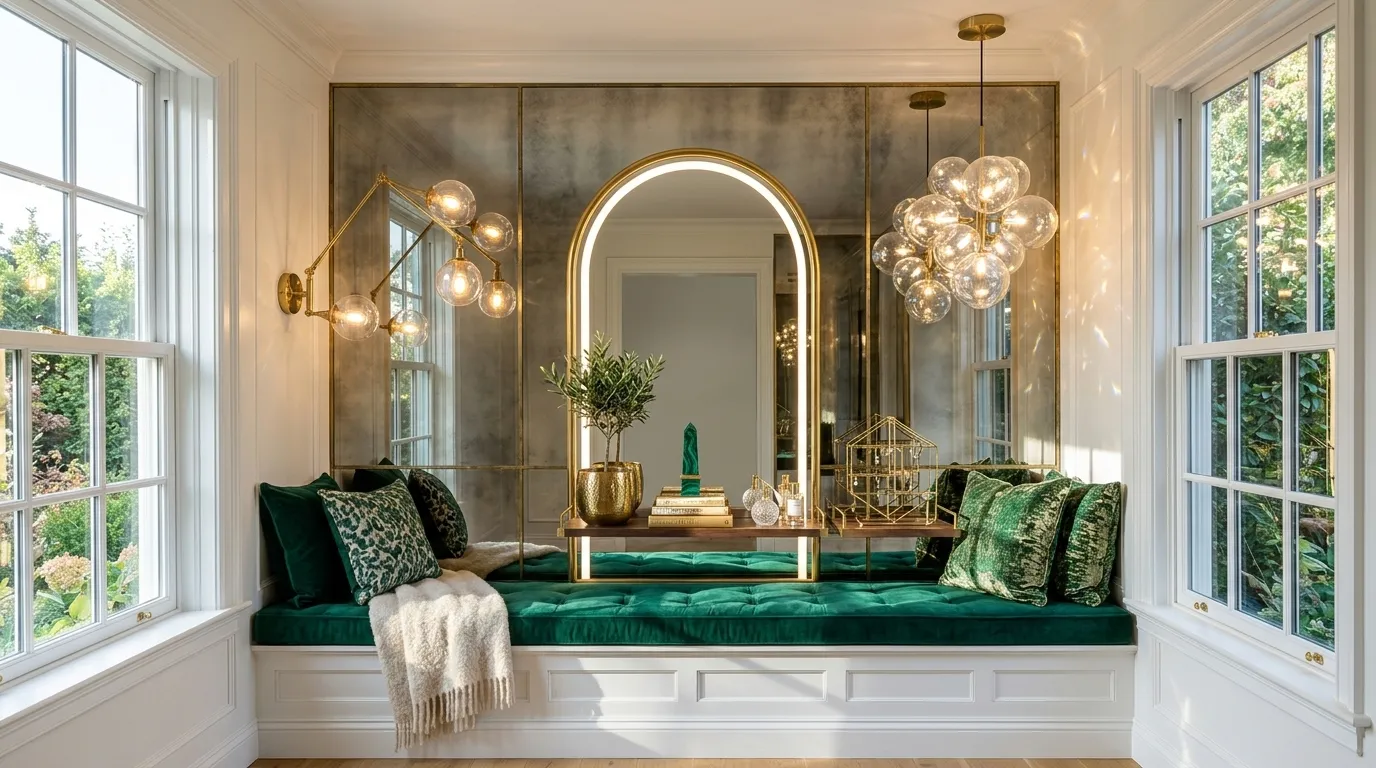
15 Vanity Ideas for Small Bedrooms That Save Space
Most small bedrooms don’t actually lack space for a vanity — they lack the right kind of vanity. A traditional vanity table with a bench typically needs at least 36 to 40 inches of clearance to use comfortably, which is more floor space than most small bedrooms can spare. That’s the real problem. I learned this the hard way styling a 10×11 guest room where a beautiful antique vanity looked perfect in photos and was completely unusable in person — nobody could pull the bench out without hitting the bed frame.
A small bedroom doesn’t need to skip the vanity — it needs a footprint that does double duty, like a wall-mounted floating shelf or a repurposed narrow desk, instead of a dedicated furniture piece.
This post solves that exact problem, with 15 vanity ideas for small bedrooms built around real dimensions, not just pretty photos.
1. Floating Ash Shelf Vanity
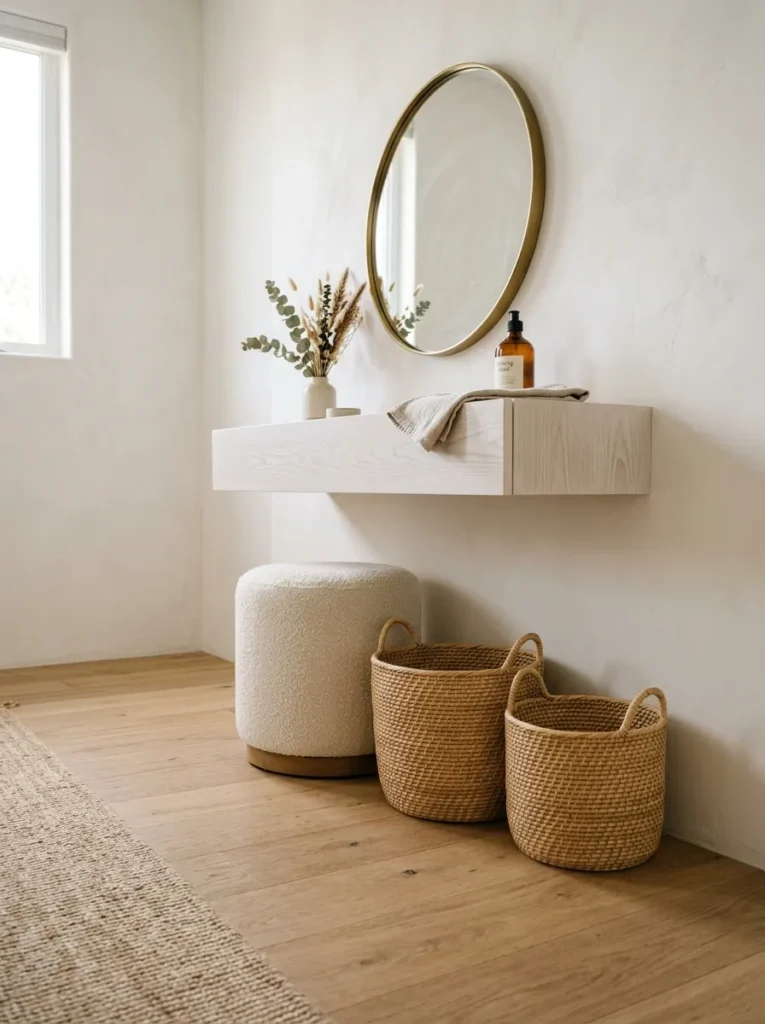
- Footprint: 30″ wide x 12″ deep floating shelf, mounted at 30″ height — leaves the floor completely open
- Material/finish: whitewashed ash wood shelf, brushed brass bracket, warm white plaster wall behind
- Mirror: 24″ round mirror, thin brass frame, tilted slightly forward
- Lighting: two brass sconces with warm 2700K bulbs, mounted at eye level on either side
- Storage: two woven rattan baskets underneath for brushes and hair tools — no drawers needed
- Seating: low cream boucle stool, 16″ tall, tucks fully under the shelf when not in use
- Integration: pairs with linen bedding in the same warm white, keeping the corner feeling like one uninterrupted plane
Why this works: A floating shelf vanity gives you the full function of a dressing station without a single inch of floor footprint, which matters most in rooms under 100 square feet.
A wall-mounted vanity is one of the few space-saving options that doesn’t compromise on function, since the floor beneath it stays completely open. My husband’s crew installs floating shelves like this constantly, and the rule never changes: you need a horizontal stud run or blocking behind the drywall to hold real weight, especially once a mirror and daily use are added. A shelf that isn’t anchored into studs will sag within months. Done correctly, a floating vanity holds firm for years and reads as built-in rather than added on, which is exactly the polished look a small bedroom needs.
Visually, this setup earns its spot through restraint rather than size. The whitewashed ash grain against a warm white plaster wall creates soft tonal movement without visual clutter, and the round brass mirror keeps the eye moving instead of stopping on a heavy frame. Rattan baskets underneath do the storage work drawers usually handle, so the whole piece stays light and airy rather than boxy. In a small bedroom, that lightness matters more than people expect — a floating vanity in whitewashed ash and brass reads as a design feature, not a squeezed-in necessity.
2. Moody Corner Vanity Nook
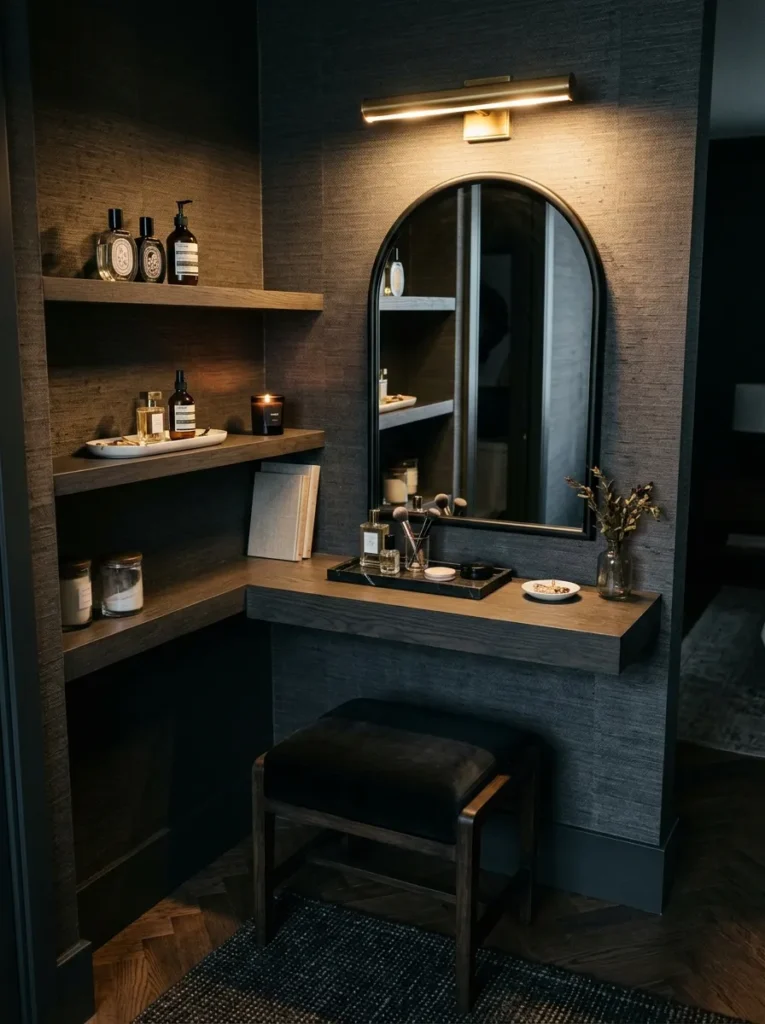
- Footprint: corner-fitted, two 18″ deep floating shelves meeting at a 90-degree angle, using a dead corner most furniture can’t reach
- Material/finish: charcoal-stained oak shelves, aged brass corner bracket, deep charcoal grasscloth wallpaper behind
- Mirror: arched black-framed mirror, 20″ wide, mounted to span the corner seam
- Lighting: single brass picture light above the mirror, warm 2400K bulb, casts a soft downward glow
- Storage: slim brass tray on one shelf for jewelry, small lidded box on the other for hair ties and pins
- Seating: low black velvet stool, 15″ round, slides fully into the corner when not in use
- Integration: charcoal tone echoes bedding in the same family, keeping the corner from feeling like an afterthought
Why this works: A corner vanity claims square footage that almost no other furniture piece can use, which makes it one of the most efficient upgrades in a small room.
I styled a corner vanity like this in a client’s 9×10 bedroom after she told me she’d given up on ever having a dressing spot of her own. The dead corner behind her door had sat empty for years, holding nothing but a stack of laundry. Two charcoal-stained shelves and an arched mirror later, that corner became her favorite part of the room. She texted me a photo of her morning coffee sitting on the shelf the following week. Corners are almost always wasted space, and a vanity built to fit one turns dead square footage into daily function.
The charcoal grasscloth wallpaper behind the shelves does more than add texture — it absorbs light in a way flat paint doesn’t, giving the whole nook an evening, jewel-box feeling even at midday. Aged brass hardware and a single warm picture light keep the mood intimate instead of clinical, which matters in a corner meant for slower morning routines. A black velvet stool completes the look without competing for space, since it disappears entirely into the shadowed corner when tucked away. Compact bedroom vanity ideas like this one work best when the finishes commit fully to one mood.
3. Repurposed Vintage Writing Desk
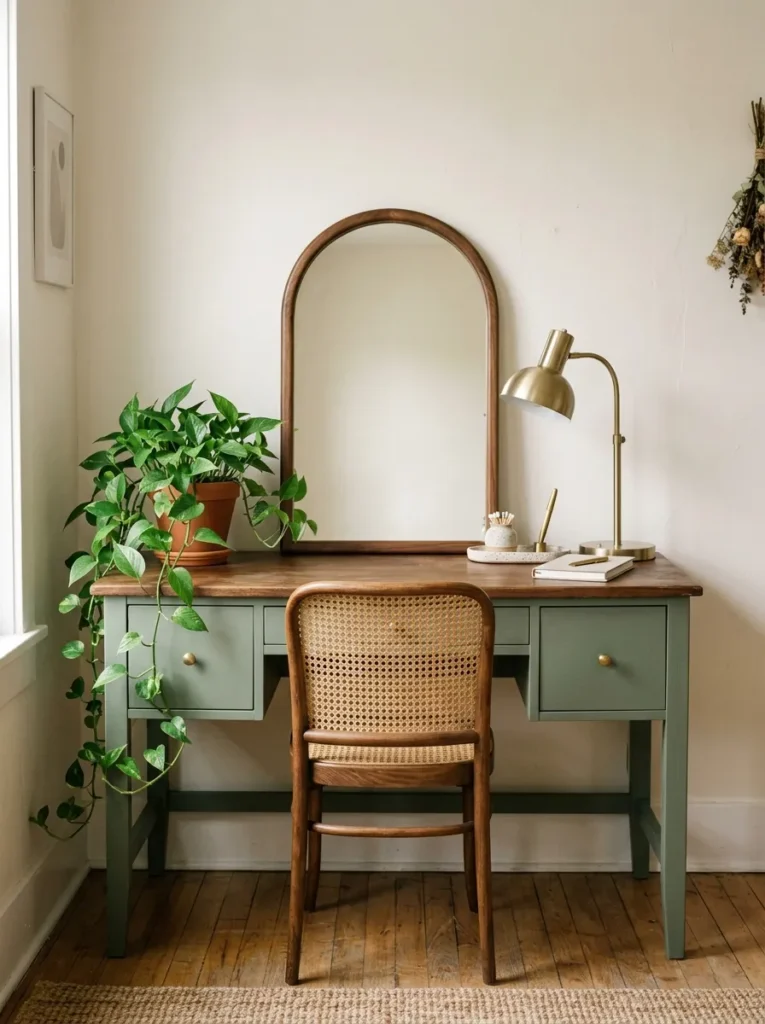
- Footprint: 28″ wide vintage writing desk, 16″ deep, single drawer, sits flush against a wall — smaller footprint than most purpose-built vanities
- Material/finish: walnut desk top, sage green painted base (chalk paint), original brass drawer pull kept intact
- Mirror: vintage arched mirror with a thin walnut frame, leaned rather than mounted, propped directly on the desk
- Lighting: single brass gooseneck lamp clipped to the desk edge, warm 2700K bulb, adjustable for task lighting
- Storage: the single drawer holds daily makeup, a small ceramic tray on top for perfume and jewelry
- Seating: cane-back bentwood chair, slides fully under the desk
- Integration: sage green base ties into botanical wall art or a trailing pothos on the corner of the desk
Why this works: A repurposed desk gives you drawer storage a floating shelf can’t offer, while staying narrower than almost any dedicated vanity on the market.
Secondhand desks are one of the most overlooked vanity solutions, and I’ve found the best ones at estate sales for under $75. Most vintage writing desks measure just 16 inches deep, several inches narrower than a standard vanity table, which makes a real difference in a room where every inch counts. Painting the base in sage green while keeping the walnut top and original brass pull intact gives it a collected, lived-in look rather than a matched furniture set. A leaned mirror instead of a mounted one also means zero wall damage, which matters most for renters.
The gooseneck lamp does double duty as both task lighting and a design detail, and I always recommend a warm 2700K bulb over anything cooler for makeup application — cool light distorts skin tone and makes getting ready feel harsher than it needs to. A trailing pothos on the corner ties back to the plant-forward styling this room leans into, softening the vintage hardware with something living. This is one of the easiest vanity ideas for small bedrooms to execute on a tight budget, since most of the cost goes toward paint and a lamp rather than new furniture entirely.
4. Fold-Down Terracotta Wall Vanity
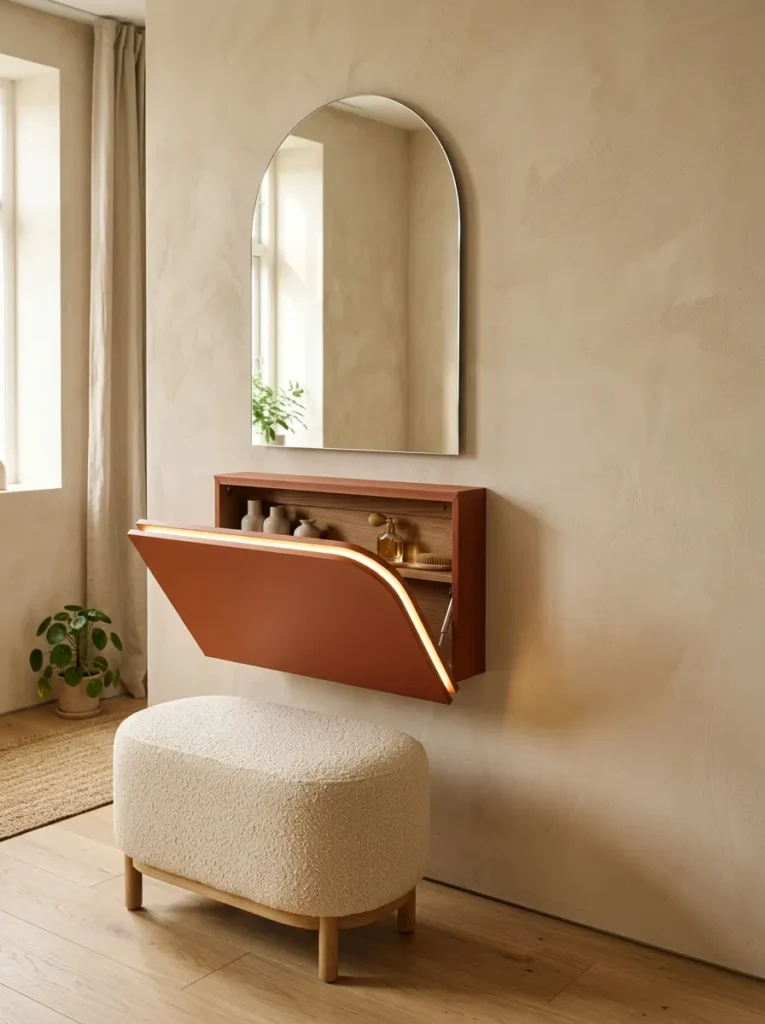
- Footprint: 26″ wide fold-down panel, mounted flush to the wall, folds flat to just 4″ deep when not in use
- Material/finish: matte terracotta-lacquered panel, curved edges, brushed unlacquered brass hinges and pull
- Mirror: curved arch mirror built into the inside of the panel lid, frameless
- Lighting: integrated warm LED strip (2700K) along the top edge of the panel, activates when unfolded
- Storage: two shallow felt-lined compartments inside the panel for jewelry and small brushes
- Seating: slim cream bouclé bench, 14″ tall, doubles as end-of-bed seating when the vanity is folded away
- Integration: terracotta tone pulls from a single accent pillow or ceramic vase elsewhere in the room, so it reads intentional rather than isolated
Why this works: A fold-down vanity is the only option that disappears completely, which makes it the single best solution for a bedroom under 90 square feet.
Fold-down hardware needs real weight consideration before installation, and this is where I always bring in my husband’s crew. A panel this size, especially with a mirror and LED wiring built in, needs a continuous steel hinge rated for repeated daily use, not the lightweight hinges sold with most flat-pack furniture kits. Anchored properly into wall studs, it holds for years without sagging or pulling away from the wall. Skip that step, and even a beautiful terracotta panel becomes a liability within months. This is one of those ideas where the unglamorous hardware matters more than the finish.
Visually, the curved terracotta lacquer softens what could otherwise feel like a purely functional gadget, giving it genuine design presence even when closed. The warm LED strip activating only when the panel opens creates a small, satisfying moment every morning, almost like a little reveal. Because the whole unit folds to just 4 inches deep, it works in bedrooms where even a floating shelf feels like too much commitment. Small bedroom vanity ideas rarely account for renters or tight layouts this well, which is exactly the gap this fold-down panel fills.
5. Rolling Black Glass Bar Cart Vanity
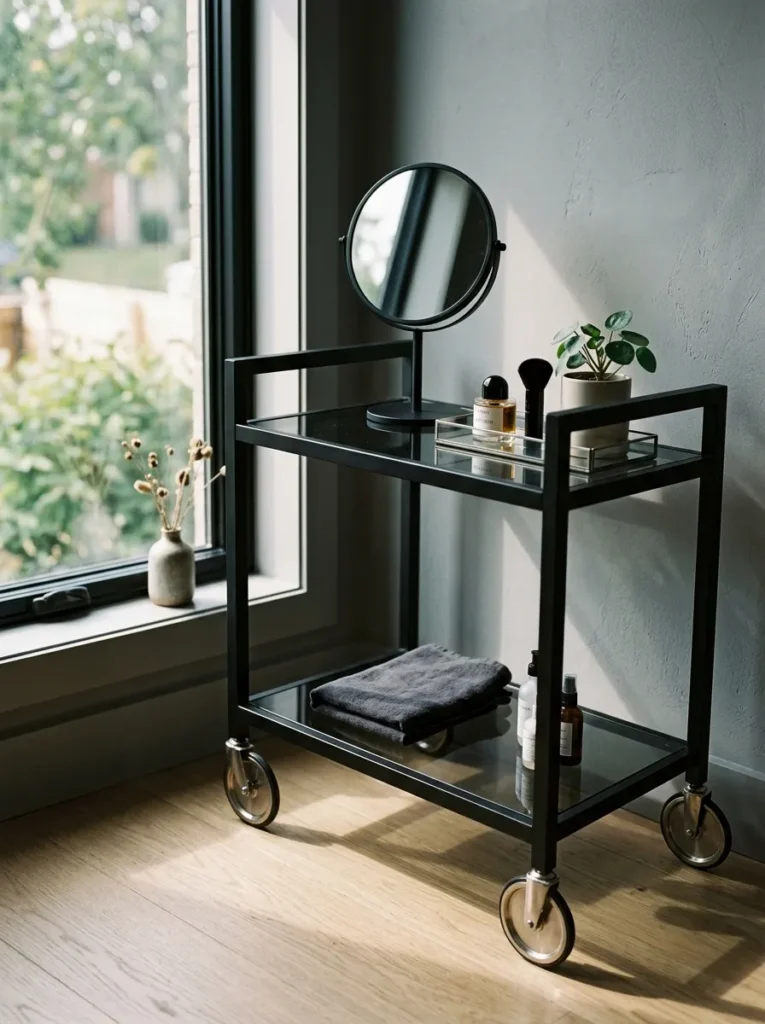
- Footprint: 24″ wide x 16″ deep two-tier rolling cart, fully mobile — zero wall mounting or floor commitment required
- Material/finish: matte black powder-coated frame, smoked glass shelves, brushed nickel wheels and handle
- Mirror: separate 18″ tabletop mirror with a black metal stand, sits on the top tier
- Lighting: small battery-powered LED puck lights clipped to the cart’s top edge, warm white tone
- Storage: bottom tier holds a woven black wire basket for towels or hair tools; top tier holds daily products in a smoked glass tray
- Seating: none required — rolls up to any existing chair or the end of the bed
- Integration: black and nickel mix echoes bedroom hardware like door handles or a black-framed window, tying the piece to the room’s existing metal palette
Why this works: A rolling vanity offers full function with zero wall damage or fixed footprint, making it the most flexible option for renters and shared spaces.
A rolling vanity solves a problem no fixed piece can: it works in a rented apartment, a shared bedroom, or a room that gets rearranged seasonally, since nothing touches the wall. That flexibility is exactly why I recommend it to clients who aren’t sure their layout is permanent yet. Because it moves on wheels, it can shift into a closet or under a window depending on the light and time of day, something a fixed vanity simply can’t do. For renters especially, this is one of the few vanity for tiny bedrooms options with genuinely no installation required.
The matte black and smoked glass combination gives this cart a sculptural, almost gallery-cart quality rather than the utilitarian bar-cart look most people picture. Battery-powered LED pucks mean no outlet is required nearby, which opens up placement options a plug-in lamp would restrict. Styled with a woven black basket and glass tray, the cart reads as considered rather than makeshift, and it photographs beautifully rolled beside a window where natural light catches the smoked glass. It’s a compact bedroom vanity idea that proves function doesn’t require permanence.
6. Carved Plaster Niche Vanity
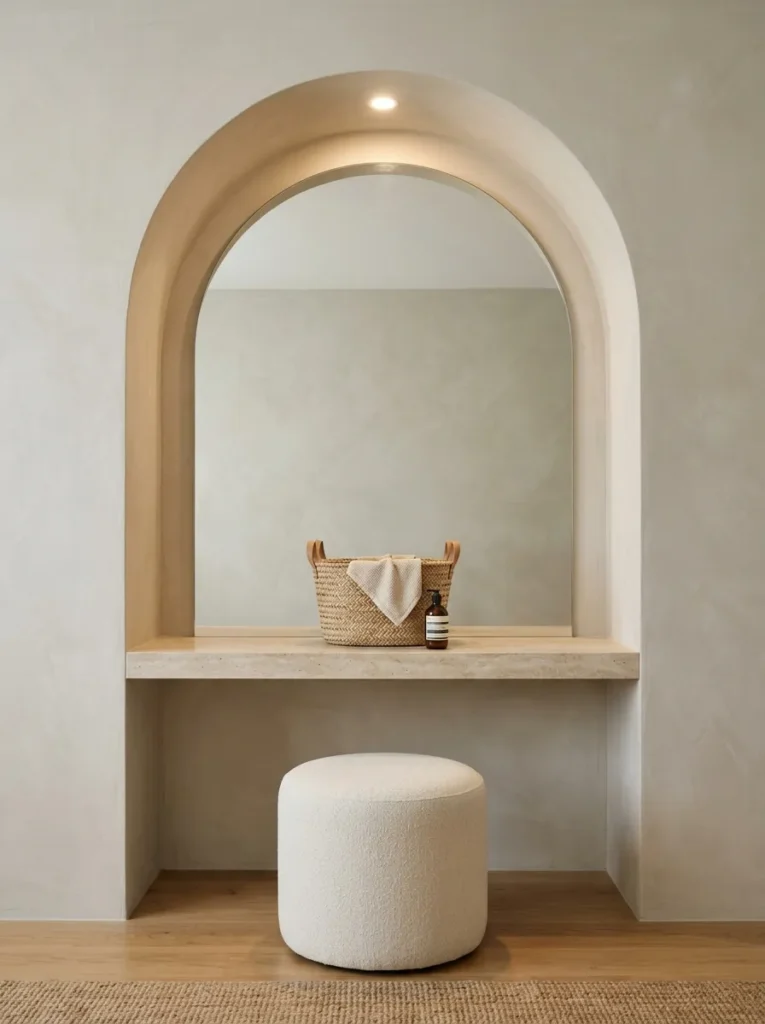
- Footprint: built into an existing wall niche, 30″ wide x 14″ deep, arched top — uses recessed depth instead of adding to the room
- Material/finish: hand-troweled Venetian plaster in warm greige, integrated stone-look shelf, unlacquered brass hardware
- Mirror: arched mirror set flush into the niche, matching the curve of the plaster opening
- Lighting: recessed warm LED downlight built into the top of the arch, casting soft, even light without harsh shadows
- Storage: a single floating stone shelf beneath the mirror, one woven basket tucked to the side
- Seating: low cream linen ottoman, pulled up only when in use
- Integration: the plaster texture continues subtly onto a nearby accent wall, so the niche feels like part of the room’s architecture, not an addition
Why this works: A wall niche converted into a vanity adds function without adding a single inch to a room’s usable floor space.
I turned an awkward, shallow wall niche in my own bedroom into this exact setup after staring at the empty space for over a year, unsure what to do with it. It turns out recessed niches are one of the most underused architectural features in older homes, and converting one into a vanity uses depth that already exists rather than eating into the room. If your bedroom has one sitting empty, it’s likely your easiest vanity solution.
Before plastering into any niche, my husband always checks whether it’s part of a load-bearing wall or simply a decorative recess, since the two require completely different approaches to lighting and shelf installation. Once cleared, hand-troweled plaster gives the niche a soft, sculptural quality that flat paint can’t replicate, and the recessed LED downlight avoids the shadow problems that a side-mounted sconce often creates in a tight space. The arched mirror set flush into the curve makes the whole niche feel finished and built-in, rather than an afterthought squeezed into leftover space.
7. Navy Pegboard Modular Vanity
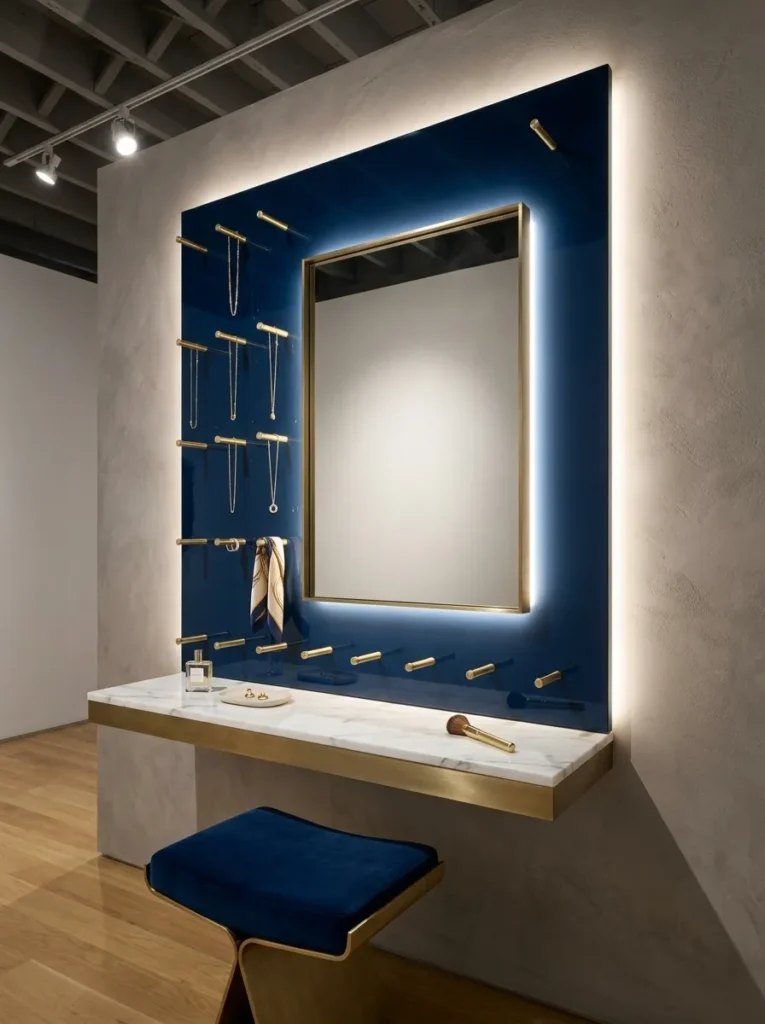
- Footprint: 24″ wide x 6″ deep pegboard panel mounted flush to the wall — the shallowest footprint of any idea so far, ideal for a bedroom under 80 square feet
- Material/finish: lacquered ink-navy pegboard, unlacquered brass pegs and hooks, small brass shelf pegs
- Mirror: rectangular mirror on adjustable brass pegs, can be repositioned or removed entirely
- Lighting: clip-on brass spotlight attached directly to a peg, warm 2700K bulb, aimed dramatically across the face at a low angle
- Storage: modular brass hooks and a small floating peg-shelf hold everything — nothing is fixed, so the whole layout can be rearranged in minutes
- Seating: no dedicated seat — a woven leather sling stool from elsewhere in the room slides over when needed
- Integration: the ink-navy panel becomes a graphic anchor against white walls, working like wall art even when the mirror is removed
Why this works: A pegboard vanity is the only setup that lets you change the entire layout without new holes in the wall, which matters most in a bedroom that will be rearranged more than once.
A pegboard vanity solves the commitment problem nobody talks about: most small-bedroom vanities assume you’ll want the same mirror height and shelf position forever, and that’s rarely true once you actually live with a setup. I moved my own panel’s mirror three times in the first month before landing on the right height for my morning routine. Because every element hangs on a peg rather than a fixed bracket, adjusting the whole layout takes minutes, not tools. For a bedroom under 80 square feet, that six-inch depth also means it barely registers as furniture at all.
The ink-navy lacquer is doing real visual work here, since a dark, saturated panel against white walls reads as intentional graphic contrast rather than a gap-filler. Brass hardware against navy has enough tonal punch to photograph well even at thumbnail size, which matters if the goal is a setup worth saving. A single spotlight aimed low across the panel throws long shadows from the pegs themselves, giving the whole wall a sculptural quality after dark. It’s an unconventional option among vanity ideas for small bedrooms, but it solves a real problem the others don’t.
8. Waterfall Marble Pedestal Vanity
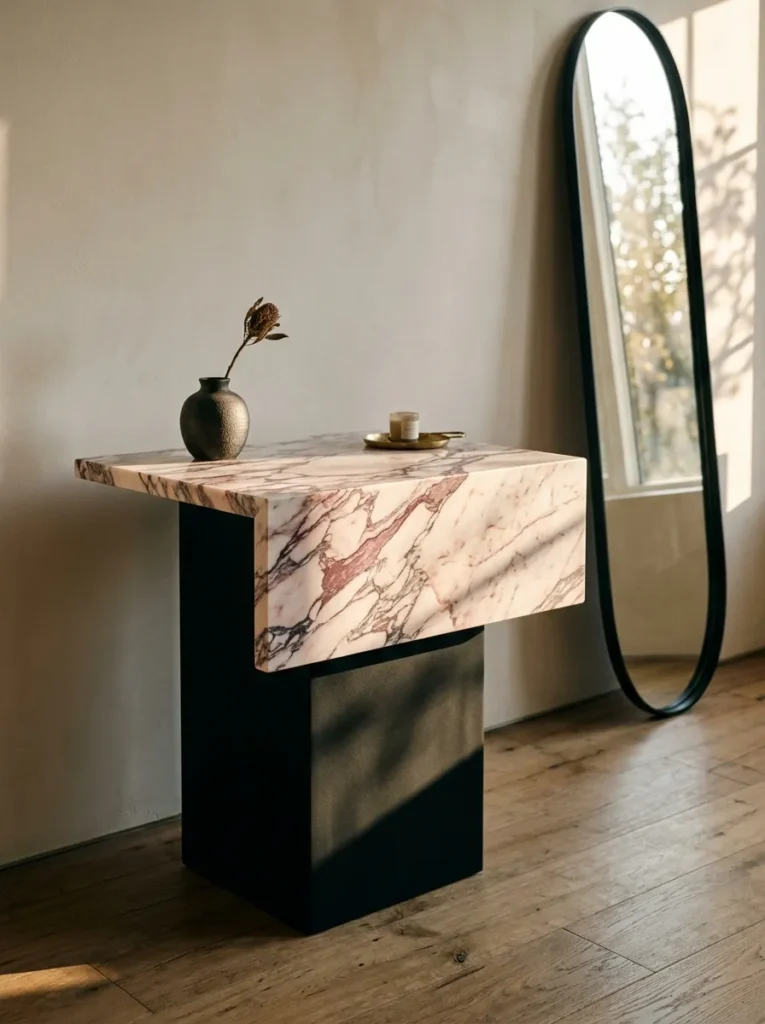
- Footprint: single 16″ round pedestal base with an 18″ waterfall marble top — no legs, no drawers, the smallest visual footprint of any freestanding option
- Material/finish: pink-toned Calacatta Viola marble top with continuous waterfall edge, matte black steel pedestal base
- Mirror: freestanding oval mirror in a matte black frame, propped directly against the wall behind
- Lighting: single wall-mounted brass picture light angled downward from above the mirror, warm and directional rather than even
- Storage: none built in — a black lacquered tray holds daily essentials, keeping the surface intentionally sparse
- Seating: black leather sling-back stool, low profile, slides beneath the marble overhang
- Integration: the pink veining in the marble becomes the room’s single boldest color note, so everything else stays neutral by design
Why this works: A single slim pedestal base, rather than a boxy cabinet, lets the vanity visually disappear from certain angles, which is what makes a naturally heavy material like marble feel light in a small room.
Marble waterfall edges are typically reserved for kitchen islands, but scaled down to an 18-inch round top, the same detail becomes genuinely striking on a bedroom vanity without demanding real estate a full vanity table would need. The pink veining running through the Calacatta Viola does more visual work than paint ever could, since natural stone reads as considered and permanent even on a small piece. Because the base is a single slim pedestal rather than a boxy cabinet, the whole vanity visually disappears from certain angles, which matters in a bedroom where every sightline counts toward feeling spacious.
I specifically avoided storage drawers on this one, and that was intentional rather than a limitation. A pedestal vanity works best when the surface stays nearly empty, letting the marble itself function as the visual statement rather than competing with clutter. This is a setup I’d recommend only to someone genuinely willing to edit down to a single tray of essentials. Done well, it reads as sculptural rather than sparse, and it’s one of the more editorial-feeling vanity ideas for small bedrooms precisely because it refuses to try to do everything at once.
9. Mirrored Closet Door Vanity
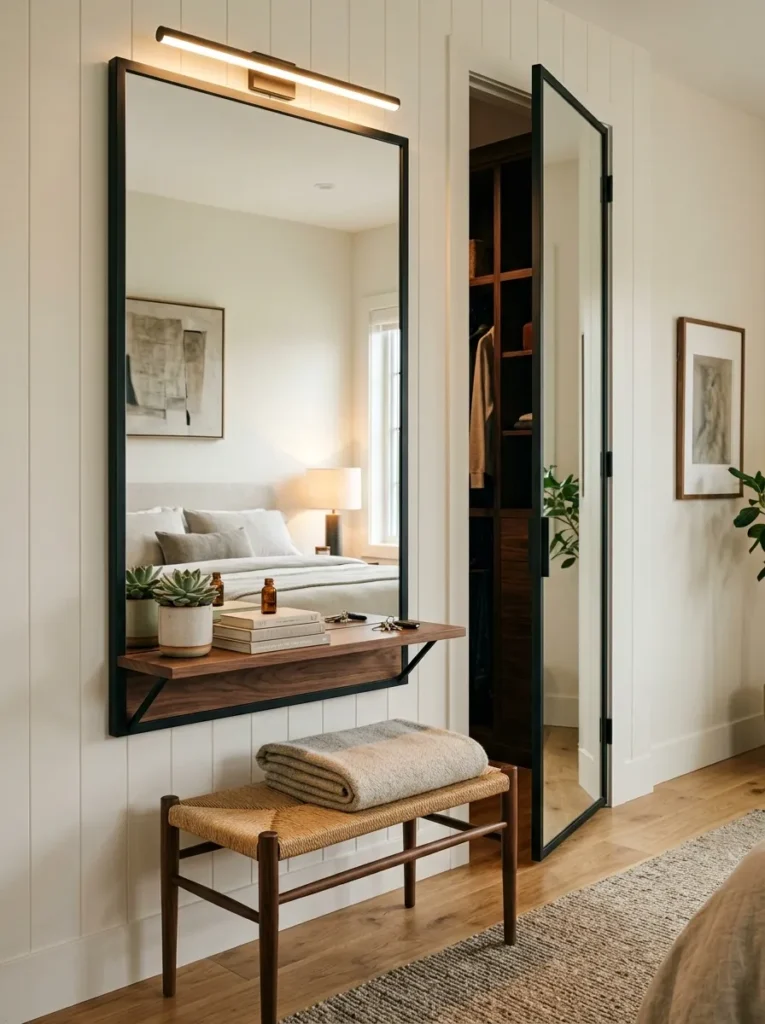
- Footprint: zero added footprint — repurposes an existing 24″ mirrored sliding closet door section with a slim shelf mounted directly below it
- Material/finish: existing mirror left as-is, new shelf in blackened steel with a walnut top, matte black wall hooks flanking either side
- Mirror: the existing full-length mirrored door itself — no new mirror purchased
- Lighting: a plug-in LED vanity light bar mounted directly above the closet frame, warm white, battery or hardwired depending on outlet access
- Storage: narrow walnut shelf holds daily products; blackened steel hooks on either side hold jewelry and hair tools
- Seating: a bench already at the foot of the bed pulls over when needed — no new seating purchased
- Integration: blackened steel and walnut echo the room’s existing black window frames and walnut nightstands, so the addition looks original to the room
Why this works: Converting an existing mirrored closet door into a vanity adds full function using furniture the room already has, which is the single cheapest solution on this list.
This is the idea I recommend first to clients on a tight budget, because it requires almost no new purchases. Most bedrooms with sliding mirrored closet doors already have a full-length mirror doing nothing but reflecting the room, and mounting a slim shelf directly below it turns that unused mirror into a genuine vanity setup. A single hardwired or plug-in light bar above the frame solves the lighting problem that closet doors were never designed for. Small bedroom vanity ideas rarely account for readers who’d rather repurpose what they own than buy something new, which makes this one worth including.
If mounting into a closet door frame rather than a stud wall, my husband always checks that the shelf bracket anchors into the surrounding door trim or frame studs rather than the door track itself, since the track isn’t built to hold weight. Done correctly, the shelf holds steady through daily use without affecting how the door slides. The walnut and blackened steel combination keeps the addition from looking like an afterthought bolted onto existing millwork, instead tying directly into a room’s existing hardware tones.
10. Lilac Fluted Glass Console Vanity
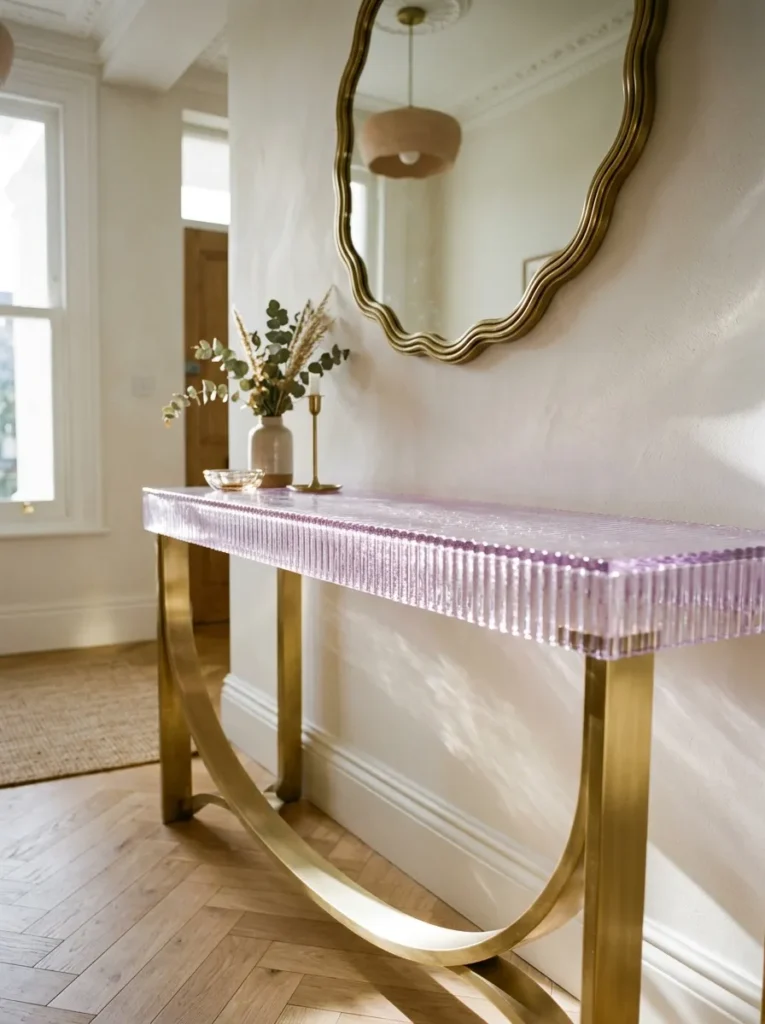
- Footprint: 26″ wide curved console with a fluted glass top, 14″ deep — the curved front edge visually shrinks its footprint compared to a squared table of the same size
- Material/finish: lilac-tinted fluted glass top, brushed brass curved legs, soft lilac-lacquered base panel
- Mirror: scalloped-edge mirror in brushed brass, mounted directly above
- Lighting: two slim brass wall sconces flanking the mirror, warm 2700K bulbs, angled inward toward the face
- Storage: single slim drawer in the base panel, plus a small fluted glass tray on top for perfume bottles
- Seating: curved bouclé stool in soft lilac, matches the console’s rounded silhouette
- Integration: the lilac tone pairs with a single floral stem in a bud vase rather than full bedding coordination, keeping the color playful instead of overwhelming
Why this works: Fluted glass catches and bends light differently than a flat surface, which gives a small vanity a glow and softness that flat materials simply can’t replicate.
Fluted glass has quietly become one of the most requested finishes I get asked about, and I understand why once you see how it behaves in real light. Unlike a flat glass or lacquer top, the ribbed texture catches morning sun and scatters it into small, moving lines across the console, which makes even a simple vanity feel alive rather than static. Paired with the lilac tint, that effect becomes genuinely photogenic, especially in a west-facing room where afternoon light rakes across the ridges. It’s a detail that photographs beautifully precisely because it never looks the same twice.
The curved brass legs and scalloped mirror lean fully into a softer, more feminine silhouette without tipping into anything dated, since the lilac stays pale and the brass stays warm rather than ornate. My husband’s team has installed enough glass-top pieces to know the weight distribution matters more than people expect — a fluted glass top needs legs rated for its actual weight, not just a decorative base, or the glass will eventually shift. Done right, this console reads as delicate but holds up daily, making it one of the more genuinely girly vanity ideas for small bedrooms without feeling fragile.
11. Butter Yellow Scalloped Floating Vanity
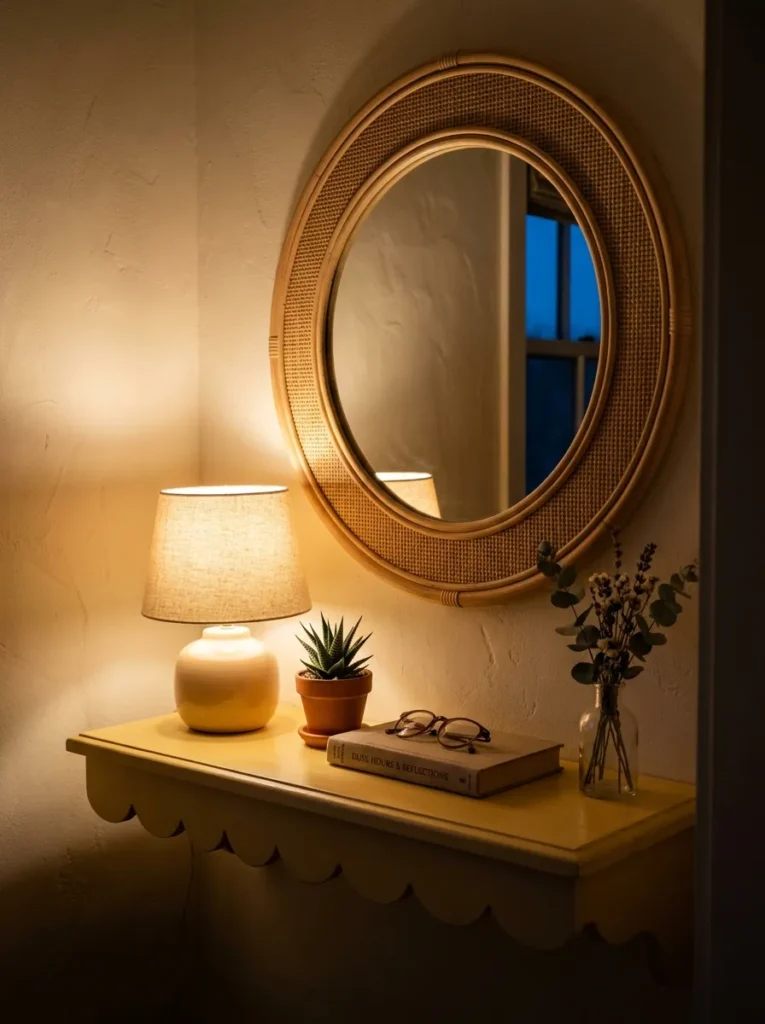
- Footprint: 28″ wide floating shelf with a scalloped front edge, 13″ deep, mounted at counter height — the curved edge reads lighter than a straight-edged shelf of the same size
- Material/finish: butter-yellow lacquered wood with a scalloped edge profile, unlacquered brass bracket support, cream plaster wall behind
- Mirror: round mirror with a thin cream rattan-wrapped frame
- Lighting: a single ruffled-shade brass table lamp sitting directly on the shelf, warm bulb, soft and low rather than overhead
- Storage: cream ceramic dish for jewelry, one small woven box tucked to the side for hair ties
- Seating: cream cane-back stool with a round cushioned seat, slides fully beneath the shelf
- Integration: the butter yellow stays contained to the shelf itself, with the rest of the wall left in cream plaster so the color reads as a deliberate pop rather than a full room commitment
Why this works: Confining a bold color like butter yellow to just the shelf, rather than the wall behind it, lets the color read as a considered accent instead of a full commitment a future resident would need to paint over.
I’ve noticed butter yellow work its way back into client requests over the past year, almost always from people who grew up around a grandmother’s kitchen or sewing room and want that same warmth without going full vintage. Scalloped edges carry a similar nostalgic softness, but paired with a clean brass bracket and a round rattan mirror, the combination lands as current rather than dated. The color stays contained to just the shelf itself, which keeps it feeling like a considered accent instead of a full commitment a future resident would need to paint over.
A ruffled-shade lamp sitting directly on the shelf does more for the mood than any overhead fixture could, since its low, warm glow feels like a bedside lamp rather than a task light. That distinction matters in a bedroom vanity, where harsh overhead lighting can feel more like a bathroom than a personal getting-ready spot. The cane-back stool completes the silhouette without adding visual weight, and because the whole setup floats, the floor beneath stays entirely open. This is one of the more distinctly compact bedroom vanity ideas that still feels indulgent.
12. Mint Kidney-Shaped Vanity Desk
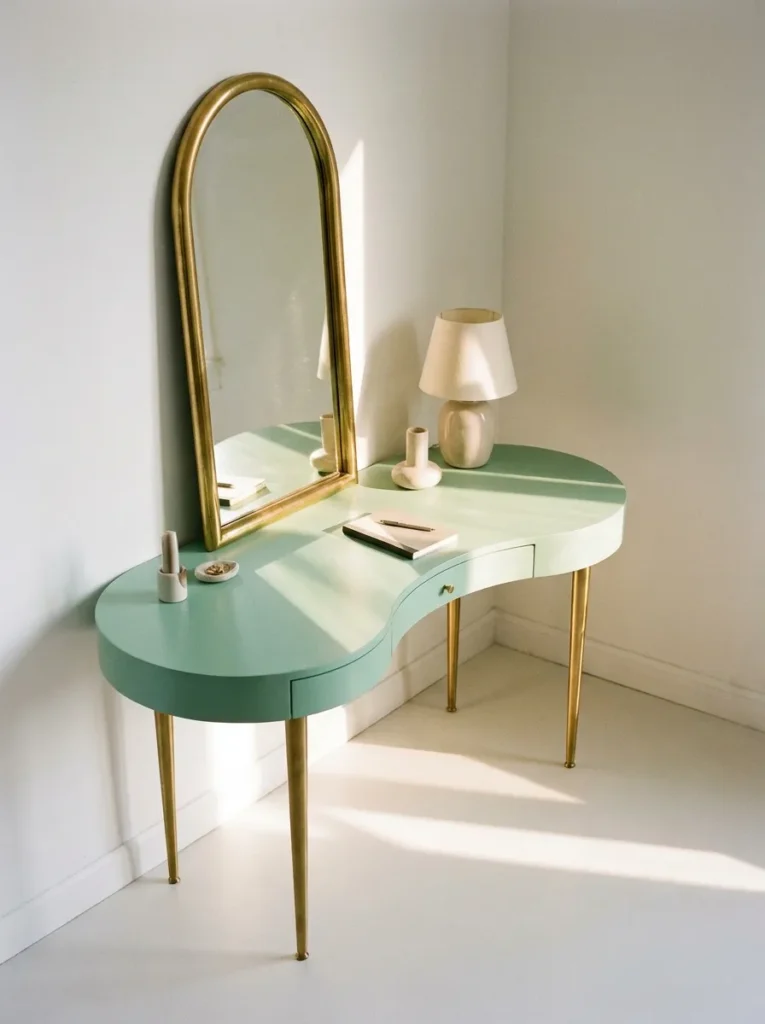
- Footprint: 30″ wide kidney-shaped desk, 18″ deep at its widest curve, tapering to 10″ — the curved silhouette tucks into corners a rectangular desk couldn’t
- Material/finish: mint-green lacquered curved top, tapered brass legs, cane-front single drawer
- Mirror: tall arched mirror in unlacquered brass, freestanding and leaned against the wall behind the desk
- Lighting: a single brass articulating wall lamp mounted above the mirror, warm bulb, adjustable to direct light exactly where needed
- Storage: the cane-front drawer holds daily products; a small mint ceramic tray on top holds perfume and rings
- Seating: a curved rattan chair with a round cushioned seat, pulled in flush with the desk’s taper
- Integration: the mint tone appears nowhere else in the room except a single trailing plant nearby, keeping the color feeling fresh rather than theme-matched
Why this works: A kidney-shaped desk’s curved taper lets it sit closer to a wall corner than any rectangular piece could, genuinely recovering inches a straight-edged desk would waste.
I’ve placed a version of this exact desk in the corner of my own daughter’s room, and the tapered curve is what actually makes it work in a space a straight desk couldn’t fit. Rectangular furniture needs a full 90-degree corner to sit flush, but a kidney shape tapers down to almost nothing at one end, letting it nestle against an angled wall or a corner with a baseboard heater in the way. That taper isn’t just decorative — it’s the entire reason this shape solves a real placement problem most furniture can’t.
The mint lacquer paired with brass and cane keeps the whole piece feeling fresh rather than saccharine, since the green stays cool and pale instead of leaning candy-bright. An articulating wall lamp above the mirror means the light can be angled precisely, which matters more than people realize when getting ready in a corner that doesn’t get much natural daylight. Left mostly free of extra decor, this kidney desk earns its visual interest entirely through shape and color rather than accessories, making it one of the more genuinely distinctive vanity ideas for small bedrooms.
13. Emerald Built-In Window Seat Vanity
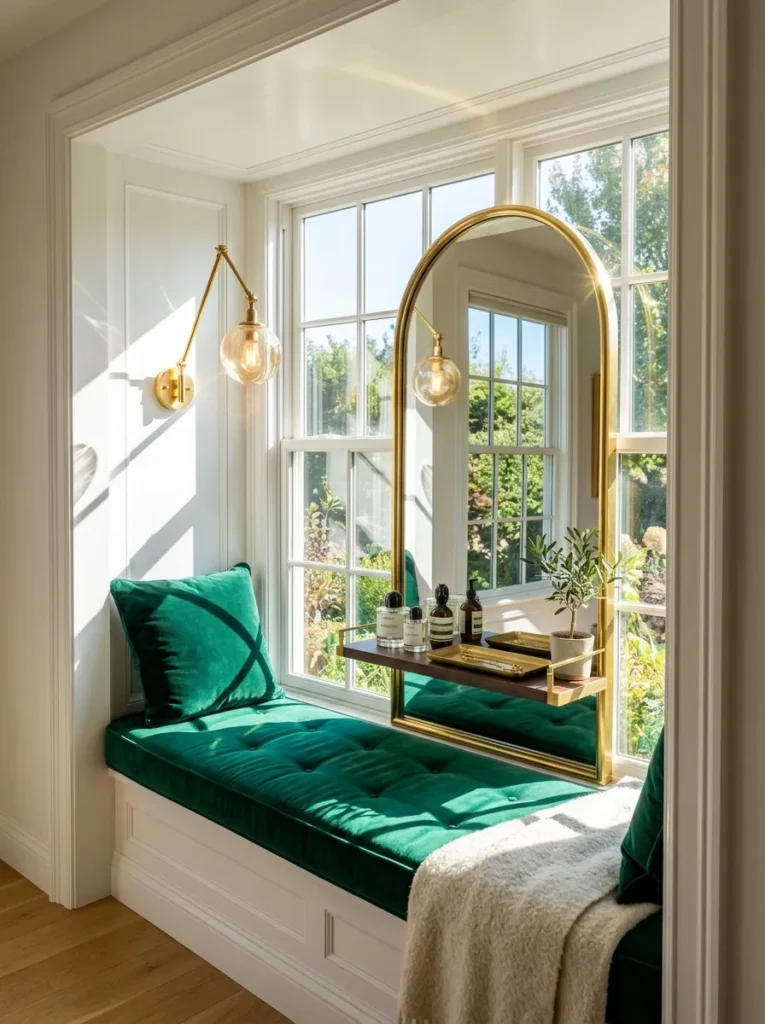
- Footprint: built into an existing window seat, 34″ wide x 15″ deep, using the seat’s ledge as the vanity surface — no new floor space required at all
- Material/finish: deep emerald velvet cushion on the seat base, emerald-lacquered wood ledge, aged brass hardware and trim
- Mirror: tall arched mirror in aged brass, mounted directly above the window seat’s side wall
- Lighting: a brass swing-arm sconce mounted beside the mirror, warm bulb, positioned to avoid glare from the window during the day
- Storage: a lift-top window seat base reveals hidden storage underneath for extra products and towels
- Seating: the window seat itself, no separate stool needed
- Integration: emerald velvet pairs with brass curtain rods and a single brass-framed piece of art nearby, so the color feels architectural rather than accessorized in
Why this works: A window seat ledge already exists in the room’s structure, which means this vanity adds zero new footprint while claiming one of the most naturally lit spots in the bedroom.
Window seats are one of the most underused features I come across in older Austin homes, usually left bare or covered in decorative pillows nobody actually sits on. Converting the ledge into a vanity surface puts genuinely the best light in the room to use, since window seats almost always sit in the most naturally bright spot available. Deep emerald velvet against brass hardware gives the nook real visual weight without requiring a single new piece of furniture, and the lift-top storage underneath solves the clutter problem a built-in surface usually creates. It’s a setup that looks intentional because it was already built into the house.
I’d caution against skipping the swing-arm sconce even in a well-lit window seat, since direct daylight is inconsistent and unusable after dusk. My husband’s crews always wire a dedicated outlet near a window seat conversion specifically for this reason, since most older homes weren’t built with one nearby. Emerald velvet holds up well against daily wear better than lighter fabrics, and the color reads as rich rather than dark even in lower afternoon light, making this one of the boldest vanity ideas for small bedrooms that still feels grounded in the room’s existing architecture.
14. Oxblood Leather-Wrapped Vanity Desk
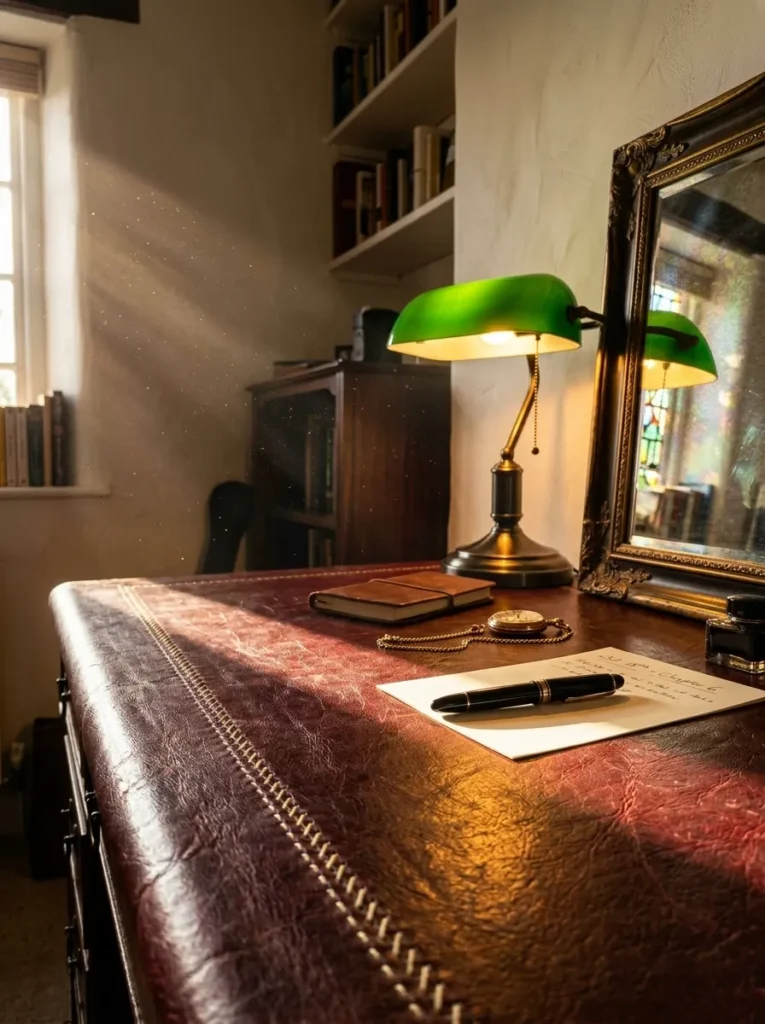
- Footprint: 27″ wide x 16″ deep writing desk with a fully leather-wrapped top and legs — a compact silhouette with unusually heavy visual presence for its size
- Material/finish: oxblood leather wrapping the entire desktop and tapered legs, saddle-stitched edges, blackened brass hardware
- Mirror: square mirror in a thin blackened brass frame, hung slightly above eye level
- Lighting: a single brass banker’s lamp with a green glass shade, warm bulb, sitting directly on the desk
- Storage: one leather-wrapped drawer with a blackened brass pull; a small black lacquer tray on top for daily items
- Seating: a low oxblood leather stool with brass capped legs, matching the desk exactly
- Integration: the oxblood tone appears only on the desk and stool, with the rest of the room left in warm white and walnut tones so the color reads as a statement rather than a theme
Why this works: Fully leather-wrapping a small desk gives it a density and richness that paint or lacquer can’t match, which makes even a compact piece feel substantial rather than minor.
Leather-wrapped furniture has a texture story that flat-painted pieces simply don’t, and oxblood specifically photographs with a depth that reads almost black in low light and rich burgundy in full sun. I first saw a leather-wrapped desk like this in a client’s study and immediately understood why it worked at vanity scale too — the material itself does the visual heavy lifting, so the piece doesn’t need to be large to feel important. A green banker’s lamp shade adds a second saturated color note without competing, since green and oxblood share enough warmth to feel coordinated rather than clashing.
Saddle-stitched leather edges need genuine craftsmanship to hold their shape over daily use, and a poorly wrapped desk will show creasing and lifting within a year. I always tell clients to check the stitching at the corners before buying, since that’s where cheaper wraps fail first. Blackened brass hardware keeps the overall look from feeling overly formal, and paired with warm white walls, this oxblood vanity becomes the clear focal point of an otherwise quiet room without overwhelming the small footprint it occupies.
15. Cobalt Arched Alcove Vanity
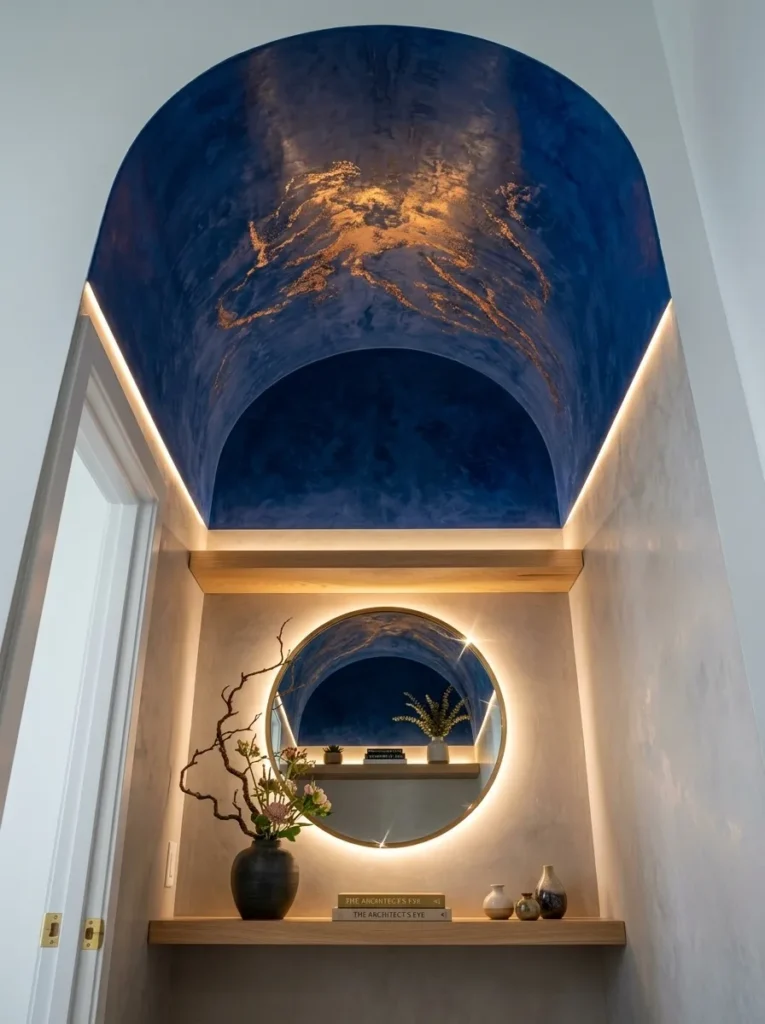
- Footprint: built into a shallow drywall alcove, 32″ wide x 12″ deep, framed with a plastered arch — uses recessed wall depth rather than room floor space
- Material/finish: cobalt blue Venetian plaster lining the interior of the arch, white oak floating shelf, brushed nickel hardware
- Mirror: round mirror in a thin white oak frame, centered in the arch
- Lighting: a hidden LED strip built into the top curve of the arch, warm white, washing light down the cobalt plaster
- Storage: a single white oak shelf beneath the mirror holding a nickel tray and one small ceramic dish
- Seating: a cobalt bouclé stool with white oak legs, pulled up only when in use
- Integration: the cobalt stays fully contained within the arch, while the surrounding wall stays white, so the alcove functions like a piece of art the vanity happens to live inside
Why this works: A recessed alcove vanity uses existing wall depth instead of room square footage, making it one of the only bold-color options that doesn’t shrink a small bedroom visually.
Cobalt is a color most people are hesitant to commit to on a full wall, but contained inside an arched alcove, it reads as a deliberate design moment rather than an overwhelming choice. The white oak shelf and mirror frame keep the material palette grounded and warm, preventing the cobalt from feeling cold or sterile, which is a common mistake with saturated blues in bedrooms.
Before plastering any alcove, my husband’s team always confirms it isn’t hiding old plumbing or electrical from a previous wall configuration, especially in older Austin homes where alcoves sometimes started as closets. Once cleared, hand-applied Venetian plaster in a saturated color like cobalt takes on a slightly variegated, cloud-like texture that flat paint never achieves, and the hidden LED strip washing down the curve emphasizes that texture beautifully after dark. This is one of the more architecturally ambitious vanity ideas for small bedrooms, but the payoff in visual drama is hard to match.
Styling Principles: Choosing Your Vanity Footprint
Before picking a style, measure your actual clearance. A vanity needs at minimum 24 inches of depth if seated use is required, but a floating, fold-down, or wall-mounted option can work with as little as 4 to 6 inches of depth if no seating is needed. Start by identifying dead space your room already has — a corner, a niche, a window seat, or an existing mirrored closet door — before considering a new furniture piece. Repurposed and built-in options almost always outperform dedicated vanity tables in small bedrooms, simply because they use space the room isn’t otherwise using. Once footprint is settled, let material and color carry the personality; a small vanity can afford one bold, saturated choice precisely because it occupies so little visual real estate.
Frequently Asked Questions
What is the minimum space needed for a bedroom vanity? A wall-mounted or floating vanity can work in as little as 4 to 6 inches of depth, while a seated vanity setup typically needs at least 24 inches of depth and 30 inches of width for comfortable use.
What are the best vanity options with no floor space to spare? Floating shelves, fold-down wall panels, and repurposed mirrored closet doors are the best options, since none of them add to a room’s usable floor footprint.
What’s a budget-friendly way to build a small bedroom vanity? Repurposing an existing mirrored closet door or a secondhand desk is typically the most affordable route, often costing under $100 in shelving, paint, and lighting.
What’s the best lighting for a small bedroom vanity? Warm-toned bulbs around 2700K positioned at eye level, either flanking or above the mirror, give the most accurate light for makeup application without harsh shadows.
Can a desk double as a bedroom vanity? Yes — a narrow desk under 18 inches deep works well as a vanity, especially with a propped or wall-mounted mirror added, and offers drawer storage a floating shelf typically lacks.
Do floating vanities need to be mounted into wall studs? Yes — a floating vanity holding daily weight and a mirror should be anchored into wall studs or blocking rather than drywall anchors alone, or it risks sagging within months.
Conclusion
A small bedroom doesn’t have to mean giving up a vanity — it just means choosing one built for the space you actually have. Whether you land on a floating shelf, a repurposed desk, or a bold cobalt alcove, the goal is the same: a spot that feels like yours every morning, without stealing floor space you need for everything else. I’ve seen how much a small addition like this can change how a room feels to live in, not just how it looks in photos.
Save the ideas that speak to you, try one in your own corner, and pass this along to anyone who’s ever said their bedroom is too small for a vanity.