The New Christmas Garland Look: 15 Styles to Try in 2026
One strand can change a whole room. I have seen a single garland turn a forgettable doorway into the first thing guests mention. If you’re looking for a the new Christmas garland look that feels modern, designed, and worth saving, you are in the right place. This guide covers 15 looks in glass beads, silk ribbon, and fresh or preserved greenery, each styled with exact colors, lighting, and hanging methods.
Some are tiny, like a five-foot swag over a kitchen window. Some are bold, like pearls spiraling up a staircase. In my experience, the difference between a garland that looks designed and one that looks draped on comes down to three things: a clear line, a controlled curve, and a mount that actually holds. My husband builds homes for a living, so you will find his practical tips woven in throughout. If you loved the wooden bead garland tree in our Christmas Tree Trends 2026 post, you will find plenty more bead inspiration here. Grab a coffee, save your favorites, and let’s find your look.
The garland is the smallest piece of Christmas decor and does the most work. Here’s why: the eye reads horizontal lines as the edges of a space, so a garland draped along one line tells the room where to look. A garland is a line of decoration that adds color and texture along an edge, and the best ones are chosen by how they hang, not how they sparkle. Last December I swapped a fussy, overstuffed garland in our Austin entry for one strand of smoked glass beads, and three guests asked if we’d repainted.
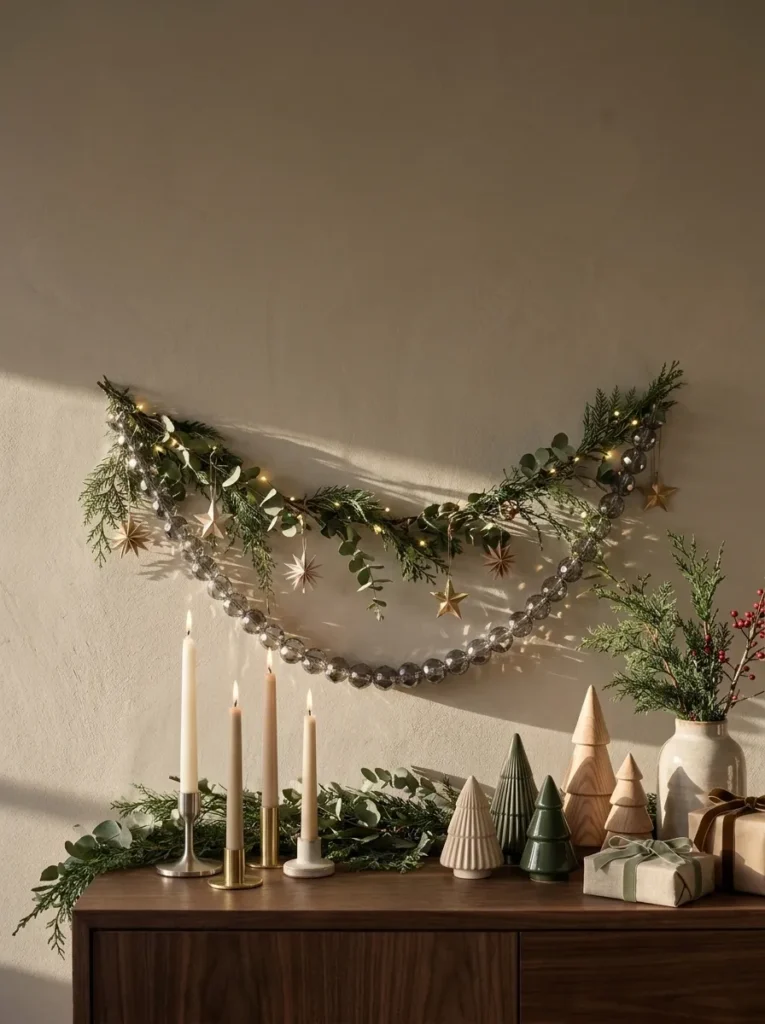
1. Smoked Glass Bead Swag — A Christmas Garland Idea for a Credenza
- Palette: smoked gray glass, brushed nickel, walnut, oat linen
- Lighting: raking afternoon window light by day, two taper candles at dusk
- Anchor: a 6-foot strand of graduated 8 mm to 20 mm beads above a walnut credenza
- Standout detail: the beads grow larger toward the center, so the curve looks weighted
- Wall: mushroom-toned plaster, left bare around the swag
Why this works: Graduated beads hang in a visible curve because the heaviest ones sit lowest, which makes a swag look intentional instead of strung.
Glass beads catch light the way water does, which is why one strand can outperform a whole shelf of ornaments. Smoked gray glass is the secret here: unlike clear beads, it reads as a soft charcoal shimmer at thumbnail size and in person. Hang it in a shallow U above a walnut credenza on a wall painted in a mushroom plaster tone, and the beads pick up every shift of daylight. The graduated sizes do the styling for you. Small beads sit near the hooks, and the largest drop to the center, so the curve looks weighted and deliberate.
Hanging glass takes more thought than hanging greenery. Adhesive hooks fail more often than people expect on textured or freshly painted walls, and a bead strand loads them constantly for weeks. Latex paint feels dry in hours but keeps curing for roughly a month. Use brushed nickel cup hooks screwed into a stud, or a drywall anchor if no stud falls where you need it. Add two taper candles on the credenza for evening, set well away from the glass, and the strand glows a soft amber without any wiring or batteries at all.
2. Ribbon Ripple Over Sofa: The new Christmas garland look
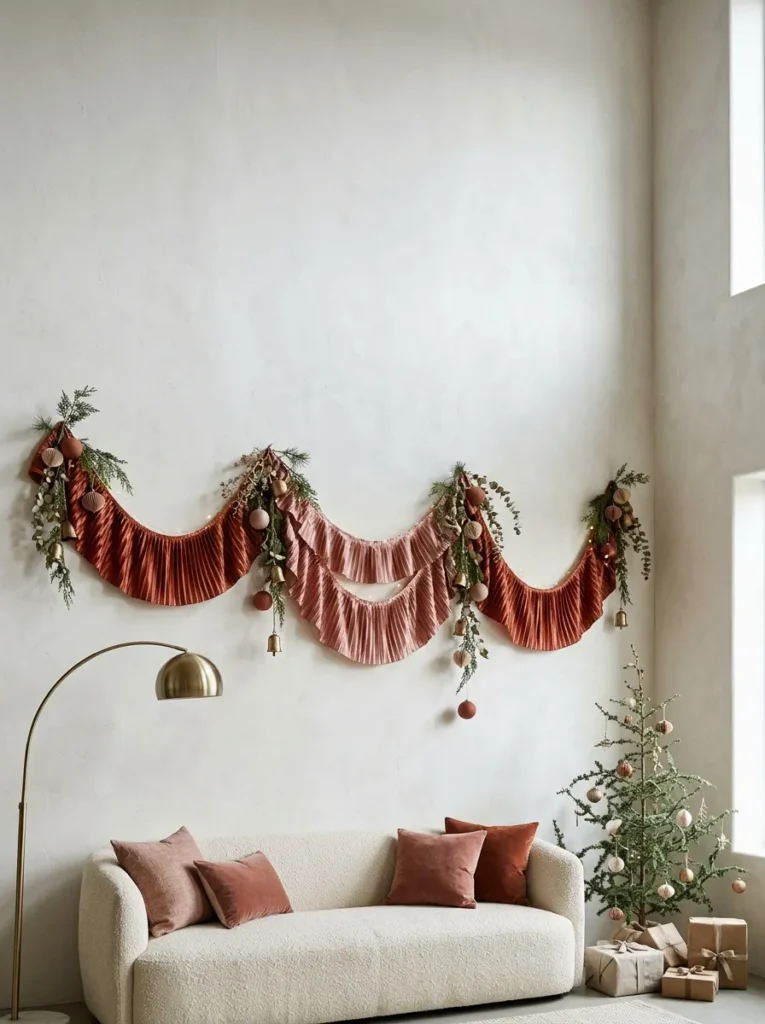
- Palette: terracotta satin, dusty rose satin, bone-white plaster, cream bouclé
- Lighting: side window light by day, one 2700K arc floor lamp at night
- Anchor: three scalloped swags of pleated ribbon above the sofa
- Standout detail: a hemp rope hidden inside the pleats keeps every scallop in shape
- Hanging: four brass hooks, evenly spaced across the wall
Why this works: Ribbon with a rope core holds a scalloped line instead of sagging, which is what separates a ribbon garland from a ribbon streamer.
I learned this the hard way in my first Austin apartment. I draped plain ribbon across a wall, and by day three it drooped like a tired streamer. The fix was hiding a hemp rope inside the ribbon, which holds every scallop in shape for the whole season. Now I fold terracotta and dusty rose satin into tight accordion pleats, pin them to the rope, and hang three soft scallops above a cream bouclé sofa. Against bone-white plaster, the two colors read as one warm gradient. Guests stop and touch the pleats, which tells me the texture is working.
Satin behaves differently from velvet. It reflects light instead of absorbing it, so a satin garland looks lighter and more modern, especially with side window light raking across the pleats. Choose double-faced satin at 2.5 inches wide, because single-faced ribbon shows its dull back wherever the pleats twist. Hang four brass hooks evenly across the wall, lift the rope onto them, and let the scallops fall naturally. At night, a single 2700K arc floor lamp angled toward the wall turns the pleats into a gentle glow, so you never need string lights on the ribbon at all.
3. Juniper and Pomegranate Swag
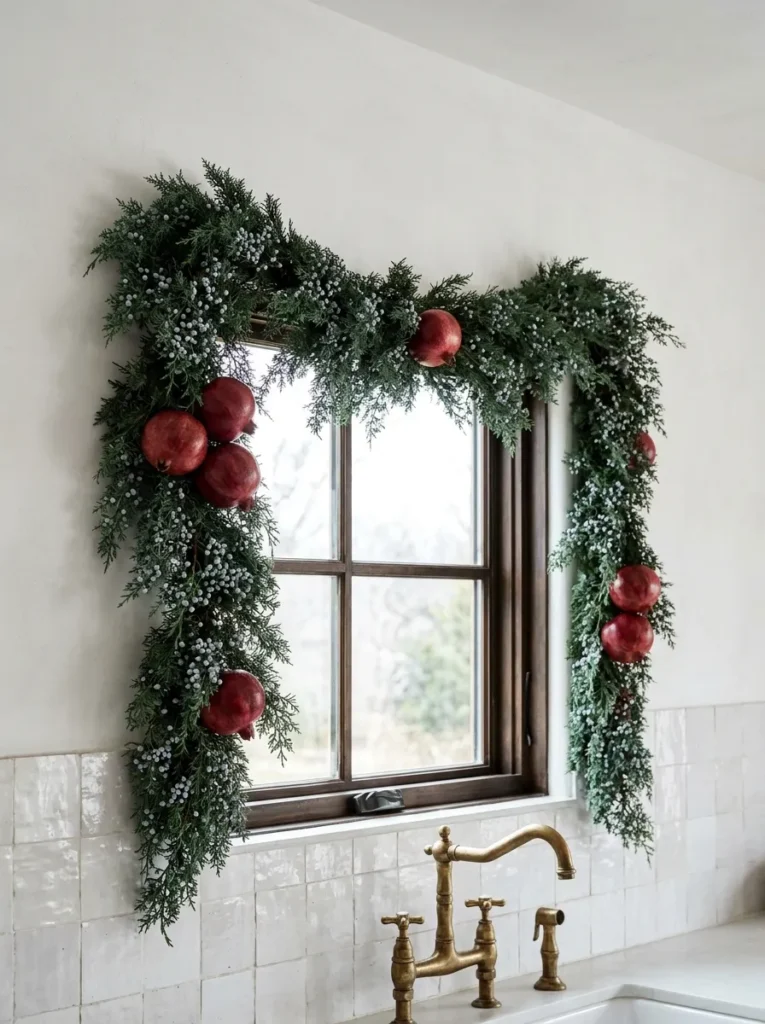
- Palette: blue-green juniper, garnet pomegranate, white zellige tile, unlacquered brass
- Lighting: soft north window light by day, a dimmable 2700K sconce at night
- Anchor: a 5-foot juniper garland framing the kitchen sink window
- Standout detail: six mini pomegranates wired in at uneven intervals
- Freshness: juniper usually holds its needles for several weeks in a cool kitchen
Why this works: Garnet fruit against blue-green juniper is a near-complementary pairing, which is why the garland reads clearly from across the room.
A kitchen window is the most overlooked garland spot in the house. It frames the one view you stare at while washing dishes. In Austin, I cut Ashe juniper from a friend’s property because its blue-green needles and silvery berries feel more modern than classic fir. Wire six mini pomegranates into the strand at uneven intervals, and the garnet fruit pops against white zellige tile and an unlacquered brass faucet. Fresh juniper smells like a cedar chest, and it usually holds its needles for several weeks in a cool kitchen, so one cutting carries you through most of December.
My husband has one rule for kitchen greenery: nothing hangs above or beside a cooktop. Fresh needles dry out and become combustible, and heat rises straight into a garland. That is why this one hangs on the window trim above the sink, well away from any burner. He also pre-drills tiny pilot holes for brass cup hooks in the trim so the wood doesn’t split. Add a dimmable 2700K sconce beside the window, and at dusk the pomegranates glow like small lanterns. Mist the strand lightly every few days to keep it fresh.
4. Mixed Metal Bead Arch
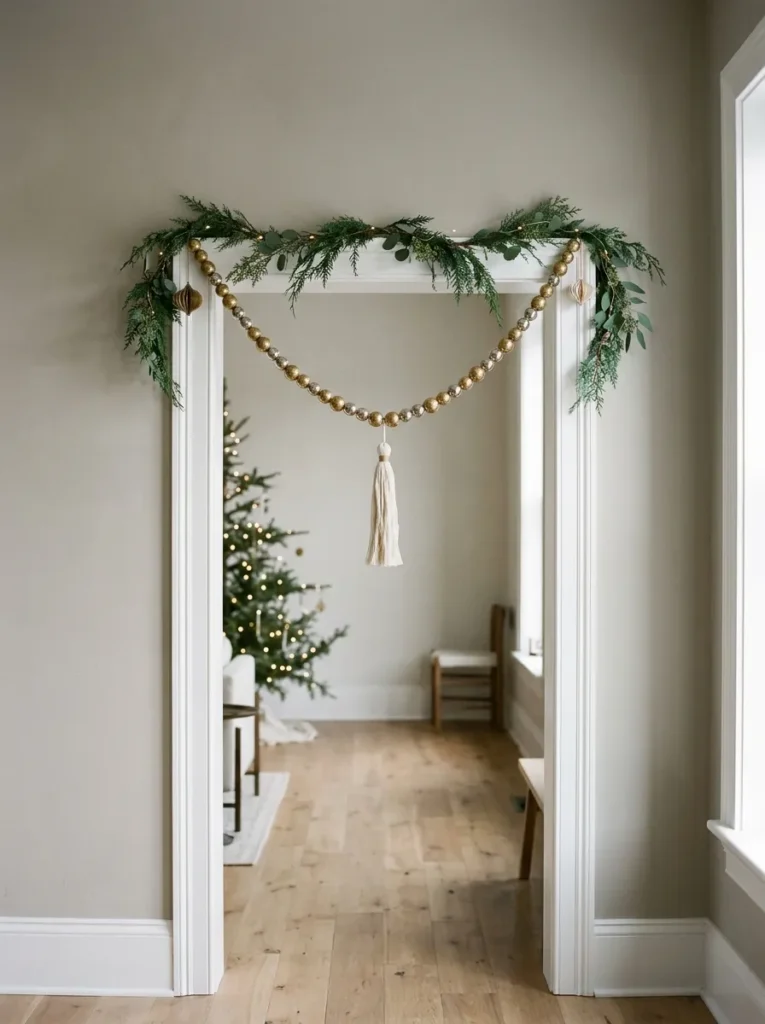
- Palette: hammered brass, polished nickel, bone linen, greige plaster
- Lighting: soft hallway daylight, a 2700K wall sconce at dusk
- Anchor: an 8-foot bead garland held in a shallow arch inside a cased opening
- Standout detail: one 8-inch bone-white linen tassel at the lowest point
- Mounting: three brass hooks screwed into the solid wood header
Why this works: A garland that follows an opening’s own proportions looks built into the house rather than added to it.
Cased openings are the most underused garland spot in a home. They frame a view, and they frame it twice, from both rooms. Metal beads suit them because hammered brass and polished nickel mix the way quiet-luxury interiors do: one warm metal, one cool, one soft bone-white tassel, nothing else. Against greige plaster, the beads read as jewelry for the doorway rather than as holiday decoration. Keep the arch shallow, no deeper than 6 inches at its lowest point, so it never blocks sight lines or catches a tall guest’s head as they walk through.
A framing carpenter will tell you to screw into the header, never the drywall. The header is the solid framing above any opening, and it holds screws without anchors, so the arch stays put through a month of brushing shoulders and foot traffic. Tap along the casing until the sound turns dull and solid, then set three brass hooks, one at each end and one at center. Thread the beads on waxed cord, hang the tassel last, and a 2700K sconce nearby makes the brass glow at dusk while the nickel stays crisp.
5. Silk Ribbon Wave
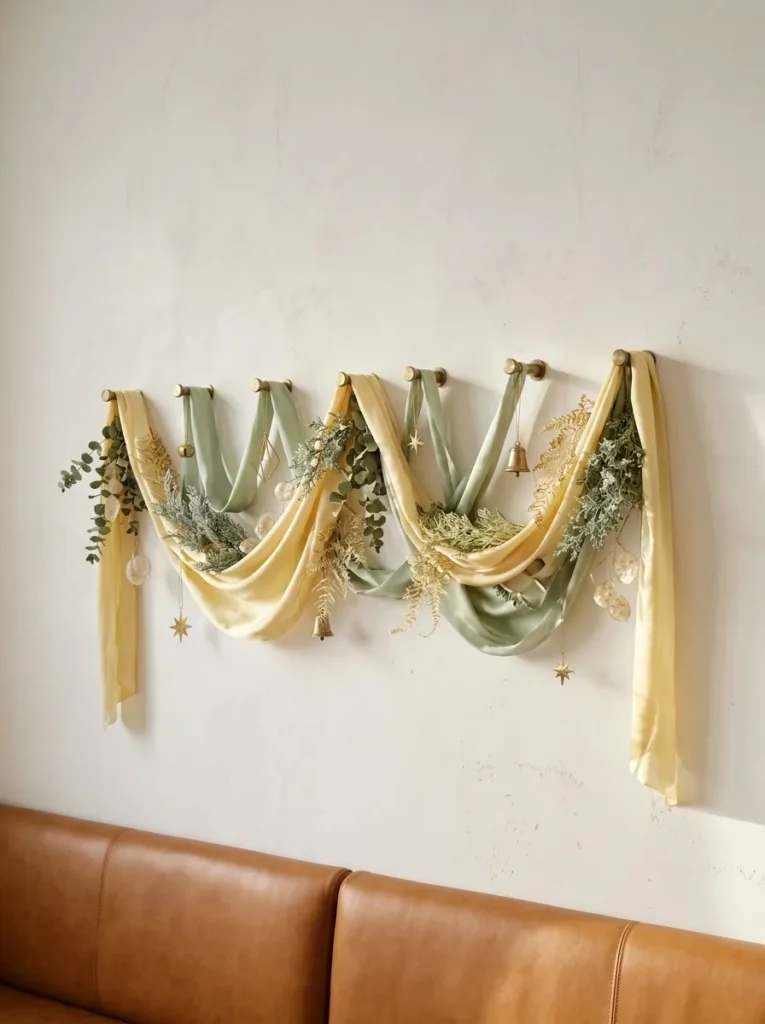
- Palette: butter-yellow silk, celadon silk, caramel leather, warm white plaster
- Lighting: east window light at breakfast, one 2700K pendant at night
- Anchor: two 4-inch silk ribbons draped in a continuous wave over seven brass pegs
- Standout detail: the pegs, not a rope, create the curve
- Furniture: a curved banquette in caramel leather beneath
Why this works: Wide silk ribbon draped over fixed pegs forms a wave that stays crisp, because the pegs control the curve instead of the ribbon’s own weight.
My first ribbon garland failed because the ribbon was too narrow. At one inch wide it looked like a gift receipt taped to the wall. Four inches changed everything. Two silk ribbons, butter yellow and celadon, drape over seven small brass pegs above a curved caramel leather banquette, and the wave looks tailored, almost architectural. Against warm white plaster, the two pale colors feel like morning light caught on fabric. I have also learned to steam the silk first, because a creased ribbon looks cheap, while a smooth one looks like a custom piece sewn for the wall.
Here is how the wave works. Set seven brass pegs, 14 inches apart, at alternating heights 6 inches apart. Loop the butter ribbon over each peg, then repeat with celadon one inch below so the two overlap slightly. Because the pegs fix every high and low point, the curve repeats evenly and never sags, even after weeks. Silk also reflects window light more than cotton, so the east-facing glow at breakfast makes both colors luminous. At night, a single 2700K pendant above the table keeps the leather warm and the ribbon soft, with no extra string lights needed.
6. Fir Arch Door Frame
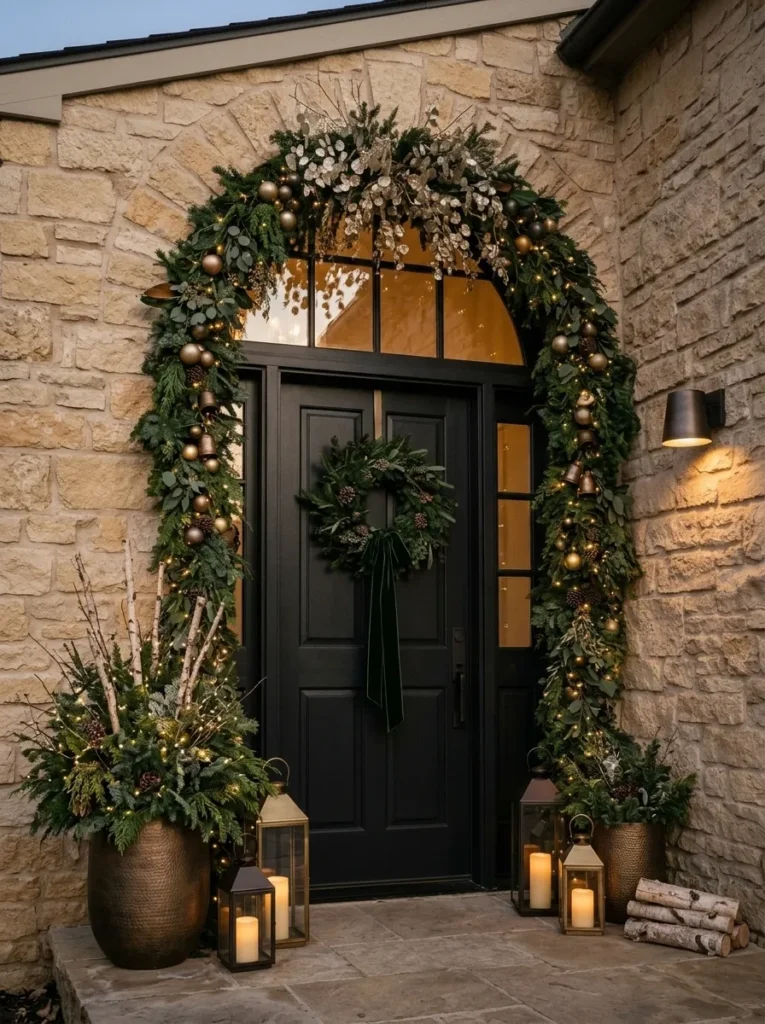
- Palette: deep Noble fir green, silver lunaria, matte black door, warm limestone
- Lighting: outdoor-rated copper-wire LEDs at 2200K, on a timer
- Anchor: an 18-foot Noble fir garland following an arched front door frame
- Standout detail: dried lunaria discs clustered at the peak like pale moons
- Mounting: clips on the trim, nothing driven into stucco or brick
Why this works: A garland that traces a door’s own curve guides the eye to the entry, which makes a front door look intentional from the street.
Of all the Christmas garland ideas I have tried, framing an arched door traces the architecture. A wreath sits in the middle of a door, while a garland follows its edge and tells visitors where the entry begins. On an arched black door last winter, I mixed deep green Noble fir with silver lunaria discs, and the cluster of pale discs at the peak looked like small moons. Against warm limestone, the matte black door and green fir feel crisp and modern. Keep the fir full and the lunaria sparse, so the silver reads as an accent.
My husband, who builds with stucco, brick, and stone for a living, gives one firm instruction for doors like this: never nail or screw into masonry for a seasonal garland. It cracks the finish and invites water in. Instead, use removable clips on the trim, or small cup hooks in wood casing. Keep the garland clear of the door swing, so it never snags or blocks the way out. Add outdoor-rated copper-wire lights at 2200K on a GFCI outlet and a timer, and the fir glows gold at dusk while the black door fades into the night.
7. Pearl Spiral Staircase
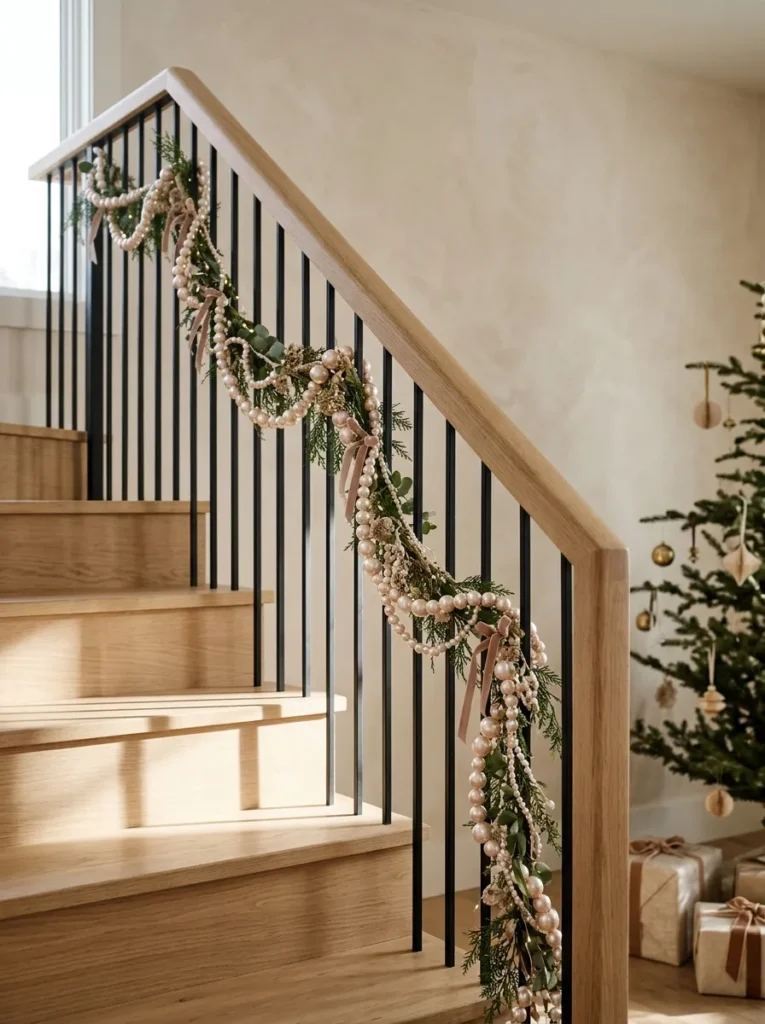
- Palette: blush pearl, matte black iron, white oak, warm plaster
- Lighting: east window light by day, one 2200K lantern on the landing at night
- Anchor: a 14-foot faux pearl garland spiraling around an iron balustrade
- Standout detail: three pearl sizes (10, 16, and 22 mm) in a repeating sequence
- Safety: nothing on the handrail, nothing on the treads
Why this works: A spiral line on a staircase draws the eye upward, which makes a modest stair feel taller and more sculptural.
Pearls look classic, but strung in three sizes they look strikingly modern. Faux pearls in blush, at 10, 16, and 22 millimeters, repeat in a loose sequence along a 14-foot strand, and the size change creates a rhythm the eye follows upward. Wound in a slow spiral around a matte black iron balustrade, the garland turns a plain staircase into a sculpture. White oak treads and warm plaster walls keep the palette soft, so the blush pearls glow rather than shout. Pearls also scatter daylight in tiny points, so a tall east window does most of the lighting work.
My husband has one stair rule I follow every year: the handrail and treads stay clear. Code requires a handrail you can grip along its length, and a garland over it turns a rail into a slip hazard. So wind the pearls around the balusters only, securing the strand with soft floral wire at every third baluster. Check that the garland sits at least 4 inches from the tread edge, because loose strands catch toes. At night, a single 2200K lantern on the landing lights the pearls from below, and the staircase glows without wires in the walkway.
8. Plum Ombré Ribbon Fall
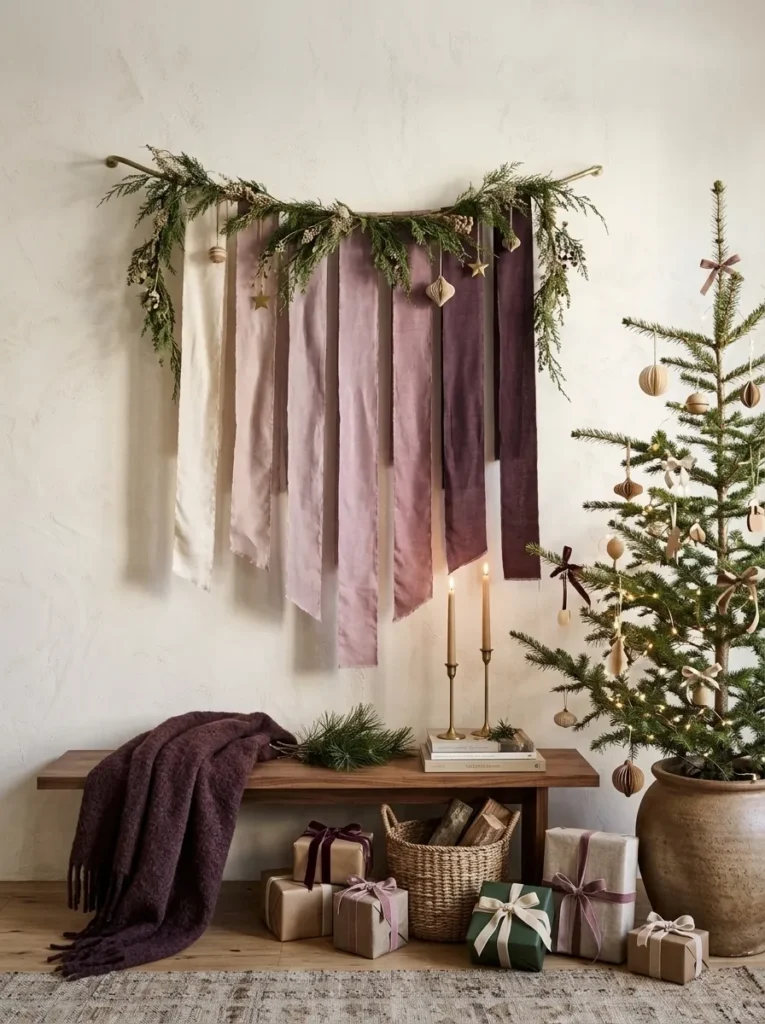
- Palette: oyster, mauve, and plum silk; walnut bench; warm white plaster
- Lighting: sidelight window by day, one 2700K sconce at night
- Anchor: seven silk ribbons hung from a curved brass rod, shading from oyster to plum
- Standout detail: tails cut at staggered lengths between 5 and 6 feet
- Hanging: rod brackets screwed into a stud
Why this works: An ombré gradient from pale to deep draws the eye downward, which gives a narrow wall presence without adding clutter.
I styled a narrow entry last December where nothing fit. There was no room for a console and no space for a wreath. So I hung a curved brass rod and let seven silk ribbons fall from it, shading from oyster to mauve to plum. The first guest through the door stopped and asked where we found the art. It was not art. It was ribbon. Against warm white plaster beside a low walnut bench, the gradient felt deliberate and calm, and the narrow wall suddenly had a focal point without adding anything to the floor.
Here is how to build the fall. Cut seven 2-inch wide silk ribbons at staggered lengths between 5 and 6 feet. Sort them light to dark, with oyster on the left and plum on the right. Fold each over the rod and secure it with a small stitch or a drop of fabric glue, so the ribbons hang flat. Mount the curved brass rod on two brackets screwed into a stud, never drywall alone. Silk moves with every opened door, so the ribbons shimmer, and a 2700K sconce beside them turns the gradient into a soft glow after dark.
9. Boxwood Sphere Chain
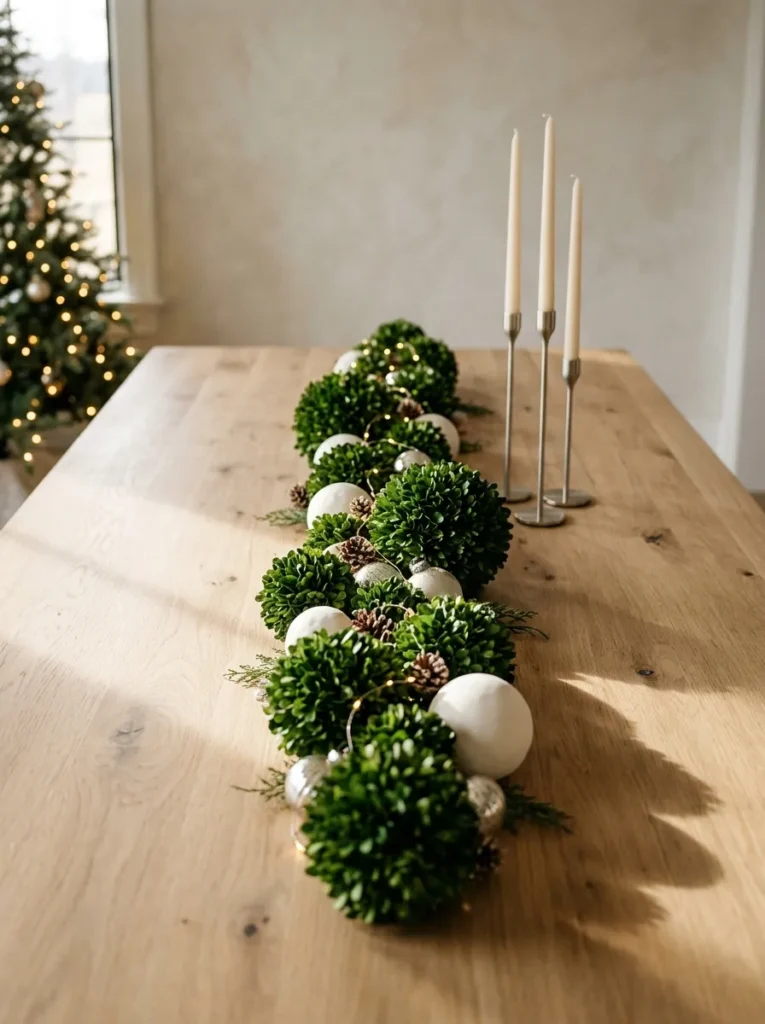
- Palette: boxwood green, bone-white ceramic, white oak, brushed nickel
- Lighting: soft window light by day, three 2700K tapers at dinner
- Anchor: a 9-foot chain of 4-inch clipped boxwood spheres down the center of the table
- Standout detail: every fifth sphere swapped for a bone-white ceramic ball of the same size
- Freshness: preserved boxwood holds its color for months
Why this works: Repeating one geometric shape in two materials gives a garland a modern, sculptural rhythm that a loose greenery runner cannot.
Clipped boxwood spheres are the most architectural greenery you can buy. Their shape never changes, which is exactly why a chain of them looks so modern. Run nine feet of four-inch spheres down a long white oak table, and swap every fifth one for a bone-white ceramic ball of the same size. The repeat feels like a pattern, not a runner. I tried this at a dinner for eight and watched guests lean in to touch which spheres were leaves and which were ceramic. That curiosity is the point: a surprise detail keeps the table interesting through dessert.
Preserved boxwood is the practical choice, because glycerin treatment keeps the leaves soft and green for months without watering or shedding. That matters on a dining table, where you want nothing dropping into a glass. My husband adds one tip from job sites: secure anything round on a table, because a rolling sphere will find the edge. Slip a dot of museum putty under each ball, and the chain stays put. Place three taper candles in brushed nickel holders well away from the greenery, and the spheres cast soft, round shadows across the oak.
10. Beaded Olive Tree
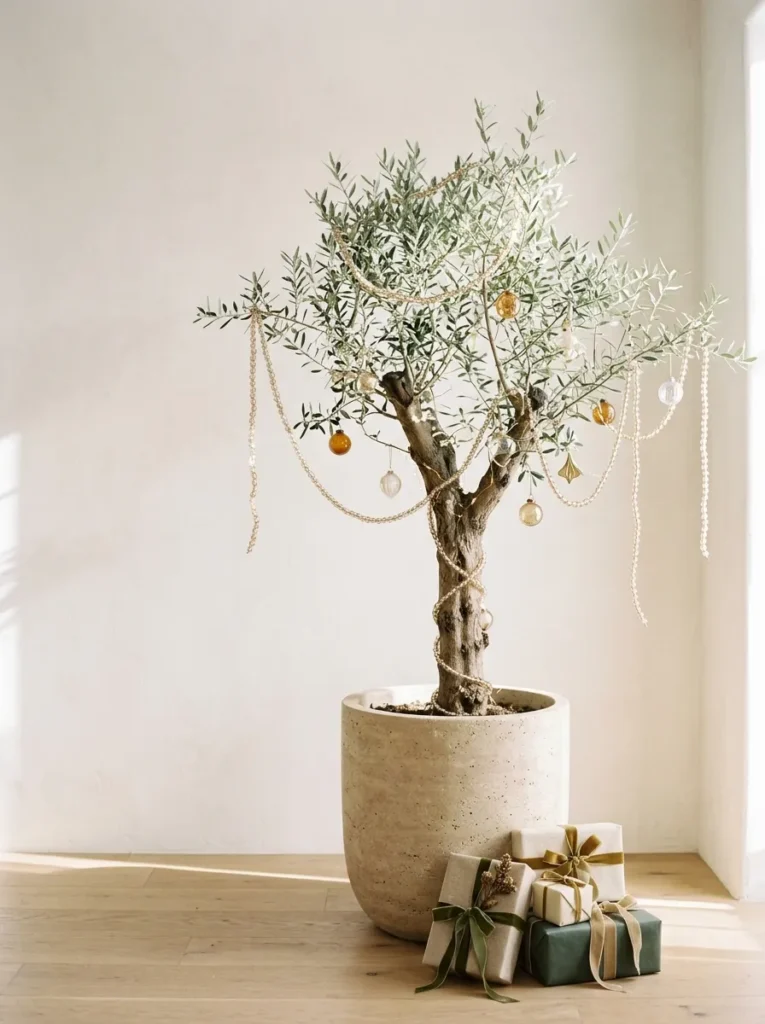
- Palette: silver-green olive foliage, champagne glass beads, honed travertine, warm white plaster
- Lighting: bright south window by day, a 2700K uplight behind the planter at night
- Anchor: a 6-foot potted olive tree wrapped with a 15-foot strand of 12 mm beads
- Standout detail: three loose strands drop from the branch tips like raindrops
- Plant care: wrap loosely and remove the strand in January
Why this works: A garland wrapped around a living tree turns a plant into a sculpture, and silver-green olive leaves make champagne beads look luminous.
Most garlands go on walls. This one goes on a tree. A six-foot potted olive tree in a honed travertine planter becomes a quiet sculpture once you spiral a strand of champagne glass beads up its trunk. Silver-green leaves make the beads look luminous. I trained in plant science, so I always add one rule: wrap loosely, with about a finger’s width of slack, because olive trunks thicken as they grow and tight cord can scar the bark. Let three loose strands drop from the branch tips, like raindrops caught mid-fall.
Choose matte champagne beads, 12 millimeters wide, strung on a flexible cord, which hangs more softly than wire. Start at the base, spiral upward with about 6 inches between turns, and tuck the end behind a branch. Give the tree a bright south window, because olives need strong light to hold their leaves indoors. Keep it away from heating vents, which dry the foliage fast. Remove the strand in January so the trunk can breathe. At night, a 2700K uplight behind the planter turns the beads into slow sparks, and the travertine glows warmly underneath.
11. Satin Island Pendant Swag
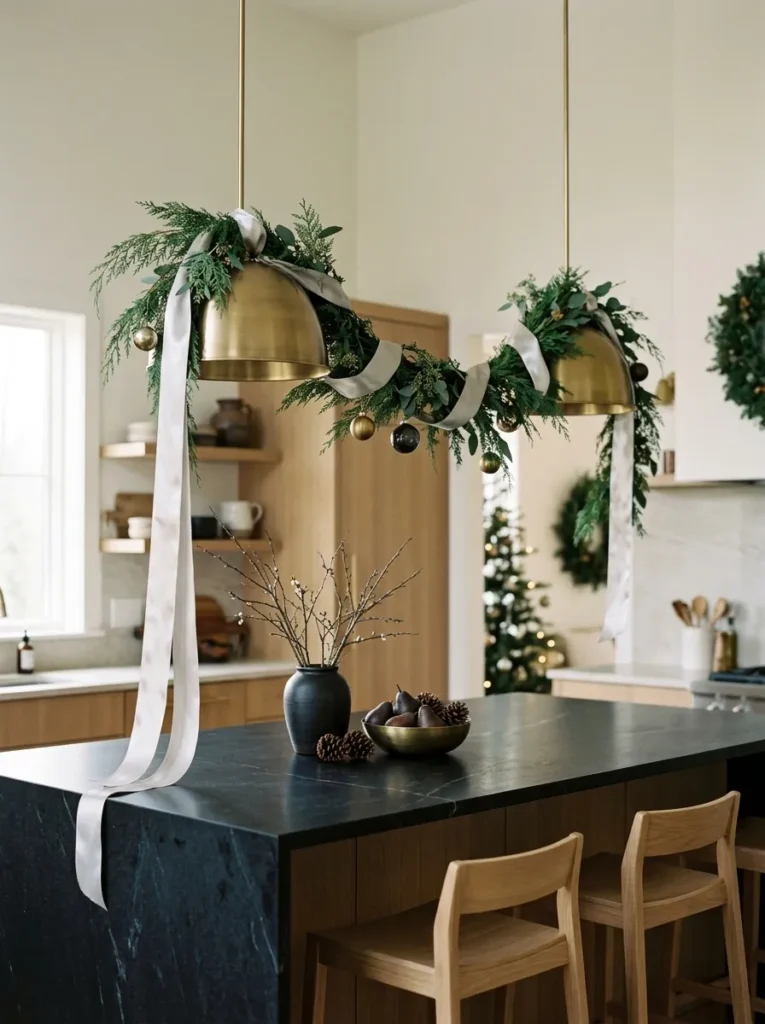
- Palette: oyster satin, black soapstone, brushed brass, white oak
- Lighting: two brass pendants with 2700K LED bulbs, plus morning side-window light
- Anchor: a 2.5-inch oyster satin ribbon swagged between two island pendants
- Standout detail: one long, free tail falls toward the counter
- Safety: LED bulbs only, with the ribbon well clear of every bulb
Why this works: A ribbon swag that links two pendants joins them into one composition, which makes a plain kitchen island feel styled.
Kitchen islands deserve a garland as much as mantels do, and the pendants above them are the ready-made frame. A single satin ribbon swagged between two brass pendants links them into one composition. Oyster satin works best, because it reflects the pendant glow and reads as pale silver against black soapstone. Choose a width of 2.5 inches so the ribbon holds a clear line from across the room. Let one end fall in a long, free tail toward the counter, and the swag gains a graceful movement. White oak stools below complete the quiet, tonal look.
Safety matters more than style here. Ribbon should never touch a hot bulb, so switch to LED bulbs at 2700K, which stay cool and give the same warm glow. Tie the ribbon to each pendant’s cord or stem, never to the lamp shade or socket, using a simple double knot that leaves the wiring untouched. Keep the swag at least 6 inches from any bulb. Satin slips, so add a dot of double-sided tape at each knot. Check the knots each week, because pendants get bumped, and satin slowly creeps along its knots.
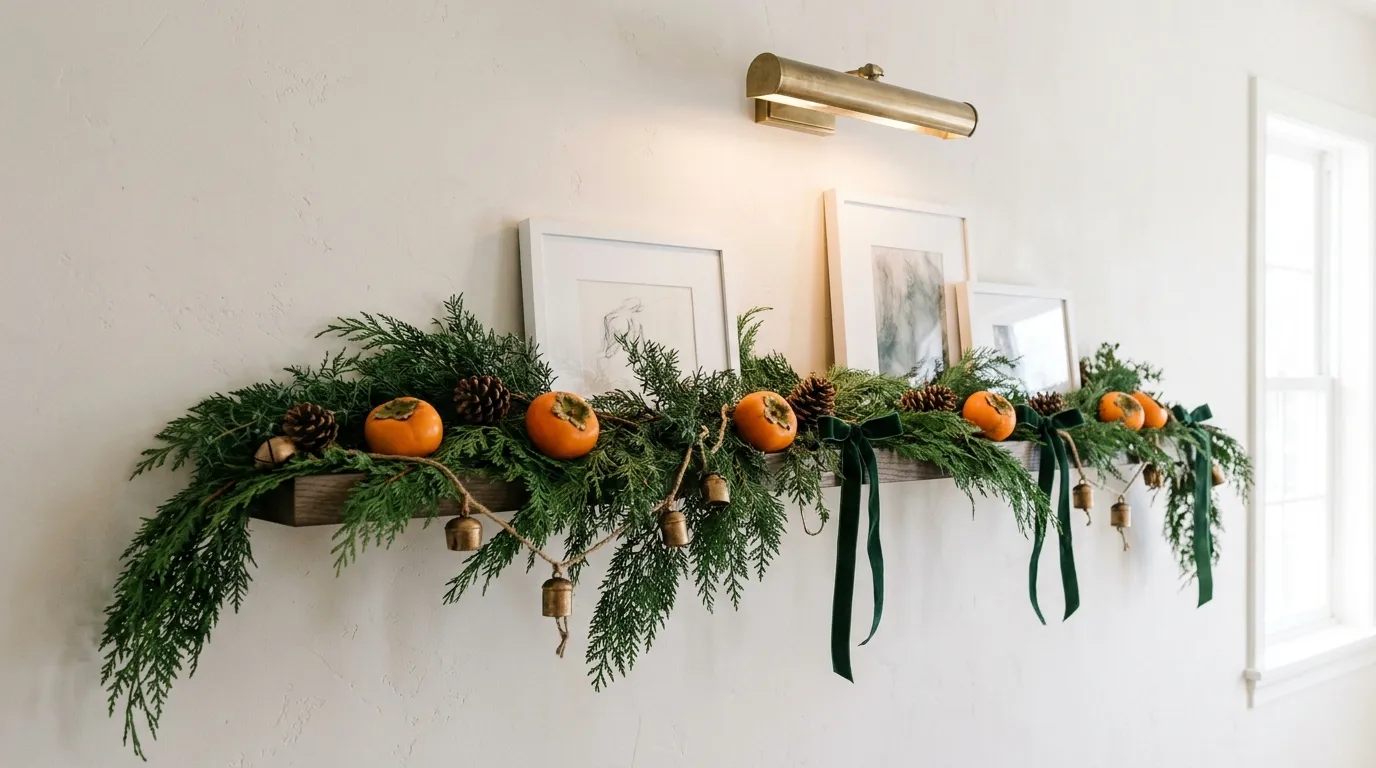
12. Cedar Persimmon Ledge
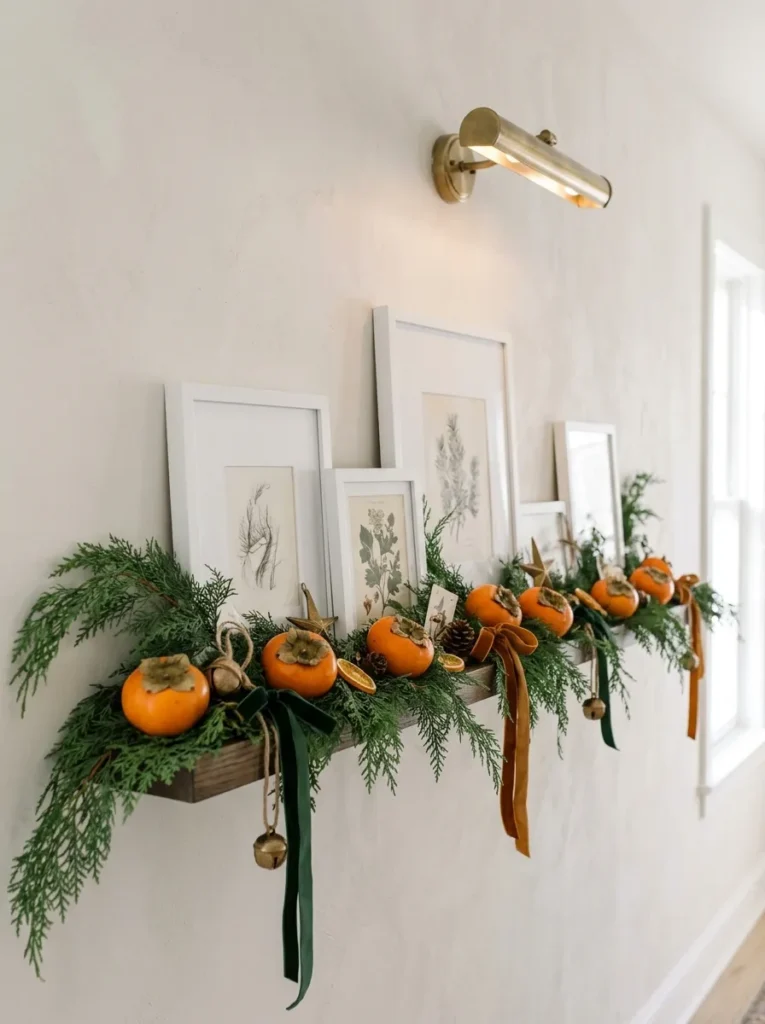
- Palette: incense cedar green, persimmon orange, smoked oak, matte white frames
- Lighting: hallway window light by day, a 2700K brass picture light at night
- Anchor: a 6-foot incense cedar garland laid along a picture ledge
- Standout detail: five Fuyu persimmons tucked between the frames
- Mounting: the ledge is screwed into every stud it crosses
Why this works: A garland laid on a picture ledge mixes with the art, so greenery and frames read as one curated gallery wall.
A picture ledge is a garland’s best friend. It gives the greenery a flat shelf to rest on, and it mixes with framed art in a way a wall hook never could. Incense cedar, with its flat, feathery sprays, lies naturally along a smoked oak ledge, and five Fuyu persimmons tucked between matte white frames add a hit of orange. I tried the combination in our hallway last winter, and my husband walked past three times before asking what had changed. The garland was low, quiet, and part of the wall, which is exactly why it worked.
A ledge takes real weight, so mount it properly. My husband screws picture ledges into every stud they cross, usually 16 inches apart, rather than relying on anchors, since a stud holds a loaded shelf for years. Choose a ledge 4 to 5 inches deep so persimmons sit securely beside frames. Lay the cedar loosely, wire each fruit to the stem, and keep the garland back from the frames’ glass by an inch. Fresh cedar stays green for a couple of weeks indoors, so cut new sprays midmonth if you want it crisp through the holidays.
13. Onyx Bead Mirror Loop
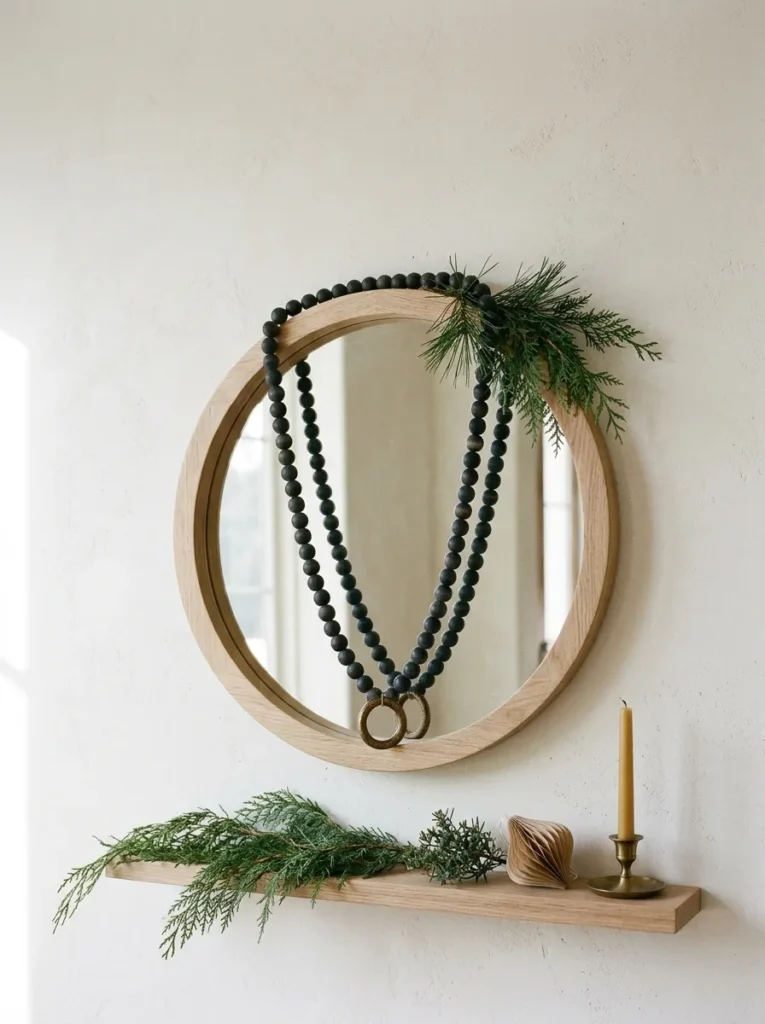
- Palette: matte onyx-black stone, aged bronze, bleached oak, limewashed white
- Lighting: soft window light by day, a 2700K plug-in sconce at night
- Anchor: a 7-foot strand of 14 mm onyx beads looped over a round 36-inch mirror
- Standout detail: one aged bronze ring slipped onto the strand at its lowest point
- Mounting: the strand hangs from its own hook, never from the mirror
Why this works: A garland looped over a round mirror doubles in the reflection, so a single strand fills the wall twice.
I will never forget the first time I looped black beads over a round mirror. The garland doubled in the reflection, and my small entry suddenly felt twice as styled for the price of one strand. Matte onyx beads, 14 millimeters wide, look quietly dramatic against a limewashed white wall and a bleached oak mirror frame. I let the strand fall in one asymmetric loop and slipped a single aged bronze ring onto the lowest point, and that ring became the detail everyone noticed. Every time, the mirror does the heavy lifting.
Mirrors are heavier than they look, and their hangers are rated for the mirror alone. My husband never lets me hang anything from a mirror frame, because extra weight pulls on the hardware and tilts the glass. Instead, set a small brass hook into a stud or anchor above the mirror, and loop the beads over it so the strand drapes across the top and down one side. Thread the bronze ring on before you hang. At night, a 2700K plug-in sconce beside the mirror lights the onyx from the side, and the black beads pick up soft gleams.
You’ll Also Love: Christmas Gift Wrapping Ideas 2026: 18 Modern Looks That Cost Little
14. Steel Canopy Ribbon Swag
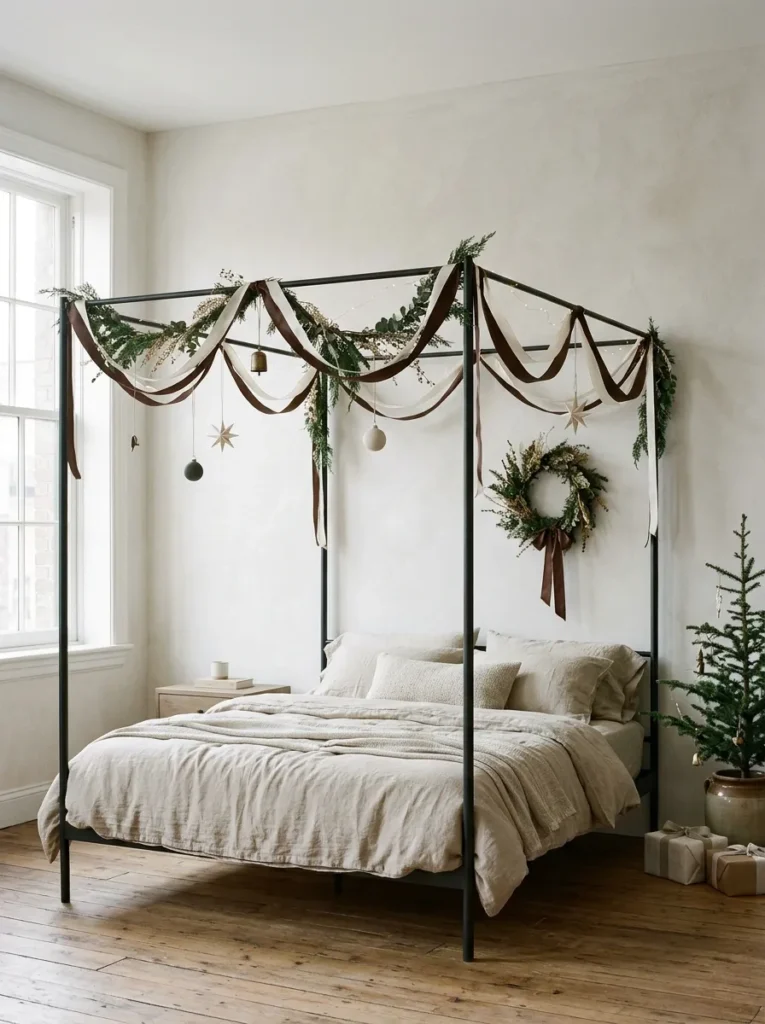
- Palette: chocolate silk, bone silk, blackened steel, oat linen
- Lighting: soft morning window light, two 2700K LED bedside lamps at night
- Anchor: three 10-foot silk ribbons swagged along the top rails of a steel canopy bed
- Standout detail: tails end at different heights, the longest about 2 feet above the pillows
- Safety: ribbons stay well away from lamp bulbs
Why this works: A canopy frame gives a garland a built-in horizontal line at ceiling height, which makes a bedroom feel taller.
A canopy bed frame is a garland’s natural stage. Its top rails sit around seven feet high, and that horizontal line draws the eye up and makes a ceiling feel taller. Slim blackened steel keeps the look light, while chocolate and bone silk ribbons bring softness to all that straight metal. Swag three 10-foot lengths in loose S-curves along the top rails, with the tails ending at different heights. Against oat linen bedding and a pale plaster wall, the dark and light ribbons repeat the contrast of the frame, so the whole bed reads like a single, composed sculpture.
Tie each ribbon to the rail with a slip knot so you can adjust the drop without tools. Use 2-inch silk, which is wide enough to hold a clear curve yet light enough that the frame never carries real weight. Silk burns like any fabric, so keep ribbons well away from bedside lamps and choose LED bulbs at 2700K, which stay cool. Let the longest tail end about 2 feet above the pillows, so it never brushes a sleeper’s face. In morning light, silk’s sheen makes the chocolate look glossy, and the bone ribbon almost glows.
15. Bay Laurel Alcove Drop — A Christmas Garland Idea for Wall Niches
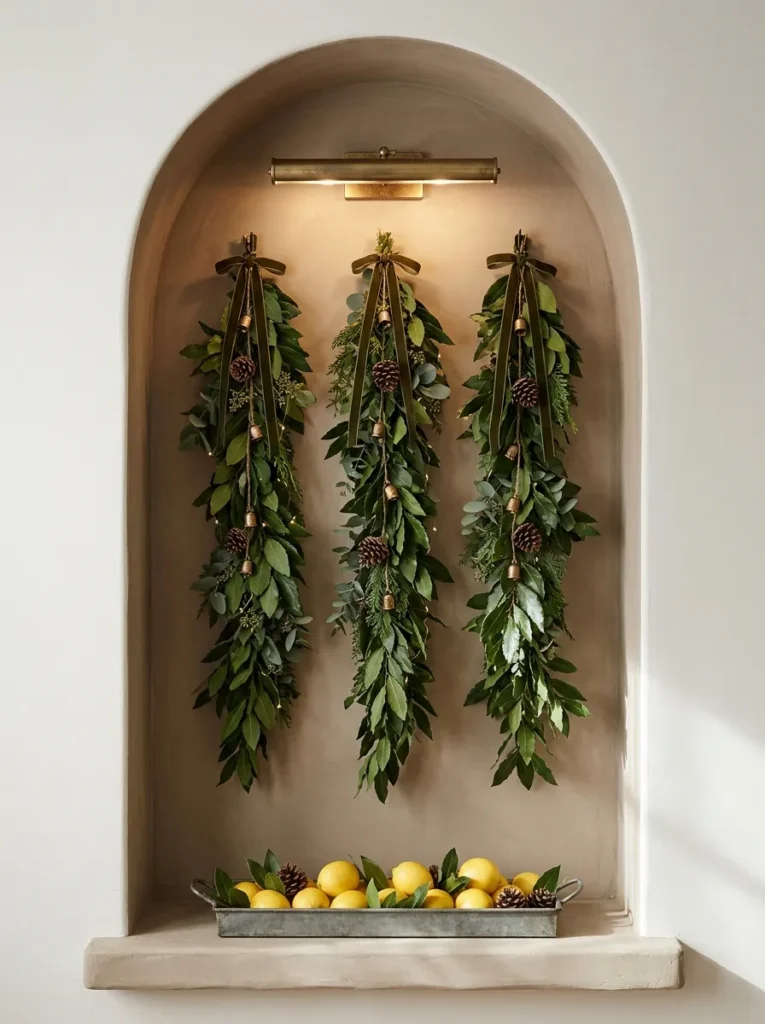
- Palette: dark bay green, lemon yellow, warm taupe plaster, aged zinc
- Lighting: soft window light by day, a 2700K picture light at night
- Anchor: three 7-foot bay laurel garlands hung vertically inside a wall alcove
- Standout detail: a zinc tray of whole lemons on a shelf below
- Freshness: untreated bay holds its color for weeks and smells like a kitchen
Why this works: Hanging garlands vertically inside an alcove frames the space like a green column, which adds height and structure that a horizontal swag cannot.
Bay laurel, Laurus nobilis, is one of the few evergreens that is both beautiful and genuinely useful. With my plant science background, I reach for it every December because its leaves are thick, glossy, and long-lasting once cut. Hung in three vertical drops inside a taupe plaster alcove, the garlands form a green column on each side and one in the center. Add a zinc tray of whole lemons below, and the yellow lifts the dark foliage without any extra color. Brush a leaf and the room smells like a kitchen, which is a small, lovely surprise.
Vertical garlands hang best from a single hook per strand, set into the alcove’s top edge. Screw cup hooks into solid wood trim, or into a stud if the alcove is framed in drywall, and tie each garland on with floral wire so it hangs straight under its own weight. Mist the leaves lightly every few days to slow drying, and keep the garlands away from any heater. Dry greenery burns fast, so swap the garlands out once leaves turn brittle. A 2700K picture light above turns the glossy leaves into deep, glowing green.
Styling Principles
Every garland has one design challenge: it is a line, and a line only looks intentional when something controls its curve, its weight, and its start and end points. These six principles solve that.
- Choose the line before the material. Decide where the eye should travel first: along a wall, around an opening, or down a staircase. A garland that follows an existing architectural line looks built in, while one hung on a blank wall looks like decoration.
- Let one material lead. Beads, ribbon, or greenery should carry the look, with a second material as a small accent. Glass beads with a single bronze ring, or juniper with six pomegranates, read as styled. Three materials fighting for attention read as clutter.
- Fix the curve with hardware. A swag only keeps its shape when pegs, hooks, or a hidden rope core hold the high and low points. Plan one hook every 18 to 24 inches for lighter strands, and closer for heavy glass or ceramic.
- Let weight choose the mount. Glass, ceramic, and metal beads belong on studs, headers, or trim. Ribbon and preserved leaves can use lighter hooks. Greenery needs clips that remove cleanly.
- Leave one part of the wall bare. A single garland on a clear surface looks like a design choice. The empty space around it does as much work as the garland itself.
- Light it from the side, and keep it warm. Raking window light and a 2700K bulb bring out texture in beads and ribbon. Keep fresh greenery at least 3 feet from any heat source, a standard fire-safety guideline.
FAQs
1. How long should a Christmas garland be? A swagged garland should be about one and a half times the width of the space it spans. That extra length lets it drape in a soft curve instead of pulling straight. For a 6-foot wall, choose roughly 9 feet. Straight runs, such as shelves, need only the exact length plus a few inches.
2. How do you hang a garland without damaging walls? Use removable clips on trim, small cup hooks in studs or wood casing, and drywall anchors only when no stud is available. Adhesive hooks suit only very light ribbon on smooth, fully cured paint. Latex paint keeps curing for about a month, so avoid adhesives on freshly painted walls.
3. How long does a fresh garland last indoors? Fresh evergreen garlands usually last three to four weeks in a cool room away from vents. Misting lightly every few days slows drying. Magnolia, bay, and juniper tend to hold up well, while cut fir dries faster near heat. Preserved leaves such as beech last for months without watering.
4. How do you stop a garland from sagging? Support it at regular points, because a garland sags when its weight is carried by only two hooks. Add a hook every 18 to 24 inches for lighter strands. A hidden rope core or wire inside ribbon keeps scallops in shape, and fixed pegs hold a wave crisp for weeks.
5. Is it safe to put lights on a fresh garland? Yes, if you use LED lights, which stay cool, and keep the garland at least 3 feet from heat sources like fireplaces, heaters, and cooktops. Outdoors, choose lights rated for outdoor use and plug them into a GFCI-protected outlet. Never leave lit candles near fresh or dried greenery.
6. What makes a garland look modern instead of traditional? A modern garland uses one tonal palette, a sculptural shape, and restraint. Matte or smoked glass beads, wide silk ribbon, and sparse greenery with one unexpected accent all look current. Avoid heavy glitter, mixed bright colors, and overstuffing, because fullness reads as dated while clean curves read as designed.
Conclusion
A garland is the smallest change with the biggest payoff. I have seen how one strand of smoked glass, one wave of silk, or one band of magnolia leaves can make a room feel finished overnight. You do not need to try all 15 of these the new Christmas garland looks for 2026. Pick one wall, one doorway, or one window, and style it with intention: one leading material, one accent, and a mount that holds.
Save this post on Pinterest so you can find it when December arrives, try one look this weekend, and share it with a friend who needs ideas.