15 Masculine Home Office Ideas That Boost Your Focus
A dark, deliberate home office isn’t just good-looking — it might actually help you get more done. That’s not a design opinion; it’s backed by something real. Masculine home office ideas built around saturated color, structured furniture lines, and a few well-placed brass details create less visual noise for your brain to sort through than a bright, busy room does, which is part of why so many people report sharper focus once they make the switch. I noticed this firsthand when my husband moved his own office from a plain white spare room into a charcoal-paneled space — he still swears his afternoons feel clearer.
But most guides stop at “dark wood, leather chair” and call it done, skipping the two things that actually make a room livable day to day: lighting that doesn’t wreck your video calls, and enough restraint that the space reads as sophisticated instead of a dated man cave cliché. That’s what this collection of 15 full room ideas is built to solve — real, recreate-able spaces with the desk, chair, lighting, and material details spelled out, so you can borrow exactly what fits your own room.
Why a Masculine Home Office Actually Helps You Focus
Here’s something most home office guides skip entirely: a darker, more structured room can genuinely help you focus better than a bright, airy one. Design research consistently ties lower-contrast, saturated color palettes and defined furniture lines to less visual “noise” for the brain to sort through, which means fewer small distractions pulling attention away from the task in front of you. I noticed this firsthand when my husband moved his home office from a white-walled spare room into a charcoal-paneled space near the garage — he swears he clears his inbox in half the time now. A well-planned masculine home office isn’t just about looks — it’s a tool for sustained concentration. This post solves the real gap: how to make that dark, grounded look actually work on camera and in daily use.
1. Charcoal Built-In Study: A Floating Desk That Keeps the Room Open
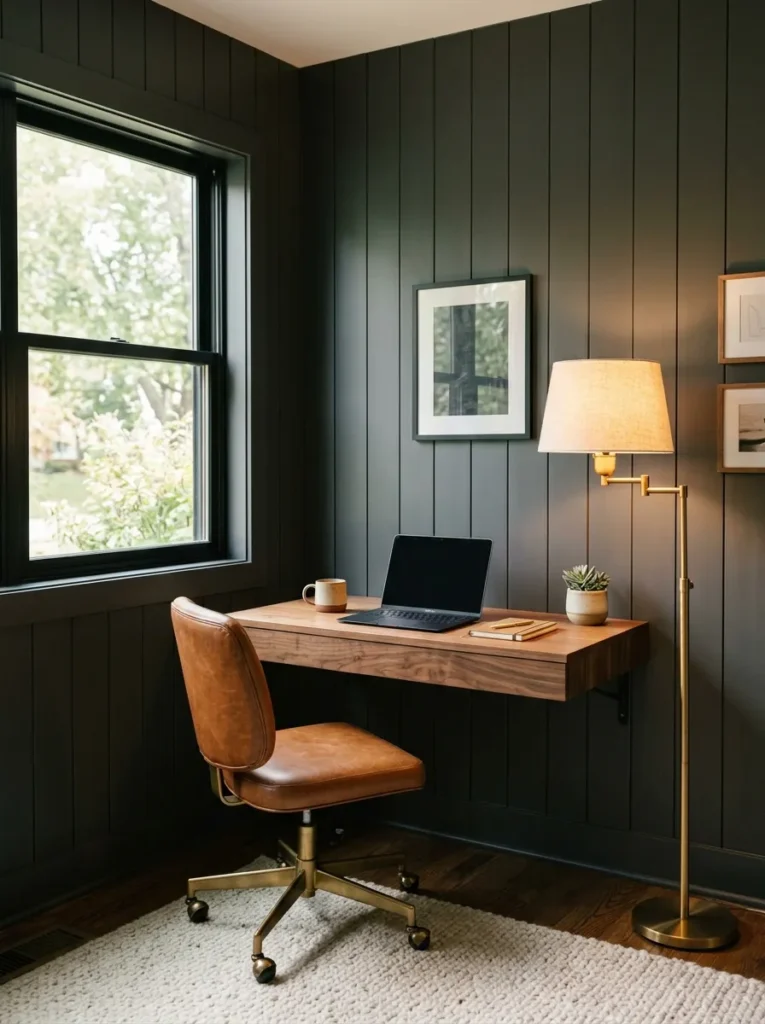
- Wall treatment: charcoal vertical-shiplap panel wall (Benjamin Moore “Kendall Charcoal”)
- Desk: built-in floating walnut desk, wall-mounted for a clean floor line
- Chair: cognac leather mid-century task chair with brass tacks
- Lighting: warm dimmable LED task lamp angled for face-forward video call light, plus a brass floor lamp for evening ambiance
- Shelving: matching walnut floating shelves for books and a few framed prints
- Rug: oatmeal wool boucle rug layered under the desk to soften the dark palette
- Plant: small potted snake plant tucked on the corner shelf — tolerant of low light
- Hardware: brushed brass pulls and hinges throughout
Why this works: A floating desk keeps the floor line visible, which stops a charcoal room from feeling boxed in.
Dark, saturated walls can make a small home office feel closed in — unless the furniture underneath stays visually light. That’s the trick behind a built-in floating desk: by lifting the work surface off the floor, you keep a clean sightline running the length of the room, which counters the visual weight of charcoal paneling. My husband framed this exact desk into a former closet nook for a client last year, running the walnut top wall-to-wall so it reads as architecture, not furniture. Paired with brass hardware and a cognac leather chair, the result feels tailored and grounded rather than heavy or cave-like.
Video calls are where most dark home offices fall apart, and this is where planning pays off. Position the desk facing a window or a warm LED panel, never with your back to the only light source in the room — charcoal walls absorb light fast, and without a front-facing source, calls read shadowy and flat. A dimmable brass floor lamp handles evening ambiance once the sun goes down, while the task lamp stays angled at desk height for daytime meetings. Add a small snake plant on the shelf for a touch of green that doesn’t demand much light or maintenance.
2. Forest & Oxblood Corner: Sophisticated Depth Without Feeling Like a Cave
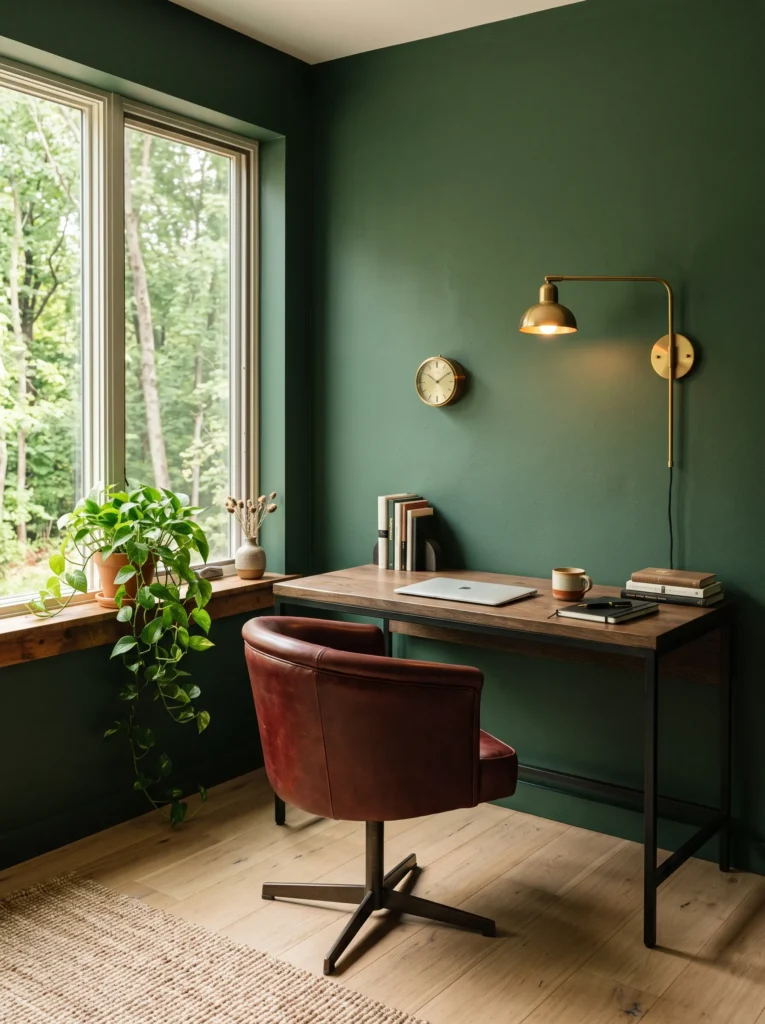
- Wall treatment: forest green painted walls (Sherwin-Williams “Rosemary”), matte finish
- Desk: industrial metal-and-wood desk, blackened steel frame with a reclaimed oak top
- Chair: oxblood leather barrel-back office chair
- Lighting: brass articulating wall sconce positioned near eye level for calls, plus a warm floor lamp for evening
- Storage: black steel file cabinet with brass pulls tucked under the desk
- Wall art: oversized botanical print in a thin brass frame
- Plant: trailing pothos in a woven basket on the windowsill
- Standout detail: a small vintage brass ship’s clock mounted on the wall
Why this works: Forest green reads as sophisticated rather than dark because it still carries warmth, unlike true black or charcoal.
I styled a version of this office for a client last spring, and the green wall was the one decision she second-guessed the whole time — until the desk went in. Deep green carries enough warmth to avoid feeling like a cave the way pure black sometimes does, and against a reclaimed oak desktop, it reads more library than man cave. The blackened steel frame keeps the industrial edge without overwhelming the room. By the time we hung the small brass clock on the wall, she told me it finally felt like a real office, not a corner she was tolerating.
Video calls in a green-walled office need a front-facing light source just as much as darker rooms do, since forest tones still absorb more light than white walls. Mount an articulating brass sconce at roughly eye level, angled toward your face rather than the wall, so it fills in shadows during calls without washing out the room’s color. In the evening, swap to the warm floor lamp for ambient light that keeps the green from reading flat. The oxblood chair and reclaimed oak desk anchor the space, while the trailing pothos softens all the hard, structured lines.
3. Espresso & Brass Library: Vintage Furniture, Hidden Modern Tech
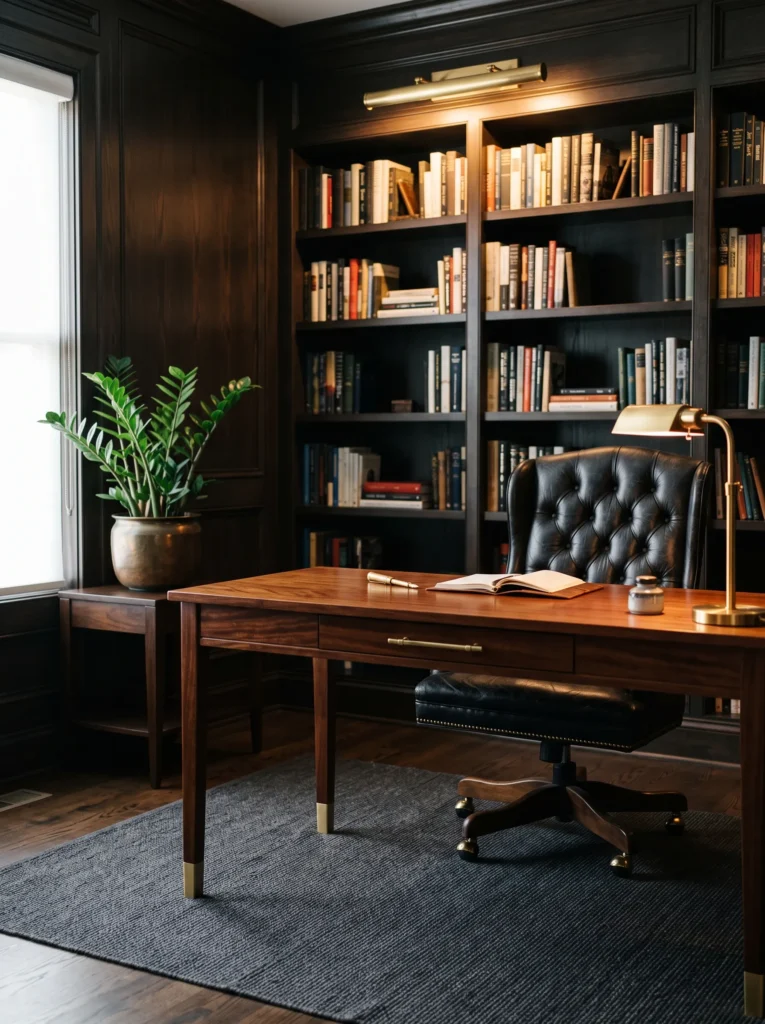
- Wall treatment: espresso-stained tongue-and-groove paneling, floor to ceiling
- Desk: restored vintage mahogany partner’s desk with brass leg caps
- Chair: black tufted leather executive chair
- Lighting: brass picture light above the shelving, plus a warm swing-arm task lamp at the desk
- Shelving: built-in espresso bookcase flanking the window, styled with books and one ceramic vessel
- Cable management: desk legs routed with hidden conduit so no cords cross the floor
- Rug: charcoal wool flatweave rug
- Plant: ZZ plant in a bronze pot, chosen for its tolerance of low light
Why this works: Hidden cable routing inside the desk legs keeps a vintage-style piece from looking cluttered with modern tech.
Espresso paneling turns a plain office into something closer to a study, but it only works if the furniture inside earns its place. My husband’s crew ran cable conduit through the legs of a similar mahogany desk on a recent build, drilling a discreet channel so the monitor and charger cords disappear before they ever reach the floor. It’s a small detail, but it’s the difference between a room that photographs well and one that actually functions daily. Paired with a tufted black leather chair and brass picture lights over the bookcase, the whole corner feels finished rather than staged.
A vintage desk brings warmth that a brand-new piece rarely matches, especially against dark espresso walls. Look for a partner’s desk or similar antique with clean lines rather than heavy carving, since ornate detailing can push a masculine office into dated territory fast. Add brass leg caps if the original hardware is worn, and keep the bookcase edited — one or two objects per shelf reads intentional, while a crowded shelf competes with the desk for attention. A ZZ plant in a bronze pot handles the low light near the paneling without any extra care required.
4. Navy & Brass Writing Room: The Easiest Dark Tone to Live With
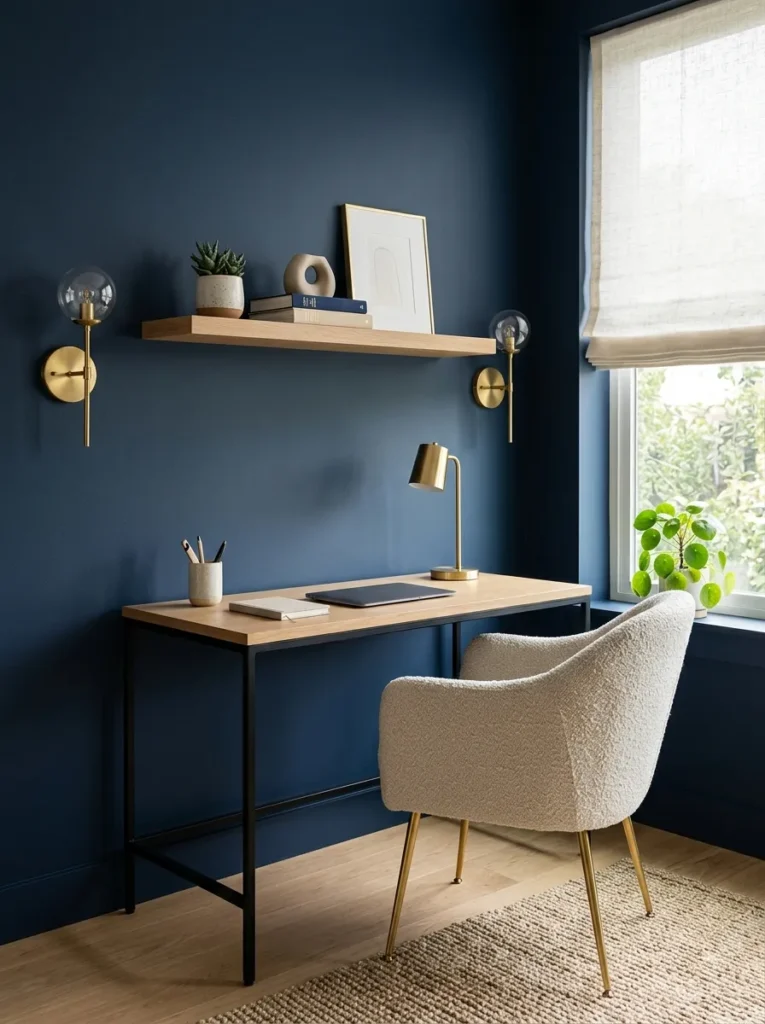
- Wall treatment: navy blue paint (Farrow & Ball “Stiffkey Blue”), eggshell finish
- Desk: slim minimalist writing desk, blackened steel legs with a white oak top
- Chair: oatmeal boucle upholstered chair with brass legs
- Lighting: brass gooseneck task lamp clamped to the desk edge, plus a pair of wall-mounted brass sconces for ambient fill
- Shelving: single floating white oak shelf above the desk, styled sparingly
- Window treatment: linen roller shade in a warm ivory tone
- Cable management: a small brass cable tray mounted under the desk to catch cords before they reach the floor
- Plant: a single trailing string of pearls in a small brass dish, tucked at the corner of the shelf
Why this works: Navy reads as calm and focused rather than heavy, which makes it the easiest dark tone to live with daily.
Navy is often the entry point for anyone nervous about going dark, and there’s a reason for that. It carries the same grounded, less-distracting quality as charcoal or black, but it never quite reads as gloomy, especially against pale oak and brass. I’ve noticed clients who hesitate at “black office” almost always say yes to navy once they see it against light wood. The slim writing desk keeps the room from feeling crowded, which matters in a smaller space where a bulky executive desk would eat the whole floor plan. It’s proof that masculine doesn’t have to mean heavy.
Video calls in a navy room are more forgiving than in true black or charcoal, since the blue still bounces some light back into the frame. That said, the two brass wall sconces do the real work here, positioned at roughly shoulder height on either side of the desk so light hits your face evenly instead of from one direction only. The brass cable tray keeps charging cords and a monitor cable from ever touching the floor, which matters more than people expect — a tidy desk reads as put-together even before anyone notices the wall color.
5. Onyx & Walnut Soundproofed Nook: Built for Video Calls
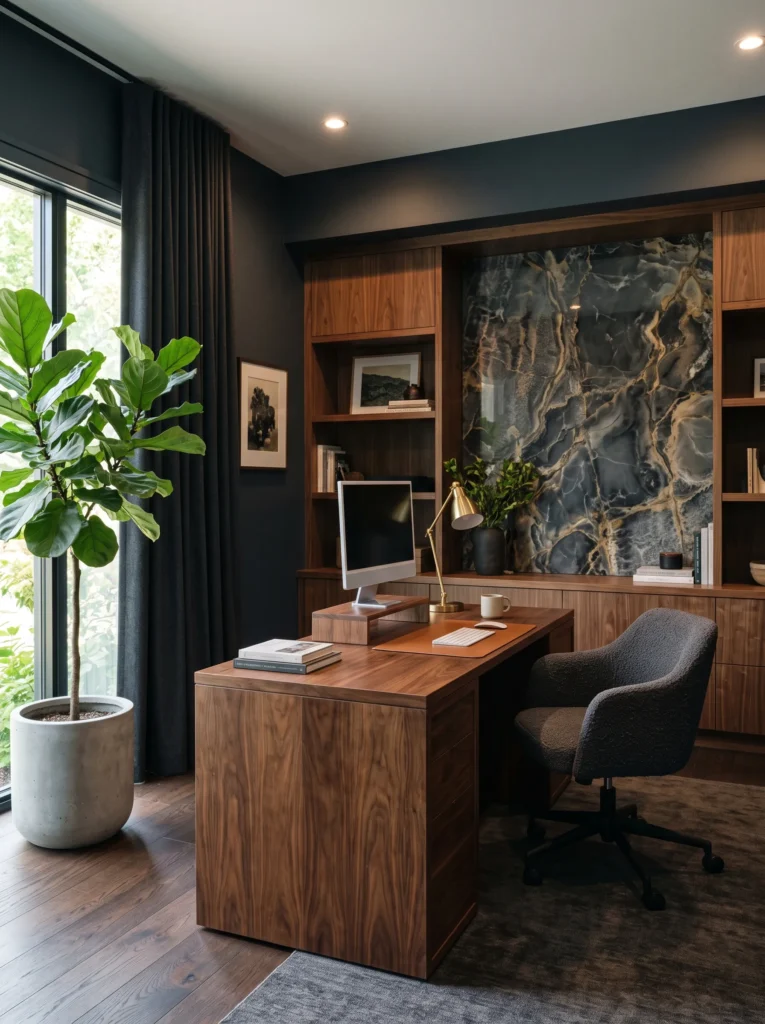
Sound is the problem nobody mentions when they talk about home office design, but anyone who’s tried to record a call next to a laundry room knows it matters more than paint color. A well-built home office needs acoustic planning as much as it needs good lighting, since hard walls and bare floors bounce sound and make video calls pick up echo. My husband’s crew handles this on nearly every home office build now — a layer of resilient channel behind the drywall, paired with a solid-core door, cuts down on both echo and noise bleeding in from the rest of the house. It’s an unglamorous detail, but it changes how a room actually feels to work in.
- Wall treatment: matte onyx-black paint on the lower half, walnut tongue-and-groove paneling above
- Desk: solid walnut executive desk with a substantial rectangular silhouette
- Chair: charcoal boucle mid-century task chair with walnut legs
- Lighting: recessed ceiling downlight above the desk, plus a warm walnut-base table lamp
- Storage: built-in walnut cabinetry along the back wall with brushed nickel pulls
- Rug: deep charcoal wool rug, low pile
- Window treatment: solid-core door and heavy wool drapery panels doubling as sound dampening
- Plant: a single fiddle leaf fig in a concrete planter near the window
Why this works: A solid-core door and resilient channel behind the drywall do more for call quality than any microphone upgrade.
This is the office to copy if video calls are a daily part of your job and the room shares a wall with something loud — a kitchen, a playroom, a laundry area. The two-tone wall treatment, onyx below and walnut above, adds visual interest without needing extra furniture, and it happens to hide scuffs well in a working space. A solid walnut executive desk anchors the room with real weight, paired with a charcoal boucle chair that keeps the whole look from feeling too formal. The heavy wool drapery isn’t just for style here; it’s doing double duty softening sound reflecting off the window glass.
Beyond the acoustic details, this room works because every material choice pulls double duty. The low-pile charcoal rug absorbs footstep sound while still being easy to roll a desk chair across daily, and the built-in cabinetry keeps files and equipment out of frame during calls. A fiddle leaf fig near the window adds a living element without demanding much beyond bright, indirect light, which this window provides most of the day. The recessed downlight above the desk handles daytime work, while the walnut table lamp takes over once the sun goes down.
6. Graphite & Brass Glass Corner: Light Without Feeling Heavy
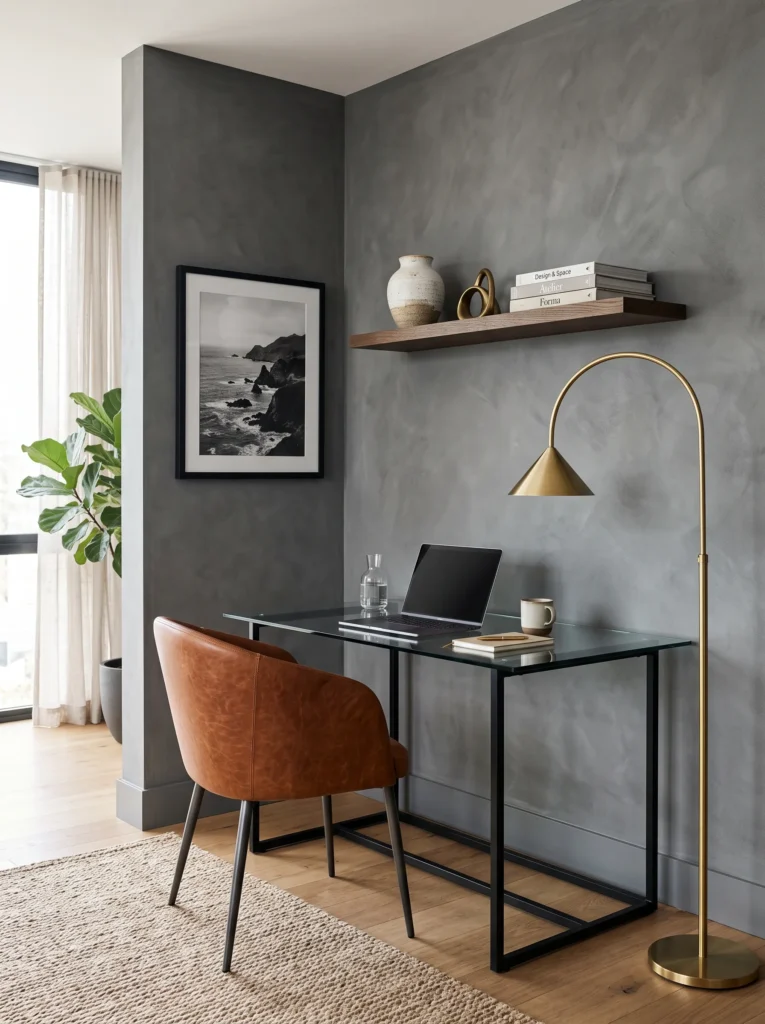
- Wall treatment: graphite gray limewash paint for a soft, textured matte finish
- Desk: glass-top desk with a blackened steel base, unexpected against the darker palette
- Chair: cognac leather task chair with a low, curved backrest
- Lighting: a sculptural brass arc floor lamp, plus a slim LED task light along the desk edge
- Shelving: floating graphite-toned shelf holding three curated objects, no more
- Wall art: single black-and-white architectural photograph in a thin black frame
- Hardware: matte black and brushed brass mixed intentionally throughout
- Plant: a small pot of English ivy trailing from the shelf edge
Why this works: A glass desktop keeps a graphite room from feeling visually heavy, since it reflects light instead of absorbing it.
Glass isn’t a material most people associate with a masculine office, and that’s exactly why it works so well here. Against a limewashed graphite wall, the desk practically disappears, letting the steel base and the room’s texture do the talking instead. I tried a similar setup in my own reading nook a few years back, worried the glass would feel cold — instead, it made the whole corner feel lighter and more current, almost like the furniture wasn’t fighting the wall color for attention. Mixing matte black and brushed brass hardware throughout keeps the room from looking too matched, which is part of what makes it feel designed rather than assembled from a catalog.
The sculptural brass arc lamp is doing more than filling a corner; positioned correctly, it throws warm light across the glass desktop and up toward the face, which happens to make it one of the better lighting setups for calls in this entire collection. Limewash paint has a soft, cloud-like texture that reads differently depending on the light hitting it, so the room shifts subtly from morning to evening without changing a single object in it. Keep the shelf edited to just a few objects, since a glass desk already draws the eye and a busy shelf competes with it.
7. Chocolate & Brass Rolltop Study: Antique Character That Lasts
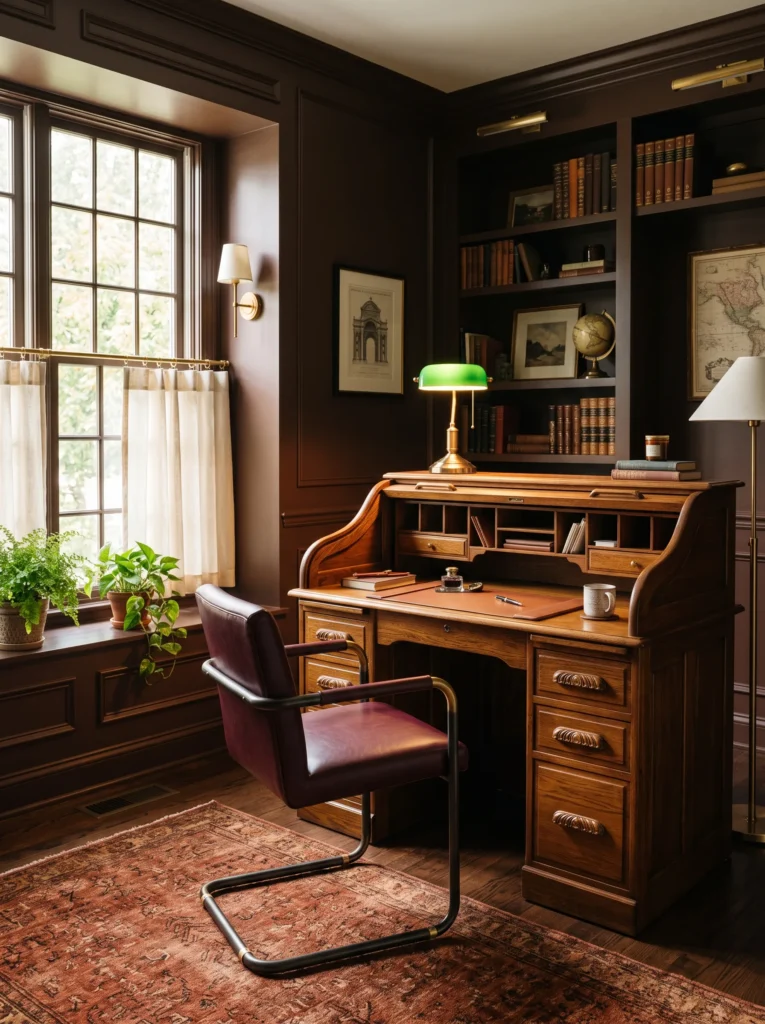
There’s a reason antique desks keep showing up in the best home offices, and it’s not just nostalgia — reclaimed hardwoods and older joinery techniques often hold up better under daily use than a lot of new furniture built to a price point. My husband has restored more than a few rolltop desks for clients over the years, and he always points out that the dovetail joints on a genuine antique outlast most modern equivalents by decades. A restored antique desk brings a level of character and durability that new furniture rarely matches.
- Wall treatment: chocolate brown paint (Benjamin Moore “Brown Horse”), matte finish, lower two-thirds only with a picture rail
- Desk: restored antique oak rolltop desk with brass hardware
- Chair: burgundy leather sled-base chair with a low, tailored profile
- Lighting: brass banker’s lamp with a green glass shade for the desk, plus a warm ceiling pendant for ambient light
- Shelving: a single antique brass étagère in the corner, styled with books and one small sculpture
- Rug: rust-toned vintage-style wool rug with subtle pattern
- Window treatment: café curtains in a heavy linen, hung at half height for privacy without blocking light
- Plant: a small potted rubber plant near the window, chosen for its glossy leaves and tolerance for moderate light
Why this works: An antique desk with real joinery brings texture and history a brand-new piece can’t fake.
Chocolate brown walls have a way of making a room feel like it’s been lived in for years, even on day one, and that’s exactly the mood this office is after. The antique oak rolltop anchors the space with real presence, its brass hardware picking up the warm tones of the banker’s lamp beside it. Rather than fight the desk’s traditional lines with something equally ornate, the burgundy leather chair stays clean and low-profile, which keeps the whole room from tipping into costume-drama territory. It’s proof that a masculine office can lean vintage without feeling dated, as long as the surrounding pieces stay restrained.
The brass banker’s lamp with its green glass shade isn’t just decorative — it throws warm, focused light exactly where you need it for reading or writing, though it’s worth pairing with a brighter ceiling fixture for video calls, since the lamp alone runs too dim and too green-tinted for camera work. The half-height café curtains let in daylight from the top of the window while still giving privacy at desk height, which matters if the office faces a street or a neighbor’s yard. A single rubber plant by the window softens the antique brass and dark wood without adding maintenance.
8. Slate Blue-Gray Minimalist Desk: A Room Built for Concentration
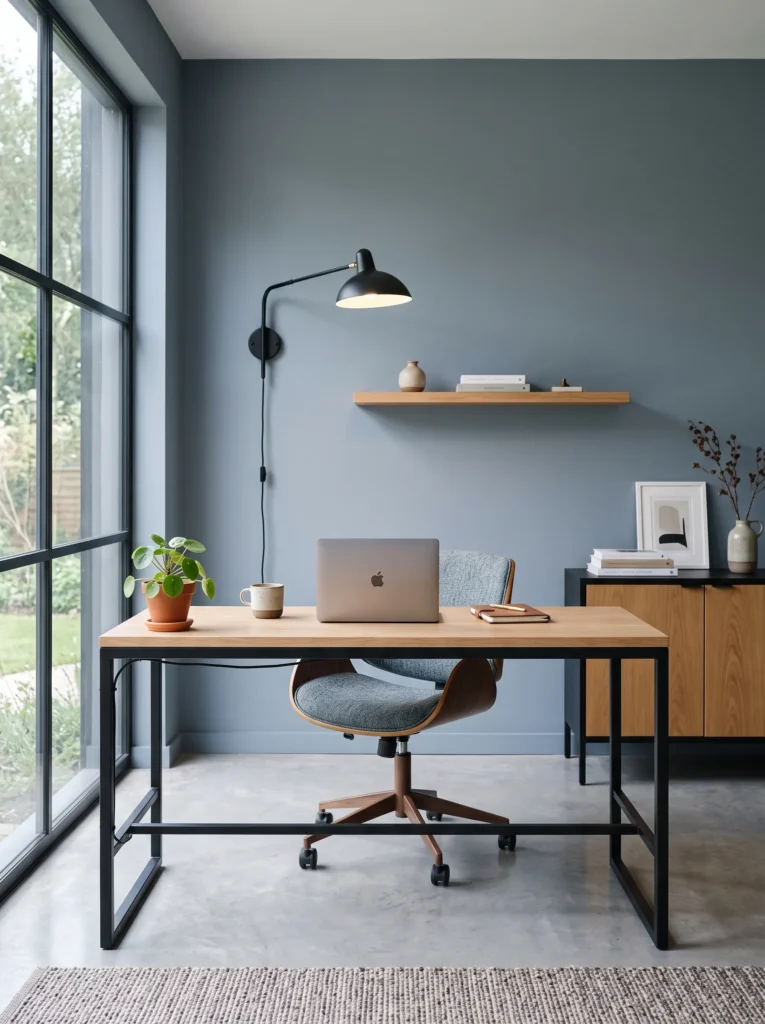
- Wall treatment: slate blue-gray paint (Sherwin-Williams “Cyberspace”), matte finish
- Desk: minimalist writing desk in blackened steel with a thin white oak top
- Chair: mid-century walnut-frame task chair upholstered in oatmeal tweed
- Lighting: a single architectural wall-mounted swing-arm lamp in matte black, plus a slim LED strip under the floating shelf
- Shelving: one long floating white oak shelf, styled with three objects and a small stack of books
- Storage: a low blackened-steel credenza along the side wall
- Cable management: cords routed through a channel built into the underside of the desk, invisible from the front
- Plant: a small snake plant in a matte black pot on the credenza
Why this works: A single long floating shelf reads calmer than a full bookcase, which matters in a room built for concentration.
Slate blue-gray sits in an interesting spot between navy and true gray — cool enough to feel modern, but not so blue that it reads nautical or so gray that it feels sterile. I’ve noticed this particular shade photographs beautifully in both morning and evening light, which is part of why it works so well on camera during calls at different times of day. The minimalist desk keeps the room feeling open rather than cluttered, and the walnut-framed task chair adds just enough warmth against all that cool wall color. Nothing here is fighting for attention, which is exactly the point in a workspace meant for focus.
Hidden cable routing under the desk does more work than people expect in a minimalist setup like this one, since even one visible cord can undo the clean look the whole room is going for. The architectural swing-arm lamp mounts directly to the wall rather than sitting on the desk, which frees up surface space and can be angled precisely for video calls without needing a separate ring light. A single long floating shelf, styled with restraint, keeps the storage functional without adding visual clutter — three objects and a small stack of books is enough.
9. True Black Built-In Corner: Big Impact in a Small Footprint
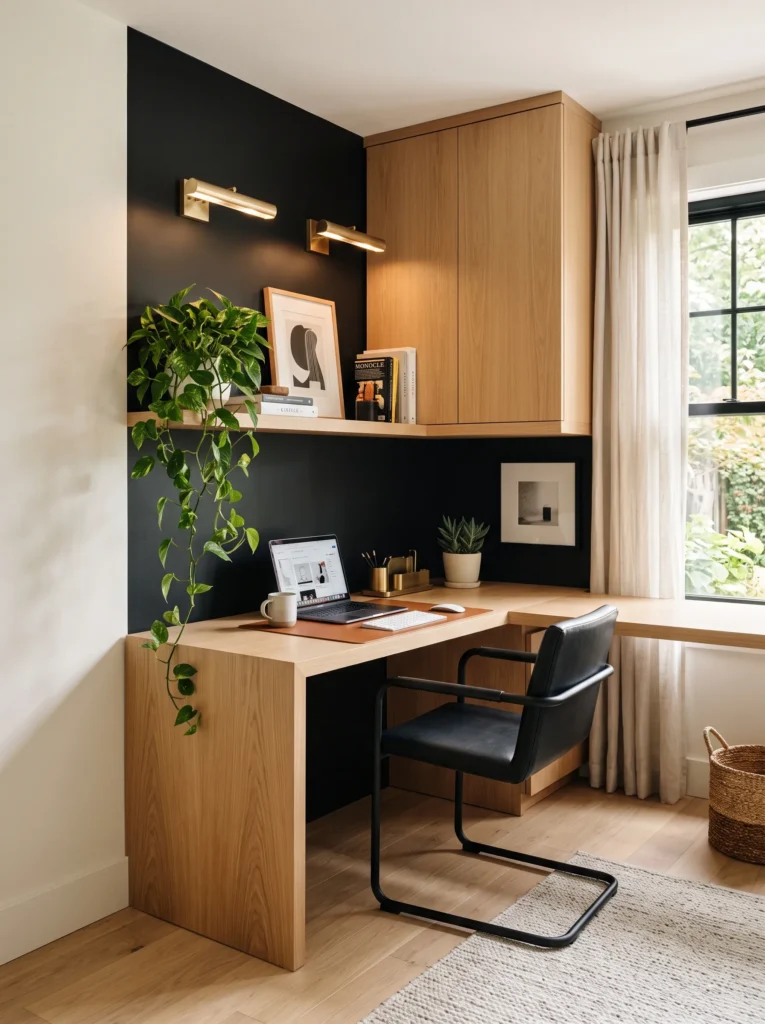
Corner desks get dismissed as a small-space compromise, but a well-built one can outperform a standalone desk for anyone doing video calls daily — you get a wraparound work surface without the visual bulk of a full executive desk sitting in the middle of the room. My husband frames these as an L-shaped built-in on-site more often than clients realize is possible in a standard spare bedroom, running the countertop from wall to wall for a seamless look. A built-in corner desk uses a room’s existing footprint more efficiently than almost any freestanding alternative.
- Wall treatment: true black paint (Farrow & Ball “Pitch Black”) on the corner walls only, with the remaining walls left a warm white for contrast
- Desk: built-in L-shaped corner desk in white oak with a waterfall edge
- Chair: black leather sled-base chair with a curved backrest
- Lighting: two brass picture lights above the desk, plus a floor lamp with a linen shade for ambient fill
- Shelving: built-in upper cabinets in white oak flanking the window
- Rug: cream wool rug anchoring the seating area away from the desk
- Hardware: brushed brass throughout, including cabinet pulls and light fixtures
- Plant: a pothos trailing from the upper cabinet, and a small cactus on the desk corner
Why this works: Painting only the corner black, while leaving the rest of the room a warm white, keeps a small office from feeling like a box.
The trick to using true black successfully in a small home office is restraint — paint the whole room black and it can feel like working inside a closet, but contain it to one corner and it becomes a focal point instead of an enclosure. That’s exactly what’s happening here: the black corner recedes visually while the built-in white oak desk and cabinetry pop forward against it. The waterfall edge on the desk, where the countertop wraps down the side rather than stopping at a hard corner, is a small architectural detail that elevates the whole build past a standard corner desk kit.
Two brass picture lights mounted above the desk solve the video call lighting problem specifically for a black-walled corner, throwing consistent front-facing light across the face without needing a separate ring light cluttering the desk. Because the surrounding walls stay a warm white, the room still feels bright and functional day to day, which matters more than people expect once the initial excitement over a bold accent wall wears off. A trailing pothos and a small desk cactus add just enough green without needing much upkeep in a corner that gets moderate, indirect light.
10. Warm Greige & Blackened Steel Loft: Industrial Without Feeling Cold
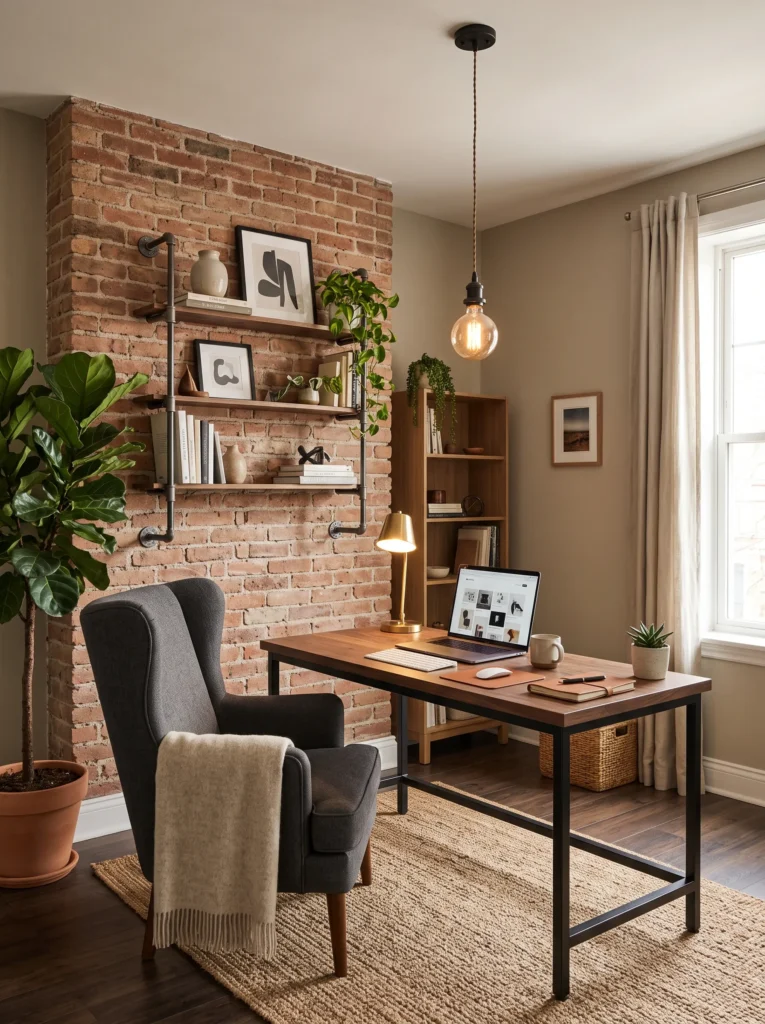
- Wall treatment: warm greige paint (Sherwin-Williams “Perfect Greige”), matte finish, paired with one exposed brick accent wall
- Desk: industrial blackened-steel desk with a raw-edge walnut slab top
- Chair: charcoal wool-upholstered wingback-style office chair
- Lighting: exposed-bulb pendant light on a dimmer, plus a brass desk lamp with an adjustable arm
- Shelving: blackened steel pipe shelving with walnut plank shelves
- Storage: vintage steel filing cabinet, repainted matte black
- Rug: a low-pile charcoal rug with subtle geometric pattern
- Plant: a large potted fiddle leaf fig anchoring the corner near the window
Why this works: Greige walls keep an industrial-style office from feeling cold, since the warmth in the paint balances all that raw steel and brick.
Exposed brick gets treated like a design shortcut, but it only earns its place when the rest of the room is intentional enough to match it. Here, the greige walls do the heavy lifting, warming up what would otherwise be a fairly cold combination of black steel and brick. My husband has framed out plenty of “industrial” offices where clients wanted the exposed-brick look but skipped the warm wall color, and the room always ended up feeling more like an unfinished basement than a design choice. The raw-edge walnut desktop against the blackened steel base bridges that gap, giving the room one clearly organic material among all the hard surfaces.
The exposed-bulb pendant is doing double duty as both a style statement and functional ambient light, but it shouldn’t be the only light source in the room if video calls are part of the daily routine — bulb-style pendants tend to cast light downward rather than forward, which leaves the face underlit on camera. Pair it with the brass desk lamp positioned to bounce light toward you during calls, and save the pendant for evening mood lighting instead. The charcoal wingback chair adds a slightly formal note that keeps the whole industrial mix from tipping into a garage workshop feel.
11. Deep Plum & Walnut Library: Jewel-Tone Focus
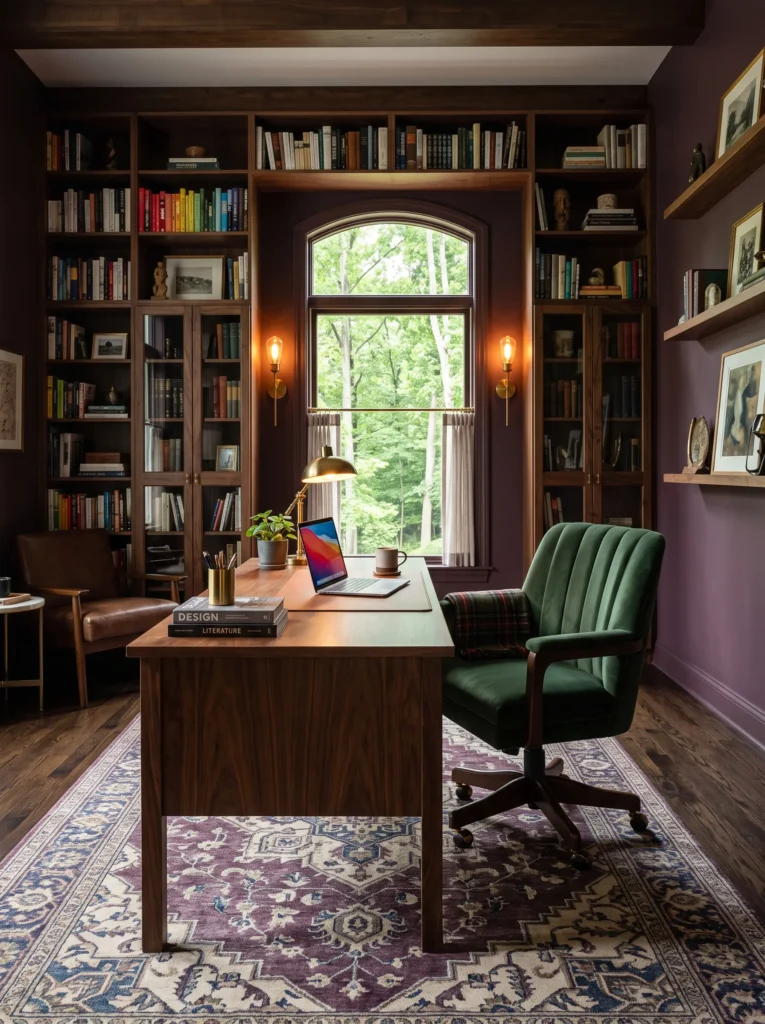
Color psychology in home offices tends to get reduced to “blue is calming,” but deep, saturated jewel tones like plum can be just as effective for focus, since they carry the same low-glare, low-distraction quality as navy or charcoal while feeling noticeably warmer in person. A deep plum wall color offers the focus benefits of a dark palette with more warmth than traditional black or charcoal options. I used a similar plum in a client’s reading room a couple of years ago and was surprised how quickly people stopped commenting on the color and started commenting on how calm the room felt to sit in.
- Wall treatment: deep plum paint (Behr “Elderberry Wine”), eggshell finish
- Desk: solid walnut executive desk with a traditional rectangular silhouette and tapered legs
- Chair: channel-tufted forest green velvet office chair
- Lighting: brass swing-arm task lamp, plus a pair of brass wall sconces flanking a window
- Shelving: built-in walnut bookcase with glass-front upper cabinets
- Rug: deep plum and cream vintage-style rug, low pile
- Window treatment: floor-length velvet drapes in a lighter dusty rose-adjacent tone for contrast
- Plant: a trailing philodendron in a ceramic pot on the bookcase
Why this works: Pairing plum walls with forest green velvet leans into color, not just tone, which keeps a dark office from reading flat or monochrome.
Most masculine office palettes stick to a single dark neutral, but this room proves that a saturated color and a contrasting jewel tone can work together without clashing, as long as they share the same warmth level. The plum walls and forest green velvet chair sit close enough on the color wheel to feel coordinated, while the walnut desk and bookcase ground everything in something more traditional. Glass-front upper cabinets keep the built-in bookcase from feeling heavy, letting a few curated books and objects show through without demanding full visual attention. It’s a combination that photographs as rich rather than dark.
Brass wall sconces flanking the window handle both daily task lighting and video call needs, since their fixed position means consistent, repeatable light every time you sit down for a call, unlike a lamp that might get bumped out of position. The velvet drapes add texture and help dampen sound bouncing off the window glass, a detail that matters more in older homes with single-pane windows than most people realize. A single trailing philodendron on the bookcase adds movement and color without competing with the room’s existing palette.
12. Two-Tone Gray & Black Minimalist: Lowering the Visual Weight
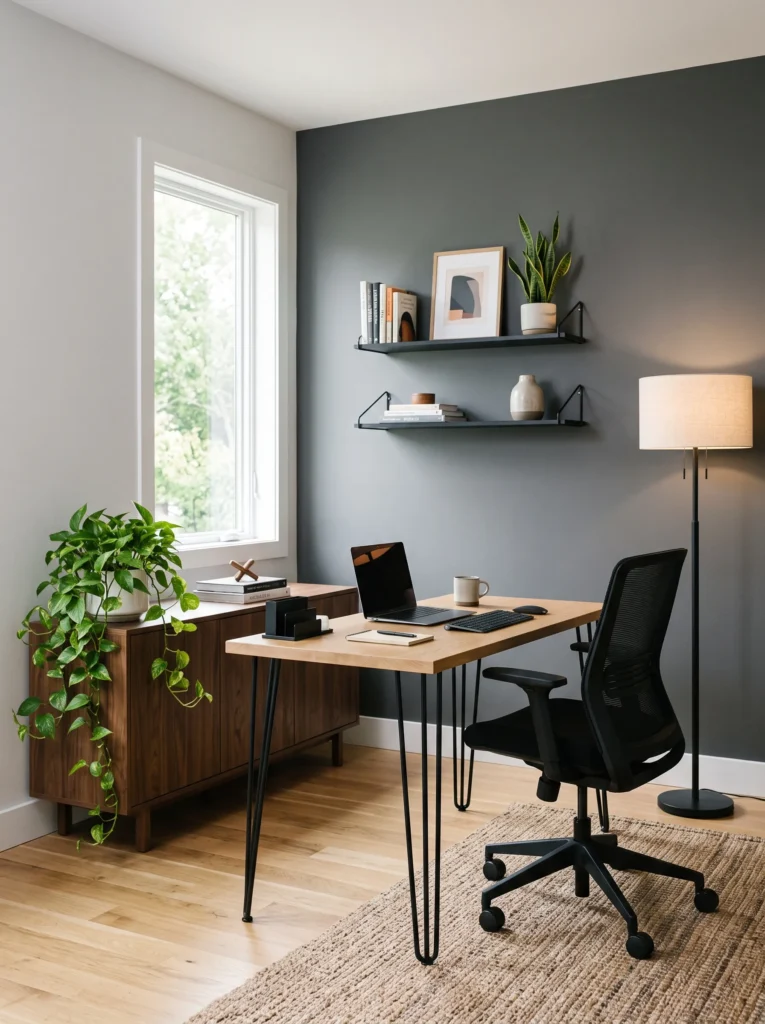
- Wall treatment: charcoal gray on the lower half, soft dove gray above, divided by a simple wood picture rail
- Desk: minimalist black steel desk with a thin white oak top and hairpin-style legs
- Chair: black leather task chair with a low mesh back for ergonomic support
- Lighting: a slim LED desk lamp with adjustable color temperature, plus a black metal floor lamp with a linen shade
- Shelving: two black metal wall-mounted shelves, styled minimally
- Storage: a low black credenza with brass pulls
- Cable management: a fabric cord sleeve running from desk to wall outlet, kept out of the visual field
- Plant: a small pot of pothos on the credenza, trailing down one side
Why this works: Splitting the wall into two tones lowers the visual weight of a dark palette without losing any of its grounded, focused feel.
A two-tone wall is one of the simplest ways to make a small home office feel less closed in without giving up the dark, focused mood a masculine palette is built around. The lower charcoal band anchors the room the way a fully dark wall would, while the lighter gray above keeps the ceiling from feeling low or the room from feeling boxed. That’s an especially useful trick in older homes with lower ceiling heights, where a fully saturated wall color can make a room feel smaller than it actually is. The hairpin-leg desk and mesh-back chair keep the furniture itself feeling light, current, and unfussy against all that structure.
An adjustable color-temperature desk lamp solves a problem most home office guides never mention: the light that looks perfect for reading in the evening often looks too warm or too dim for a daytime video call. Being able to shift the lamp cooler and brighter for calls, then warmer for focused work later, means one fixture handles two different needs instead of requiring separate lamps for each. The fabric cord sleeve keeps charging cables and monitor cords bundled and out of frame, which matters more than people expect once the camera is actually on.
13. Deep Espresso & Brass Wingback Reading Corner: A Second Purpose Beyond the Screen
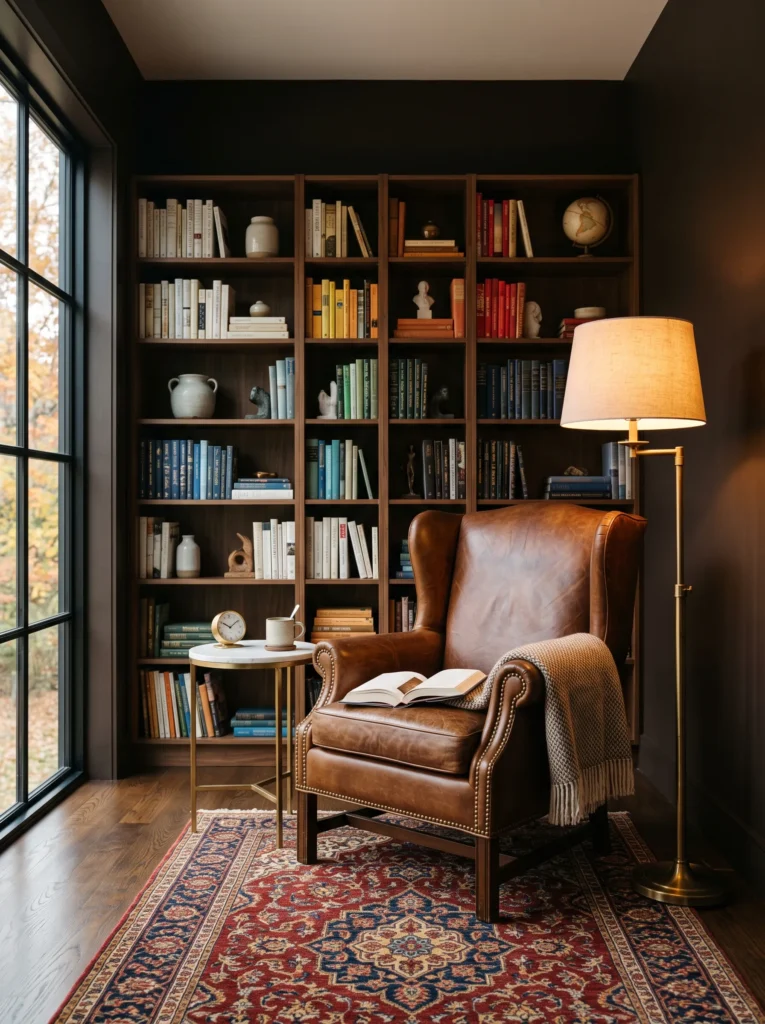
Not every home office idea needs to center on a desk — a reading and thinking corner adjacent to the main workspace gives a room dimension and makes it feel like a full study rather than just a place to sit at a computer. I’ve noticed the offices that get used the most, both mine and clients’, tend to have a spot for reading or thinking away from the screen, not just a desk pushed against a wall. This corner pairs with any of the desk setups above and rounds out a larger home office footprint.
- Wall treatment: deep espresso brown paint (Behr “Espresso Beans”), matte finish
- Desk: N/A — this is a reading nook adjacent to a main desk area
- Chair: tobacco leather wingback chair with brass nailhead trim
- Lighting: a brass floor lamp with a linen drum shade, positioned beside the chair
- Shelving: floor-to-ceiling walnut bookcase, fully built in
- Rug: a small Persian-style rug in rust, navy, and cream layered under the chair
- Side table: round brass side table with a marble top
- Plant: a mature snake plant in a woven basket beside the bookcase
Why this works: A dedicated reading chair gives a home office a second purpose beyond screen time, which makes the whole room feel more lived-in.
A wingback chair does something a desk chair never can: it signals that this room is for thinking, not just typing, and that distinction matters more than it sounds like it should. Tobacco leather with brass nailhead trim keeps the piece from reading as fussy or overly traditional, while the deep espresso walls behind it make the whole corner feel enclosed and calm rather than exposed. My husband built a similar floor-to-ceiling bookcase for a client’s home office last year, and the biggest request was making sure the shelves could handle real weight — hardback books add up fast, and cheap shelving sags within a year.
The brass side table with a marble top gives the chair a landing spot for a coffee cup or a stack of papers, which keeps the reading corner functional rather than purely decorative. A floor lamp beside the chair, rather than overhead lighting, creates a more focused, intimate pool of light for reading, distinct from the brighter task lighting at the main desk. Layering a small Persian-style rug under the chair adds pattern and color in a room that otherwise leans heavily on solid dark tones, giving the eye somewhere to rest.
14. Matte Black & Cognac Loft Office: Industrial Warmed Up
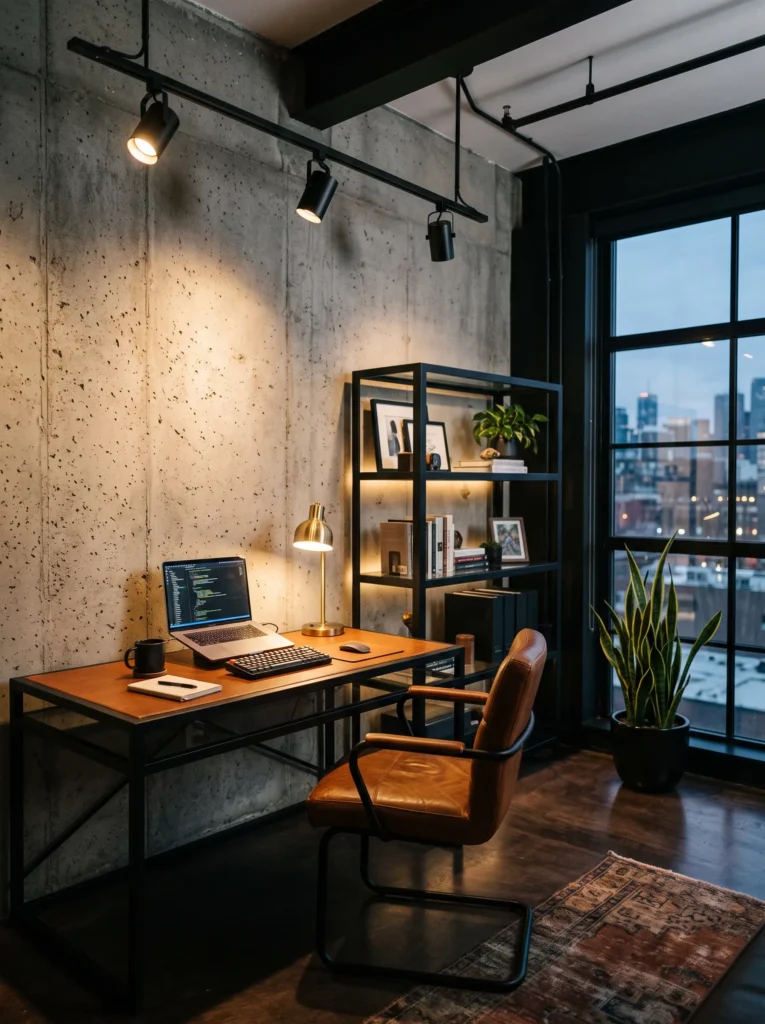
- Wall treatment: matte black paint (Sherwin-Williams “Tricorn Black”) on three walls, with the fourth left as exposed concrete
- Desk: industrial black steel desk with a cognac leather-wrapped top
- Chair: cognac leather executive chair with a low, tailored profile
- Lighting: track lighting overhead on a dimmer, plus a brass gooseneck task lamp
- Shelving: black steel and glass shelving unit, minimally styled
- Storage: matte black filing cabinet tucked beneath the desk
- Rug: none — polished concrete floor left bare for an industrial loft feel
- Plant: a large snake plant in a black ceramic planter, positioned near the window for contrast
Why this works: A leather-wrapped desktop softens an otherwise all-black, all-industrial room without adding a single soft object.
An all-black room with a concrete floor risks feeling more like a garage than an office, and the detail that keeps this one from tipping that direction is the cognac leather wrapping the desktop. It’s an unexpected material choice for a desk surface, but it warms up the black steel frame instantly and gives the whole piece a tailored, almost saddle-like quality. Track lighting overhead, rather than a single fixture, lets you direct light exactly where it’s needed across a room this dark, which matters both for daily work and for keeping video calls well-lit without harsh overhead shadows.
Bare concrete floors read as a deliberate loft aesthetic rather than an unfinished space, but only when paired with warm materials elsewhere in the room — the cognac chair and desktop do that work here. A single large snake plant near the window adds a living element without needing much light, since snake plants tolerate the lower light levels common in all-black rooms better than most houseplants. The glass-and-steel shelving stays minimally styled on purpose; a busy shelf against black walls creates visual clutter fast, while a few well-chosen objects read as curated.
15. Hunter Green & Brass Corner Nook: Big Style in a Small Footprint
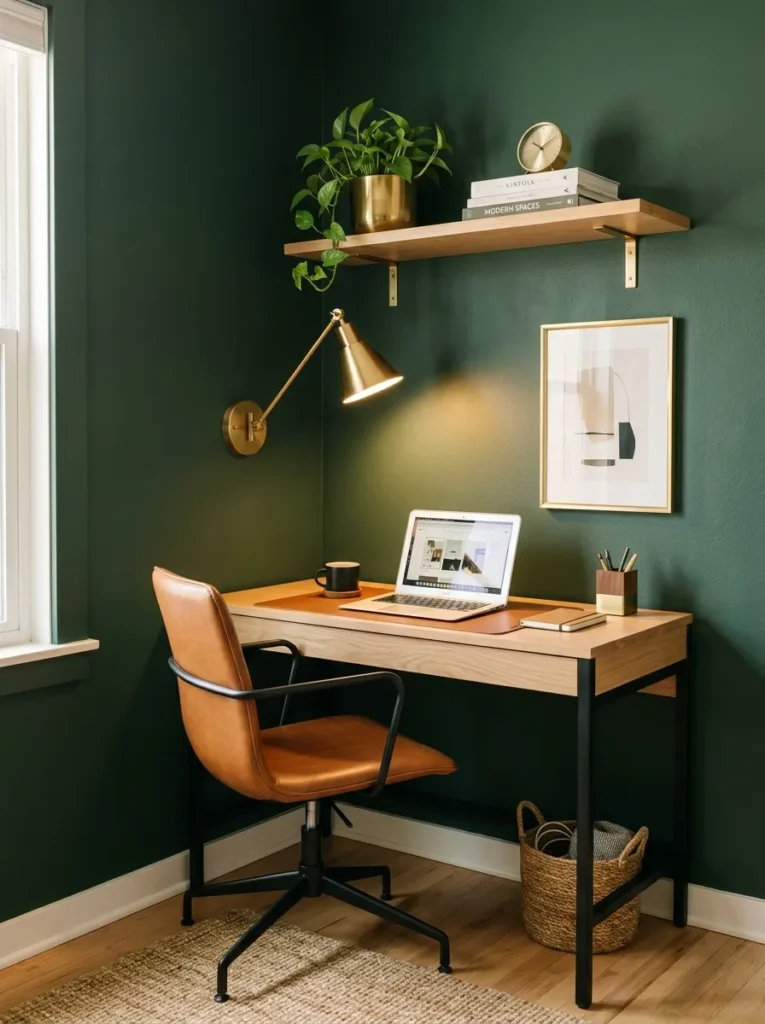
Small home offices, the kind carved out of a bedroom corner or a landing, get shortchanged in most design advice because the assumption is you need less thought when you have less space — the opposite is actually true. In a compact home office, every material choice carries more visual weight, since there’s less room for the eye to rest between elements. That means color, hardware, and even plant choice all matter more here than they would in a larger dedicated room.
- Wall treatment: hunter green paint (Farrow & Ball “Studio Green”) on the corner nook only
- Desk: compact writing desk in blackened steel with a narrow white oak top
- Chair: cognac leather task chair with a slim profile to fit the footprint
- Lighting: a single brass wall sconce mounted directly above the desk, angled downward
- Shelving: one small floating brass-bracket shelf above the desk
- Storage: a slim rolling file cart tucked to the side, finished in matte black
- Cable management: an under-desk cable tray to keep the small footprint tidy
- Plant: a single small pothos in a brass pot on the shelf
Why this works: In a small nook, one bold wall color does more visual work than several coordinating pieces of furniture ever could.
A corner nook doesn’t have the luxury of a full room’s worth of furniture to build a mood, so the wall color has to carry more of that weight on its own. Hunter green does exactly that here, turning what could be an afterthought corner into a defined, intentional workspace the moment you paint it. The compact desk and slim task chair are chosen specifically to fit a narrow footprint without feeling cramped, and the brass hardware throughout — the sconce, the shelf brackets, the plant pot — ties the small space together visually even though there isn’t much square footage to work with.
The single wall-mounted sconce solves both the space problem and the video call lighting problem at once, since a nook this size rarely has room for a floor lamp, and a sconce angled correctly provides consistent, repeatable front-facing light every time you sit down. A rolling file cart tucked beside the desk keeps supplies accessible without needing built-in cabinetry, which matters in a rental or a space you don’t want to modify permanently. Even in a nook this size, a single trailing plant keeps the corner from feeling purely utilitarian.
Styling Principles for a Masculine Home Office
A masculine home office lives or dies on two things most guides skip: video call lighting and the line between “grounded” and “gloomy.” Dark walls absorb light fast, which means a single overhead fixture is almost never enough — you need a front-facing light source, whether that’s a desk lamp, wall sconce, or picture light, positioned at roughly eye level so it fills in shadows on camera instead of leaving your face underlit. The single biggest lighting mistake in a dark home office is relying on ambient light alone without a dedicated front-facing source for calls.
The second principle is contrast management. A fully saturated dark room, floor to ceiling, can tip from focused to closed-in fast, especially in smaller spaces or rooms with low ceilings. The fix isn’t abandoning the dark palette — it’s containing it. Paint one wall instead of four, add a lighter ceiling, or pair dark walls with pale wood furniture so the room still reads as intentional rather than cave-like. And when it comes to sound: hard walls, bare floors, and thin doors all bounce noise, so if calls are a daily part of your work, a rug, heavy drapery, or even a solid-core door does more for call quality than most people assume.
Frequently Asked Questions
What’s the best lighting for video calls in a dark home office? A front-facing light source positioned at or near eye level works best — a desk lamp, wall sconce, or picture light angled toward your face rather than overhead. Overhead lighting alone tends to cast shadows that read poorly on camera in a dark-walled room.
How can I get this look on a budget? Paint is the highest-impact, lowest-cost change you can make, so start there before buying new furniture. A single accent wall in a saturated dark tone, paired with brass hardware swaps on existing furniture, gets most of the visual impact without a full room overhaul.
What if my home office is really small? Contain the dark color to one wall or a defined nook rather than the whole room, and choose a compact desk with a slim profile. In a small space, one bold wall color and a few well-chosen brass accents do more work than trying to fit in every element from a larger room.
What desk material works best for a masculine home office? Solid wood, blackened steel, and leather-wrapped tops all read as grounded and durable, and mixing two materials — like a steel base with a walnut top — tends to look more current than an all-wood or all-metal desk alone.
How do I keep this from looking like a cliché man cave? Skip literal sports memorabilia, taxidermy, and matched furniture sets, and lean instead on a defined color palette, mixed metals, and one or two curated statement pieces. Restraint, not more objects, is what separates a sophisticated office from a dated one.
Does a dark office actually help with focus, or is that just a design trend? Design and workspace research consistently links lower-contrast, saturated color palettes to less visual distraction than bright, busy spaces, since there’s simply less for the eye and brain to process. A dark, structured office isn’t just an aesthetic choice — it can genuinely support sustained concentration.
Conclusion
A masculine home office doesn’t have to choose between mood and function — the fifteen ideas here prove you can have moody color, warm brass details, and a space that still works beautifully on camera every single day. Whether you’re drawn to a full charcoal built-in or just want to try one hunter green corner nook, start small and build from there. I’ve seen how much one confident wall color and a well-placed lamp can change how a room feels to actually sit and work in.
Save this post to Pinterest, pick the idea that fits your space best, and give it a try — and pass it along to anyone else planning a home office refresh of their own.