15 Minimalist Christmas Decor Ideas for a Calm, Uncluttered Home
Walk into a room with one glowing object and nothing else, and you’ll slow down without realizing it. That’s the feeling these minimalist Christmas decor ideas are built to create.
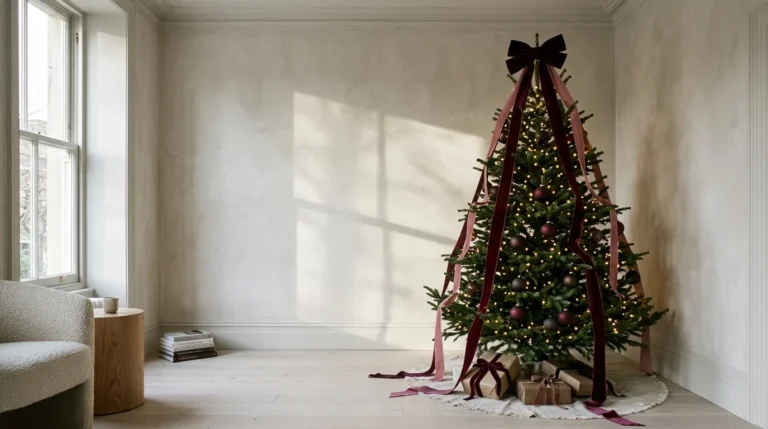
Instead of unpacking every box, you’ll choose one strong anchor for each zone, leave generous empty space around it, and light it warmly. You won’t find a beige-only formula here. A deep green tree, an oxblood ribbon, and a lilac lantern prove that restraint is about quantity, not color.
Every idea gives exact sizes, colors, and placement, plus what to leave out. I’ve tried many of these in our Austin home, and my husband, who builds houses for a living, helped me get the mounting and wiring right. Save the ideas you love, then pick one to try this season.
A bare shelf with one dramatic object looks more expensive than a crowded one. That’s not an accident. The eye reads a single large object with empty space around it as a deliberate composition, while many small objects compete for attention and register as clutter, which is why designers often cut a display by a third before calling it finished. Last December I pulled 40 ornaments off one bookshelf in our Austin house and left a single glass orb. Friends asked what we’d changed. They couldn’t name it, only that the room felt finished. This post solves the editing problem: fifteen rooms, each with one anchor piece, in any color you choose.
1. Fluted Pot Evergreen — A Minimalist Christmas Decor Idea for the Living Room
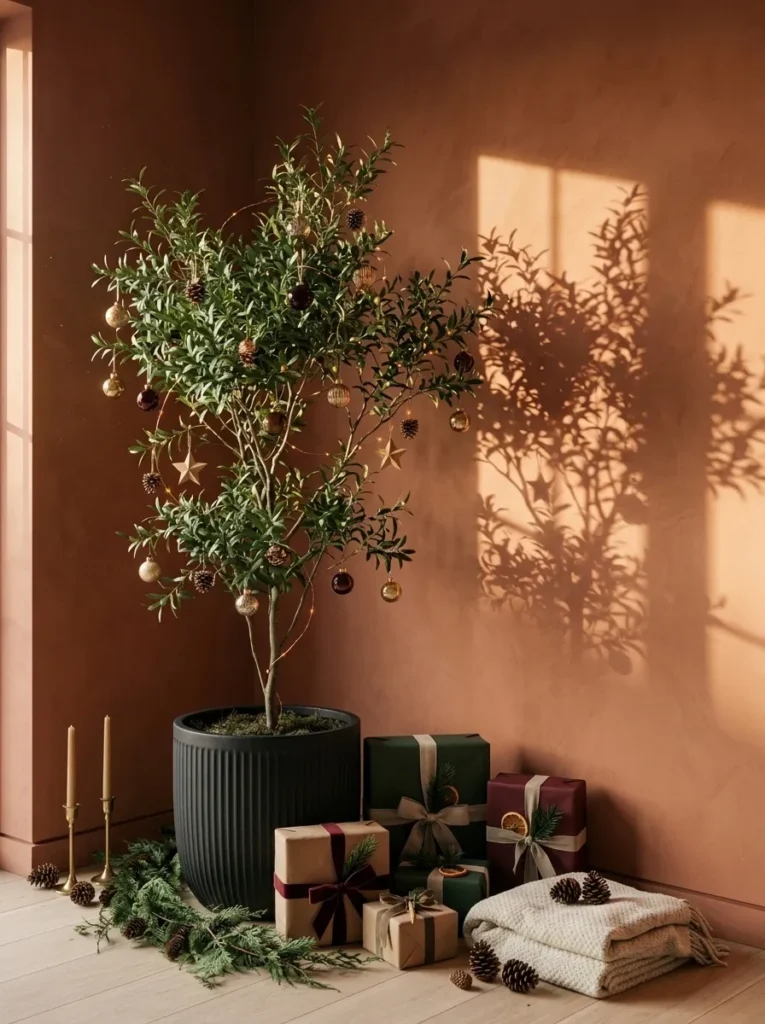
- Anchor piece: 7-foot slim faux Fraser fir, 26 inches wide at the base, in deep forest green
- Vessel: 18-inch rounded, ribbed matte black ceramic pot, ballasted with about 30 pounds of pea gravel
- Zone: Living room corner, set against a terracotta limewash wall
- Palette: Forest green, terracotta, matte black, pale oak floor
- Negative space: About 4 feet of open wall and floor on each side
- Lighting: One 2700K warm-white strand of 120 LEDs on a black cord, wound in straight vertical runs
- Supporting detail: None beyond the pot, whose ribbed, rounded form supplies the one curve this sharp-edged tree needs
- What to leave out: Tree skirt, topper, garland, ornaments, and gifts
Why this works: Deep green in front of a warm clay wall reads as a bold, deliberate color pairing rather than a decoration.
I’ll admit I hesitated before putting a green tree against a terracotta wall. Two strong colors can fight, I thought. Then I stood back and saw the opposite. Green sits across from red-orange on the color wheel, so each one makes the other look richer. The ribbed black pot adds a rounded shape, which softens the tree’s sharp vertical lines. Guests walk in and read the corner as a designed moment, not a holiday display. If your wall is white, try the same tree with a plaster-pink or sage pot instead. Commit to one bold pairing.
Hiding the cord is the difference between a display and a mess. My husband, who builds homes for a living, hides wiring the way electricians do: out of sight and along the lowest edge. Plug into the outlet closest to the corner, run the cord along the baseboard behind the pot, and press it under a paintable cord cover in the wall color. Fill the pot with 30 pounds of pea gravel, so the tree can’t tip. Choose a 2700K strand, which has the amber glow of an old filament bulb, and leave every other lamp off after dark.
2. Brass Ring Ribbon
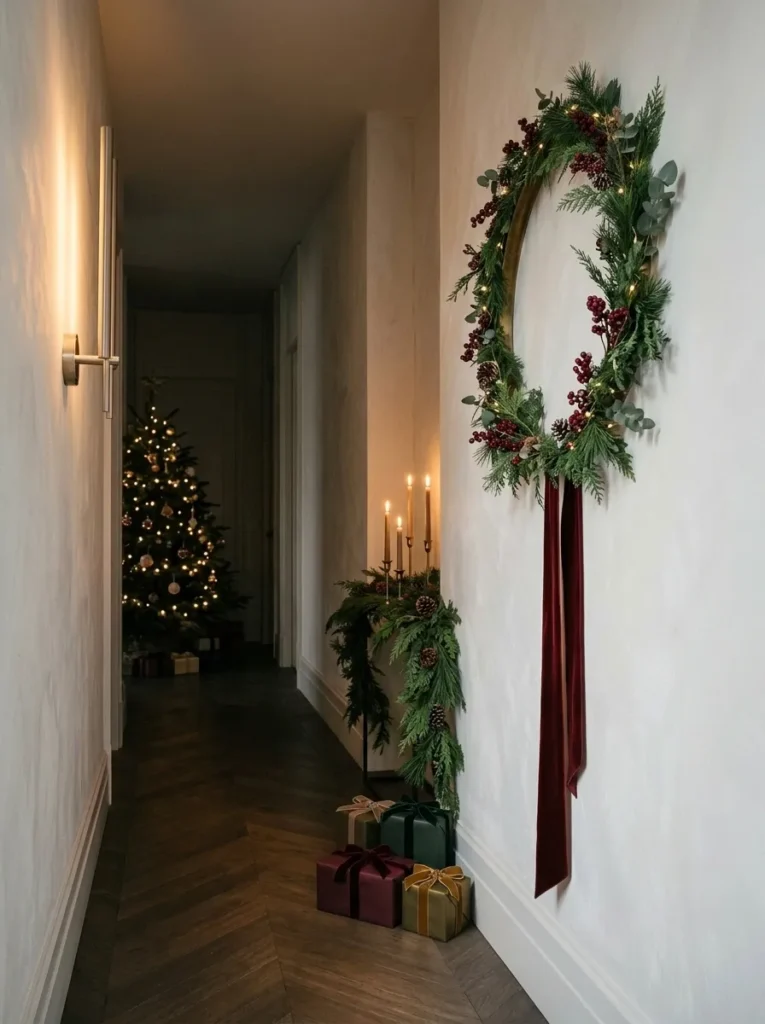
- Anchor piece: One 5-inch-wide oxblood velvet ribbon, 9 feet long, tied through a ring and falling in two uneven tails, the longer ending 3 inches above the floor and the shorter about 14 inches higher
- Zone: Entry hall wall
- Palette: Oxblood, chalk-white plaster, antique brass, smoked oak floor
- Negative space: About 5 feet of bare wall on each side
- Lighting: One aged-nickel swing-arm sconce with a 2200K filament bulb, mounted 18 inches to the right at eye level
- Supporting detail: A 30-inch solid brass ring, hung flat on one hook, that frames the ribbon in a curve and carries its weight
- What to leave out: Bow, wreath, garland, framed art on the same wall, and any second ribbon color
Why this works: A single circle above a long vertical fall gives a plain wall both curve and height without adding extra objects.
Designers pair a circle with a vertical line because the two shapes balance each other. A 30-inch brass ring gives the eye a curve to land on, while a 9-foot ribbon falling from it pulls the gaze toward the floor. Oxblood velvet absorbs light along its folds and glows on its edges, so the color shifts as the day moves. Against chalk-white plaster, it stays legible at thumbnail size. Using two tails of unequal length keeps the fall from looking stiff, which is why one tail should stop 3 inches above the floor and the other 14 inches higher.
Hanging a ring needs a plan. A 30-inch solid brass ring weighs about 3 pounds, and ribbon tails add a pull that drywall will not hold. My husband would tell you the same thing: locate the stud, drive a #10 screw, and hang the ring on a single brass hook rated for 25 pounds. Then thread the ribbon through the ring’s lower curve, cut each tail on a diagonal, and seal the ends with a dab of fray-stopper so the velvet stays crisp. Add one nickel sconce at eye level. The mix of brass and nickel feels collected, not matched.
3. Black Crescent Wreath
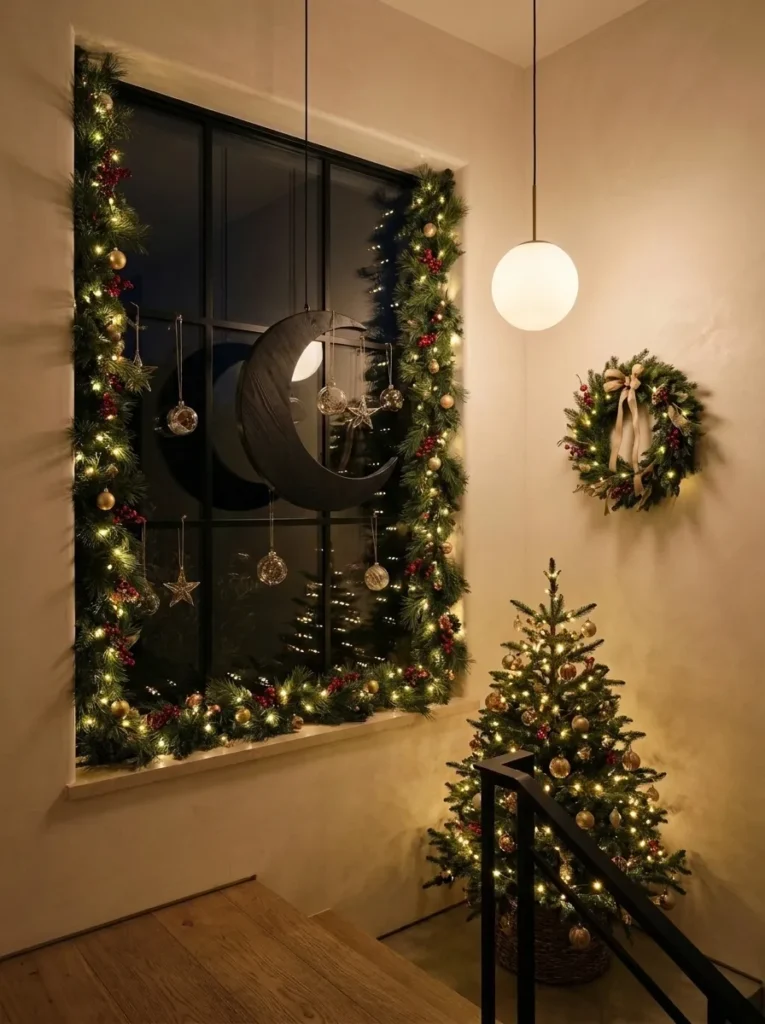
- Anchor piece: One 30-inch crescent wreath of matte black faux cedar, open on the lower right, about 5 inches deep
- Zone: Stairwell landing, hung on an 8-inch black linen cord in front of a 46-inch-wide black steel-framed window
- Palette: Matte black, white plaster, honed gray limestone sill, dark night glass
- Negative space: About 8 inches of open glass on each side, with the sill and landing floor fully bare
- Lighting: One opal-glass globe pendant with a 2700K bulb, no other fixtures lit
- Supporting detail: None. The dark glass mirrors the crescent at night, so the reflection does the work of a second decoration
- What to leave out: Ribbon, berries, wreath lights, and any seasonal object on the sill or stairs
Why this works: An open crescent gives a wreath movement, and dark glass at night turns that one curve into a pair.
Most wreaths are closed circles, which means they sit there politely. A crescent leaves one side open, and that gap creates movement, like a brushstroke. I noticed this when I tilted a 30-inch cedar ring on a client’s landing and the whole window woke up. Matte black faux cedar keeps the edges crisp, because flat finishes absorb light instead of bouncing glare. At night, the dark glass reflects the crescent and doubles it, so one object reads as a pair. Hang it so the opening faces the stairs, and your eye follows the curve up and out.
Because a stairwell window sits high, the hanging method matters. Install one black screw-in hook into the wood header above the window, not the steel frame or the glass, and use a black linen cord about 8 inches long so the wreath hangs in front of the glass without touching it. A crescent of this size weighs about 2 pounds, which any rated screw-in hook handles. Leave the sill and steps completely bare, and turn on only the globe pendant. At dusk, the wreath turns into a bold, dark shape against the pane, and the reflection finishes the composition.
4. Cobalt Orb Bowl
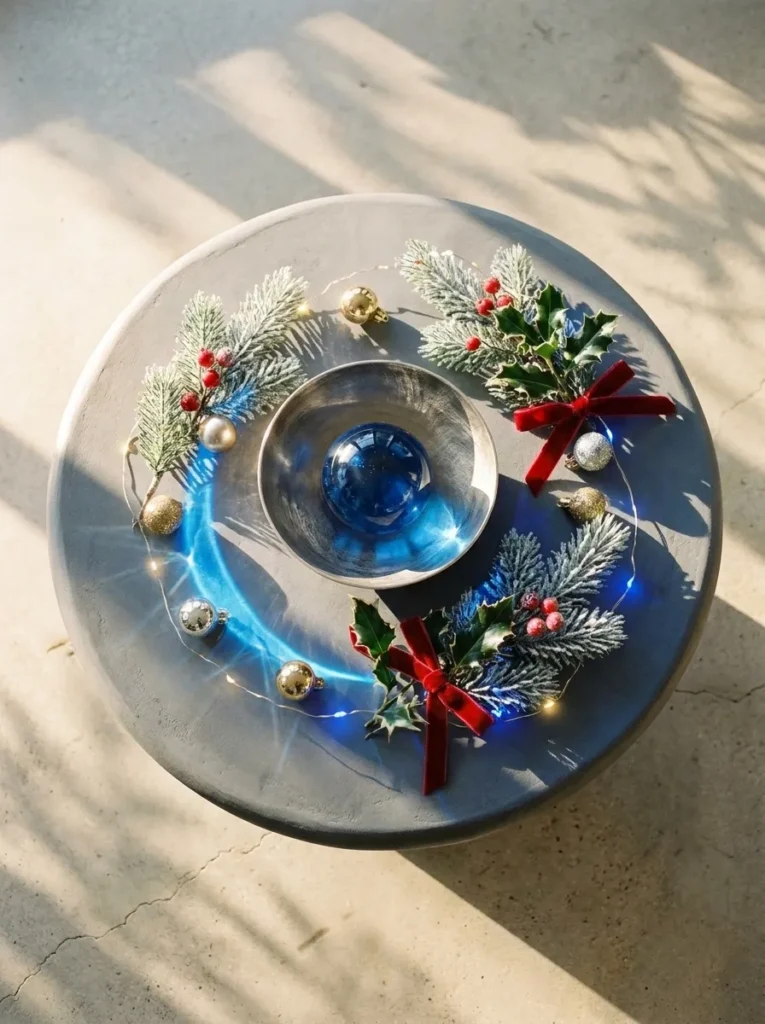
- Anchor piece: One hand-blown 10-inch cobalt-blue glass orb
- Vessel: Shallow 16-inch brushed nickel bowl, about 2 inches deep
- Zone: Living room, center of a 36-inch round coffee table
- Palette: Cobalt blue, brushed nickel, chalk-gray plaster tabletop, pale poured-concrete floor
- Negative space: About 10 inches of bare plaster all the way around the bowl
- Lighting: Window light by day. At night, one matte black arc floor lamp with a 2700K bulb, angled so the orb throws a cobalt pool onto the table
- Supporting detail: The nickel bowl, which cradles the sphere so it can’t roll and gives the glass a soft metal edge to reflect
- What to leave out: Books, candles, a tray of extra ornaments, greenery, and ribbon
Why this works: One saturated-color object on a bare surface reads as art, not as a seasonal decoration.
Saturated color works best in small doses, and glass is the exception. A cobalt orb carries color through its whole body, so it glows rather than just sits. A 10-inch sphere is large enough to read from across the room, yet small enough to leave most of a 36-inch table empty. Because glass transmits light, the same piece looks different at noon, at 5 p.m., and under a lamp. Designers often place a single colored vessel on a pale surface for this reason: the contrast makes the object look lit from within, even when it isn’t.
Choose the bowl carefully, because it carries half the design. A 16-inch brushed nickel bowl, about 2 inches deep, cradles the orb so it cannot roll, and its soft metallic finish picks up cobalt reflections along the rim. Skip polished chrome, which throws harsh glare. Place the arc lamp 3 to 4 feet from the table, angled so the beam crosses the sphere at about 45 degrees, and watch a bright blue pool spread across the plaster. Expect to dust the glass every few days. Fingerprints show immediately, so keep a microfiber cloth in a nearby drawer.
5. Aubergine Taper Powder Room
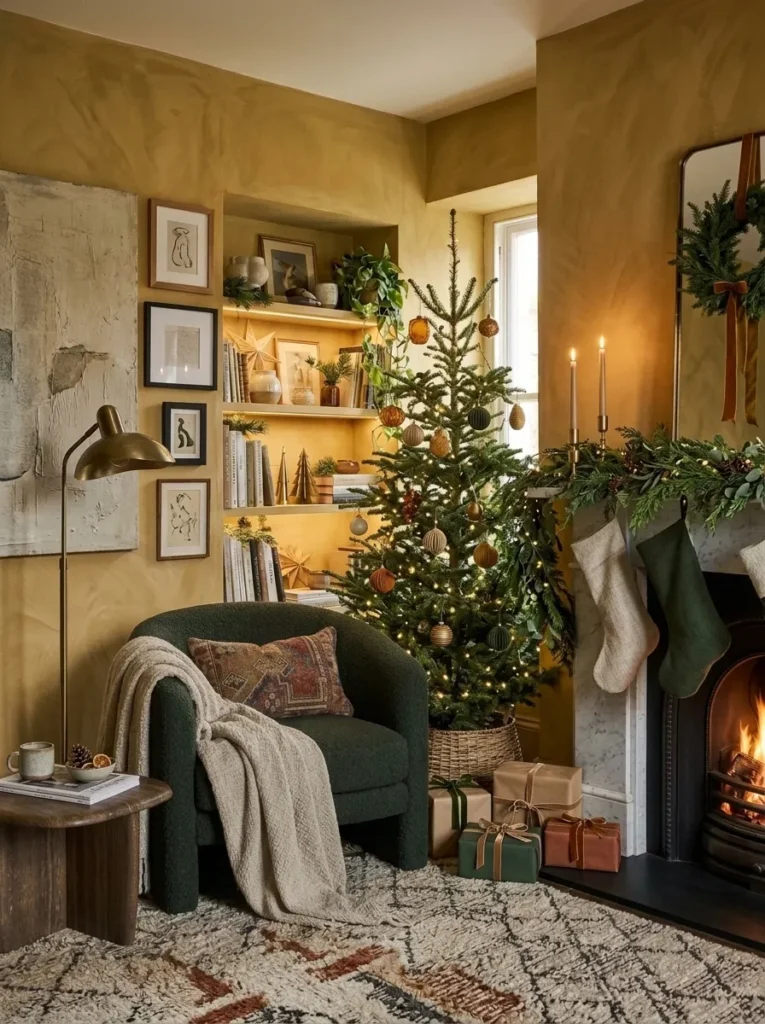
- Anchor piece: One 18-inch aubergine dipped taper in a 10-inch solid brass candlestick
- Zone: Powder room, at one end of a 30-inch honed white marble vanity ledge
- Palette: Aubergine, antique brass, butter-yellow limewash wall, honed white marble
- Negative space: About 24 inches of bare ledge beside the candlestick
- Lighting: One flame, about 1900K in color, with the vanity bulbs switched off
- Clearance: At least 12 inches from towels, curtains, and plants
- Supporting detail: None. The powder room mirror already doubles the flame, so no extra piece is needed
- What to leave out: Extra candles, greenery rings, scented soap displays, and holiday hand towels
Why this works: In a small room, one flame in a dark vertical line becomes an eye-level focal point and doubles in the mirror.
A powder room is the smallest stage in your house, and that’s your advantage. Guests spend two minutes there, usually alone, so one striking object gets their full attention. An aubergine taper reads as a thin, dark vertical line, which contrasts sharply with butter-yellow limewash and the curve of a marble ledge. Brass gives the candle a warm base and ties to brass hardware. I’ve lit this exact setup before dinner parties, and guests mention it more than the table. The mirror multiplies the flame, so one 18-inch taper looks like a pair without any extra candles.
Fire safety shapes the placement. My husband, who reads building codes the way other people read novels, insists on at least 12 inches of clearance from towels, curtains, and plants. In a powder room, that usually means the far end of the ledge, away from the hand towel. Set the candlestick on a flat, level surface, trim the wick to a quarter inch, and never leave a lit taper unattended. Light it only when guests are expected, then snuff it out before bed. The rest of the room stays quiet, with just one warm line of light.
6. Saffron Ceramic Cone

- Anchor piece: One hand-thrown ceramic cone, 28 inches tall and 12 inches across the base, in glossy saffron glaze with horizontal ridges
- Zone: Dining room sideboard, set over the left third of a 60-inch walnut top
- Palette: Saffron, deep teal wall, walnut, aged bronze
- Negative space: Roughly 40 inches of bare walnut to the right of the cone
- Lighting: One aged-bronze picture light with a 2200K bulb, clipped above the cone and aimed down the ridges
- Supporting detail: A 6-inch round cork pad under the base, which protects the walnut from the rough glazed foot
- What to leave out: Ornaments in or around the cone, garland, a runner, candles, and a second sculpture
Why this works: A sculptural object in one saturated color gives a dining room a focal point that a tree could not.
I found this cone at a ceramics market in Austin, and it sat in my garage for a month before I knew what to do with it. Placed on a plain sideboard, it suddenly made sense. The shape is a tree without trying to be one, which keeps it modern. Saffron against deep teal gives the strongest contrast I know, and the horizontal ridges catch light in thin bright lines. Set it on the left third of the sideboard, never centered, and leave the rest bare. That imbalance feels deliberate, like a gallery with a single painting.
Heavy ceramic needs a plan. A 28-inch cone weighs about 15 pounds, and glazed bases are rough underneath, so they scratch walnut quickly. Slip a 6-inch round cork pad beneath the base and the finish stays safe. Clip an aged-bronze picture light above, aim it straight down the ridges, and use a 2200K bulb so the saffron glows instead of turning lemon. Keep the sideboard clear of everything else, including candles, runners, and ornaments. If you have kids or a big dog, tuck the cone toward the wall, where a bump is less likely to topple it.
7. Linear Light Tree
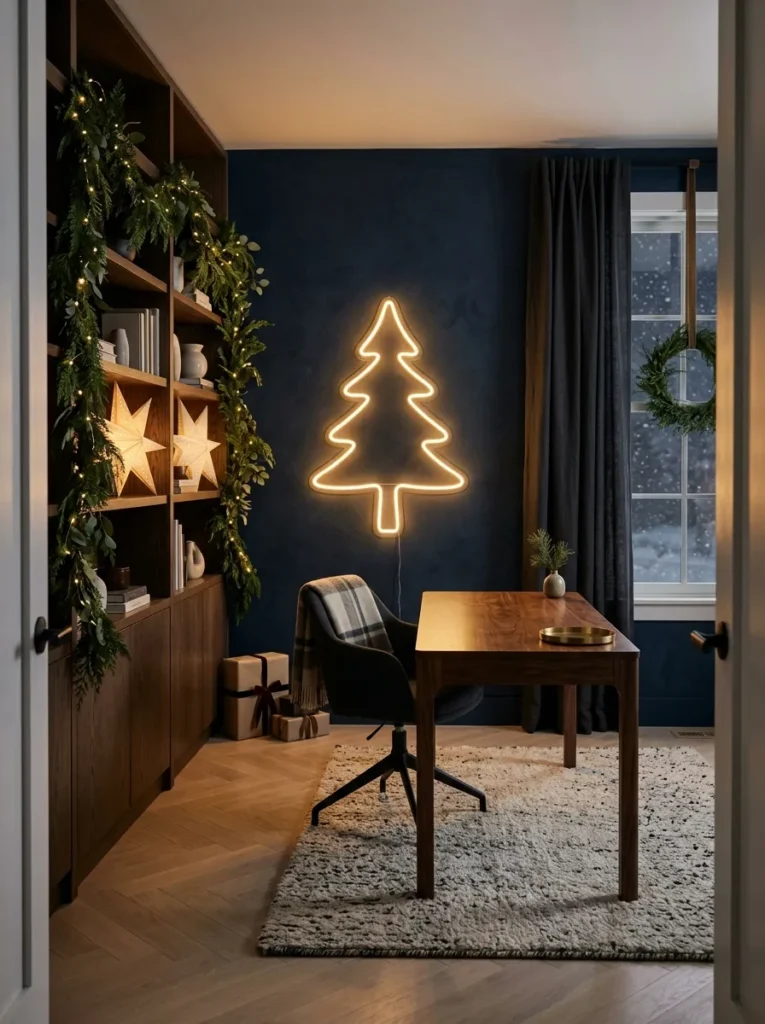
- Anchor piece: One 48-inch single-line tree outline in warm-white LED neon flex, bonded to a clear acrylic panel
- Panel: 30-by-50-inch clear acrylic, 3/16 inch thick, held 1 inch off the wall by four brushed-steel standoffs
- Zone: Home office, centered on the wall behind a 60-inch walnut desk
- Palette: Ink-navy plaster wall, warm-white light, walnut, matte black cord
- Negative space: About 20 inches of bare wall above the tree and 3 feet on each side
- Lighting: The neon line is the only light after dark: 2200K, dimmed to about 30 percent, with the desk lamp off
- Supporting detail: The standoff gap, which creates the shadow line behind the outline and makes it float
- What to leave out: Ornaments, a topper, a second light, and any other art on the wall
Why this works: A single continuous line of light draws a tree without adding any objects to the room.
A tree doesn’t need branches to read as a tree. The brain completes a familiar shape from just a few lines, which is why a single continuous outline of light works as a tree from across the room. Warm-white LED neon flex gives that line a soft, even glow with no visible bulbs. Against an ink-navy plaster wall, the line looks drawn with a pencil of light. Dim it to about 30 percent, and the glow stops reading as a sign and starts reading as art. Keep the outline simple: five zigzag tiers and one trunk stroke.
Mounting decides whether this looks custom or cheap. Ask a sign shop to bond the flex to a 30-by-50-inch clear acrylic panel, 3/16 inch thick, then hold it 1 inch off the wall with four brushed-steel standoffs screwed into studs or rated anchors. The shadow behind the line is half the effect. Route the thin power cable down behind the desk, tuck the small transformer in a drawer, and plug it into a dimmable outlet or inline dimmer. Check that the flex is rated for indoor use, and never cover the transformer. The result looks like a gallery installation.
8. Brass Bell on Leather

- Anchor piece: One 10-inch cast brass bell with a clapper, hung from a 2-inch-wide vegetable-tanned leather strap about 14 inches long
- Zone: Mudroom wall beside the back door, hung from one black steel hook at 66 inches
- Palette: Dusty peach plaster wall, antique brass, tan leather, dark slate floor
- Negative space: About 4 feet of bare wall on each side, with the coat hooks kept on the opposite wall
- Lighting: The mudroom’s existing ceiling light with a 2700K bulb, and nothing added
- Supporting detail: The leather strap, which brings in a soft texture and lets the bell swing when touched
- What to leave out: Ribbon, greenery, a second bell, a wreath, and a sign
Why this works: A single heavy brass object on an empty wall gives a utility space one memorable detail and one sound.
I added a bell to our back hall three Decembers ago, mostly on a whim. Now every guest who comes through the back door rings it, and I wouldn’t remove it. A 10-inch brass bell weighs about 2 pounds, which gives it presence even though it’s small. Against dusty peach plaster, the metal glows like a lantern without any light inside it. Tan leather adds a soft, tactile note. The whole wall stays nearly empty, and that restraint is what makes visitors stop and look. Mudrooms are working spaces, so one beautiful object beats a themed vignette.
Hang the bell where hands can reach it and heads can’t hit it. A hook at 66 inches does both, putting the bell’s lip about 42 inches off the floor. Screw the black steel hook into a stud, because 2 pounds swinging repeatedly will loosen a plain drywall anchor within weeks. Loop the strap twice over the hook for a tight hold, and cut the tail at an angle so it doesn’t fray. If kids ring it constantly, a felt pad inside the lip softens the sound. Leave the surrounding wall bare, so the bell stays the whole story.
9. Chalk Steel Snowflake
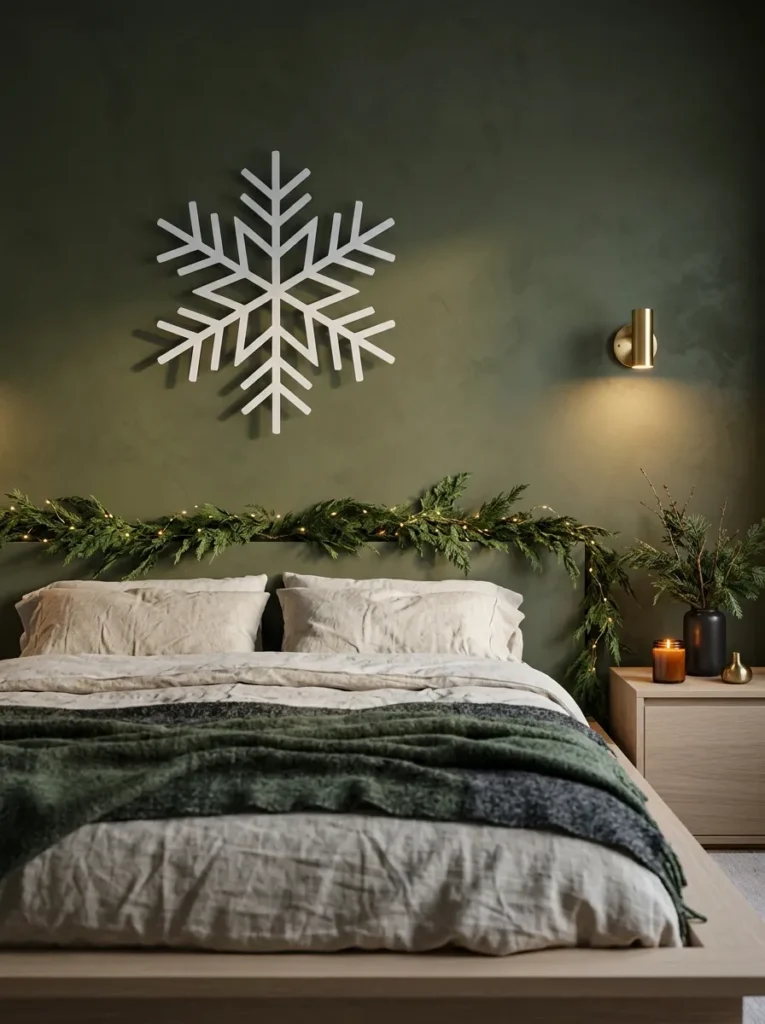
- Anchor piece: One 40-inch laser-cut steel snowflake, powder-coated matte chalk white, six points, 1/8 inch thick
- Zone: Bedroom wall, centered above a low platform bed with its bottom edge 14 inches above the headboard
- Palette: Deep olive limewash wall, matte chalk white, pale oak bed frame
- Negative space: About 14 inches of clear wall above the headboard and 3 feet of bare wall on each side
- Lighting: One 2700K plug-in sconce on the right, aimed to skim across the surface and cast a soft-edged shadow
- Supporting detail: A steel French cleat, which holds the piece flat and a half inch off the wall to create the shadow line
- What to leave out: Garland, string lights, ornaments on the bed, and a second wall piece
Why this works: A single graphic shape in chalk white on a deep wall gives a bedroom its holiday signal without adding another object to the room.
Snowflakes are usually small, fussy things, but at 40 inches wide, they behave like art. I noticed that when I tested a laser-cut steel version above a guest bed: the lines were crisp, the shadow was dramatic, and the room felt designed rather than decorated. Matte chalk white pops on olive limewash because the dark wall absorbs light while the steel reflects it. The cutouts let the wall color show through, which makes the shape feel light despite its size. Keep the pattern geometric, with six clean points and a few small cuts, and avoid lacy, overly detailed designs.
Mounting a steel piece takes more care than hanging a frame. A 40-inch laser-cut snowflake can weigh 6 to 8 pounds, so use a steel French cleat screwed into at least one stud, which holds the piece flat and a half inch off the wall. That gap creates the shadow line that makes the shape pop. Center it 14 inches above the headboard, then place one 2700K sconce to the side so light skims across the surface. Check it with a 24-inch level before tightening, because on a symmetrical shape, a tilt shows immediately.
You’ll Also Love:15 Christmas Wreath Ideas for a Front Door That Stands Out
10. Blush Advent Cabinet
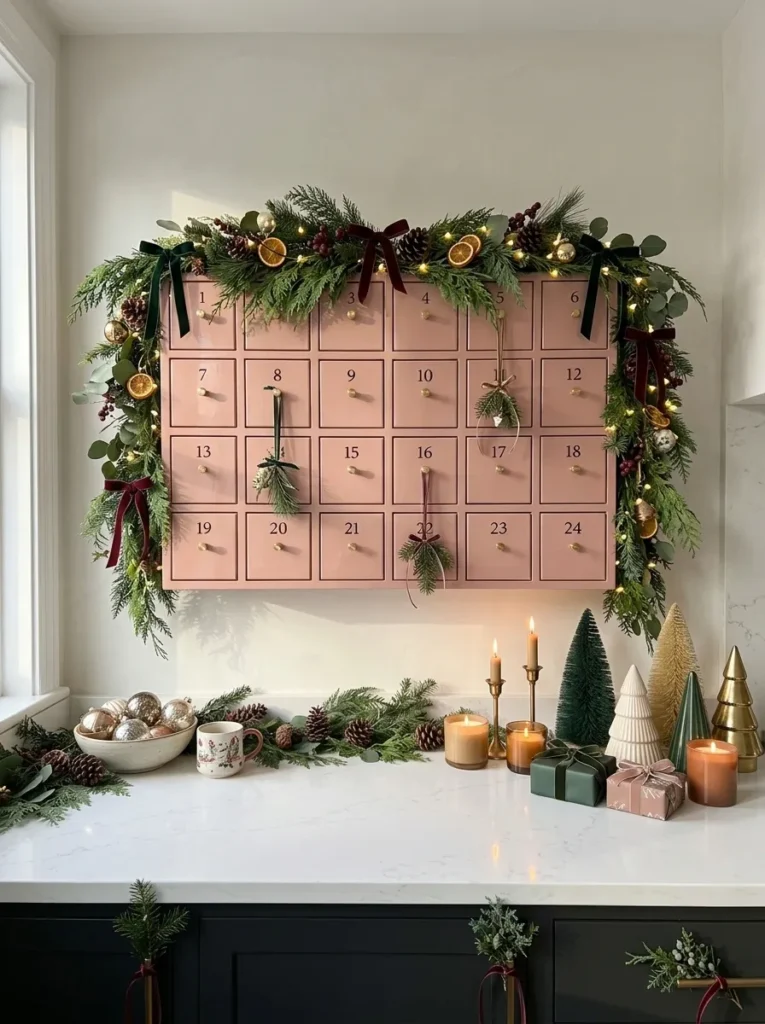
- Anchor piece: One wall-hung advent cabinet, 30 inches wide by 24 inches tall by 4 inches deep, with 24 numbered drawers in blush-pink lacquer
- Zone: Kitchen wall, centered above a 6-foot run of white quartz counter, bottom edge 18 inches above the counter
- Palette: Blush pink, brass, white quartz, matte charcoal lower cabinets
- Negative space: About 24 inches of bare wall on each side, with the counter below left fully clear
- Lighting: The kitchen’s existing pendant with a 2700K bulb, and nothing added
- Supporting detail: 24 small brass knobs and 1-inch black numerals, hand-lettered with a paint pen, because the numbers are the only pattern the cabinet needs
- What to leave out: Garland, ornaments on top, a countdown sign, and anything on the counter
Why this works: One functional, well-built piece gives a kitchen a daily ritual and a holiday signal without any extra decorations.
I fill an advent cabinet every November, and it has become my favorite decoration in the house. Among minimalist Christmas decor ideas, it’s rare because it’s both a decoration and a daily ritual. A 30-by-24-inch cabinet in blush-pink lacquer looks like a piece of furniture, not a craft project. Brass knobs catch the light, and the numbered drawers create a quiet grid of pattern. Against charcoal lower cabinets and white quartz, the soft pink feels modern rather than sweet. Fill each drawer with a small treat or note, and you’ll watch family members drift into the kitchen every morning.
Build or buy with function in mind. Drawers should be at least 2 inches square and 3 inches deep, enough to hold a wrapped chocolate or a folded note. Choose lacquer or a satin enamel over matte paint, because small hands and sticky fingers wear matte finishes within a week. A filled cabinet weighs about 12 to 15 pounds, so drive two #10 screws into studs through a hanging rail on the back. Hang it with the bottom edge 18 inches above the counter, so the middle rows sit near adult eye level.
11. Mirror Sphere Sunroom
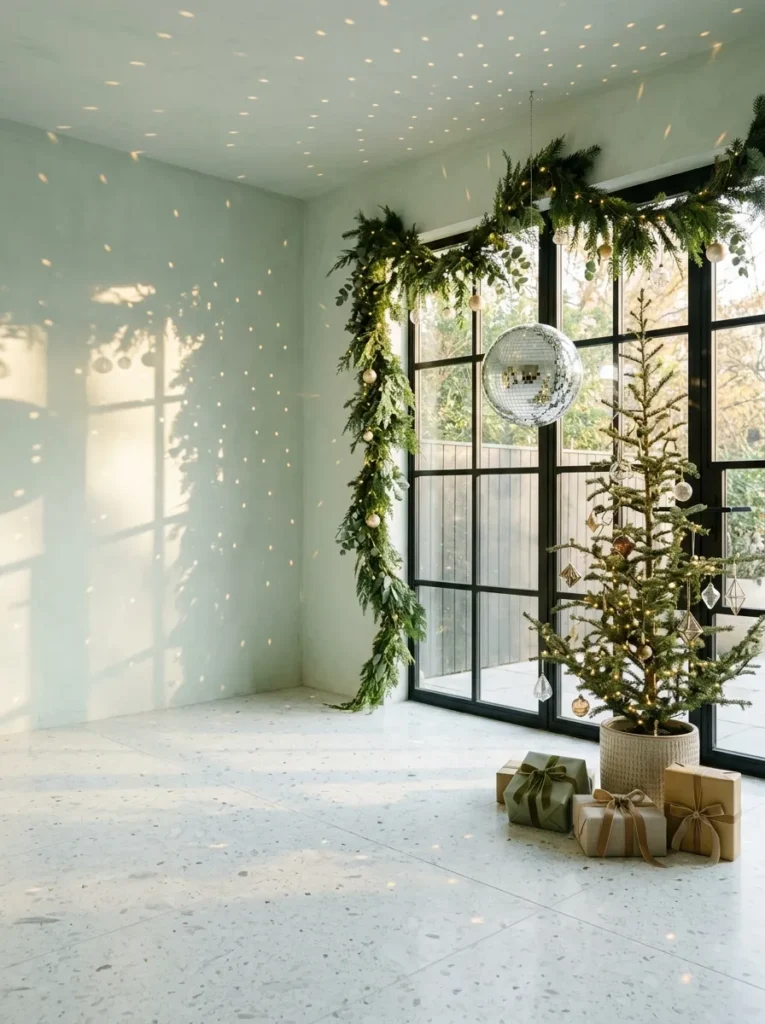
- Anchor piece: One 16-inch faceted mirror sphere, hung on a thin black cord
- Zone: Sunroom, hung 12 inches in front of the center of a 6-foot window
- Palette: Mirror silver, pale mint plaster walls, white terrazzo floor, matte black window frame
- Negative space: About 8 feet of open floor and wall on the side the light dots travel toward
- Lighting: Direct sun by day. At dusk, one 2700K spotlight aimed at the sphere from across the room, with all other lamps off
- Supporting detail: A ball-bearing swivel hook above the sphere, which lets it turn slowly in passing air so the light dots drift
- What to leave out: A second sphere, garland, colored bulbs, and props on the floor
Why this works: A mirrored sphere turns a plain room into moving light, so the glow is the decoration and the object barely registers.
A faceted mirror sphere does something no other ornament can: it turns one object into hundreds of moving points of light. Each mirror facet reflects the sun or one lamp, so a 16-inch sphere can scatter bright dots across walls, floor, and ceiling. Against pale mint plaster, those dots read as silver confetti drifting across the walls. The effect changes with the hour. Morning sun makes white-gold dots, while a single 2700K bulb at dusk turns them warm and amber. Because the sphere itself is small and quiet, the room still feels empty and open.
Hang it where light can reach it. Choose a window that gets direct sun for at least three hours, and hang the sphere 12 inches in front of the glass. Screw a ceiling hook into a joist, not drywall, and use a ball-bearing swivel so the sphere turns slowly in passing air without a motor. A 16-inch glass sphere weighs about 3 pounds. For evenings, aim one 2700K spotlight at it from across the room, and switch every other lamp off. The dots will cover the floor in pale ripples while the room itself.
12. Lilac Lantern Porch
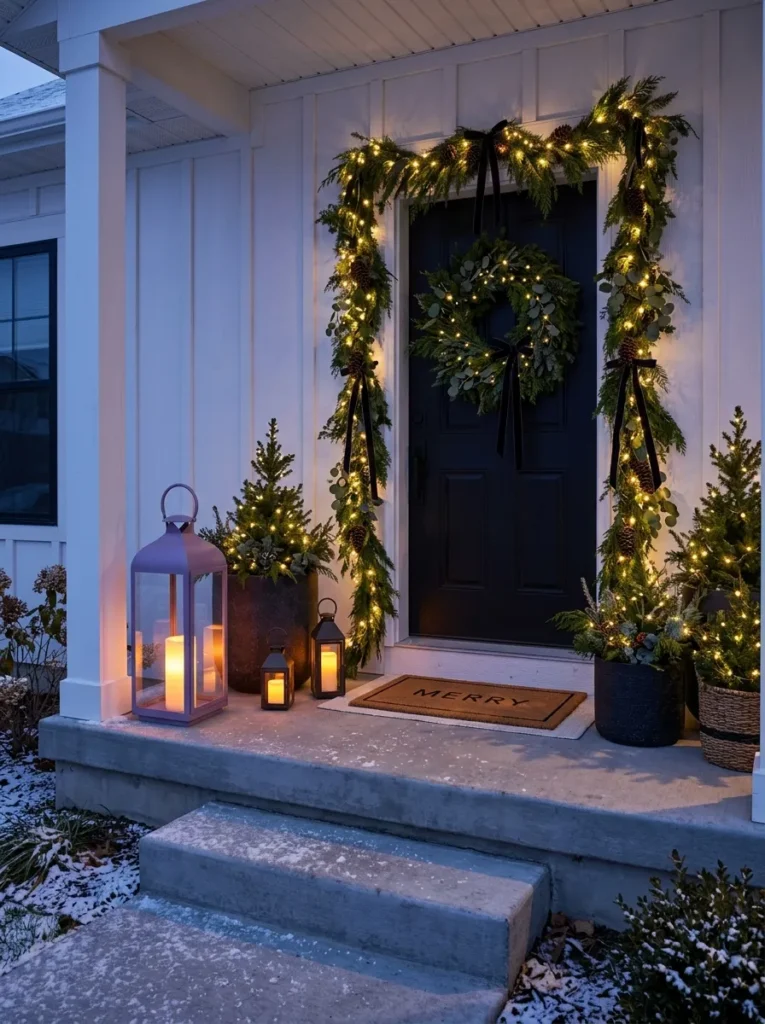
- Anchor piece: One 32-inch steel lantern, powder-coated matte lilac, with a flat roof and four glass panes
- Candle: One 6-by-9-inch flameless pillar with a warm 2200K LED
- Zone: Front porch floor, 4 feet to the left of the door and 6 inches from the wall
- Palette: Pale lilac, white board-and-batten wall, gray concrete floor, black door
- Negative space: About 4 feet of bare porch floor on each side of the lantern
- Lighting: The flameless candle only, with the porch light switched off
- Supporting detail: A 5-pound steel disk hidden in the base, which keeps a tall lantern upright in wind
- What to leave out: Greenery, ribbon, a second lantern, and string lights
Why this works: A single tall, lit object in an unexpected color gives a porch one clear focal point without a themed display.
Porches usually get piled with garland, planters, and a wreath, which means nothing stands out. A single 32-inch lantern in matte lilac is the opposite. I noticed how well it worked when a neighbor asked where I’d found the color, then stood on our steps for five minutes just looking. Pale lilac pops against white board-and-batten and gray concrete without feeling loud. The flat-roofed, four-pane frame keeps the shape modern, and the single warm light inside gives the porch a clear focal point at dusk. Place it 6 inches from the wall, not centered, so it feels deliberate.
Weather decides what works outside. Choose powder-coated steel, which resists rust better than painted tin, and check that the glass panes are tempered, so a stray football or hailstone won’t shatter them. Use a flameless candle with a timer, because real flames and wind don’t mix, and swap the batteries before the holidays begin. A 32-inch lantern can topple, so tuck a 5-pound steel disk inside the base. Keep it at least 3 feet from the door swing and out of the path, so no one trips on it. Wipe it down with a damp cloth after storms.
13. Poppy Branch in Soapstone
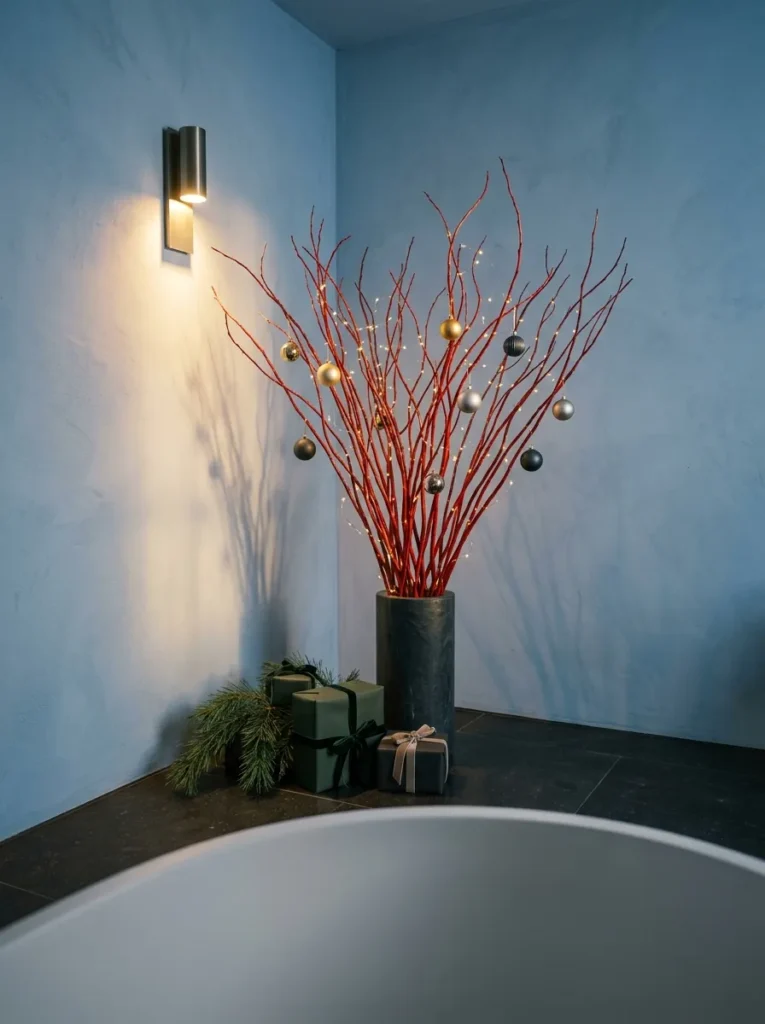
- Anchor piece: One 6-foot curly willow branch, lacquered poppy red in a satin finish
- Vessel: 12-inch-tall, 10-inch-wide honed charcoal soapstone cylinder, weighted with 15 pounds of aquarium gravel
- Zone: Primary bathroom, in the corner beside a freestanding tub
- Palette: Poppy red, powder-blue limewash wall, charcoal soapstone, white tub
- Negative space: About 3 feet of bare wall and floor on each side of the branch
- Lighting: One dimmed 2700K sconce above the vanity, and nothing else
- Supporting detail: The soapstone vessel, whose cool, matte surface anchors a tall, thin branch both visually and physically
- What to leave out: Ornaments, lights on the branch, greenery, ribbon, and any candle near the tub
Why this works: One boldly colored curved line against a pale wall reads as a drawing in space, and red on soft blue keeps it from looking traditional.
I painted my first branch red on a whim. I sprayed a bare willow stem with two coats of satin lacquer, and I couldn’t stop looking at it. A 6-foot curly willow has loops and curves that no ornament can imitate, and poppy red turns those curves into a drawing. Against powder-blue limewash, the red looks crisp and modern instead of traditional. Satin lacquer is the right finish, because gloss feels plastic and matte looks chalky. In a bathroom, where everything is white and hard-edged, one curved red line feels like the whole decoration.
Prepping the branch takes one afternoon. Cut a 6-foot curly willow stem to a clean angle, wipe off dust, and spray it with two light coats of satin lacquer, allowing 30 minutes between coats. Lacquer cures best in a garage or outdoors, not in the bathroom, because humidity slows drying and clouds the finish. Once dry, set the stem in a soapstone cylinder weighted with 15 pounds of aquarium gravel, so it can’t tip when someone brushes past. Place it at least 3 feet from the tub, out of splash range.
14. Persimmon Glass Bead Swag
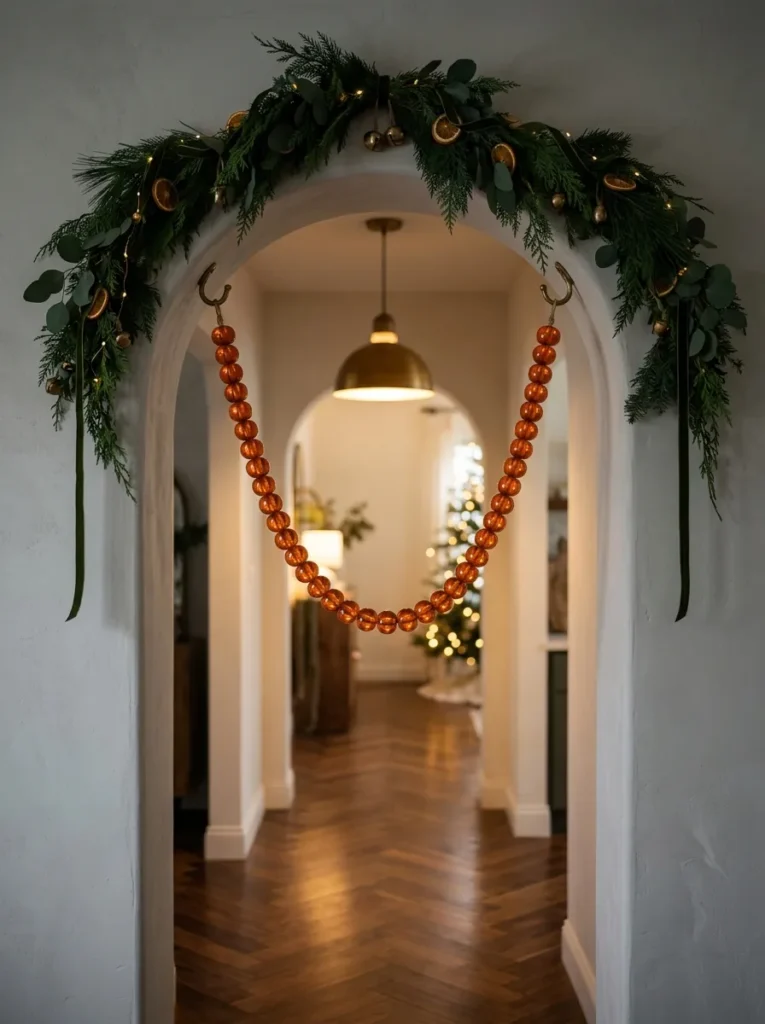
- Anchor piece: One 6-foot strand of 1-inch hand-blown glass beads in persimmon orange, hung in a single swag
- Zone: Arched doorway between the hall and dining room, hung across a 42-inch-wide arch with a 14-inch center drop
- Palette: Persimmon, pale gray plaster arch, walnut herringbone floor, brass hooks
- Negative space: The rest of the arch and the wall around it stay completely bare
- Lighting: The hall’s existing 2700K pendant behind the beads, which makes each one glow, with no added lights
- Supporting detail: Two 1-inch brass hooks at the springline of the arch, which hold the curve and serve as the only visible hardware
- What to leave out: Tassels, greenery, a second strand, and bows
Why this works: One curved line of colored glass frames a doorway the way a wreath frames a door, but with light passing through it.
A garland doesn’t have to be green or fresh. A single strand of 1-inch persimmon glass beads follows the same gentle curve as a pine swag, but it behaves like jewelry. Glass transmits light, so when the hall pendant glows behind it, each bead lights up like a small lantern. Against pale gray plaster, the orange looks vivid rather than rustic. Hang it in one catenary curve, the natural shape of a hanging chain, and the swag looks relaxed. Fourteen inches of drop across a 42-inch arch is the proportion that reads best.
Plan the geometry before you hang anything. For a 42-inch arch, use a 6-foot strand: that leaves about 9 inches of tail on each end and lets the center sag 14 inches. Mark the hook locations 42 inches apart at the arch’s springline, where the curve begins, then screw in two brass hooks with drywall anchors rated for 15 pounds. The strand weighs about 3 pounds, so the anchors have a wide safety margin. Drape the strand, then adjust the tails until the swag is symmetrical. Stand 8 feet back to check it.
15. Lemon Poinsettia Laundry — A Minimalist Christmas Decor Idea for a Utility Room
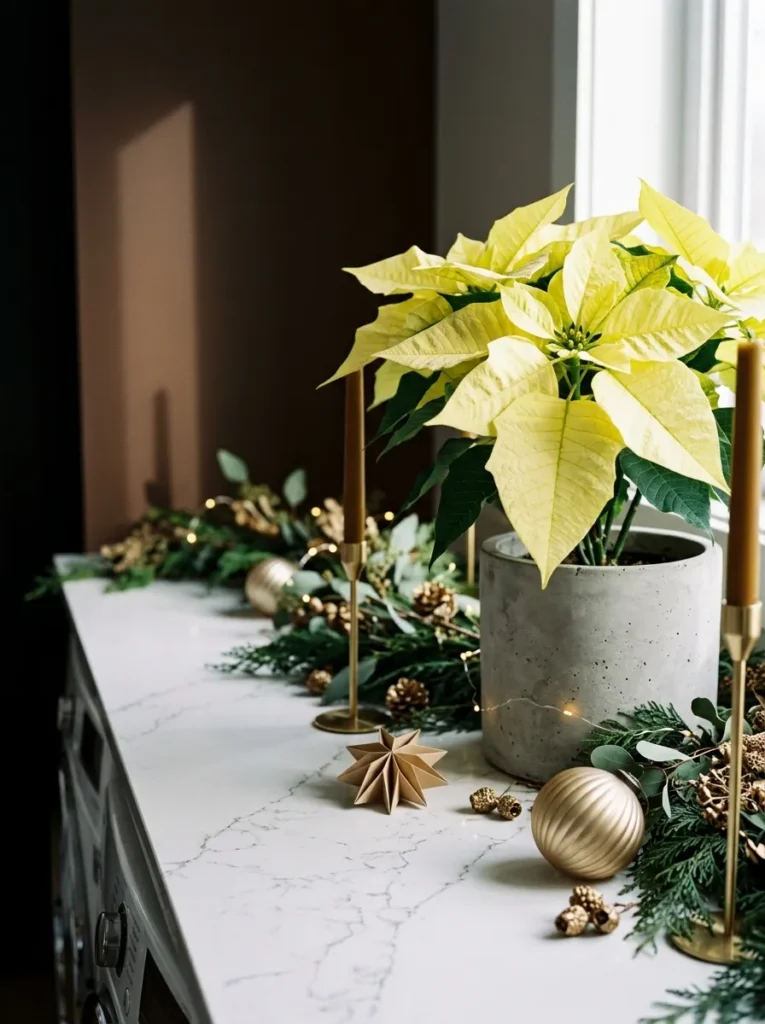
- Anchor piece: One lemon-yellow poinsettia, about 14 inches tall and 12 inches wide
- Pot: 8-inch raw concrete pot with a drainage hole and saucer, with the grower’s foil sleeve removed
- Zone: Laundry room, at the left end of a 5-foot white quartz folding counter beneath a window
- Palette: Lemon yellow, chocolate-brown wall, raw concrete, white quartz
- Negative space: About 3 feet of bare counter to the right, with the windowsill kept clear
- Lighting: Bright window light by day. At night, the room’s one ceiling fixture with a 2700K bulb, dimmed
- Supporting detail: The saucer, which catches drainage so the roots never sit in water
- What to leave out: Foil sleeve, ribbon, glitter, a second plant, and anything else on the counter
Why this works: A single living plant in an unexpected color adds fresh color and life to a utility room without adding an ornament.
The color on a poinsettia isn’t a flower. Those yellow, red, or white parts are bracts, which are modified leaves, and the true flowers are the tiny yellow buds in the center. That’s why bract color lasts for weeks, long after petals would have dropped. A lemon-yellow plant looks striking against a chocolate-brown wall because the two colors sit far apart in hue and brightness. In a laundry room, where finishes are hard and white, a living plant brings softness. If the room has a bright window, it’s also one of the best spots for a poinsettia to thrive.
I’ve killed more poinsettias than I’d like to admit, and nearly every time the culprit was the foil sleeve. Foil traps water around the roots, which rot quickly. Slip the plant out, repot it in a concrete pot with a drainage hole, and set it on a saucer you empty after 30 minutes. Give it at least 6 hours of bright, indirect light, and keep it away from cold drafts, since temperatures below 50°F make the leaves drop. Water only when the top inch of soil feels dry. A healthy plant will hold its color through New Year’s.
Styling Principles for Editing Down
Every idea above follows the same short set of rules. Use them to edit any room you already have.
1. Choose the anchor first. Before you buy or unpack anything, decide which single piece will carry the zone. A zone with one strong anchor needs no supporting cast. If you can’t name the anchor in five words, the display isn’t edited yet.
2. Size the anchor up, not the collection. One 30-inch object looks intentional, while ten 3-inch objects look accidental. A large piece also needs far less surrounding styling, which is why every anchor above is oversized, sculptural, or both.
3. Leave real empty space. Aim for roughly as much bare surface or wall around the anchor as the anchor itself occupies. The negative space is part of the design, not a gap waiting to be filled.
4. Use one warm light source per zone. Pick a 2700K bulb (or 2200K for an amber glow) and let it do the work. Several competing lights flatten a display, while one source creates shadow, depth, and mood.
5. Commit to one color. Minimal doesn’t mean colorless. A single saturated tone, like forest green, oxblood, lilac, or persimmon, reads as bold and deliberate when nothing else competes with it.
6. Edit by subtraction. Build the display, then remove one-third of it before you stop. Designers often cut a display by a third, and then ask what else can go. The last thing you add is usually the first thing you should take away.
7. Hide the mechanics. Route cords along baseboards, screw heavy pieces into studs, and ballast tall pieces so they can’t tip. Visible hardware and loose cables break the calm of a single object.
8. Style for the camera and the room. Check each zone from the doorway and from six feet back, then take a quick phone photo. If the anchor reads clearly in the photo, it will read clearly in person.
FAQs
1. How do I decorate for Christmas with minimal stuff? Choose one anchor piece for each zone, such as a slim tree, a single wreath, or one oversized glass ornament, then leave the surrounding surface bare. Add one warm light source and nothing else. Simple Christmas decorating works best when each room carries one strong object instead of many small ones.
2. How many ornaments is enough for a minimalist tree? For a 7-foot minimalist tree, 15 to 30 ornaments in one color is a good ceiling. Many modern minimalist trees use no ornaments at all, only a single strand of 2700K warm-white lights. If you’re unsure, hang half of what you planned and stand six feet back before adding more.
3. What are the best single statement pieces for minimal Christmas decor? The strongest statement pieces are large, sculptural, or unusual in material: a 7-foot pencil-slim tree in a concrete pot, a 16-inch mirror sphere, a 24-inch matte black wreath, a 9-foot velvet ribbon, or a wall-hung advent cabinet. Each works because the eye reads one large object as art.
4. What are budget-friendly minimalist Christmas ideas? Minimal decor is naturally affordable, because you buy one piece instead of many. Spray a bare willow branch with red lacquer, wrap an empty box in matte paper, hang one length of velvet ribbon, or place a single potted poinsettia on a clear counter. Most of these cost under $40 and store flat.
5. How do I keep a minimalist Christmas look from feeling cold? Choose warm light and one saturated color. A 2700K bulb, a lacquered or velvet surface, and a living plant all add warmth without adding clutter. Texture matters too: velvet, felted wool, brass, and glass catch light differently, so one object feels rich even in an empty room.
6. Can minimalist Christmas decor still feel festive? Yes. Festive comes from color, light, and a recognizable holiday shape, not from quantity. A glowing tree outline, a red branch, or a single brass bell signals Christmas immediately. One clear holiday symbol, lit warmly, reads as more intentional than a dozen small ornaments competing for attention.
Conclusion
A beautiful Christmas doesn’t need more decorations. It needs better choices. These minimalist Christmas decor ideas show how one oversized object, one warm light, and a little space can make a room feel finished and peaceful. I’ve seen how small changes like these can completely transform a space, and the best part is how much time you get back.
Start with one zone this weekend: a branch, a ribbon, or a single glowing tree. Save this post to your Pinterest board, try one idea at home, and share it with a friend who’s tired of holiday clutter.