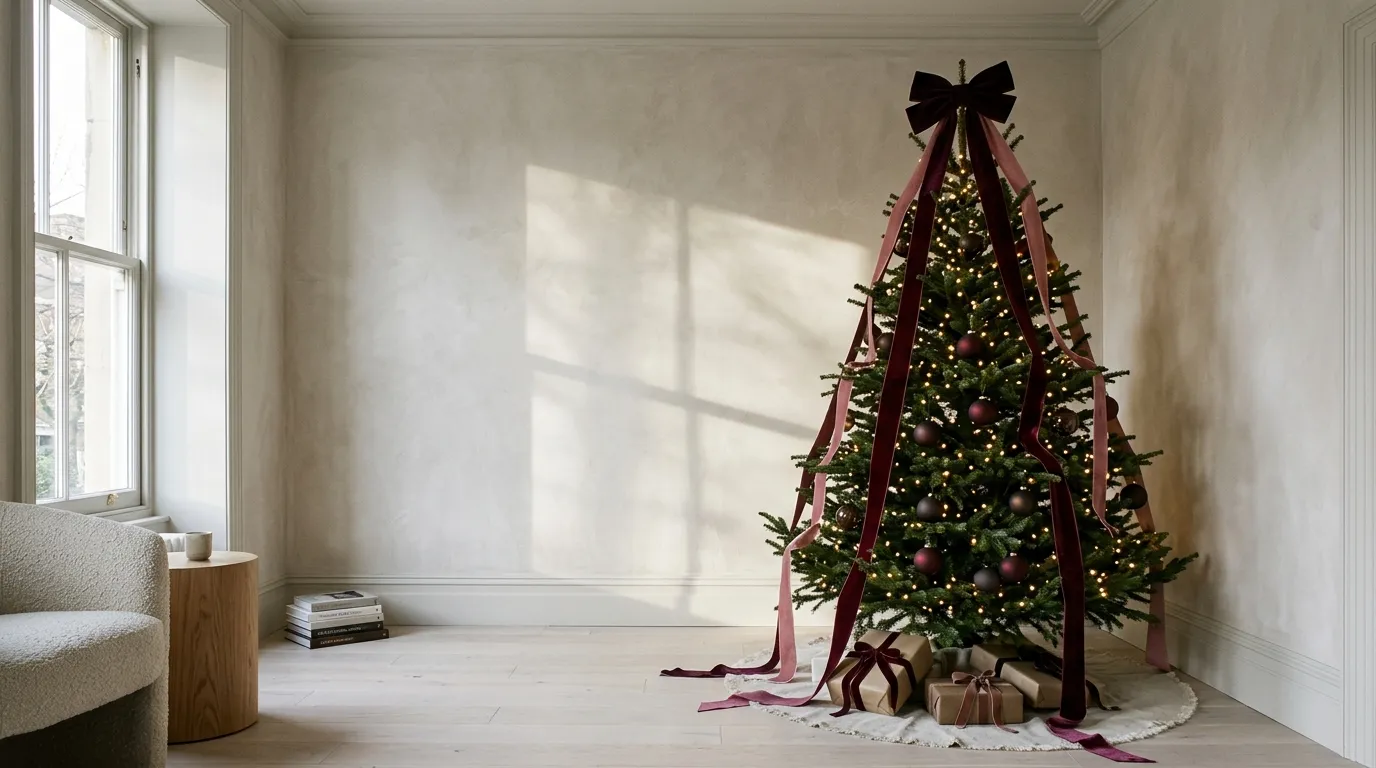
Christmas Tree Trends 2026: 15 Looks Everyone Will Love
Your tree is the first thing guests notice, and it should look like you chose every piece on purpose. That is why Christmas tree trends 2026 feel so refreshing: softer, more sculptural, and far more personal than the glitter-heavy trees of the past. From a ribbon-draped fir to a tree that floats upside down, these 15 looks come with exact ornament sizes, bulb warmth, and light counts, so nothing is left to guesswork. The common problem is buying pretty pieces that never quite come together. I’ve seen it happen in many homes, and the fix is always a clear plan. Pick one look, follow the numbers, and your tree will feel designed, calm, and completely yours.
Christmas tree styles change every year because they follow the same color cycle as the rest of the home. Ornament palettes tend to mirror the paint and fabric colors popular in the same period, which makes the year’s palettes a reliable preview of what trees will look like. Structure moves much slower: tree shape, light warmth, and ornament scale age far more gradually than color. A tree stays current longest when its structure is chosen for longevity and its color is chosen for this year. I learned this by tossing a turquoise-and-lime ornament set after one season while keeping the warm-white lights.
Below are 15 looks from Christmas tree trends 2026, each with exact sizes, bulb warmth, and colors, so you can rebuild one at home.
1. Velvet Ribbon Cascade — A Christmas Tree Trend for 2026 That Draws the Eye Up
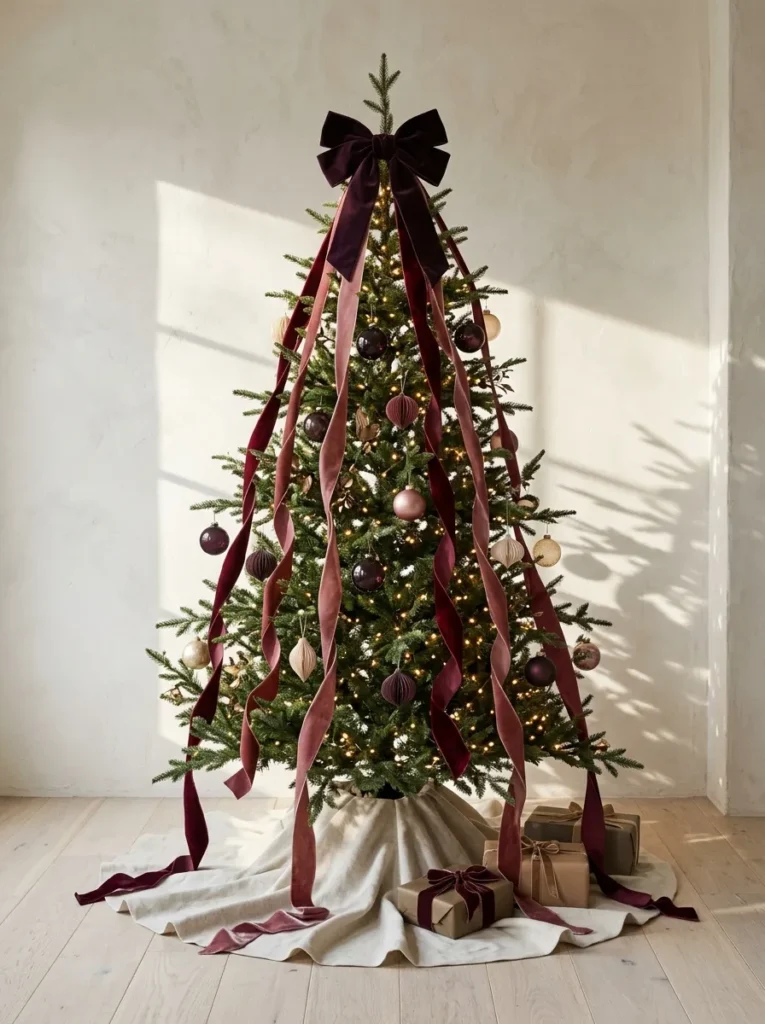
- Tree: 7.5-foot full artificial Nordmann fir, 52 inches wide at the base, dense, with a fire-resistant tag
- Ribbon: about 30 yards of 4-inch silk velvet, in eight vertical cascades from the topper to the floor (8 feet each) plus 12 small bows
- Ornaments: 14 matte bordeaux balls (3 inches) tucked near the trunk for depth, nothing else
- Palette: bordeaux, dusty rose, bone, aubergine
- Lighting: 2700K warm white LEDs on green wire, about 75 bulbs per foot, so six 100-bulb strings (600 total)
- Topper: 20-inch aubergine velvet bow with 40-inch tails running down the front
- Skirt/base: 36-inch round bone linen skirt with a raw edge
- Left off: balls over 3 inches, glitter, metallic ribbon, garland, and tinsel
- Copyable detail: Alternate bordeaux and dusty rose cascades in unbroken lines so the tree reads as vertical stripes
Why this works: Vertical ribbon lines elongate the tree and add rich color without the visual noise of dozens of ornaments.
Ribbon-led trees work because vertical lines make a ceiling feel taller. Running 4-inch silk velvet from the topper to the floor in unbroken cascades stretches the tree’s silhouette and replaces dozens of small ornaments with a few long, deliberate strokes. Velvet absorbs light instead of bouncing it, so bordeaux and dusty rose show as deep, saturated color in the evening rather than flat red. Add bone and aubergine for variation, and the palette reads closer to a couture window than a craft table. This is one of the most budget-friendly trends, since ribbon costs far less than ornament sets.
I tested this on my own tree and learned that ribbon needs a plan. Cut each drop 12 inches longer than you think, then pin it to the topper with floral wire and let it fall naturally. With six light strings, outlet safety matters. My husband checks the label on every strand for its maximum connected length, never daisy-chains beyond it, and uses a heavy-duty 14-gauge cord rated for indoor use. Keep velvet tails away from bulbs so fabric never rests against a warm connection, and keep the tree 3 feet from any fireplace.
2. Midnight Pearl Fir
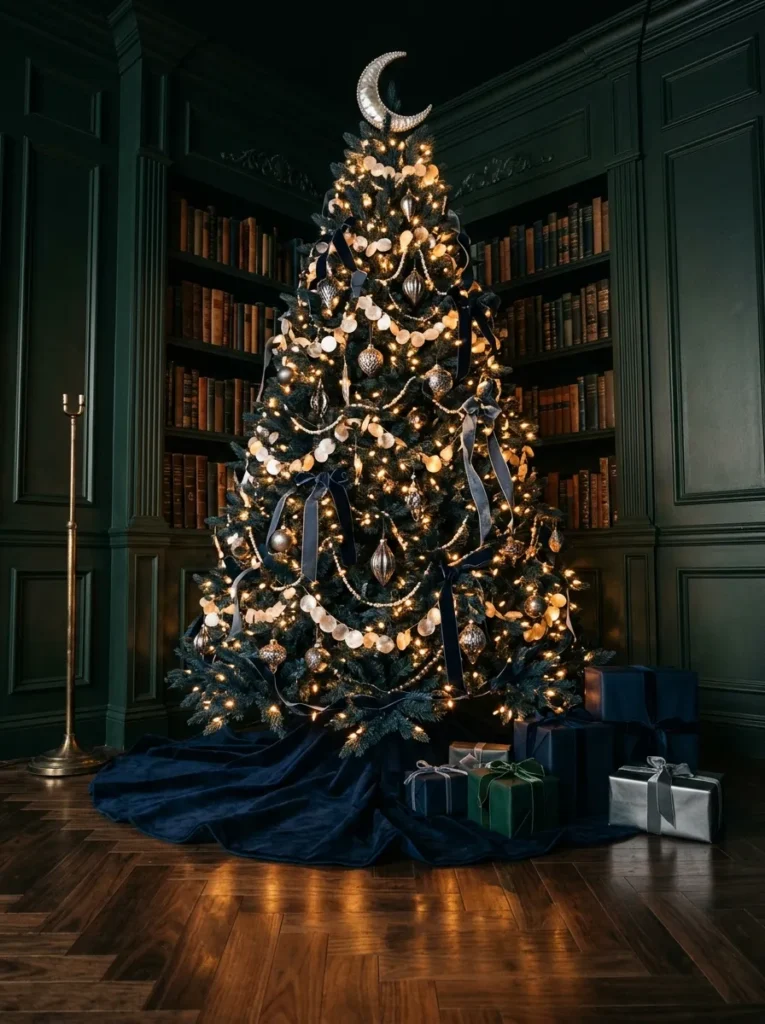
- Tree: 7-foot full artificial Nordmann fir, 48 inches wide at the base
- Ornaments: 14 matte midnight navy balls (4 inches), 10 capiz shell discs (3 inches), 8 pewter fluted teardrops (5 inches)
- Palette: midnight navy, pearl white, pewter, ink blue-black
- Lighting: 2200K candle-glow LEDs on green wire, about 85 bulbs per foot, so six 100-bulb strings (600 total)
- Topper: 12-inch pearl-glazed ceramic crescent moon
- Skirt/base: 34-inch ink-navy wool felt skirt
- Left off: red, gold, glitter, tinsel, and ribbon
- Copyable detail: Hang the capiz discs on clear fishing line so they turn and flicker like pearls
Why this works: Matte navy absorbs light while pearl and pewter catch it, so the tree shifts and glimmers like a night sky.
A guest once told me my midnight tree looked like it had its own weather, and I’ve been chasing that compliment ever since. Dark trees succeed when the darkness has texture. Matte navy balls soak up light, while capiz shell discs and pewter drops pick it up in small flashes, so the tree seems to shift as you walk past. Set a 2200K candle-glow strand deep in the branches and the pearl pieces glow like a moon reflected on water. It’s moody without being heavy, and it pairs well with white plaster walls or deep-green paint.
Light temperature changes how dark colors read. At 2200K, close to candlelight, navy keeps its depth, while 3000K or higher can read noticeably flatter. Use about 85 bulbs per foot, or six 100-bulb strands for a 7-foot tree, and weave them along the inner branches instead of the tips. Hang the capiz discs on clear fishing line so they turn gently in warm air from the room. Pearl reflects whatever is near it, so keep the tree away from bright overhead lights, which wash out the shimmer and dull the entire palette.
3. Floating Inverted Fir
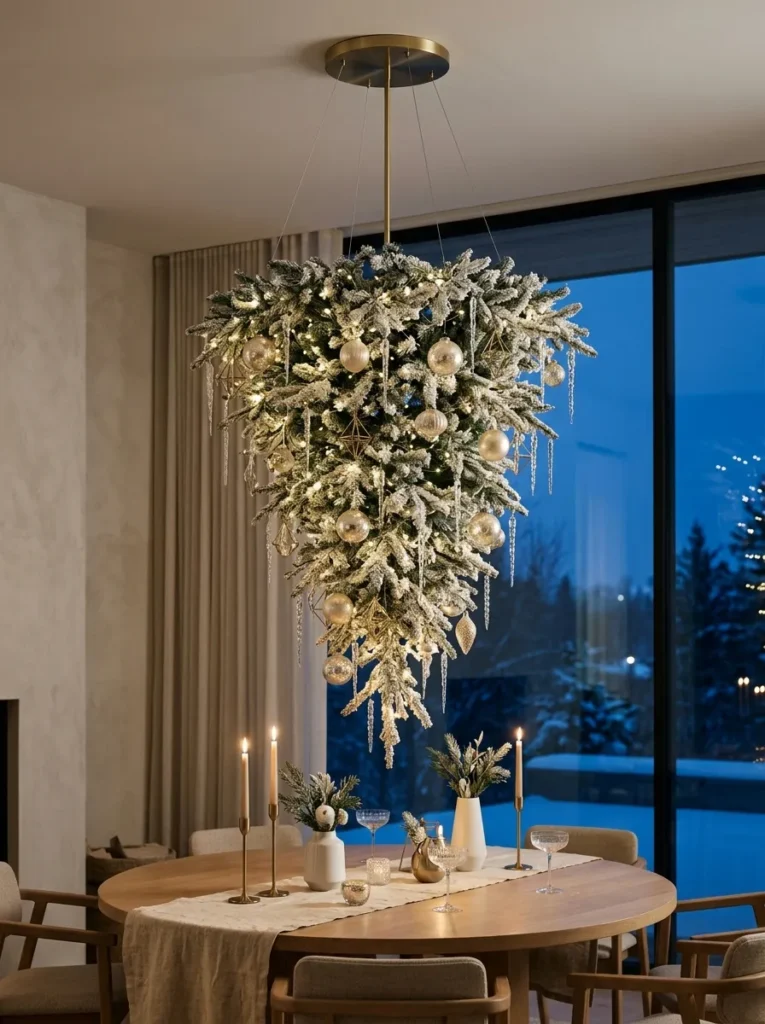
- Tree: 5-foot inverted artificial fir hung tip-down from the ceiling, 30 inches wide at the top, about 20 pounds
- Ornaments: 16 clear glass icicle teardrops (5 inches), 12 champagne mercury-glass balls (3 inches)
- Palette: frosted evergreen, champagne, clear glass, bone
- Lighting: 2700K warm white LEDs on clear wire, 100 bulbs per foot, so five 100-bulb strings (500 total)
- Topper (at the tip): single 6-inch champagne glass drop
- Skirt/base: none; a 14-inch matte brass ceiling canopy hides the mount
- Left off: stand, skirt, tinsel, red, and ribbon
- Copyable detail: Hang it in a room with 9-foot ceilings so the tip sits about 18 inches above a round white oak table with a bone linen runner
Why this works: Hanging the tree frees the floor and turns it into a light installation at eye level.
Hanging a tree upside down sounds odd until you see it above a dining table. The wide branches sit near the ceiling, the tip points toward the table, and the floor stays completely clear, which makes it ideal for small rooms, apartments, and homes with curious pets. I’ve watched guests lean back in their chairs just to look up at it. Clear glass icicles echo the downward shape, and champagne mercury balls add a soft metallic gleam. With frosted evergreen, bone, and clear glass as the palette, it reads like a light installation more than a Christmas tree.
The mount is the part that matters. Never hang a tree from drywall anchors. My husband fastens a ceiling hook directly into a joist, using hardware rated for at least three times its decorated weight, so a 20-pound tree on a hook rated for 60 pounds or more. Use a steel cable with a turnbuckle to level the tree, and keep the cord tucked along the trunk. Choose an artificial tree for this look; a real tree’s water supply cannot hang upside down, and shedding needles would land on your table.
4. Bleached Branch Sculpture
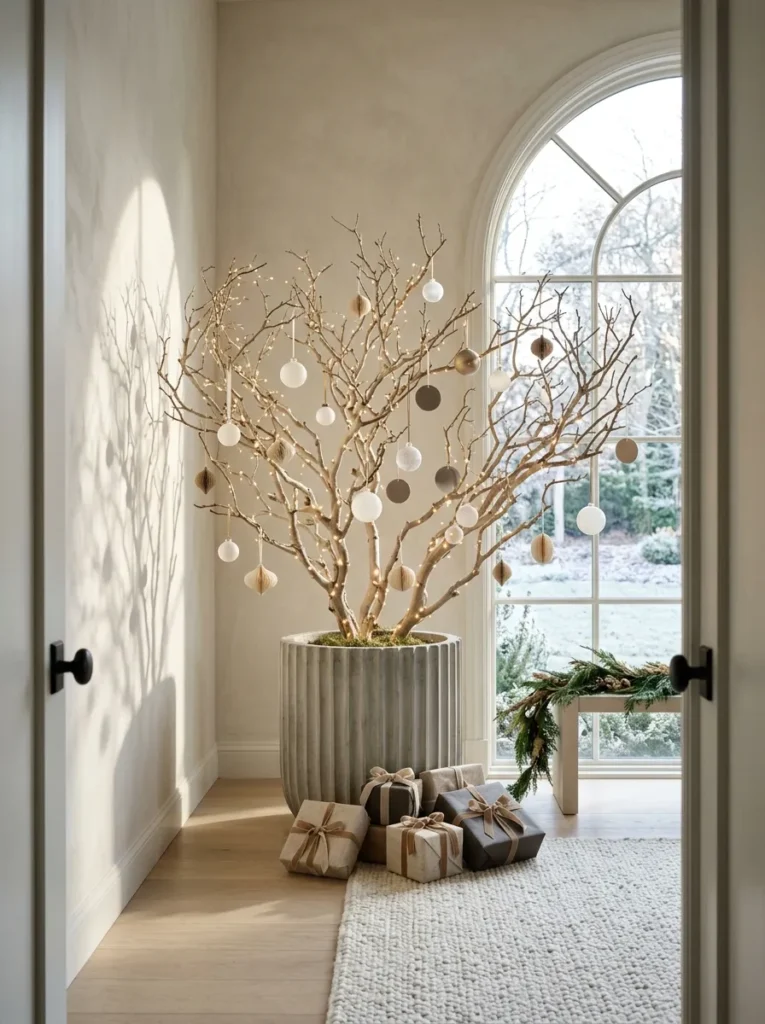
- Tree: 6-foot bleached manzanita branch, about 36 inches wide, bare and unpruned
- Ornaments: 12 opal glass orbs (3 inches), 5 warm-gray ceramic discs (4 inches), hung at staggered lengths from 4 to 18 inches
- Palette: bone white, opal, warm gray, pale brass
- Lighting: 2700K copper-wire micro LEDs, about 30 per foot of height, so two 100-bulb strings (200 total)
- Topper: none; the branch tips stay bare
- Skirt/base: 16-inch fluted concrete planter filled with sand and river stone
- Left off: tinsel, garland, ribbon, and any ornament over 4 inches
- Copyable detail: Hang pieces at different lengths so the branch silhouette reads through the ornaments
Why this works: Bare branches let the silhouette do the decorating, and the empty space makes each ornament look like a collected object.
The first time I stood a bleached manzanita branch in my entry, it sat there for a week before I admitted it was already my tree. Branch trees succeed because the silhouette does the decorating. Each twist and fork reads like a pencil drawing against a white wall, and a few opal glass orbs hung at different lengths give the eye places to rest. Keep the count low, around 17 pieces on a 6-foot branch, so negative space stays part of the look. Bone, opal, and warm gray keep everything calm and sculptural.
Stability matters more than most people expect. A 6-foot branch has an uneven weight, so anchor it in a heavy planter, at least 16 inches wide, filled with about 25 pounds of sand and river stone, then wedge the trunk with small stones so it cannot rotate. Hang ornaments on thin brass wire at staggered lengths from 4 to 18 inches, which lets them move without tangling. Wrap the copper-wire lights from the trunk outward, and plug the string into a timer so the glow switches on at dusk. I’ve found this simple routine keeps the branch looking intentional.
You’ll Also Love:15 Christmas Bedroom Decor Ideas for a Cozy, Restful Retreat
5. Candle-Glow Light Fir
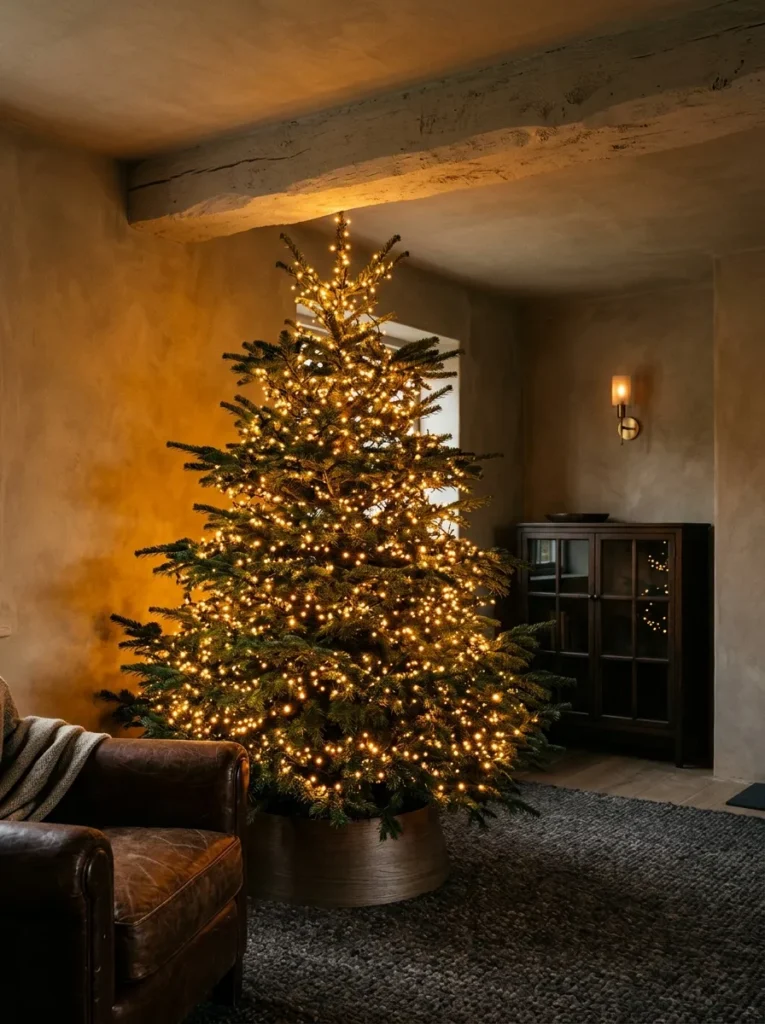
- Tree: 7.5-foot full artificial Douglas fir, 55 inches wide at the base, dense
- Ornaments: none; the lights are the decoration
- Palette: deep evergreen, candle amber, ivory, smoked brass
- Lighting: 2200K warm amber filament-style LEDs, 150 bulbs per foot, so eleven 100-bulb strings (1,100 total), layered at three depths
- Topper: bare leader with a single 3-inch ivory glass finial
- Skirt/base: 32-inch smoked oak ring collar
- Left off: ornaments, ribbon, garland, tinsel, and cool-white bulbs
- Copyable detail: Place lights against the trunk, mid-branch, and at the tips so the glow has real depth
Why this works: Layered warm lights make the tree itself the ornament, and the glow flatters every surface around it.
Warm-white-only lighting is one of the easiest ways to make a tree look expensive. Bulb color is measured in Kelvin, and 2200K sits near candlelight and firelight, a range that flatters green needles and warms every nearby wall. Skip ornaments entirely, and 150 bulbs per foot creates a glowing, three-dimensional volume that photographs beautifully at night. Layering is the secret: lights placed against the trunk, mid-branch, and at the tips give the tree depth that a single wrap never achieves. The result feels calm, glowing, and quietly luxurious, especially against a dark wall or paneled room.
I did this once with eleven strings and a single outlet, and learned that more lights need more planning. Check each box for the maximum number of strings that can connect end to end, because LED limits are higher than older incandescent ones, but still printed on the tag. Plug the whole tree into one surge-protected power strip, and put it on a timer set for dusk to bedtime. Space strings with about 10 inches between each wrap, and test every strand before you start so you are not unwrapping a finished tree to fix one dead section.
6. Collected Glass Diagonal
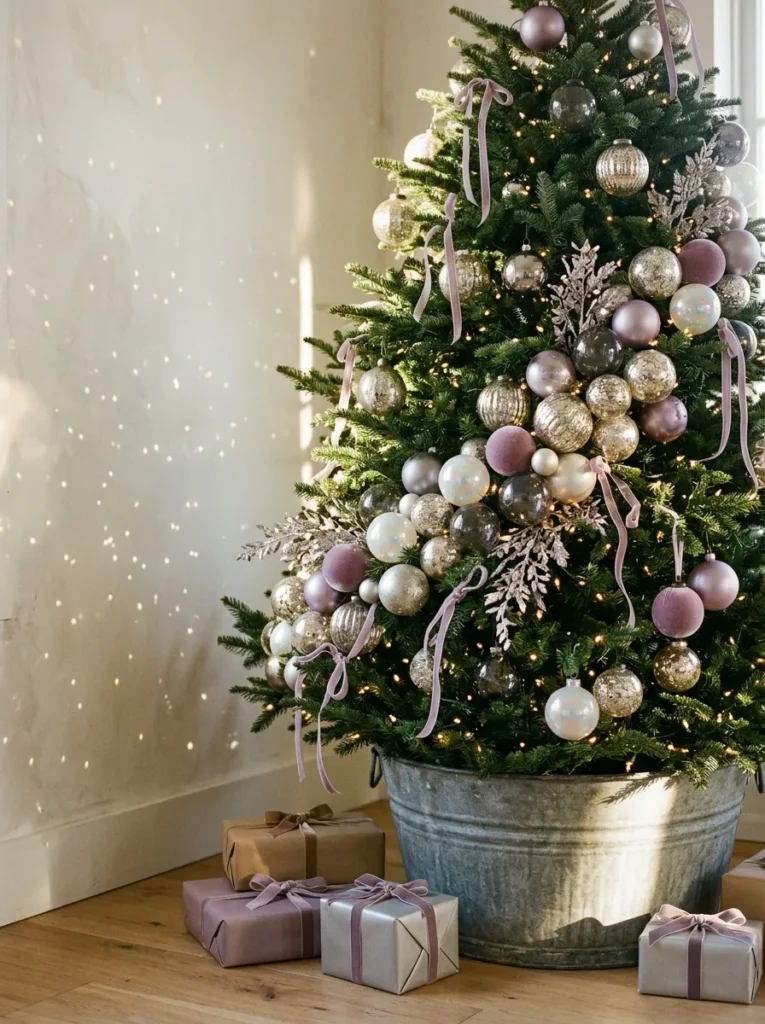
- Tree: 7-foot freshly cut Noble fir, 4 feet wide at the base, open branching
- Ornaments: 30 collected glass pieces: 12 vintage mercury-glass balls (2.5 inches), 10 hand-blown opal and smoke pieces (3 inches), 8 glass icicles (6 inches)
- Palette: antique silver, smoke gray, opal white, dusty lilac
- Lighting: 2700K warm white LEDs on green wire, about 70 bulbs per foot, so five 100-bulb strings (500 total)
- Topper: single 4-inch dusty lilac glass spire
- Skirt/base: 26-inch galvanized zinc tub hiding the steel stand
- Left off: ornaments outside the band, ribbon, garland, and red
- Copyable detail: Cluster every ornament in one 14-inch band running from lower left to upper right, and leave the rest of the tree bare
Why this works: Concentrating mismatched ornaments in one diagonal band reads as deliberate curating, so a collection of odds and ends looks designed.
Years of thrift-store trips taught me that mismatched ornaments only look chaotic when they’re scattered. Group them into one diagonal band, 14 inches wide, running from lower left to upper right, and the same odds and ends read as a curated collection. Antique silver, smoke gray, opal white, and dusty lilac stay close in tone, so even pieces from different decades belong together. I once hung 30 flea-market ornaments this way for a client, and she assumed the set was custom. The bare branches around the band give your eye a place to rest.
Noble fir is the best choice for this look because its stiff, widely spaced branches hold heavy glass without drooping. A freshly cut tree drinks about a quart of water per inch of trunk diameter daily, so check the reservoir every morning. My husband insists on a steel stand rated for the tree’s height and says to cut half an inch off the base before it goes in water. Hide the stand inside a 26-inch galvanized zinc tub, but leave a gap so you can reach the water level and refill without moving anything.
7. Tabletop Cone Trio
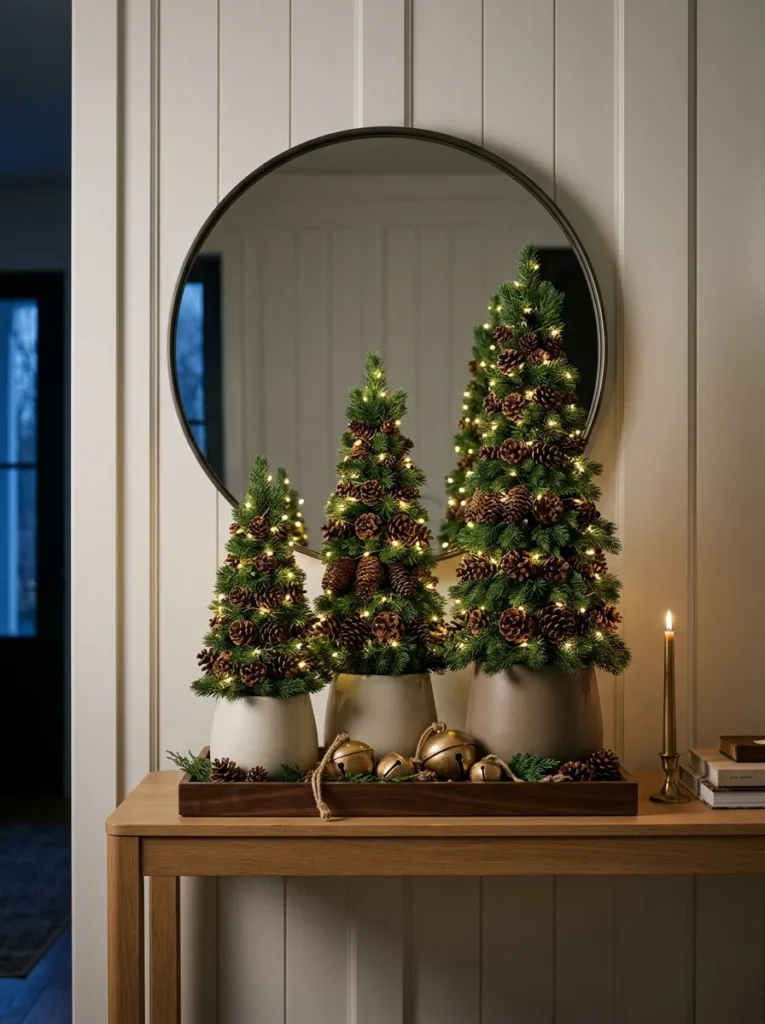
- Tree: three artificial full-density spruce cones at 18, 24, and 30 inches tall (11, 14, and 17 inches wide at the base)
- Ornaments: 24 matte bone glass balls (1.5 inches) and 6 antique brass bells (1.25 inches), split across the three trees
- Palette: deep spruce, bone white, taupe, antique brass
- Lighting: 2700K battery-powered copper-wire micro LEDs, about 20 bulbs per foot of height, one strand per tree on a timer
- Topper: none; each cone keeps its natural tip
- Skirt/base: three fluted stoneware pots in bone and taupe (7, 9, and 11 inches wide) on a 36-inch walnut tray
- Left off: garland, ribbon, red, skirts, and any ornament over 1.5 inches
- Copyable detail: Stagger the trees with 3 to 4 inches between them so the three heights form one rising line
Why this works: Odd-numbered groupings at graduated heights look composed, and small trees fit any console, shelf, or entry.
Designers group objects in odd numbers because the eye finds three more balanced than two or four, and tabletop trees follow the same rule. A trio at 18, 24, and 30 inches creates a rising line that fills a console without crowding it. Small cones make it easy to repeat a single palette, with spruce green, bone, taupe, and antique brass working across every piece. In apartments, entryways, and kitchens with no floor space, this trend delivers a full tree look in a 3-foot width. Set all three on one long walnut tray, and the arrangement reads as one composition.
I styled this for a narrow entry console and was surprised by how much attention three small trees got compared with one big one. Guests stopped, touched the brass bells, and asked where I bought them. The trick is restraint: tiny 1.5-inch balls only, about ten per tree, so the green cone shape stays visible. Use battery-powered copper-wire lights with a timer, and tuck the battery packs behind the pots so no wires show. Real mini trees dry out indoors, so I stick with artificial cones, and I fluff each branch tier before decorating so the silhouette stays crisp.
8. Cobalt Glass Drench
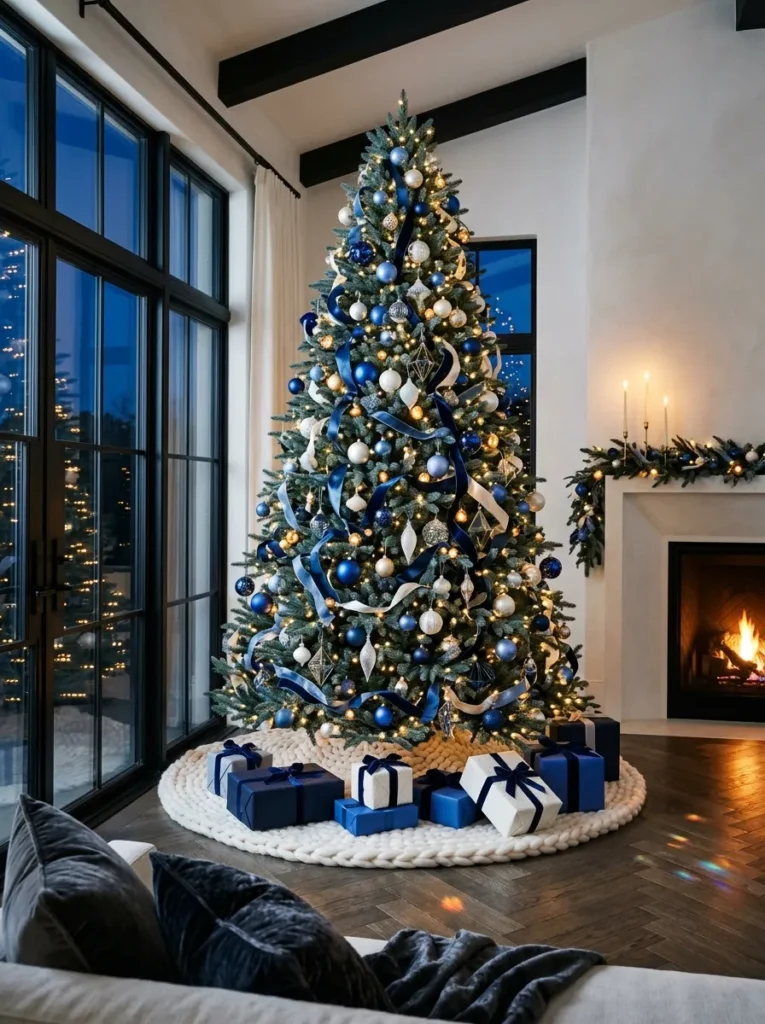
- Tree: 7-foot full artificial blue spruce, 48 inches wide at the base, silver-green tips
- Ornaments: 42 pieces: 16 cobalt gloss balls (3 inches), 12 cornflower matte balls (4 inches), 8 powder-blue glass teardrops (6 inches), 6 pearl-white balls (2.5 inches)
- Palette: cobalt, cornflower, powder blue, pearl white
- Lighting: 2700K warm white LEDs on green wire, about 80 bulbs per foot, so six 100-bulb strings (600 total)
- Topper: 14-inch cobalt glass spire
- Skirt/base: 36-inch pearl white wool felt skirt
- Left off: red, gold, green-contrast ornaments, ribbon, and tinsel
- Copyable detail: Hang the cobalt gloss balls deepest in the branches so they reflect the lights from within
Why this works: Blue spruce needles carry a silver cast that harmonizes with blue glass, so the tree looks chosen rather than decorated.
When I first tried blue on a Christmas tree, I expected it to feel cold. It felt like a jewelry box instead. Blue spruce needles carry a silver cast, so cobalt, cornflower, and powder blue sit naturally against them. Gloss finishes in the deepest tone, matte in the mid tone, and teardrops in the lightest create three levels of reflection, which keeps a single-color tree from looking flat. Set the warm 2700K lights deep in the branches and the cobalt glows from within. Pearl white balls act as highlights, so the whole tree reads like glazed ceramic.
Color-drenched trees work best when ornament sizes vary. Aim for six ornaments per foot, which is about 42 on a 7-foot tree, and hang the largest pieces on the lower third where branches are widest. Space matching tones at least a hand-width apart so no two cobalt balls touch. Because gloss finishes show fingerprints, I handle them with cotton gloves when I unpack. Store each ornament in a divided box; scratches show immediately on deep blue glass. The investment is modest, since a repeating palette lets you add two or three pieces each year without redoing the tree.
9. Plum Half Tree
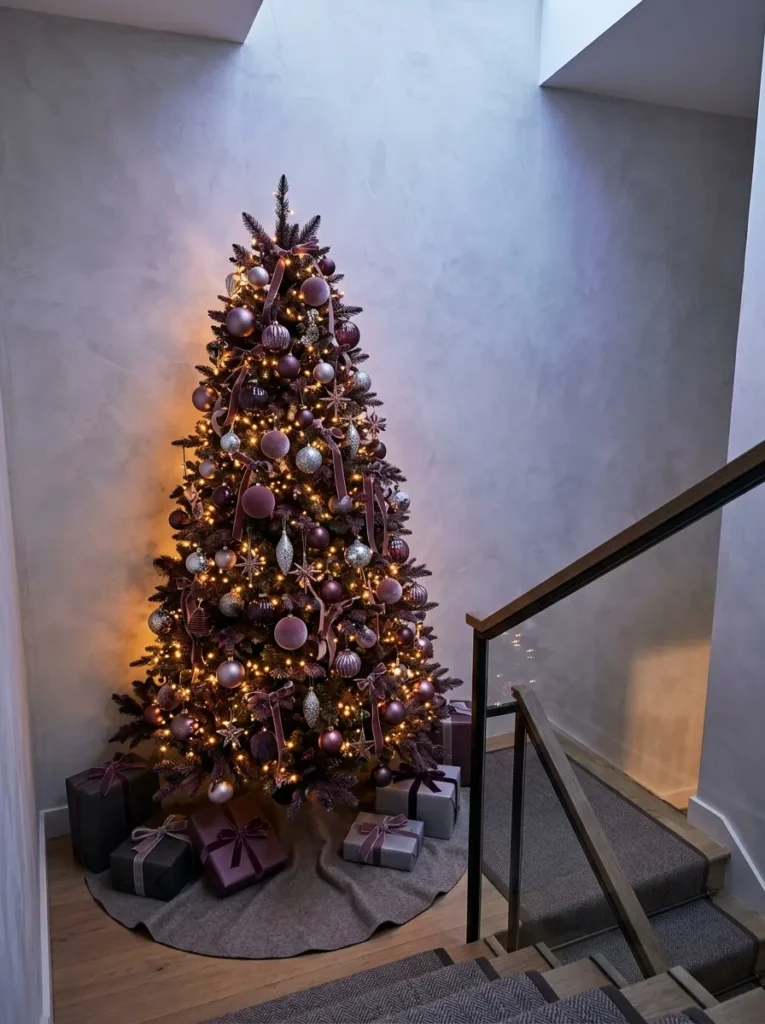
- Tree: 7-foot artificial half tree with a flat back, 40 inches wide and 20 inches deep, set against a wall
- Ornaments: 20 plum glass balls (3 inches), 12 dusty mauve matte balls (4 inches), 8 brushed silver fluted teardrops (5 inches)
- Palette: plum, dusty mauve, warm gray, brushed silver
- Lighting: 2700K warm white LEDs on green wire, about 70 bulbs per foot, so five 100-bulb strings (500 total)
- Topper: 12-inch brushed silver spire
- Skirt/base: 28-inch warm gray wool felt half-circle skirt cut to fit the flat back
- Left off: ornaments on the back, red, gold, ribbon, and tinsel
- Copyable detail: Run the lights from the front center outward and keep the flat back unlit against the wall
Why this works: A half tree gives a full-tree silhouette in 20 inches of depth, so it fits hallways and stair landings where a round tree cannot.
A standard 7-foot tree is about 4 feet wide, which means it uses 12 to 16 square feet of floor space. A half tree, with its flat back against the wall, needs less than half of that. The shape suits stair landings, narrow hallways, and apartment living rooms where a full tree would block foot traffic. Plum, dusty mauve, warm gray, and brushed silver give the compact form a rich, modern look, and the flat back lets you put every ornament where it will be seen. Nothing is wasted on branches nobody sees.
I recommend a half tree to anyone who feels like they have no room for a tree. In my own entry, a 20-inch-deep half tree left 36 inches of walking space, which a round tree would have eaten. Run the lights from the front center outward and keep the flat back against the wall, and place the largest mauve balls low and the silver teardrops higher up. Because the back is flat, small gaps against the wall can show, so tuck a folded sheet of warm gray felt behind it. Anchor it to a wall stud with a small strap.
10. Greige Flocked Column
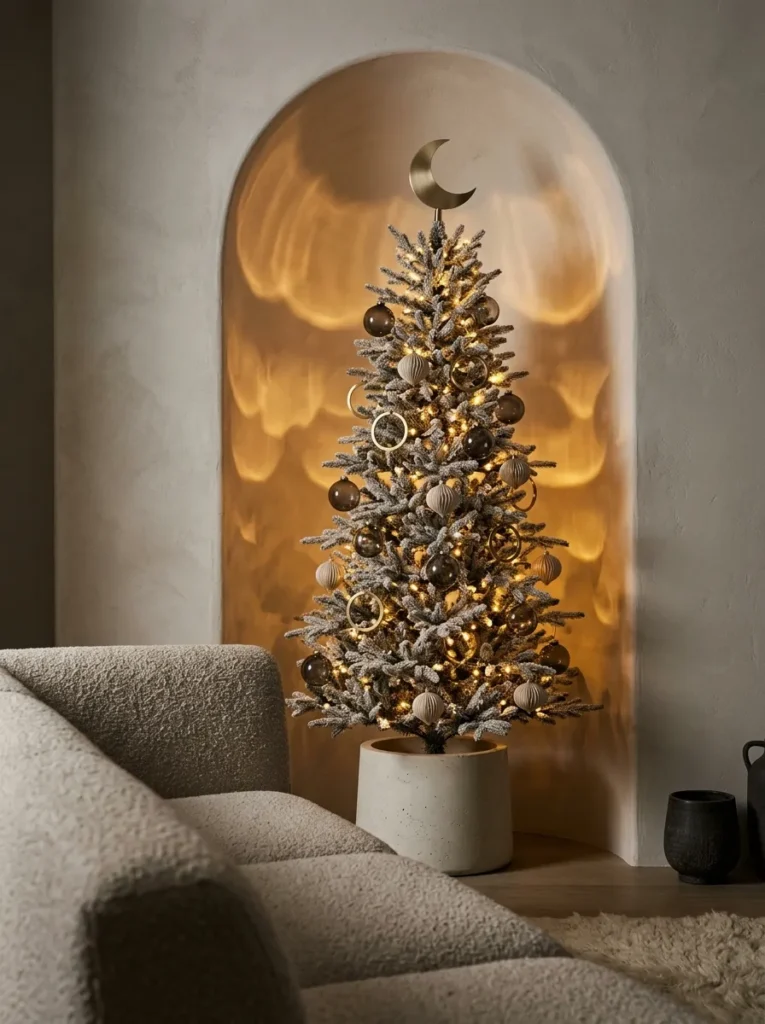
- Tree: 7-foot slim artificial fir, flocked in greige (a soft mushroom-oatmeal tone), 36 inches wide at the base, medium-full
- Ornaments: 12 smoked-glass orbs (4 inches), 10 bone ceramic fluted baubles (3 inches), 8 brushed brass rings (2.5 inches)
- Palette: greige, bone white, brushed brass, smoked glass gray
- Lighting: 2700K warm white LEDs on white wire, 100 bulbs per foot of height, so seven 100-bulb strings (700 total)
- Topper: 14-inch brushed brass crescent arc
- Skirt/base: 22-inch round plaster-finish drum cover in pale concrete
- Left off: red, tinsel, glitter, ribbon, and any ornament under 2.5 inches
- Copyable detail: Turn the crescent’s open side toward the room so the lights glint through it
Why this works: A tinted flocked tree matches plaster and oak tones, so it looks built into the room instead of added to it.
Pure white flocking is giving way to tinted flocking, and the shift changes everything. A greige finish, somewhere between mushroom and oatmeal, looks like sun-bleached bark under snow instead of a winter cartoon, and it sits comfortably beside plaster walls, bouclé sofas, and pale oak floors. Slim trees reinforce the modern feel: at 36 inches wide, a 7-foot column leaves room for a sofa or console beside it, so it reads as a sculpture rather than a seasonal takeover. Brushed brass and smoked glass supply the only shine, which is why the whole tree feels quiet, expensive, and calm.
I styled a tree like this for a client with a curved plaster alcove, and the brass crescent topper turned out to be the detail everyone photographed. Skip the star and let a 14-inch arc catch the lights. Before buying any flocked artificial tree, look for a fire-resistant label on the tag, keep the tree 3 feet from heat vents and fireplaces, and run all seven strings through one power strip with a breaker. Flocking sheds slightly in transit, so fluff branches over a drop cloth outside before bringing the tree into the room.
11. Glazed Ceramic Studio Tree
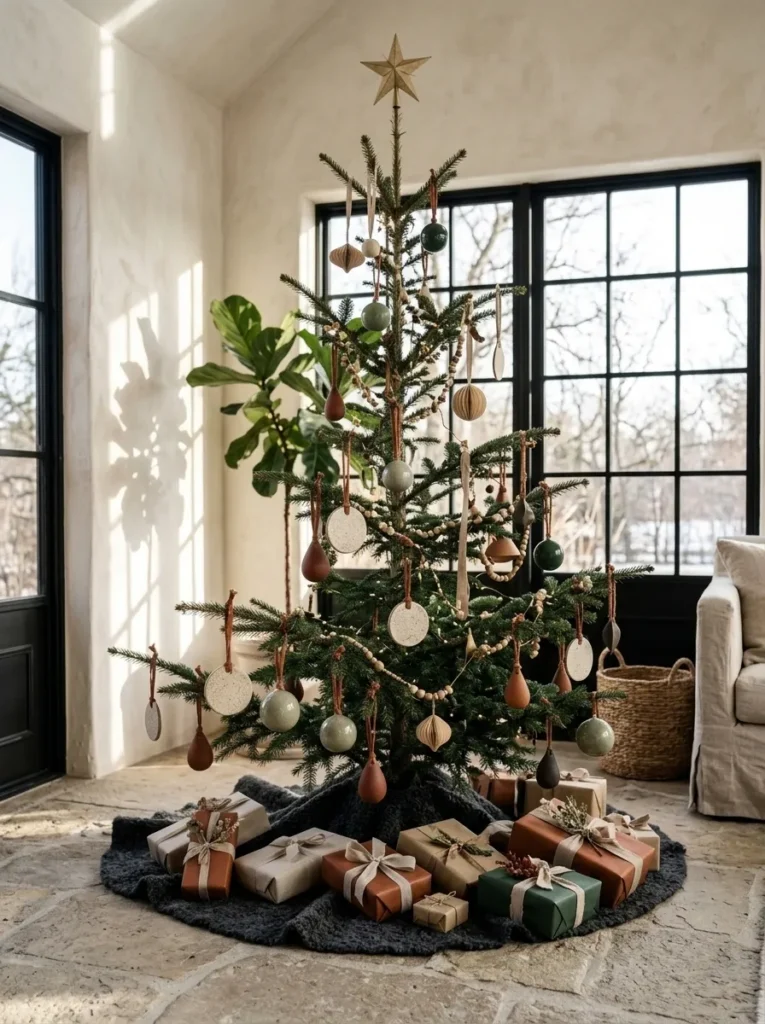
- Tree: 6.5-foot artificial Norway spruce, 44 inches wide at the base, medium-full
- Ornaments: 26 hand-thrown ceramic pieces: 10 speckled cream discs (3 inches), 6 celadon orbs (3.5 inches), 6 rust teardrops (4 inches), 4 charcoal-glazed bells (3 inches)
- Palette: speckled cream, celadon green, rust, charcoal
- Lighting: 2700K warm white LEDs on green wire, about 60 bulbs per foot, so four 100-bulb strings (400 total)
- Topper: 9-inch speckled cream ceramic spire
- Skirt/base: 30-inch charcoal wool felt skirt
- Left off: glass balls, tinsel, ribbon, garland, and metallic finishes
- Copyable detail: Hang every piece on a 4-inch loop of rust waxed linen cord so the glazes read as handmade
Why this works: Handmade ceramic adds texture and visual weight that glass cannot, and the glaze variation makes each piece look one of a kind.
I bought my first ceramic ornaments from a potter at an Austin market, and the way people crowd around that tree each December still surprises me. Glass reflects; ceramic absorbs, so these pieces read as objects instead of sparkle. Speckled cream, celadon, rust, and charcoal glazes vary slightly from piece to piece, which gives the tree a studio-shelf quality that mass-produced sets rarely match. Keep the count to about 26 on a 6.5-foot tree so each piece has room. Hang them at eye level first, because that is where guests look most, then fill upward.
Ceramic ornaments weigh far more than hollow glass, so branch strength matters. Hang each piece on a 4-inch loop of rust waxed linen cord, and place heavier rust teardrops on thick inner branches near the trunk. Lightweight cream discs can go farther out. Check loops regularly during the season, because a loose loop can drop a piece onto a hard floor. Store ceramics individually wrapped in unbleached paper, never in plastic, which traps moisture. Pieces cost between $8 and $25 each from independent potters, so build the collection gradually, adding three or four a year.
12. Mixed Metal Orb Spiral
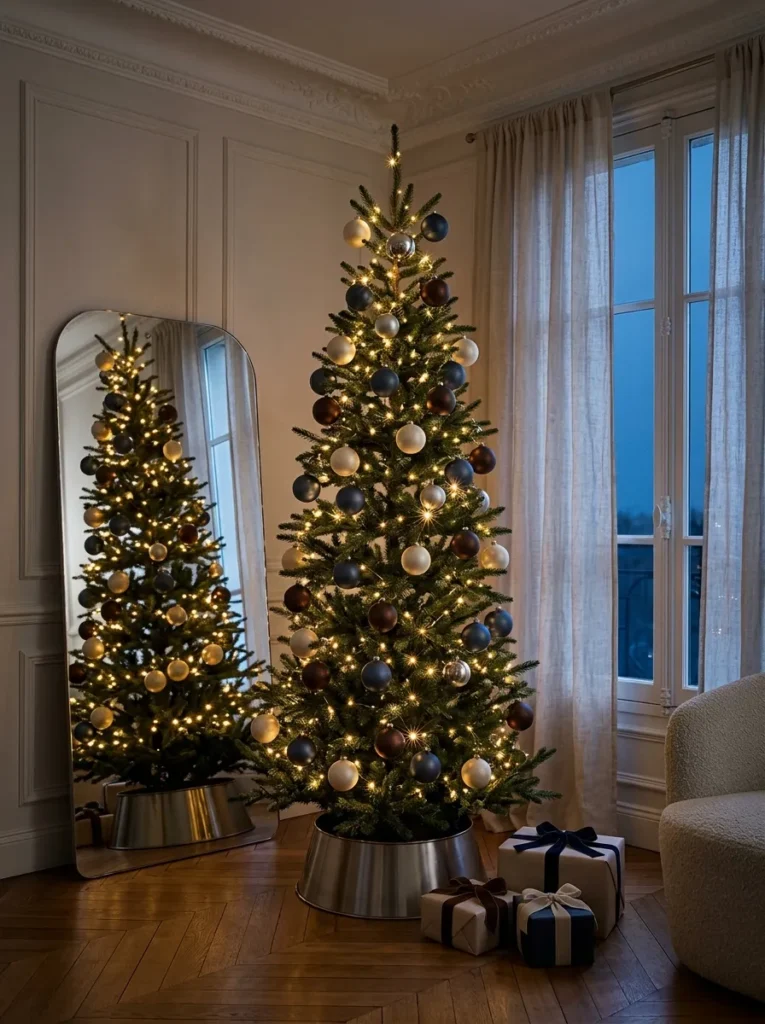
- Tree: 7-foot slim artificial spruce, 40 inches wide at the base, medium-full (about 1,000 tips)
- Ornaments: 8 matte orbs (8 inches, cream and smoke blue), 5 matte orbs (12 inches, chocolate and cream), 2 brushed nickel orbs (10 inches)
- Palette: matte cream, smoke blue, chocolate brown, brushed nickel
- Lighting: 2700K warm white on green wire, about 50 bulbs per foot, so four 100-bulb strings (400 total)
- Topper: 10-inch smoke-blue orb pushed onto the leader
- Skirt/base: 26-inch curved brushed-nickel steel collar
- Left off: ornaments under 8 inches, garland, ribbon, and tinsel
- Copyable detail: Set one nickel orb low and one at mid-height inside the spiral so they pick up the room’s reflections
Why this works: Large ornaments read as design objects, and the bare branches between them let the tree’s shape do the work.
Scale is the quiet driver behind this look. A 7-foot tree decorated with 3-inch ornaments needs around 50 pieces to look finished, while the same tree needs only 15 orbs at 8 to 12 inches. Matte finishes keep the large forms from turning into mirrors that reflect clutter, and two brushed nickel orbs add a metallic note that echoes cabinet pulls and lamp bases. Smoke blue, cream, and chocolate brown sit close together in value, so the tree reads as a calm, sculptural collection of shapes, even from across the room.
I once hung a 12-inch glass orb on a thin outer branch and watched it slide to the floor within an hour. Large ornaments belong on the sturdiest limbs, close to the trunk, where branches are thickest and can bear the load. A good rule for anything heavy is to spread the weight, so place the largest orbs low and centered while keeping the lighter ones higher. Choose shatterproof acrylic orbs if kids or pets share the room; at this size, a matte coating hides seams far better than gloss does.
13. Dried Botanical Plume Fir
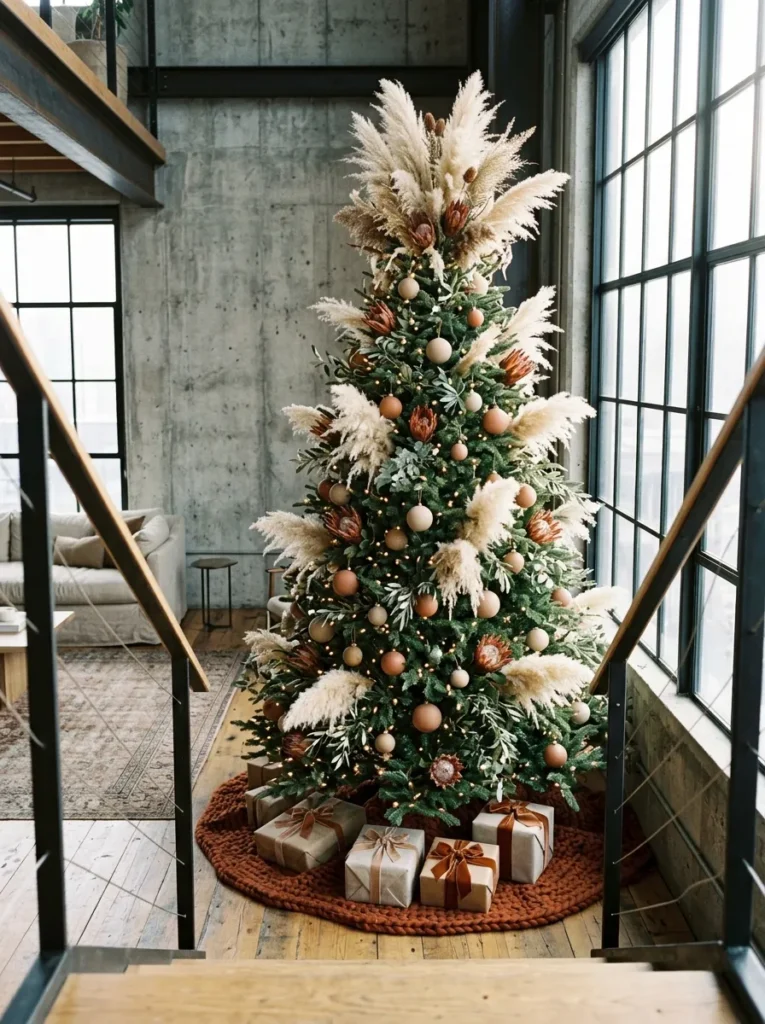
- Tree: 7-foot full artificial Nordmann fir, 48 inches wide at the base, medium-full
- Botanicals: 14 bleached pampas stems (24 inches), 10 preserved olive eucalyptus stems (18 inches), 6 dried rust protea heads (4 inches), wired in loose clusters of three
- Ornaments: 12 matte sand-colored glass balls (3 inches) to fill gaps
- Palette: bleached ivory, preserved olive, rust, sand
- Lighting: 2700K warm white LEDs only, about 70 bulbs per foot, so five 100-bulb strings (500 total)
- Topper: single 24-inch bleached pampas plume wired to the leader
- Skirt/base: 34-inch rust wool felt skirt
- Left off: glitter, tinsel, candles, ribbon, and shiny glass
- Copyable detail: Angle every cluster upward at a different depth so the stems move like wild grass
Why this works: Dried botanicals add feathery texture and height variation that ornaments alone cannot, so the silhouette turns soft instead of round.
My plant science background taught me that preserved botanicals hold their shape for years, and that changed how I decorate. Bleached pampas, preserved olive eucalyptus, and rust protea bring movement to a tree in a way ornaments cannot, because the stems angle upward like wild grass. Cluster them in groups of three, set at different depths, and fill the gaps with a few matte sand glass balls. The silhouette turns soft and feathered instead of round, which is why this look feels modern and a little wild at the same time. It also keeps ornament costs low.
Dried botanicals are dry material, so treat them with respect. Use LED bulbs only, because they stay cool to the touch, and keep candles and open flames away from the tree entirely. Hold stems at least 4 inches from any bulb, and wire each cluster to a sturdy branch near the trunk instead of the tip. Pampas sheds fine fluff, so shake every plume outdoors before it comes inside. Store the stems upright in a tall box after the season, away from damp, and they can return for several years of decorating.
14. Wooden Bead Garland Tree
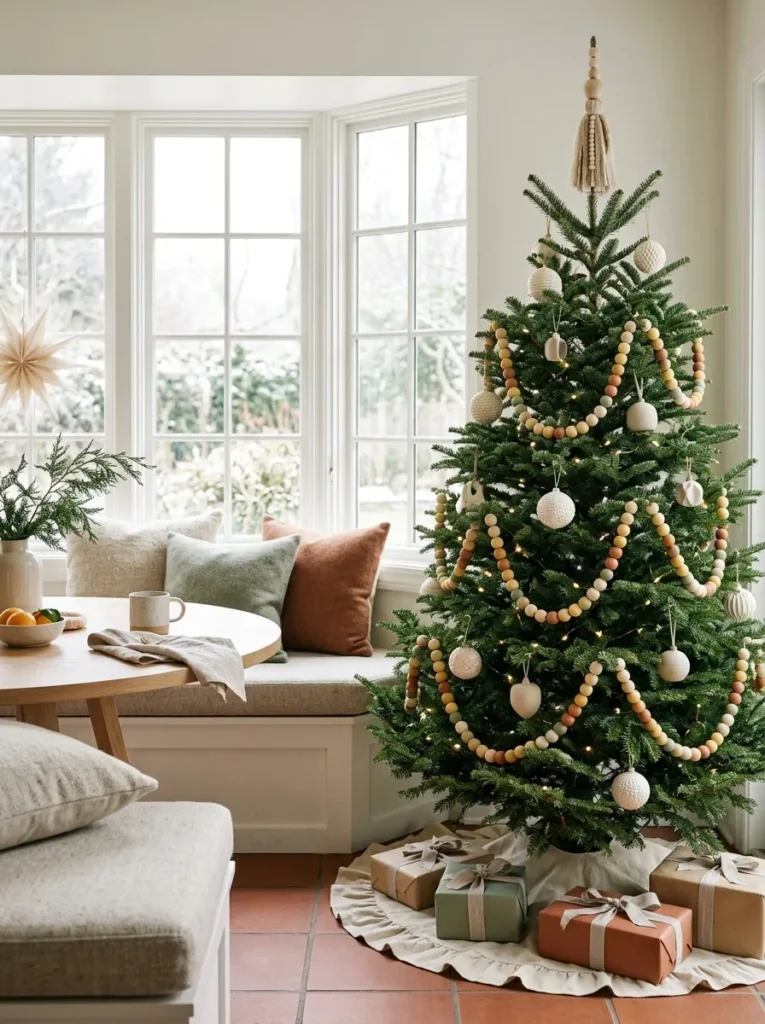
- Tree: 7-foot full artificial Douglas fir, 50 inches wide at the base, medium-full
- Garland: about 28 feet of 1-inch wooden bead garland (4 feet per foot of height), in 4-foot swags
- Ornaments: 12 matte ivory balls (3 inches) tucked between the swags
- Palette: butter yellow, terracotta, sage, ivory
- Lighting: 2700K warm white LEDs on green wire, about 70 bulbs per foot, so five 100-bulb strings (500 total)
- Topper: 10-inch butter yellow wooden bead tassel wired to the leader
- Skirt/base: 32-inch natural canvas skirt
- Left off: tinsel, glitter, ribbon, and anything glossy
- Copyable detail: Drape each swag in a loose U that dips about 8 inches, and alternate the bead colors tier by tier
Why this works: Chunky beads add color and handmade texture in long swags, so the tree needs very few ornaments.
Wooden bead garlands are the easiest way to add color and texture without a pile of ornaments. A 1-inch bead garland has real visual weight, so a 7-foot tree needs about 28 feet to look intentional, roughly 4 feet per foot of height. Butter yellow, terracotta, sage, and ivory beads read soft and sun-warmed against green needles. Swag each strand in loose U-shapes that dip about 8 inches, working tier by tier from the bottom, and the tree gains rhythm without clutter. Because wood is lightweight, nothing droops or pulls branches out of shape.
I made my first bead garland from craft-store beads and cotton cord on a rainy weekend, and it cost less than one box of glass ornaments. That’s the beauty of this trend: you can buy ready-made or string your own. Paint wooden beads with matte acrylic in your four tones, then thread them on 1/8-inch cotton cord with a knot between every few beads so they hang evenly. Make each strand 4 feet long, which is easy to swag and store. Wrap garlands loosely around a cardboard tube in the off-season so the cord never kinks.
15. Moss and Sage Tonal Tree — A 2026 Christmas Tree Trend in Quiet Greens
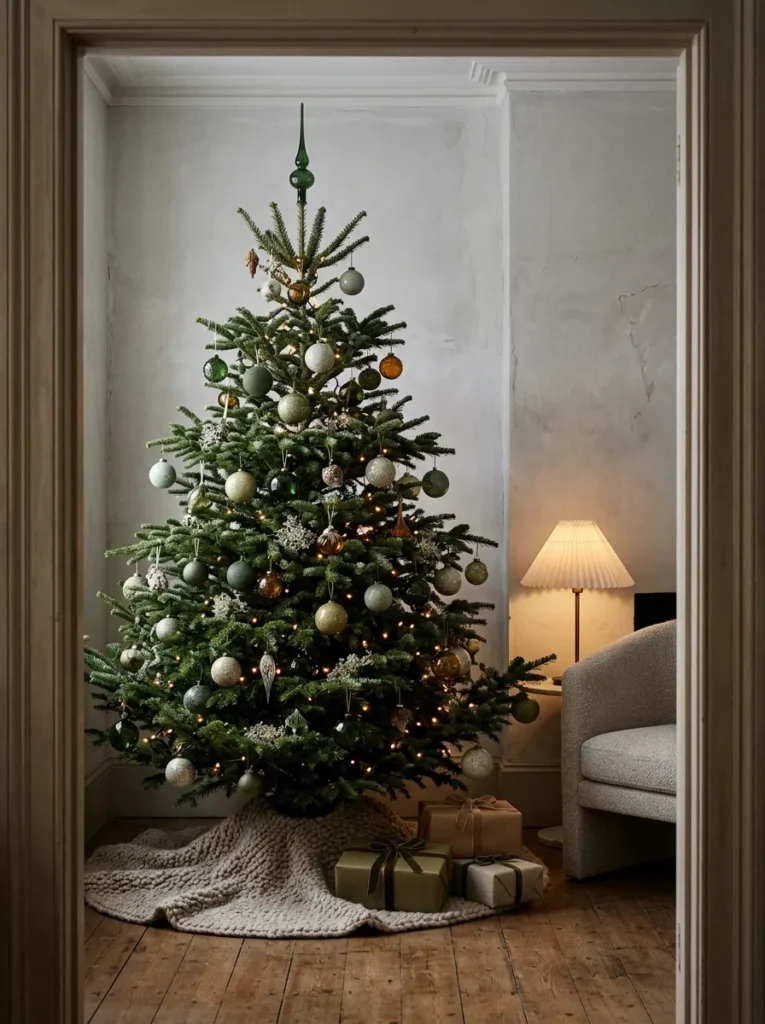
- Tree: 7.5-foot full artificial Fraser fir, 52 inches wide at the base
- Ornaments: 45 pieces: 16 forest green velvet-flocked balls (3 inches), 14 moss crackle-glaze ceramic balls (3.5 inches), 8 sage matte glass teardrops (5 inches), 7 lichen gray-green glass balls (2.5 inches)
- Palette: forest green, moss, sage, lichen gray-green
- Lighting: 2700K warm white LEDs on green wire, about 75 bulbs per foot, so six 100-bulb strings (600 total)
- Topper: 10-inch forest green matte glass spire
- Skirt/base: 36-inch round oatmeal wool skirt
- Left off: red, gold, white, ribbon, and tinsel
- Copyable detail: Hang the darkest balls deep near the trunk and the pale lichen pieces on the outer tips so the tree lightens toward its edges
Why this works: Tone-on-tone greens stay quiet against the needles, so the texture and shape of each ornament tell the story.
Green on green sounds risky, but plants have been doing it forever. In a garden, layered greens rarely clash, because they share the same undertone, and the same rule works on a tree. Forest, moss, sage, and pale lichen ornaments melt into the needles at a distance, then reveal texture up close: crackle glaze, velvet, and matte glass. The tree reads as one quiet, rich mass instead of a collection of decorations. I’ve seen this style calm a loud room, and it keeps its charm long after the holiday colors of the moment fade.
Placement matters more than color count here. Hang the darkest forest green balls deep near the trunk to build shadow, moss pieces through the middle, and the pale lichen teardrops on the outer tips, so the tree seems to lighten toward its edges like frost on a spruce. Use about six ornaments per foot, which is 45 on a 7.5-foot tree, and mix finishes so each tone has two textures. Warm 2700K lights keep the greens from turning blue, which can happen under cool white bulbs. Step back and squint every few minutes to spot gaps.
Styling Principles
Choose structure for the long run. Tree shape, light warmth, and ornament scale age far more slowly than color. Pick a silhouette you love, warm 2200K to 2700K bulbs, and one consistent ornament size range, and you can keep all three for years.
Let color be the rotating layer. Ornaments, ribbon, and skirts are the cheapest pieces to swap, so this year’s palette belongs there. Most of this year’s tree styles can be rebuilt by changing only those three items.
Hold the palette to four tones. Every look above uses four named tones, which is enough for depth and still reads as one idea.
Light the tree at three depths. Place bulbs against the trunk, mid-branch, and at the tips. A tree lit at all three depths glows from within instead of showing a surface wrap.
Edit by leaving things off. The most polished 2026 Christmas tree ideas leave something out on purpose, whether it is tinsel, ribbon, or any ornament under 2.5 inches.
Size the tree to the room. A tree about 12 inches shorter than the ceiling leaves space for the topper and stand, and a clear 3-foot gap from heat sources keeps it safe.
FAQs
1. How do I pick a Christmas tree trend that lasts several years? Choose the structure first and the color second. Tree shape, light warmth, and ornament scale stay current far longer than any palette, so buy those for the long run and rotate color through ornaments, ribbon, and a skirt each year. That way you can follow Christmas tree decorating trends for the cost of a few new pieces.
2. How many lights does a Christmas tree need? A full glow takes about 100 bulbs per foot of tree height, so a 7.5-foot tree needs roughly 750 bulbs, or eight 100-bulb strings. For a softer look, 50 to 70 bulbs per foot works well. Warm white at 2200K to 2700K flatters green needles and nearly every ornament color.
3. Is a real or artificial tree safer, and which costs less? Both are safe when handled correctly. A real tree needs fresh water daily and a 3-foot gap from heat sources, while an artificial tree should carry a fire-resistant label. A real 7-foot tree typically costs about $60 to $120 each year, and a quality artificial tree often costs $200 to $600 and pays for itself over roughly five to eight seasons. Prices vary by region.
4. How many ornaments do I need per foot? For standard 3-inch balls, plan on 4 to 6 ornaments per foot, which is 28 to 42 on a 7-foot tree. Oversized 8 to 12 inch orbs need only about 2 per foot. A sparse, sculptural look takes 2 to 3 pieces per foot.
5. What are budget-friendly ways to try a trend? Pick the single element that defines the look and spend there. A ribbon cascade needs mostly velvet ribbon, a branch tree needs one branch and a handful of ornaments, and a color drench can start with one set of matching balls. Thrifted glass in a limited palette also works and keeps the cost down.
6. What bulb color looks best on a modern tree? Warm white between 2200K and 2700K looks best on most modern trees. It matches candlelight, keeps deep colors like navy and bordeaux rich, and avoids the bluish cast of cool-white bulbs.
Conclusion
A great tree doesn’t need to be perfect. It needs a plan: a shape you love, warm lights, and a palette that feels like you. Whether you choose a floating fir, a bleached branch, or a trio of tiny cones, the best picks from Christmas tree trends 2026 are the ones you can build at home. I’ve seen how small changes like these can completely transform a room.
Save this post on Pinterest so you can find it when decorating day arrives, try one look this season, and share it with a friend who is still staring at a bare tree.