
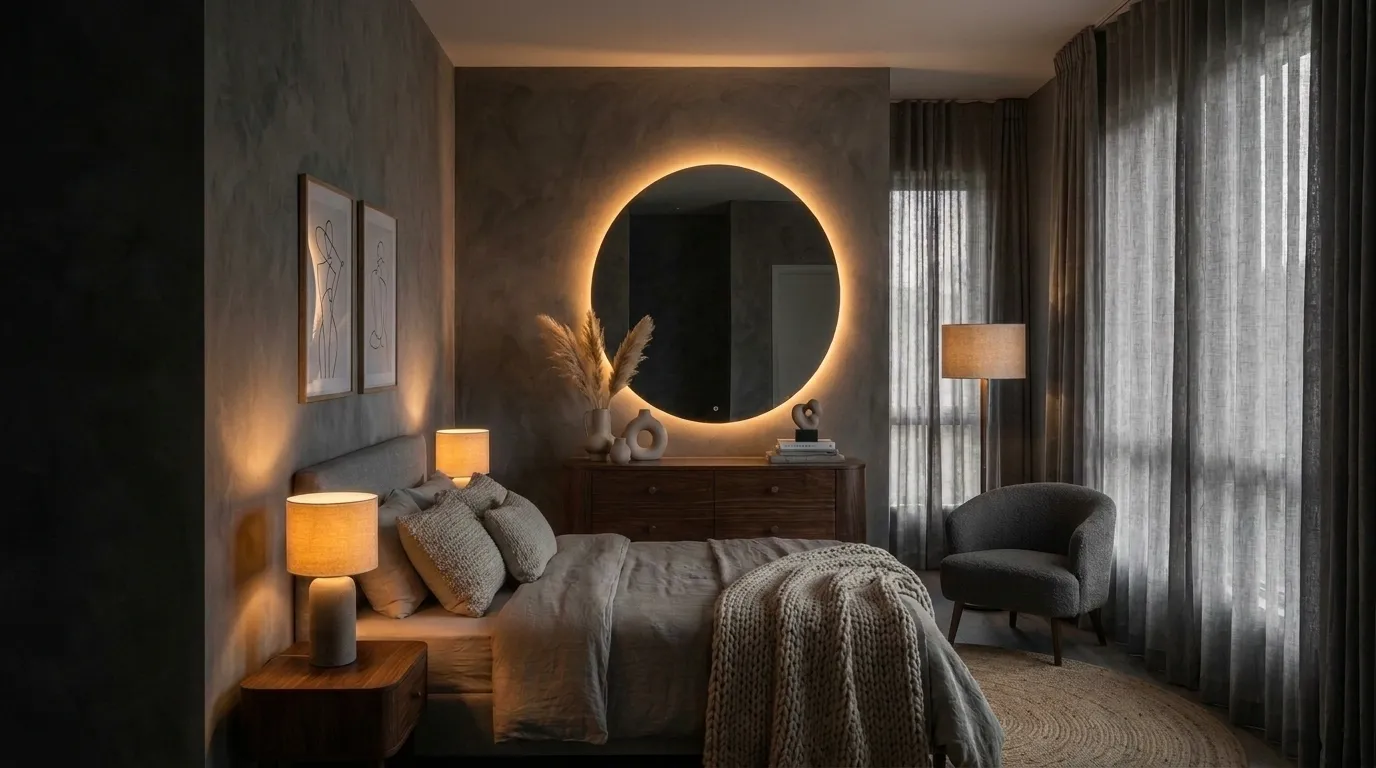
15 Bedroom Lighting Ideas Without Overhead Light That Actually Feel Bright
Not every beautiful bedroom starts with a ceiling fixture. Some of the most inviting rooms I’ve ever styled never had one to begin with. If you’ve ever stood in a bedroom flipping a switch that controls nothing but a single plugged-in lamp, you already know the problem this post solves — and you’re far from alone. These bedroom lighting ideas without overhead light aren’t workarounds or consolation prizes.They’re genuinely better than a single bright bulb in the middle of the ceiling, because layered light always feels warmer and more intentional.
My husband has rewired enough older homes to know this setup is everywhere, especially in houses built before overhead bedroom lighting was standard code. Here’s how to make it work beautifully.
Why So Many Bedrooms Have No Overhead Light
A lot of American bedrooms feel dim not because they lack good taste, but because they were never wired for overhead light in the first place. Many U.S. homes built before the 1960s and ’70s used switch-controlled outlets instead of ceiling fixtures in bedrooms, since overhead lighting wasn’t standard residential code in many regions until decades later. That’s why so many renters — and even owners of older homes — end up stuck with one lamp plugged into a single switched outlet, usually in the least convenient corner of the room.
My husband, who’s spent twenty years in residential construction, still runs into this exact wiring setup on renovation walkthroughs. A bedroom doesn’t need a ceiling fixture to feel bright — it needs layered light sources placed with intention. That’s exactly what this post solves.
This post connects naturally to our color-focused bedroom guides — Cherry Red, Jewel Tone, Emerald Green, Dark Blue & Gold, Lavender, Sage Green, and Small Black Luxury — since great lighting works across any of those palettes.
1. Plug-In Wall Sconces
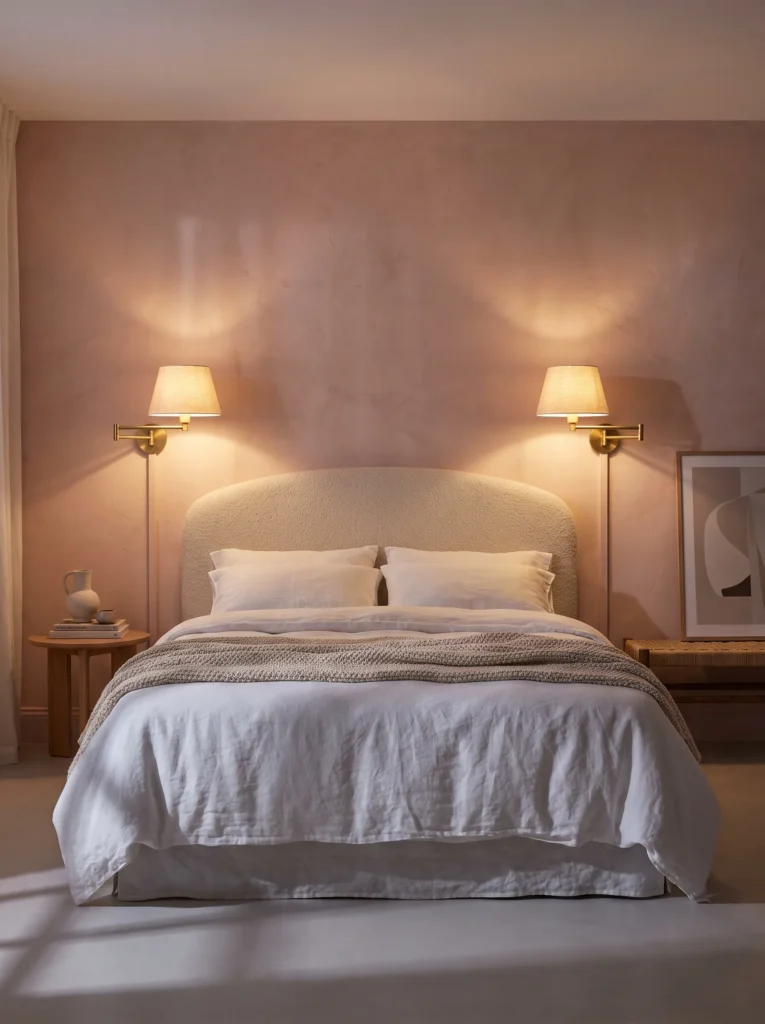
- Fixture type: Swing-arm plug-in wall sconces, mounted flanking the headboard
- Placement: 20–24 inches above mattress height, cord routed through a cord cover down to the outlet
- Bulb temperature: 2700K soft white for a warm, skin-flattering glow
- Outlet solution: Runs directly off the existing switched outlet, so the wall switch still controls the room
- Styling context: Pairs beautifully with brass or aged-bronze hardware and a linen or bouclé headboard
- Standout detail: Choose a sconce with an articulating arm so light bends exactly where you read
Why this works: Wall sconces free up nightstand surface space while delivering the same warm, layered light a ceiling fixture would, without any rewiring.
Most people assume plug-in sconces mean visible cords snaking down a freshly painted wall, but that’s not actually true anymore. Paintable cord covers — the kind that mount flush and can be painted to match your wall color — make this installation nearly invisible. My husband uses the exact same channel covers on renovation jobs when clients want sconce lighting but don’t want to open drywall for hardwiring. The result is a fixture that looks fully built-in. It’s one of the few upgrades that reads as “custom electrical work” while actually taking under thirty minutes to install with zero tools beyond a level and some anchors.
Swing-arm sconces also solve a real functional problem: reading in bed. A fixed lamp on a nightstand throws light down and out, but an articulating sconce arm lets you angle the bulb precisely over a book or a phone screen. In my experience, this small adjustability is what actually gets people to use their reading light instead of just leaving their phone flashlight on. Pair the sconces with a linen drum shade to soften the output, and keep both sconces on the same switched circuit so one flip of the wall switch turns the whole scene on or off together.
2. Statement Floor Lamp
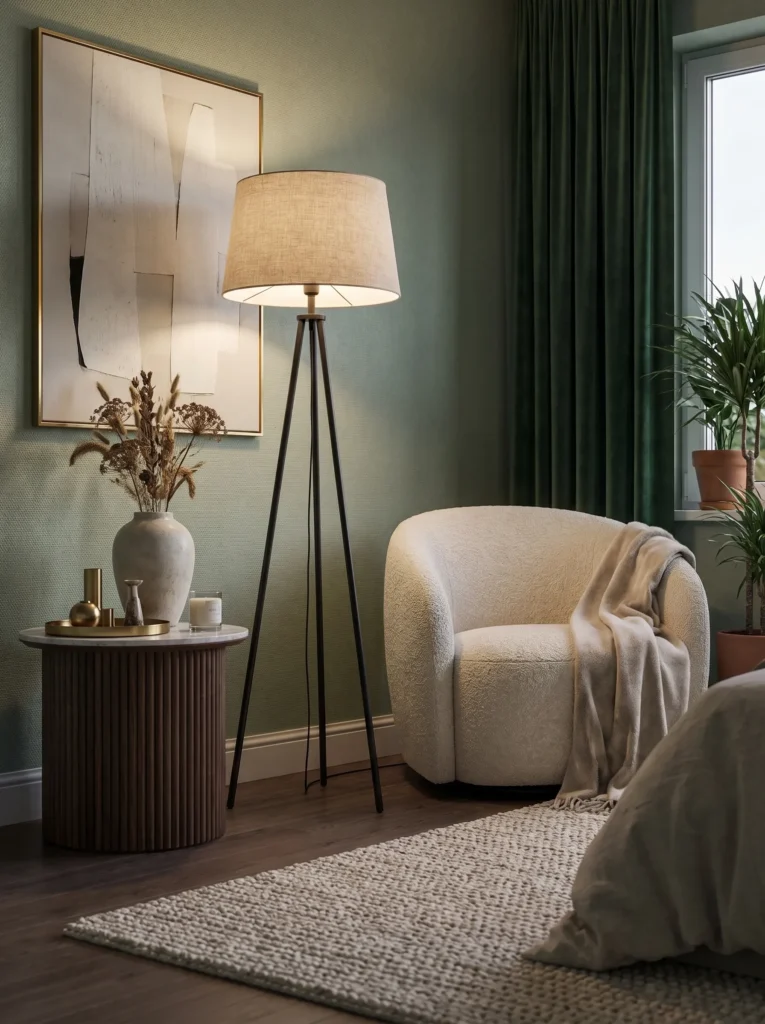
- Fixture type: Oversized arc or tripod floor lamp with a linen or opal glass shade
- Placement: Positioned directly at or near the room’s single switched outlet, in a reading nook or corner
- Bulb temperature: 2700K–3000K, nothing cooler, or the room reads clinical instead of restful
- Outlet solution: Plugs straight into the switched outlet, meaning the existing wall switch operates the whole lamp
- Styling context: Works with a curved bouclé accent chair, a fluted side table, and a low-pile wool rug
- Standout detail: A tripod lamp with a marble or travertine base grounds the whole corner as an intentional vignette, not an afterthought
Why this works: A statement floor lamp does double duty — it solves the ambient lighting gap and instantly becomes a design anchor the eye is drawn to.
A ceiling fixture lights a room from directly overhead, but a tall arc or tripod floor lamp lights it from an angle, which is actually closer to how natural light behaves at sunset. That angled wash feels less flat and more dimensional against a wall. This is a fact lighting designers rely on constantly: light coming from a single point at eye level or below creates warmth, while a single point directly overhead creates hard shadows under noses and brow lines — the same reason bathroom vanity lighting avoids pure overhead bulbs. A floor lamp with a fabric shade diffuses that light even further, spreading it softly across the whole corner of the room.
I styled a guest bedroom in a 1940s Austin bungalow last year that had exactly this problem — one switched outlet, no ceiling box, low ceilings that made pendant lighting awkward. We used a nine-foot arc floor lamp with a linen drum shade positioned to hang light over a small reading chair, and the switched outlet controlled the whole thing. The homeowner told me it was the first time that corner of the room felt “finished” instead of just furnished. Sometimes the fix isn’t more fixtures — it’s one lamp, placed with real intention.
3. Hanging Pendant on a Plug-In Cord
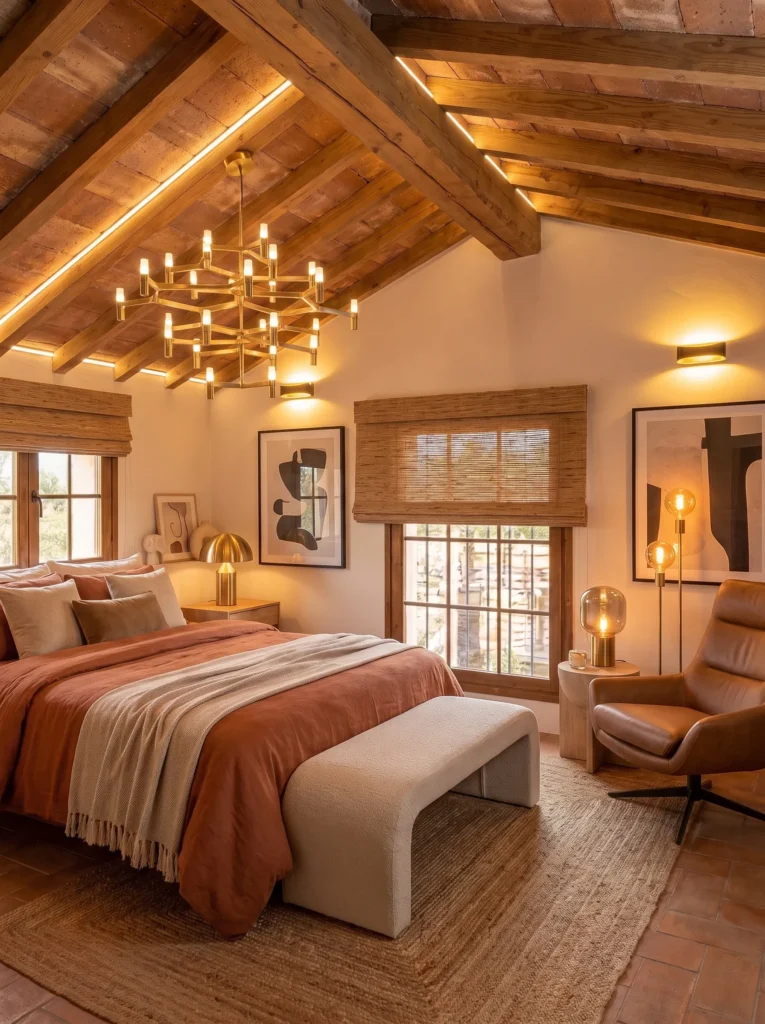
- Fixture type: Swag pendant light on a fabric-covered plug-in cord, hung from a ceiling hook
- Placement: Centered over a nightstand or reading chair, cord run along the ceiling and down the wall to the switched outlet
- Bulb temperature: 2700K amber-toned bulb inside a glass or rattan shade
- Outlet solution: No wiring required — the swag hook holds the weight, the cord routes to the existing switched outlet
- Styling context: Pairs well with terracotta, rattan, and warm wood tones for an earthy, layered look
- Standout detail: A ribbed amber glass shade throws a warm, dappled pattern onto the ceiling that reads as genuinely custom
Why this works: A plug-in swag pendant gives the visual impact of a real ceiling fixture — including that layered, dropped-height glow — without a single wire touched.
Here’s a fact most renters don’t realize: swag hooks are a completely legal, damage-free way to hang real weight from a ceiling, rated for anywhere from 15 to 50 pounds depending on the anchor, which is more than enough for any pendant shade. The cord simply runs along the ceiling line — most people staple or clip it flush against the crown molding or ceiling edge — then drops down the wall to the switched outlet. Visually, this reads exactly like a hardwired pendant once it’s installed. It’s genuinely one of the highest-impact, lowest-permanence lighting ideas for bedrooms with no overhead light.
My husband installs swag hooks on rental properties constantly, and the rule he always gives tenants is simple: find the ceiling joist, not just drywall, before anchoring anything heavier than a few pounds. A stud finder solves this in under a minute. Once it’s secured properly, a ribbed amber glass pendant does something a table lamp never can — it pulls the eye upward and makes a low ceiling feel taller. That vertical pull is exactly why this idea photographs so well and reads as intentional rather than improvised.
4. String Lights, Done Elegantly
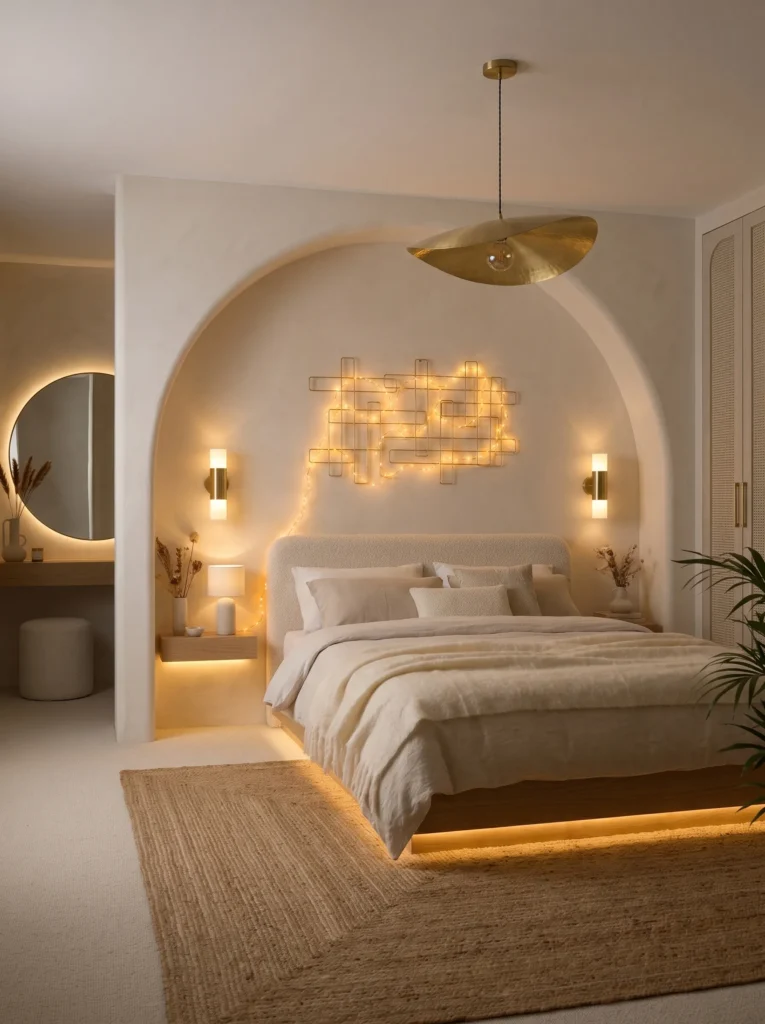
- Fixture type: Micro LED string lights on a slim brass or matte-black wire, not the bulky dorm-room kind
- Placement: Draped along a curved headboard silhouette or looped through a wall-mounted brass wire grid above the bed
- Bulb temperature: 2700K warm white, tiny bead bulbs, never the blue-white “fairy light” tone
- Outlet solution: Battery-pack or USB-powered version eliminates cord clutter entirely, or plugs into the switched outlet with a slim inline dimmer
- Styling context: Works best against a curved plaster or Venetian-plaster wall finish, paired with a bouclé or cream mohair throw
- Standout detail: Looping the lights through a geometric brass wire wall grid turns them into a sculptural piece instead of a dorm-room cliché
Why this works: Micro LEDs on a fine-gauge wire read as architectural lighting, not decoration, when the bulb is small enough to disappear into the design.
String lights get dismissed by design purists, and honestly, most of the time they deserve it. The difference between “college dorm” and “genuinely elevated” comes down to two things: bulb size and installation method. Bulbs under a quarter-inch, mounted on a wire thin enough to nearly vanish against the wall, read as intentional lighting design rather than an afterthought. Draping them loosely across a duvet is the outdated move. Running them through a fixed architectural element — a wire grid, a curved headboard frame, a piece of driftwood — is what makes this idea feel current for 2026 rather than dated.
I used this exact approach in a client’s Austin condo last spring: a curved bouclé headboard with a brass wire grid mounted just above it, micro LEDs threaded through in a loose geometric pattern. Guests kept asking where she’d sourced the “light fixture,” not realizing it was $28 worth of string lights installed with real intention. That’s the tell for whether an idea is working — nobody should be able to identify it as “string lights” at first glance. The battery-pack version means zero visible cords and zero outlet dependency at all.
5. Backlit Mirror
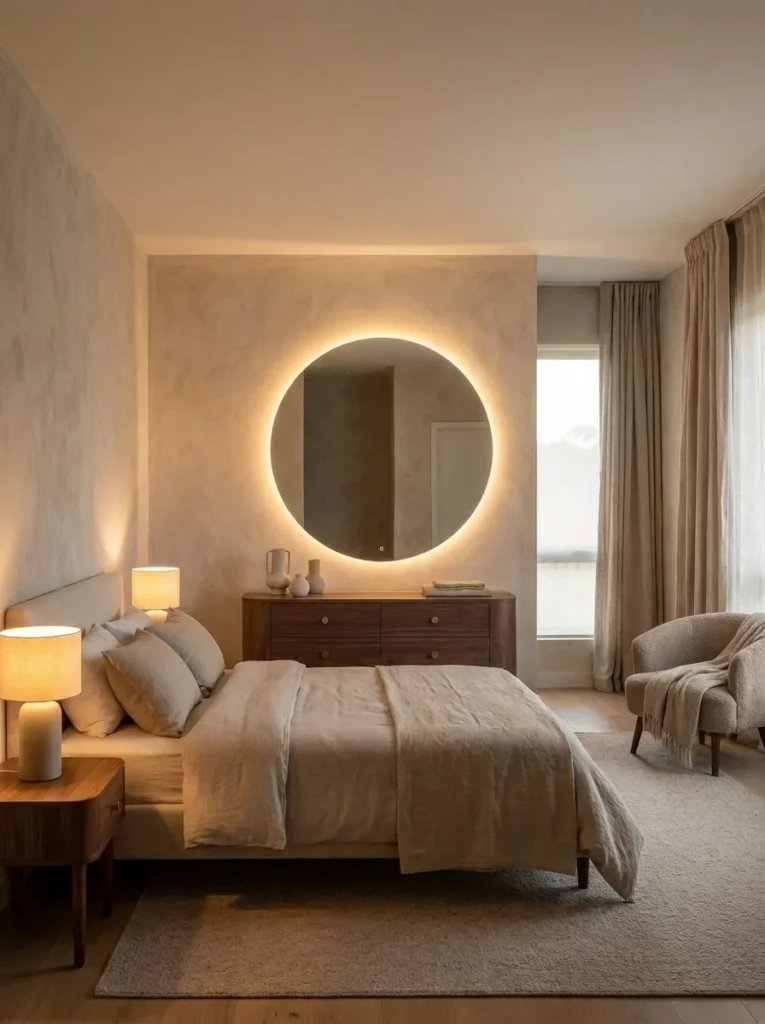
- Fixture type: LED-backlit round or organic-shaped mirror with an integrated dimmable ring light
- Placement: Mounted on the wall opposite the window or beside a dresser, functioning as both task and accent light
- Bulb temperature: 3000K, slightly cleaner than bedside lamps since this fixture does double duty for getting dressed
- Outlet solution: Most backlit mirrors plug into a standard outlet with an inline switch, independent of the room’s single switched circuit
- Styling context: Pairs with a curved walnut dresser, unlacquered brass pulls, and a plaster or limewash wall finish
- Standout detail: An organic, asymmetric mirror shape rather than a perfect circle keeps the whole vignette from feeling like a hotel bathroom
Why this works: A backlit mirror solves the “no overhead light for getting dressed” problem that plug-in lamps genuinely can’t fix, since lamps light a room but rarely light a face.
Task lighting is the piece most bedroom lighting advice skips entirely. Ambient lamps make a room feel warm, but they do almost nothing when you’re standing at a dresser trying to see your own reflection clearly. A backlit mirror solves that specific gap: it throws even, shadow-free light across your face and torso, the same principle used in professional vanity and stage lighting. Ambient lamps light a room; task lighting like a backlit mirror lights a person — and a bedroom genuinely needs both to function well, not just look good in photos.
An organic, asymmetric mirror shape has quietly replaced the perfectly round “halo mirror” as the more current choice for 2026 interiors — it reads as sculptural rather than utilitarian. I’d steer clients away from stark white LED rings toward mirrors with a warmer 3000K glow and a slightly irregular silhouette, paired with a curved walnut dresser and unlacquered brass hardware that will patina naturally over time. It’s a small fixture, but it’s often the one detail that makes a bedroom photograph as “designed” rather than simply decorated.
6. Grouped Vintage Lamp Collection
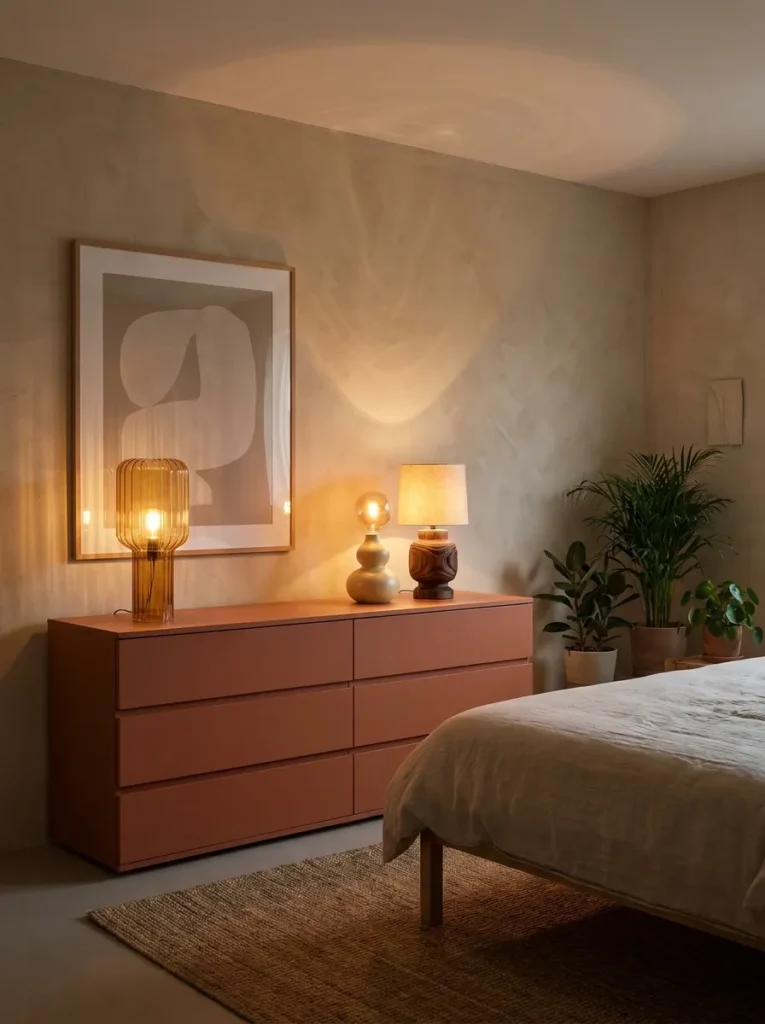
- Fixture type: Two to three mismatched vintage or vintage-style table lamps grouped on a single dresser or credenza
- Placement: Clustered at varying heights along one surface, rather than symmetrically paired on nightstands
- Bulb temperature: 2700K across all three, kept consistent even though the shades and bases differ
- Outlet solution: Best run through a single smart power strip plugged into the switched outlet, so one wall flip controls all three at once
- Styling context: Works with mixed metals — a fluted glass base, a ceramic gourd-shaped base, and a carved wood base — against a warm plaster or clay-toned wall
- Standout detail: Intentional height variation (short, medium, tall) creates a skyline effect that reads as curated collecting, not clutter
Why this works: Grouping light sources at different heights mimics the layered effect of real architectural lighting, which is exactly why one corner can look “designed” instead of just furnished.
A single lamp on a single nightstand is functional. Three lamps of varying height, material, and shade shape grouped together on one surface is a design statement — and it solves the ambient lighting gap far more effectively than one fixture ever could, because the light sources overlap and soften each other’s shadows. This is the same layering principle professional lighting designers use in living rooms, just scaled down for a bedroom dresser or credenza. The mismatch is the point: a fluted glass base next to a ceramic gourd base next to a carved wood base reads as a collection built over time, not a matching three-pack ordered off one page.
I’ve noticed this idea works especially well for people who inherited or thrifted a few lamps and assumed they didn’t “match” enough to use. They almost always do, as long as the bulb temperature stays consistent across all three — that’s the detail that ties mismatched bases together visually. Smart plugs solve the practical side: one plugged into the switched outlet, with the other two lamps daisy-chained through a short power strip, so the existing wall switch still operates the whole grouped display at once.
7. Sculptural Picture Light
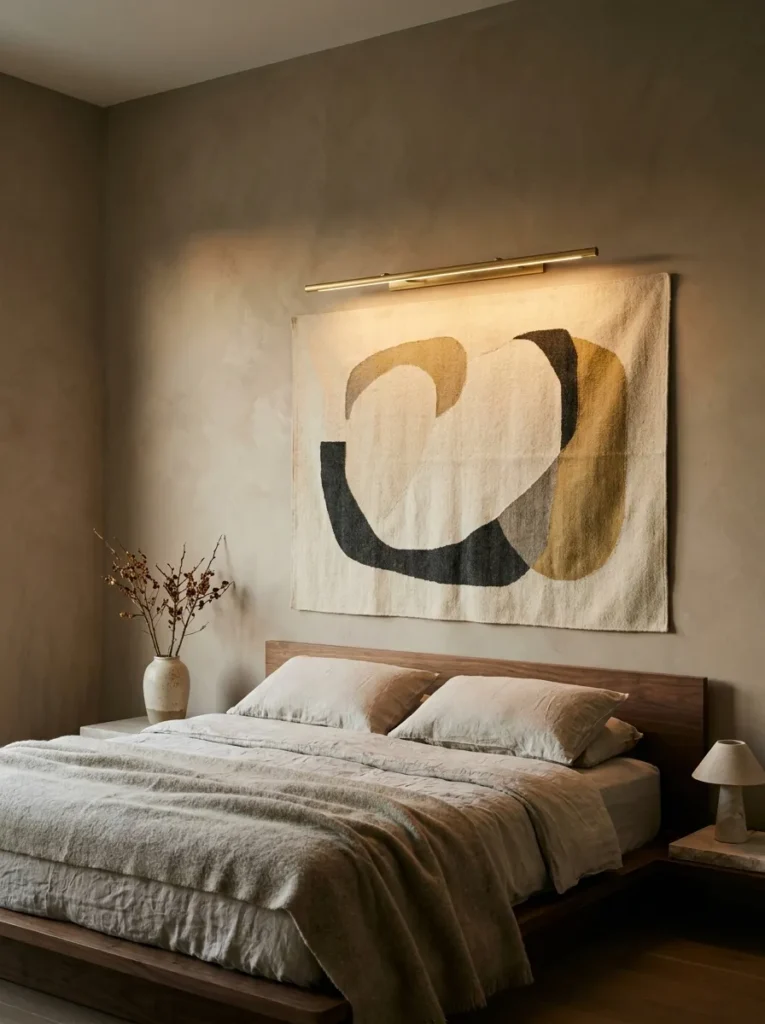
- Fixture type: Slim brass or matte-black picture light mounted above a single large art piece or framed textile
- Placement: Centered above the headboard wall art, roughly 8–10 inches above the frame’s top edge
- Bulb temperature: 2700K, warm and directional, angled slightly downward to wash the artwork without glare
- Outlet solution: Battery-operated picture lights (rechargeable via USB) skip the outlet problem entirely, or a plug-in version routes down the wall in a paintable cord channel to the switched outlet
- Styling context: Pairs with a plaster or Venetian-finish wall, a low platform bed, and warm oak or walnut furniture for a gallery-quiet mood
- Standout detail: Choosing an oversized textile or abstract art piece over a picture light — rather than a small framed print — makes the light read as museum-grade, not decorative afterthought
Why this works: A picture light does something no lamp can: it turns a flat wall into a lit focal point, giving the whole room a sense of curated intention the moment you walk in.
Most bedroom lighting advice treats art and light as two separate decisions, but they’re actually the same decision done well. A picture light angled at roughly 30 degrees washes an artwork evenly without hot spots or glare, the same technique used in gallery installations. That angled wash also bounces soft ambient light back into the room, so a single fixture does double duty as both accent and ambient light. In a bedroom with no ceiling fixture, that dual function matters — it means fewer lamps cluttering nightstand surfaces while still filling the room with warmth.
A picture light is one of the few fixtures that looks genuinely custom-built even when it’s battery-powered and requires zero installation beyond a single wall anchor. I’ve used rechargeable picture lights on client projects specifically because they photograph as “hardwired gallery lighting” while taking about five minutes to hang. Pair it with an oversized abstract textile piece rather than a small framed print — scale is what separates a sophisticated moment from a dorm-room afterthought, and it’s the detail most people skip entirely.
8. Smart Bulb Ambient Layer
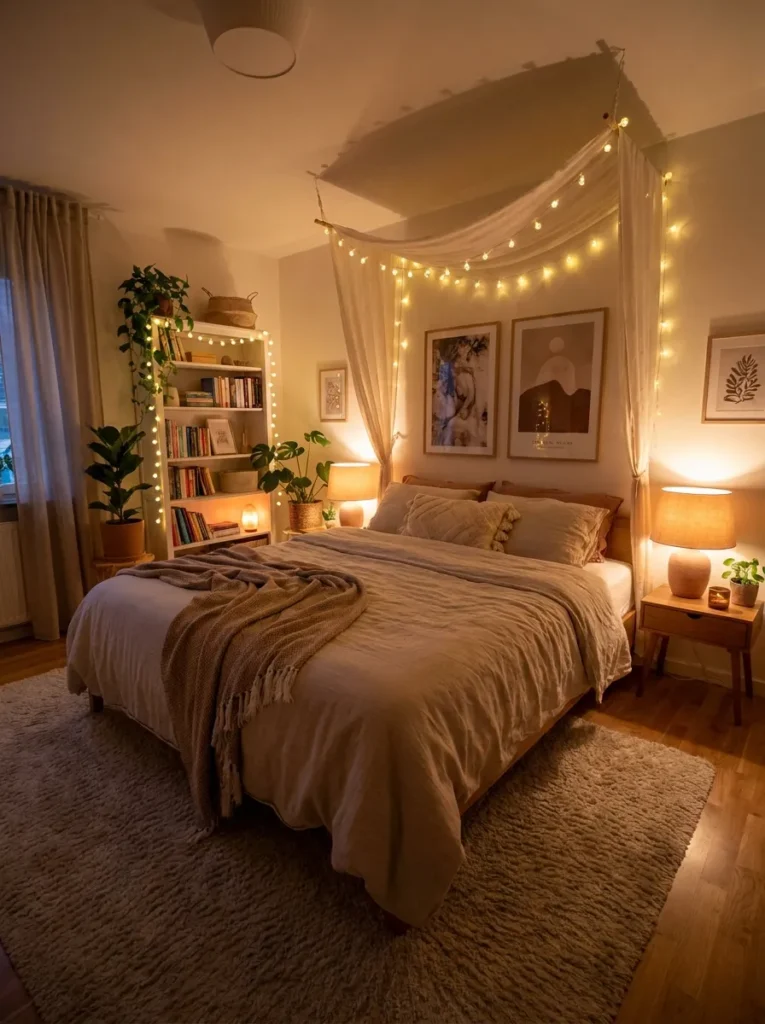
- Fixture type: Two or three smart bulbs distributed across existing lamps, controlled by app or voice rather than the wall switch
- Placement: One in a floor lamp, one in a table lamp, one in a small accent fixture, spread around the room’s perimeter
- Bulb temperature: Tunable white, set to 2700K in the evening and 3000K in the morning to shift with natural circadian rhythm
- Outlet solution: Bulbs screw into any existing fixture; a smart plug on the switched outlet lets the wall switch still act as a manual override
- Styling context: Works in any palette since the bulbs themselves are invisible once installed — pairs naturally with whatever furniture and finishes are already in the room
- Standout detail: Scheduling the bulbs to dim gradually over 20 minutes before bedtime mimics a sunset, a genuine sleep-science-backed detail most decor posts never mention
Why this works: Smart bulbs solve the single-switched-outlet problem at the software level instead of the wiring level, which means zero installation and full control from a phone.
Cooler bulb temperatures above 4000K suppress melatonin production more than warm temperatures do, which is why lighting scientists recommend staying under 3000K in bedrooms after sunset. This is a real, research-backed reason to avoid the cool-white bulbs that ship standard in most fixtures. Smart bulbs solve this two ways: they let you choose warm temperatures permanently, and they let you schedule a gradual dim in the evening that mimics natural sunset light, which several sleep studies associate with easier wind-down. It’s a detail almost no decor-focused lighting post actually explains, even though it’s the single biggest functional upgrade on this list.
My husband installs smart switches on renovation jobs specifically because they don’t require any rewiring — they replace the existing switch plate and communicate directly with the bulbs, meaning the switched outlet you already have becomes fully programmable. For renters who can’t touch wiring at all, smart plugs do the same job at the outlet level instead of the switch level. Either way, the wall switch keeps working exactly as it always has, just with far more control behind it.
9. Under-Bed LED Glow
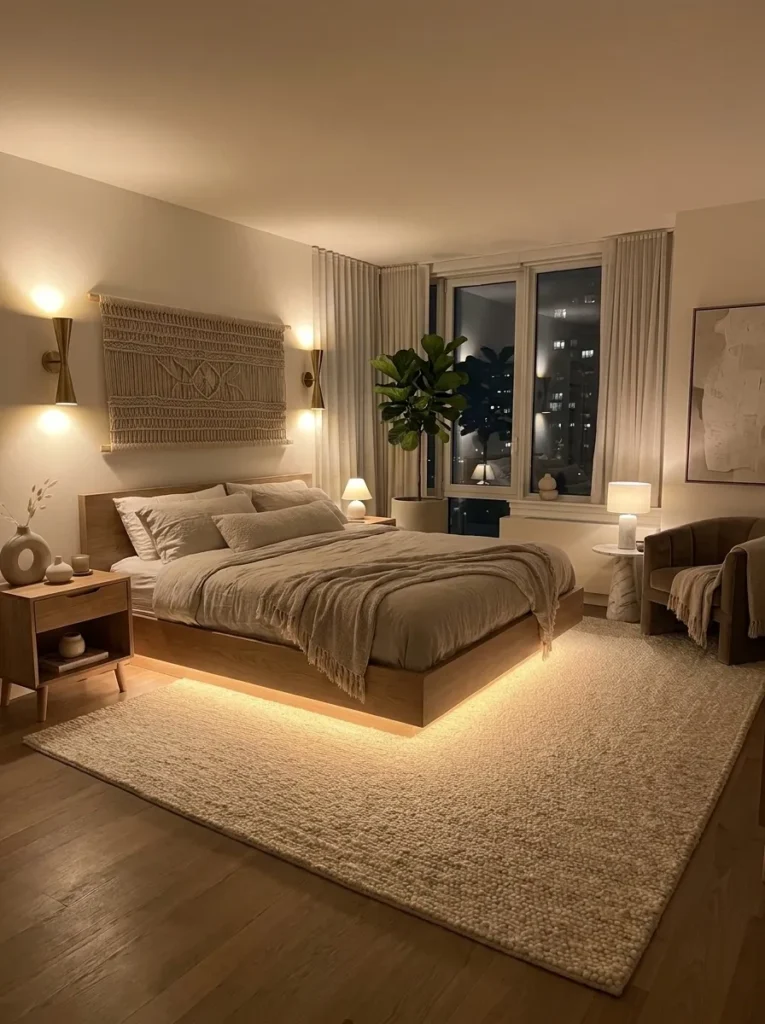
- Fixture type: Warm-white LED strip lighting mounted along the underside of a platform bed frame
- Placement: Adhered to the frame’s inner edge, angled to cast light downward and outward onto the floor, not upward into the room
- Bulb temperature: 2700K strictly — cooler strips read as under-cabinet kitchen lighting, not bedroom ambiance
- Outlet solution: Battery-pack or USB-powered strips avoid cords entirely; plug-in versions route behind the bed frame to the switched outlet
- Styling context: Pairs specifically with a low platform bed frame in walnut or white oak, and works beautifully against a textured bouclé rug
- Standout detail: A floating platform bed with a visible gap beneath the frame turns this from a novelty into genuine architectural lighting
Why this works: Under-bed lighting does something ambient lamps can’t — it makes a heavy platform bed frame visually float, changing how the entire room reads at night.
This idea only works with the right bed frame, and that’s the detail most posts skip. A platform bed with at least a four-inch gap between the frame and the floor is what makes under-bed lighting look architectural rather than gimmicky — anything lower and the glow just looks like a spill rather than an intentional wash. Warm 2700K strips angled downward create a soft halo along the floor that makes a heavy wood frame appear to hover, an effect borrowed directly from hotel and boutique hospitality lighting design, where “floating” furniture is used deliberately to make rooms feel larger and more elevated.
I’ll admit this was the one idea I was skeptical about until I saw it done well in a client’s guest room — a white oak platform frame with a warm LED strip tucked into the underside groove. At night, with the main lamps off, the whole room reads like a boutique hotel rather than a bedroom. It’s genuinely one of the more dramatic, camera-ready lighting moments on this list, and it requires no wiring at all if you choose a rechargeable battery strip instead of a hardwired one.
10. Dimmable Rattan Pendant, Plug-In Style
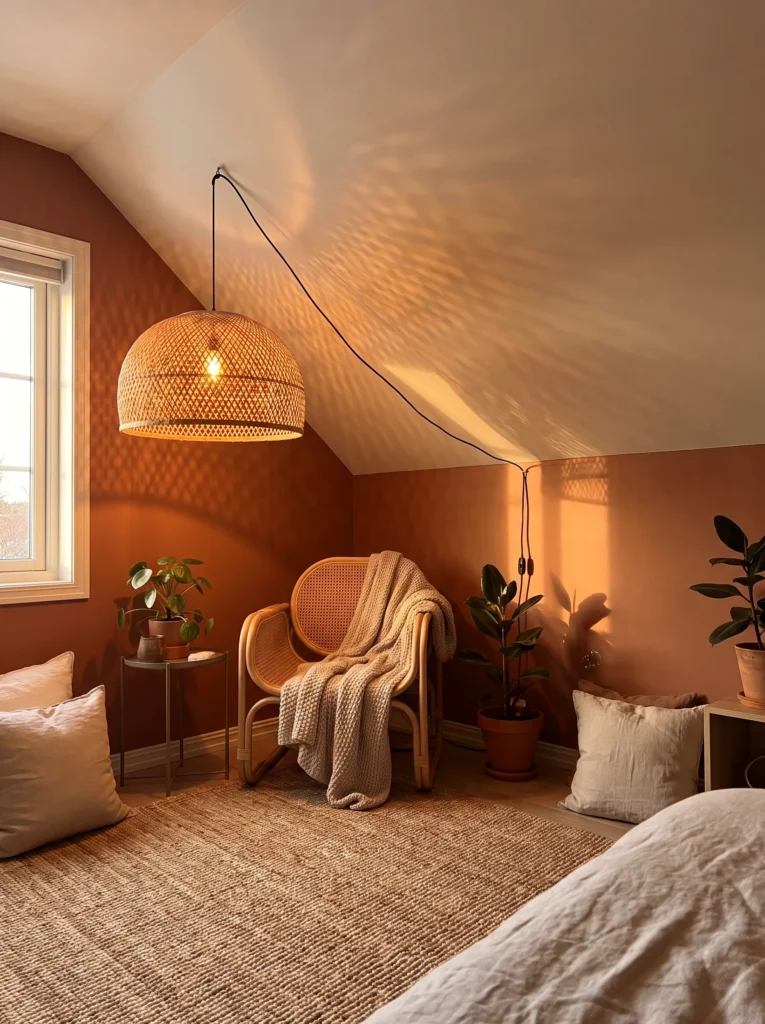
- Fixture type: Woven rattan or cane pendant shade on a plug-in swag cord, paired with an inline dimmer switch
- Placement: Hung slightly off-center over a reading chair or bench, rather than dead-center over the bed
- Bulb temperature: 2700K, filtered through the woven texture for a dappled, sun-through-leaves effect
- Outlet solution: Inline cord dimmer lets you control brightness independently, plugged into the switched outlet
- Styling context: Pairs with rattan or cane furniture accents, a jute rug, and warm terracotta or clay wall tones for an organic-modern feel
- Standout detail: The dappled shadow pattern a woven shade throws on the ceiling and walls is a genuine visual signature no smooth-glass fixture can replicate
Why this works: Woven pendant shades filter light rather than just diffusing it, creating texture and movement on the walls that a plain fixture simply can’t produce.
Light behaves differently depending on what it passes through, and this is a fact worth understanding before buying any shade. A solid fabric shade diffuses light evenly. A woven rattan or cane shade filters it, letting some light pass directly through the gaps in the weave and casting a dappled, organic pattern across the ceiling and nearby walls. That pattern shifts subtly throughout the evening as the bulb warms, giving the room a sense of movement that a static fixture never achieves. It’s a small physics detail, but it’s exactly why rattan pendants photograph so beautifully at golden hour.
An inline dimmer cord is the detail that makes this idea function well day-to-day, not just look good in photos. Without one, a woven pendant is either fully on or fully off, which limits it to a single mood. With a dimmer, the same fixture can go from a bright reading light in the early evening to a soft, barely-there glow right before bed. I’ve swapped a plain glass pendant for a rattan one in more than one client’s reading nook, and the dappled ceiling pattern alone is usually what gets photographed first.
11. Candlelight-Style LED Sconce Pair
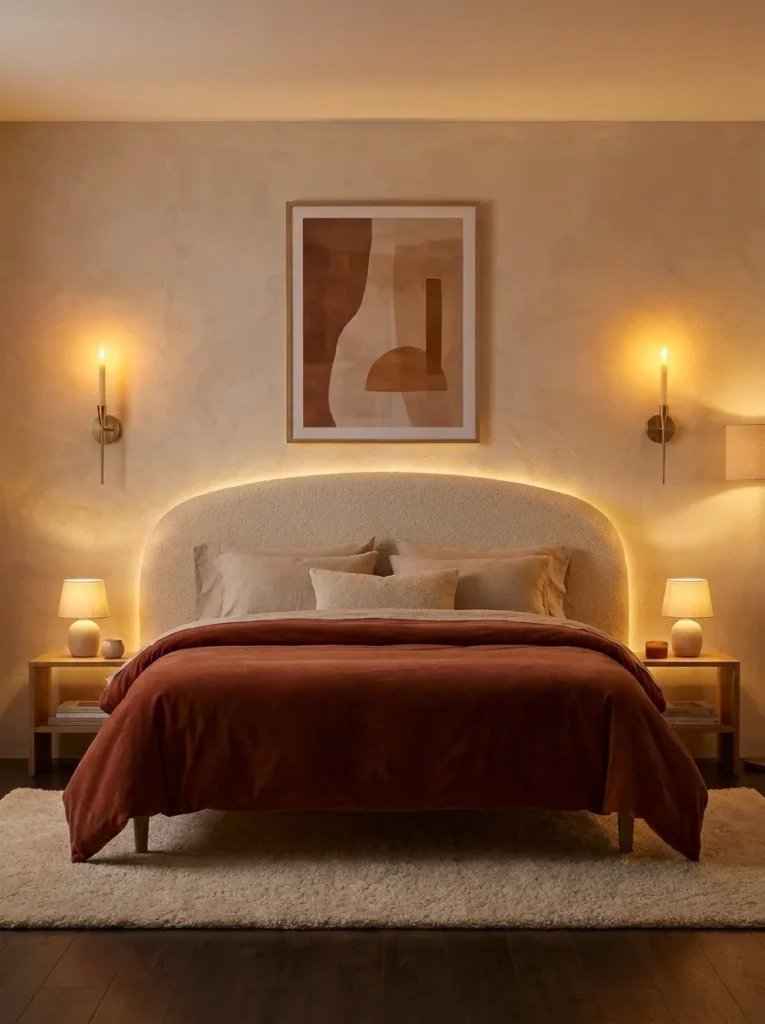
- Fixture type: Flameless LED taper sconces mounted in a fixed candle-style wall bracket, battery or plug-in operated
- Placement: Mounted symmetrically on either side of a curved upholstered headboard, at shoulder height when seated in bed
- Bulb temperature: Warm amber flicker-effect LED, closest to true candlelight around 1800–2200K
- Outlet solution: Battery-operated tapers avoid the outlet question entirely and can be swapped without any electrical work
- Styling context: Pairs with a curved velvet or bouclé headboard, brushed-brass brackets, and a plaster wall finish for an old-world-meets-modern feel
- Standout detail: Genuine flicker-effect LED technology (not a static glow) creates real ambient movement most plug-in fixtures can’t replicate
Why this works: True flicker-effect LEDs mimic the irregular movement of real flame, which is the specific quality that makes candlelight feel more restful than any static bulb.
Light sources that flicker irregularly, the way real flame does, are processed by the eye as more calming than perfectly steady light — which is part of why candlelight has always felt more restful than a lamp. Flameless taper sconces with genuine flicker-effect technology recreate that irregular movement safely, without the fire hazard of an open flame near bedding or curtains. This is a meaningfully different product category than a plain amber bulb; the flicker pattern itself is what does the psychological work, not just the color temperature.
A symmetrical pair mounted at shoulder height on either side of a curved headboard creates a sense of formality and intention that a single bedside lamp doesn’t achieve on its own. Brushed-brass brackets against a plaster wall lean into an old-world warmth without feeling dated, especially paired with a curved velvet or bouclé headboard shape that’s distinctly 2026 rather than the boxier, tufted headboards from a decade ago. Battery-operated versions mean this idea works in any bedroom, regardless of outlet placement, and can be repositioned instantly if the furniture layout changes.
12. Floating Shelf Light Ledge
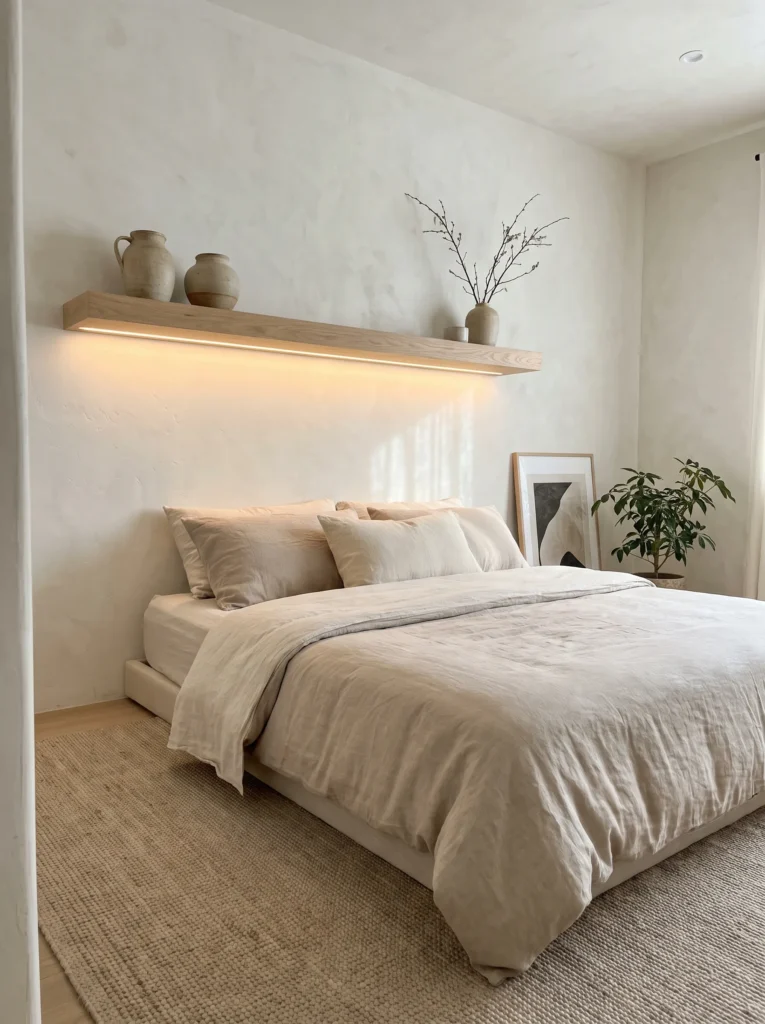
- Fixture type: A floating wood shelf with integrated warm LED strip lighting tucked beneath the front lip
- Placement: Mounted above the headboard or beside the bed in place of a traditional nightstand
- Bulb temperature: 2700K, angled downward and slightly forward to wash the wall without glaring into the eyes
- Outlet solution: Battery-powered LED strip under the shelf lip removes any outlet dependency at all
- Styling context: Pairs with white oak or walnut shelving, a small collection of ceramics or books, and a limewash wall finish
- Standout detail: Combining storage, styling surface, and light source into one floating element is a genuinely space-saving idea for small bedrooms with no room for a nightstand lamp
Why this works: A light ledge solves two problems at once — it replaces a bedside lamp’s function and eliminates the need for nightstand floor space entirely.
Small bedrooms genuinely struggle with this list’s other ideas if there’s no room for a nightstand or floor lamp in the first place, and that’s exactly the gap a floating light ledge fills. Mounting a slim wood shelf at bedside height, with a warm LED strip hidden beneath its front lip, gives you a display surface, a light source, and zero footprint on the floor. The light washes downward and across the wall rather than shining directly into your eyes, which solves the harsh-glare problem that plain under-shelf strips sometimes create when they’re not angled correctly during installation.
My husband has framed out floating shelves on tight-footprint renovation projects specifically because they read as intentional built-ins rather than makeshift furniture, and the same logic applies here for lighting. A battery-powered LED strip means there’s no cord to hide and no outlet dependency at all — just a shelf that quietly does three jobs at once. For a small bedroom with no space for a traditional nightstand, this is often the single highest-impact idea on the entire list.
13. Curved Glass Accent Lamp
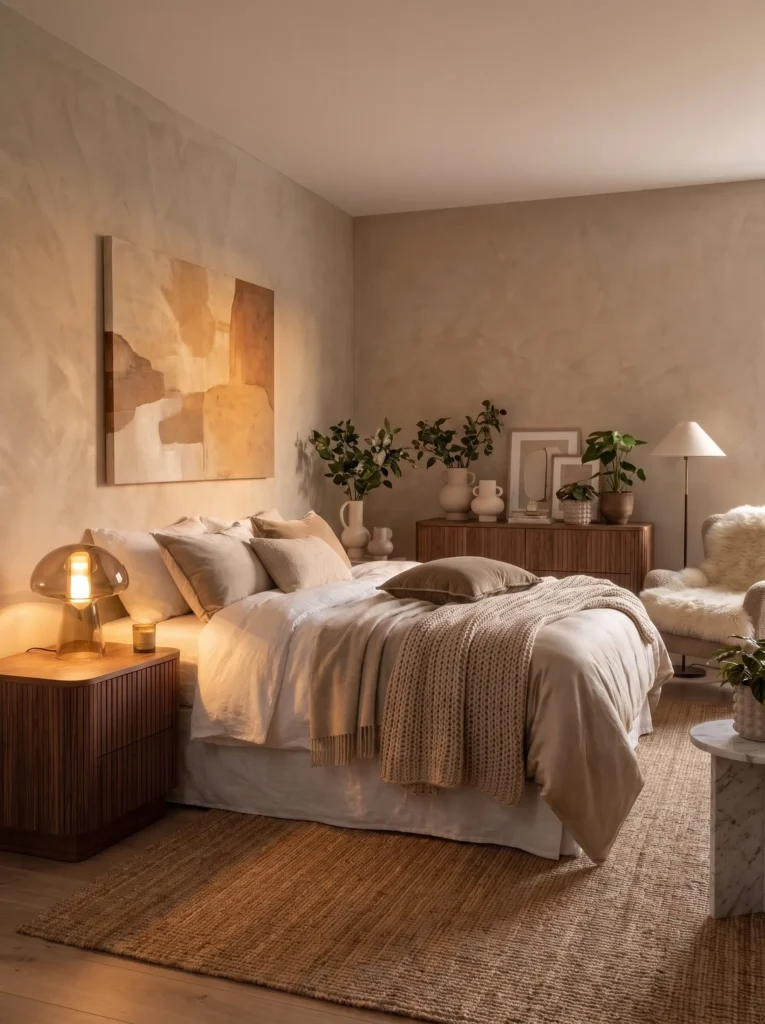
- Fixture type: Mushroom-style or organic curved glass table lamp with an integrated, non-removable shade
- Placement: Single statement piece on a nightstand or low dresser, used as a secondary accent rather than the room’s main light
- Bulb temperature: 2700K, softened further by tinted or frosted glass in amber, smoke, or sage tones
- Outlet solution: Plugs into the switched outlet directly, or runs on a small smart plug for independent on/off control
- Styling context: Pairs with curved, organic-modern furniture — a kidney-shaped bench, a fluted nightstand — and works especially well against a plaster or microcement wall
- Standout detail: Tinted glass (amber or smoke, not clear) tints the light itself, casting a subtly colored glow rather than plain white light
Why this works: A curved glass lamp with tinted, integrated shading does something layered lamps can’t — it colors the light itself, adding depth to a room without adding another object to style around.
Most table lamps separate the base from the shade, but curved glass lamps fuse the two into one sculptural form, and that single detail changes how they read in a room. Instead of looking like “a light with a shade on it,” they read as an object first and a light source second — closer to a piece of art than a fixture. Tinted glass in smoke or amber tones goes a step further: it subtly colors the light itself as it passes through, which is a genuinely different visual effect than a lamp with a fabric shade simply diffusing white light evenly across a room.
I’ve noticed these lamps work best as a solo statement rather than styled in pairs — one curved amber lamp on an otherwise clear surface has more visual weight than two matching ones flanking a bed. Pair it with fluted or curved furniture nearby to echo its shape, and resist the urge to add a second identical lamp on the opposite nightstand. A single sculptural light source, placed with intention, often reads as more considered than a symmetrical pair.
14. Uplighting Floor Torchiere
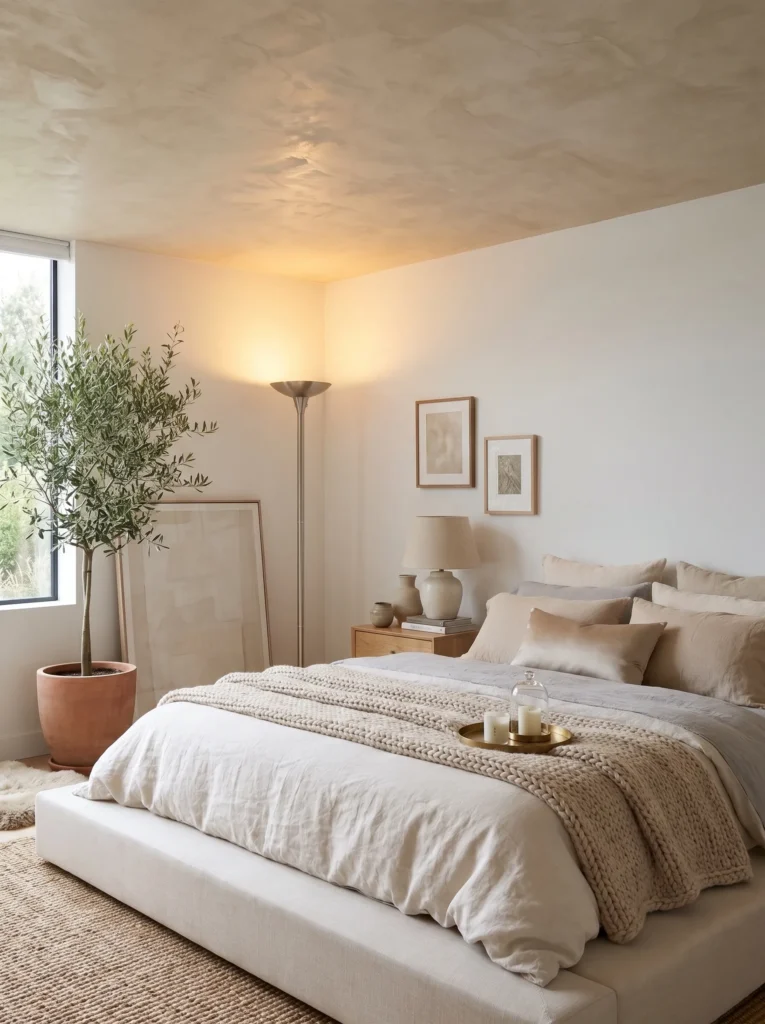
- Fixture type: Slim torchiere-style floor lamp that directs light upward toward the ceiling rather than downward
- Placement: Positioned in a corner near the switched outlet, angled to wash light across the ceiling and upper walls
- Bulb temperature: 3000K, slightly cleaner than downlighting since it’s reflecting off a ceiling surface rather than shining directly
- Outlet solution: Plugs directly into the existing switched outlet, no rewiring or hardware needed
- Styling context: Pairs with a textured plaster ceiling finish, minimalist furniture, and neutral tones that let the light wash read as the main visual feature
- Standout detail: Bouncing light off the ceiling makes a low-ceilinged room feel taller — a genuine spatial trick borrowed from small-apartment lighting design
Why this works: Uplighting uses the ceiling itself as a giant diffuser, spreading soft, even light across the whole room from a single fixture in a way no downward-facing lamp can replicate.
Bouncing light off a light-colored ceiling before it reaches eye level softens shadows and spreads illumination more evenly across a room than any single downward-facing lamp can achieve on its own. This is a core principle in small-space lighting design, and it’s especially useful in bedrooms with low ceilings, where a torchiere floor lamp can make eight-foot ceilings feel noticeably taller simply by drawing the eye upward toward the reflected glow. It’s one fixture doing the ambient work of several, which matters in a bedroom that only has one switched outlet to work with in the first place.
This is a genuinely underused idea in bedroom decor content, probably because it doesn’t photograph as an obvious “lamp” moment the way a table lamp does. But in person, it transforms a room. I placed one in the corner of my own guest room, a slim brushed-nickel torchiere tucked beside a reading chair, and the ceiling’s warm glow does more to make that room feel finished than any single decorative object I’ve added since.
15. Backlit Headboard Panel
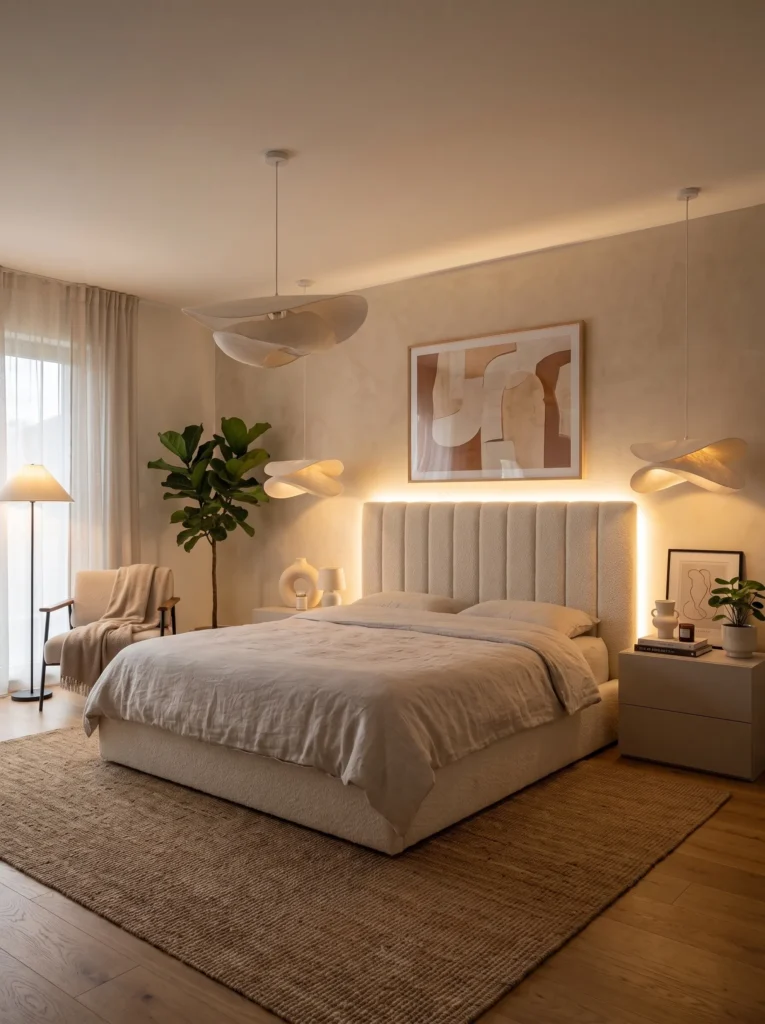
- Fixture type: An upholstered or wood-slat headboard panel with concealed LED strip lighting along its back edge, creating a halo effect against the wall
- Placement: Mounted flush to the wall behind the bed, with the LED strip hidden between the panel and the wall surface
- Bulb temperature: 2700K, barely visible as a direct light source — the effect is a soft glow outlining the headboard’s silhouette
- Outlet solution: Battery-powered strip avoids outlet dependency, or a slim cord routes down behind the headboard to the switched outlet
- Styling context: Pairs with a curved or channel-tufted headboard in bouclé or velvet, set against a plaster or limewash wall for maximum silhouette contrast
- Standout detail: The halo effect only works with a headboard that stands slightly off the wall, so the panel itself becomes architectural rather than purely decorative
Why this works: A backlit headboard turns the bed itself into the room’s primary light source, which is a genuinely different approach than adding lamps around it.
Every idea on this list so far adds a light source somewhere near the bed. This one makes the bed the light source. A concealed LED strip mounted along the back edge of a headboard panel — one that sits an inch or two off the wall rather than flush against it — creates a soft halo of light outlining the headboard’s shape. It’s a subtle effect, not a bright one, and that’s the point: this works as the final layer in a layered lighting scheme, not the main source, adding depth and dimension to the wall behind the bed once the room’s other lights are dimmed.
My husband has built a few custom headboard frames on renovation projects where clients specifically requested this detail, and the trick is always the same: the panel needs a slight standoff from the wall, usually achieved with simple furring strips, for the light to spill outward evenly instead of just glowing at the edges. It’s a more involved idea than the others on this list, but for a primary bedroom meant to feel like a genuine architectural statement, it’s worth the extra step.
Lighting Ideas for Our Color-Story Bedrooms
16. Cherry Red Bedroom — Sculptural Picture Light
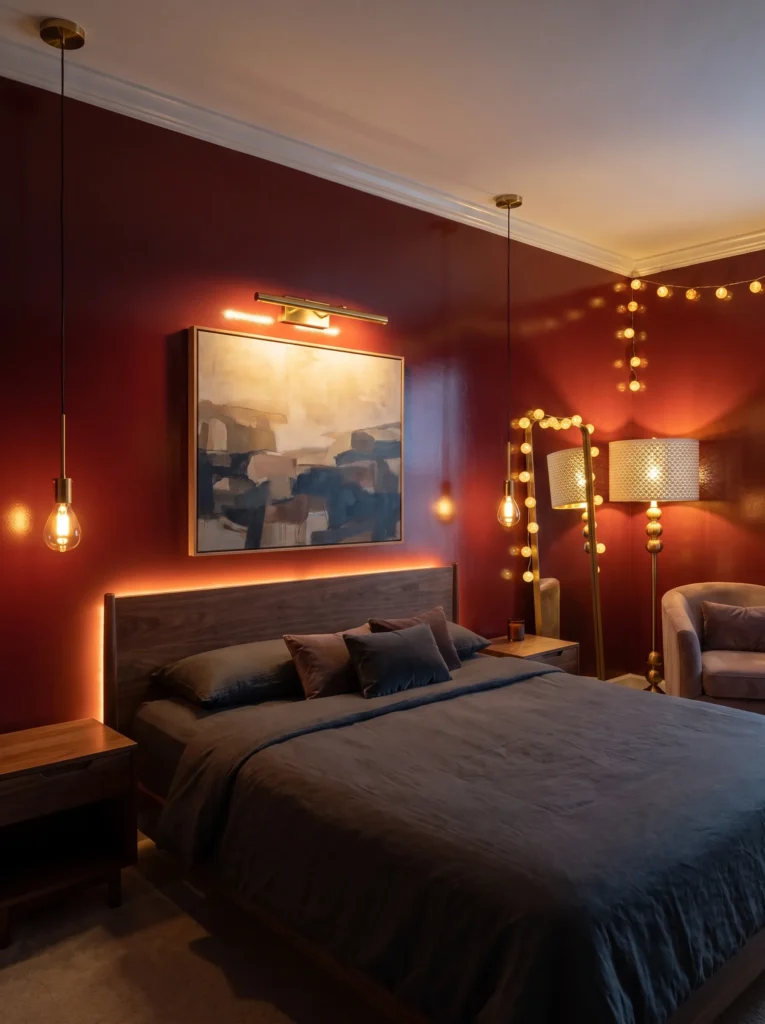
- Fixture type: Slim brass picture light above a bold abstract art piece
- Placement: Centered above the headboard wall, angled to wash warm light down the deep red backdrop
- Bulb temperature: 2700K, amber-warm to keep the red from reading harsh or overly saturated at night
- Outlet solution: Battery-powered version skips cords entirely
- Styling context: Pairs with lacquered cherry-red walls, brass hardware, and a walnut headboard
- Standout detail: The warm wash softens the red’s intensity after dark, so the room feels rich rather than loud
Why this works: Directional picture lighting is what keeps a saturated cherry-red wall feeling elegant instead of overwhelming once the sun goes down.
Deep, saturated colors like cherry red behave differently under artificial light than they do in daylight — cooler bulbs can make red walls feel almost neon, while warm 2700K light mutes that intensity into something closer to oxblood or garnet. A single picture light angled at 30 degrees gives the wall a soft glow without flooding the whole room, which matters in a bold color story where too much brightness competes with the palette instead of complementing it. This is the detail most bold-color bedroom guides skip entirely.
I’ve noticed clients who commit to a strong red often get nervous once the paint’s on the wall and the room feels more intense than the swatch promised. Warm, angled lighting solves that anxiety almost instantly — the same red that felt loud under a bare bulb reads as sophisticated and enveloping once it’s lit correctly. Pair the picture light with brass fixtures throughout the room, since warm metals hold up beautifully against red in low, golden light.
17. Jewel Tone Bedroom — Grouped Vintage Lamp Collection
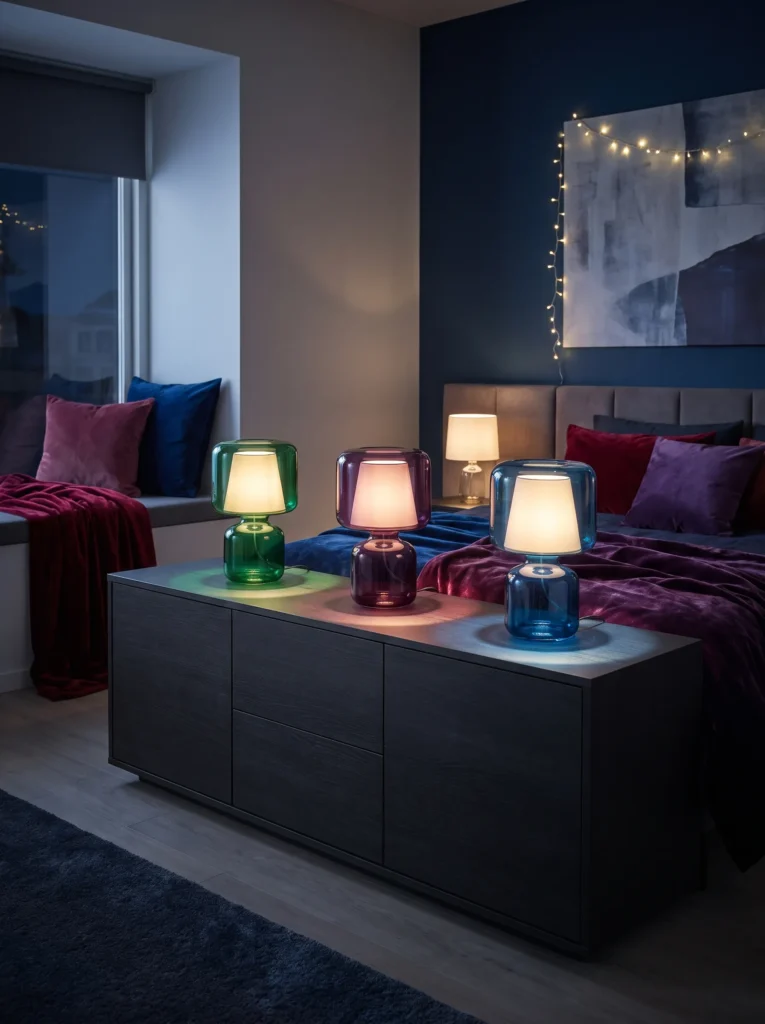
- Fixture type: Three mismatched lamps — emerald glass base, amethyst ceramic base, sapphire-blue fluted base — grouped on a credenza
- Placement: Clustered at varying heights along one wall, away from the bed
- Bulb temperature: 2700K throughout, consistent across all three
- Outlet solution: Single smart power strip on the switched outlet, controlling all three together
- Styling context: Pairs with mixed jewel-toned velvet textiles, brass accents, and a deep charcoal or emerald wall
- Standout detail: Colored glass bases catch and scatter warm light in small colored pools across the surface below
Why this works: Jewel-toned lamp bases don’t just provide light — they extend the room’s color story into the light source itself, something a plain white lamp never achieves.
A jewel-tone bedroom already commits to richness through fabric and paint, so the lighting should lean into that same density rather than retreating to neutral white shades. Colored glass lamp bases — emerald, amethyst, sapphire — catch warm bulb light and cast faint tinted pools onto the surface beneath them, adding a layer of color that fabric and paint alone can’t replicate. Grouping three different jewel tones together, rather than matching them, mirrors the eclectic-but-intentional feel that makes jewel-tone rooms work in the first place.
I’ve styled jewel-tone bedrooms where the biggest missed opportunity was always the lighting — beautiful velvet and rich wall color, then a plain glass lamp that added nothing to the palette. Swapping in colored glass bases is a small, inexpensive change that makes the whole room feel considered down to the last detail. Keep the bulb temperature consistent across all three lamps so the jewel tones read as intentional variation, not mismatched leftovers.
18. Emerald Green Bedroom — Dimmable Rattan Pendant
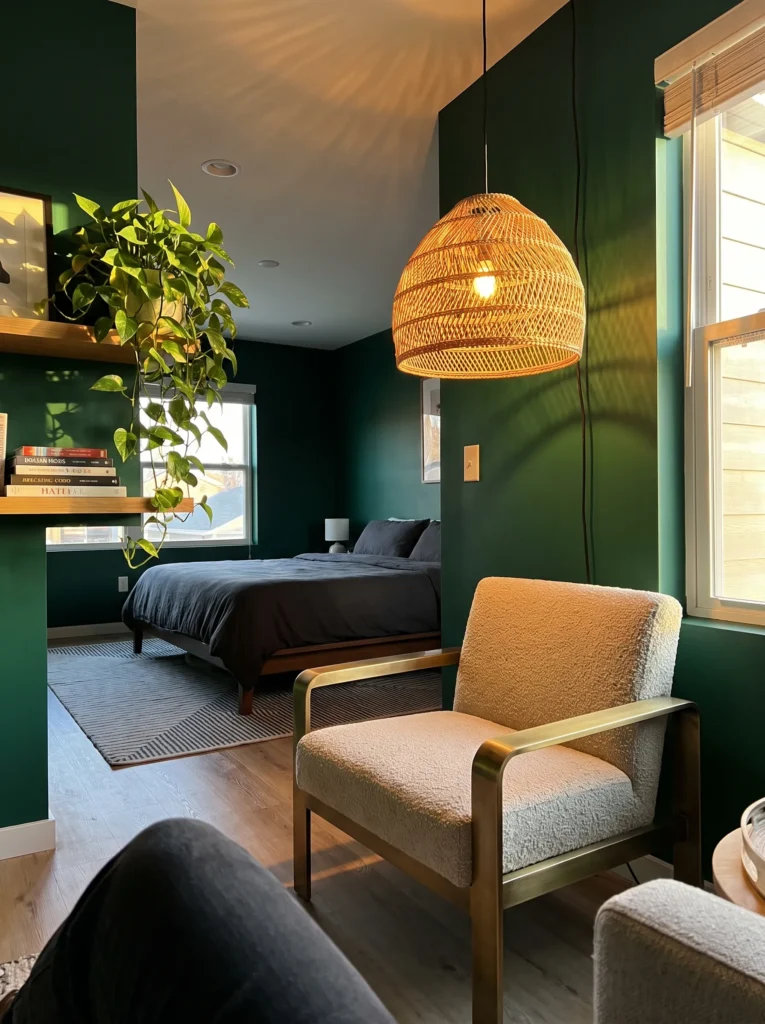
- Fixture type: Woven rattan pendant on a plug-in swag cord with inline dimmer
- Placement: Hung slightly off-center over a reading chair in the corner
- Bulb temperature: 2700K, filtered through the weave for a dappled, botanical feel
- Outlet solution: Inline dimmer cord routes to the switched outlet
- Styling context: Pairs with deep emerald walls, brass accents, and abundant trailing plants
- Standout detail: The dappled shadow pattern echoes leaf-dappled light, reinforcing the botanical mood emerald rooms lean into
Why this works: A woven shade filters light the way tree canopy filters sunlight, which is exactly the organic, garden-adjacent mood an emerald bedroom is already reaching for.
Emerald green is one of the few paint colors directly borrowed from the natural world, and the lighting in a room like this should reinforce that connection rather than fight it with something sleek and industrial. A rattan pendant does this literally — light passing through a woven shade creates the same dappled, irregular pattern you’d see under a tree canopy, which deepens the botanical feeling the color is already establishing. It’s a detail I come back to often, since my background is in plant science before it was ever in decor, and light quality genuinely changes how “alive” a green room feels.
Pair the pendant with real trailing plants nearby — pothos or a philodendron cascading from a high shelf — and the dappled light pattern starts to blend visually with actual leaf shadows once the plants fill in. That layering between real foliage and filtered light is what makes an emerald bedroom feel genuinely immersive rather than just a paint color choice.
19. Dark Blue & Gold Bedroom — Backlit Headboard Panel
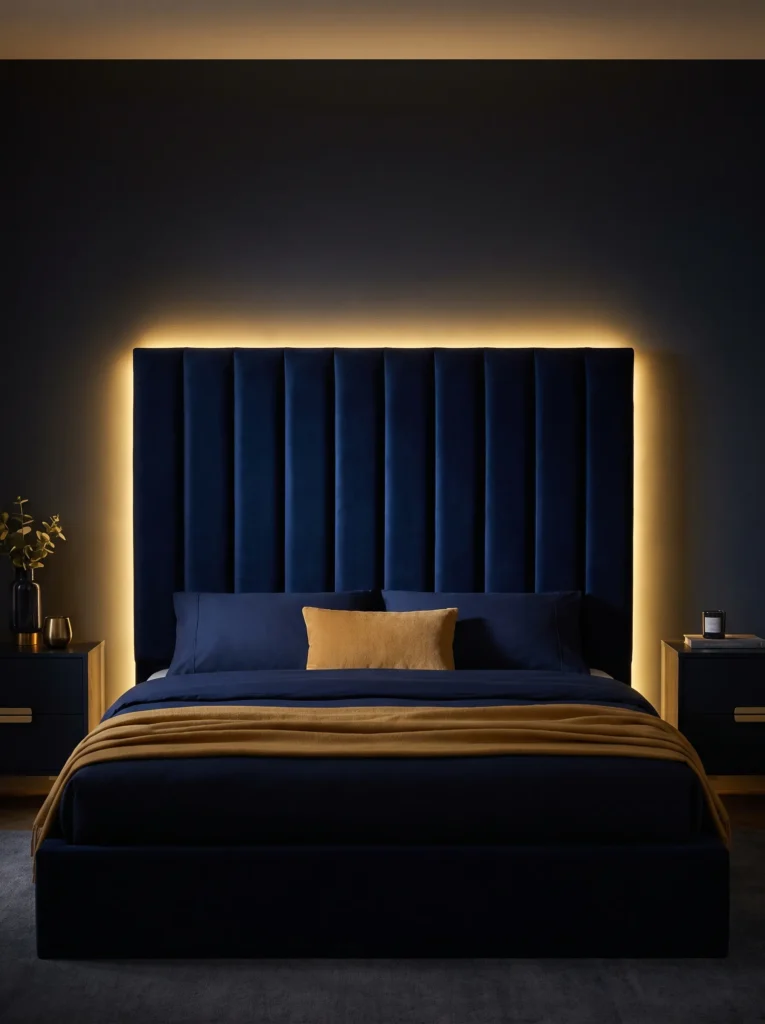
- Fixture type: Channel-tufted navy velvet headboard panel with concealed gold-toned LED strip along the back edge
- Placement: Mounted with a slight standoff from a deep navy or midnight-blue wall
- Bulb temperature: 2700K, creating a warm gold halo against the cool navy backdrop
- Outlet solution: Battery-powered strip avoids outlet dependency entirely
- Styling context: Pairs with brushed-gold hardware, navy velvet bedding, and a lacquered navy nightstand
- Standout detail: The warm gold glow against the cool navy creates genuine color contrast, echoing the room’s core palette in the light itself
Why this works: Warm light against a cool, dark wall creates a visible temperature contrast that makes a navy-and-gold color story feel dimensional even after the sun goes down.
Dark blue walls absorb a lot of ambient light, which is part of why moody bedrooms can feel flat without the right lighting plan. A warm gold halo glowing along the edge of a headboard panel solves that directly — the contrast between the cool navy backdrop and the warm amber light mirrors the room’s gold accents, so the lighting itself becomes part of the metallic color story instead of a separate element layered on top. Warm light against a cool dark wall reads as richer and more dimensional than the same wall lit with cool-white light, which is worth remembering in any moody, dark-painted room.
My husband framed a headboard exactly this way on a recent project — a half-inch standoff from the wall, gold LED strip tucked behind — and the effect at night is dramatic without being loud. It’s a detail that photographs beautifully but also just makes the room genuinely nicer to be in after dark, which is ultimately the whole point.
20. Lavender Bedroom — Curved Glass Accent Lamp
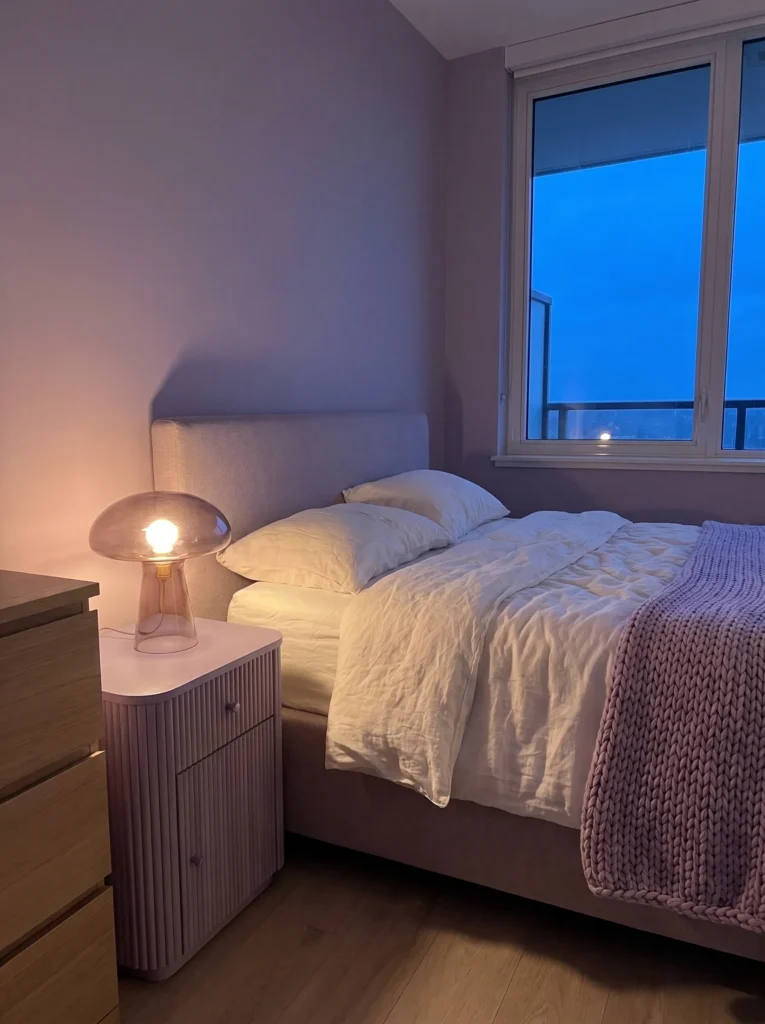
- Fixture type: Mushroom-style curved glass lamp with a soft lilac or smoke-tinted shade
- Placement: Single statement piece on a nightstand, used as accent rather than main light
- Bulb temperature: 2700K, filtered through tinted glass for a hazy, soft-focus glow
- Outlet solution: Plugs into the switched outlet or runs on a small smart plug
- Styling context: Pairs with dusty lavender walls, fluted white oak furniture, and brushed-nickel hardware
- Standout detail: Lilac-tinted glass tints the light itself just slightly, deepening the room’s palette without adding another purple object to style around
Why this works: A softly tinted glass lamp extends a lavender color story into the light itself, which reads as more considered than simply adding another lavender throw pillow.
Lavender is a notoriously tricky color to light well — under a cool white bulb it can drift gray and lifeless, but under warm 2700K light filtered through tinted glass, it holds its dusty, romantic quality after dark. A curved lilac-glass lamp does double duty here: it provides warm ambient light while subtly reinforcing the wall color, so the whole room feels cohesive rather than like paint and lighting were chosen separately. This is a detail lavender rooms specifically need, more than almost any other color story on this list.
I’ve found that softer, more muted colors like lavender actually benefit from restraint in lighting — one well-chosen tinted lamp does more than several mismatched fixtures competing for attention. Keep the rest of the room’s lighting warm and simple, let this one sculptural piece carry the color story, and resist the urge to add multiple purple-toned accents elsewhere in the room.
21. Sage Green Bedroom — Statement Floor Lamp
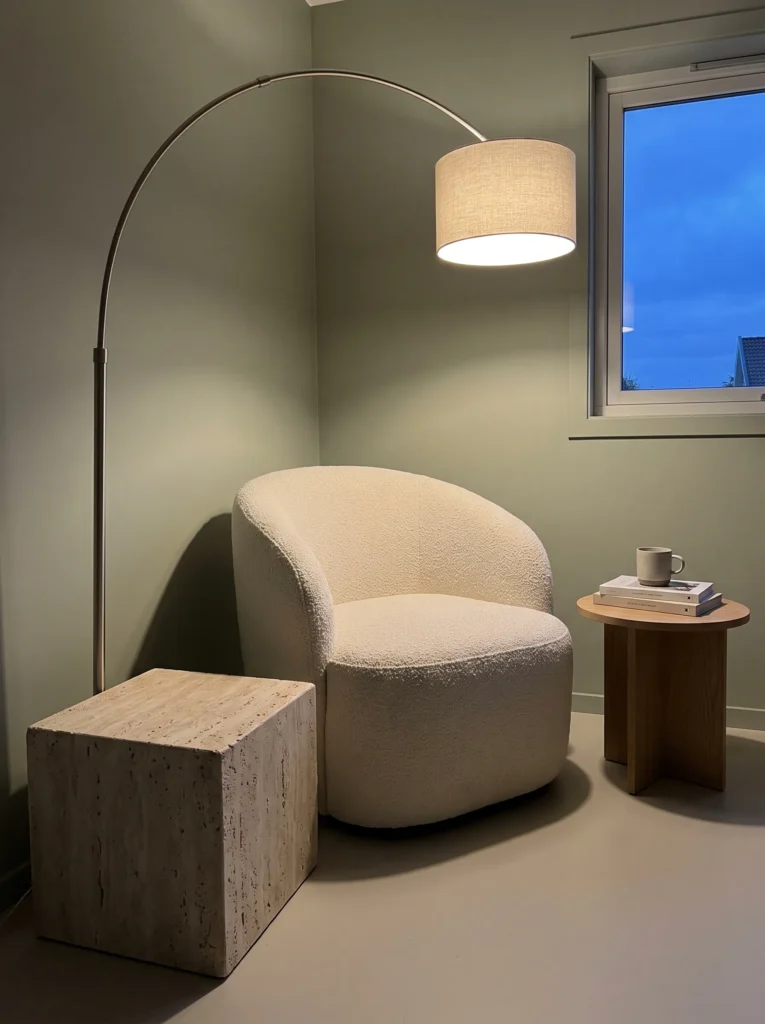
- Fixture type: Oversized arc floor lamp with a natural linen shade and a travertine base
- Placement: Positioned in a reading corner near the switched outlet
- Bulb temperature: 2700K–3000K, warm and even
- Outlet solution: Plugs directly into the switched outlet
- Styling context: Pairs with sage-green walls, a bouclé accent chair, and natural wood tones
- Standout detail: A travertine base echoes the room’s earthy, organic material story instead of defaulting to black metal
Why this works: Choosing a natural-stone lamp base over the more common black metal one keeps a sage green room feeling organic and grounded rather than sleek and cold.
Sage green rooms lean on natural, earthy materials — linen, wood, stone — and the lighting should follow that same material logic rather than introducing something sharp or industrial. A travertine-based arc lamp does exactly that: the stone’s warm, veined texture echoes the same organic quality sage green pulls from nature, while the linen shade diffuses light in a soft, even wash rather than a hard-edged glow. It’s a small substitution, but material consistency is often what separates a room that feels curated from one that feels assembled piece by piece.
That’s why many designers recommend choosing a lamp’s material before its color — a travertine or unfinished-wood base will almost always feel more at home in a sage green room than a glossy black one, even if the black lamp is technically “on trend.” Keep the shade a natural linen or raw cotton tone rather than pure white, since a slightly warmer shade color holds up better against the green undertones on the wall.
22. Small Black Luxury Bedroom — Candlelight-Style LED Sconce Pair
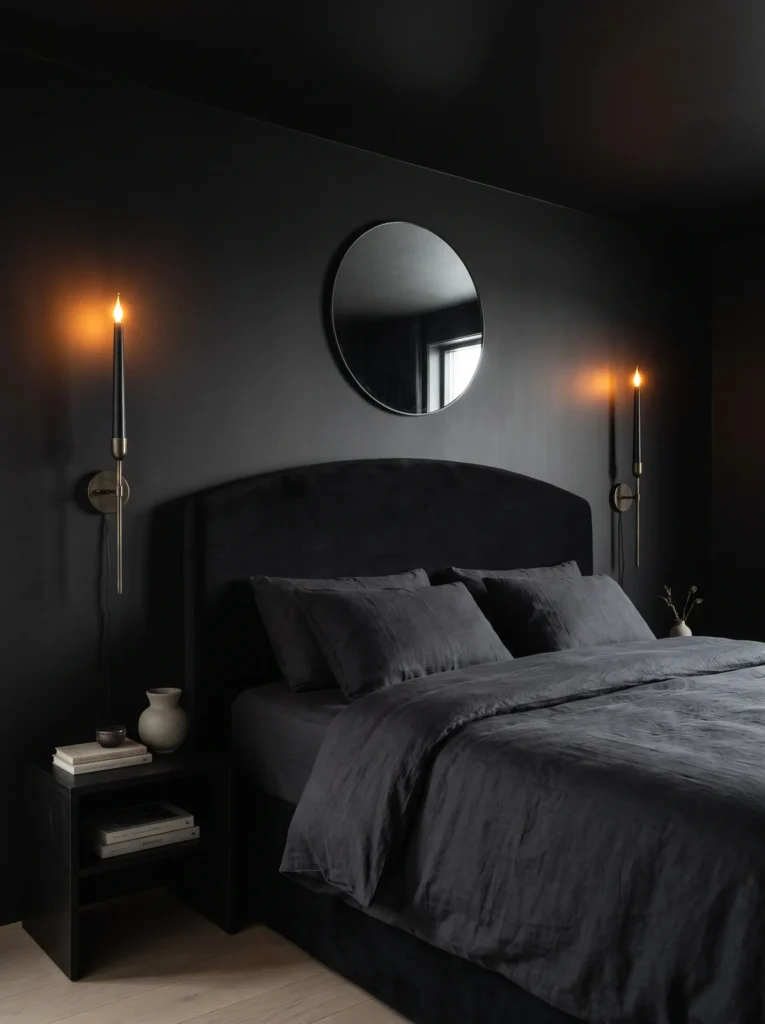
- Fixture type: Flameless LED taper sconces in blackened-brass brackets
- Placement: Mounted symmetrically flanking a curved black velvet headboard
- Bulb temperature: Warm amber flicker-effect LED, around 1800–2200K
- Outlet solution: Battery-operated, no outlet dependency at all
- Styling context: Pairs with matte black walls, blackened-brass hardware, and deep charcoal velvet bedding
- Standout detail: In a small dark room, the flickering warm light does the work a window normally would, adding movement and life to a space with limited natural light
Why this works: A flickering, warm light source is especially important in a small black room, where the dark walls already absorb most ambient brightness and static lighting can feel flat.
Small rooms painted in deep black or charcoal tones face a specific lighting challenge: the walls absorb far more light than a pale room would, which means a flat, static bulb can leave the space feeling dim rather than moody in the intended way. Genuine flicker-effect candlelight sconces solve this by adding movement to the light itself, which reads as warmth and life even in a compact, dark-walled room. In a small dark bedroom, light that moves does more visual work than light that’s simply brighter.
I’ve styled a few of these compact black-luxury bedrooms, and the sconces are consistently the detail that makes the biggest difference between a room that feels cave-like and one that feels genuinely luxurious. Blackened-brass brackets disappear into the dark wall during the day, then the warm flicker takes over at night, giving the whole room a sense of quiet drama without needing any additional square footage to pull it off.
Styling Principles: Layered Lighting for Bedrooms Without Overhead Light
The secret to a bedroom that feels genuinely bright without a ceiling fixture isn’t more lamps — it’s layered lighting done with intention. Every well-lit room combines three types of light: ambient (the overall fill, from floor lamps, torchieres, or grouped table lamps), task (focused light for reading or getting dressed, like an articulating sconce or backlit mirror), and accent (the mood layer — string lights, under-bed strips, a backlit headboard). A room with only ambient light feels flat. A room with only accent light feels dim and moody but impractical. Combining all three, even with just two or three fixtures total, is what makes a space feel finished.
Bulb temperature matters just as much as fixture choice. Stay between 2700K and 3000K for nearly every bedroom fixture — anything cooler starts to feel closer to office or retail lighting than a restful bedroom. And if the room only has one switched outlet, remember that a smart plug or smart bulb turns that single switch into a full lighting control system, without touching a single wire.
Frequently Asked Questions
How do I light a bedroom with no overhead light? Layer two to three plug-in fixtures — a floor lamp, a wall sconce, and an accent light like a backlit mirror or string lights — connected through the room’s existing switched outlet, ideally with a smart plug so one switch controls them all together.
What’s the best bulb temperature for a bedroom? Warm white, between 2700K and 3000K, is the standard recommendation, since cooler temperatures above 4000K read as clinical and can interfere with the body’s natural wind-down before sleep.
Can I add a smart switch without rewiring the room? Yes — smart switches typically replace an existing switch plate and communicate wirelessly with smart bulbs, requiring no new wiring, while smart plugs offer the same control at the outlet level for renters who can’t modify switches at all.
What’s the most budget-friendly bedroom lighting idea without overhead light? A single smart bulb in an existing lamp, paired with a warm-white LED strip under a shelf or bed frame, delivers a layered lighting effect for well under $50 total.
Is it worth adding a ceiling fixture if I own the home? It depends on your electrical panel and existing wiring — if there’s already a switched outlet in the room, adding a ceiling box typically means running new wire back to the switch, which is a job worth having an electrician quote rather than a weekend DIY project.
Do plug-in wall sconces look as good as hardwired ones? With a paintable cord cover routing the cord flush to the wall, plug-in sconces are visually nearly indistinguishable from hardwired versions once installed.
Conclusion
A bedroom without overhead light isn’t a limitation — it’s an invitation to build something warmer, layered, and far more personal than a single bulb ever could. Whether you start with one plug-in sconce, a smart bulb, or a backlit headboard, these bedroom lighting ideas without overhead light prove that real ambiance comes from intention, not from what’s wired into the ceiling.
I’ve seen how much one well-placed lamp can change how a whole room feels at night. Save this post to Pinterest, try one idea this weekend, and pass it along to anyone still living under a single harsh bulb wondering why their bedroom never quite feels finished.