5 Boho Coastal Bedroom Ideas That Feel Breezy, Not Beach-Kitsch
Picture waking up to soft light, pale linen, and a room that feels like a deep breath. That’s the promise of these boho coastal bedroom ideas, and it’s easier to reach than you think. The trouble is that most beach-inspired bedrooms either feel like a souvenir shop or collapse into a pile of mismatched textures. I’ve styled enough rooms, and lived with enough of my own mistakes, to know the difference comes down to restraint. Between my plant science background and a husband who builds homes, I know what holds up in real bedrooms, from sunlight to humidity
. Below, you’ll find 15 complete rooms with exact wall finishes, bedding, plants, curtains, and lighting, so you can recreate every detail. Save the ones you love, and start with just one.
Why Boho and Coastal Blend So Naturally
Boho and coastal look like opposites, but they blend naturally because both are built from natural, weathered, handmade materials. Linen, rattan, jute, and sun-faded wood belong to each style, so the blend works when boho’s layered texture meets coastal’s lighter palette and room to breathe. It fails when both pile on pattern and props. I learned this in my own Austin guest room, where a woven wall piece, three baskets, and a seagrass rug fought each other until I removed half of them and the room finally exhaled. A boho coastal bedroom feels calm when texture does the talking and color stays quiet. This post solves that balance, with fifteen full rooms you can recreate piece by piece.
Arched Plaster Alcove
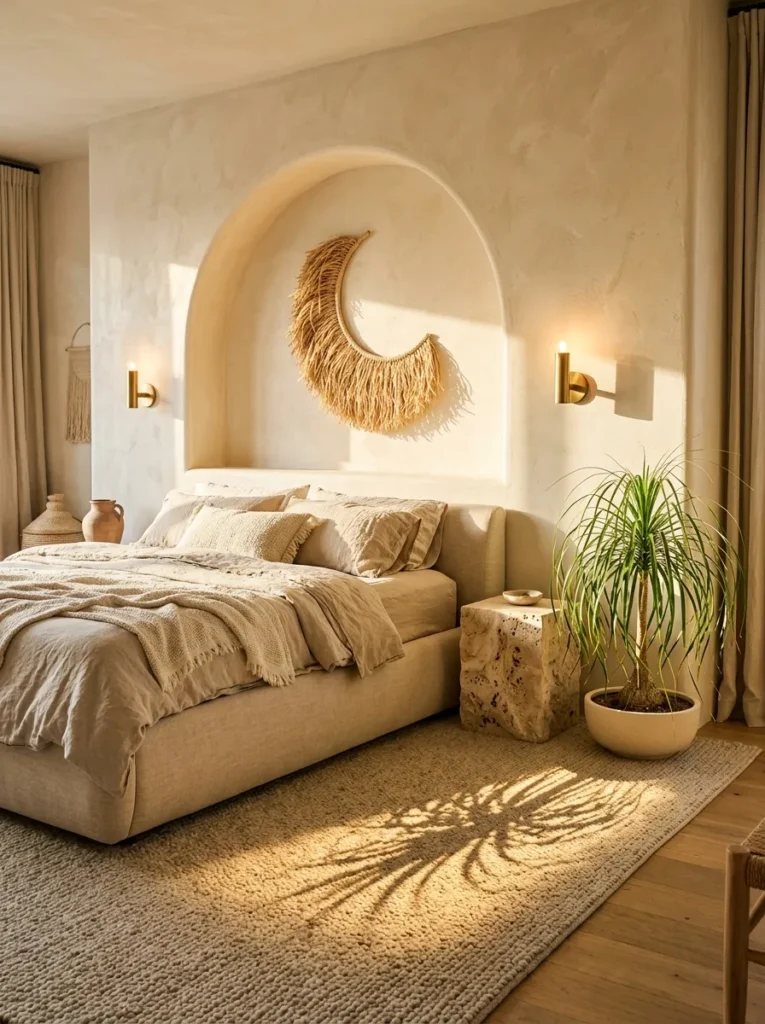
- Walls: Smooth lime plaster in pale sand, with a rounded arched niche behind the bed painted one shade deeper
- Bedding: Washed oatmeal linen duvet, ivory cotton waffle-weave blanket, bone gauze throw
- Frame and hardware: Low bed with a curved headboard, upholstered in oatmeal washed linen; round honed travertine side table; unlacquered brass sconce arms
- Wall decor: Hand-woven raffia crescent, about 30 inches wide, set inside the niche
- Plants: Ponytail palm (Beaucarnea recurvata), bright light to full sun, drought tolerant, in a cream matte ceramic bowl
- Rug: Hand-loomed wool in bleached oat, low pile
- Curtains: Floor-to-ceiling cotton-linen sheers, lightweight, on a ceiling track, filtering light like frosted glass
- Hanging and lighting: Dome pendant in paper and rattan (2700K), brass swing-arm sconces (2700K), plus window light
Why this works: Repeating one soft curve in the niche, headboard, and side table makes a layered room feel unified, calm, and unmistakably modern.
Curves calm a room before you consciously notice them. Environmental psychology research suggests people tend to prefer rounded forms over sharp angles, which is why an arched plaster niche feels instantly restful. Here it frames the bed like a soft shadow, painted one shade deeper than the pale sand walls. The low upholstered headboard repeats that rounded edge in oatmeal linen, and a honed travertine side table echoes it again at nightstand height. Nothing is ornate, yet every line flows into the next. That repetition of one gentle shape is what makes a modern room feel designed rather than decorated.
The texture comes from materials, not clutter. Washed oatmeal linen layers under an ivory waffle-weave blanket, while a crescent of hand-woven raffia sits inside the niche as the room’s only wall piece. A ponytail palm in a cream ceramic bowl brings sculptural height; it stores water in its swollen base, so it forgives forgotten waterings. Unlacquered brass sconces will age to a soft honey tone, which suits the sand palette beautifully. Floor-to-ceiling cotton-linen sheers on a ceiling track blur the daylight like frosted glass. It’s quiet luxury, boho in texture and coastal in light.
Driftwood Gray Cyanotype
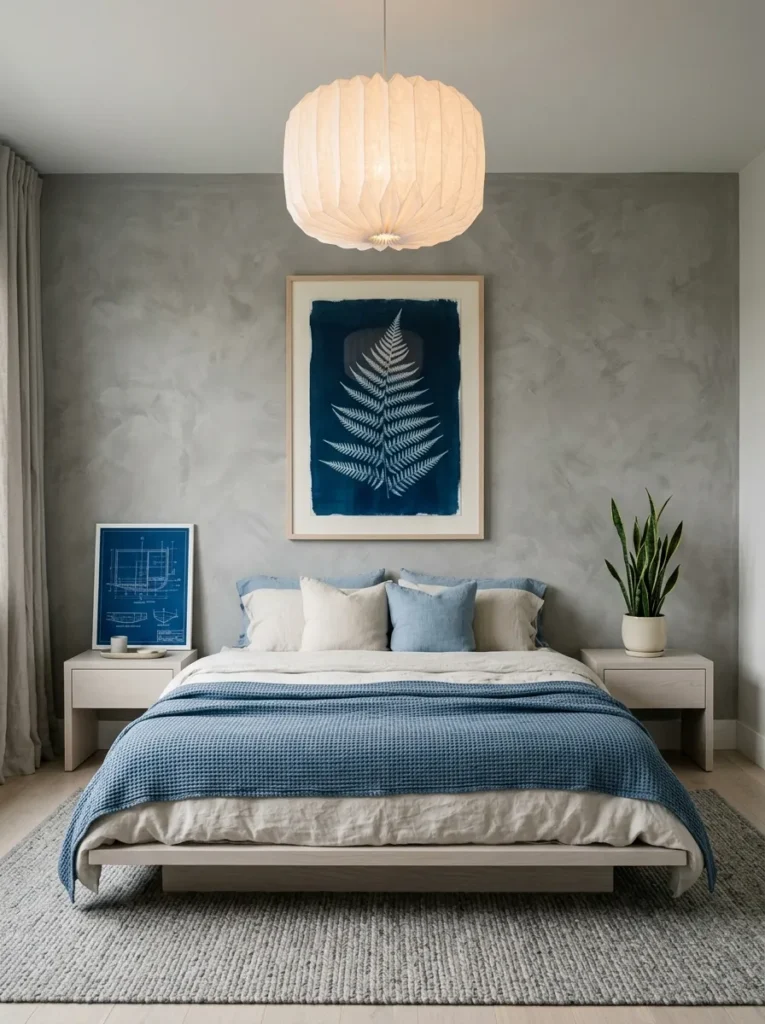
- Walls: Matte limewash in soft driftwood gray, gently mottled
- Bedding: Stonewashed bone-white cotton percale, washed-blue cotton waffle blanket, ivory linen pillows
- Frame and hardware: Low platform bed in pale ash wood, floating ash nightstands, brushed-nickel pulls
- Wall decor: Oversized framed cyanotype of fern fronds in washed blue, about 30×40 inches, thin pale oak frame
- Plants: African spear (Sansevieria cylindrica), low to bright light, matte bone stoneware pot
- Rug: Flatweave wool in pale gray-oat with a tonal diamond weave, 8×10
- Curtains: Bone-white linen, medium weight, hung at ceiling height to soften direct sun
- Hanging and lighting: Oversized pleated washi-paper pendant (2700K), speckled white ceramic table lamps with linen shades (2700K)
Why this works: A muted driftwood-gray base lets a single washed-blue artwork become the focal point, so the room feels curated, not decorated.
I used to think gray rooms felt cold, until I tried driftwood gray limewash. Its mottled, weathered surface behaves like sun-bleached wood, so the walls feel warm even in shade. I softened them with bone-white percale and a low platform bed in pale ash, which keeps the room light instead of heavy. The washed-blue cyanotype of fern fronds is the only strong color, and it carries enormous weight because everything around it stays muted. Reduce the palette, and one piece starts to feel like gallery art. I’ve noticed guests pause in front of it, which rarely happens in busier rooms.
A gentle word about humidity. In coastal or Gulf-adjacent climates, indoor moisture is what turns a beautiful linen room musty. My husband, who builds homes, recommends keeping indoor relative humidity between 30 and 50 percent, because mold becomes a risk above 60. A small bedroom dehumidifier, a bathroom exhaust fan that vents outdoors, and a cracked window on dry days handle most of it. Then enjoy the pleasures: linen curtains hung high, a speckled white lamp glowing at 2700K, and a spear-shaped Sansevieria in bone stoneware, which tolerates both dim corners and bright sun.
Image description: Overcast morning light on matte driftwood-gray limewash, shot straight on at eye level, perfectly symmetrical. Low pale ash platform bed, bone percale, washed-blue waffle blanket, oversized framed fern cyanotype above, Sansevieria in a bone pot, pleated washi pendant glowing warm, gray-oat rug, the blue print popping crisply against gray walls.
Halo Ring Canopy
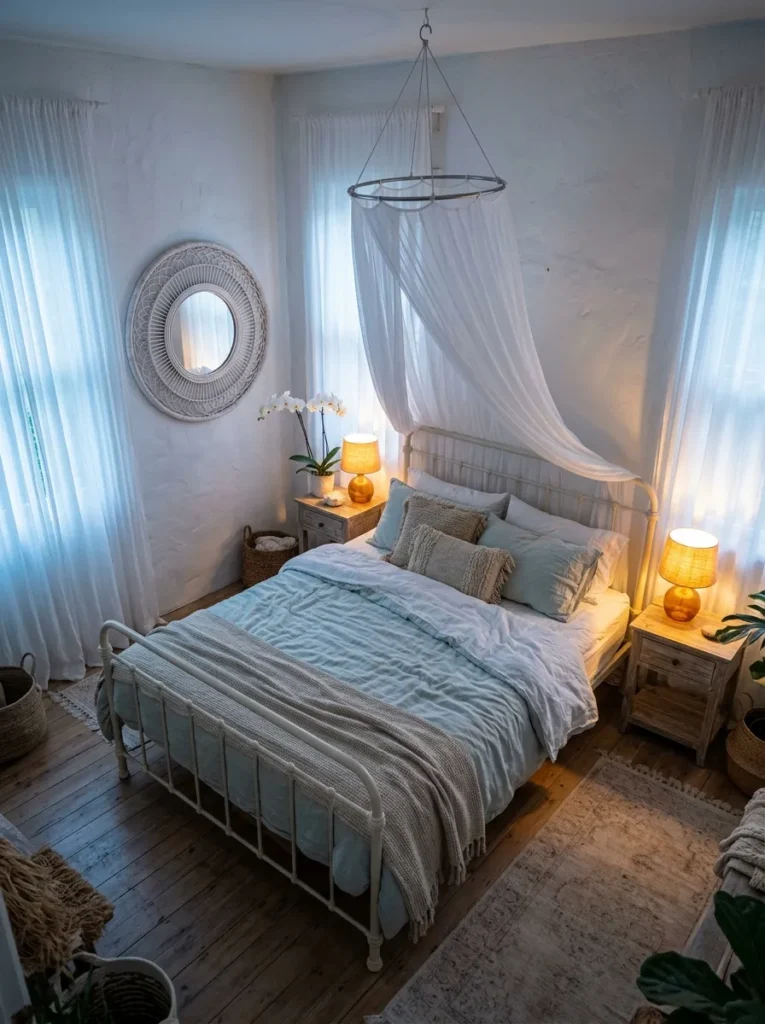
- Walls: Whitewashed lime plaster, warm white with a faint seafoam undertone
- Bedding: Stonewashed linen duvet in pale seafoam, white cotton gauze coverlet, bone quilted cotton folded at the foot
- Frame and hardware: Slim iron platform bed in matte bone powder coat; 48-inch hoop in pewter-finish steel
- Wall decor: Round mirror in a whitewashed rattan frame, about 30 inches
- Plants: Moth orchid (Phalaenopsis), bright indirect light from an east window, white glazed ceramic cachepot with bark mix
- Rug: Oval hand-braided cotton in ivory with a sea-glass edge band
- Curtains: White cotton voile, ultra-light, ceiling to floor, veiling the sun
- Hanging and lighting: Ring draped in white voile, opal-glass globe pendant (2700K) inside the ring, ceramic bedside lamps with linen shades and amber bulbs (2200K)
Why this works: A suspended ring adds height and softness above the bed without enclosing it, keeping the room light, sculptural, and modern.
A hanging ring does what a heavy four-poster can’t: it adds height without enclosing the bed. A 48-inch hoop in pewter-finish steel, softly draped in white voile, makes a circular focal point that feels sculptural and modern. In my last guest-room refresh, I noticed how it pulled the eye straight to the center and made the low iron bed feel intentional. Surround it with whitewashed plaster, pale seafoam linen, and sea-glass accents, and the whole room reads fresh and layered instead of busy. It’s the most photogenic corner of the room, and the installation is simpler than it looks.
Safety comes first with anything suspended over a bed. My husband’s rule is to fasten a ring like this into ceiling joists with a screw hook rated well above the load, never into drywall alone, because fabric, steel, and gravity add up fast. Locate the joist with a stud finder, then hang the ring from two points for balance. Beneath it, a moth orchid in a white ceramic pot adds one elegant bloom spike, and an ivory braided rug with a sea-glass edge grounds the floor. Use amber 2200K bulbs in the lamps and the voile glows like candlelit linen.
Blush Sand Rattan Arch
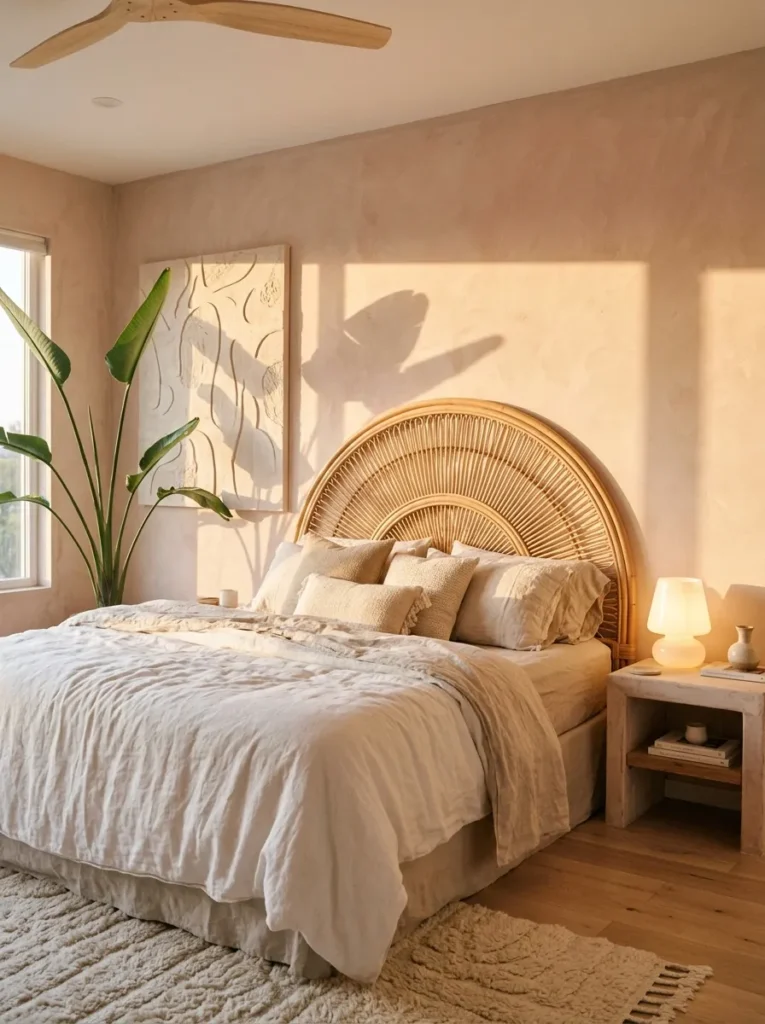
- Walls: Smooth lime plaster in blush sand, a pale peach-tinted neutral, satin-matte
- Bedding: Ivory washed linen duvet, cream cotton gauze coverlet, one blush-sand linen bolster
- Frame and hardware: Oversized arched rattan headboard on a low bleached-rattan frame, brushed-brass fan pull
- Wall decor: One hand-troweled white plaster relief panel, about 30×40 inches, hung beside the window
- Plants: Bird of paradise (Strelitzia nicolai), 4+ hours of bright light, fluted matte ivory ceramic pot
- Rug: Hand-knotted wool in warm ivory with a faint blush stripe, 9×12
- Curtains: Ivory washed linen, medium weight, floor to ceiling, turning low sun into a blush glow
- Hanging and lighting: Slim ceiling fan with pale oak blades on a fan-rated box, opal-glass table lamps (2700K), linen-shaded floor lamp (2700K)
Why this works: Keeping the palette within three softly related tones lets the arched headboard act as the architecture, so the room feels calm and expensive.
Warm light changes color, and blush sand is the proof. Under 2700K bulbs, pale peach-tinted plaster glows like warm sand at dusk, but on gray mornings it reads as a soft, creamy neutral. That shifting quality keeps the room interesting all day. Against it, an oversized arched rattan headboard becomes the architectural moment, its honey weave echoing the plaster’s warmth. Ivory linen, cream gauze, and a single blush bolster keep the bed serene. Because the palette stays within three softly related tones, the room feels expensive and calm, with no patterns competing for attention.
Look up before you style. A ceiling fan hung from a standard light box can loosen over time, which is why my husband insists on a fan-rated box fastened to a joist or brace. Choose a slim fan with pale oak blades, and it disappears into the ceiling while quietly keeping the air moving through layered linen. Anchor the corner with a bird of paradise in a fluted ivory pot; it thrives with at least four hours of bright light. Add a hand-troweled plaster relief panel and opal-glass lamps, and you get texture, glow, and sculpture in one calm composition.
Whitewashed Four-Poster
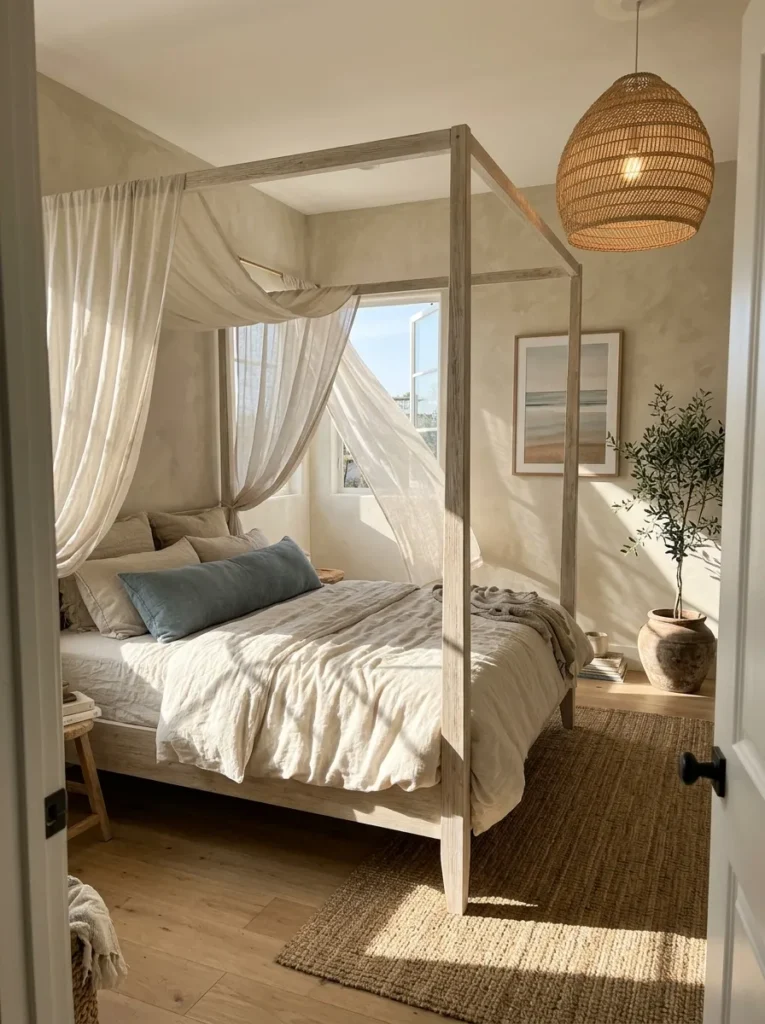
- Walls: Oyster-gray limewash, soft and cloudy
- Bedding: Ivory stonewashed linen duvet, bleached cotton quilt folded at the foot, one washed-blue linen bolster
- Frame and hardware: Whitewashed oak four-poster with slim square posts and no heavy top fabric, satin-nickel hardware
- Wall decor: Large framed abstract print of soft tidal lines in sand and washed blue, about 36×48 inches, whitewashed oak frame
- Plants: Olive tree (Olea europaea), 6+ hours of bright light, honed limestone-look cement planter
- Rug: Flatweave cotton in ivory with a pale oyster border, 8×10
- Curtains: Sheer white linen, lightweight, tied to the posts and hung at the window to veil the light
- Hanging and lighting: Oversized woven seagrass pendant, about 30 inches (2700K), linen-shaded floor lamp (2700K)
Why this works: Slim posts and sheer linen add height and a sculptural frame to the bed without the weight of a traditional canopy.
I used to avoid four-posters, convinced they belonged in a country inn. Then I styled one with whitewashed oak and sheer linen, and the room finally made sense to me. The slim square posts frame the bed like a quiet architectural drawing, adding height without bulk. Skip the heavy fabric on top, let sheer panels fall softly to the floor, and the whole bedroom feels airy and sculpted. I noticed how the oyster-gray limewash made the white oak look luminous, almost sun-bleached. It was a reminder that a classic silhouette, in a lighter palette, can look entirely new.
Texture finishes the picture. A washed-blue linen bolster is the only color note against ivory bedding, while a large framed print of soft tidal lines in sand and blue hangs above like a quiet horizon. An olive tree in a limestone-look planter fills the corner with silvery leaves, and it needs about six hours of bright light to look its best. Overhead, an oversized woven seagrass pendant glows at 2700K, casting a basket-weave shadow on the plaster. Flatweave cotton underfoot keeps everything light. The room feels collected, calm, and slightly cinematic.
Cane Panel Headboard
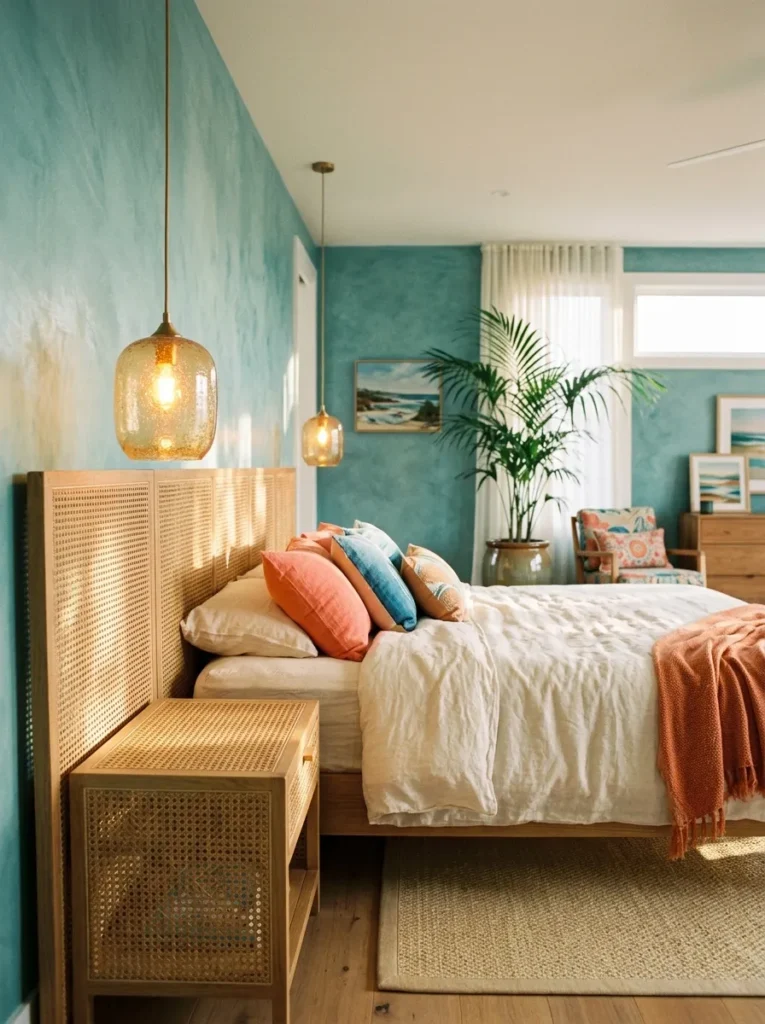
- Walls: Pale sea-glass green limewash, soft and chalky
- Bedding: Warm-white stonewashed linen duvet, quilted ivory cotton coverlet, a pair of sea-glass linen pillows
- Frame and hardware: Wall-mounted headboard of natural cane in a pale oak frame, 60 inches wide, over a low whitewashed oak base; brushed-nickel hardware
- Wall decor: One tall, narrow framed pressed-grass botanical, about 12×40 inches, on the side wall
- Plants: Kentia palm (Howea forsteriana), medium to bright indirect light, glazed sea-glass stoneware pot
- Rug: Bleached sisal in pale straw, 8×10
- Curtains: Washed linen in warm white, lightweight, softening glare into an even glow
- Hanging and lighting: Pair of mouth-blown seeded-glass pendants flanking the bed (2700K, wired by an electrician), slim nickel floor lamp with a linen shade (2700K)
Why this works: A wall-mounted cane panel turns the whole wall into the focal point, so the bed needs no extra decor to feel finished.
A wall-mounted headboard does something a freestanding frame can’t: it turns the whole wall into the statement. Here, a 60-inch panel of natural cane glows against sea-glass limewash, and the low oak base keeps the mattress grounded. My husband’s tip is simple: mount it with a French cleat fastened into studs, not just drywall, so the panel stays flush and secure. I’ve seen this approach look almost custom, even when the panel is store-bought. The honey weave brings warmth, the sea-glass walls bring calm, and together they feel unmistakably fresh and modern.
Light makes this one sing. Two mouth-blown seeded-glass pendants hang on either side of the bed at 2700K, scattering tiny sparkles across the cane, so you don’t need nightstand lamps at all. Warm-white linen and a quilted ivory coverlet keep the bed soft and crisp together. In the corner, a kentia palm in a sea-glass stoneware pot handles medium light with ease, a forgiving choice for bedrooms. A bleached sisal rug and a tall pressed-grass botanical complete the scene. It reads as boho in texture and coastal in tone, but undeniably modern.
Sculpted Plaster Headboard
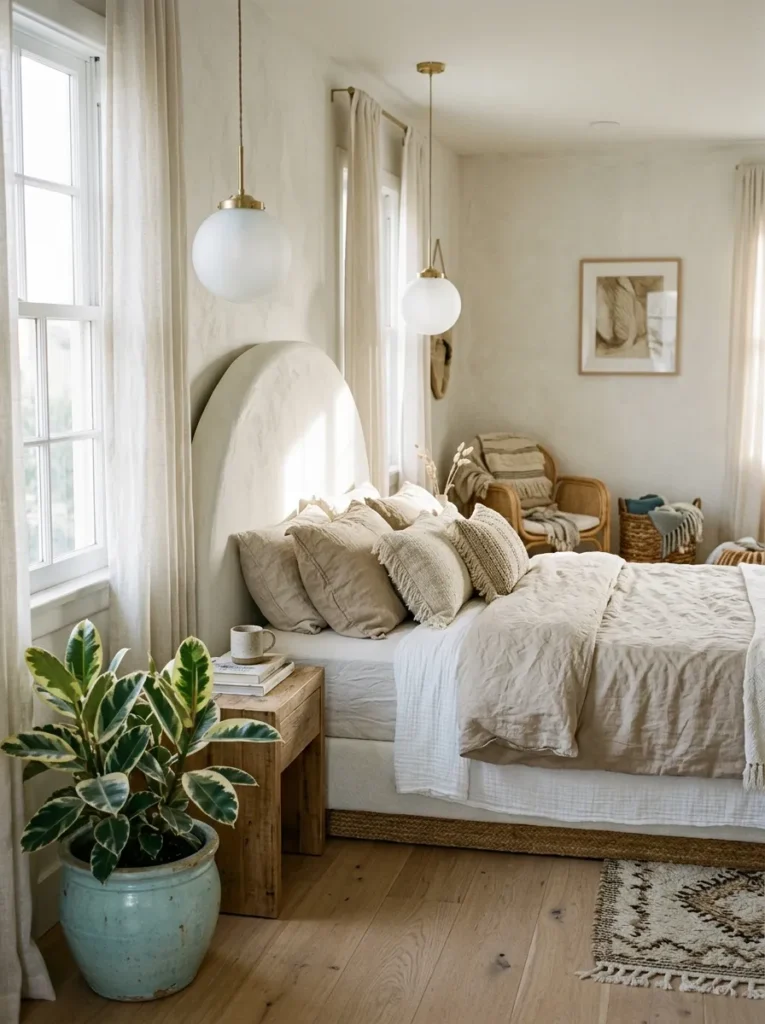
- Walls: Smooth lime plaster in sea-salt white, with a built-in curved headboard sculpted from the same plaster
- Bedding: Oat washed-linen duvet, white cotton gauze coverlet, two chalk-white linen pillows
- Frame and hardware: Low platform wrapped in woven natural jute, no visible hardware so the plaster stays the statement
- Wall decor: Hand-stitched raw linen hanging with sand-colored thread, about 24×36 inches
- Plants: Rubber plant (Ficus elastica ‘Tineke’), bright indirect light, pale aqua-glazed ceramic pot
- Rug: Hand-tufted wool in chalk white with a soft ripple texture, 9×12
- Curtains: Raw oatmeal linen, medium weight, on a wood rod, glowing like paper in the morning
- Hanging and lighting: Cluster of three frosted-glass globe pendants at staggered heights (2700K, wired by an electrician), linen drum bedside lamps (2700K)
Why this works: A headboard sculpted from the same plaster as the wall disappears into the room, adding soft form and shadow without adding objects.
I fell for sculpted headboards while watching a plasterer work in a friend’s house, smoothing a gentle curve with nothing but a trowel and patience. The effect was instant: the wall seemed to wrap around the bed like a soft cocoon. Skip the pointed edges, keep the plaster the same sea-salt white as the room, and the headboard disappears into the architecture. At night, washed by lamplight, it glows like carved sand. That tone-on-tone trick is what makes this feel so modern. No frame, no fuss, only form, texture, and shadow.
Contrast comes from natural materials. A low jute-wrapped base grounds the bed, oat linen layers over white gauze, and a hand-stitched linen hanging adds a quiet line of sand-colored thread. A rubber plant in a pale aqua-glazed pot brings glossy cream-and-green leaves, thriving in bright, indirect light. Three frosted-glass globes hang at different heights, each at 2700K, glowing like soft moons. The room is simple, but nothing is accidental: every material is natural, nearly every shade stays within the sand and white family, and the gently curved plaster ties it together.
Haint Blue Ceiling
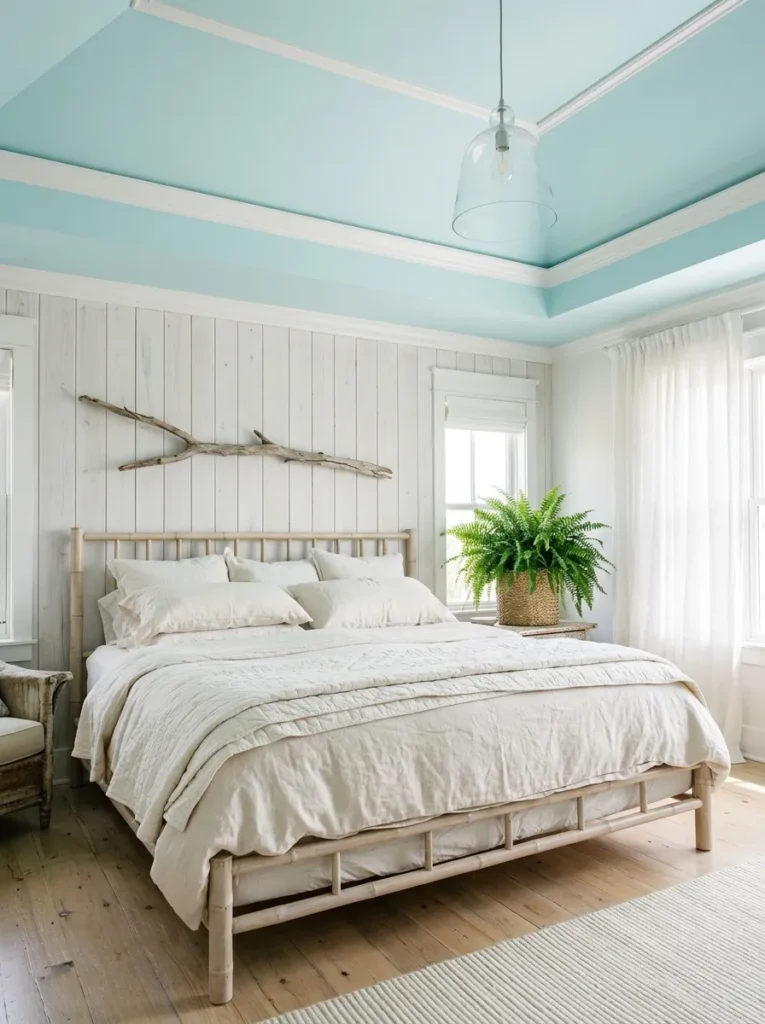
- Walls: Whitewashed vertical tongue-and-groove paneling in soft white, with the ceiling painted pale aqua-blue
- Bedding: Ivory washed-linen duvet, white cotton matelassé coverlet, one haint-blue linen bolster
- Frame and hardware: Bleached bamboo bed with a tall headboard of slender horizontal poles, solid brass hardware
- Wall decor: One long driftwood branch, about 48 inches, mounted horizontally above the headboard
- Plants: Boston fern (Nephrolepis exaltata), bright indirect light and humidity, in a seagrass basket with a waterproof liner
- Rug: Round hand-loomed cotton in ivory with a ribbed texture, 8 feet across
- Curtains: Lightweight white cotton-linen, hung just below the ceiling line so the blue stays visible
- Hanging and lighting: Clear glass bell pendant (2700K), bamboo-base bedside lamps with linen shades (2700K)
Why this works: A pale blue ceiling reads like open sky, adding color and height while the walls and bedding stay light.
Look up. In the American Southeast, porch ceilings have been painted a pale aqua-blue called haint blue for generations, a tradition rooted in Gullah Geechee culture. Indoors, the same color becomes a quiet design trick: a blue ceiling reads like open sky, making the room feel taller and brighter in daylight. Pair it with whitewashed vertical paneling and a bleached bamboo bed, and the ceiling becomes the only color moment. It is subtle, modern, and easy to live with, proof that the most striking boho coastal bedroom ideas often start overhead rather than on the walls.
Keep the rest weightless. Slender horizontal bamboo poles form the headboard, ivory linen and white matelassé keep the bed crisp, and a lone driftwood branch hangs above like a pencil line. A Boston fern in a seagrass basket loves the humidity, though it wants bright, indirect light and a steady drink. Hang the curtains just below the ceiling edge so the blue stays visible, and choose a clear glass bell pendant at 2700K, which lets the color shine instead of hiding it. Waking up to this ceiling feels like looking at a pale morning sky.
You’ll Also Love:15 Boho Maximalist Bedroom Ideas for Fearless Pattern and Color Lovers
Lilac Fog Spindle Bed
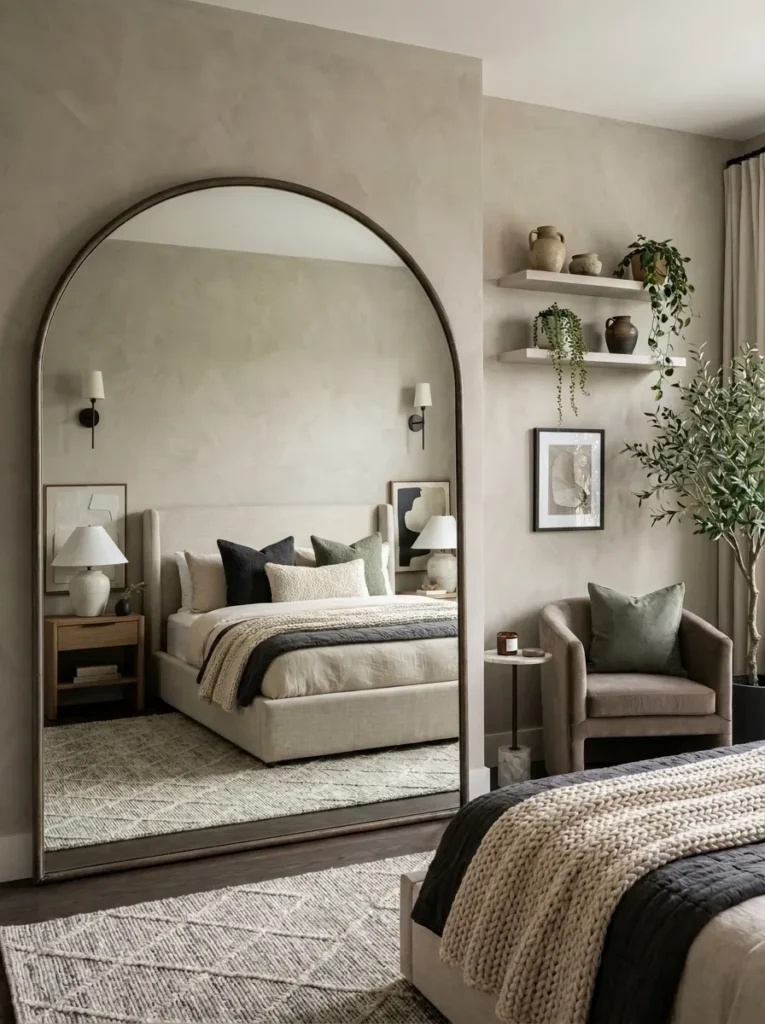
- Walls: Soft lilac-gray limewash, like sea fog at dusk, matte
- Bedding: Silver-gray stonewashed linen duvet, white cotton quilt, one oatmeal linen bolster
- Frame and hardware: Weathered-oak bed with a tall spindle headboard, solid brass bolts in a pewter finish
- Wall decor: Large arched leaning mirror, slim pewter frame, about 72 inches tall
- Plants: Mistletoe cactus (Rhipsalis baccifera), bright indirect light, oat-glazed stoneware pot on a floating shelf
- Rug: Low-pile wool in ivory with a soft ripple pattern, 8×10
- Curtains: Lined oatmeal linen, heavier weight, holding back harsh sunrise with a thin glow at the edges
- Hanging and lighting: Pair of pleated linen lantern pendants (2700K), pewter-finish swing-arm wall lamps (2700K)
Why this works: A lilac tint warms up gray walls while keeping them cool and hazy, so the room looks softly different from morning to dusk.
At dusk, sea fog turns the shoreline a soft lilac-gray, and this room borrows that exact moment. The limewash shifts from pearl at noon to violet-gray at twilight, so the bedroom feels different each hour. A weathered-oak spindle headboard adds vertical rhythm, and silver-gray linen keeps everything within the same hushed family. Nothing here is heavy, glossy, or loud. I’ve noticed that people who fear gray walls often love this tone, because the hint of lilac warms it. A tall arched mirror doubles the light, making the room feel noticeably larger.
If your home sits near the coast, hardware deserves a second look. My husband recommends solid brass or marine-grade stainless steel for bed bolts, curtain brackets, and lamp fittings, because salt-laden air corrodes plated finishes. Here, pewter-finished brass bolts hold the spindle frame together without streaking. Add a mistletoe cactus trailing from a floating shelf, which needs only bright, indirect light, and a pair of pleated linen pendants glowing at 2700K. Lined oat curtains hold back harsh sunrise, while an ivory ripple-pattern rug keeps the floor soft. It is calm, durable, and made to age gracefully.
Bleached Grasscloth Wall
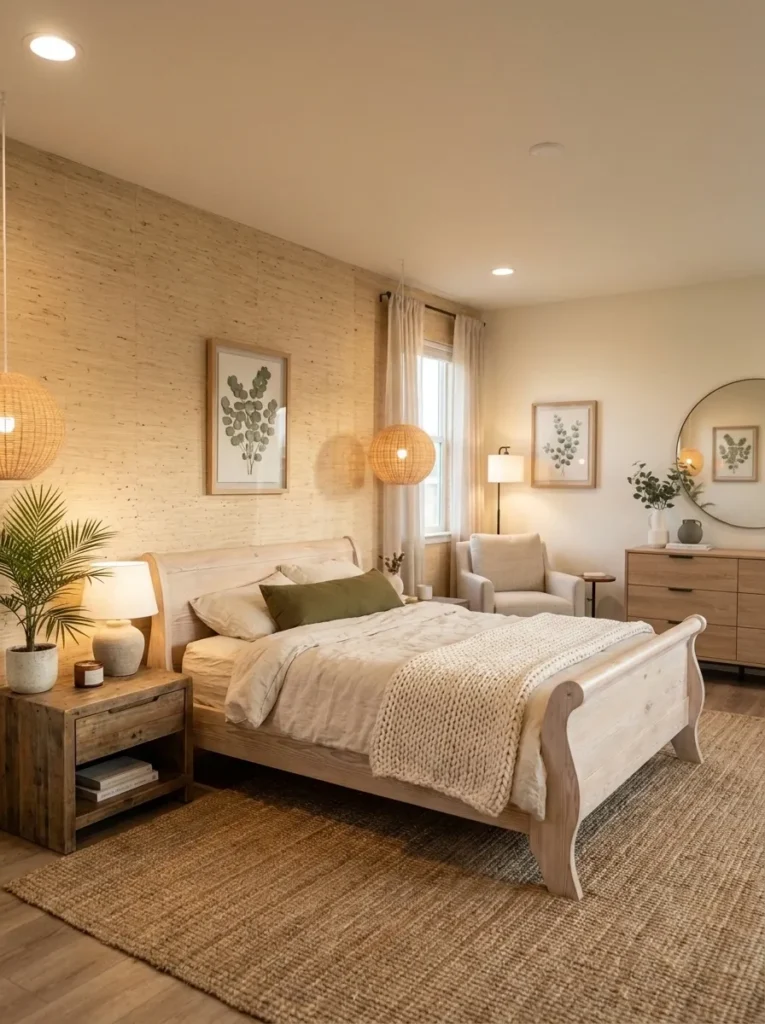
- Walls: Natural grasscloth in pale straw on the headboard wall, surrounding walls in chalk-white limewash
- Bedding: Ivory washed-linen duvet, white cotton quilt, one muted olive linen bolster
- Frame and hardware: Whitewashed pine sleigh bed with scooped ends, brushed-nickel hardware
- Wall decor: Pair of framed pressed-eucalyptus studies on cream mats, about 18×24 inches each
- Plants: Dwarf date palm (Phoenix roebelenii), bright light, matte limestone-look pot
- Rug: Hand-woven wool in warm ivory with a straw-colored border, 9×12
- Curtains: Natural cotton-linen in pale straw, medium weight, filtering light into a golden haze
- Hanging and lighting: Cane-wrapped globe pendant, 24 inches (2700K), ceramic bedside lamps with linen shades (2700K)
Why this works: One natural-fiber accent wall adds depth and warmth, while the whitewashed bed and limewashed walls keep the room light.
Grasscloth is woven from natural fibers like sisal, jute, or arrowroot, and because the fibers vary from roll to roll, no two walls look identical. That slight variation is the point: a pale straw panel behind the bed shifts subtly with the light, giving the headboard wall depth that paint can’t match. Keep it to one wall, and let chalk-white limewash carry the rest. The scooped ends of a whitewashed pine sleigh bed echo the soft, woven lines. It reads as quiet, tactile luxury, the kind found in boutique hotels, but warm enough to live in every day.
A practical note: grasscloth prefers dry rooms, so a bedroom is the ideal home for it. Ask the installer about seams, which are a natural part of the look, and avoid wiping it with water. Layer ivory linen, a white quilt, and one muted olive bolster, then hang two pressed-eucalyptus studies on cream mats. A dwarf date palm in a limestone-look pot brings a graceful, feathery silhouette, and it likes bright light. Together, they feel layered, not busy. The cane-wrapped globe pendant at 2700K gives the straw tones a golden glow after sunset.
Washed Denim Scallop
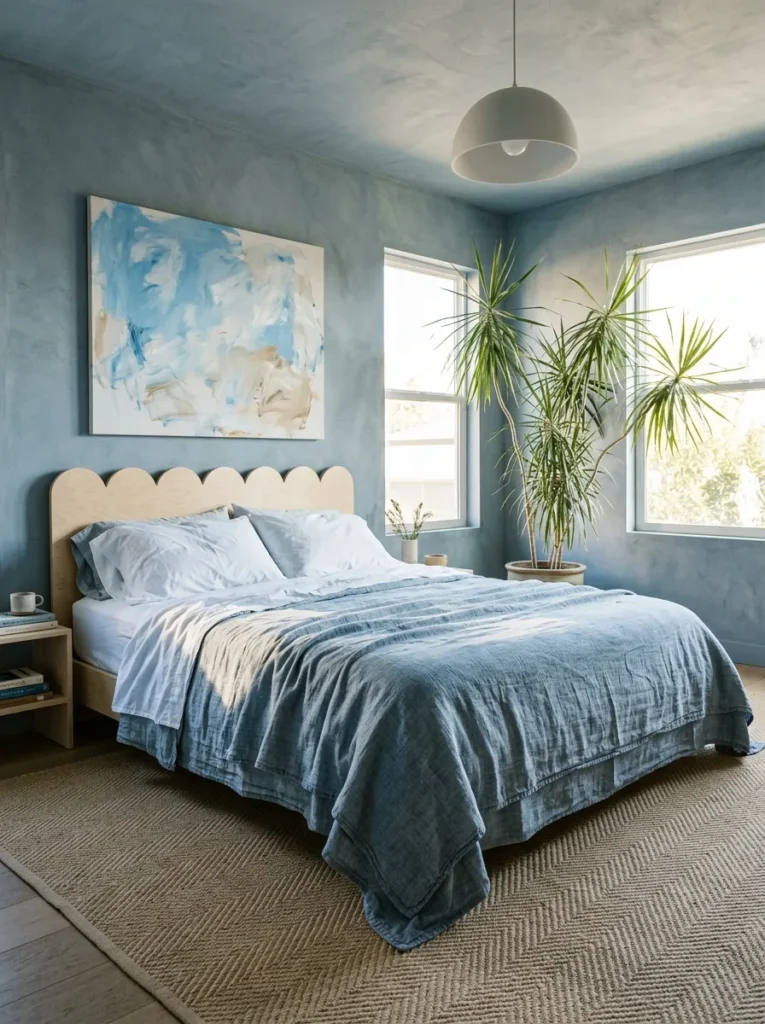
- Walls: Limewash in washed denim blue, softly mottled, ceiling in white
- Bedding: Crisp white cotton percale, ivory linen duvet, chambray quilted coverlet folded at the foot
- Frame and hardware: Pale birch bed with a scalloped headboard, aged-brass knobs on a matching birch nightstand
- Wall decor: Oversized abstract watercolor-wash canvas in ivory, sand, and sky blue, unframed, about 36×48 inches
- Plants: Dragon tree (Dracaena marginata), low to bright indirect light, matte white ceramic pot
- Rug: Low-pile wool in sandy oat with a tonal herringbone weave, 8×10
- Curtains: Ivory linen-cotton, medium weight, floor length, brightening the denim wall with soft diffused light
- Hanging and lighting: White ceramic dome pendant, 18 inches (2700K), white ceramic bedside lamps with oatmeal shades (2700K)
Why this works: Limewash softens a blue wall into something airy, and the scalloped headboard’s curves keep the color from feeling heavy.
My first denim-blue wall was a mistake. I chose a flat, saturated paint, and the room felt like a cold swimming pool. Limewash fixed everything. Its chalky, cloudy finish softens the blue into something closer to washed linen, and the movement in the surface reads as light, not color. Against crisp white percale and a pale birch headboard with scalloped edges, the room finally felt calm and a little playful. I’ve seen this combination work especially well in small bedrooms, where the soft curves keep the blue from feeling heavy.
Keep every other element pale and tactile. A chambray quilted coverlet echoes the walls without matching them, and ivory linen layers keep the bed fresh. A dragon tree in a matte white pot rises beside the window, thriving in low to bright indirect light and asking for very little. The oversized abstract canvas in ivory, sand, and sky blue reads like a watercolor horizon. An 18-inch white ceramic dome pendant glows at 2700K, and sand-toned herringbone wool underfoot adds one last quiet texture. The room feels clean, soft, and thoughtfully put together.
Butter Linen Alcove
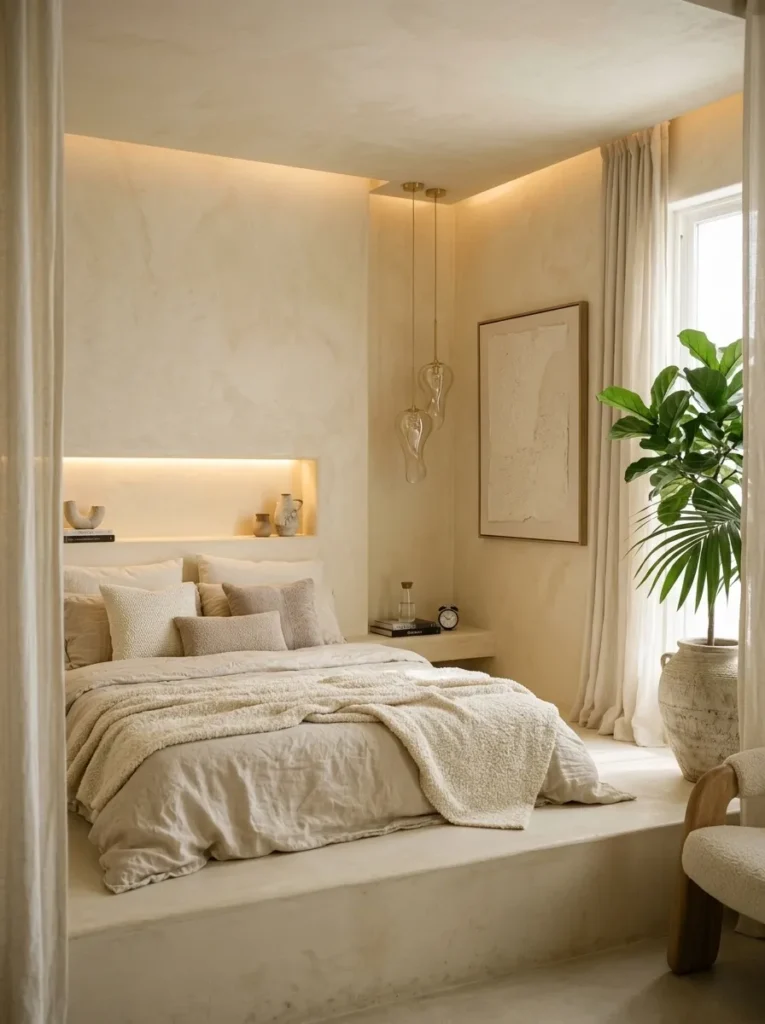
- Walls: Limewash in pale butter cream, soft and sun-faded, with a plastered alcove surround
- Bedding: Ecru stonewashed linen duvet, ivory cotton gauze coverlet, one butter-cream linen bolster
- Frame and hardware: Low built-in plastered alcove bed with recessed side niches, brushed-pewter hardware
- Wall decor: Pair of framed black-and-white dune photographs on wide white mats, about 16×20 inches each, thin oak frames
- Plants: Foxtail agave (Agave attenuata), full sun to bright light, matte cream cement pot
- Rug: Loop-pile wool in oat, 8×10
- Curtains: Heavy washed ivory linen on a ceiling track to close the alcove for sleep, sheer cotton voile at the window
- Hanging and lighting: One oversized hand-blown pale amber glass pendant (2700K), warm recessed strip in the niche (2200K)
Why this works: A sun-faded butter tone reads as light rather than color, and a plastered alcove turns the bed into a calm room within a room.
Butter-cream is the color nobody expects in a coastal bedroom, and that is why it works. Sun-faded yellow, diluted to nearly white, reads like morning light caught on plaster rather than a paint color. Wrap a low bed in a plastered alcove and the effect deepens: the nook becomes a quiet room within a room. I noticed how guests linger near it, drawn to the cocoon-like feel. Add an ivory linen curtain on a ceiling track, pull it closed for sleep, and the alcove turns into a soft, private hideaway at night.
Layering keeps the sunny tone grown-up. Ecru linen and ivory gauze sit against butter-cream walls, while one bolster picks up the exact wall shade. Two black-and-white dune photographs hang on wide white mats, adding graphic contrast without introducing another color. A foxtail agave in a matte cream pot is soft to the touch, with no spines, and it loves full sun by the window. A pale amber glass pendant at 2700K and a warm recessed strip in the niche at 2200K give the alcove its golden evening glow. It feels restful, bright, and quietly luxurious.
Mushroom Limewash Floor Bed
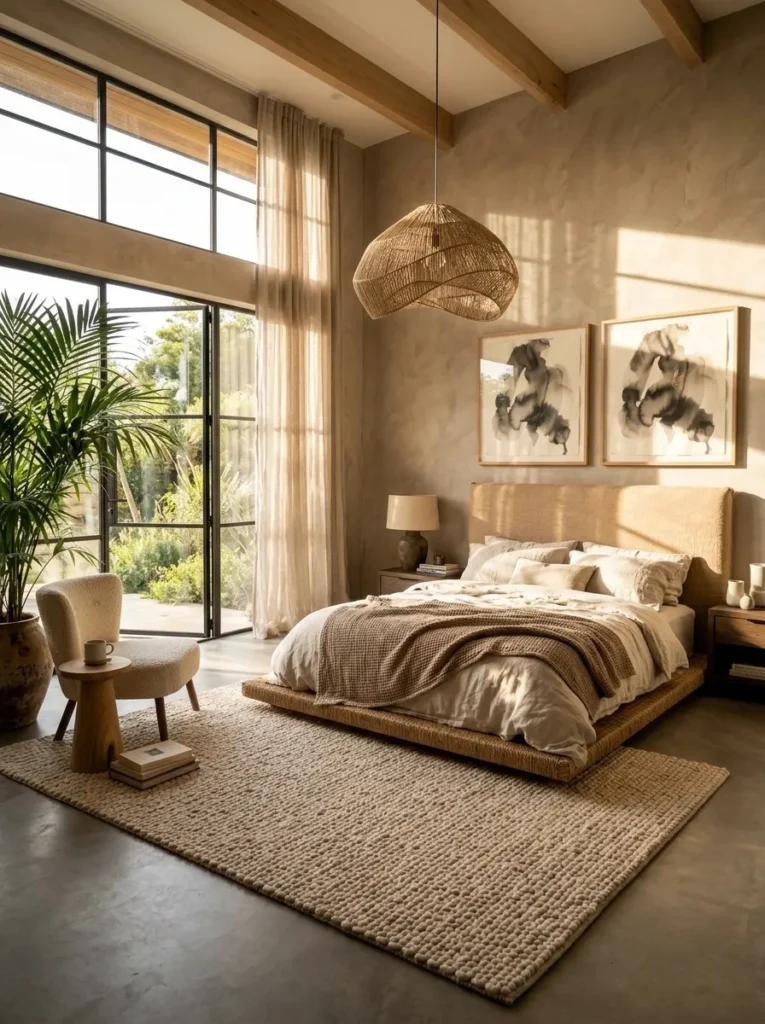
- Walls: Limewash in mushroom taupe, a warm light greige, with a soft chalky finish
- Bedding: Ivory stonewashed linen duvet, oatmeal cotton gauze throw, two chalk-white linen pillows
- Frame and hardware: Low floor bed on a natural rush platform (tatami-style), no hardware, with a slim floating pale oak shelf as the nightstand
- Wall decor: One large ink-wash abstract on rice paper, soft gray on ivory, about 30×40 inches, unframed
- Plants: Bamboo palm (Chamaedorea seifrizii), low to bright indirect light, oatmeal-glazed stoneware pot
- Rug: Undyed hand-spun wool in ivory, low pile, 8×10
- Curtains: Washed linen in stone, medium weight, hung floor to ceiling to soften the light
- Hanging and lighting: Oversized hand-woven rush pendant, 28 inches (2700K), low linen-shaded floor lamp at the bedside (2200K)
Why this works: A low floor-level bed opens up the wall and ceiling, so the room reads taller, quieter, and more spacious.
A low bed changes how a room feels the moment you walk in. Because less furniture rises into your sightline, more wall and ceiling stay visible, and the room reads taller and calmer. That is basic proportion at work. Here, a mattress sits on a rush platform, tatami-style, with mushroom limewash rising above it in soft, cloudy layers. I tried a floor-level setup in my own guest room years ago, and what surprised me most was how quiet it looked. There is nothing to compete with the texture, which is exactly the point.
Restraint carries the rest of the scene. Ivory linen sits under an oatmeal gauze throw, while a single ink-wash abstract hangs unframed on the wall like a quiet horizon. A bamboo palm in an oatmeal stoneware pot handles low to bright indirect light, which makes it a forgiving bedroom plant. Overhead, an oversized rush pendant glows at 2700K, and a low linen floor lamp at 2200K gives bedtime reading a candle-soft warmth. Stone-colored linen curtains and undyed wool underfoot finish a room that looks calm before you even notice why.
Saddle Leather Headboard
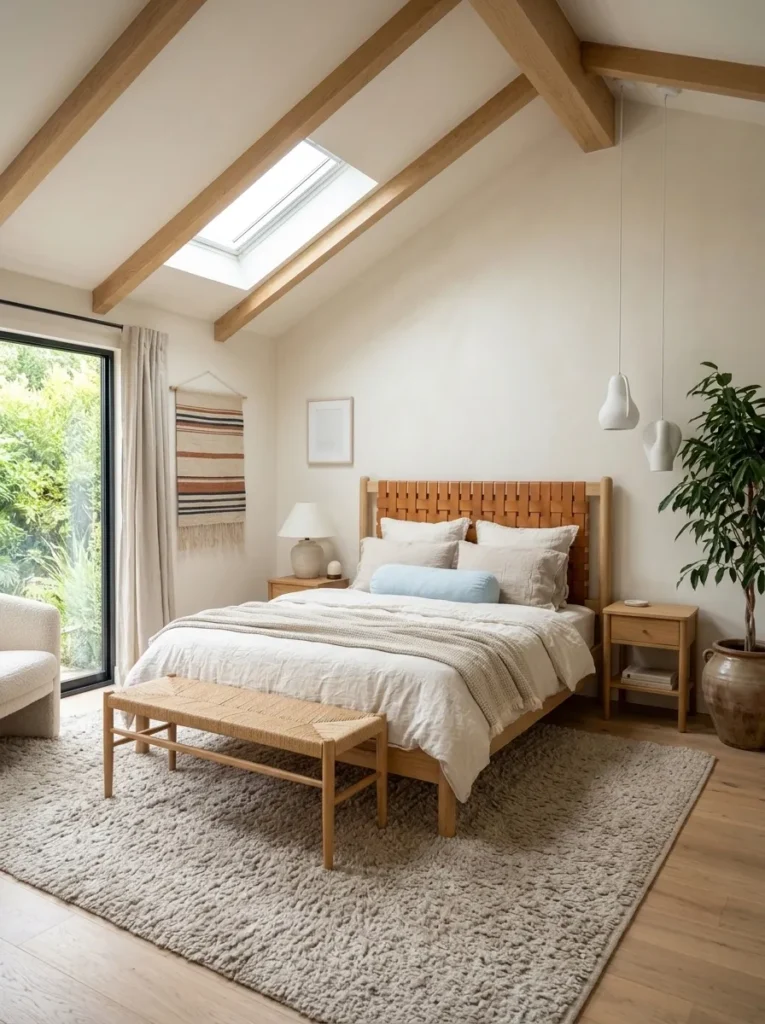
- Walls: Limewash in warm white with a soft chalky finish
- Bedding: Ivory washed-linen duvet, white cotton matelassé coverlet, one pale sky-blue linen bolster
- Frame and hardware: Pale oak bed with a woven saddle-tan leather strap headboard, aged-brass rivets
- Wall decor: Flatwoven wool tapestry in ivory and tan stripes, about 40×60 inches, hung from a pale oak rod
- Plants: Spineless yucca (Yucca gigantea), bright light, matte sand-colored cement pot
- Rug: Flatweave wool-jute blend in ivory with a tan pinstripe, 8×10
- Curtains: Oatmeal linen-cotton, medium weight, brightening the room into a warm, even glow
- Hanging and lighting: Oversized antique-white enamel dome pendant with a brass interior, 24 inches (2700K), aged-brass swing-arm sconces with linen shades (2700K)
Why this works: A single woven leather headboard brings warm, aging texture to a pale room without adding visual weight.
Leather ages like a good pair of boots: it softens, darkens, and develops a patina that no factory finish can imitate. A woven saddle-tan strap headboard brings that warmth to a pale bedroom, and the interlaced pattern reads as modern basketry rather than rustic tack. Because vegetable-tanned leather is a natural material, it pairs easily with linen, wool, and pale oak. The key is proportion: one leather piece, at the bed, with everything else light. That single warm tan anchors the room without weighing it down, giving boho texture and coastal brightness a grown-up edge.
Everything else stays pale and tactile. A white limewash wall, ivory linen, and a pale sky-blue bolster keep the bed fresh, while a flatwoven wool tapestry in ivory and tan stripes hangs from a pale oak rod. A spineless yucca in a sand-colored cement pot gives the corner sculptural height and thrives in bright light. Above, an oversized antique-white enamel pendant with a brass interior glows at 2700K, casting a warm pool onto the bed. Oatmeal linen curtains soften the daylight. Nothing here shouts. It’s a polished room with one confident texture.
Pale Clay Plaster
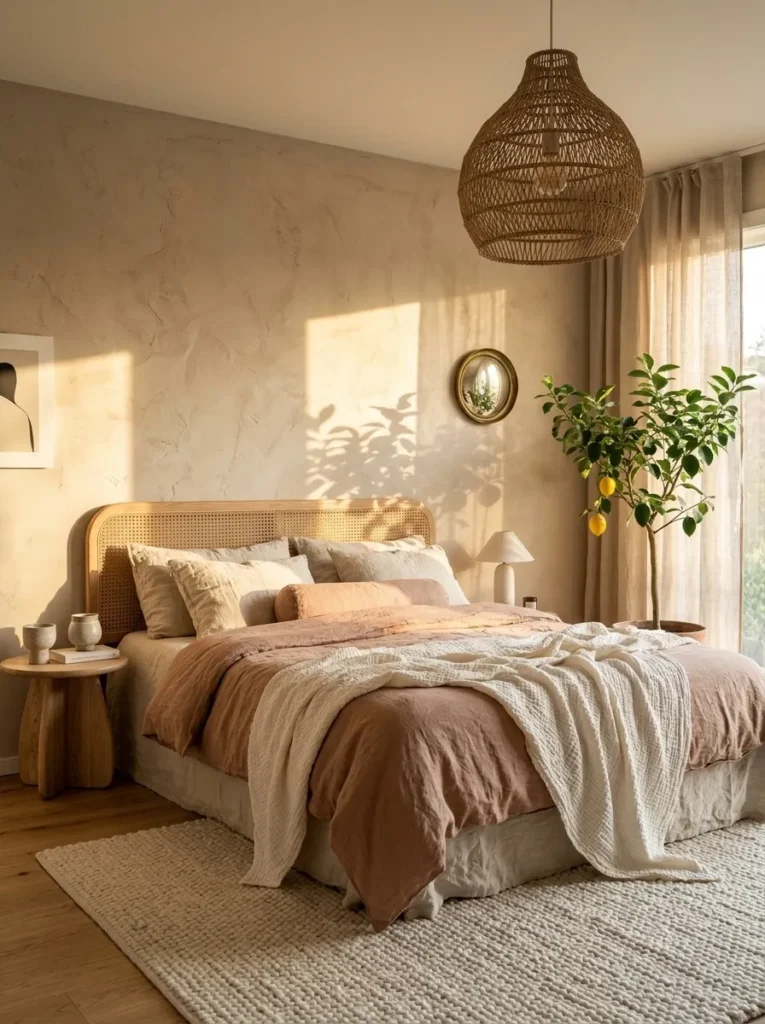
- Walls: Pale clay lime plaster, a diluted terracotta-pink, hand-troweled
- Bedding: Warm-white washed-linen duvet, ivory cotton gauze coverlet, one clay-pink linen bolster
- Frame and hardware: Linen-upholstered daybed-style bed with low arms and a bolster back, hammered-brass hardware
- Wall decor: Round convex mirror in a thin hammered-brass frame, about 32 inches
- Plants: Meyer lemon (Citrus × meyeri), at least 8 hours of direct sun or a grow light, unglazed terracotta pot
- Rug: Hand-woven cotton in ivory with one narrow clay-colored band, 8×10
- Curtains: Warm-white cotton-linen, medium weight, floor length, washing the clay wall in soft light
- Hanging and lighting: Hand-woven bleached willow lantern, 22 inches (2700K), clay-colored ceramic lamps with white linen shades (2700K)
Why this works: A diluted terracotta-pink plaster feels sunlit and warm, and a living lemon tree gives the room a natural focal point.
I killed my first indoor lemon tree, despite my plant science background. The lesson? Citrus needs eight hours of direct sun, not a pretty corner. That mistake pushed me to design the whole room around it. Pale clay plaster, warm and slightly pink, makes the leaves look glossy and the fruit glow. Beside a low linen daybed, the lemon tree becomes a living centerpiece, and the room suddenly feels Mediterranean without a single tile. In my experience, building a room around the plant, not a trend, makes the design feel inevitable.
Texture keeps the clay from turning flat. A hand-troweled wall catches light unevenly, and a round hammered-brass mirror bounces it back across the bed. Warm-white linen and ivory gauze sit lightly against the pink, while a bleached willow lantern at 2700K adds a soft, woven shadow overhead. Clay-colored ceramic lamps echo the wall without matching it. Plant care is simple: set the terracotta pot by the sunniest window, water when the top inch dries, and add a grow light in winter. The reward is a room that smells faintly of citrus.
Styling Principles
Every room above follows the same quiet rules. Borrow them, and your own space will feel intentional instead of random.
Hold the palette to three or four tones. Pick a base (sand, oyster, or whitewash), one softer accent, and one natural material. A boho coastal bedroom stays calm when texture does the layering and color stays within a few related tones.
Choose one hero texture. Cane, plaster, grasscloth, or leather can lead the room. Everything else supports it. When two hero pieces compete, kitsch creeps in.
Layer by weight, not by quantity. Pair heavy with light: a chunky wool rug under cotton gauze, a solid oak frame beside sheer voile. Three layers on the bed are plenty.
Keep contrast low. Pale, low-contrast palettes in natural fibers like linen, jute, and cane let you layer generously without clutter. Save the high-contrast moment for one small piece, like a single artwork.
Leave space on purpose. Breathing room is the coastal half of the equation. A bare stretch of wall beside a statement piece reads as confidence, not emptiness.
Repeat one shape. A curve, a slat, or a scallop echoed three times quietly ties the room together.
Light it warmly. Use 2700K bulbs overhead, 2200K for reading lamps, and let daylight pass through linen or voile.
In my own Austin home, the best edit I ever made was removing one thing. When a room feels busy, take away a piece before you add another.
Frequently Asked Questions
What is boho coastal style?
Boho coastal style blends the layered, handmade textures of bohemian design with the pale palette, natural light, and open space of coastal interiors. Think washed linen, rattan, cane, jute, and limewash in sand, whitewash, washed blue, and seafoam. It skips pattern overload and nautical props, so the room feels collected and calm.
How do I avoid a kitschy beach look?
To avoid a kitschy beach look, skip literal beach symbols like shells, anchors, and lettered signs, and express the coast through color, light, and natural materials instead. Choose one hero piece, such as a cane headboard or a driftwood branch, and keep the rest quiet. A breezy boho bedroom reads as coastal because of its light and texture, not its souvenirs.
What are the best plants for a coastal bedroom?
The best plants for a coastal bedroom are tolerant, sculptural species like kentia palm, ponytail palm, African spear (Sansevieria cylindrica), bird of paradise, and olive tree, matched to your window’s light. With my plant science background, I’d say light matters more than species: sunny windows suit olive trees and ponytail palms, while kentia palms and snake plants handle dimmer corners. Terracotta pots dry faster, which helps if you tend to overwater. Several of these are mildly toxic to pets, so check before you buy.
What are budget-friendly ways to try boho coastal decor?
The most affordable way to try boho beach bedroom decor is to start with walls and bedding: a soft white or limewash-effect paint, then washed linen or cotton gauze layers. Add one natural-fiber piece next, such as a jute rug, a woven pendant, or a rattan mirror, and thrift baskets or frames for the rest. Prices vary, so check current costs, but one idea at a time keeps the project manageable.
How do I handle humidity in a bedroom?
To handle bedroom humidity, aim to keep indoor relative humidity between 30 and 50 percent, using a dehumidifier, an exhaust fan that vents outdoors, and good airflow from a ceiling fan. A small hygrometer shows your actual level for a few dollars. My husband also suggests keeping furniture a few inches off exterior walls so air can circulate behind it. Linen, cane, and sisal dry quickly, but a closed-up damp room can still turn musty.
Does boho coastal style work in a small bedroom?
Yes, a coastal boho bedroom suits small spaces because its pale palette and low-profile furniture make a room feel larger. Choose a low bed, hang sheer curtains close to the ceiling, add one mirror to bounce light, and limit yourself to a single hero texture. Fewer, lighter layers will always beat more of them.
Conclusion
A calm, light-filled bedroom doesn’t come from buying more. It comes from choosing a few natural materials, keeping the palette soft, and letting texture and daylight do the work. Whichever of these boho coastal bedroom ideas speaks to you, start small: repaint one wall, swap your bedding for washed linen, or add a single sculptural plant. I’ve seen how small changes like these can completely transform a space.
Save this post on Pinterest so your favorites are easy to find, try one idea this weekend, and share it with a friend who’s craving a more peaceful place to.