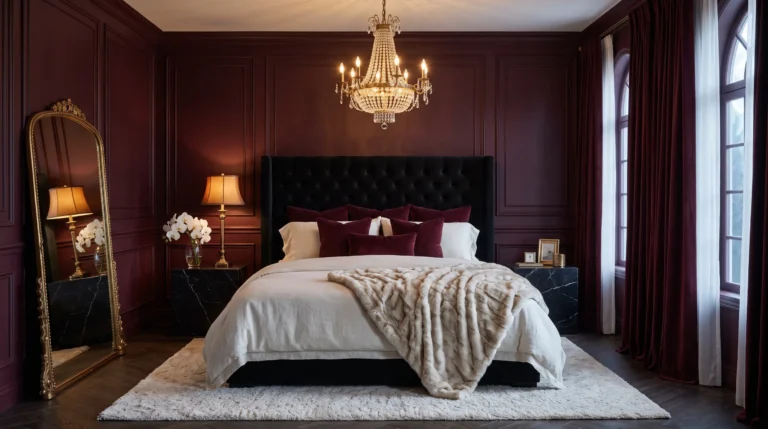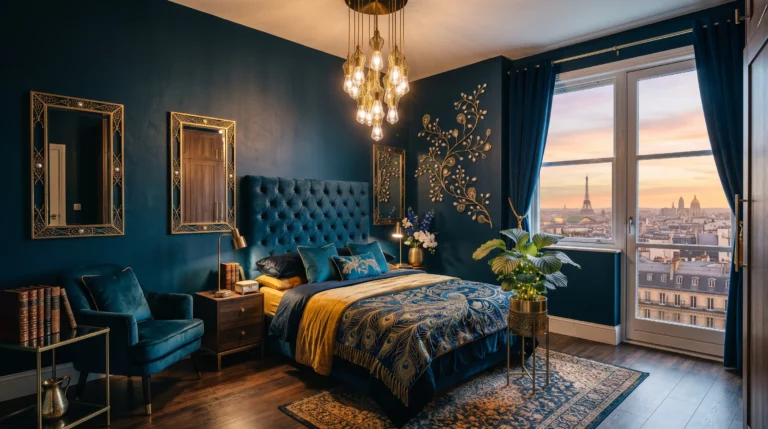
18 Whimsical Bedroom Ideas for Adults with Dreamy Charm
Not every whimsical bedroom idea has to look like it belongs in a nursery. In fact, most of the ones that do miss the mark entirely. The real secret to whimsical bedroom ideas for adults is restraint: one dramatic, well-made detail does more than five small playful accents ever could. I learned this firsthand styling a guest room with too many small rounded mirrors at once — it read as a prop closet, not a bedroom.
This roundup gathers 18 fully styled looks that bring genuine personality into a space through scale, shape, and material quality, not costume-like themes. Each idea covers the full room: walls, bedding, lighting, and the small details that make a space feel finished, so you can recreate the look, not just borrow a colo
What Makes a Bedroom Whimsical Without Making It Look Like a Child’s Room?
Most people think whimsy means adding more — more color, more pattern, more themed objects. It’s actually the opposite. Whimsical style in an adult space comes from unexpected scale or shape, not literal storybook motifs. One oversized or unusually curved piece reads as playful sophistication, while five small “cute” accessories together start to feel like a costume. I learned this the hard way styling a guest room with too many rounded mirrors at once — it looked like a prop closet, not a bedroom.
A single dramatic, well-made piece will always read as more grown-up than a room full of small whimsical touches.
This post solves that gap: how to bring in real personality and playfulness without tipping into juvenile territory.
1. Scalloped Canopy Nook — A Whimsical Bedroom Idea for Adults
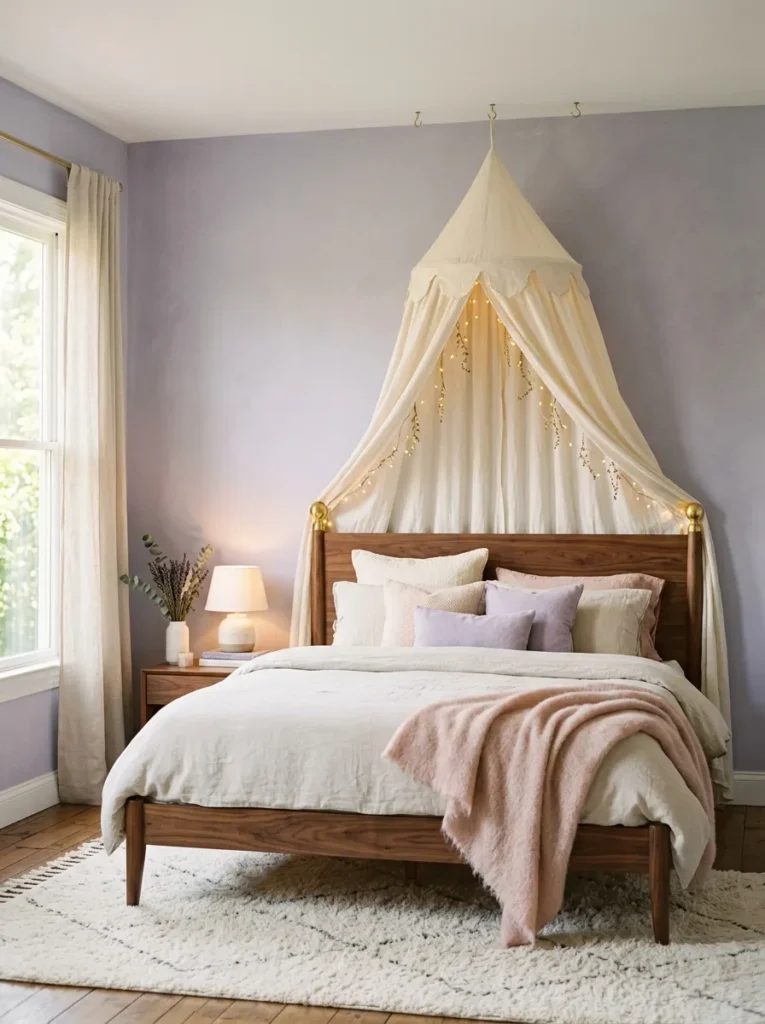
- Walls painted in a dusty lavender-gray (Benjamin Moore “Lavender Mist” family) with a soft eggshell finish
- Scalloped canopy frame in warm cream linen, mounted above the headboard and gathered at two brass finial points
- Walnut platform bed frame with a low, curved footboard
- Bedding layered in oatmeal linen duvet with a single mushroom-colored coverlet folded at the foot
- Three pillows: one bolster in cream velvet, two square shams in a subtle scalloped-edge cotton
- Mohair throw in soft blush, draped loosely over one corner of the bed
- Vintage-style Moroccan wool rug in ivory and rust, placed so it extends 24 inches beyond each side of the bed
- Aged brass sconces flanking the headboard instead of a single overhead fixture
Why this works: A curved canopy frame reads as architectural rather than costume-like because the shape itself, not a printed theme, carries the whimsy.
My husband’s crew installed a curved canopy frame like this in a client’s primary suite last spring, and the trickiest part wasn’t the fabric — it was anchoring the frame securely into drywall without visible bracket lines. He used a hidden French cleat mounted into wall studs, which let the canopy float away from the wall by a few inches instead of sitting flush. That small gap is what makes the whole thing look sculptural instead of stapled-on. If you’re hiring this out, ask specifically about stud placement before the frame ships, since off-center studs can throw off the whole symmetry.
A scalloped canopy sounds delicate, but the effect in person is surprisingly grounded once the walnut bed frame and brass hardware anchor it in warmer, heavier tones. The lavender-gray wall keeps the palette adult rather than pastel-sweet, and the ivory rug adds enough texture underfoot that the room doesn’t feel one-note. This is a favorite starting point for anyone nervous about “too cute,” because the canopy is the only overtly whimsical element in the entire room. Everything else — the linen, the walnut, the brass — is doing quiet, sophisticated work around it.
2. Mural Headboard Wall
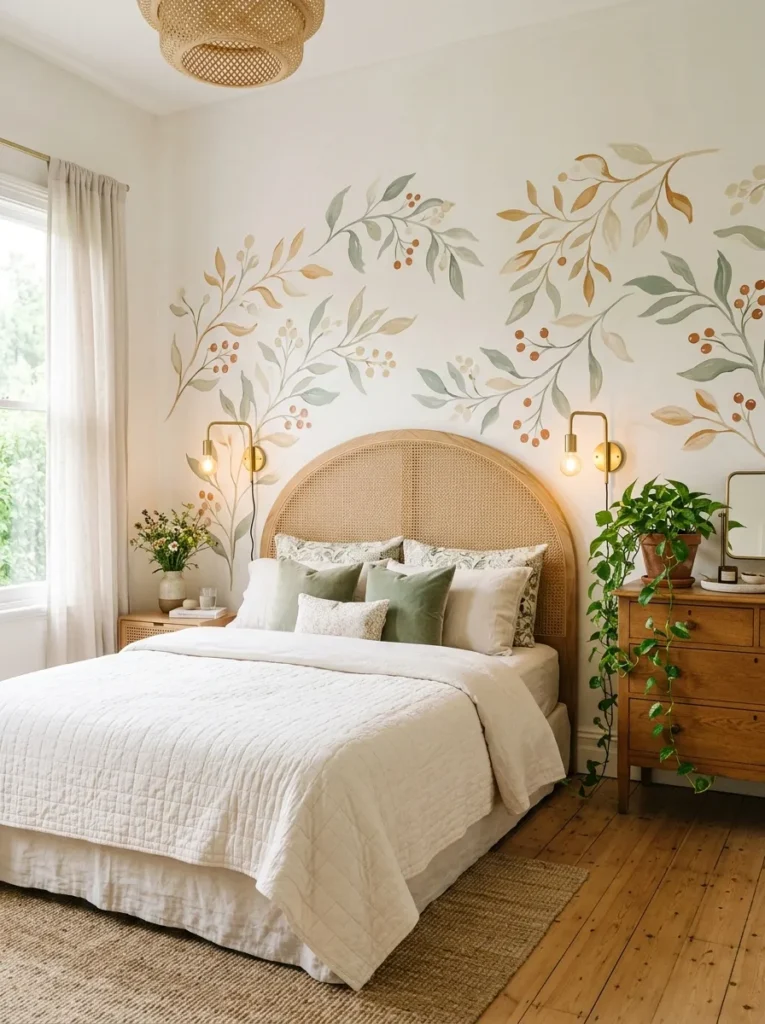
- Hand-painted mural behind the headboard featuring stylized branch and leaf silhouettes in sage green and muted ochre on a warm white base
- Remaining three walls left in a soft warm white (Sherwin-Williams “Alabaster”) to let the mural stand alone
- Cane and oak headboard with a gently arched top rail
- Bedding in soft sage linen sheets with an ivory quilted coverlet
- Pillow arrangement: two ochre linen shams, one small sage velvet lumbar pillow
- Woven wool throw in cream and ochre stripe, folded at the foot of the bed
- Low-pile wool rug in warm white with a subtle sage border, centered under the bed
- Brass swing-arm reading lights mounted directly to the wall on either side of the headboard, freeing up nightstand space
- One trailing pothos in a stoneware planter on the dresser, echoing the mural’s leaf shapes
Why this works: A hand-painted mural confined to a single wall behind the bed keeps the whimsy contained to one plane, so the room reads as art-forward instead of themed.
Between my plant science background and my husband’s construction work, this is probably the idea that pulls the most from both sides of how I think about a room. The branch shapes in the mural aren’t random — they’re loosely modeled on a real fig branch structure, which gives the pattern an organic logic instead of a cartoonish one. Muralists I’ve worked with always stress the same thing: keep the palette to two or three tones max, or the wall starts competing with everything else in the room instead of anchoring it.
Painted murals intimidate a lot of people because they sound permanent and expensive, but a single accent wall keeps both the cost and the commitment manageable compared to wallpapering an entire room. The sage and ochre palette stays warm enough to feel grown-up rather than nursery-adjacent, and confining the pattern to one wall means the cane headboard, wool rug, and brass lighting all get room to breathe. A real trailing plant on the dresser is the finishing touch that ties the painted leaves to something living, which is a detail most whimsical bedroom decor ideas skip entirely.
3. Arched Window Reading Perch
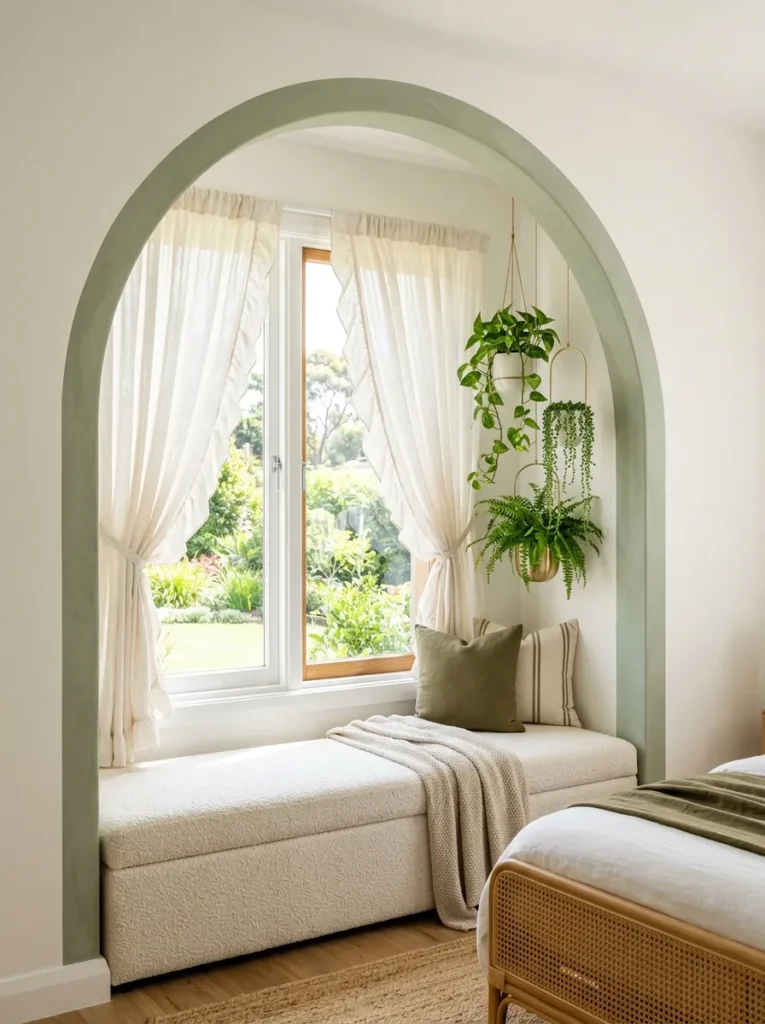
- Existing rectangular window reframed with a curved plaster arch surround, painted to match the wall in a soft dusty sage
- Walls in the same dusty sage (Sherwin-Williams “Comfort Gray” family) with a matte finish throughout
- Built-in cushioned window seat upholstered in ivory bouclé, positioned beneath the arched window
- Bed frame in natural rattan with a low, rounded headboard, placed perpendicular to the window rather than facing it head-on
- Bedding in soft moss-green linen with an ivory ribbed throw folded at the foot
- Two ivory linen curtain panels with a gathered ruffle trim, hung on a slim antique-brass rod recessed into the arch
- Three trailing plants — a pothos, a string of pearls, and a small fern — hung at staggered heights from brass ceiling hooks beside the window
- Woven jute rug beneath the window seat, and a single brass wall sconce mounted just outside the arch for evening reading light
Why this works: Staggering trailing plants at different heights beside a window creates layered movement that a single potted plant on a shelf never achieves.
Window seats are often treated as an afterthought in bedroom design, tucked in wherever there’s leftover space, but placing the bed perpendicular to the window instead of facing it directly frees up the entire sill for a proper reading perch. Reframing a plain rectangular window with a curved plaster arch changes the entire feel of natural light entering the room — it softens the geometry of the whole wall, not just the window itself. Ruffled curtain trim adds a small playful detail without tipping into anything costume-like, especially against a quiet sage backdrop and minimal surrounding decor.
I’ve hung trailing plants at staggered heights in a few different rooms now, and it’s consistently the detail guests comment on before anything else in the space. A single plant on a shelf reads as an afterthought, but three at different heights beside natural light start to feel like a living curtain of their own. Pothos and string of pearls are forgiving choices for a bedroom with moderate light, since neither needs daily attention, and both trail in a way that softens the hard edge of the plaster arch beautifully over time.
4. Amber-Lit Canopy Frame
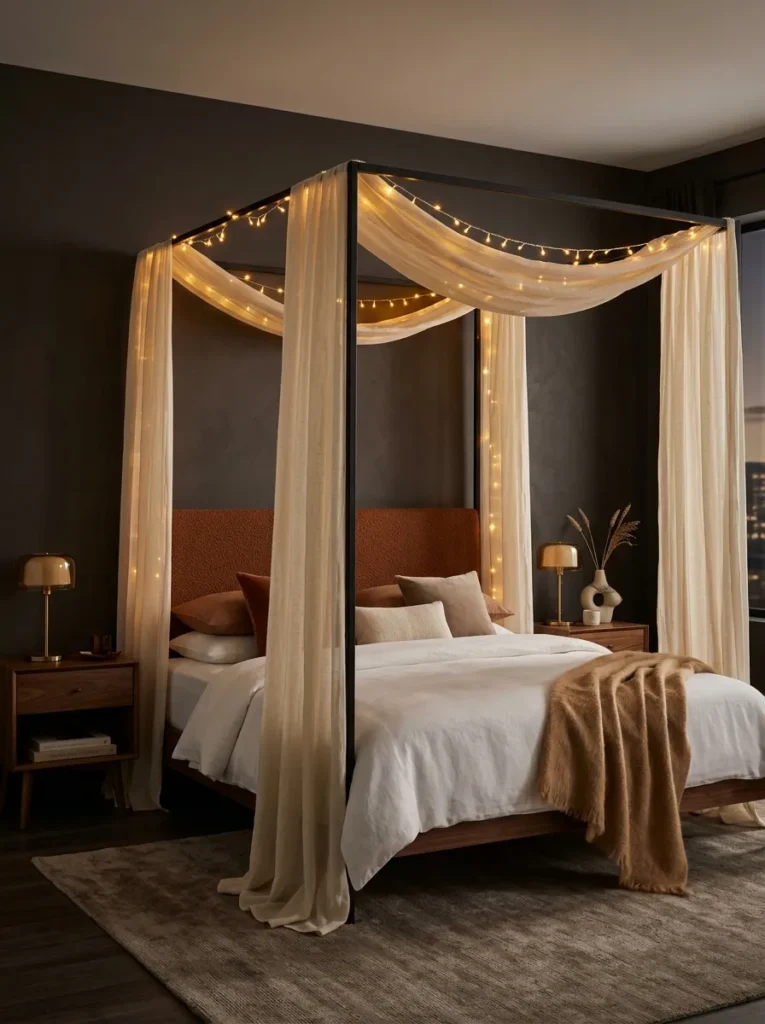
- Slim blackened-steel canopy frame mounted directly to the ceiling above the bed, no fabric draping — just the open frame itself as sculpture
- Warm amber string lights (2200K, not colored) woven once around the top rail of the frame, wired to a dimmer switch mounted at nightstand height
- Walls in a deep charcoal-brown (Benjamin Moore “Kendall Charcoal” family), matte finish, on all four sides
- Bed frame in dark walnut with a low upholstered headboard in rust boucle
- Bedding in warm ivory linen sheets with a deep umber quilted coverlet
- Two rust velvet pillows, one ivory linen lumbar pillow
- Camel-colored mohair throw draped across the foot of the bed
- Vintage hand-knotted rug in rust, cream, and charcoal, centered under the bed
Why this works: Warm amber light woven through an open steel frame turns the canopy into a fixture rather than a decoration, so the whimsy comes from engineering, not embellishment.
The trick with a bare canopy frame is resisting the urge to drape it in fabric — the steel itself, lit from within, is the whole point. Dimmable amber light at a true warm-white temperature avoids the cheap, party-string look entirely, especially against a dark charcoal wall that lets the glow read as ambient rather than decorative. My husband’s electricians run a hardwired dimmer line for installations like this rather than relying on a plug-in remote, since a wired switch means the light never accidentally resets to full brightness. It’s a small upgrade cost that makes the whole feature feel built-in rather than bolted on.
Dark charcoal walls sound like a bold commitment, but they’re exactly what makes a lit canopy frame work — the warm light has nowhere to disappear to, so it genuinely glows instead of getting washed out by a pale backdrop. This is a striking option for anyone who wants their whimsy to show up specifically at night, when the amber light turns an otherwise minimal, moody room into something closer to candlelight. During the day, the frame reads as quiet architectural sculpture; after dark, it becomes the room’s entire mood.
5. Scattered Light Vanity Corner
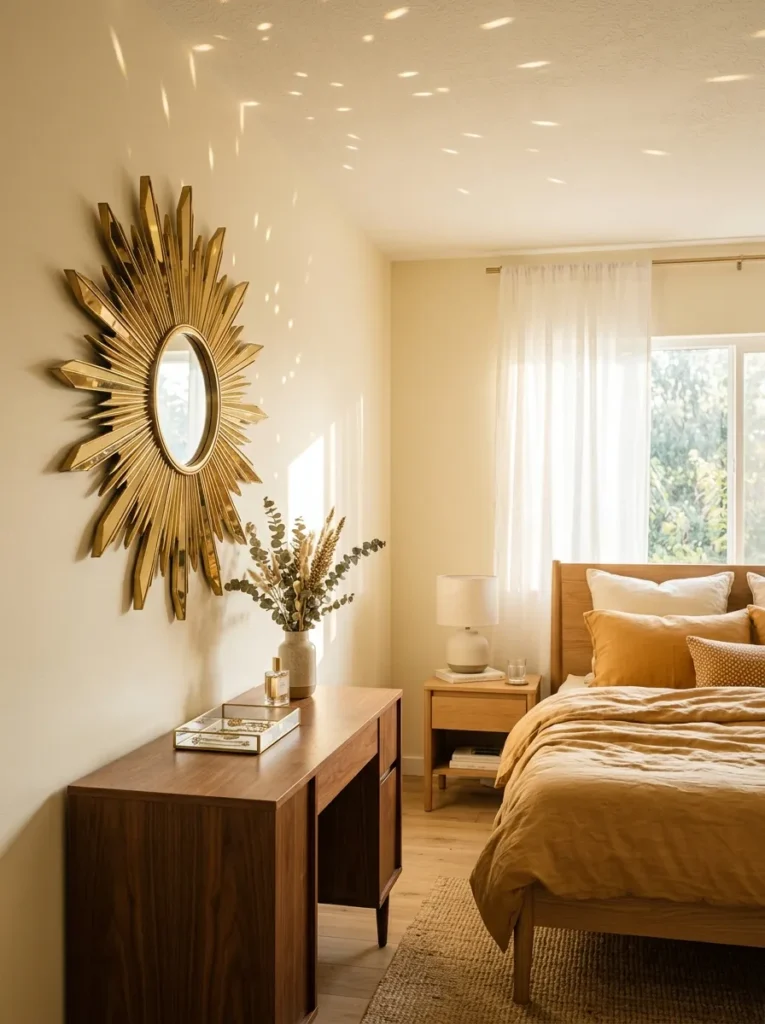
- Faceted brass sunburst mirror, 30 inches wide, hung at an angle in the corner where morning light enters, positioned specifically to catch and scatter light across the ceiling
- Walls in a soft buttery cream (Sherwin-Williams “Ivoire” family), eggshell finish
- Antique brass and walnut vanity table beneath the mirror, paired with a curved cane-back chair
- Bed frame in white oak with a gently rounded headboard, positioned so morning light crosses it first
- Bedding in soft honey-linen sheets with a cream waffle coverlet
- Two cream linen pillows, one honey velvet lumbar pillow
- Ivory bouclé bench at the foot of the bed
- Sheer linen curtains in warm white, hung loosely to let the scattered light move freely through the room
Why this works: A faceted mirror angled to catch direct morning light throws small moving fragments across the ceiling, giving the room a quiet, ever-changing detail no static decor piece can replicate.
Most mirrors get hung purely for reflection, but a faceted sunburst mirror angled toward an east-facing window does something different entirely — it breaks direct sunlight into dozens of small moving fragments that drift across the ceiling as the sun rises. It’s a detail that costs nothing beyond correct placement, yet it’s the kind of thing houseguests always ask about. Getting the angle right takes some trial and error; even a few degrees changes where the light lands, so it’s worth testing at different times of morning before committing to permanent wall anchors.
I stumbled onto this effect by accident in my own bedroom, angling a mirror to check the light before I’d even thought about the sunburst shape, and I’ve never gone back to hanging mirrors flat against a wall since. The soft honey and cream palette throughout the room amplifies the effect rather than competing with it, since every surface reflects a little of that scattered morning glow. It’s a whimsical touch built entirely on physics and placement rather than an object at all, which makes it feel discovered rather than decorated.
6. Cedarwood Reading Alcove
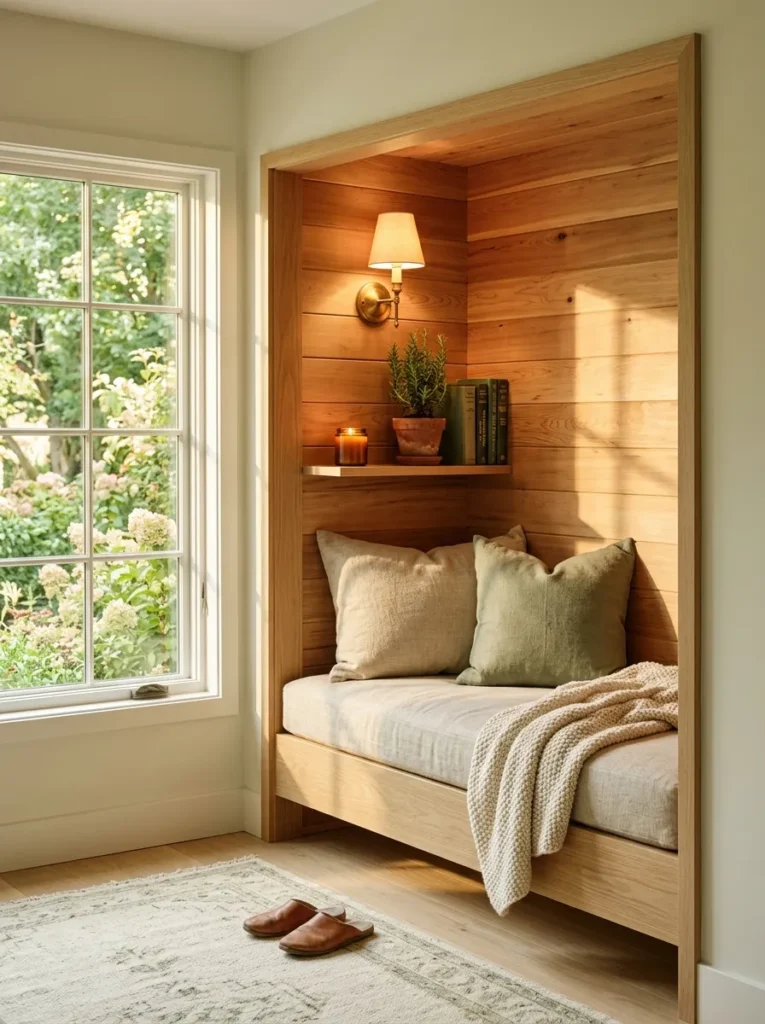
- Built-in reading alcove carved into a deep wall niche, lined in warm cedar wood paneling left unfinished to show natural grain
- Remaining walls in a soft sage-white (Behr “Silver Sage” family), matte finish
- Low daybed frame in white oak fitted into the alcove, upholstered bench cushion in oatmeal linen
- A single cedarwood candle (cedar and amber note, unscented smoke) kept on the built-in shelf beside the alcove, its warm woody scent echoing the paneling itself rather than sitting apart from it
- Bedding on the adjacent main bed in ivory linen with a sage quilted coverlet
- Two sage velvet pillows, one oatmeal linen lumbar pillow on the daybed cushion
- Woven wool rug in cream and moss green beneath the alcove
- Brass reading sconce mounted directly into the cedar paneling, plus a small potted rosemary plant on the alcove shelf
Why this works: Matching a candle’s scent note to the room’s actual building material turns fragrance into part of the design story instead of a separate finishing touch.
Cedar paneling brings texture and warmth to a niche most builders would otherwise leave as flat drywall, and it’s one of the more requested upgrades my husband’s crew handles in older Austin homes with awkward wall recesses. Choosing a cedar-and-amber candle note to sit beside actual cedar paneling means the scent reinforces what’s already true about the room rather than introducing something unrelated, the way a floral or bakery-scented candle would. It’s a subtle sensory layer that most bedroom styling completely ignores in favor of purely visual choices, even though scent shapes how a room feels just as much as light does.
Sage and oatmeal keep the alcove feeling calm rather than rustic-cabin, and the rosemary plant on the shelf adds a second, living echo of that same woody, herbal scent world without ever competing with the candle. This is a favorite idea for anyone who reads before bed, since the alcove creates a defined, cozy pocket separate from the sleeping side of the room, while the cedar scent makes the whole space feel warmer the moment you walk in, well before you’ve noticed a single visual detail.
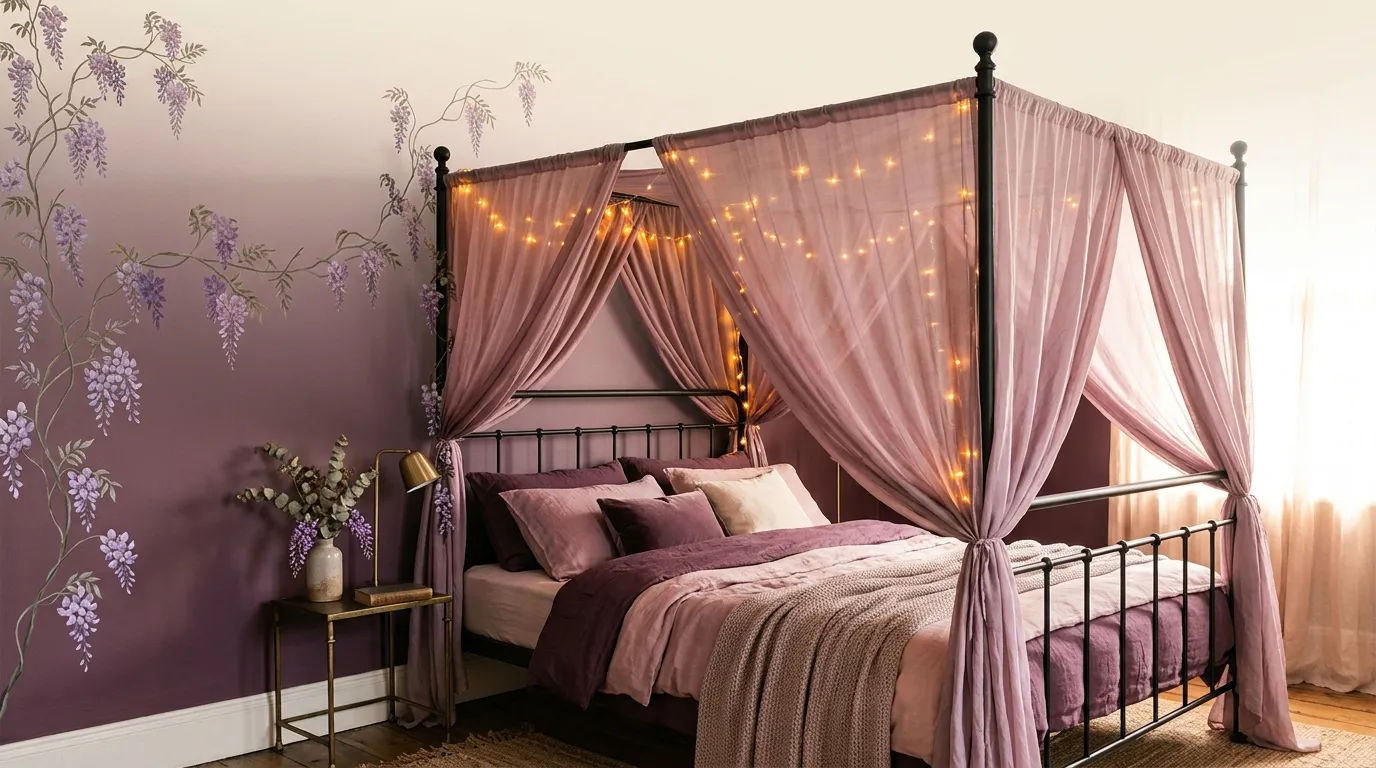
7. Plum Silk Canopy
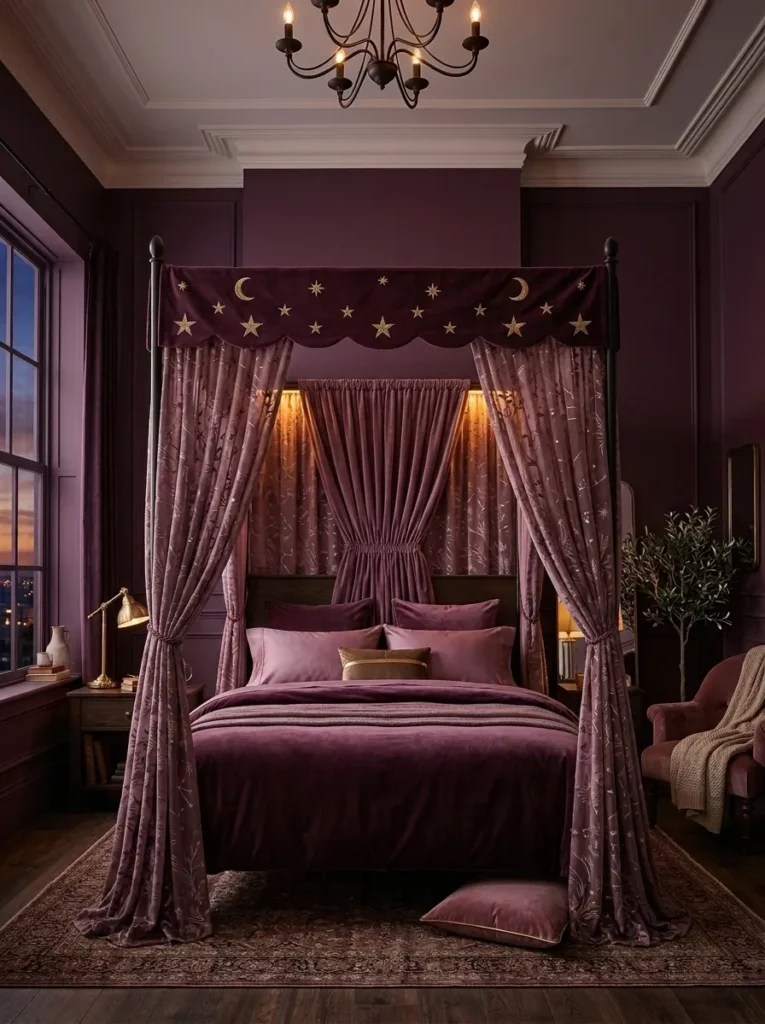
- Walls in a saturated deep plum (Farrow & Ball “Brinjal” family), matte finish, on all four walls for full immersion
- Traditional four-poster bed frame in slim blackened iron, with a silk canopy drape in dusty mauve gathered at each post
- Warm amber string lights (2200K) woven along the canopy’s top rail beneath the silk, glowing softly through the fabric rather than sitting exposed
- Small solid-brass star appliqués — not plastic, not printed — stitched sparingly along one edge of the canopy drape, no more than six total
- Bedding in deep plum linen sheets with a dusty mauve velvet coverlet
- Two mauve velvet pillows, one ivory silk lumbar pillow
- Antique brass table lamps with fluted mauve glass shades on each nightstand
- Hand-knotted rug in plum, charcoal, and gold, centered beneath the bed
Why this works: Light glowing through silk rather than exposed bulbs turns string lighting into ambiance instead of decoration, which is what separates a grown-up celestial bedroom from a kid’s fairy-light tent.
This is the idea I’d point to if someone asked what whimsical bedroom decor looks like when it fully commits to a fantasy without tipping into costume. The plum walls do the heavy lifting here — a saturated, dreamlike color like this reads as confident and adult, especially paired with matte finishes and brass hardware rather than anything glossy or metallic-bright. Real brass stars, sewn sparingly rather than scattered everywhere, keep the celestial motif feeling like a considered detail instead of a theme. Restraint is what makes six stars work where twenty would not.
I styled a version of this in a client consultation last year, and the moment that made the room click wasn’t the canopy at all — it was switching the lamp shades from clear glass to a soft mauve tint. Suddenly every light source in the room, not just the canopy, carried the same warm glow, and the whole space felt cohesive instead of like one statement piece surrounded by ordinary furniture. That’s the real lesson with saturated color stories: every light source has to agree with the wall color, or the drama falls apart under normal daylight.
You’ll Also Love: 15 Emerald Green Bedroom Ideas That Sparkle
8. Wisteria Mural Iron Bed
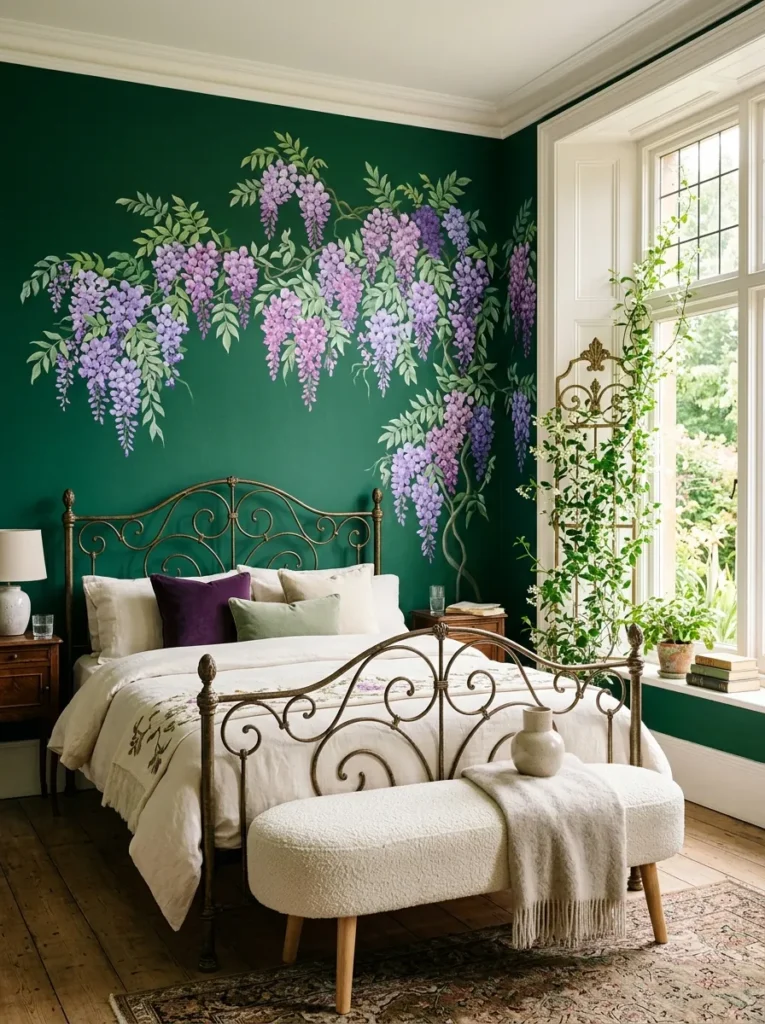
- Hand-painted mural of climbing wisteria vines in soft lilac and sage, rendered across the headboard wall against a deep emerald-green base coat
- Remaining walls in the same deep emerald (Sherwin-Williams “Rosemary” family), matte finish, for full garden immersion
- Wrought iron bed frame with a gently scrolled headboard, finished in aged bronze rather than traditional black
- Bedding in soft moss-green linen sheets with an ivory quilted coverlet
- Two lilac velvet pillows, one sage linen lumbar pillow
- Boucle bench in warm ivory at the foot of the bed
- Vintage brass floor lamp with a fluted glass shade in the reading corner
- Trailing jasmine vine in a hammered brass planter, trained to climb a slim brass trellis mounted beside the window
Why this works: A trained live vine climbing a mounted trellis beside a painted mural extends the artwork into something actually growing, which no printed wallpaper can replicate.
Emerald green is one of the most underused colors in whimsical bedroom decor, largely because people assume dark saturated tones only work in masculine or moody rooms. Paired with a hand-painted wisteria mural instead of printed wallpaper, the depth of the color becomes part of the garden fantasy rather than working against it. This is where my plant science background genuinely shapes the design choice: I trained the jasmine vine on its own brass trellis specifically because a real climbing plant beside a painted one creates a layered, almost theatrical depth that a single flat mural alone never achieves, no matter how well it’s painted.
Wrought iron in a soft aged bronze rather than stark black keeps the scrolled headboard from feeling heavy against the emerald backdrop, and it’s a detail my husband’s crew often recommends when clients want an antique feel without an actually antique (and often structurally unreliable) piece. New iron frames finished to look aged give you the romantic silhouette with none of the wobble or rust risk of a genuine vintage bed. It’s a practical swap that nobody notices is a swap at all.
9. Floating Moon Ledge
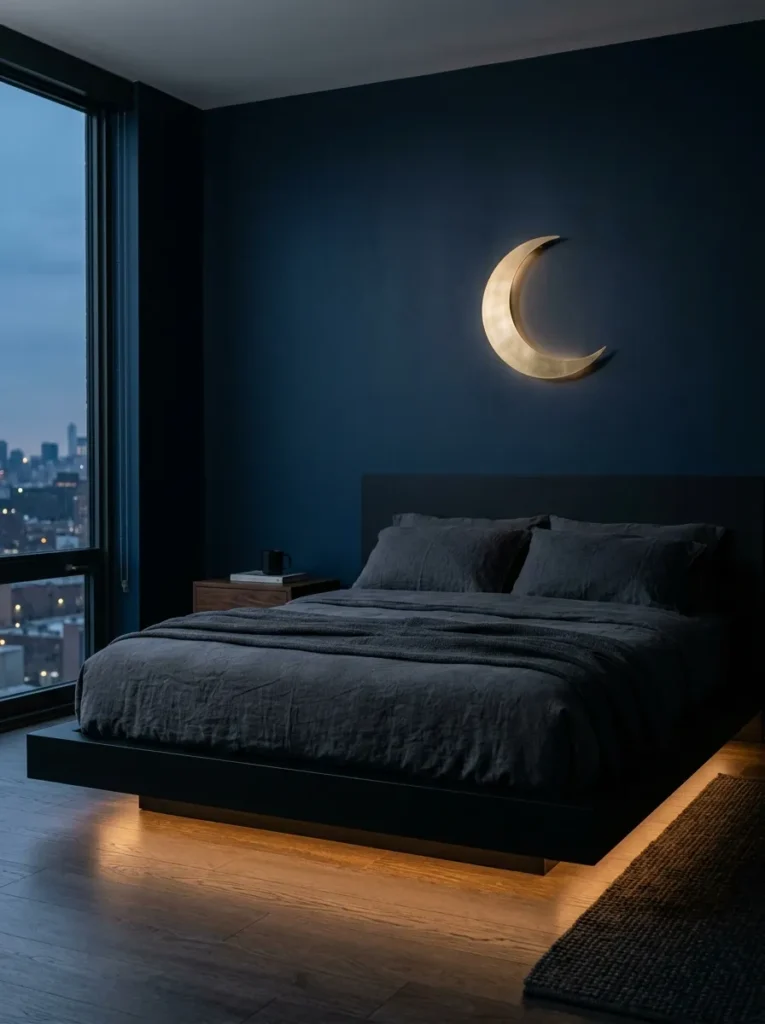
- Wall-mounted floating bed platform in matte black steel, cantilevered from the wall with no visible legs, finished with a concealed warm-white LED strip along the underside so the platform appears to hover
- Walls in a deep midnight blue (Benjamin Moore “Hale Navy” family), matte finish
- A single crescent-shaped solid brass wall sconce mounted above the headboard, doubling as both light source and celestial motif
- Bedding in charcoal linen sheets with a soft dove-gray quilted coverlet
- Two charcoal velvet pillows, one dove-gray linen lumbar pillow
- Low bouclé stool in place of a traditional nightstand, holding a single brass reading lamp
- Wool rug in charcoal and midnight blue stripe, placed beneath the floating platform’s visible glow
- Sheer navy linen curtains on a slim matte-black rod, left mostly open to let evening light in
Why this works: A concealed light strip beneath a cantilevered platform makes the entire bed frame appear to hover, turning structural engineering itself into the room’s whimsical detail.
Floating beds require real structural planning, not a decorative panel glued to the wall, which is exactly why my husband’s crew gets nervous when clients ask for one without budgeting for proper wall reinforcement first. A cantilevered platform needs to anchor into at least two wall studs with steel brackets rated well beyond the mattress and sleeper weight combined, and skipping that step is how a “floating” bed ends up sagging within a year. Done correctly, though, it’s one of the most striking whimsical bedroom decor choices available, because the illusion of weightlessness is achieved through engineering rather than any added object.
Midnight blue walls make the concealed under-platform glow read as genuinely luminous rather than like a stray strip light, since there’s no competing brightness anywhere else in the room. The single crescent sconce above the headboard is doing double duty as both the room’s primary light source and its only overtly celestial reference, which keeps the moon motif from feeling literal or theme-park in nature. Everything else in the room — the charcoal linens, the bouclé stool, the striped rug — stays deliberately quiet so that hovering glow remains the undisputed focal point.
10. Moonlit Garden Sleigh Bed
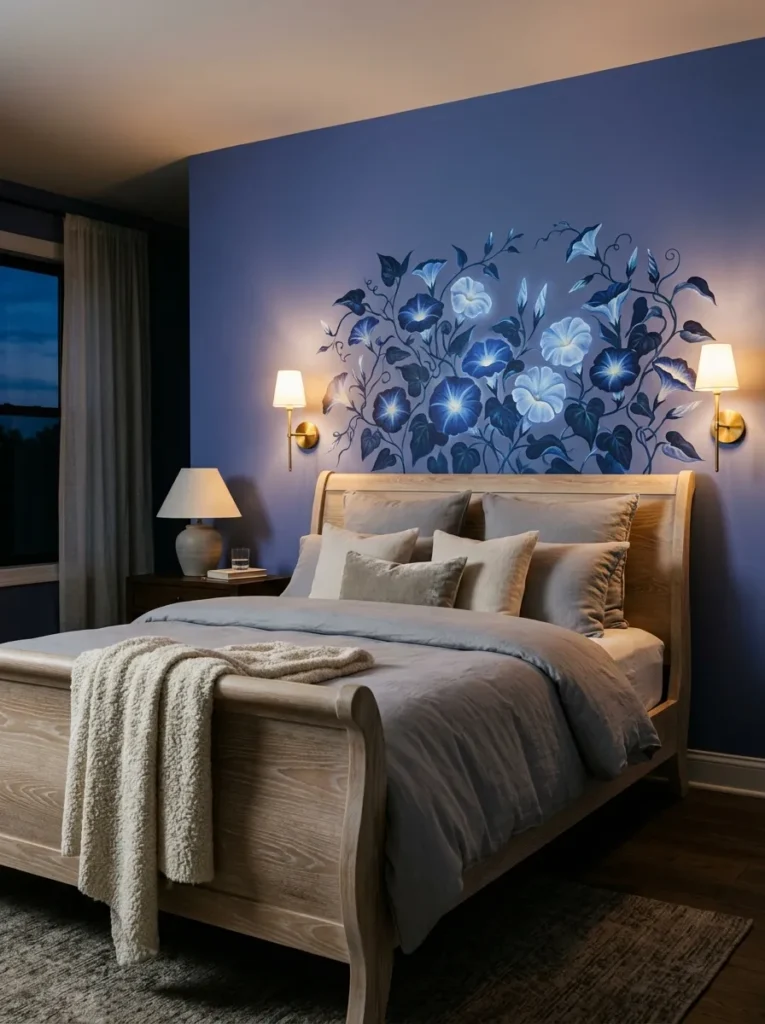
- Walls in a soft dusty periwinkle (Benjamin Moore “Windmill Wings” family), matte finish
- Sleigh-style bed frame in whitewashed oak, with the classic curved head and footboard softened by the pale wood tone rather than traditional dark mahogany
- Hand-painted mural of a night garden — climbing moonflowers and soft silver-green leaves — rendered on the wall directly behind the headboard, against a deeper indigo base within the mural itself
- Bedding in soft dove-gray linen sheets with a periwinkle quilted coverlet
- Two silver-sage velvet pillows, one indigo linen lumbar pillow
- Cream bouclé throw draped over the sleigh footboard
- Antique brass moon-phase wall sconce mounted above the mural, warm 2700K glow
- Wool rug in periwinkle and cream, centered beneath the bed, with a potted night-blooming jasmine in a stoneware planter on the dresser
Why this works: A moonflower mural confined to the space directly behind a pale sleigh headboard turns a classic silhouette into something dreamlike without changing the furniture itself.
Moonflowers only open at night, which makes them a genuinely fitting choice for a bedroom mural rather than an arbitrary pretty flower pattern — the plant’s own nature already matches the room’s nighttime mood. Whitewashing the sleigh frame instead of leaving it in a traditional dark stain keeps the whole silhouette feeling current rather than heirloom-formal, which matters when you’re pairing a classic shape with something as fantastical as a hand-painted night garden. The moon-phase sconce above ties the celestial idea together without adding a second competing motif anywhere else in the room.
I chose moonflower for a mural specifically because of how it grows in real gardens, climbing and twisting rather than sitting in a tidy row, which gives a painted version far more movement than a stiff floral repeat ever could. That’s a detail most decorators wouldn’t think to mention, but it’s exactly the kind of plant-science logic that makes a mural feel alive instead of decorative. Paired with the pale sleigh frame and soft periwinkle walls, the whole room reads as a quiet nighttime scene rather than a costume of one.
11. Cloud-Soft Minimalist Perch
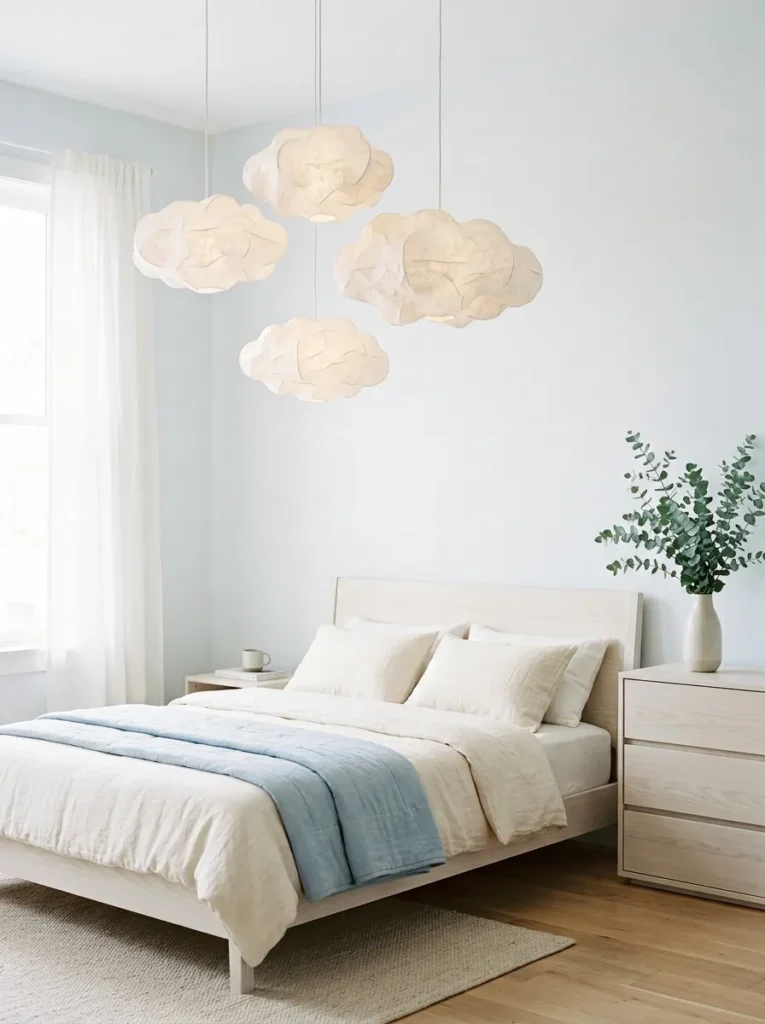
- No-headboard minimalist bed frame in matte white ash, sitting low and simple with clean rectangular lines
- Walls in the softest imaginable dove-white with a faint blue undertone (Sherwin-Williams “Snowbound” family), matte finish
- Above the bed, three oversized sculptural paper-and-linen pendant lights shaped like soft rounded clouds, clustered at varying heights and wired on a single dimmer
- Bedding in cream linen sheets with a soft powder-blue quilted coverlet
- Two cream bouclé pillows, one powder-blue velvet lumbar pillow
- Ivory mohair throw folded loosely at the foot of the bed
- Flatweave wool rug in cream with a barely-there blue stripe
- A single silver-dollar eucalyptus branch in a tall ceramic vase on the dresser, and brass reading sconces mounted on either side at headboard height since there’s no frame to anchor a lamp against
Why this works: Removing the headboard entirely gives sculptural cloud pendants room to become the room’s actual focal point instead of competing with a busy frame below them.
Sometimes the most whimsical decision in a room is what you leave out rather than what you add, and a no-headboard frame is exactly that kind of restraint. Without a tall structural piece behind the bed, three cloud-shaped pendant lights suspended at staggered heights become the undisputed visual anchor the moment you walk in. Paper-and-linen shades diffuse the light into something genuinely soft rather than harsh, closer to actual clouds catching late-afternoon sun than to any obvious light fixture. Dove-white walls with a faint blue undertone keep the whole palette feeling airy rather than sterile.
I’ve noticed that clients who are nervous about “too whimsical” almost always respond well to this idea first, because nothing about it reads as costume-like or overtly themed — it just feels soft, calm, and a little dreamlike. The clustered pendant heights matter more than people expect; hanging all three at the same level flattens the effect completely, while staggering them by even six to eight inches creates the layered, drifting quality that makes the cloud shapes feel like they’re actually floating rather than simply hanging there.
12. Jewel-Tone Velvet Alcove
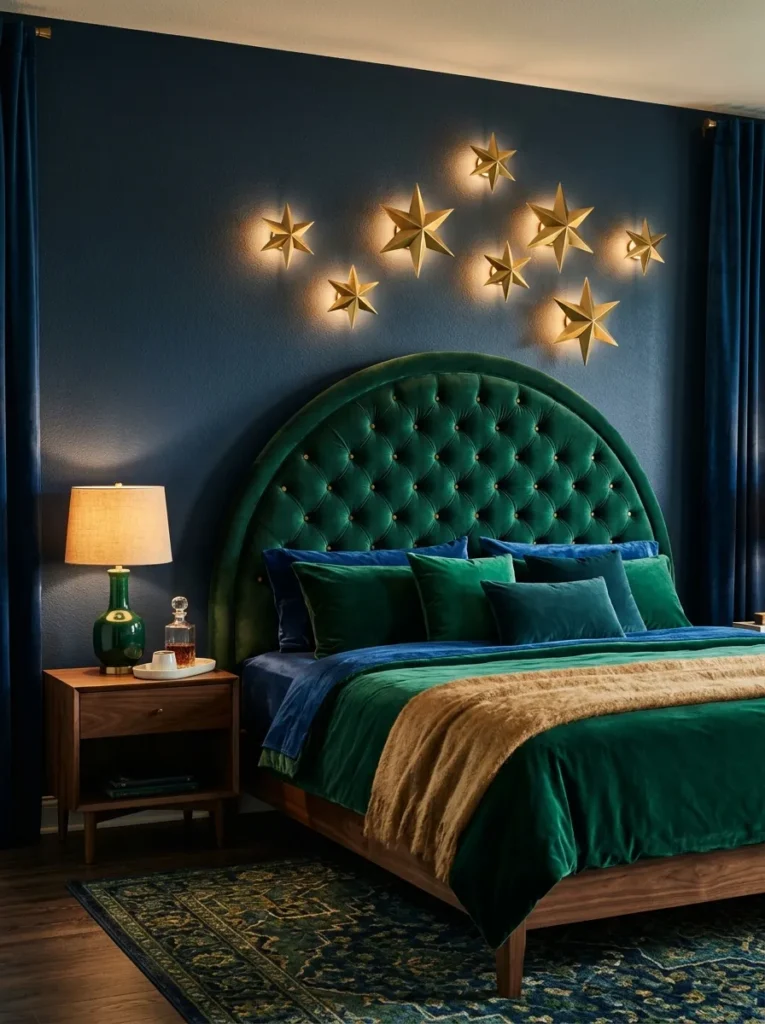
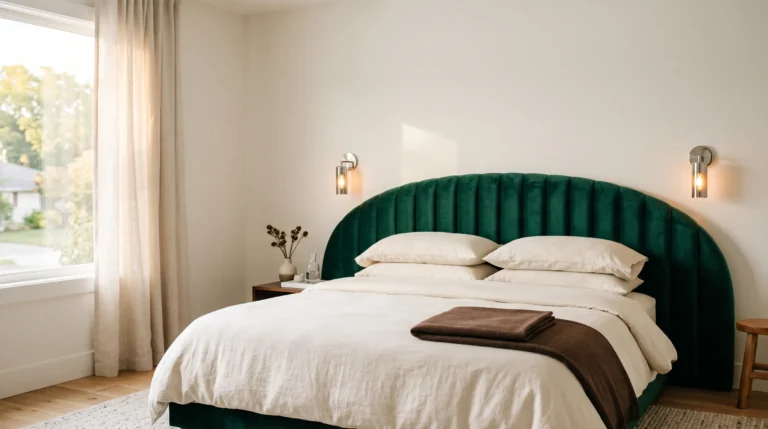
- Deep emerald tufted velvet headboard with a gently arched, button-tufted top, upholstered in a rich forest-green velvet
- Walls in a saturated deep sapphire blue (Sherwin-Williams “Naval” family), matte finish, on all four walls
- Brass star-shaped wall sconces, solid cast rather than stamped, mounted in a loose scattered cluster above the headboard rather than in a symmetrical row
- Bedding in emerald-green linen sheets with a sapphire quilted coverlet
- Two sapphire velvet pillows, one emerald linen lumbar pillow with gold piping
- Camel-colored mohair throw draped over one corner
- Hand-knotted rug in sapphire, emerald, and gold thread, centered beneath the bed
- Brass nightstands with rounded, sculptural bases (no drawers, just an open shelf), and a single brass floor lamp with a fluted glass shade in the reading corner
Why this works: Cast-brass stars scattered in an intentionally uneven cluster read as a real constellation rather than a symmetrical decorative pattern, which is what keeps the celestial motif from feeling costume-like.
Sapphire and emerald together is a color pairing most bedroom decor completely avoids, largely because two saturated jewel tones side by side can easily tip into visual chaos without the right balance of texture and metal tone. Keeping every metal finish in the room to a single warm brass, and every fabric to velvet or linen rather than anything shiny or synthetic, is what allows two bold colors to coexist without competing. The result is a room that feels closer to a richly appointed study than a themed bedroom, even with a full constellation of stars mounted above the bed.
I deliberately scattered the star sconces unevenly rather than lining them up, because true constellations don’t follow a grid, and a symmetrical arrangement immediately reads as decorative pattern instead of night sky. It’s a small styling choice, but it’s the difference between a room that looks staged for a photo and one that feels genuinely dreamed up. Gold piping on the lumbar pillow echoes the brass throughout the room just enough to tie every metal element together into one coherent, jewel-box story.
13. Blush Wave Headboard
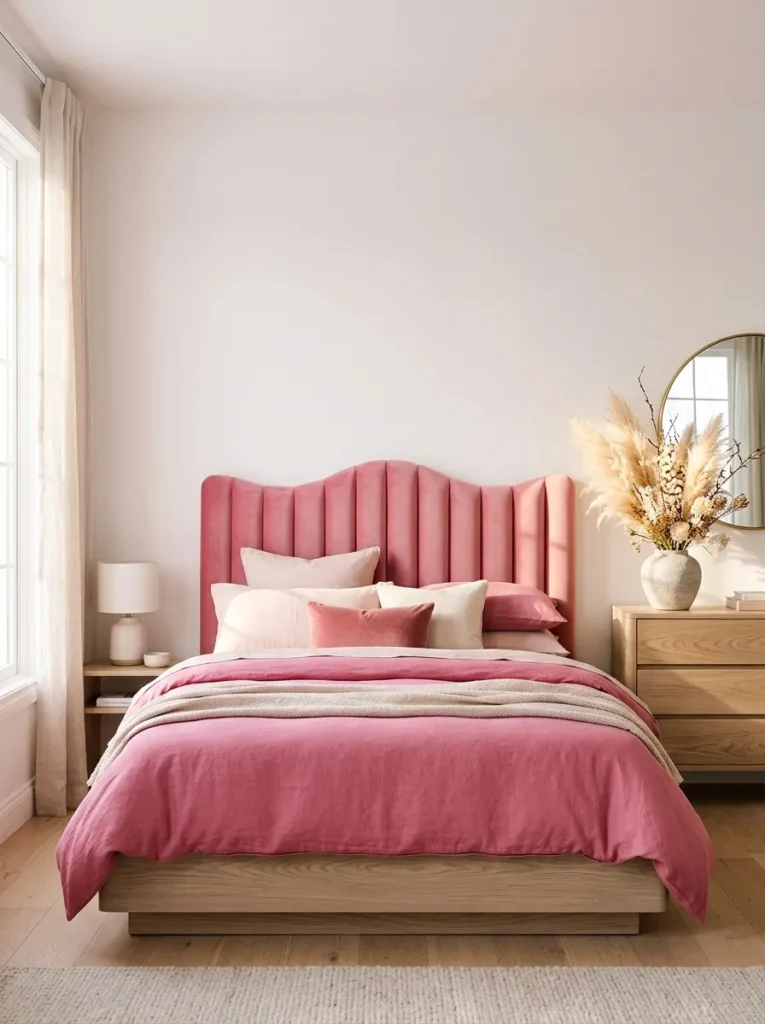
- Channel-tufted headboard in soft blush velvet, shaped in a gentle wave rather than a straight or arched line, mounted on a low platform frame in brushed ash
- Walls in the softest warm blush-white (Benjamin Moore “Pale Pink” family), matte finish
- Bedding in ivory linen sheets with a dusty rose quilted coverlet
- Two blush velvet pillows, one ivory linen lumbar pillow with a thin gold cord trim
- Cream bouclé throw draped over one corner of the bed
- Brass nightstands with rounded pedestal bases, topped with fluted glass table lamps in a soft rose tint
- Hand-knotted rug in blush, cream, and warm gray, centered beneath the bed
- A cluster of dried pampas grass in a tall stone vase on the dresser, and a slim brass curtain rod holding sheer blush-toned linen drapes
Why this works: A wave-shaped channel-tufted headboard reads as sculptural rather than sweet, which keeps a blush color palette from tipping into anything nursery-adjacent.
Blush is one of the most misunderstood colors in adult bedroom decor, mostly because it’s so often paired with soft rounded furniture and delicate accessories that push a room toward “little girl’s room” instead of “grown-up retreat.” The fix is texture and shape: channel tufting gives the headboard clean architectural lines even in a soft color, and the fluted glass lamp shades echo that same rippled texture across the room. Warm brass hardware and a gray-toned rug keep the palette from reading as purely pastel. Blush reads sophisticated when it’s paired with structured, textural pieces rather than soft, rounded ones.
I’ve steered more than one client away from pairing blush with anything cutesy or curved, because the color alone already carries a lot of softness — it doesn’t need the furniture repeating that message. A wave-shaped headboard gives the eye something structured to focus on, so the room feels intentional rather than accidentally sweet. Dried pampas grass instead of fresh flowers adds texture without introducing a second soft, romantic element, which is exactly the kind of small substitution that keeps a blush room feeling current instead of dated.
14. Rattan Canopy in Bloom
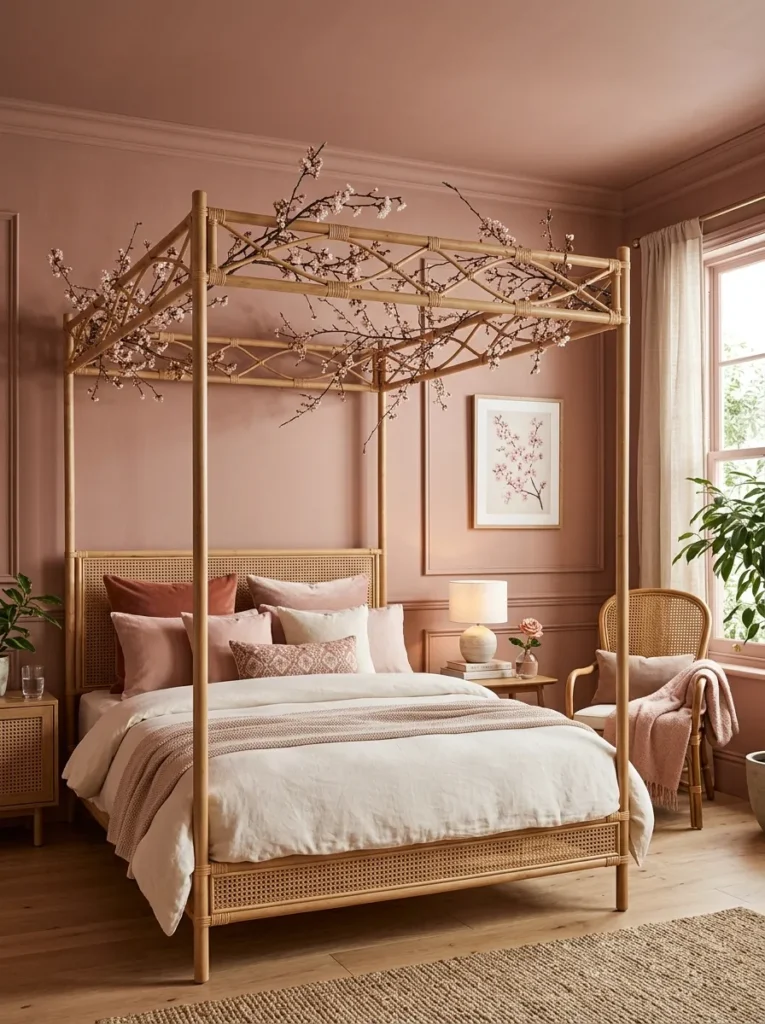
- Natural rattan four-poster canopy bed frame, hand-woven, left in its raw honey-toned finish rather than painted or whitewashed
- Walls in a soft dusty rose (Sherwin-Williams “Rosy Outlook” family), matte finish
- Real dried cherry blossom branches, gathered loosely and woven through the top rail of the canopy frame, no fabric drape at all
- Bedding in ivory linen sheets with a soft rose quilted coverlet
- Two dusty-rose velvet pillows, one ivory linen lumbar pillow
- Cream mohair throw folded at the foot of the bed
- Round rattan side table beside a curved cane-back accent chair in the corner
- Woven jute rug in natural tan beneath the bed, and a small potted cherry tree sapling in a terra cotta pot near the window
Why this works: Real dried branches woven through a canopy frame skip fabric entirely, so the whimsy comes from an actual botanical element rather than a printed or costume-like theme.
Cherry blossom themes usually show up in bedroom decor as printed wallpaper or fabric, which almost always tips toward greeting-card sweetness rather than genuine sophistication. Skipping fabric altogether and weaving real dried branches directly through a rattan canopy frame changes that completely — the texture is organic and irregular in a way no printed pattern can replicate, and the honey-toned rattan already carries a warm, natural quality that keeps the dusty rose walls from feeling overly precious. Dried branches woven through an open frame create movement and shadow that a flat fabric canopy never can.
This is one of the ideas that leans most directly into my plant science background, since dried cherry blossom branches hold their shape and soft texture for months without needing water or maintenance, unlike fresh-cut stems that wilt within days. I’ve found that gathering the branches loosely rather than arranging them symmetrically gives the canopy a wilder, more natural look, closer to something found growing than something staged. The small potted cherry sapling by the window ties the whole room back to something actually alive and growing, not just decorative.
15. Rose Gold Camelback Retreat
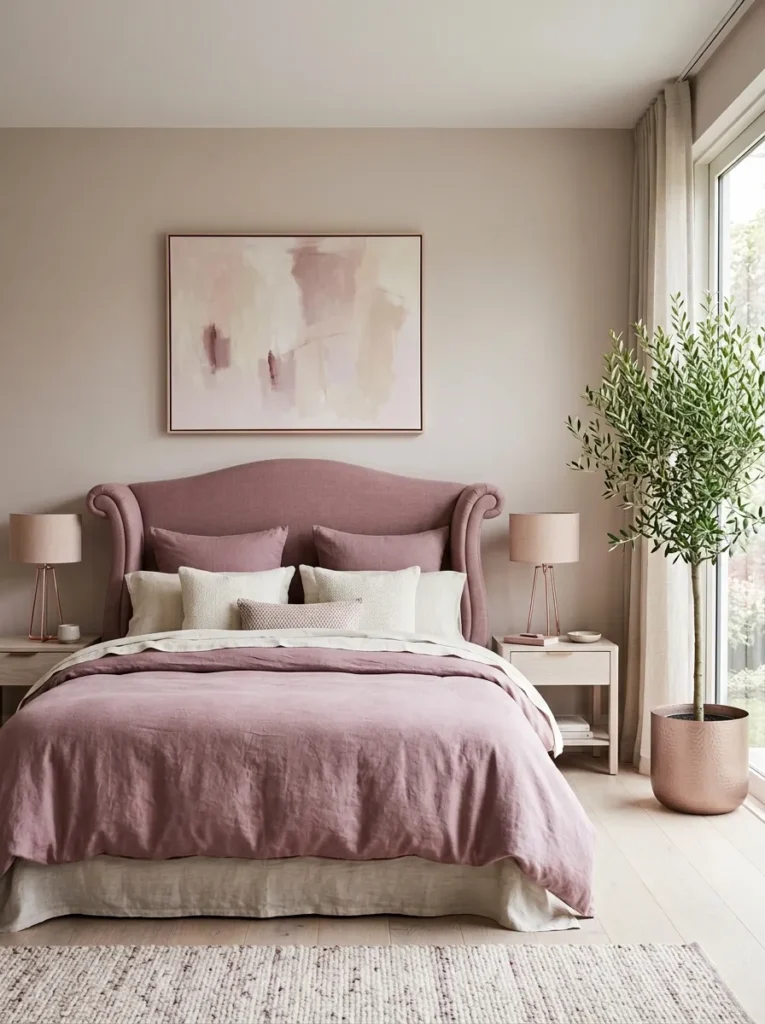
- Camelback upholstered headboard in dusty mauve linen, with a gently curved top rail and rolled arms extending partway down each side
- Walls in a warm greige-pink (Behr “Cavern Clay” adjacent softer tone), matte finish
- Bedding in soft ivory linen sheets with a mauve quilted coverlet
- Two mauve velvet pillows, one blush linen lumbar pillow
- Ivory bouclé throw draped over one rolled arm of the headboard
- Rose-gold table lamps with fluted alabaster shades on each nightstand, nightstands themselves in a pale ash wood with simple square legs
- Vintage-inspired rug in mauve, ivory, and soft gray, centered beneath the bed
- A single olive tree in a rose-gold planter positioned in the corner near natural light, and rose-gold drawer pulls throughout to keep the metal story consistent
Why this works: A camelback silhouette borrowed from traditional upholstery brings a formal, old-world curve into a soft modern palette, giving the room a quietly romantic edge without any overt theme.
Rose gold gets dismissed by a lot of designers as a passing trend, but used sparingly and consistently across every metal surface in a room, it reads as a deliberate warm-toned choice rather than a dated finish. The camelback headboard shape is borrowed from traditional English upholstery, and bringing that formal curve into a soft mauve linen instead of a heavier brocade keeps the whole piece feeling current rather than antique. This is a strong closing idea for anyone who wants their whimsy to feel like restrained romance rather than obvious fantasy.
I’ve noticed that rooms built around a single consistent metal tone always photograph and feel more finished than rooms mixing brass, chrome, and gold randomly, and rose gold in particular rewards that consistency because it reads differently depending on the light around it. In direct sun it looks almost pink; in warm lamp light, it leans closer to true gold. That subtle shift throughout the day is part of what makes a room like this feel alive rather than static, and it’s a detail worth planning for before a single piece gets purchased.
16. Peacock Teal Wingback Nook
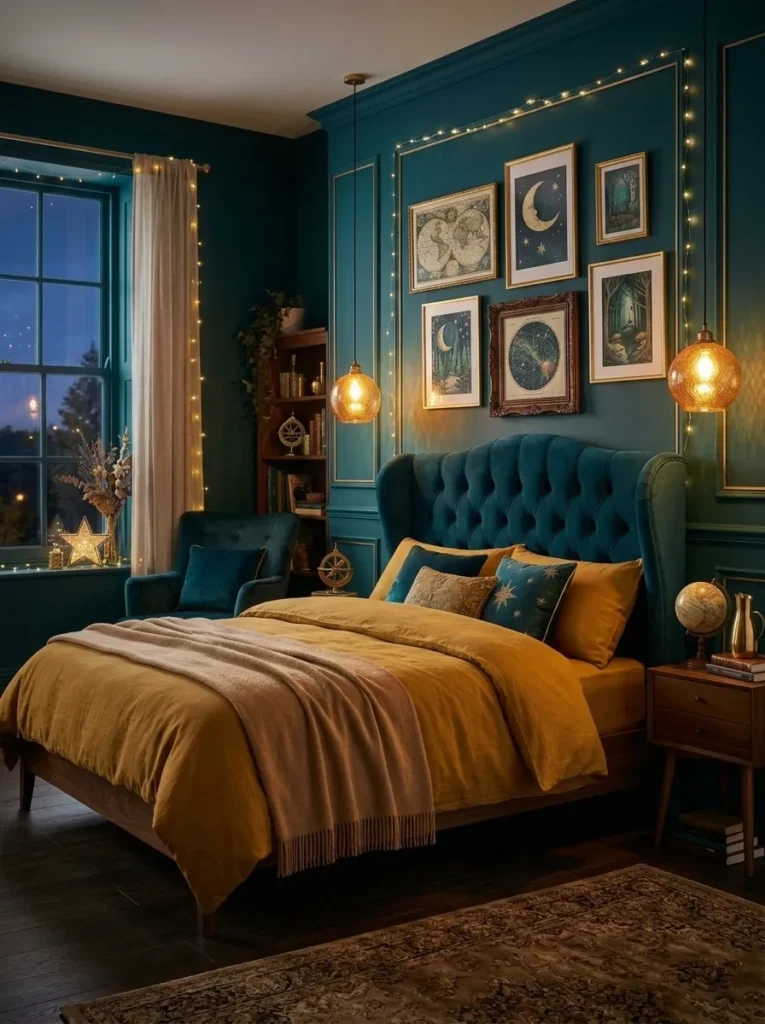
- Tall wingback-style upholstered headboard in deep peacock-teal velvet, with side panels that curve slightly inward to frame the pillows
- Walls in the same peacock teal (Sherwin-Williams “Rocky River” family), matte finish, on all four walls for full immersion
- Bed frame beneath the headboard kept simple: a low walnut base with no visible footboard
- A single amber-glass pendant light hung low beside the bed instead of a nightstand lamp, casting a warm honeyed glow across the headboard’s velvet texture
- Bedding in warm ivory linen sheets with a mustard-gold quilted coverlet
- Two teal velvet pillows, one mustard linen lumbar pillow
- Camel mohair throw folded at the foot of the bed
- Brass drawer pulls and a brass pendant cord to keep the metal story consistent, plus a hand-knotted rug in teal, mustard, and cream beneath the bed
Why this works: A wingback headboard’s curved side panels create a sense of enclosure around the pillows, giving the room an intimate, cocoon-like feeling that a flat headboard never achieves.
Peacock teal is a color most homeowners are afraid to commit to on all four walls, but paired with warm ivory and mustard-gold accents, the saturation reads as rich and enveloping rather than cold or overly dramatic. The wingback shape borrows from traditional upholstered armchairs, and translating that curved, protective silhouette into a headboard gives the whole bed a sense of being tucked in rather than simply placed against a wall. A wingback headboard’s curved panels create an enclosed, cocoon-like feeling that flat headboards can’t replicate.
I’ve noticed that clients drawn to deep jewel tones like this one often worry the room will feel too dark or heavy, but a single warm light source positioned low and close to the bed changes that completely. The amber-glass pendant beside the headboard throws a honeyed glow directly onto the teal velvet, and that contrast between cool wall color and warm light is what keeps the whole room feeling inviting rather than cave-like once evening sets in.
17. Burgundy Bentwood Retreat
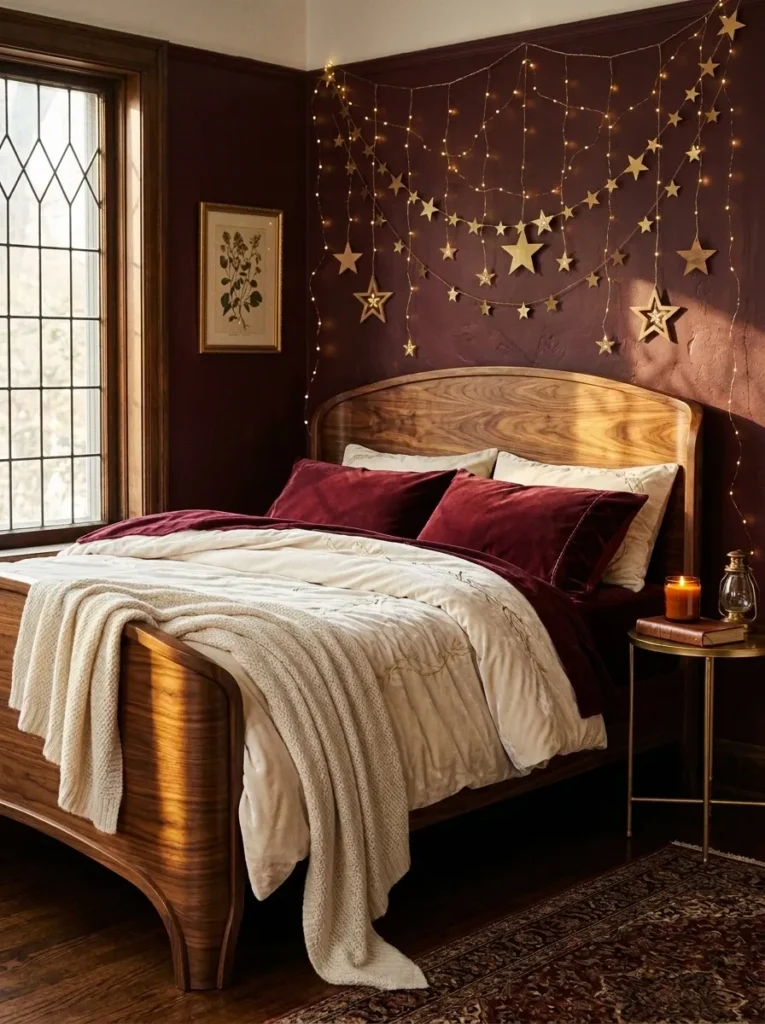
- Curved bentwood bed frame in a deep-stained walnut, the headboard and footboard both formed from a single continuous bent wood arc rather than straight panels
- Walls in a rich burgundy-wine (Benjamin Moore “Merlot” family), matte finish
- A single spiced amber candle kept on the nightstand, its warm cedar-and-clove scent echoing the deep, cozy tone of the room rather than sitting apart from it
- Bedding in ivory linen sheets with a burgundy velvet coverlet
- Two burgundy velvet pillows, one ivory linen lumbar pillow with gold piping
- Cream bouclé throw draped over the curved footboard
- Round brass nightstands with pedestal bases, topped with small fluted glass lamps
- Vintage wool rug in burgundy, gold, and cream, centered beneath the bed
Why this works: A single continuous bentwood arc forming both headboard and footboard gives the frame a fluid, sculptural silhouette that a jointed, straight-lined frame could never achieve.
Bentwood furniture has a long design history rooted in curved, steam-shaped wood, and applying that same technique to a full bed frame produces a silhouette that feels genuinely sculptural rather than assembled from flat panels. Against deep burgundy walls, the curved walnut arcs catch light differently depending on where you’re standing in the room, which gives the frame a quiet sense of movement even though it’s completely still. Gold piping on the lumbar pillow and the round pedestal nightstands both echo that same curved language throughout the room, so nothing feels like a straight-edged interruption.
My husband’s team occasionally builds custom bentwood pieces for clients, and the process is genuinely more involved than most people expect — the wood has to be steamed and clamped into the curve over days, not hours, or it springs back toward flat once released. That patience is exactly what gives a piece like this its value; a rushed curve looks stiff, while a properly steamed one holds a soft, continuous arc that reads as effortless even though it took real time to achieve.
18. Golden Hour Petal Headboard
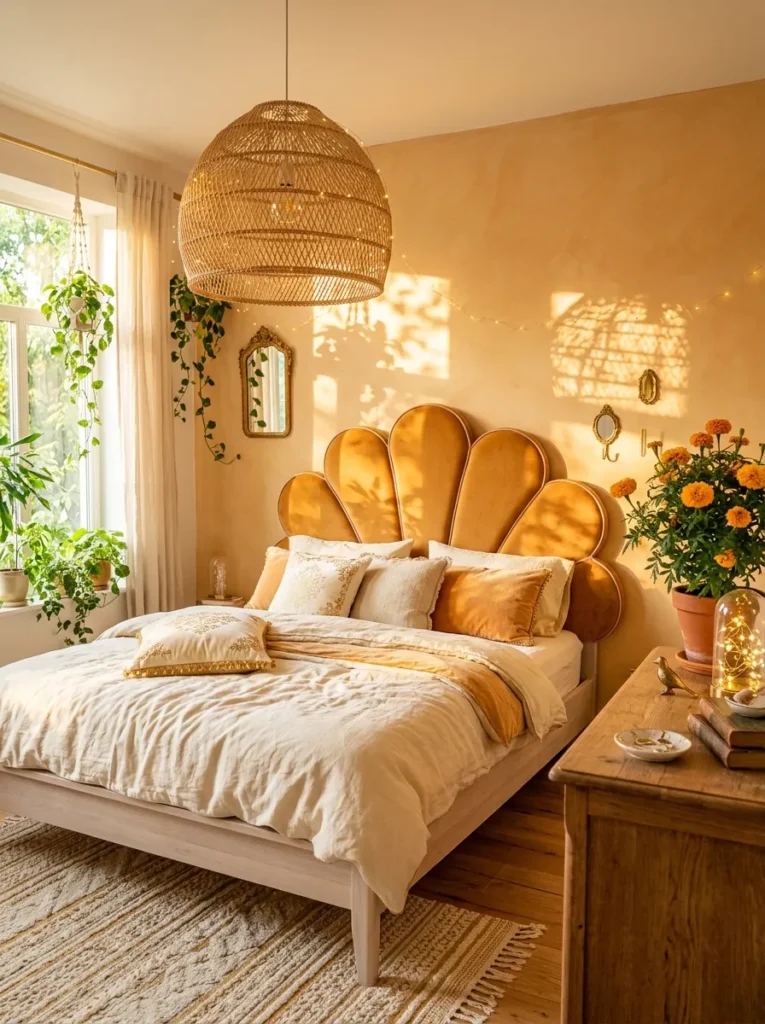
- Petal-shaped tufted headboard in warm apricot-gold velvet, composed of three overlapping rounded panels rather than one flat piece, giving it a soft flower-like silhouette
- Walls in a warm honeyed apricot (Sherwin-Williams “Gobi Desert” family), matte finish
- Low platform bed frame in pale ash wood beneath the headboard
- Bedding in ivory linen sheets with a soft gold quilted coverlet
- Two apricot velvet pillows, one ivory linen lumbar pillow
- Woven rattan pendant light hung above the bed, casting soft dappled shadow patterns across the ceiling and headboard in the evening
- Cream bouclé throw folded at the foot of the bed
- Flatweave jute rug in warm tan, and a small potted marigold in a terra cotta pot on the dresser, echoing the gold tones throughout
Why this works: Three overlapping rounded panels give the headboard a soft, floral silhouette without a single literal flower printed or painted anywhere in the room.
Apricot and gold together create one of the warmest palettes possible in a bedroom, and the petal-shaped headboard is what earns this room its whimsy without relying on any literal botanical imagery. Three overlapping tufted panels catch light and shadow differently than a single flat surface would, so the shape reads as soft and organic even in solid velvet. A woven rattan pendant overhead does quiet extra work here too, throwing dappled shadow patterns across the ceiling and headboard as the light shifts through the day, which keeps the room feeling alive rather than static.
I’ve found that warm, golden color palettes like this one photograph beautifully but can feel flat in person without a light source that actually moves shadow around the room, which is exactly why the rattan pendant matters as much as the headboard shape itself. Dappled shadow from a woven pendant does more to make a room feel alive throughout the day than any static wall color alone. Paired with the pale ash bed frame and a single potted marigold, the whole space feels like captured late-afternoon light rather than a themed color scheme.
Styling Principles: Keeping Whimsy Sophisticated
The line between “playful adult bedroom” and “kid’s room cosplay” comes down to three things: restraint, scale, and material quality.
- Restraint. Pick one whimsical device per room — a curved headboard, a mural, a lit canopy — and let everything else stay quiet. Two or three whimsical elements competing in the same space is what tips a room toward costume-like rather than curated.
- Scale. An oversized mirror, an unusually shaped headboard, or a floor-to-ceiling mural reads as intentional design. The same idea shrunk down to a small accessory reads as a novelty item. Bigger, bolder, and more architectural almost always looks more grown-up than small and scattered.
- Material quality. Real brass instead of gold-painted plastic. Hand-painted murals instead of printed wallpaper. Velvet, linen, and solid wood instead of synthetic fabrics and laminate. Grown-up whimsical style is built on materials that would look at home in any high-end interior, even before the playful shape or color is added.
The single biggest mistake in whimsical bedroom decor is stacking too many playful details in one room instead of choosing one and building quality around it.
Frequently Asked Questions About Whimsical Bedroom Ideas for Adults
How do you make whimsical decor look adult instead of childish? Limit each room to one whimsical focal point, choose oversized or unusual shapes over small themed objects, and use high-quality materials like velvet, brass, and hand-painted finishes rather than printed or plastic ones.
What colors work best for a whimsical adult bedroom? Saturated, moody tones — deep plum, emerald, sapphire, burgundy — tend to read as sophisticated, while soft pastels work best when paired with structured, textural furniture rather than rounded, delicate pieces.
Are string lights or fairy lights ever appropriate in an adult bedroom? Yes, when they’re warm white or amber toned (not multicolored), woven into a canopy frame or along architectural details rather than scattered loosely, and connected to a dimmer for control over brightness.
What are budget-friendly ways to add whimsy to a bedroom? A single statement mirror, one hand-painted accent wall, or trailing plants hung at staggered heights all bring genuine personality into a room without a full furniture overhaul.
How much whimsy is too much for one bedroom? As a general rule, one clear whimsical device per room is enough. Once a space has more than two or three overtly playful elements competing for attention, it starts to feel themed rather than styled.
What’s the best whimsical bedroom idea for a small space? An oversized mirror or a single hand-painted mural confined to the headboard wall both add drama without requiring extra floor space, making them strong options for smaller rooms.
Conclusion
Whimsy in a bedroom doesn’t have to mean starting over or committing to a full theme. Sometimes it’s one curved headboard, one hand-painted wall, or one light source that changes how a room feels after dark. These 18 whimsical bedrooms for adults share the same idea: real materials, confident scale, and just enough restraint to stay sophisticated. I’ve seen how one well-chosen detail like these can transform a space more than a full renovation would.
Save this post to Pinterest, pick the idea that feels most like you, and try it in your own room. Share it with a friend who needs more personality in their space.