20 Winter Home Decor Ideas That Last All Season
Winter is the most under-decorated season in American homes, and that’s a design problem, not a personal failing. Most of us decorate hard for the holidays, strip everything on January 2, and then live with bare shelves for two and a half months. Winter, as its own decorating season, runs roughly 10 to 12 weeks, from early January through mid-March in most U.S. climates, nearly as long as any other season. Yet almost no advice treats it as a separate identity from Christmas. Winter home decor works best when it centers on cold light, bare branches, and texture rather than holiday ornaments.
Last January, I walked into a client’s home in Round Rock and found one lonely wreath and a bare mantel where the tree had been. Nothing was broken. It just had no plan. This winter decor guide shows you how to decorate for winter room by room, so your home looks intentional from the first frost to the first crocus.
1. Frosted Lunaria Crescent
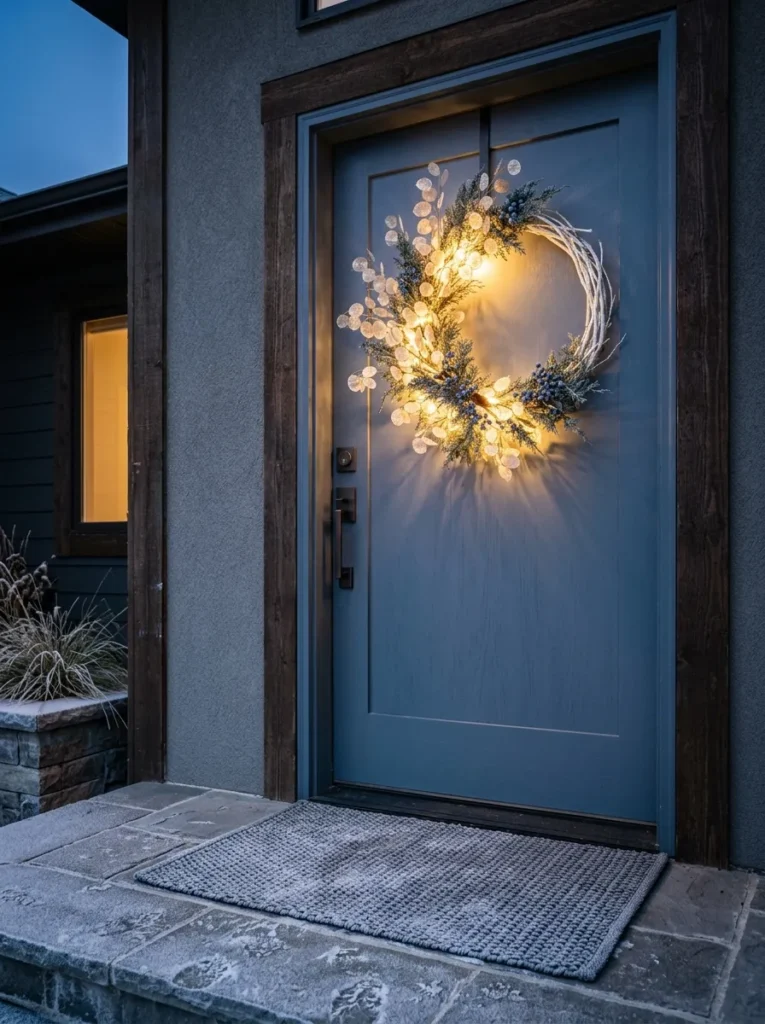
- Palette: icy blue-white: matte slate-blue door, frosted white, pale silver, dusty blue
- Wreath: an off-center crescent about 28 inches tall on a grapevine base, wired with 22-gauge floral wire
- Plants: dried lunaria (silver dollar) pods, blue-berried juniper sprigs, white-washed pussy willow
- Lighting: swap the porch bulb to 3000K so the silver pods glow instead of turning yellow
- Textile: a cream-and-gray herringbone coir doormat, no red anywhere
- Wow moment: at dusk the translucent pods catch the porch light like frosted glass
- Budget: roughly $45 to $60 in craft-store stems, less if you grow your own lunaria
Why this works: A cool blue-white palette against a matte door reads as frost rather than Christmas, and translucent seed pods glow under porch light.
Lunaria pods look like pieces of frosted glass hanging on a stem, which is exactly why they belong on a winter door. Botanically, the silvery disc is the septum, the thin membrane left behind after the outer seed coverings fall away, so nothing about it needs painting or frosting. Pair it with juniper, whose dusty blue berries are actually fleshy seed cones, and the whole crescent reads as ice without a single ornament. The color stays icy blue-white from door to doormat, which keeps the wreath from being mistaken for Christmas leftovers. It lasts through March.
My husband, who builds homes for a living, flagged something I had ignored for years: over-the-door hangers pinch the weatherstripping and leave a gap at the top of the frame. In a cold snap, that gap is a draft you pay for. Use a magnetic hook on a steel door, or a small brass screw hook in the top rail of a wood door. Hang the crescent slightly off-center, tilted toward the hinge side, so the doorknob stays clear. I’ve tried it on a matte slate-blue door and a white one, and blue wins every time.
For 15 more front door wreath winter ideas, see our full Winter Wreath Ideas for Front Door guide.
2. Magnolia and Black Steel
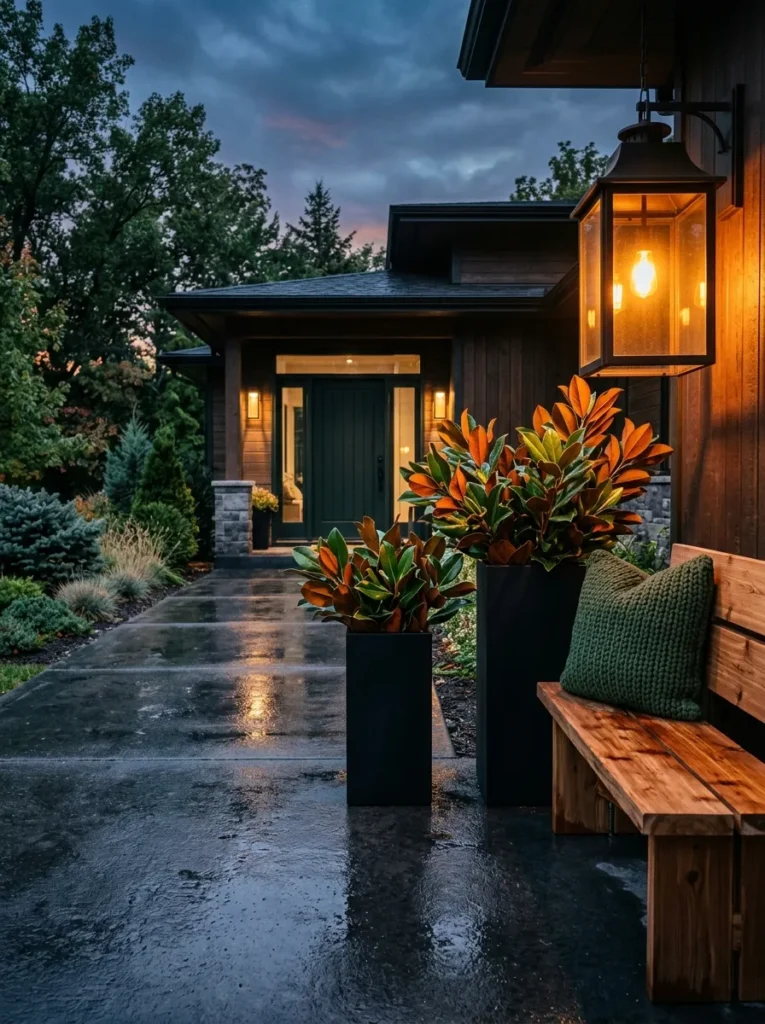
- Palette: deep evergreen, rust-brown, blackened steel, raw cedar
- Anchor: two 30-inch blackened-steel planters, frost-proof and set on small feet
- Plants: cut Southern magnolia stems, glossy on top with rust-brown suede undersides
- Seating: a split cedar bench between the planters, left unfinished for texture
- Textile: one solution-dyed acrylic pillow in forest green, made to survive rain and frost
- Lighting: one oversized lantern with an amber LED flame, lit at dusk
- Wow moment: the lantern turns the rust undersides copper, like embers in green
- Budget: about $25 per bunch of stems, or free from a neighbor’s tree
Why this works: Southern magnolia’s waxy, leathery leaves stay glossy for weeks in freezing weather, so a porch can look full and expensive for almost nothing.
Southern magnolia leaves are built for weather. Their thick, waxy cuticle slows moisture loss, which is why cut stems stay glossy for weeks on a porch that dips below freezing overnight. Flip one over and you find the surprise: a rust-brown, suede-soft underside that no artificial garland can fake. Stack the stems tall in two blackened-steel planters and the whole porch turns deep evergreen with copper edges. Add a split cedar bench between them, and a lantern glowing at dusk lights those undersides like embers. The stems cost about $25 a bunch, or nothing from a neighbor’s tree.
Here’s the mistake I made in my first winter styling porches: I used terracotta. Water soaks into it, freezes, and cracks the pot from inside, which is why I now choose fiberglass or steel. My husband adds a second warning from the jobsite: rock salt is a common cause of concrete spalling, those flaky, pitted patches on porch slabs. Use sand for traction instead, and set planters on small feet so water drains away from the slab. In Austin, even one hard freeze is enough to split a wet terracotta pot overnight.
For 15 more porch winter ideas, see our full Winter Porch Decor Ideas That Survive the Cold guide.
3. Charcoal Boot Bench and Frosted Fern
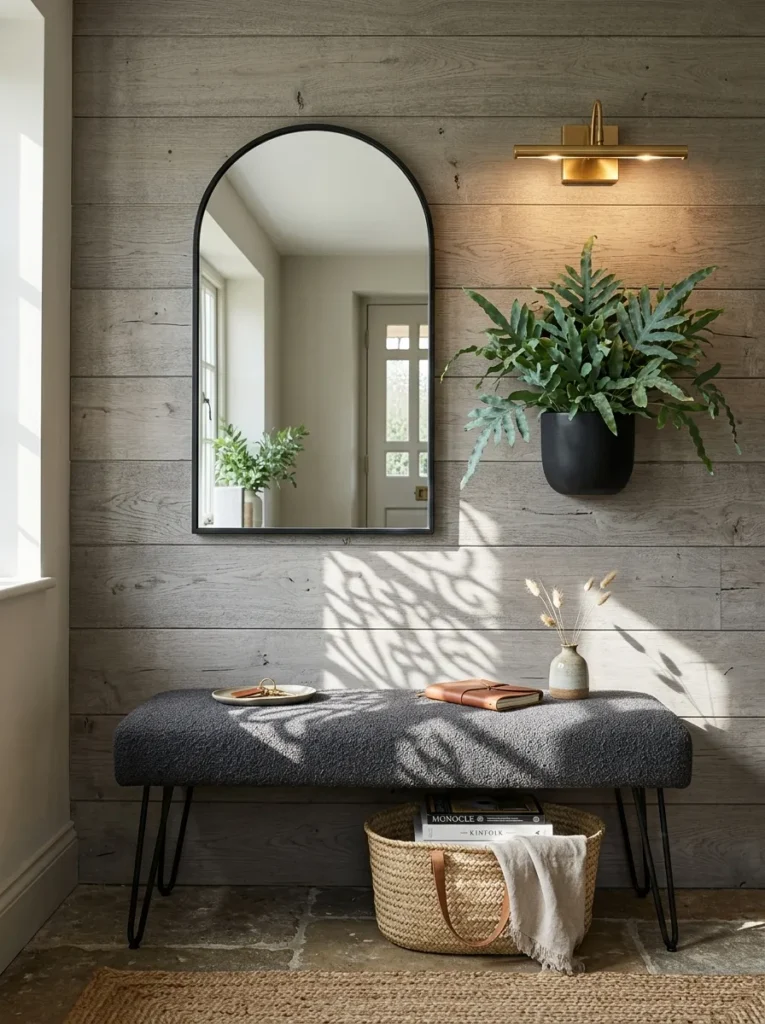
- Palette: charcoal bouclé, weathered gray oak, matte black iron, frosted sage-green
- Bench: a low charcoal bouclé boot bench with black iron hairpin legs, set against the entry wall
- Storage: a woven charcoal seagrass basket beneath, for wet boots and gloves
- Plant: a potted blue star fern in a matte black concrete planter, chosen for low light and cool drafts
- Mirror: a slim, arched black-framed mirror hung above the bench
- Lighting: a wall-mounted brass picture light angled down onto the fern’s fronds
- Textile: a folded weathered-gray wool throw draped over one end of the bench
- Wow moment: the fern’s blue-green fronds catch the picture light and cast lacy shadows across the charcoal bouclé
Why this works: A boot bench with real cold-tolerant greenery turns a mudroom entry into a styled moment instead of a dumping spot for winter coats.
Every home has one: the entry corner that becomes a pile of boots, mittens, and abandoned umbrellas by mid-January. Fixing it starts with furniture that does double duty. A low charcoal bouclé bench with black iron hairpin legs gives people somewhere to sit while pulling off wet boots, and a woven seagrass basket underneath swallows the clutter completely. Above it, a slim black-framed arched mirror lets you check your coat on the way out. The whole corner goes from chaotic to composed in an afternoon, using furniture you likely already need anyway.
Blue star fern is the detail that makes this corner feel alive rather than staged. It tolerates the cold drafts and lower light typical of an entryway, conditions that kill most houseplants by February. I’ve watched this exact fern survive a drafty Austin entry through two winters, still pushing new silvery-blue fronds each spring. Set it in a matte black concrete planter, angle a small brass picture light onto the fronds, and the lacy shadows land across the bouclé bench like frost on fabric. It costs less than a fresh floral arrangement and it lasts all season.
4. Pewter and Bare Branch
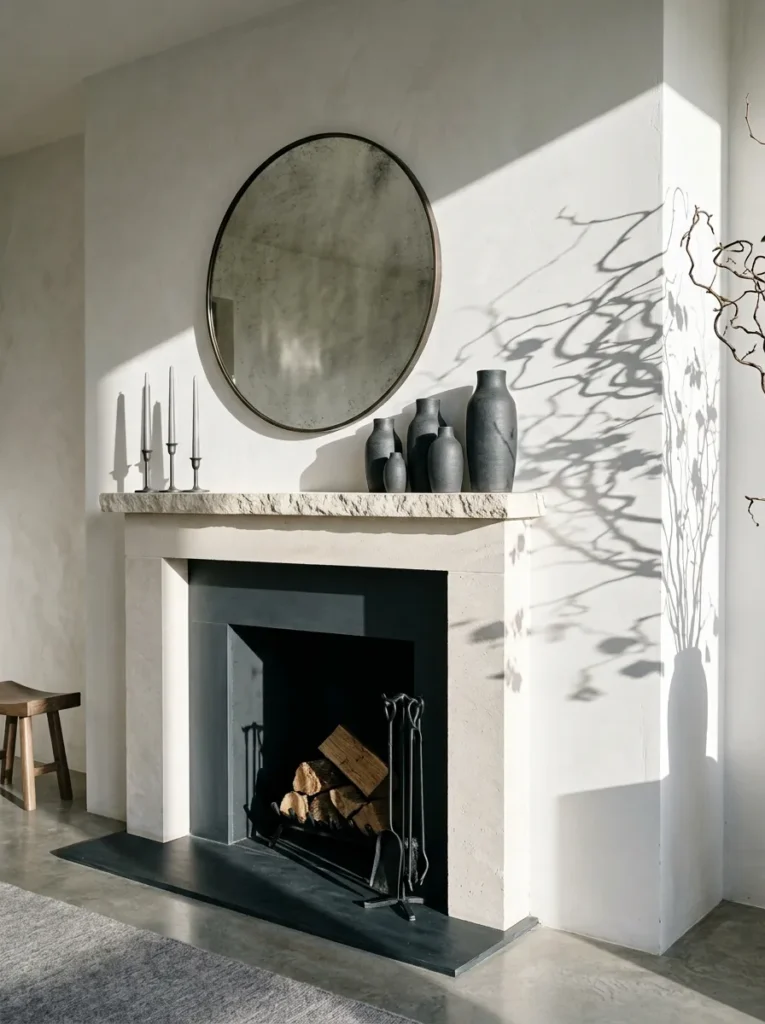
- Palette: pewter gray, charcoal stoneware, antiqued mercury-glass silver, bone-white wall
- Anchor: five hand-thrown charcoal stoneware vases in graduated heights, staggered with the tallest off-center
- Plants: one contorted hazel branch per vase (Harry Lauder’s walking stick)
- Mirror: a round antiqued-mercury mirror, about 30 inches, leaned at one end of the mantel
- Candles: three tall pewter-toned tapers, lit only at dusk
- Textile: a pewter-gray mohair throw draped over the nearest armchair
- Wow moment: low afternoon sun throws twisted branch shadows up the wall like ink drawings
- Budget: under $100 if the hazel comes from your own yard or a friend’s
Why this works: Bare, twisted branches give a mantel structure and shadow play, so a palette with no color at all still looks rich.
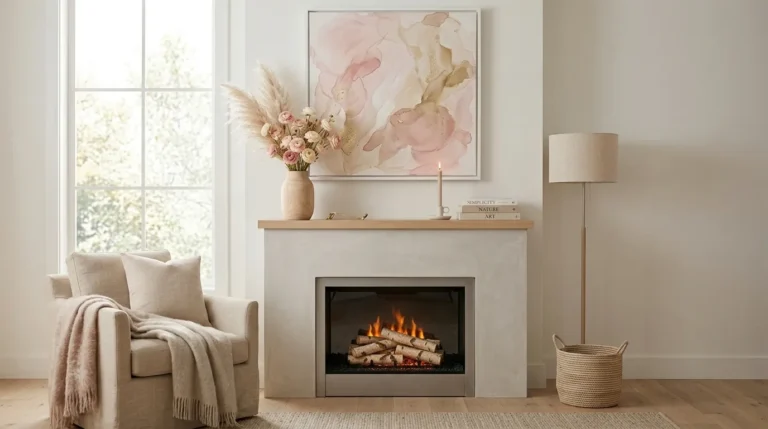
I still remember the January afternoon a client’s contorted hazel shrub, bare and knotted, changed how I think about winter mantels. Its branches curled like handwriting, and I couldn’t stop looking. I cut five, dropped each into a different-height charcoal stoneware vase, and lined them up beside a round mercury-glass mirror and three pewter tapers. At four o’clock, low sun raked across the mantel and threw the twisted shadows up the wall like ink drawings. My client stopped mid-sentence. That’s the effect: a palette of pewter, charcoal, and silver with no color at all, letting light do the decorating.
Contorted hazel, sold as Harry Lauder’s walking stick, earns its place in winter home decor because it does its best work when bare. By late winter, soft catkins dangle from the twisted stems, adding pollen-dusted movement without a single ornament. Keep the vases at three different heights, with the tallest off-center. Leave at least a hand’s width between vessels so the shadows stay separate instead of blurring into one mass. Light the tapers only at dusk, so the mantel has two moods: shadow drawing by day, candlelight by night. Keep candles and dry branches clear of the firebox opening.
For 15 more mantel winter ideas, see our full Winter Mantel Decorating Ideas Beyond Christmas guide.
5. Charred Oak and Alabaster
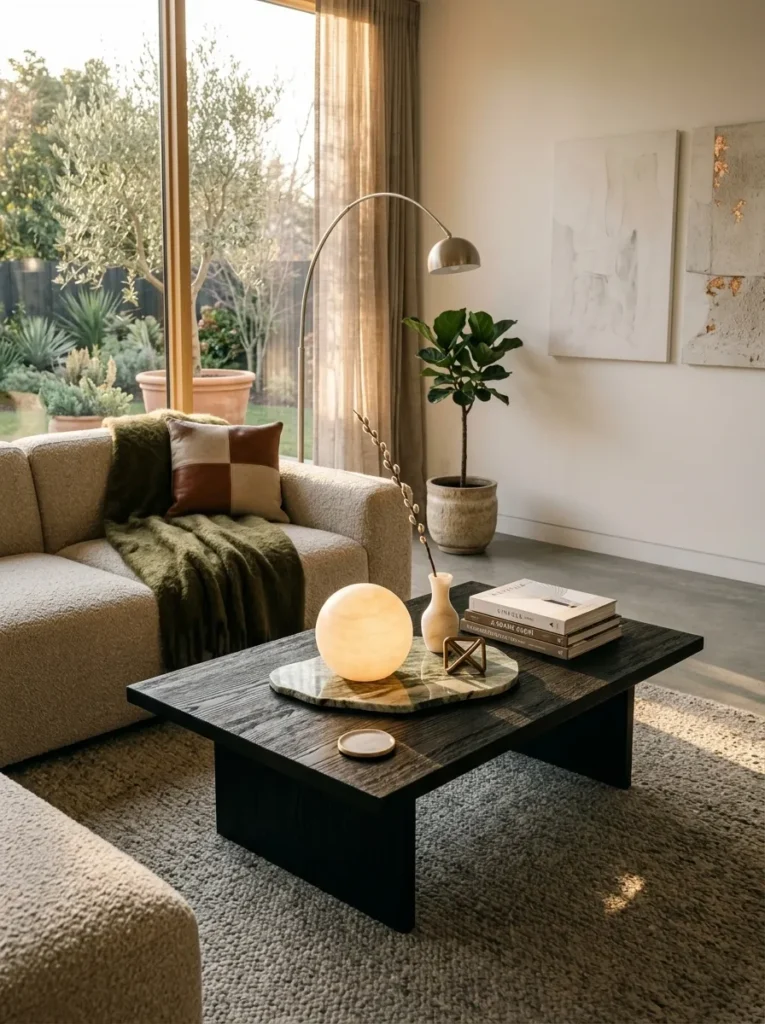
- Palette: charred black oak, alabaster white, oatmeal bouclé, brushed nickel
- Anchor: a low charred-oak coffee table (shou sugi ban finish) with visible wood grain through the char
- Seating: a curved oatmeal bouclé sectional, no throw pillows with pattern
- Sculpture: one alabaster stone orb, roughly 8 inches, set alone on the table
- Lighting: a brushed-nickel arc lamp positioned to cast the orb’s shadow across the table’s charred surface
- Plant: a single stem of pussy willow in a narrow alabaster vase
- Wow moment: the orb’s soft white curve against blackened wood grain looks like a sculpture gallery, not a living room
- Budget: a shou sugi ban table runs $400 to $900; the alabaster orb, $60 to $120
Why this works: Extreme material contrast, charred black wood against pale alabaster, creates visual drama without adding a single extra object.
Shou sugi ban is a centuries-old Japanese technique: wood is charred, then brushed and sealed, which chars the surface into a texture with real depth. My husband started using it on exterior siding for its weather resistance, and I borrowed the idea for indoor furniture. The result is a coffee table with a matte black surface that still shows wood grain when light rakes across it. Set one pale alabaster orb on that black surface, and the contrast does all the styling work. No clutter, no pattern, no red or green anywhere. This is winter as a material story rather than a color story.
Restraint is the hardest part of this look, and also the most important. One object on the table, one plant, one lamp: that’s the whole room. I’ve furnished plenty of winter living rooms that tried to do too much, layering blankets, candles, and greenery until the charred table disappeared under clutter. Here, the oatmeal bouclé sectional stays free of patterned pillows so the eye lands on the table. Position the arc lamp so its light rakes low across the surface at an angle, letting the orb cast a long, soft shadow. That shadow is the room’s real decoration.
6. Forest Bouclé and Woven Rattan
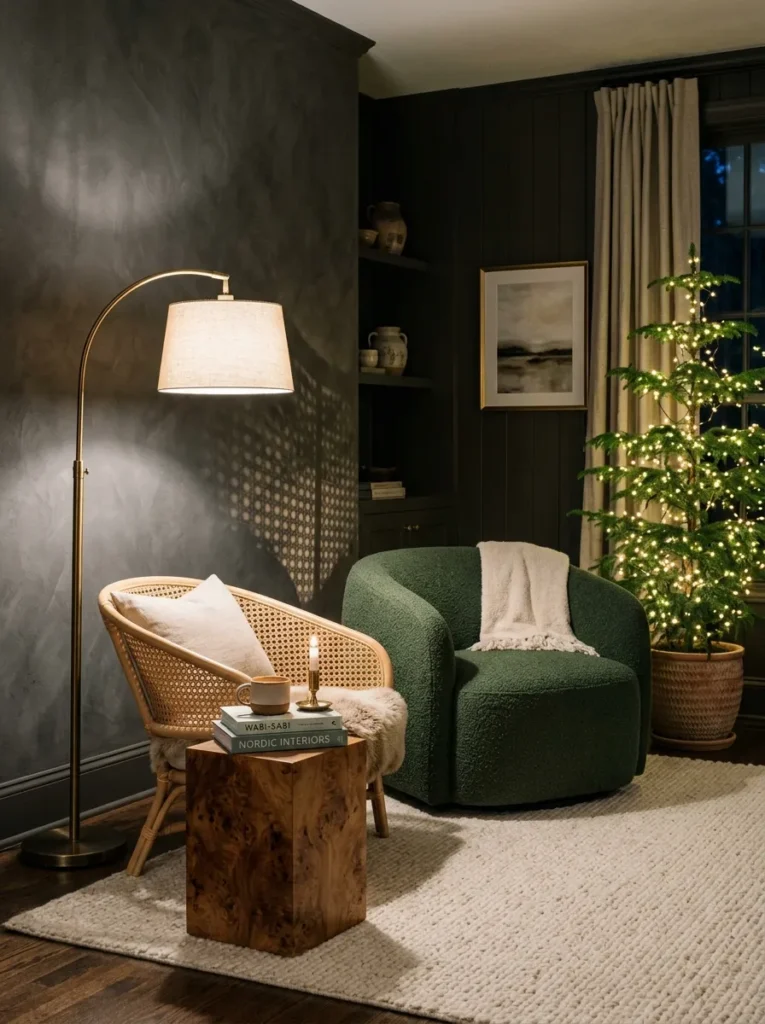
- Palette: deep forest-green bouclé, natural rattan, cream wool, aged brass
- Seating: a curved forest-green bouclé armchair paired with a woven rattan accent chair
- Table: a round cream wool rug beneath a low burl-wood side table
- Lighting: an aged-brass floor lamp with a linen drum shade, warm 2200K bulb
- Textile: a chunky cream wool throw folded over the rattan chair’s arm
- Plant: one potted Norfolk Island pine in a woven seagrass basket, strung with a single loop of tiny warm-white lights
- Wow moment: the rattan’s woven shadow pattern falls across the cream rug when the floor lamp is lit at night
- Budget: the Norfolk pine runs $25 to $45 and doubles as a living, reusable “tree” for years
Why this works: Pairing a soft bouclé chair with a natural rattan one keeps a forest-green room from feeling heavy, and texture does the work color usually does.
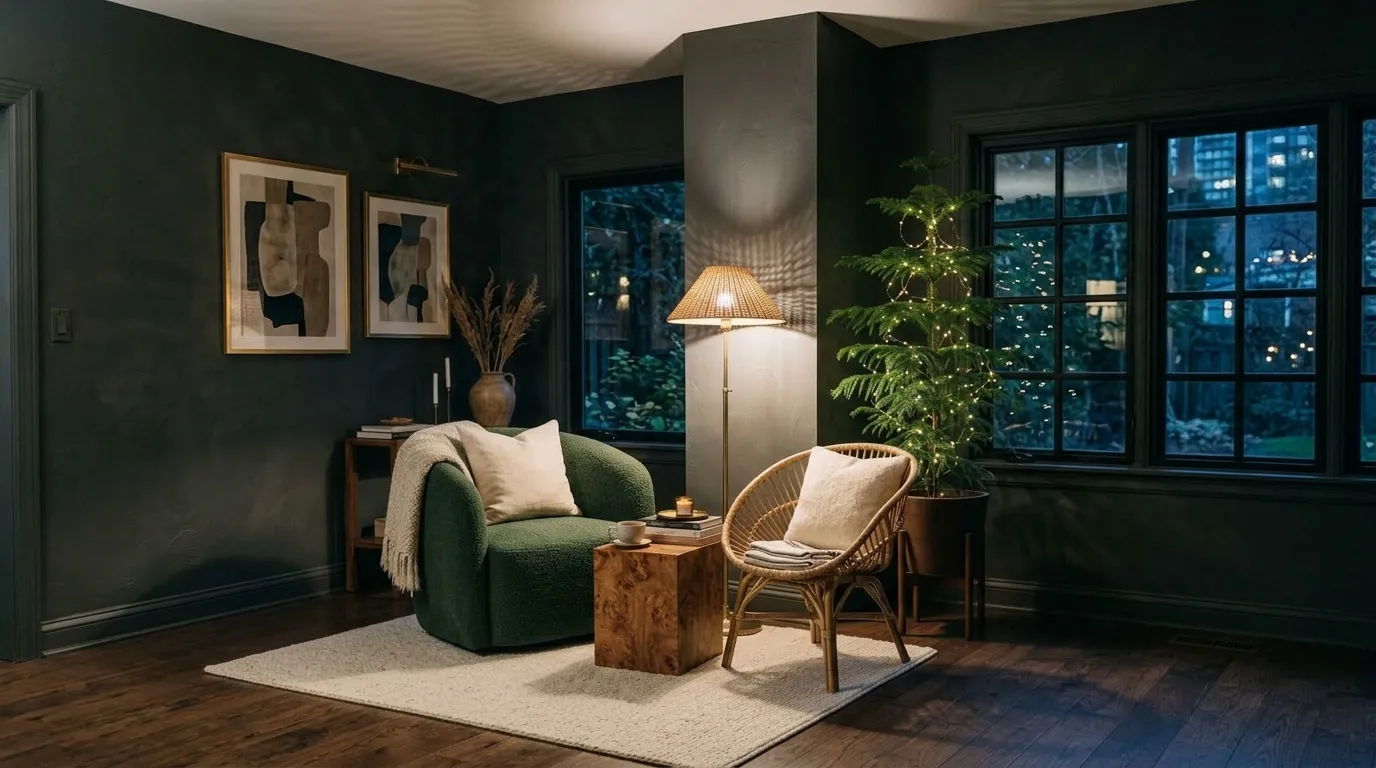
Deep forest green can swallow a room if you let every surface carry it, so I use it in one place only: a single curved bouclé armchair. Everything around it goes textural instead of colorful, a woven rattan accent chair, a cream wool rug, a burl-wood side table with visible grain. At night, an aged-brass floor lamp throws the rattan’s basketweave shadow across the rug in a pattern no printed textile could match. It’s one of my favorite winter home decor pairings because it reads as calm and layered rather than staged, and it works in almost any room shape.
The Norfolk Island pine tucked beside the chair earns its keep long after January. Unlike a cut tree, it’s a genuine houseplant that tolerates lower light and cooler rooms, which makes it realistic for a living room that isn’t right next to a window. Wind one loop of tiny warm-white lights through its branches instead of buying a separate holiday tree next December; it becomes a permanent, softly lit fixture in the corner. I’ve had readers tell me theirs is now five years old and still going, which says something about how forgiving it is.
7. Frosted Sage and Brushed Copper
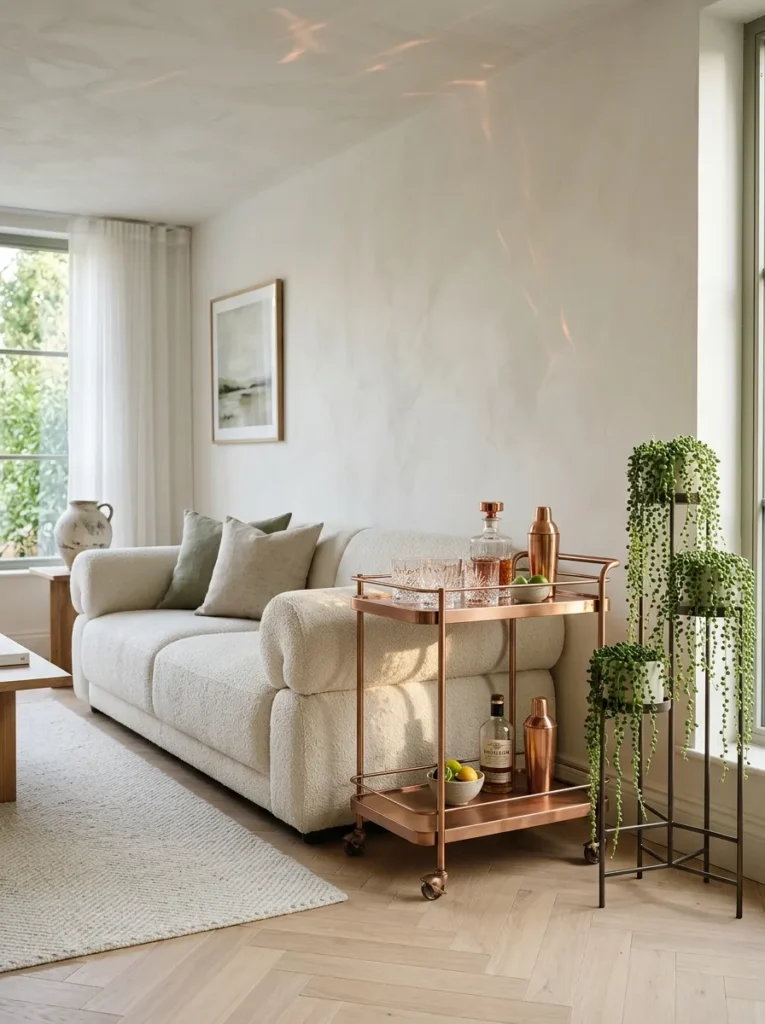
- Palette: frosted sage-green, brushed copper, bone-white bouclé, pale ash wood
- Sofa: a low bone-white bouclé sofa with rounded, pillowless bolster arms
- Accent: a brushed-copper drinks trolley styled with three etched glass tumblers and one copper ice bucket
- Rug: a pale ash-toned wool rug in a subtle herringbone weave
- Plant: a trailing string of pearls in a frosted sage-green ceramic pot, set on a plant stand at varying heights
- Lighting: a copper-based table lamp with a frosted glass globe shade, on a warm 2400K bulb
- Wow moment: the copper trolley catches every light source in the room and scatters small warm reflections across the ceiling
Why this works: Brushed copper reflects ambient light in every direction, so a single accent piece can brighten a whole corner without adding wattage.
A drinks trolley sounds like a small detail, but in a winter living room it changes how the whole corner behaves. Brushed copper doesn’t just sit there like most metal accents; it actively bounces light, catching the lamp glow and the window’s gray afternoon light and scattering both across the ceiling and nearby walls. Set it beside a bone-white bouclé sofa with rounded bolster arms, on a pale herringbone wool rug, and the copper becomes the room’s brightest, warmest note without you turning up a single bulb. That’s the whole appeal of this frosted sage and copper pairing.
I’ve noticed the plants people forget about are usually the ones that thrive best in winter light, and string of pearls is a perfect example. Its trailing, bead-like leaves store water, so it tolerates the drier air most homes get once the heat runs constantly. Set it in a frosted sage-green ceramic pot on a tiered plant stand so it cascades at two different heights beside the sofa. Combined with the copper trolley’s reflective glow, the corner feels finished and considered, not like an afterthought squeezed in after the holidays ended.
8. Amber Glass and Forsythia
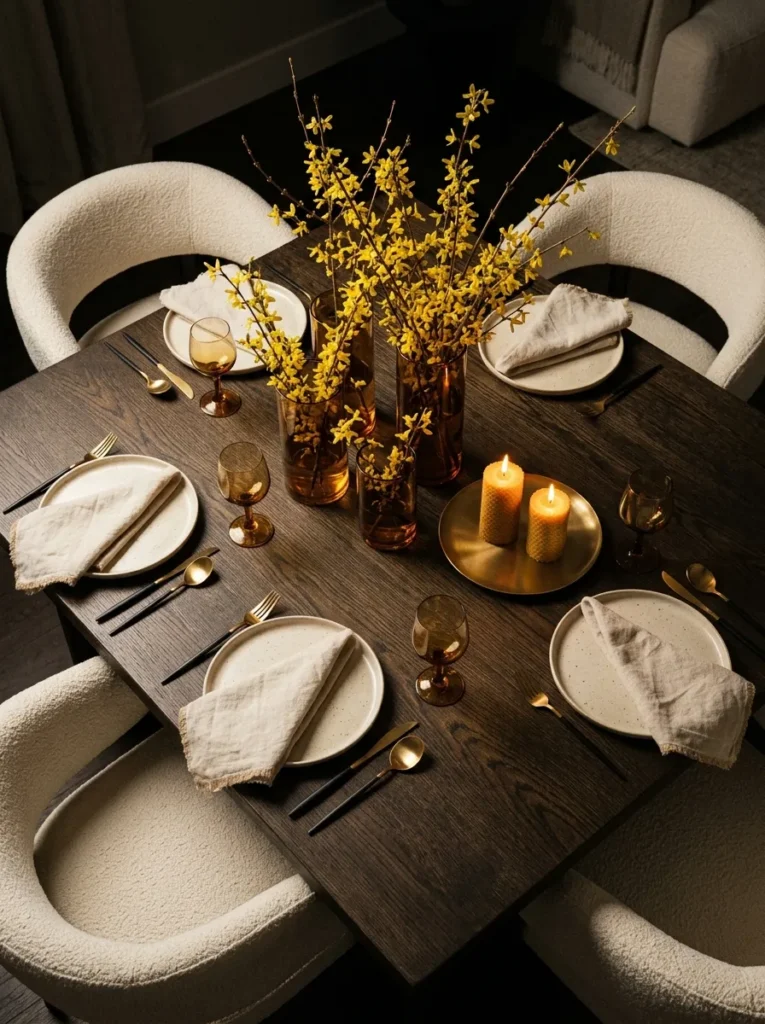
- Palette: amber-gold, smoked oak, ivory, brushed brass
- Table: a 96-inch smoked-oak table left bare, with no tablecloth
- Centerpiece: five hand-blown amber glass cylinders in three heights, each holding forced forsythia branches
- Candles: two ripple-sculpted beeswax pillars on one brushed-brass plate
- Seating: ivory bouclé chairs with curved backs
- Textile: unbleached linen napkins, folded flat, no napkin rings
- Lighting: overhead fixture dimmed to about 20 percent, with 2200K to 2700K bulbs
- Wow moment: candlelight passes through the amber glass and throws honey-gold pools across the oak grain
Why this works: Forsythia forced indoors blooms weeks before spring, so amber glass turns a bare winter branch into a living gold centerpiece.
Forsythia can bloom on your dining table in January, long before it flowers outside. Its buds have already logged the cold hours they need, so warm water and a bright counter convince them spring has arrived. Cut stems once the buds swell, slit the bottom inch, and expect blossoms in one to three weeks. That’s the whole secret behind this table: yellow blossoms in amber glass, on smoked oak, under candlelight. Gold arrives as a living color, not a metallic ornament, so the look stays modern and calm. Best of all, it costs less than one florist bouquet.
Style the table like a gallery, not a spread. Set five amber glass cylinders in three heights down the center, leaving 12 inches at each end clear. Add two ripple-sculpted beeswax pillars on a single brushed-brass plate for mixed-metal restraint. Ivory bouclé chairs soften all that hard glass. Now the lighting: I dim the overhead fixture to about 20 percent and let the candles work. I’ve noticed guests linger longer at this table, probably because the amber tones flatter every face. Keep bulbs at 2200K to 2700K so the glass reads honey rather than harsh.
9. Smoked Glass and Silver Birch
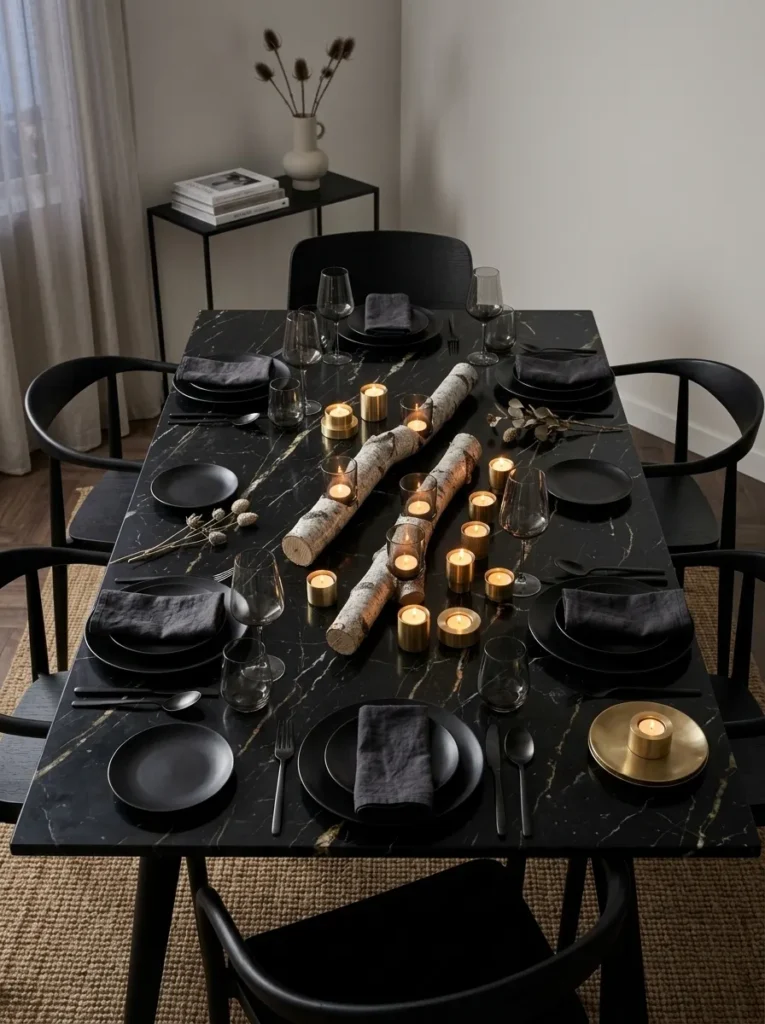
- Palette: charcoal-smoked glass, silver birch bark, warm brass, ink-black linen
- Table: a round black marble table, or a black linen tablecloth over any table you own
- Centerpiece: three birch branch sections (bark left on) laid horizontally, cradling smoked-glass votives in their forks
- Candles: eight small brass votive cups holding unscented white candles, clustered at varying heights
- Chairs: black metal chairs with a thin brass frame accent
- Lighting: a brass articulating pendant, dimmed low, no other light source
- Wow moment: candlelight through smoked glass throws a faint charcoal haze across the white birch bark
Why this works: Horizontal branches replace a tall centerpiece, so guests can actually see each other across the table while candlelight does the rest of the work.
Most centerpieces block conversation, and nobody says anything because it feels rude to complain about a floral arrangement. This one solves it by lying down instead of standing up. Three sections of silver birch, bark left rough and intact, run the length of the table at under 6 inches tall, well below eye level when seated. Nestled into their natural forks sit small smoked-glass votives, eight scattered candle points at slightly different heights. Against black marble or black linen, the pale bark practically glows. It’s the most requested table I style each winter, and it photographs beautifully from every seat.
Sourcing birch is easier than people expect. Many florists sell cut birch branches by the bundle for $15 to $25, or a local tree trimming service will often give sections away. Choose pieces with the bark’s black horizontal lenticels visible, that texture is the whole point. Lay the branches with cut ends tucked under a runner or hidden by candles, and keep at least 4 inches of clearance from any flame. I’ve noticed guests instinctively reach out to touch the bark before they even sit down. That tactile pull is rare in winter home decor and worth building a table around.
10. Frosted Glass and Dusty Miller
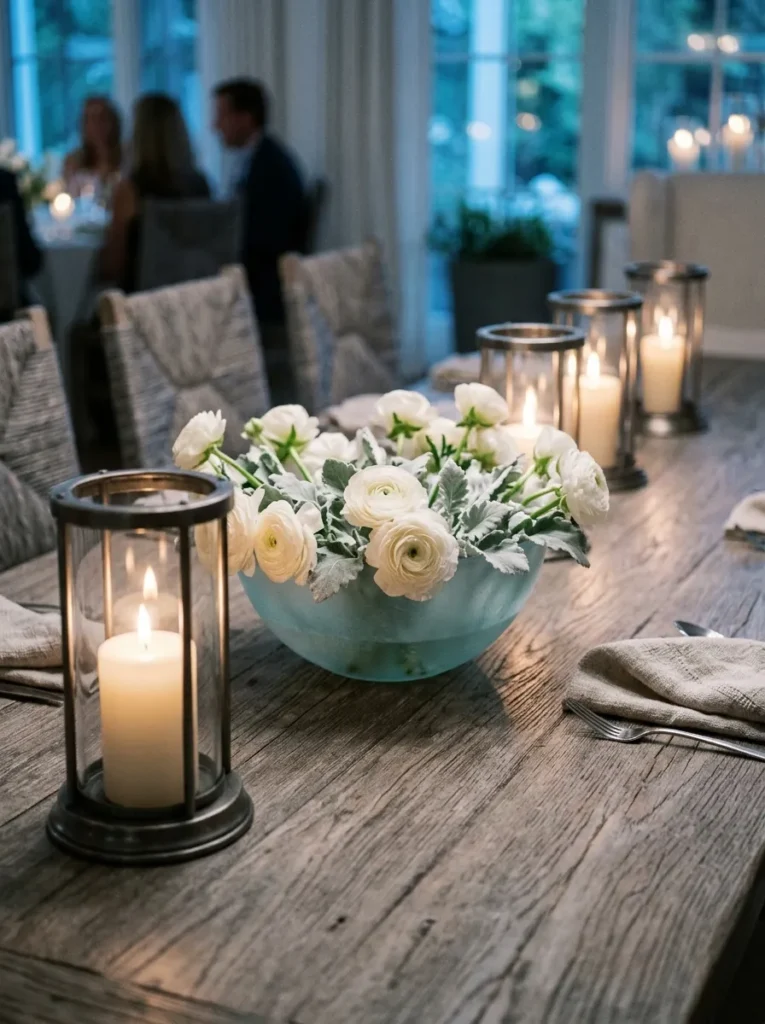
- Palette: frosted sea-glass blue, silvered dusty miller foliage, brushed pewter, driftwood-gray oak
- Table: a driftwood-gray oak table, left bare
- Centerpiece: a low, wide frosted glass bowl filled with silvery dusty miller foliage and white ranunculus tucked low
- Candles: four brushed pewter hurricane lanterns at varying heights, unscented white pillars inside
- Chairs: woven gray rush-seat chairs with pale oak frames
- Lighting: overhead dimmed close to dark, letting the hurricanes carry the room
- Wow moment: frosted glass diffuses the candlelight into a soft blue-white halo instead of a sharp flame
- Budget: dusty miller runs $3 to $5 a stem and holds its silvery color for two to three weeks cut
Why this works: Frosted glass scatters candlelight into a diffuse glow rather than a hot point, which is why this table reads soft and icy instead of amber and cozy.
Every centerpiece on this list so far leans warm, amber glass, brass, candlelight through clear vessels, so this one goes the other direction on purpose. Frosted, sea-glass-blue glass doesn’t let light pass through cleanly; it scatters it, turning four pewter hurricane lanterns into a soft halo instead of individual flames. Dusty miller’s felted, silver-white leaves pick up that cool light beautifully, especially paired with a few white ranunculus tucked low in the bowl. Set against driftwood-gray oak and pale rush-seat chairs, the whole table reads icy and quiet rather than cozy and golden, a genuinely different mood within the same winter season.
Dusty miller is an underused cut foliage, and it deserves more credit. Its felted texture comes from tiny hairs that trap air and reflect light, the same trait that helps the living plant survive light frost in a garden bed. Cut stems hold that silvery color for two to three weeks with no wilting, longer than almost any other filler foliage I’ve used. Keep the arrangement low and wide, under 6 inches tall, so it never blocks sightlines across the table. Refresh the water every four days and the dusty miller will outlast the ranunculus by a full week.
11. Paperwhites and Oak Shelves
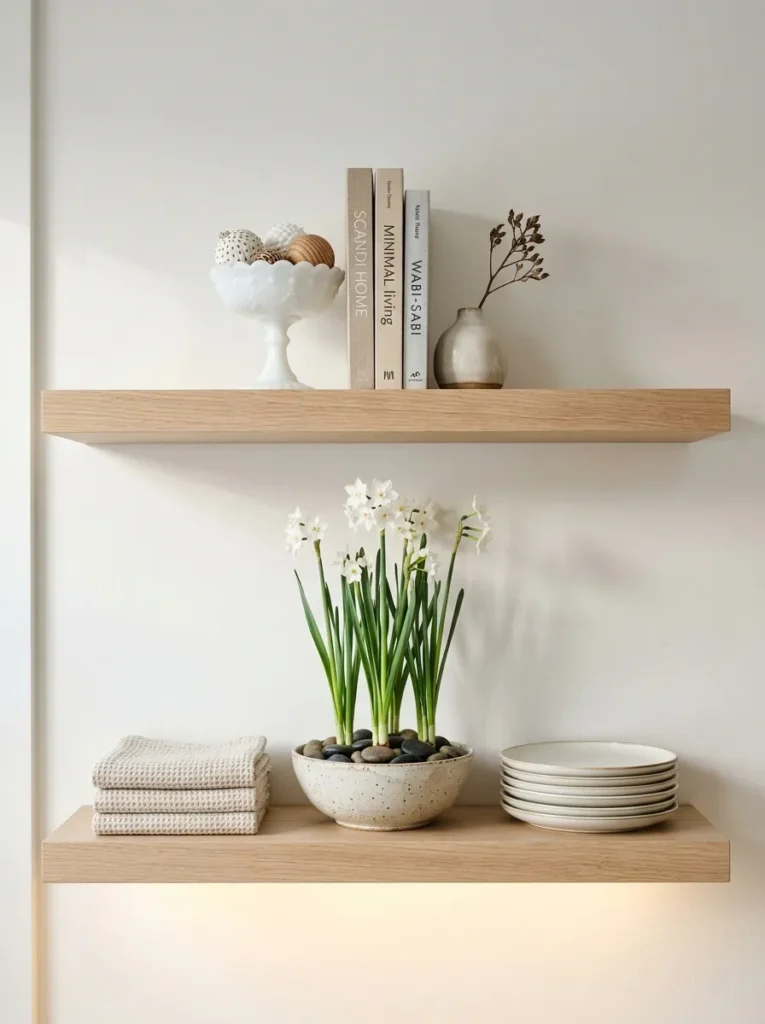
- Palette: frosted neutral: warm white wall, speckled ivory stoneware, pale rift-cut white oak, milk-glass opal
- Shelves: two 10-inch-deep floating shelves in rift-cut white oak, 48 inches wide
- Plants: paperwhite ‘Ziva’ bulbs in a speckled stoneware bowl of river stones
- Textiles: oatmeal waffle-weave towels, one stacked and one draped, plus a rolled raw linen runner
- Objects: a milk-glass compote, a matte ivory pitcher, and stacked white plates
- Lighting: a 2700K under-shelf LED strip that switches on at dusk
- Wow moment: at 5 p.m., white blossoms glow against the frost-gray window while the strip warms the oak
- Budget: paperwhite bulbs run about $2 each, and the styling uses what’s already in your cabinets
Why this works: Paperwhite bulbs bloom white without any chilling period, so a neutral shelf gets height and a living focal point within three to five weeks.
My first paperwhites were a disaster. By week two the stems had stretched to 18 inches and flopped across my counter like wet noodles. Now I know why: bulbs forced in warm, dim rooms grow leggy. Watering with a solution of about 5 percent alcohol, once shoots reach an inch or two, keeps stems roughly a third shorter without harming the blooms. Set the bulbs in a speckled stoneware bowl of river stones, and they’ll stand tall beside stacked white plates and folded oatmeal towels. Choose ‘Ziva’ for bright white flowers, but its scent is strong.
Open shelving looks effortless, but the wall carries real weight. A full stack of stoneware can weigh 30 pounds, and drywall anchors alone won’t hold that. My husband always locates the studs, usually 16 inches on center, and drives 2.5-inch screws through the shelf’s hidden bracket into wood. Then style with restraint: two shelves, three groupings, and one deliberate blank stretch of oak. Add a 2700K under-shelf LED strip so the ivory glazes glow after 5 p.m. That small glow makes a kitchen feel finished long before dinner, once winter darkness arrives.
12. Celadon Herb Sill
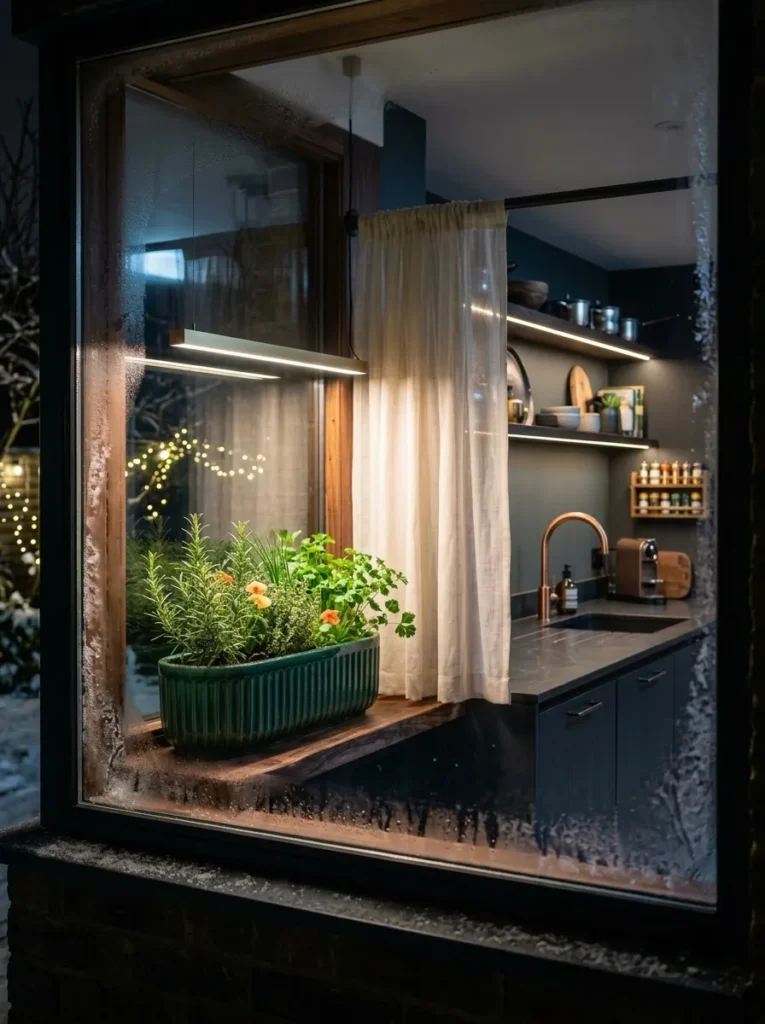
- Palette: pale celadon glaze, black walnut, matte black hardware, living green
- Anchor: a 24-inch fluted celadon trough planter with a drainage saucer, set on a black walnut board
- Plants: rosemary, thyme, flat-leaf parsley, and chives, chosen for cool-sill tolerance
- Lighting: a slim matte black 4000K full-spectrum LED bar clipped 6 to 12 inches above the leaves, on a 12-hour timer
- Textile: a half-height cotton voile café panel on a matte black rod
- Tool: a pair of blackened-steel herb snips resting on the board
- Wow moment: after dark, the window glows like a lit terrarium when seen from the yard
- Budget: about $70 all in, with herb starts at roughly $4 each
Why this works: Cool-tolerant herbs plus 12 hours of full-spectrum light give a kitchen window fresh green in the darkest months.
Most winter herb gardens fail for one reason: too little light. Winter days in much of the U.S. deliver only nine to ten hours of daylight, and a windowsill gets a fraction of it. A 4000K full-spectrum LED bar clipped six to twelve inches above the leaves, on a timer for twelve hours, fixes that. Choose rosemary, thyme, flat-leaf parsley, and chives, which tolerate cool sills. Skip basil, which sulks below 50 degrees. Planted in a fluted celadon trough on a black walnut board, the whole setup looks like sculpture instead of a kitchen chore.
I learned the watering rule the hard way, losing a rosemary to kindness in my first apartment. Rosemary wants dry feet, especially in winter, when slower growth keeps soil wet longer. Water only when the top inch feels dry, and empty the saucer within an hour. Keep leaves off the glass; night temperatures at the pane can drop far below the room’s. A half-height cotton voile café panel on a matte black rod softens the view and buffers some chill. After dark, from the yard, the window glows like a lit terrarium.
13. Terracotta and Winter Eucalyptus
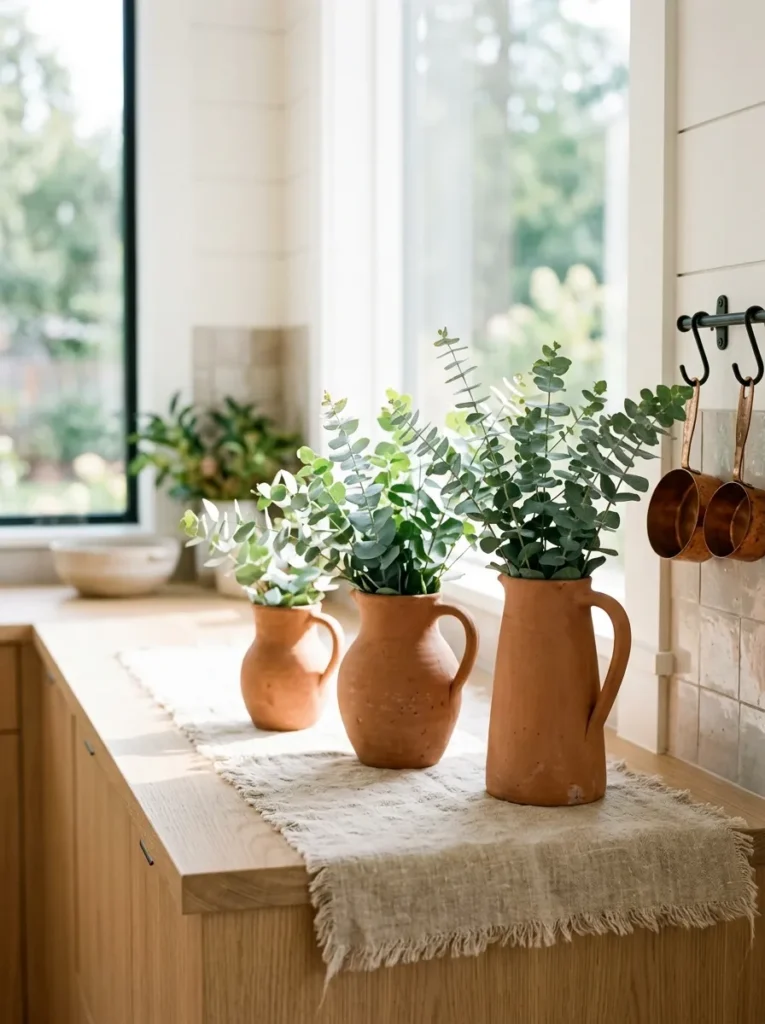
- Palette: unglazed terracotta, silvery-blue eucalyptus, raw linen, matte black iron
- Anchor: a row of three unglazed terracotta pitchers, graduated in size, lined along the counter or windowsill
- Plants: fresh-cut silver dollar eucalyptus, stems bruised at the base to release oil and extend vase life
- Textile: a raw, unhemmed linen runner draped along the counter edge
- Hardware: matte black iron cup hooks holding two copper measuring cups, off to one side
- Lighting: natural morning light only, no artificial source in this vignette
- Wow moment: the eucalyptus releases a faint menthol scent into the kitchen every time someone brushes past
- Budget: eucalyptus bunches run $8 to $15 at most grocery florist counters
Why this works: Bruised eucalyptus stems release essential oils into the air passively, so this vignette layers scent into the kitchen without a single candle or diffuser.
Eucalyptus does something most winter greenery can’t: it scents a room just by sitting there. Lightly crushing the bottom two inches of each stem with the back of a knife ruptures the oil glands in the bark, releasing that clean, faintly menthol smell every time someone walks past or brushes the leaves. Set three unglazed terracotta pitchers of graduated size along a sunny counter, stems loose and slightly overflowing rather than arranged, and the whole corner feels like an apothecary shelf. Unglazed terracotta’s raw, porous surface plays against the eucalyptus’s silvery-blue leaves in a way that no glossy vase ever could.
Terracotta’s porousness is exactly why this arrangement is low-maintenance. The clay wicks a small amount of moisture through the walls, which slows algae buildup in the water compared to a sealed glass vase. I’ve kept eucalyptus fresh in terracotta for nearly three weeks this way, changing the water only once. Drape a raw, unhemmed linen runner beneath the pitchers so the frayed edge picks up the terracotta’s texture, and hang two copper measuring cups on iron hooks nearby. Let morning light alone do the styling here; this vignette isn’t meant to work after dark.
14. Blush Plaster Sunrise
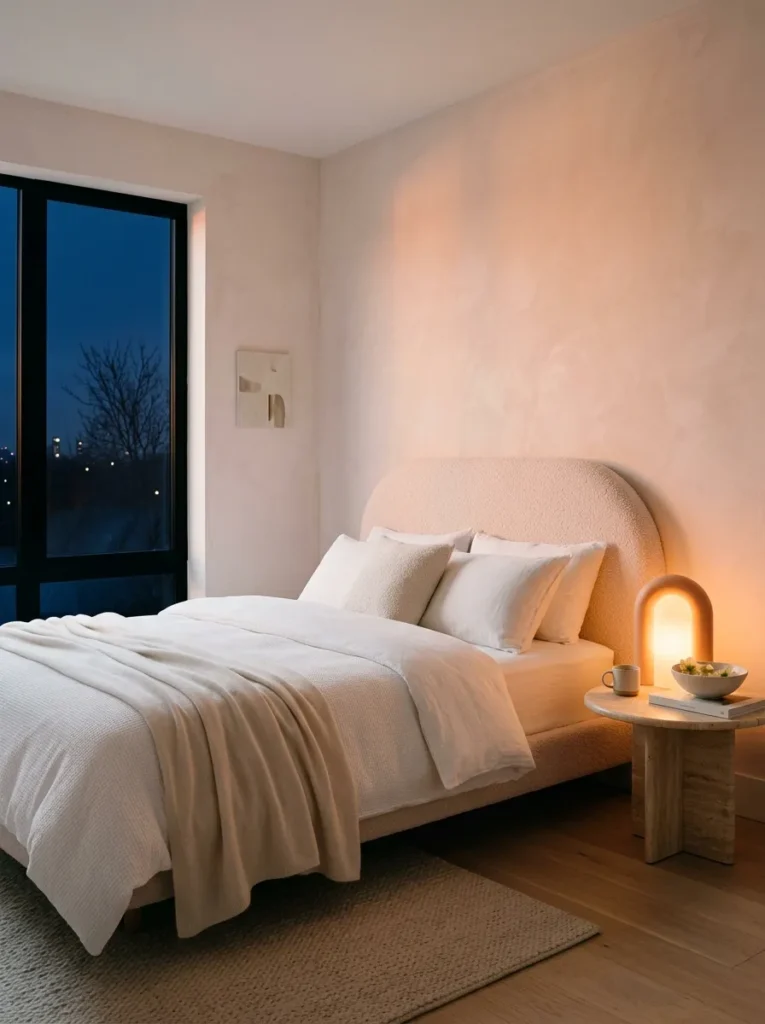
- Palette: blush-white limewashed walls, oyster-gray cashmere, bone-white ceramic, pale travertine
- Bed: a low platform bed with a curved blush-white bouclé headboard, no footboard
- Lighting: a sunrise lamp on a timer, plus a linen-shade table lamp on a 2200K bulb for evenings
- Textiles: a linen duvet cover, a wool-blend blanket folded in thirds, one oversized oyster cashmere-blend throw
- Table: a round 20-inch travertine side table
- Plants: three hellebore heads floating in a shallow bone-white bowl
- Wow moment: the room brightens like real dawn over 30 minutes, and the pink-white walls glow peach
- Budget: a good sunrise lamp runs about $45 to $90
Why this works: A sunrise lamp turns a pitch-dark January morning into gradual daylight, and blush-white walls amplify that glow.
January mornings used to feel like punishment in our house: alarm at 6:40, pitch dark, cold floors. Then I added a sunrise lamp, and everything changed. These lamps brighten gradually over 20 to 30 minutes, mimicking dawn, and morning light is one of the strongest signals for setting your body clock. Now picture it in a blush-white room: limewashed pink-white walls, a curved bouclé headboard, and a round travertine side table catching that slow gold glow. The room becomes the sunrise. It’s the most useful of all winter decorating ideas I’ve tried, and it looks like a boutique hotel.
Layering does the rest, and the order matters. Start with a crisp linen duvet cover, add a wool-blend blanket folded in thirds at the foot, and finish with one oversized cashmere-blend throw in oyster gray. Wool insulates even when slightly damp, so it keeps its warmth through humid winter nights. On the round travertine table, float three hellebore blooms in a shallow bone-white bowl. Hellebores flower January through March, but cut stems wilt fast, so float the heads instead. Keep the lamp’s shade in undyed linen and the bulb at 2200K for the evening.
15. Aubergine Velvet Drapes
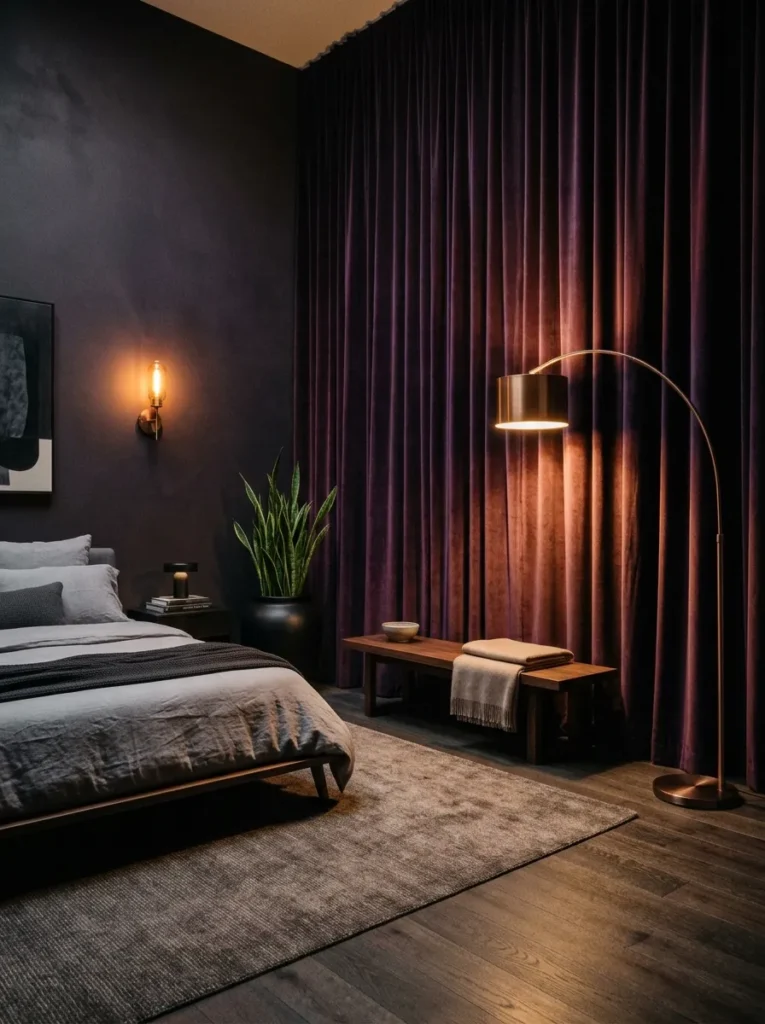
- Palette: deep aubergine velvet, stone-gray plaster, blackened bronze, black walnut
- Drapes: floor-to-ceiling aubergine velvet panels on a ceiling-mounted track, extending 8 inches past the window frame on each side
- Lighting: a bronze arc floor lamp, a ceramic table lamp, and a low wall sconce, all at 2200K to 2700K
- Bed: a low platform bed in washed stone-gray linen, no pattern
- Bench: a black walnut bench at the foot of the bed
- Plant: one African spear plant in a matte black pot
- Wow moment: three pools of lamplight slide across the velvet folds like a curtain at the theater
- Budget: the velvet is the main spend, roughly $200 to $400 per pair of panels
Why this works: Three warm light sources at three heights beat one overhead fixture, and dark velvet turns short winter days into a deliberate mood.
A single overhead light is the worst thing you can do to a winter bedroom. It flattens everything, and its bright, blue-leaning glow works against melatonin just when you’re winding down. Layer three warm sources at three heights instead: a bronze arc floor lamp, a ceramic table lamp, and a low wall sconce, all at 2200K to 2700K. Against stone-gray plaster walls and floor-to-ceiling aubergine velvet drapes, that glow turns the room into a jewel box. It’s the deepest, most grown-up look in this guide, and it needs no ornaments, only shadow.
I made the classic mistake in my first bedroom design: velvet drapes hung right at the window trim, so they looked stingy and let cold air slide around the edges. Now I mount a ceiling track and hang panels to the floor, extending about eight inches past the frame on each side. Add a black walnut bench at the foot of the bed, and set one African spear plant in a matte black pot beside it. That plant tolerates dim winter light and cool rooms, and its upright stems echo the drapes’ vertical lines.
16. Charcoal Linen and Dried Allium
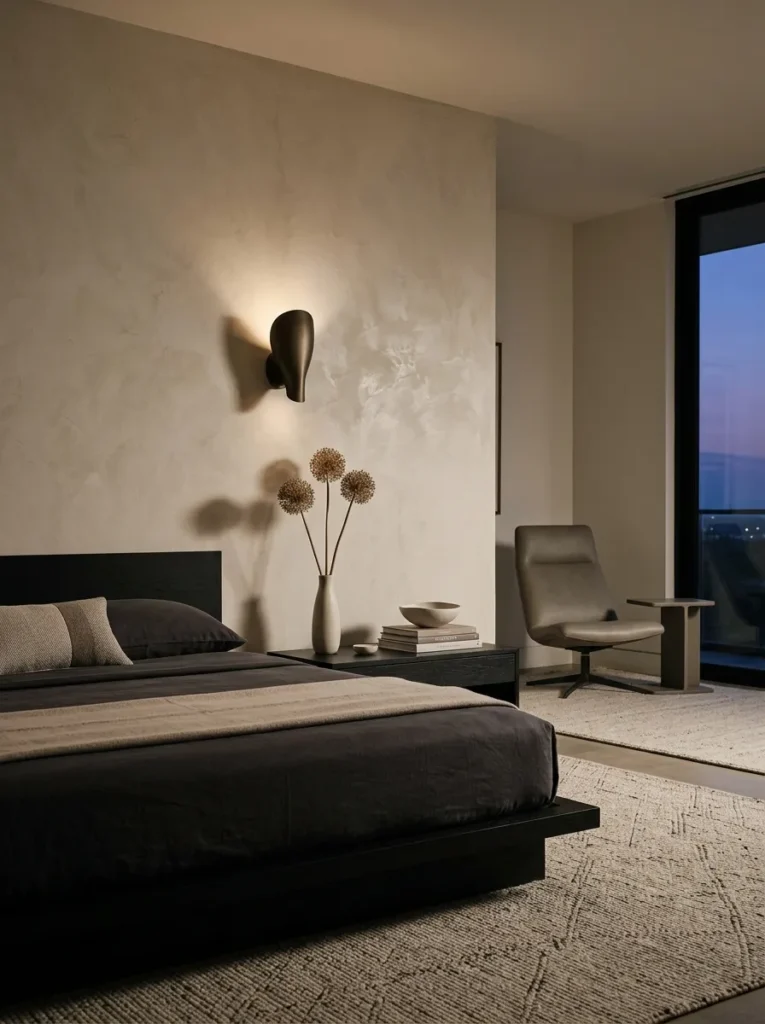
- Palette: charcoal-gray linen, dried allium seed heads, raw plaster wall, blackened oak
- Bed: a low blackened-oak platform bed with charcoal linen bedding, no headboard
- Plants: three dried allium seed heads (star-shaped, silvery) in a single tall blackened-oak bud vase
- Wall: one wall finished in raw, hand-troweled plaster with visible trowel marks
- Lighting: a single sculptural wall sconce with an exposed warm-toned bulb, dimmed low
- Textile: a heavyweight bouclé bench in oatmeal at the foot of the bed
- Wow moment: the sconce’s low sidelight throws the plaster’s trowel texture into deep relief across the wall
- Budget: dried allium heads run $4 to $8 each and last indefinitely with no water
Why this works: Raw plaster catches raking light in a way flat drywall never does, so one dimmed sconce can texture an entire wall without any additional decor.
Dried allium seed heads look almost otherworldly, tall, spiky spheres made of dozens of tiny star-shaped florets, and they need absolutely nothing from you once cut. No water, no feeding, no wilting to watch for. Set three stems, slightly uneven in height, into one tall blackened-oak bud vase beside a low platform bed, and they read as sculpture rather than a floral arrangement. Against charcoal linen bedding and a raw plaster wall, the room goes almost monochrome, texture carrying every bit of the visual interest that color usually would in a bedroom.
That raw plaster wall is the real trick behind this room’s depth. Hand-troweled plaster keeps every pass of the trowel visible instead of sanding it smooth, so when a single warm sconce is mounted low and dimmed, the light rakes sideways across those ridges and throws soft shadows across the whole surface. I’ve seen this technique used on a single accent wall completely change how a plain bedroom photographs, without adding a single extra object. Keep the rest of the room quiet, one bench, one vase, so the plaster and the light stay the focus.
17. Fluted Taupe and Orchid
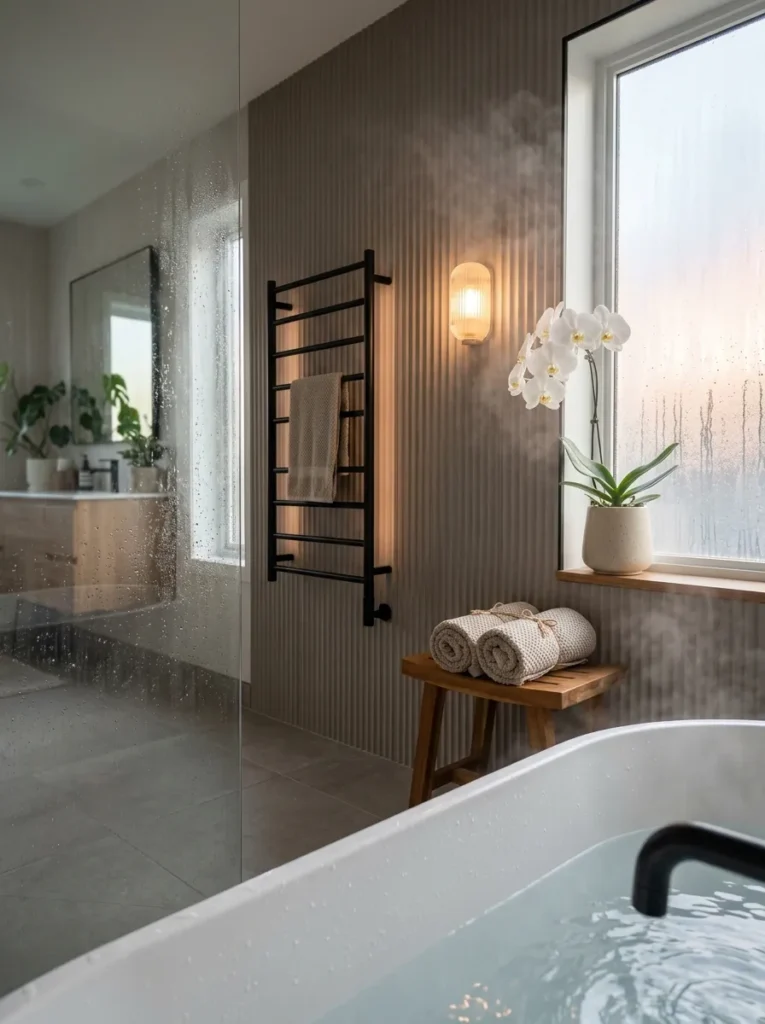
- Palette: mushroom taupe, oat linen, matte black, teak
- Wall: a fluted plaster-effect panel in mushroom taupe behind the vanity
- Heat: a plug-in matte black towel warmer beside the tub or shower
- Lighting: a ribbed-glass sconce dimmed to 2400K
- Textiles: rolled oat waffle-weave towels stacked on a teak stool, plus a thick oat cotton bath mat
- Plant: one white Phalaenopsis orchid in a matte ceramic pot
- Wow moment: steam drifts through the ribbed-glass halo while a warm towel waits
- Budget: about $60 to $110 for a plug-in warmer, and the orchid runs $20 to $35
Why this works: A warm towel and a plant that thrives in steam make a bathroom feel like a winter spa, not just a room you rush through.
The bathroom is the fastest place to make winter feel luxurious, and you can do it in under an hour. Start with heat: a plug-in matte black towel warmer means the first thing you touch after a shower is warm, not damp and cold. Add a fluted mushroom-taupe wall, a teak stool holding rolled oat towels, and a ribbed-glass sconce dimmed to 2400K. Then bring in a white Phalaenopsis orchid, which loves bathroom humidity and often blooms right in mid-winter. The room stops being a place you rush through and becomes the one you save for last.
My husband gives one rule for every winter bathroom: run the exhaust fan for 20 minutes after each shower. Closed-up winter homes trap steam, and moisture that lingers is what grows mildew on grout and paint. He also points out that fan size matters: aim for about one cubic foot per minute per square foot of floor, with a 50 CFM minimum. I’ve tried the orchid in a bathroom without a working fan, and the leaves spotted within weeks. Good ventilation protects the plant, the paint, and your fluted taupe wall.
18. Slate and Steam Eucalyptus

- Palette: charcoal slate tile, soapstone gray, brushed brass, muted eucalyptus green
- Shower: a bundle of fresh eucalyptus tied with jute twine, hung directly from the showerhead
- Surfaces: a soapstone vanity top and charcoal slate floor tile, both left matte and unsealed for a stone-quarry look
- Fixtures: brushed-brass faucet and hardware, swapped from the usual chrome
- Lighting: a single brass sconce on each side of the mirror, warm 2400K, no overhead light used while bathing
- Textile: a waffle-weave storm-gray robe hung on a brass hook
- Wow moment: hot shower steam pulls menthol scent from the eucalyptus and fogs the mirror in a soft gray halo
- Budget: a fresh eucalyptus bundle for the shower costs $10 to $15 and lasts one to two weeks
Why this works: Steam physically activates the essential oils in eucalyptus leaves, turning an ordinary shower into aromatherapy without spending a cent on a diffuser.
Hanging eucalyptus in the shower is one of those tricks that sounds like a Pinterest myth until you try it. Steam heats the leaves and opens the oil glands in the foliage, releasing that same clean, menthol scent people pay for in a spa diffuser, except this one is free and lasts about two weeks. Tie a small bundle with jute twine and loop it directly over the showerhead, high enough to stay clear of direct spray. Against charcoal slate tile and a soapstone vanity, the muted green looks intentional, like a detail pulled from a mountain lodge rather than a bathroom.
Stone choice matters more than people think in a winter bathroom, and this is where my husband’s material knowledge comes in handy. Soapstone is naturally nonporous and resists both moisture and temperature swings far better than many quartz composites, which is why it holds up so well as a vanity top in a room that goes from cold to steamy several times a day. He’s installed it in guest bathrooms specifically for that reason. Pair it with matte, unsealed slate flooring, and swap chrome fixtures for brushed brass so the whole room reads warmer under low sconce light.
19. Moon Phase Grid
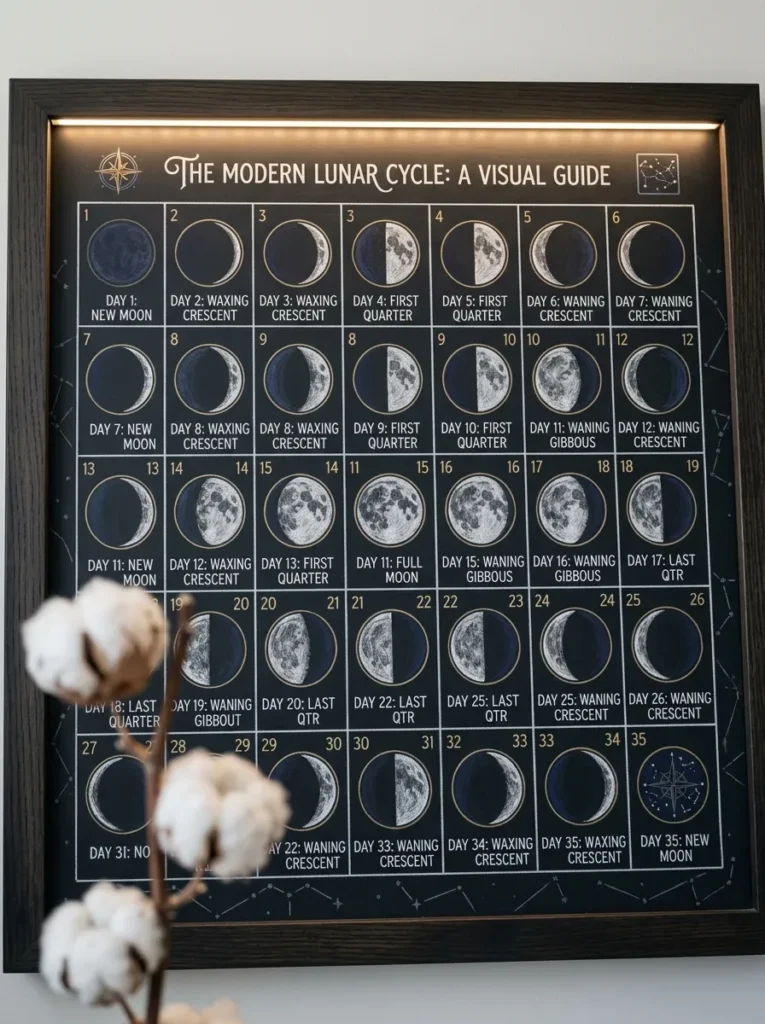
- Palette: graphite slate-black, chalk white, natural ash wood, dried cotton-boll white
- Board: a 24 by 36-inch porcelain-enamel steel chalkboard in a slim natural ash frame
- Design: a five-row grid of circles, one per night, each shaded to that night’s moon phase
- Chalk: dustless white chalk pencils or chalk markers, with shadows smudged by fingertip
- Plants: five dried cotton stems in a smoked-glass bud vase below
- Lighting: a 2700K picture light above, aimed to graze the surface
- Wow moment: the grid glows like a night sky against the slate when the light hits
- Budget: about $60 to $120 for the board, with chalk under $10
Why this works: A moon grid gives winter’s long nights a purpose, and it looks like modern art instead of seasonal lettering.
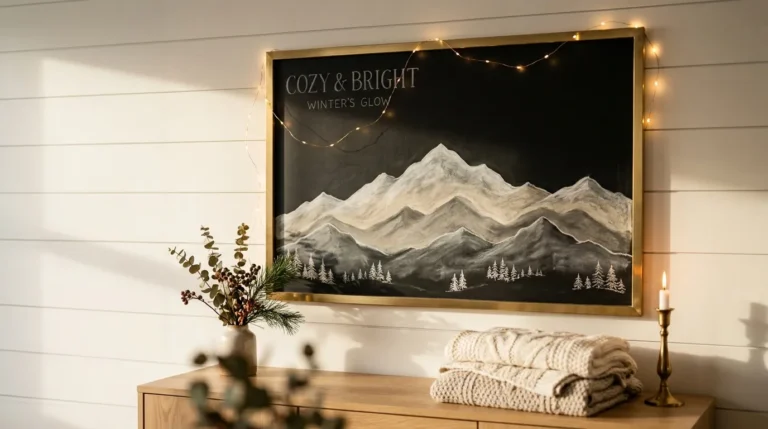
Two Januaries ago, I drew a moon on a chalkboard every night, mostly out of stubbornness, and it became my favorite winter ritual. Winter has the longest nights of the year, so the moon is easy to catch from your own window. The result: a 5-row grid of small circles, each one shaded to that night’s phase in white chalk on graphite black. Guests always stop to ask about it, then start counting circles. It works as art, a calendar, and a conversation piece without any of the usual seasonal lettering or clip-art snowflakes.
Chalkboard technique decides whether this looks crisp or muddy. Porcelain-enamel steel boards resist ghosting, the faint shadow left behind after erasing, so choose one in a slim natural ash frame, about 24 by 36 inches. Season a new board by rubbing the side of a chalk stick across the whole surface, then wiping it clean. Draw circles with a compass or a jar lid, shade with the flat of the chalk, and smudge the terminator line with your fingertip. Then hang a 2700K picture light above and tuck five dried cotton stems into a smoked-glass bud vase below.
For 15 more chalkboard winter ideas, see our full Winter Chalkboard Ideas for a Cozy Home guide.
20. The Changeover, Done Right
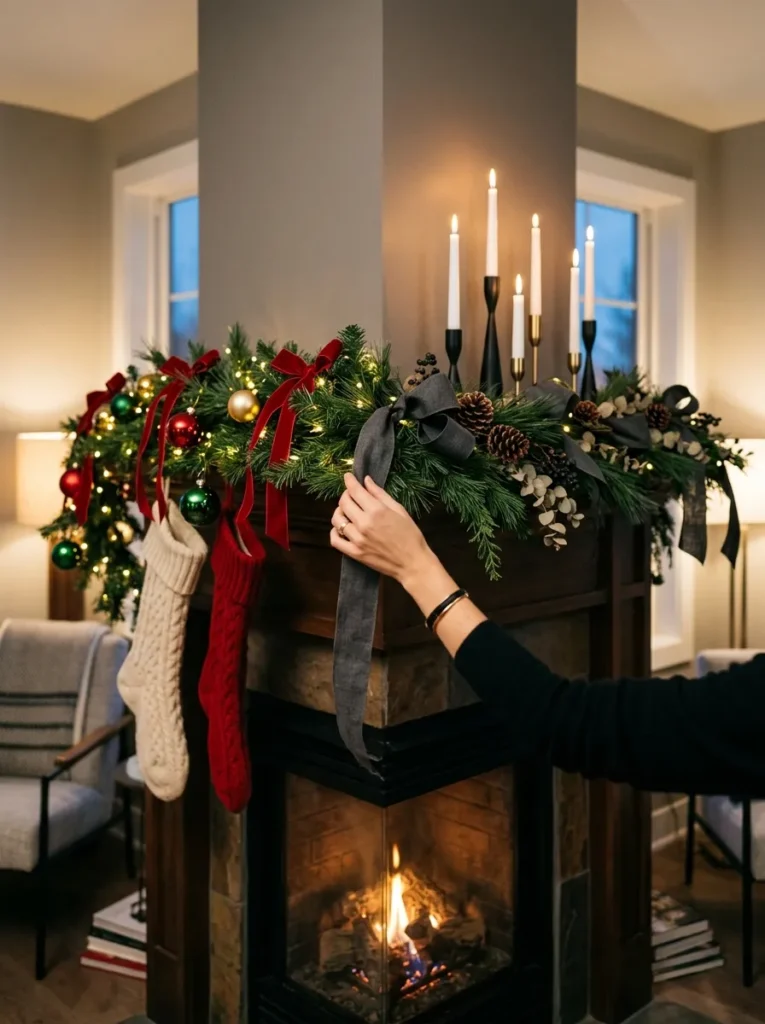
Take Christmas down in an order, not a scramble. Tree and ornaments come first, ideally within the twelve days after Christmas or by early January. Strip anything Santa-specific, plaid ribbon, red-and-green, string lights in warm multicolor, and box it separately from your general winter stock so next year’s unpacking is fast. Then look at what’s left: evergreen garland, pinecones, white string lights, and neutral ribbon can often stay if you simply swap out the red accents.
- Keep: real or faux evergreen greenery, pinecones, birch branches, plain white or warm-white string lights
- Remove: anything red, plaid, or Santa-themed; ornament balls; stockings; the tree itself
- Add: dried florals, pampas or lunaria stems, icy-blue or amber glass, extra candles
- Swap: red ribbon for velvet in aubergine or mushroom taupe; colored lights for a single warm-white string
Why this works: Winter decorating and Christmas decorating share a base layer of evergreen and warm light, so a smart changeover reuses half your materials instead of starting over.
I used to treat January 2 as demolition day, and by January 3 my house looked like nobody lived there. Now I do it in two passes. The first pass, usually the weekend after New Year’s, removes anything overtly festive: ornaments, stockings, red ribbon, the tree. The second pass, a few days later, is additive. I go back through the boxes I kept, mostly greenery, pinecones, and warm-white lights, and rebuild each surface with a winter palette instead of a holiday one. That’s why my mantel never sits bare for more than 48 hours. It just changes its outfit.
The specific swap that makes the biggest visual difference is ribbon and candles. Red velvet on a mantel garland reads as Christmas the moment you see it, but swap that same garland’s ribbon for one in charcoal, aubergine, or icy blue, and it instantly reads as winter. Replace red taper candles with white, cream, or pewter ones. Keep the greenery exactly where it was; structure doesn’t need to change, only color. This single move, done in under 30 minutes, is often the difference between a house that looks like leftover Christmas and one that looks intentionally styled for January.
Styling Principles for a Winter Home
Transitioning from Christmas without a bare house. The trick isn’t removing everything at once — it’s separating what’s Christmas-specific (ornaments, red, plaid, Santa motifs) from what’s simply cold-weather (evergreen, pinecones, warm-white light, texture). Take down the first category within the twelve days after Christmas, then rebuild the second category with a winter palette. Half your materials carry over; you’re only swapping color, not starting from zero.
Choosing one cohesive winter palette. Winter home decor works best when each room commits to one clear palette rather than borrowing a little from every trend. Icy blue-white, deep evergreen, silver-charcoal, warm amber-gold, blush-white, and frosted neutral are six distinct moods; pick one or two for your whole home rather than mixing all six room to room. A winter home feels intentional when every room’s palette can be named in three words or fewer — that’s the real test of a cohesive scheme.
Using lighting to combat short days. Winter light is the one material every room in this guide shares. Warm bulbs (2200K–2700K) read as candlelight and cozy a space instantly; a single 4000K full-spectrum source is worth reserving for spots that need real brightness, like a kitchen herb shelf or a home office.
Layer three light sources per room — overhead, task, and ambient — rather than relying on one fixture, since a single overhead light flattens a room and works against your body’s evening wind-down.
Frequently Asked Questions
When should I take down Christmas decorations? Most traditions call for removing Christmas decor within the twelve days after Christmas, so by early January, though there’s no hard rule. What matters more than the date is doing it in two passes: remove anything overtly festive first, then restyle with winter-appropriate pieces so the house doesn’t sit bare.
How long does winter decorating season actually last? Winter, as its own decorating season, spans roughly 10 to 12 weeks, from early January through mid-March in most U.S. climates, nearly as long as any other season on the calendar.
What are budget-friendly ways to decorate for winter? Cut branches (eucalyptus, birch, hazel), forced bulbs like paperwhites and forsythia, and dried foliage like lunaria or allium all cost under $15 and require zero long-term investment. Swapping ribbon color and candle color on decor you already own is free and instantly shifts the mood from holiday to winter.
What are the best colors for a winter home? There’s no single “correct” winter palette — icy blue-white, deep evergreen, charcoal-silver, amber-gold, blush-white, and frosted neutral are all authentic winter palettes. Choosing one and applying it consistently matters more than which specific palette you pick.
Does winter decor work in warm climates like Texas? Yes. Winter decorating is about seasonal mood and available light, not snowfall. In Austin, where hard freezes are rare, the same amber-gold candlelight, forced bulbs, and layered textiles create a winter feel indoors regardless of the daytime temperature outside.
How do I keep winter decor from looking like leftover Christmas? Remove anything red, plaid, or explicitly holiday-themed, and lean on materials that read as “cold weather” rather than “festive” — bare branches, dried botanicals, ice-toned glass, and natural textures like linen, wool, and raw wood.
Can houseplants really survive a dim winter windowsill? Some can. Cool-tolerant options like rosemary, thyme, string of pearls, blue star fern, and Norfolk Island pine handle lower light and cooler rooms far better than tropical houseplants, making them reliable choices for winter styling through the darkest months.
Conclusion
Winter home decor deserves more than a few surviving Christmas leftovers. Across twenty rooms and zones, the through-line has been the same: pick one honest palette per space, let real materials and real light do the work, and let the season last its full ten to twelve weeks instead of vanishing after New Year’s. I’ve seen how a $10 eucalyptus bundle or a single sunrise lamp can shift how a whole house feels in January.
Try one idea this week, whichever zone needs it most, then save this guide and come back for the next. Share it with anyone still staring at a bare mantel.