10 Winter Wreath Ideas for a Front Door That Lasts All Season
Most winter wreaths get hung in early December and look sad by February. These 10 winter wreath ideas are built differently — around color theory, real material science, and your actual front door, not just leftover Christmas greenery. For months, this wreath is nearly the only color on your entire house exterior, which means getting the palette right matters more than most decor guides let on. I’ve watched this play out on my porch here in Austin, where a wreath I almost dismissed as too plain outlasted every neighbor’s arrangement, still full and vibrant well into February.
Whether your door is matte black or soft cream, there’s a full, weather-durable concept here built to actually make it through the whole cold season.
Why Color Matters More on a Winter Wreath
Here’s something most wreath guides skip: for weeks on end, your winter wreath is nearly the only color your house shows against a landscape that’s gone bare — brown branches, gray sky, sometimes snow. Color theory backs this up: a single saturated hue reads far stronger against a neutral backdrop than when it’s competing with other color, and that’s exactly the setting a winter wreath sits in for ten to twelve weeks straight. I learned this my first winter in Austin, when an amber wreath I almost skipped turned out to be the only warm note on our whole block for six weeks.
A winter wreath’s color pairing with your door is the most visible exterior design decision your house makes all season. This post solves that with ten full, weather-durable wreath concepts built around color first, not just greenery.
1. Charcoal & Silver Evergreen
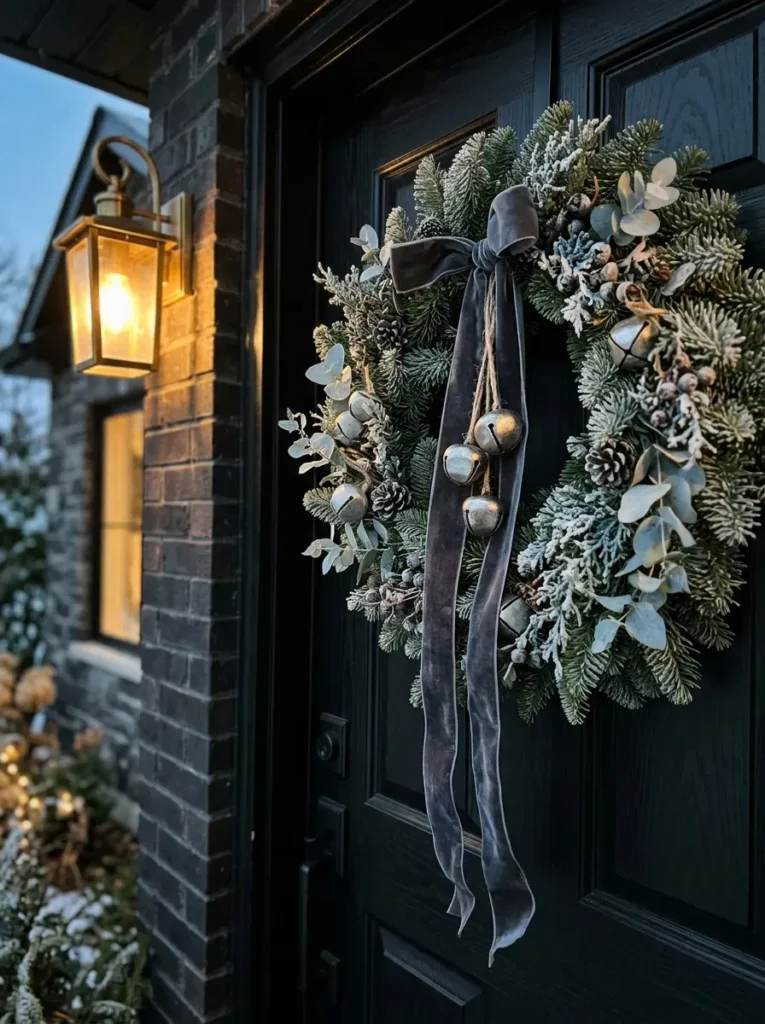
- Base: Full noble fir, 24–26 inches across for real visual weight against a dark door
- Palette: Charcoal gray, brushed silver, soft dove white
- Materials: Preserved silver dollar eucalyptus, small pewter sleigh bells, silvery brunia berries tucked in loose clusters
- Ribbon: 4-inch charcoal velvet ribbon with long trailing tails
- Door pairing: Reads sharpest against a matte black or deep charcoal front door
- Durability: Noble fir holds its needles far longer outdoors than blue spruce or Fraser fir, staying full and green from early December straight through February without drying brittle
- Standout detail: A small, off-center cluster of hand-wired antique pewter sleigh bells — placed asymmetrically instead of centered
Why this works: A charcoal-and-silver palette against a black door creates almost no color contrast — which is exactly what makes the silver accents glow instead of compete.
Noble fir is the unsung hero of winter wreaths. Unlike Fraser fir or blue spruce, its needles are thicker, waxier, and far more resistant to drying out, which means a noble fir base can stay full and green outdoors from early December straight through February without turning brittle or dropping needles across your porch. That durability matters more than most decor guides admit, because a winter wreath isn’t judged on day one — it’s judged in week nine, when the temperature has dropped, the wind has picked up, and everything else on the block has gone gray and lifeless around it.
Against a black or charcoal door, this palette does something subtle: the silver eucalyptus and pewter bells catch whatever light is available — porch light in the evening, flat daylight at noon — and appear to glow rather than simply sit there. That’s the effect of near-zero contrast between wreath and door; nothing competes for attention except the metallics. Guests notice the bells before they notice the doorbell. It’s a wreath that photographs well in every kind of winter light, from bright snow glare to dim December afternoons, without needing a single warm tone in the arrangement.
2. Frosted Birch & Ice Blue
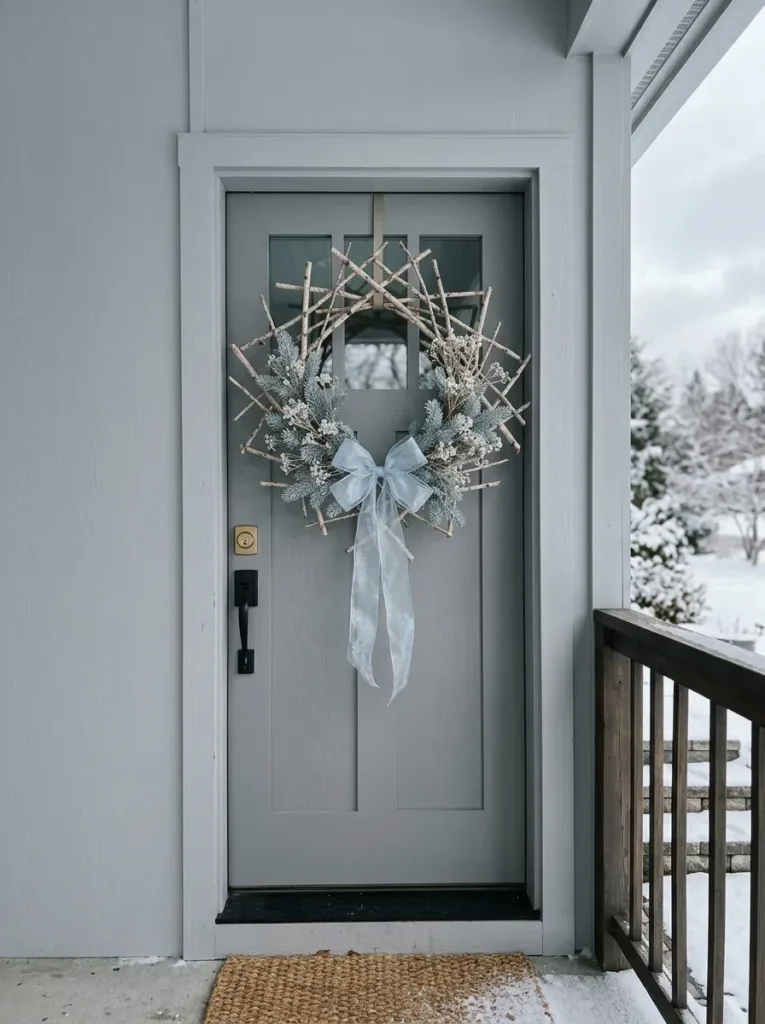
- Base: Bent birch branches wired into a wreath form, not traditional greenery, with a few sprigs of blue spruce mixed in
- Palette: Icy blue-white, silver-gray, natural birch bark tan
- Materials: Real blue spruce sprigs, faux frosted pinecones (real pinecones absorb moisture and can mold through freeze-thaw cycles), silver-gray eucalyptus
- Ribbon: Pale ice-blue organza, tied in a loose, uneven bow
- Door pairing: Best against a white, soft gray, or pale blue door for enough contrast to show the bark texture
- Size: Smaller and deliberately sparse, 16–18 inches
- Standout detail: A few strands of real dried baby’s breath left ungathered, sticking out at odd angles instead of trimmed neat
Why this works: A sparse, uneven wreath reads as more natural and expensive than a dense, perfectly round one — density signals “artificial” faster than almost any other visual cue.
I almost returned this wreath the first time I made one, because it looked wrong sitting on my workbench — too sparse, too uneven, nothing like the tight, round wreaths I’d always bought. Then I hung it on our own front door and understood immediately: bare birch branches read as intentional and expensive precisely because they aren’t crowded with filler. The eye reads open space as a design choice, not a mistake. Against Austin’s mild winters, where we rarely get real snow, the icy blue-white palette does something clever — it makes the wreath itself look frost-covered even on a fifty-degree afternoon.
This idea works well if your porch already leans minimal or modern, since bare birch reads closer to sculpture than traditional greenery. A few blue spruce sprigs keep it from feeling entirely empty, and their blue-green cast pulls the icy palette together without adding bulk. Because there’s less material overall, this wreath weighs noticeably less than a full evergreen base — light enough for a simple adhesive hook rather than the weight-rated hardware my husband insists heavier winter wreaths actually need, since under-rated over-the-door hooks can bend or pop loose once ice adds extra weight during a hard freeze.
3. Amber & Cinnamon Glow
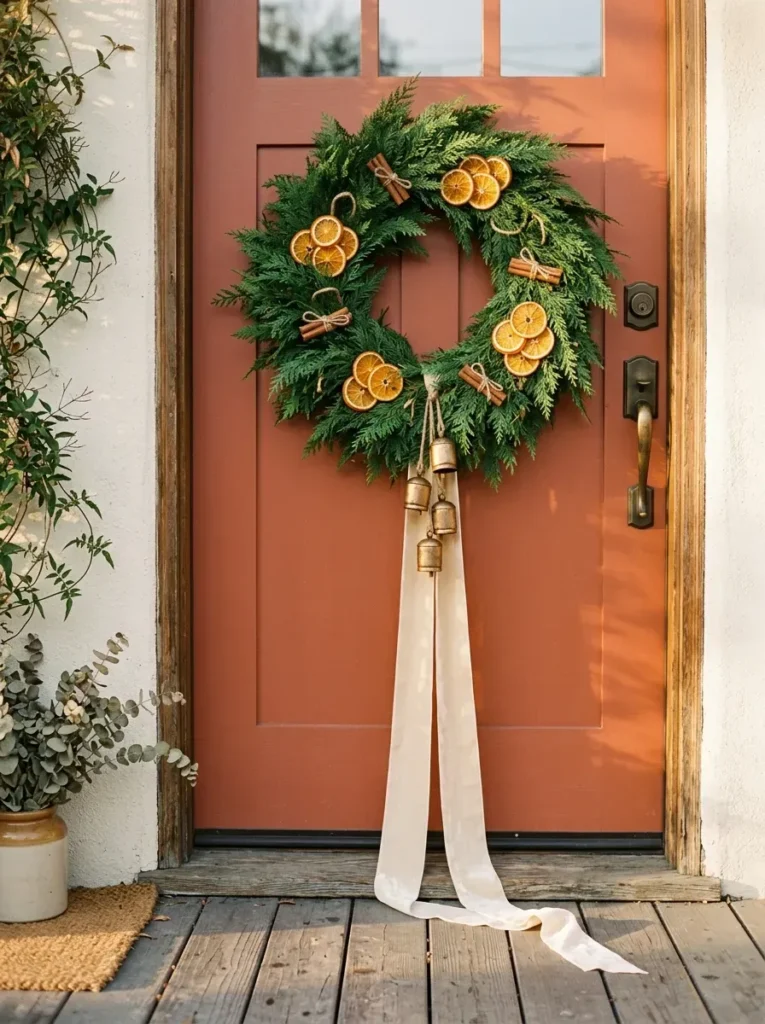
- Base: Full cedar wreath, 20–22 inches
- Palette: Amber-gold, cinnamon brown, cream
- Materials: Dehydrated orange slices sealed with clear coat, cinnamon sticks bundled in threes, cream velvet ribbon
- Door pairing: Works beautifully against a deep red, terracotta, or warm wood-stained door
- Standout detail: Small brass bells woven throughout instead of the more common silver jingle bell cluster, keeping the metal tone warm rather than cool
- Durability: Dehydrated, sealed orange slices hold their color and shape outdoors all season; fresh-cut slices typically mold within 10–14 days in damp winter conditions
Why this works: Dehydrated citrus slices sealed with a clear coat will hold their color and shape outdoors for the entire winter, while fresh-cut orange slices typically mold within two weeks.
Most wreath tutorials use fresh orange slices for a pop of color, and most of those wreaths look terrible by the second week. Fresh citrus holds too much moisture, and once temperatures swing between freezing nights and warmer afternoons — which happens constantly in a Texas winter — that moisture turns to mold fast. Dehydrating the slices first, then sealing them with a light clear coat, solves this almost entirely. The color deepens to a richer amber instead of fading, and the texture turns leathery rather than mushy, which means this wreath still looks intentional in week eleven instead of embarrassing.
Cedar makes a warmer, denser base than fir, with a slightly reddish cast that plays beautifully against amber and cinnamon rather than fighting it. Cinnamon sticks bundled in small groups of three add scent and texture without looking cluttered, and swapping the expected silver jingle bells for warm brass ones keeps the whole arrangement in one temperature family instead of mixing cool metal into a warm palette. Hung against a terracotta or wood-stained door, this wreath reads less like winter decor and more like something someone actually thought through — which, honestly, is the whole point of a good wreath.
4. Deep Evergreen & Cranberry
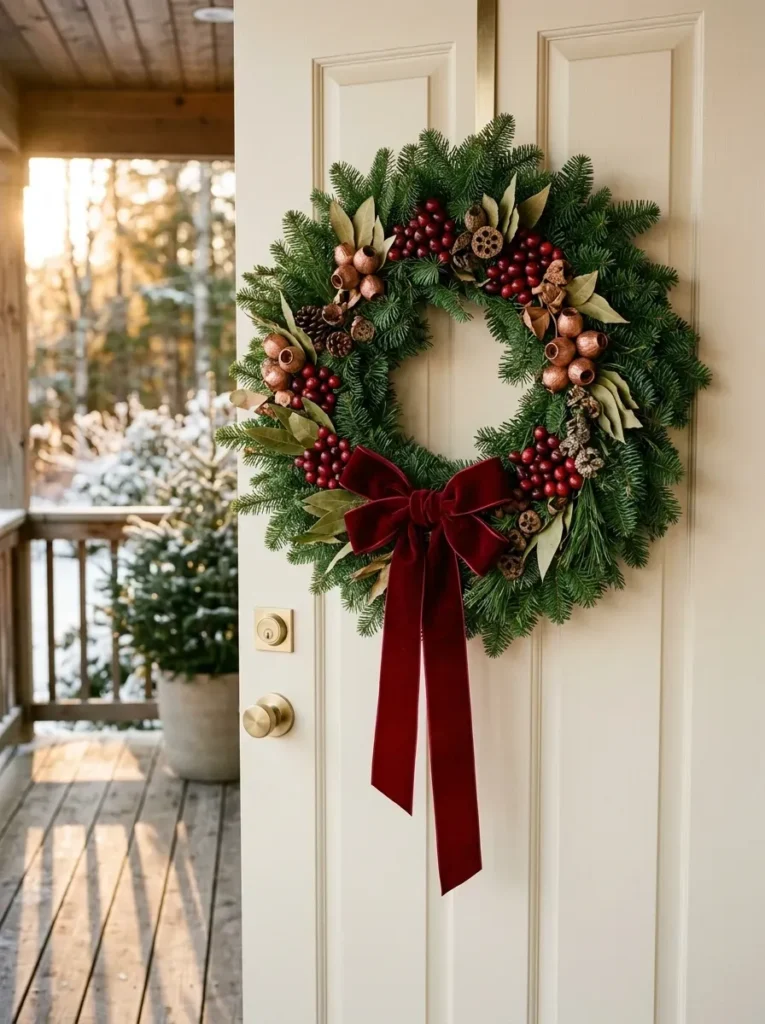
- Base: Full Fraser fir wreath, 22–24 inches, dense and traditional in shape
- Palette: Deep evergreen, cranberry red, aged copper
- Materials: Dried cranberry clusters wired in small bunches (not a single garland strand), preserved boxwood sprigs, copper eucalyptus pods
- Ribbon: Wide cranberry velvet ribbon, single knot, no bow
- Door pairing: Strongest against a cream, white, or pale sage door where the cranberry can actually read as color instead of blending into a dark background
- Size: Full and dense, sitting close to the door rather than floating off it
- Hardware: A dense Fraser fir wreath this size typically weighs 4–6 pounds once damp from rain or ice, which is heavier than most standard adhesive or wire hooks are rated for
- Standout detail: Small copper eucalyptus seed pods clustered near the ribbon knot instead of scattered evenly — a deliberate weight point, not symmetry
Why this works: Dried cranberries wired in small clusters read as richer and more dimensional than a single strand of garland, because clustering creates shadow and depth that a flat strand simply can’t.
Fraser fir is the classic choice for a reason: it holds its shape and color better than almost any other real evergreen once cut, and it’s dense enough to give cranberry clusters something to nestle into rather than sit flat on top of. Against a cream or white door, the cranberry doesn’t just add color — it becomes the entire focal point, since there’s nothing else in the palette fighting for attention except the muted copper accents near the base. This is a wreath built for a traditional porch that still wants restraint over the more cluttered, ornament-heavy version of the same color story.
My husband’s rule for any wreath over four pounds: skip the adhesive hook entirely and use a wreath hanger rated for at least ten pounds, with a bracket that grips over the top of the door frame rather than one relying on suction or adhesive. Rain and ice add real weight fast — a dry wreath at four pounds can climb past six once soaked, and that’s exactly when cheap hardware fails, usually at the worst possible moment, like right before guests arrive for a holiday gathering.
5. Navy & Antique Brass
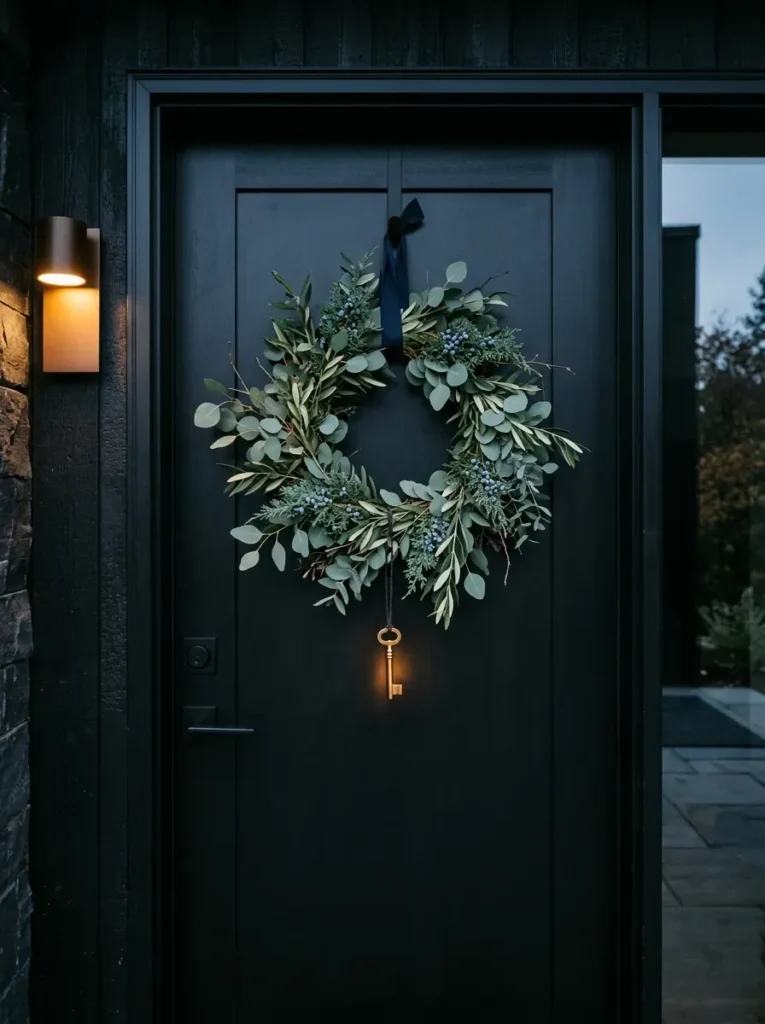
- Base: Preserved eucalyptus and blue-gray juniper mix, 20 inches
- Palette: Navy, antique brass, dusty sage
- Materials: Preserved silver-dollar eucalyptus, blue juniper sprigs, a single vintage brass skeleton key hung as the focal charm
- Ribbon: Navy grosgrain, thin width, tied simply — the key does the visual work, not the bow
- Door pairing: Best against a white, black, or navy-on-navy door for a tonal, moody look
- Size: Slightly smaller and looser than a traditional wreath, letting stems show
- Standout detail: The brass skeleton key hangs slightly off-center on its own short ribbon, like a pendant, instead of being wired flat into the greenery
Why this works: Replacing the expected bow with a single hanging object gives the eye one clear focal point instead of asking it to take in an entire wreath at once.
A client once told me she almost skipped this design because it seemed “too plain” in photos, then called me two weeks after hanging it to say it was the first wreath she’d ever gotten compliments on from actual strangers walking their dogs. That’s the effect of restraint — most winter wreaths are busy, and a navy-and-brass wreath with one hanging key reads as curated rather than decorated. It photographs unusually well in low evening light, since the brass catches whatever glow is available and the navy juniper recedes into shadow around it.
Blue juniper is worth seeking out specifically over standard blue spruce for this look — its needles carry a genuinely dustier, grayer cast that pairs with navy far better than spruce’s brighter blue-green. If your local nursery doesn’t stock it, ask; many carry it seasonally but only display the more common spruce and fir varieties up front. The tonal effect only works if the greenery itself leans gray-blue rather than green, so it’s worth the extra question before you buy.
6. Ivory Pampas & Frosted Pine
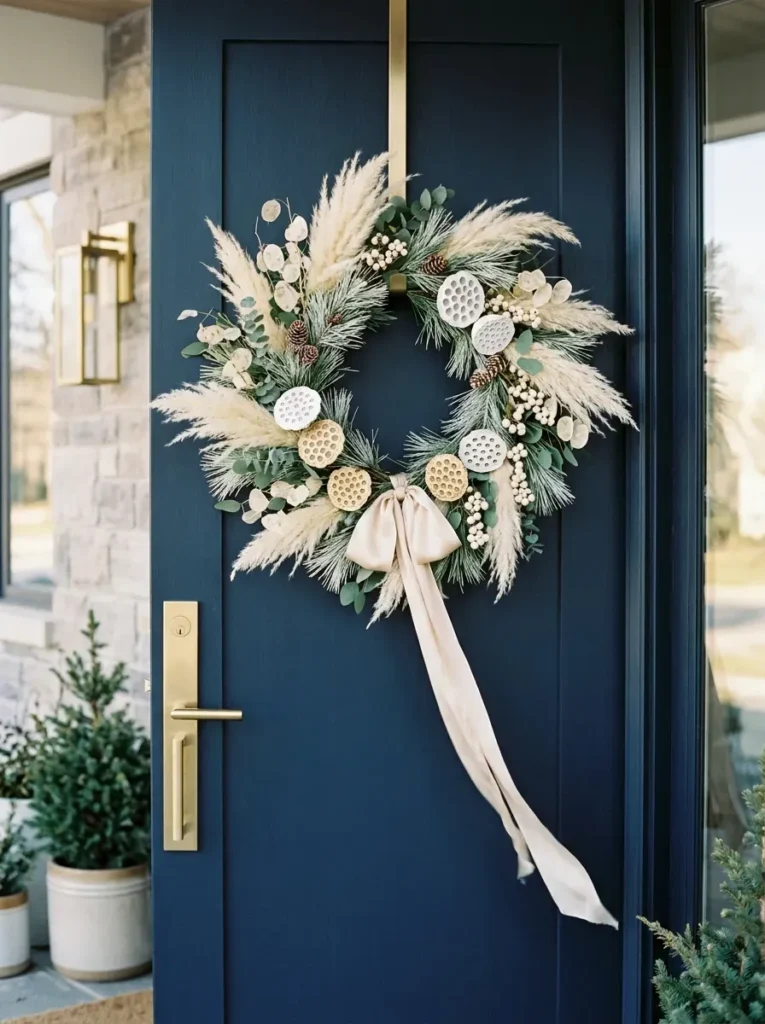
- Base: Preserved white pine mixed with dried ivory pampas grass plumes, 18–20 inches
- Palette: Ivory, bone white, pale champagne
- Materials: Dried pampas grass (sealed with hairspray or a craft sealant to prevent shedding), white pine sprigs, a few dried lotus pods spray-painted ivory
- Ribbon: Champagne silk, thin and knotted loosely, tails left uneven
- Door pairing: Strongest against a black, navy, or deep green door where the ivory tones actually stand out instead of disappearing into a light-colored door
- Size: Airy and textural rather than dense — negative space is part of the design
- Durability note: Untreated pampas grass sheds constantly in wind and rain; sealing it first is what makes it viable outdoors for a full winter
Why this works: Untreated dried pampas grass sheds constantly outdoors, but a light coat of clear sealant locks the fibers in place for the entire season without changing its texture.
Pampas grass shows up constantly in fall decor, but almost nobody carries it into winter, which is exactly what makes this wreath feel fresh rather than trend-driven. The trick is sealing every plume before it goes outside — a light, even coat of clear craft sealant or unscented hairspray keeps the fibers from shedding across your porch every time the wind picks up, without flattening the texture that makes pampas grass appealing in the first place. Paired with white pine and a few ivory-painted lotus pods, this wreath leans more sculptural than seasonal, closer to a textural art piece than traditional greenery.
Because ivory and bone white sit so close in value, this wreath needs real contrast from the door itself to read clearly from the street — a light gray or white door will swallow it almost entirely. Hung against black, navy, or a deep hunter green, though, every plume and pod becomes visible, and the texture does the work color usually does. It’s a striking option for a modern porch that wants winter interest without falling back on traditional evergreen and red.
7. Magnolia Leaf & Antique Copper
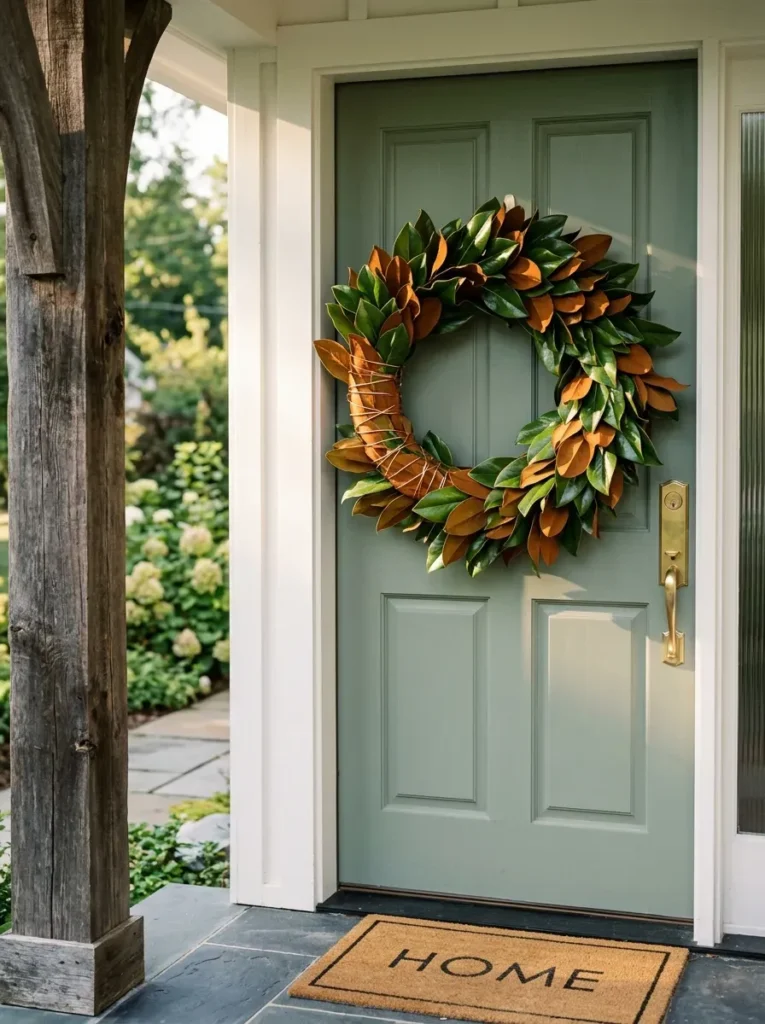
- Base: Fresh-cut Southern magnolia branches wired directly into a wreath form, no floral foam needed
- Palette: Glossy deep green, rust-brown, antique copper
- Materials: Magnolia leaves left untrimmed so both the green face and the rust-colored underside show, thin copper wire wrapped through the base, a few dried copper eucalyptus pods tucked near the bottom
- Ribbon: None — copper wire replaces ribbon entirely, wrapped loosely around one section
- Door pairing: Reads richest against a sage green, hunter green, or deep charcoal door
- Size: Medium, 20 inches, left slightly irregular rather than trimmed round
- Standout detail: Leaves flipped to alternate green-side and rust-side every few inches, creating a two-tone pattern within a single plant material
- Durability: Magnolia leaves are thick and waxy enough to cure in place rather than wilt, holding their shape 8 to 10 weeks outdoors without crumbling
Why this works: Magnolia leaves are leathery enough to cure and darken in place over several weeks rather than wilt, which is why a magnolia wreath actually looks better in week six than it did on day one.
I didn’t plan this wreath — it started with branches my husband trimmed off a magnolia tree during a landscaping job near our house, and I brought a few home just to see what they’d do. Two weeks later, the leaves hadn’t wilted at all; they’d simply cured, darkening at the edges and curling slightly at the tips into a color I couldn’t have picked from a paint chip. That accident turned into one of my favorite winter wreaths, since magnolia does something few other materials do outdoors — it improves with age instead of degrading, which makes it forgiving for anyone nervous about fading arrangements.
Against a sage green or charcoal door, the two-tone leaf effect becomes the whole story — you don’t need bright color when the material itself shifts between deep green and rust-brown depending on the light. Morning sun catches the glossy green faces; afternoon shadow pulls out the rust undersides instead. It’s a wreath that changes appearance throughout the day without you touching it, which most winter arrangements can’t claim. Skip the ribbon entirely here, since copper wire wrapped loosely through the branches does more work than fabric ever could, and keeps the whole piece feeling organic rather than staged.
8. Rosemary & Frosted Lavender
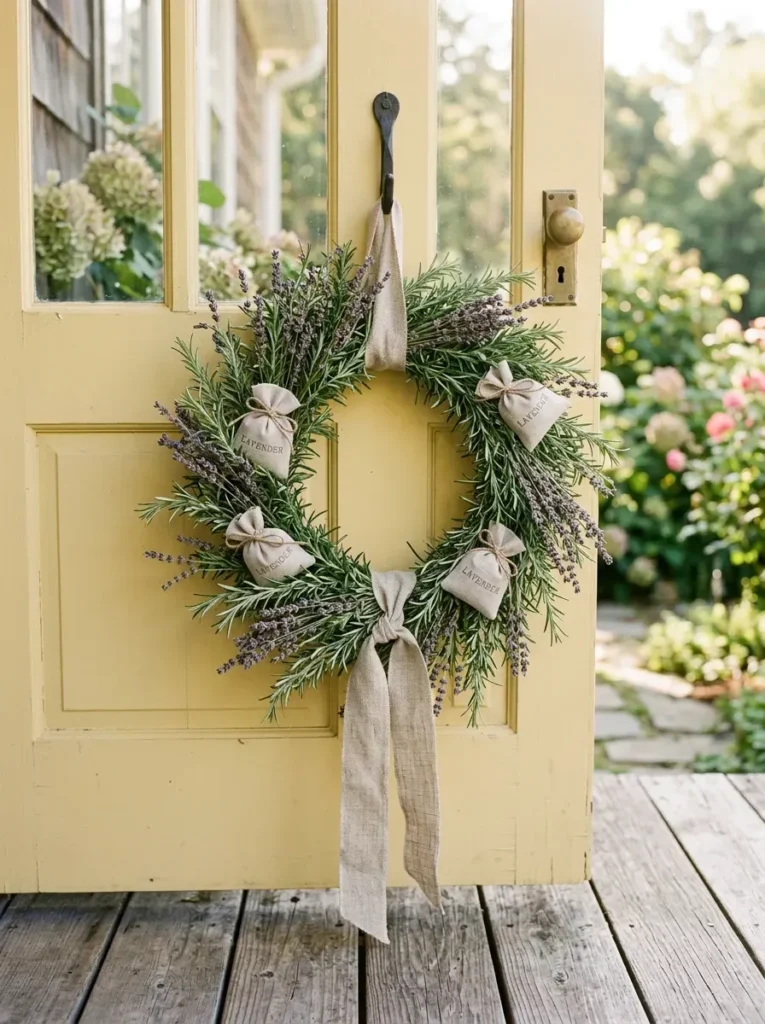
- Base: Fresh rosemary sprigs and dried lavender stems wired onto a grapevine base, no floral foam
- Palette: Silvery sage green, pale lavender-gray, bone white
- Materials: Fresh rosemary — a woody, cold-hardy herb that survives light frost far better than soft herbs like basil or mint — dried lavender bundles, a few sprigs of dusty miller for extra silver tone
- Ribbon: Unbleached linen ribbon, narrow width, simple single knot
- Door pairing: Best against a pale butter yellow, soft cream, or weathered wood door
- Size: Compact, 16 inches, kept loose rather than shaped round
- Standout detail: Small linen sachets of dried lavender buds tied into the arrangement, releasing scent when the door opens
- Durability: Rosemary tolerates temperatures down into the mid-20s Fahrenheit without browning, unlike soft-stemmed herbs that blacken at the first hard frost
Why this works: Rosemary is a woody perennial that tolerates temperatures into the mid-20s Fahrenheit without browning, which is why it’s one of the only fresh herbs that can realistically survive an entire outdoor winter display.
Rosemary earns a spot on a front door that most herbs never could, because it’s woody rather than soft-stemmed — the same trait that keeps it alive in a garden through mild winter frost keeps it from blackening on your door within days. Lavender, dried rather than fresh, adds a cooler gray-lavender note without the moisture issues fresh flowers bring outdoors. Together they create a wreath that reads as effortless and slightly wild, more herb garden than florist shop, which suits a cottage-style entry far better than tightly shaped greenery ever does. It’s also one of the only wreaths here that actually changes as it dries.
Scent is the real payoff, something almost no other winter wreath offers. Every time the door opens, rosemary releases its sharp, resinous smell into the entryway, and the tucked lavender sachets add a softer, sweeter note underneath it. Guests notice this before they notice the wreath itself. Because both plants dry slightly over the season rather than staying perfectly fresh, this arrangement actually looks better by January than it did in early December — the lavender deepens in color and the rosemary tightens, giving the whole piece a more settled, intentional shape than it had on day one.
Image description: A loose rosemary and dried lavender wreath on a butter-yellow front door, backlit by soft late-morning sun, linen ribbon knotted simply at the base. Small lavender sachets visible among silver-green sprigs. Weathered wood porch boards below. Airy, cottage-style, natural light, tight crop.
9. Cotton Boll & Warm Oat
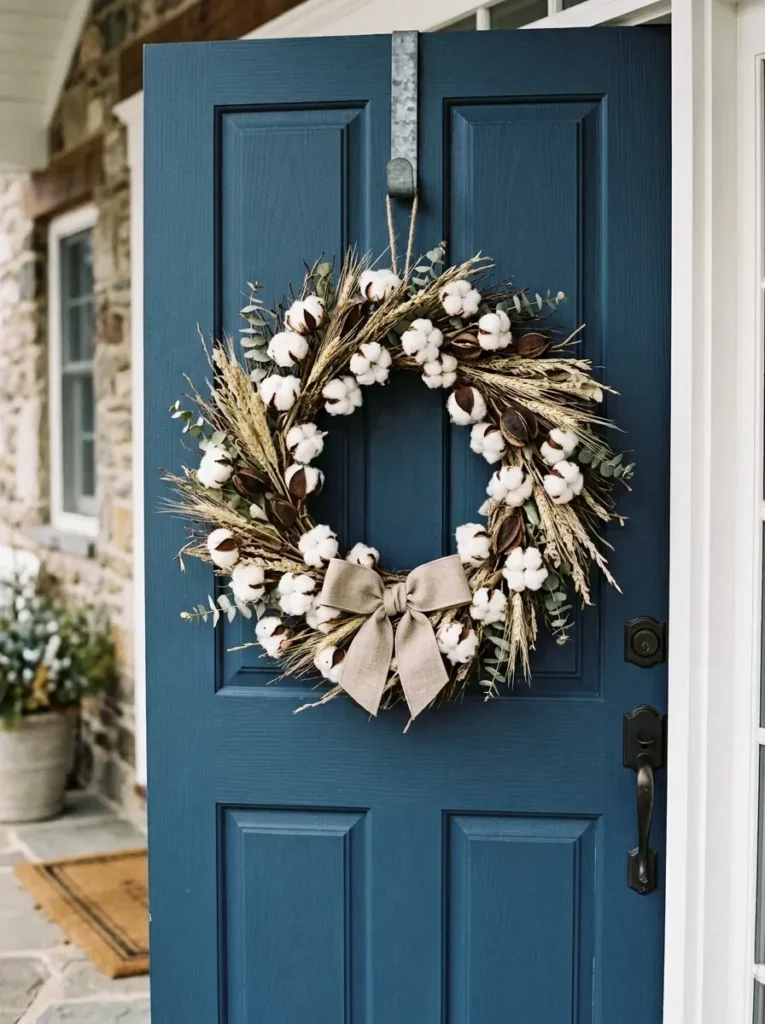
- Base: Dried cotton stems (natural, unbleached bolls) wired onto a wicker wreath form
- Palette: Warm oat, bone white, soft taupe
- Materials: Natural cotton bolls left slightly open and uneven, dried wheat stems mixed in for texture, small taupe linen bow
- Ribbon: Taupe linen, wide, simple loop bow — no trailing tails
- Door pairing: Strongest against a deep denim blue, black, or dark green door for enough contrast against the pale cotton
- Size: Medium, 18–20 inches, kept slightly asymmetrical
- Standout detail: A few cotton bolls left unopened in their dried pod casing, mixed among the fully opened bolls for textural variation
- Hardware: In humid, rain-heavy climates like Austin, a standard chrome or brass-plated hook can rust and streak a painted door within one season; a galvanized or powder-coated hook resists staining through repeated wet-dry cycles
Why this works: In humid climates, a standard plated hook can rust and streak a painted door within a single season, which is why the hardware matters as much as the wreath itself for keeping a door looking clean.
Cotton reads as farmhouse decor almost everywhere it shows up, but leaving a few bolls unopened in their pod casing pulls this wreath away from that expected look and into something closer to a dried botanical study. My husband’s crews run into this constantly on job sites near us — pale, neutral materials disappearing against the wrong door color, which is exactly what this wreath needs to avoid. Against anything lighter than denim blue or true black, the cotton simply blends into the door instead of standing out, so the door color here matters as much as the wreath itself.
Here’s a detail most decor guides skip entirely: hardware matters as much as the wreath in a climate like ours. Austin’s winters swing between damp, rainy stretches and dry cold snaps, and a cheap chrome or brass-plated hook can start rusting and leaving faint orange streaks down a painted door within a single season. A galvanized steel hook or a powder-coated bracket resists that completely, holding up through repeated wet-dry cycles without marking the paint. It’s a five-dollar difference protecting a door finish worth far more, and it’s the first thing my husband checks before hanging anything heavier than a small swag.
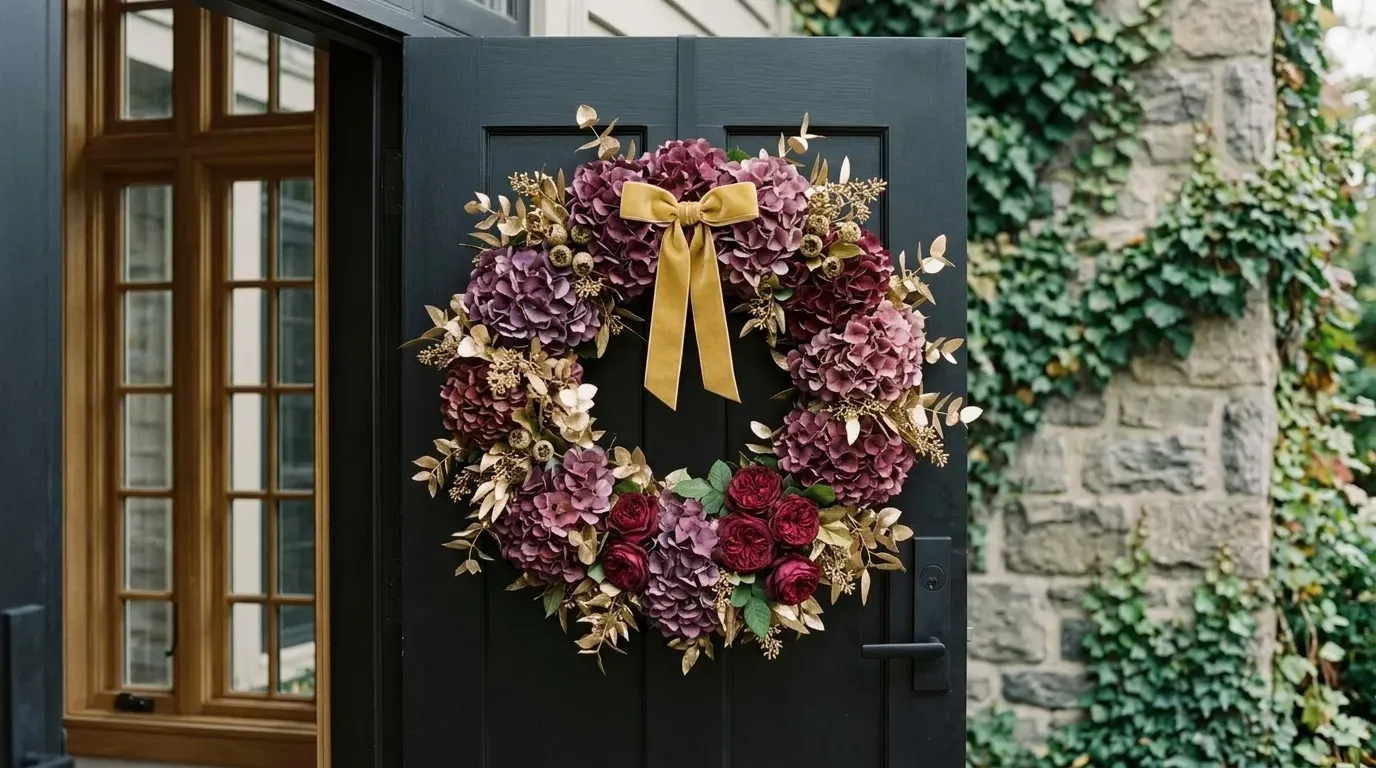
10. Plum Hydrangea & Aged Gold
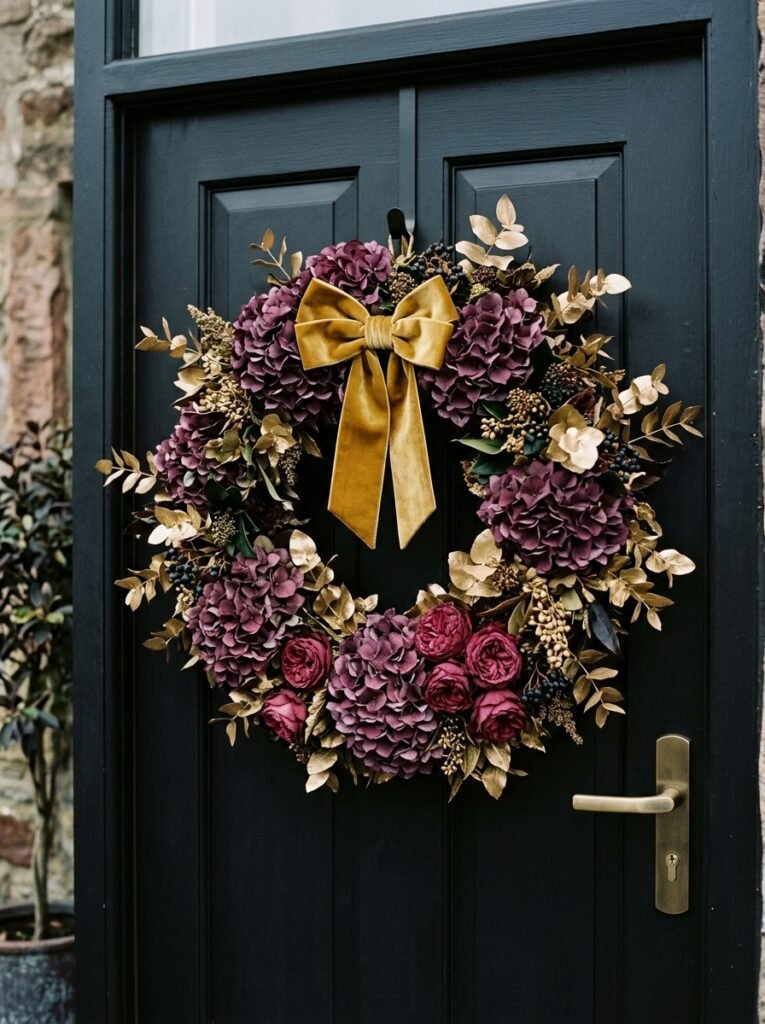
- Base: Dried hydrangea heads in deep plum and wine tones, full and rounded, wired onto a grapevine base
- Palette: Deep plum, aged gold, dusty burgundy
- Materials: Dried hydrangea (holds its papery texture and color for months once fully dried, unlike fresh blooms which mold within days outdoors), aged gold eucalyptus leaves, a few dark burgundy dried roses tucked near the base
- Ribbon: Aged gold velvet, wide, tied in a loose double-loop bow with short tails
- Door pairing: Strongest against a black, deep navy, or soft gray door where the jewel tones read as rich rather than muddy
- Size: Full and lush, 22 inches, filling most of the wreath form densely
- Standout detail: A cluster of dried roses left slightly crushed and irregular near the ribbon knot, rather than the pristine, uniform blooms most floral wreaths use
Why this works: Fully dried hydrangea heads hold their color and papery texture for months outdoors, while fresh-cut hydrangea blooms mold within days once exposed to winter moisture.
A client once handed me a box of hydrangeas from her own garden, dried and forgotten in her garage since fall, convinced they were too far gone to use. They weren’t — dried hydrangea heads are remarkably durable once fully cured, holding both color and shape through an entire winter outdoors, which fresh blooms simply cannot do. That’s the whole appeal of this wreath: it looks like a florist arrangement but behaves like a weatherproof one. The jewel-toned plum reads deep and rich rather than dark and muddy, especially once the aged gold eucalyptus catches whatever light is available nearby.
Against a black or navy door, this wreath does something few others on this list attempt — it leans genuinely luxurious rather than rustic or cozy, closer to a statement piece than seasonal decor. Leaving a few dried roses slightly crushed and irregular near the base keeps the whole thing from reading too polished or floral-shop perfect. It’s a wreath suited to a more formal entry, somewhere the homeowner wants winter color without the expected greenery, and it holds up remarkably well through an entire cold season with almost no maintenance required.
You’ll Also Love: 18 Winter Chalkboard Ideas for a Cozy Home
Styling Principles
Choosing a winter wreath color isn’t about picking your favorite palette — it’s about reading your door first. A dark door (black, navy, charcoal) makes light and metallic tones glow, while a pale door (white, cream, soft gray) needs a deeper, more saturated wreath to actually register from the street. Warm door colors like terracotta or wood stain pull best from amber, cinnamon, and copper palettes; cool doors pair naturally with icy blue, silver, and plum.
Material durability matters just as much as color. Woody, waxy, or fully dried materials — noble fir, magnolia leaves, rosemary, dried hydrangea — survive weeks of freezing temperatures far better than soft greenery or fresh flowers, which tend to blacken or mold within days. And don’t overlook hardware: a heavier winter wreath needs a weight-rated hanger, not an adhesive hook, especially once rain or ice adds extra pounds.
FAQ
How do I choose the right color for a winter wreath? Start with your door color, not the wreath. Dark doors show off light or metallic palettes best, while light-colored doors need a deeper, more saturated wreath to stand out from the street.
What materials actually survive an entire winter outdoors? Woody or fully dried materials hold up best — noble fir, magnolia leaves, rosemary, dried hydrangea, and sealed pampas grass all resist freezing temperatures and moisture far longer than fresh flowers or soft-stemmed greenery.
How do I safely hang a heavier winter wreath? Skip adhesive hooks for anything over four pounds. Use a hanger rated for at least ten pounds with a bracket that grips over the top of the door frame, since rain and ice can add significant weight fast.
Are there budget-friendly winter wreath ideas? Yes — cotton boll, dried lavender and rosemary, and grapevine-based wreaths all use inexpensive, often garden-sourced materials, and a simple linen or grosgrain ribbon costs far less than velvet without looking cheaper.
How long should a winter wreath stay up? A true winter wreath (not Christmas-specific) can reasonably stay up from early December through late February, since the materials and palettes in this style aren’t tied to any single holiday.
Will a fresh evergreen wreath survive freezing temperatures? Most real evergreens — fir, cedar, juniper — handle freezing temperatures fine and often look better once slightly cured by cold. It’s moisture and mold, not cold itself, that typically ends a wreath’s season early.
Conclusion
A great winter wreath isn’t an afterthought hung up in a rush — it’s a small, intentional design choice that carries your front door through the quietest, grayest months of the year. Whichever of these ten ideas catches your eye, from charcoal-and-silver evergreen to plum hydrangea, choose it based on your actual door color and how much weather it’ll need to survive. I’ve seen firsthand how a well-matched wreath can become the one thing neighbors compliment for weeks.
Save this post to Pinterest, pick the winter wreath idea that fits your door best, and pass it along to anyone still hanging the same tired evergreen loop every year.