15 Small Apartment Balcony Ideas That Actually Work in Tiny Spaces
You pinned a gorgeous balcony setup last spring, bought the pieces, and none of it fit. Sound familiar? You’re not doing anything wrong — most balcony inspiration is staged for a full-size patio, not a real apartment ledge that’s barely 4 to 6 feet deep. That mismatch is exactly why small apartment balcony ideas need a different starting point: real furniture footprint, real weight limits, and real renter restrictions, not just a pretty photo.
My husband runs a home construction company, and after years of watching him check load ratings before anyone touches paint color, I’ve learned that the prettiest balcony setups are always the ones built around actual constraints, not around what looked good in someone else’s much bigger space. This post is fifteen fully styled, genuinely small-space-tested ideas — furniture that folds, plants that thrive in containers, and layouts sized for depth and weight from the very first measurement, not the last one.
Why Most Balcony Inspiration Doesn’t Fit a Real Apartment Ledge
Most balcony inspiration photos fail the second you try to recreate them, because they’re staged for a full patio, not a real apartment ledge. A standard outdoor dining set needs at least 5 to 6 feet of depth just to pull out a chair — but most apartment balconies run only 4 to 6 feet deep, and plenty of buildings post a weight limit you’ll never see mentioned in a styling photo. My husband’s spent two decades in construction, and the first thing he checks on any balcony job is the load rating, not the paint color.
Real small-balcony design has to start with furniture footprint and weight math, not a mood board. That’s exactly what this post solves — fifteen setups sized for actual tiny apartment balconies, built to work in real rental conditions.
1. Fold-Down Bistro Ledge — A Small Apartment Balcony Idea for 4-Foot-Deep Spaces
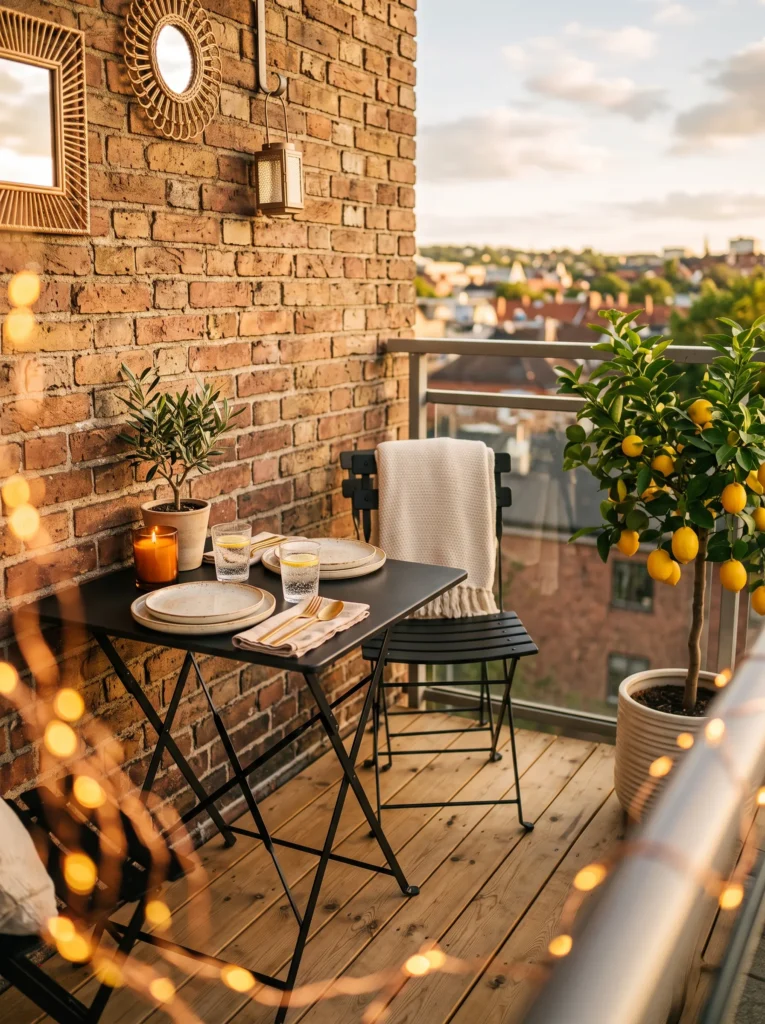
- Furniture: Wall-mounted drop-leaf table (18″ x 24″ open, folds to 4″ deep) + two curved-back bistro chairs in matte black powder-coated steel; fits balconies as shallow as 4 feet, chairs stack flush against the rail when not in use
- Planters/plants: Dwarf Meyer lemon tree in a 16-inch fiberglass planter (needs 6+ hours full sun, tolerates light wind once roots establish), trailing rosemary in a rail-clip planter
- Flooring: Interlocking teak-look composite deck tiles — no adhesive, lifts in seconds for cleaning or moving out
- Lighting: Solar-powered copper rope lights clipped along the rail, no outlet needed
- Storage: Table folds flat against the exterior wall; chairs stack in under 2 square feet
- Standout detail: A vintage brass café curtain rod, mounted just above the table, repurposed as a hanging bar for three trailing herb pots
Why this works: A drop-leaf table solves the single biggest small-balcony problem — furniture that only exists when you need it.
In my experience, people default to a full bistro set and then can’t open their sliding door. This setup flips that. The table’s 4-inch folded depth means it disappears against the wall, and the two chairs tuck in without blocking the doorway. The dwarf Meyer lemon does double duty as a privacy screen and a genuinely productive plant — Austin balconies get enough reflected heat that citrus in containers actually thrives if you’re consistent with watering. It’s a full morning-coffee setup that costs you almost no floor space when you’re not using it.
Weight matters more than people think. A 16-inch planter with a mature lemon tree, wet soil, and the pot itself can run 45 to 60 pounds — well within most balcony load limits, but worth checking your lease. My husband always tells clients that older buildings (pre-1990s) tend to have lower posted balcony weight limits than newer construction, sometimes as low as 30 pounds per square foot. Keep heavier planters like this one centered near the load-bearing wall connection rather than out at the railing edge, where cantilevered weight is under more structural stress.
2. Hanging Egg Chair Corner
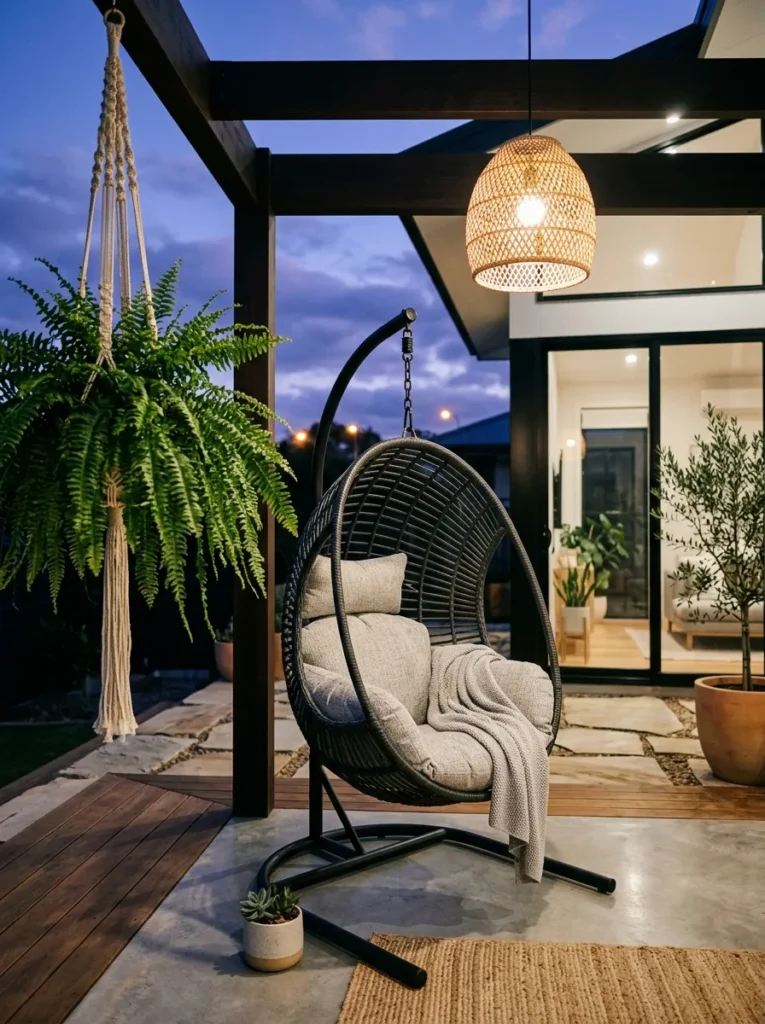
- Furniture: Freestanding steel-frame hanging egg chair on an A-frame stand (no railing mount required) — footprint roughly 3 feet by 3 feet, chair swivels 360 degrees
- Planters/plants: Boston fern in a hanging macramé sling (thrives in partial shade, appreciates humidity — good pick for a covered or north-facing balcony), snake plant in a low ceramic bowl for the corner floor
- Flooring: Charcoal-gray outdoor rug, 3-by-5, UV-treated and machine-washable
- Lighting: Battery-operated lantern with a warm 2700K bulb, hung from the stand’s frame
- Privacy: Woven reed screening clipped to the rail with tension clips, no drilling
- Storage: Chair cushion is removable and stores in a weatherproof zip bag when not in use
- Standout detail: A single oversized woven cane pendant shade suspended just above the chair, giving the corner a real “room” feeling despite the small footprint
Why this works: A freestanding stand instead of a rail-mounted swing removes weight-load guesswork entirely, since the chair’s weight sits on the balcony floor, not the railing.
I once styled a balcony for a client who desperately wanted a hanging egg chair but had a strict no-drilling lease clause. The freestanding A-frame stand solved it completely — no hardware touches the railing or the wall. She ended up using that corner every single evening. The chair’s swivel base means it can angle away from a neighbor’s sightline or toward the sunset, which matters more on a shared balcony wall than people expect. It reads as a full lounge nook, even though the entire setup occupies less space than a standard armchair.
Wind exposure is the real consideration at height, and it’s one almost nobody addresses. My husband’s rule of thumb from framing decades of balconies: anything above the third floor gets noticeably more sustained wind than ground-level patios, which is why a heavy A-frame base (not a lightweight one) actually matters here — it keeps the chair from swaying or tipping in gusts. The reed privacy screen is tension-clipped rather than tied, so it flexes with wind instead of tearing loose, which is a small but genuinely useful upgrade over zip-tied versions.
3. Foldable Bar-Height Perch
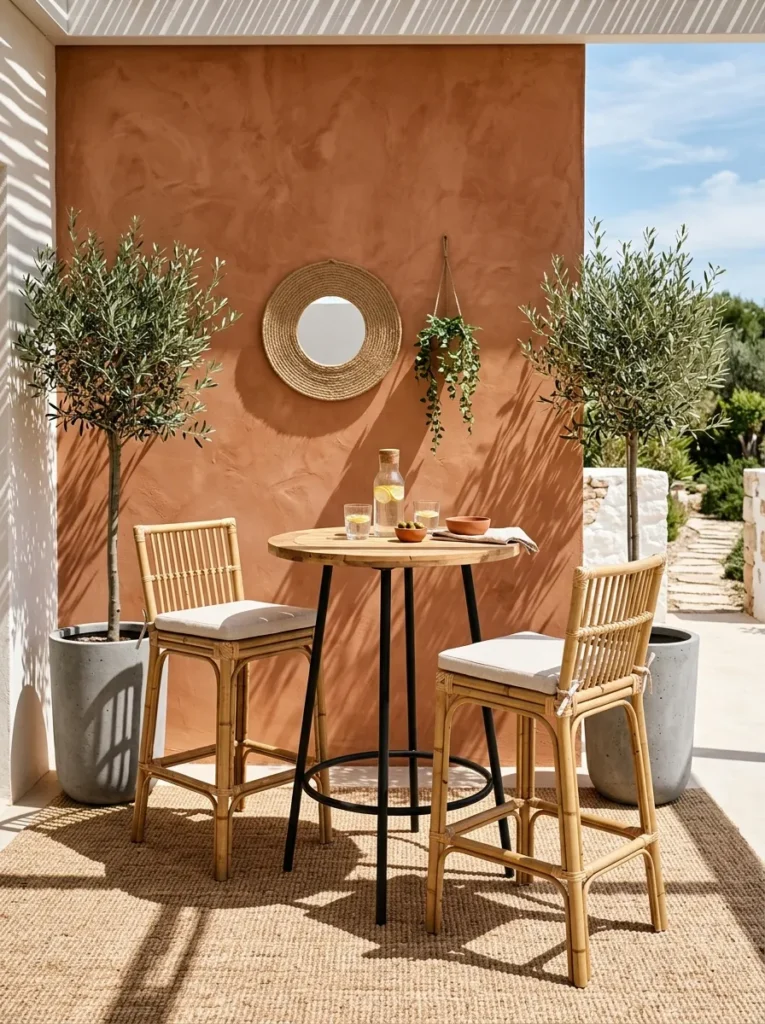
- Furniture: Foldable bar-height table (28-inch round top, 40 inches tall) with two folding bar stools in bent bamboo — full setup folds to under 3 inches thick for storage
- Planters/plants: Two olive trees in slim 12-inch concrete planters flanking the table (drought-tolerant, handles full sun and wind well, a strong pick for an east- or west-facing ledge)
- Flooring: Sisal-look outdoor rug runner, 2-by-6, rolls up in seconds
- Lighting: Wall-mounted solar sconces on either side of the door, no wiring
- Storage: Entire set (table + 2 stools) stores flat behind a door or in a closet, under 4 inches of depth combined
- Standout detail: A textured lime-washed plaster-effect panel (peel-and-stick, renter-safe) mounted behind the table as a backdrop
Why this works: Bar height gives you an eye-level view over most railings, which matters enormously on balconies where the rail itself blocks a standing view.
Standard patio chairs put you at rail height, which on a lot of apartment balconies means staring at metal bars instead of the actual view. A bar-height setup solves that instantly — you’re seated but still seeing over the top rail. This is one of the few configurations where the height itself is the design decision, not the furniture style. The two olive trees frame the table without eating into usable floor space, since their canopies stay narrow and upright rather than sprawling. It’s a setup that photographs like a rooftop bar corner, even on a fourth-floor rental ledge.
The lime-washed plaster panel is doing more work than it looks like. Flat concrete or brick balcony walls read cold in photos and in person, and a textured backdrop panel changes the entire mood of the space for under $60 without a single tool. Olive trees are genuinely one of the better container choices for windy, sun-baked balconies — their silvery leaves are built for reflected heat and airflow, unlike broad-leafed tropicals that shred in sustained wind. That’s a detail most balcony guides skip because they’re staged indoors, not tested outside.
4. Terracotta and Cobalt Corner
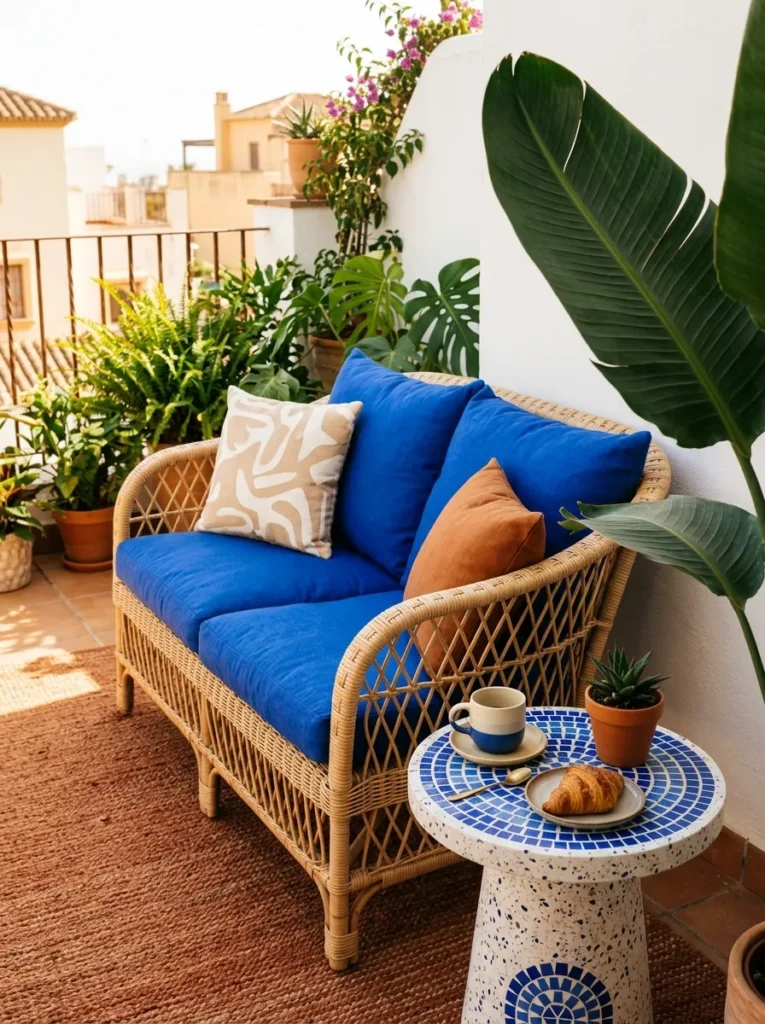
- Furniture: Low-profile rattan loveseat (46 inches wide, 26 inches deep) with two cobalt-blue outdoor cushions, paired with a round terrazzo side table
- Planters/plants: Bird of paradise in a 14-inch terracotta pot (needs bright indirect to full sun, handles heat well — striking silhouette for a narrow space), trailing pothos in a cobalt ceramic hanger
- Flooring: Woven jute-look outdoor rug in rust and cream, 4-by-6
- Lighting: String of amber glass globe lights along the top rail
- Privacy: None needed if facing away from neighbors; optional bamboo roll-shade if exposed
- Storage: Loveseat cushions are removable and machine-washable; store flat in a closet bin during off-season
- Standout detail: A hand-painted cobalt-and-white tile insert (peel-and-stick, renter-safe) set into the side table top
Why this works: Building a color scheme around exactly two dominant hues, rather than five competing accents, is what makes a small balcony read as intentional instead of visually busy.
A colorful balcony scheme reads as intentional, not chaotic, when it’s built around exactly two dominant hues rather than five accent colors competing for attention.
I painted a client’s side table cobalt on a whim years ago, thinking it might feel too bold against the terracotta pots — it ended up being the single detail every guest commented on. That’s the thing about color on a small balcony: there’s so little surface area that one bold choice reads as a full design statement instead of a random accessory. The rattan loveseat keeps the base neutral enough that the cobalt cushions and tile insert don’t compete with each other. Bird of paradise adds height and drama without taking up more than 14 inches of floor footprint.
Rattan and rattan-look resin furniture holds up far better outdoors than people assume, but only if it’s the all-weather woven resin version, not natural rattan, which will crack and fade within a season of direct sun exposure. My husband sees this mistake constantly on renovation walk-throughs — clients bring outdoor-looking indoor furniture onto a balcony and it’s ruined by August. Check the tag for “all-weather” or “resin wicker” specifically. The terrazzo table top is naturally water-resistant, so it needs zero seasonal maintenance beyond a wipe-down, which matters on a balcony you’re not going to babysit every week.
5. Sunset Ombre Rail Garden
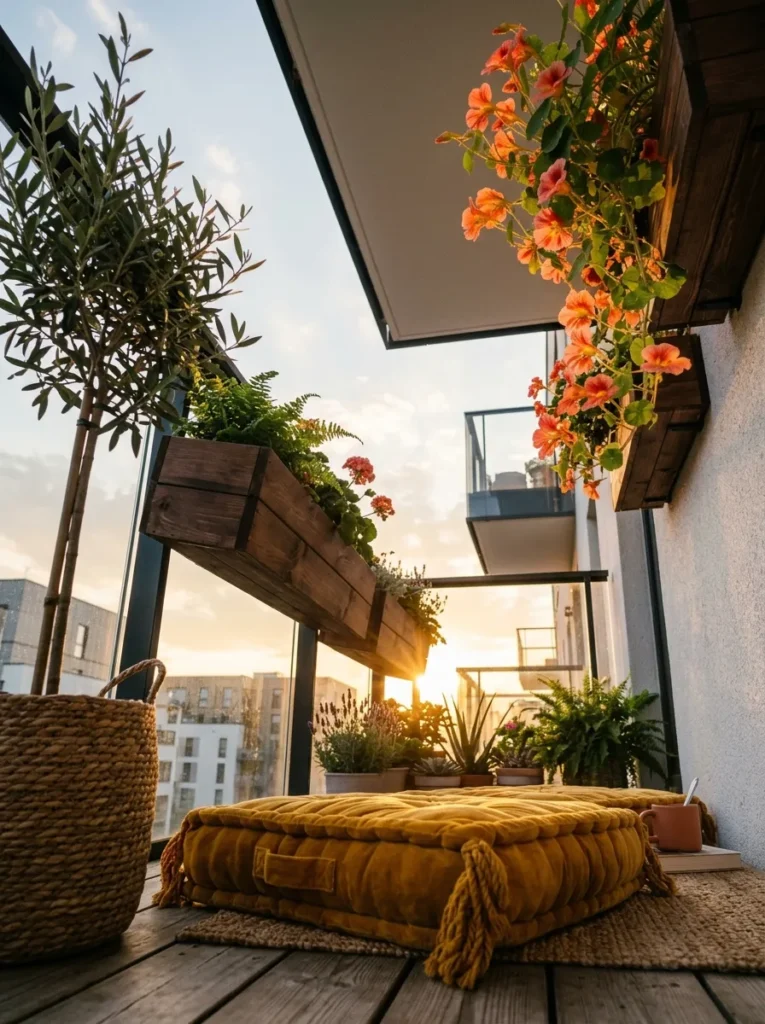
- Furniture: No seating — this idea is a vertical rail-garden focal wall, paired with a single low floor cushion (18-inch round, mustard velvet-outdoor blend) for one-person seating
- Planters/plants: Six matching rail-mounted planters in a graduated ombre from coral to burnt orange, planted with trailing nasturtiums (edible flowers, thrives in full sun, tolerates heat) and dwarf marigolds
- Flooring: None required — floor cushion sits directly on existing balcony surface, or a small 2-by-3 flatweave mat
- Lighting: Warm LED puck lights tucked under each planter, angled downward
- Storage: Planters clip on and off the rail in seconds for winterizing
- Standout detail: The six planters are installed at slightly staggered heights rather than a straight line, creating a stair-step visual rhythm across the rail
Why this works: Railing weight limits are usually far stricter than floor weight limits, so a lightweight, staggered planter row solves the color-drama problem without the load risk of floor planters.
Most people don’t realize that railing-mounted weight and floor-load weight are two completely different numbers on an apartment balcony. My husband checks both separately on every job — a railing bracket might only be rated for 15 to 20 pounds per planter, even when the floor itself can hold hundreds. That’s why this idea uses lightweight resin planters with well-draining soil mix instead of ceramic, and keeps each one under that safer threshold. The trailing nasturtiums cascade down the front of the rail, which means the color show reads even from the street below, not just from inside the apartment.
A staggered planter installation, rather than a single straight row, is what makes a rail garden photograph like a designed feature instead of a maintenance chore. The height variation catches light differently across each pot throughout the day, so the ombre effect actually shifts and deepens as the sun moves — something a flat row can’t do. Nasturtiums are also genuinely useful beyond decoration: the flowers are edible and the plant tolerates neglect better than most flowering annuals, which matters on a balcony you’re not tending daily. It’s color drama with almost no upkeep demand.
6. Emerald and Brass Reading Nook
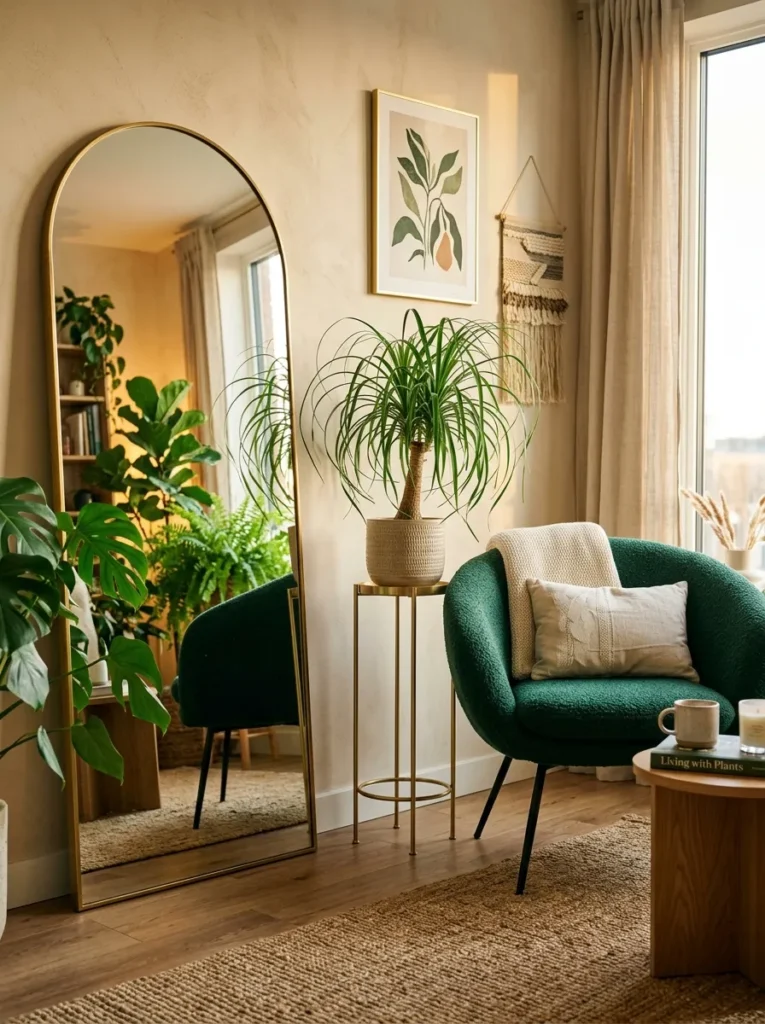
- Furniture: Single papasan-style bowl chair with an emerald bouclé cushion, paired with a slim brass plant stand as a side table
- Planters/plants: Ponytail palm in a 10-inch brass-finish planter on the stand (extremely drought-tolerant, ideal for renters who travel often), a small pot of trailing English ivy tucked at the chair’s base
- Flooring: Emerald-and-cream Moroccan-print outdoor rug, 3-by-5
- Lighting: Brass lantern with a flickering LED candle insert, placed on the plant stand
- Storage: Chair cushion zips off for indoor storage in winter; frame is UV-resistant resin wicker and can stay outside year-round
- Standout detail: A vintage-style brass wall mirror, weatherproof-rated, mounted at an angle to visually double the balcony’s depth
Why this works: A mirror angled toward the interior doorway is one of the few tricks that genuinely changes how deep a space reads in photos and in person.
I’ve used this mirror trick on three different tiny balconies now, and it works every time — a single balcony this size can look almost twice as deep in photos once there’s a reflective surface bouncing the light and the greenery back into frame. The emerald and brass combination feels rich without needing more than two pieces of furniture, which is really the whole challenge on a 4-foot-deep ledge. Ponytail palms are an underused pick here; they store water in their trunk base, so they’re forgiving if you forget to water for a week or two during a busy stretch.
The papasan-style bowl chair is a smart single-seat solution because its curved frame tucks closer to a wall than a boxy armchair of the same width, saving real inches on a shallow footprint. Weatherproof-rated mirrors use a sealed acrylic or treated glass backing specifically designed to resist moisture fogging, which a standard indoor mirror will not survive outdoors. That distinction matters more than it sounds — an unrated mirror will cloud and peel within one Austin summer. Buying the outdoor-rated version costs a little more up front but avoids replacing it every year.
7. Mint and Citrus Kitchen Corner
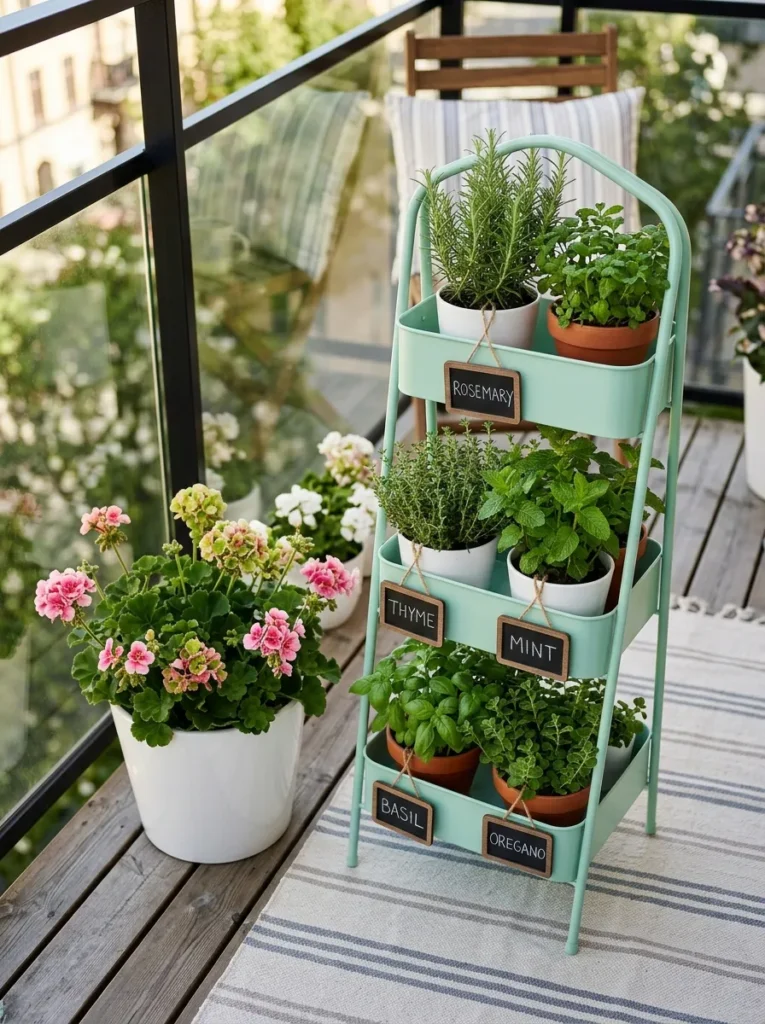
- Furniture: Slatted teak bench, 45 inches wide by 20 inches deep, doubles as a plant shelf underneath — no separate table needed
- Planters/plants: Mint, basil, and thyme in a 3-tier mint-green metal plant stand (all thrive in 4-6 hours of sun and are genuinely useful, not just decorative), lemon-scented geranium in a white ceramic pot on the bench
- Flooring: White-and-mint striped outdoor runner, 2-by-6
- Lighting: String of small white fairy lights woven through the plant stand tiers
- Storage: Bench cushion is a single removable pad, stores flat; plant stand folds for winter
- Standout detail: A chalkboard-painted wood tag hangs from each herb pot, labeled by hand — a small detail that photographs beautifully and actually helps you remember what you planted
A kitchen-herb balcony is one of the few small-space ideas that earns its keep beyond decoration. Fresh mint and basil in the 3-tier stand mean you’re actually harvesting something, not just looking at it, and the mint-green metal frame keeps the whole corner feeling crisp rather than cluttered. Lemon-scented geranium adds a soft citrus note to the air without the space demands of an actual citrus tree. The white-and-mint striped runner ties the color story together, so even a working herb corner reads as styled rather than utilitarian.
Why this works: A working herb station gives a small balcony real daily function, which is what makes people actually use the space instead of just photographing it once.
In my experience, purely decorative balcony setups get used for about two weeks and then ignored. A kitchen-herb corner keeps people coming back daily, because you’re out there anyway to snip basil for dinner. Mint spreads aggressively even in a container, so keep it in its own pot rather than mixed with the thyme and basil — that’s a mistake I’ve watched more than one client make, where the mint takes over the whole tier within a season. The chalkboard tags are a five-minute craft project that makes the whole setup feel considered rather than thrown together.
8. Lemon Yellow Café Set
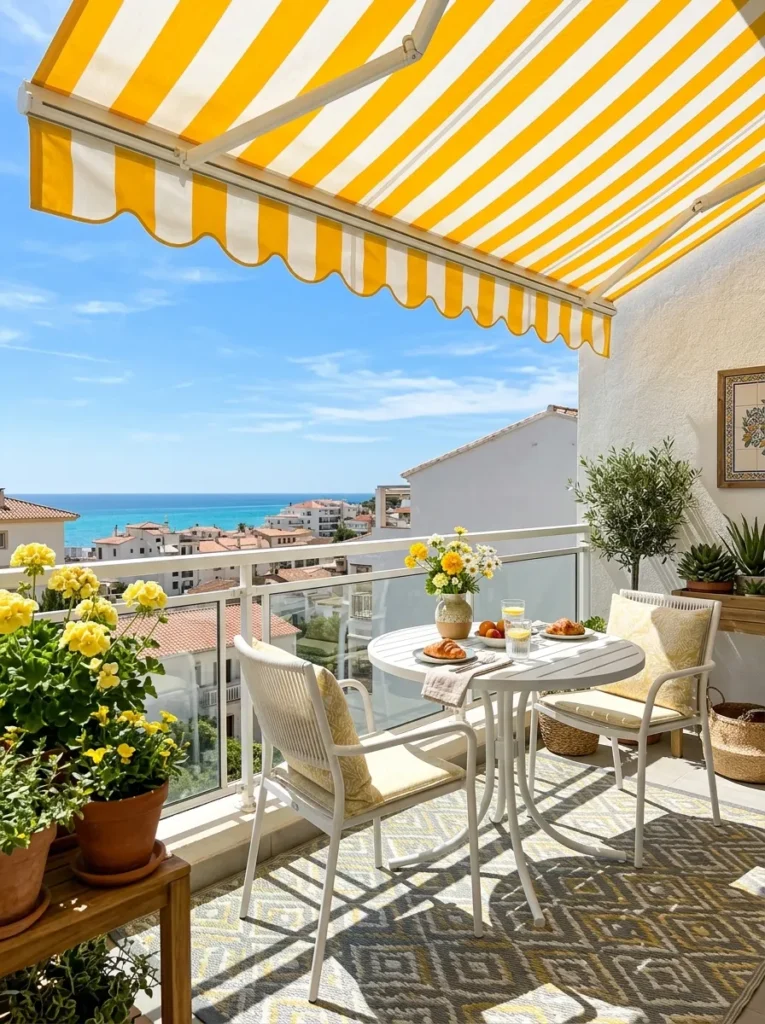
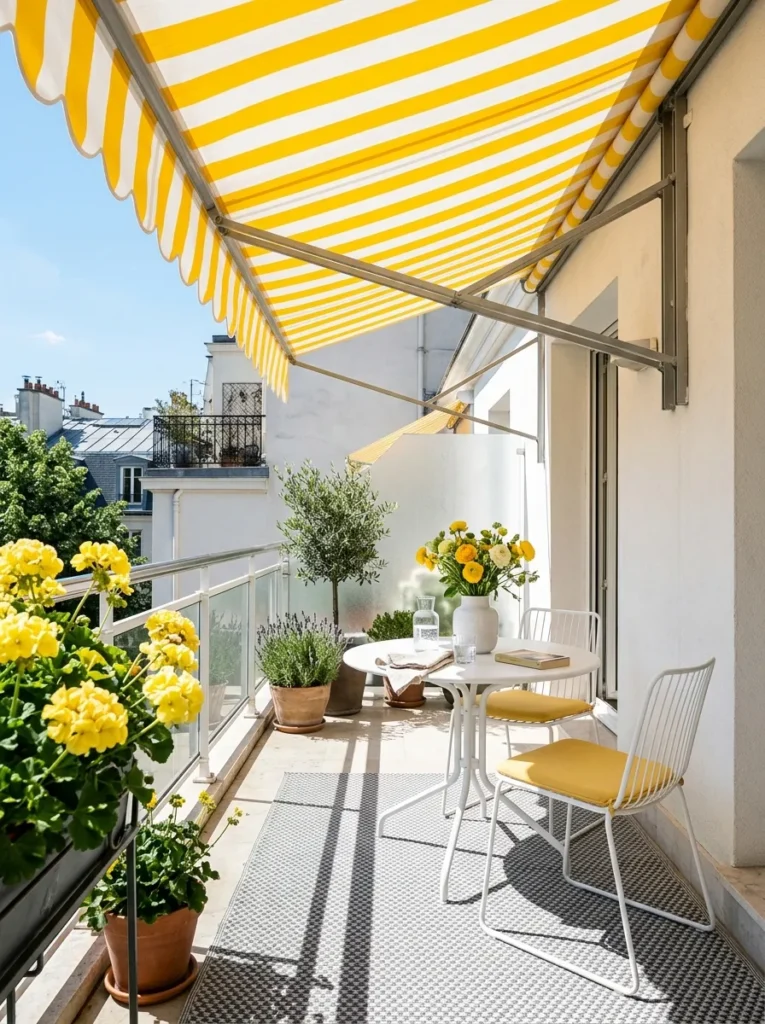
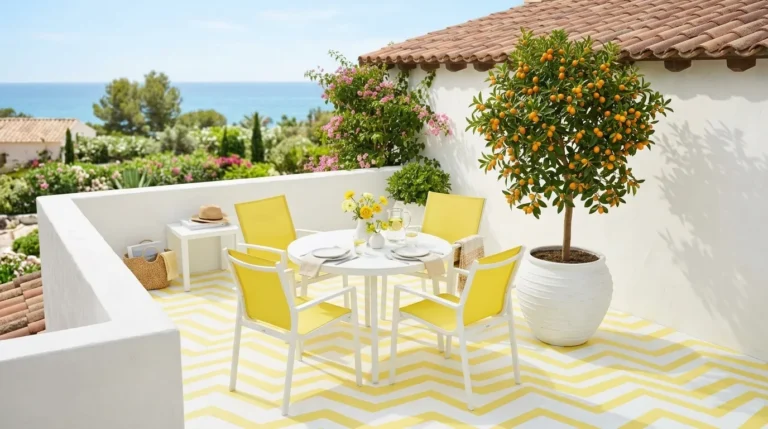
Bright yellow accents on a balcony do something most color guides don’t mention: they read as sunlight even on an overcast day, which matters in climates with a real gray season. This setup leans fully into that effect.
- Furniture: Round white bistro table (24-inch top) with two woven scoop chairs in natural rattan-look resin
- Planters/plants: Yellow geraniums in a pair of white scalloped-edge planters (full sun, blooms reliably through Texas summer heat), a small potted calamondin orange for scent and structure
- Flooring: White floor with a lemon-yellow scalloped-edge outdoor rug, 3-by-4
- Lighting: Yellow-glass pendant lantern, battery-powered, hung from a tension rod across the doorway
- Storage: Chairs stack; table folds flat against the wall when not in use
- Standout detail: A scalloped café awning (fabric, tension-mounted, no drilling) in yellow-and-white stripe over the table
Why this works: A single saturated color used sparingly across just two or three objects reads as cheerful and curated — spread across everything, the same yellow reads busy instead.
The scalloped awning is doing more visual work here than any single piece of furniture. It frames the whole setup the moment you step onto the balcony, and because it’s tension-mounted rather than drilled in, it comes down in under a minute if you move out. Calamondin orange is an underused choice for small containers — it stays compact, tolerates the reflected heat off a stucco or brick wall, and produces small fragrant blooms most of the year in a warm climate. Paired with the white bistro set, the whole corner reads fresh and considered rather than themed.
9. Aqua and Coral Hammock Nook
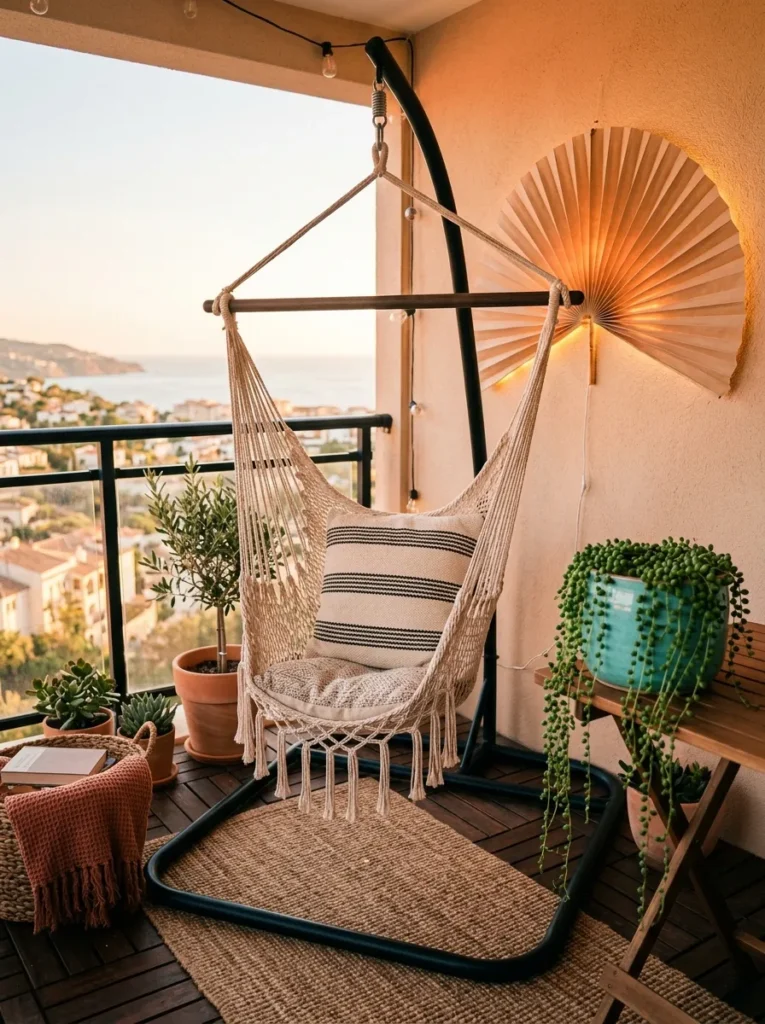
- Furniture: Fabric hammock swing chair with a wood spreader bar, hung from a freestanding steel frame (not railing-mounted) — footprint about 3 feet square
- Planters/plants: Hibiscus in a coral 14-inch pot (full sun, dramatic blooms, handles heat well but needs regular watering — a good pick if you’re home often), trailing string-of-pearls in a small aqua hanging pot beside the frame
- Flooring: Aqua and white Moroccan-tile-print outdoor rug, 3-by-5
- Lighting: Solar lantern with a warm bulb, hung from the frame’s crossbar
- Storage: Hammock seat unclips from the frame and rolls up for storage; frame legs fold flat
- Standout detail: A coral-and-white striped throw pillow tucked into the hammock, paired with a single oversized paper fan mounted on the wall behind it as wall art
Why this works: A freestanding hammock frame delivers the swing-chair effect popular in full-patio photos without needing a rail rated for hanging weight.
I’ve seen renters try to hang a swing chair straight from the railing more than once, and it’s genuinely one of the riskier balcony setups if the railing isn’t rated for hanging or shock-load weight. A freestanding frame sidesteps that completely — the weight sits on the balcony floor across four wide feet, distributing the load instead of concentrating it on one railing point. Hibiscus brings serious color payoff for very little floor space, and its blooms only last a day or two each but replace themselves constantly through the warm months, so the color show never really stops.
Hanging furniture also puts real stress on a structure over time, which is worth understanding before you install anything. A single hammock frame with a person’s full weight swinging creates repeated shock-load stress that’s different from a static weight sitting still — that’s why a rated freestanding stand, built for exactly this kind of movement, is the safer call over anything mounted to existing railing hardware, especially on older buildings. The paper fan wall art costs under $15 and instantly fills the blank wall space that a hammock nook otherwise leaves empty behind it.
10. Fuchsia and Turquoise Floor Lounge
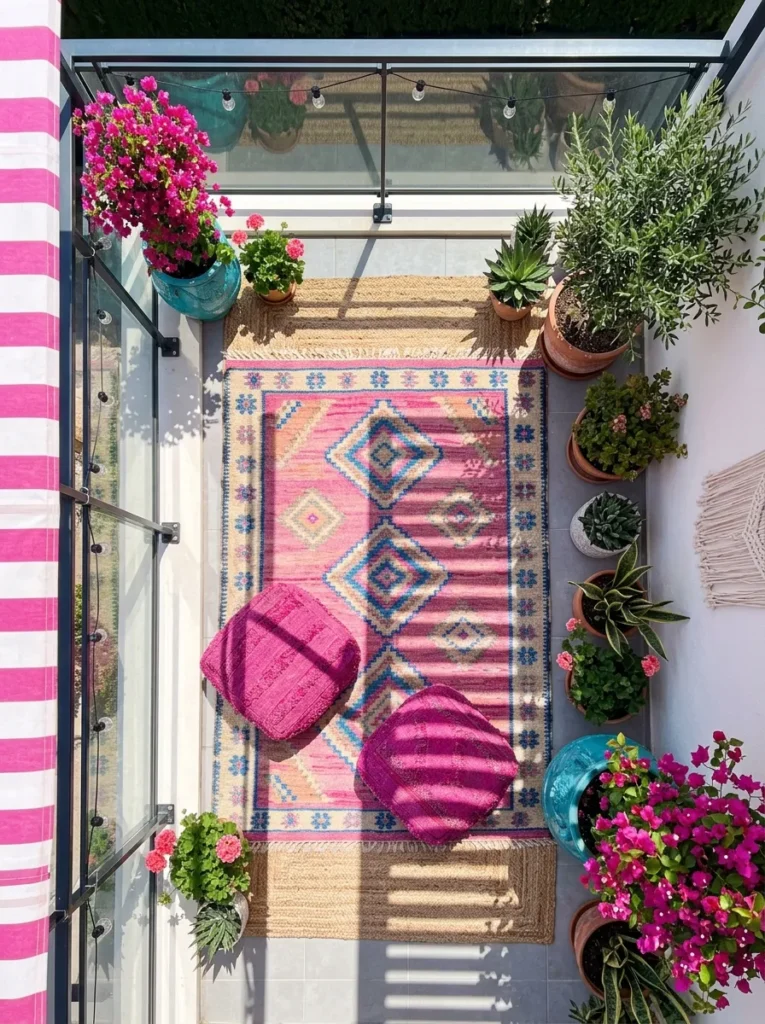
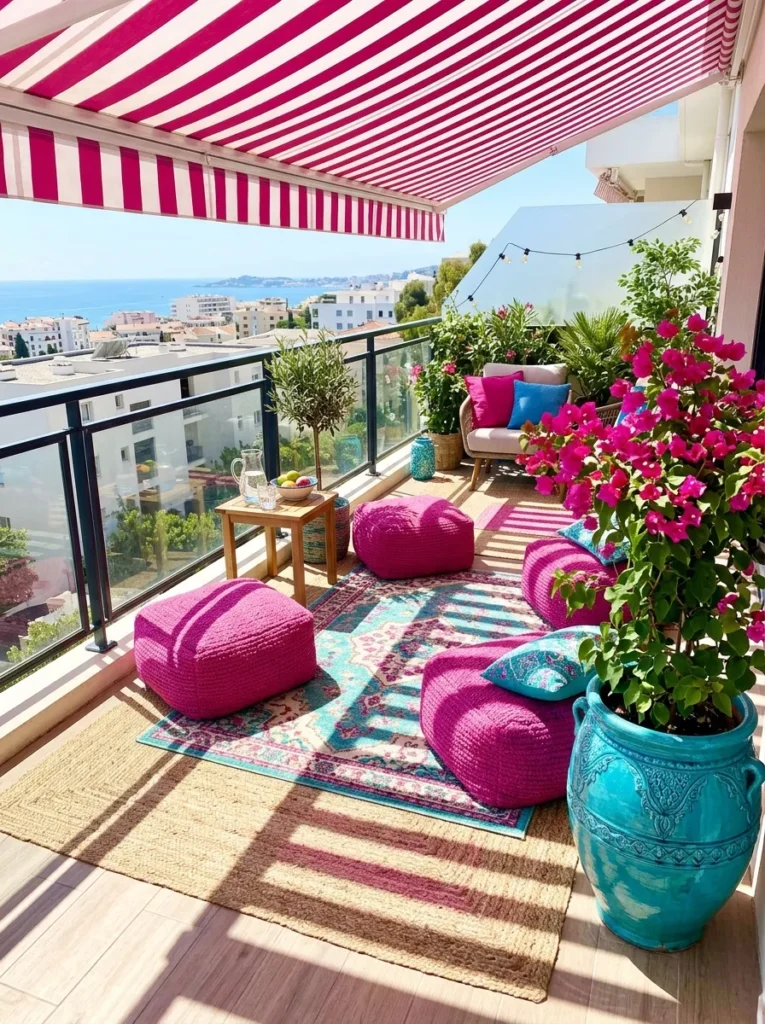
- Furniture: No raised seating — three floor poufs in fuchsia velvet-outdoor blend, arranged around a low round rattan tray table (16 inches tall)
- Planters/plants: Bougainvillea in a 12-inch turquoise-glazed pot, trained up a slim bamboo trellis (needs full sun, genuinely thrives on heat and drought stress), croton in a smaller matching pot for year-round color from foliage alone
- Flooring: Layered rugs — a jute base rug topped with a smaller fuchsia-and-turquoise geometric-print rug
- Lighting: Fringed rattan pendant lantern hung low over the table
- Storage: Poufs are foam-filled and stack two-high in a closet; trellis unclips from the pot for flat storage
- Standout detail: A scalloped fabric canopy in fuchsia-and-white stripe, tension-mounted above the seating area
Why this works: Floor-level seating uses roughly half the visual footprint of chairs, which frees up enough floor space to layer rugs and color without the balcony feeling cramped.
Bougainvillea is one of the best-kept secrets for a genuinely tiny balcony because it wants poor soil, full sun, and to be left alone — the plants that struggle in containers are usually the ones that need consistent moisture, and this isn’t one of them. Trained up a slim trellis, it adds real height and color drama without eating into your seating footprint the way a spreading shrub would. The croton beside it keeps the color story going even in the rare week the bougainvillea isn’t in full bloom, since its leaves stay striped in red, orange, and green year-round in a warm climate like Austin’s.
Floor cushions get dismissed as a college-apartment solution, but styled with layered rugs and a proper canopy overhead, the same setup reads as an intentional lounge corner. I’ve noticed people default to raised furniture on tiny balconies because it feels more “finished,” when actually the opposite is true — three poufs around a low table leaves walking space on every side, which a bistro set with pulled-out chairs never does. The fringed lantern hung low ties the whole scene together at eye level when you’re seated on the floor.
11. Coral Canvas Daybed Corner
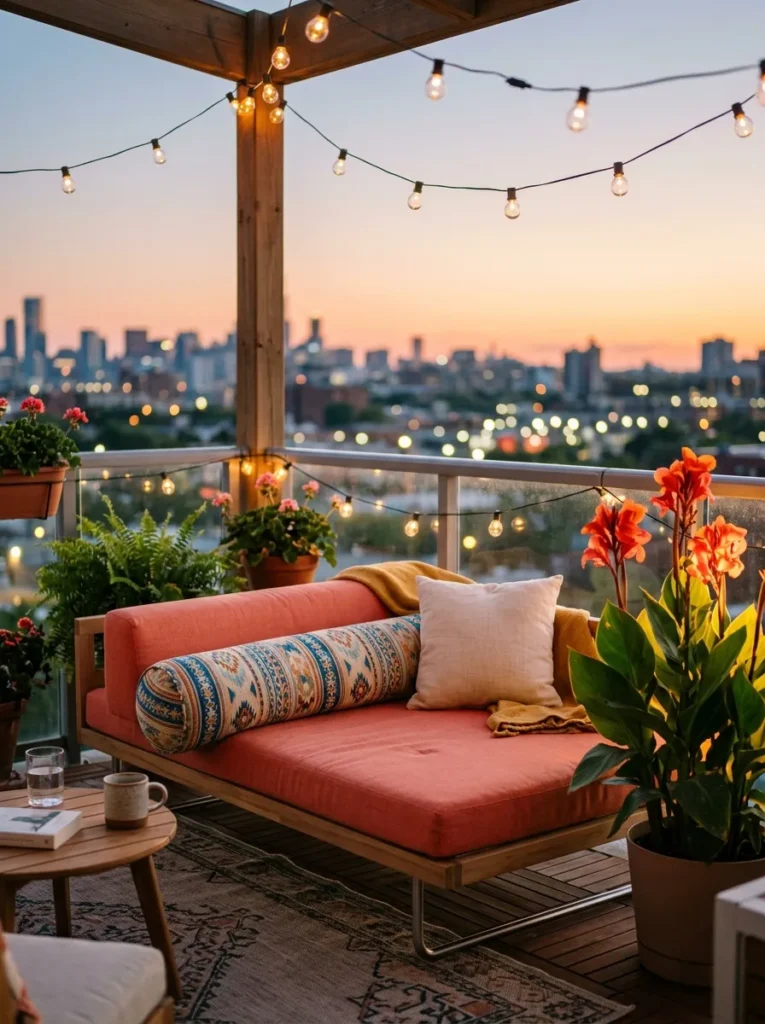
A fold-out daybed is the single furniture choice most small-balcony guides skip entirely, because a standard daybed frame is too deep for a 4-foot ledge — but a canvas sling design changes that math completely.
- Furniture: Fold-flat canvas daybed with a powder-coated steel frame (30 inches wide, folds to 5 inches deep when stored), coral canvas sling seat
- Planters/plants: Canna lily in a 14-inch coral-and-cream striped pot (dramatic tropical blooms, handles full sun and heat, needs regular water), trailing petunias in a white window-box style planter along the rail
- Flooring: Coral-and-white striped canvas floor mat, wipes clean
- Lighting: Warm white string lights zigzagged overhead between two tension rods
- Storage: Daybed frame folds flat and slides under a bed or into a closet in under a minute
- Standout detail: A single oversized round bolster pillow in a mismatched print, propped at one end for a lounge-like feel.
Why this works: A canvas sling frame folds to under 5 inches deep, which solves the depth problem a rigid wood daybed frame cannot.
Canna lily earns its floor space on a balcony that gets real afternoon sun — the blooms come in nearly every warm color and the foliage alone reads tropical and lush even between flowering cycles. Paired with trailing petunias along the rail, the whole scene has color at two different heights, which makes a narrow balcony feel fuller without adding a single extra piece of furniture. The daybed’s canvas sling design is what makes this workable in a shallow space at all: a standard wood-frame daybed simply won’t fit a 4- to 6-foot depth once you account for door clearance.
My husband’s crews see a lot of botched balcony furniture installs where people try to wedge oversized pieces through a sliding door frame that’s simply too narrow — a folding canvas daybed avoids that entirely since it collapses to carry through sideways. That’s a small but real logistical detail nobody mentions until moving day. The string lights zigzagged overhead also do double duty as a light wind-flag: their gentle movement in a breeze is a visual cue the space is airy and alive, rather than static, which photographs beautifully at dusk.
You’ll Also Love: 15 Hydrangea Garden Ideas for a Stunning Yard
12. Tropical Jewel-Tone Saucer Chair
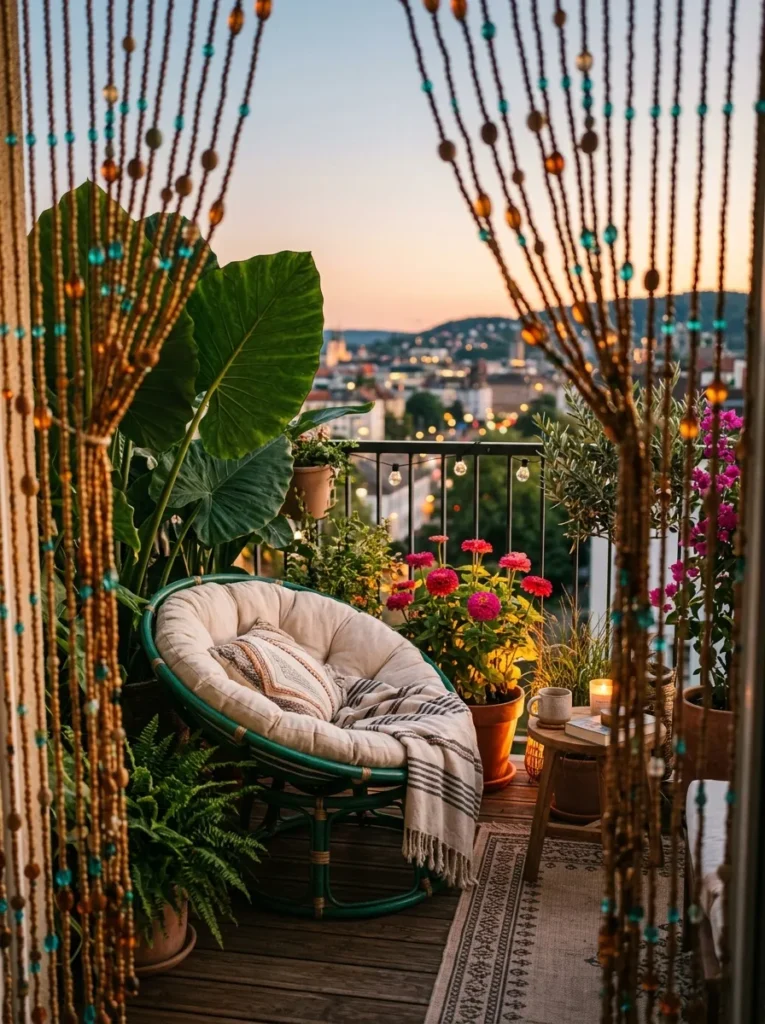
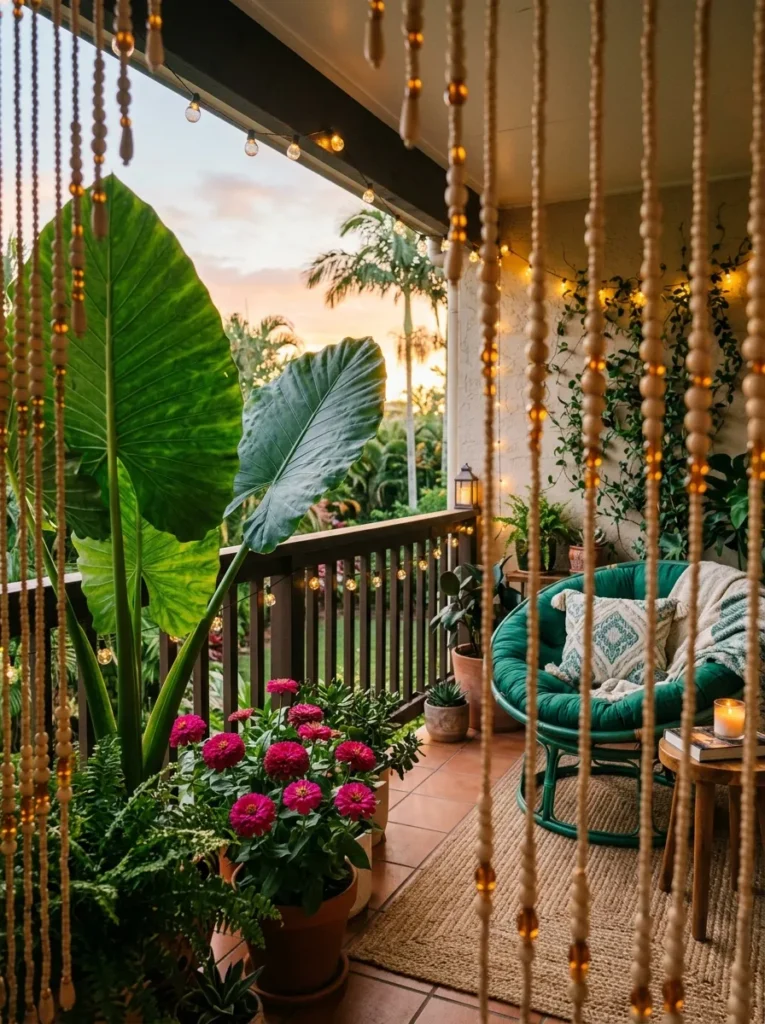
- Furniture: Single oversized rattan saucer chair on a swivel metal base (36-inch diameter), no additional seating — designed for a one-person nook
- Planters/plants: Elephant ear in a 16-inch emerald-glazed pot (dramatic oversized tropical foliage, needs partial shade and consistent moisture — best for a covered or east-facing balcony), zinnias in a small magenta pot for a pop of bloom at chair height
- Flooring: Jewel-toned Persian-print outdoor rug in emerald, magenta, and gold, 3-by-4
- Lighting: Small brass table lamp with a battery-operated warm bulb, set on a narrow side shelf
- Storage: Chair cushion removes and stores flat; frame is UV-rated resin and stays outside year-round
- Standout detail: A beaded curtain panel, weatherproof-rated, hung in the doorway just behind the chair to frame the view from inside
Why this works: A single generously sized chair, rather than two smaller ones, almost always fits a narrow balcony better and reads as more intentional than a mismatched pair.
I styled a one-chair balcony for a client last spring who was convinced a single seat would look sparse, and it did the opposite — the oversized saucer chair filled the space with presence instead of clutter, and she used it daily because there was no clutter to navigate around. Elephant ear is the plant that makes this corner feel genuinely tropical rather than generically green; its leaves can reach 18 inches across, so one plant does the visual work of three smaller ones. Paired with the beaded doorway curtain, the whole nook feels like a private retreat rather than a leftover ledge outside a window.
Jewel tones read as cozy rather than cold specifically because they’re saturated and warm-based, unlike pastel or cool-toned palettes that can feel sparse in a small footprint. A single oversized chair paired with one statement plant consistently reads as more finished in photos than two smaller mismatched pieces competing for the same space. The narrow side shelf holding the brass lamp adds function without adding floor footprint, since it mounts directly to the chair frame rather than sitting as a separate table.
13. Chalk White and Chartreuse Modern Ledge
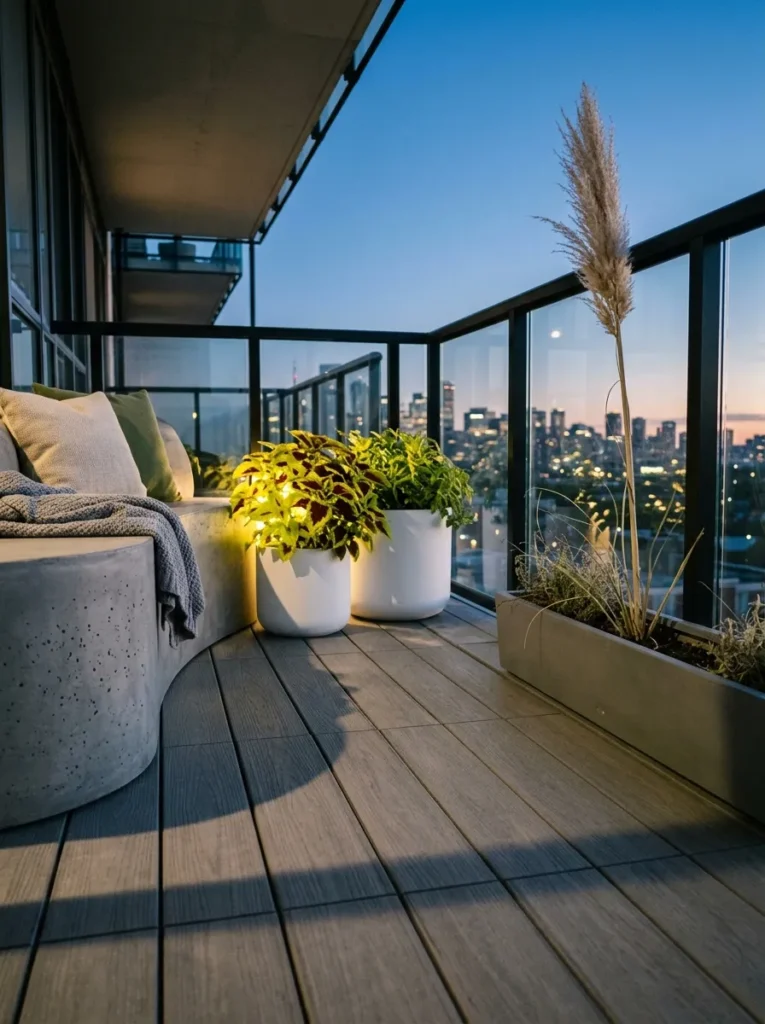
Modern balcony styling in 2026 leans away from busy patterns toward clean, sculptural shapes — this setup is built entirely around that restraint.
- Furniture: Curved-edge concrete-look resin bench (42 inches wide, 16 inches deep) paired with a single organic-shaped side table in the same finish
- Planters/plants: Snake plant ‘Bantel’s Sensation’ in a chalk-white cylindrical planter (striking vertical striping, extremely drought-tolerant, ideal for a low-maintenance modern look), chartreuse coleus in a matching smaller cylinder for a sharp color contrast against the white
- Flooring: Poured-look interlocking composite tiles in warm gray
- Lighting: Slim linear LED bar light, solar-powered, mounted flush under the bench edge for an uplighting glow
- Storage: Bench and table are both lightweight resin and can be moved as one unit into a closet if needed, though both are rated for year-round outdoor use
- Standout detail: A single sculptural dried pampas grass stem, oversized, standing alone in a floor vase beside the bench
Why this works: A restrained two-color palette against curved, sculptural furniture is what makes a small space read as deliberately modern rather than sparsely furnished.
Chartreuse against chalk white is a combination I keep coming back to because it photographs sharper than almost any other pairing — the contrast reads clearly even at thumbnail size, which matters if this space is getting saved and scrolled past quickly. The curved-edge bench avoids the boxy, hard-angled look that dates a lot of balcony furniture within a couple of seasons, leaning instead into the organic-modern shapes shaping current design. Snake plant ‘Bantel’s Sensation’ is a genuinely underused variety compared to the standard striped version, and its vertical lines echo the linear light fixture beneath the bench.
Uplighting is a detail almost nobody uses on a balcony, and it changes the entire evening mood of the space. A flush-mounted linear light angled upward under a bench edge creates dramatic shadow play across textured plant leaves that overhead string lighting simply cannot replicate. The composite tiles underfoot are worth the investment over a standard outdoor rug in a modern scheme specifically because their poured-concrete look holds a clean line the way a soft rug edge never quite does, keeping the whole footprint feeling architectural rather than decorated.
14. Cherry Red and Steel Micro-Balcony— A Small Apartment Balcony Ideas for Quiet Luxury
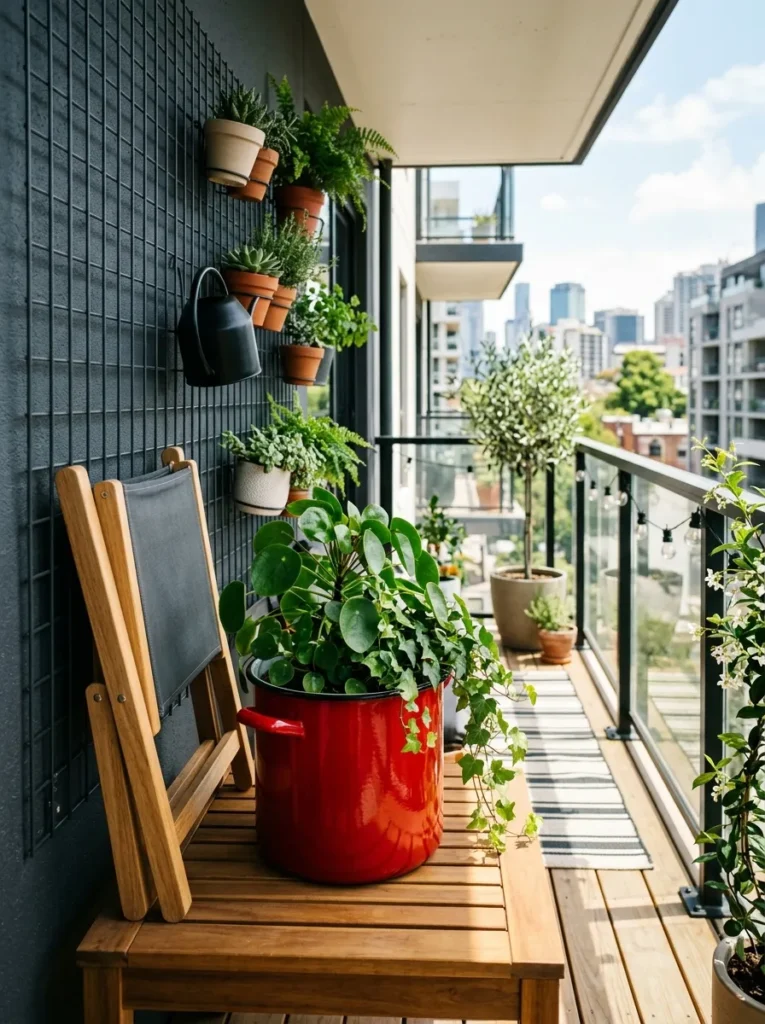
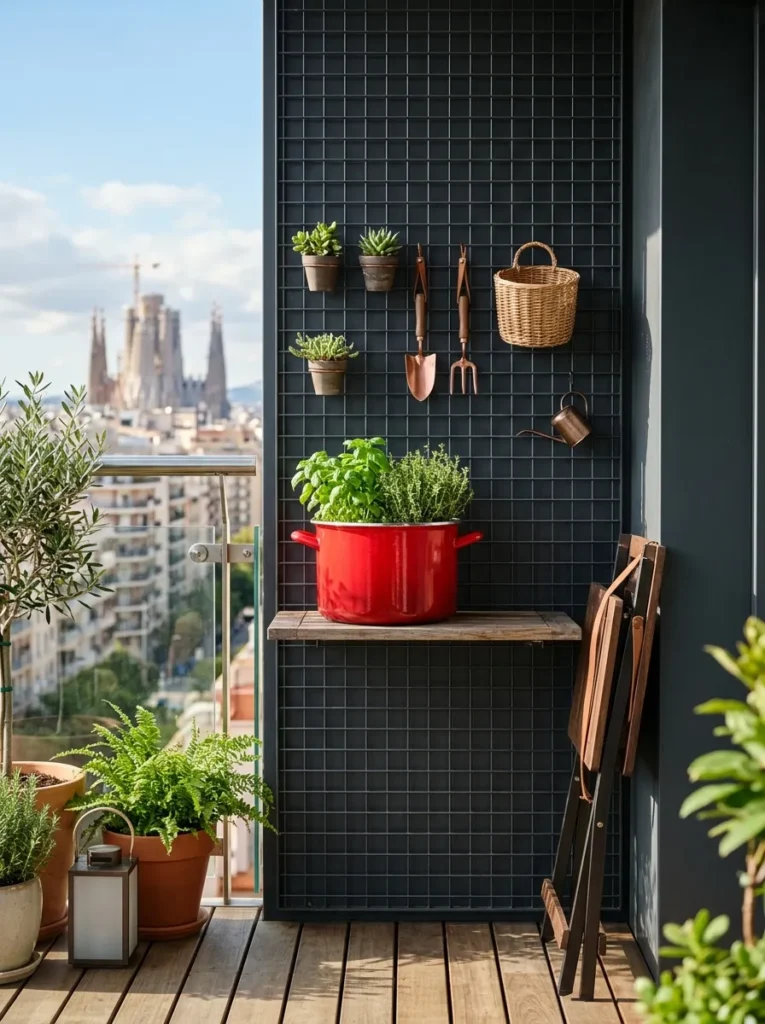
- Furniture: Single folding steel-frame stool (14-inch seat, folds to under 2 inches thick) paired with a wall-mounted steel shelf-ledge (24 inches wide) instead of a table — built for balconies under 4 feet deep where any table footprint is unworkable
- Planters/plants: Dwarf pomegranate in a 10-inch cherry-red enamel pot (compact size suited to true micro-balconies, tolerates full sun and reflected heat, produces small edible fruit), trailing sedum in a steel-mesh rail planter
- Flooring: Dark charcoal indoor-outdoor mat, 2-by-3, non-slip backing
- Lighting: Single cherry-red enamel pendant lantern, battery-operated, hung from a ceiling hook if the balcony is covered
- Storage: Stool folds and hangs on a wall hook; shelf-ledge stays mounted year-round since it holds no weight-bearing furniture
- Standout detail: A powder-coated steel grid panel, mounted flush to the wall, doubling as both wall art and a hanging point for small tool-style plant clips
Why this works: A wall-mounted shelf-ledge instead of a floor table reclaims the entire floor footprint on a genuinely sub-4-foot balcony, where a table simply isn’t structurally an option.
This is the setup I’d point to for the smallest balconies — the ones under 4 feet deep that most guides quietly skip because a table just doesn’t fit alongside a door swing. Wall-mounting the shelf-ledge instead solves it, since it holds a coffee cup or small plant without taking a single inch of floor space. The dwarf pomegranate is scaled specifically for this — a full-size pomegranate needs more root room than a 10-inch pot allows, but the dwarf variety stays compact for years and still fruits reliably in a hot, sunny spot.
The steel grid panel is doing quiet double duty as both decoration and function, which matters when there’s genuinely no spare inch for a separate accent piece. My husband’s crews use grid panels like this constantly for garage organization, and repurposing one here as wall art with clip-on plant hooks means the “decor” and the “storage” are the same object. Cherry red against charcoal and raw steel keeps the tiny footprint from reading as an afterthought — it’s a bold, intentional color choice on a space most people would leave bare.
15. Coral Blush and Brushed Gold Corner
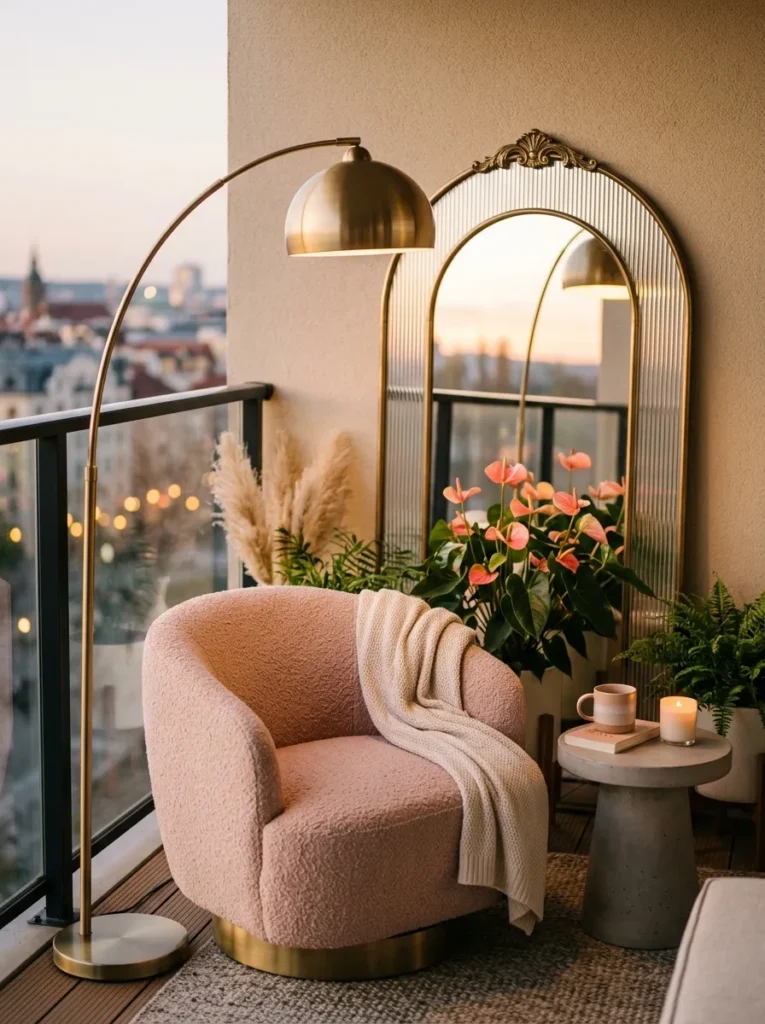
- Furniture: Curved-back accent chair (28-inch width) in blush bouclé with a brushed-gold swivel base, paired with a small round brushed-gold side table
- Planters/plants: Flamingo flower (anthurium) in a blush-pink 12-inch pot (bold, glossy tropical blooms, needs bright indirect light — a strong pick for a partially shaded balcony), trailing ivy in a small brushed-gold hanging pot
- Flooring: Blush-and-cream marbled outdoor rug, 3-by-5
- Lighting: Brushed-gold arc lamp, solar-powered, curving over the chair from a weighted base
- Storage: Chair cushion is removable and machine-washable; frame is UV-rated resin built to stay outdoors year-round
- Standout detail: A fluted brushed-gold mirror, weatherproof-rated, mounted at chair height to double as both art and light-bouncing depth
Why this works: Mixed-metal minimalism — one warm metal tone repeated across every hard surface — reads as quiet luxury rather than mismatched decor, even on a tiny footprint.
Blush and brushed gold is a combination that leans fully into the quiet-luxury direction shaping modern interiors right now, and it translates surprisingly well outdoors. The curved-back chair’s swivel base means you can angle it toward the anthurium blooms or toward the view, which matters on a balcony too small to reposition furniture physically. Anthurium is an underused choice in outdoor container gardening — its glossy red-pink blooms last for weeks at a time and thrive in the kind of bright, indirect light a covered or east-facing balcony naturally provides, without the sunburn risk full-sun flowers face.
I styled a version of this corner for a client with a north-facing balcony who assumed she couldn’t have bold color without direct sun, and the anthurium proved her wrong within a season. The arc lamp is worth the higher price point over a standard clip light because its curve echoes the chair’s swivel base and the mirror’s fluted edge, tying three separate objects into one cohesive silhouette. That kind of repeated shape is what makes a small, mixed collection of pieces read as a single designed moment instead of separately purchased items.
Styling Principles: Furniture Footprint and Weight Math
Before buying anything for a small apartment balcony, work backward from two numbers: your balcony’s actual depth and its posted weight limit, if one exists.
Depth first. Measure from the exterior wall to the railing, not the door frame to the railing — door swing eats into usable space too. Anything you buy needs to leave at least 12 to 18 inches of clear walking path past the door. This is why folding, wall-mounted, or floor-cushion setups outperform fixed furniture on balconies under 6 feet deep: a standard dining set assumes patio-level space most apartments simply don’t have.
Weight second, and in two separate categories. Floor load and railing load are rated differently, and a railing bracket is almost always the stricter limit. Check your lease or call your building manager before installing anything on the rail itself — hanging planters, swing chairs, or mounted shelves. When in doubt, choose a freestanding stand over a rail-mounted piece; the weight distributes across the floor instead of concentrating on one bracket point.
Soil weight adds up fast. A single 14-inch pot with wet potting mix and a mature plant can weigh 40 pounds or more. Multiply that across several planters and you can approach a real limit quickly, especially on older buildings, which tend to carry lower posted weight ratings than newer construction. Favor lightweight resin or fiberglass planters over ceramic or concrete when you’re grouping several together, and center the heaviest pieces near the wall rather than out at the railing edge, where structural stress is highest.
FAQs
1. How much weight can an apartment balcony hold? Weight limits vary widely by building and are usually posted in your lease or building code documentation, but many residential balconies are rated between 40 and 100 pounds per square foot for floor load, with railing-mounted weight limits often far lower — sometimes just 15 to 20 pounds per bracket point. Always check your specific building rather than assuming a standard number.
2. What are the best plants for a small sunny balcony? Dwarf citrus, olive trees, bougainvillea, and succulents like snake plant all handle full sun, heat, and container life well, since they’re naturally suited to drought stress and reflected heat off walls and railings.
3. What are the best plants for a small shaded or covered balcony? Ferns, elephant ear, anthurium, and trailing ivy or pothos all do well in bright indirect light without direct sun exposure, making them strong choices for north-facing or covered balconies.
4. What furniture actually fits a 4- to 6-foot-deep balcony? Folding bistro tables, wall-mounted drop-leaf tables, freestanding hanging chairs on A-frame stands, and low floor-cushion seating all work well at this depth, since they either fold flat or keep a footprint under 3 feet.
5. What are renter-friendly privacy solutions for a balcony? Tension-clip reed screening, freestanding folding screens, and tall potted plants like olive trees or bamboo all add privacy without drilling into railings or walls, which keeps your security deposit intact.
6. How can I style a small balcony on a budget? Focus your budget on one or two standout pieces — a bold planter, a canopy, or a single accent chair — and fill in the rest with affordable folding furniture, solar lighting, and a peel-and-stick renter-friendly rug or wall panel.
Conclusion
A tiny balcony doesn’t have to mean a bare one. Whether you go bold with jewel tones, keep it clean and modern with brushed gold, or start small with a single folding stool and one great plant, these small apartment balcony ideas are built to actually fit your space — not just your Pinterest board. I’ve seen how much a well-planned corner like this gets used, day after day, once it’s sized right and set up with real weight and depth in mind.
Save this post before you start shopping, try even one of these ideas in your own space this week, and pass it along to anyone else stuck staring at a balcony that felt too small to bother with. It rarely is.