15 Hydrangea Garden Ideas for a Stunning Yard
Here’s something most garden blogs won’t tell you: the reason your hydrangea never blooms probably has nothing to do with sun or soil. It’s pruning at the wrong time of year. These hydrangea garden ideas are built around getting that one detail right first, then layering in the color, placement, and design choices that actually make a garden feel intentional. I’ve been growing hydrangeas in our Austin yard for years now, moving them through sun, shade, containers, and clay soil, and I’ve watched more of them fail from bad pruning timing than any other cause.
Whether you want a privacy hedge, a cutting garden, or a single dramatic specimen by the front door, understanding old-wood versus new-wood blooming changes everything about how you plant and care for these shrubs. This guide walks through fifteen distinct ways to use hydrangeas well, with the botany explained plainly enough that you’ll actually remember it.
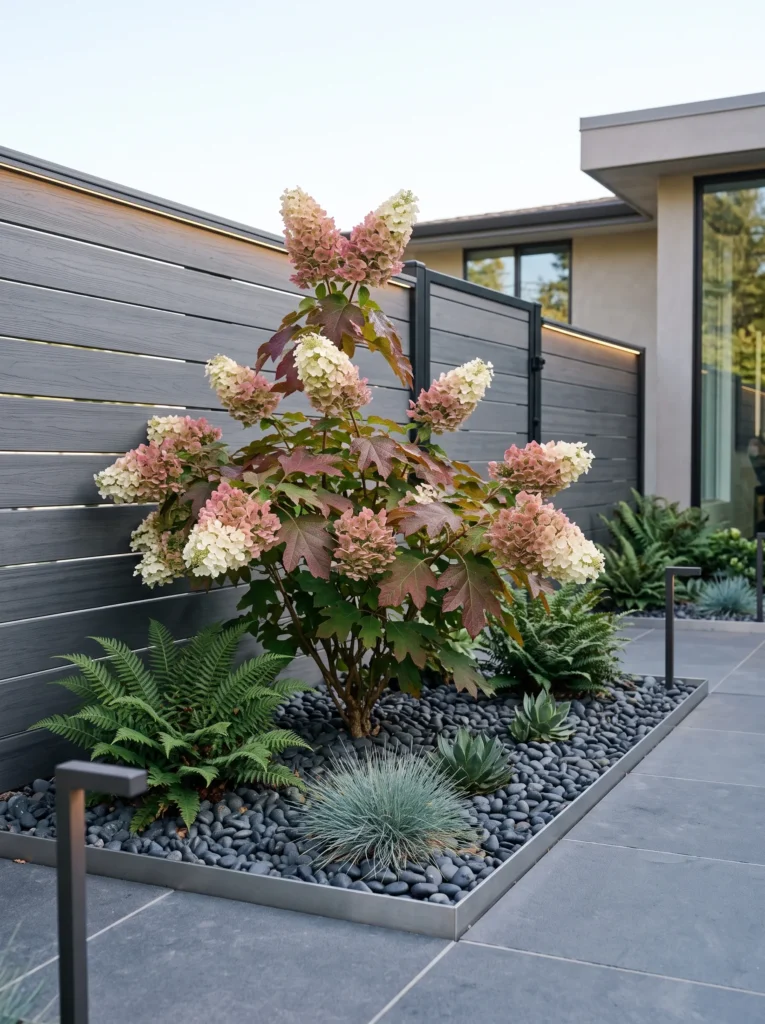
Oakleaf Foundation Drama
- Scientific name: Hydrangea quercifolia (oakleaf hydrangea)
- Hardiness: Zones 5–9; handles Central Texas heat well once established
- Bloom type: Old-wood bloomer — flower buds set in late summer for the following year, so prune only right after flowering
- Standout detail: Cinnamon-colored, exfoliating bark revealed each winter once leaves drop, paired with oak-shaped foliage that turns deep burgundy-red in fall
- Placement: Foundation planting or woodland edge with morning sun and afternoon shade
- Worth noting: Michigan State University Extension highlights oakleaf hydrangea for offering multi-season interest — bark, bloom, and fall color — that most flowering shrubs can’t match (verify current URL before citing)
Why this works: Oakleaf hydrangea is one of the few shrubs that delivers spring blooms, fall foliage color, and winter bark interest from a single plant.
Most people picture bigleaf hydrangeas when they think of these shrubs, but oakleaf hydrangea earns its place through structure long after the blooms fade. The cone-shaped flower clusters open creamy white in early summer, age to dusty pink, then dry to a soft parchment brown that holds through fall. Once the oak-shaped leaves drop, the exfoliating cinnamon bark becomes the real focal point, giving the bed winter interest most flowering shrubs can’t match. Because it blooms on old wood, pruning right after flowering, never in late fall or early spring, protects next year’s show.
In Austin gardens, oakleaf hydrangea handles our brutal August heat better than bigleaf varieties, as long as it gets afternoon shade and consistent moisture through the first two summers. I’ve planted it along the north side of a client’s porch where morning sun hit the leaves and the house blocked the worst afternoon rays, and it filled in beautifully by year three. Pair it with dwarf yaupon holly or native ferns at the base for textural contrast, and let the burgundy fall foliage carry the bed into October. It reads as intentional structure, not just another green foundation shrub.
Panicle Patio Standards
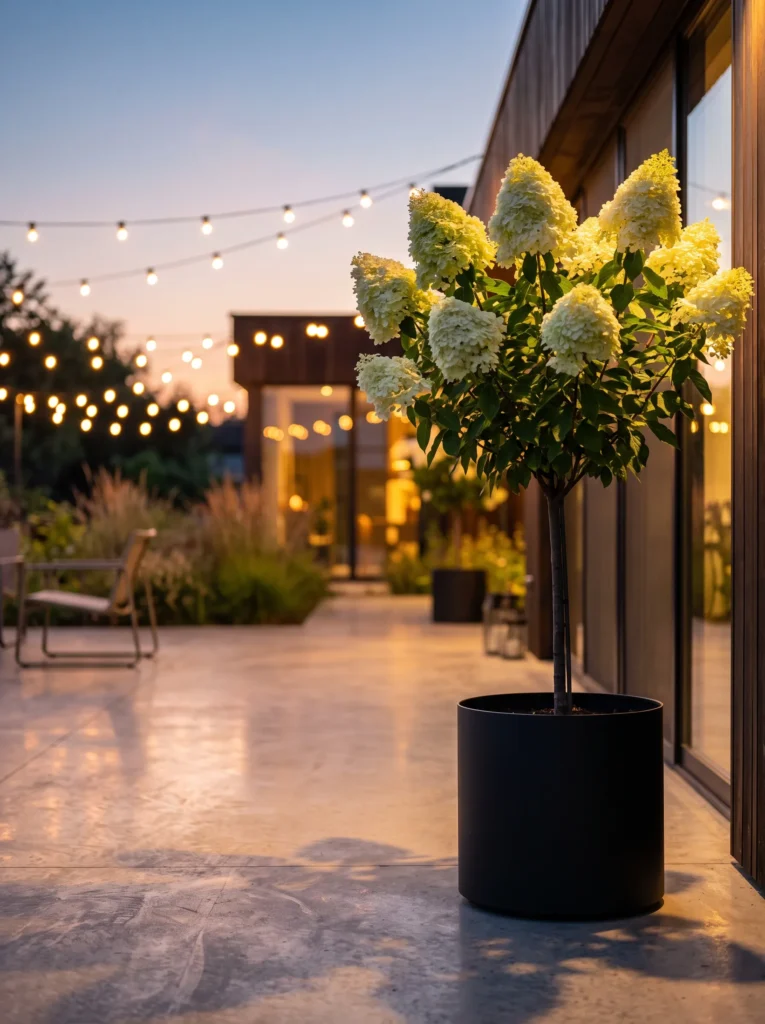
- Scientific name: Hydrangea paniculata (‘Limelight,’ ‘Little Lime’)
- Hardiness: Zones 3–8 — more cold-hardy and sun-tolerant than bigleaf types
- Bloom type: New-wood bloomer, so hard pruning in late winter doesn’t cost you that summer’s flowers
- Standout detail: Trained into a single-trunk “tree” form, underlit with a low solar light at dusk so the cone-shaped blooms glow softly after sunset
- Placement: Container or patio corner with six-plus hours of direct sun
- Construction note: My husband, who’s built more raised planters than either of us can count, always over-drills drainage on containers holding panicle hydrangeas
Why this works: Because panicle hydrangea blooms on new wood, hard pruning in late winter guarantees a full flush of flowers by midsummer.
Panicle hydrangea is the one variety that tolerates full Texas sun without wilting by 3 p.m., which is why it works so well trained into a small patio tree instead of a sprawling shrub. Because it blooms on new wood, you can cut it back hard in late winter and still get a full flush of cone-shaped blooms by midsummer, something you can’t do with bigleaf varieties. The flowers open lime-white, shift to soft pink as nights cool in September, and dry beautifully on the plant, so a single trained specimen gives three distinct looks across one growing season.
My husband, who’s built more raised planters than either of us can count, always tells clients to over-drill drainage on any container holding a panicle hydrangea — the standard four holes in most nursery pots aren’t enough once Texas rain shows up in bursts. We drilled six extra half-inch holes into a 24-inch steel planter for our own patio tree, and it’s never sat in standing water since. Set a small solar light at the base so the blooms glow softly after dark — it turns an ordinary patio corner into the best-looking spot in the yard.
Annabelle Cutting Row
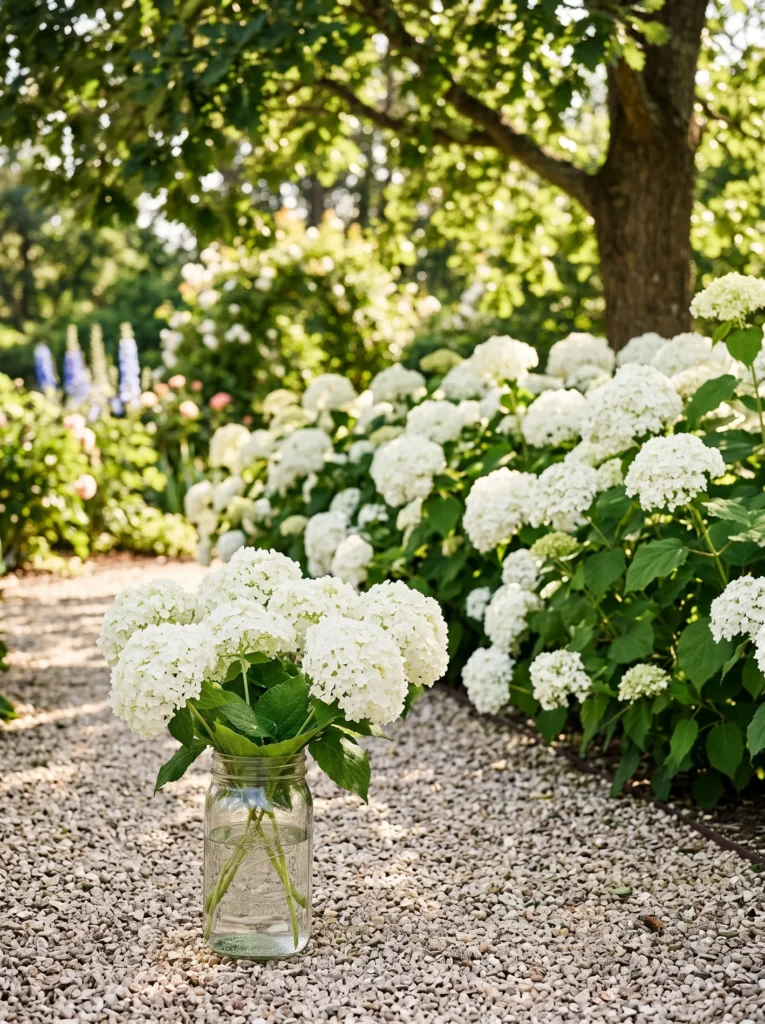
- Scientific name: Hydrangea arborescens ‘Annabelle’
- Hardiness: Zones 3–9; native to the eastern US, forgiving in heat and cold alike
- Bloom type: New-wood bloomer — can be cut nearly to the ground each February and still bloom by June
- Cost-per-season value: A $20–25 shrub produces a dozen-plus dinner-plate-sized blooms every summer for years, versus $10–15 per grocery-store bouquet that lasts a week
- Standout detail: Planted in a straight cutting row, spaced 3 feet apart, so the mophead blooms read like a hedge of white pom-poms by July
- Placement: Part-shade bed, protected from harsh west sun that can wilt the oversized blooms
Why this works: A single ‘Annabelle’ hydrangea shrub can produce more cut flowers in one summer than a year’s worth of store-bought bouquets, at a fraction of the cost.
I planted six ‘Annabelle’ hydrangeas in a straight row along our side yard three years ago mainly because I was tired of buying grocery-store bouquets that wilted within a week. That one-time cost, roughly $150 for six shrubs, has already paid for itself many times over — each plant now produces a dozen or more blooms the size of dinner plates every summer, and I cut armfuls for the kitchen table without the bed ever looking bare. Because arborescens blooms on new wood, I cut the whole row back to about 12 inches every February, and it fills back in.
Annabelle hydrangea is native to the eastern United States, which means it handles clay soil and humidity better than most ornamental shrubs and rarely needs fertilizer beyond a spring topdressing of compost. The blooms start lime-green, open to pure white, and by late summer often flop under their own weight, so I stake mine loosely with green garden stakes hidden inside the foliage. Plant it in a spot with morning sun and afternoon shade, since harsh west sun can wilt the oversized flower heads by midday. For a cutting garden, few shrubs deliver this many blooms for this little effort.
Blue Mophead Hedge Line
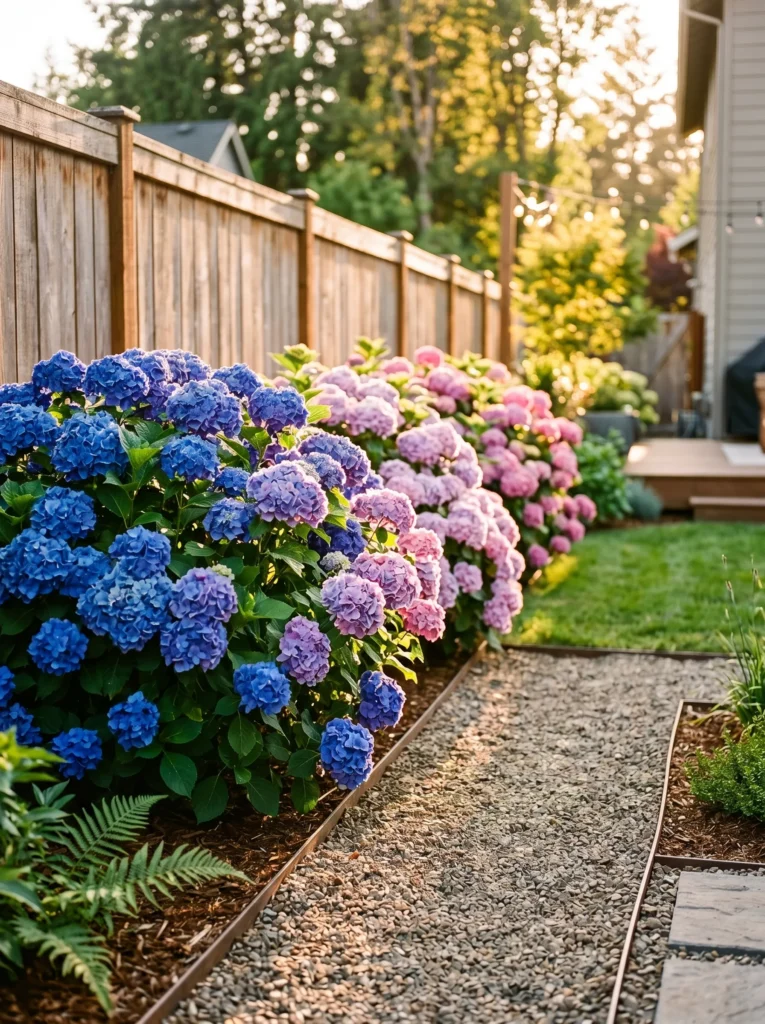
- Scientific name: Hydrangea macrophylla
- Hardiness: Zones 6–9; in Austin’s zone 8b, plant with morning sun and shelter from late-spring cold snaps that can damage old-wood buds
- Bloom color science: Flower color depends on aluminum uptake, controlled by soil pH — acidic soil (below 5.5) makes aluminum available for true blue blooms; alkaline soil (above 6.5) locks it out and shifts blooms to pink
- Standout detail: Amend soil pH gradually along the hedge row so blooms shift from deep blue at one end to soft lavender-pink at the other, creating a natural ombré effect
- Bloom type: Old-wood bloomer — prune only within a few weeks of the flowers fading
Why this works: Hydrangea macrophylla flower color is determined by soil pH, not variety, so a single hedge can be shaded from blue to pink with targeted soil amendments.
Hydrangea macrophylla is the only common hydrangea where you can actually choose the flower color, and it comes down to simple soil chemistry, not luck. Acidic soil, below a pH of about 5.5, keeps aluminum available to the plant’s roots and produces true blue blooms, while soil above 6.5 locks that aluminum out and shifts the same variety to pink. If you amend soil pH gradually along a hedge row, using more aluminum sulfate at one end and garden lime at the other, you can create a natural gradient of blue-to-pink blooms across a single planting, which looks completely intentional.
In our neighborhood, I’ve noticed the biggest hydrangea disappointment isn’t color — it’s a hedge that never blooms, and it’s almost always a pruning mistake. Bigleaf hydrangea sets its flower buds on old wood by late summer, so pruning in fall or late winter cuts off next year’s flowers before they ever open. I prune ours within two to three weeks after the blooms fade in July, and nothing later. For the hedge, space plants about 4 feet apart along a fence line with morning sun and afternoon shade, and expect full coverage by the second or third growing season.
Climbing Hydrangea Wall
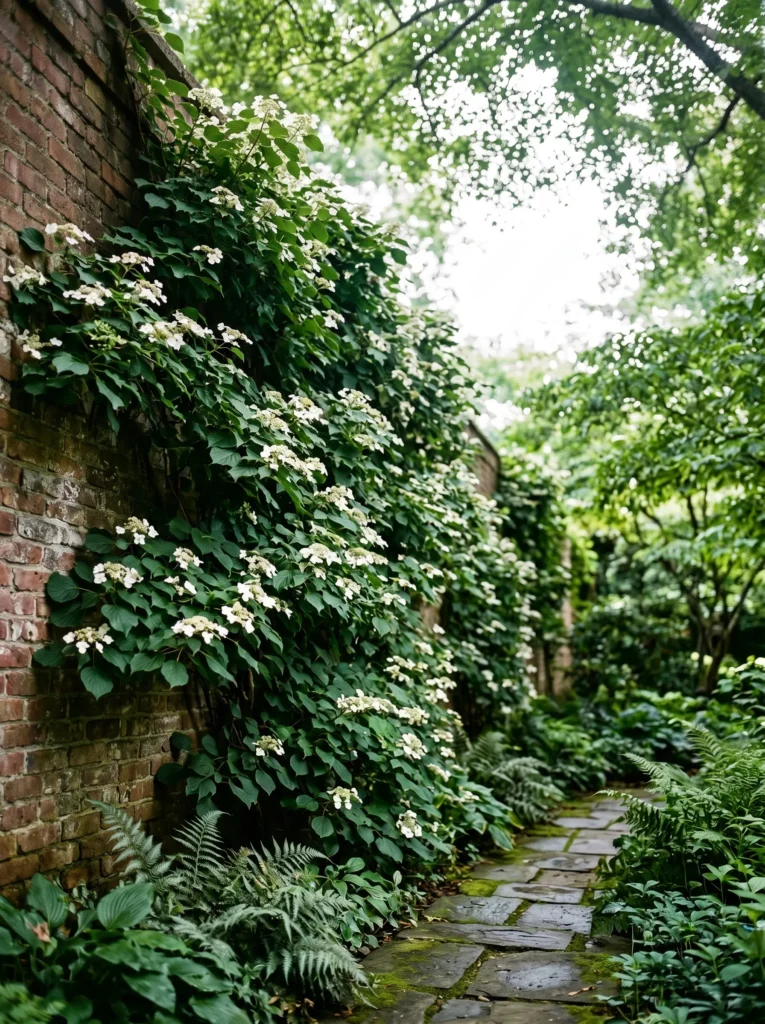
- Scientific name: Hydrangea anomala subsp. petiolaris (climbing hydrangea)
- Hardiness: Zones 4–8; self-clinging via aerial rootlets, no trellis hardware required
- Bloom type: Blooms on old wood, so avoid pruning until right after the white lacecap flowers fade in early summer
- Standout detail: Trained flat against a north-facing brick or stucco wall, it creates a living green tapestry studded with white lacecap blooms, then turns a warm gold in fall
- Slow-growing note: Can take three to four years to establish before it climbs aggressively, so patience matters more than any other hydrangea on this list
- Placement: Shaded exterior wall, fence, or arbor — one of the few hydrangeas that genuinely thrives in low light
Why this works: Climbing hydrangea is one of the few flowering vines that self-clings to masonry without damaging mortar, making it a genuine option for shaded exterior walls where little else blooms.
Most vines either need wire supports or eventually work their way under siding, but climbing hydrangea’s aerial rootlets grip brick and stucco directly without prying into mortar joints, which is why my husband’s crew will actually recommend it for north-facing walls where clients want green coverage without structural risk. It’s slow to establish, often looking like it’s doing nothing for the first two or three years while it builds a root system, then it takes off and can climb 30 to 50 feet given time. The reward is a wall of glossy heart-shaped leaves dotted with white lacecap blooms in early summer, followed by peeling cinnamon bark in winter once the leaves drop.
If you’ve got a shady side yard or a garage wall that gets morning light at best, this is the hydrangea that actually wants that spot, rather than merely tolerating it. Give it something to grip, brick, stucco, or a wooden fence, and resist the urge to prune during those slow early years since you’ll only be removing wood that would’ve eventually flowered. By year five, expect full coverage and a genuinely dramatic early-summer bloom that most passersby won’t even recognize as a hydrangea.
Reblooming Patio Pair
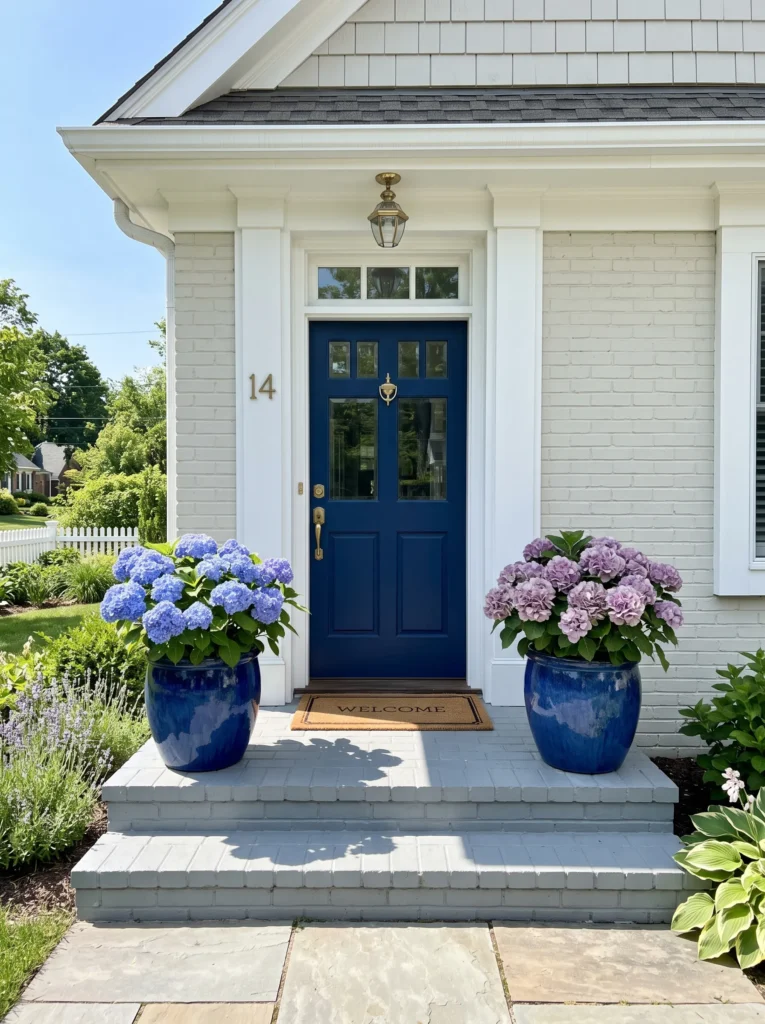
- Variety: Hydrangea macrophylla ‘Endless Summer’ series
- Bloom type: Blooms on both old and new wood, so a damaged bud from a late frost isn’t a lost season — the plant sends up new flowering stems anyway
- Cost-per-season value: One $30 nursery plant, given the right container, can produce two bloom cycles a year for a decade or more
- Standout detail: Two matching glazed ceramic pots flanking a front door, one tuned slightly more acidic than the other so the blooms sit a half-shade apart, deep periwinkle and dusty mauve, rather than matching exactly
- Placement: Container garden, part-shade, morning sun preferred
- Honest note: Skip this if you’re not willing to check soil moisture — containers dry out fast in Texas heat and ‘Endless Summer’ wilts visibly within a day of missed watering
Why this works: ‘Endless Summer’ hydrangea is one of the only reblooming varieties bred to flower on new growth after a hard frost damages old wood, which solves the single most common reason home gardeners never see blooms.
I get more questions about ‘Endless Summer’ than any other hydrangea, mostly because it’s the variety big box stores sell everywhere, but it genuinely earns the hype for containers. Unlike most bigleaf hydrangeas that bloom exclusively on old wood, this series flowers on both old and new growth, so a surprise April freeze that kills this year’s buds doesn’t cost you the whole season. In a large glazed pot near an entryway, it becomes a low-maintenance focal point that blooms from May through first frost with deadheading.
For a front-door pairing, I’ve used two identical 24-inch pots but treated the soil differently, adding aluminum sulfate to one and leaving the other closer to neutral, so the blooms land a shade apart instead of matching perfectly. That small asymmetry reads as intentional rather than store-bought. Water deeply two to three times a week once summer heat sets in, since containers lose moisture far faster than in-ground beds, and Texas AgriLife Extension notes container plants can need watering up to twice as often as the same species planted in soil. Feed monthly with a balanced fertilizer through the growing season for the fullest second bloom.
Fire Light Privacy Hedge
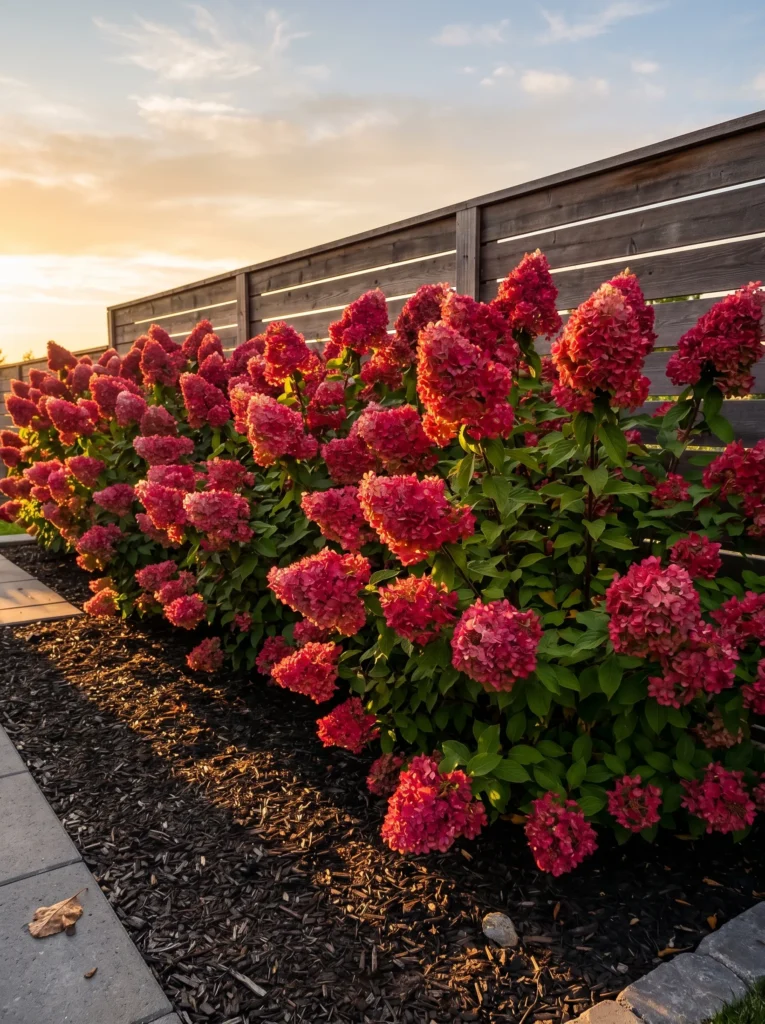
- Variety: Hydrangea paniculata ‘Fire Light’
- Hardiness: Zones 3–8; tolerates full sun better than almost any other hydrangea type
- Bloom type: New-wood bloomer — cut back by a third each late winter for the strongest late-summer color
- Standout detail: Blooms open white in July, then deepen to a genuine deep red-pink by September, far past the point most hydrangeas have faded to brown, giving a privacy hedge a second, more dramatic color phase heading into fall
- Placement: Full sun, spaced 4–5 feet apart along a property line, mature height 4–5 feet
- Landscape use: Privacy screening along a fence or side yard where you want height and seasonal color, not just green
Why this works: ‘Fire Light’ hydrangea is one of the few shrubs that gets more colorful as summer ends, deepening from white to deep red-pink in September rather than fading like most late-season blooms.
By the time most people’s hydrangeas have gone tan and crispy in the August heat, ‘Fire Light’ is just getting started. It opens creamy white in midsummer, then the sturdy stems and dense flower heads slowly flush to a deep wine-red as nights cool in September, holding that color for weeks. Because it blooms on new wood and tolerates full Texas sun without the wilting bigleaf varieties show by afternoon, it works as a genuine privacy hedge rather than a specimen plant you baby in part shade. Space plants 4 to 5 feet apart and expect a solid screen within two growing seasons.
I planted a short run of ‘Fire Light’ along the side fence where our neighbor’s AC unit sits, mostly to hide the equipment, and by the second September I had people asking what the deep red shrub was. The strong stems don’t flop under the weight of the blooms the way older paniculata varieties can, so there’s no staking involved. Prune it back by about a third in late winter to keep it dense and encourage the biggest flower heads, and give it consistent water through its first two summers while roots establish.
Lacecap Pathway Border
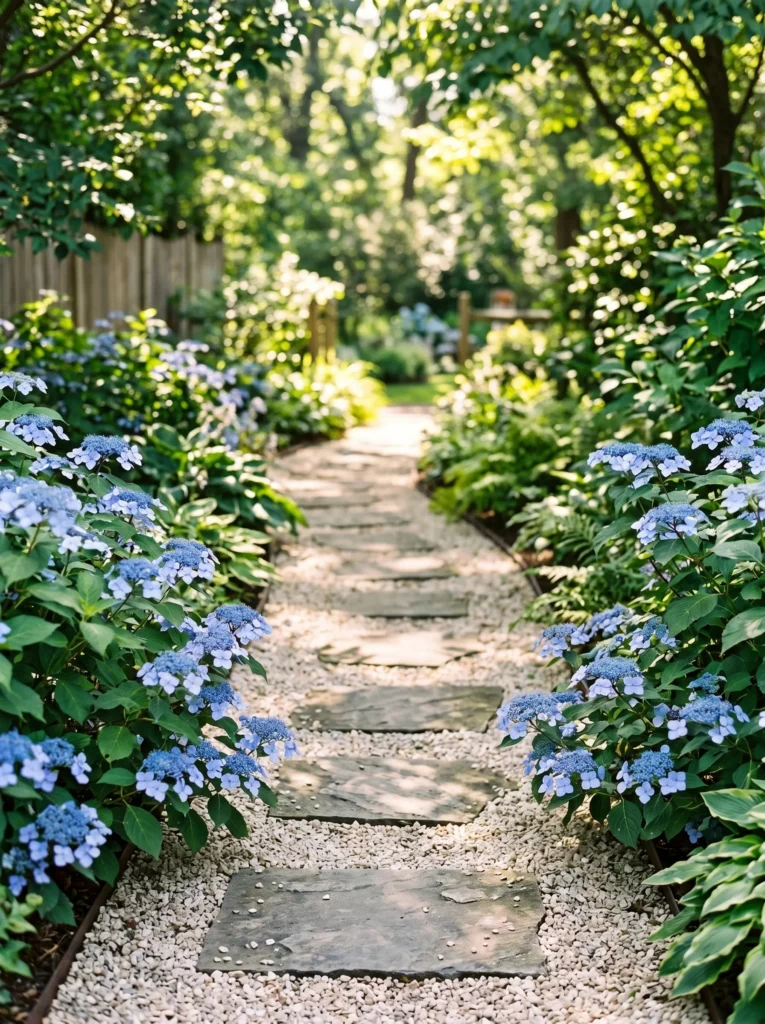
- Scientific name: Hydrangea serrata (mountain hydrangea)
- Hardiness: Zones 5–9; more cold-hardy flower buds than macrophylla, better suited to gardens with unpredictable spring frosts
- Bloom type: Primarily old-wood, but hardier buds mean fewer frost-damaged, no-bloom seasons than bigleaf types
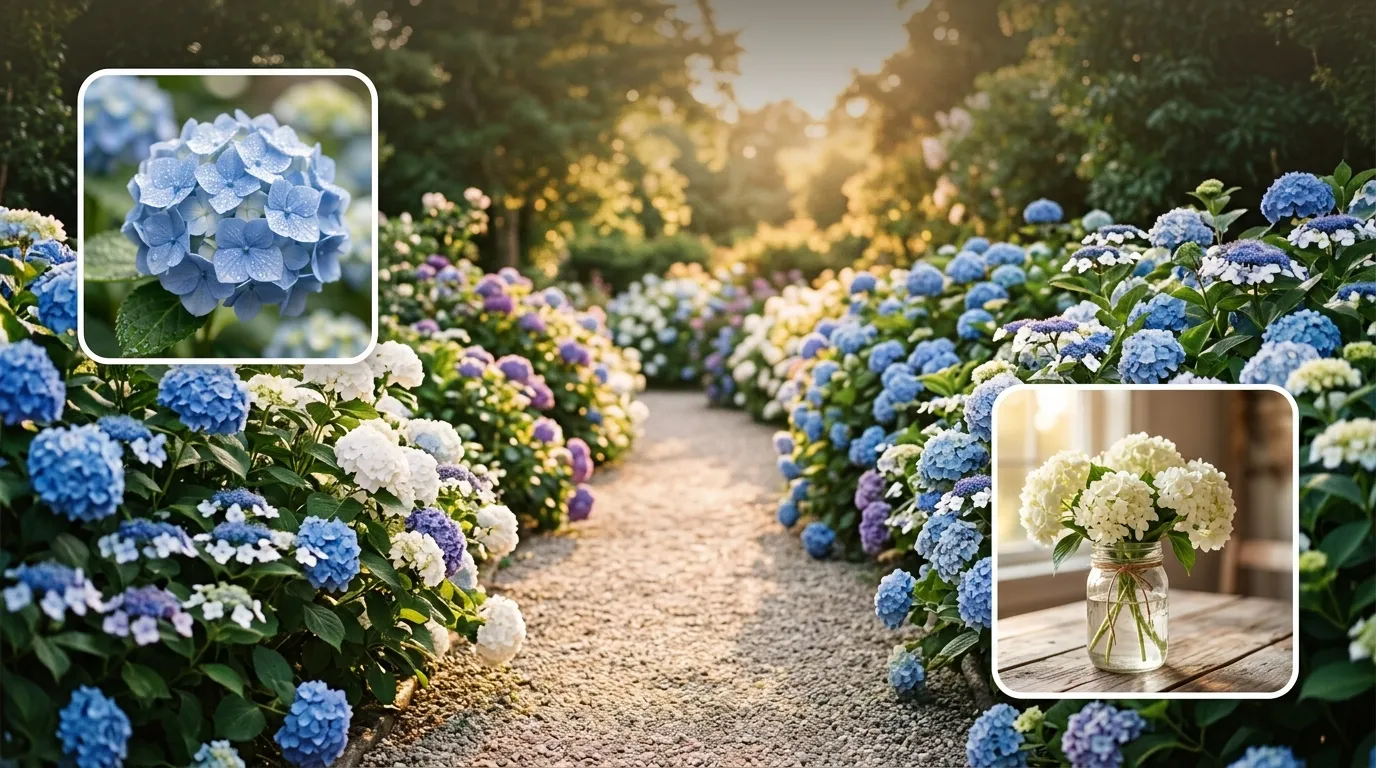
- Standout detail: Delicate lacecap blooms in a soft periwinkle-blue, planted low along both sides of a stone or gravel path so the flowers brush against your legs as you walk through
- Scale note: Stays compact at 3–4 feet, making it one of the few hydrangeas that works at true pathway scale rather than towering over a walkway
- Placement: Part shade, along a garden path or stepping-stone walkway
Why this works: Mountain hydrangea sets flower buds that are more cold-tolerant than bigleaf hydrangea, so it blooms reliably even in gardens where late frosts regularly damage other varieties.
Hydrangea serrata gets overlooked because the blooms are smaller and more delicate-looking than a classic mophead, but that’s exactly what makes it work along a path where you want texture at eye level, not a wall of flowers blocking the view. The lacecap flower heads, a ring of small fertile blooms surrounded by larger sterile florets, read as softer and more naturalistic than macrophylla, and the plant’s compact size, usually staying under 4 feet, means it never crowds a walkway. University of Maryland Extension notes mountain hydrangea’s flower buds tolerate more cold than macrophylla’s, which explains why it blooms more consistently in gardens with unpredictable spring weather.
I lined a gravel path to our garden shed with mountain hydrangea a few summers ago, spacing plants about 3 feet apart on each side, and by the second year the blooms had filled in enough that walking through felt like moving through a soft blue tunnel. Give it part shade and consistent moisture, and prune only right after flowering to protect next year’s buds. For a smaller yard where a full-size mophead hydrangea would overwhelm the space, this is the variety that fits the scale.
Incrediball Woodland Specimen
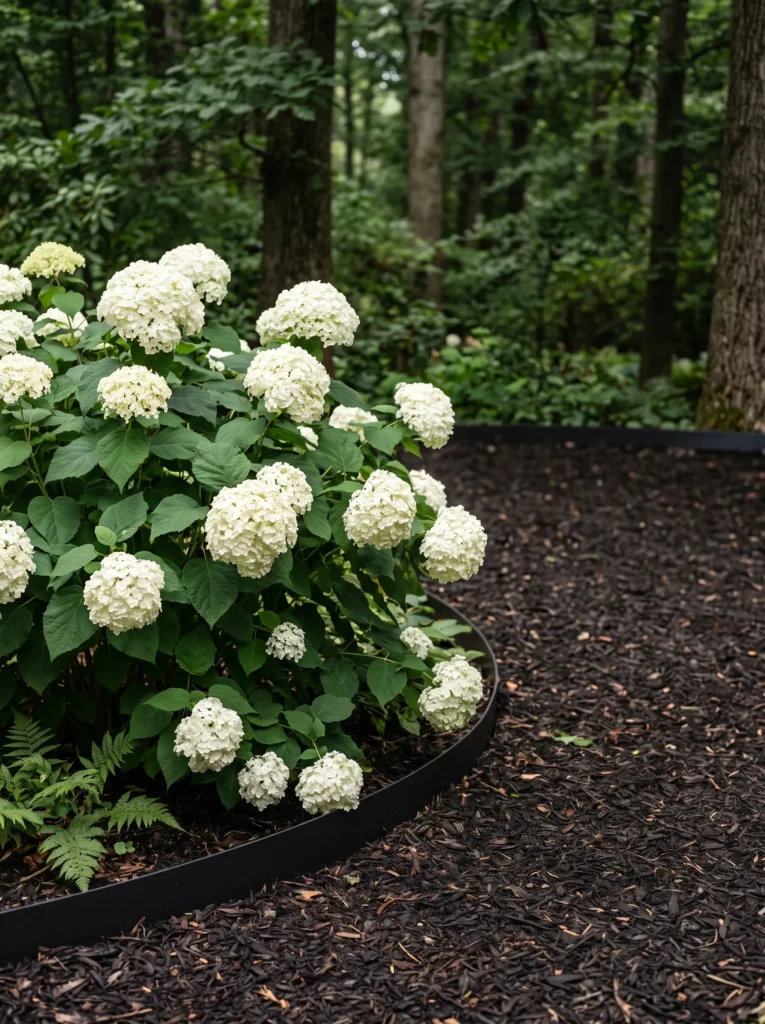
- Variety: Hydrangea arborescens ‘Incrediball’
- Bloom type: New-wood bloomer with reinforced stems bred specifically to hold up massive blooms without flopping, unlike the original ‘Annabelle’
- Bloom size: Flower heads can reach 12 inches across, among the largest of any hardy hydrangea
- Standout detail: Planted as a single specimen in a shaded woodland corner, edged with a ring of matte black steel landscape border to visually anchor the pale green-white blooms against dark mulch
- Placement: Part to full shade, woodland edge or north-facing bed
- Landscape use: Standalone specimen rather than hedge or border — needs room to show off its scale
Why this works: ‘Incrediball’ hydrangea was specifically bred with reinforced stems to hold its dinner-plate-sized blooms upright, solving the flopping problem that plagues older smooth hydrangea varieties.
If you’ve ever grown a classic ‘Annabelle’ hydrangea and watched every bloom collapse into the dirt after a summer storm, ‘Incrediball’ fixes exactly that problem. The stems are noticeably thicker, bred to support flower heads that can stretch to 12 inches across without staking. Because it blooms on new wood, a hard late-winter cutback each year actually produces bigger, sturdier blooms rather than a leggy, floppy shrub. Planted alone as a specimen rather than crowded into a hedge, it has room to show off its full scale, which is really the point of growing it at all.
I moved one to a shaded corner near our back fence a couple of summers ago and ringed the base with a slim black steel edging strip, mostly to keep mulch from washing onto the lawn during heavy rain. The unexpected bonus was how much that dark, clean-lined border made the pale green-white blooms pop against the mulch bed behind it. Give it consistent moisture and afternoon shade in Texas heat, and expect blooms from June through August, aging from lime-green to bright white to a soft parchment tone by fall.
Vanilla Strawberry Dried Border
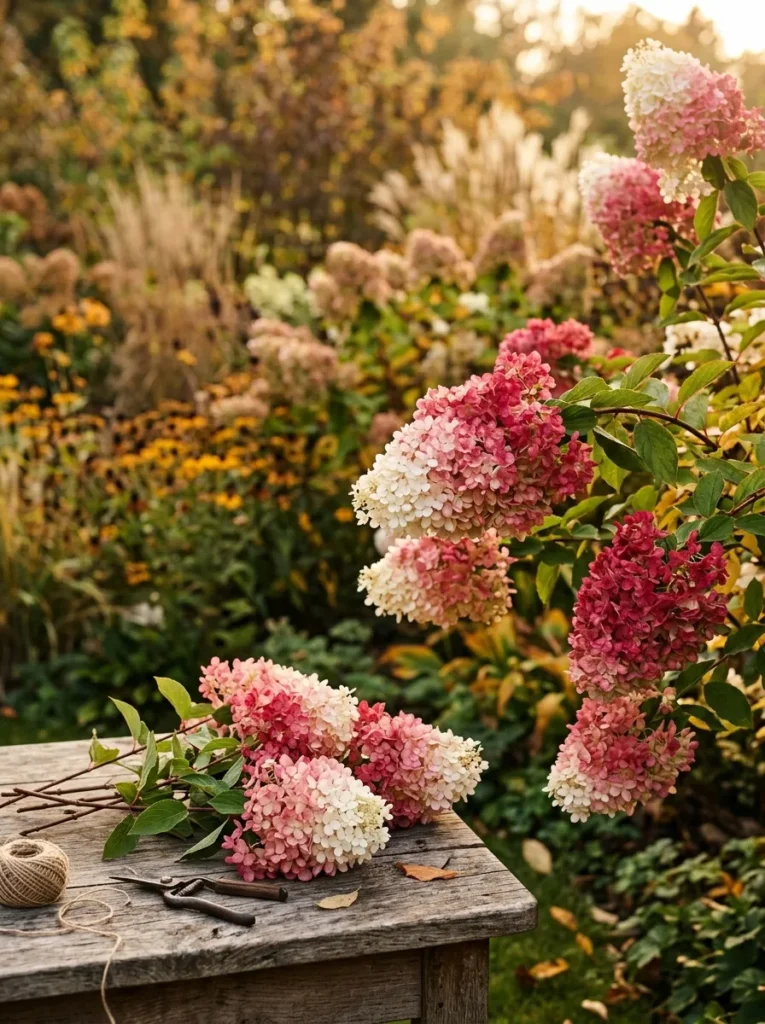
- Variety: Hydrangea paniculata ‘Vanilla Strawberry’
- Bloom color science: Blooms open pure white, then shift through pink to deep strawberry-red as the season progresses — a genetic color change unrelated to soil pH, unlike macrophylla
- Cost-per-season value: Blooms dry beautifully on the stem, so one shrub can supply an entire season’s worth of fall wreaths and arrangements at no added cost
- Standout detail: Left unclipped through October, the two-tone panicles, white at the tip fading to red at the base, create a natural ombré effect perfect for cutting and hanging to dry
- Bloom type: New-wood bloomer, prune hard in late winter
- Placement: Full sun to part shade border, 6–8 feet mature width
Why this works: ‘Vanilla Strawberry’ hydrangea changes from white to deep red through genetics alone, not soil chemistry, making its color shift reliable and predictable in any soil type.
Unlike blue-and-pink macrophylla varieties, where color depends entirely on soil pH, ‘Vanilla Strawberry’ shifts color on its own schedule regardless of what’s happening underground. The cone-shaped blooms open pure white in midsummer, then blush pink through August, and by September deepen into a genuine strawberry-red at the base while the tips stay pale, creating a two-tone effect on a single flower head. Because it’s a paniculata type blooming on new wood, a hard cutback each February keeps the shrub full and produces the strongest color contrast the following fall.
I’ve started leaving mine uncut well into October instead of deadheading, mostly because the dried blooms hold their color and shape beautifully once cut and hung upside down in a dark closet for two weeks. A single mature shrub produces more dried material than I can use in wreaths and mantel arrangements each fall, which means real savings if you’ve been buying dried florals at $8 to $12 a stem from a craft store. Plant it where it gets at least six hours of sun for the deepest color development.
Grass-Paired Organic Border
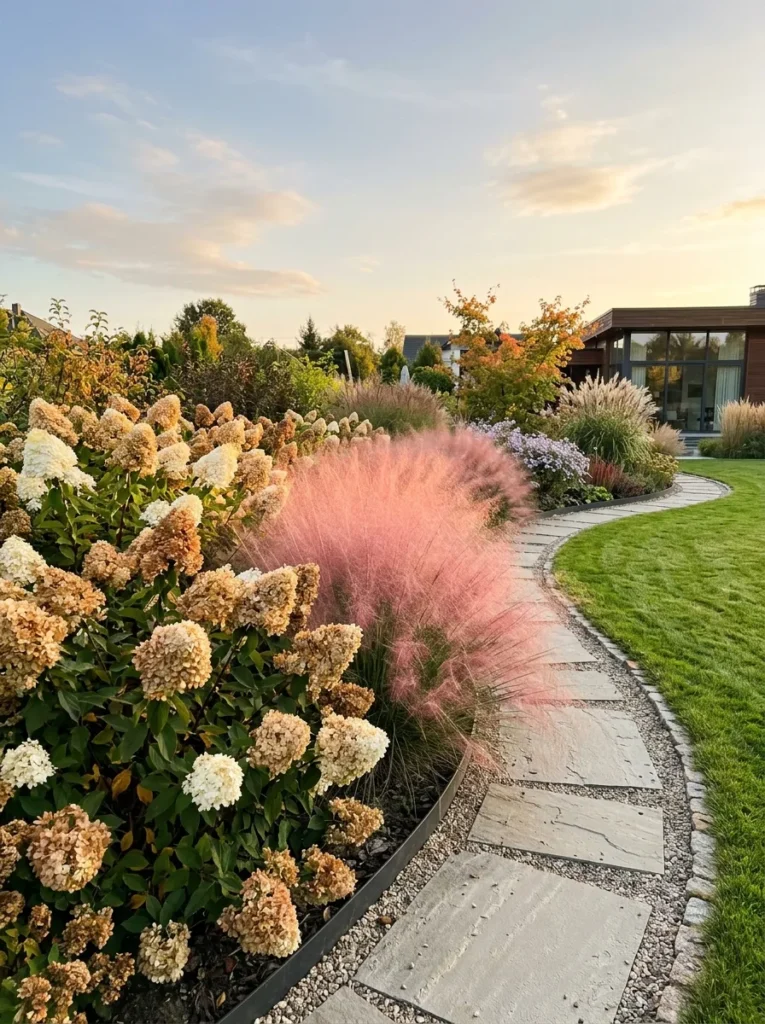
- Variety: Hydrangea arborescens (any white-blooming cultivar), paired with muhly grass
- Design direction: A modern, textural border pairing rounded mophead blooms with the airy, upright form of pink muhly grass (Muhlenbergia capillaris) for contrast
- Standout detail: Muhly grass turns a hazy pink-purple cloud in October, timed to bloom right as the hydrangea’s white flowers begin fading to parchment, creating a soft, layered color transition rather than a hard seasonal cutoff
- Placement: Mixed border, full sun to light shade, curved bed edge for a natural, non-linear layout
- Style note: Reflects a quiet, organic-modern landscaping approach — rounded forms and native grasses instead of clipped, formal hedging
Why this works: Pairing rounded hydrangea blooms with the upright, airy texture of native muhly grass creates contrast without competing for attention, a foundational principle of layered border design.
A border of all-hydrangea planting can start to feel flat by late summer once the blooms fade to brown, which is why I like pairing arborescens varieties with pink muhly grass along a curved bed edge. The grass stays a quiet green mound through summer, doing nothing especially notable, then in October it erupts into a hazy pink-purple cloud right as the hydrangea blooms are drying to parchment tan. The contrast between the hydrangea’s dense, rounded flower heads and the grass’s airy, upright texture gives the border real depth instead of one repeated shape throughout.
This kind of pairing reflects a broader shift I’ve noticed in landscaping requests lately, less formal, clipped hedging and more relaxed, native-leaning combinations that still feel intentional rather than wild. Space muhly grass clumps about 3 feet from each hydrangea to avoid root competition, and give the whole bed full sun, since muhly grass won’t bloom fully in shade even though the hydrangea tolerates it fine. By the second fall, the two textures read as a single designed moment rather than separate plantings.
Bobo Dwarf Foundation
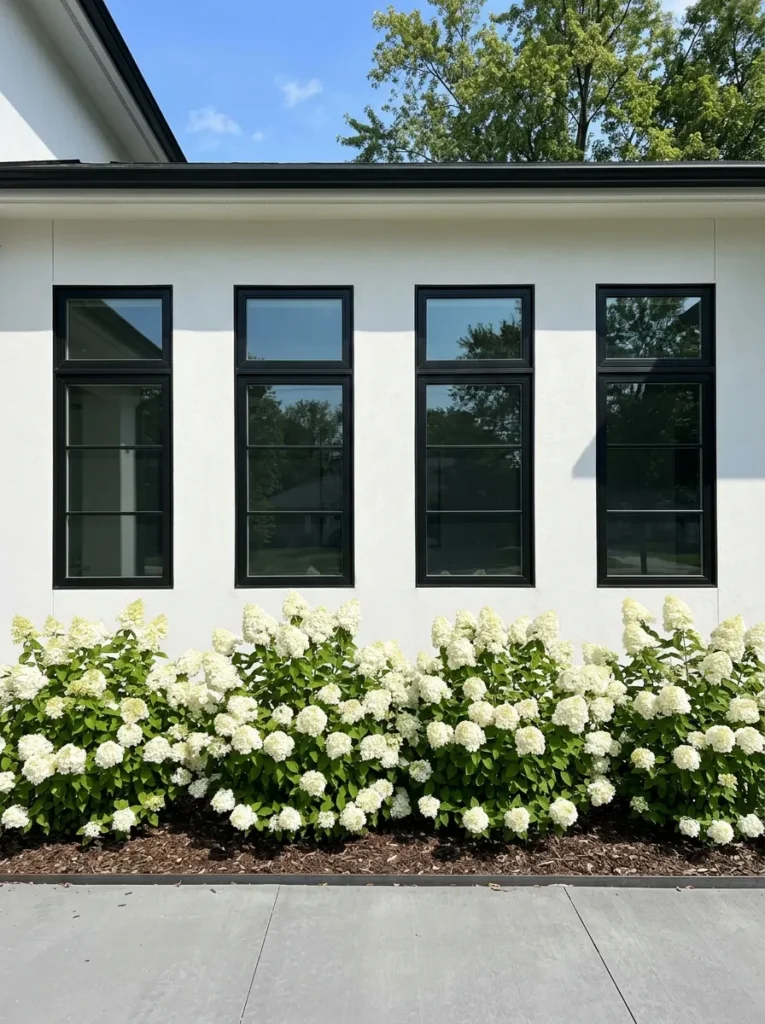
- Variety: Hydrangea paniculata ‘Bobo’
- Mature size: Stays under 3 feet tall and wide, one of the most compact panicle hydrangeas available, bred specifically for small yards and foundation plantings
- Bloom type: New-wood bloomer, extremely floriferous — young plants often bloom heavily in their first full season
- Standout detail: Planted in a tight, repeating row directly beneath a row of black-framed windows, so the dense white blooms echo the home’s window rhythm without ever needing to be pruned into shape
- Placement: Full sun, foundation bed, small-yard or townhouse landscaping
- Landscape use: Foundation planting for homes with limited yard space where full-size panicle hydrangeas would overwhelm the bed
Why this works: ‘Bobo’ hydrangea was bred to stay under 3 feet tall while still producing full-size panicle blooms, making genuine hydrangea drama possible in yards too small for standard varieties.
Most panicle hydrangeas eventually reach 6 to 8 feet, which rules them out for a lot of the smaller lots and townhome yards common in newer Austin neighborhoods. ‘Bobo’ solves that by staying compact, usually under 3 feet, while still producing the same dense, cone-shaped white blooms as its larger relatives. Because it flowers on new wood and blooms heavily even as a young plant, you get a full, established look in the first or second year rather than waiting three or four seasons for a shrub to fill in, which matters when you’re working with a small foundation bed.
I planted a tight row of five along the front of a client’s single-story home a couple of years back, spaced about 2 feet apart directly under a row of black-framed windows, and by midsummer the repeating white blooms created a clean, rhythmic line that echoed the window spacing above. No pruning into shape was needed, the plant’s natural form did the work. For anyone with a small front yard who assumes big, dramatic hydrangeas aren’t an option, this variety proves otherwise.
Pinky Winky Arbor Espalier
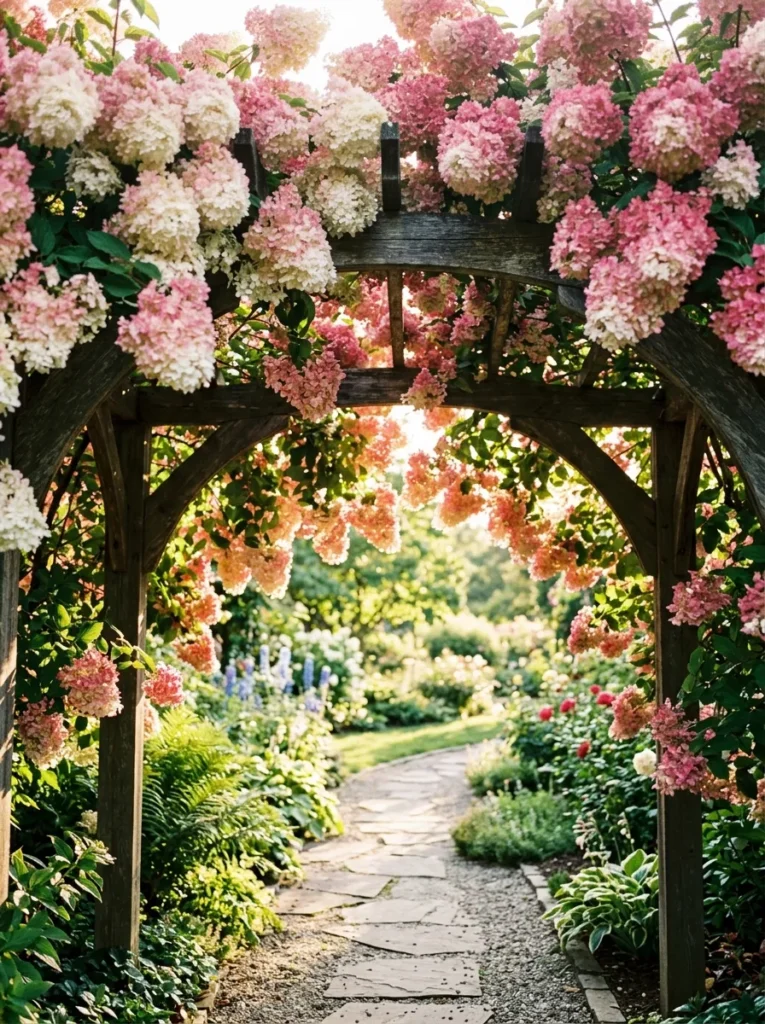
- Variety: Hydrangea paniculata ‘Pinky Winky’
- Standout detail: Trained flat against a wooden arbor or pergola beam, with panicles trimmed to grow outward rather than up, creating a living archway where guests walk directly beneath two-tone white-and-pink blooms
- Bloom color: Panicles open white at the tip while the base blushes deep pink as the season progresses, giving each flower head two distinct colors at once
- Bloom type: New-wood bloomer — late-winter pruning keeps growth directed along the arbor frame instead of upward and unruly
- Construction note: My husband always specs galvanized wire, not zip ties or twine, when training any woody shrub against a structure — twine rots within a season and the plant’s weight can pull loose exactly when the blooms are heaviest
- Placement: Trained along an arbor, pergola, or garden entrance, full sun
Why this works: ‘Pinky Winky’ hydrangea’s naturally upright growth habit makes it one of the few hydrangea varieties suited to true espalier or arbor training, rather than free-standing shrub form.
Most hydrangeas want to grow as a rounded mound, which makes them a poor fit for training against a structure, but ‘Pinky Winky’ grows upright enough that it can actually be guided along an arbor or pergola beam with patience and the right hardware. The two-tone blooms, white at the tip and deepening to pink at the base as summer goes on, look almost more dramatic overhead than they do at eye level in a border. Because it flowers on new wood, an aggressive late-winter prune each year keeps growth directed sideways along the frame rather than shooting straight up past it.
My husband, who’s installed more pergolas and arbors than he can count, insists on galvanized wire loops rather than twine or zip ties when training any woody shrub against a wood or metal structure. Twine breaks down within a season in Texas humidity, and a heavy, blooming panicle can pull the whole thing loose right when it matters most. He staples the wire loosely enough to allow the trunk to thicken over time without girdling it. Give the arbor full sun and expect it to take three to four years before the coverage looks truly established.
Fern-and-Hydrangea Shade Bed
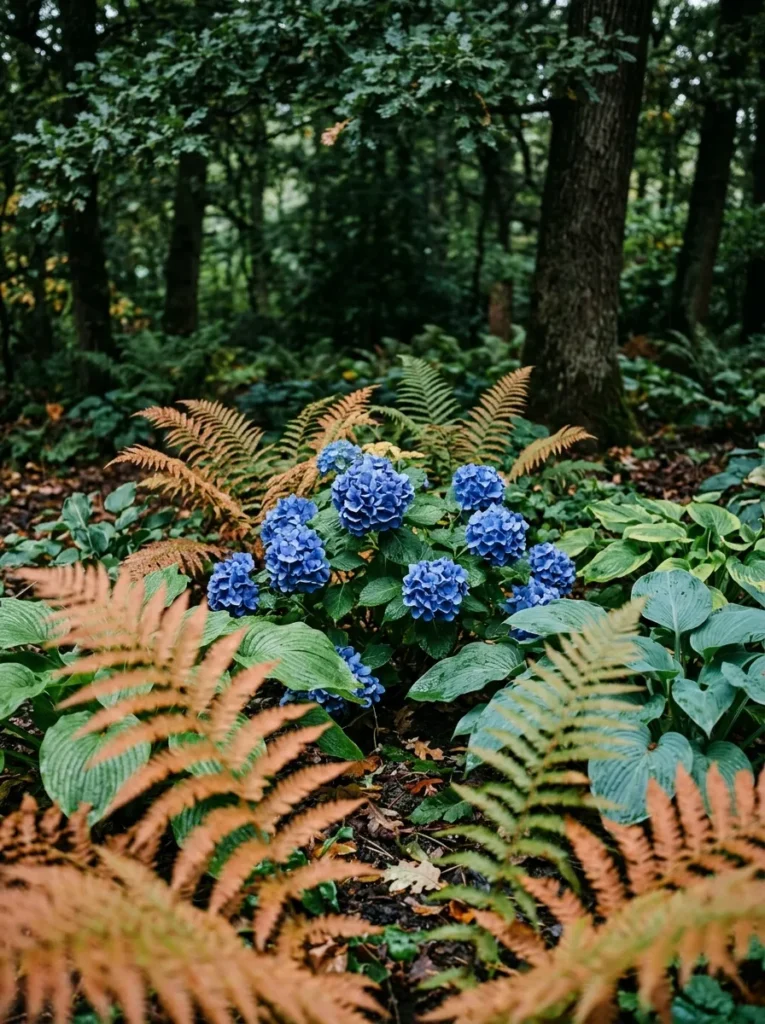
- Variety: Hydrangea macrophylla or Hydrangea serrata paired with native ferns and hostas
- Standout detail: Deep-shade woodland bed where blue hydrangea blooms sit against the fine, feathery texture of autumn fern (Dryopteris erythrosora), whose fronds emerge coppery-orange in spring before turning deep green — a texture and color contrast most all-hydrangea beds skip entirely
- Growing conditions: Full to dappled shade, consistently moist, slightly acidic soil, ideal for the deep-shade side yards common in older Austin neighborhoods with mature oak canopy
- Bloom type: Old-wood bloomer, prune only within a few weeks after flowering
- Placement: Woodland-edge bed, north or east-facing side yard under established tree canopy
Why this works: Deep shade under mature trees is usually treated as a design limitation, but it’s actually the ideal growing condition for both hydrangea and native fern, making it one of the easiest high-impact combinations for a shaded yard.
A shady side yard under an old oak often gets written off as a spot where nothing interesting will grow, but it’s actually close to ideal for a hydrangea and fern pairing. University of Maryland Extension notes hydrangea macrophylla generally performs best with morning sun and afternoon shade, which describes exactly the light pattern found beneath a mature deciduous canopy. Underplanting with autumn fern adds a textural layer most shade beds skip, since the coppery-orange new fronds in spring contrast beautifully with the hydrangea’s rounded blue blooms once they open in early summer.
I’ve used this combination in a few client yards where the previous landscaping was just mulch and a struggling patch of grass under an oak tree, and it consistently becomes the yard’s best feature within two seasons. Keep the soil consistently moist, since both ferns and hydrangeas struggle in dry shade, and mulch heavily to retain moisture through Texas summers. The blue bloom color will hold naturally in most acidic, shaded soil without needing amendment, since alkaline conditions are more common in sunny, exposed beds than in shaded ones.
Formal Walkway Symmetry
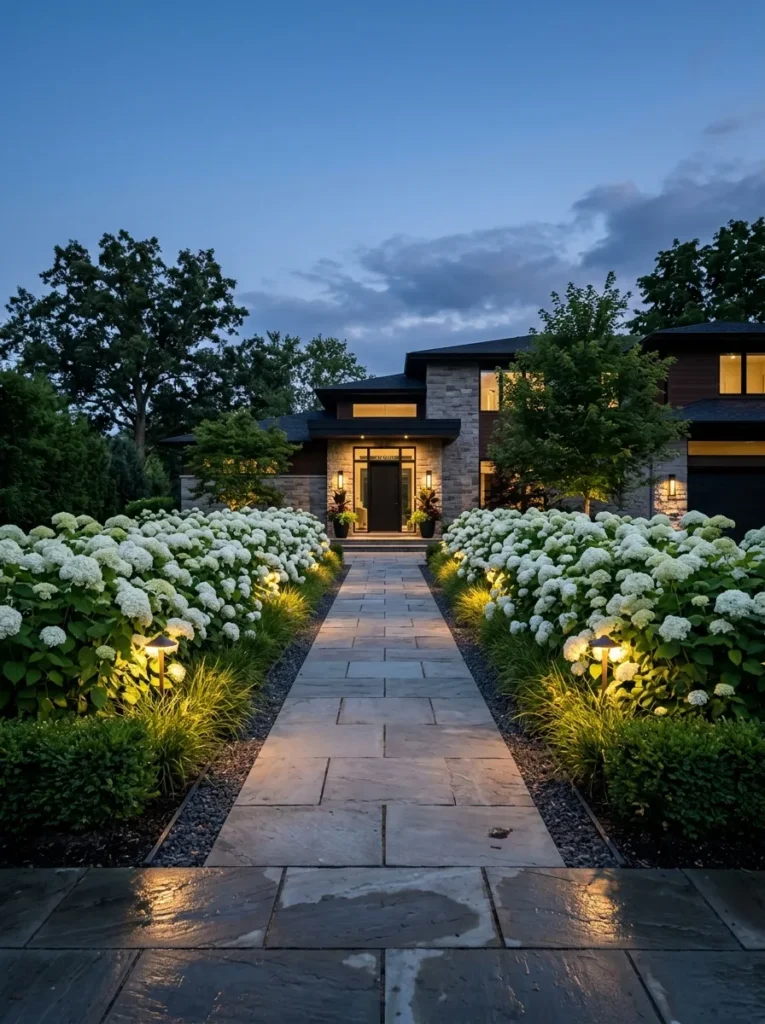
- Variety: Hydrangea macrophylla ‘Madame Emile Mouillère’ (classic white mophead)
- Standout detail: Two matched rows flanking a stone or paver walkway, uplit at dusk with low-voltage landscape fixtures tucked at the base of each shrub so the white blooms glow softly against the dark evening garden
- Bloom type: Old-wood bloomer, prune within weeks of flowering to protect next year’s buds
- Landscape use: Formal pathway framing for a front walkway or garden entrance, evening curb appeal
- Construction note: Low-voltage lighting wire should run in conduit beneath the walkway pavers, not simply buried under mulch, since mulch shifts and exposes wiring within a year or two — something my husband’s crews handle on nearly every hardscape install with landscape lighting
Why this works: A symmetrical planting along a walkway reads as intentional and formal even in a modest yard, and low-voltage uplighting extends that impact into the evening hours when most homes go dark.
Symmetry is one of the simplest design tools available, and a pair of matched hydrangea rows flanking a front walkway delivers it without requiring any real landscaping expertise. ‘Madame Emile Mouillère’ produces pure white mophead blooms that hold their color regardless of soil pH, which matters here since you want both rows to match exactly rather than drifting toward blue on one side. Because it blooms on old wood, pruning only within a few weeks after the flowers fade protects the following year’s display, and a formal walkway planting depends on consistent, reliable blooms more than a casual border does.
Adding low-voltage uplighting at dusk is what turns this from a nice daytime feature into genuine evening curb appeal, something most front-yard plantings never account for. My husband’s crews always run the lighting conduit beneath the walkway pavers themselves during installation rather than simply burying wire under mulch, since mulch shifts, washes out in heavy rain, and exposes wiring within a year or two otherwise. Once installed properly, a soft uplight on each shrub makes the white blooms glow against the darker garden beyond, turning a simple walkway into the kind of entrance neighbors notice.
Styling Principles: Choosing Hydrangeas by Bloom Type First
The single biggest reason home hydrangeas fail to bloom isn’t sun, soil, or fertilizer — it’s pruning at the wrong time relative to the plant’s bloom type. Before choosing a hydrangea for color or shape, figure out whether it blooms on old wood or new wood, because that determines when you’re allowed to prune it.
Old-wood bloomers — Hydrangea macrophylla, quercifolia, and most serrata varieties — set next year’s flower buds by late summer of the current year. Prune these anytime other than the few weeks right after flowering, and you cut off buds that were already formed, which is why so many bigleaf hydrangeas “never bloom” despite looking healthy. New-wood bloomers — Hydrangea paniculata and arborescens — form flower buds on the current season’s growth, so a hard cutback in late winter doesn’t cost you anything; it often produces bigger, stronger blooms.
A hydrangea that blooms on old wood should only be pruned within a few weeks of its flowers fading, while a hydrangea that blooms on new wood can be cut back hard in late winter without losing that year’s flowers.
Once bloom type is settled, layer in the practical factors: sun exposure (paniculata tolerates full Texas sun; macrophylla wants afternoon shade), mature size relative to the space, and whether soil pH matters for color (only true for macrophylla and serrata — paniculata and arborescens colors are genetic, not pH-driven). Getting these fundamentals right matters more than any single design choice, because a hydrangea that doesn’t bloom can’t do much for a garden no matter how well it’s placed.
Frequently Asked Questions
Why won’t my hydrangea bloom? The most common cause is pruning at the wrong time for that variety’s bloom type. Old-wood bloomers like Hydrangea macrophylla set next year’s buds by late summer, so pruning in fall, winter, or early spring removes flowers before they open. Cold damage to old-wood buds during a late frost is the second most common cause.
How do I change my hydrangea’s flower color? Only Hydrangea macrophylla and serrata change color based on soil pH — acidic soil below about 5.5 produces blue blooms, while soil above 6.5 shifts the same plant to pink. Paniculata and arborescens varieties don’t respond to soil pH; their color changes are genetic and follow the season instead.
What are the best hydrangea varieties for small yards? Compact varieties like ‘Bobo’ (paniculata) and dwarf Hydrangea serrata cultivars stay under 3–4 feet at maturity, making them well suited to foundation beds, containers, and small side yards where full-size varieties would quickly overwhelm the space.
Do hydrangeas need full sun or shade? It depends on the type. Hydrangea paniculata tolerates full sun even in hot climates, while macrophylla, serrata, and quercifolia generally perform best with morning sun and afternoon shade, since intense afternoon heat can wilt their larger leaves and blooms.
When should I prune my hydrangea? Prune old-wood bloomers (macrophylla, quercifolia, most serrata) only within a few weeks after flowering ends. Prune new-wood bloomers (paniculata, arborescens) in late winter or very early spring, before new growth starts.
Are hydrangeas actually worth the cost compared to buying cut flowers? Yes, in most cases. A single hydrangea shrub costing $20–30 typically produces a dozen or more blooms every summer for years, while a comparable grocery-store bouquet costing $10–15 lasts about a week. Over a few seasons, one shrub can offset the cost of dozens of bouquets.
Final Thought
A great hydrangea garden isn’t about picking the prettiest bloom color — it’s about matching the right variety to your light, your space, and your patience for pruning timing. Once that foundation is right, these hydrangea garden ideas give you plenty of room to get creative, from a trained arbor archway to a color-gradient hedge to a simple cutting row that pays for itself in a single summer.
I’ve seen how much a well-placed hydrangea can change the feel of an entryway or backyard, often more than people expect from one shrub. Save this post to Pinterest for planting season, try one idea in your own yard this year, and pass it along to anyone who’s given up on their hydrangeas blooming.