15 Emerald Green Bedroom Ideas That Sparkle
Emerald doesn’t act like other greens. There’s something about the way it catches light — cooler, brighter, almost gemstone-like — that makes a bedroom feel alive instead of just colorful. These emerald green bedroom ideas are built around that difference, moving past the deep forest and olive tones you’ve probably already seen and into something more current, more saturated, and honestly, more fun to design around. I came to home design through plant science, not a design degree, so I notice color the way you’d notice it in a garden — how blue undertones shift depending on the light, how one saturated element can carry an entire room without needing much else around it. My husband runs a construction company here in Austin, and between the two of us, we’ve seen firsthand what actually holds up in a real bedroom versus what only looks good in a photograph.
This list is fifteen genuinely different ways to bring emerald into a bedroom — through a single chair, a lacquered wall, a tiled alcove, a painted ceiling beam — each one modern, distinct, and built to feel intentional rather than trendy. Whether you’re ready to commit to a full statement wall or just want to test the color with a pillow and a plant, there’s an idea here sized to match your space and your comfort level with bold color.
Core Positioning: Why Emerald Works for a Bedroom
Not every green belongs in a bedroom, and that’s worth saying plainly before diving into any of the ideas below. Bedrooms are restorative spaces, and colors with a heavy yellow or brown undertone — olive, moss, khaki — can feel muddy or flat once the lights go down, especially under warm bulbs. Emerald behaves differently because of its undertone: it leans blue rather than yellow, which is exactly what gives it that cool, gem-like quality instead of an earthy, outdoorsy one.
That blue undertone matters more than most people realize. It’s the reason emerald pairs so naturally with cool metals like chrome and silver, the reason it photographs with a glassy, almost jewel-box quality under both daylight and lamplight, and the reason it reads as sophisticated rather than rustic. A hunter or pine green pulls a room toward a cabin-in-the-woods feeling. Emerald pulls a room toward something closer to a well-cut gemstone — saturated, but never heavy.
In color terms, this is worth stating plainly: emerald’s blue undertone is what separates it from earthy greens like olive or moss, and that undertone is exactly why it reads as cool and jewel-like rather than rustic or outdoorsy.
There’s also a practical reason emerald suits bedrooms specifically, more than living rooms or kitchens. Bedrooms are typically smaller, more enclosed spaces where a bold color has room to feel intentional rather than overwhelming, since you’re not trying to balance it against an open floor plan or multiple sightlines. A saturated color in a contained room reads as a deliberate design choice. The same color spread across a large, open living area can start to feel more like a paint decision than a design one.
The ideas that follow show fifteen different ways to apply that same undertone-driven logic — some through paint, some through fabric, some through a single piece of furniture — so you can find the version that fits your space, your light, and how bold you’re ready to go.
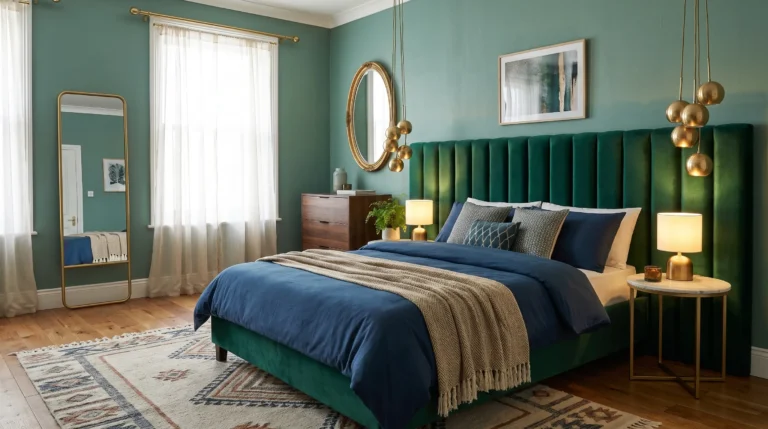
1. Emerald Velvet Headboard — An Emerald Green Bedroom Idea
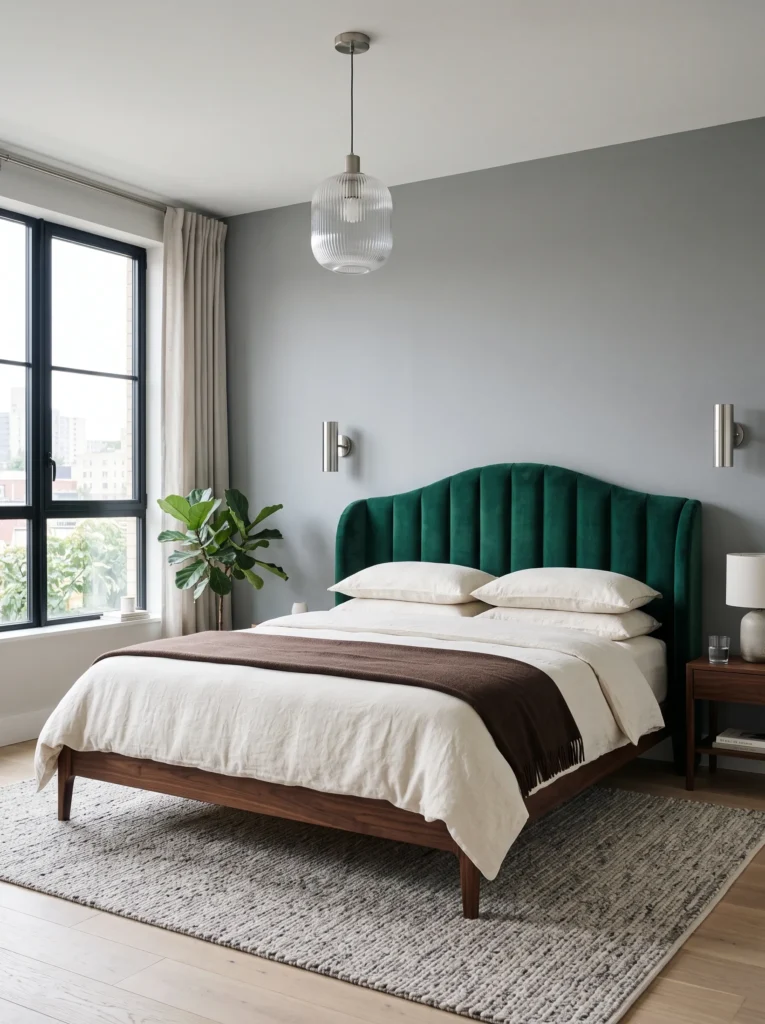
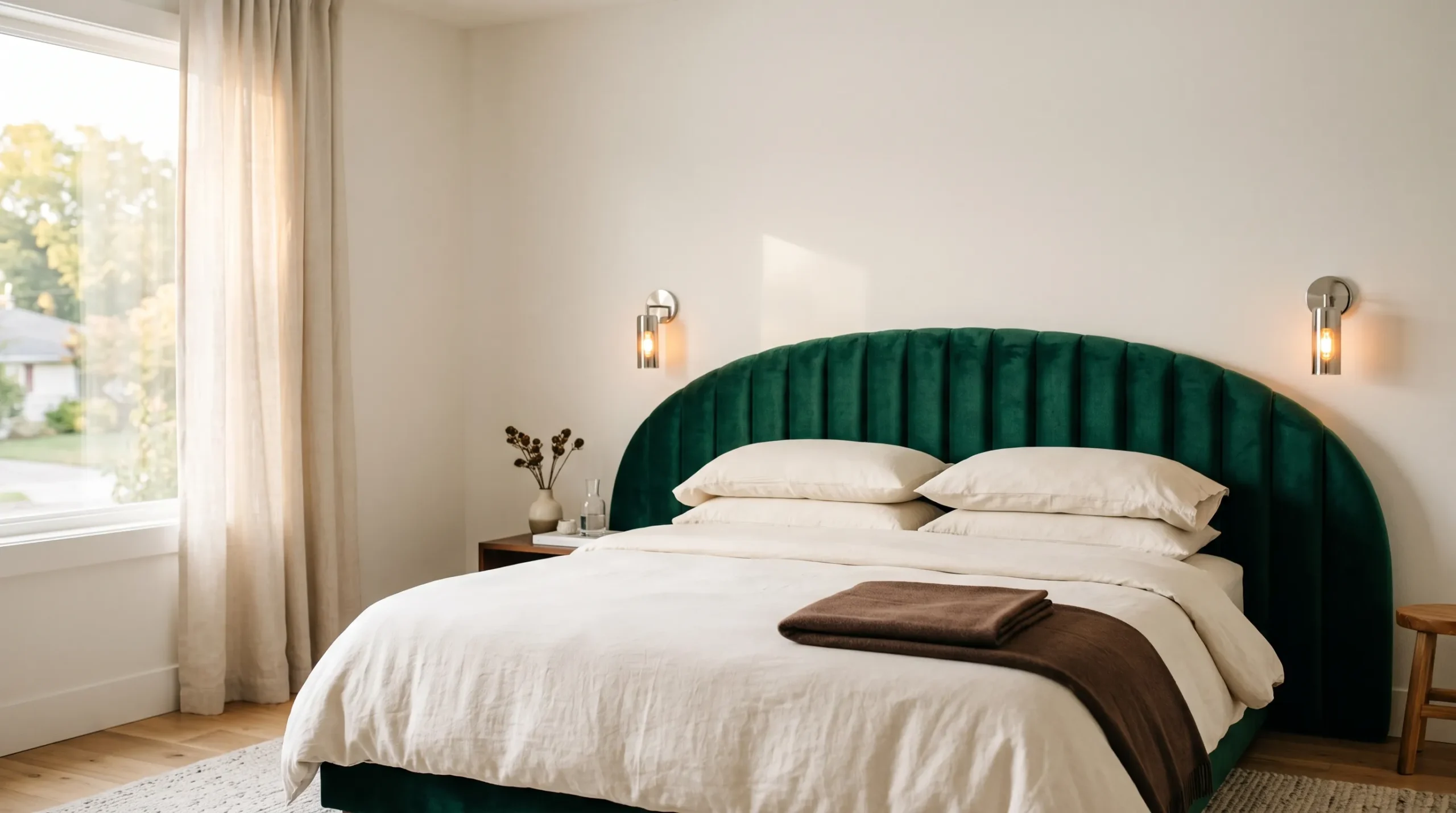
- Channel-tufted velvet headboard in true emerald, curved silhouette instead of a carved frame
- Low-profile sled bed frame for a clean, current base
- Brushed chrome sconces flanking the headboard for cool-toned contrast
- Ivory linen bedding paired with a chocolate brown throw for warmth
- Fluted glass pendant lighting overhead
Why this works: Emerald’s blue undertone is what makes cool metals like chrome feel like a natural match instead of an afterthought.
In my experience, this pairing works because the cool undertones keep the room from feeling heavy, even with a saturated color covering the headboard wall. Brushed chrome sconces and ivory bedding lighten the mood, while a chocolate throw adds warmth without competing with the green. Fluted glass pendants catch light beautifully in the evening, giving the space a soft glow that feels intentional rather than staged. The result is a bedroom that reads sophisticated and alive, not dark or overwhelming, proving emerald can feel airy when the surrounding palette is chosen with care.
Emerald’s blue undertone is exactly why it reads as jewel-toned rather than earthy, and that undertone is the reason cool metals like chrome and silver look so natural against it. A channel-tufted velvet headboard in true emerald anchors this bedroom with texture and depth, while the curved silhouette keeps the shape soft instead of formal. Paired with a low-profile sled bed frame, the whole look feels current rather than traditional. This is one of the clearest ways to bring jewel-toned green bedroom decor into a modern space without leaning into old-world glam.
2. Smoked Glass & Emerald
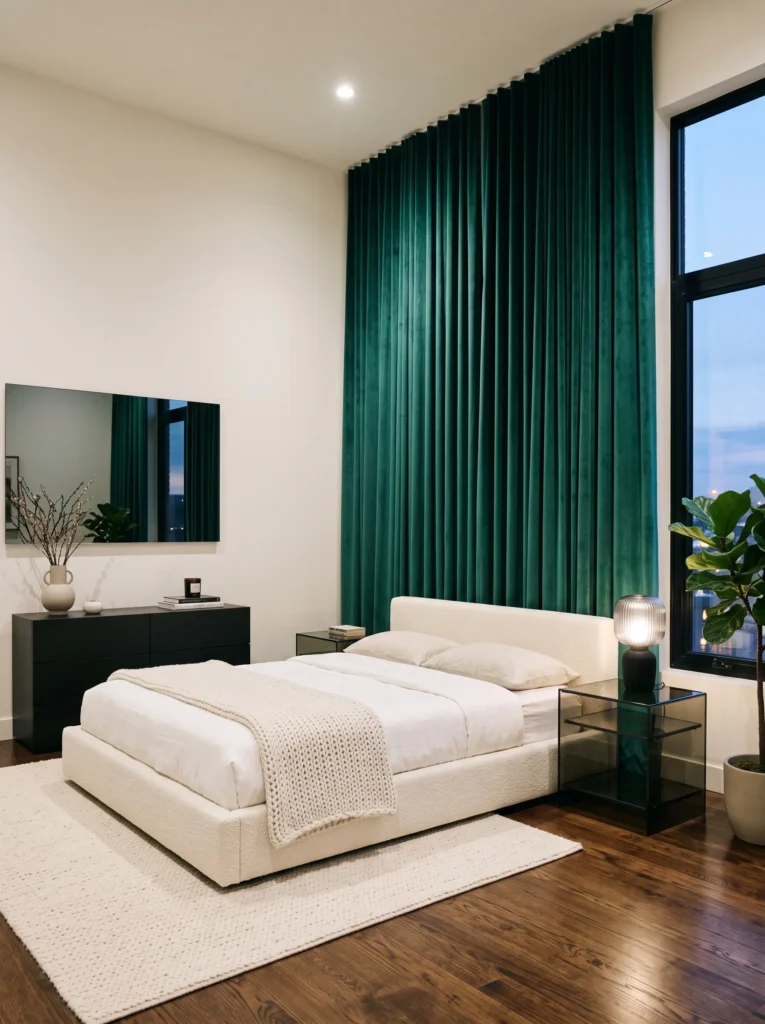
- Emerald floor-to-ceiling drapery as the main color statement, walls kept a soft warm white
- Smoked glass nightstands and a matching smoked mirror above the dresser
- Black matte hardware on window frames and door pulls
- Low platform bed in ivory boucle
- Sculptural black table lamp with a fluted glass shade
Why this works: Emerald doesn’t need to touch the walls to make a strong first impression — fabric and reflective surfaces can carry the color instead.
I styled a guest room this way last spring, and the smoked glass surfaces were the detail everyone asked about first. Instead of painting the walls emerald, the color lives in floor-to-ceiling drapery, which lets the green feel bold without covering every surface. Smoked glass nightstands and a matching mirror add a moody reflection that shifts with the light throughout the day. Black matte hardware on the windows and door pulls sharpens the whole room, keeping the palette graphic instead of soft. It’s proof that emerald doesn’t need to touch the walls to make a strong first impression.
The ivory boucle platform bed keeps the base of the room quiet, so your eye travels up toward the drapery and glass instead of feeling boxed in by color. A sculptural black lamp with a fluted glass shade adds one more layer of texture without introducing a new hue. This combination works especially well in bedrooms with limited wall space for a headboard statement, since the drama comes from fabric and reflective surfaces rather than paint. Guests often assume the room took months to plan, when really it’s just a handful of intentional, well-chosen pieces working together.
3. Curved Emerald Nook
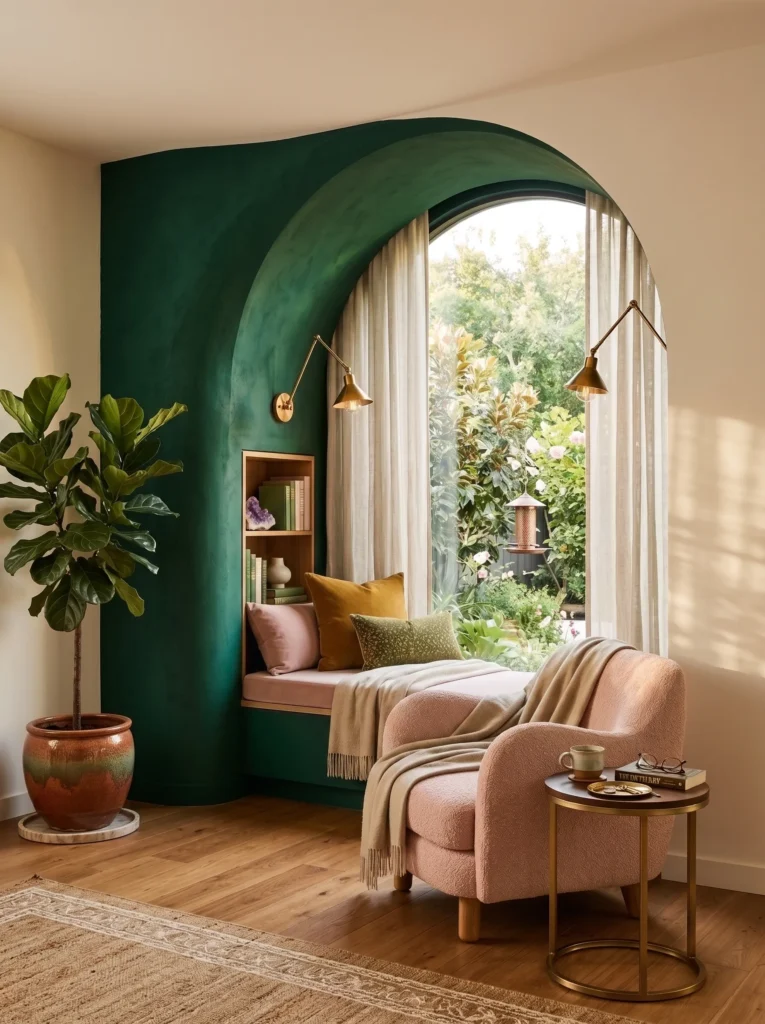
- Curved emerald accent wall built into a window reading nook, rest of room in warm white
- Warm brushed brass sconces mounted at reading height
- Blush boucle armchair with a small round side table
- Sheer linen curtains to soften the curve
- Potted fiddle leaf fig for organic texture
Why this works: A curved wall softens a saturated color, removing the hard lines that can make a small space feel closed in.
A curved wall is one of the easiest ways to soften a saturated color like emerald, since the rounded edge removes the hard lines that can make a small nook feel closed in. I added this exact detail to a client’s reading corner in Austin, and the curve alone made the emerald feel more like a cocoon than a wall of color. Warm brushed brass sconces mounted at reading height bring a golden contrast against the cool green, proving that not every emerald space needs to stay in the silver-and-chrome family to feel intentional and current.
A blush boucle armchair softens the corner further, keeping the space from feeling too cool or formal, while a small round side table holds a cup of coffee within easy reach. Sheer linen curtains diffuse the natural light and blur the hard edge where wall meets window, and a potted fiddle leaf fig brings a living green that echoes the emerald without matching it exactly. This nook proves that emerald green bedroom ideas don’t have to mean an entire room — sometimes one curved corner delivers all the color impact a space actually needs.
You’ll Also Love: 18 Whimsical Bedroom Ideas for Adults with Dreamy Charm
4. High-Gloss Lacquer Wall
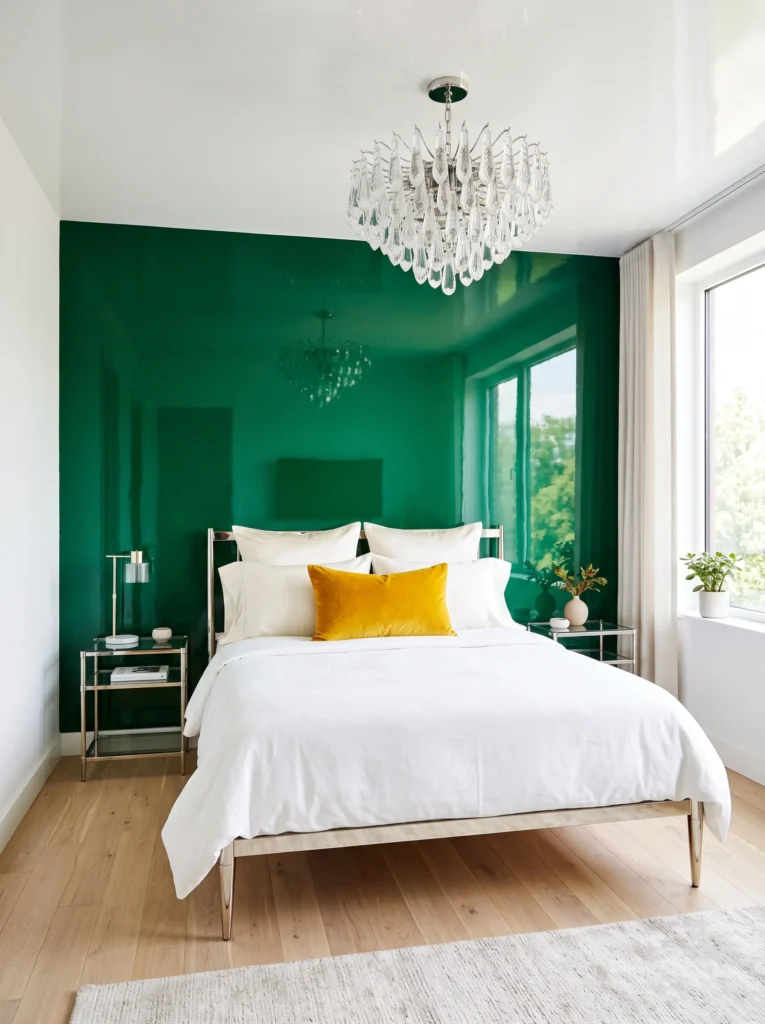
- High-gloss lacquered emerald wall behind the bed, mirror-like sheen that reflects light
- Polished nickel bed frame with slim, tapered legs
- Silk-blend throw pillows in ivory and a single citrine yellow accent
- Statement chandelier with clear glass drops for extra shine
- Glossy white ceiling paint to bounce light back into the room
Why this works: A lacquered finish turns emerald into a light source instead of a flat color, which is what gives the room its jewel-box shine.
A flat matte wall absorbs light, but a lacquered one throws it back, and that’s the entire secret behind this idea’s shine. I’ve noticed that clients are often hesitant about high-gloss paint because it shows every imperfection, but on a single accent wall behind the bed, that reflective quality becomes the whole point. Polished nickel bed legs pick up the same sheen, while a citrine pillow adds a flash of warm color against all that cool green. The chandelier’s glass drops scatter light across the lacquered surface, making the wall look almost liquid at night.
This is one of the boldest ways to bring vivid emerald into a bedroom without covering every surface, since the gloss alone does most of the visual work. Because lacquer reflects both natural and artificial light, the room actually feels brighter than a matte emerald wall would, which matters if your space doesn’t get much sun. A glossy white ceiling continues that light-bouncing effect overhead, keeping the whole room from feeling closed in. It’s a dramatic, current take on jewel-toned green bedroom decor that photographs beautifully and never looks dated.
5. Emerald Silk & Gold Foil
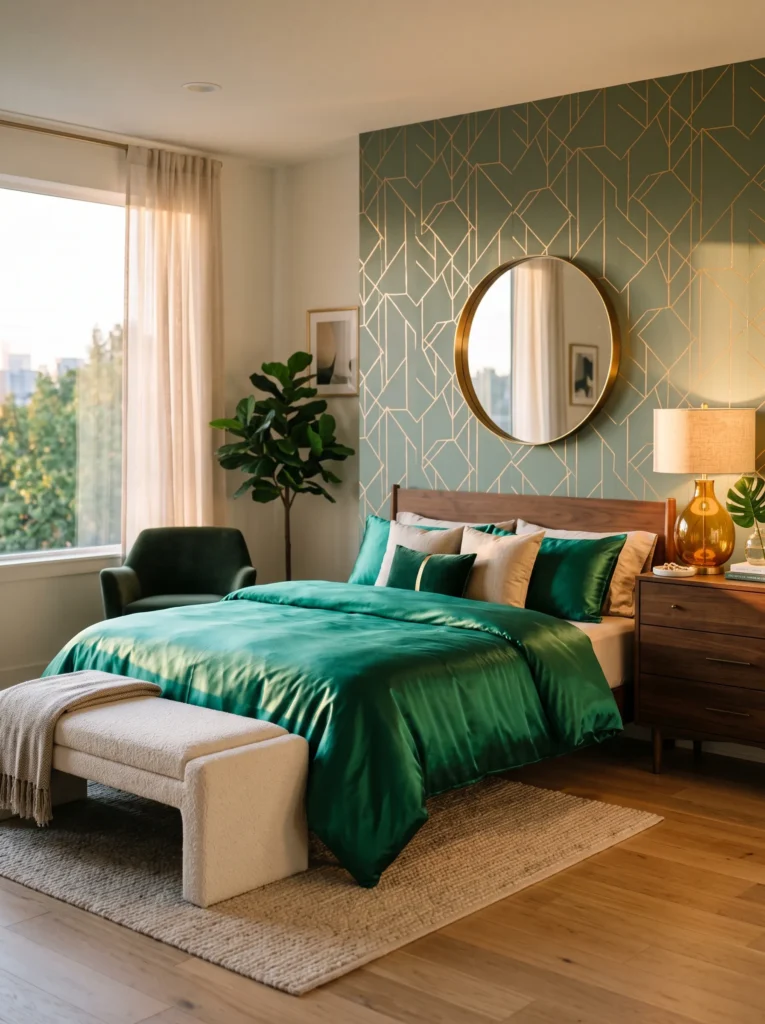
- Emerald silk bedding with a subtle sheen, catching light differently than matte cotton
- Warm gold foil accent panel on one wall, geometric pattern
- Round brass mirror above a low dresser
- Sculptural amber glass table lamp
- Ivory bouclé bench at the foot of the bed
Why this works: Silk’s natural sheen shifts the shade of emerald throughout the day, making the color feel alive rather than static.
Silk behaves differently than any other bedding fabric, and that’s exactly why it works so well with a color as saturated as emerald. As light moves across the room throughout the day, the silk catches and releases it, so the green appears to shift from deep jewel tone to a brighter, almost glassy shade by afternoon. A gold foil accent panel adds warmth and pattern without competing with the bedding, and its geometric lines keep the whole look feeling current rather than ornate. This is a favorite pairing for anyone who wants their emerald bedroom ideas to feel dynamic, not flat.
An amber glass lamp continues the warm-tone thread started by the gold foil, casting a soft glow that flatters the silk’s sheen at night. A round brass mirror above the dresser adds another reflective surface, bouncing light back into the room and making it feel larger than it is. The ivory bouclé bench grounds the space with texture, balancing all that shine with something soft underfoot. Together, these pieces prove that vivid color and metallic warmth can coexist beautifully when the shine is layered with intention.
6. Mirrored Emerald Dresser
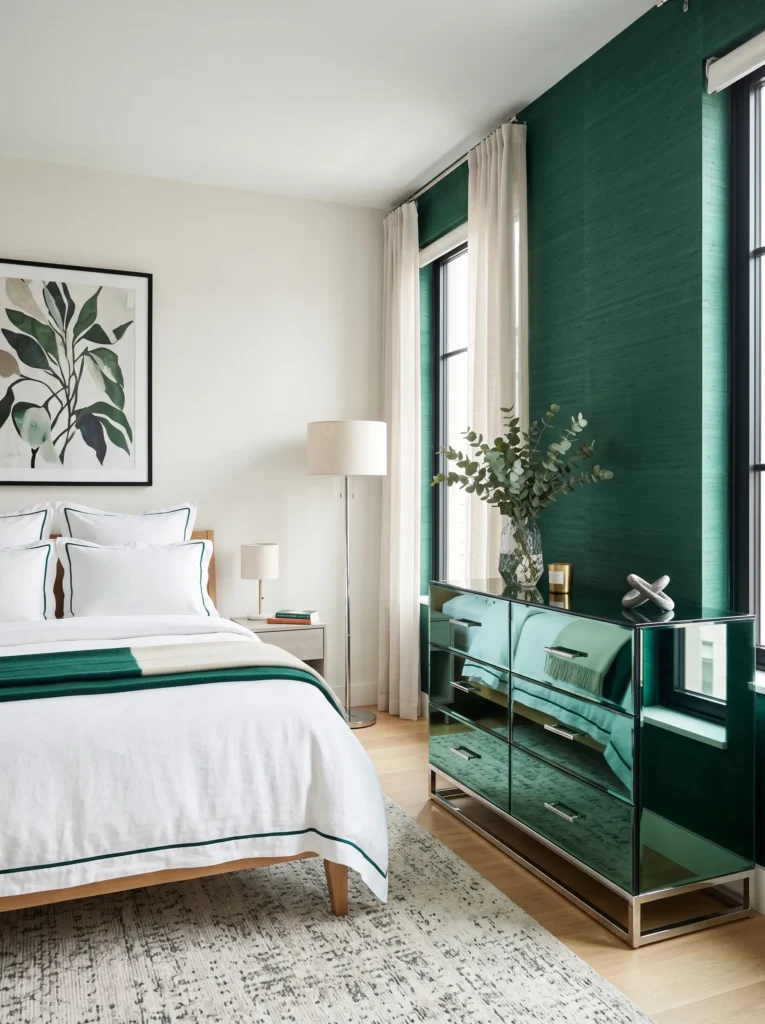
- Mirrored emerald-tinted glass dresser as the room’s shine-forward statement piece
- Deep emerald grasscloth wallpaper on a single wall for texture against the shine
- Chrome drawer pulls and a slim chrome floor lamp
- White piped bedding to keep the palette crisp
- Faceted glass vase with fresh eucalyptus for organic contrast
Why this works: Mixing a matte, textured material like grasscloth against a mirrored, reflective one creates visual depth without adding another color.
I’ve seen this pairing work in more small bedrooms than any other emerald idea I’ve styled, mostly because the mirrored dresser does double duty — it’s a shine-forward statement piece and a light-bouncing trick that makes a tight room feel bigger. The emerald-tinted glass reflects the grasscloth wallpaper behind it, so the texture and the shine play off each other instead of clashing. Chrome hardware and a slim chrome floor lamp keep the metal palette cool and consistent, reinforcing the blue undertone that makes emerald read as a true gemstone shade rather than something closer to olive or moss.
White piped bedding keeps the rest of the room crisp and uncluttered, letting the dresser and wallpaper carry all the visual interest. A faceted glass vase with fresh eucalyptus softens the shine with something organic and adds a touch of living texture into a styled space. This combination is especially useful for anyone nervous about committing to a fully saturated emerald bedroom, since the shine and texture do the heavy lifting while the base palette stays neutral and calm.
7. Painted Emerald Ceiling
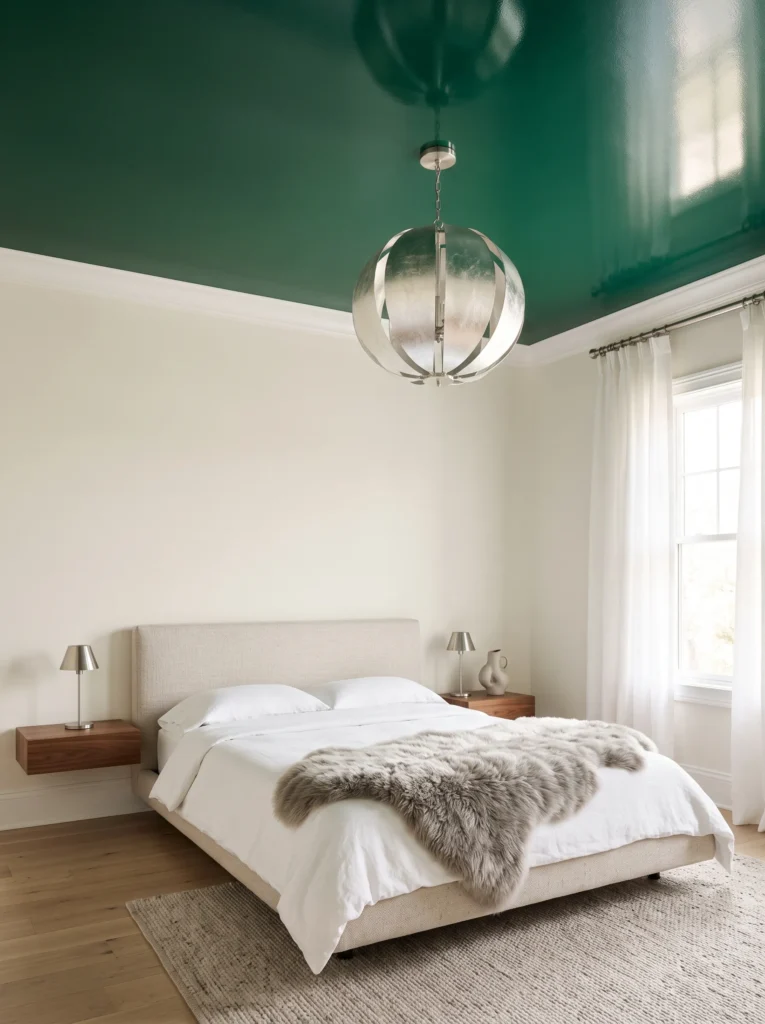
- Emerald gloss paint on the ceiling only, walls kept a soft warm ivory
- Silver leaf pendant light as the room’s central shine
- Low platform bed with a slim upholstered frame in oatmeal linen
- Brushed silver curtain rods and hardware throughout
- Sheepskin throw draped over the foot of the bed for texture
Why this works: A painted ceiling changes how a color reads because light hits it at a different angle than a wall ever would, giving emerald a completely different personality overhead.
A ceiling catches light at a different angle than any wall, which is exactly why painting one emerald changes the personality of the color entirely. Instead of surrounding you, the green becomes a canopy overhead, deep and cocooning without shrinking the room the way a fully saturated wall sometimes can. Silver leaf pendant lighting reflects against the glossy paint, scattering small points of light across the ceiling at night. Keeping the walls a soft ivory grounds the whole look, so the drama stays contained to one surface instead of taking over the entire space.
This is one of the more advanced ways to use vivid emerald in a bedroom, and it’s worth mentioning that gloss finishes on ceilings show every roller mark, so professional application matters here more than almost anywhere else in the room. Brushed silver hardware throughout keeps the metal palette cool and consistent with the ceiling’s undertone. A sheepskin throw at the foot of the bed adds warmth underfoot, balancing the coolness above. It’s a striking, editorial approach to jewel-toned green bedroom decor that most homeowners overlook entirely.
8. Emerald Statement Chair
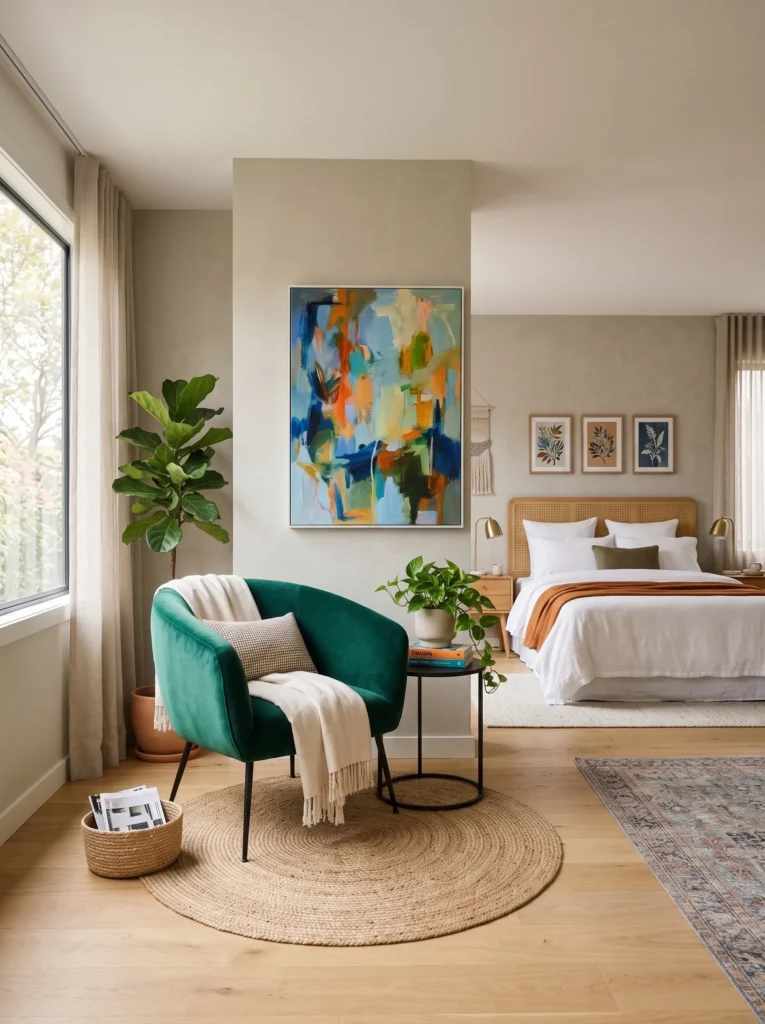
- Single sculptural emerald velvet chair as the room’s only saturated color moment
- Curved, low-back silhouette with black matte metal legs
- Rest of room in warm greige and natural oak tones
- Woven jute rug underfoot for texture contrast
- Small black matte side table beside the chair
Why this works: One saturated chair delivers the same visual impact as an entire accent wall, without the long-term commitment of paint.
I’ve talked more than a few nervous clients into trying emerald this way — one chair, nothing else. It always surprises them how much impact a single saturated piece can have in an otherwise neutral room. The curved, low-back silhouette keeps the chair feeling current rather than heavy, and black matte legs ground it against the warm greige walls. A jute rug underfoot adds texture without introducing another color, letting the chair stay the obvious focal point. For anyone unsure about committing to emerald green bedroom ideas at a larger scale, this is the lowest-risk entry point that still makes a real statement.
Because the rest of the room stays in warm, neutral tones, the chair reads as intentional rather than random, which fits the idea that nothing in a well-designed room should feel like an afterthought. A small black matte side table beside it keeps the vignette functional, not just decorative. This approach works especially well in bedrooms that already have good bones and natural light, since the chair becomes the one piece doing all the color storytelling in the room.
9. Emerald Canopy Drapery
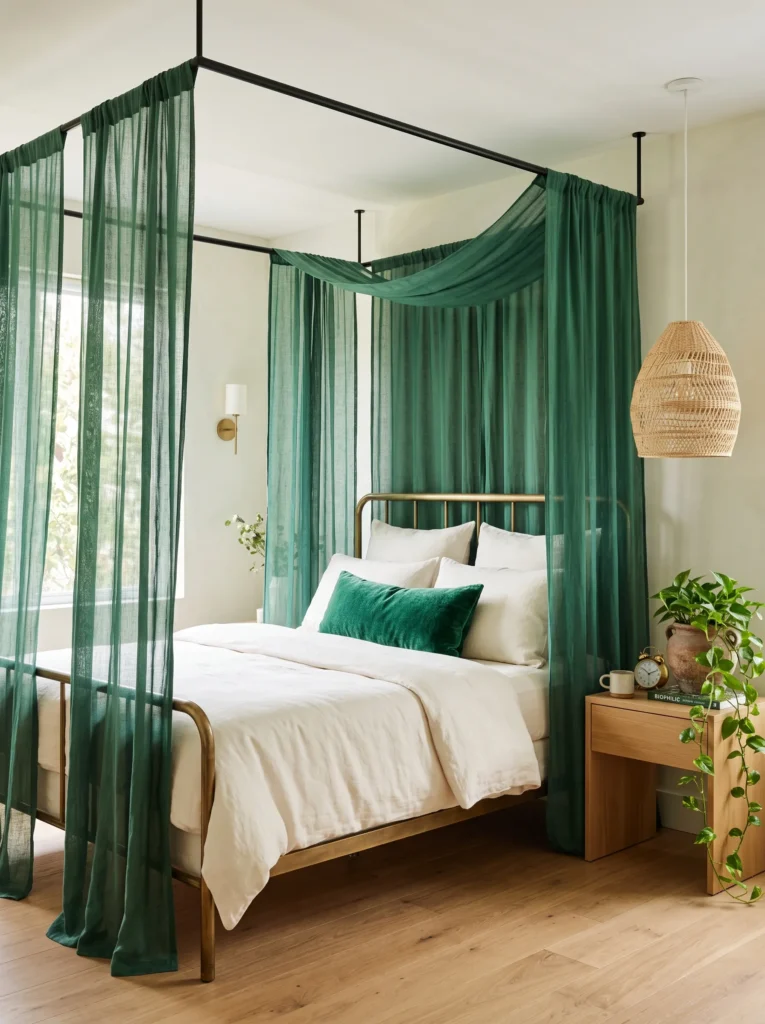
- Sheer emerald canopy drapery suspended from a slim black ceiling rod above the bed
- Unlacquered brass bed frame with a warm, aged patina
- Ivory linen bedding layered with a small emerald velvet lumbar pillow
- Woven rattan pendant light for organic texture
- Terracotta pot with a trailing pothos on the nightstand
Why this works: Sheer fabric lets emerald filter light instead of blocking it, which keeps a canopy from feeling heavy the way solid drapery often does.
A canopy is one of the more theatrical ways to bring color into a bedroom, but sheer fabric keeps it from feeling heavy or overdone. Because the emerald fabric is translucent, light filters through it rather than getting blocked, so the color shifts in intensity depending on the time of day. I added a version of this to my own guest room last year, using an unlacquered brass rod that’s since developed a warm, aged patina — something I’ve come to appreciate more than a perfectly polished finish. It gives the whole setup a collected, lived-in feeling rather than a showroom one.
The unlacquered brass bed frame continues that warm, aged quality, pairing naturally with the cooler undertone of the emerald sheer above it. A woven rattan pendant adds organic texture overhead, softening the more graphic lines of the canopy rod. A single trailing pothos on the nightstand brings in a living green that echoes the canopy without matching it exactly, tying the whole room back to its jewel-toned green bedroom decor without feeling matchy or overdesigned.
10. Fluted Emerald Panels
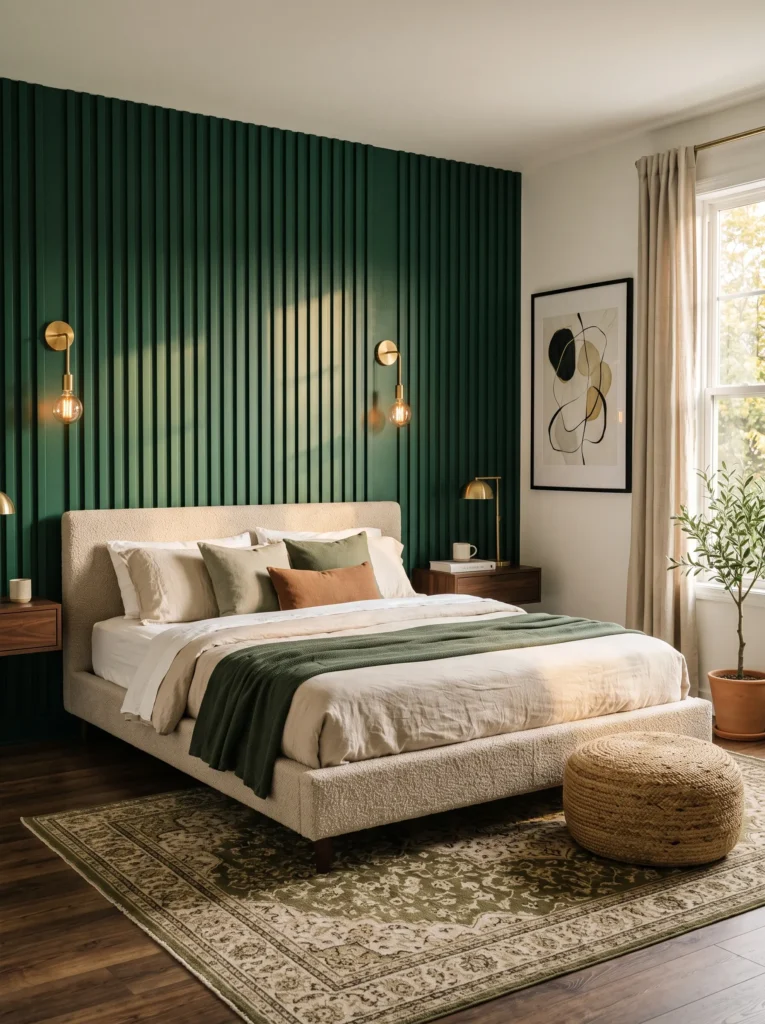
- Fluted wood wall paneling painted emerald, floor-to-ceiling behind the bed
- Warm brass wall sconces with exposed bulbs, mounted directly on the fluted surface
- Low upholstered bed frame in warm oatmeal bouclé
- Black-framed art print for graphic contrast
- Natural jute pouf at the foot of the bed
Why this works: Fluted paneling is one of the few architectural details that changes how paint reflects light across a single wall, since each groove catches shadow differently throughout the day.
Fluted paneling does something flat paint never can — it changes how light moves across the wall depending on the time of day, since each groove catches its own small shadow. Painting the panels emerald rather than leaving them natural wood turns a subtle architectural detail into the room’s main event. Warm brass sconces mounted directly onto the grooves add a soft, uneven glow that highlights the texture even further. This is a favorite technique for anyone who wants their emerald green bedroom ideas to feel architectural rather than purely decorative, since the color and the texture are working together, not separately.
An oatmeal bouclé bed frame keeps the base of the room soft and tactile, offsetting the more structured lines of the paneling above it. A black-framed art print adds graphic contrast without introducing a new color, and a jute pouf at the foot of the bed brings in warmth and texture underfoot. This combination works particularly well in bedrooms with an otherwise plain wall behind the bed, since the fluting alone creates enough visual interest to justify skipping additional artwork or shelving.
11. Emerald Tiled Alcove
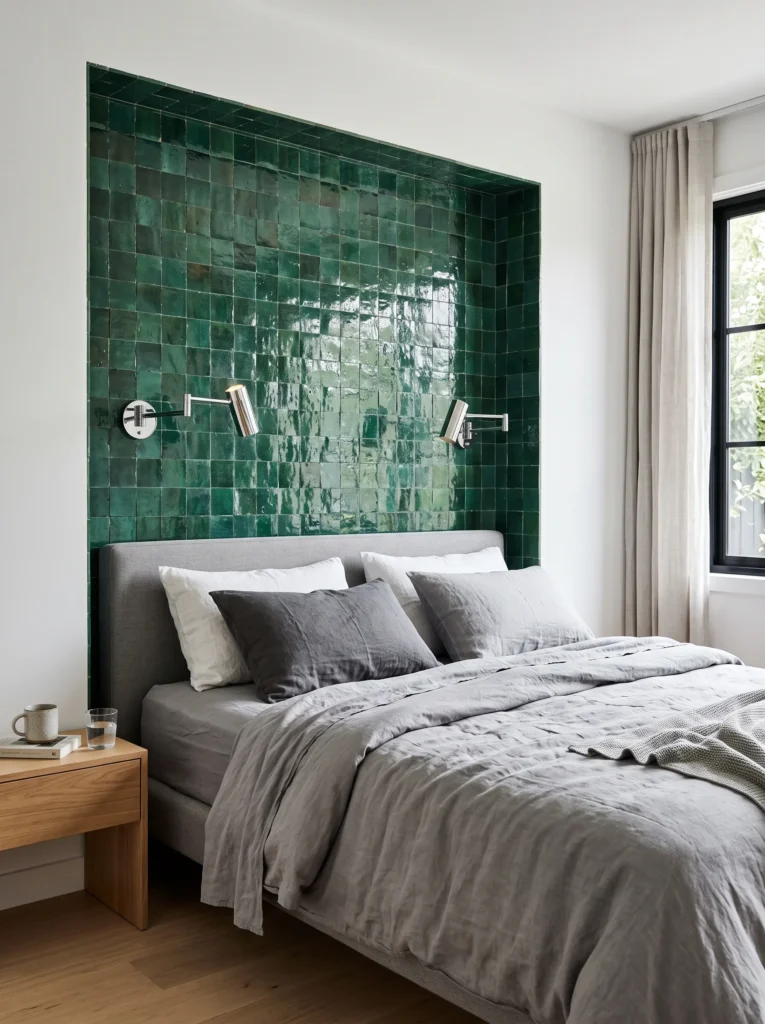
- Small emerald zellige tile alcove built behind the bed, from floor to headboard height only
- Handmade tile with slight color variation, glossy finish
- Chrome reading sconces mounted into the tile
- White matte walls surrounding the alcove for contrast
- Simple linen bedding in soft dove grey
Why this works: Zellige tile’s natural color variation is what keeps a saturated shade like emerald from looking flat or artificial, since no two tiles reflect light exactly the same way.
Tile isn’t a material most people think to use in a bedroom, but a small emerald zellige alcove behind the bed brings a level of texture and depth that paint simply can’t replicate. Handmade tile has natural color variation from piece to piece, so the wall never looks flat, even under a single glossy finish. Chrome sconces mounted directly into the tile keep the lighting streamlined and modern, avoiding bulky fixtures that would compete with the alcove itself. It’s an unexpected but genuinely striking way to introduce vivid emerald into a small footprint of the room.
Keeping the surrounding walls white and matte lets the tiled alcove stand out as a clear focal point rather than blending into a busier palette. Dove grey linen bedding adds a cool, quiet neutral that doesn’t fight with the emerald’s blue undertone the way a warmer neutral might. This idea works especially well for renters or anyone hesitant about painting a full wall, since the tile can often be installed as a smaller, contained project with a much bigger visual payoff.
12. Curved Emerald Daybed
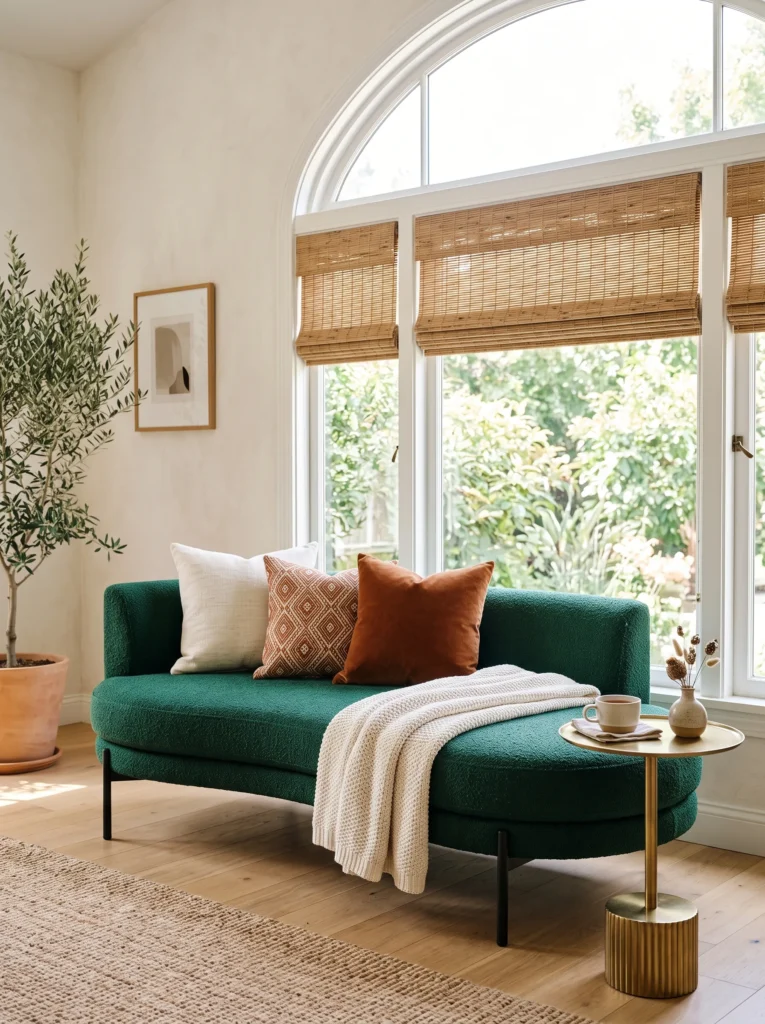
- Sculptural curved daybed upholstered in emerald bouclé, positioned beneath a window instead of a traditional bed frame
- Black matte metal legs, thin and architectural
- Layered ivory and rust-colored throw pillows
- Woven rattan blinds instead of curtains
- Small round brass side table
Why this works: A curved daybed placed beneath natural light does something a traditional headboard can’t — it turns the bed itself into the room’s architectural focal point.
I’ve noticed that curved furniture tends to photograph better than almost anything else in a saturated color, and a daybed is no exception. The rounded silhouette softens emerald bouclé in a way a boxy frame never could, and positioning it beneath a window instead of against a wall turns the whole piece into the room’s architectural focal point. Black matte legs keep the shape looking intentional and current rather than soft or overdone. This setup works especially well in smaller bedrooms or guest rooms where a full traditional bed frame might feel too heavy for the space.
Rust-colored throw pillows add warmth against the cooler emerald tone, while ivory pillows keep the layering from feeling too saturated overall. Woven rattan blinds let in natural light without competing with the daybed’s texture, and a small round brass side table adds just enough shine to keep the vignette from feeling flat. It’s one of the more unconventional emerald green bedroom ideas on this list, but it consistently gets the most attention from anyone seeing the room in person for the first time.
13. Emerald Boucle Bench Nook
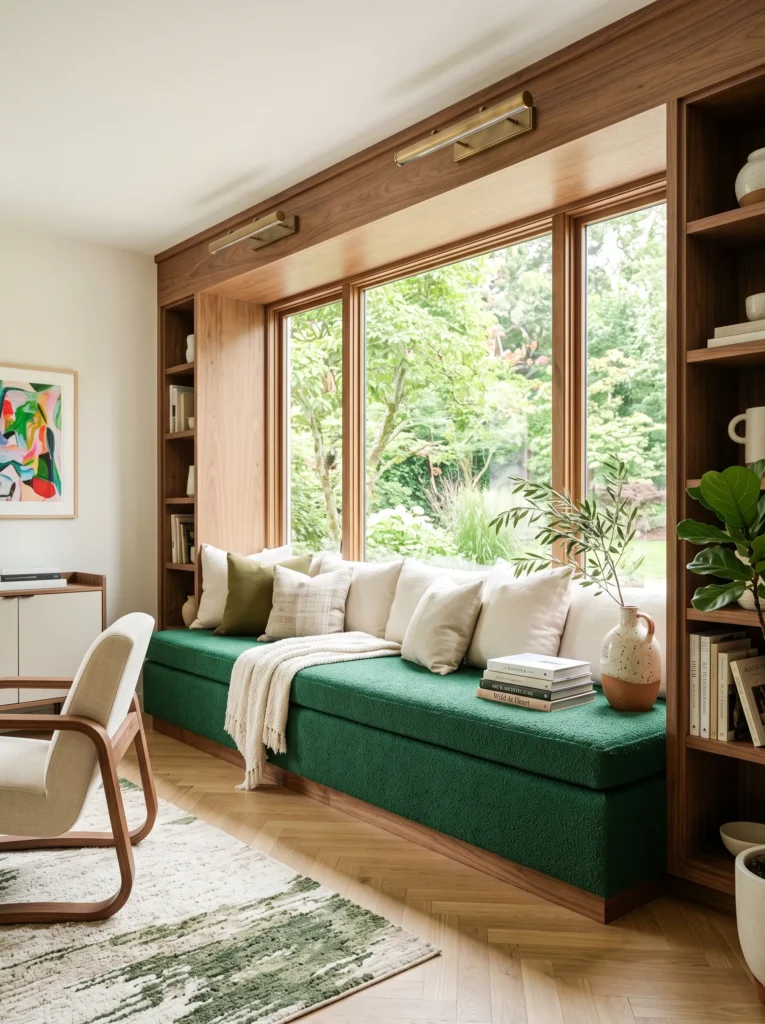
- Built-in window bench upholstered in emerald bouclé, tucked into a bay or bump-out window
- Warm walnut wood trim framing the bench
- Brass picture lights mounted above for a gallery-style glow
- Ivory linen cushions layered on top of the emerald base
- Small stack of books and a ceramic vase as the only styling
Why this works: A built-in bench uses architecture instead of furniture to introduce color, which is why it never feels like it could be swapped out or replaced.
Built-in pieces read differently than freestanding furniture, mostly because they feel permanent rather than decorative. An emerald bouclé window bench framed in warm walnut trim brings color into the room through architecture rather than a piece that could easily be swapped out later. Brass picture lights mounted above add a soft, gallery-style glow at night, treating the bench almost like a piece of art rather than just a seating spot. This is one of the more understated emerald green bedroom ideas here, but it’s also one of the most functional, giving the room a reading nook and a color statement in a single built-in feature.
Ivory linen cushions layered on top of the emerald base soften the look and make the bench genuinely comfortable, not just decorative. Keeping the styling minimal — a small stack of books, one ceramic vase — lets the walnut trim and bouclé texture carry the visual weight without added clutter. This approach works particularly well in bedrooms with awkward window nooks or bump-outs that don’t know quite what to do with themselves, turning an underused corner into the most personal spot in the room.
14. Emerald & Terracotta Wall
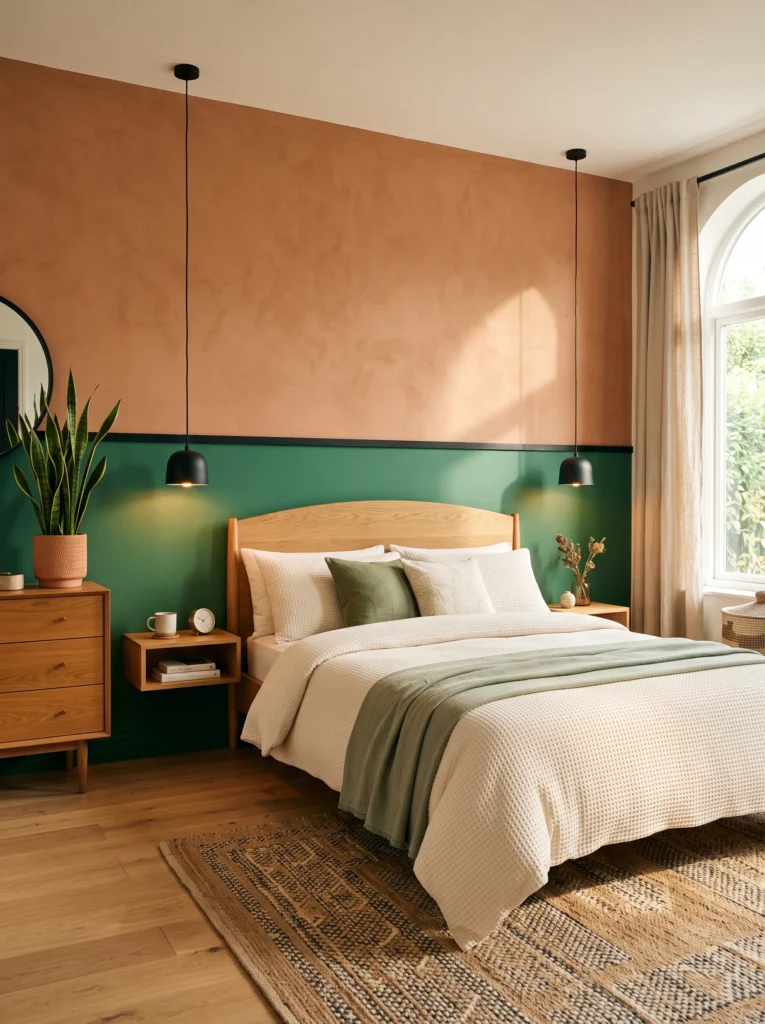
- Half-painted wall, emerald on the lower half, warm terracotta plaster on the upper half, divided by a slim black trim line
- Curved oak headboard, natural unstained wood
- Black matte pendant lights on either side of the bed
- Ivory waffle-weave bedding
- Small potted snake plant on the dresser
Why this works: Pairing emerald with terracotta instead of a neutral is an unexpected combination, but the warm clay tone keeps the cooler green from feeling severe or overly formal.
Most emerald bedrooms lean on neutrals to balance the color, but pairing it with warm terracotta plaster creates a combination I genuinely didn’t expect to love as much as I do. The clay tone keeps the cooler green from feeling severe, and the slim black trim line dividing the two colors gives the wall a deliberate, architectural feel rather than looking like an accident. A curved oak headboard in natural, unstained wood adds warmth at eye level, tying back to the terracotta above without matching it exactly. It’s a genuinely unique way to bring vivid emerald into a bedroom.
Black matte pendant lights flanking the bed keep the metal palette understated, letting the wall colors do the visual work instead. Ivory waffle-weave bedding adds texture without competing with either the emerald or the terracotta, and a small potted snake plant on the dresser brings in a living green that echoes the wall’s lower half. This combination proves that jewel-toned green bedroom decor doesn’t have to rely on cool neutrals to feel balanced and current.
15. Emerald Accent Ceiling Beam
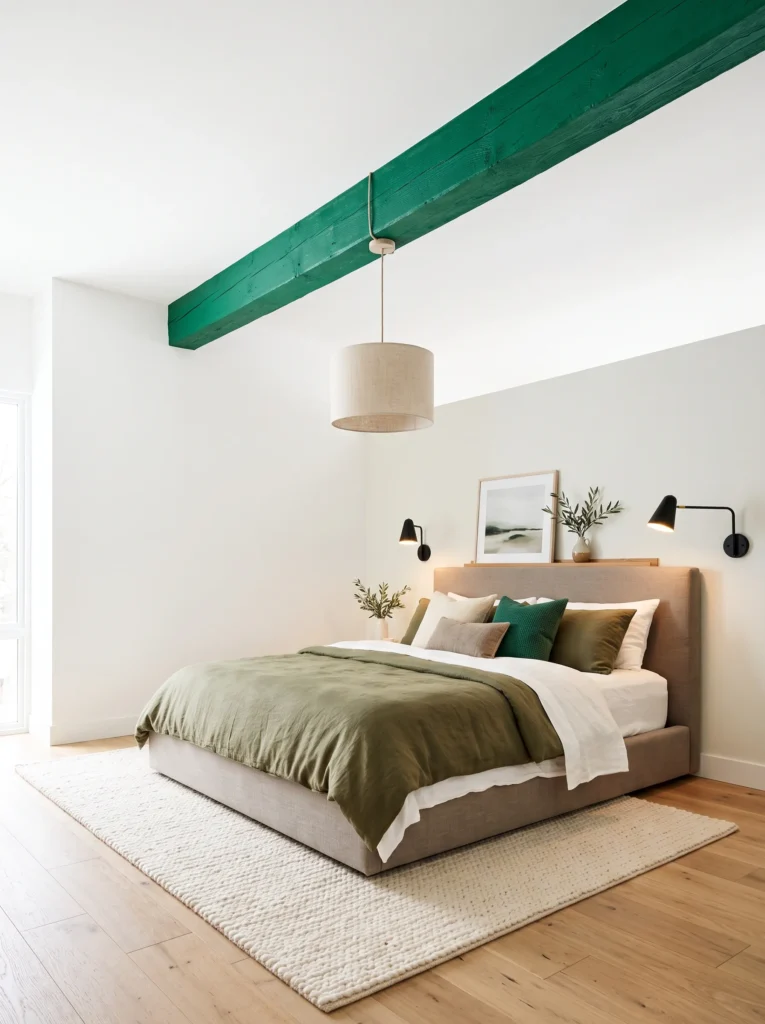
- Exposed ceiling beam painted emerald, running the length of the room above the bed, rest of ceiling left white
- Simple linen drum pendant hanging from the beam
- Low platform bed in warm taupe linen
- Woven wool rug in a soft cream tone underfoot
- Minimal black wall sconces on either side of the bed
Why this works: A single painted beam draws the eye upward without covering the entire ceiling, which is why it works in rooms where a full emerald ceiling would feel like too much.
Not every room can handle a fully painted emerald ceiling, and that’s exactly why a single painted beam works so well as a middle-ground option. My husband has pointed out on more than one renovation that exposed beams are often left natural or painted white by default, simply because nobody considers color as an option — but a beam painted emerald draws the eye upward and adds architectural interest without overwhelming the room the way a full ceiling treatment might. A simple linen drum pendant hanging from the beam keeps the lighting soft and unfussy.
A low platform bed in warm taupe linen keeps the base of the room calm, letting the beam remain the clear focal point overhead. A cream wool rug underfoot adds texture without introducing another color, and minimal black sconces on either side of the bed keep the metal palette quiet and consistent. This is one of the simplest ways to work vivid emerald into a bedroom that already has good architectural bones, using structure instead of paint coverage to make the statement.
Styling Principles: Getting Emerald Right
Managing saturation. Emerald is one of the more intense colors on the spectrum, and how much of it a room can handle depends almost entirely on square footage and natural light. In a small bedroom, a full emerald wall can visually shrink the space, especially with limited daylight to bounce off it — which is why several ideas in this list use emerald in a smaller dose instead: a single chair, a canopy, a ceiling beam, a tiled alcove. Larger rooms with good natural light can typically handle a full wall or even a full ceiling without feeling closed in. If you’re unsure, start small. A chair or a bench is far easier to change your mind about than a freshly painted wall.
Choosing the right accent metal. Emerald’s blue undertone is what separates it from earthier greens like olive, sage, or the deeper hunter and pine tones often paired with warm gold. That cooler undertone is why silver, chrome, and black matte hardware tend to feel more natural against emerald than brass does — though warm brass and unlacquered metals absolutely still work, especially when you want to soften the color’s intensity rather than sharpen it. There’s no single correct metal here. The right choice depends on whether you want the room to feel cooler and more graphic, or warmer and more collected.
Keeping the look modern, not dated. Older jewel-tone bedrooms leaned heavily on tufted Chesterfield furniture, carved wood frames, and heavy drapery — a formal, old-world aesthetic that can quickly feel dated. To keep emerald current, favor curved or low-profile furniture silhouettes over anything boxy or ornate, mix matte and glossy textures rather than defaulting to one finish throughout, and let the color show up in unexpected places — a ceiling, a bench, a single chair — rather than covering every wall by default.
A quick fact worth remembering: emerald’s blue undertone is the reason cool metals like chrome and silver read as more natural pairings than warm gold, which behaves differently against earthier greens.
Frequently Asked Questions About Emerald Green Bedroom Ideas
Is emerald green too bold for a bedroom? Emerald is a bold color, but it doesn’t have to overwhelm a bedroom if it’s introduced with intention. A single accent wall, a statement chair, or a canopy can deliver the same visual impact as a full room without the same level of commitment.
What are the best accent colors for an emerald bedroom? Ivory, blush, terracotta, chocolate brown, and citrine all pair beautifully with emerald, since each one offsets the color’s cool undertone in a different way. Warm neutrals soften the intensity, while bright accents like citrine or blush add contrast and energy.
How do I use emerald in a small bedroom without it feeling cramped? In a small room, emerald works best in a contained dose — a single wall, a piece of furniture, or a ceiling detail rather than full wall-to-wall coverage. Keeping the surrounding palette light and letting reflective surfaces like mirrors or glossy finishes bounce light back into the room also helps prevent the space from feeling closed in.
What’s the best paint finish for an emerald accent wall? A soft eggshell or satin finish tends to work best for most emerald walls, since it reflects a moderate amount of light without showing every imperfection the way a full gloss finish can. If you want a true statement wall, high-gloss lacquer is stunning, but it requires careful surface prep and, in most cases, is best left to a professional painter.
Does emerald work in a bedroom with limited natural light? Yes, though it’s worth choosing your finish carefully. A glossier sheen reflects more of the available light back into the room, while a fully matte finish can make a dim room feel even darker. Pairing emerald with reflective metals like chrome or mirrored furniture also helps compensate for lower natural light.
What’s a budget-friendly way to try emerald without repainting a whole room? Bedding, drapery, and a single accent chair are the easiest low-commitment ways to test emerald before painting a wall. A canopy or a set of throw pillows lets you live with the color for a while and decide whether you want to go bigger.
Conclusion
Emerald is proof that a bold color doesn’t have to mean a formal, old-world bedroom. Done well — with the right metal, the right saturation, and a little restraint — it reads modern, personal, and genuinely striking. I’ve seen how a single well-placed piece, like a curved chair or a canopy of sheer fabric, can completely shift how a room feels without a single wall being repainted.If any of these emerald green bedroom ideas caught your eye, save this post to Pinterest so you can come back to it when you’re ready to start.
Try one idea first, live with it for a while, and see where it takes the rest of the room. And if you know someone who’s been eyeing a bold color for their own bedroom, pass this along — sometimes all it takes is seeing the right example to feel confident enough to try it.