15 Japandi Dining Room Ideas That Feel Intentional
A dining room shouldn’t feel like an afterthought squeezed between the kitchen and the living room — it deserves its own sense of calm. That’s exactly what these Japandi dining room ideas are built around. Japandi blends Japanese restraint with Scandinavian warmth, creating spaces that feel intentional rather than sparse. In my own home, the dining room is where this philosophy shows up most clearly — fewer pieces, better materials, and nothing sitting there just to fill space.
This post walks through 15 fully styled rooms, from live-edge walnut statement tables to small-space drop-leaf solutions, each one showing exactly how to balance wood tones, lighting, and texture so your dining room feels calm, considered, and genuinely livable — not just photogenic.
Why Japandi Works So Well for a Dining Room
Most people assume a dining room needs more — more decor, more seating, more “cozy” layers — to feel welcoming. Japandi says the opposite, and the research backs it up. Japandi blends Japanese wabi-sabi, the appreciation of imperfection and restraint, with Scandinavian hygge, the pursuit of everyday coziness. Applied to a dining room, that means fewer, better-made pieces around the table, which naturally slows the pace of a meal. A dining room with fewer, higher-quality objects genuinely encourages slower, more mindful eating — there’s less visual noise pulling attention away from the food and the people at the table.
I noticed this firsthand after replacing a cluttered sideboard with a single ceramic vessel: dinners in that room started lasting longer, without anyone trying to make that happen. This post solves the real gap in most Japandi dining room content — it shows you exactly how to balance light and dark wood tones, plus how to adapt the style for both small and large dining spaces.
1. Ash & Walnut Balance: The Classic Wood-Tone Pairing
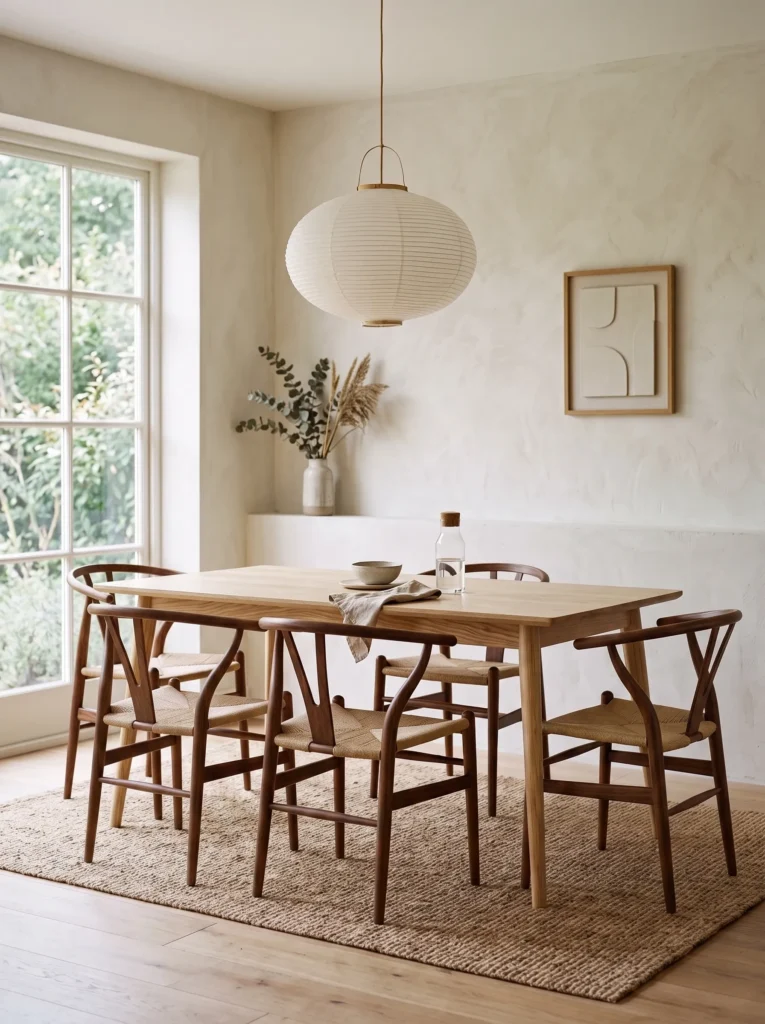
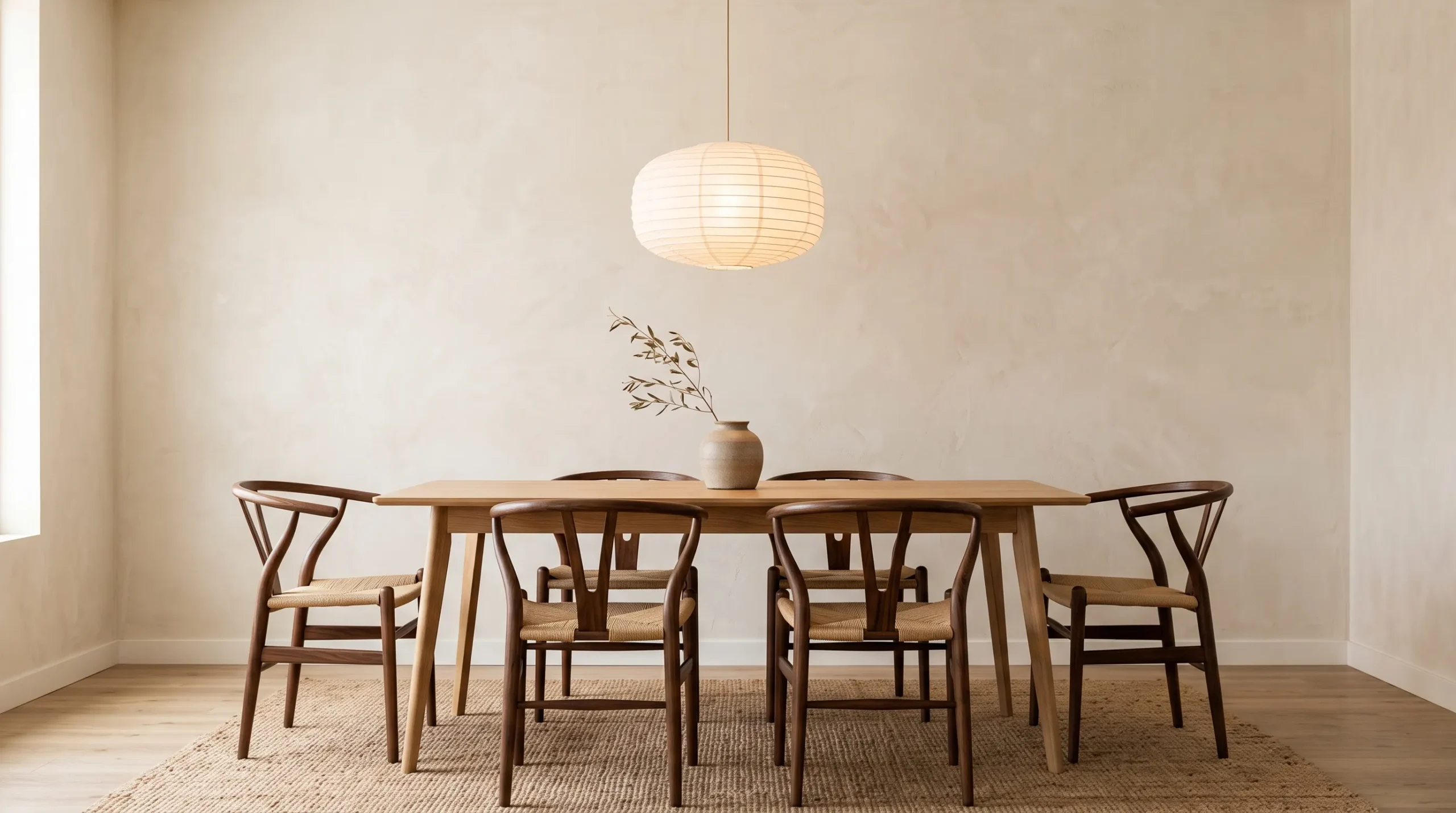
- Solid ash dining table with straight, tapered legs
- Six walnut wishbone chairs with woven paper-cord seats
- Lime-washed plaster walls in a warm oat-white tone
- Single rice-paper drum pendant above the table, plus brass wall sconces for evening light
- Jute rug sized to keep all chairs on it, even when pulled out
- Stoneware dinnerware in a soft oatmeal glaze, intentionally mismatched
- Potted olive tree in an unglazed terracotta pot near the window
- Matte brass hardware on a slim entry console
Why this works: Pairing one light wood with one dark wood is the fastest way to keep a Japandi room from feeling either too stark or too heavy.
Pairing a light wood like ash with a darker wood like walnut is the most reliable way to keep a Japandi dining room from feeling either too stark or too heavy. Ash brings brightness and a fine, straight grain that reflects light well, while walnut’s deeper tone grounds the room and keeps the chairs from visually disappearing against pale walls. This isn’t a random styling trick — designers lean on roughly a 60/40 ratio, letting the lighter wood dominate as the table while the darker wood plays a supporting role in the chairs, so the contrast reads as intentional.
My husband’s crew builds a lot of custom dining tables, and ash is one of his favorite choices for daily use — it resists dents from dropped silverware and everyday chair scrapes, but still takes stain evenly if you ever want to shift the tone later. He tells clients to check the joinery before the finish, since a table held together with true mortise-and-tenon joints will outlast one that relies on hardware and glue alone. In this room, that durability matters as much as the look — a table for daily family dinners has to survive real life, not photograph well.
You’ll Also Love:15 Moody Dining Room Ideas for Candlelit Dinners
2. Sunken Tatami Nook: Floor Seating Without a Single Wall
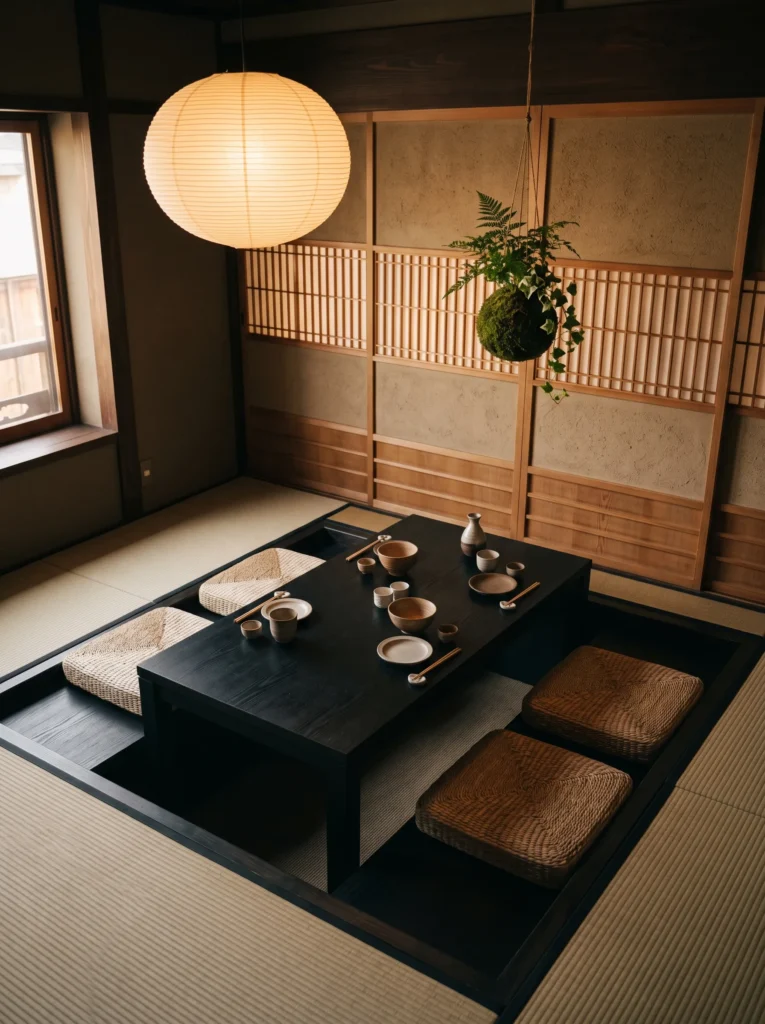
- Platform table in black-stained oak, raised about 14 inches off the ground
- Woven rush floor cushions arranged around three sides instead of chairs
- Sliding cedar and rice-paper screen doors along the back wall
- Recessed lighting plus a low paper floor lantern for evening ambience
- Rush matting covering the platform base
- Matte black stoneware stacked with pale celadon bowls
- Hanging kokedama moss ball near the window
- Narrow cedar sideboard along the back wall for hidden storage
Why this works: A sunken or raised platform visually separates a dining zone from an open-concept space without adding a single wall.
Floor seating isn’t just an aesthetic choice — it changes how a meal feels. Lowering the eye line closer to the table encourages a slower, more grounded pace, which is part of why traditional Japanese dining rooms have used platform seating for centuries. A raised or sunken platform also visually separates the dining zone from the rest of an open-concept space without adding walls, something increasingly useful in modern homes. Pairing black-stained oak with pale rush cushions keeps the look from feeling heavy, since the dark wood stays close to the ground while lighter, textured materials surround it at eye level.
When my husband’s team builds a sunken dining platform, the framing matters more than people expect — it isn’t just a box on the floor. They frame it with pressure-treated joists tied into the subfloor, then insulate underneath if the platform sits over an unconditioned space, so it doesn’t feel cold underfoot in winter. He recommends a step height no taller than 7 inches for safety, especially in homes with kids or older guests. It’s a small structural detail most design blogs skip, but it’s the difference between a nook that feels intentional and one that feels like a tripping hazard.
3. Curved Oak Simplicity: Softer Lines for Tighter Rooms
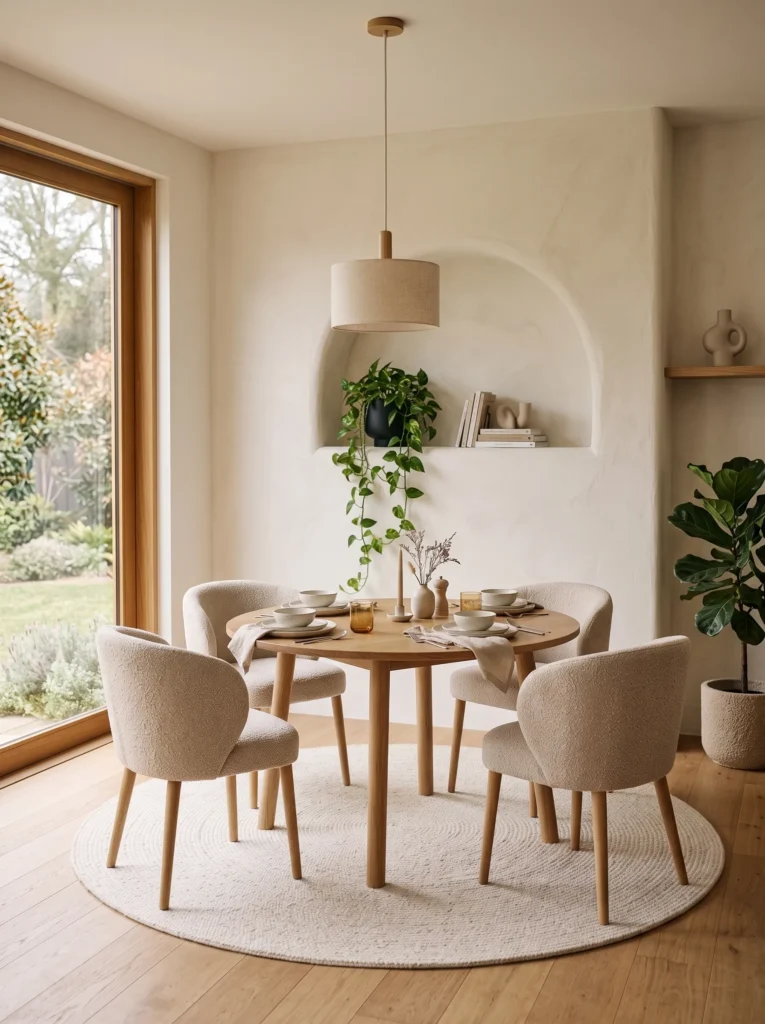
- Round oak table with a sculptural curved pedestal base
- Curved bouclé dining chairs in oatmeal and soft charcoal
- Plaster archway niche built into the back wall, painted to match
- Sculptural curved-arm brass wall sconce plus a woven pendant overhead
- Round wool-blend rug in undyed cream beneath the table
- Handmade stoneware in a mottled ash glaze
- Trailing pothos in a curved matte-black ceramic planter
- Curved white oak console along the adjacent wall
Why this works: Curved silhouettes remove the sharp corners that make smaller dining rooms feel cramped, letting chairs tuck in without bumping a hard edge.
Curved furniture does more than soften a room’s look — it changes how people move through it. Round and curved silhouettes remove the sharp corners that make smaller or oddly shaped dining rooms feel cramped, letting chairs tuck closer to the table without anyone bumping a hard edge. This is a reason curved forms have become a defining feature of 2026 interior design, in Japandi spaces where every piece is meant to feel considered rather than accidental. A round oak table paired with a curved plaster archway creates a sense of flow that a boxy rectangular layout can’t offer in a tighter footprint.
I styled a version of this room for a friend with a narrow galley-style dining area, and the curved table solved a problem her old rectangular one never could — six people could sit comfortably without anyone’s chair scraping the wall behind them. The plaster archway was originally her husband’s idea, meant to hide a slightly uneven wall from an old renovation, but it ended up becoming the room’s focal point. Guests kept commenting on it before they noticed the table. It’s a reminder that the most memorable detail in a room is often the one solving a real, practical problem.
4. Live-Edge Walnut Statement: One Bold Material, Everything Else Quiet
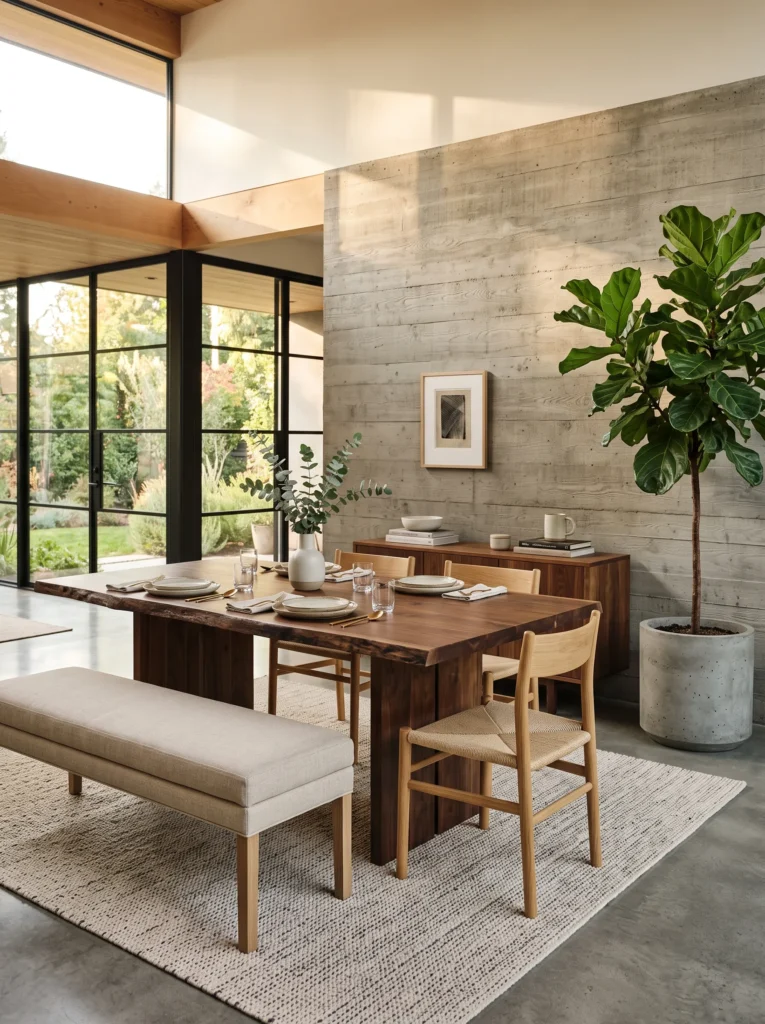
- Live-edge walnut slab table with visible natural grain and one raw edge
- Mixed chair set: three light oak ladder-back chairs, one upholstered linen bench
- Board-formed concrete accent wall behind the table
- Oversized paper lantern pendant in a soft dome shape
- Flat-weave wool runner rug in undyed natural fiber
- Hand-thrown ceramics in a speckled stoneware glaze
- Single large fiddle-leaf fig in a raw concrete planter
- Blackened steel shelf bracket holding one ceramic vase
Why this works: A live-edge slab keeps a single dramatic material as the room’s one bold gesture, so everything else can stay quiet.
A live-edge table works in a Japandi room precisely because it carries the drama on its own, which means everything around it can stay quiet. The raw, unfinished edge is a direct expression of wabi-sabi — beauty found in natural imperfection rather than polished uniformity — so no additional ornamentation is needed to make the room feel considered. Mixing oak ladder-back chairs with one upholstered bench along the slab’s straight side breaks the symmetry just enough to feel lived-in rather than showroom-staged. Against a board-formed concrete wall, the walnut’s warmth reads even richer by contrast.
My husband has cautioned more than one client against live-edge tables without proper kiln-drying, since a slab that hasn’t been dried to the right moisture content will crack or warp within a year, especially in Texas humidity swings. He always checks that a table has been kiln-dried below 10% moisture content before recommending it for daily use. It’s a detail nobody photographs, but it’s the reason a beautiful live-edge table either becomes a decades-long heirloom or an expensive mistake within its first year in a home.
5. Shoji Screen Divide: Privacy Without Closing Off the Room
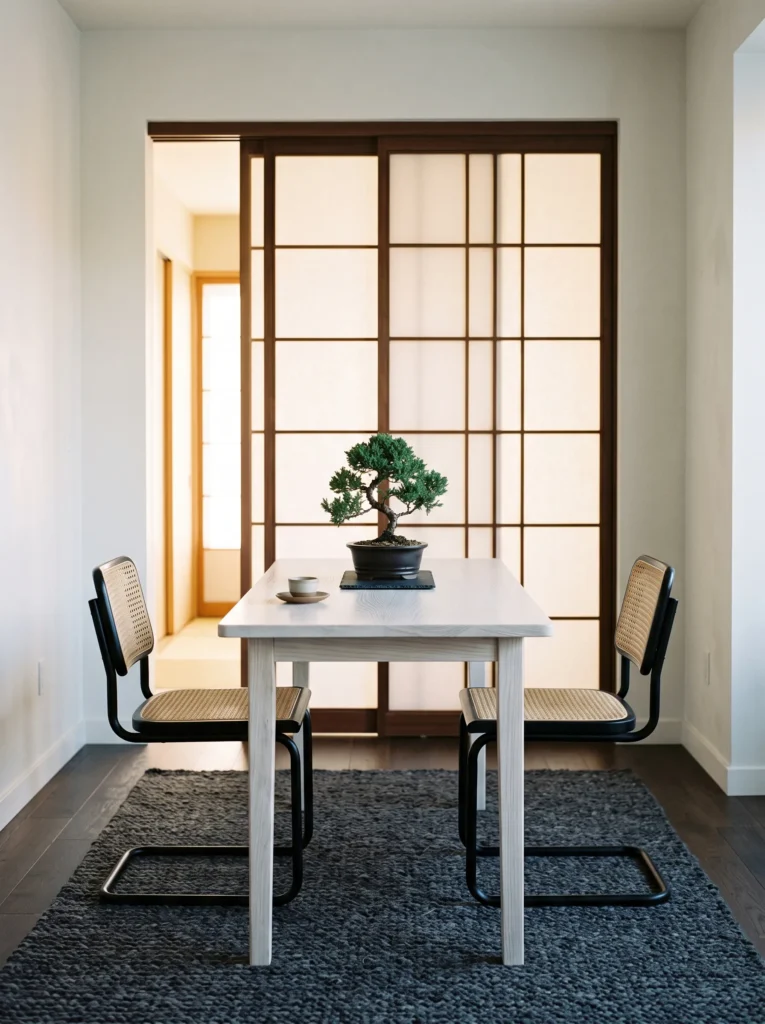
- Narrow rectangular table in whitewashed ash
- Black metal-frame dining chairs with woven rattan seats
- Full-height shoji-inspired sliding screen dividing the dining area from a hallway
- Linear brass pendant light running the length of the table
- Low-pile wool rug in charcoal beneath the table only
- Matte white ceramic dinnerware stacked with a single black lacquer tray
- Bonsai juniper in a shallow glazed dish as the table centerpiece
- Slim black steel shelf mounted above a narrow console
Why this works: A shoji-style screen adds privacy and diffused light without closing off a room the way a solid wall does.
A shoji-inspired screen solves a problem a lot of open-concept homes run into: how to give a dining area a sense of enclosure without shrinking the room. The rice-paper-style panels diffuse light rather than blocking it, so the space stays bright even with a physical divider in place. Pairing whitewashed ash with black metal chairs keeps the palette from tipping too pale, while the linear brass pendant draws the eye down the table’s length rather than up toward the ceiling. It’s a layout especially useful for narrow dining rooms squeezed between a kitchen and a living area.
I first used a shoji-style screen in a client’s rowhouse where the dining table sat directly in the flow of foot traffic from the front door. The screen gave the space a sense of arrival — guests noticed the shift in light and texture before they even reached the table. It didn’t require moving a single wall, which mattered in a rental where structural changes weren’t an option. That’s often the appeal of Japandi solutions: they solve real spatial problems without permanent construction.
6. Bench & Black Oak Pairing: Flexible Seating for Any Headcount
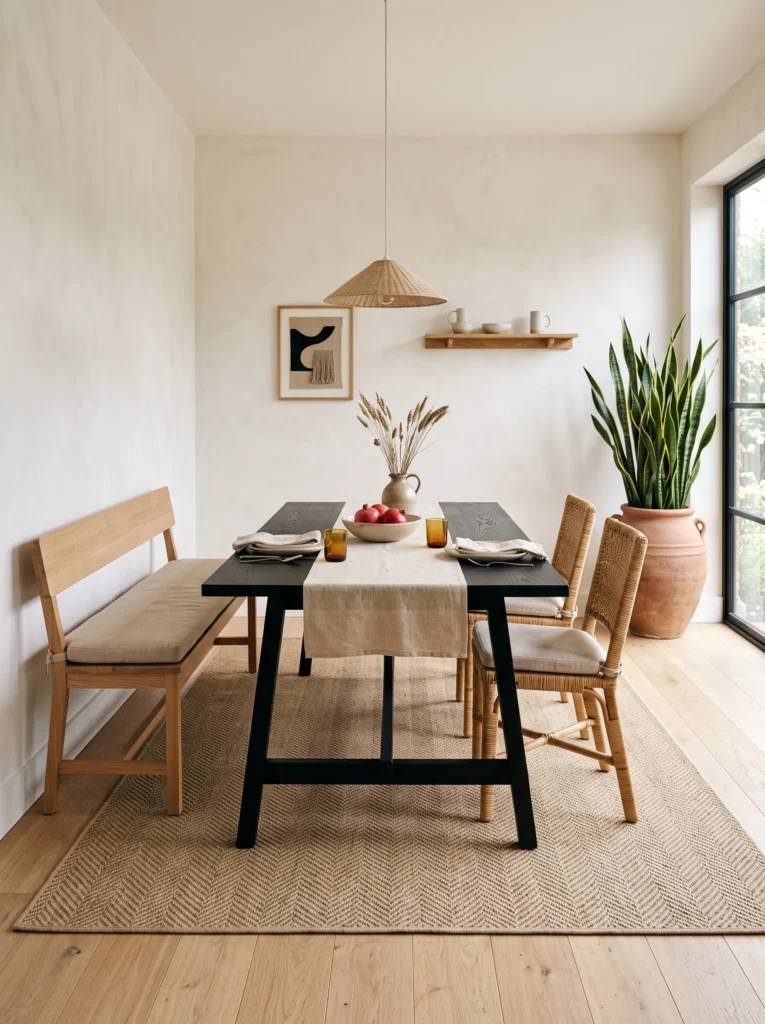
- Long rectangular table in black-stained oak with a matte finish
- Full-length light oak bench on one side, two woven-seat chairs on the other
- Warm white limewash walls with visible brushed texture
- Woven abaca pendant light with an organic, irregular shape
- Natural sisal rug in a herringbone weave
- Stoneware in a warm sand glaze, stacked asymmetrically
- Snake plant in a tall unglazed clay pot in the corner
- Reclaimed oak shelf holding folded linen napkins
Why this works: Benches make a fixed-size table flexible, letting a household seat two or six without rearranging furniture.
A bench on one side of the table is one of the most practical Japandi choices a household can make, since it lets a fixed-size table flex between an intimate weeknight dinner and a full table of guests. Sliding closer together on a bench takes seconds, while adding extra chairs to a chair-only layout usually means dragging mismatched seating from another room. Pairing a light oak bench with a black-stained oak table keeps the wood-tone balance intact even with this asymmetry, and the woven abaca pendant overhead softens the room’s straight lines with an organic, irregular silhouette.
In my own dining room, the bench became the seat my kids actually fight over, which says something about how a simple furniture swap can change a room’s daily rhythm. It also solved a problem the chairs never did — muddy shoes and backpacks used to end up draped over chair backs, but a bench doesn’t invite that kind of clutter the same way. It’s a small, unglamorous benefit that never shows up in a styled photo, but it’s real.
7. Cerused Oak & Cane: Texture as the Focal Point
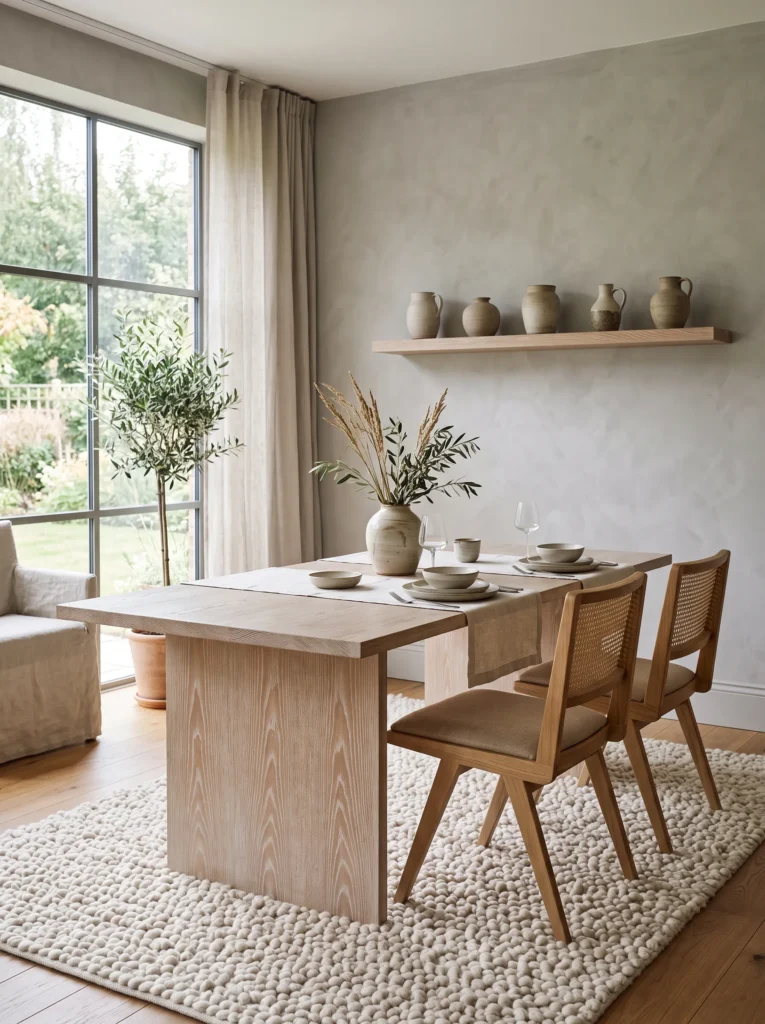
- Cerused oak table with visible open-grain texture and a whitewashed finish
- Cane-back dining chairs with natural rattan seats
- Textured lime plaster wall in a soft dove-gray tone
- Woven rattan pendant light paired with a slim wall-mounted picture light
- Chunky wool bouclé rug in undyed ivory
- Ceramic dinnerware in a pale ash-glaze finish
- Trailing string-of-pearls plant in a small ceruse-finished wood planter
- Floating oak shelf displaying three hand-thrown vessels
Why this works: Cerusing opens the wood’s natural grain instead of hiding it, so the texture itself becomes the room’s quiet focal point.
Cerusing is a finishing technique where white pigment gets worked into the open pores of oak’s grain, and it’s one of the most underused tricks in Japandi styling. Instead of a flat, uniform wood tone, the grain itself becomes visible texture, which gives the table depth without adding a single extra object to the room. Cane-back chairs echo that same open, breathable texture, so the pairing feels cohesive rather than accidental. Against a dove-gray plaster wall, the whole room reads as tonal and restrained, letting texture do the work that color usually would.
I first noticed cerused oak in a furniture showroom years ago and almost walked past the table before running my hand across it — the texture stopped me in a way a smooth finish never would have. That tactile quality matters more than most people realize when choosing a dining table, since it’s the surface everyone touches, leans on, and sets dishes down on every single day. A cerused finish also hides light scratches better than a glossy one, which makes it a genuinely practical choice for a table in daily use.
8. Charred Timber Accent: Deep Black Tones Without Paint
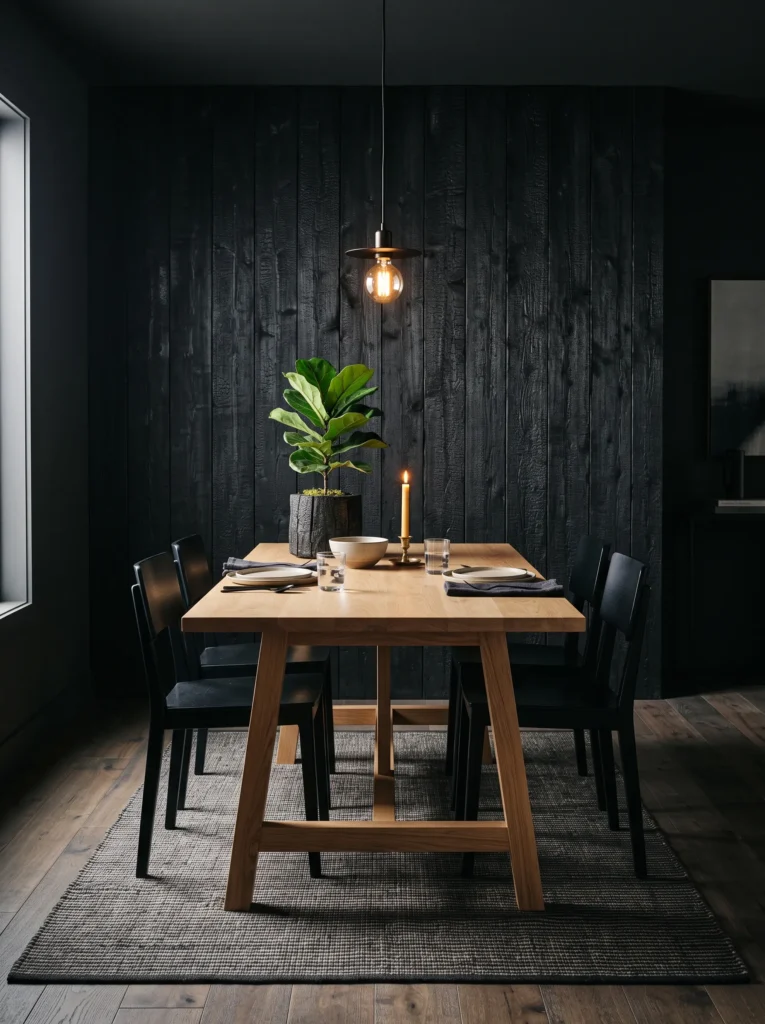
- Rectangular table in pale oak with a simple trestle base
- Black lacquer chairs with slim, straight backs
- One accent wall finished in shou sugi ban charred cedar
- Warm dimmable pendant with a matte black shade
- Thin flatwoven rug in charcoal and undyed cotton stripes
- Matte black ceramic dinnerware with unglazed stoneware serving bowls
- Small potted fig tree in a charred-wood planter box to echo the wall
- Slim black steel picture ledge holding one framed botanical print
Why this works: A single charred-wood wall introduces deep black tones through texture rather than paint, keeping the material story authentic.
Shou sugi ban, the Japanese technique of charring wood to preserve and darken it, brings genuine black tones into a room without relying on paint. The charring process seals the wood’s surface, making it naturally resistant to moisture and pests, so it’s as functional as it is beautiful. Using it on a single accent wall lets a pale oak table and trestle base stay the visual anchor, while the charred wall provides depth and contrast behind it. Black lacquer chairs pick up the same dark tone at a smaller scale, tying the whole room together without overwhelming it.
My husband has installed shou sugi ban siding on exteriors more often than interior walls, but he tells clients the same finishing rule applies either way: a light brushing after charring removes loose soot and keeps the texture from transferring onto clothing or hands. Skipping that step is the most common mistake he sees, since an unbrushed charred wall will leave black residue on anything that brushes against it. Properly finished shou sugi ban is naturally fire- and pest-resistant, a genuine functional benefit beyond its dramatic look.
9. Small-Space Drop-Leaf: Flexible Seating Without the Footprint
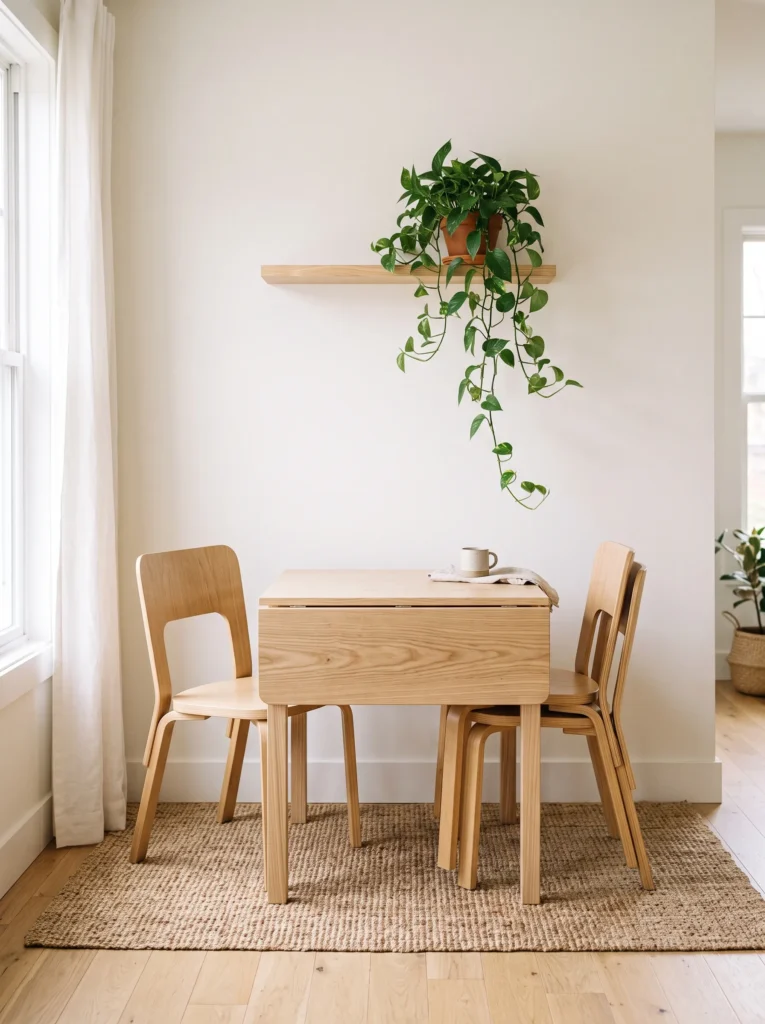
- Drop-leaf table in light ash, foldable from two-seat to six-seat
- Set of stackable oak chairs stored against the wall when not in use
- Warm white painted walls with a matte finish
- Compact rattan pendant light sized for a smaller footprint
- Small jute rug placed only under the table’s expanded footprint
- Simple white stoneware, stacked to save cabinet space
- Single trailing pothos on a wall-mounted floating shelf instead of the floor
- Slim wall-mounted plate rack replacing a full sideboard
Why this works: A drop-leaf table solves the real challenge small dining rooms face — needing full seating occasionally without permanent floor-space commitment.
Small dining rooms have a genuine spatial challenge that most Japandi content skips entirely: needing to seat six people occasionally while living day-to-day with only two. A drop-leaf table solves this directly, expanding from an everyday two-seat footprint to a full dinner-party size without needing a second table stored elsewhere. Stackable chairs solve the same problem for seating, tucking against a wall when they’re not needed. Light ash keeps the folded table from feeling like a bulky piece of furniture even in its smallest form, and a wall-mounted plate rack frees up floor space a standing sideboard would otherwise take.
I get more questions about small dining spaces than almost any other topic, and the drop-leaf table is consistently the solution people are surprised by, since most assume “small space” means giving up flexibility altogether. A well-built drop-leaf hinge should hold the leaf firmly at both a fully extended and fully folded position without sagging over time — that’s worth checking before buying, since a cheap hinge is usually the first thing to fail. It’s a practical detail that makes the difference between a table that lasts and one that doesn’t.
10. Matte Black Steel Frame: An Industrial Edge on a Warm Palette
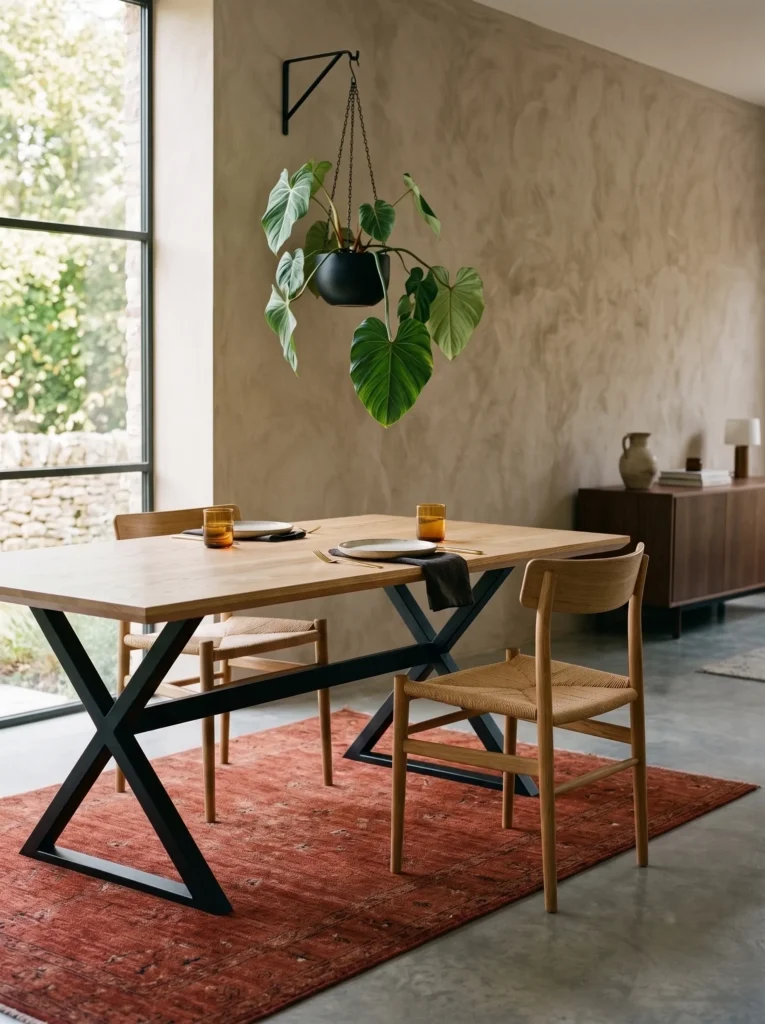
- Dining table with a solid ash top and matte black powder-coated steel base
- Rush-seat oak chairs with slightly curved backs
- Warm taupe plaster wall with a subtle hand-troweled texture
- Slim black linear pendant suspended low over the table
- Wide-plank rug in a muted clay-red tone, natural wool
- Hand-glazed stoneware in a warm sand and rust palette
- Trailing philodendron in a black ceramic hanging planter near the window
- Black steel-framed mirror leaning against the far wall
Why this works: A steel base introduces an industrial-modern edge that keeps a Japandi room from tipping into purely rustic territory.
Steel isn’t a material people usually associate with Japandi, but a matte black steel base under an ash tabletop is exactly the kind of unexpected pairing that keeps a room from feeling like a template. The steel base reads lighter than a solid wood one, visually, which works especially well in dining rooms that also serve as a walkway between other spaces. Rush-seat chairs soften the steel’s hard lines, and the clay-red wool rug pulls warmth back into a room that could otherwise lean cold. It’s a combination that feels considered rather than trend-driven.
I’ve noticed that clients who are hesitant about “too minimal” often respond best to this pairing, since the steel base gives the room a slightly more structured, grounded feel than an all-wood table would. It photographs beautifully, but it also holds up: a steel base won’t warp, crack, or need refinishing the way a wood base eventually might. For a dining room that gets heavy daily use — kids doing homework, dinner every night — that kind of low-maintenance durability is worth as much as the look itself.
11. Herringbone Parquet Floor: Pattern at Floor Level
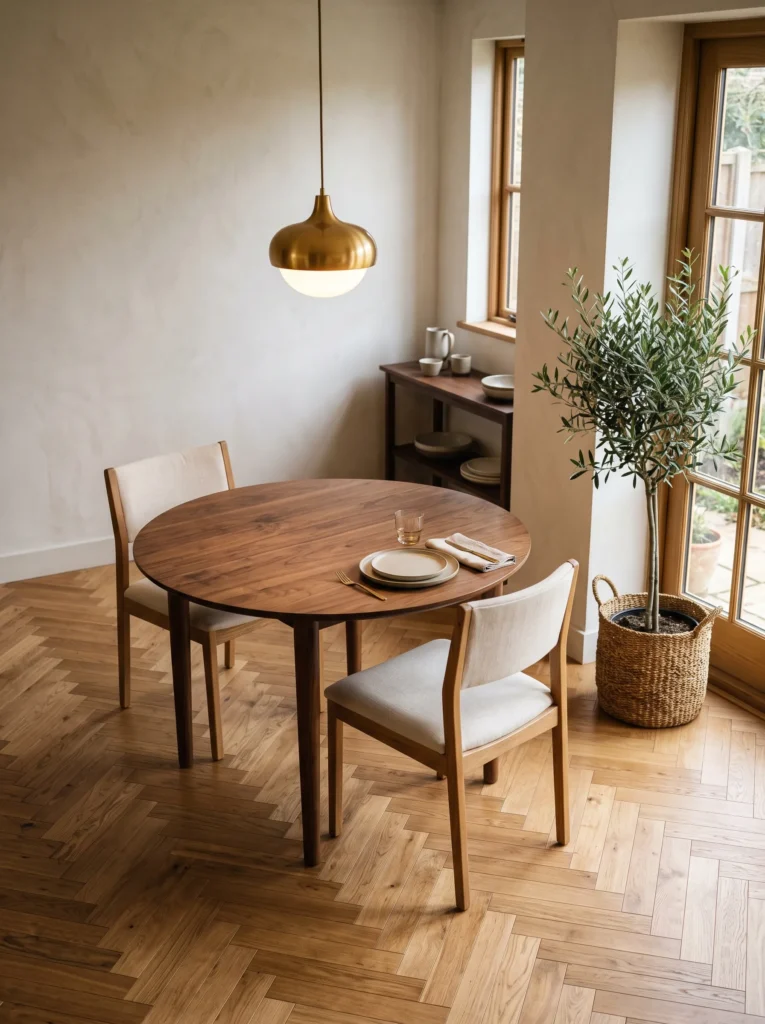
- Herringbone parquet flooring in natural oak as the room’s foundation
- Round walnut table with turned, tapered legs
- Set of six cream linen-upholstered chairs with slim wood frames
- Soft plaster ceiling medallion left unpainted, echoing the natural material palette
- Warm brass and paper pendant with a soft diffused glow
- No rug, letting the parquet pattern stay fully visible
- Ivory stoneware with a hand-painted charcoal rim
- Small potted olive tree in a woven seagrass basket in the corner
Why this works: Herringbone flooring adds pattern and craftsmanship at floor level, so the room doesn’t need a rug or bold wall treatment to feel finished.
A herringbone parquet floor gives a Japandi dining room its pattern and craftsmanship without needing a single patterned textile. That matters because Japandi’s restraint usually means skipping busy rugs or wallpaper, and a room without any pattern at all can start to feel flat. The angled, interlocking planks add visual movement at floor level, so the walnut table and linen chairs above it can stay completely quiet in color and shape. Leaving the floor bare, without a rug, lets that pattern read clearly instead of getting muffled underfoot.
I’ve walked through a lot of client homes where a beautiful herringbone floor gets hidden under a rug out of habit, and it’s genuinely one of my most common pieces of advice: let good flooring be seen. My husband’s crew has installed herringbone parquet a handful of times, and he always flags that it takes noticeably more labor than standard plank flooring because of the precise angle cuts at each row — which is part of why it reads as a higher-end detail the moment you walk into the room.
12. Sculptural Ceramic Centerpiece: Subtraction as the Design Move
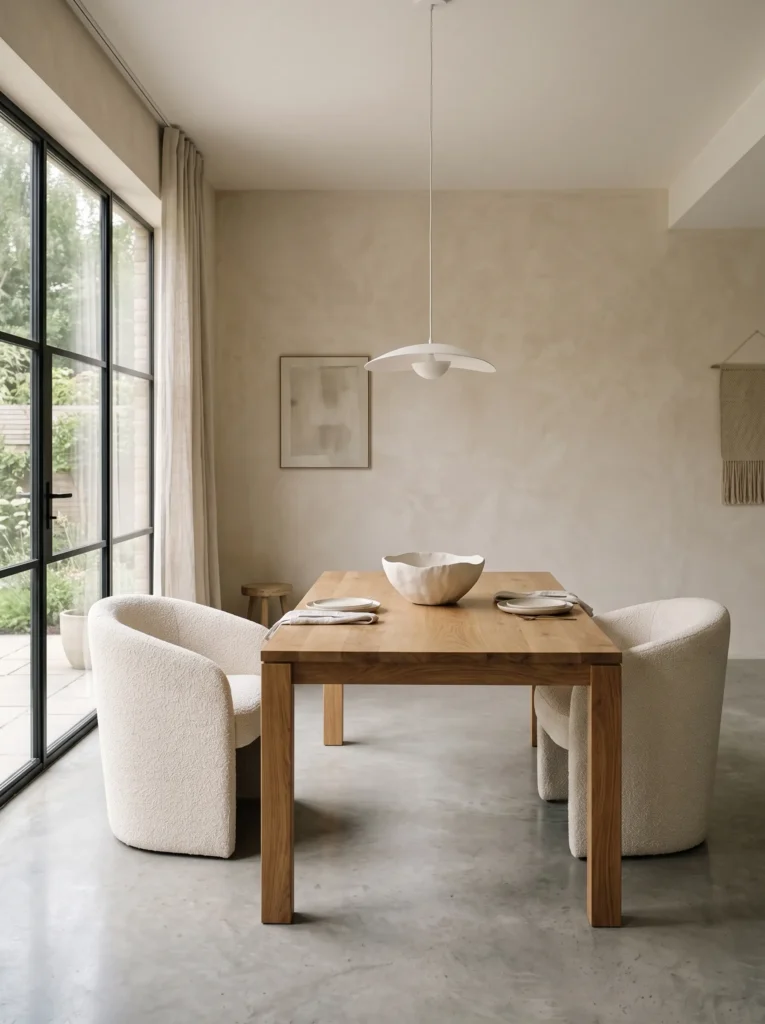
- Long white oak table with a clean, unadorned rectangular silhouette
- Curved boucle-upholstered dining chairs in warm greige
- Smooth lime-plaster wall in a pale clay tone
- Sculptural ceramic centerpiece bowl as the table’s sole decorative object
- Woven rattan pendant with an oversized, rounded silhouette
- No rug, polished concrete flooring left bare
- Matte stoneware in a soft blush-sand glaze
- Small potted rosemary in a raw clay pot, doubling as a usable herb
Why this works: When a room strips back nearly everything else, one sculptural object gets to carry the entire visual weight of the space.
Sometimes the most powerful design move is subtraction rather than addition, and this room proves it. With bare concrete floors, a plain oak table, and unadorned plaster walls, there’s almost nothing left to distract from a single sculptural ceramic centerpiece sitting at the table’s center. That kind of restraint is genuinely hard to pull off — most people feel the instinct to fill empty space — but it’s exactly what wabi-sabi asks for: appreciating the object in front of you instead of surrounding it with competition. The boucle chairs add just enough texture to keep the room from feeling cold.
I once removed nearly every decorative object from a client’s dining room during a styling session, down to a single handmade bowl, and her first reaction was hesitation — it felt too bare. A week later she called to say the room felt calmer than it ever had, and that the bowl had somehow become the thing guests actually talked about. That’s the real test of restraint done well: it doesn’t feel like less, it feels like more attention paid to what’s actually there.
13. Layered Neutrals & Boucle: Depth Without Adding Color
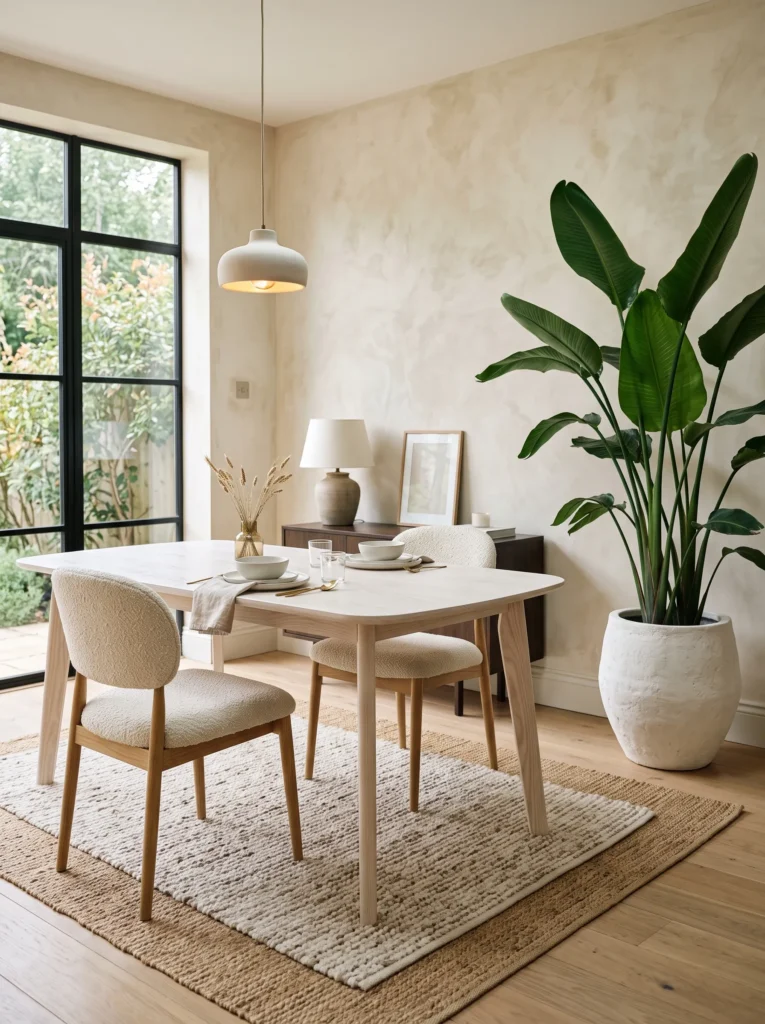
- Rectangular white ash table with rounded corner edges
- Mixed seating: four boucle-upholstered chairs in oatmeal, two slatted oak chairs at the ends
- Warm white walls with a soft venetian plaster finish
- Woven jute pendant paired with a low brass table lamp on the sideboard
- Layered rugs: a jute base layer with a smaller wool runner on top
- Cream stoneware with a subtle ribbed texture
- Large potted bird of paradise in a plaster-finished planter
- Low oak sideboard with brass cup pulls
Why this works: Layering two rug textures adds visual depth to a neutral room without introducing a single new color.
Layering a wool runner over a jute base rug is a trick that adds real depth to an all-neutral room without breaking the Japandi palette. The two natural fibers catch light differently, so even in a room built almost entirely from cream and white tones, there’s texture doing the work that color usually would. Mixing boucle chairs with slatted oak ones at the table’s ends keeps the seating from feeling like a matched set bought all at once, which reads as more collected and personal. The rounded table corners echo the room’s soft, layered feel rather than introducing hard geometric lines.
I’ve found that clients drawn to all-neutral rooms often worry the space will feel flat once it’s built, and layering textures is consistently the fix that puts their mind at ease. A jute-and-wool rug pairing also happens to be practical for a dining room, since the tougher jute layer underneath holds up to chair legs and dropped crumbs better than wool alone would on its own directly against daily foot traffic.
14. Indoor-Outdoor Engawa Style: Blurring the Threshold
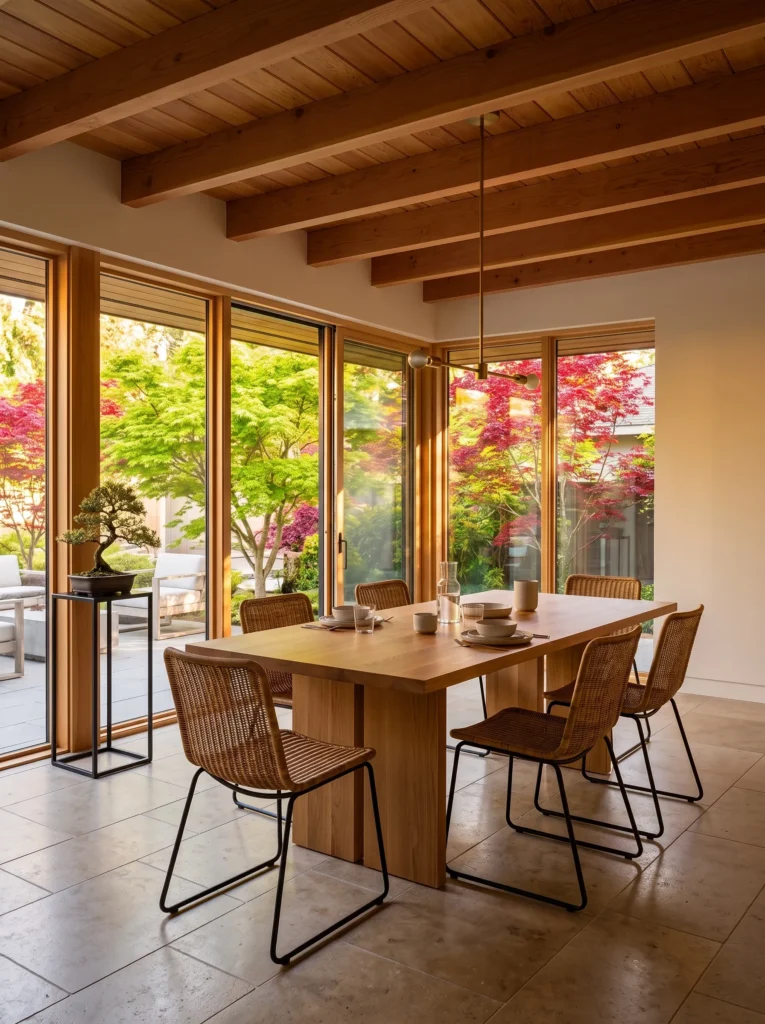
- Low oak table extending near full-height sliding glass doors
- Woven rattan chairs with slim black metal frames
- Exposed cedar ceiling beams left in their natural finish
- Simple paper-shade floor lanterns flanking the doors for evening light
- No rug, natural stone tile flooring extending toward the outdoor threshold
- Earthenware dinnerware in a raw terracotta finish
- A row of potted Japanese maples visible just beyond the glass doors
- Slim black steel plant stand holding a single bonsai just inside
Why this works: Borrowing the engawa concept — a transitional indoor-outdoor threshold — blurs the line between the dining room and the yard beyond it.
The engawa, a traditional Japanese architectural feature, is a transitional strip of space bridging a home’s interior and its garden, and borrowing that concept for a modern dining room creates a genuine connection to the outdoors. Positioning the table close to full-height glass doors, with natural stone tile flooring running seamlessly toward the threshold, blurs the boundary between inside and outside more than a rug or curtain ever could. Rattan chairs with black metal frames feel appropriate in both settings, so the transition doesn’t feel forced. Exposed cedar beams overhead tie the room to natural materials found just beyond the glass.
Austin’s climate makes this layout genuinely functional for a good part of the year, not just a photogenic idea — being able to slide the doors open during a mild evening and let the dining space essentially extend outward is one of my favorite features in homes with a covered patio just beyond. My husband has framed a few of these transitions and always emphasizes proper door track drainage, since standing water at a sliding door threshold is one of the most common water-intrusion issues he sees on service calls.
15. Warm Terracotta Accent Wall: Color Without Breaking Restraint
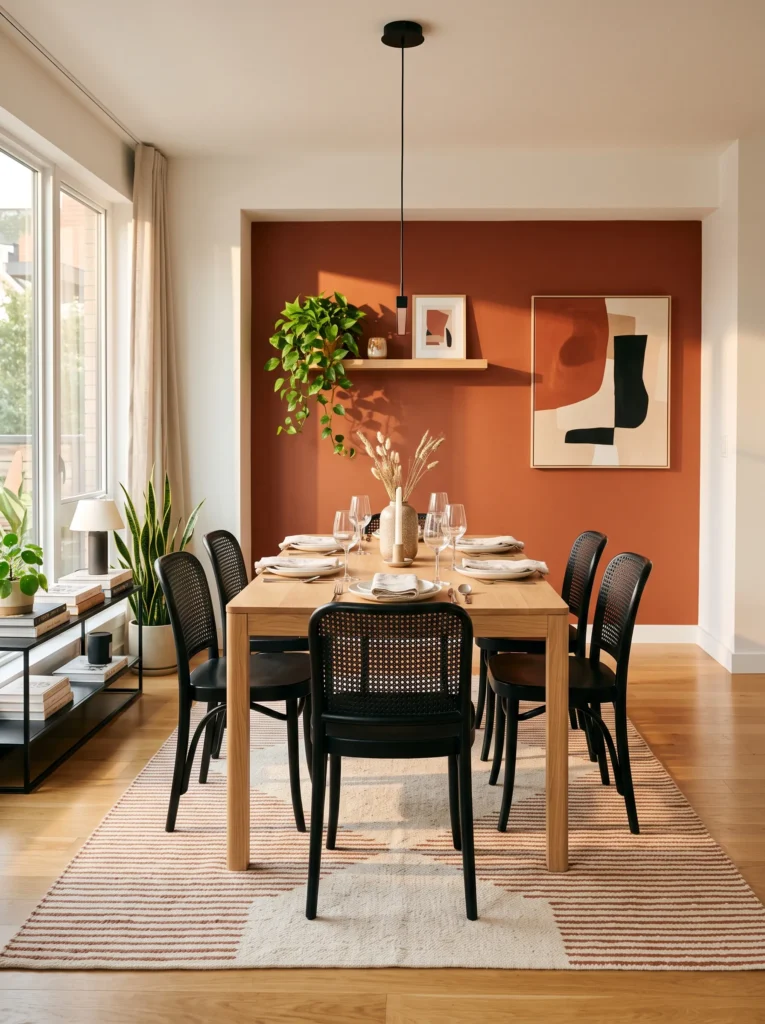
- Rectangular light oak table with straight, simple legs
- Black rattan-back chairs with a slim wood frame
- Accent wall painted in a warm burnt-terracotta tone, remaining walls in soft white
- Woven raffia pendant with a wide, shallow silhouette
- Flatwoven wool rug in undyed cream with a subtle terracotta stripe
- Stoneware in a matching burnt-terracotta glaze, mixed with plain white pieces
- Trailing pothos on a floating shelf mounted on the terracotta wall
- Slim black wall sconces flanking the terracotta wall for evening warmth
Why this works: A single warm-toned accent wall introduces color without breaking Japandi’s material-first, restrained palette.
Most Japandi rooms lean entirely on natural material tones, but a single burnt-terracotta accent wall proves color and restraint aren’t mutually exclusive. Keeping the color to one wall, with the rest of the room in soft white and light oak, means the terracotta reads as a considered accent rather than a dominant scheme. Black rattan chairs pick up just enough darkness to balance the warm wall without competing with it, and the terracotta-glazed stoneware ties the tabletop styling back to the wall behind it. It’s a subtle way to bring genuine warmth into a room that could otherwise feel entirely neutral.
I added a terracotta wall to my own breakfast nook almost as an experiment, half-expecting to repaint it within a year, and it’s become one of the few color choices in my home I’ve never second-guessed. A single warm accent wall paired with mostly neutral materials is one of the easiest ways to add color to a Japandi space without disrupting its calm, restrained feel. It’s proof that Japandi doesn’t require an entirely white-and-beige room to still feel authentic to the style.
Styling Principles: Balancing Light and Dark Wood in a Japandi Dining Room
Getting the wood pairing right is the single biggest factor separating a room that feels like true Japandi from one that just feels bare. The most reliable ratio is roughly 60% light wood to 40% dark wood, letting one tone lead while the other grounds the space. A few guiding rules:
- Let the table set the dominant tone, and use chairs, a rug, or an accent wall to introduce the contrasting shade — don’t split the table itself into two tones.
- Pair warm light woods (ash, oak) with warm dark woods (walnut, black-stained oak) rather than mixing warm and cool undertones, which can make a room feel unresolved.
- If you’re unsure which wood to commit to, start with the floor. Whatever tone dominates the flooring should generally match your table, with the contrasting tone reserved for chairs or accents.
- Metal and black-stained wood can function as your “dark” element if you’d rather not commit to two different wood species in one room.
- Fewer, better pieces always outperform more furniture at a lower quality — this is true of Japandi generally, but especially true of a dining table, which gets more daily use than almost any other piece in the home.
Frequently Asked Questions
What is Japandi style? Japandi is a design style that blends Japanese wabi-sabi, the appreciation of natural imperfection and restraint, with Scandinavian hygge, the pursuit of everyday coziness and comfort.
What wood pairings work best for a Japandi dining room? Pair one light wood, such as ash or oak, with one darker wood or finish, such as walnut or black-stained oak, in roughly a 60/40 ratio so the room feels balanced rather than stark or heavy.
How do you style a small Japandi dining room? Choose a drop-leaf or round table to maximize flexible seating, use stackable chairs to free up floor space when not needed, and skip a floor rug if the room feels tight, letting the flooring itself stay visible.
Is Japandi style budget-friendly? Japandi can be achieved on a range of budgets since it relies on fewer, well-chosen pieces rather than expensive statement furniture; a single ceramic centerpiece or a linen table runner can shift a room’s feel without a full furniture overhaul.
What are the best plants for a Japandi dining room? Olive trees, fiddle-leaf figs, snake plants, and trailing pothos all work well in Japandi spaces because their simple, sculptural shapes echo the style’s restrained aesthetic without adding visual clutter.
Do Japandi dining rooms need a rug? No — a rug is optional in Japandi design, and many rooms with beautiful natural flooring, like herringbone parquet or stone tile, are intentionally left bare to let that material be the room’s texture.
Conclusion
A great dining room isn’t about filling every surface — it’s about choosing pieces that earn their place at the table. These Japandi dining room ideas prove that a calmer, more intentional space doesn’t mean sacrificing warmth or personality; it just means being selective about what stays. I’ve seen how a single change, like swapping in a bench or letting a beautiful floor go bare, can shift the entire feel of a room without a full renovation.
Save this post to Pinterest, pick one idea to try first, and pass it along to anyone else ready to slow their dining room down.