15 Wildflower Tablescape Ideas for an Effortless, Romantic Table
Picture a long table, a crisp linen runner, and a loose handful of flowers that looks like it grew right there. These wildflower tablescape ideas show you how to get that look at home, with no florist and no mess. I’m Emily, and after years of cutting stems in my Austin backyard, I’ve noticed one pattern: the loosest arrangements follow the most careful plan. Inside are 15 modern, full-table scenes with exact flowers, vessels, runner sizes, and candlelight, plus the asymmetric triangle technique and the seasonal timing that make every stem look intentional. I’ve tested these tables with zinnias, coneflowers, and grasses, and a few lessons from my husband’s construction work made them sturdier, too. Save your favorite and try it this weekend.
A wildflower arrangement looks effortless for one reason: it isn’t random. Florists build these loose bouquets on an asymmetric triangle, varying stem heights on purpose and clustering flowers in odd numbers, which is the technical difference between artfully undone and simply thrown together. Three cosmos read as a deliberate group; four read as a scattered handful. The first time I tried a jar of Queen Anne’s lace at our Austin dining table, I stuck every stem at the same height and it looked like a cafeteria salad bar. A wildflower arrangement looks gathered, not messy, when stems vary in height, flowers cluster in odd numbers, and one shape leads the eye. This post shows fifteen tables that do exactly that.
1. Cosmos in Speckled Stoneware — A Wildflower Tablescape Idea for Spring
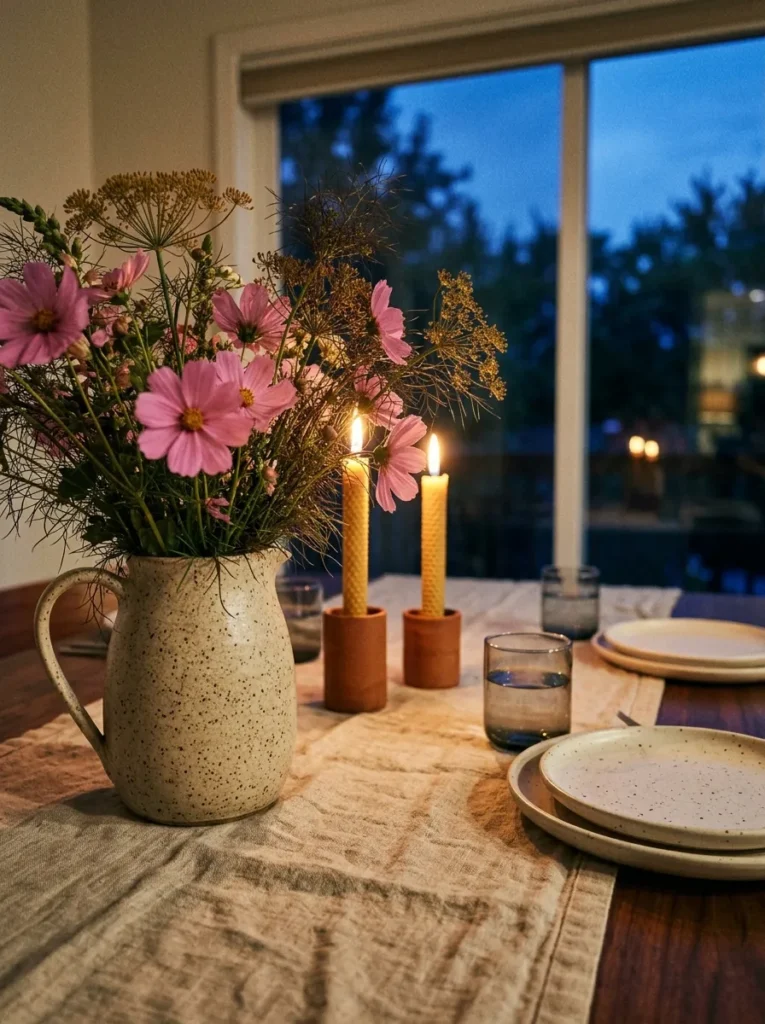
- Vessel: Oatmeal-glazed, iron-speckled stoneware pitcher, 8 inches tall, with a pinched spout and a thick curved handle
- Flowers: Seven pink and white cosmos (Cosmos bipinnatus) plus three stems of bronze fennel
- Palette: Blush, oatmeal, bronze green, flax beige
- Runner: Oatmeal stonewashed linen, 14 inches wide, double-stitched hem, 10-inch overhang
- Place setting: Speckled cream stoneware plates, smoke-gray tumblers, hammered stainless flatware, blush linen napkins
- Light: Cream beeswax tapers in raw terracotta cylinder holders at 8 and 11 inches
- Standout detail: One skeletal fennel umbel arcs past the cosmos and breaks the silhouette
- Season: Cosmos bloom from late spring until first frost, which runs through November in Texas
Why this works: An odd number of cosmos stems cut to three different heights creates the asymmetric triangle that makes a loose arrangement look planned.
Cosmos do the hard work of a wildflower arrangement for you, because their thread-thin stems naturally bend at different angles. Cut seven stems in three lengths, then group them as three, three, and one, so the tallest cluster leans left and the lone stem tucks low on the right. That lopsided shape is the asymmetric triangle in action. Bronze fennel adds a feathery second texture, and its licorice scent is mild enough not to compete with dinner. Because the pitcher’s broad opening lets stems fan, you skip the floral foam entirely.
Lay an oatmeal stonewashed linen runner, 14 inches wide with a double-stitched hem, and let it hang 10 inches past each end. Set the pitcher about a third of the way down, leaving the far end open for serving dishes. Speckled cream plates, smoke-gray tumblers, and blush napkins keep the palette tonal, so the cosmos stay the brightest thing in the room. At dusk, cream beeswax tapers in raw terracotta cylinders add amber glow. Keep flames a foot from the fennel, which dries quickly. Cosmos bloom until first frost, so this table works in Texas through November.
2. Salt-Glazed Crock Bouquet
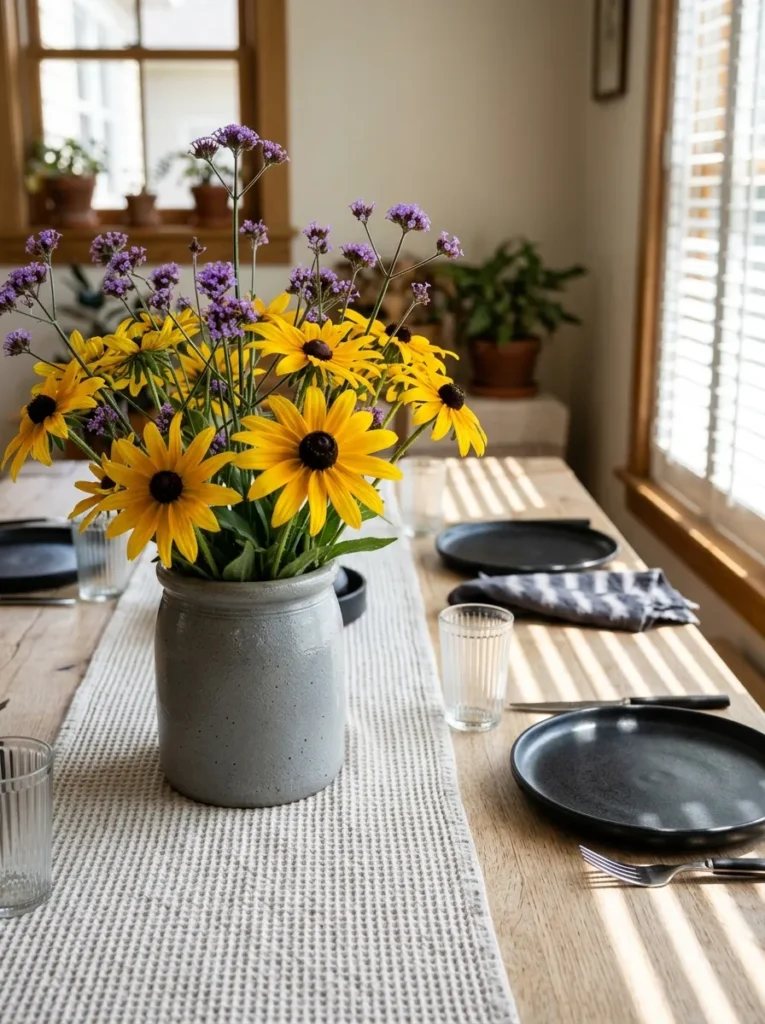
- Vessel: Gray salt-glazed stoneware crock, about 9 inches tall, roughly 6 pounds empty
- Flowers: Five black-eyed Susans (Rudbeckia hirta) and three stems of purple top verbena (Verbena bonariensis); verbena rises 18 inches above the rim, rudbeckia sits at 6 to 10
- Palette: Mustard yellow, charcoal gray, deep violet, bone white
- Runner: Bone waffle-weave linen, 14 inches wide, charcoal-bound edges, 10-inch overhang
- Place setting: Black-glazed plates, ribbed clear tumblers, matte black flatware, charcoal napkins
- Light: Matte black tapers in a shallow iron dish, at least a foot from the stems
- Standout detail: One rudbeckia is cut short and tucked against the rim so its dark cone echoes the black plates
- Season: Black-eyed Susans bloom June through September; purple top verbena runs spring through frost
Why this works: A heavy, low-slung crock keeps tall wildflower stems stable and puts the visual weight at the base, so loose stems look grounded instead of top-heavy.
I bought this crock for four dollars at an estate sale in Bastrop, and it taught me more about arranging than any book. Filled with five black-eyed Susans and three verbena stems, it looks planted rather than placed. Rudbeckia hirta is a native Texas plant, so its stems are stiff and hairy, which means they hold their angle without wire. Cut the verbena nearly twice as tall as the flowers and let it lean off-center. The yellow and violet sit across from each other on the color wheel, so the contrast pops even in a photo.
My husband builds homes for a living, and the first thing he did was lift the crock and nod. A low, wide base weighing about six pounds stays put when a guest bumps the table, which a tall glass vase often can’t. Lay a bone waffle-weave runner, 14 inches wide with charcoal-bound edges, across pale oak, with a 10-inch overhang. Charcoal napkins, ribbed clear tumblers, and black-glazed plates echo the dark flower cones. Matte black tapers sit in a shallow iron dish at least a foot from the stems, since open flame and loose petals make a risky pair.
3. Queen Anne’s Lace Bottles
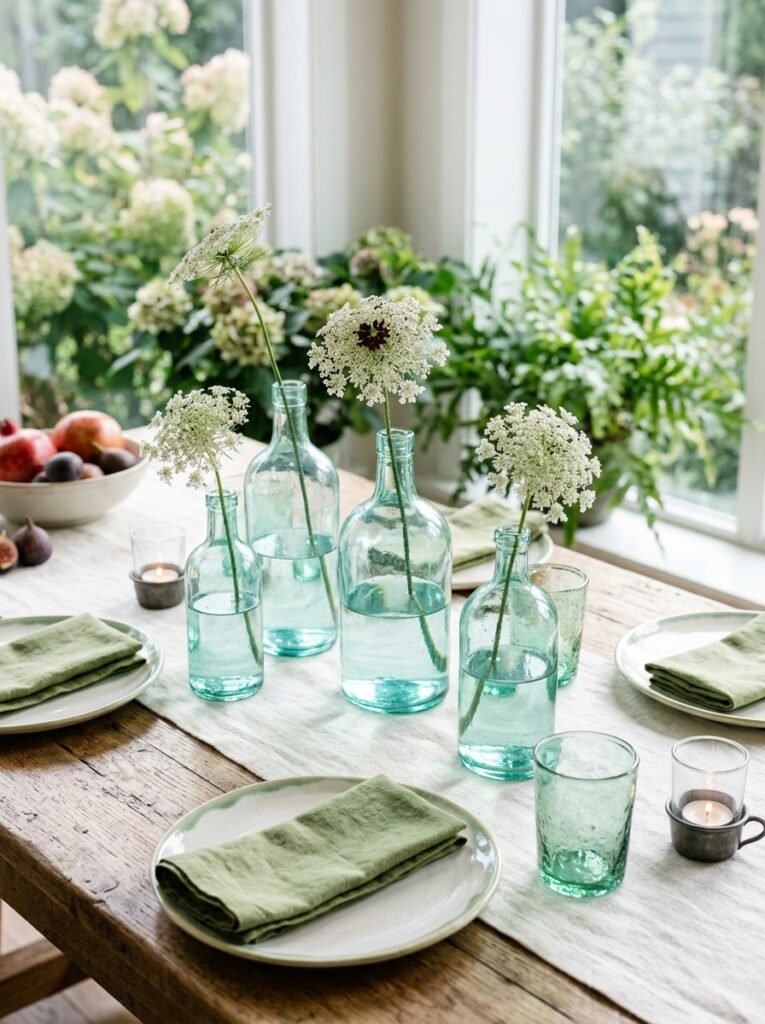
- Vessel: Five hand-blown sea-green glass bottles with organic curves, 5 to 12 inches tall, grouped as one set
- Flowers: Queen Anne’s lace (Daucus carota), one stem per bottle, plus two stems of northern sea oats
- Palette: Sea green, ivory, pewter, white
- Runner: Ivory linen, 12 inches wide, hand-rolled hem, 10-inch overhang
- Place setting: White plates with a pale celadon rim, green-tinted tumblers, pewter-finish flatware, white linen napkins
- Light: Clear glass votives in pewter cups, a foot from the lace
- Standout detail: Pick umbels that carry the single dark burgundy floret at the center
- Season: Late spring through summer in most of the U.S., peaking around June
Why this works: Odd-numbered groupings of bottles at different heights give a wildflower table built-in rhythm, so each stem can stay simple.
Queen Anne’s lace has a tiny secret: many umbels carry one dark burgundy floret at the center, and it’s the detail guests lean in to notice. Each flat head is an umbel, a cluster of dozens of tiny flowers on spokes, which is why one stem fills space so well. Five bottles, five stems, each cut to a different height. I like to set the tallest at the back left and drop the shortest forward right. The sea-green glass lets stems show through, so trim leaves below the water line to keep the water clear for days.
Here’s the plant-science note I wish more blogs included: wild carrot’s sap can irritate skin in sunlight, so wear gloves when cutting, and never forage unless you’re certain, because poison hemlock looks similar. A florist-grown or farmers-market stem is the safer route. Lay an ivory linen runner, 12 inches wide with a hand-rolled hem and a 10-inch overhang, and group the bottles off-center. White plates with a pale celadon rim and green-tinted tumblers repeat the glass. Clear votives in pewter cups sit a foot from the lace. Queen Anne’s lace blooms late spring through summer, peaking around June.
4. Tonal Blue Larkspur
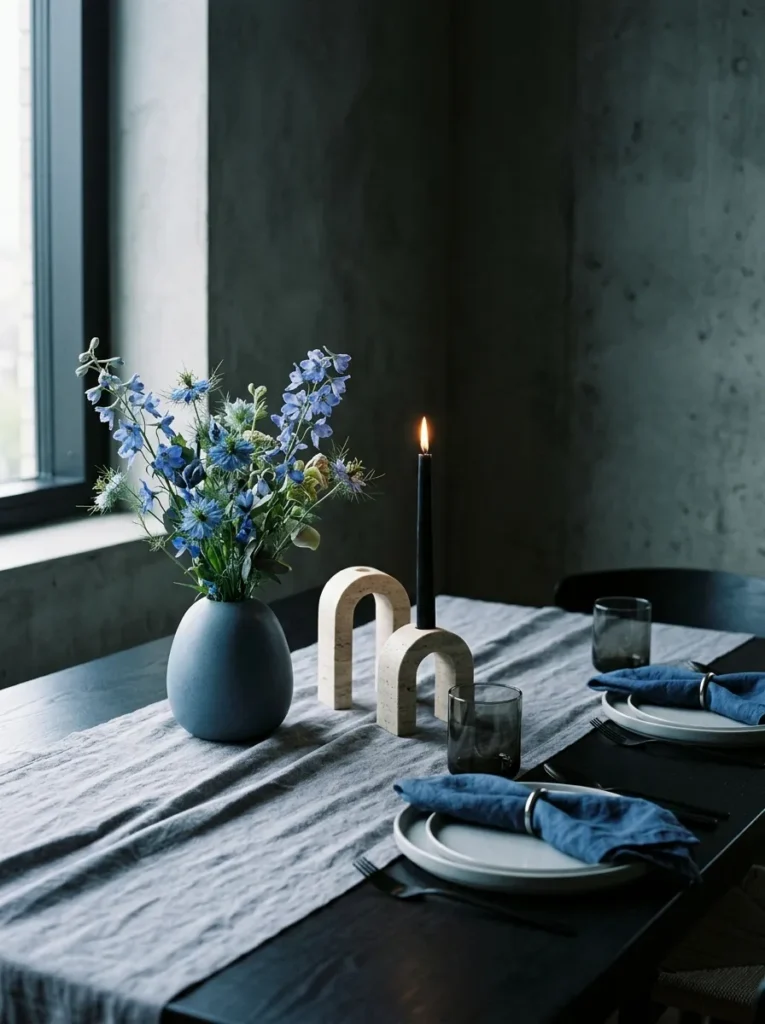
- Vessel: Matte slate-blue ceramic pebble vase, 9 inches tall, with an off-center curved neck
- Flowers: Seven larkspur (Consolida ajacis) in three blues, plus five pale blue nigella (Nigella damascena) with seed pods
- Palette: Slate blue, dove gray, indigo, bone white
- Runner: Dove-gray Belgian linen, 13 inches wide, flat hem, 10-inch overhang
- Place setting: Matte pale-gray porcelain plates, smoked-glass tumblers, satin nickel flatware, indigo linen napkins
- Light: Slim black tapers in arched travertine candle holders, staggered at 8 and 12 inches
- Standout detail: The pale, pitted travertine arches add one stone-textured curve that echoes the vase’s neck
- Season: Larkspur peaks March through May in Central Texas and fades in summer heat
Why this works: A tonal palette of one color in several depths looks expensive because nothing competes with the flowers.
Quiet luxury in a tablescape comes down to restraint: one color family in several depths, and nothing shiny competing with the flowers. Here that family is blue. Larkspur spikes in pale, mid, and deep blue stand in an off-center, pebble-shaped vase, with nigella filling the middle ground. Larkspur is a cool-season annual, so it blooms best in spring and fades fast once Texas heat arrives. It’s also toxic if eaten, so keep it away from plates and pets. Cut seven stems at three heights, tallest on the left, and let the curved neck of the vase set the lean.
Build the table in the same hushed range. A dove-gray linen runner, 13 inches wide with a flat hem, runs down the center and hangs 10 inches past each end. Matte pale-gray plates, smoked-glass tumblers, and indigo napkins keep every layer within the blue-gray family. Then add one surprise: arched travertine candle holders with slim black tapers at 8 and 12 inches. Their pale, pitted stone adds texture and a clean curve that echoes the vase. Satin nickel flatware keeps the metal quiet. The whole table reads like a design magazine spread, yet it takes twenty minutes to set.
5. Zinnia on White Oak
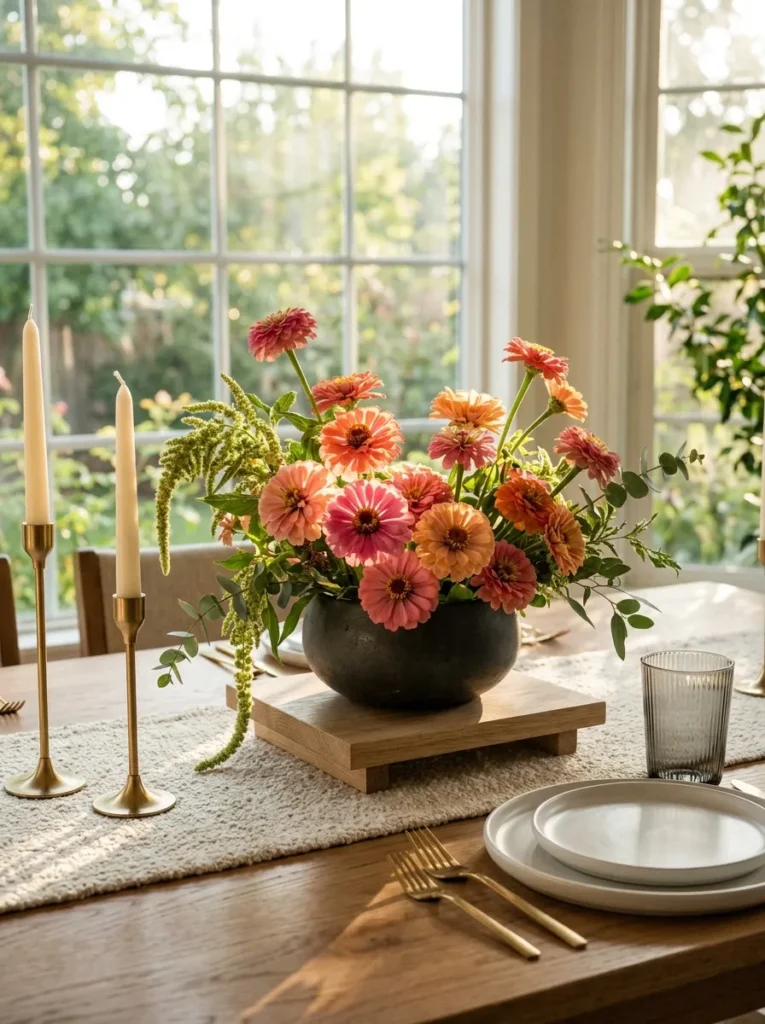
- Vessel: Low charcoal ceramic bowl with a pinched rim, 10 inches wide, on a 3-inch round white oak plinth
- Flowers: Eleven zinnias (Zinnia elegans) in blush, coral, and apricot, plus five stems of green amaranth
- Palette: Blush, coral, charcoal, warm white oak
- Runner: Warm ivory bouclé-textured cotton, 14 inches wide, bound edges, 8-inch overhang
- Place setting: Matte white organic-rim plates, smoke-gray stemless glasses, blackened-steel flatware, charcoal napkins
- Light: Three sculptural brass candlesticks with ivory tapers at three heights
- Standout detail: The oak plinth lifts the bowl and puts bare wood grain at the center of the table
- Season: Zinnias bloom from midsummer until first frost and thrive in Texas heat
Why this works: A low bowl on a solid plinth keeps heavy blooms below eye level while the raised base gives the arrangement a sculptural presence.
I once styled a table with a tall vase of zinnias, and halfway through dinner my friend leaned sideways to see her husband. Never again. Now I use a low charcoal bowl on a round oak plinth, with eleven zinnias in blush, coral, and apricot, with the tallest stems leaning left to form an asymmetric triangle. Zinnias hold up in Texas heat, and their sturdy stems stay straight without wire. The tonal blush range feels modern because the color shifts gently rather than clashing. Green amaranth tassels drift over one side to break the triangle’s edge and add movement.
My husband often builds with white oak, and he explained why it works here: its pores are naturally plugged, which is why it’s used for barrels and boats, so a damp bowl won’t stain it. Still, he rubs on a coat of hardwax oil first. Then I layer the full table: a warm ivory bouclé runner, 14 inches wide with bound edges, white organic-rim plates, smoke-gray stemless glasses, and blackened-steel flatware. Brass candlesticks with ivory tapers at three heights sit a foot from the amaranth. Mixed metals feel current when one is dark and one is warm.
6. Olive Serpentine Meadow
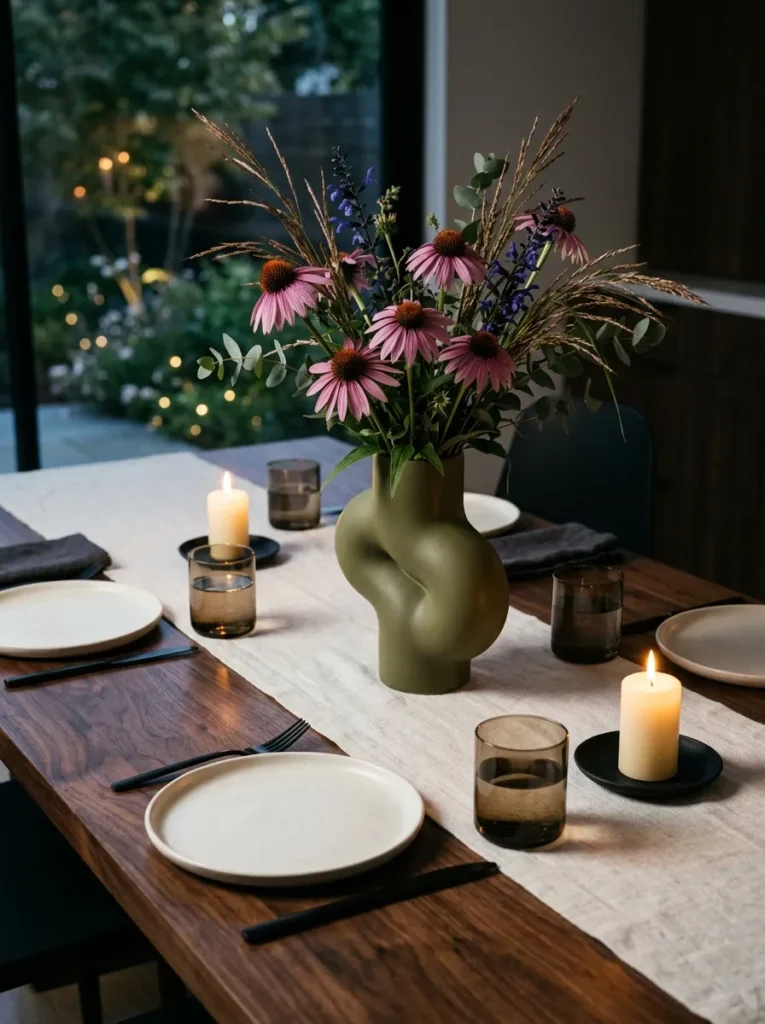
- Vessel: Serpentine matte olive ceramic tray-vase, 26 inches long, 3 inches deep, with two pin frogs to anchor stems
- Flowers: Five purple coneflowers (Echinacea purpurea), mealy blue sage (Salvia farinacea), and little bluestem plumes
- Palette: Dusty mauve, deep olive, bone, smoked bronze
- Runner: Bone-white heavy linen, 12 inches wide, clean flat hem, 12-inch overhang
- Place setting: Bone porcelain plates, smoked-bronze tumblers, blackened-steel flatware, olive linen napkins
- Light: Chunky bone-white pillars at 3, 5, and 7 inches on low black iron candle plates
- Standout detail: The S-curve guides the eye down the table, and bluestem plumes extend past the far end
- Season: Coneflowers bloom June through September; bluestem plumes turn bronze in fall
Why this works: A low, curved vessel keeps stems under 10 inches, leaving sightlines open while the S-curve gives the table a flowing center line.
Straight lines make a table look set; one curve makes it look designed. This serpentine olive vase, about 26 inches long, swings gently down the center of the runner. Two pin frogs hidden inside hold the stems exactly where you place them, which is how I get five coneflowers to cluster at one bend, with mealy blue sage filling the next curve and bluestem plumes extending past the end. Echinacea stems are stiff and native to prairies, so they behave. Keep every stem under 10 inches above the rim so guests can talk across the table.
Many wildflower tablescape ideas stop at the vase, but the modern look comes from the layers around it. Lay a bone-white linen runner, 12 inches wide with a clean flat hem and a 12-inch overhang, so the olive curve stands out. Bone porcelain plates, smoked-bronze tumblers, and blackened-steel flatware add depth without noise. Chunky bone pillars at 3, 5, and 7 inches sit on low black iron plates, each at least a foot from the plumes. Coneflowers bloom June through September, and bluestem turns bronze as fall arrives, echoing the tumblers.
7. Shirley Poppy Column
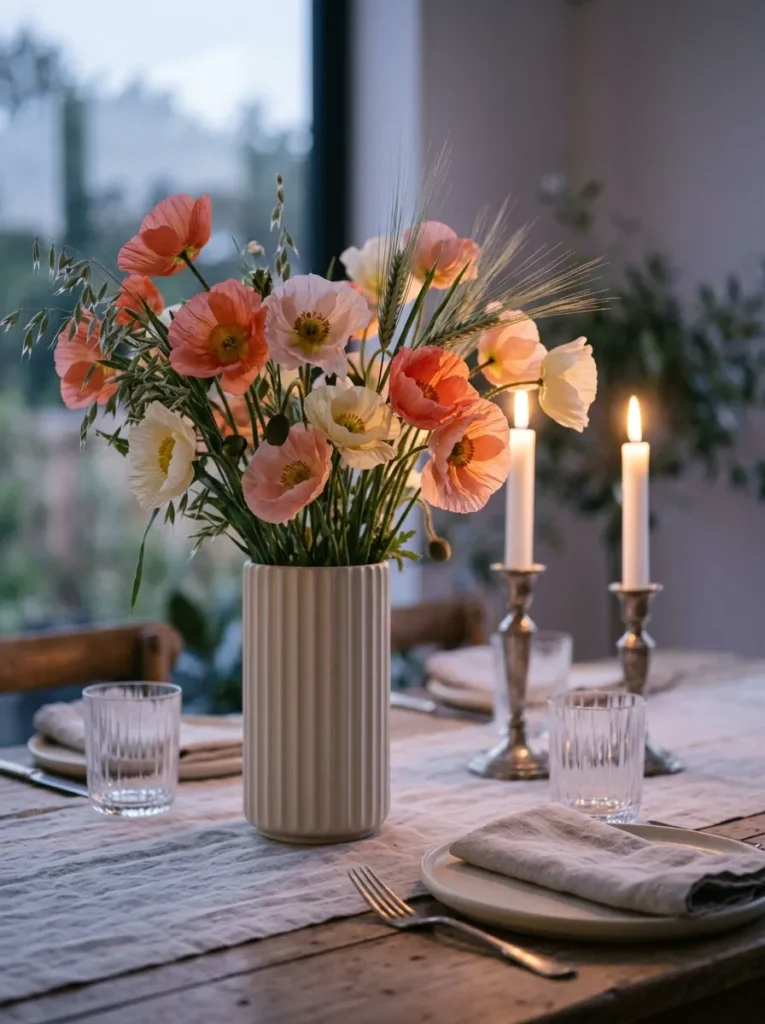
- Vessel: Tall fluted cream ceramic column vase, 12 inches high, with a narrow mouth
- Flowers: Nine Shirley poppies (Papaver rhoeas) in coral, blush, and white, plus five stems of foxtail barley
- Palette: Coral, blush, lilac-gray, cream
- Runner: Pale mushroom linen, 13 inches wide, squared hemmed ends, 9-inch overhang
- Place setting: Cream plates with a reactive-glaze rim, clear fluted tumblers, polished stainless flatware, lilac-gray napkins
- Light: Antiqued silver candlesticks with white tapers at 9 and 12 inches
- Standout detail: Poppy petals are crepe-paper thin, so candlelight makes them glow from behind
- Season: Poppies bloom March through May in Central Texas
Why this works: A tall, narrow column vase supports delicate poppy stems and frames their crepe-paper petals in negative space.
Poppies drop their petals within days, unless you condition them the way florists do. Sear each cut stem end in boiling water for 20 seconds, then move it into cool water; this seals the milky latex that otherwise clogs the stem. Nine Shirley poppies in coral, blush, and white look best in a narrow-mouthed column vase, which holds their thin stems upright without wire. Cluster them as five, three, and one, with the tallest group reaching toward one side. Foxtail barley adds a silver-green edge. Cut them in bud for the longest display.
Set the column on a pale mushroom linen runner, 13 inches wide with squared, hemmed ends and a 9-inch overhang. Cream plates with a reactive-glaze rim, clear fluted tumblers, polished stainless flatware, and lilac-gray napkins keep the palette airy. Place two antiqued silver candlesticks with white tapers at 9 and 12 inches nearby, so the flames glow through the poppies’ translucent petals at dusk. Keep a foot of space between wick and bloom, since poppy petals are paper-thin. Poppies bloom March through May in Central Texas, so plan this table for spring.
8. Concrete Trough Gaura
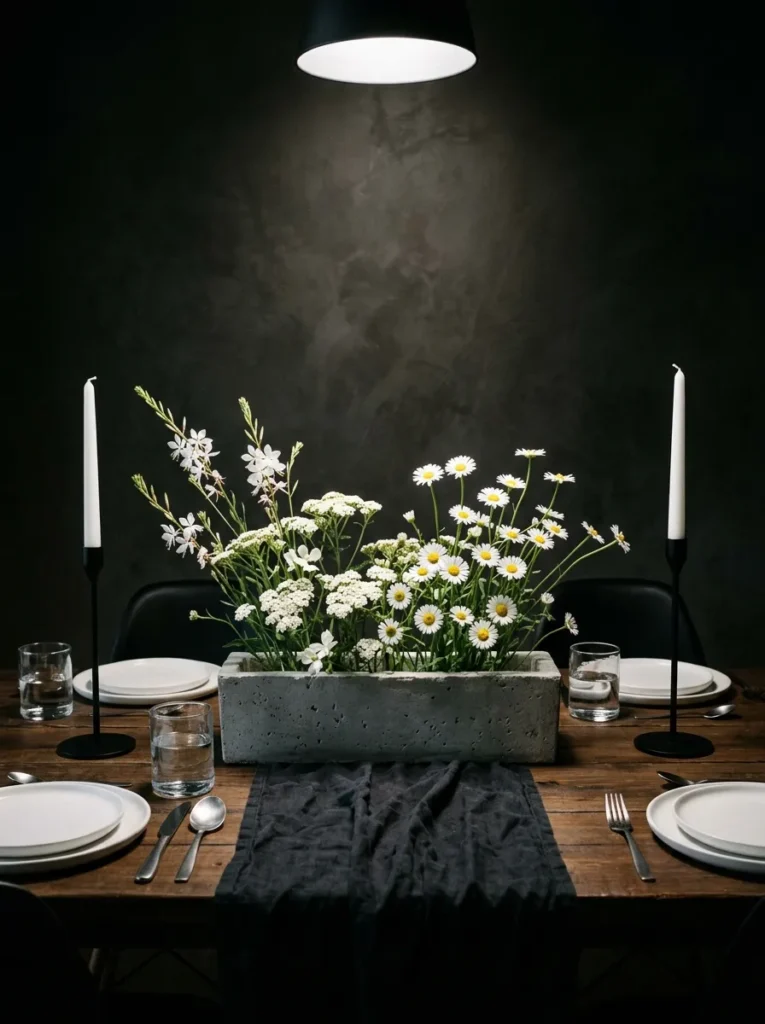
- Vessel: Hand-cast rectangular concrete trough, 20 inches long, 5 inches wide, 5 inches deep, with a glass tray liner
- Flowers: Seven white butterfly gaura (Gaura lindheimeri) wands, five white yarrow (Achillea millefolium) heads, and daisy fleabane (Erigeron philadelphicus)
- Palette: Concrete gray, white, blush, matte black
- Runner: Washed black linen, 14 inches wide, flat hem, 10-inch overhang
- Place setting: Matte white plates, clear tumblers, brushed stainless flatware, white linen napkins
- Light: Matte black candlesticks with white tapers at three heights
- Standout detail: White blooms glow against the black runner, while the mineral-gray concrete grounds the airy stems
- Season: Gaura blooms May until frost; yarrow June through August; fleabane in spring
Why this works: White blooms against a dark runner create high contrast that photographs well, while the concrete grounds the airy stems.
The concrete trough started as a leftover-form experiment in my husband’s shop, and it’s now my favorite vessel for airy flowers. White butterfly gaura, a Texas native, sends up wand-thin stems that sway at the lightest breeze, so cluster seven at one end and let them lean past the trough. Add five white yarrow heads in the middle for flat, solid contrast, and daisy fleabane at the low end. Against matte concrete, the whites look almost silver. Stagger heights so the tallest wand rises about 16 inches and the shortest barely clears the rim.
Here’s what my husband told me about concrete vessels: new concrete leaches lime, which raises the water’s pH and can shorten vase life, so a glass tray liner is essential, and a penetrating sealer helps. Concrete also needs about 28 days to cure fully before it touches anything wet. Lay a washed black linen runner, 14 inches wide with a flat hem, and let the white blooms glow against it. Matte white plates, clear tumblers, and brushed stainless flatware stay crisp. Matte black candlesticks with white tapers at three heights sit a foot away. Gaura blooms May until frost.
You’ll Also Love:15 Japandi Dining Room Ideas That Feel Intentional
9. Butter Coreopsis Bowl
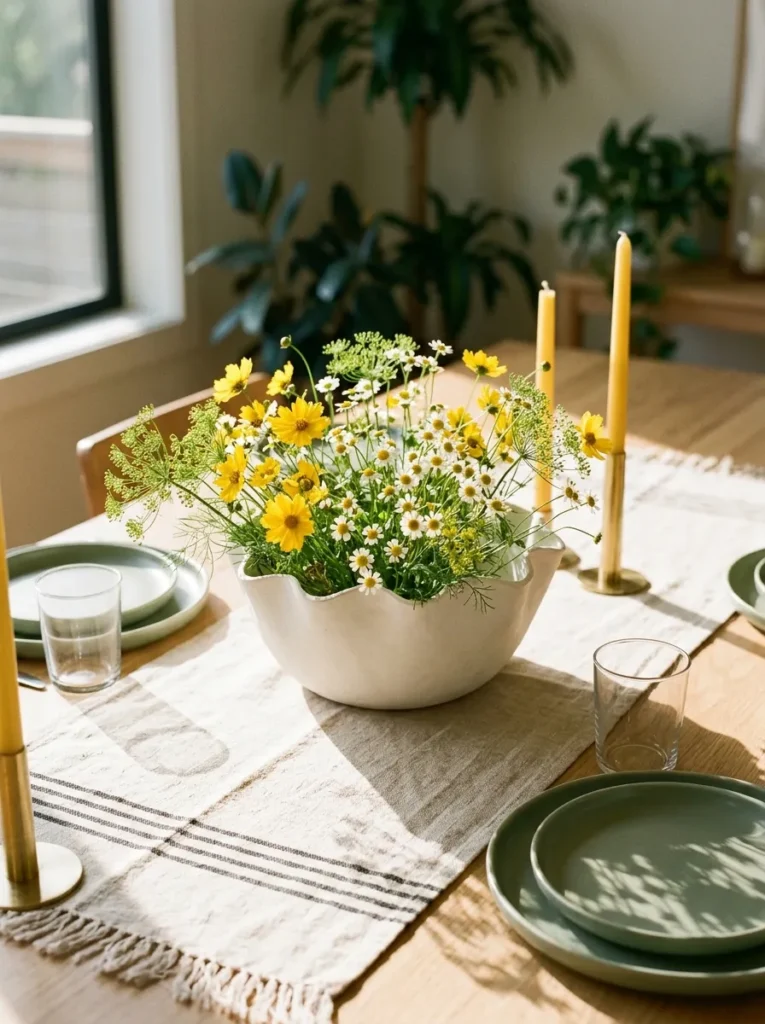
- Vessel: Wide raw white clay bowl with a wavy rim, 14 inches across and 4 inches deep, with crumpled chicken wire inside
- Flowers: Nine plains coreopsis (Coreopsis tinctoria) with maroon centers, seven oxeye daisies (Leucanthemum vulgare), and five dill flowers
- Palette: Butter yellow, white, sage green, maroon
- Runner: Natural flax linen, 13 inches wide, thin black stripe one inch from each end, 10-inch overhang
- Place setting: Sage-green stoneware plates, clear hand-blown tumblers, stainless flatware with black handles, white napkins with a pale yellow border
- Light: Butter-yellow tapers in clear glass candlesticks, staggered
- Standout detail: Thin black stripes at each end of the runner give the loose bowl a crisp, graphic frame
- Season: Coreopsis and oxeye daisies bloom May through July
Why this works: A wide, shallow bowl packs a lot of bloom into a low profile, so the table feels full without blocking conversation.
A guest once told me my table looked like a field photographed through a Polaroid, and that’s exactly the feeling I chase with butter yellow. Plains coreopsis, a Texas native, has maroon centers that give each yellow flower a graphic eye. I fill a wide white bowl over crumpled chicken wire, which anchors stems at any angle, and place nine coreopsis, seven oxeye daisies, and five dill flowers in clusters of odd numbers. Keep the highest stem about 12 inches above the rim, and let a few daisies lean over the bowl’s wavy edge.
This wildflower table decor works because the runner is neat while the flowers are loose. A natural flax runner, 13 inches wide, carries a thin black stripe one inch from each end and hangs 10 inches past each end. Sage-green stoneware plates, clear hand-blown tumblers, and stainless flatware with black handles repeat the stripes in small ways. Butter-yellow tapers in clear glass candlesticks sit a foot from the daisies. Napkins in white linen with a pale yellow border finish the look. Coreopsis and oxeye daisies bloom May through July, so it’s a late-spring-to-early-summer table.
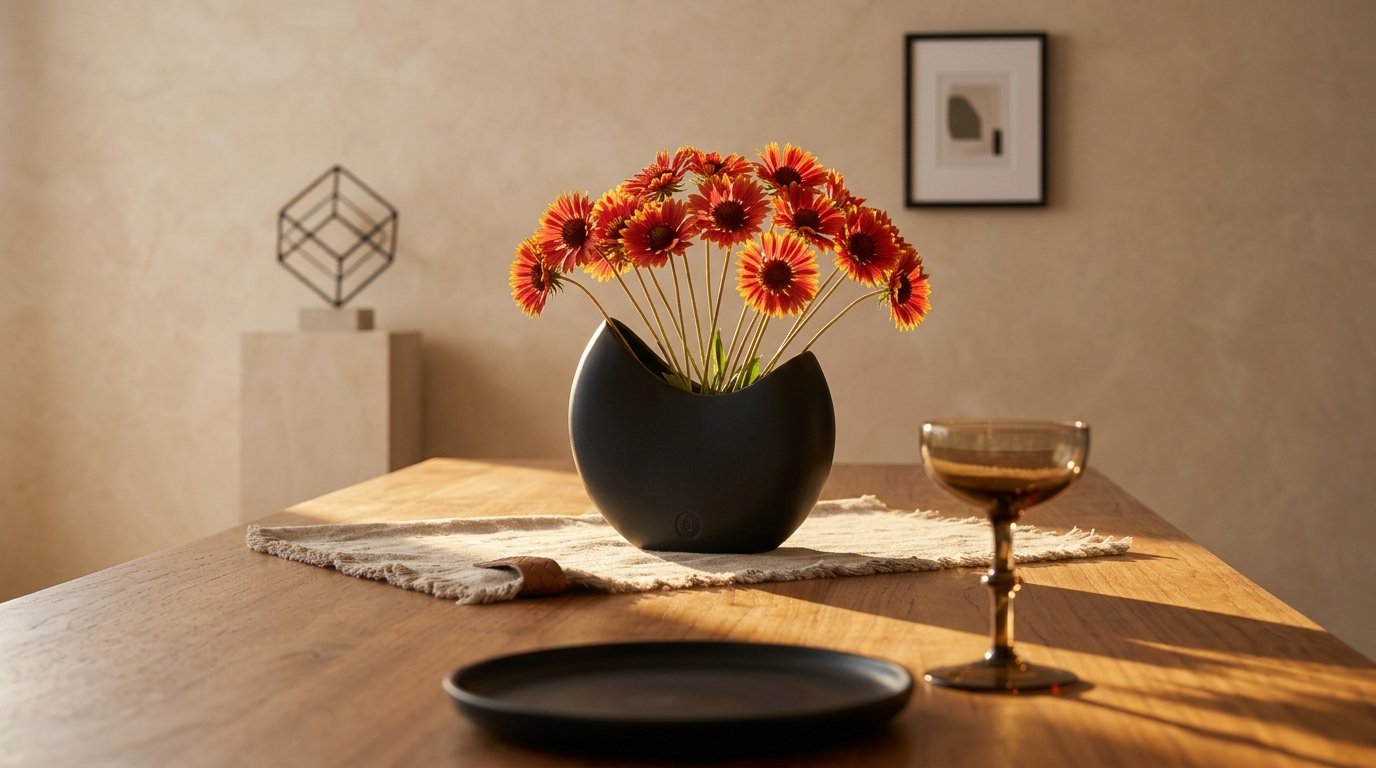
10. Gaillardia in Terracotta
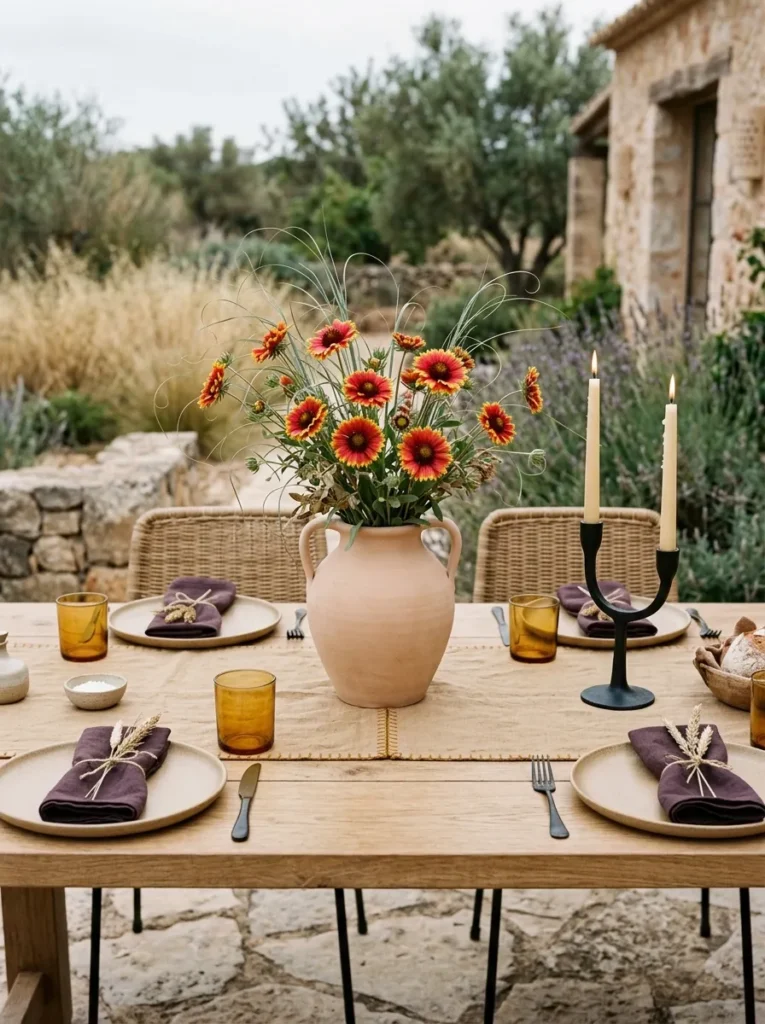
- Vessel: Unglazed pale terracotta amphora, 13 inches tall, with a slim neck and a glass jar liner hidden inside
- Flowers: Seven Indian blanket flowers (Gaillardia pulchella) and five stems of blue grama grass (Bouteloua gracilis)
- Palette: Terracotta, ochre, sandstone, aubergine
- Runner: Sandstone linen, 14 inches wide, a thin ochre line hand-stitched along each edge, 10-inch overhang
- Place setting: Matte sand-glazed plates, smoked amber tumblers, brushed brass flatware, aubergine napkins
- Light: Cream tapers in black iron holders at 8 and 11 inches
- Standout detail: Blue grama seed heads curl sideways like tiny combs
- Season: Indian blanket blooms May through September; blue grama seed heads show from midsummer
Why this works: A porous, unglazed vessel with a hidden liner gives a sun-baked look without risking water rings on the table.
Indian blanket looks like a sunset someone folded into a flower. Each bloom has a red center with a yellow-tipped fringe, which is exactly why a pale terracotta amphora flatters it. Cut seven stems and cluster them as three, three, and one, then add blue grama grass, whose seed heads curl sideways like tiny combs. I noticed Gaillardia stems are wiry and branch easily, so a slim-necked vessel holds them in a natural lean with no wire or foam. Keep the tallest stem about 14 inches above the rim, with the lowest just over it, to preserve the triangle.
My husband spots one mistake in nearly every home he walks through: water rings from porous pottery on a finished wood table. Unglazed terracotta sweats, so a glass jar sits inside the amphora, and a cork coaster sits underneath. Across the table, lay a sandstone linen runner, 14 inches wide, with a thin ochre line hand-stitched along each edge and a 10-inch overhang. Matte sand-glazed plates, smoked amber tumblers, brushed brass flatware, and aubergine napkins complete a sun-warmed palette. Cream tapers in black iron holders at 8 and 11 inches sit a foot from the grass.
11. Pink Muhly Cloud
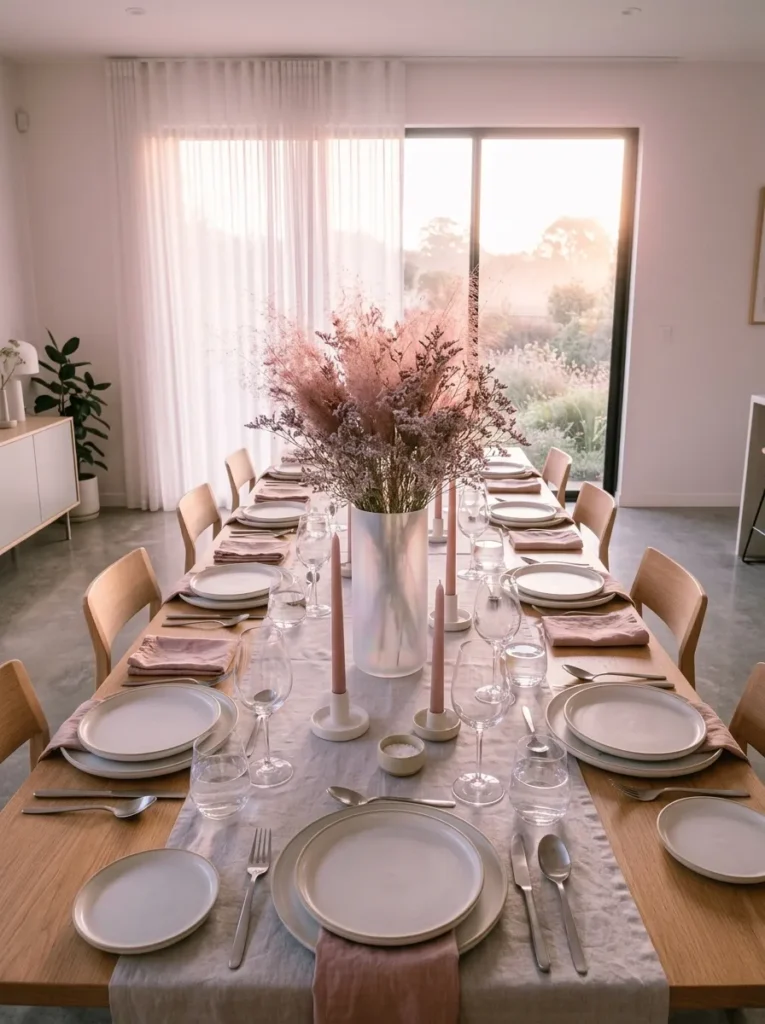
- Vessel: Tall opal frosted glass cylinder, 8 inches high, with a 4-inch opening
- Flowers: Fifteen pink muhly grass plumes (Muhlenbergia capillaris) and five Gregg’s mistflower (Conoclinium greggii) stems
- Palette: Dusty pink, lavender, opal white, silver
- Runner: Pale oyster linen, 14 inches wide, mitered ends, 9-inch overhang
- Place setting: Opal-white plates, clear stemless glasses, polished silver flatware, dusty-pink napkins
- Light: Dusty-pink tapers in matte white ceramic holders at 7 and 10 inches
- Standout detail: Backlit plumes turn into a pink haze that seems to hover above the table
- Season: Pink muhly blooms September through November; mistflower runs spring to frost
Why this works: A narrow cylinder lets airy plumes fan into one cloud-shaped mass, adding height without visual weight.
Pink muhly grass blooms in response to shortening days: as nights lengthen in early fall, the plumes flush pink, which is why this display peaks from September through November. A native Texas grass, it holds its shape for weeks, even without water. Fifteen plumes in a tall, frosted cylinder fan out into a hazy pink cloud, with five stems of Gregg’s mistflower grouped low on one side to add lavender fluff. Cut the muhly at three heights, the tallest about 12 inches above the rim, and tilt the arrangement toward its heavier side.
Pair that haze with a pale oyster linen runner, 14 inches wide, with mitered ends and a 9-inch overhang. The neutral cloth lets the pink glow. Opal-white plates, clear stemless glasses, polished silver flatware, and dusty-pink napkins repeat the palette quietly. Dusty-pink tapers in matte white ceramic holders at 7 and 10 inches sit at either end of the vase, a foot away from the plumes, which are fine and feathery. This is a garden-style tablescape that still feels modern, because every element is soft in color but sharp in line. It suits an October dinner.
12. Bud Vase Row
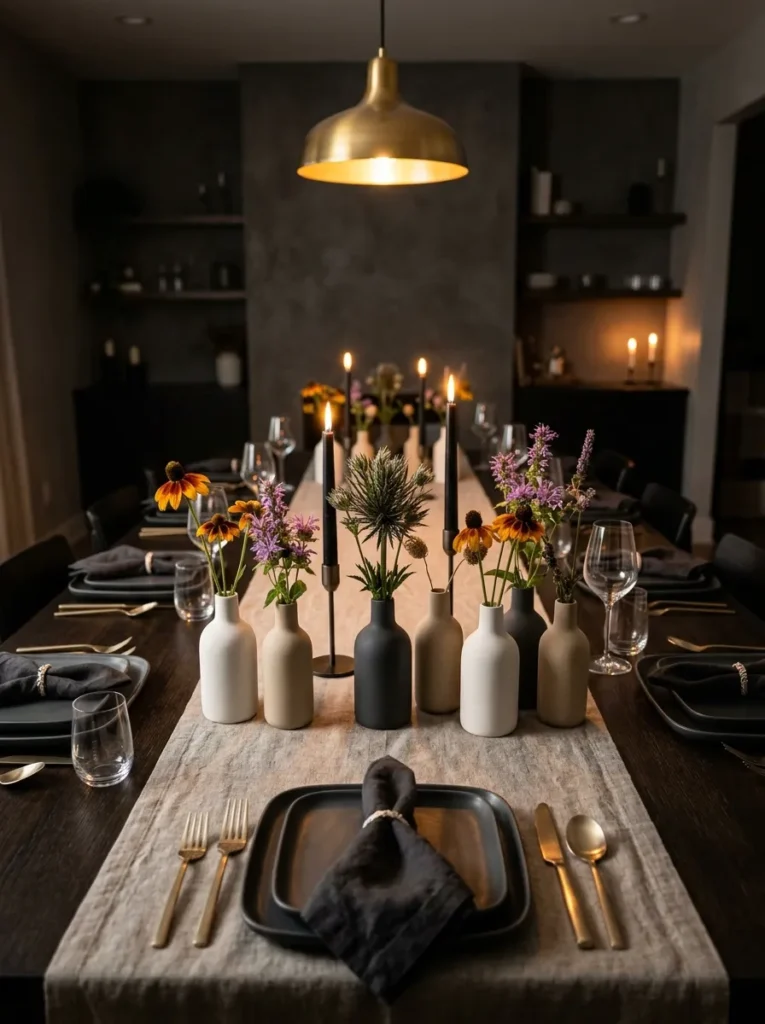
- Vessel: Seven matte ceramic bud vases in chalk white, sand, and charcoal, 4 to 9 inches tall, spaced 6 to 8 inches apart
- Flowers: Three Mexican hat (Ratibida columnifera), three lemon beebalm (Monarda citriodora), and one rattlesnake master (Eryngium yuccifolium), one stem per vase
- Palette: Mahogany, lavender, silver-green, chalk white
- Runner: Warm greige linen-cotton, 11 inches wide, mitered ends, 12-inch overhang
- Place setting: Matte charcoal square plates, clear tumblers, champagne-gold flatware, chalk-white napkins
- Light: Slim tapers in blackened-steel holders, set between the vases at alternating heights
- Standout detail: One spiky rattlesnake master globe is the architectural surprise in an otherwise soft row
- Season: Mexican hat and beebalm bloom May through August; rattlesnake master June through August
Why this works: A single-stem bud vase row delivers wildflowers in a clean linear format, so the table feels curated instead of crowded.
The first time I tried a row of bud vases, I lined them up like soldiers, and it looked like a science fair. Now I vary the spacing, the height, and the finish, and the whole line looks curated instead of stiff. Seven matte vases in chalk, sand, and charcoal run down the runner, each holding one stem: three Mexican hat, three lemon beebalm, and one rattlesnake master. Lemon beebalm smells faintly of citrus when brushed. I place the odd rattlesnake master two-thirds of the way down, and the eye lands there first, then wanders.
My husband’s tip from years of walkthroughs: put self-adhesive felt dots under every ceramic base, because bare stoneware scratches finished wood faster than you’d expect. It matters here, with seven small vases. Lay a warm greige linen-cotton runner, 11 inches wide with mitered ends and a 12-inch overhang, then add matte charcoal square plates, clear tumblers, champagne-gold flatware, and chalk-white napkins. Slim tapers in blackened-steel holders sit between the vases at alternating heights, each a foot from a stem. The narrow runner keeps everything linear and modern. Mexican hat and beebalm bloom May through August.
13. Raspberry Phlox on Terrazzo
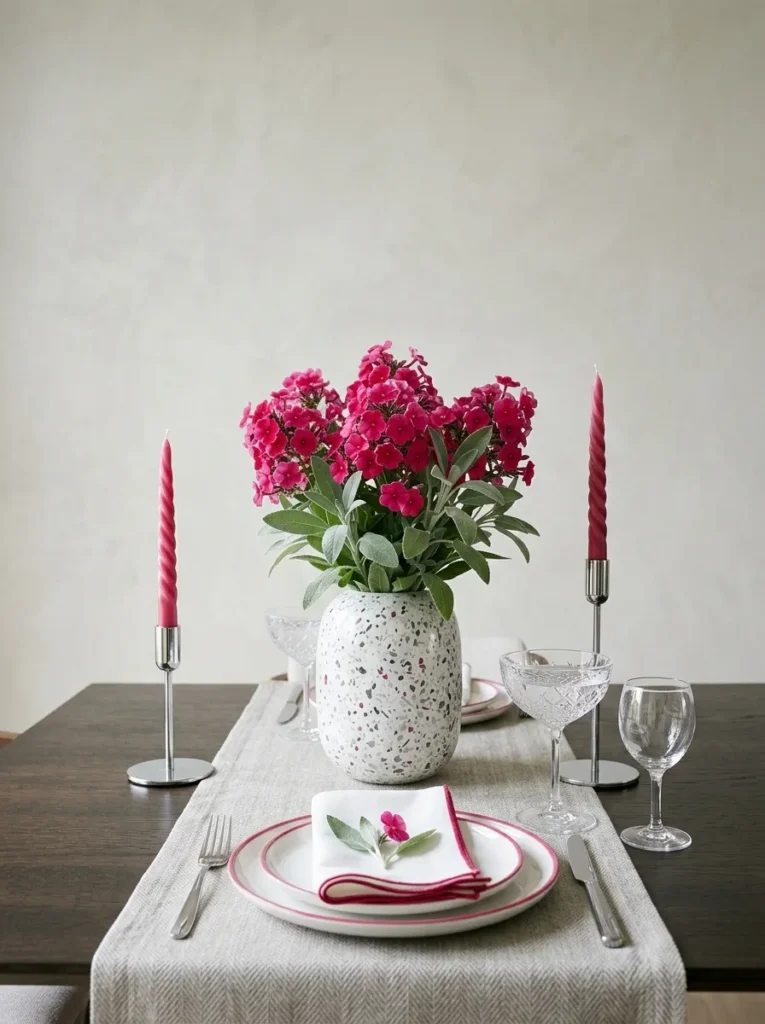
- Vessel: Polished terrazzo vase with pink and gray chips, 8 inches tall, wide mouth
- Flowers: Eleven Drummond’s phlox (Phlox drummondii) stems in raspberry and white, plus five stems of silver sage (Artemisia ludoviciana)
- Palette: Raspberry, silver, terrazzo gray, white
- Runner: Fine herringbone-weave greige cotton, 13 inches wide, bound edges, 10-inch overhang
- Place setting: Glossy white plates with a raspberry rim, clear coupe glasses, polished chrome flatware, white napkins
- Light: Twisted raspberry tapers in polished chrome candlesticks at 9 and 12 inches
- Standout detail: Silver sage foliage looks almost metallic against the raspberry blooms
- Season: Drummond’s phlox blooms March through May in Texas; silver sage foliage lasts most of the growing season
Why this works: Silver foliage cools down a saturated pink and adds a metallic note that makes a loose arrangement feel styled.
Drummond’s phlox is named for Thomas Drummond, a Scottish naturalist who collected seeds in Texas in the 1830s, and it’s still a Texas spring signature. Its dome-shaped clusters of raspberry and white blooms look dense, so they pair best with something airy. Silver sage does that job. The leaves look silver because they’re covered in tiny hairs that scatter light. Cut eleven phlox in clusters of five, three, and three, then tuck five silver sage stems high and to one side. Strip the lower leaves of both so the water stays clear for five or six days.
A fine herringbone-weave runner in greige cotton, 13 inches wide with bound edges, lets the raspberry stand out without competing. Let it hang 10 inches past each end. Glossy white plates with a raspberry rim, clear coupe glasses, and polished chrome flatware add a crisp, current finish. Twisted raspberry tapers in chrome candlesticks, at 9 and 12 inches, sit a foot from the sage leaves. The terrazzo vase carries the idea: its pink and gray chips pick up both the bloom and the foliage. Phlox blooms March through May in Texas, so style this table for spring.
14. Liatris Moon Jar
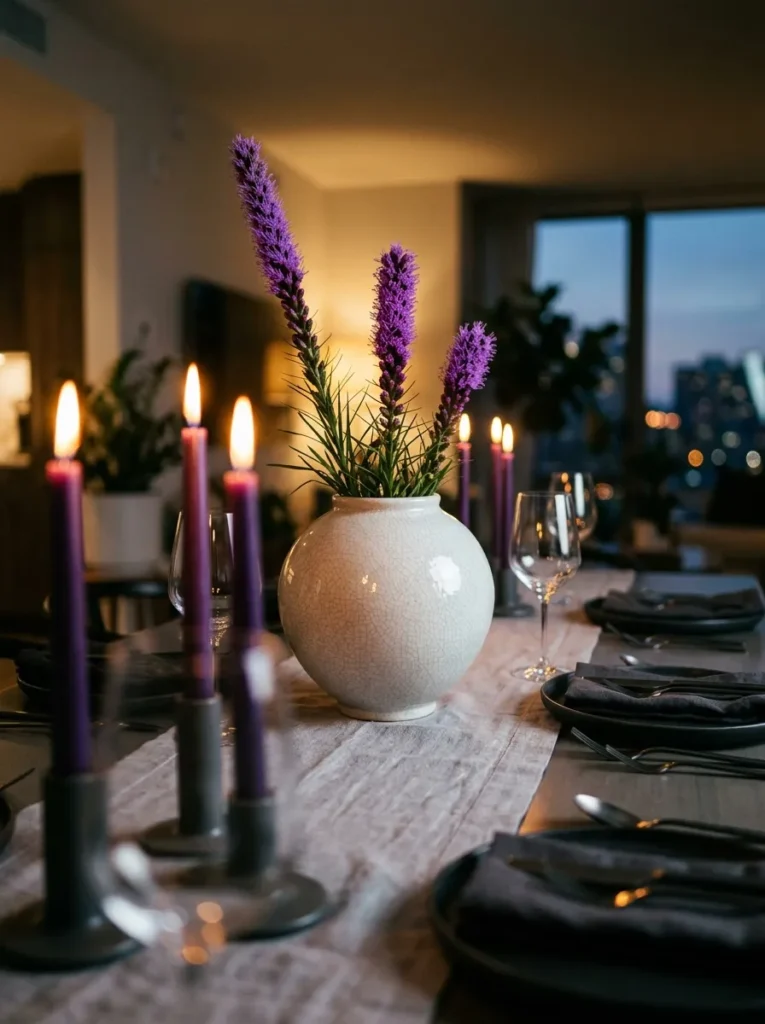
- Vessel: Pearl-white crackle-glaze moon jar, 8 inches tall, with a wide, rounded belly
- Flowers: Seven prairie blazing star (Liatris pycnostachya) spikes cut at three heights
- Palette: Violet, pearl white, graphite, gunmetal
- Runner: Pearl-gray silk-linen blend, 13 inches wide, mitered ends, 9-inch overhang
- Place setting: Matte graphite plates, clear tumblers, gunmetal flatware, pearl-white napkins
- Light: Deep violet tapers in low graphite stone holders at 8 and 10 inches
- Standout detail: The violet tapers repeat the blazing star’s color, so flame and flower match
- Season: Blazing star blooms July through September in Texas
Why this works: A rounded jar balances vertical spikes, and cutting three distinct heights echoes the heaven-human-earth triangle of Japanese ikebana.
I learned the three-height rule from a friend who studied ikebana, and it changed how I cut every stem. The tallest line is “heaven,” the middle is “human,” and the shortest is “earth,” which forms an asymmetric triangle. I tried it with seven blazing star spikes in a pearl-white moon jar, and the table finally looked intentional. Liatris blooms from the top down, unlike most flowers, so the tip colors first. Cut the tallest spike about 10 inches above the rim, the next at 7, and the shortest at 4, then tilt the group slightly off center.
The jar’s round belly balances all that vertical. Lay a pearl-gray silk-linen runner, 13 inches wide with mitered ends and a 9-inch overhang. It has a faint sheen that catches candlelight. Matte graphite plates, clear tumblers, gunmetal flatware, and pearl-white napkins keep the palette cool. Then comes my favorite detail: deep violet tapers in low graphite stone holders, cut to 8 and 10 inches, so the flames echo the blossoms’ color. Set them a foot from the spikes. Blazing star blooms July through September in Texas, which makes this a late-summer table.
15. Cream Sunflower Trio — A Wildflower Tablescape Idea for Late Summer
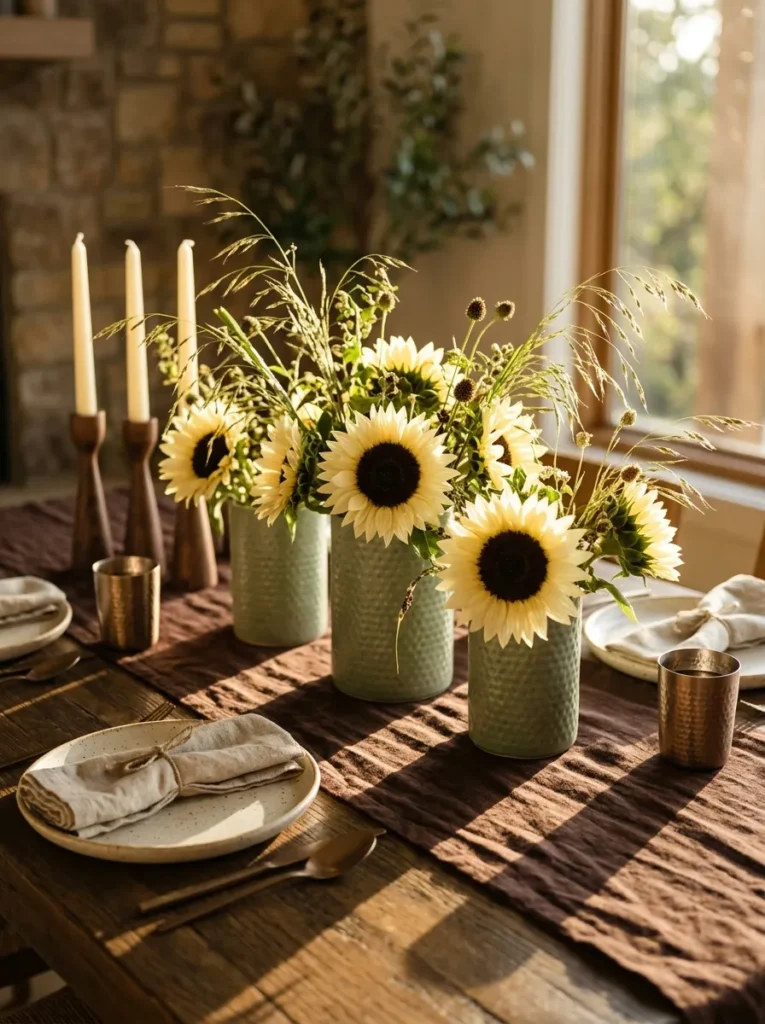
- Vessel: Three matte sage-green ceramic vessels with hand-pressed dimples, 5, 7, and 9 inches tall, each weighted with 2 inches of pea gravel
- Flowers: Five cream ‘Italian White’ sunflowers (Helianthus annuus) and nine stems of sideoats grama (Bouteloua curtipendula), the Texas state grass
- Palette: Cream, chocolate, sage, bronze
- Runner: Deep chocolate-brown linen, 13 inches wide, flat hem, 10-inch overhang
- Place setting: Cream stoneware plates, bronze-tinted tumblers, matte bronze flatware, sage napkins
- Light: Cream tapers in dark walnut candlesticks at 9 and 12 inches
- Standout detail: Pale sunflower faces turn toward the seats, their chocolate centers echoing the runner
- Season: Sunflowers bloom June through September; sideoats grama seed heads appear midsummer to fall
Why this works: A trio of graduated vessels spreads the flowers across the runner in one rhythm, and a dark runner makes pale blooms read clearly.
Mature sunflowers face east, so a cut one can look at you or away depending on how you turn the vessel. I rotate each jar until the faces point toward the seats. Three sage vessels, sized 5, 7, and 9 inches, hold five cream sunflowers in groups of two, two, and one, with sideoats grama, the Texas state grass, arching sideways between them. Cut sunflowers about 6 inches above each rim, because a heavy head on a long stem looks top-heavy and wobbles. Sunflower pollen stains linen, so shake each head over the sink first.
My husband’s trick for top-heavy flowers comes straight from the job site: ballast. Two inches of pea gravel in the bottom of each vessel lowers the center of gravity, so a sunflower won’t tip when someone reaches across. Across the table, lay a deep chocolate-brown linen runner, 13 inches wide with a flat hem and a 10-inch overhang, which makes the pale blooms pop. Cream stoneware plates, bronze-tinted tumblers, matte bronze flatware, and sage napkins follow the palette. Cream tapers in dark walnut candlesticks at 9 and 12 inches sit a foot back. Sunflowers bloom June through September.
Styling Principles
Every table in this post rests on the same structure: a loose arrangement built on a deliberate frame.
The asymmetric triangle, in four moves
- Pick an odd number of stems per flower type. Three, five, seven, nine, or eleven read as a natural cluster. Even counts look sorted.
- Cut at three heights. The tallest stem sets the peak, the middle group fills the slope, and the shortest tucks just over the rim.
- Lean the peak off-center. Put the tallest cluster over one shoulder of the vessel, not in the middle, so the shape rises on one side and falls on the other.
- Break the edge once. One trailing grass, seed head, or vine past the silhouette makes the shape look grown rather than built.
A wildflower arrangement looks intentional when its stems form an asymmetric triangle, with odd-numbered clusters at three different heights. Stems should sit under 10 to 12 inches above the vessel on a dining table, so guests can see each other across it.
The frame around the flowers
A runner is the neat counterweight to loose stems. Most dining tables suit a runner 12 to 15 inches wide, roughly a third of the table’s width, with an 8 to 12 inch overhang at each end. Keep every open flame at least a foot from loose petals, grasses, and seed heads.
Seasonal availability (Central Texas; shift about a month for cooler climates)
- Early spring (March to May): larkspur, Shirley poppies, Drummond’s phlox, daisy fleabane
- Late spring to early summer (May to July): plains coreopsis, oxeye daisies, Queen Anne’s lace, Mexican hat, lemon beebalm
- Summer (June to September): black-eyed Susans, purple coneflower, prairie blazing star, sunflowers, Indian blanket, zinnias
- Fall (September to frost): pink muhly grass, little bluestem plumes, and cosmos, zinnias, and Indian blanket until the first frost
Wildflowers are seasonal, so a table styled for the month you’re in will always look fresher and cost less than one built from out-of-season stems.
Alt text: “Seasonal wildflower stem heights and runner styling chart”
FAQs
1. How do you arrange wildflowers so they look intentional? Arrange wildflowers in an asymmetric triangle: group stems in odd numbers, cut them at three different heights, and lean the tallest cluster off-center. Add one trailing stem past the edge for movement. The structure stays hidden, so the arrangement reads as loose but deliberate.
2. What are the best low-maintenance wildflower varieties for a table? Zinnias, black-eyed Susans, purple coneflowers, yarrow, and sunflowers are the most forgiving. Their stems are stiff, hold their angle without wire, and last roughly a week in a vase. Delicate poppies and cosmos are lovelier but shorter-lived, typically three to five days.
3. How can you style wildflower table decor on a budget? Grow zinnias or cosmos from seed; one packet costs a few dollars and yields dozens of stems. Otherwise, buy mixed buckets at a farmers market or add yarrow and grasses to a grocery-store bouquet. Forage only from your own yard or with permission, and only plants you can identify with certainty.
4. How long do wildflower arrangements last? Most cut wildflowers last four to seven days. Sturdy types like zinnias, coneflowers, and yarrow can last up to ten, while poppies and cosmos fade in three to five. Change the water every two days, strip leaves below the waterline, and keep the arrangement away from direct sun.
5. What are the best vessels for a loose wildflower arrangement? Choose a heavy, stable vessel with a shape suited to your stems: a narrow neck for thin stems, a wide bowl with a pin frog or crumpled chicken wire for dense clusters, or single-stem bud vases for a row. Use a glass liner inside porous materials like terracotta or concrete.
6. How wide should a table runner be for a centerpiece? A runner is typically 12 to 15 inches wide, about a third of the table’s width, with an 8 to 12 inch overhang at each end. Pressed, hemmed edges keep the runner neat, which lets the flowers on top stay loose without the table looking messy.
Conclusion
A beautiful table isn’t about perfect flowers. It’s about a plan: a neat runner, a clear shape, and a few stems cut at different heights. These wildflower tablescape ideas give you that plan in fifteen styles, from quiet tonal blues to bold zinnias on white oak. I’ve seen how small changes like these can transform a dinner, turning an ordinary Tuesday into something guests remember.
Pick one idea that fits what’s blooming near you, try it this week, and trust the triangle. Save this post on Pinterest, and share it with a friend who loves a beautiful table.