15 Cozy Reading Nook Ideas for Any Size Room
You bought the chair. You styled the corner. So why is your reading nook holding laundry instead of you?
These cozy reading nook ideas answer that with fifteen fully styled spaces, from a closet painted paprika orange to a screened porch with a haint-blue ceiling. I’ve walked into many homes where the nook looked perfect and went unused, and the culprit was almost always the light, the seat, or both. Each idea here fixes those details, with practical input from my husband’s years in home construction on wiring, shelving, and seat heights.
Whether you have a spare closet, a stair landing, or one corner of a studio, you’ll find a plan to save, copy, and finish this weekend.
Why Most Reading Nooks Go Unused
The prettiest reading nook in a house is often the emptiest. Style rarely decides whether a nook gets used; lighting does. A reading light placed behind and slightly above shoulder height lights the page without glare or eye strain, which is why nooks lit only by ceiling or ambient light go unused. I learned this in my own Austin home, where a gorgeous chair by a south window sat untouched for months until a $35 swing-arm lamp finally gave me a reason to sit there.
This post solves that problem: fifteen fully styled nooks, each built around the light, seating, and storage that make people actually read.
1. Built-In Window Bench — A Cozy Reading Nook Idea for Natural Light
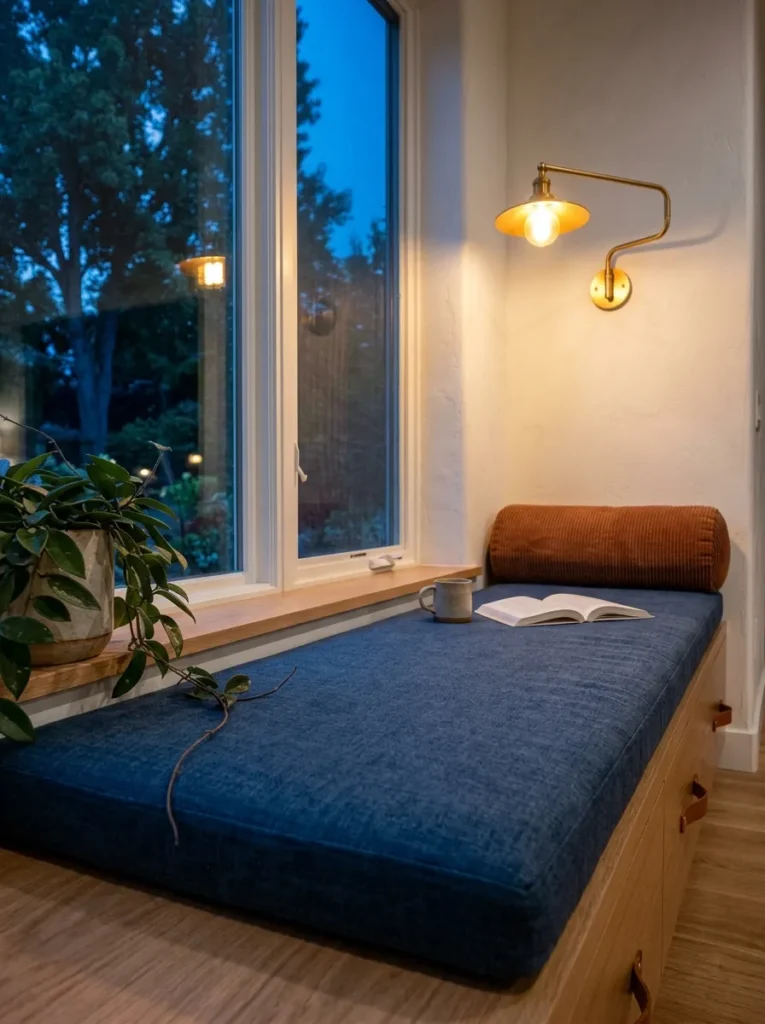
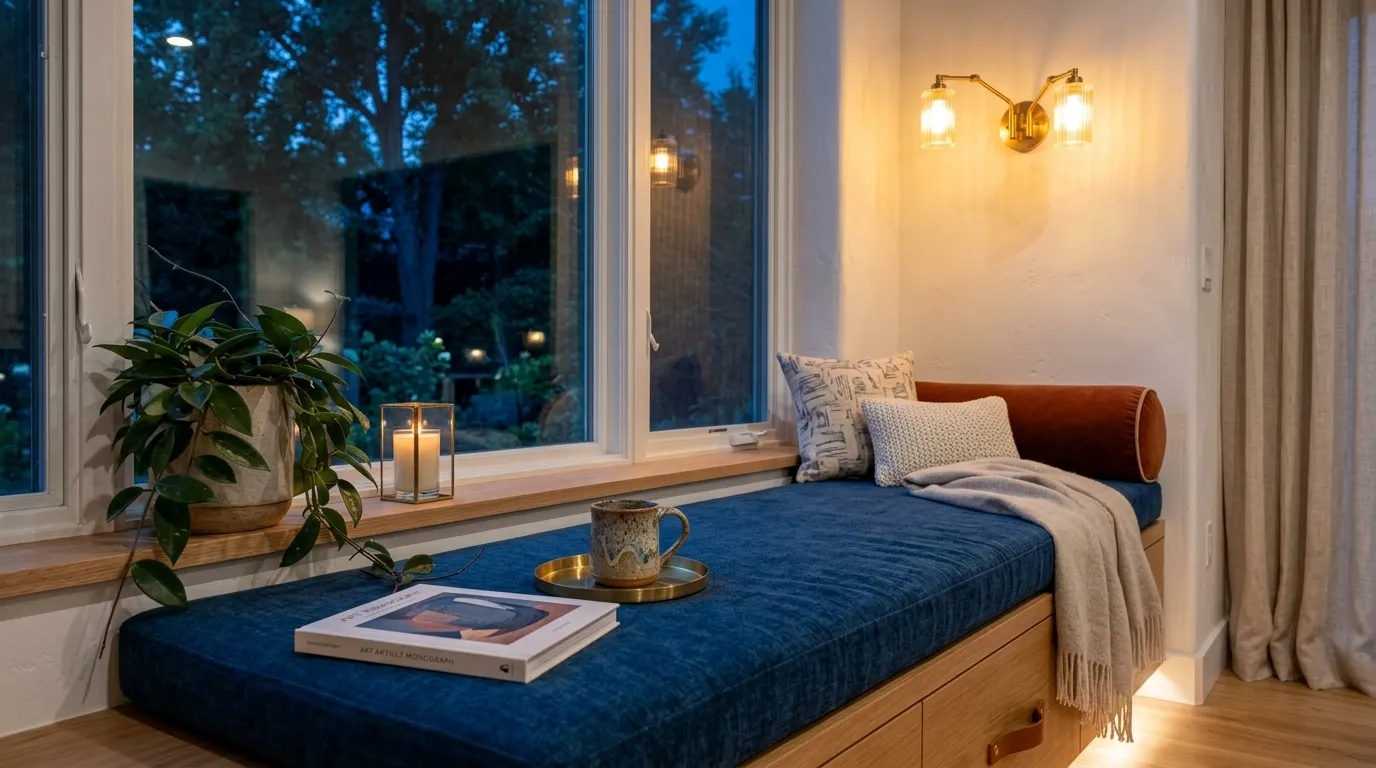
- Palette: white oak bench front, indigo-dyed linen cushion, aged brass hardware, chalk-white walls, with a rust corduroy bolster as the one warm accent.
- Seating: a 20-inch-deep bench, 17 inches off the floor, topped with a 4-inch high-resilience foam cushion. Deep enough to sit sideways with your knees up.
- Task light: a brass swing-arm sconce mounted on the wall at the bench’s back corner, centered about 50 inches off the floor, just behind your shoulder. Use a 2700K bulb at roughly 800 lumens on a wall dimmer.
- Surface and storage: a 6-inch-deep floating oak ledge holds a mug. Two deep drawers under the seat hold paperbacks, with cognac leather strap pulls as the standout detail.
- Rug and plant: a flatweave wool runner in indigo and cream stripes, plus a Hoya carnosa ‘Krimson Queen’ trailing from a glazed pot on the sill.
- Throw: a charcoal wool throw folded over the bench arm.
Why this works: A built-in bench fixes the seat, storage, and light in one ergonomic position, so the nook reads the same way at 2 p.m. and 9 p.m.
A window bench is the only reading seat that comes with its own storage, view, and daylight, and it works because the dimensions are fixed. Build the seat 17 inches high and 20 inches deep, and an adult can sit sideways with knees up, which is the posture most people drift into after twenty minutes. Daylight arrives from the side, so the page stays evenly lit. At night, the 2700K sconce takes over from behind your shoulder, so your own head never shadows the page. The indigo linen holds the deepest color in the room.
My husband builds window benches into remodels, and the rule he repeats is to plan the wiring before the drywall closes. Run the sconce cable and a nearby outlet while the wall is open, because fishing wire later means patching drywall. Frame the bench as plywood boxes tied into the wall studs, then add full-extension slides to the two drawers so a stack of hardcovers slides out easily. Cognac leather strap pulls keep the oak front clean. Set a Hoya carnosa ‘Krimson Queen’ on the sill; its waxy leaves store water and tolerate the heat radiating off Texas glass.
2. Closet Reading Den
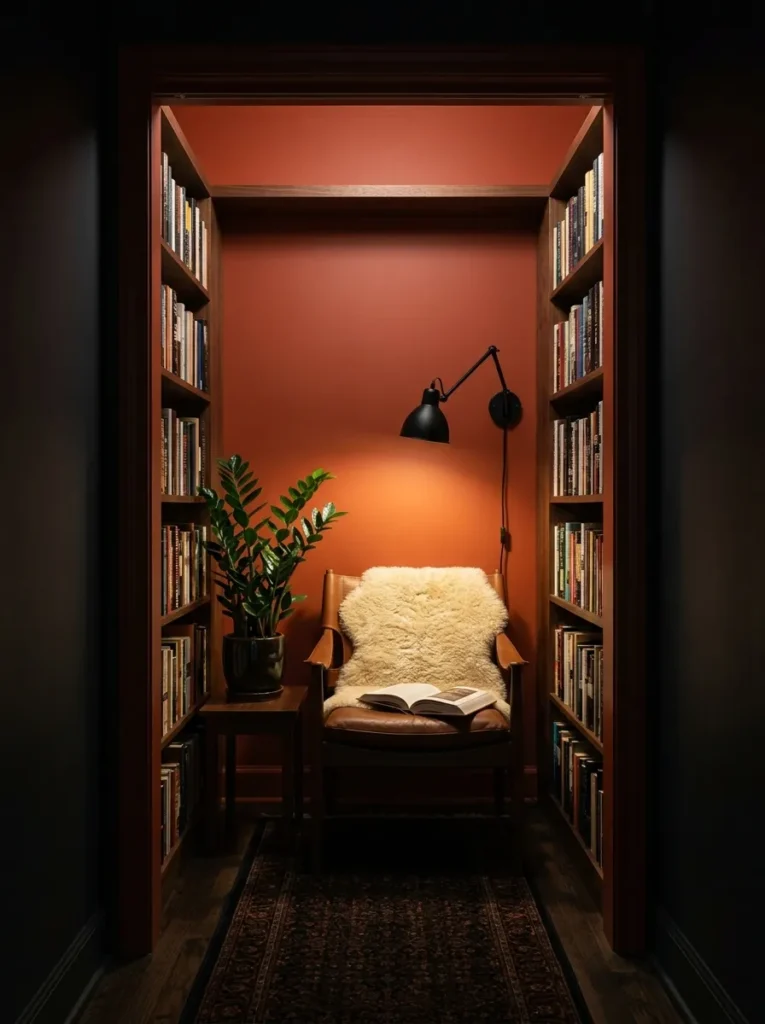
- Palette: paprika-orange walls and ceiling in one continuous color, walnut shelving, a tobacco-brown leather sling chair, and cream sheepskin.
- Seating: a butterfly sling chair in leather on a matte black steel frame. It needs about 30 inches of width, so use a walk-in or a reach-in with the doors removed.
- Task light: a black iron plug-in swing-arm lamp screwed to the side wall about 42 inches off the floor, just behind and above your shoulder. Use a dimmable 2200K amber LED at about 500 lumens.
- Surface and storage: an 8-inch-deep walnut ledge at 22 inches high sits at elbow level. Floor-to-ceiling walnut shelves, 10 inches deep, replace the hanging rod.
- Rug and plant: a 3-by-5-foot cotton dhurrie in cream with one black stripe, and a ZZ plant ‘Raven’ in a matte black pot.
- Standout detail: the painted ceiling. Carrying the color overhead makes the closet read as a deliberate room, not leftover storage.
Why this works: A closet is enclosed, quiet, and small enough to light with one lamp, which makes it one of the easiest spaces in a house to turn into a place people actually read.
I once pulled eleven pairs of shoes out of a guest-room closet and found the best reading spot in the house. The client had been looking for somewhere quiet, and the closet already had four things working in its favor: a door for privacy, walls that deaden sound, a ceiling close enough to light with one lamp, and no competing view. Painting everything paprika orange, ceiling included, made the space feel like a small jewel box rather than storage. In the evening, the amber light bounces off every surface, and the tobacco-brown sling chair seems to disappear into the glow.
Converting a closet is mostly subtraction. Pull the hanging rod, patch the cleat holes, and swap any bare-bulb ceiling fixture for a flush LED, because building codes keep exposed bulbs away from stored items. My husband checks for a plumbing stack or a structural header before anyone mounts shelving. Then fit 10-inch-deep walnut shelves floor to ceiling, add an 8-inch ledge at elbow height for a mug, and leave the doors off for airflow. A ZZ plant ‘Raven’ fits the corner, since its rhizomes store water, it tolerates dim light, and its near-black leaves stand out against paprika walls.
3. Curved Corner Chair
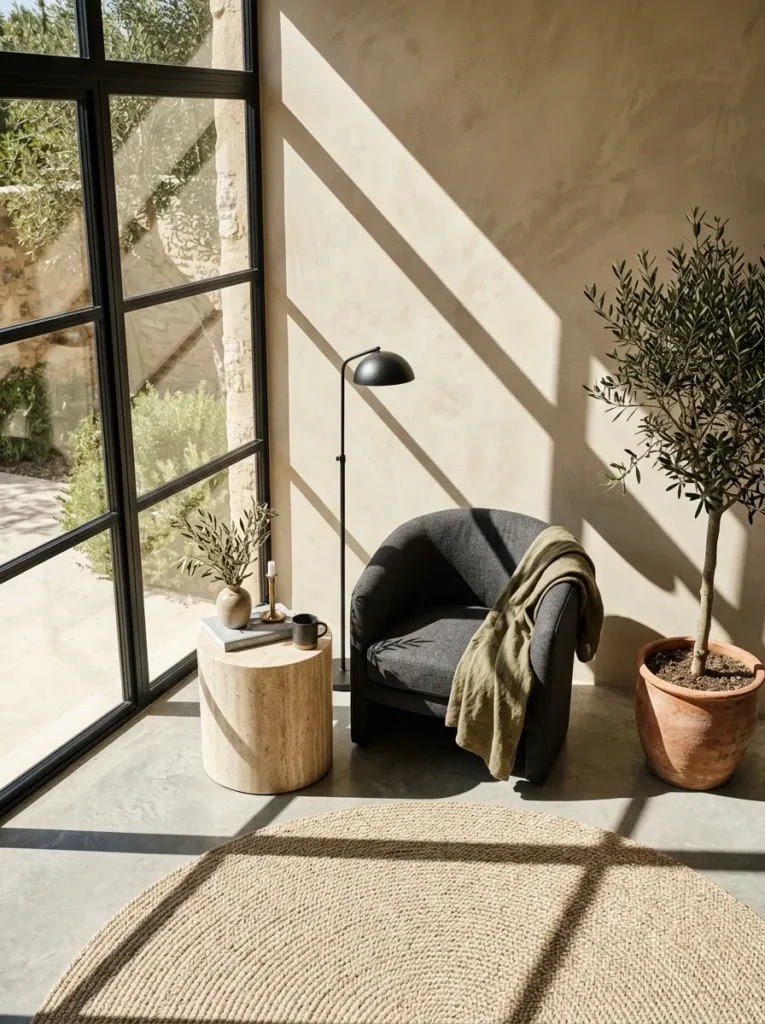
- Palette: sand limewash walls, a charcoal wool flannel chair, a honed travertine side table, and blackened steel.
- Seating: a curved barrel chair with a wraparound back, angled in the corner about 8 inches off each wall to leave room for a lamp behind it.
- Task light: a blackened-steel floor lamp in the gap behind the chair, adjustable head set at about 50 inches and angled down over the shoulder. Use a 2700K bulb at about 800 lumens.
- Surface and storage: a 16-inch honed travertine drum table within arm’s reach. A 4-inch-deep blackened-steel book ledge on the wall shows covers facing out.
- Textiles and rug: an oatmeal merino knit throw, an ink-black linen lumbar pillow, and a 5-foot round wool-and-jute rug in oat.
- Plant and standout detail: an olive tree (Olea europaea) in a matte clay pot. The hand-brushed limewash, with its cloudy variation, is the standout.
Why this works: A corner gives the chair two walls to anchor against and leaves a natural spot for a floor lamp behind the reader’s shoulder.
Of all the cozy reading nook ideas I’ve styled, the corner chair needs the least construction and rewards the most planning. Set the barrel chair at an angle, about 8 inches from each wall, so the curved back catches the limewash like a sculpture. The floor lamp goes behind the shoulder, head tilted down over the page, which lights the book without glare. In the evening, the sand wall glows like warm plaster, and the charcoal flannel looks nearly black. By day, the window light and the olive’s silver leaves make the same corner feel airy.
Limewash is the quiet detail here. Applied with a wide brush in crisscross strokes, it leaves soft, cloudy variation that picks up lamplight differently than flat paint. On new drywall, prime first, because limewash needs a porous surface to bond. Add the travertine drum table within arm’s reach, then layer an oatmeal merino throw and an ink-black linen lumbar pillow. An olive tree in a matte clay pot belongs in the brightest spot; its leaves wear tiny silvery scales that cut water loss in strong sun, which suits a bright Texas window.
4. Slatted Under-Stair Alcove
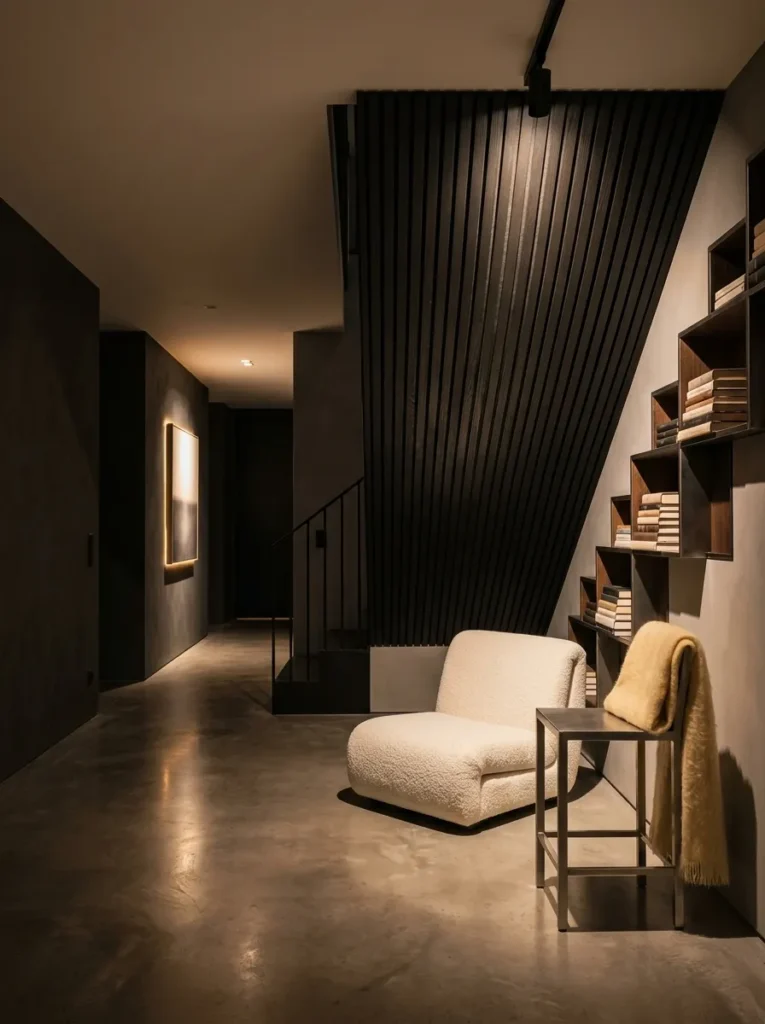
- Palette: black-stained ash vertical slats, bone-white wool, brushed stainless steel, and a pale saffron mohair throw as the single warm note.
- Seating: a low floor lounger with a 14-inch seat and a curved bone-white wool back. It stays under the sloping soffit without a bumped head.
- Task light: a matte black track spot mounted where the stair soffit sits about 44 to 48 inches off the floor, directly behind and slightly above your shoulder. Use a 2700K bulb at about 600 lumens.
- Surface and storage: a 14-inch brushed stainless stool holds a mug. Stair-stepped cubbies in black-stained ash follow the rise of the treads and hold your books, the standout detail.
- Rug and plant: a 4-by-6-foot hand-knotted wool rug in charcoal and bone, plus a cast-iron plant (Aspidistra elatior) in a matte black pot.
Why this works: A staircase already gives you a sloped ceiling that forces a low seat and a single light source, which makes the space under it ideal for focused reading.
The floor under a staircase is the most overlooked square footage in a house, and a reading alcove claims it beautifully. Because the ceiling slopes, the seat has to sit low: a 14-inch floor lounger keeps your head clear while you read. Black-stained ash slats make the angled soffit look deliberate instead of leftover, and they hide the seams where drywall meets stair framing. After dark, one directional spot behind your shoulder lights the page while the dark slats absorb everything else. The effect is closer to a hotel library than a storage cupboard.
Before building, have the framing checked: stairs can carry loads you cannot see. My husband also reminds clients that many local codes require 1/2-inch drywall under stairs when the space is enclosed, so check yours before covering anything with wood. Make the stair-stepped cubbies 10 inches deep, following the rise of each tread, to hold paperbacks. Leave the lowest cubby open for a basket of extra throws. A brushed stainless stool holds your mug. A cast-iron plant (Aspidistra elatior) belongs here because it evolved in forest understory shade, and a pale saffron mohair throw adds warmth.
5. Divider Bookcase Nook
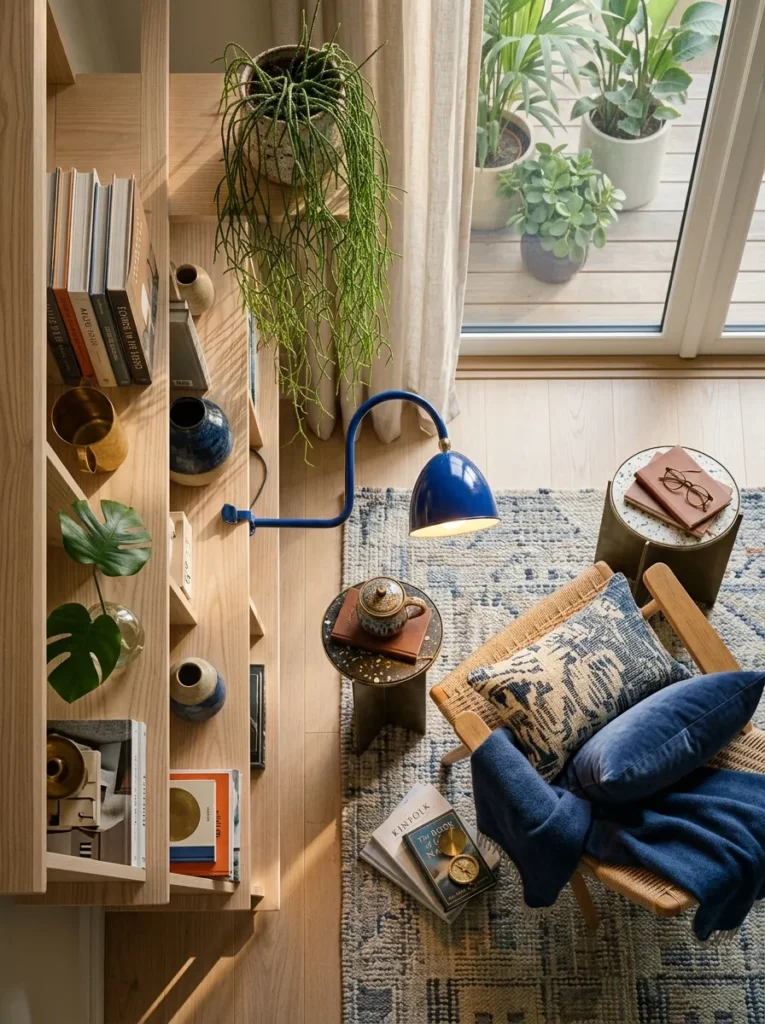
- Palette: pale ash wood, natural paper cord, chalk white, and cobalt enamel as the one saturated color.
- Seating: a Danish-style lounge chair with an ash frame and woven paper-cord seat, 16-inch seat height, only 25 inches wide. Angle it beside the bookcase.
- Task light: a cobalt enamel clamp-on lamp fixed to a bookcase upright behind the chair, about 46 inches off the floor. Use a 2700K bulb at about 600 lumens, with no drilling or wiring.
- Surface and storage: a 72-inch open-back ash bookcase, 8 inches deep, set perpendicular to the wall as a room divider. A 12-inch round ash nesting table holds a mug.
- Textiles and rug: an oat linen throw, an ash-gray wool lumbar pillow, and a 3-by-5-foot washable flatweave rug in chalk and ash stripes.
- Plant: a mistletoe cactus (Rhipsalis baccifera) hanging from the top shelf.
Why this works: A divider bookcase turns one open room into two zones, giving a small apartment a reading spot that feels separate from the bed or sofa.
In my first apartment, the only place to read was the bed, and I was asleep within four pages. A bookcase set perpendicular to the wall changed that. It carves a nook out of one open room, gives the Danish cord chair a backdrop, and keeps the view of the bed out of sight. Pale ash and natural paper cord keep the look light, so a chalk-white studio never feels crowded. After sunset, the cobalt enamel lamp becomes the one bold note, pulling your eye straight to the page and away from the laundry pile.
A 72-inch bookcase can tip, so anchor it. My husband straps every tall unit to a wall stud with a 2½-inch screw, and a freestanding divider can sit with its short end against a wall and strap there. Renters can clamp the lamp to a shelf upright, with no drilling or wiring. Hang a mistletoe cactus (Rhipsalis baccifera) from the top shelf; as a rainforest epiphyte, it prefers bright indirect light and adapts to ordinary apartment humidity. Set a 12-inch round ash nesting table beside the chair for your mug and a paperback.
6. Screened Porch Lounge
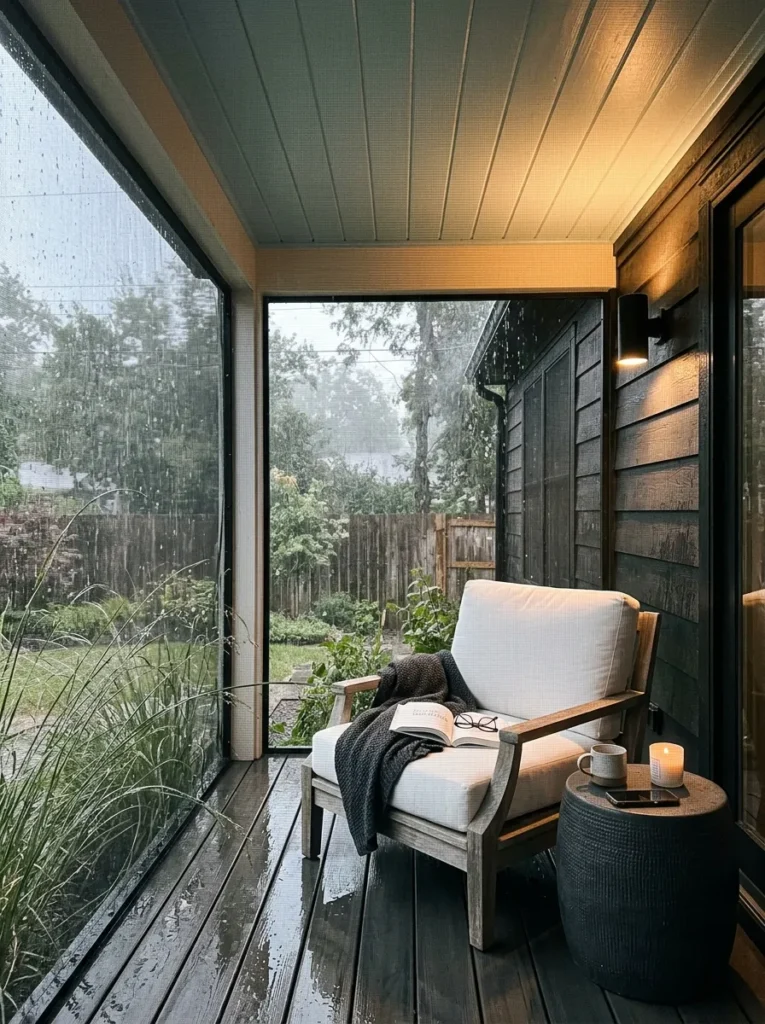
- Palette: silvered teak, optic white, matte black steel, and a haint-blue slatted ceiling in the pale blue-green Southern tradition.
- Seating: a low teak lounge chair with a 15-inch seat and a wide 3-inch cushion in optic-white solution-dyed acrylic fabric, which resists mildew and fading.
- Task light: a matte black wet-rated sconce on the porch post behind the chair, about 48 inches off the floor. Use a warm 2700K bulb at about 600 lumens, on a dimmer.
- Surface and storage: a charcoal-glazed ceramic garden stool serves as the side table. A teak side cabinet with a lift lid keeps books dry in humid weather.
- Textiles and rug: an ink-black outdoor lumbar pillow, an optic-white cotton waffle throw, and a 5-by-8-foot black-and-white woven rug made from recycled plastic.
- Plant and standout detail: bamboo muhly (Muhlenbergia dubia) in a charcoal planter. The haint-blue ceiling is the standout.
Why this works: A porch nook works only when the light is chosen for outdoors: a warm, wet-rated bulb behind your shoulder lights the page and draws fewer insects than cool white.
Screened porches are where I read most from April through October, and the lesson came quickly: shade beats sunshine. A haint blue ceiling, painted in the Southern tradition, bounces cool light down onto the page while the screen blocks mosquitoes. Matte finishes everywhere keep glare off the page, even at noon. The silvered teak chair sits low, with a wide optic-white cushion, so you can sink in and still see the yard. At dusk, a warm 2700K sconce behind your shoulder lights the page and draws fewer insects than cool white bulbs do.
Porches are built to shed water, so check the floor first. Decking slopes a fraction of an inch per foot away from the house, which is invisible until a chair wobbles; adjustable glides on the teak legs fix it. My husband insists on GFCI-protected, wet-rated fixtures outdoors, with the wiring run through conduit to the post. Keep books dry in a teak side cabinet with a lift lid, and set a charcoal-glazed ceramic stool beside the chair for your drink. Bamboo muhly, a Texas native grass, sways in the screen breeze and softens the black steel.
7. Arched Fireplace Alcove
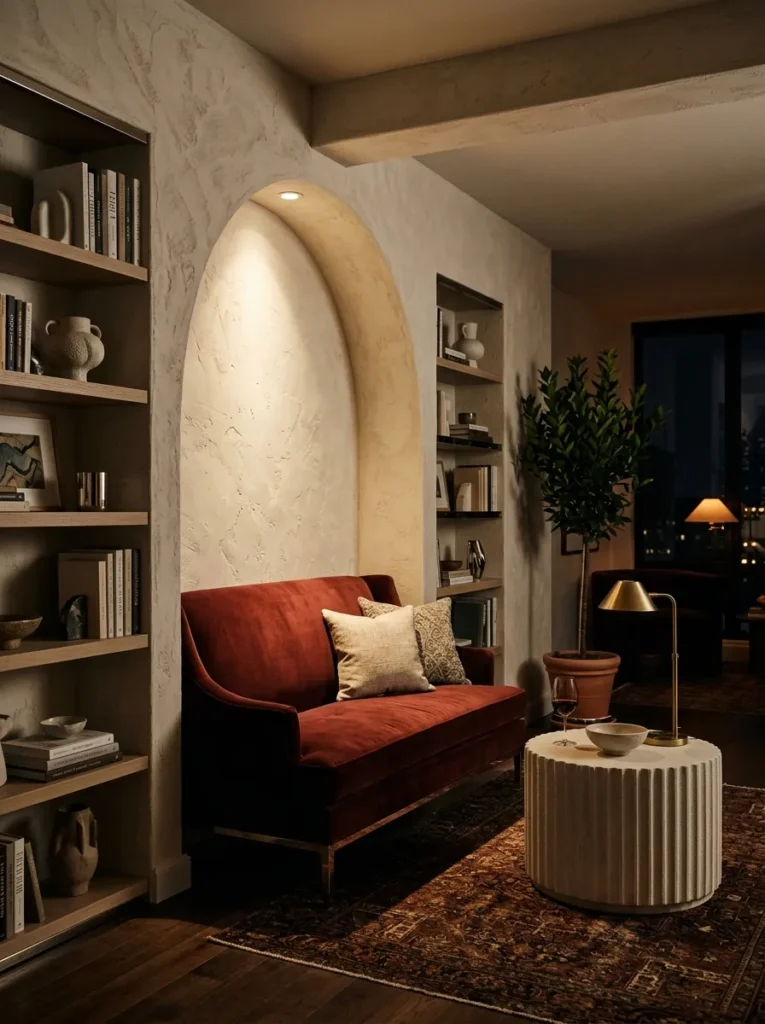
- Palette: oxblood velvet, limed oak shelves, warm plaster white, and polished nickel hardware.
- Seating: a compact channel-back settee in oxblood velvet, 54 inches wide with a 17-inch seat. It fits an alcove at least 5 feet wide.
- Task light: a recessed adjustable gimbal downlight set about a foot behind the settee’s back edge, above your shoulder line and tilted toward your lap. Use a 2700K bulb at about 650 lumens.
- Surface and storage: a 14-inch fluted plaster drum table holds a mug. Limed oak shelves, 11 inches deep, flank the settee on both sides.
- Textiles and rug: a bone cashmere-blend throw over the arm, and a 5-by-7-foot hand-loomed oatmeal wool rug with a thin oxblood border.
- Plant and standout detail: a bay laurel standard (Laurus nobilis) in a plaster pot. The hand-troweled plaster arch over the alcove is the standout.
Why this works: A recessed alcove has walls on three sides, so one light placed behind the seat is enough to light a page and keep the rest of the room calm.
Alcoves beside a fireplace are architecture’s gift to readers: three walls, a built-in sense of enclosure, and a ceiling already close enough to light. A plaster arch makes that enclosure feel intentional, and oxblood velvet gives the settee a rich, dense pile that photographs beautifully. Place a recessed gimbal light about a foot behind the seat’s back edge, tilted toward your lap, and the beam lands on the page without casting a shadow across it. In the evening, the limed oak shelves glow pale gold, while the polished nickel hardware catches small points of light.
The arch is the detail guests ask about. My husband builds them from flexible drywall or a plywood template, then skim-coats everything with plaster for a seamless curve. Keep books and textiles well clear of the firebox opening, and check your fireplace manufacturer’s clearance rules before filling nearby shelves. A 14-inch fluted plaster drum table holds your mug. Layer a bone cashmere-blend throw over the arm. Set a bay laurel standard (Laurus nobilis) in a plaster pot beside the settee; its leaves hold aromatic oils that release a faint, herbal scent whenever you brush past.
8. Bay Window Chaise
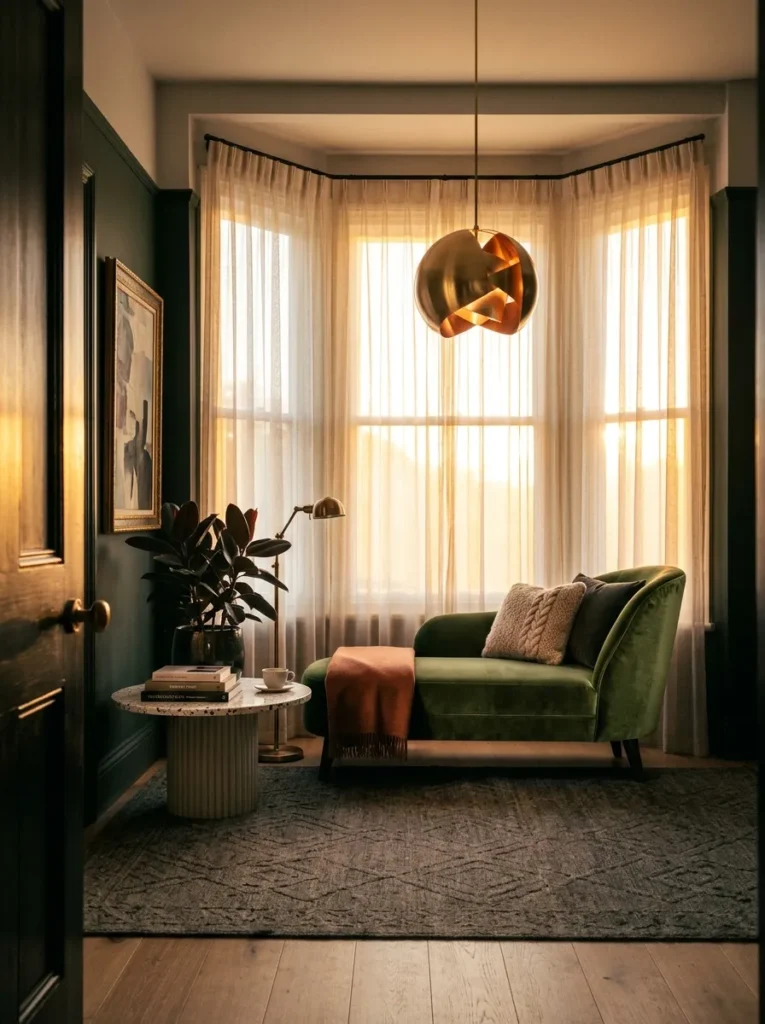
- Palette: mushroom-gray linen, blackened oak, antique-white linen sheers, and brushed copper.
- Seating: an armless chaise longue, 72 inches long, with a sloped headrest. Keep it 6 inches off the glass so the sheers hang freely.
- Task light: a brushed copper dome swag pendant on a ceiling hook behind the chaise head, hung 14 to 16 inches behind and above your seated shoulder. Use a 2700K bulb at about 700 lumens.
- Surface and storage: a 16-inch blackened oak tray table beside the chaise. A 36-inch-wide, 18-inch-high blackened oak bookshelf sits under the window.
- Textiles and rug: a charcoal wool throw, a pleated cream pillow, and an 8-by-10-foot hand-tufted wool rug in charcoal with ivory contour lines.
- Plant and standout detail: a rubber plant (Ficus elastica ‘Burgundy’) in a ribbed white pot. The copper swag pendant, with its cord hidden in a painted raceway, is the standout.
Why this works: A swagged pendant brings overhead light down to reading height without hardwiring, so a bay window can get a proper task light in an afternoon.
The first time a friend visited from Dallas, she walked straight to the bay window, kicked off her shoes, and stayed for two hours with one book. The chaise did that, not me. Seventy-two inches of mushroom-gray linen lets you stretch out fully, and the sloped headrest holds your neck at a comfortable angle. Because the pendant hangs just behind and above your shoulder, the page stays bright while the antique-white sheers soften the afternoon sun. At night, the copper shade casts a tight amber pool across the throw. Blackened oak keeps the whole corner grounded and modern.
Swag pendants are the renter-proof and remodel-friendly fix for bay windows, where walls are mostly glass and sconces have nowhere to land. Screw the ceiling hook into a joist, not drywall; my husband finds the joist with a stud finder and tests it by hand before hanging anything. Run the cord down the wall inside a paintable raceway in the wall color. Keep the chaise 6 inches off the glass. A rubber plant (Ficus elastica ‘Burgundy’) suits the bay’s bright light, and its thick, leathery leaves lose water slowly, which helps when air conditioning dries the room.
You’ll Also Love: 15 Sage Green Living Room Ideas for a Calm, Grounded Space
9. Landing Window Perch
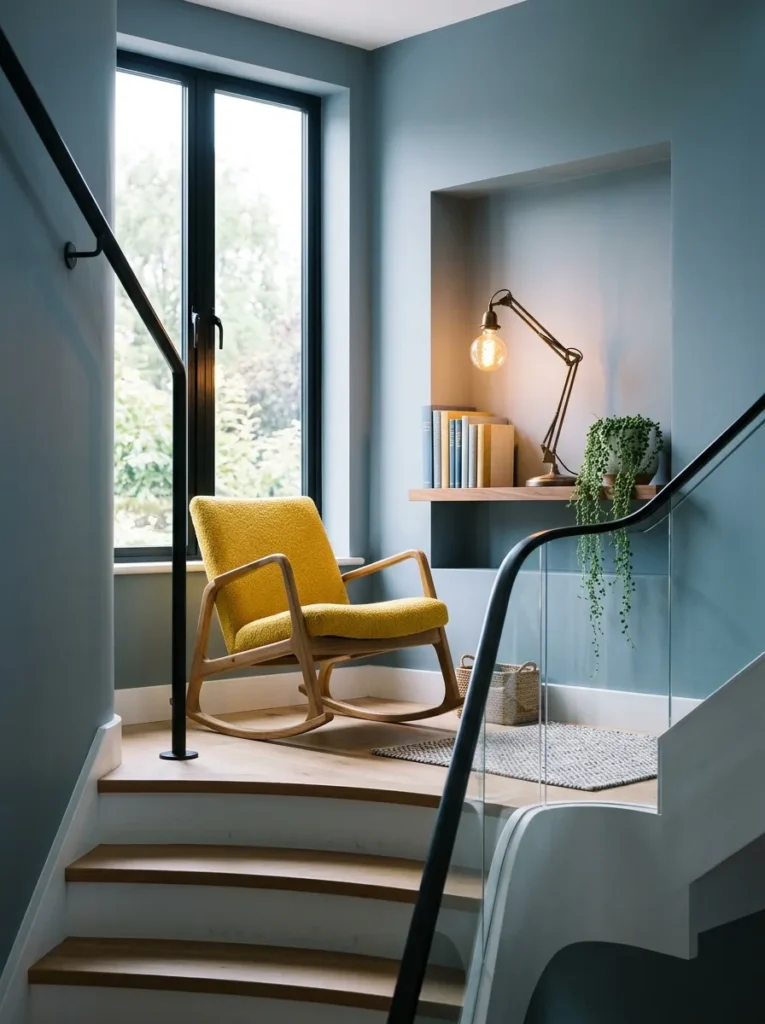
- Palette: bent ash plywood, butter-yellow wool, matte white walls, and antique bronze.
- Seating: a bent ash plywood rocking chair with a butter-yellow wool seat cushion. Leave about 24 inches of clear swing space in front and behind.
- Task light: an antique bronze table lamp with a linen drum shade, set on a floating shelf behind the chair, shade centered about 48 inches off the floor. Use a 2700K bulb at about 600 lumens.
- Surface and storage: a 24-inch floating ash shelf at 24 inches high holds a mug. A recessed book niche cut between wall studs, 3½ inches deep and 14 inches wide, is the standout.
- Textiles and rug: a slate-gray felted wool throw and a 2½-by-8-foot hand-woven runner in white and ash.
- Plant: a string of pearls (Senecio rowleyanus) trailing from the window sill.
Why this works: Stair landings are quiet, daylit pockets nobody uses, so a rocker, one lamp, and a recessed niche are enough to turn them into reading rooms.
Stair landings often sit unused: a window, a bare wall, and a rug nobody looks at. I turned one into a reading perch with a rocking chair, and the motion alone made it the seat guests chose first. Morning light slides across the rocker’s curved arms. Bent ash plywood keeps the silhouette light and sculptural, and the butter-yellow wool seat adds warmth against matte white walls. Keep 24 inches clear in front and behind so the rocker can swing. The lamp, set on a floating shelf behind your shoulder, lights the page without glare.
The standout is the recessed niche. Between two studs, a non-load-bearing interior wall usually has a 3½-inch-deep empty cavity that can hold paperbacks. My husband checks for wiring and plumbing before cutting, then frames the opening with ash trim. Paint the niche’s back wall a muted bronze so book spines pop against it. Add a floating shelf at 24 inches high for a mug. A string of pearls (Senecio rowleyanus) trails from the sill; each bead-shaped leaf has a translucent strip that lets light reach its interior, which suits bright landing windows.
10. Dormer Platform Daybed
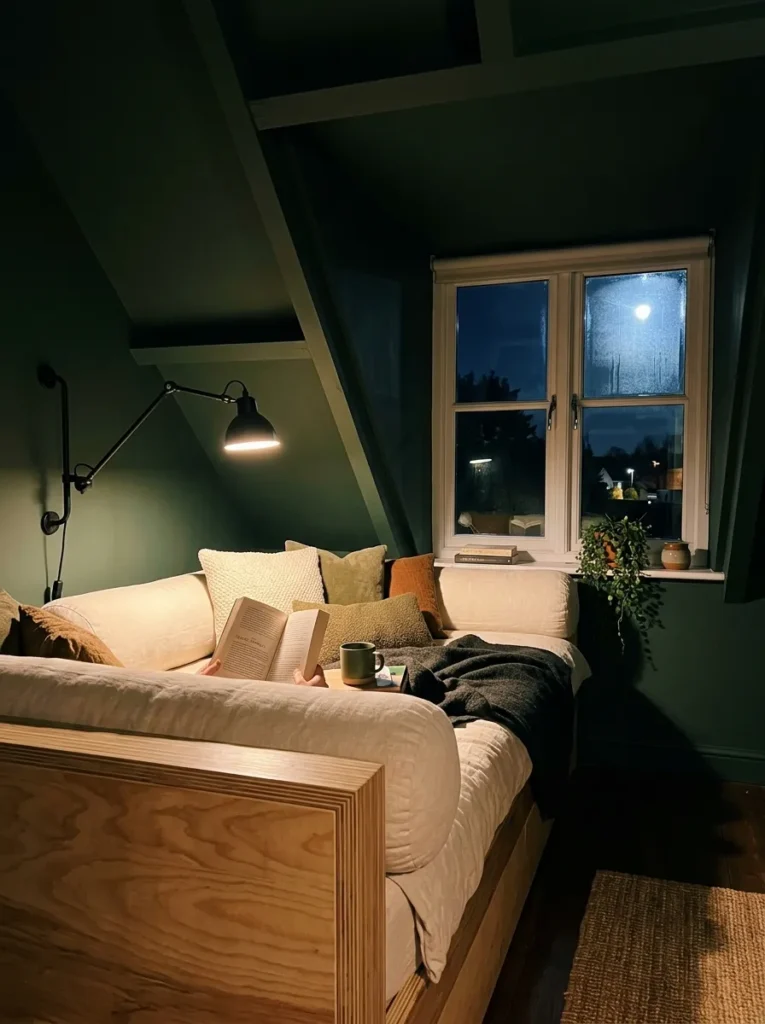
- Palette: pine-green walls, raw birch plywood, ivory wool, and satin black steel.
- Seating: a built-in birch plywood platform daybed, 36 inches deep and 18 inches high. It has a 5-inch ivory wool-blend cushion and two 20-inch bolsters.
- Task light: a hardwired satin black adjustable-arm lamp on the gable wall, about 52 inches off the floor and 8 inches behind your seated shoulder. Use a 2700K bulb at about 600 lumens on a dimmer.
- Surface and storage: a 10-inch-deep birch shelf runs along the knee wall, with two shallow drawers under the platform.
- Rug and plant: a 5-by-8-foot low-pile oat wool rug, plus a string of turtles (Peperomia prostrata) in a white ceramic pot on the window ledge.
- Standout detail: the layered birch plywood edge, left exposed on the platform, drawers, and shelf.
Why this works: An attic dormer already gives you a window and three enclosing walls, so a platform daybed built to its exact width turns the whole space into a reading room.
An attic dormer is a ready-made reading room: a window, a sloped ceiling, and walls on three sides. A platform daybed, built to the dormer’s exact width, fills the space without wasted floor. At 36 inches deep, it lets you lie back, prop your head on two bolsters, and keep the book at the right angle. Pine-green walls make raw birch plywood glow warm gold, and the plywood’s layered edge profile adds a graphic line. Evening light stays low and warm, so the slope overhead feels like a canopy instead of a ceiling.
Attic floors are often framed for lighter loads than main-floor rooms, so have a contractor check the joists before adding built-ins. My husband lays out platforms so the weight spans several joists instead of resting on one. Keep any knee-wall insulation intact when you cut in storage, and add two shallow drawers beneath the seat. Mount the wall lamp about 8 inches behind your seated shoulder, with a dimmer for late nights. A string of turtles (Peperomia prostrata) suits the window ledge; its small, thick leaves store water, so it forgives the heat that builds under a roof.
11. Library Ladder Wall
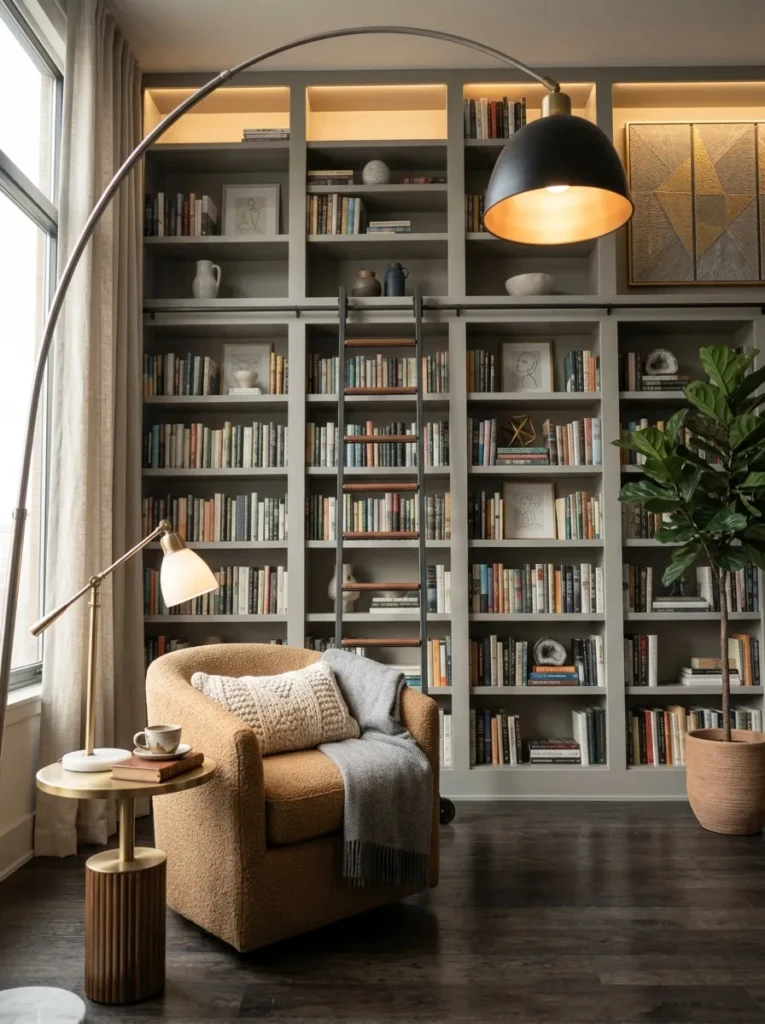
- Palette: putty-gray built-in shelving, camel suede, graphite-finished steel, and unlacquered zinc.
- Seating: a swivel tub chair in camel suede on a graphite steel pedestal base, 17-inch seat. It rotates toward the shelves so you can reach the next book without standing.
- Task light: a brushed zinc arc lamp with a weighted base, standing behind the chair, shade about 50 inches off the floor and reaching over your shoulder. Use a 2700K bulb at about 800 lumens.
- Surface and storage: a 14-inch honed gray marble pedestal table holds a mug. Floor-to-ceiling shelves, 12 inches deep and painted putty gray, hold the books.
- Textiles and rug: a bone-and-graphite herringbone wool throw and a 6-by-9-foot low-pile wool rug in graphite with an ivory pinstripe.
- Plant and standout detail: a Kentia palm (Howea forsteriana) in a zinc planter. The graphite steel rolling ladder on a rail is the standout.
Why this works: A swivel chair facing a shelf wall keeps the next book within reach, which keeps the nook in use for longer sessions.
My favorite reading nook is not in a corner at all. It is a wall of shelves, a swivel chair, and a ladder that slides on a rail. I once spun the chair toward the shelves, pulled down a book I had forgotten owning, and finished it that weekend. A library wall does that: it keeps the next book within reach, so reading becomes a habit instead of a project. Putty-gray paint on the shelves lets the spines supply the color, while the camel suede chair adds the single warm note.
Shelves sag, and builders know it. A 3/4-inch plywood shelf spanning more than about 30 inches will bow under a row of hardcovers, so my husband adds a 1½-inch solid oak front band, painted to match, which stiffens the edge and hides the plywood. Cap shelf depth at 12 inches. Screw the ladder rail into wall studs, not drywall anchors. Behind the swivel chair, the zinc arc lamp sends light over your shoulder onto the page. A Kentia palm (Howea forsteriana) belongs in the corner; it evolved on a forest floor and tolerates low light.
12. Suspended Swing Chair
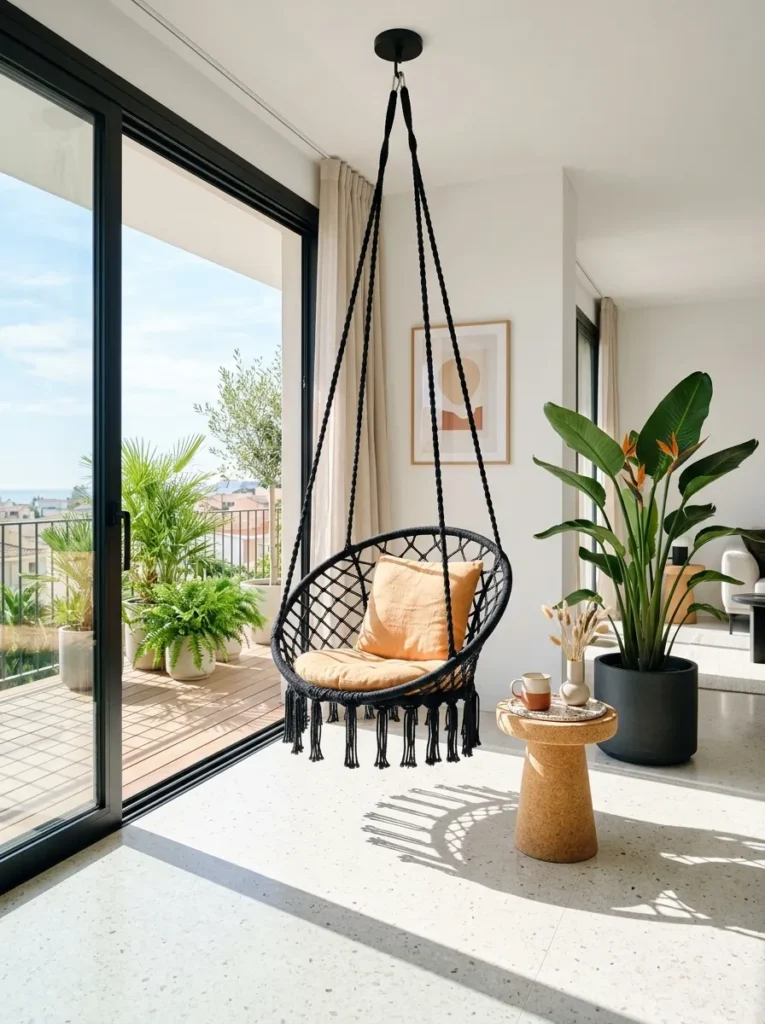
- Palette: jet-black woven cord, apricot linen, pale terrazzo with white marble chips, and matte white walls.
- Seating: a single-point hanging chair in jet-black woven cord, 28 inches wide, with an apricot linen seat cushion about 18 inches off the floor.
- Task light: a matte white adjustable-arm wall sconce, mounted 3 feet behind the chair’s resting spot at about 54 inches high and aimed over your shoulder. Use a 2700K bulb at about 700 lumens.
- Surface and storage: a 16-inch round honey-toned cork side table. A matte white floating shelf, 8 inches deep and 60 inches long, sits at 40 inches high.
- Textiles and rug: an ivory waffle-knit throw and a 5-by-7-foot ivory wool rug with a hand-drawn apricot grid.
- Plant and standout detail: a bird of paradise (Strelitzia nicolai) in a matte white pot. The pale terrazzo floor is the standout.
Why this works: A hanging chair sits at a fixed height with open space around it, so one sconce set behind its arc lights the page however you sway.
A hanging chair changes how a room feels, which is why it works so well as a reading seat. Suspended from a single point, it moves with a gentle sway that slows you down and makes a long chapter feel shorter. Place it beside a sliding glass door, and side daylight keeps the page evenly lit all morning. Jet-black woven cord reads like a line drawing against matte white walls, while the apricot linen cushion supplies warmth. Pale terrazzo underneath adds a cool, polished contrast that makes the whole corner feel designed.
I once hung a swing chair from drywall anchors, and my husband made me take it down within the hour. A hanging chair needs a ceiling joist or solid blocking behind the hook, plus a swivel rated well above the load, ideally 500 pounds or more. Leave about 30 inches of clear space around the swing’s arc. A matte white wall sconce, mounted 3 feet behind the chair’s resting spot, lights the page over your shoulder. A bird of paradise (Strelitzia nicolai) loves the bright glass-door light; keep it clear of the swing’s path.
13. Hallway Wingback Alcove
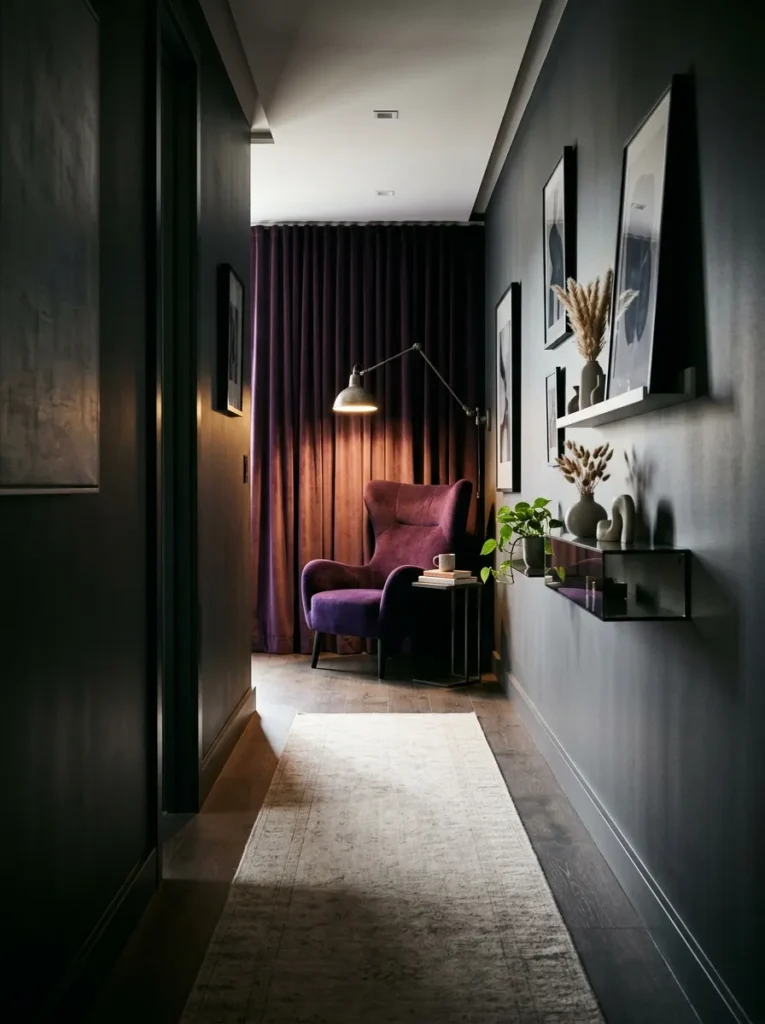
- Palette: aubergine mohair velvet, warm white walls, smoked glass, and aged pewter.
- Seating: a slim wingback chair, 28 inches wide with a 17-inch seat, upholstered in aubergine mohair velvet. The tall wings block the view down the hall.
- Task light: a wall-mounted aged pewter swing-arm lamp with a smoked-glass shade, set on the side wall about 50 inches off the floor, behind and above your shoulder. Use a 2700K bulb at about 600 lumens.
- Surface and storage: a 10-inch-deep smoked-glass wall shelf at 24 inches high holds a mug. Three stacked 4-inch-deep warm white picture ledges show book covers.
- Rug and plant: a 2½-by-8-foot warm white wool runner with a pewter stripe, plus a Dracaena fragrans ‘Janet Craig’ in a pewter-glazed pot.
- Standout detail: a floor-length aubergine wool curtain on a ceiling track, hung behind the chair to soften hallway echo.
Why this works: A high-backed chair and a floor-length curtain turn a hallway’s dead end into a room within a room without taking floor space from the walkway.
Most hallways end in a blank wall, and that blank wall is a free reading room. Building codes generally require a hallway to stay at least 36 inches wide, so keep the chair at the very end of the run, never in the walkway. A slim wingback, 28 inches wide, fits there, and its tall wings block the sightline down the hall. Aubergine mohair velvet turns a forgotten spot into a jewel-toned focal point against warm white walls. A floor-length aubergine wool curtain hung behind the chair softens hallway echo and adds a rich backdrop.
Hang the curtain track into ceiling joists with screws, not drywall anchors; my husband says wool panels weigh more than most people expect. A plug-in swing-arm lamp works if the cord is tucked into a paintable raceway; otherwise, ask an electrician to add a switched outlet at the end wall. Stack three 4-inch-deep picture ledges at the wall for books with covers facing out, and tuck a 10-inch smoked-glass shelf at 24 inches for your mug. Add a warm white and pewter runner to define the zone. A Dracaena fragrans ‘Janet Craig’ tolerates the low light of hallways.
14. Shared Loveseat Nook
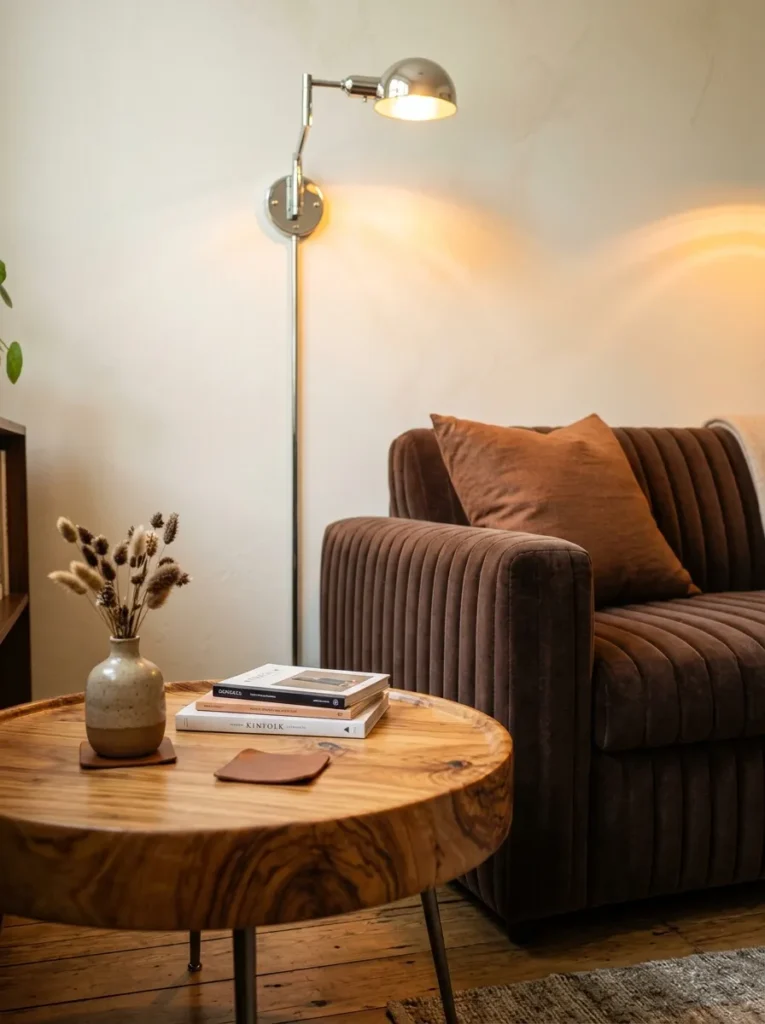
- Palette: chocolate-brown ribbed velvet, vanilla-cream walls, olive wood, and polished chrome.
- Seating: a 64-inch two-seat loveseat with a low back and a 17-inch seat in ribbed chocolate velvet, with room for two readers side by side.
- Task light: two polished chrome swing-arm sconces, one above and behind each outer shoulder, centered about 52 inches off the floor. Each has its own dimmer and a 2700K bulb at about 600 lumens.
- Surface and storage: a 22-inch round olive wood coffee table holds mugs. A 60-inch-wide, 14-inch-high vanilla-lacquered low bookcase sits under the window.
- Textiles and rug: two throws, one cream waffle and one mushroom wool, and a 6-by-9-foot low-pile wool rug in vanilla with soft brown cloud shapes.
- Plant and standout detail: a Pilea peperomioides in a ribbed white pot. The paired sconces on separate dimmers are the standout.
Why this works: Two sconces on separate dimmers let two people read side by side without sharing one beam, which is the difference between a shared nook and a crowded one.
My husband reads until midnight and I fall asleep by ten, which is how I learned that a shared reading nook needs two lights, not one. A loveseat gives two people a place to read side by side. Chocolate-brown ribbed velvet absorbs shadow and looks rich in warm light. Two chrome sconces sit above and behind each outer shoulder, each on its own dimmer, so one reader can switch off while the other finishes a chapter. Vanilla-cream walls reflect the glow back onto the page, keeping the whole alcove soft without extra lamps.
Mount swing-arm sconces to wood blocking between the studs instead of drywall anchors, because an extended arm pulls outward with real torque. Ask whoever is wiring to run both sconces through two separate switches or dimmers. Keep a 22-inch olive wood coffee table 14 inches from the loveseat edge for mugs. Under the window, a low vanilla-lacquered bookcase, 14 inches high, holds oversized books on top. A Pilea peperomioides in a ribbed white pot thrives in bright, indirect light, and it sends up baby plants you can share with the reader beside you.
15. Floor Cushion Lounge — A Cozy Reading Nook Idea for a Tight Budget
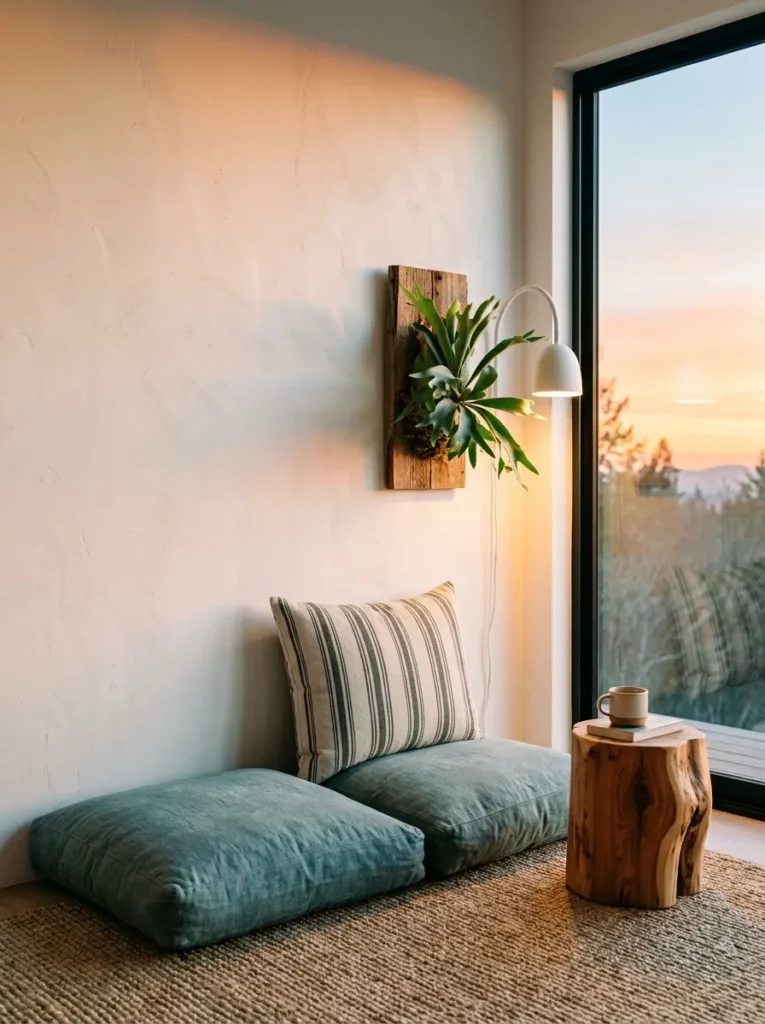
- Palette: dusty teal washed-linen cushions, charcoal ticking stripe, raw jute, and plaster-white walls.
- Seating: two 36-inch square floor cushions with 6-inch foam cores and zip-off washed-linen covers, one flat and one propped as a backrest.
- Back support: a 24-inch-tall wall-mounted back cushion in charcoal ticking stripe, hung on a French cleat. This is the standout.
- Task light: a matte white gooseneck floor lamp tucked behind the cushions, head set at about 44 inches and aimed over your shoulder. Use a 2700K bulb at about 600 lumens.
- Surface and storage: a 14-inch cross-cut cedar log stool holds a mug. Three 16-inch lidded seagrass baskets sit under a floating shelf for paperbacks and throws.
- Rug and plant: a 5-by-8-foot raw jute rug, plus a staghorn fern (Platycerium bifurcatum) mounted on a cedar plaque above.
Why this works: Floor cushions are only comfortable for long reading with a firm back support, and a wall-mounted cushion supplies it without any bulky furniture.
The cheapest nook I ever styled was also the one people fought over. A client had a bare wall and a $400 budget, so we skipped furniture and used two 36-inch floor cushions, a jute rug, and a wall-mounted back cushion. Floor seating works because there is no chair to look dated: the washed dusty-teal linen looks relaxed and current. Rest your back against the charcoal ticking stripe, and the posture settles into a gentle recline within minutes. In the evening, the matte white gooseneck lamp throws a clean beam over your shoulder, with no cord in the walkway.
The back cushion hangs on a French cleat, two boards with matching 45-degree bevels: one screwed into wall studs, the other fixed to the cushion’s plywood backer. My husband favors this method because the weight spreads across studs and the cushion lifts off for cleaning. Mount it so the cushion’s bottom edge sits 6 inches above the floor cushions. Hang a staghorn fern (Platycerium bifurcatum) on a cedar plaque above; its flat shield fronds cover the roots, so it grows happily mounted with no pot. Three lidded seagrass baskets under a floating shelf hold paperbacks and throws.
Styling Principles
Every nook above solves the same design problem: a spot that looks inviting is not the same as a spot that works for reading. These principles apply to any of them.
Put the light behind you, not above you. A reading light placed behind and slightly above seated shoulder height, roughly 5 to 10 inches above it, lights the page without glare and without your head casting a shadow. Ceiling fixtures and ambient lamps alone cannot do this job.
Choose the bulb before the fixture. A 2700K bulb at roughly 450 to 800 lumens gives enough light for print while staying warm in the evening. Amber bulbs around 2200K create beautiful mood but work better as a second layer than as the only reading light.
Dim everything you can. One dimmer lets the same lamp serve a bright afternoon chapter and a quiet late-night one.
Test the seat for an hour, not a minute. A comfortable reading chair has a seat height of about 16 to 18 inches, supports your lower back, and lets your feet rest flat or on a stool. A chair that feels fine for five minutes can still send you to the sofa after twenty.
Give every nook a surface, a shelf, and a texture. A place to set a mug, a shelf within arm’s reach, and one soft layer such as a throw or a wool rug are what turn a styled corner into a place you return to.
FAQs
1. What is the best lighting for a reading nook? The best reading nook lighting is an adjustable task light placed behind and slightly above your shoulder, using a warm 2700K bulb of roughly 450 to 800 lumens. This lights the page evenly, avoids glare, and keeps shadows off the book. Add a dimmer so you can lower it at night.
2. How do I create a reading nook in a small apartment? Use a corner, a window, or a bookcase divider to define the zone, then add a compact chair, a clamp-on or plug-in lamp, and a small side table. A 4-by-4-foot footprint is enough. Vertical shelving keeps books close without using floor space, and no drilling is needed.
3. How can I create a reading nook on a budget? Start with the lamp and the seat, since those matter most. A clamp-on task light, a secondhand chair or two floor cushions, and a basic shelf can come together for a few hundred dollars. Paint, a thrifted throw, and a trailing plant add style without adding much cost.
4. What is the best chair for long reading sessions? The best chair for long reading has firm lower-back support, a seat height of about 16 to 18 inches, and enough depth to sit comfortably for an hour or more. Swivel tub chairs, wingbacks, and chaise longues all work. Add a footstool if your feet do not rest flat.
5. How do I build a window seat? Build a plywood box frame about 17 to 18 inches high and 18 to 22 inches deep, fix wood cleats into the wall studs, and screw the frame to them. Add a 3/4-inch plywood top, trim the front, and finish with a 3- to 4-inch foam cushion. Check for heating vents and wiring first.
6. How much space does a reading nook need? A reading nook needs about 3 by 4 feet at minimum: roughly 30 inches for the chair, plus room for a side table and a lamp. A closet, a stair landing, or the end of a hallway can all provide that, as long as you can light the page from behind.
Conclusion
A great reading spot doesn’t need a big room or a big budget. It needs a comfortable seat, a light behind your shoulder, and a shelf within reach. I’ve seen how small changes like these can transform a space, and these fifteen cozy reading nook ideas prove it works in closets, corners, and porches. Choose the one that fits your home, and start with the lamp.
Save this post on Pinterest so it’s ready when you are, try one idea this weekend, and share it with a friend with a stack of unread books. Your next chapter is waiting.