21 No Headboard Bedroom Ideas That Wow
A headboard is one of the largest single furniture purchases in a bedroom, both in cost and in how much wall space it eats up. So what happens when you skip it entirely? The wall behind your bed becomes open real estate for something with far more range: architecture, lighting, art, or a bold color story. These no headboard bedroom ideas aren’t about leaving a gap unfilled. They’re about giving that wall a job a headboard never could. I’ve noticed the rooms that skip the headboard on purpose, not out of budget necessity, are usually the ones that end up feeling the most collected. Whether you’re renting, redecorating on a budget, or just tired of the same upholstered rectangle everyone else has, there’s a headboard-free approach here that will make the wall behind your bed the best part of the room.
Skipping a headboard is not a sign that a bedroom is unfinished. In fact, a headboard is one of the largest single furniture purchases in a bedroom by both cost and visual footprint, so removing it frees both your budget and the wall for something with more visual range, such as art, architecture, lighting, or textiles. I’ve found that the best headboard-free rooms feel more considered because the entire bedroom — not one oversized piece — has to work together. A low bed, layered bedding, dramatic lighting, and a strong wall treatment can look far more intentional than simply buying a large upholstered headboard. These ideas solve exactly how to make that approach feel complete.
Painted Ceiling Halo
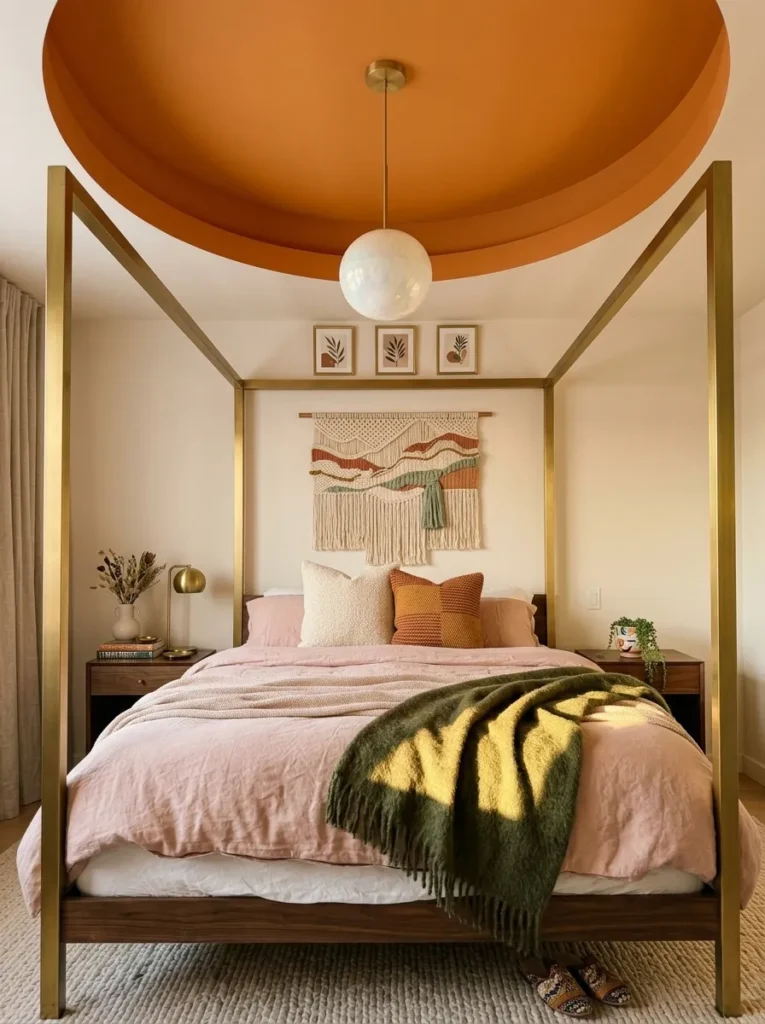
- Wall treatment: matte warm white wall behind the bed, letting the ceiling shape carry the color instead
- Ceiling: deep apricot oval painted onto the ceiling, extending about 18 inches down the wall
- Bed frame: slim brushed-brass four-post frame, no headboard panel
- Bedding: ivory cotton, pale blush linen, one terracotta-striped lumbar pillow
- Lighting: small opal pendant centered inside the painted oval
- Fact: paint is one of the only structural elements a renter can typically change without violating a lease, which is part of why ceiling color has become a workaround for architectural drama in rentals
- Rug: cream-and-apricot geometric wool rug under the lower two-thirds of the bed
Why this works: Extending color from the ceiling onto the wall gives an open bed a defined architectural zone without a single mounted object.
Most people paint a ceiling white and never look up again, which is exactly why this idea gets attention. A deep apricot oval, extended about 18 inches down the wall, turns the ceiling into the room’s actual focal point. It’s one of the few architectural-feeling changes a renter can make with just a paint sample and painter’s tape, since it doesn’t touch drywall or require patching later. A slim brass four-post frame keeps the bed visually open beneath it, so the oval reads clearly instead of competing with a solid headboard shape.
I tried a version of this in my own daughter’s room a few years back, though in a much softer dusty pink, and I was surprised how much taller the ceiling felt once the shape broke up the flat white. It’s a trick that works best in rooms with standard 8- to 9-foot ceilings, since taller rooms can swallow the effect. Keep nightstands narrow and pale so they disappear against the wall, and resist the urge to add more than one sculptural object nearby — the ceiling should stay the loudest thing in the room.
Draped Silk Wall
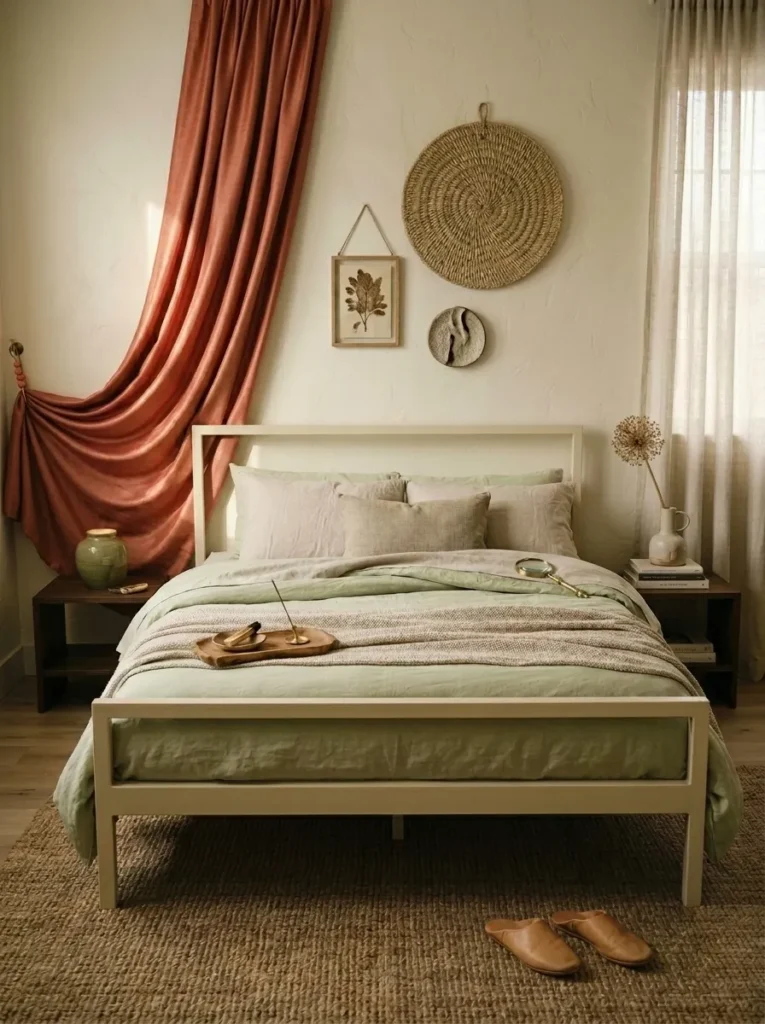
- Textile: single 90-inch-wide matte silk panel, hung from ceiling height
- Color: vivid dusty coral with subtle tonal variation
- Bed frame: low cream-painted metal frame, rounded corners
- Bedding: white linen, pale pistachio quilt, dusty-coral accent pillows
- Weight consideration: silk this size is light, typically under 3 pounds, so it doesn’t demand the heavy-duty hardware a solid textile or tapestry would
- Rug: small woven jute rug under the lower half of the bed
- Plant: compact olive tree near the window
Why this works: A single oversized textile panel replaces the visual width of a headboard while adding movement no solid surface can offer.
A headboard is fixed the day you buy it. A hung textile isn’t, and that difference matters more than people expect. This 90-inch panel of dusty-coral silk moves slightly with the room’s air currents, catching light differently through the day in a way a painted or upholstered surface never will. Because silk this size weighs only a few pounds, it hangs from a simple ceiling track or rated rod rather than anything load-bearing, which makes it one of the more approachable ideas here for anyone hesitant about wall damage. A low cream metal frame keeps the fabric visible from mattress height up.
I’ve noticed clients underestimate how much a fabric backdrop changes a room’s temperature, visually speaking. Coral silk against white linen and pistachio green reads warm without tipping into overly saturated. If your bedroom gets strong afternoon sun, ask about the fabric’s light resistance before committing, since some silks fade unevenly over a year or two of direct exposure. A sculptural ceramic floor lamp in one corner and a small olive tree by the window round the room out without pulling focus from the coral itself.
Floating Bubble Mirror
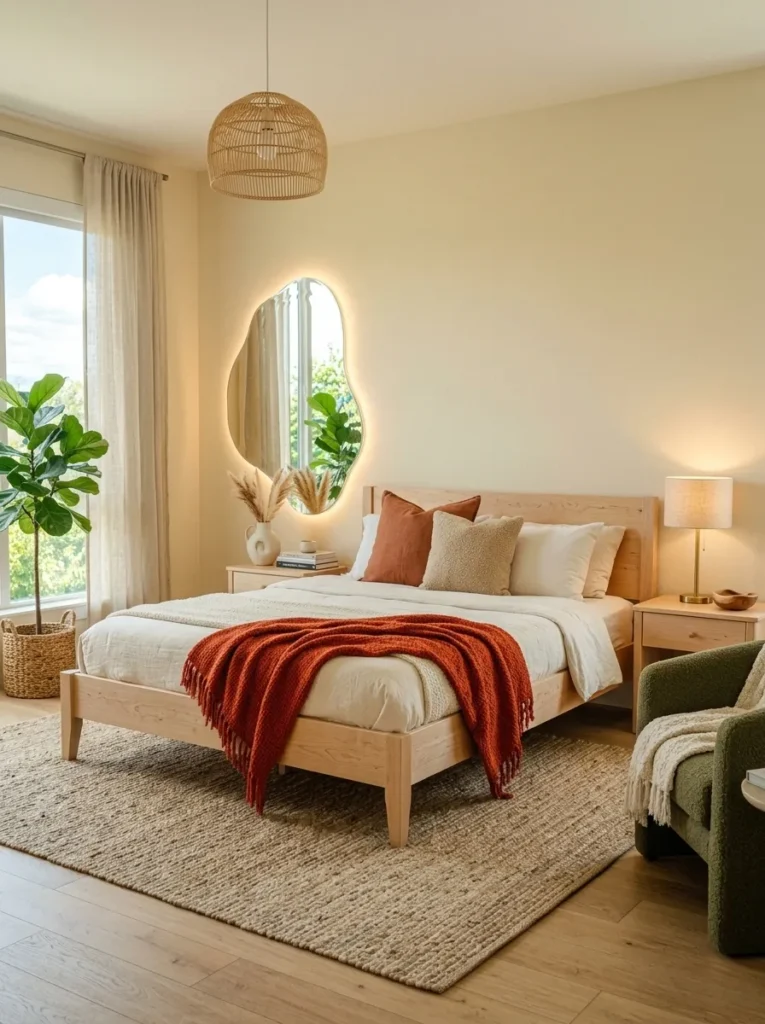
- Mirror: oversized 48-inch irregular oval mirror, softly rippled edge
- Placement: centered above the mattress, with an intentional 8-inch gap left open
- Bed frame: natural-birch low platform, rounded corners
- Wall: matte buttercream paint
- Bedding: ivory bedding, vivid persimmon throw
- Construction note: a mirror this size typically weighs 15 to 25 pounds depending on the frame, so it needs to land on at least one stud or use anchors rated for that weight — never picture-hanging strips alone
- Lighting: concealed LED strip behind the mirror’s perimeter
Why this works: An oversized, irregularly shaped mirror adds dimension to a headboard-free wall while keeping the bed itself visually open.
A rectangular mirror reads as furniture. An irregular one reads as art, and that small shift is really what makes this idea work. The rippled 48-inch oval, left with an 8-inch gap above the mattress rather than mounted flush, catches distorted reflections of the room that shift depending on where you’re standing. Hidden LED lighting behind its edge makes the whole shape appear to float once the sun goes down, which is a detail that photographs especially well for anyone documenting the process on Pinterest.
My husband’s rule for anything mirror-sized is simple: locate the studs before you fall in love with the mirror. A piece this size can run 15 to 25 pounds depending on the frame material, and on plaster walls especially, that means finding real structural support rather than trusting a decorative hook rated for a picture frame. Once it’s properly mounted, though, this is one of the lower-maintenance ideas on the list — no fabric to fade, no plant to water, just a reflective surface that makes a smaller bedroom feel like it has an extra window.
Oversized Botanical Silhouette
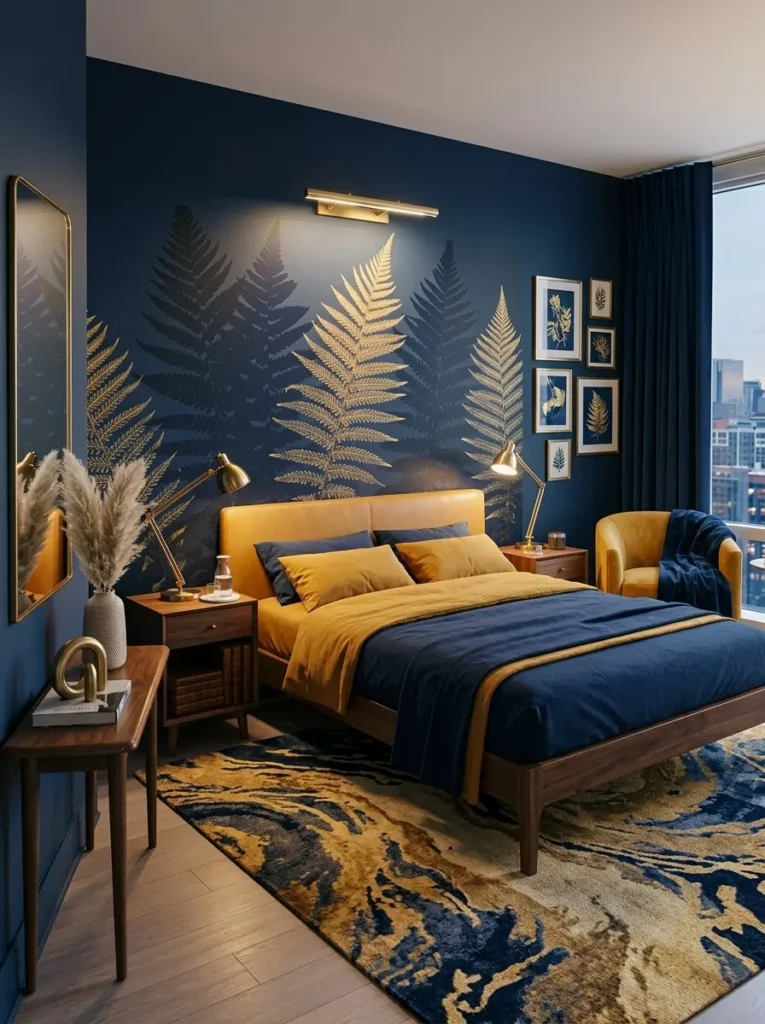
- Artwork: single 60-by-84-inch cyanotype-style botanical panel
- Color: indigo botanical silhouettes on warm ivory
- Bed frame: low camel-brown leather platform
- Bedding: oatmeal linen, saffron-yellow coverlet
- Fact: a print under roughly 30 inches wide tends to visually disappear above a queen or king bed, which is why scale, not subject matter, is usually the reason bedroom art falls flat
- Lighting: narrow ceiling-mounted picture light
- Plant: tall bird-of-paradise, several feet from the bed
Why this works: A single oversized botanical composition gives an open bed frame strong vertical presence without relying on a curated gallery wall.
Scale is the detail most people get wrong with bedroom art, and it’s rarely about taste. A print under about 30 inches wide tends to visually shrink to nothing above a queen or king bed, no matter how good the image is. This 60-by-84-inch cyanotype panel avoids that problem entirely, filling enough wall space to feel intentional rather than like an afterthought hung too small. As someone who came to home decor through plant science, I’m always drawn to botanical work that reads more graphic than literal — oversized fern silhouettes in deep indigo do exactly that, without tipping into anything too literal or twee.
A narrow picture light angled to skim across the surface, rather than flood it from directly above, brings out texture in the paper that flat overhead lighting would flatten. Position the bird-of-paradise a few feet away from the artwork itself, not directly beside it, so the plant’s leaves and the panel’s silhouettes read as two separate visual layers instead of blurring together. If the piece is framed under glass, factor that added weight into your mounting hardware before hanging it.
Clay-Colored Cocoon
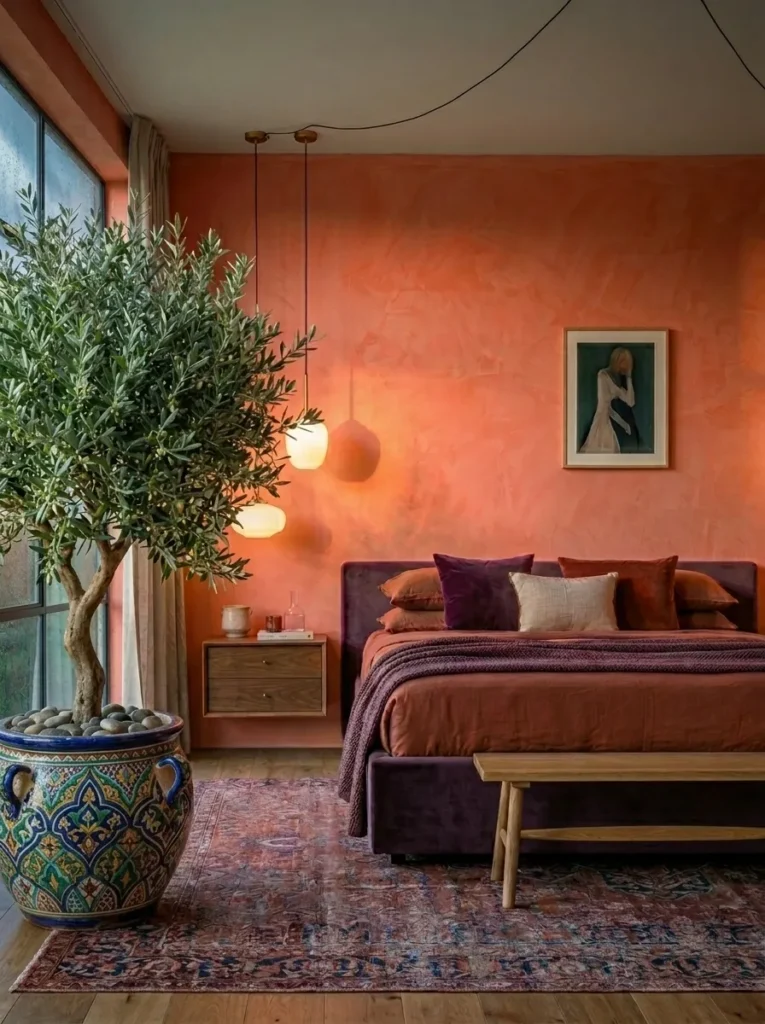
- Wall treatment: matte coral-clay plaster, wrapped floor to ceiling behind the bed
- Palette: coral clay, cream, caramel, dark plum
- Bed frame: low natural-cane platform
- Bedding: ivory linen, caramel quilting, one dark-plum lumbar cushion
- Fact: plaster naturally diffuses and softens light rather than reflecting it sharply the way flat paint does, which is part of why plastered rooms tend to photograph warmer at any time of day
- Lighting: two milk-glass globe pendants at different heights
- Rug: faded Persian-style rug in rust, cream, and plum
Why this works: Wrapping the entire wall in one plaster finish gives the bedroom a cohesive envelope, letting the headboard idea disappear entirely.
The most convincing headboard-free bedrooms often stop trying to replace the headboard at all. Here, the whole sleeping wall becomes a clay-colored envelope, plastered from baseboard to ceiling in a matte coral-clay finish. Plaster behaves differently than paint in a room like this — it diffuses light instead of bouncing it back sharply, so the wall looks warm and soft even under ordinary daylight, not just at golden hour. A low cane platform sits against it, dressed in ivory linen, caramel quilting, and one dark-plum lumbar cushion, with two milk-glass pendants hung at slightly different heights beside curved walnut nightstands.
What makes this feel like a finished room rather than a decorated bed is repetition of shape rather than repetition of color. The rounded cane frame, curved nightstands, globe pendants, and a faded Persian-style rug all echo one another in softness. I’ve seen clay-plastered accent walls become the room people photograph first when showing friends their house, mostly because the texture reads as custom even when it was a weekend project. Keep additional furniture minimal so the wrapped wall stays the clear visual priority, and let a tall olive tree near the window be the only living counterpoint to all that saturated color.
Indigo Window Alcove
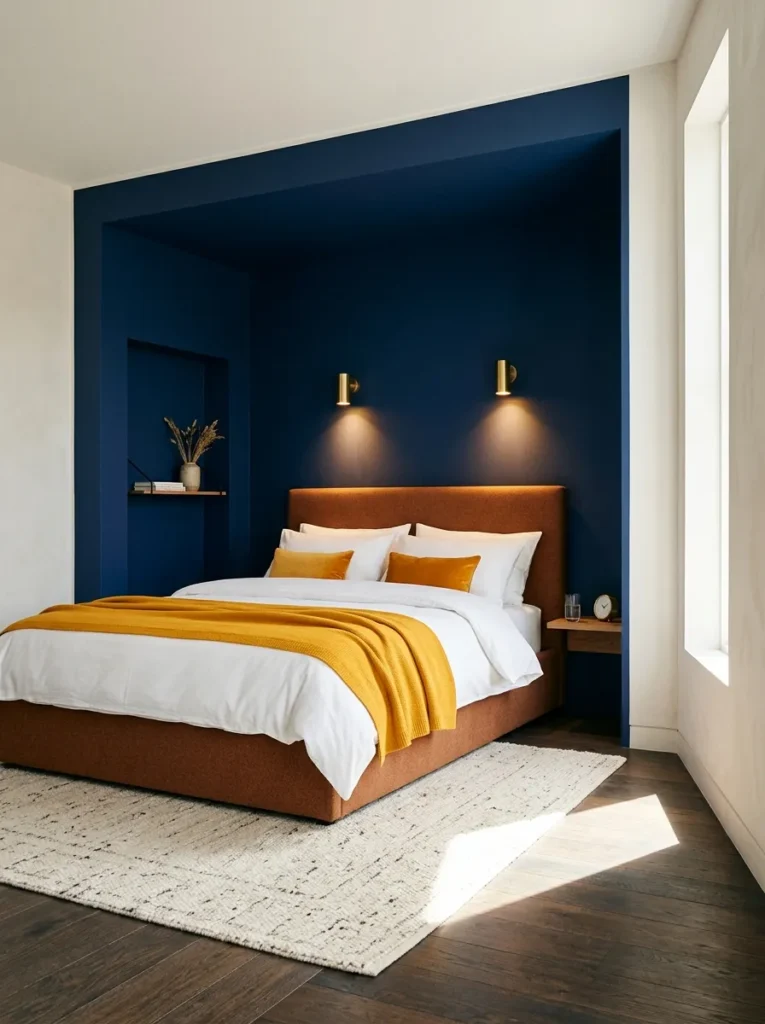
- Architecture: shallow 6-inch-deep framed alcove, roughly 84 inches wide
- Color: saturated indigo inside the recess, warm ivory on the surrounding walls
- Bed frame: low cinnamon-brown upholstered platform
- Bedding: white percale, dusty-lavender shams, saffron coverlet
- Construction note: before cutting into an existing wall for any recess, my husband always checks for wiring and plumbing runs first — a 6-inch depth is usually shallow enough to clear most standard framing, but it should never be assumed
- Lighting: slim brass reading lights mounted inside the alcove
- Rug: cream rug with cinnamon and indigo geometry
Why this works: A shallow architectural recess gives the bed a custom-built setting without adding a separate headboard.
An alcove can make an ordinary bedroom wall look custom-built without placing a single headboard behind the mattress. Frame a shallow six-inch recess about 84 inches wide, then paint its interior saturated indigo while the surrounding walls stay warm ivory. A low cinnamon-brown upholstered platform sits inside it, layered with white percale, dusty-lavender shams, and a saffron throw. Two slim brass reading lights are built into the recess itself, while floating ivory nightstands keep the floor visible below.
This is one of the strongest options for a renovation or new build, because the architecture gets designed around your exact mattress and frame dimensions rather than adjusted after the fact. Before any wall gets opened, my husband’s crew always locates wiring and plumbing runs first — a 6-inch recess depth usually clears standard framing, but “usually” isn’t a word you want attached to a structural decision, so it’s always confirmed, never assumed. Done properly, the payoff is real: the bed looks built into the architecture, while the open platform silhouette keeps the room from feeling visually heavy despite the bold indigo color.
Sculptural Pendant Pair
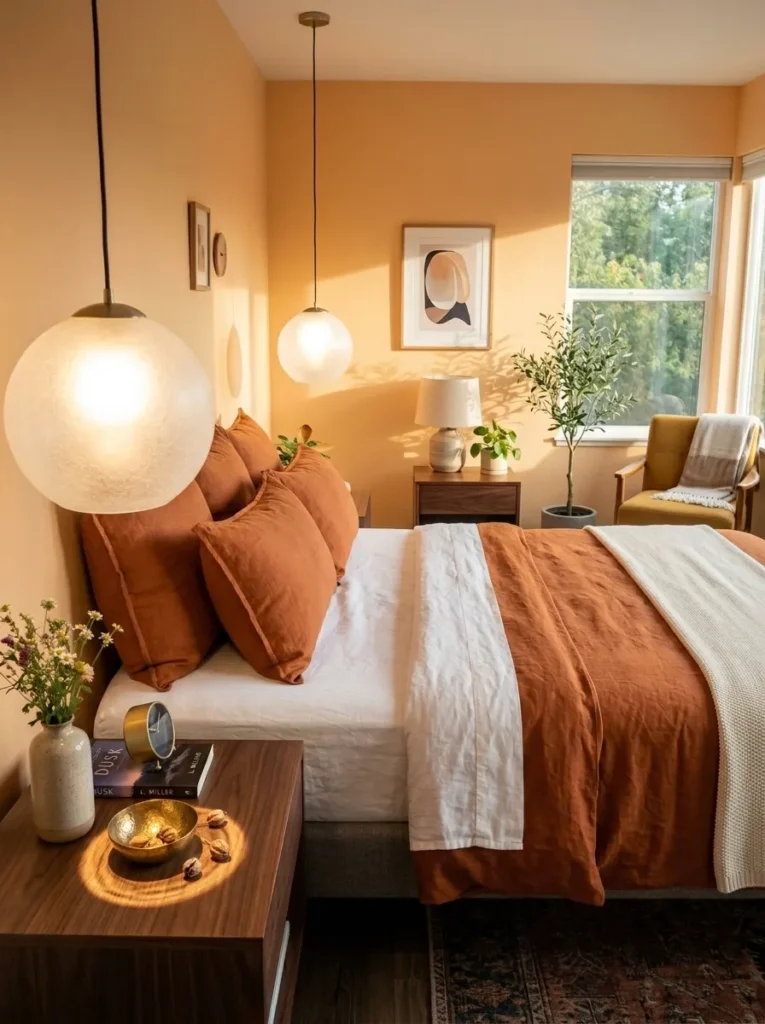
- Lighting: two oversized frosted-glass pendants, hung at different heights beside the bed
- Wall color: pale apricot limewash
- Bed frame: slim walnut sled platform
- Bedding: cream linen, dusty-blue sheets, burnt-orange blanket
- Nightstands: rounded travertine cubes
- Fact: mismatched fixture heights create asymmetry that the eye reads as deliberate design rather than as an installation mistake, which is why designers increasingly avoid perfectly matched pendant pairs
- Rug: oatmeal wool rug with an irregular border
Why this works: Oversized lighting placed beside the bed defines the sleeping zone from the sides, leaving the wall entirely free of headboard furniture.
Instead of putting the visual weight behind the bed, this idea puts it beside it. Two oversized frosted-glass pendants hang at deliberately different heights, which sounds like a small detail but changes the whole read of the room — mismatched heights signal intention, where a perfectly matched pair can start to feel like a furniture-store display. Below them, a slim walnut sled platform carries cream linen, dusty-blue sheets, and a burnt-orange woven blanket, while rounded travertine cubes stand in for bulky nightstands.
This arrangement works especially well when the wall behind the bed is narrow, oddly proportioned, or simply too nice architecturally to cover up. The pendant pair establishes a strong vertical rhythm on either side of the mattress while leaving the actual wall as breathing room. Use dimmable bulbs and always follow the fixture’s electrical rating rather than improvising the installation — if new wiring is going in during a renovation, center the junction boxes precisely before the wall gets finished, since moving them after drywall is a much bigger job than getting it right the first time.
Patterned Wallpaper Wrap
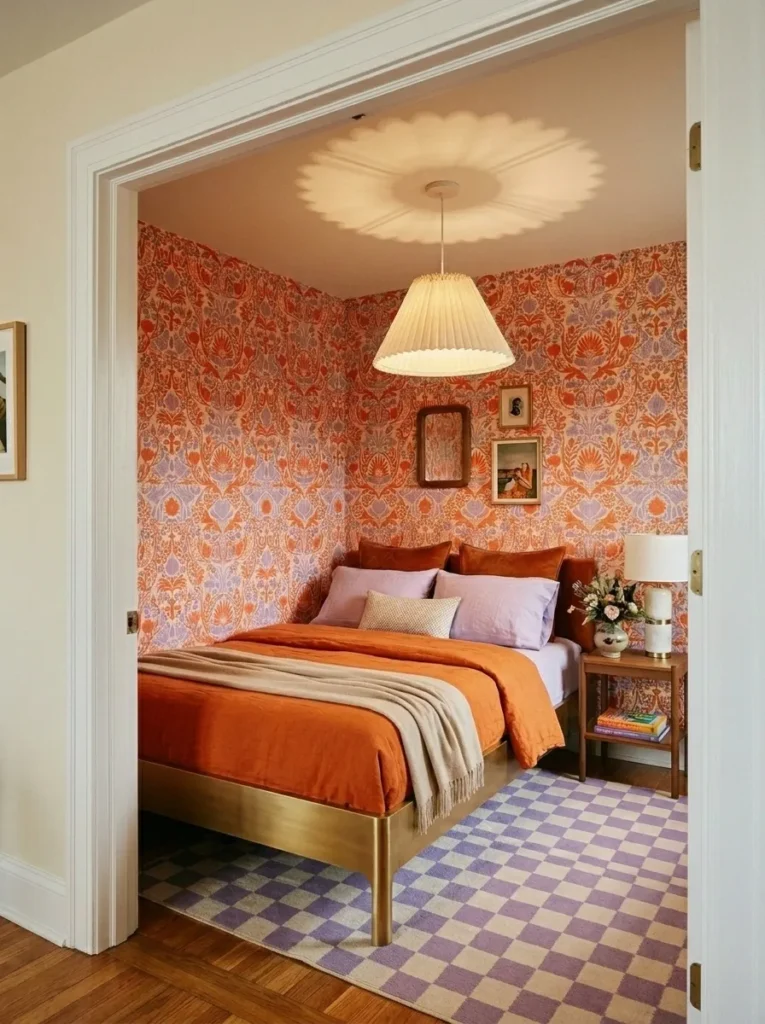
- Wallpaper: covers the bed wall and continues 12 inches onto each adjacent wall
- Pattern: oversized tomato orange, ivory, and muted lavender brushwork
- Bed frame: rounded matte-white metal platform
- Bedding: ivory cotton, lavender linen, tomato-orange quilt
- Rental note: removable wallpaper has come a long way in the last several years — it can achieve the same wrapped-corner effect as traditional paper, provided the wall surface is smooth and the product is rated for the removal timeline your lease requires
- Lighting: pleated linen ceiling pendant with brass canopy
- Rug: faded lavender-and-cream checkerboard wool rug
Why this works: Wrapping bold wallpaper slightly around the corners makes the sleeping area feel like a deliberately designed room within a room.
Wallpaper becomes far more convincing when it refuses to stop at the bed wall. This oversized hand-painted pattern in tomato orange, ivory, and muted lavender wraps 12 inches around both adjacent corners rather than stopping in a clean vertical line. A rounded matte-white metal platform sits against it, layered with ivory cotton, lavender linen, and a tomato-orange quilt. That partial wrap is really what separates this from an ordinary feature wall — stopping precisely at the corner reads as a decorating decision, while carrying the pattern around it makes the whole sleeping area feel enveloped.
If you rent, removable wallpaper has improved enough in recent years that it can achieve nearly the same effect, as long as the wall surface is smooth enough for good adhesion and the product is rated for how long you plan to leave it up before removal. I always tell people to test a small piece in a closet first, since older or textured plaster walls sometimes reject removable adhesive unevenly. Keep the rest of the bedroom’s walls quieter and repeat the lavender sparingly elsewhere so the room reads as one composition, not a collection of separately decorated surfaces.
Terracotta Stripe Wall
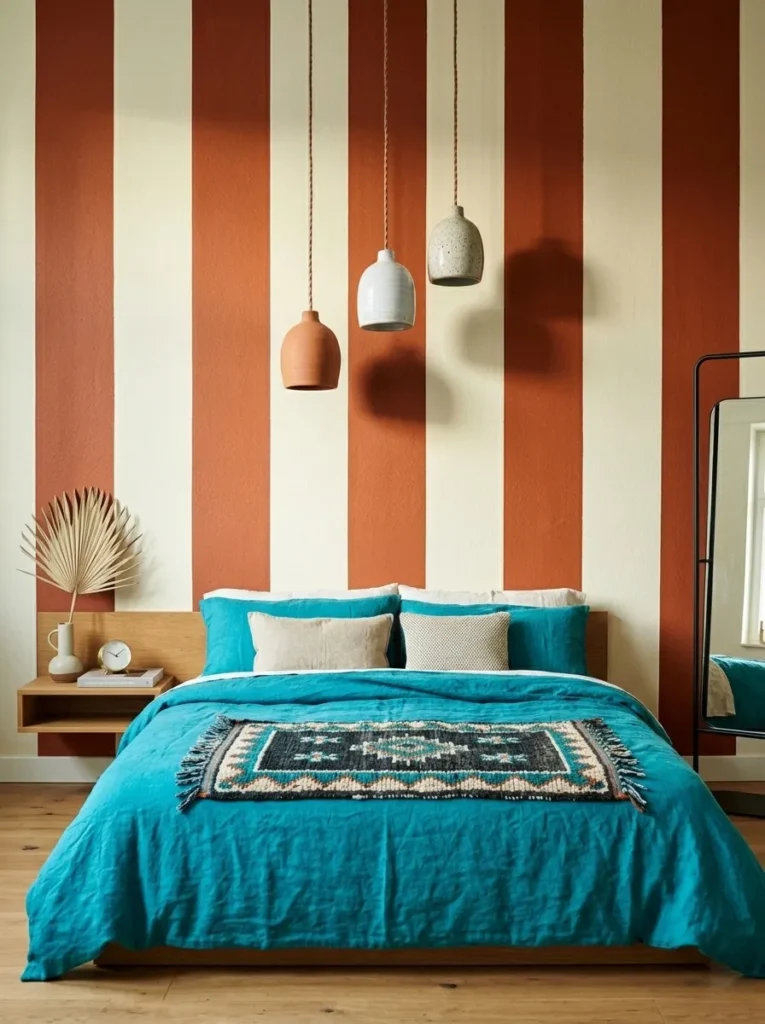
- Wall treatment: broad 18-inch vertical stripes, alternating dusty terracotta and warm ivory
- Bed frame: low oatmeal upholstered platform
- Bedding: white cotton, cinnamon linen shams, muted turquoise throw
- Technique note: stripes should terminate at the ceiling line rather than stop behind the mattress — ending them early is the detail that makes a striped wall read as painted furniture instead of architecture
- Lighting: two sculptural off-white ceramic pendants
- Rug: vintage rug in terracotta, turquoise, cream, and charcoal
Why this works: Broad painted stripes give a headboard-free bed a strong vertical backdrop while tying the whole bedroom palette together.
Vertical stripes can make a headboard-free bedroom feel intentionally architectural without adding an inch of physical depth. Alternating 18-inch bands of dusty terracotta and warm ivory run from floor to ceiling behind the bed, with a low oatmeal upholstered platform sitting in front of them. White cotton bedding, cinnamon linen shams, and a muted turquoise throw layer in color without competing against the stripes themselves. The turquoise is doing real work here — it’s an unexpected pairing against the earthy terracotta that keeps the whole palette from reading as another neutral bedroom.
The detail that makes or breaks this idea is where the stripes stop. I’ve seen well-painted stripes look accidentally like a headboard shape simply because they ended right behind the mattress instead of running all the way to the ceiling. Carrying them the full height of the wall is what tips the treatment into architecture instead of furniture. A low upholstered platform is the right companion because its simple silhouette leaves the striped pattern fully visible, and irregular off-white ceramic pendants add a sculptural counterpoint without pulling focus from the wall itself.
Floor-to-Ceiling Curtains
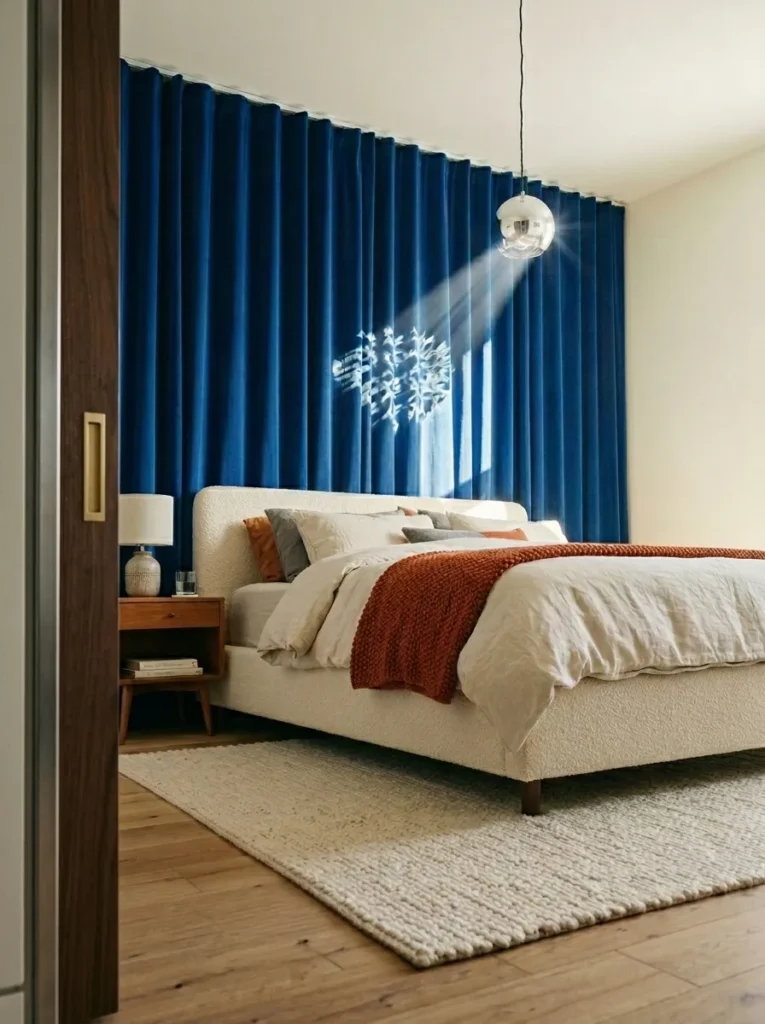
- Textile: full-height pleated curtains across the wall behind the bed
- Color: electric-blue linen-blend
- Bed frame: low cream bouclé platform
- Bedding: crisp white bedding, burnt-orange blanket, pale-lavender accent pillow
- Fact: floor-to-ceiling curtains are one of the most reliable ways to visually raise a standard 8-foot ceiling, since mounting the track at the ceiling line rather than just above the window draws the eye upward along an unbroken vertical line
- Lighting: sculptural chrome pendant, hung slightly forward of the curtains
- Rug: ivory rug with thin cobalt and rust lines
Why this works: Full-height curtains turn the entire bed wall into a soft architectural surface while staying completely reversible.
A wall of electric-blue linen-blend curtains can be far more dramatic than an ordinary headboard, and mounting the track at true ceiling height rather than just above where a window frame would sit is the detail that makes it work. That small choice draws the eye up along one unbroken vertical line, which is one of the most reliable tricks for making a standard 8-foot ceiling feel taller. A low cream bouclé platform sits directly in front of the curtain wall, kept simple in crisp white bedding, burnt orange, and one pale-lavender pillow so the blue stays the star.
Curtains also solve a problem paint and plaster can’t: they hide an unattractive wall, uneven texture, or rental-grade finish completely, and they come back down just as easily as they went up. Keep the hem just above the floor so the folds stay crisp instead of pooling, and if the room gets strong afternoon sun, choose a fabric with reasonable light resistance or add a liner for both privacy and protection. Pale-oak nightstands on either side and an ivory rug marked with thin cobalt and rust lines connect the dramatic wall back down to the floor.
Plum Velvet Drama
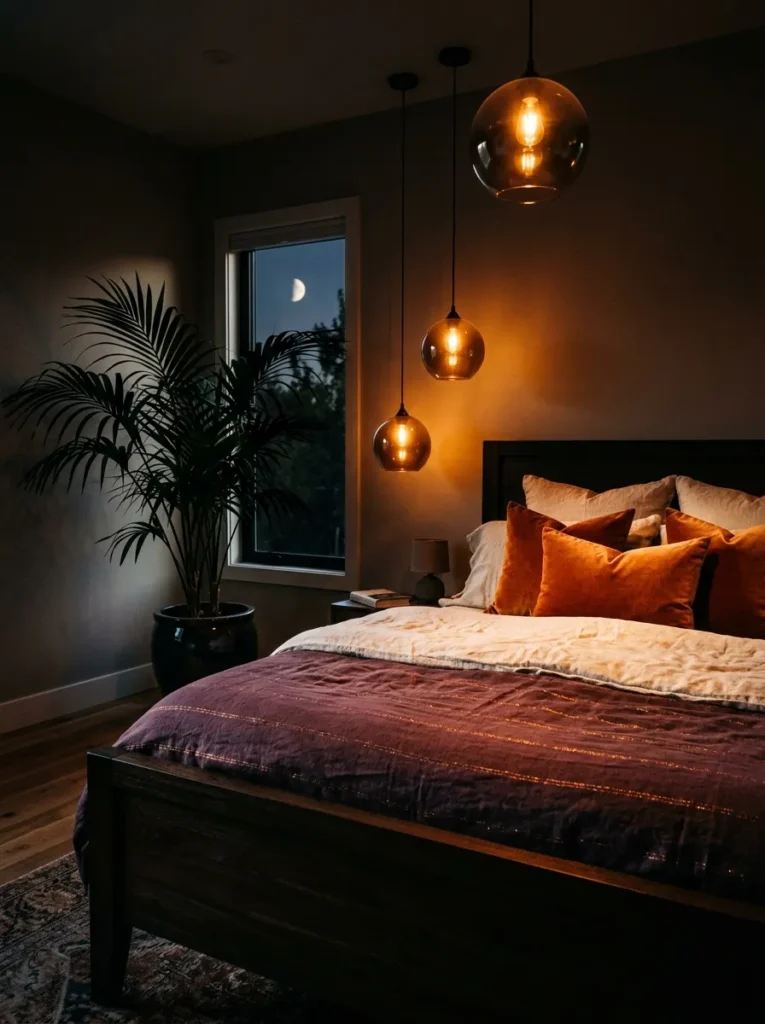
- Bed frame: low-profile curved ivory bouclé platform
- Bedding: ivory sheets, dusty-rose duvet, deep-plum quilt, rust velvet pillows
- Wall hanging: 72-by-84-inch abstract textile in plum, copper, blush, and cream
- Fact: velvet’s pile absorbs ambient light rather than reflecting it, which is why dark velvet pieces read as more dramatic in person than they photograph under flat lighting — dimmed, warm-toned bulbs bring that texture back out
- Lighting: three smoked-glass pendants at different heights
- Rug: faded Persian rug in plum, copper, dusty rose, and cream
Why this works: Deep plum, copper, velvet, and glass give the bedroom theatrical depth without needing a headboard to anchor it.
This bedroom should feel like someone turned down the lights and made every surface more dramatic. It starts with a curved ivory bouclé platform, built up in layers: crisp ivory sheets, dusty-rose duvet, deep-plum quilt, and oversized rust velvet pillows. Behind it, a 72-by-84-inch abstract textile mixes plum, copper, blush, and cream. Velvet is doing quiet work here that’s easy to overlook — its pile absorbs light rather than bouncing it back, which is why the pillows can look almost flat under a bright overhead fixture but come alive under the three smoked-glass pendants hung at different heights beside the bed.
The drama really comes from contrast rather than clutter. Velvet absorbs light, smoked glass catches it, copper reflects it, and ivory keeps the darker colors from swallowing the room whole. A kentia palm rising from a charcoal planter adds one living, irregular shape against all that saturated color. Let the textile stay the largest visual statement and repeat its colors through a few smaller objects instead of adding more artwork — a curved bouclé bench and black nightstands are enough structure to finish the room.
Scarlet Silk Cascade
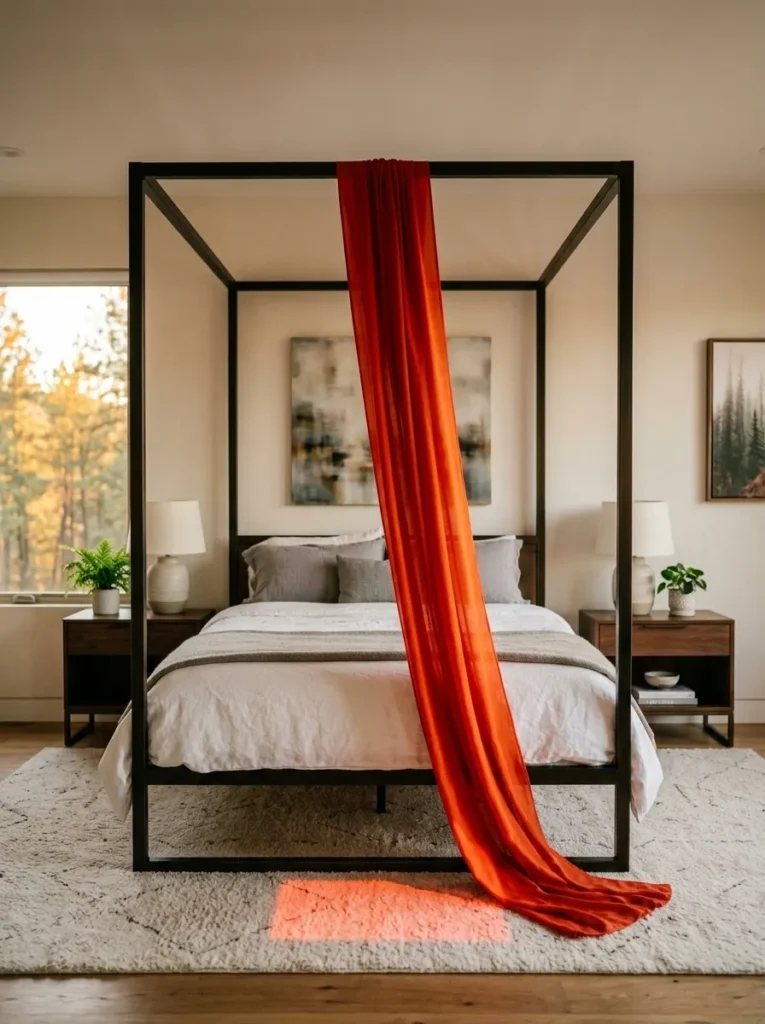
- Bed frame: low blackened-bronze metal platform, rounded corners
- Bedding: ivory linen, pale-blush duvet, crimson quilt, cinnamon velvet lumbar pillow
- Wall hanging: floor-length scarlet silk textile, hung from a ceiling-mounted brass rail
- Design principle: leaving one side of the wall exposed instead of covering it entirely gives the fabric architectural weight — full coverage reads as a curtain, partial coverage reads as intentional art
- Lighting: oversized white alabaster pendant
- Rug: cream rug with a burgundy and blush border
Why this works: One dramatic, asymmetrically hung textile replaces the visual mass of a headboard while the rest of the room balances its color.
A scarlet silk cascade can turn a headboard-free bedroom into something closer to a boutique suite, and the asymmetry is what makes it work rather than the color alone. One floor-length panel hangs from a slim brass ceiling rail, offset to one side behind a low blackened-bronze platform, so the fabric falls uninterrupted on one edge while the other side of the wall stays exposed. That negative space is doing real work — cover the whole wall and the silk reads as a curtain; leave half the wall bare and it reads as an art installation. The bed itself stays simple: ivory linen, pale-blush duvet, crimson quilt, and one cinnamon velvet lumbar pillow.
For the ceiling rail, use hardware properly rated for the fabric’s weight and secure it into real structural support — a heavy textile should never depend on adhesive hooks, no matter how sturdy the packaging claims. A white alabaster pendant hangs over the bed to soften the drama with a gentler, more diffused light source, while a glossy rubber plant in an ivory stone planter and a cream rug edged in burgundy and blush keep the rest of the room grounded and quiet against all that scarlet.
Cobalt Canopy Moment
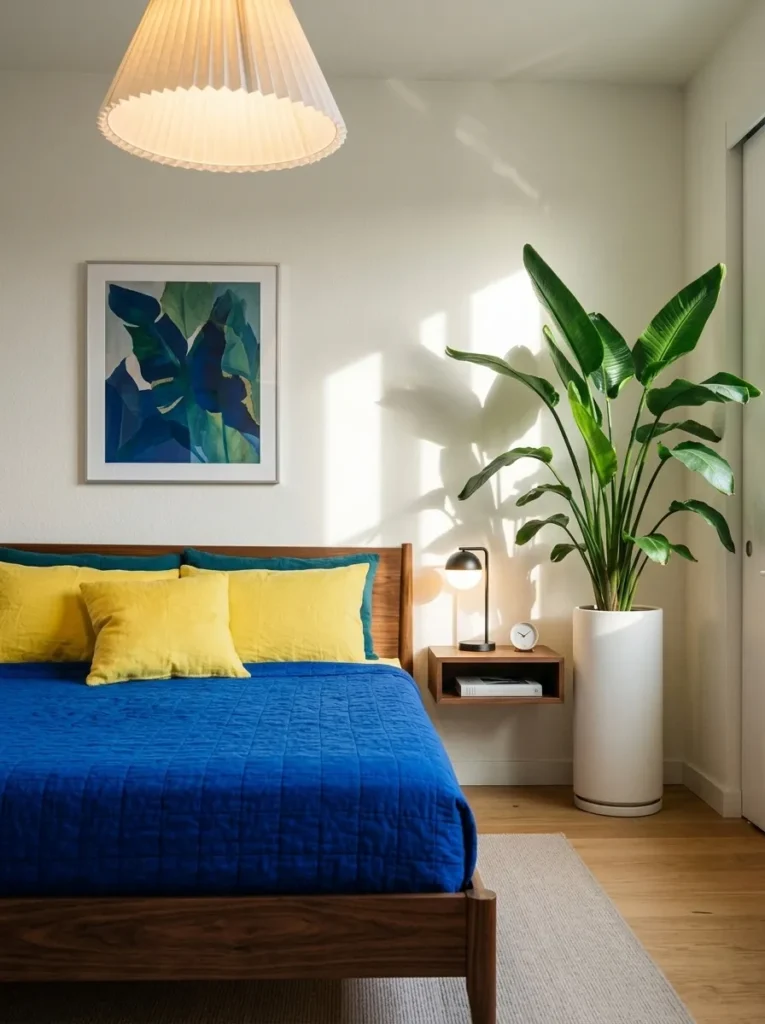
- Bed frame: low natural-maple platform
- Bedding: white percale, pale gray-blue linen, saturated cobalt quilt, butter-yellow velvet cushions
- Wall hanging: large hand-painted canvas textile in cobalt, ivory, and ochre
- Styling note: leave a visible gap of wall between the textile and the mattress — closing that gap makes the artwork read as a disguised headboard instead of an independently mounted piece
- Lighting: sculptural pleated-paper pendant, hung low over the bed
- Rug: ivory rug with irregular cobalt brushstrokes
Why this works: Cobalt bedding, botanical foliage, and warm yellow accents give an open bed frame enough visual energy to stand entirely on its own.
This is the bedroom to choose when the goal is unapologetically colorful but still grown-up. A low maple platform disappears beneath white percale, pale gray-blue linen, a saturated cobalt quilt, and butter-yellow velvet cushions, while a hand-painted textile above combines cobalt, ivory, and ochre in oversized abstract strokes. The palette works because each color occupies its own surface instead of competing for the same one — cobalt belongs to the textile and quilt, yellow stays mostly in the cushions, and terracotta lives only in the bird-of-paradise planter by the window.
I’ve noticed this is the idea people get most nervous about before trying, and then most attached to once it’s finished. The maple platform is deliberately simple, since its only job is keeping the floor plan light against all that saturated color above it. Leave a visible band of wall between the textile and the mattress rather than hanging it flush — that gap is what keeps the piece reading as intentionally mounted art instead of an accidental headboard stand-in, and it’s a detail almost every competing idea online skips entirely.
Aubergine Hotel Bedroom
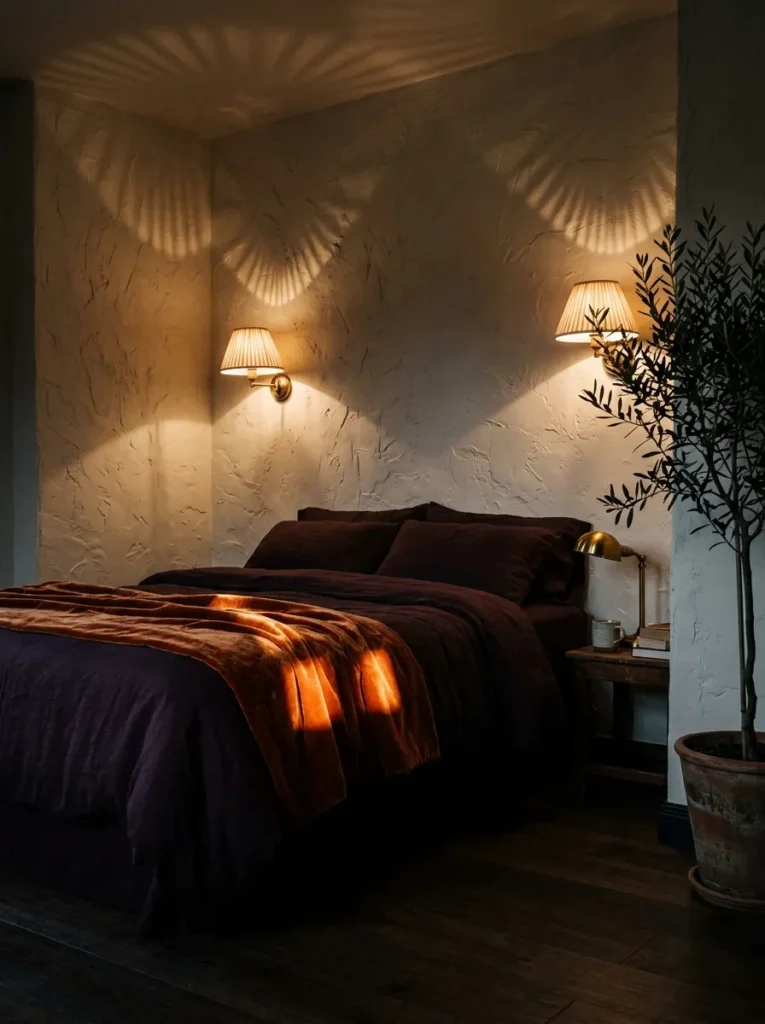
- Bed frame: low camel-colored performance-fabric platform
- Bedding: cream cotton, mauve linen duvet, aubergine quilt, burnt-orange velvet pillows
- Wall hanging: large sculptural ivory plaster relief
- Material logic: the room’s expensive feel comes from mixing surface finishes, not price tags — matte plaster, reflective brass, smooth walnut, and absorbent velvet all behave differently under light, which is what real hotel design leans on
- Lighting: oversized pleated-shade sconces on aged-brass arms
- Rug: geometric design in cream, aubergine, camel, and burnt-orange
Why this works: Hotel-style material layering and sculptural wall art make the bedroom feel luxurious without needing a headboard to anchor it.
Think boutique hotel rather than traditional bedroom. A camel performance-fabric platform sits low beneath cream cotton sheets, mauve linen, an aubergine quilt, and burnt-orange velvet pillows, while a large ivory plaster relief above adds real physical texture instead of another flat piece of furniture. What actually reads as expensive here isn’t any single item — it’s the mix of surface finishes. Matte plaster diffuses light, aged brass catches and throws it, smooth walnut reflects it evenly, and velvet absorbs it entirely, and that variation is closer to what hospitality designers actually rely on than any individual splurge purchase.
For the pleated sconces on either side, mounting has to match the fixture’s actual electrical requirements — they need a proper junction box or structural anchor point, not just a decorative screw into drywall, since they’re both heavier and wired differently than a simple picture frame. A low bed base leaves plenty of wall exposed for the plaster relief to read clearly as art, while an olive tree in a matte-black planter and a slim camel bench finish the room without crowding it. Nothing here should look overly matched — that’s what keeps it feeling curated instead of purchased as a set.
Emerald-Free Jewel Box
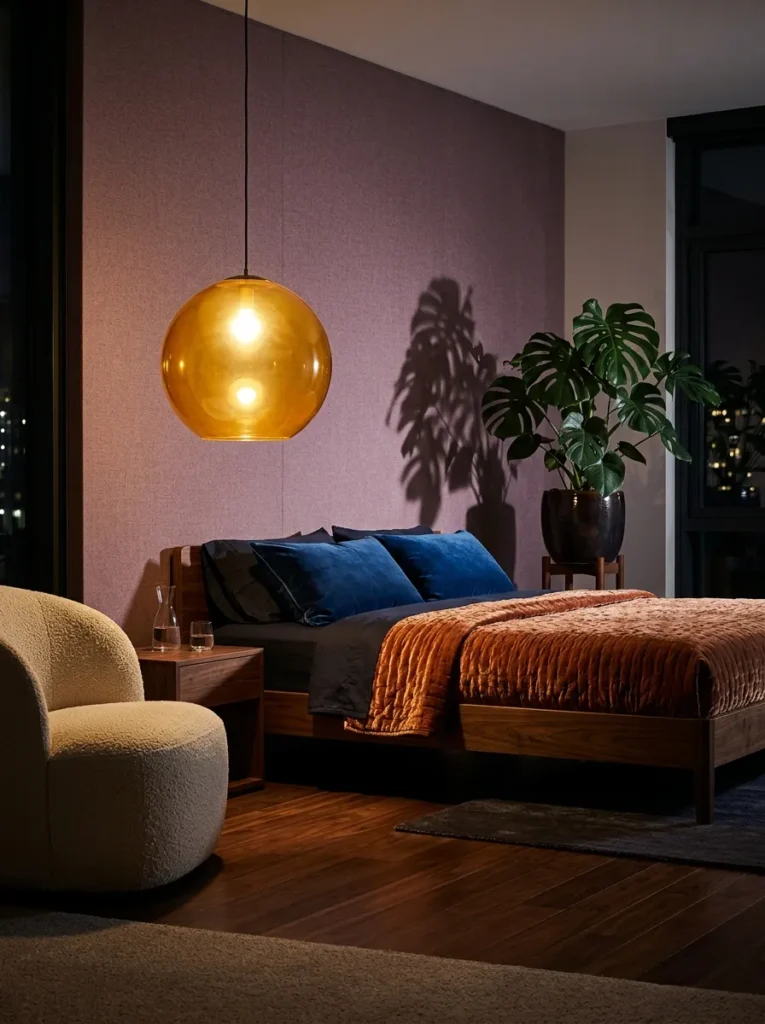
- Bed frame: low upholstered platform in pale mushroom bouclé
- Bedding: ivory sateen, dusty-lilac duvet, copper quilt, deep sapphire velvet cushions
- Wall hanging: oversized geometric textile in sapphire, copper, ivory, and mauve
- Palette note: most jewel-tone bedroom content defaults to emerald and gold — this room proves the same saturated, layered mood works entirely without either, which keeps the look from feeling like a repeat of what’s already everywhere
- Lighting: dramatic oversized amber-glass pendant
- Rug: faded mauve rug with copper and sapphire details
Why this works: Sapphire, copper, lilac, and mushroom create a genuinely jewel-toned bedroom without leaning on the familiar emerald-and-gold formula.
This jewel-box bedroom takes the saturated route without falling into the most familiar version of it. Most jewel-tone bedroom inspiration defaults to emerald and gold almost automatically, which is exactly why this room deliberately avoids both — a mushroom bouclé platform, ivory sateen, dusty lilac, a copper-toned quilt, and deep sapphire velvet cushions prove the same rich, layered mood works with an entirely different set of colors. A large geometric textile in sapphire, copper, ivory, and mauve hangs above the bed, while an amber-glass pendant glows overhead.
The strongest detail is the relationship between that amber pendant and the copper quilt — they belong to the same warm family but sit on completely different surfaces, so the room feels coordinated without looking like it came from one matching collection. Sapphire supplies the cooler counterpoint, and lilac bridges the two. Keep the wall textile oversized but relatively flat so the room doesn’t get physically crowded, and if you want more drama after dark, dim the amber lighting low and let daylight reveal the cooler sapphire tones during the day instead.
Burgundy Canopy Glow
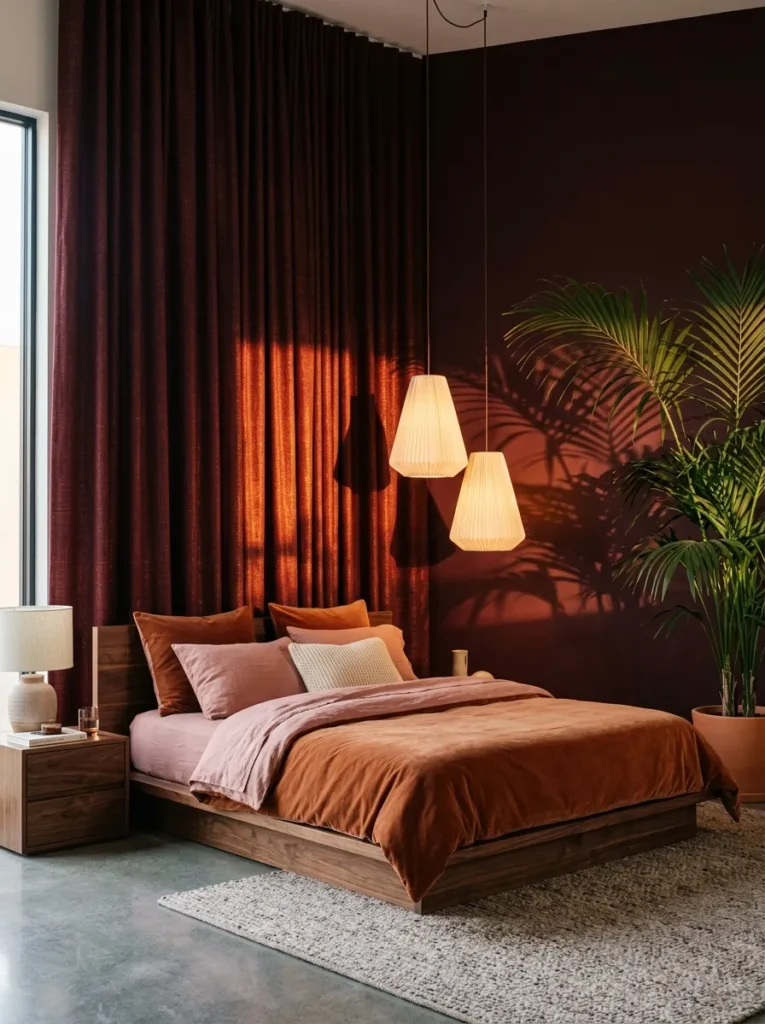
- Bed frame: low natural-walnut platform, softly rounded corners
- Bedding: ivory linen, dusty-pink duvet, burgundy quilt, cinnamon velvet pillows
- Wall hanging: large woven textile in burgundy, blush, copper, and cream
- Design principle: the textile, pendants, and palm all reach upward at different points across the wall, which is why the space never reads as unfinished even with nothing directly behind the mattress
- Lighting: two oversized pleated-paper pendants at different heights
- Rug: faded cream rug with burgundy and dusty-pink details
Why this works: Burgundy, blush, walnut, and copper give a simple platform bed the drama of a boutique suite without adding a headboard.
A low walnut platform can look remarkably luxurious once the rest of the room is layered with intention. Ivory linen, a dusty-pink duvet, burgundy quilt, and cinnamon velvet pillows sit beneath a large woven textile in burgundy, blush, copper, and cream, hung above the mattress. Two pleated-paper pendants glow at different heights beside the bed, while a kentia palm rises from a weathered terracotta planter nearby. The real trick here is vertical rhythm: the textile, the pendants, and the palm all reach upward from different points on the wall, so the eye keeps moving instead of landing on one empty gap where a headboard would normally sit.
I’ve noticed that rooms built this way rarely feel unfinished, even without anything directly behind the mattress, because there’s always something drawing the eye upward nearby. Keep the walnut platform low enough that the bedding stays visually connected to the rug below, and repeat copper only in small accessories and lighting hardware rather than anywhere larger. The woven wall piece should sit on hardware rated for its actual weight and your wall’s construction — for an especially cinematic evening look, dim the two pendants separately so their differing heights create two overlapping pools of warm light across the textile.
Lilac Cloud Bedroom
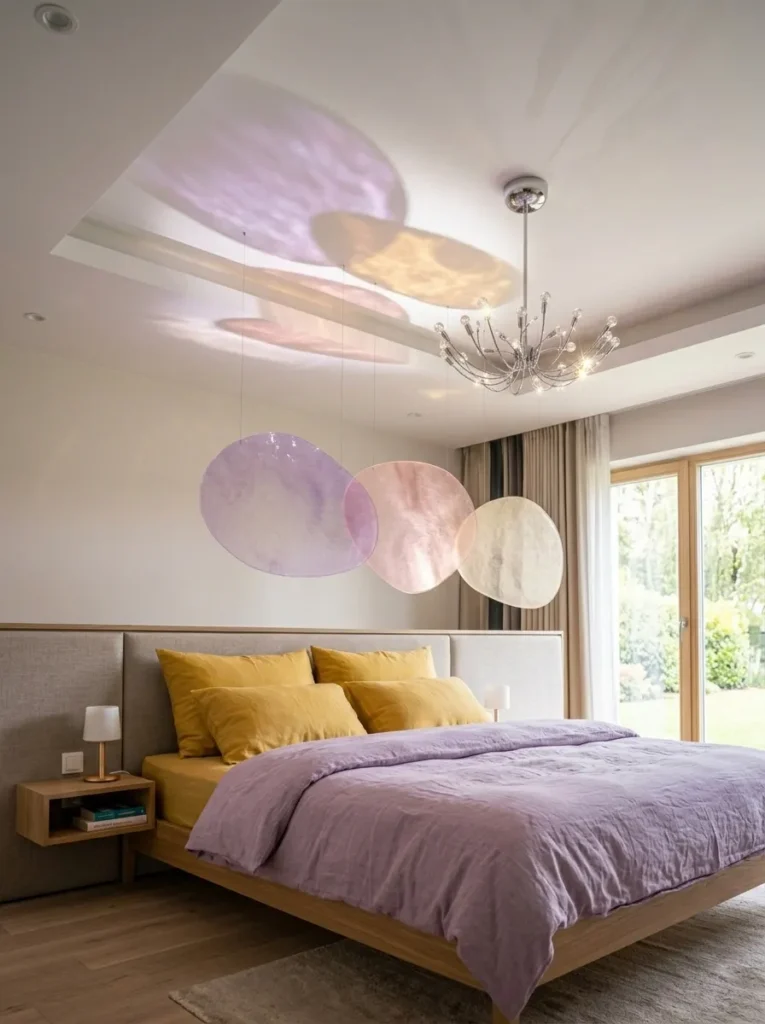
- Bed frame: ultra-low ivory bouclé platform
- Bedding: white cotton, pale-lilac linen duvet, lavender quilt, buttery-yellow velvet pillows
- Wall hanging: three oversized translucent organza panels in lilac, blush, and cream
- Fact: translucent fabric layered in front of a window behaves differently across the day than any solid material — it filters and softens direct light rather than blocking it, which is why the room’s mood genuinely shifts between morning and evening without any lighting changes
- Lighting: sculptural chrome chandelier with frosted globes
- Rug: plush cream rug with an irregular lavender border
Why this works: Translucent textiles, pale lavender, and layered bedding create a dreamy atmosphere while keeping the bed completely headboard-free.
This room is intentionally soft, but its proportions keep it from tipping into sugary. An ultra-low ivory platform disappears beneath white cotton sheets, pale-lilac linen, a lavender quilt, and buttery-yellow velvet pillows, while three oversized organza panels in lilac, blush, and cream hang behind the bed from a ceiling track, overlapping loosely rather than lying flat. Translucent fabric does something a solid textile or painted wall never can: it filters and softens whatever light passes through it instead of blocking it outright, which means this room’s entire mood shifts between morning and evening without a single light switch being touched.
Because the panels are ceiling-mounted, use a track and fastening system rated for their combined load rather than treating them like lightweight curtain panels, since layered fabric adds up in weight more than people expect. A chrome chandelier with frosted globes catches those same shifting light conditions in tiny reflected flashes after dark, while a fiddle-leaf fig in a glossy lavender planter and mirrored bedside tables help bounce whatever daylight is available around the rest of the room. Keep decorative objects minimal here so the fabric stays the defining feature, not a backdrop for clutter.
Mediterranean Linen Retreat
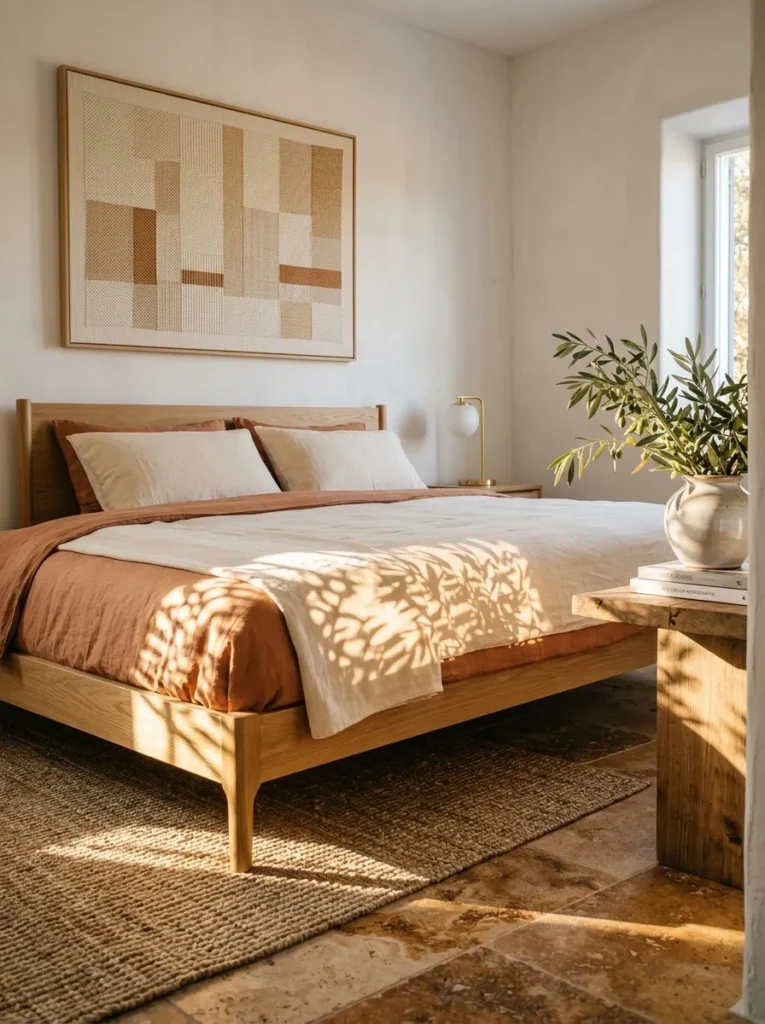
- Bed frame: low natural-oak platform, rounded corners, no headboard
- Bedding: ivory linen sheets, sand-colored duvet, muted apricot quilt, two oversized striped lumbar pillows
- Wall hanging: large handwoven linen textile in cream, terracotta, and faded ochre
- Fact: flatweave and handwoven textiles reflect light unevenly across their surface, which is part of why natural fiber wall pieces read as warmer in photographs than printed fabric of the same color
- Lighting: two aged-brass dome sconces, warm 2700K bulbs
- Rug: large flatweave rug, faded terracotta and cream geometric border
Why this works: Natural oak, linen, terracotta, and travertine make a headboard unnecessary because the entire room shares one tactile, sun-warmed material language.
The secret to a finished headboard-free bedroom is giving every layer a job instead of letting one piece carry the whole room. A rounded natural-oak platform sits beneath ivory linen sheets, a sand duvet, an apricot quilt, and oversized striped lumbar pillows, while a handwoven linen textile in cream, terracotta, and faded ochre hangs directly behind it. Handwoven fiber catches light differently than printed fabric — its uneven weave scatters light across the surface instead of reflecting it flat, which is why textiles like this photograph warmer than a printed version in the same colorway ever could.
A mature olive tree in a handmade terracotta pot by the window gives the room a living, sun-loving anchor that suits Austin’s bright afternoon light especially well. I’ve noticed olive trees handle our summer heat better than most decor-blog darlings like fiddle-leaf figs, so this is a plant I recommend often to clients here. Travertine echoes the pale bedding on one side of the bed, while a simple oak stool sits on the other, keeping the arrangement asymmetrical rather than matched. Aged-brass dome sconces on both sides fill in the light a headboard’s shadow would otherwise leave empty.
Lavender Parisian Layering
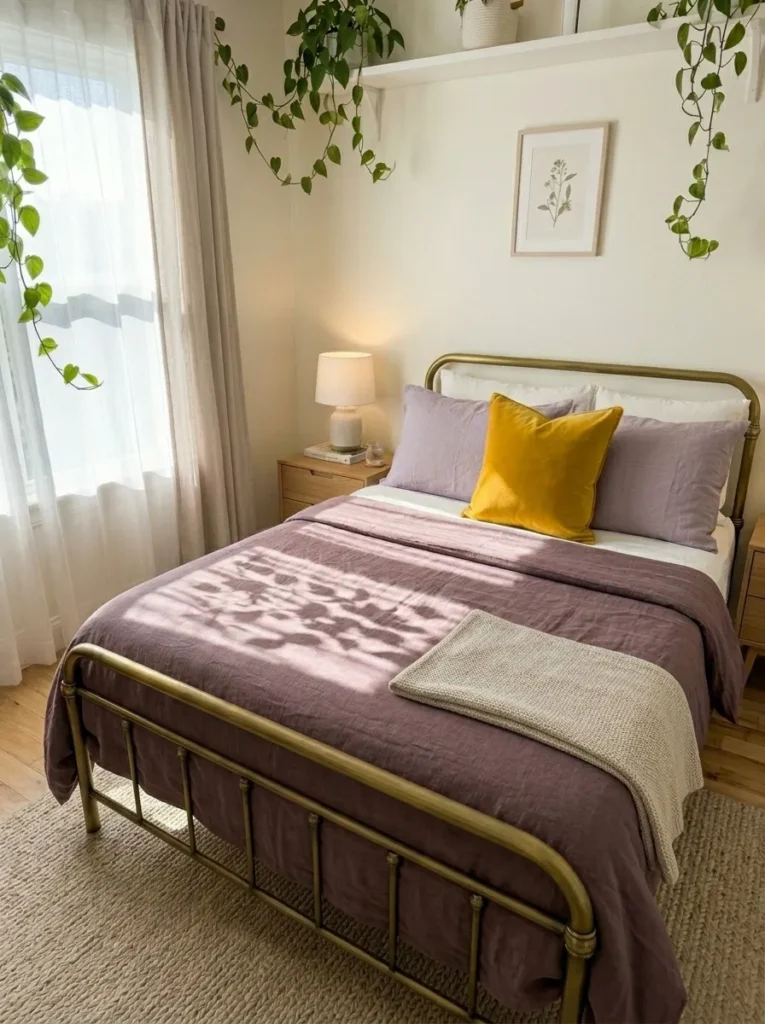
- Bed frame: slim antique-brass metal frame, open above the mattress
- Bedding: white cotton sheets, pale lavender linen duvet, dusty-plum quilt, butter-yellow velvet lumbar pillow
- Wall hanging: oversized vintage botanical textile in faded lavender and ochre
- Styling principle: deliberate asymmetry — mismatched bedside furniture — is what keeps a room like this from reading as a matched furniture-store set
- Lighting: pleated fabric table lamps, aged-brass bases
- Rug: faded Aubusson-inspired rug in lavender, cream, ochre, and muted blue
Why this works: Layered lavender, brass, vintage textiles, and mismatched furniture give the bed a collected European character without a single headboard in sight.
A no-headboard bedroom can feel wonderfully romantic when the layers are intentionally mismatched rather than coordinated from a catalog. A slim antique-brass metal bed sits beneath white cotton sheets, a pale-lavender linen duvet, dusty-plum quilt, and one butter-yellow velvet lumbar pillow, while an oversized vintage botanical textile in faded lavender and ochre hangs above the mattress. A trailing heartleaf philodendron in a ceramic wall planter softens one corner, and pleated fabric lamps with aged-brass bases glow warmly from petite bedside tables on either side of the bed.
The trick here is resisting perfect symmetry, which is a habit I have to actively remind myself of, since my instinct is always to match things. A painted bedside table on one side and a narrow brass drink table on the other let the room feel gathered over time instead of purchased in one trip. The delicate antique-brass frame works well beneath a large textile precisely because it has almost no visual weight of its own to compete with. In a smaller bedroom, choose a narrow rug that extends beyond the bed rather than one that fills the whole floor.
Coastal Terracotta Bedroom
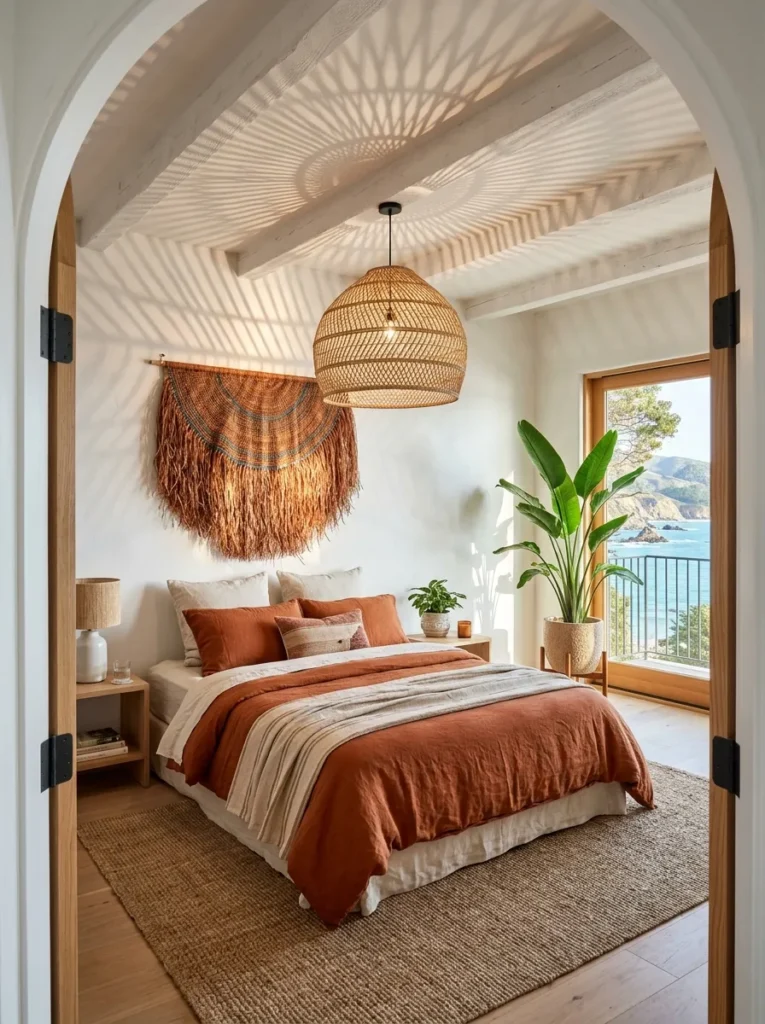
- Bed frame: low whitewashed ash platform, exposed rounded feet
- Bedding: crisp ivory cotton, pale blue linen, terracotta quilted coverlet, striped rust-and-cream pillows
- Wall hanging: large sculptural woven piece in natural raffia and rust-colored fibers
- Fact: raffia is a palm fiber, not a grass, which is why it holds a stiffer structural shape than jute or seagrass and can be woven into more sculptural, dimensional forms for wall pieces like this one
- Lighting: large woven pendant with a natural rattan shade
- Rug: textured ivory wool rug with thin rust and faded blue lines
Why this works: Coastal materials without the expected blue-and-white palette give the headboard-free bed a warmer, more contemporary identity.
Coastal bedrooms do not have to default to blue and white the way most decor content assumes they should. A whitewashed ash platform carries ivory cotton, pale-blue linen, a terracotta quilted coverlet, and striped rust-and-cream pillows, while a sculptural raffia wall piece hangs behind it, combining natural fiber with rust-colored strands. Raffia holds structure differently than the jute or seagrass most coastal decor reaches for — it’s a stiffer palm fiber, which is exactly why it can be shaped into something more dimensional and sculptural rather than lying flat like a typical woven mat.
The terracotta is what actually changes the familiar coastal formula here, letting blue play a supporting role instead of dominating every surface. A large rattan pendant hangs above the mattress, its woven ribs adding texture at ceiling height that echoes the raffia below. Pale-oak nightstands and an oatmeal bench keep the room visually light, and a tall bird-of-paradise by the window brings in one living, upright shape. Skip shells, anchors, or anything overtly nautical — they’d pull this toward themed decor instead of a genuinely designed room.
Chocolate Garden Suite
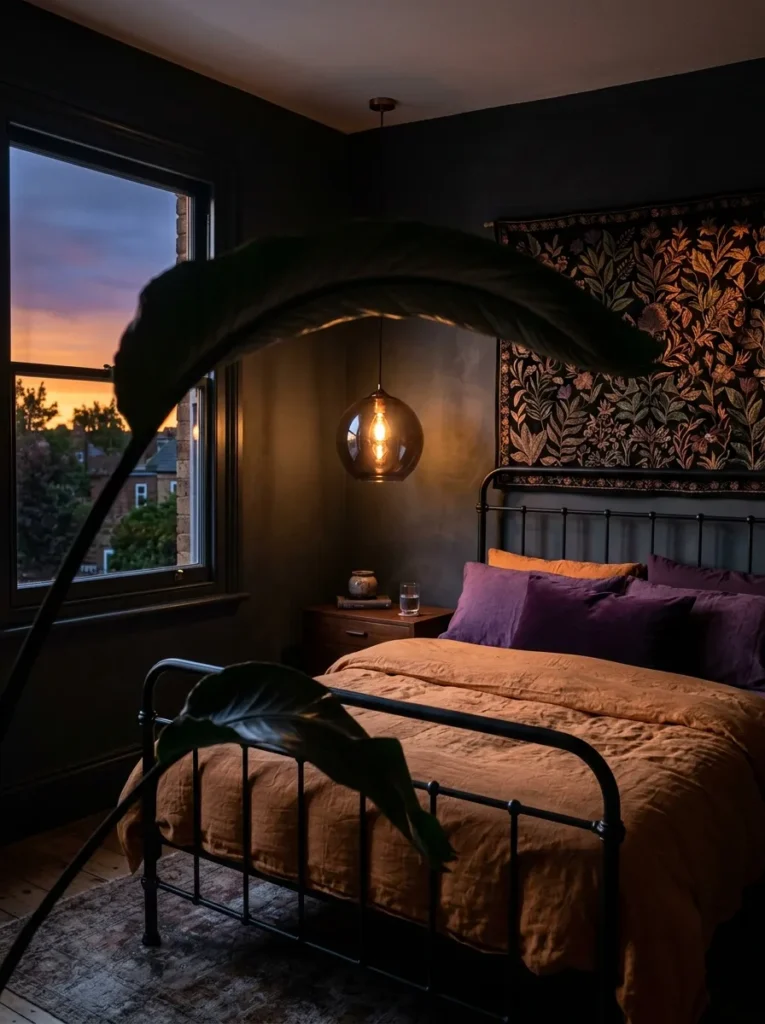
- Bed frame: low espresso-stained walnut platform, floating base
- Bedding: warm ivory percale, caramel linen duvet, dusty peach quilt, deep aubergine velvet pillows
- Wall hanging: oversized pressed-botanical textile, cream flowers and rust foliage on a chocolate-brown ground
- Growing note: fiddle-leaf figs need bright, filtered light rather than direct sun through an uncovered window, and rotating the pot every couple of weeks keeps growth even instead of leaning toward the light source
- Lighting: sculptural mushroom lamps in brushed nickel
- Rug: faded peach-and-cream Persian-style rug, small aubergine details
Why this works: Deep chocolate, dusty peach, walnut, and botanical imagery create a layered bedroom that reads as designed from every angle rather than dependent on a headboard.
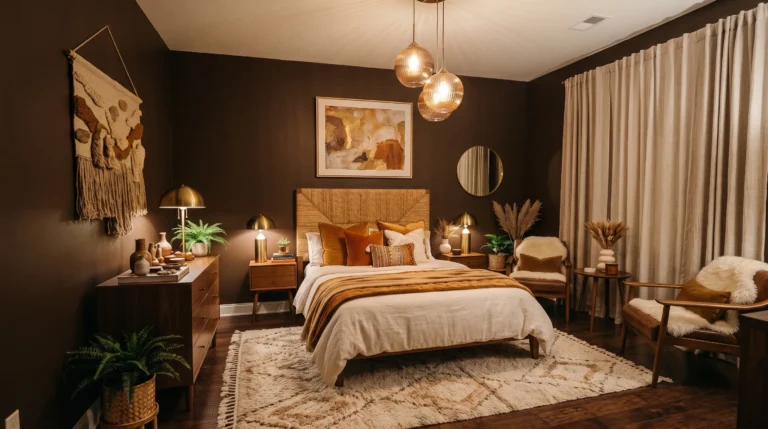
Dark walls aren’t required to make a bedroom feel dramatic — sometimes the furniture and textiles alone can carry that depth. An espresso-stained walnut platform sits beneath warm ivory percale, caramel linen, a dusty-peach quilt, and deep aubergine velvet pillows, while an oversized botanical textile hangs behind it, cream flowers and rust foliage set against a chocolate-brown ground. Brushed-nickel mushroom lamps glow from rounded walnut nightstands on either side, and a faded peach-and-cream Persian-style rug ties the warm tones together across the floor.
This color story works because the chocolate ground stays concentrated in the wall textile instead of repeating everywhere, which leaves room for walnut, peach, aubergine, and caramel to each hold their own space. A tall fiddle-leaf fig stands farther across the room in a ribbed clay planter, and as someone with a plant science background, I always place mine where it gets bright, filtered light rather than direct sun through an uncovered window — direct exposure scorches the leaves faster than most people expect. Keep one nightstand nearly empty so the room reads as composed, not styled to capacity.
Styling Principles for a Bedroom Without a Headboard
Let the Whole Room Do the Work
A bed without a headboard looks intentional when the wall, bedding, lighting, rug, furniture, and accessories are designed as one composition rather than treated separately.
Match the Alternative to the Bed
Low platforms work especially well with oversized art, textiles, and dramatic wall treatments because they leave more vertical space visible. A delicate metal frame can support stronger architectural or textile elements, while an upholstered platform usually works best with lighter wall treatments.
Think About Scale First
The alternative behind the bed should generally have enough scale to relate to the mattress. A tiny print above a king bed can look accidental, while an oversized textile, architectural treatment, or lighting arrangement can visually balance the bed without physically becoming a headboard.
Take Wall Safety Seriously
Heavy mirrors, plaster pieces, shelving, ceiling tracks, and large framed artwork need hardware appropriate to the object’s weight and the wall substrate. Drywall, plaster, masonry, and framed walls do not all accept the same fastening methods.
Use Budget Where It Shows
Skipping a headboard can free money for a larger rug, better lighting, substantial artwork, custom curtains, or quality bedding. In a small bedroom, it can also preserve valuable floor and wall space.
Build Layers, Not Clutter
A beautiful headboard-free bedroom does not need twenty accessories. Choose a few strong layers: substantial bedding, one memorable wall element, dramatic lighting, a rug, a plant, and carefully selected furniture.
FAQ
Is it okay to have a bed with no headboard?
Yes. A bed does not need a headboard to be functional or visually complete. A headboard-free bedroom can use artwork, textiles, architectural details, lighting, or a strong color treatment to define the sleeping area.
What is the best headboard alternative for a small bedroom?
Oversized wall-mounted artwork, a painted wall treatment, full-height curtains, or sculptural lighting can work especially well because they add visual impact without taking up the floor depth of a traditional headboard.
How do you safely mount heavy decor above a bed?
Heavy decor should be attached using hardware appropriate for both the object’s weight and the wall construction. For particularly heavy pieces, locate structural framing or use an appropriate engineered mounting system rather than relying on ordinary adhesive hooks.
Does a bed need a headboard for support?
No. A headboard is generally decorative or provides a comfortable surface for sitting up in bed; it is not inherently required for the mattress or bed frame to function.
Are no-headboard bedrooms cheaper?
They can be. Eliminating a headboard frees the purchase budget for other elements such as a larger rug, better lighting, substantial artwork, quality bedding, or custom window treatments.
What can I put behind a bed instead of a headboard?
Popular alternatives include oversized textiles, dramatic artwork, painted architectural treatments, curtains, mirrors, wall shelving, sculptural lighting, wallpaper, plaster details, and large botanical installations.
Can a platform bed look good without a headboard?
Absolutely. Low platform beds are especially effective because their simple silhouette leaves more wall visible and allows bedding, artwork, lighting, rugs, and plants to carry the room’s visual weight.
Final Thought
A headboard is only one way to give a bedroom structure, and it is certainly not the only way to make the bed feel finished. The strongest no headboard bedroom ideas treat the entire room as the design statement: the wall hanging works with the bedding, the lighting works with the furniture, the rug connects the colors, and the plants bring another layer of shape and texture.
If you would rather build a statement headboard instead of skipping it, see our DIY Headboard Ideas guide.
A headboard was never the only way to finish a bed. Once you let go of it, the wall behind your mattress opens up to lighting, texture, color, and art that can carry far more personality than upholstery ever could. Whatever style pulls you in, plaster and brass, woven raffia, a wrapped color drench, treat it as one complete room, not a single fix. I’ve seen how a small change like a leaned ladder or a painted ceiling shape can transform a bedroom entirely. Save this post for later, try one idea in your own space, and pass it along to anyone still convinced their bed needs a headboard to feel finished.