15 Sage Green Bedroom Ideas for a Stylish Budget Room
Sage green bedroom ideas shouldn’t mean choosing between a color you love and a budget you can actually stick to. That’s the trap most bedroom makeovers fall into — gorgeous paint, but nothing else in the room gets styled to match. In my experience redoing bedrooms in our own house, the wall is rarely what makes a room feel finished. It’s the bedding, the plant in the corner, the one thrifted mirror that ties everything together.
This post walks through 15 full sage green bedroom ideas, each with real costs attached, so you can style a complete room — walls, bedding, art, and plants — without guessing what it’ll actually cost you.
Why Sage Green Works for a Budget Bedroom Refresh
Most people assume a bold bedroom color means a bold bedroom budget. Sage green breaks that rule. Because it’s a muted, grayed-green rather than a saturated hue, it sits comfortably next to whatever your room already has — honey oak nightstands, cream trim, a hand-me-down dresser that doesn’t quite match anything. Sage green is one of the few trending bedroom colors that layers over an existing room instead of requiring you to replace it. I learned this firsthand repainting our guest room around furniture we already owned — no new pieces, just paint and a few $20 swaps that pulled everything together.
That’s exactly what this post is for: real ideas, real prices, a full room that actually looks finished, not just a wall.
1. Thrifted Rattan Reading Nook
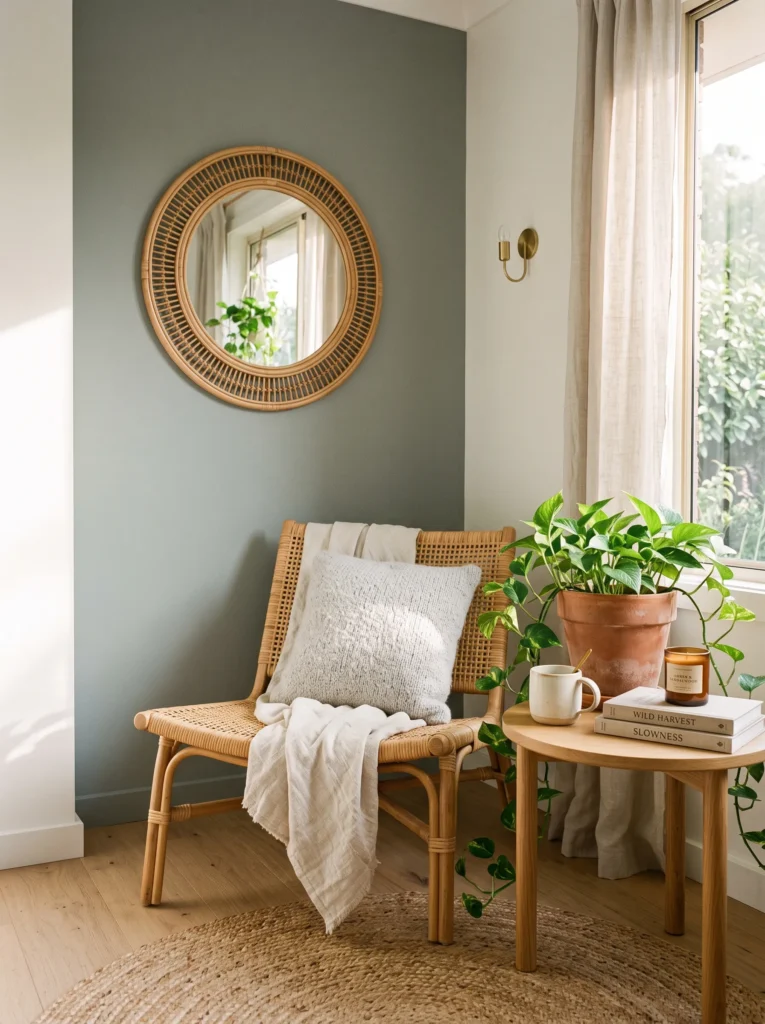
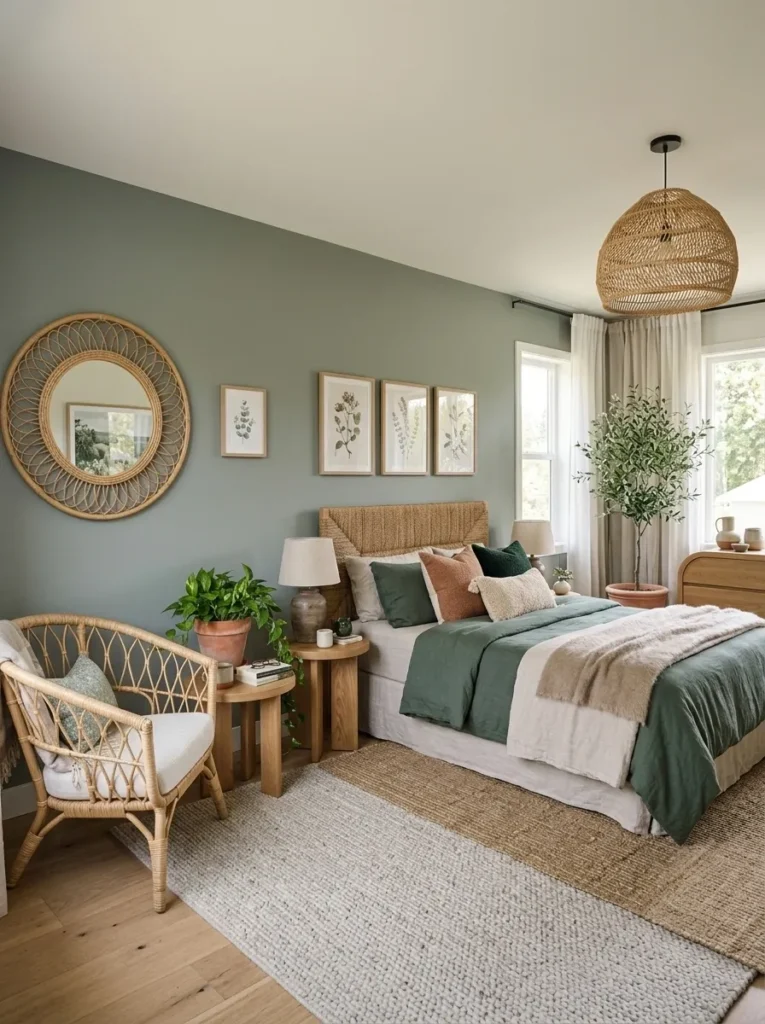
- A $9 sample pot of sage-gray paint covers one small nook wall — no need for a full gallon
- A $15 thrifted rattan chair (check Facebook Marketplace or ReStore) becomes the anchor piece
- A $6 secondhand rattan mirror replaces framed wall art entirely
- A $12 cream waffle-knit throw layers texture without buying new bedding
- A $8 pothos in a $4 terracotta pot brings in real greenery for under $15 combined
Why this works: A single painted nook wall creates the visual impact of a full accent wall for a fraction of the paint cost.
Most people think you need a whole gallon of paint to make a color statement, but that’s simply not true for a small space. A sample-size pot of sage-gray paint, usually $8 to $10 at any hardware store, covers a modest nook wall with room to spare. In my experience, painting just one wall behind a reading chair does more visual work than people expect — it frames the space without overwhelming the room. Pair it with secondhand rattan pieces, and you’ve built a whole corner that feels intentional, not accidental, for under fifty dollars total.
The rattan mirror is the detail that keeps this nook from feeling like a typical thrifted-furniture arrangement. Round rattan mirrors show up constantly at estate sales and thrift stores for $5 to $10, and they catch light in a way flat wall art simply can’t. Set beside a sage-painted wall, the woven texture reads as warm and layered rather than sparse. A trailing pothos on the side table softens the corner further, and because pothos tolerates low light and irregular watering, it’s realistically one of the easiest plants to keep alive in a bedroom that doesn’t get direct sun.
2. Vintage Frame Gallery Wall
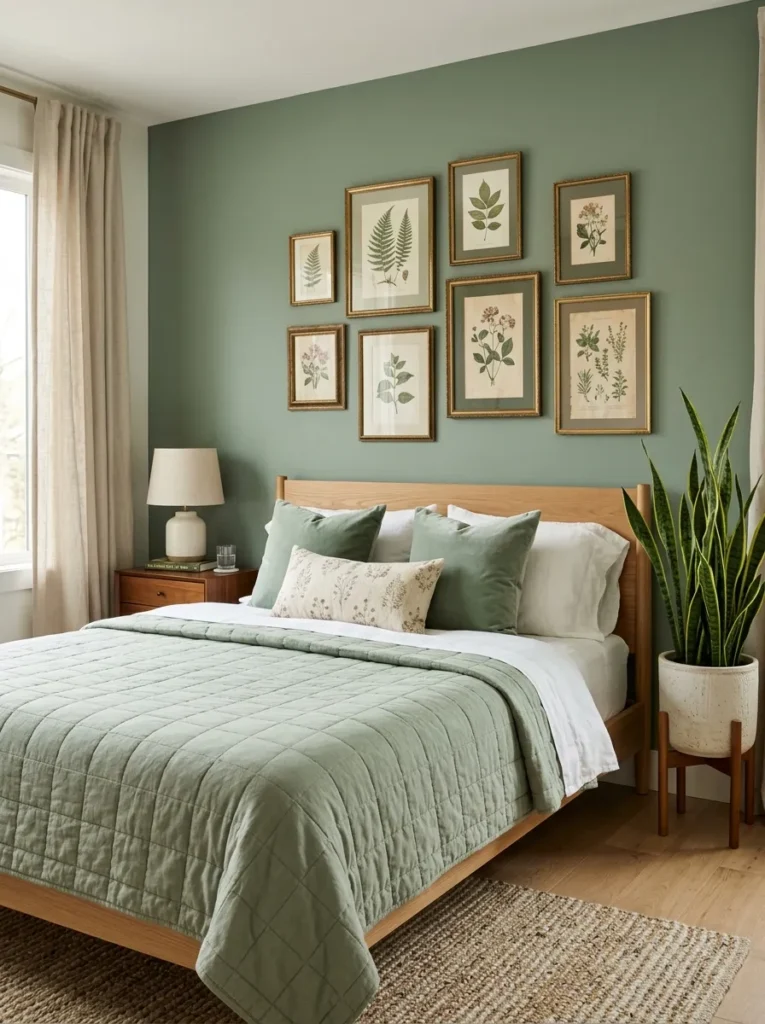
- A gallon of sage green paint ($38–48) covers the full accent wall behind the bed
- Six to eight thrifted frames ($2–5 each) get unified with one can of brass spray paint ($7)
- A $45 quilted sage coverlet becomes the bedding anchor instead of a full new bedding set
- A $18 snake plant in a $12 ceramic pot adds height in the room’s corner
- Botanical prints — free printable ones or $10 vintage prints — fill the frames
Why this works: Uniform frame color turns mismatched thrifted finds into a cohesive gallery wall, which is what separates “curated” from “cluttered.”
I redid a guest room this way last spring, and the frame trick genuinely surprised me. I’d collected eight mismatched frames over two years of thrifting — different woods, different finishes, some plastic — and none of them looked good together until I sprayed all of them the same brass tone. Suddenly it read as one intentional gallery wall instead of a pile of secondhand finds. My husband, who’s done more accent walls than either of us can count, always tells clients that a satin or eggshell finish holds up better than flat paint in bedrooms, since it resists scuffing from headboards and furniture.
The sage wall does the heavy lifting here, but the quilted coverlet keeps the bedding from competing. Quilted sage textiles in this tone run $40 to $50 at most home stores, and the subtle texture reads as elevated without matching too closely to the wall color, which can flatten the whole room visually. A snake plant in the corner adds vertical interest the frames alone can’t provide, and because it needs watering only every two to three weeks, it’s a realistic choice for anyone who’s killed a plant or two before.
3. Curved Rattan Headboard
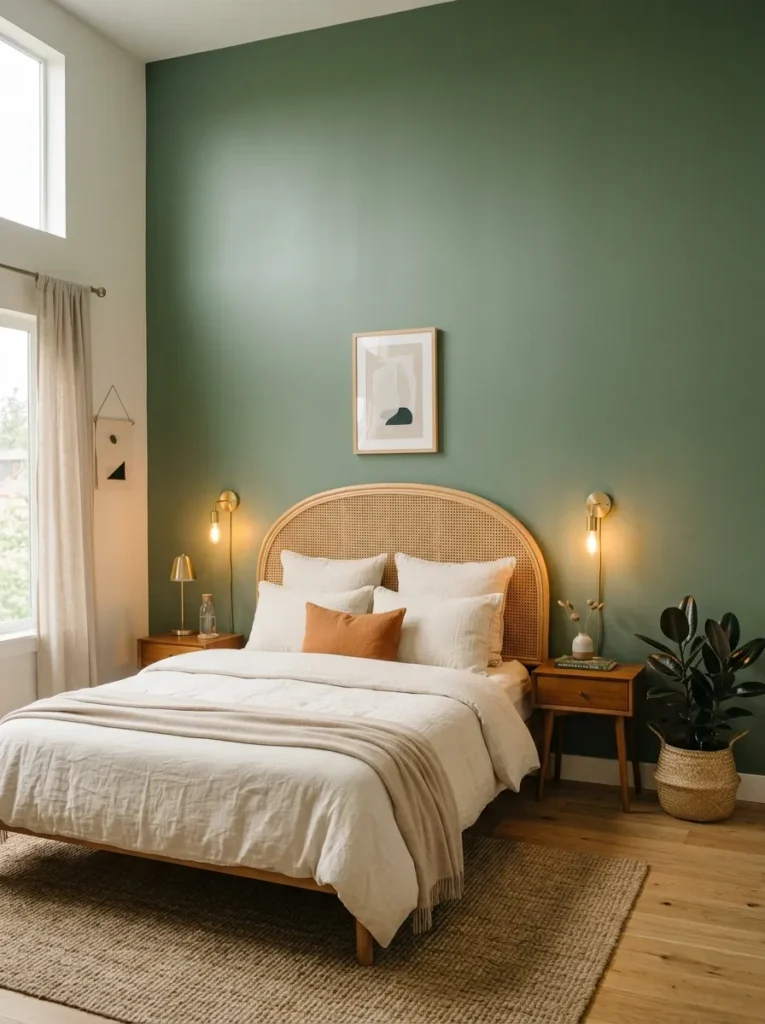
- A $120–160 curved rattan headboard (widely available at budget furniture retailers) replaces a traditional flat one
- A $45 gallon of sage green paint covers the wall behind it in a soft matte finish
- A $35 pair of brass wall sconces flank the headboard instead of overhead lighting
- A $50 linen duvet set in cream ties the palette together without matching the wall exactly
- A $22 rubber plant in a woven basket planter adds an organic, sculptural counterpoint
Why this works: Curved furniture silhouettes soften a room’s overall geometry, which is why a curved headboard reads as more current than a traditional squared one.
Curved furniture has moved from occasional accent piece to a real design category over the past couple of years, and a rattan headboard is one of the more affordable ways into that look. At $120 to $160, it costs less than most upholstered headboards, and the open woven texture keeps a sage-painted wall from feeling heavy. Brass sconces mounted on either side replace the need for bedside lamps entirely, which frees up nightstand space — a small functional upgrade most people don’t think to make until they’ve lived with cluttered nightstands for years.
A linen duvet in warm cream, rather than another shade of green, is the detail that keeps this room from feeling one-note. Layering a neutral textile over a saturated wall color is a principle interior stylists rely on constantly, since it lets the eye rest between the wall and the furniture. The rubber plant’s broad, glossy leaves echo the headboard’s curves without repeating the rattan material, which matters — repeating the same material twice in one room tends to flatten a design that would otherwise feel rich and considered.
4. Board and Batten Nook
- Furring strips ($1.50–2 each; 8–10 needed) run $15–20, plus a $10 sample pot of sage paint keeps a partial accent wall under $35 total
- Stopping the boards at chair-rail height, roughly 36 to 42 inches, uses about half the lumber of a full-height treatment
- A $12 secondhand cane nightstand keeps the rest of the furniture simple and uncluttered
- A $7 wall-mounted hook holds a trailing spider plant near the window
- A $15 framed canvas botanical print fills the remaining wall space above the nightstand
Why this works: Partial-height board and batten reads as an architectural feature rather than a paint project, without the material cost of a full accent wall.
A partial board and batten wall costs significantly less than full panel treatments, and there’s a structural reason it still reads as finished rather than half-done. Furring strips typically come in 8-foot lengths for $1.50 to $2 each, and covering a wall from floor to 38 inches usually requires only eight to ten strips. Painting the boards and the wall behind them the same sage tone, rather than leaving the boards white, is what makes the treatment look intentional instead of like an unfinished renovation. This detail alone separates a polished result from a project that looks abandoned midway through.
Keeping the furniture simple matters just as much as the wall treatment here. A single cane nightstand, rather than a matching set, keeps the room from feeling overcrowded once the board and batten adds visual texture of its own. The trailing spider plant softens the geometric lines of the boards without competing with them, and spider plants tolerate irregular watering better than most houseplants, which makes them a realistic choice for a bedroom that doesn’t get daily attention. The canvas print above the nightstand fills the remaining wall space without requiring a full gallery arrangement.
5. Curtain Wall Illusion
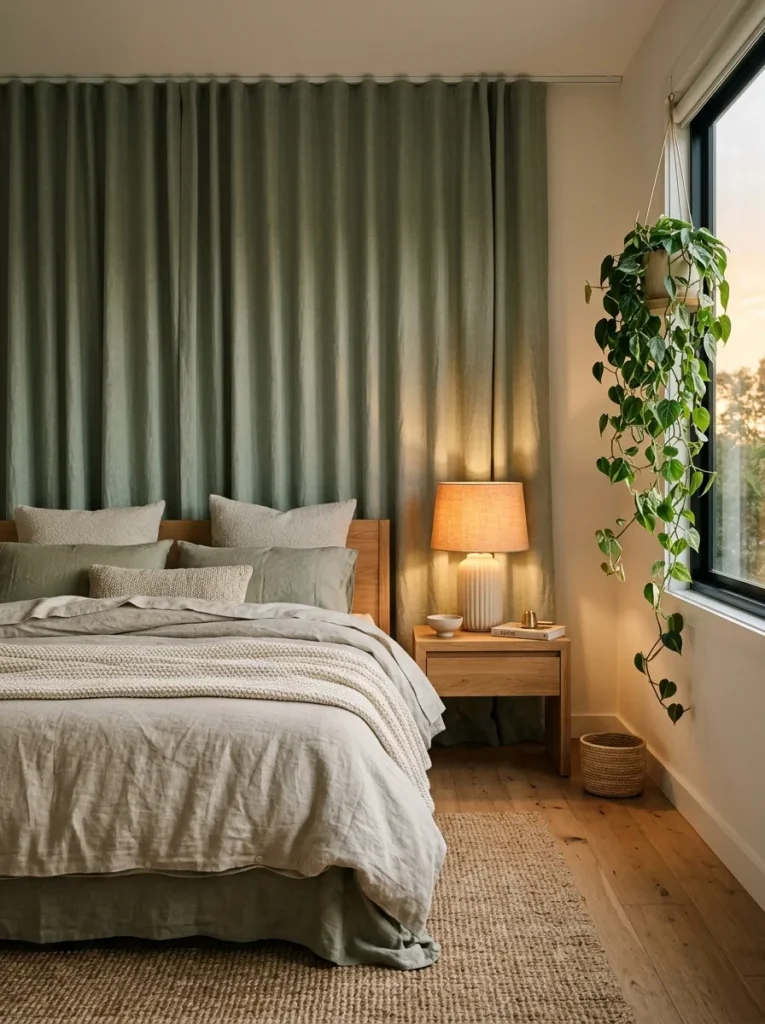
- $28 pair of sage linen-blend curtain panels hung wall-to-wall behind the bed, ceiling to floor
- A $14 curtain rod, extended a few inches wider than the headboard, for a fuller drape
- $22 fluted ceramic table lamp on the nightstand
- $18 trailing philodendron in a $9 woven pot near the window
- Existing white or cream bedding stays exactly as-is — no new bedding purchase needed
Why this works: Floor-to-ceiling curtains hung wall-to-wall mimic the visual weight of an upholstered accent wall for a fraction of the price.
My sister-in-law stayed in our guest room last winter and asked where I’d found the wall paneling behind the bed. It wasn’t paneling — it was two sage linen-blend curtain panels, hung wall-to-wall on a rod extended a few inches past the headboard on each side. The trick is hanging the rod close to the ceiling rather than just above the window frame, so the fabric reads as a soft wall treatment instead of window dressing. It’s the single cheapest way I’ve found to add both color and texture to a bedroom without touching a paintbrush.
The fluted ceramic lamp earns its place because it catches the curtain’s texture in warm evening light, something a flat overhead fixture can’t replicate. Leaving the existing bedding untouched keeps the whole refresh affordable, since white or cream sheets and a duvet already read as fresh against a sage backdrop rather than competing with it. The trailing philodendron near the window adds movement without requiring another wall-mounted element, and its glossy leaves pick up the same soft light the curtains diffuse across the room throughout the day.
You’ll Also Love:15 Dark Blue and Gold Bedroom Ideas for a Regal, Modern Retreat
6. Woven Texture Corner
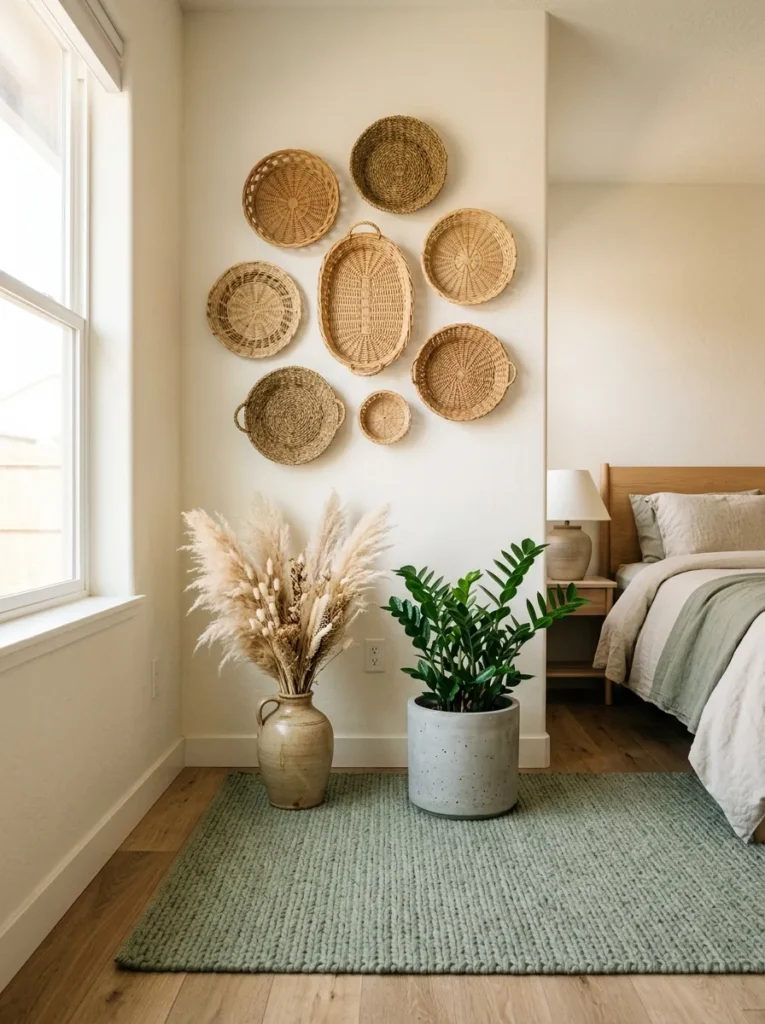
- $35 sage-toned jute or wool-blend rug layered under a reading chair or in the room’s corner
- $12 thrifted ceramic vase with $6 dried pampas or eucalyptus stems
- $19 ZZ plant in a $10 concrete pot — one of the few plants that tolerates low bedroom light
- $14 set of two or three woven wall baskets replaces framed art entirely
- Existing pillows get one $10 sage accent pillow added, not replaced
Why this works: Layering natural textures like jute and dried stems adds warmth and depth without introducing another wall color or pattern.
My husband, who’s refinished more bedroom floors than either of us can count, always tells me a rug this size does real work protecting flooring, not just decorating it — true even over laminate in a rental. A jute or wool-blend rug in sage layered into an underused corner grounds the space without the cost of new furniture. The dried pampas stems in a thrifted vase add movement that fresh flowers can’t sustain on a budget, since they last for months rather than days. Together, these small additions build texture the way a full furniture swap normally would.
The ZZ plant is the detail worth remembering if past plants haven’t survived in your bedroom. It tolerates low light and infrequent watering better than almost anything else sold at a garden center, which makes it a realistic pick for north-facing rooms or spaces without a large window. Woven wall baskets mounted in a loose cluster fill the same visual role as framed art, but at a lower cost and with more dimension. One new accent pillow, rather than a full pillow swap, keeps the existing bedding budget intact while still tying the corner’s textures back to the bed.
7. Terracotta and Linen Layers
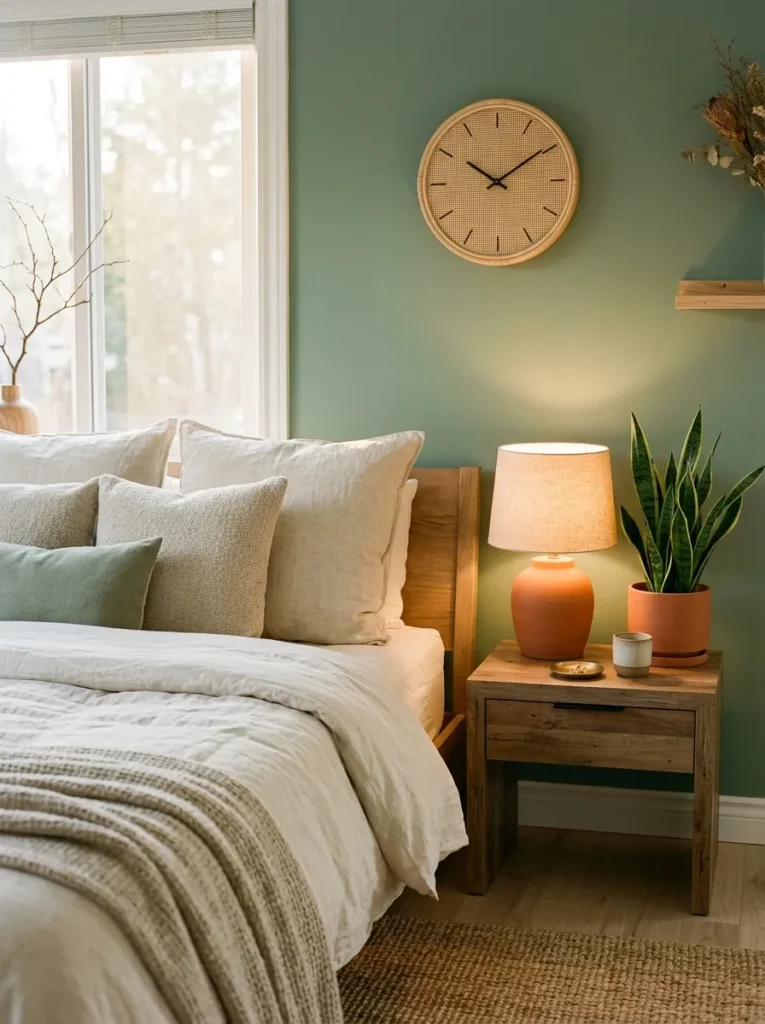
- Sage green already on the walls? Skip repainting — add a $16 terracotta table lamp and $9 terracotta planter instead to shift the whole room’s warmth
- $32 linen bedding set in warm cream layers over existing sage or white sheets
- $11 rattan wall clock replaces a second piece of framed art
- $14 snake plant cutting propagated in the $9 terracotta pot, or a $22 mature plant if starting from scratch
- $8 jute drawer pulls swapped onto an existing dresser tie the palette together at a small scale
Why this works: Terracotta’s warm, earthy undertone is one of the few accent colors that complements sage without competing with its cool gray base.
Sage green leans slightly cool and gray, which is exactly why it pairs so naturally with terracotta’s warmth rather than clashing with it. This is a genuine color-theory principle, not a styling trend: pairing a cool-based hue with a warm-based accent creates visual balance instead of flatness. A terracotta lamp base and matching planter bring that warmth into the room in small, affordable doses, so there’s no need to repaint anything if the walls are already sage. The linen bedding in cream sits between the two tones, letting the eye move comfortably from wall to lamp to bed without any one element overpowering the room.
Swapping dresser pulls is the smallest change on this list, and also one of the most overlooked. A set of jute or rope pulls, usually $6 to $10 for a full set, updates an existing dresser without the cost of new furniture or paint. It’s a detail I’ve added to more than one client’s room as the last step, and it consistently reads as more expensive than it is. Paired with a rattan wall clock instead of a second framed print, the room gains texture and function in the same breath, rounding out the palette with almost no added clutter.
8. Moody Evening Corner
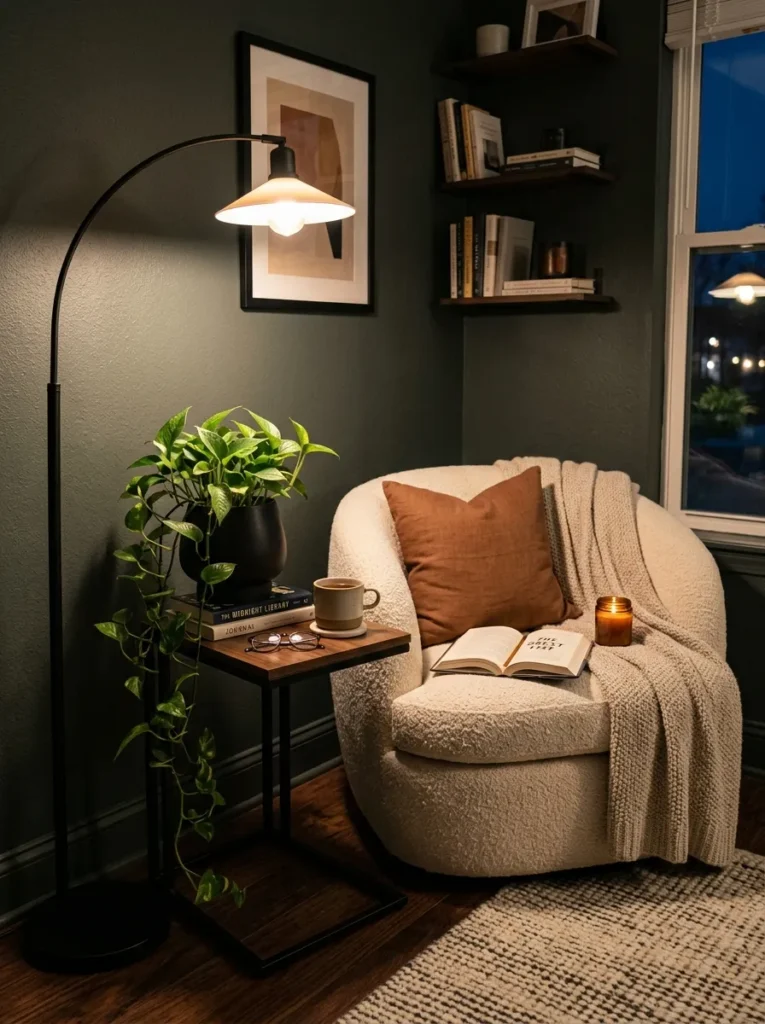
- $42 gallon of deeper sage-charcoal blend paint (a slightly darker sage than the room’s main wall) for one reading corner
- $19 black metal floor lamp with a warm-toned bulb for evening ambiance
- $16 boucle accent chair cover thrifted and reupholstered over an existing chair frame
- $13 trailing pothos in a $7 black ceramic pot, positioned to catch lamp light
- $9 set of textured stoneware coasters and a small tray on the side table
Why this works: A slightly darker sage in one corner, rather than across the whole room, creates depth without the commitment or cost of a full color change.
Full-room color saturation isn’t the only way to add mood to a bedroom, and it’s rarely the most budget-friendly one either. Painting a single reading corner in a deeper sage-charcoal blend, just a few shades darker than the main wall color, creates a sense of depth that a flat, single-tone room doesn’t achieve. In my experience, this kind of subtle tonal shift photographs better than people expect, especially in evening light, because it gives the eye a place to land rather than one continuous flat wall. The warm-bulb floor lamp reinforces that mood without requiring any additional wiring or fixture changes.
Reupholstering an existing chair with a boucle slipcover, rather than buying a new accent chair, keeps this corner’s cost low while still introducing a genuinely current texture. Boucle has moved well beyond trend status at this point into a staple neutral texture, and it pairs particularly well against a darker sage backdrop. The pothos catches the lamp’s warm light as it trails from its black pot, softening the corner’s more moody palette. Together, these pieces turn an unused corner into a small, deliberate retreat within the larger room.
9. Scalloped Shelf Display
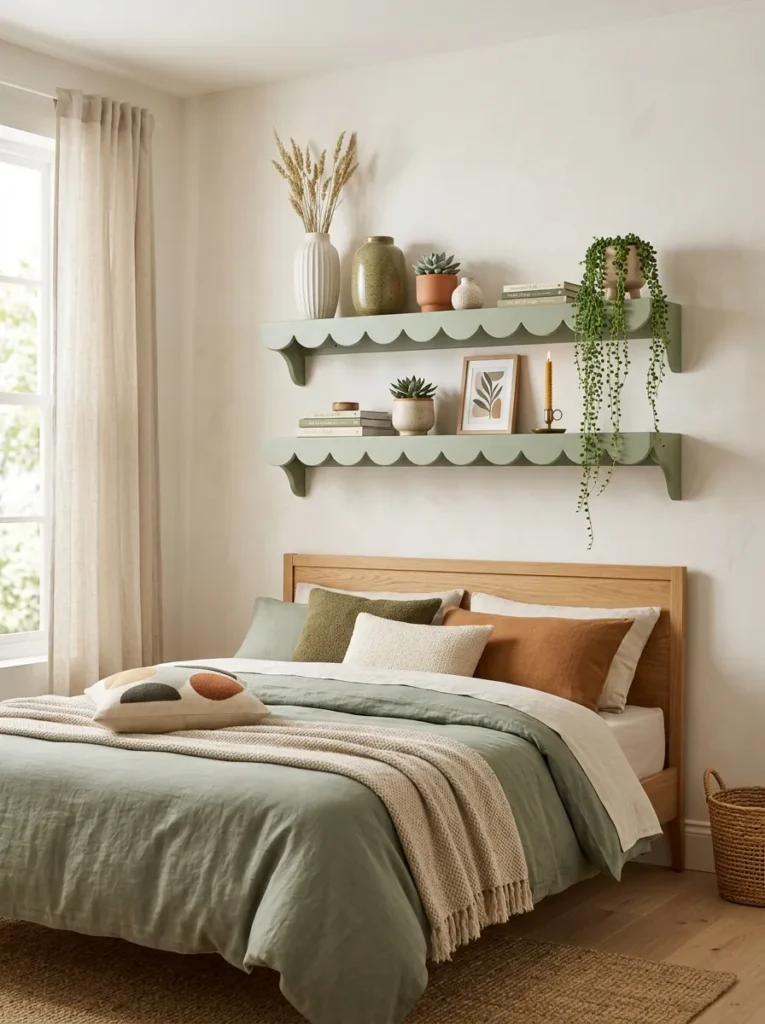
- $24 pair of scalloped-edge wood shelves (unfinished, then painted sage or left natural) mounted above the headboard
- $15 can of sage paint sample covers both shelves with plenty left over
- $18 collection of three thrifted ceramic vases in varying heights, $4–8 each
- $12 trailing string of pearls or string of hearts in a small hanging pot, one of the more compact trailing plants for shelf display
- Existing books or framed photos style the shelves — no need to buy new decor objects
Why this works: Curved, scalloped shelf edges introduce the softened, organic silhouettes currently replacing sharp-angled shelving in updated bedroom design.
Scalloped or wave-edge shelving has largely replaced the straight-edged floating shelves that dominated bedroom styling for the past decade, and it’s a small swap that changes a room’s whole feel. A pair of unfinished wood shelves runs under $30 total, and painting them sage rather than leaving them raw ties them directly into the room’s palette instead of treating them as a separate element. Mounted above the headboard rather than on a blank wall, they add both storage and display space in a spot that’s often left completely empty in bedroom layouts.
Styling the shelves with pieces already owned, rather than buying new decor, is what keeps this idea affordable and personal at the same time. A trio of thrifted vases in different heights creates rhythm across the shelf without needing matching sets, and a small trailing plant softens the shelf’s edge as it grows over time. I’ve noticed shelves styled with a mix of heights and one trailing element tend to photograph far better than perfectly matched, symmetrical arrangements — the slight imperfection is what makes it feel like a real, lived-in room.
10. Vintage Brass Mirror Moment
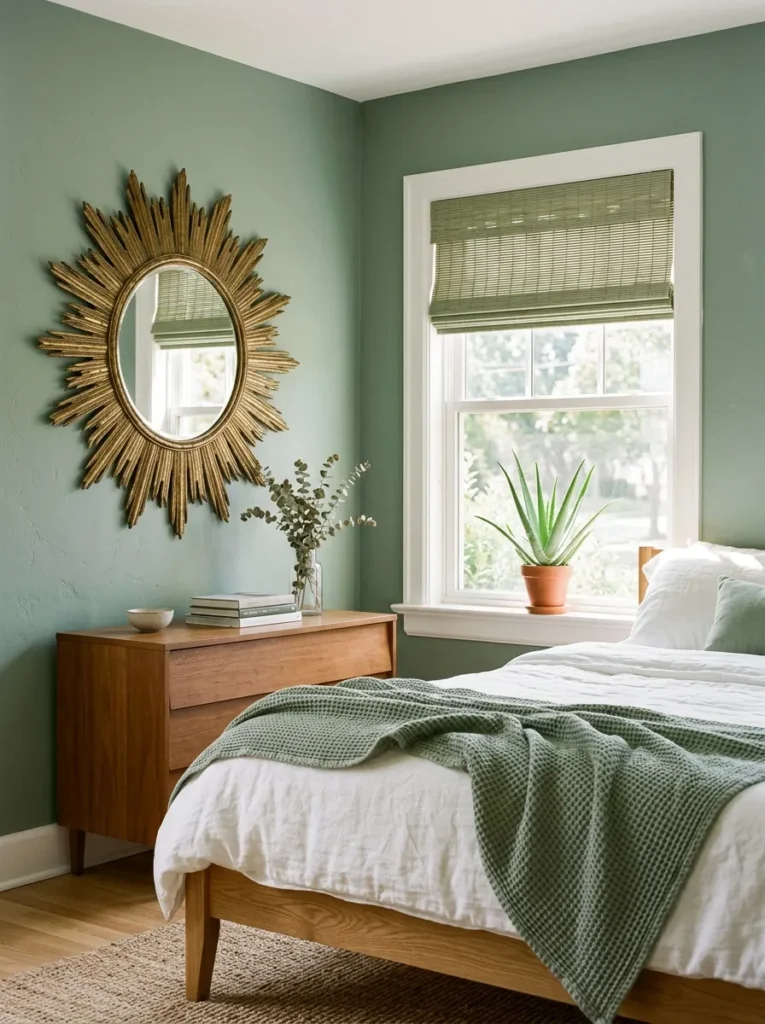
- $22 vintage sunburst or oval brass mirror, thrifted or found secondhand, hung as the room’s focal point opposite the bed
- $18 sage roman shade or bamboo blind replaces heavier curtains at the window
- $28 waffle-weave sage throw blanket layered at the foot of the bed over existing bedding
- $16 aloe vera plant in a $8 fluted white pot on the windowsill
- $9 small brass catch-all tray on the nightstand ties the metal tones together
Why this works: A single oversized mirror opposite the room’s main light source multiplies natural light across the whole space at almost no cost.
Placing a mirror directly across from a window is a genuine lighting principle, not just a styling preference — it reflects and doubles available daylight, which matters most in bedrooms that only get light from one direction. A vintage brass sunburst mirror does this while also serving as the room’s focal point, which means there’s less pressure to fill the rest of the walls with additional art. Thrifted versions run $15 to $30 depending on size, considerably less than new decorative mirrors of comparable scale, and the slightly imperfect vintage brass finish tends to look richer than anything mass-produced.
A bamboo or roman shade at the window keeps the light this mirror reflects soft rather than harsh, which matters in a bedroom more than almost any other room in the house. Aloe vera on the sill tolerates the brighter light a window seat receives and needs watering only every two to three weeks, making it a low-maintenance choice for a spot that gets consistent sun. The waffle-weave throw adds texture at the foot of the bed without requiring a full bedding replacement, rounding out the room’s textures in one affordable layer.
11. Canopy Frame Corner
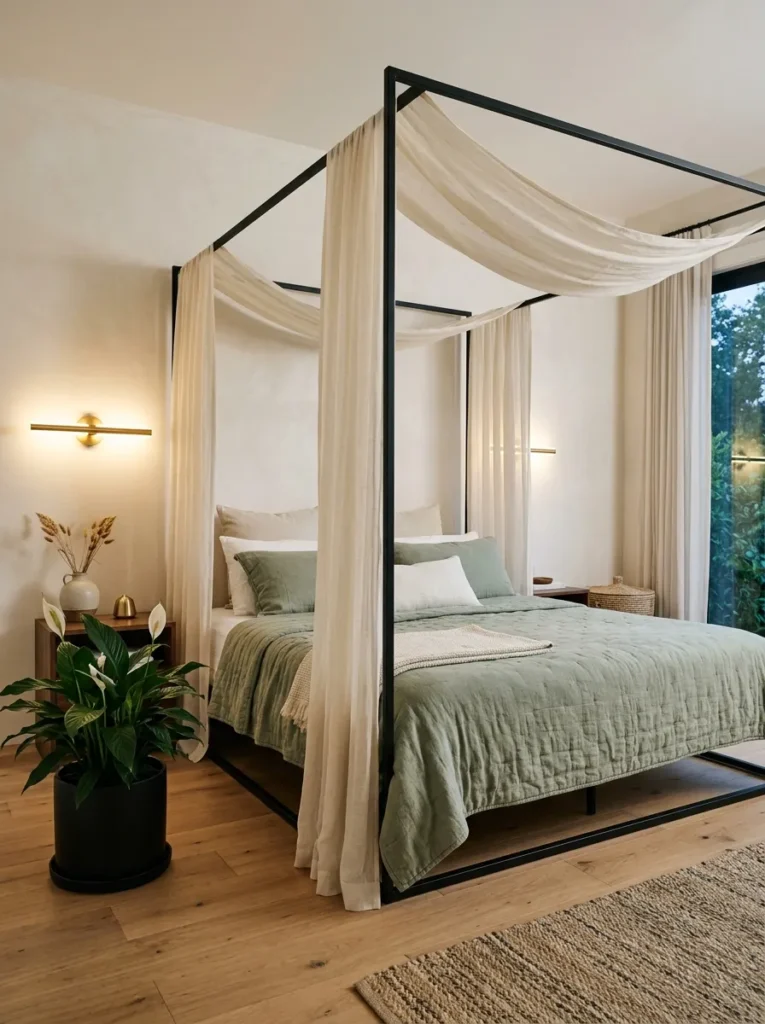
- $34 simple black metal canopy bed frame attachment (fits over an existing bed frame) rather than buying a full new bed
- $19 sheer white or cream canopy fabric draped over the frame
- $26 sage green quilted bedspread underneath the canopy
- $15 peace lily in a $10 black ceramic planter on the floor beside the bed
- $12 pair of small brass wall sconces mounted on either side for soft evening light
Why this works: A canopy attachment adds architectural height to a room without the expense or commitment of raising ceilings or buying new furniture.
Most people assume a canopy bed means buying an entirely new bed frame, but attachment kits that clamp onto an existing frame have made this look accessible at a much lower cost. At roughly $30 to $40, these attachments add real vertical height to a bedroom, which matters more than people expect in rooms with standard eight-foot ceilings. The sheer fabric softens the black metal frame and lets light pass through rather than blocking it, keeping the room from feeling closed in despite the added structure overhead.
Peace lilies do well on the floor beside a bed because they tolerate the lower, indirect light most bedrooms receive away from windows, and they signal when they need water by drooping slightly, which takes the guesswork out of care. My husband installed similar canopy attachment brackets in a client’s guest room last year and noted that the anchor points matter more than the fabric choice, since a loosely secured frame will sag within weeks. Getting that structural detail right is what makes this look last rather than needing constant readjustment.
12. Gingham Accent Layer
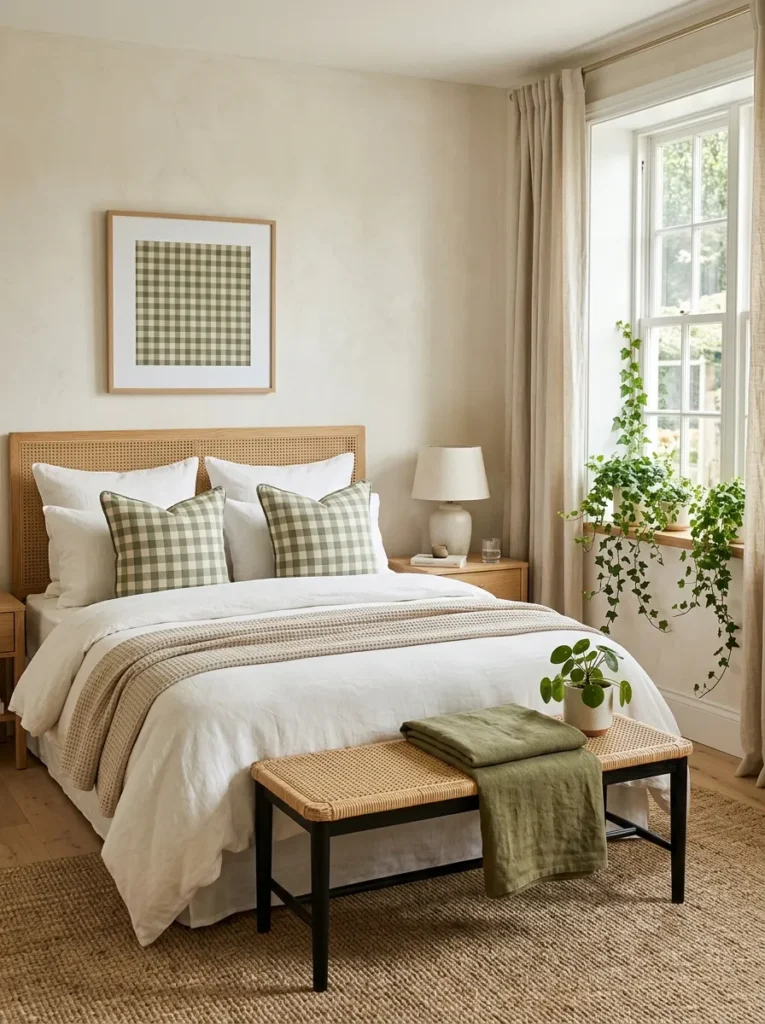
- $24 sage and cream gingham throw pillow covers (set of two) layered over existing bed pillows
- $16 gingham fabric remnant, framed in an $8 thrifted frame, as a single piece of graphic wall art
- $30 cane and rattan bench placed at the foot of the bed for functional seating
- $14 English ivy in a $6 hanging pot near the window, trained along the windowsill
- Existing lamp gets a $9 sage lampshade swap instead of buying a new lamp entirely
Why this works: A single graphic pattern like gingham, used sparingly in just two spots, adds visual interest without overwhelming a room built around a solid color palette.
Gingham has moved from picnic-blanket cliché to a genuinely modern pattern choice when it’s scaled correctly and paired with a muted color like sage rather than a bright primary. Using it in exactly two places — pillow covers and one framed remnant — keeps the pattern from taking over a room that otherwise relies on solid color and texture. Framing a fabric remnant instead of buying printed art costs a fraction of the price and results in something no one else’s bedroom has, since it’s built from a specific fabric choice rather than a mass-produced print.
The cane bench at the foot of the bed adds function most bedrooms lack: a spot to sit while putting on shoes or laying out clothes for the next day. English ivy trained along a windowsill adds a soft, trailing green line that echoes the gingham’s linear pattern without repeating it directly. Swapping just the lampshade on an existing lamp, rather than replacing the whole fixture, is one of the more overlooked budget upgrades — a nine-dollar shade change can shift a lamp’s entire look in under five minutes.
13. Wicker Headboard Wall
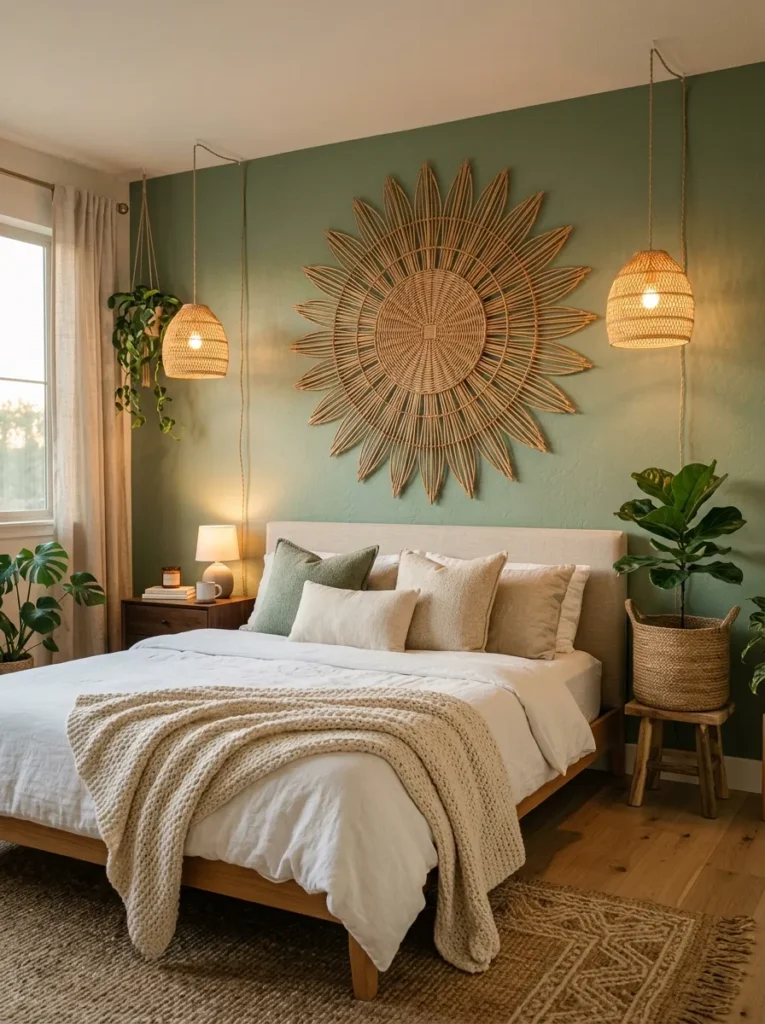
- $45 oversized wicker or seagrass wall hanging (fan or sunburst shape) used as a headboard substitute instead of buying furniture
- $12 sage green paint sample covers the wall behind it for contrast
- $20 cream chunky-knit throw layered over existing bedding
- $17 fiddle leaf fig cutting in a $9 woven basket planter, positioned in the corner
- $10 pair of small rattan pendant clip lights mounted above, used instead of a full light fixture swap
Why this works: An oversized wall hanging mounted at headboard height creates the visual scale of a real headboard without the cost or weight of furniture.
Skipping a traditional headboard entirely and mounting an oversized wicker or seagrass wall hanging in its place is one of the more overlooked budget swaps in bedroom design, largely because people assume a headboard has to be furniture. At $40 to $50, a large woven wall piece costs less than most upholstered headboards and weighs a fraction as much, which also makes it easier to hang without needing to anchor into a stud for structural support. Mounted against a sage-painted wall, the natural woven texture stands out clearly rather than blending in, giving the bed a defined focal point.
The fiddle leaf fig in the corner is worth choosing carefully since the full-size version can be finicky about light and water, but a smaller rooted cutting is far more forgiving and costs significantly less to start. Clip-on rattan pendant lights mounted above the wall hanging add a warm glow at night without the cost or effort of rewiring a ceiling fixture, which matters in rental bedrooms where permanent changes aren’t an option. Together, these pieces build a headboard wall that looks fully furnished for well under what a real headboard would cost.
14. Botanical Print Trio
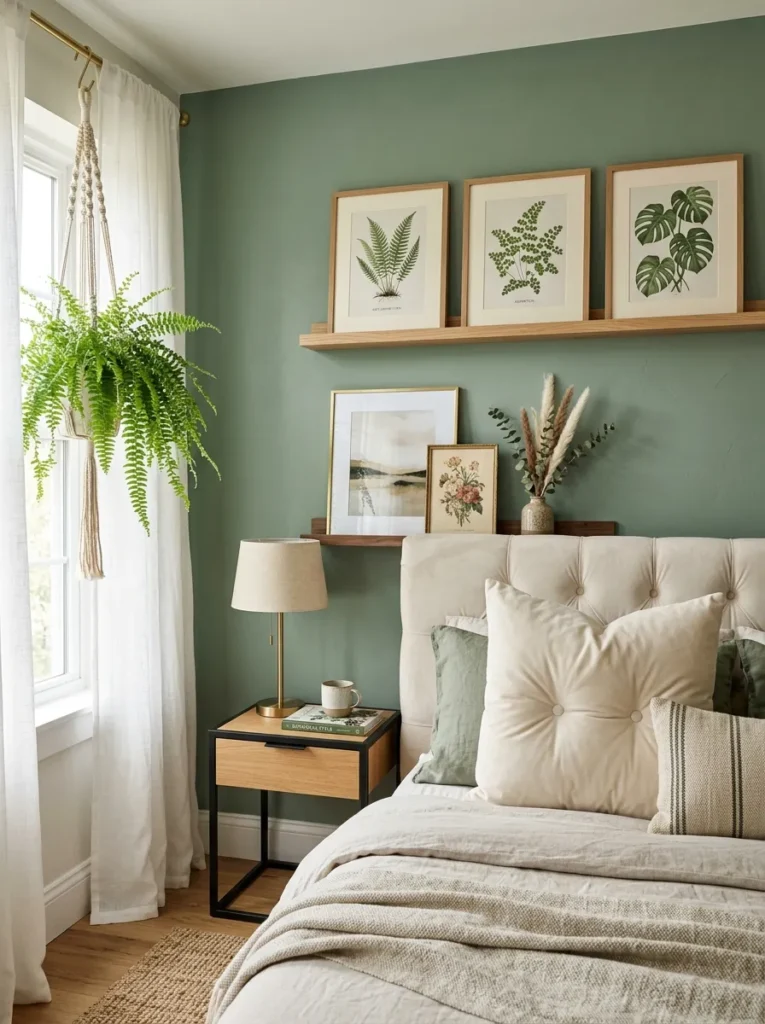
- $18 set of three botanical prints (free printables or thrifted, matted and framed in $5 thrifted frames each)
- $30 gallon of sage green paint for a single accent wall behind the print arrangement
- $25 cream tufted throw pillow (single, oversized) layered on existing bedding
- $13 Boston fern in a $7 hanging macrame-style pot near the window
- $9 small wood picture ledge mounted below the prints instead of individual nail placement
Why this works: A picture ledge lets art be rearranged without new nail holes, which matters most for renters working within a limited budget.
A trio of botanical prints arranged along a single wood ledge, rather than nailed individually to the wall, solves a real problem for renters and budget-conscious decorators alike: it allows the arrangement to change without patching new holes every time. Botanical illustrations specifically tend to complement a sage green wall better than abstract art, since the color already echoes the plant life depicted in the prints themselves. Thrifted frames in mismatched but complementary finishes, painted the same tone if needed, keep the framing cost under $20 for all three pieces combined.
A Boston fern hanging near the window adds real texture that a flat print arrangement can’t achieve on its own, and its cascading fronds soften the straight lines of the picture ledge below. Boston ferns do best with consistent humidity, which makes a bedroom with a window that gets indirect light a reasonably good spot for one, provided the leaves are misted occasionally. The single oversized cream pillow anchors the bed’s existing bedding without requiring a full replacement, keeping the whole wall-to-bed color story cohesive at minimal added cost.
15. Layered Neutral Textiles
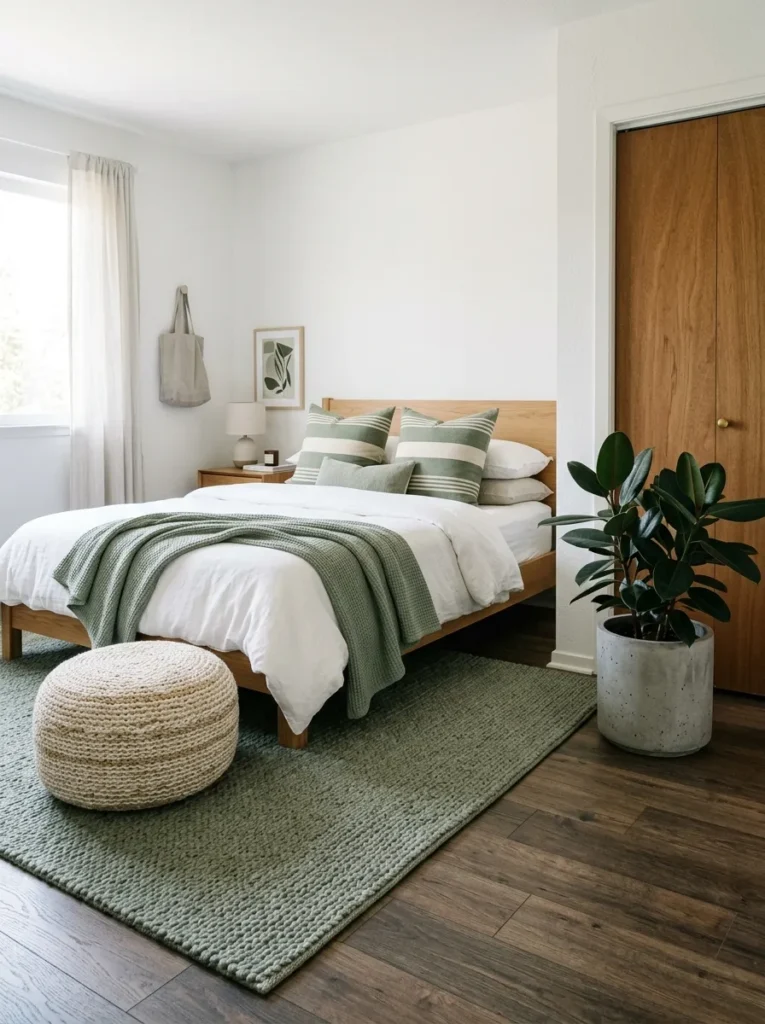
- Existing white walls stay as-is — a $28 sage green textured area rug becomes the room’s primary color source instead of paint
- $24 set of two sage-and-cream striped pillow shams over existing pillows
- $19 woven cotton pouf placed at the foot of the bed for extra seating
- $15 rubber tree cutting in a $9 concrete planter near the closet
- $11 rattan tray on the dresser corrals existing perfume bottles or jewelry into one styled grouping
Why this works: Introducing sage through a rug rather than paint is the lowest-commitment way to test the color before a full wall treatment.
For anyone hesitant to commit to painting an entire wall, bringing sage green into the room through a textured area rug is a genuinely practical starting point, and it happens to be one of the more budget-friendly options on this list since a mid-size rug typically runs $25 to $40. The rug sits at floor level, which draws the eye downward and makes a room feel larger rather than boxed in by wall color, a small but real spatial effect. Striped sham covers in sage and cream tie the color back up toward the bed without requiring a full new bedding set.
A woven cotton pouf at the foot of the bed adds functional seating in a room that likely doesn’t have room for a bench or chair, and it can be moved easily when more floor space is needed. The rubber tree cutting near the closet fills an often-overlooked corner with height and glossy texture, while the rattan tray on the dresser is a small styling trick that takes cluttered surfaces — perfume, jewelry, loose items — and turns them into one intentional grouping in under a minute.
Sage Green Bedroom Styling Principles
A sage green bedroom works best when the color is treated as a foundation, not a finishing touch. Because sage carries a muted, gray undertone rather than a saturated one, it’s forgiving of mismatched furniture, uneven lighting, and pieces collected over time rather than bought as a set — which is exactly why it suits a budget refresh better than bolder greens. The ideas above lean on this quality deliberately: pairing sage with warm woods, brass, and natural fiber textures like rattan and jute keeps the room from feeling cold, while a few darker or warm-toned accents (terracotta, deep sage-charcoal, black metal) stop the space from reading as flat or one-note.
The most successful sage bedrooms mix at least two textures beyond paint — a woven rug, a linen throw, a ceramic lamp — since color alone rarely carries a room the way texture and color together do. When working with a limited budget, prioritize the wall treatment or one anchor piece first, then build outward with smaller, lower-cost layers like pillows, plants, and thrifted decor rather than spreading the budget evenly across everything at once.
Frequently Asked Questions
Does sage green make a bedroom look smaller? No — sage green’s light, grayed undertone actually reflects more light than darker greens like emerald or forest, which keeps rooms feeling open rather than closed in, even in smaller spaces.
What colors pair well with sage green in a bedroom? Sage pairs naturally with warm neutrals like cream and terracotta, natural materials like rattan and jute, and metal accents in brass or black — the contrast between sage’s cool base and these warmer tones keeps the room balanced.
Can I do a sage green bedroom without repainting the walls? Yes — introducing sage through a rug, bedding, curtains, or an accent chair lets you test the color at a much lower cost before committing to a full paint job.
What’s the cheapest way to add sage green to a bedroom? A sample-size pot of sage paint on a single accent wall, a sage textile like a throw or pillow covers, or a thrifted sage-toned decor piece are typically the lowest-cost ways to bring the color in, often for under $30.
Do I need to buy a whole new bedding set for a sage bedroom? No — cream or white bedding already pairs well with sage walls, so adding just one sage accent pillow or throw is usually enough to tie the room together without a full bedding replacement.
What plants work best in a sage green bedroom? Low-light, low-maintenance plants like pothos, snake plant, ZZ plant, and peace lily do well in most bedrooms, since they tolerate irregular watering and indirect light better than higher-maintenance species.
Conclusion
A sage green bedroom doesn’t have to come with a big price tag or a room full of brand-new furniture. Whether you start with a single painted accent wall, a thrifted mirror, or just a new throw pillow, these ideas show how a little intention goes a long way. I’ve seen how small, affordable changes like these can genuinely transform a room without a full renovation budget.
Save this post to Pinterest for when you’re ready to start, try one idea this weekend, and pass it along to anyone else planning a bedroom refresh on a budget of their own.