15 Small black luxury bedroom ideas That Actually Work
Everyone assumes black will make a small bedroom feel even smaller. I used to think that too — until I painted my own guest room and watched it do the opposite. These Small black luxury bedroom ideas prove that the right technique matters more than the room’s square footage. A small bedroom painted in one committed black tone, floor to ceiling, actually loses its corners to shadow, which removes the visual cues that make a room read as boxy in the first place. The problem was never the color. It was always the execution — dark walls paired with bright white trim, chopping the room into visible chunks instead of letting it breathe as one continuous space.
This post walks through fifteen real, small-space-tested small black luxury bedroom looks, each one built around genuine techniques — cocooning, strategic mirror placement, and layered lighting — so you can bring real luxury into a room that isn’t large, without it ever feeling cramped.
Why Black Doesn’t Actually Shrink a Small Room
Most people assume black shrinks a room. It doesn’t — bad execution does. When a small bedroom is painted one dark tone floor to ceiling, including the trim, the room actually loses its corners. Shadow swallows the edges that normally tell your eye “this room is small,” and the space reads as enveloping rather than boxed-in. Designers call this cocooning.
The real problem in most black bedrooms isn’t the color — it’s dark walls paired with bright white trim, which chops the room into visible chunks and makes it feel smaller, not bigger. I learned this the hard way in our own guest room, where painting just the walls black (trim left white) made it feel like a shoebox — until we repainted the trim to match.
A small room painted entirely in one black tone, including the trim and ceiling, will almost always feel larger than the same room with black walls and white trim.
This post solves that: fifteen real, small-space-tested black bedroom looks — not sprawling showroom bedrooms with no relevance to an actual 10×11 room.
1. The Full Cocoon Effect
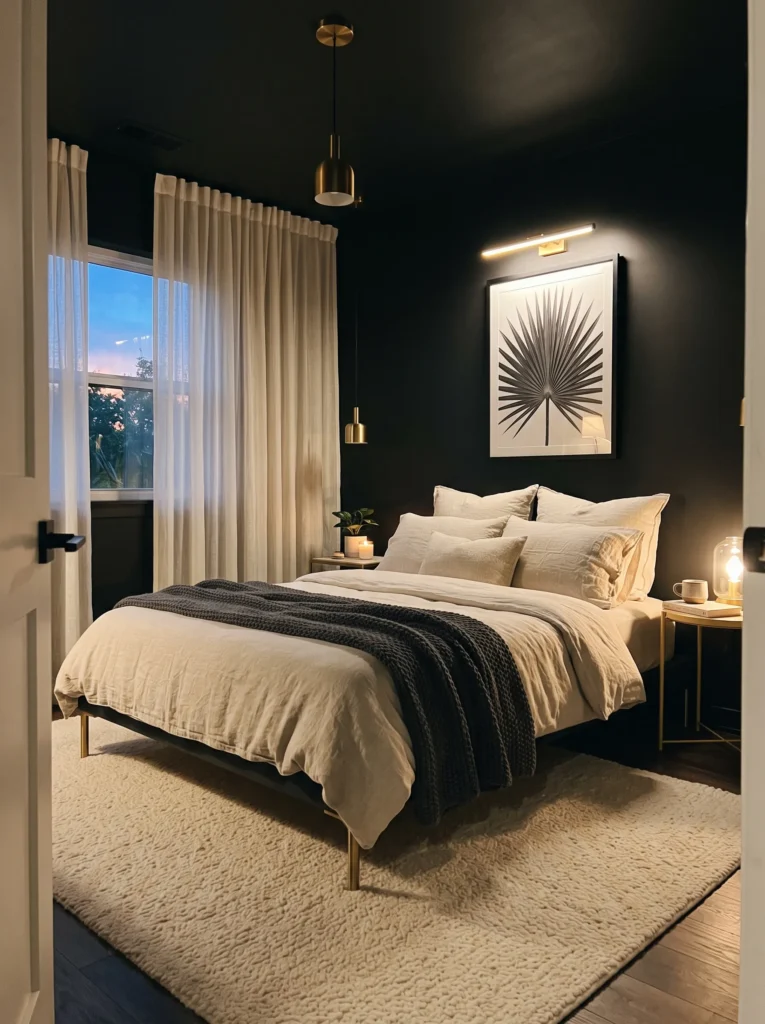
- WALLS: True black matte with a cool undertone (no brown or blue drift), painted wall-to-wall — including trim, doors, and ceiling — to erase every visual break
- BEDDING: Heavyweight stonewashed linen in oatmeal, layered with a charcoal wool throw at the foot of the bed
- WALL DECOR/ART: A single black-and-white botanical print lit by a brass picture light instead of hung bare — the light source doubles as depth-adding decor
- PLANTS: A ZZ plant in a matte black ceramic pot on the nightstand — it tolerates low light, and its glossy leaves catch whatever light does reach it
- HANGING ELEMENTS: A brass dome pendant hung low over one nightstand instead of a matching pair, freeing visual space on the other side
- RUG: A chunky ivory wool bouclé rug, sized to cover most of the visible floor
- CURTAINS: Sheer oatmeal linen, floor to ceiling, mounted high above the window frame to pull the eye upward
- FURNITURE/HARDWARE: Low platform bed frame with slim brass legs, keeping the floor visible beneath it
Why this works: A small room loses its boxy feeling when the walls, trim, and ceiling share the exact same dark tone, because the eye has no measuring lines left to work with.
Cocooning works because your eye judges a room’s size using edges — where the wall meets the trim, where the trim meets the ceiling. Paint every one of those transitions the same black, and those measuring lines disappear. The room stops reading as “four walls and a ceiling” and starts reading as one continuous, enveloping space. This is the single most effective small-space technique for a dark bedroom, and it’s also the most commonly skipped one, because most black bedroom inspiration leaves the trim white “for contrast.” That contrast is exactly what chops a small room up and makes it feel smaller than it actually is.
What keeps this look from feeling like a cave is contrast placed where it matters — in texture, not on the trim. Oatmeal linen bedding, an ivory bouclé rug, and a brass picture light all sit against the black in soft, warm tones, so the eye has plenty to land on without a single hard edge breaking up the walls. In my experience, this combination reads as far more expensive than an all-white room the same size, because the contrast feels intentional rather than accidental. A 10×11 bedroom done this way photographs — and lives — like a room twice its size.
You’ll Also Love:15 Soft Yellow Bedroom Ideas That Feel Calm
2. Mirror-Deep Alcove
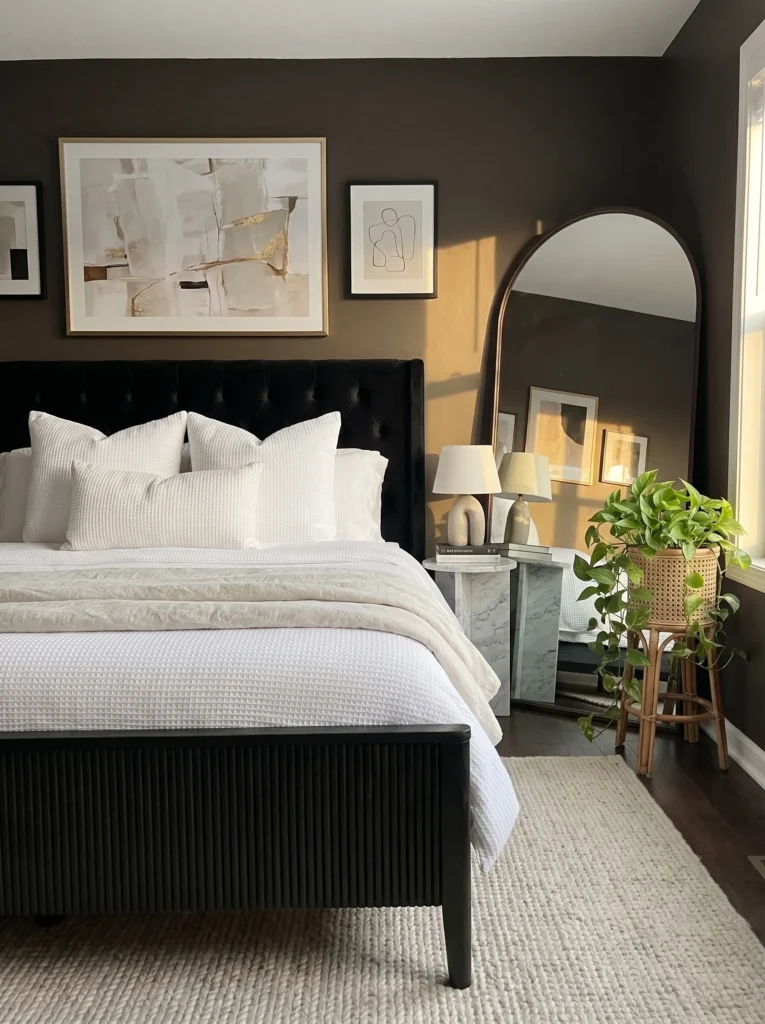
- WALLS: Soft black with a warm brown undertone — almost espresso in low light — in an eggshell finish that gently bounces light around the room
- BEDDING: Black velvet channel-tufted headboard paired with crisp white waffle-cotton bedding
- WALL DECOR/ART: A tall arched mirror leaned against the wall opposite the window, angled to reflect natural light back into the room
- PLANTS: Trailing pothos in a woven black rattan hanging planter beside the mirror, its vines softening the mirror’s hard edge
- HANGING ELEMENTS: A slim woven pendant with a warm bulb, hung slightly off-center from the bed
- RUG: Flatweave wool rug in soft charcoal stripes, low pile to keep the floor line visible
- CURTAINS: Black-and-oatmeal windowpane linen, hung on a slim brass rod
- FURNITURE/HARDWARE: Black-stained oak bed frame with fluted detailing and tapered wood legs
Why this works: A mirror placed to reflect a window instead of a wall doubles a small room’s available daylight, not just its sense of furniture.
I styled a room almost this exact size for a client last spring, and the mirror was the piece that changed everything. She’d assumed a large mirror would make her 10×12 bedroom feel busier, but leaning it opposite the window instead of hanging it flat did the opposite — it pulled outdoor light across the room and deepened the sense of space. The espresso-toned black walls kept their warmth even in low light, which surprised her more than anything else we tried. That’s the detail people miss: undertone matters as much as darkness when choosing black for a small room.
The fluted oak bed frame keeps this look from feeling heavy, since its tapered legs leave the floor visible on all four sides — a small but important trick when square footage is tight. Paired with crisp white waffle-cotton bedding, the black velvet headboard reads as the room’s one true luxury moment instead of competing with everything else in the space. The trailing pothos softens the mirror’s straight edge, and its vines will only get longer with time, adding more life to the corner without taking up a single inch of floor space.
3. Vertical Black Built-Ins
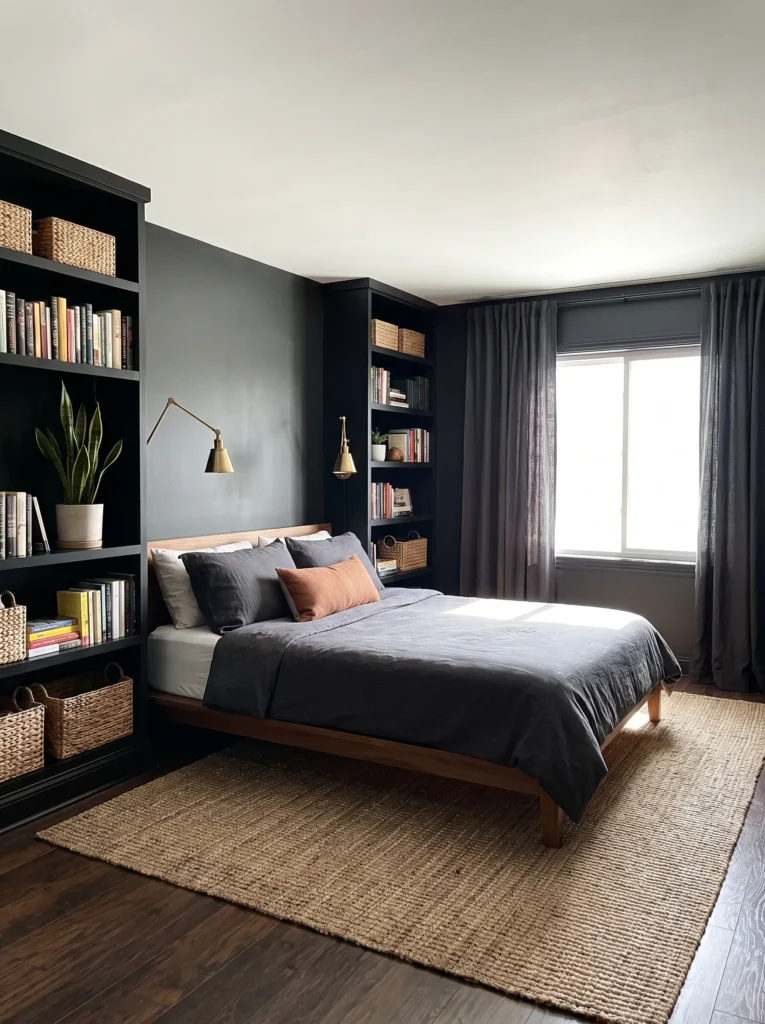
- WALLS: True black in a scuff-resistant matte-eggshell hybrid finish — the type my husband’s crews use in small, high-touch rooms because flat matte shows fingerprints within a year, while a slight sheen wipes clean and still reads as matte from more than three feet away
- BEDDING: Charcoal linen duvet with a single burnt-terracotta lumbar pillow for warmth
- WALL DECOR/ART: Floor-to-ceiling black built-in shelving flanking the headboard, styled with stacked books and one small sculptural object per shelf — never filled solid
- PLANTS: A snake plant on the lowest shelf, chosen because it tolerates the lower light a small room’s single window usually allows
- HANGING ELEMENTS: A slim brass reading sconce mounted directly to the shelving, saving nightstand space entirely
- RUG: Natural jute-and-wool blend rug, adding texture without adding visual weight
- CURTAINS: Blackout-lined linen in matching charcoal, so the window disappears into the wall color rather than interrupting it
- FURNITURE/HARDWARE: Low platform bed frame with exposed black metal legs — storage lives on the walls, not under the mattress
Why this works: In a small bedroom, storage that climbs the wall instead of spreading across the floor is what actually makes the room feel larger — not the color of the walls.
Most small bedrooms lose floor space to dressers and nightstands that could just as easily live on the wall. Floor-to-ceiling shelving flanking the headboard solves two problems at once: it gives a small room real storage without eating into the square footage that makes the room feel walkable, and it draws the eye upward, which makes the ceiling feel higher than it is. Built directly into a black wall, the shelving nearly disappears into the color, so it reads as architecture rather than furniture. That distinction matters more in a small room than almost anywhere else in the house.
My husband’s crews see this mistake constantly on renovation walkthroughs: a true flat matte black in a small, high-touch bedroom that shows every scuff and fingerprint within months. A matte-eggshell hybrid finish solves it, keeping the deep, non-reflective look of matte while wiping clean like a satin. It’s a small spec change that makes a real difference in how the room holds up and photographs a year later. Paired with the jute-wool rug and a single terracotta pillow for warmth, the whole look stays grounded instead of feeling like an empty gallery wall.
4. Curved Silk Corner
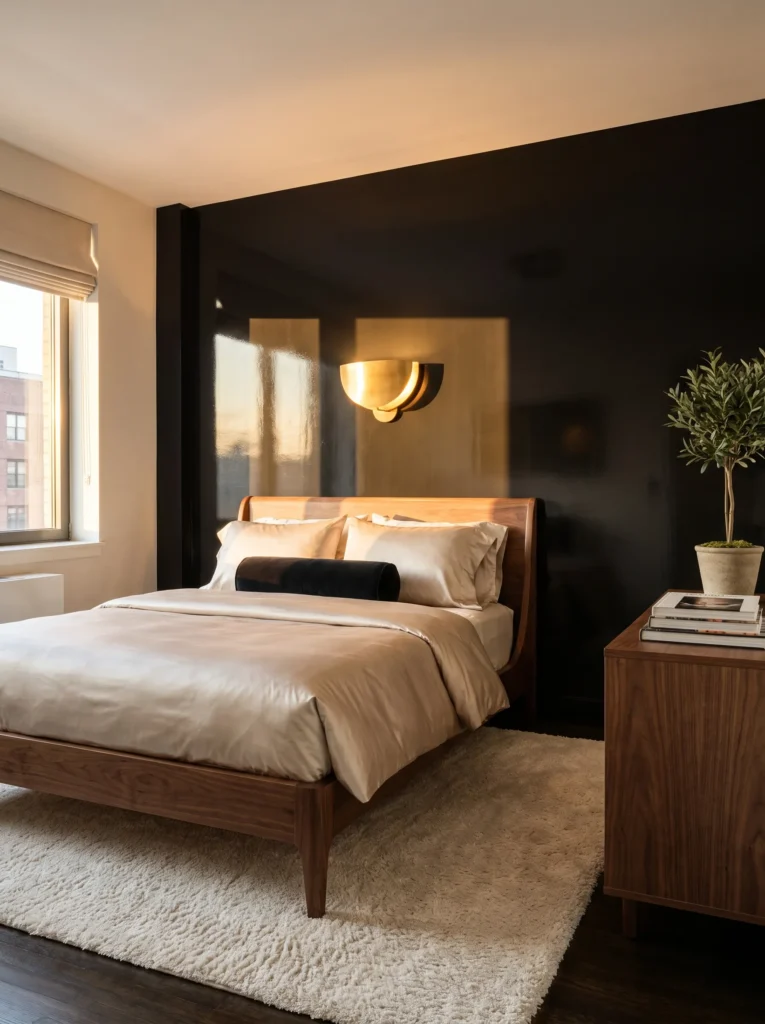
Curved, high-gloss black lacquer is one of the fastest ways to make a small bedroom read as intentional rather than crowded — a matte, boxy silhouette in a tight room emphasizes every straight edge, while a rounded one softens the room’s actual corners.
- WALLS: Black lacquer-effect paint with a warm brown undertone, high-gloss finish on one accent wall only, behind the bed
- BEDDING: Champagne silk-blend duvet with a black velvet bolster pillow at the headboard
- WALL DECOR/ART: No wall art on the lacquer wall — the sheen itself acts as the visual moment, reflecting ambient light
- PLANTS: A small olive topiary in a curved black stoneware pot on the dresser, chosen for its sculptural, rounded shape that echoes the room’s curves
- HANGING ELEMENTS: A curved brass wall sconce mounted directly above the headboard instead of a pendant, freeing ceiling space
- RUG: Ivory shag rug with rounded edges, placed to soften the transition between bed and floor
- CURTAINS: Champagne silk-blend drapery, floor length, hung to pool slightly at the base
- FURNITURE/HARDWARE: Curved, organic-modern bed frame with tapered walnut legs and brass sabot caps
Why this works: A rounded silhouette against a small room’s straight walls softens the space’s actual corners instead of adding more of them.
Curved furniture is one of the most underused small-space tricks in bedroom design, and it has nothing to do with trend-chasing. A small room is made up almost entirely of hard right angles — walls, doorframes, dressers. Introducing one genuinely curved anchor piece, like this organic-modern bed frame, breaks that repetition and gives the eye a place to rest that isn’t another 90-degree corner. Paired with a single high-gloss lacquer wall behind the headboard, the curve and the sheen work together, catching and bouncing light across the room instead of absorbing it flat.
The tapered walnut legs with brass sabot caps do double duty here — they keep the floor visible beneath the frame, which is non-negotiable in a small room, and they warm up what could otherwise be a cold, overly polished look. I’ve noticed that clients who are nervous about high-gloss black in a small space relax once they see it paired with warm wood tones and silk instead of chrome and glass. The champagne silk drapery and bolster pillow keep the room feeling soft, not showroom-sterile, even with all that shine in the mix.
5. Layered Glow Technique
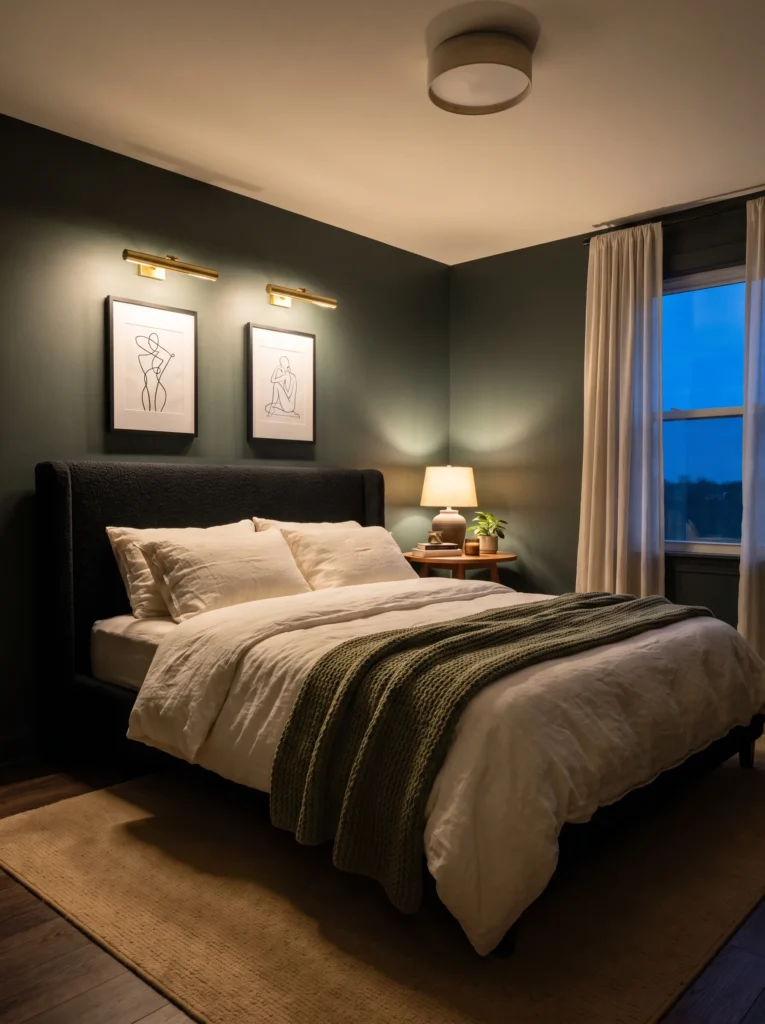
I once walked into a small black bedroom that had exactly one light source — a single overhead fixture — and it felt like a cave the second the sun went down. That’s the mistake this idea fixes.
- WALLS: Soft black with a faint bottle-green undertone, matte finish, walls only (ceiling left in a warm off-white to keep the room from feeling capped)
- BEDDING: Ribbed black bouclé headboard with ivory linen bedding and a moss-green throw
- WALL DECOR/ART: A pair of small brass picture lights over abstract line-art prints, used purely as a second light layer
- PLANTS: A trailing string of pearls in a small brass hanging planter near the window, where it gets the most natural light
- HANGING ELEMENTS: A dimmable brass and frosted-glass flush-mount fixture, kept low on the dimmer for evening use
- RUG: Warm camel wool rug, low pile
- CURTAINS: Sheer ivory linen paired with a slim wood cornice board to disguise a shorter window
- FURNITURE/HARDWARE: Bouclé-upholstered bed frame on slim black metal legs
Why this works: A small dark room needs at least three separate light sources at three different heights to avoid feeling like a cave once natural light fades.
Lighting layering matters more in a small black bedroom than in almost any other room in the house, because dark walls absorb light instead of bouncing it, and a single overhead fixture simply can’t compensate for that. This room uses three distinct layers: a dimmable flush-mount overhead, two brass picture lights at art height, and natural light from the window during the day. Each one hits the walls at a different angle, which keeps shadows from pooling in the corners after dark. Left with just one source, even a beautifully styled black room can start to feel flat and closed-in by evening.
Leaving the ceiling a warm off-white here isn’t a compromise — it’s intentional. Full cocooning works beautifully in some rooms, but in a room with lower ceilings to begin with, keeping the ceiling lighter while the walls stay a soft, green-black tone prevents the room from feeling capped. In my experience, this combination gives you the drama of a dark bedroom without sacrificing the sense that the room can still breathe, which matters most in the exact rooms where square footage is already working against you.
6. Marble & Brass Vanity Nook
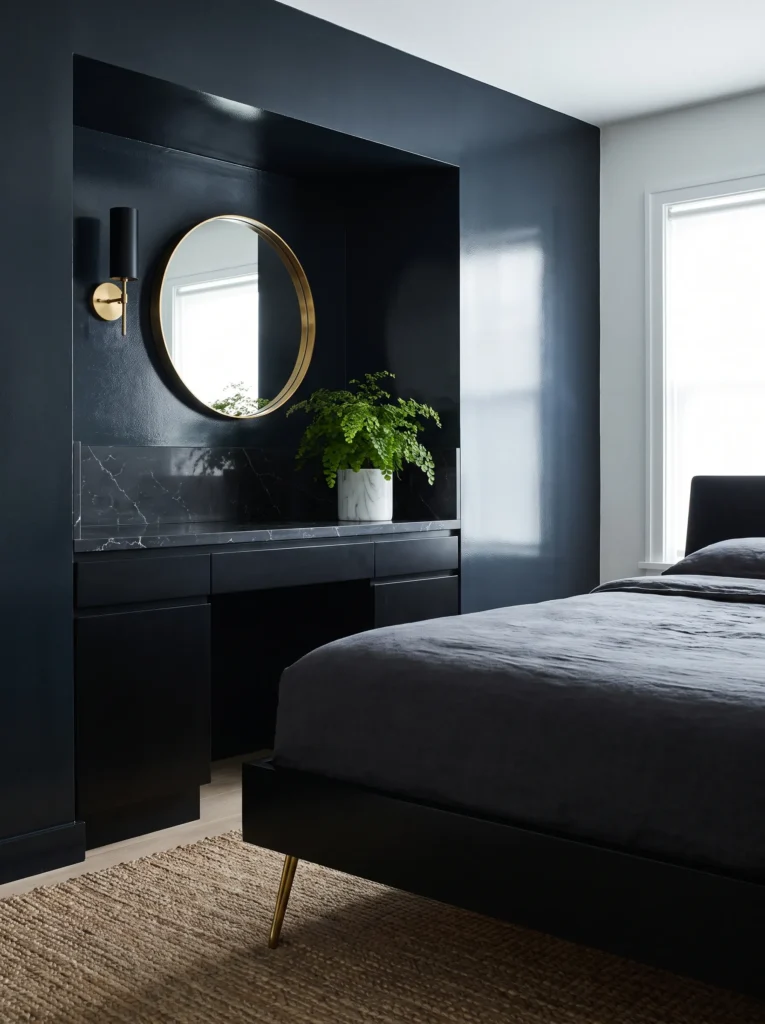
- WALLS: True black with a cool blue undertone, high-sheen satin finish on the wall behind a small built-in vanity nook
- BEDDING: White Belgian linen with a black-and-white marbled throw pillow tying the bedding to the vanity surface
- WALL DECOR/ART: A round mirror mounted directly above the vanity, doing double duty as both function and depth
- PLANTS: A small maidenhair fern in a white marble-look pot on the vanity — it prefers the indirect light this nook typically gets, away from direct sun
- HANGING ELEMENTS: A slim black-and-brass wall sconce flanking the vanity mirror on one side only, keeping the nook from feeling symmetrical and predictable
- RUG: A small ivory Moroccan-style accent rug placed just at the vanity, distinct from the room’s main rug
- CURTAINS: Black linen with a subtle cream pinstripe, hung close to the ceiling line
- FURNITURE/HARDWARE: Black lacquer bed frame with brass hairpin legs; the vanity nook itself uses a white marble-look countertop with black cabinetry below
Why this works: Carving out one small dedicated surface — even 18 inches wide — reads as luxury because it signals the room was planned around a real routine, not just decorated.
A vanity nook this size doesn’t need to be a full dressing room to feel like one. What makes it read as luxurious is the pairing of materials — a cool-toned black wall, a white marble-look counter, and warm brass fixtures — combined with the fact that it exists at all in a small footprint. Most small bedrooms skip a dedicated surface like this entirely, assuming there isn’t room. Even an 18-inch built-in ledge, tucked into an existing wall recess, gives the room a sense of purpose beyond sleeping, which is exactly the kind of detail that makes a small space feel considered rather than cramped.
The round mirror above the vanity earns its place doing two jobs at once: it’s functional for the vanity itself, and its position — angled to catch whatever light the room’s window offers — adds the same depth-boosting effect as a larger leaned mirror elsewhere in the room. Pairing the cool-blue-black wall with a marble-look counter and brass hardware keeps the palette from feeling cold, since the warmth in the brass and the soft veining in the marble balance the deeper undertone of the paint. It’s a small footprint doing a lot of visual work.
7. Fluted Arch Alcove
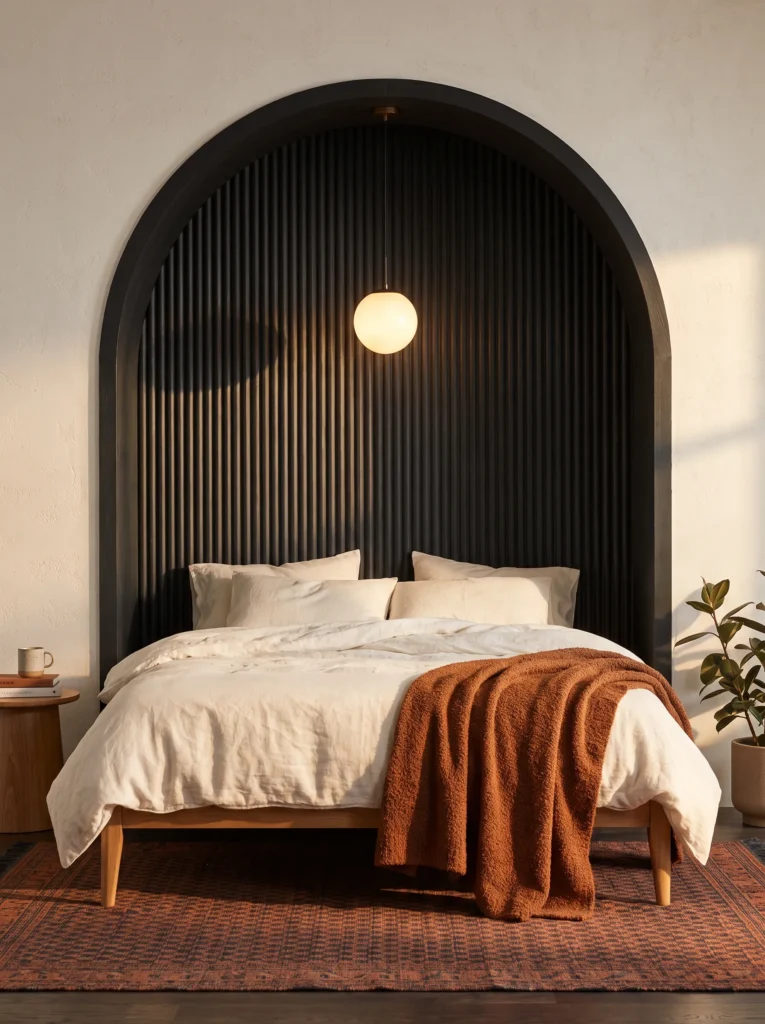
An arched, ribbed-paneled alcove is one of the strongest ways to add architectural interest to a small bedroom without adding a single extra piece of furniture — the detail lives in the wall itself.
- WALLS: Warmest of the black family — a deep charcoal-black with visible warmth in daylight — matte finish, with a fluted wood-paneled arch built out behind the headboard
- BEDDING: Rust-orange bouclé throw layered over ivory cotton-linen bedding
- WALL DECOR/ART: No separate art — the fluted arch itself is the focal point, left intentionally bare
- PLANTS: A rubber plant in a fluted black ceramic pot in the corner, echoing the ribbed detail of the arch
- HANGING ELEMENTS: A single glass globe pendant, hung centered inside the arch above the headboard
- RUG: Rust-and-charcoal flatweave rug with a subtle geometric border
- CURTAINS: Ivory linen-cotton blend, simple and unfussy, so they don’t compete with the arch
- FURNITURE/HARDWARE: Low bed frame with black-stained oak legs, kept visually light to let the arch stay the star
Why this works: An architectural focal point built into the wall itself adds visual richness to a small room without consuming any of its limited floor space.
A fluted arch alcove works because it puts the room’s most dramatic detail somewhere that costs zero square footage — directly on the wall, rising up behind the bed. In a larger bedroom, that kind of drama often comes from an oversized furniture piece or a gallery wall, both of which eat into open floor space a small room can’t spare. Here, the ribbing itself catches light and shadow differently throughout the day, so the wall changes character from morning to evening without a single object added. It’s one of the more architecturally ambitious ideas on this list, and one of the easiest to actually build.
This is a detail my husband’s crews have framed out in a handful of small bedroom renovations, and it’s simpler than it looks — a plywood arch template, ribbed wood strips, and paint. What makes it work in a small room specifically is restraint elsewhere: no wall art competing with the arch, minimal curtains, and a low-profile bed frame that doesn’t fight for attention. The rust bouclé throw is the only strong color note in the room, and it’s enough, because the architecture is already doing the heavy lifting.
8. Two-Tone Panel Wall
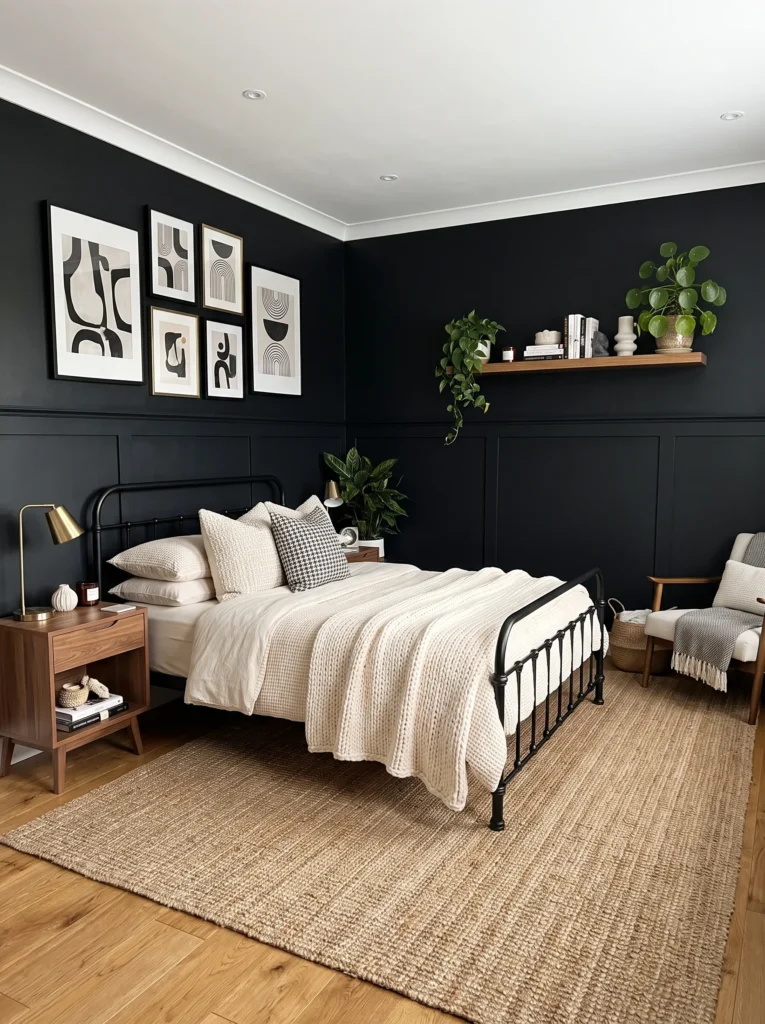
A wall painted in two different black finishes — same exact color, different sheen — adds visual texture without breaking the eye-line the way two different black tones would.
- WALLS: True black with a neutral undertone, lower third finished in a flat matte, upper two-thirds in a soft satin — same paint color, different sheen level, separated by a thin black shadow-line molding
- BEDDING: Chunky ivory knit-cotton bedding with a single black-and-cream houndstooth pillow
- WALL DECOR/ART: A trio of small brass-framed botanical prints, hung in a tight vertical column rather than spread wide, to preserve wall space on either side
- PLANTS: A pilea in a black concrete pot on a floating shelf beside the bed
- HANGING ELEMENTS: A woven black rattan pendant, hung slightly lower than standard to fill the vertical space between bed and ceiling
- RUG: Cream cable-knit wool rug, thick pile, placed only at the foot of the bed to keep the rest of the floor open
- CURTAINS: Unlined ivory linen, sheer enough to let full daylight through
- FURNITURE/HARDWARE: Black metal four-leg bed frame with a slim profile and no footboard
Why this works: Two sheens of the exact same black paint create depth and texture on a wall without introducing a second color that would visually chop the room in half.
The trick here is subtle enough that most guests won’t consciously register it — they’ll just sense the wall has more depth than a flat coat of black usually offers. Matte absorbs light at the bottom of the wall, near the furniture, while the satin finish above catches and reflects it, drawing the eye gently upward. That upward pull is what makes a shadow-line molding detail like this worth the extra step for a small room specifically, since anything that lifts the eye toward the ceiling makes the space feel taller than its actual dimensions suggest.
I tried this exact two-tone technique in my own home office closet-turned-reading-nook, and it photographed noticeably richer than the single-sheen version I’d done in an earlier room. The houndstooth pillow and cream cable-knit rug keep the palette from feeling too serious, and because the rug only covers the foot of the bed rather than the whole floor, the black metal bed legs stay fully visible — which matters more for the room’s sense of openness than people usually expect from a single furniture choice.
9. Slim Iron Canopy
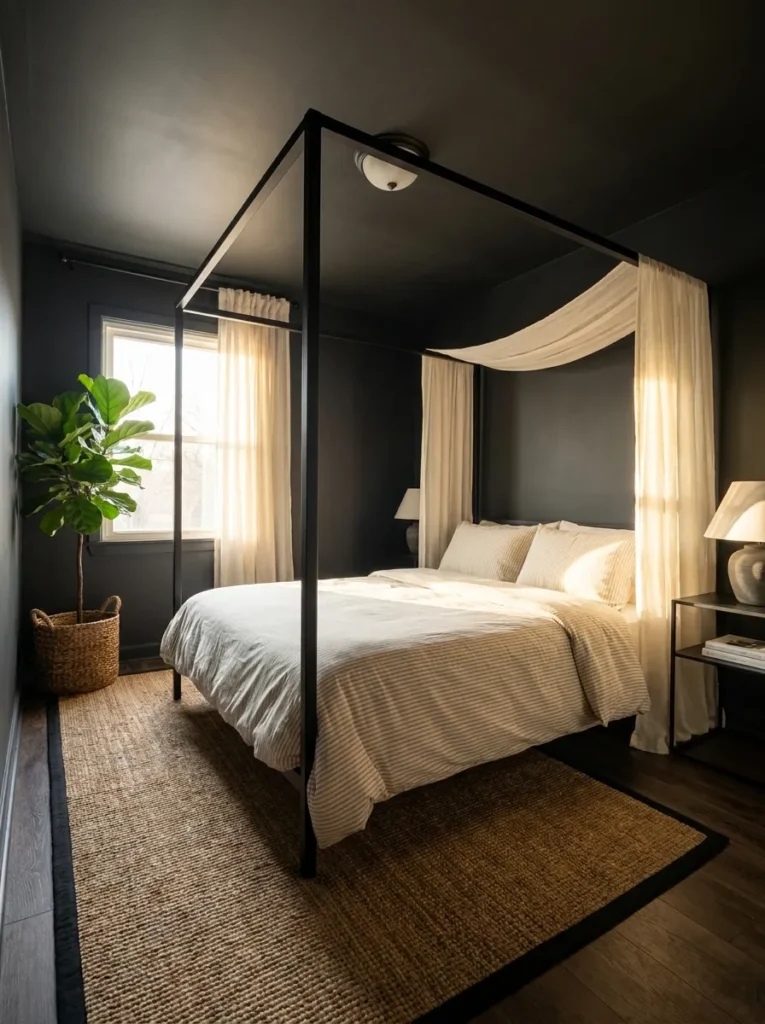
Black rooms with low ceilings often skip canopy beds entirely, assuming the extra height will feel oppressive — but a slim, open iron frame does the opposite of a heavy traditional four-poster.
- WALLS: Soft black with a warm gray undertone, matte finish, all four walls and ceiling painted to match for full cocooning
- BEDDING: Ivory linen bedding with a black-and-white ticking-stripe duvet cover layered underneath
- WALL DECOR/ART: No wall art — the canopy frame itself is the room’s vertical statement, left unobstructed
- PLANTS: A small fiddle leaf fig in a woven black seagrass basket in the corner, chosen for its height and the way its leaves catch light near the window
- HANGING ELEMENTS: Sheer ivory canopy fabric draped loosely over the top of the iron frame, not fully closed, letting light pass through
- RUG: Natural jute rug, edge-bound in black
- CURTAINS: Matching sheer ivory linen to echo the canopy fabric and unify the room’s few light-colored elements
- FURNITURE/HARDWARE: Slim black iron four-poster frame with thin, tapered posts — visually the lightest bed frame on this list
Why this works: An open iron canopy frame adds real height and drama to a small room’s vertical space without blocking any of the sightlines a solid frame would.
A traditional wood canopy bed can overwhelm a small room fast, simply because of how much visual mass it adds at eye level. An iron frame with thin, tapered posts solves that problem by giving the room the same sense of height and occasion without the bulk — you can see straight through it from any angle in the room, which keeps the space feeling open even with a large-scale piece of furniture at its center. Painted the exact black as the walls and left unobstructed by wall art, the frame reads as sculpture more than furniture, which is exactly the effect a small luxury bedroom benefits from most.
Full wall-and-ceiling cocooning does most of the heavy lifting in this room, and the canopy frame simply extends that same enveloping feeling upward instead of stopping at eight feet. In my experience, clients are far more nervous about canopy beds in small rooms than almost any other piece on this list, assuming height will feel claustrophobic. The opposite tends to happen once the frame goes up — sheer draping and thin iron posts read as airy, not heavy, and the natural jute rug keeps the whole look grounded rather than overly formal.
10. Floating Nightstand Setup
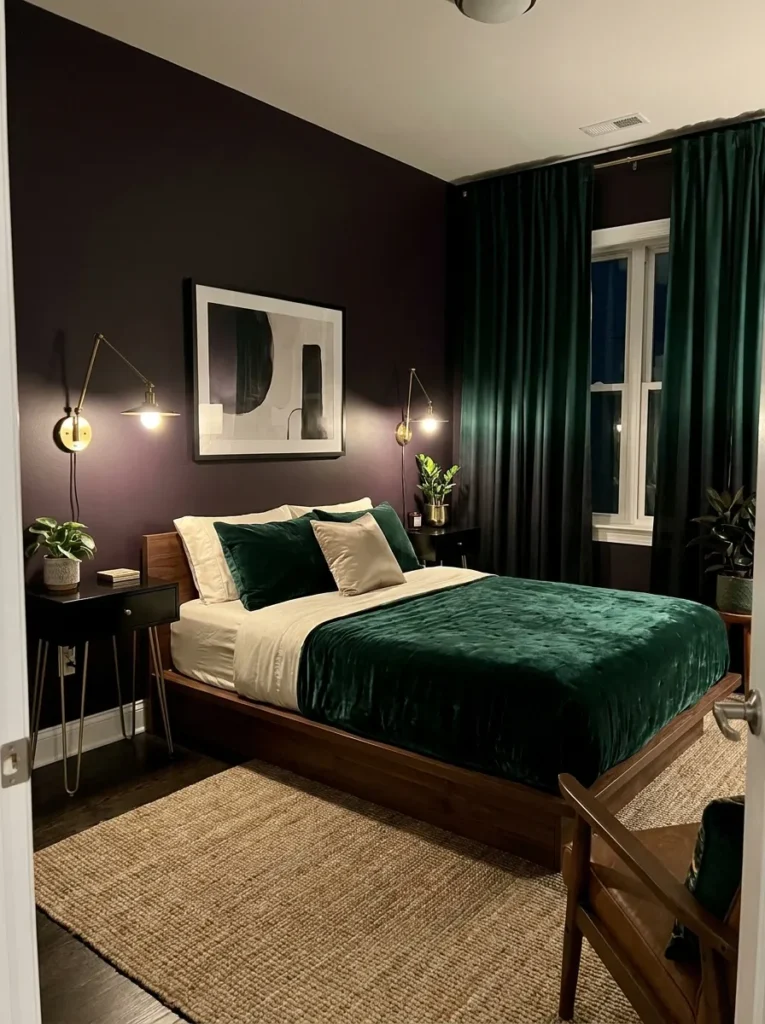
Wall-mounted, floating furniture is the single fastest way to make a small floor plan feel bigger, because it leaves the entire floor line visible from the doorway — a completely uninterrupted sightline most bedrooms never achieve.
- WALLS: Deep black with a subtle plum undertone, eggshell finish
- BEDDING: Deep emerald velvet coverlet folded at the foot of the bed over ivory percale sheets
- WALL DECOR/ART: Two small round brass-framed mirrors, one above each floating nightstand, angled slightly to catch window light from across the room
- PLANTS: A pair of small pothos cuttings in slim glass bud vases, one on each floating nightstand
- HANGING ELEMENTS: Two matching brass swing-arm sconces, mounted directly to the wall above the nightstands, eliminating the need for table lamps entirely
- RUG: Charcoal boucle-weave rug, low pile, running the full width beneath the bed
- CURTAINS: Emerald-black ombré linen, deepest at the floor
- FURNITURE/HARDWARE: Black lacquer floating nightstands with brass hairpin brackets; low platform bed with completely exposed black metal legs
Why this works: When every surface in a small room — nightstands included — sits off the floor, the eye reads the entire floor plan as open, which changes how large the room feels far more than any single wall color choice does.
Floating nightstands solve a problem most small bedrooms don’t even realize they have: table legs and drawer bases quietly clutter the one continuous sightline that makes a room feel spacious. Mount the nightstands to the wall instead, and that entire strip of floor along the base of the bed stays completely open, visible in one uninterrupted line from the doorway. Paired with a low platform bed on slim exposed legs, this room achieves something rare for its size — you can see the floor beneath nearly every piece of furniture in it, which does more for the room’s perceived size than the black walls do on their own.
Swing-arm sconces mounted above each floating nightstand solve a second small-space problem at the same time: table lamps eat surface space that a small nightstand can’t spare, and cords running down to an outlet add visual clutter. Wall-mounted sconces remove both issues entirely. The plum undertone in the black walls warms up beautifully next to the emerald velvet coverlet and ombré curtains, giving the room a jewel-toned richness that still reads as restrained rather than busy, which is the balance a small luxury bedroom needs most.
11. Mirrored Wardrobe Wall
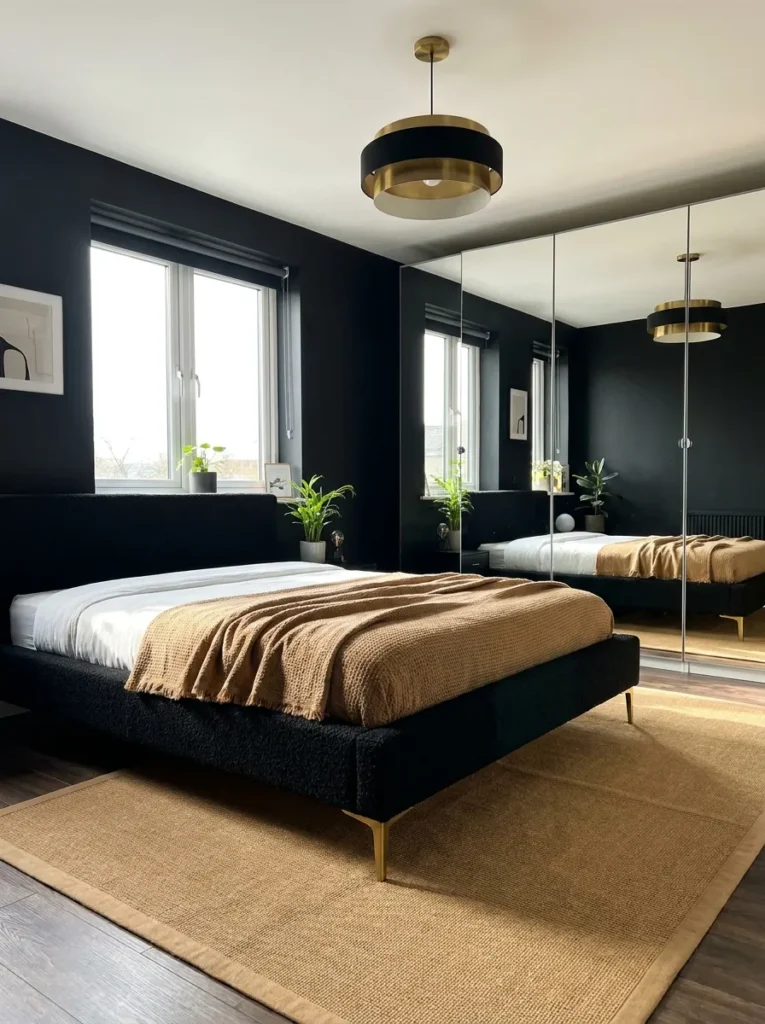
- WALLS: True black in a warm neutral undertone, matte finish, on three walls; the fourth wall is a full built-in wardrobe with mirrored, black-framed doors floor to ceiling
- BEDDING: Camel bouclé throw over crisp white cotton-percale sheets
- WALL DECOR/ART: No separate art on the mirrored wall — the reflection itself does the visual work, doubling the room’s apparent depth
- PLANTS: A trailing philodendron in a black hanging macramé planter near the window, reflected a second time in the wardrobe doors
- HANGING ELEMENTS: A single sculptural black-and-brass pendant, hung centered so its reflection reads as a second fixture in the mirrored wall
- RUG: Warm camel flatweave rug, low pile, sized to run nearly wall to wall
- CURTAINS: Black linen with a soft ivory trim edge, hung close to the ceiling
- FURNITURE/HARDWARE: Low upholstered black bouclé bed frame with slim brass legs
Why this works: A full mirrored wall does more for a small room’s perceived depth than any single decorative mirror, because it reflects the entire opposite side of the room rather than one framed section of it.
Full-wall mirrored wardrobe doors are a detail I’ve seen more often in my husband’s commercial builds than in residential bedrooms, but the logic translates perfectly to a small home. Instead of a single mirror reflecting a slice of the room, floor-to-ceiling mirrored doors reflect the entire opposite wall — furniture, pendant, plant, and all — effectively doubling the visible depth of the space. It’s also functional in a way decorative mirrors aren’t: it hides an entire wardrobe’s worth of storage behind a seamless black-framed surface, so the room gains real closet space without losing an inch of visual openness.
The reflected pendant light is the detail most people notice last and remember longest — hung dead center, it appears to repeat itself in the mirrored wall, making the room look like it has two fixtures instead of one. Paired with warm camel tones in the bouclé throw and rug, the black stays soft rather than severe, and the philodendron’s trailing vines get reflected too, doubling the sense of life in the room. It’s a genuinely luxurious effect that costs nothing beyond the mirror install itself.
12. Sculptural Bench Nook
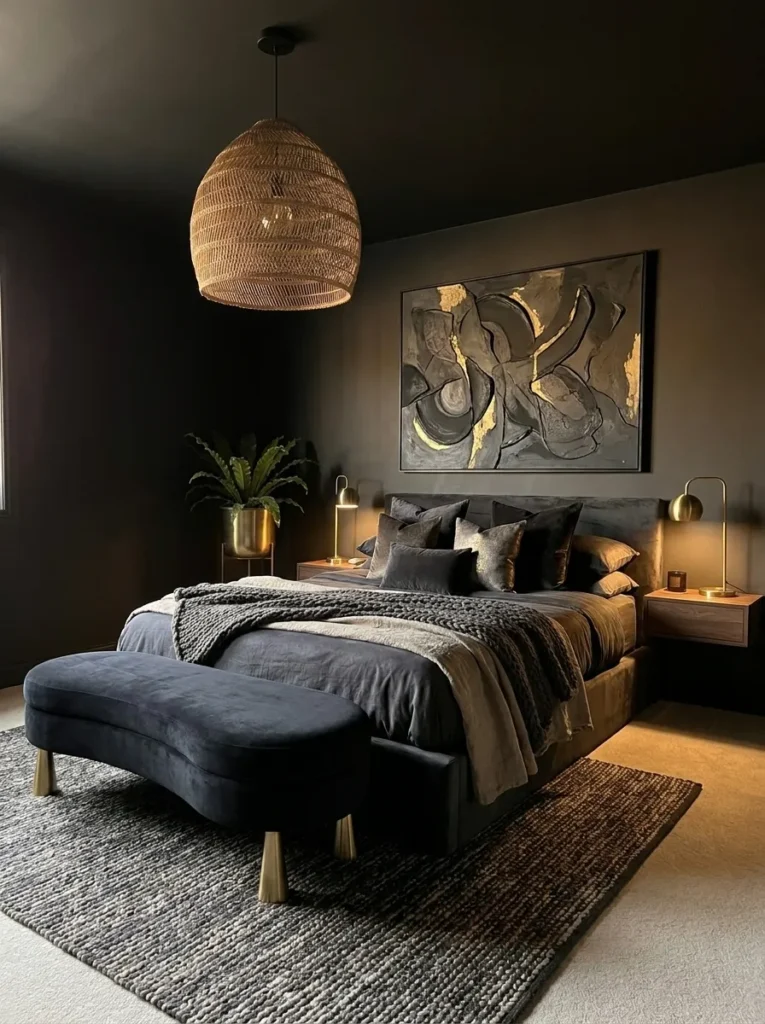
A small bedroom rarely has room for a full seating area, but a single sculptural bench at the foot of the bed adds the lounge-like feel of a much larger suite without requiring extra square footage.
- WALLS: Soft black with a warm taupe undertone, matte finish, all walls matching, ceiling in the same tone for full cocooning
- BEDDING: Ivory bouclé bedding with a black-and-tan leopard-print lumbar pillow as the room’s one bold pattern moment
- WALL DECOR/ART: A large-scale abstract charcoal-and-cream canvas leaned against the wall behind the bench, rather than hung, for a more collected, less staged feel
- PLANTS: A bird’s nest fern in a black textured stoneware pot on the bench, chosen because it thrives in the lower, indirect light most small bedrooms actually get
- HANGING ELEMENTS: A woven black jute pendant, oversized but airy, hung to fill the vertical gap above the seating nook
- RUG: Ivory Berber-style rug with black flecking, placed beneath the bench and extending partway under the bed
- CURTAINS: Taupe-black linen blend, unlined, allowing soft diffused light through
- FURNITURE/HARDWARE: Curved black velvet bench with brass cone legs at the foot of the bed; bed frame in matching black velvet with a low, wide headboard
Why this works: A single bench, rather than a full seating arrangement, gives a small bedroom a lounge moment without sacrificing the walking space a second chair or ottoman would require.
Most small bedrooms skip seating altogether, assuming there’s no room for it — and usually, there isn’t room for a chair and an ottoman. One curved bench solves that differently. Placed at the foot of the bed, it doesn’t block the room’s main walking path the way a freestanding chair angled into the room would, and its curved shape means there’s no sharp corner catching a hip on the way past. That’s a detail I’ve genuinely watched trip people up in small rooms with a squared-off bench instead — the rounded version simply moves through the space better.
Leaning the abstract canvas against the wall instead of hanging it does double duty for a small room: it removes the visual weight of a frame sitting flush on dark walls, and it makes the whole vignette feel more like a considered, evolving space than a finished, static one. The leopard-print lumbar pillow is the only pattern in the entire room, which keeps it from competing with the taupe-black walls or the charcoal canvas — a small room can usually only support one loud pattern moment before it starts to feel busy.
13. Brass Inlay Headboard Wall
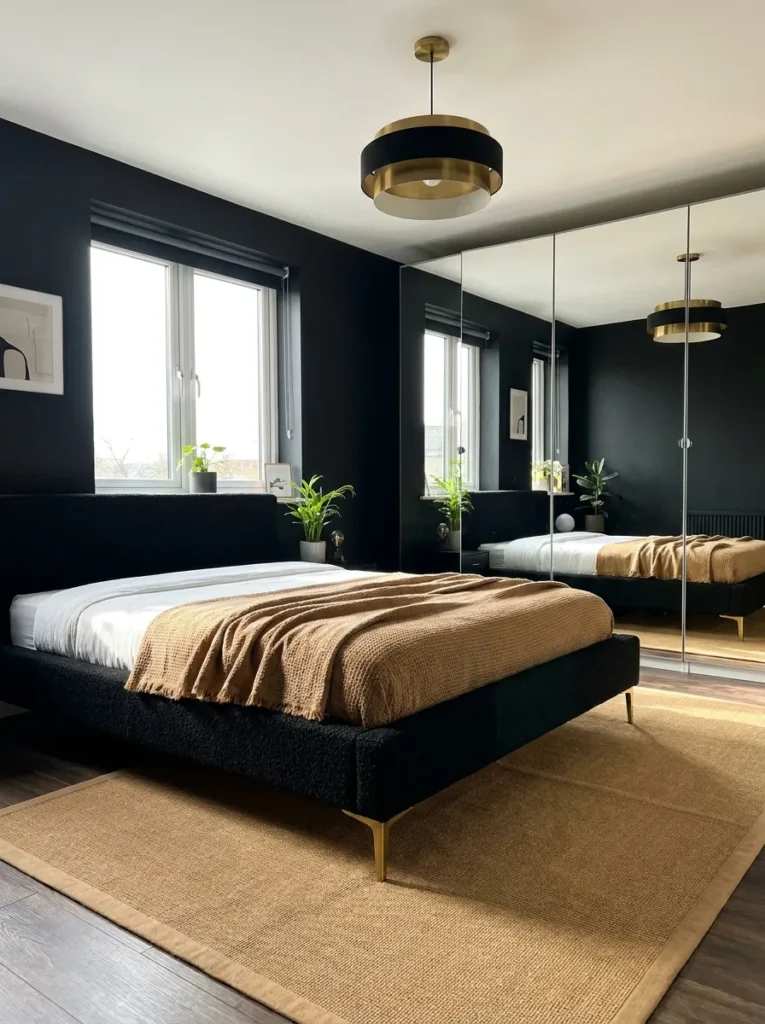
- WALLS: True black with a cool charcoal undertone, matte finish, with a thin brass inlay strip framing a rectangular section of wall directly behind the headboard — inset, not applied
- BEDDING: Dove-gray linen bedding with an ivory quilted coverlet folded at the foot
- WALL DECOR/ART: No art within the brass-inlaid panel — the inlay itself is the art, left clean and unobstructed
- PLANTS: A small ponytail palm in a brass-banded black pot on the dresser, its sculptural silhouette echoing the geometric brass line
- HANGING ELEMENTS: Two slim brass wall sconces mounted just outside the inlay border, flanking the headboard symmetrically
- RUG: Charcoal wool rug with a subtle brass-toned fleck woven through
- CURTAINS: Dove-gray linen, floor to ceiling, hung on a slim black rod
- FURNITURE/HARDWARE: Low black velvet headboard sized to sit fully within the brass-inlaid panel, black metal bed frame legs
Why this works: A single inset brass line does more visual work than a large piece of art, because it reads as permanent architecture rather than decoration that could be swapped out.
An inlaid brass strip is a genuinely different kind of detail than hanging art on a black wall — it’s construction, not decoration, and it reads that way the moment you walk in. My husband’s crews have cut reveals like this into drywall for a handful of clients wanting a built-in look without a full millwork budget, and it’s a surprisingly affordable way to add a defined, gallery-like moment to a small room. Because the brass line frames the headboard precisely, the whole wall functions as one designed unit rather than a wall with furniture pushed against it, which is exactly the kind of intentionality that makes a small room feel high-end instead of thrown together.
Keeping the inlaid panel empty of any additional art was a deliberate restraint — in a small room, one clear focal point outperforms a cluster of smaller ones every time. The dove-gray bedding and curtains keep the palette soft against all that black and brass, and the ponytail palm’s rounded, sculptural shape gives the room a second point of visual interest without competing with the headboard wall. This is one of the more understated ideas here, and it’s also one of the most timeless.
14. Terrazzo & Ink Accent
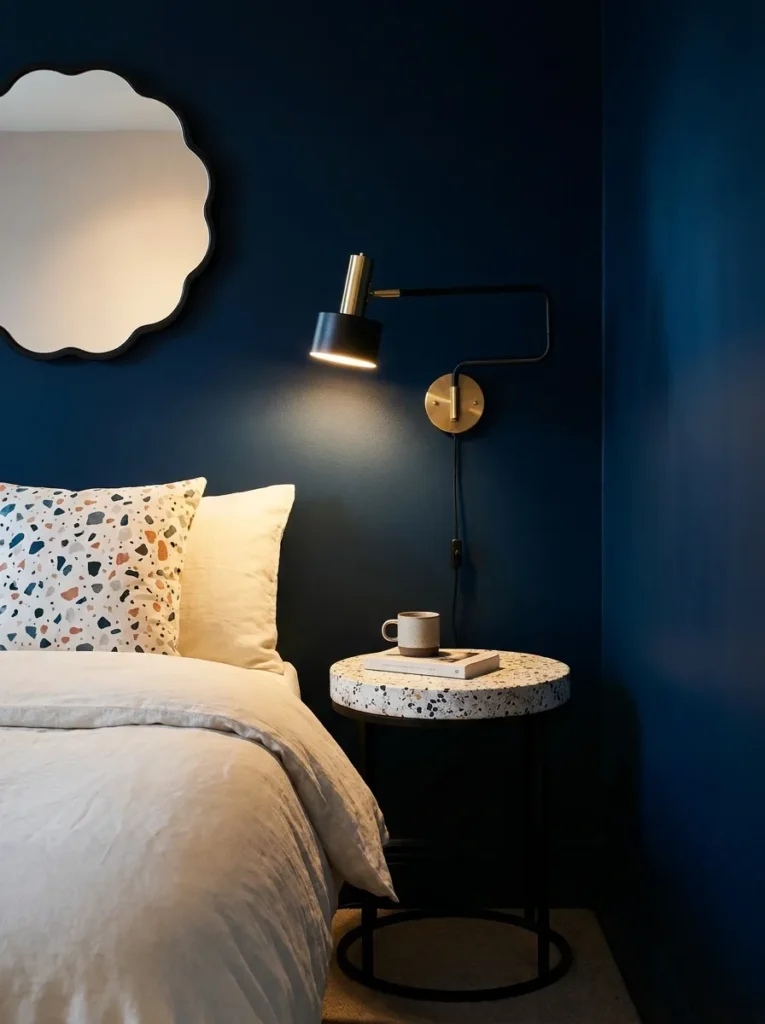
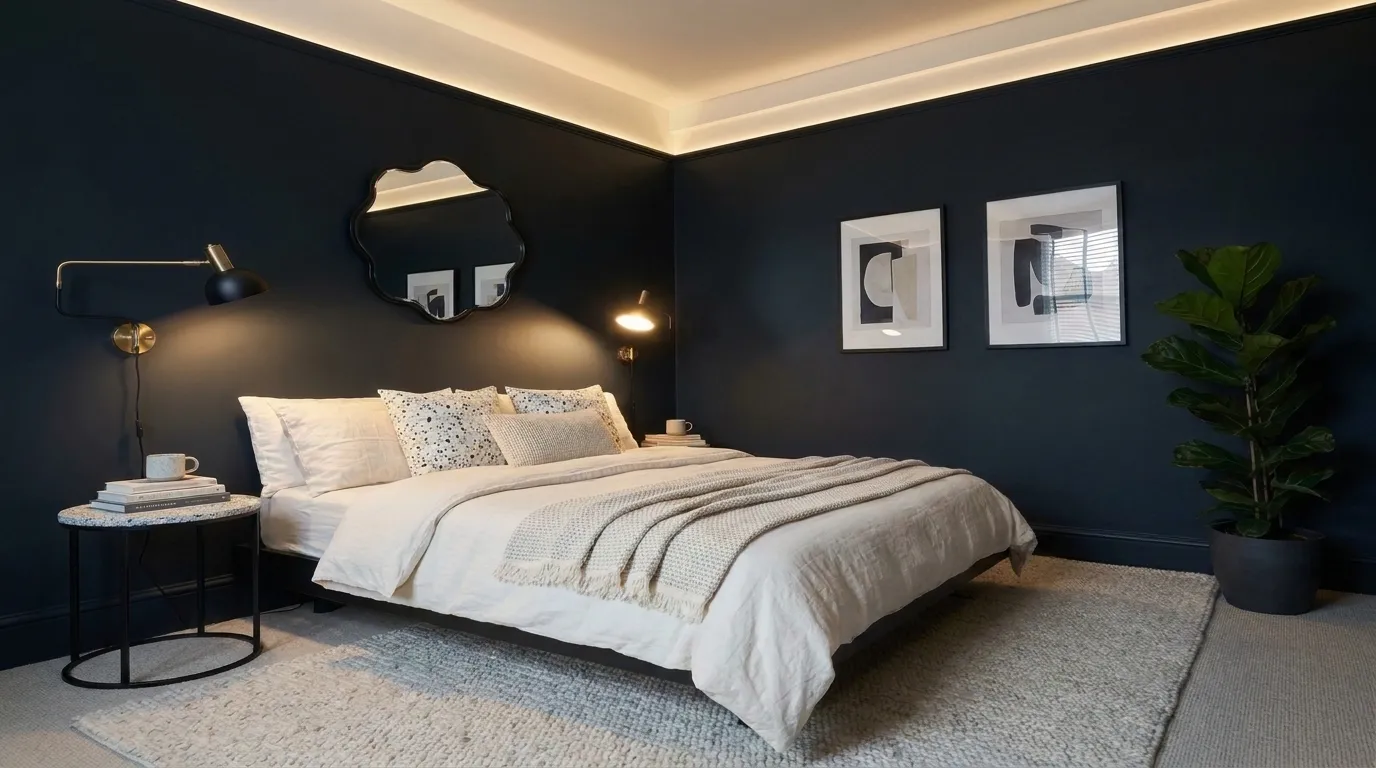
Terrazzo-look surfaces have shown up in kitchens and bathrooms for years, but a terrazzo-topped nightstand against ink-black walls is a combination almost no bedroom content has covered — and it’s a genuinely fresh way to bring texture into a small dark room.
- WALLS: Deep ink-black with a faint blue undertone, satin finish for subtle light reflection
- BEDDING: Ivory linen bedding with a black-and-white terrazzo-print throw pillow tying the palette to the nightstand surface
- WALL DECOR/ART: A small black-framed mirror with a scalloped edge, hung slightly off-center above one nightstand
- PLANTS: A polka dot begonia in a small terrazzo-look pot on the nightstand, chosen for its patterned leaves that echo the terrazzo surface
- HANGING ELEMENTS: A single black-and-brass articulated wall lamp beside the bed, adjustable rather than fixed
- RUG: Ivory flatweave rug with fine black speckling, low profile
- CURTAINS: Ink-black linen with a narrow ivory trim
- FURNITURE/HARDWARE: Round terrazzo-topped nightstand with black metal base; black upholstered bed frame with brass-capped legs
Why this works: One genuinely unexpected material — terrazzo — placed against ink-black walls gives a small room a distinct identity instead of reading as a repeat of every other black bedroom online.
Terrazzo is having a real moment in kitchens and baths right now, but almost nobody is bringing it into the bedroom, which makes it one of the more effective ways to make a small black bedroom feel current rather than like a rehash of the last decade’s dark-room trend. The flecked surface catches light differently than a solid material would, adding movement to a room that could otherwise feel visually static against flat black walls. It’s a small, contained way to introduce pattern and texture without adding another color to the palette.
The articulated wall lamp beside the bed solves a real small-room problem: fixed sconces can’t be adjusted for reading, and table lamps take up nightstand surface a terrazzo top this beautiful shouldn’t have to share. An adjustable arm gives you both function and a clean, uncluttered surface. I’ve noticed this is the detail that makes people pause when they walk into a room like this — it looks intentional in a way a plug-in lamp rarely manages, and the terrazzo pot echoing the nightstand top ties the whole vignette together without feeling matchy.
15. Warm Metal Mixed Palette
- WALLS: True black with a warm undertone, matte finish, all four walls matching
- BEDDING: Rust-and-cream striped linen duvet with a solid black velvet euro sham
- WALL DECOR/ART: A small gallery of three mixed-metal (brass, blackened steel, unlacquered copper) wall hooks styled with a single woven bag and a straw hat — functional decor that doubles as storage
- PLANTS: A staghorn fern mounted directly to the wall in a small wire frame, taking up zero floor or surface space entirely
- HANGING ELEMENTS: A copper-and-black pendant with a warm bulb, hung slightly off-center above the dresser rather than the bed
- RUG: Rust flatweave rug with a thin black border
- CURTAINS: Rust-and-black block-print linen, floor length
- FURNITURE/HARDWARE: Black rattan-and-metal bed frame with a woven headboard and slim black legs
Why this works: Mixing three different warm metals deliberately, rather than matching everything to one finish, keeps a small black room from feeling like a single monochrome block.
Most small black bedrooms default to a single matching metal — all brass, or all black hardware — because it feels safer and easier to plan. Mixing brass, blackened steel, and unlacquered copper deliberately does more for the room’s richness, as long as each metal appears more than once so it reads as intentional rather than mismatched. Here, the copper pendant, the mixed-metal wall hooks, and the black bed frame legs all work together because warm and cool tones alternate throughout the room instead of clustering in one spot. It’s a subtler kind of visual interest than pattern or texture, and it photographs beautifully because no single surface goes flat.
The wall-mounted staghorn fern earns its place for a reason beyond looks — in a small bedroom, floor and surface space are the two things you can’t spare, and a fern that lives entirely on the wall costs neither. That’s the same logic behind the functional wall hooks doubling as both storage and decor. The rust-and-black block-print curtains and rug bring warmth into a room that could otherwise feel cool and formal, keeping the overall mood grounded and lived-in rather than showroom-perfect.
Styling Principles: Making Black Work in a Small Room
Small black bedrooms succeed or fail on three techniques, not on the shade of black you pick.
Cocooning is the foundation. Painting the walls, trim, and ceiling the same black tone removes the visual break points that make a room read as small in the first place. The moment trim goes white against black walls, the eye starts measuring the room’s actual boundaries — and that’s when a small space starts to feel small. Full cocooning only works, though, if you commit to it completely; a half-matched trim does more visual damage than leaving everything white.
Mirror placement is the second lever, and it’s about angle, not just size. A mirror reflecting a blank wall adds almost nothing. A mirror positioned to reflect a window, a light fixture, or the opposite side of the room genuinely expands how much light and depth the space appears to hold. Full mirrored wardrobe walls take this furthest, but even a single leaned mirror angled correctly makes a measurable difference.
Lighting layering is what keeps a cocooned, mirror-deep black room from feeling like a cave once the sun goes down. One overhead fixture can’t do the job alone in a room that’s absorbing light instead of bouncing it. Every idea in this post relies on at least two, usually three, light sources at different heights — overhead, wall-mounted, and a warm accent — so the room stays inviting after dark instead of going flat and heavy.
Beyond those three techniques, the small-space wins that matter most are the ones that protect floor space: furniture with visible legs, floating or wall-mounted pieces where possible, and vertical storage instead of horizontal. A small black bedroom feels luxurious not because it’s dark, but because every surface in it was chosen to keep the floor line open and the light moving.
Frequently Asked Questions
Does black paint actually make a small room feel smaller? No — not on its own. A small room painted entirely in one black tone, including the trim and ceiling, typically feels larger than the same room with black walls and contrasting white trim, because the color removes visual break points rather than adding them. The rooms that feel smaller are usually the ones where dark walls meet bright trim, not the ones that commit to black throughout.
What’s the best black paint finish for a small bedroom? A matte or matte-eggshell hybrid finish works best for walls in a small bedroom. True flat matte gives the deepest, most enveloping color, but it shows scuffs and fingerprints quickly in a high-touch room. A slight eggshell sheen wipes clean while still reading as matte from a few feet away, which matters in a room where furniture sits close to the walls.
How do you add luxury to a small black bedroom without adding bulk? Choose material quality over size — velvet, brass, marble-look surfaces, and curved silhouettes signal luxury without taking up extra floor space. Furniture with visible legs, floating nightstands, and wall-mounted lighting all preserve the open floor line that makes a small room feel larger, while still allowing for genuinely rich materials layered throughout.
What’s a budget-friendly way to try a small black luxury bedroom look? Start with the walls and one material moment. A single well-chosen accent — a velvet headboard, a brass pendant, or one leaned mirror — paired with fully cocooned black walls delivers most of the visual impact of a full room makeover. Bedding, throw pillows, and a single plant are the least expensive way to layer in warmth once the walls are done.
What’s the best lighting setup for a small black bedroom? Layer at least two, ideally three, light sources at different heights: a dimmable overhead fixture, wall-mounted sconces or picture lights, and natural daylight from the window. This prevents the flat, cave-like feeling that a single overhead light creates once the sun goes down, since dark walls absorb rather than bounce available light.
Do plants work well in a small black bedroom? Yes, and they read especially well against black walls because the contrast makes leaf texture and color stand out. Choose species that tolerate the lower indirect light most small bedrooms get — pothos, ZZ plants, snake plants, and ferns are reliable choices, and wall-mounted or hanging options like a staghorn fern keep valuable floor and surface space free.
Conclusion
A small bedroom was never the obstacle — the wrong execution was. Once you cocoon the walls, layer your lighting, and let a well-placed mirror do its job, black stops shrinking a room and starts giving it depth, warmth, and a sense of intention most bedrooms never achieve. I’ve seen how much these small changes transform a space, often more than a full renovation would.
Whichever of these small black luxury bedroom ideas speaks to you first — the fluted arch, the floating nightstands, the mirrored wardrobe wall — start there. Save this post to Pinterest, try one idea this weekend, and pass it along to anyone who still believes their small bedroom can’t handle black. It absolutely can.