15 Winter Porch Decor Ideas That Survive the Cold
Most winter porch decor ideas look gorgeous in a photo and fall apart by January. That’s the honest truth nobody tells you before the first hard freeze hits. Ceramic pots crack, standard wicker turns brittle, and string lights on the wrong outlet become a real hazard once snow starts piling up. I’ve watched this play out on porches all over Austin, thanks to years of hearing about it secondhand through my husband’s construction crews. This post is different: fifteen fully styled winter porches, each one built from materials genuinely rated to survive freezing temperatures, not just look pretty for a single afternoon.
These winter porch decor ideas cover every seating piece, planter, and light fixture with real winter weather in mind, so what you fall in love with today still looks beautiful in March.
Why Winter Porch Decor Needs Its Own Rulebook
Most porch decorating advice treats winter like a colder version of fall, and that’s exactly where it goes wrong. Freezing temperatures don’t just chill a space — they physically destroy the wrong materials. Ceramic and terracotta pots can crack when water trapped inside them freezes and expands, which is why frost-proof containers like fiberglass or concrete matter more here than almost any other season. I’ve watched my husband’s crews deal with this on job sites more times than I can count — a beautiful glazed pot left out through one hard freeze, split clean down the side by spring. Winter porch decor ideas only work long-term when every material on that porch is chosen to survive freezing, not just look pretty in a photo.
That’s what this post solves: fifteen fully styled winter porches, built from materials that actually make it to March.
1. Frosted Silver Bistro Corner
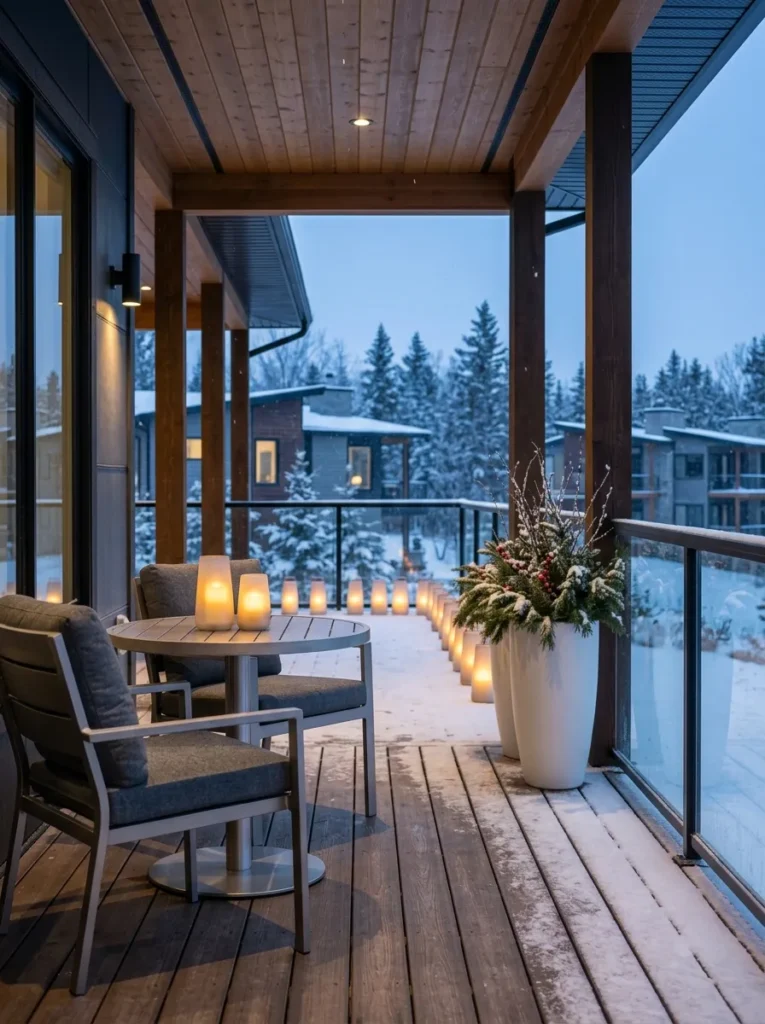
- Seating/furniture: A powder-coated aluminum bistro set in brushed pewter — aluminum won’t crack, rust, or warp in freezing temps the way wicker or untreated wood can
- Planters: Matte white fiberglass urns, chosen specifically because fiberglass flexes instead of cracking when soil freezes solid
- Lighting: IP65-rated cool-white icicle lights strung along the porch eaves, built to handle direct snow and ice contact without shorting out
- Door element: A simple silver-dollar eucalyptus and white pine swag, left mostly bare so the icy palette reads clean rather than cluttered
- Textiles: Charcoal wool-blend cushions with a factory-applied water-repellent finish, rated to resist damp without soaking through
- Flooring/rug: A dark charcoal indoor-outdoor polypropylene rug, which won’t hold moisture or mildew the way natural fiber rugs do in wet snow
- Standout detail: A cluster of frosted-glass hurricane lanterns holding flameless candles, arranged at staggered heights along the railing for a soft icy glow after dark
Why this works: A tight, cool-toned palette photographs cleanly against snow, and every material on this porch is rated to survive direct freeze-thaw cycles without failing by February.
Fiberglass planters solve a problem most winter porch guides never mention. Standard ceramic containers trap water in their porous surface, and once that water freezes and expands, the pot splits — often overnight, often without warning. Fiberglass is nonporous and flexible enough to handle that expansion safely, which is exactly why it shows up so often on porches that actually make it through a full winter intact. Pair it with aluminum furniture, which shares the same advantage, and you’ve got a porch that looks effortlessly icy and cold-resistant without a single material choice working against the season.
This is the kind of porch that photographs best right at dusk, when the icicle lights and lantern glow start to take over from daylight. Snow tends to make cool palettes look even crisper rather than washed out, which is part of why silver, charcoal, and white hold up so well here visually. I’ve noticed guests always comment on the lanterns first — there’s something about flameless candlelight through frosted glass that reads as warm and cold-weather-appropriate at the same time, which is a harder balance to strike than people expect on a winter front porch.
2. Evergreen and Brass Reading Nook
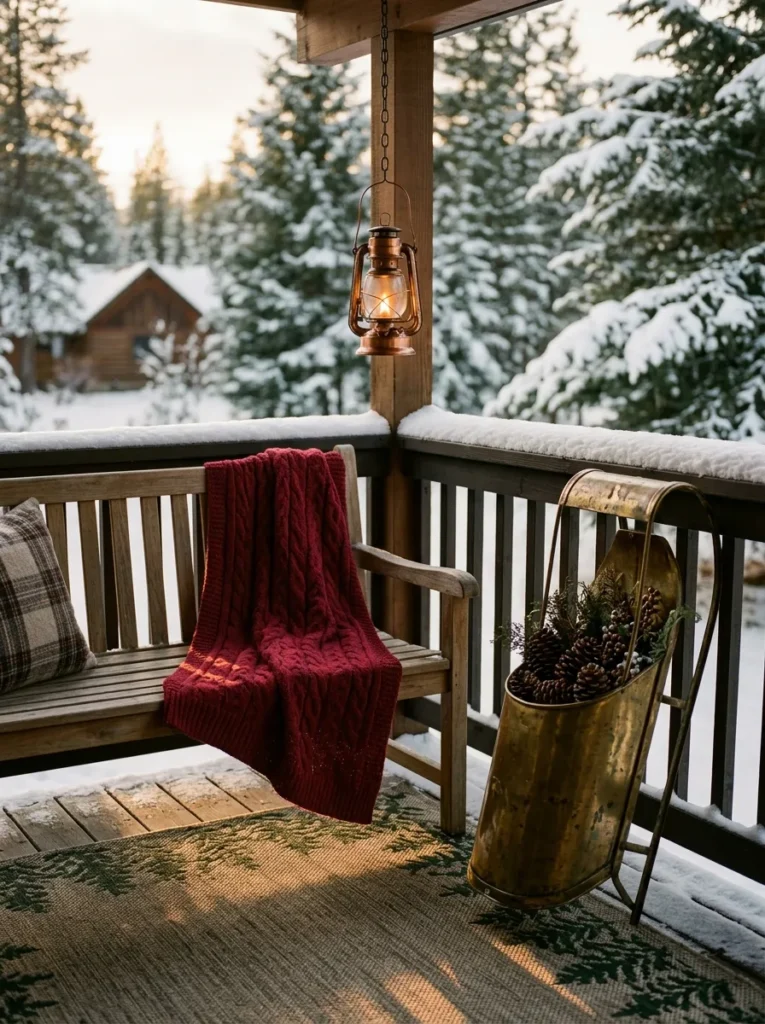
- Seating/furniture: An oiled teak bench, which handles freeze-thaw cycles well because teak’s natural oils resist moisture absorption far better than untreated softwoods
- Planters: Cast concrete urns in a warm charcoal finish, heavy enough to stay put in winter wind and immune to cracking from frozen soil
- Lighting: A copper lantern fitted with a flameless candle, hung from a shepherd’s hook rated for outdoor wet-location use
- Door element: A short mixed-greenery bundle of cedar and boxwood tied with cranberry ribbon, kept brief since full wreath styling lives in its own post
- Textiles: A cranberry buffalo-check wool throw, treated for water resistance, draped over the bench arm
- Flooring/rug: A dark evergreen looped outdoor rug, tightly woven so melting snow drains through rather than pooling on the surface
- Standout detail: A vintage brass sled leaned against the railing and filled with pinecones and cut spruce
Why this works: Deep evergreen against warm brass and cranberry gives this porch a rich, grounded feeling that reads as intentional rather than seasonal clutter.
My husband’s crews always oil exposed teak furniture before the first freeze, and it’s a step most homeowners skip entirely. Teak has natural oils that repel water on their own, but years of exposure strip that protection, and once moisture gets into the wood grain, freeze-thaw cycles can split it the same way they crack ceramic. A once-a-year oil treatment before winter keeps that from happening, and it’s the difference between a bench that lasts fifteen years and one that starts splitting by its third. It’s a small maintenance detail, but it matters far more in freezing climates than in mild ones.
The brass sled was actually inspired by one I spotted at an estate sale outside Austin — battered, rusted at the runners, but the shape alone was so charming I couldn’t stop thinking about it on porches afterward. A found or vintage piece like that gives a winter porch a sense of history that brand-new decor rarely achieves. Leaned against a railing and filled with greenery, it becomes a focal point without competing with the wreath or the seating, which keeps the whole layout feeling composed instead of busy.
3. Amber Cedar Fireside Corner
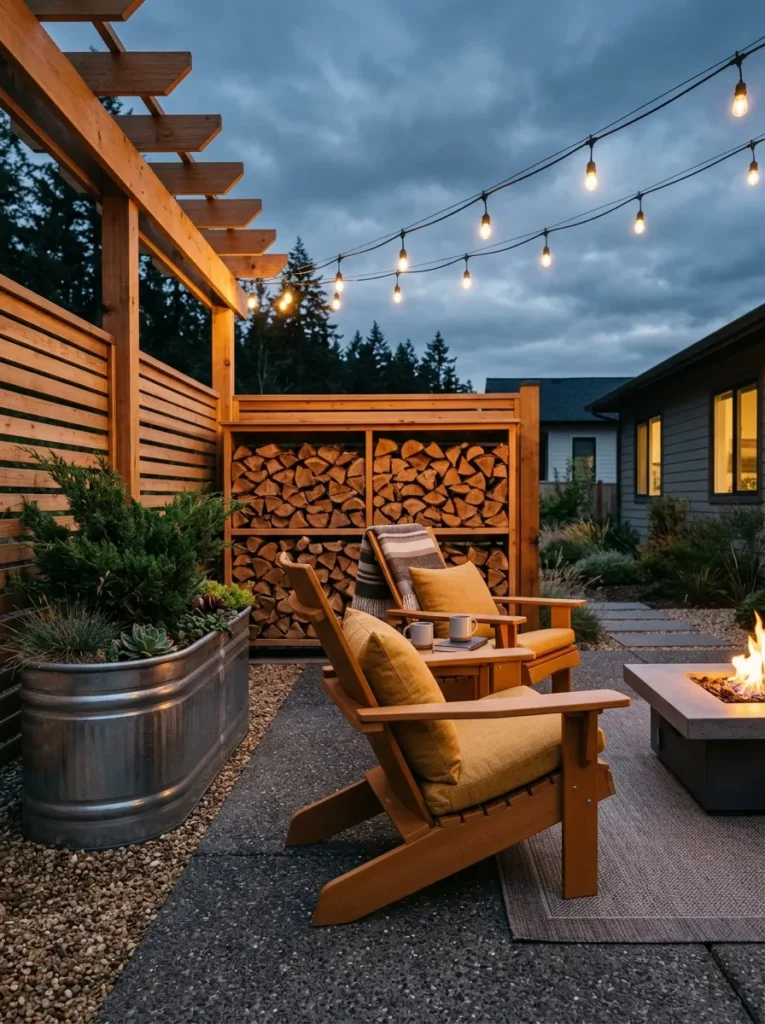
- Seating/furniture: HDPE poly-lumber Adirondack chairs in a honey-amber tone — poly-lumber is UV-stable and impervious to moisture, so it never cracks, splinters, or rots through repeated freezing
- Planters: Galvanized steel troughs, naturally rust-resistant and unaffected by frozen soil since metal doesn’t absorb and hold water the way clay does
- Lighting: Warm amber Edison-bulb string lights rated IP44, strung low across the porch ceiling for a glow that reads warm even on the shortest winter days
- Door element: A single juniper and cedar bundle, kept loose and asymmetrical rather than a formal wreath
- Textiles: Mustard corduroy cushions with a weatherproof backing, chosen for texture contrast against the smooth poly-lumber chairs
- Flooring/rug: A jute-look polypropylene rug that mimics natural fiber without the moisture-absorption problems real jute has in snow
- Standout detail: A custom cedar firewood rack built into the porch’s side wall, sized to match the railing height
Why this works: Poly-lumber furniture holds its color and shape through repeated freeze-thaw cycles with zero maintenance, which is what lets a warm amber palette stay practical through a genuinely cold winter.
In my experience, amber and gold-toned porches tend to be the ones that photograph best in the low winter sun, when daylight only lasts a few usable hours. The firewood rack came directly from a request I made to my husband years ago, and it’s become one of my favorite details to recommend since. Built-in storage solves a real problem — loose firewood piled against a porch wall looks messy and can attract pests, while a rack sized to the railing keeps everything contained and turns a practical necessity into part of the design. He builds these from cedar specifically because it resists rot even when stacked wood stays damp against it through a wet winter, which pressure-treated pine doesn’t handle nearly as well over time.
Poly-lumber Adirondack chairs are worth the higher upfront cost if you’re decorating a porch that gets real winter weather. Unlike wood, which needs yearly sealing, or wicker, which can become brittle and crack in sustained cold, poly-lumber holds its color and shape through repeated freeze-thaw cycles with zero maintenance. That durability is exactly why this amber palette can lean warm and inviting without sacrificing the practical requirements a genuinely cold winter porch demands from every single piece on it.
You’ll Also Love:15 Winter Mantel Decorating Ideas to Love Long After Christmas
4. Ruby and Cream Winter Elegance
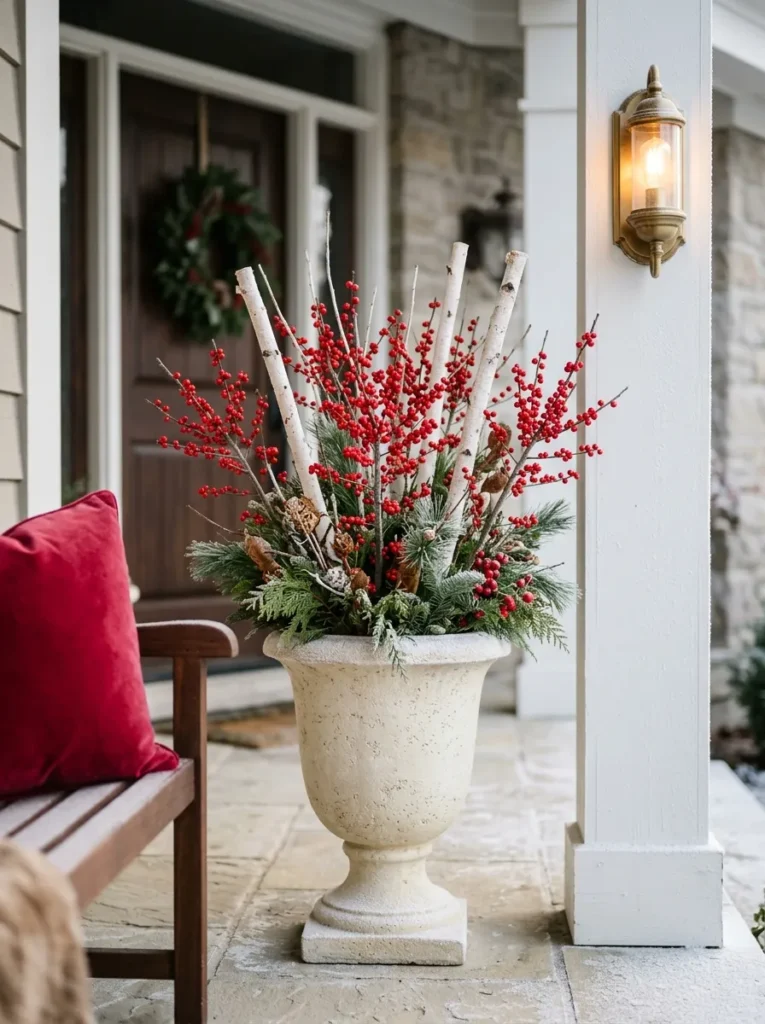
- Seating/furniture: A wrought iron bistro set with a factory rust-resistant powder coat and cream cushions — properly coated iron won’t corrode from winter moisture the way bare metal does
- Planters: Cast stone urns in warm cream, dense enough to resist cracking and heavy enough to anchor the porch through winter wind gusts
- Plants: Winterberry holly (Ilex verticillata), which drops its leaves but holds bright red berries through the coldest months, paired with cut white birch branches for height
- Lighting: Brass wall sconces rated for wet locations, giving off a warm glow that reads elegant rather than purely festive
- Door element: A simple cream ribbon bow with a thin gold wire edge, tied directly to the door hardware
- Textiles: Ruby velvet-look cushions with a weatherproof polyester backing
- Flooring/rug: A cream cable-knit-textured outdoor rug, tightly looped so it sheds moisture instead of holding it
- Standout detail: Oversized cream bows with trailing gold-wire ribbon tied to each porch column, spaced evenly for a formal, tailored rhythm
Why this works: A single bold jewel tone against a cream base feels considered and expensive rather than seasonal, and every texture in the mix is genuinely rated to survive a hard freeze.
Ruby only works as a winter color when it’s treated as an accent, not a backdrop — that’s a distinction I’ve had to correct myself on before. My first instinct was always to go heavier with the red, but a porch styled with cream as the dominant tone and ruby reserved for cushions, berries, and one ribbon detail per column reads far more sophisticated. It photographs beautifully against both snow and bare winter branches, and it avoids tipping into full Christmas territory, which matters if you want the porch to still feel intentional well into February.
Winterberry holly deserves more attention than it gets in porch styling. The plant is native across much of the eastern and midwestern US, genuinely cold-hardy down to well below freezing, and unlike most winter greenery, it delivers actual color rather than just texture. Paired with pale birch branches, it creates real visual contrast without a single fake stem in the mix. I’ve noticed real, cold-hardy plant material photographs with a crispness that faux greenery simply can’t replicate, especially once frost sets in.
5. Sapphire and Silver Moonlit Porch
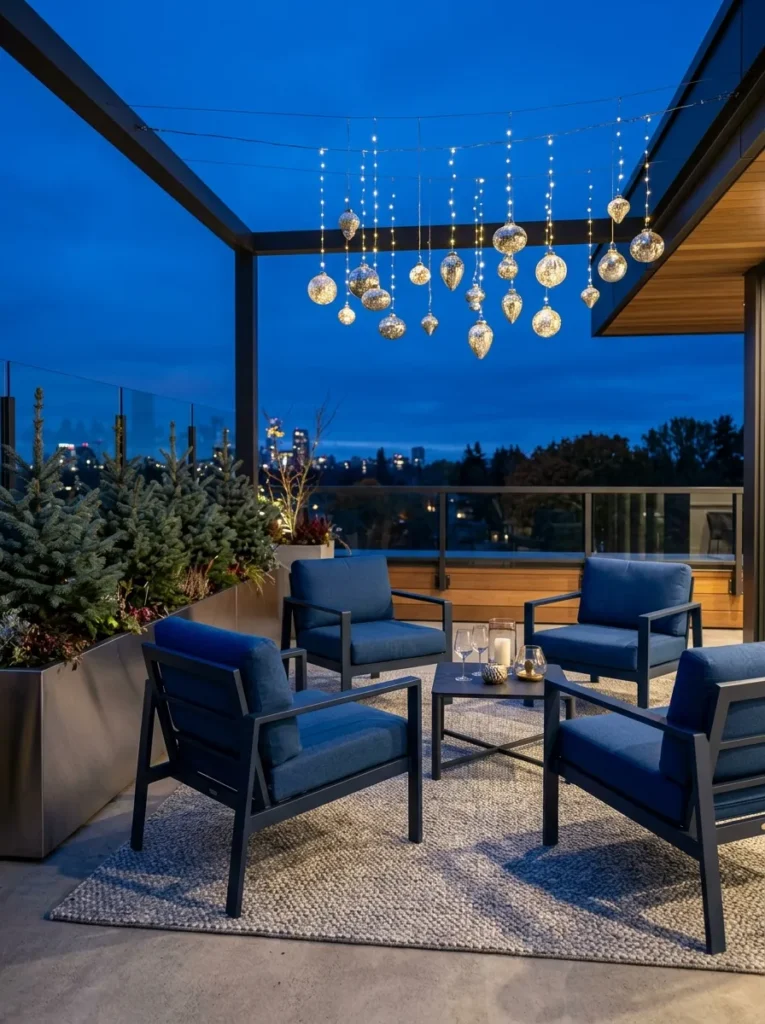
- Seating/furniture: A cast aluminum bistro set finished in a matte navy powder coat — aluminum’s non-porous surface means it never absorbs water that could freeze and warp the joints
- Planters: Brushed stainless steel troughs, chosen because steel handles freezing soil with zero cracking risk and reads sleek against the cool palette
- Plants: Blue spruce boughs mixed with white winterberry stems, both genuinely cold-hardy and holding color through deep winter
- Lighting: Cool-white LED lantern-style fixtures rated IP65, hung at staggered heights for a moonlit effect after dusk
- Door element: A loose spruce and silver eucalyptus bundle, kept minimal
- Textiles: Sapphire wool-blend cushions with a DWR (durable water repellent) finish
- Flooring/rug: A silver-gray fine-weave indoor-outdoor rug
- Standout detail: Clusters of mercury glass ornaments hung from the porch ceiling beam on nearly invisible fishing line, so they appear to float
Why this works: Sapphire against brushed silver creates a cool, saturated palette that reads as genuinely luxurious in photographs, particularly once evening lighting takes over.
Suspended mercury glass is one of those details that costs very little but transforms how a porch photographs at night. My husband installed a small ceiling hook specifically for this on our own porch two winters ago, and it turned out to be one of the easiest upgrades we’ve made — a single anchor point rated for outdoor use, positioned before the porch ceiling gets painted or sealed, saves you from drilling into finished material later. The ornaments themselves catch and scatter whatever light source is nearby, which is exactly why they photograph so well against the navy furniture and cool string lighting.
This palette earns the word “moonlit” honestly, because sapphire and silver are two of the only tones that actually intensify rather than flatten under winter evening light. Most warm-toned porches lose their richness once the sun drops, but cool blues and brushed metal keep their saturation, especially with LED lighting nearby. That’s part of why this combination works so well for anyone decorating a porch that gets more evening foot traffic than daytime visibility during winter’s shorter days.
6. Emerald and Brass Quiet Luxury
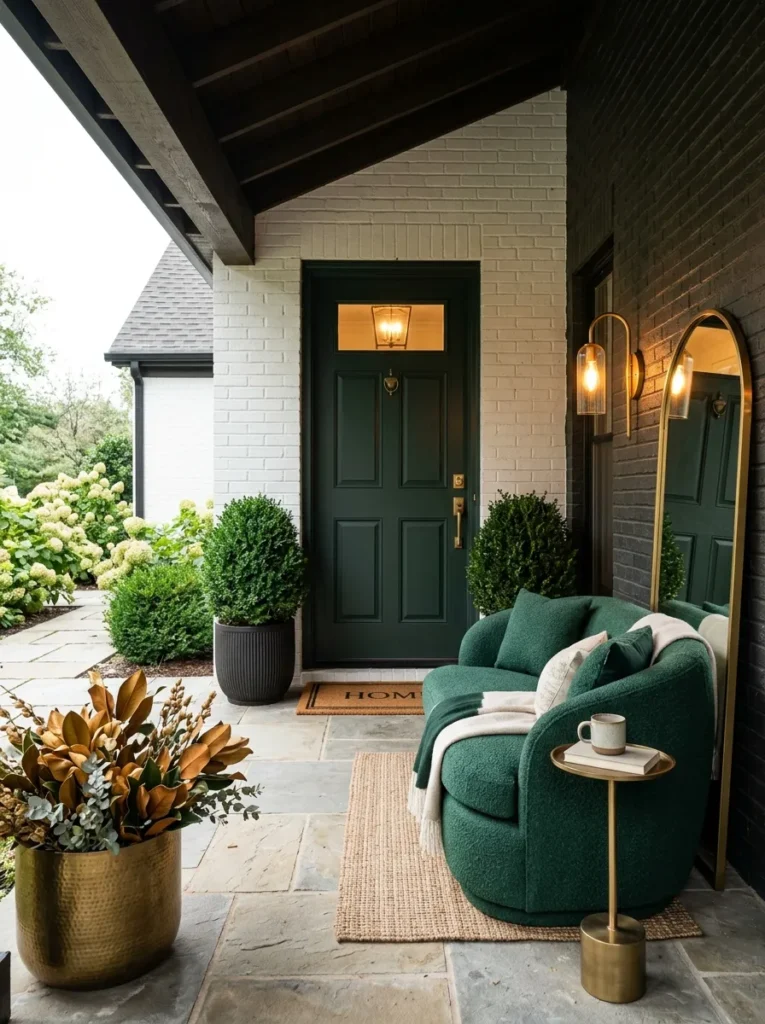
- Seating/furniture: A curved boucle-textured outdoor loveseat on a cast aluminum frame, leaning into 2026’s rounded, organic-modern silhouettes rather than boxy traditional porch furniture
- Planters: Galvanized steel troughs finished with a brass-tone powder coat, unaffected by frozen soil expansion
- Plants: Dwarf boxwood balls paired with preserved gold-dusted magnolia leaves for texture without demanding cold-hardiness from a delicate stem
- Lighting: Brass wall sconces rated for wet, freezing conditions, positioned to wash light upward along the wall rather than straight down
- Door element: A trio of small boxwood topiaries flanking the door instead of a traditional wreath
- Textiles: Emerald velvet-look cushions with gold piping detail
- Flooring/rug: A deep emerald rug with a subtle geometric weave
- Standout detail: A large arched mirror leaned casually against the porch wall, reflecting the sconce light and doubling the sense of depth
Why this works: A leaned arched mirror catches and bounces whatever light source sits nearest, which is the single detail that makes a styled porch look like a design magazine spread instead of a seasonal display.
Emerald and brass together avoid the trap most jewel-toned winter porches fall into, which is looking like leftover Christmas decor by January. Keeping the green in structural elements — boxwood topiaries, a velvet cushion, a rug — rather than tinsel or ornaments lets the color read as a genuine design choice year-round through the cold season. Brass warms the whole palette just enough that it never feels cold or sterile, even against a stainless winter sky, and the curved loveseat silhouette keeps the whole setup feeling current rather than dated.
The leaning mirror is a trick borrowed directly from interior styling that almost nobody applies to porches, and it deserves far more use than it gets. Positioned against a wall rather than mounted, it catches and bounces whatever light source sits nearest, whether that’s a sconce, a lantern, or afternoon sun on a clear winter day. It also makes a narrow porch feel noticeably wider in photographs, which is a genuinely useful trick if your outdoor space runs on the smaller side.
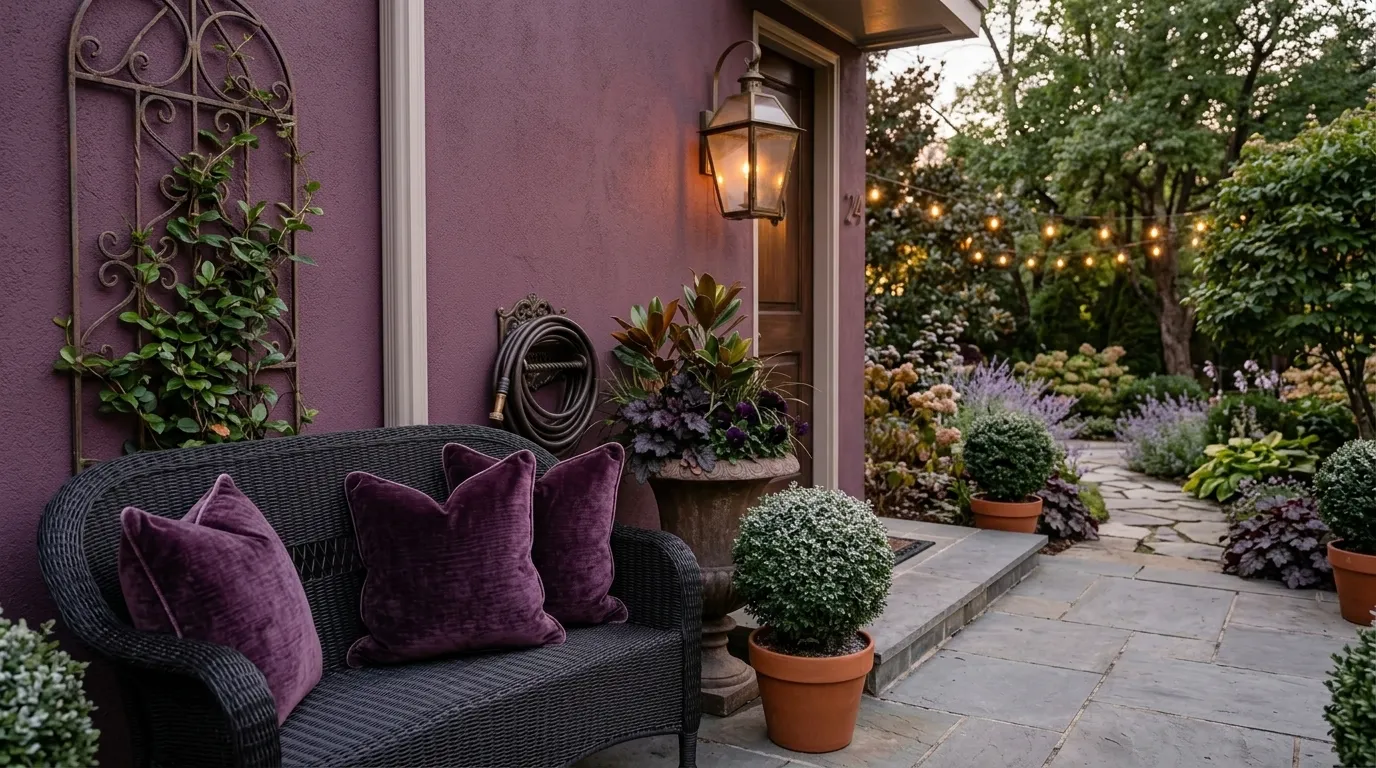
7. Aubergine and Antique Gold Corner
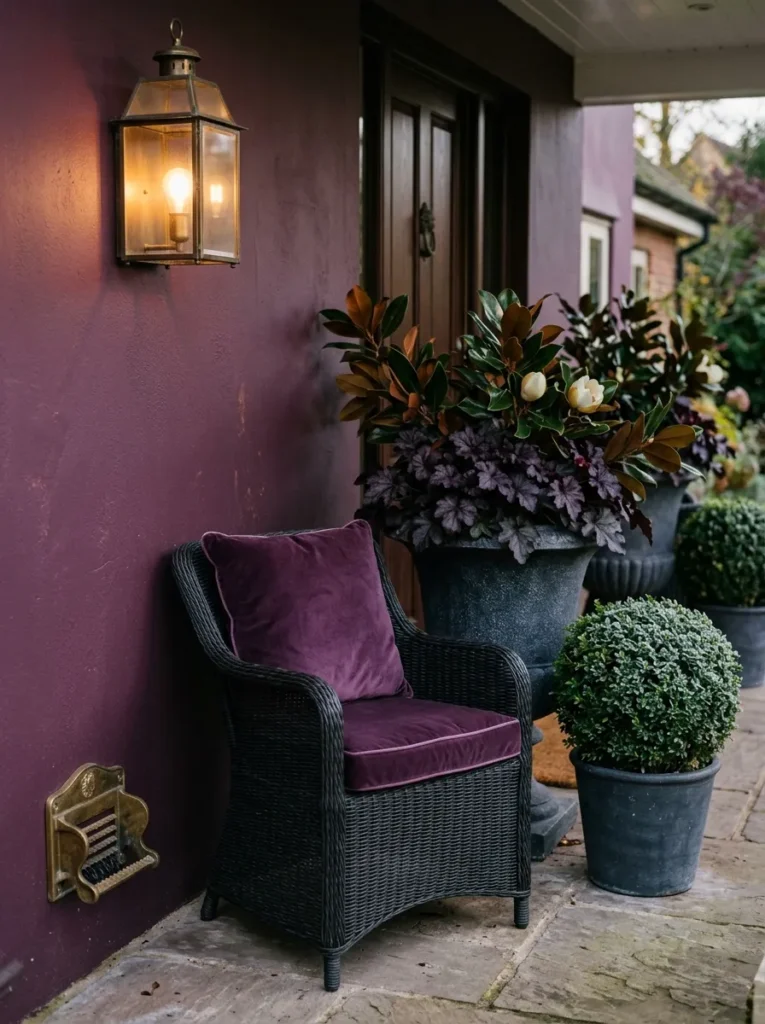
- Seating/furniture: An all-weather HDPE resin wicker loveseat rated specifically for sub-freezing temperatures — this differs from standard outdoor wicker, which can turn brittle and crack once temps drop below freezing
- Planters: Cast resin urns finished in a faux-lead patina, lightweight but genuinely frost-proof and unaffected by frozen, expanding soil
- Plants: Dark-leaved heuchera (coral bells) tucked beneath cut magnolia branches, both tolerant of hard freezes when planted or arranged correctly
- Lighting: Antique brass lantern-style sconces rated for wet locations, casting a warm glow against the deep purple backdrop
- Door element: A single deep-plum ribbon knot tied high on the door, no greenery
- Textiles: Aubergine velvet cushions with metallic gold piping and a weatherproof backing
- Flooring/rug: A charcoal rug with a subtle aubergine diamond pattern, tightly woven to shed snowmelt
- Standout detail: An antique brass boot scraper mounted beside the door, paired with a small potted boxwood topiary — genuinely functional in snow, not purely decorative
Why this works: Aubergine is rare on winter porches, which is exactly what makes it feel expensive, and pairing it with warm brass keeps the deep color from reading heavy or cold.
Cold-rated resin wicker gets confused with regular wicker constantly, and the difference matters more in a genuine winter climate than almost anywhere else. Standard wicker, whether natural rattan or a cheaper synthetic blend, loses flexibility once temperatures drop and can snap or split under normal use by midwinter. The resin used in cold-rated pieces stays pliable down to well below freezing, which is the only reason a loveseat this deep and saturated in color can sit outside through January without cracking at the joints. It’s worth checking the manufacturer’s temperature rating before buying, not just the word “wicker” on the label.
A brass boot scraper sounds like a small, almost forgotten detail, but it solves a real problem in snowy climates and earns its place visually at the same time. Mounted at the right height beside the door, it keeps snow and ice off shoes before anyone steps inside, which matters more in a genuine winter than in a mild-climate fall. I’ve noticed it’s also one of those antique-style details guests always ask about, because it reads as thoughtful rather than purely seasonal, and it photographs beautifully with a little frost catching the brass.
8. Marigold and Ink Navy Statement Porch
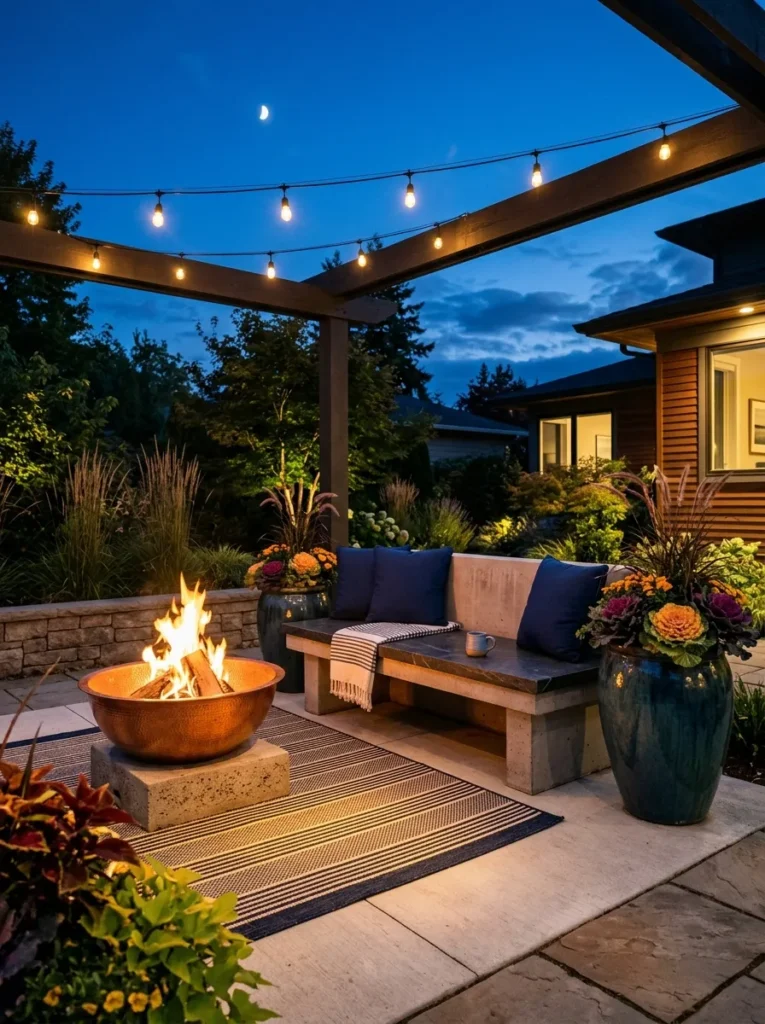
- Seating/furniture: A soapstone-topped concrete bench — soapstone is naturally freeze-resistant and used on real Austin-area patios my husband’s crews have built, since it won’t pit, crack, or stain from ice
- Planters: Freeze-rated glazed stoneware urns, specifically kiln-fired and tested for outdoor winter use, unlike standard glazed ceramic which can still crack under expansion
- Plants: Amber and rust-toned ornamental cabbage, genuinely cold-hardy and often more vibrant after the first frost touches its leaves
- Lighting: Warm marigold-toned LED string lights on a GFCI-protected outdoor outlet — my husband’s crews always require ground-fault protection on any outdoor lighting circuit exposed to snow or standing water
- Door element: A curved copper fire bowl set beside the door instead of traditional greenery, burning low in the evenings
- Textiles: Ink navy cushions with a mustard piping detail, weatherproof polyester fill
- Flooring/rug: A navy and marigold striped flatweave outdoor rug
- Standout detail: The copper fire bowl itself, positioned as the porch’s focal point rather than tucked to the side
Why this works: A genuine GFCI-protected outlet isn’t optional on a porch running winter string lights near snow or ice — it’s a real safety requirement, and it’s rarely mentioned in decorating advice.
Ground-fault protection sounds like a technical detail that has nothing to do with decorating, but it’s one of the most important things nobody tells you before you string lights across a winter porch. Standard outdoor outlets aren’t always GFCI-protected, especially on older homes, and running string lights near melting snow or ice on an ungrounded circuit is a genuine electrical hazard. A licensed electrician can add GFCI protection in an afternoon, and it’s the kind of upgrade that makes every other winter lighting idea in this post actually safe to use, not just pretty to look at.
The copper fire bowl earns its place as the centerpiece here because it does something no other detail on this list can — it provides real warmth on a porch, not just visual warmth. Set at a safe distance from cushions and the wood bench, it turns a decorated porch into a place people actually want to sit through a cold evening, which is the whole point of styling one in the first place. Against the ink navy backdrop, the flame’s glow reads richer and more saturated than it would against a lighter palette.
9. Rose Quartz and Brushed Nickel Porch
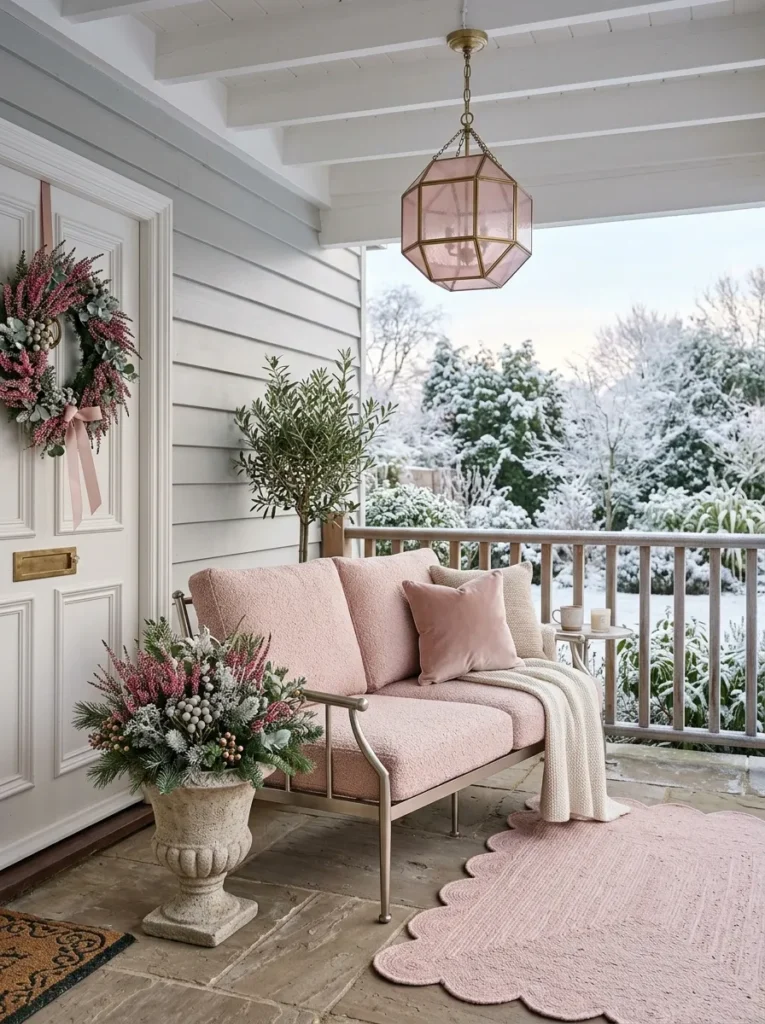
- Seating/furniture: A powder-coated steel loveseat in soft brushed nickel, chosen because steel’s coating resists chipping and rust even through repeated freeze-thaw cycles
- Planters: Blush-toned cast stone urns, dense and crack-resistant against frozen soil expansion
- Plants: Pink heather (Erica carnea ‘Pink Spangles’), one of the few flowering plants that actually blooms through freezing temperatures, paired with silver brunia stems
- Lighting: A blush glass pendant lantern hung from a wet-rated ceiling hook, holding a flameless candle
- Door element: A slim silver-dollar eucalyptus swag with a single blush ribbon
- Textiles: Dusty rose bouclé cushions with a weatherproof laminate backing
- Flooring/rug: A scalloped-edge blush and cream outdoor rug, an unexpected shape against the usual rectangular porch rug
- Standout detail: The scalloped rug edge itself, which reads as noticeably more elevated than a standard rectangle in photographs
Why this works: A cool, frosty backdrop is what keeps blush and pink tones from reading as soft or overly sweet, letting the palette feel sophisticated rather than seasonal.
In my experience, blush and pink read as far more sophisticated in winter than people expect — it’s the cool, frosty backdrop that keeps the color from feeling soft or overly sweet. Pink heather deserves a place on more winter porches than it gets. Most flowering plants go completely dormant once temperatures drop, but heather is genuinely bred for cold-climate blooming, and ‘Pink Spangles’ will hold color through snow cover in a way almost nothing else on a plant list can manage. Paired with silver brunia — a dried, naturally silvery stem that needs no water or care at all — it gives this porch real texture and color without asking a single plant to do something it can’t survive.
A scalloped rug edge is a small architectural choice that changes how the entire porch reads in photographs, and it costs no more than a standard rectangular rug in most cases. Straight edges are the default nearly everywhere, which is exactly why a curved one stands out immediately, even at thumbnail size. Paired with the blush pendant lantern glowing overhead, this porch has a soft, almost boutique-hotel quality that still checks every box for winter durability, from the steel furniture down to the frost-rated stone planters.
10. Teal and Copper Botanical Luxury
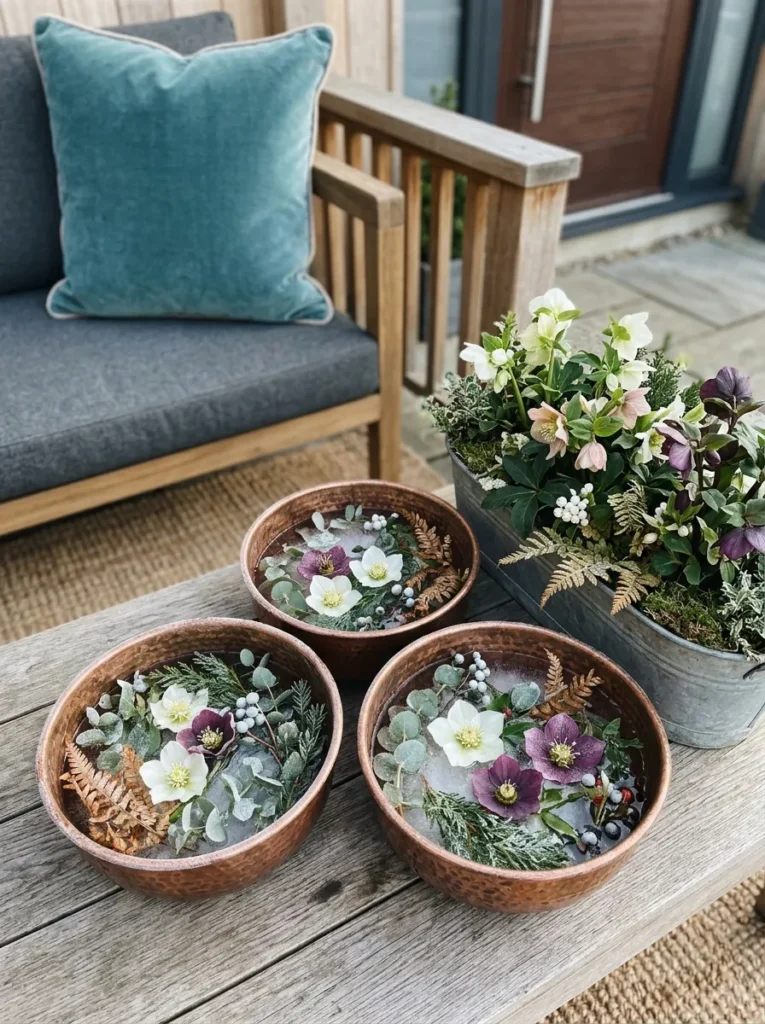
- Seating/furniture: A reclaimed cast iron bench, sealed and powder-coated in matte black to prevent rust — cast iron itself is dense and freeze-stable, but the coating is what actually keeps it from pitting through repeated winters
- Planters: Hammered zinc planters, a metal that develops a soft living patina over time and, like other metals, never cracks from frozen soil
- Plants: Hellebores (Helleborus niger), also called the Christmas rose, one of the only perennials that actually blooms in freezing temperatures and often pushes flowers straight through light snow
- Lighting: Copper-toned solar lanterns with a built-in warm LED, requiring no outdoor outlet at all, which matters on porches without easy access to wiring
- Door element: A loose eucalyptus and copper-painted branch bundle, hung asymmetrically
- Textiles: Deep teal velvet cushions with a weatherproof backing and copper-thread piping
- Flooring/rug: A teal and copper abstract-pattern outdoor rug with a tight, low-pile weave
- Standout detail: A trio of hammered copper bowls filled with water left to freeze naturally, each holding a single frozen rose or greenery sprig suspended in the ice
Why this works: Teal and copper together create a genuinely rare winter palette, and the frozen ice bowls give the porch a moment of real seasonal magic that no artificial decoration can replicate.
Hellebores are one of the most underused plants in winter porch styling, largely because most people assume nothing blooms in freezing weather. That assumption is wrong — hellebores are specifically bred to flower from late winter into early spring, often pushing buds up through a light snow cover without any damage. Planted in a zinc container near the door, they give this porch something almost no other idea in this post can offer: living, blooming color in the coldest months, not just structural greenery or dried stems standing in for the real thing.
The frozen ice bowls take a little advance planning, but they’re one of the most photographed details I’ve styled on any winter porch. Filling a shallow copper or metal bowl with water, adding a stem or sprig, and leaving it outside overnight in freezing temperatures creates a genuinely one-of-a-kind centerpiece by morning. It melts eventually, which means it needs refreshing every few days in a hard freeze, but that impermanence is part of what makes it feel special rather than staged. Guests always ask how it’s done.
11. Midnight Burgundy and Black Iron
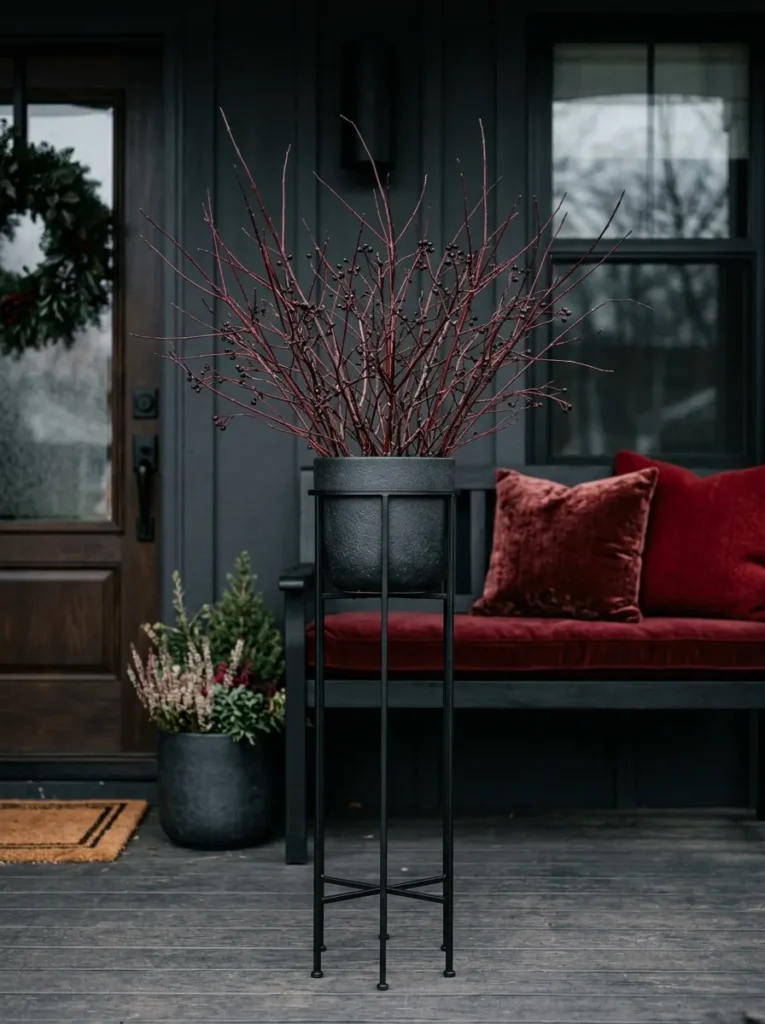
- Seating/furniture: A recycled ocean-plastic HDPE bench in matte black — genuinely freeze-rated, UV-stable, and immune to the splintering or cracking that wood can develop after several winters
- Planters: Powder-coated concrete planters in deep charcoal, dense enough to resist wind and completely unaffected by frozen, expanding soil
- Plants: Burgundy-leaved heuchera paired with black-stemmed dogwood branches (Cornus sericea ‘Kelseyi’ variants run darker than the typical red-twig), giving genuine height and near-black contrast
- Lighting: Matte black wall sconces rated for wet, freezing locations, angled to throw light downward across the bench rather than outward
- Door element: A single black-ribboned bundle of dried burgundy amaranth, hung low and off-center
- Textiles: Oxblood velvet cushions with a weatherproof backing, no piping or trim
- Flooring/rug: A charcoal rug with a faint burgundy undertone, chosen deliberately understated so it doesn’t compete with the furniture
- Standout detail: A full-height black iron plant stand holding a single dramatic branch arrangement, positioned like a piece of sculpture rather than a planter
Why this works: One dramatic, dark, editorial vignette outperforms five smaller decorations every time, since dark tones absorb and hold light in a way pastel or neutral setups can’t replicate.
In my experience, the porches people save the most on Pinterest are almost never the busiest ones — this is proof that one dramatic, dark, editorial vignette outperforms five smaller decorations every time. Dark, saturated palettes are genuinely underused on winter porches, and I think it comes down to a misconception that dark colors read as cold or uninviting in already-cold weather. In practice, the opposite is true. Oxblood and near-black tones absorb and hold onto whatever light hits them, whether that’s a low winter sun or a warm sconce after dark, which makes the whole porch feel richer rather than starker.
The black iron plant stand is doing the real work here, and it’s worth investing in one solid, well-made piece rather than several smaller decorative items. A single tall stand holding one dramatic branch arrangement reads as curated and gallery-like, especially against the recycled black HDPE bench and matching sconces. It’s the kind of detail that photographs beautifully from almost any angle, and unlike cut flowers or fragile greenery, the branches themselves can stay outside through the entire season without wilting or browning.
12. Cobalt and Warm Oak Nordic Porch
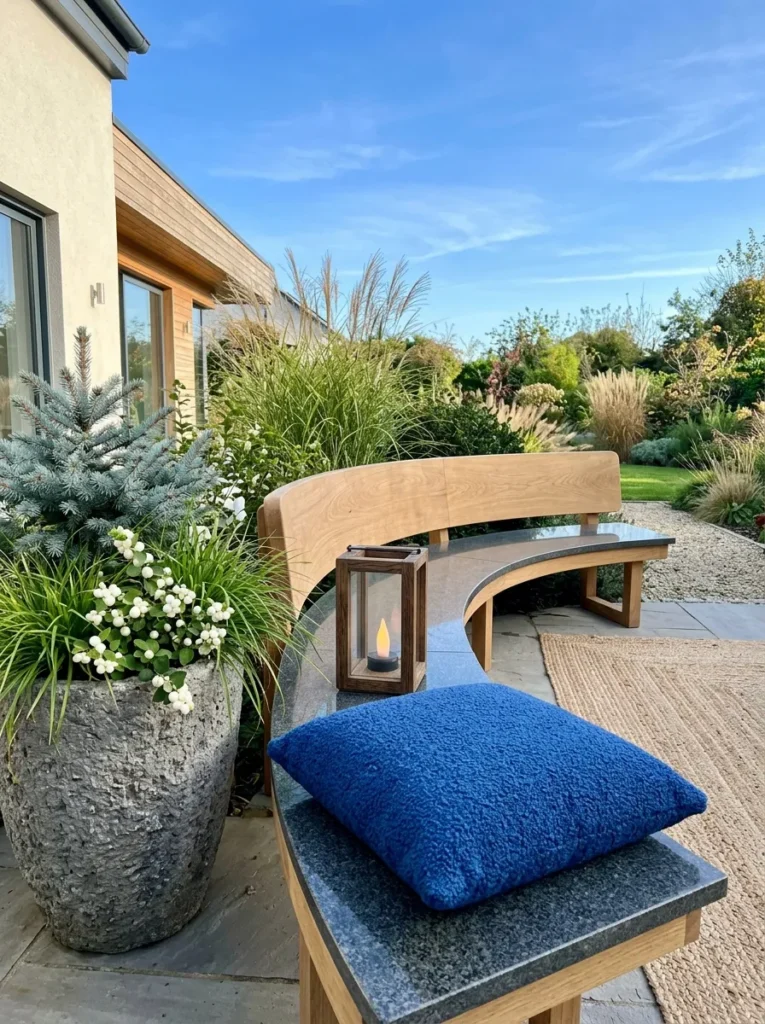
- Seating/furniture: A granite-topped steel bench, the stone surface naturally freeze-resistant since granite doesn’t absorb enough water to crack under expansion the way porous stone can
- Planters: Hypertufa planters — a lightweight, frost-proof mix of cement, peat, and perlite that mimics natural stone texture without the weight or cracking risk of solid concrete
- Plants: Blue spruce boughs paired with white snowberry (Symphoricarpos albus), a genuinely cold-hardy native shrub whose pale berries hold through the coldest months
- Lighting: Warm oak-toned wooden lantern fixtures with weatherproof LED inserts, hung at two different heights for depth
- Door element: A minimal cobalt ribbon tied in a single loose knot, no greenery at all
- Textiles: Cobalt blue bouclé cushions with a weatherproof laminate backing
- Flooring/rug: A natural oak-toned wool-look outdoor rug with a subtle cobalt border stripe
- Standout detail: A curved, organic-modern oak bench back inspired by 2026’s rounded furniture silhouettes, paired with the cool stone seat for texture contrast
Why this works: Cobalt against warm oak strikes the exact balance between cozy and current that most winter porches miss by leaning entirely warm or entirely cold.
Hypertufa is one of those materials nobody outside horticulture and landscape circles ever talks about, and it deserves far more attention on winter porches. It’s essentially a manmade lightweight stone, mixed to be porous enough for drainage but dense enough to resist the kind of cracking that plagues traditional terracotta in freezing weather. Because it’s lighter than solid concrete, it’s also genuinely practical for anyone styling a porch without help moving heavy containers, which matters more than most decorating advice ever acknowledges when winter arrives and everything needs to be arranged in the cold.
The curved oak bench back is a deliberate nod to where outdoor furniture design is actually heading, away from the boxy, straight-lined pieces that have dominated porches for years. Rounded, organic silhouettes read as noticeably more current in photographs, and pairing that softness with the cool granite seat and cobalt cushions keeps the whole look from feeling either too rustic or too sterile. It’s the kind of porch that looks equally at home in a design magazine spread as it does dusted lightly with real snow.
13. Golden Wheat and Charcoal Modern Porch
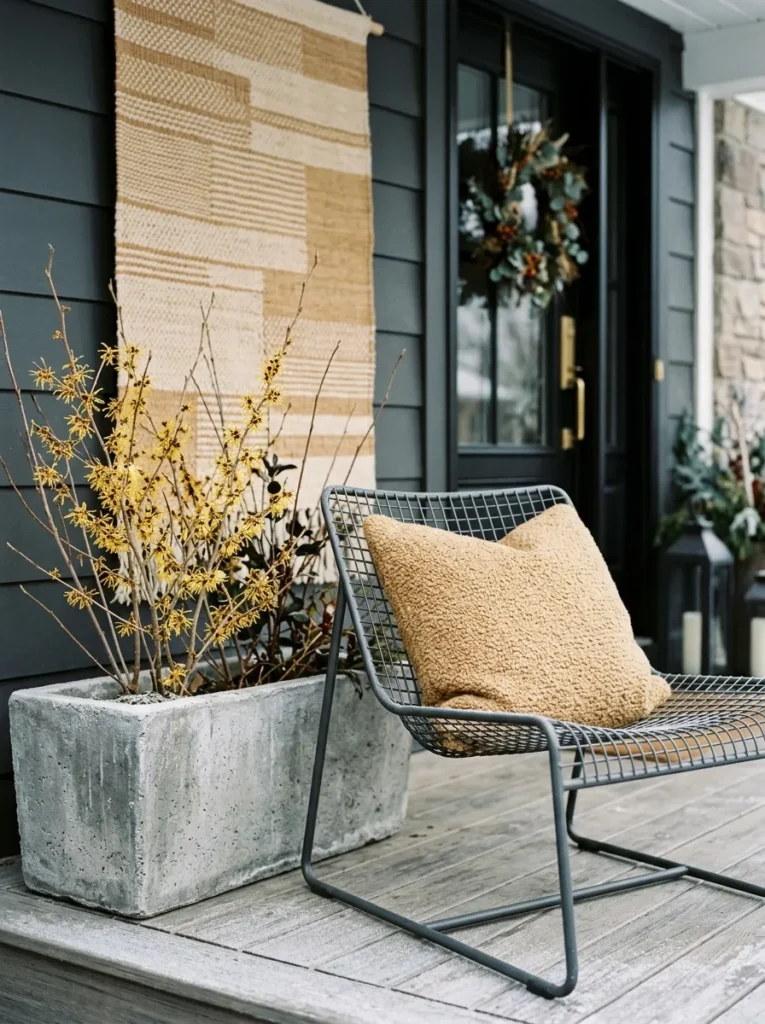
- Seating/furniture: A charcoal powder-coated steel mesh bistro set — the fine mesh construction sheds snow rather than collecting it, and the coating resists corrosion through repeated freezing
- Planters: Raw poured concrete troughs, left unpolished for texture, dense enough to resist cracking from frozen, expanding soil
- Plants: Witch hazel branches (Hamamelis x intermedia), one of the only shrubs that actually blooms in midwinter, its thread-like gold flowers appearing directly on bare branches during the coldest stretch of the season
- Lighting: Brass uplighting fixtures rated for wet locations, angled upward against the porch columns for a warm architectural glow
- Door element: A dried wheat and pampas bundle, tied simply, chosen because dried grasses hold their color through the entire winter with zero risk of frost damage
- Textiles: Wheat-gold bouclé cushions with a weatherproof laminate backing
- Flooring/rug: A charcoal and wheat two-tone flatweave outdoor rug
- Standout detail: An oversized woven wall hanging in wheat and charcoal tones, treated with an outdoor fabric sealant so it can stay up through the whole season
Why this works: Witch hazel is genuinely rare in winter porch styling, and its bright gold blooms against charcoal steel give this porch a living, blooming focal point most “winter greenery” setups simply can’t offer.
Witch hazel deserves a permanent place on winter plant lists, and I’m always a little surprised it isn’t used more often. It’s one of the very few shrubs that blooms specifically in the coldest months, sometimes flowering right through a light snow, with spidery gold petals that curl inward on the harshest days and unfurl again as temperatures rise. Cut a few branches for the door bundle or leave a small potted one near the entry, and you get genuine seasonal color that nothing artificial can replicate — a detail that instantly signals real plant knowledge behind the styling, not just decoration.
The woven wall hanging is a detail borrowed from indoor styling that translates surprisingly well outdoors, as long as the fabric is treated correctly first. A standard macramé piece will mildew and sag within weeks of winter moisture, but an outdoor-rated sealant spray creates enough water resistance to let it hang safely through the season. Against the charcoal mesh furniture, it adds warmth and texture at eye level, filling vertical space that most porches leave completely empty and unconsidered.
14. Champagne Swing and Snowdrops
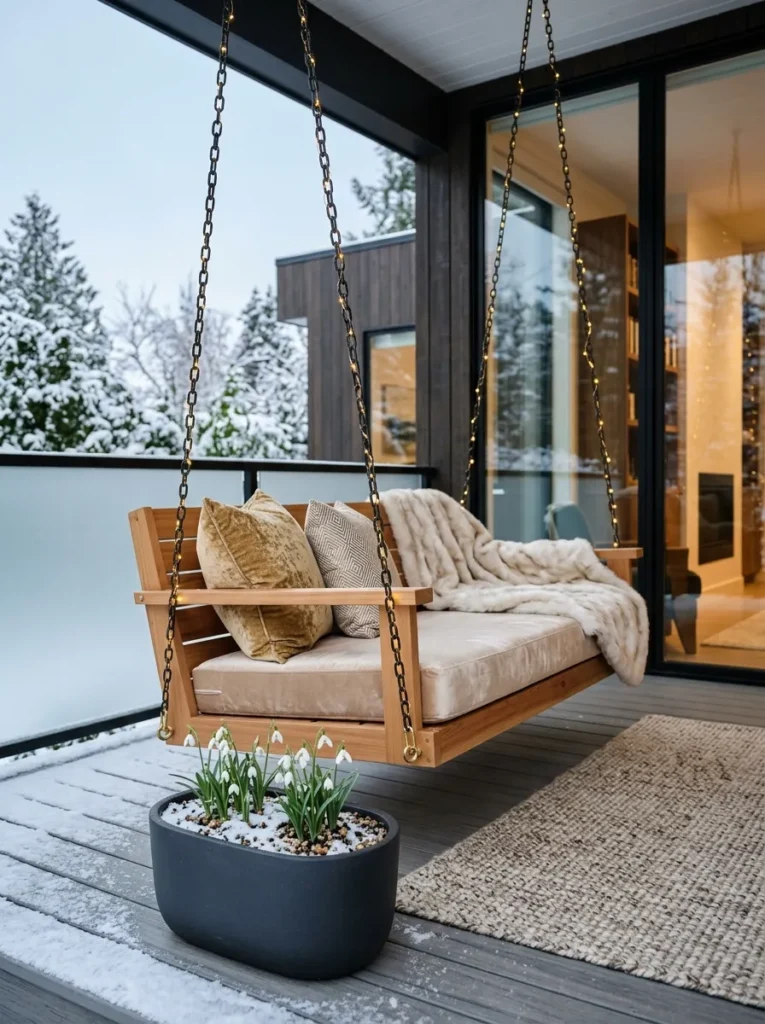
- Seating/furniture: A sealed cedar porch swing stained deep espresso — cedar naturally resists rot and, when properly sealed before the first freeze, handles winter moisture far better than untreated pine
- Planters: Double-walled insulated resin planters, a genuinely functional choice since the air gap between walls helps protect plant roots from sudden hard freezes
- Plants: Snowdrops (Galanthus nivalis), among the very earliest and hardiest winter bloomers, known for pushing white flowers up through actual snow cover
- Lighting: Champagne-gold fairy lights rated IP44, wrapped along the swing’s hanging chains for a soft glow around the seat itself
- Door element: A slim ivory ribbon tied in a single bow, kept deliberately minimal
- Textiles: A champagne velvet swing cushion with tasseled corner trim, weatherproof backing
- Flooring/rug: An ivory and taupe textured outdoor rug beneath the swing
- Standout detail: The swing itself, positioned as the clear centerpiece of the porch rather than one piece among several
Why this works: A porch swing turns a decorated porch into a place someone actually wants to sit for twenty minutes with coffee, even in the cold, which is the single upgrade people regret not adding sooner.
In my experience, a porch swing is the single upgrade people regret not adding sooner — it turns a decorated porch into a place someone actually wants to sit for twenty minutes with coffee, even in the cold. Double-walled insulated planters solve a problem that catches a lot of people off guard mid-winter: even frost-proof containers don’t fully protect what’s growing inside them from a sudden hard freeze. The air pocket between the planter’s two walls acts as genuine insulation, buffering root systems from temperature swings the way a single-wall container simply can’t.
Snowdrops are proof that a winter porch doesn’t have to rely entirely on evergreens and dried stems for its living color. These small white blooms are specifically built for cold, often flowering while snow is still on the ground around them, and they multiply readily once established in a container or garden bed. Planted near the base of the swing, they add a quiet, delicate detail that rewards anyone who actually stops to sit down, which fits perfectly with a porch designed around slowing down rather than rushing past.
15. Lavender Frost Minimalist Porch
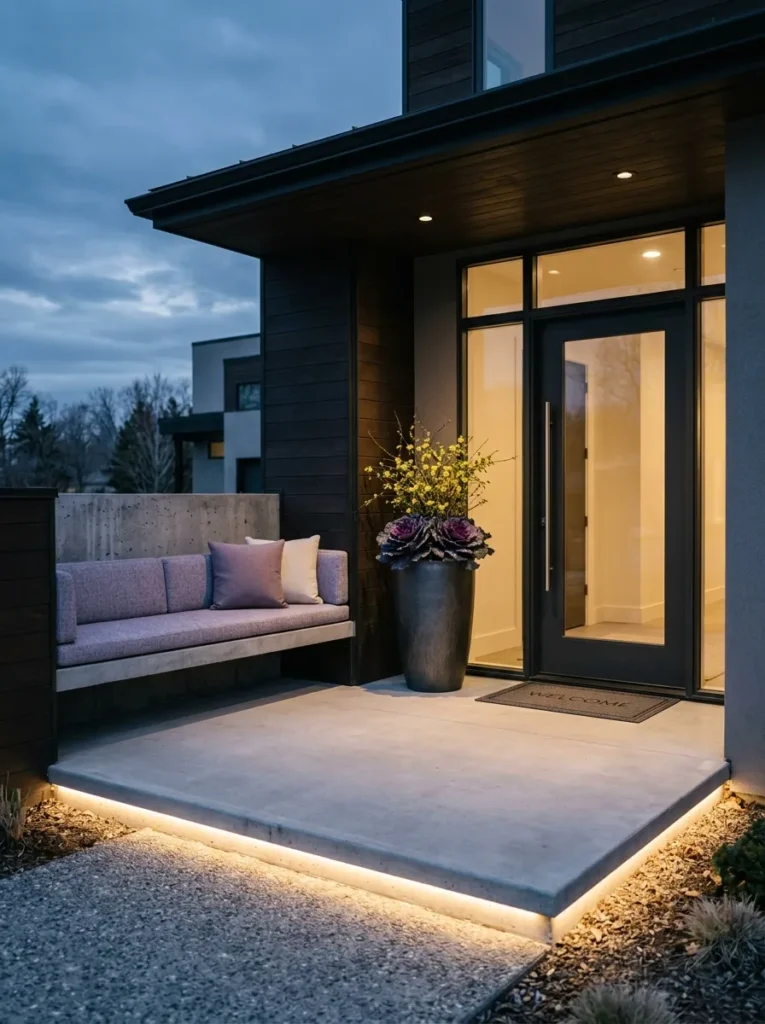
- Seating/furniture: A built-in poured concrete bench, integrated directly into the porch architecture — concrete’s density makes it essentially immune to freeze damage as long as it’s properly sealed against water absorption
- Planters: Tall powder-coated aluminum cylinder planters in soft pewter, lightweight and completely unaffected by frozen soil
- Plants: Pale lavender ornamental kale, its ruffled edges intensifying in color as temperatures drop, paired with white winter jasmine (Jasminum nudiflorum) for a rare touch of pale yellow bloom against the cool palette
- Lighting: Recessed step lighting rated for wet, freezing conditions, built into the porch’s edge for a clean, architectural glow with no visible fixtures
- Door element: A bare, unadorned door with a single small lavender ribbon on the handle, embracing negative space
- Textiles: Pale lavender-gray linen-look cushions with a weatherproof performance fabric
- Flooring/rug: A pewter-gray minimal outdoor rug with no pattern at all
- Standout detail: The recessed lighting itself, which eliminates visible fixtures entirely for a seamless, architectural look after dark
Why this works: Recessed lighting removes every visible fixture from the porch, letting the pale lavender and pewter palette carry the entire design without competing hardware pulling focus.
Ornamental kale is one of the most reliable cold-weather plants available, and it genuinely performs better once frost arrives rather than in spite of it. The ruffled leaves intensify in color as temperatures drop, which means a container planted in early winter often looks even better by January than it did the week it was planted. Pairing pale lavender kale with winter jasmine’s small yellow blooms gives this porch a soft, almost watercolor palette that still checks every box for hardiness, since both plants are genuinely built to handle repeated hard freezes without dying back.
Recessed step lighting takes more planning upfront than a string of lights or a plug-in lantern, since it typically requires an electrician and needs to be installed before a porch floor is finished. But the payoff is a porch that looks architecturally intentional after dark rather than decorated, with no cords, no visible fixtures, and no hardware breaking up the clean lines of the concrete bench and cylinder planters. It’s the kind of detail that reads as quiet luxury rather than seasonal effort.
Styling Principles: What Actually Survives a Winter Porch
Before decorating anything, plan for the freeze first and the aesthetic second. Every material choice on this list — fiberglass, cast stone, galvanized steel, sealed cedar, powder-coated aluminum — was chosen because it resists cracking, rusting, or warping under repeated freeze-thaw cycles, not just because it looks good in a photo. Any porous material that holds water, like standard ceramic, terracotta, or untreated wood, is a genuine risk once temperatures drop below freezing. Lighting needs its own safety check too: anything running near snow or standing water should sit on a GFCI-protected outdoor outlet, and fixtures should carry a wet-location or IP44/IP65 rating rather than a basic indoor rating. Cold-hardy, real plant material — heather, hellebores, witch hazel, winterberry — will consistently outperform faux greenery both visually and practically, since it’s built to handle exactly the conditions your porch will face for the next three months.
Frequently Asked Questions
What planters survive freezing temperatures without cracking? Fiberglass, cast stone, concrete, galvanized metal, and hypertufa are the most reliable frost-proof options. Standard glazed ceramic and terracotta are the most likely to crack, since water trapped in their porous surface expands as it freezes.
What are the best cold-hardy plants for a winter porch? Winterberry holly, hellebores, heather, witch hazel, and snowdrops are all genuinely cold-hardy and, in several cases, actually bloom during freezing weather rather than simply surviving it.
Is it safe to run string lights on a porch in snow or ice? Only if the fixtures are rated for wet or damp locations (look for IP44 or higher) and the outlet they’re plugged into is GFCI-protected. Standard indoor-rated lights and unprotected outlets are a genuine hazard near snow and moisture.
Can I use regular outdoor wicker furniture in winter? Standard wicker, natural or synthetic, can become brittle and crack once temperatures drop below freezing. Look specifically for wicker labeled cold-rated or freeze-resistant, or choose aluminum, poly-lumber, or sealed teak instead.
How do I protect outdoor furniture through a full winter? Oil exposed teak before the first hard freeze, keep cushions with weatherproof or DWR-treated fabric, and store anything not genuinely freeze-rated in a garage or covered space once temperatures drop consistently below freezing.
What’s a budget-friendly way to try a winter porch decor idea? Start with one frost-proof planter and a cold-hardy plant like heather or ornamental kale — it’s the single highest-impact, lowest-cost change, and it won’t need replacing when the season ends.
Conclusion
A beautiful winter porch isn’t about piling on more decorations — it’s about choosing the right materials so everything you love still looks good after the first hard freeze. Whether you’re drawn to the icy blue-white elegance of the frosted silver corner or the rich drama of the emerald and brass setup, every idea here was built to actually survive a real winter, not just photograph well for a day. I’ve seen how much more a porch gets used once it’s styled to handle the cold properly.
Save this post, pick one winter porch decor idea to try first, and pass it along to anyone else planning to decorate before the next freeze rolls in.