15 Fantasy Medieval Bedroom Ideas for Adults
A medieval-inspired bedroom looks adult when its materials are real and its props are few. That is the whole secret behind these fantasy medieval bedroom ideas. Hand-troweled plaster, forged iron, and heavy wool read as architecture; plastic crests and costume velvet read as a party. Designers call this material honesty, and it works because our eyes register texture and weight before we register theme
. In my own Austin guest room, one iron bed and one plaster wall got more compliments than the three themed accessories I removed. One well-made material does more than five decorative nods to the Middle Ages.
This post shows fifteen full rooms that feel serious, layered, and genuinely livable.
1. Arched Plaster Alcove — A Fantasy Medieval Bedroom Idea for a Sculptural Headboard
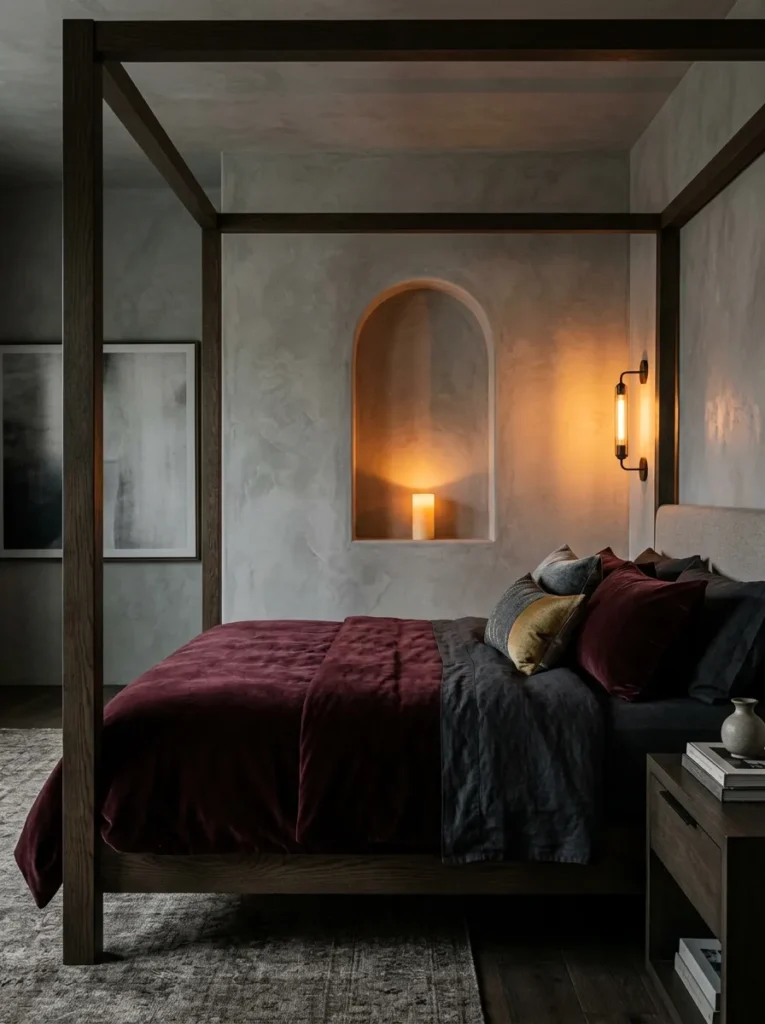
- Walls: hand-troweled lime plaster tinted dove gray, with a sculpted arched alcove behind the bed
- Bed: low platform bed with rounded corners, upholstered in burgundy cotton-velvet
- Textiles: oatmeal heavy linen sheets, charcoal wool throw, one burgundy velvet bolster
- Lighting: slim blackened-iron wall sconce with a dimmable 2200K candle-style LED bulb, grazing the plaster
- Wall decor and rug: one oversized faded indigo-and-rust wool tapestry hung flat from a thin brass rod; rust-and-charcoal flatweave wool rug, 8 x 10 ft
- Plant: cast-iron plant (Aspidistra elatior) in a honed gray stone planter, since it tolerates low light
Why this works: Lime plaster reads as real stone because its uneven troweled texture catches light the way quarried masonry does.
A rounded arch is the quietest way to say medieval. Lime plaster is a mineral finish, so it cures hard, breathes, and carries the slightly cloudy variation you see on old masonry. Here, a dove-gray tint wraps a sculpted alcove, and the low burgundy velvet bed sits inside it like a piece of furniture made for the space. With one saturated color and no clutter, the room feels more like a boutique hotel suite than a themed set.
Here is what my husband tells every client who wants a stone-look wall: patience beats technique. Lime plaster goes over primed drywall in two thin coats, with a full day of drying between them, and a single thick coat will crack. Troweling in short, overlapping arcs creates the stone-like variation, and a wax or sealer coat on top keeps it from marking near the bed. The alcove is built out from the wall with a light stud frame and flexible drywall, so it adds curve without touching structure. Graze the wall with one sconce and the texture glows.
2. Blackened Steel Canopy
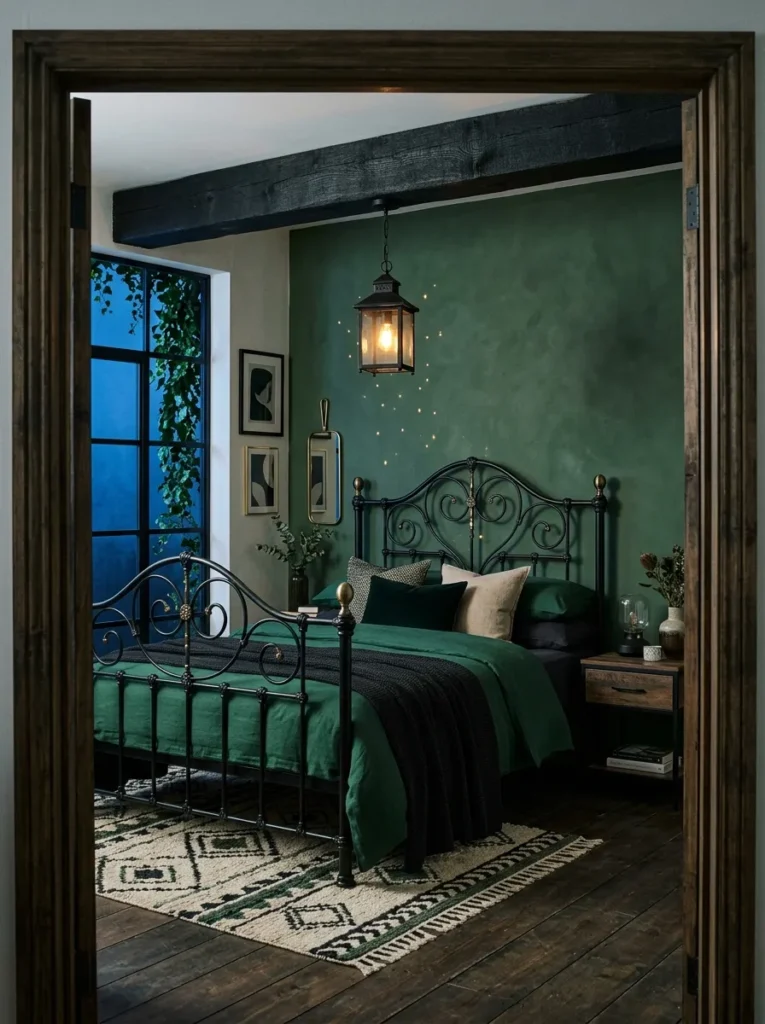
- Walls: matte forest green limewash on all four walls
- Ceiling: reclaimed-oak box beam, charred and sealed
- Bed: slim blackened-steel four-poster frame in square tube with brushed brass caps, no fabric
- Textiles: oatmeal washed linen duvet, moss velvet lumbar pillow, charcoal wool-blend throw
- Lighting, decor, rug: oversized blackened-iron hoop pendant with candle-style LED bulbs; a 20-inch hand-forged iron shield sculpture hung low and alone; natural jute-wool flatweave rug with a black border
- Plant: English ivy (Hedera helix) trailing from a black iron ledge by an east window
Why this works: Matte limewash absorbs light instead of reflecting it, so black iron and a charred beam read as solid shapes against deep green.
A guest once asked if our house started life as a barn. It didn’t. The beam over this bed is a hollow box my husband built from three oak boards, then charred with a torch and sealed. That moment taught me how much a single heavy line overhead changes a room. Against matte forest green limewash, the slim black steel frame disappears into the beam’s shadow and the brass caps catch every flicker. I kept the oatmeal linen duvet plain so the eye has somewhere to rest, and the room settled into something calm, grounded, and unmistakably adult.
Charred wood looks incredible and rubs off like chalk if you skip the final step. My husband brushes the char back, then seals it with a matte clear coat so the beam never sheds soot onto the bed. A box beam also stays light, and it screws directly into ceiling joists; a solid block inside carries the pendant chain. Candle-style LED bulbs give the pendant an evening glow. Ivy trails from a black ledge by the window because it wants bright, indirect light, and in Austin that means an east-facing spot, never the afternoon glare.
You’ll Also Love: 15 Pink Coquette Bedroom Ideas That Feel Romantic, Not Juvenile
3. Aubergine Linenfold Wall
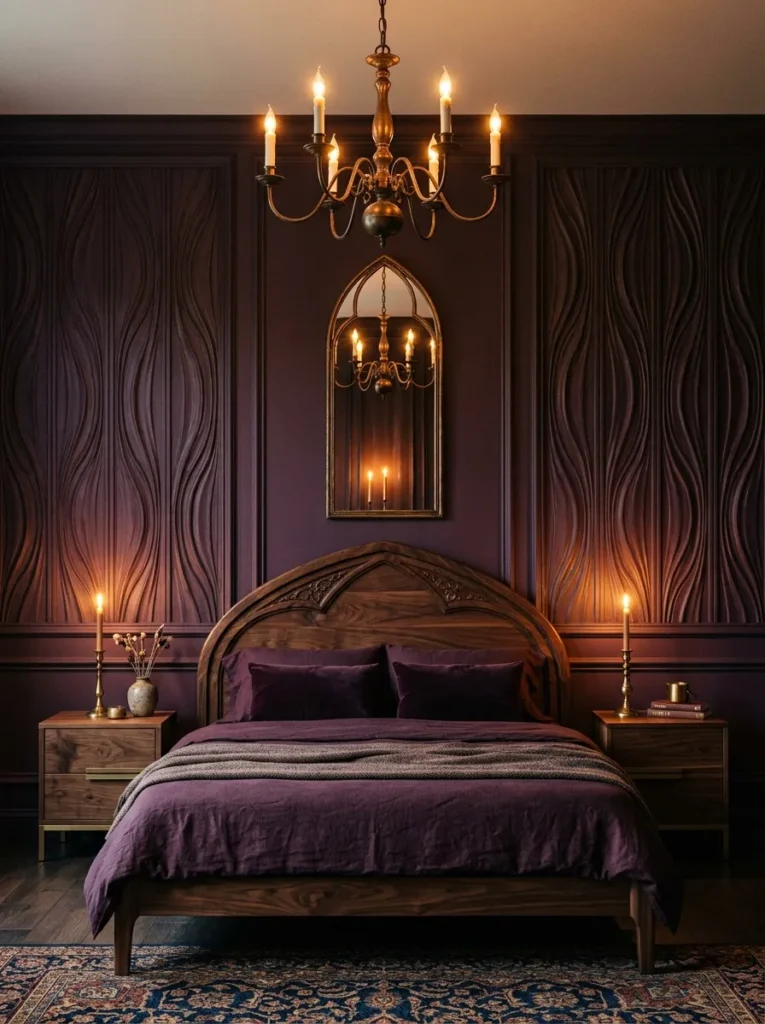
- Walls: oversized linenfold paneling to 5 feet in matte aubergine, upper wall in plum limewash
- Bed: low walnut platform bed with a smooth, tall lancet-arch headboard and no carving
- Textiles: aged-bronze quilted velvet coverlet, aubergine velvet floor-length drapes, ivory heavy linen sheets
- Lighting: two-tier aged-bronze ring chandelier with candle-style LED bulbs on a dimmer
- Decor and rug: 40-inch slim bronze-patina lancet mirror; low-pile plum wool rug with a faded bronze border, 8 x 10 ft
- Plant: rosemary topiary in a cream terracotta pot on a south-facing sill
Why this works: Linenfold is a real late-medieval carving pattern that mimics folded cloth, so it adds historic depth without a single obvious prop.
Linenfold is the most underrated medieval detail. Carvers first used it in the late 1400s to mimic folded cloth in solid oak, and at oversized scale in one tone, it looks as current as a gallery wall. In aubergine paint, the vertical folds throw soft shadows that shift as the day moves, so the wall never looks flat. I’ve seen this work well with a low walnut bed, because a smooth pointed headboard echoes the folds without competing. Add floor-length aubergine velvet drapes and an aged-bronze coverlet, and the room reads as quiet luxury, not a themed set.
A heavy chandelier is where good intentions meet gravity. Standard ceiling boxes are rated for up to roughly 50 pounds, and a two-tier bronze ring fixture can easily approach that. My husband always fixes a brace between the joists first, then hangs the fixture from that. Use LED candle-style bulbs on a dimmer, since real flames and fabric drapes don’t mix. By the window, I keep a rosemary topiary in a terracotta pot. It needs six or more hours of direct sun and fast-draining soil, so a south window works while dim corners kill it.
4. Sculpted Plaster Hearth
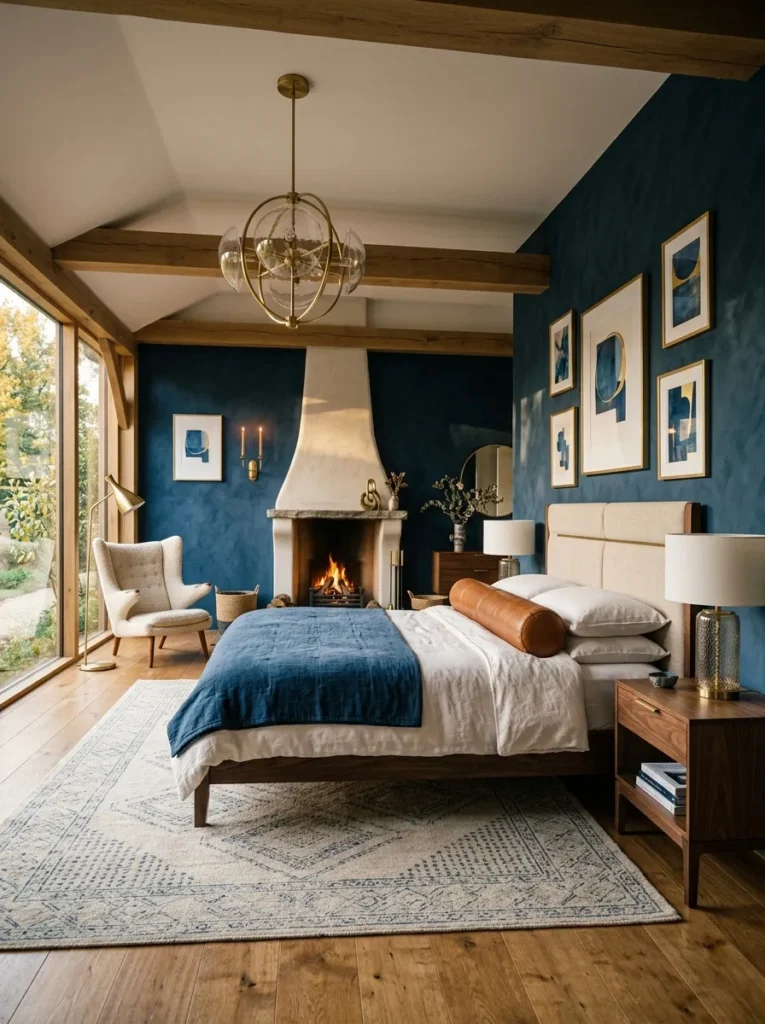
- Walls and hearth: deep matte indigo limewash, with a smooth, curved hooded fireplace in limestone-white plaster, an electric insert and no flue
- Bed: low limed-oak bed with a thick, softly rounded slab headboard
- Textiles: chalk-white heavy linen duvet, slate-blue wool blanket, one cognac leather bolster
- Lighting: slim unlacquered-brass arm sconces with LED taper bulbs, dimmed to low amber at night
- Wall decor and rug: 30-inch matte-black forged-iron ring sculpture inspired by a single chainmail link; oatmeal wool rug with a slate border, 8 x 10 ft
- Plant: ZZ plant (Zamioculcas zamiifolia) in a matte black ceramic pot, which handles low light
Why this works: Medieval great halls centered on a hooded hearth, and a plaster hood with an electric insert recreates that focal point without a chimney.
Medieval halls were built around the hearth, and that single idea modernizes beautifully. A smooth, curved plaster hood in limestone white, set against deep indigo limewash, becomes a sculptural focal point the moment you walk in. The limed-oak bed with its rounded slab headboard sits opposite, so the room has two calm, soft-edged anchors. Cognac leather on the bolster adds one warm note, which keeps the indigo from feeling cold at night.
Here is the part that surprises people: an electric hearth is mostly a framing project. Without a flue, the hood is just a stud frame wrapped in drywall and finished with lime plaster. My husband checks the manufacturer’s clearance sheet for the insert before anything gets built, and confirms the circuit can carry the load. Indigo limewash also changes across the day. In morning light it reads as a soft navy, and at night it deepens toward black, which is why the brass sconces, dimmed to low amber, matter so much.
5. Peacock Teal Half-Tester
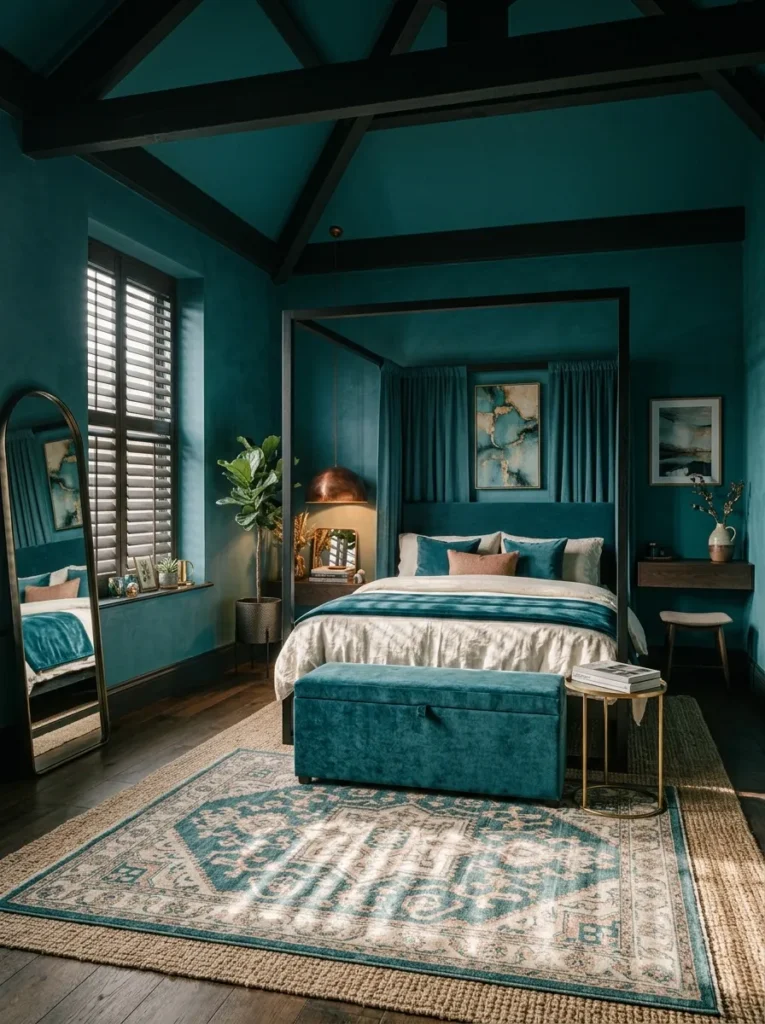
- Walls: deep peacock teal in matte paint, sampled in three lights
- Window: louvered smoked-oak shutters with slim black iron straps
- Bed: slim blackened-oak half-tester with a short arched rail over the pillows and straight-hung teal linen panels
- Textiles: cream heavy linen duvet, ivory wool blanket, burnt-copper velvet lumbar pillow
- Lighting: pair of hand-spun copper dome pendants on black cord at bedside, with warm 2200K bulbs
- Decor, rug, plant: 4-foot matte-black forged-iron blade sculpture hung vertically; cream-and-copper striped wool kilim, 8 x 10 ft; staghorn fern (Platycerium bifurcatum) mounted on a charred board
Why this works: Deep teal shifts from luminous in daylight to almost black at night, so test paint samples in morning, afternoon, and lamplight before committing.
My first teal bedroom was a mistake. I picked the sample at noon, loved the glow, then watched it turn nearly black under evening lamps. The second attempt worked because I painted three large squares and checked them in morning light, afternoon sun, and lamplight. The winner was a deep peacock teal that holds its color after dark. Paired with a slim blackened-oak half-tester, whose short arched rail covers only the pillows, the bed feels sheltered without the weight of a full four-poster. Copper pendants and a burnt-copper lumbar pillow add just enough warmth to the cool blue-green.
The shutters are the detail guests notice first. Louvered smoked-oak panels with slim black iron straps fold back by day and close to a slatted glow at night, which feels medieval in structure and modern in proportion. Beside them I mounted a staghorn fern on a charred board, because these ferns grow on tree bark in the wild and prefer to be hung, not potted. They want bright, indirect light and a good soak about once a week. Copper, teal, and black iron repeat in small touches, so nothing in the room looks accidental.
6. Bleached Oak Trestle Bed
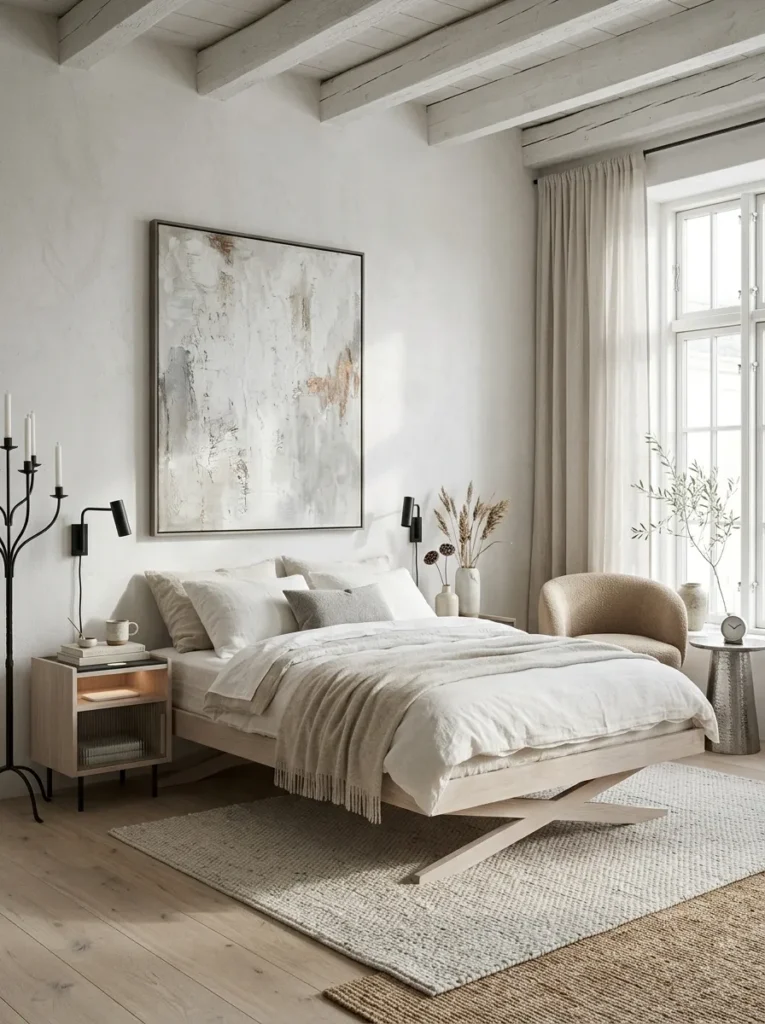
- Walls: chalk-white limewash, brushed on loosely for a soft, cloudy finish
- Ceiling: exposed rafters, whitewashed to a pale, grainy finish
- Bed: low bleached-oak trestle bed with open X-shaped end supports and a floating plank headboard
- Textiles: bone linen duvet, ash-gray wool blanket, undyed sheepskin throw
- Lighting: slim blackened-iron floor candelabra with LED taper bulbs, plus morning light through a tall arched black-steel window
- Decor, rug, plant: 5-foot hand-woven wall hanging in bone and ash stripes; ivory hand-spun wool rug, 9 x 12 ft; olive tree (Olea europaea) in a gray terracotta pot by the window
Why this works: A near-white room reads as medieval when texture, not color, does the work: limewash, raw wood, and wool.
Not every medieval room needs to be dark. Picture a limewashed monastery cell flooded with soft daylight, and the appeal becomes obvious. In my experience, this version is the easiest for beginners, because chalk-white limewash, bleached oak, and black iron are forgiving together. The trestle bed’s open X-shaped supports echo the folding stools of medieval halls, but in a calm, minimal way. Everything stays quietly tone-on-tone, so the eye reads shape and grain.
Texture does the heavy lifting here, so choose it with care. Limewash applied in loose, crisscross strokes shows a soft, cloudy movement, while a roller leaves a flat, painted look. I’ve seen this go wrong when people mix several whites, so pick one chalk tone and let the oak, wool, and iron supply the contrast. The olive tree is more than decoration. It evolved in bright Mediterranean sun, needs at least six hours of direct light, and prefers soil that dries between waterings, so it earns its spot beside the arched window.
7. Ochre Barrel Vault
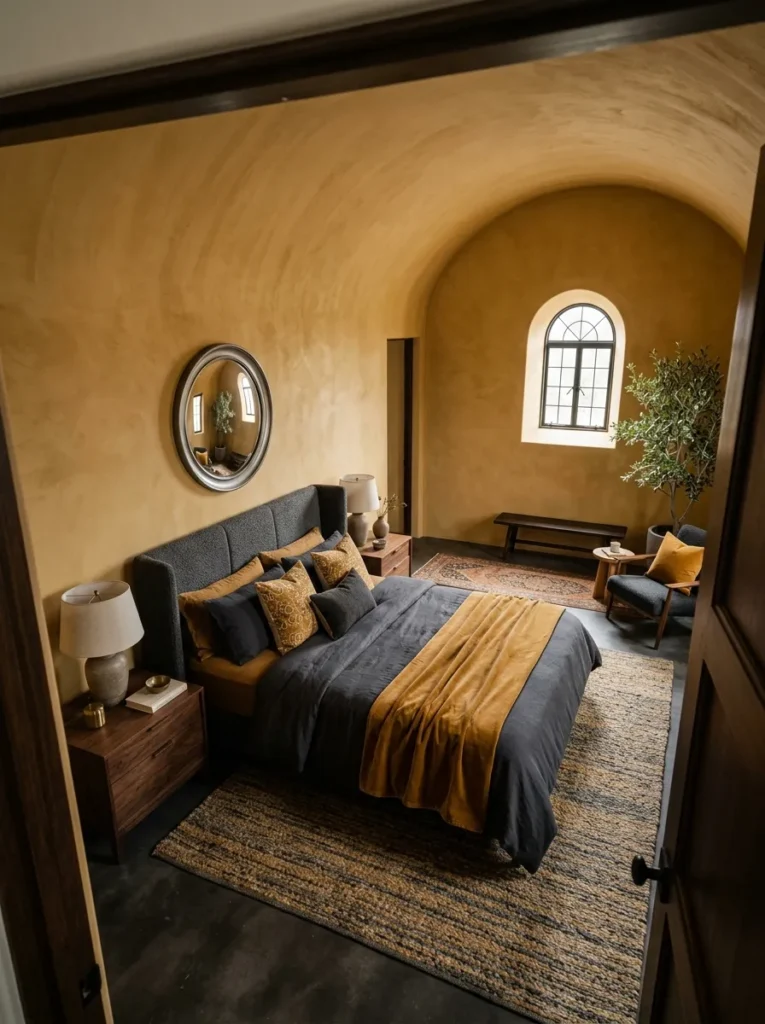
- Walls and ceiling: ochre tadelakt-style polished lime plaster that curves up into a shallow barrel vault
- Bed: curved wingback bed upholstered in charcoal wool, tall like a medieval high-backed chair
- Textiles: warm white linen sheets, charcoal wool blanket, one saffron velvet bolster
- Lighting: hammered pewter wall sconces with warm LED candle bulbs, dimmed low at night
- Decor and rug: 24-inch convex mirror in a thin aged-pewter frame; thick undyed charcoal-brown wool rug, 8 x 10 ft
- Plant: dragon tree (Dracaena marginata) in a matte stone pot, slow-growing and happy in modest light
Why this works: Polished lime plaster reflects light softly, which lets a saturated ochre read as rich instead of loud.
A curved ceiling changes how a bedroom feels before you notice why. Medieval vaulted rooms drew the eye upward and made stone feel sheltering, and a shallow plaster vault does the same in a modern bedroom. Here, ochre walls roll into the ceiling without a hard corner, so the room reads as one carved volume. The charcoal wingback bed grounds the warmth, and a saffron bolster repeats the wall color just once, so the palette stays confident and calm.
Tadelakt is the traditional version of this finish. Plasterers polish the lime with a smooth stone while it is still damp, then seal it with olive-oil soap, which gives the wall a soft, suede-like sheen. It is skilled work, so budget extra time and a professional hand. The convex mirror is the quiet medieval touch, a nod to the round mirrors in fifteenth-century Flemish paintings. Beside it, a dragon tree (Dracaena marginata) suits this setting well. It grows slowly, tolerates modest light, and its spiky, arching leaves add a sculptural silhouette without any fuss.
8. Smoked Oak Box Bed
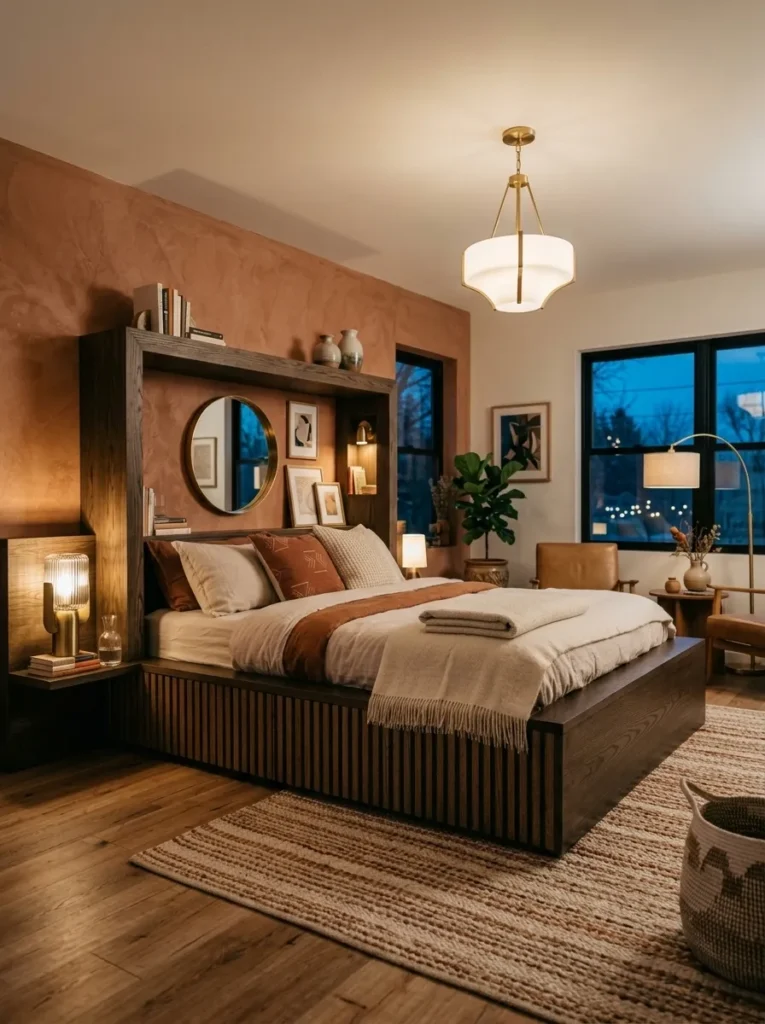
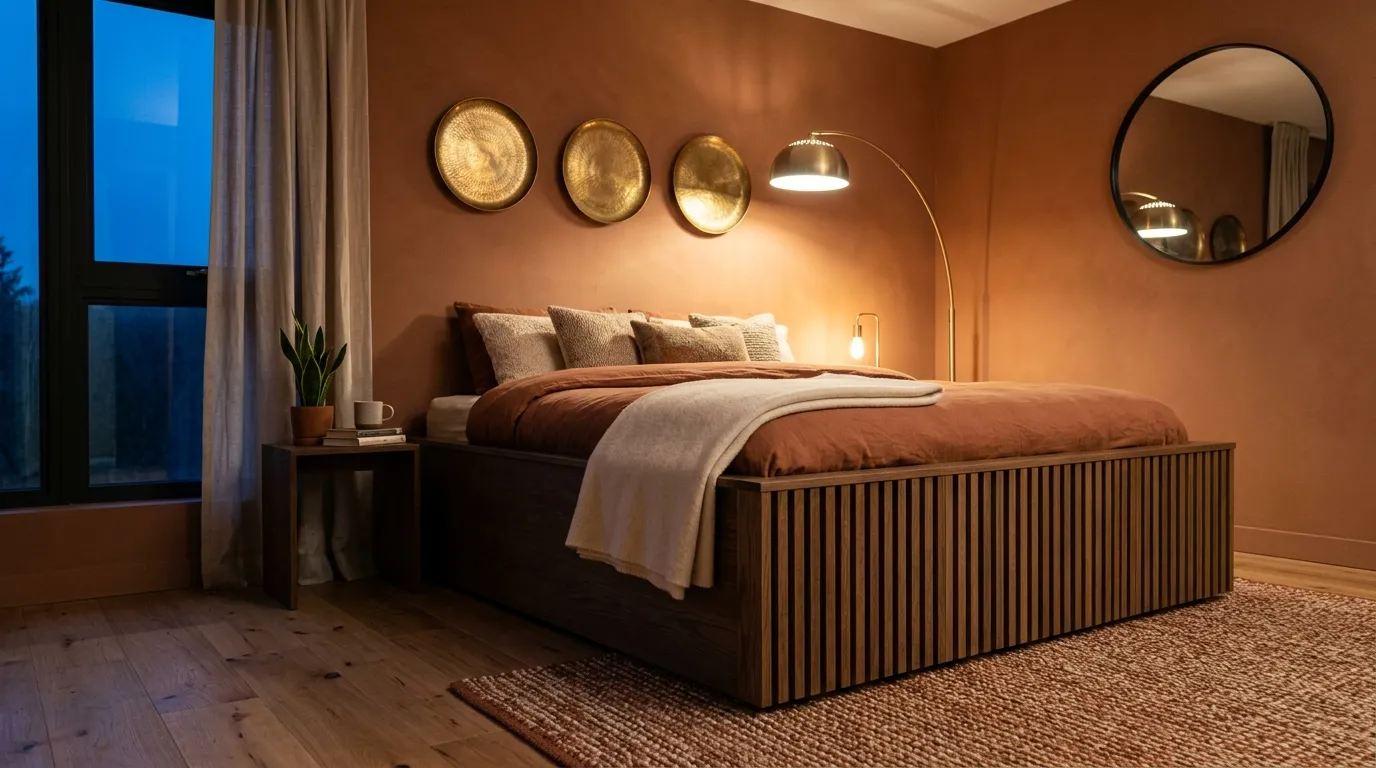
- Walls: terracotta clay plaster, hand-applied for a soft, earthy finish
- Bed: built-in smoked-oak box bed with a slatted front panel and a slim built-in shelf
- Textiles: cream wool blanket, undyed linen sheets, one rust linen pillow
- Lighting: flush LED strip under the top rail, plus a black iron swing-arm light at bedside
- Decor and rug: vertical row of three hammered-brass roundels, like shield studs; cream-and-rust faded-diamond woven wool rug, 8 x 10 ft
- Plant: jade plant (Crassula ovata) in a black stone pot
Why this works: A built-in box bed frames the mattress like a room within the room, which makes a bedroom feel cozy at any size.
I was skeptical the first time I considered sleeping inside a box. Medieval box beds were built to hold in heat, and I assumed they’d feel cramped. Then I tried a nook with smoked oak surrounding the mattress, and it felt like being tucked in. The terracotta clay-plaster walls glow warm around it, while the oak frame stays dark and quiet. A slatted front panel keeps the bed ventilated and visually light. Cream wool bedding stops the nook from reading heavy, and one rust linen pillow ties the bed to the walls. It’s the coziest corner I’ve styled.
Practical details make this work. A box bed needs airflow, so the slatted front, a gap behind the mattress, and an open end keep moisture from building up. Measure twice for the mattress, because a built-in nook leaves no room for error. I add a flush LED strip under the top rail for a soft reading glow, plus a small black iron swing-arm light. For greenery, a jade plant (Crassula ovata) thrives beside it. It stores water in its leaves, loves bright light, and handles air-conditioned rooms far better than ferns do.
9. Rose Window Headboard
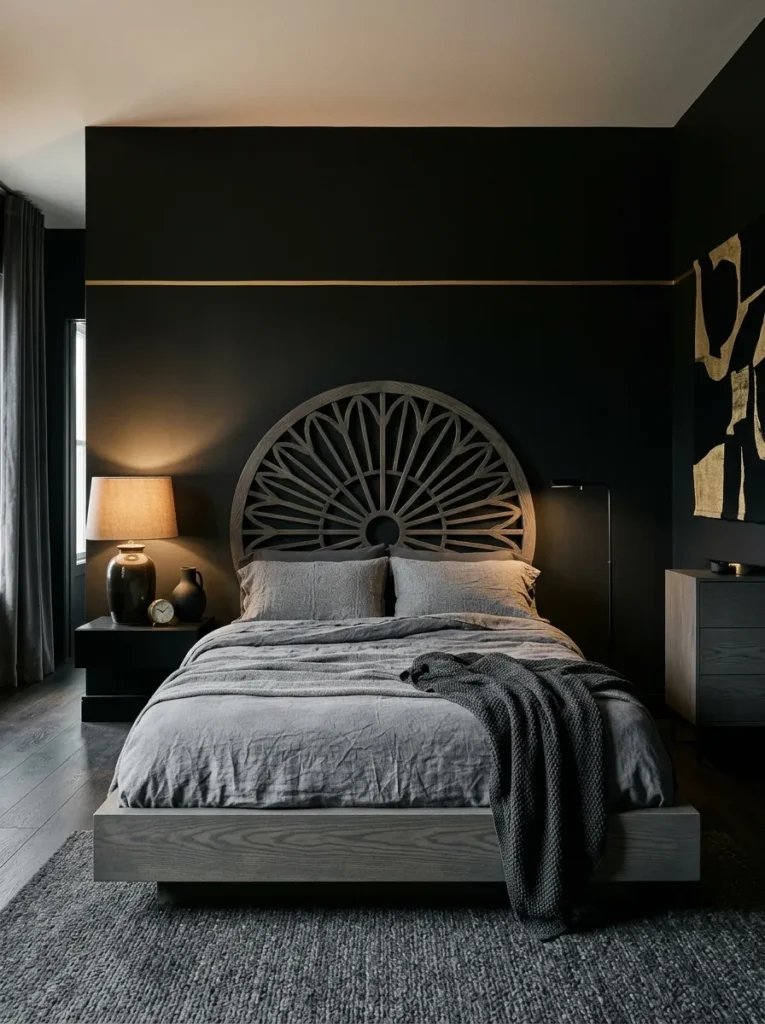
- Walls: matte soot-black limewash, with one thin band of antique gold leaf at picture-rail height
- Bed: low gray-washed ash bed with a large round, radially slatted headboard recalling a Gothic rose window
- Textiles: smoke-gray linen duvet, black wool blanket, one antique-gold velvet pillow
- Lighting: pair of dark-glazed ceramic table lamps with linen shades and warm 2200K bulbs
- Decor and rug: 14-inch polished-steel buckler hung like a mirror; smoke-gray high-low wool rug with a charcoal border, 9 x 12 ft
- Plant: peace lily (Spathiphyllum) in a matte ceramic pot, its white blooms glowing against the black wall
Why this works: Matte black walls make a room feel deeper instead of smaller when one pale shape and one metallic accent carry the contrast.
Black walls scare people, and I get it. I’ve seen this work well, though, in rooms where light has somewhere to land. A matte soot-black limewash soaks up glare and makes pale shapes pop, so the round, slatted gray-washed ash headboard reads like a Gothic rose window set into the wall. Here, smoke-gray linen adds a second pale note, and a single band of antique gold leaf at picture-rail height provides the glint. Everything else stays quiet.
Gold leaf sounds fussy, but a single line is surprisingly forgiving. Use a gilding kit with size, mask the band with painter’s tape, and press the leaf on with a soft brush. If it tears, patch it with another flake. The ceramic lamps do the real lighting work, glowing at eye level so the black walls never feel like a void. A peace lily (Spathiphyllum) belongs here for a reason: it tolerates low light, and its white blooms stand out against black like candles. Keep it away from pets, since the leaves are toxic if chewed.
10. Deep Window Seat
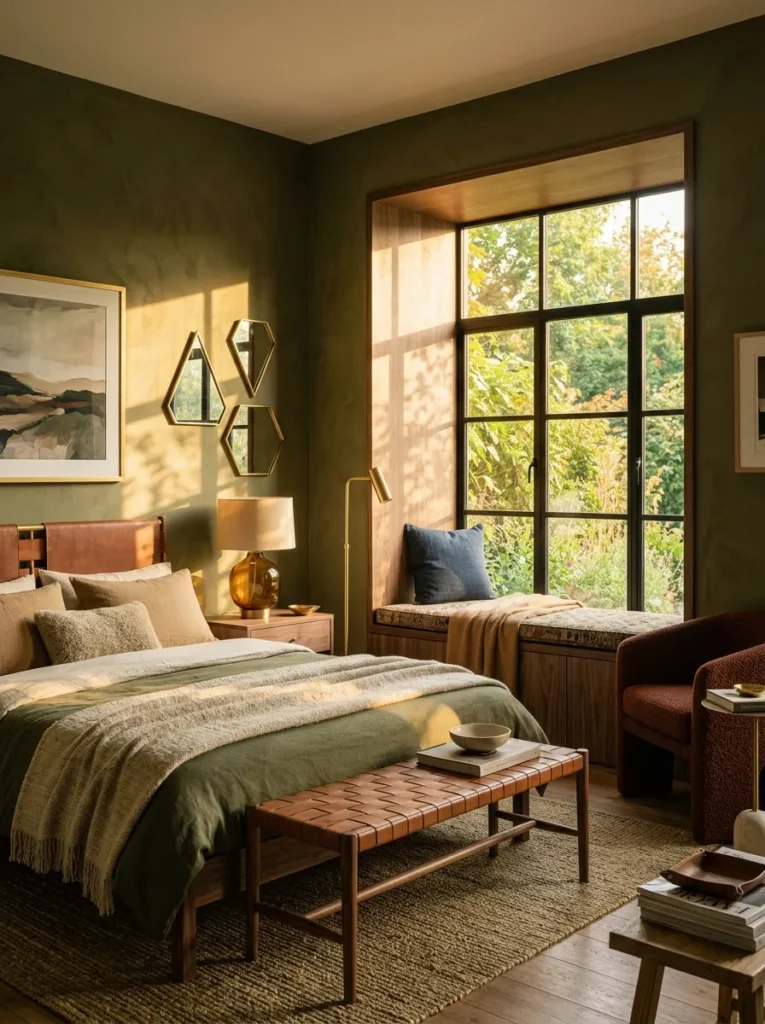
- Walls: deep olive limewash, with parchment-cream plaster returns wrapping the window reveal
- Window: deep reveal with a built-in walnut-edged seat and a hinged storage top
- Bed: low blackened-steel platform frame with a headboard of taut saddle-tan leather straps
- Textiles: parchment linen duvet, camel wool blanket, one olive-brown velvet cushion on the seat
- Lighting: hand-forged iron floor torchère with a warm LED flame bulb for evening, plus full daylight through the window
- Decor and rug: 6-foot woven wool banner in parchment and olive on a walnut rod; braided camel wool-jute rug, 8 x 10 ft
- Plant: Spanish lavender (Lavandula stoechas) in terracotta pots along the sill
Why this works: A deep, plaster-wrapped window seat recreates the thick-walled window of a castle keep and gives the room a built-in place to sit and read.
Thick walls gave medieval windows their charm. Builders cut a deep opening through the stone, and the sill became a seat where people read by daylight. A plaster-wrapped embrasure recreates that moment in a modern bedroom. Pair it with deep olive limewash and parchment-cream returns, and the window becomes a glowing frame in the wall. The saddle-leather strap bed sits low and quiet, so the window stays the star.
Building one is easier than it looks. My husband frames the seat with 2×4 uprights every 16 inches, caps it with three-quarter-inch plywood, and hinges the top so the base doubles as storage. The reveal is wrapped in plaster returns, so there’s no structural change. Add a thin walnut edge on the front lip and the seat feels custom. Spanish lavender (Lavandula stoechas) suits the sill, since it needs at least six hours of sun and lean, fast-draining soil. In Austin’s heat, a south-facing seat keeps it flowering far longer than any shady corner would.
11. Stone Wall, Rope Bed
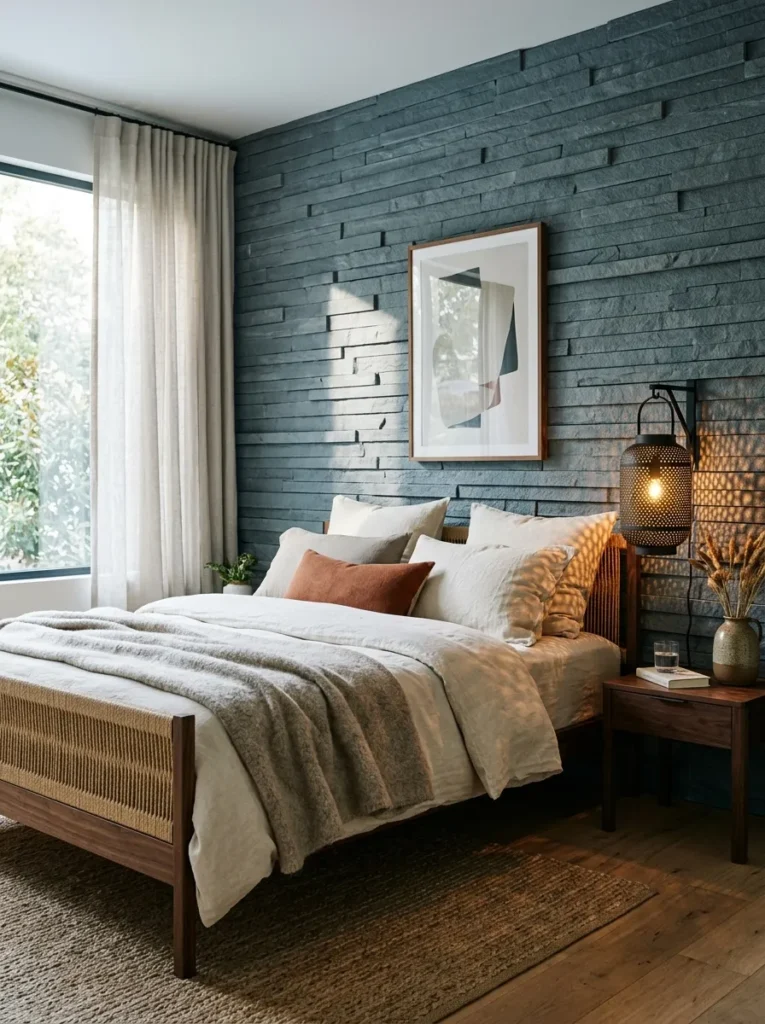
- Walls: slate blue-gray ledgestone veneer behind the bed, other walls in pale putty-gray limewash
- Bed: slim dark walnut rope bed with square posts and natural manila cord laced across the footboard
- Textiles: ecru heavy linen sheets, slate wool blanket, one rust wool bolster
- Lighting: pair of pierced blackened-steel lanterns at the bedside with flameless LED candles, throwing dotted shadows
- Wall decor and rug: 3-foot antique-style iron wall rail with three forged hooks holding a folded wool blanket and a leather satchel; oatmeal-and-rust hand-loomed wool rug, 8 x 10 ft
- Plant: rubber plant (Ficus elastica ‘Burgundy’) in a putty-gray ceramic pot
Why this works: Thin stone veneer gives a room the texture of real masonry at a fraction of the weight and cost of full stone.
I once tried to talk my husband into full stone for a bedroom wall. He pulled out a tape measure and a calculator, and the weight number ended the debate. That was my introduction to thin stone veneer, which delivers real quarried texture without the heavy load. Behind a walnut rope bed, slate blue-gray ledgestone becomes the anchor of the room. Pale putty-gray limewash on the other walls keeps the stone from overwhelming the space.
Veneer is lighter, but it still needs a plan. Building codes generally cap adhered veneer at about 15 pounds per square foot, so my husband checks the product’s weight and preps the wall with the right backing before a single stone goes up. The rope bed adds a handmade contrast. Manila cord is laced across the footboard in a tight diamond pattern, a nod to the rope beds medieval households slept on, while a solid slat base carries the mattress. A rubber plant (Ficus elastica ‘Burgundy’) echoes the rust bolster and thrives in bright, indirect light.
12. Rose Clay Dais
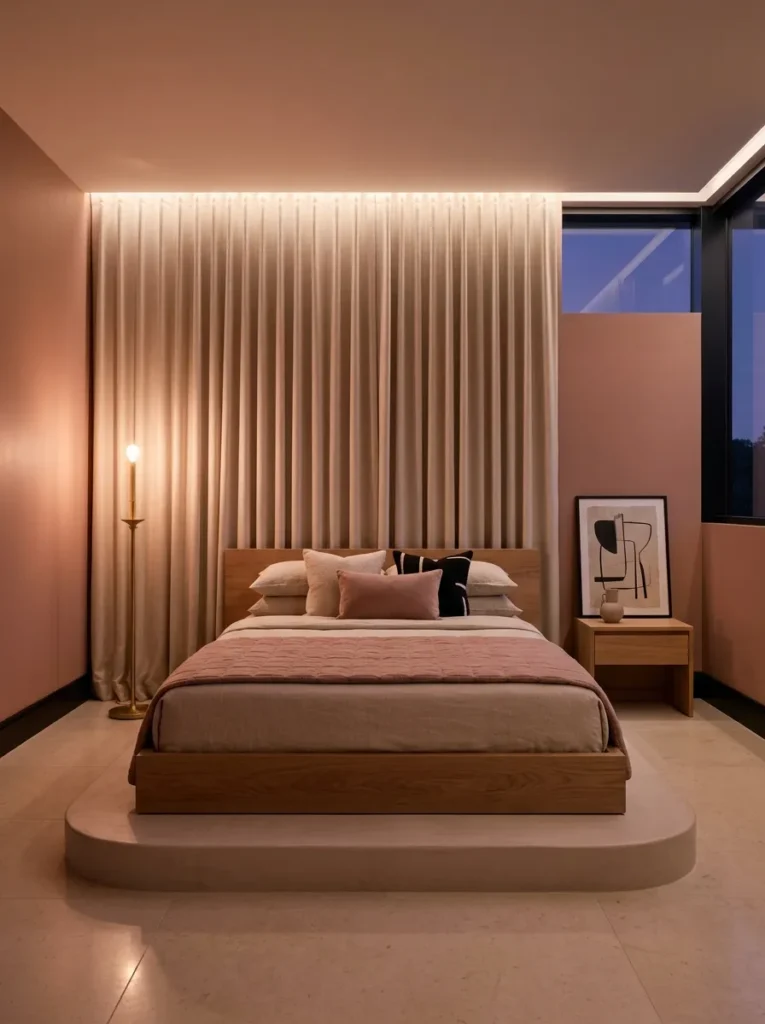
- Walls: hand-troweled rose-clay lime plaster, soft and chalky, with ink-black trim and baseboards
- Architecture: six-inch plaster dais with a rounded front edge under the bed, plus floor-to-ceiling oatmeal wool-linen drapery on a ceiling track along the bed wall
- Bed: slim low oak platform frame, so the mattress seems to float on the dais
- Textiles: oatmeal heavy linen duvet, ink-black wool blanket, one rose-clay velvet pillow
- Lighting: pair of tall brass candlestick lamps with linen shades and warm 2200K bulbs
- Decor, rug, plant: one 20-inch bone ceramic relief shield plaque, hung alone; black-bound oatmeal wool rug, 9 x 12 ft; ponytail palm (Beaucarnea recurvata) in a black stoneware pot
Why this works: A low dais gives the bed presence and lets floor-length drapery frame it, the way medieval beds were set apart as the room’s centerpiece.
In medieval homes, the bed was the most important piece in the room, so it was raised, curtained, and framed. That logic still works beautifully. A six-inch plaster dais lifts the mattress just enough to feel ceremonial, and a floor-to-ceiling oatmeal drapery wall softens the entire bed wall. In my experience, hand-troweled rose-clay plaster is the secret that keeps this from feeling heavy, because its soft, dusty pink tone reads warm in daylight and nearly neutral by lamplight. Ink-black trim then sharpens every edge, giving the room a graphic, gallery-like finish.
Drapery is the easiest way to add height. A ceiling-mounted track lets the fabric hang from the ceiling to the floor, so the wall reads taller, and it avoids the sagging that thin curtain rods suffer under heavy linen. My husband screws the track into joists, not just drywall. The dais is a simple plywood-and-stud box finished in plaster, rounded at the front edge for a soft shadow line. Ponytail palm (Beaucarnea recurvata) works beside the drapes, since it stores water in its swollen base and tolerates bright rooms with irregular watering.
13. Studded Plank Closet Door
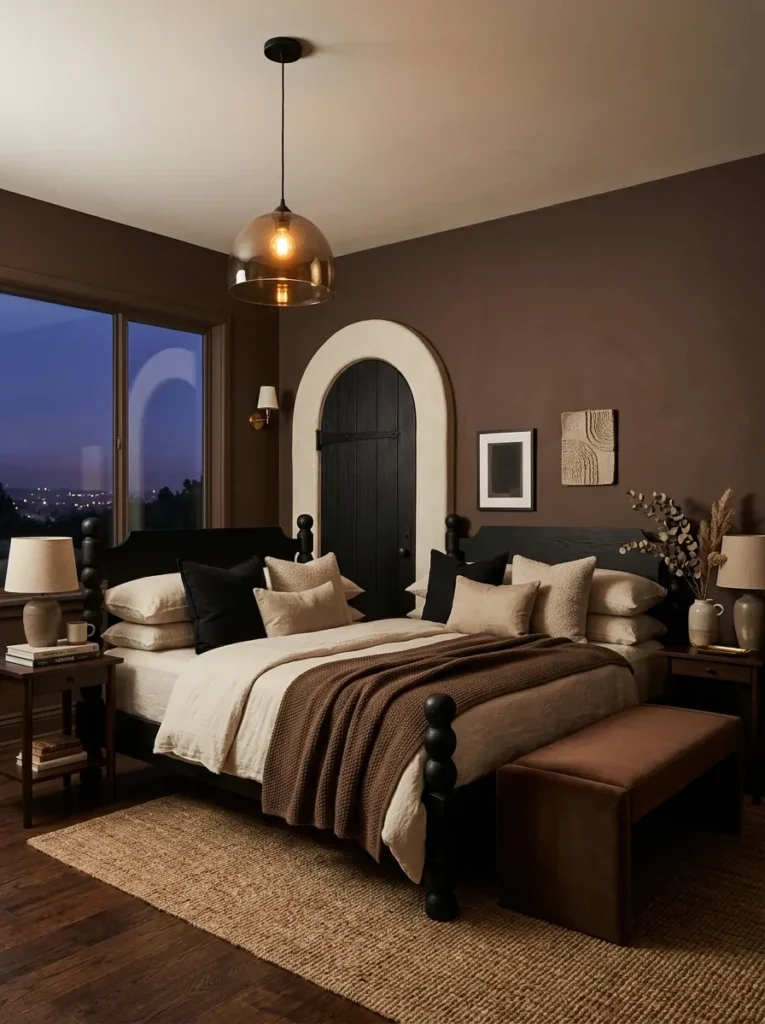
- Walls: cocoa-brown limewash, with a cream plaster surround on the arched door
- Architecture: round-arched closet door in blackened-oak planks, with forged iron strap hinges and a single row of nail heads
- Bed: low ebonized-ash bed with chunky turned posts and a wide, flat headboard, no canopy
- Textiles: cream heavy linen duvet, mushroom wool blanket, one dove-gray velvet pillow
- Lighting: three smoked-glass globe pendants on blackened chains at staggered heights, with warm 2200K LED bulbs
- Decor, rug, plant: 28-inch hand-hammered nickel disc hung like an oversized shield boss; cream hand-knotted wool rug with a cocoa border, 8 x 10 ft; parlor palm (Chamaedorea elegans) in a cream stoneware pot
Why this works: An arched plank door with iron strap hinges borrows the oldest medieval door design, so one architectural piece does the work of a whole theme.
The fastest way to a convincing castle bedroom style is a door. Medieval doors were built from vertical planks held together by horizontal battens and iron straps, and that honest construction still looks striking. Set in a cream plaster arch against cocoa-brown limewash, a blackened-oak version becomes the room’s single dramatic moment. The ebonized-ash bed with chunky turned posts sits low and quiet, so the door takes the lead.
Authentic doors are heavy, and I learned that the hard way while helping hang one at a job site. A solid oak plank door can weigh 80 pounds or more, so it needs three strong hinges screwed into the framing, not just the trim. For a bedroom closet, a hollow-core door with applied planks and strap hinges gives the same look with less strain. Smoked-glass pendants at three heights soften the hard lines, and a parlor palm (Chamaedorea elegans) in the corner thrives in the low, even light of a cocoa-toned room.
14. Hoop Canopy in Heather
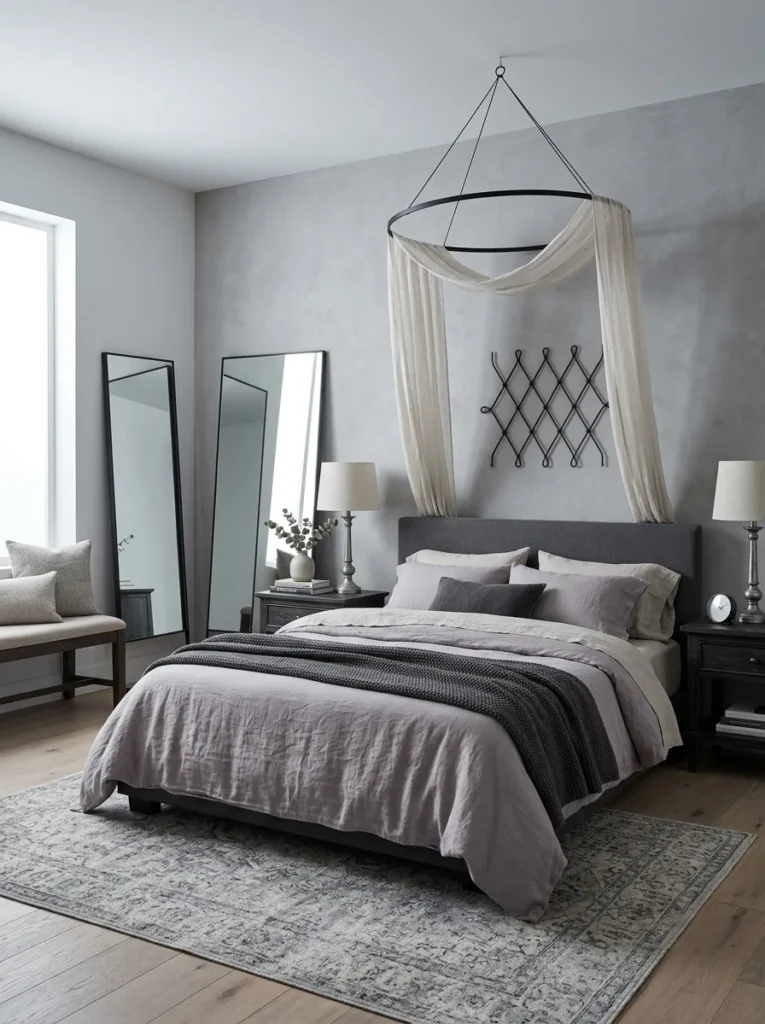
- Walls: heather-gray limewash with a faint lilac undertone
- Canopy: 48-inch blackened-steel hoop hung from the ceiling, with bone linen panels falling to the floor behind the bed
- Bed: low oyster-linen upholstered bed with a gently curved crescent headboard
- Textiles: bone linen duvet, silver-gray wool blanket, one black velvet bolster
- Lighting: pair of aged-silver candlestick lamps with ivory shades and warm 2200K bulbs
- Decor, rug, plant: 5-foot black wrought-iron diamond-lattice grille hung like Gothic tracery; heather-and-bone hand-knotted wool rug, 8 x 10 ft; bird’s nest fern (Asplenium nidus) in a black ceramic pot
Why this works: A ring canopy gives a bed the sheltered, enclosed feeling of medieval bed hangings, without the bulk of a full four-poster frame.
I once styled a friend’s guest room with a tall four-poster, and she called it a ship. The next version used a single steel hoop instead, and the room finally breathed. Linen panels falling from a ring behind the bed create the same enclosed feeling medieval bed hangings gave, without any of the bulk. Against heather-gray limewash with a faint lilac undertone, the black ring and bone linen look crisp and calm. A black wrought-iron lattice on the wall adds a nod to Gothic window tracery, so the room delivers restrained, modern gothic character.
A ceiling-hung hoop looks weightless, but it must be anchored properly. Steel and linen together can run 15 to 25 pounds, so my husband hangs a ring like this from two points, each a screw hook driven into a ceiling joist, never just drywall anchors. Keep the linen panels slightly longer than the floor height so they pool softly. On the nightstand, aged-silver candlestick lamps add a soft shine. A bird’s nest fern (Asplenium nidus) suits the cool palette, preferring humid, indirect light and watering poured into the soil, never the center.
15. Travertine Floor, Sage Walls — A Fantasy Medieval Bedroom Idea Built Around Stone
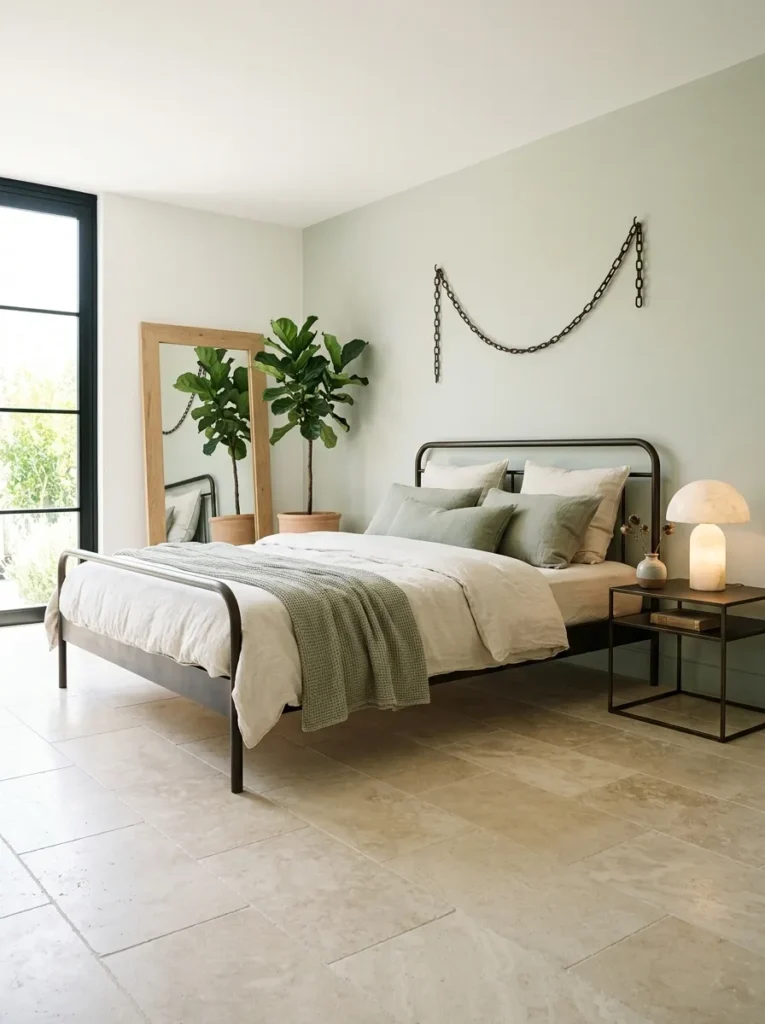
- Walls: pale sage limewash with a soft gray-green cast
- Floor: honed, filled travertine tile in warm cream, laid in a staggered pattern
- Bed: low oiled-bronze wrought-iron sleigh bed with rounded scroll ends
- Textiles: ivory heavy linen duvet, sage-gray wool blanket, one oatmeal velvet pillow
- Lighting: pair of alabaster dome table lamps glowing warm amber, with 2200K bulbs
- Decor, rug, plant: 5-foot hand-forged iron chain hung in a loose swag from two hooks; undyed cream flatweave wool rug, 8 x 10 ft; African spear plant (Dracaena angolensis) in a cream stone pot
Why this works: Stone floors were the standard medieval surface, and honed travertine reproduces that look in warm cream tones that feel softer than gray slate.
Stone floors were the default in medieval homes, and that history makes them an elegant modern choice. If you’re choosing one of these fantasy medieval bedroom ideas to build into the house itself, start with the floor. Honed travertine in warm cream feels softer than gray slate, and its natural pits and veining read as old without trying. Pale sage limewash above it adds a quiet green cast, while the oiled-bronze sleigh bed brings gentle curves. Alabaster lamps glow like lanterns made of stone, and I’ve noticed guests always reach out to touch them.
Travertine rewards a little planning. It’s a natural stone with small pits, so ask your installer to use a filled and honed finish for a smooth bedroom floor, and seal it once installed. Tile typically runs roughly $5 to $15 per square foot before labor, so a 12 x 14 room fits many budgets. Radiant mats can add warmth underfoot, which matters on cold winter mornings. For greenery, an African spear plant (Dracaena angolensis) fits the story. Its upright, cylindrical leaves look like spears, it tolerates low light, and it needs water only when the soil is dry.
Styling Principles
Every room above follows the same four rules. They are what keep a medieval-inspired bedroom looking like design instead of a costume.
- One real material leads. Pick lime plaster, forged iron, heavy linen, or oak as the star, and let everything else support it. A medieval-inspired bedroom reads as architecture when its materials are authentic, not when its accessories are numerous.
- Restraint beats repetition. Use one shield, one tapestry, or one arch. A second and third copy of the same idea turns a design direction into a theme.
- Keep the palette tight. Hold the room to one saturated color, one neutral, and one metal. Mixed metals work when one leads and the other appears in small doses.
- Modern shapes carry the history. Rounded corners, slim frames, and low beds let a single medieval detail feel current. Curved plaster and clean-lined iron look contemporary because the silhouette is modern, even when the idea is old.
FAQs
1. How do you make medieval decor look adult instead of costume-like? Use authentic materials and limit themed objects to one or two. Lime plaster, forged iron, and heavy wool or linen read as architecture, while plastic props and costume-grade fabric read as novelty. Choose one focal feature, such as an arched alcove or a hooded hearth, and keep the rest quiet and tone-on-tone.
2. What are the best materials for a stone-look bedroom wall? Lime plaster, tadelakt, and thin stone veneer are the strongest options. Hand-troweled lime plaster gives a soft, cloudy stone texture, tadelakt adds a polished suede-like sheen, and thin veneer delivers real stone at far less weight than full stone. Adhered veneer is generally limited to about 15 pounds per square foot, so check your local code.
3. How can I try a medieval bedroom on a budget? Limewash one wall and add one statement piece. A single limewashed wall, a wool throw, and a thrifted iron lamp or candlestick create the mood for far less than a full renovation. Add pieces slowly, because restraint is part of what makes the look read as sophisticated.
4. What is safe lighting for a dramatic medieval bedroom? Use LED candle-style bulbs on a dimmer in iron or brass fixtures. Warm 2200K to 2700K bulbs give a candlelit glow with no open flame near bedding or drapes. Heavy chandeliers must be anchored to blocking between ceiling joists, since a standard ceiling box is generally rated for up to about 50 pounds.
5. How do you style a small bedroom in a medieval look? Choose one focal feature and keep furniture low. A pale limewashed wall, a low bed, and a ceiling-mounted drapery track that draws the eye upward make a small room feel intentional, not crowded. Skip bulky canopies and use a slim hoop or half-tester instead.
6. Can I get this look in a rental? Yes, with freestanding pieces. A forged-iron bed, a heavy wool rug, plug-in sconces, a floor candelabra with LED tapers, and a large textile hung from a tension rod create the mood without touching the walls. Check your lease before painting or limewashing.
Conclusion
A medieval-inspired bedroom doesn’t need a costume shop’s worth of props to feel like the Middle Ages. It needs one real material doing the talking, a tight palette, and modern shapes carrying the history. Whether you start with a single limewashed wall, a forged-iron bed, or a plaster alcove, these fantasy medieval bedroom ideas prove that restraint is what separates architecture from a theme.
I’ve seen how one well-made piece, placed with intention, outperforms a whole room of decorative nods. Pick the room that speaks to you, start with one material, and let it lead.