15 Palm Sunday Decoration Ideas for a Meaningful Home
Your front door, your table, your mantel: Palm Sunday deserves a look all its own. If you’ve searched for Palm Sunday decoration ideas and found only pastel Easter bunnies and generic greenery, you’re not alone. I’ve styled Holy Week in my Austin home for years, and the displays that stayed with me were never the busiest. They were the quietest. In this guide, you’ll find 15 modern, meaningful scenes built from fresh palm fronds, candlelight, and deep green, cream, and gold tones. Each one includes exact colors, lighting, and a small detail that makes it feel planned. Pick one idea, try it this week, and watch an ordinary corner become something worth pausing for.
The most honest Palm Sunday decoration is one that changes while it sits on your table. Cut palm fronds begin drying and curling within two to three days, because the leaf keeps losing water through its surface after it leaves the tree, and the blades fold inward as they dehydrate. Most displays fail by fighting this. I made that mistake in my first Austin apartment, when a perfect entry arrangement had curled into spirals by Tuesday. Now I style for the curl.
A Palm Sunday display feels intentional, not like leftover Easter, when it follows one deep palette, plans for drying, and refreshes the focal point. This post shows you exactly how, room by room.
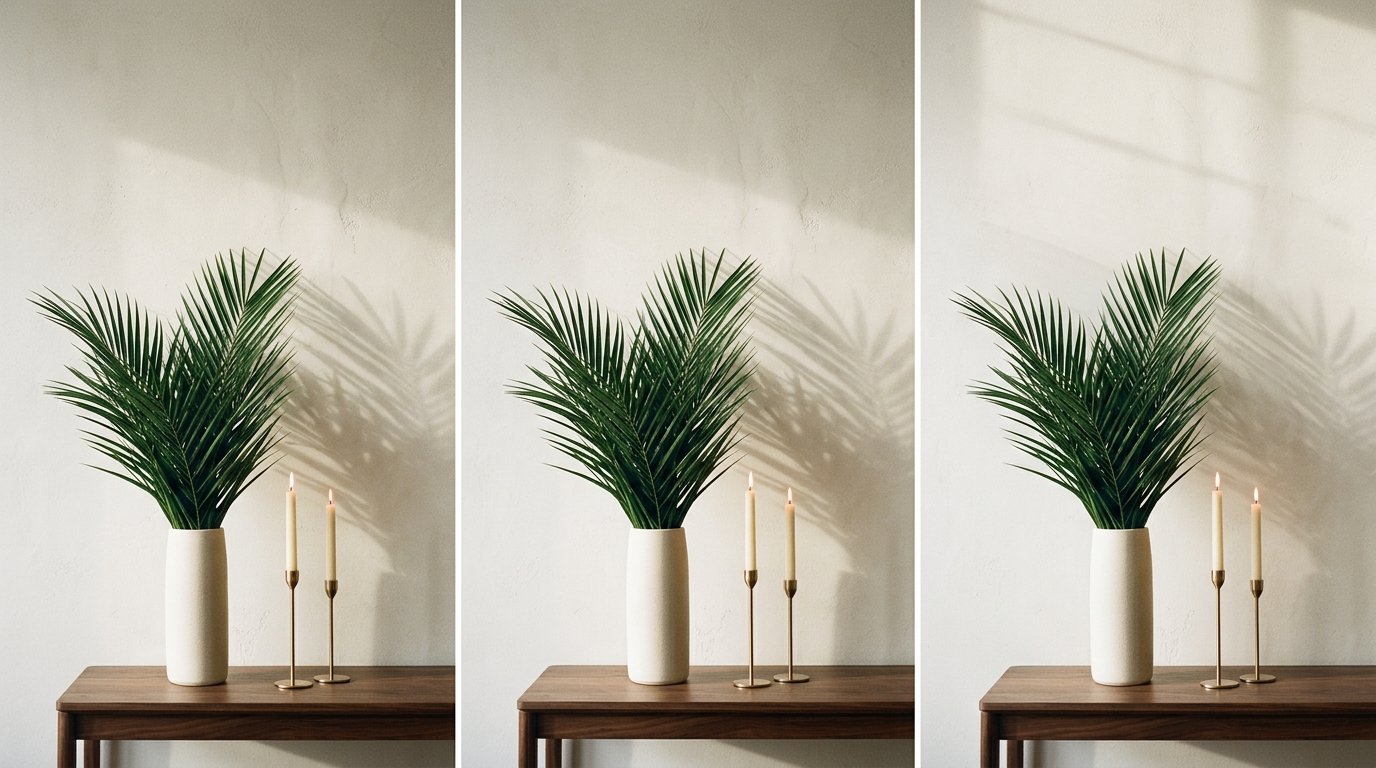
1. Entry Console Sheaf — A Palm Sunday Decoration Idea for a Welcoming Front Hall
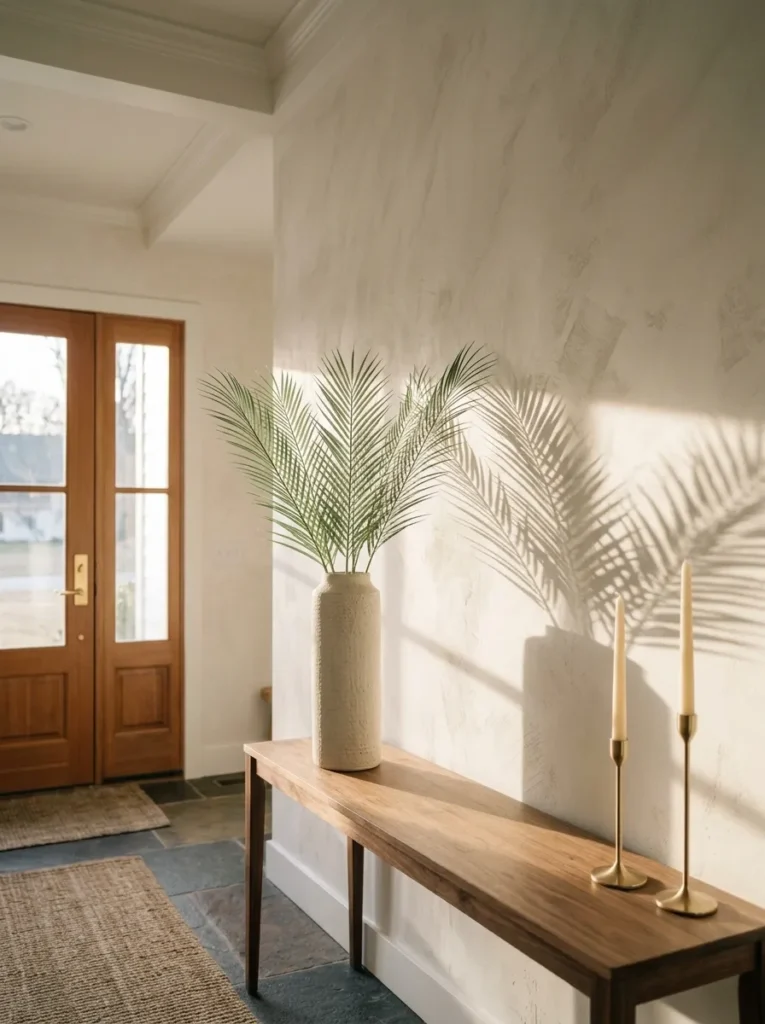
- Eight to ten fronds, 30 to 36 inches long, packed into a 14-inch cream ceramic cylinder
- Deep spruce-green fronds against a chalky cream limewash wall
- Two satin-gold taper candlesticks at different heights
- A slim walnut console, otherwise left bare
- Stems bound once with undyed linen twine in a flat knot
Why this works: A tall, single-species palm sheaf looks deliberate because one vertical shape in one green needs nothing else to look finished.
Palm fronds are built for height, so give them some. Cut stems stay upright best when supported to at least half their length, which is why a narrow cylinder vase outperforms a wide bowl on an entry console. Pack eight to ten fronds tightly, then let the tips fan out. The result looks like a fountain frozen mid-spray. Against chalky cream limewash, the deep spruce green reads instantly from the front door, which matters because guests judge a home in seconds. Keep everything else on the console quiet: two candles, one small dish for keys, nothing more.
My husband spotted the real risk in these entry setups: the floor register. In many homes, supply vents sit near exterior doors, and forced air will dry a frond in a day instead of three. Check where your vent is before choosing a spot, and move the console if needed. He also shims the console level on uneven floors, since a top-heavy sheaf and a swinging front door make a tippy combination. By Wednesday, let the fronds curl. The spiral tips look even better in evening candlelight, throwing slow shadows across the limewash.
2. Linen Cross Panel
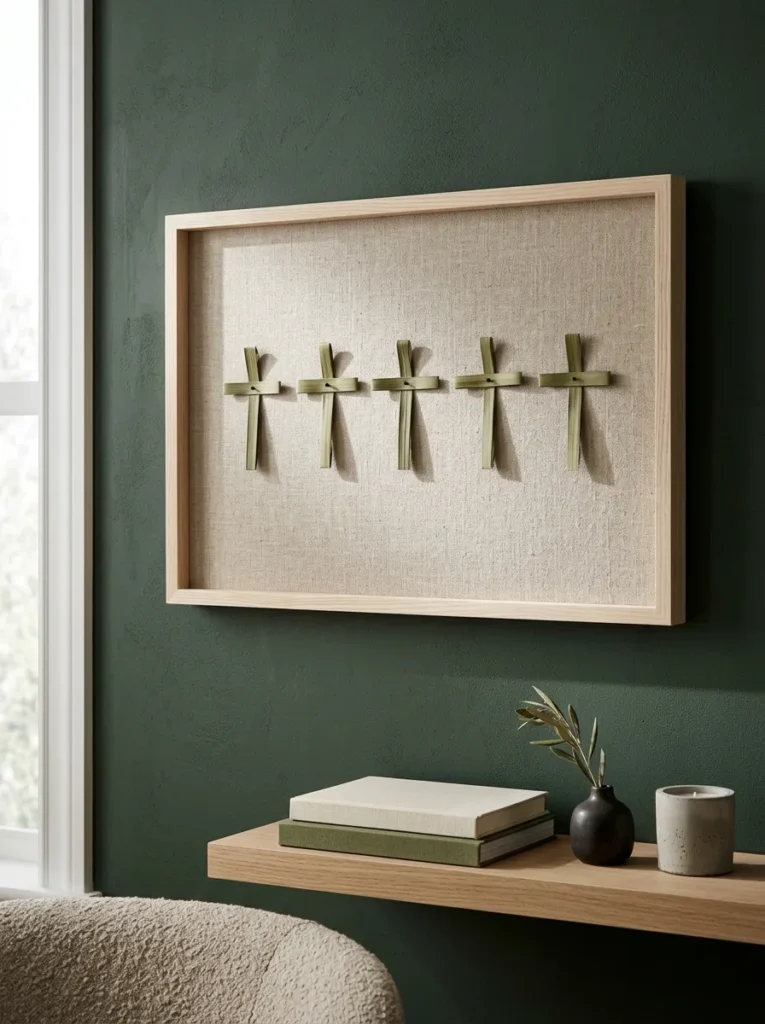
- Five hand-folded palm crosses, 5 to 8 inches tall, pinned in a single row
- Oatmeal linen stretched over a 24-by-36-inch ash-framed panel
- Blackened steel pins, one through the center of each cross
- Hung at eye level above a bench or dresser, where people naturally pause
- Linen year tags on the back turn the panel into an annual collection
Why this works: Handmade palm crosses look like a gallery piece when they share one surface, one spacing, and one background.
My first palm cross looked like a crumpled receipt. I had folded it straight from a dry frond at a neighbor’s kitchen table in Austin, and it cracked at every bend. A friend’s grandmother laughed, then showed me the trick: soak the frond in warm water for twenty minutes first. The leaf turns pliable, almost like ribbon. Now I make five every Palm Sunday and pin them in a row on oatmeal linen. The crosses dry slowly in place, tightening into small, sculptural shapes that hold their form for weeks, and the collection grows with each year.
Stretch oatmeal linen over a 24-by-36-inch wood panel and you have a pinboard that looks like a gallery piece. Space the crosses four inches apart, pin each one through its center with a blackened steel pin, and hang the panel at eye level above a bench or dresser. The pins hold the soaked, folded shapes in place as they dry. On the back of each cross, I clip a linen tag with the year written in graphite. Years later, the row becomes a quiet family record that reads from across the room, without a single word on the wall.
3. Laid Frond Runner
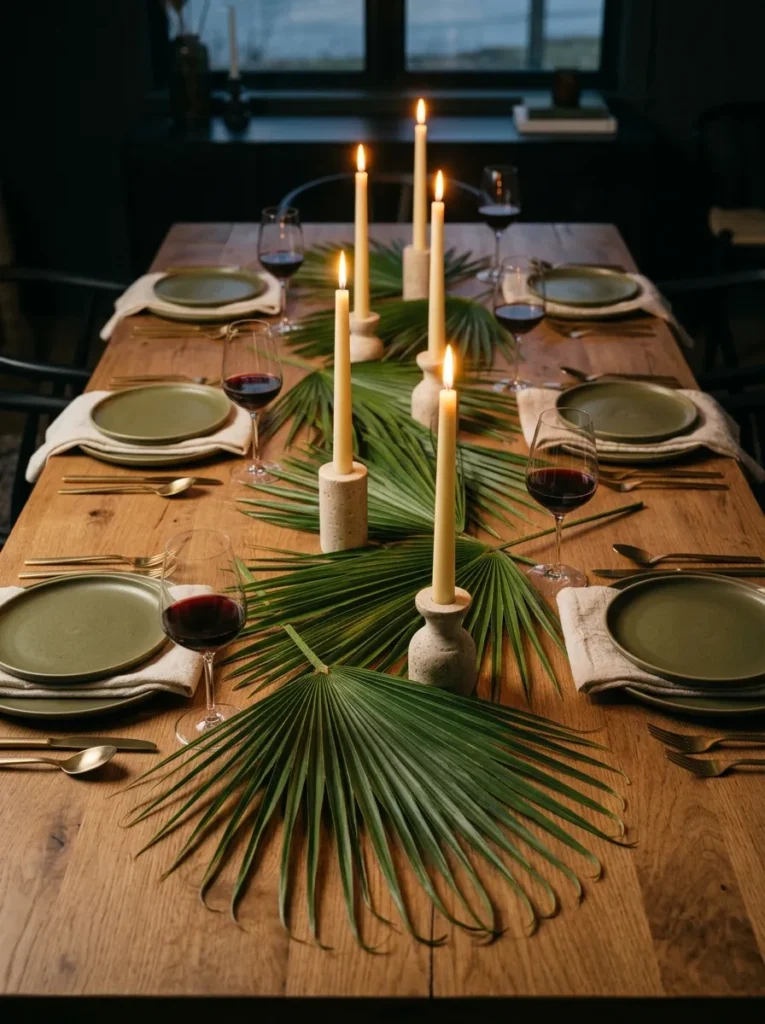
- Six to eight fronds laid down the center of the table, overlapping by about a third
- Deep olive stoneware plates on cream linen napkins
- Ivory beeswax tapers in honed travertine holders
- Place names written in gold paint pen on a single frond blade
- Lights low at dinner, candles only
Why this works: Fronds laid flat keep the table low enough for conversation and let the natural curl read as texture, not decay.
A low runner of laid fronds changes how a table feels. Nothing blocks sightlines, so conversation flows across the table instead of around a vase. I first tried this on a Palm Sunday lunch for eight, and I noticed guests kept touching the leaves, which tells you everything about how tactile they are. Overlap six to eight fronds by about a third, stem to tip, and tuck the cut ends under a candle holder. Deep olive stoneware, cream linen napkins, and ivory beeswax tapers in honed travertine holders keep the palette tight, so the green stays the star.
Here’s the practical part my husband insists on. Fresh palm stems leave damp marks, and beeswax drips are unavoidable, so protect the wood. On a polyurethane finish, wax pops off cleanly once cooled. On an oiled or waxed oak table, it can stain, so slide a sheet of parchment paper under each candle holder and under the fronds. In the evening, turn off overhead lights and let the tapers carry the room. Candlelight makes the curling tips glow amber along their edges, and the olive stoneware turns almost black, which feels calm.
4. Arched Mantel Edit
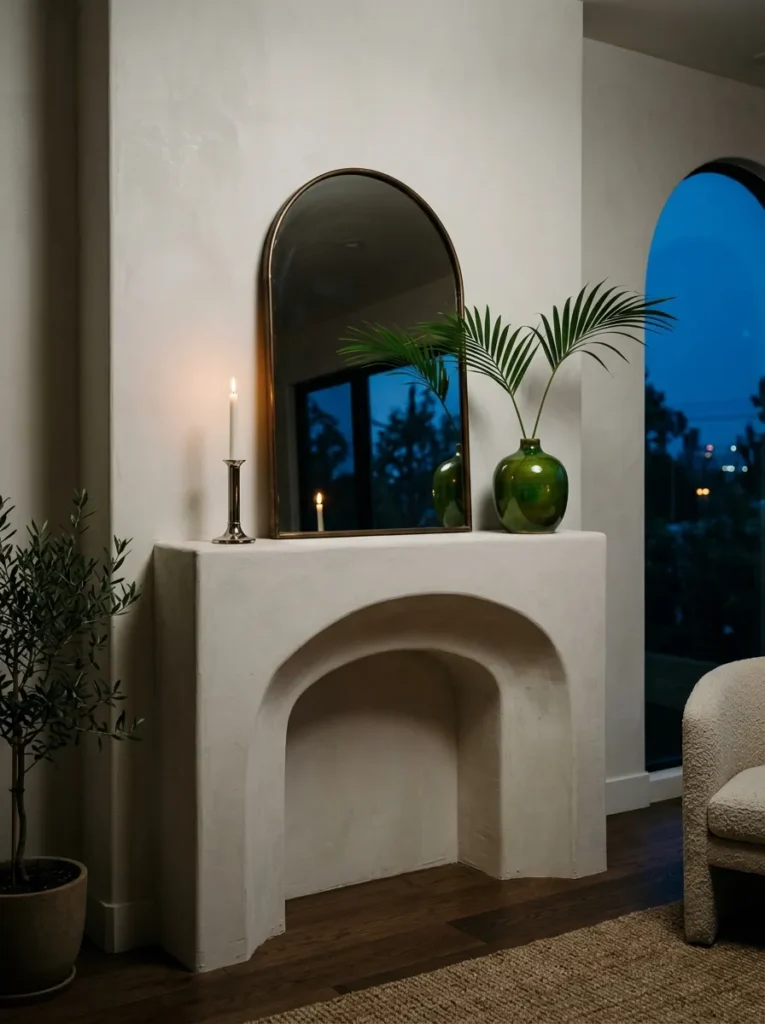
- Matte bone-white plaster mantel and chimney wall
- Arched mirror, 30 by 48 inches, in a slim aged-bronze frame
- Squat bottle-green glazed ceramic vase holding three arching fronds
- Two polished nickel candlesticks at different heights
- Standout detail: each frond’s curve repeats in the mirror’s arch, so the shape appears twice
Why this works: An arched mirror doubles a frond’s curve, so three stems read as one complete, sculptural composition.
Most Palm Sunday decoration ideas stop at the table, which leaves the mantel doing nothing. Curves are what make this one work. Arching fronds echo an arched mirror, and the reflection repeats the shape, so three stems look like six. Keep the palette to a quiet range: matte bone-white plaster, a squat bottle-green glazed vase, and a slim aged-bronze mirror frame. Add two polished nickel candlesticks at different heights, and the mixed metals feel collected, not matched. I like leaving at least a third of the mantel bare. Empty space is what makes a simple arrangement look expensive and calm.
Weight is the part nobody mentions. A 30-by-48-inch mirror can weigh 30 to 40 pounds, and my husband never trusts drywall anchors with that. He hangs it on a French cleat screwed into wall studs, or simply leans it on the mantel with a small rubber pad underneath if the shelf is deep enough. Keep fronds away from a working fireplace, because heat will dry them within a day. In the evening, light both candles and turn off the lamps. The bronze frame catches the flame and the green vase glows.
5. Palm Hoop Sideboard
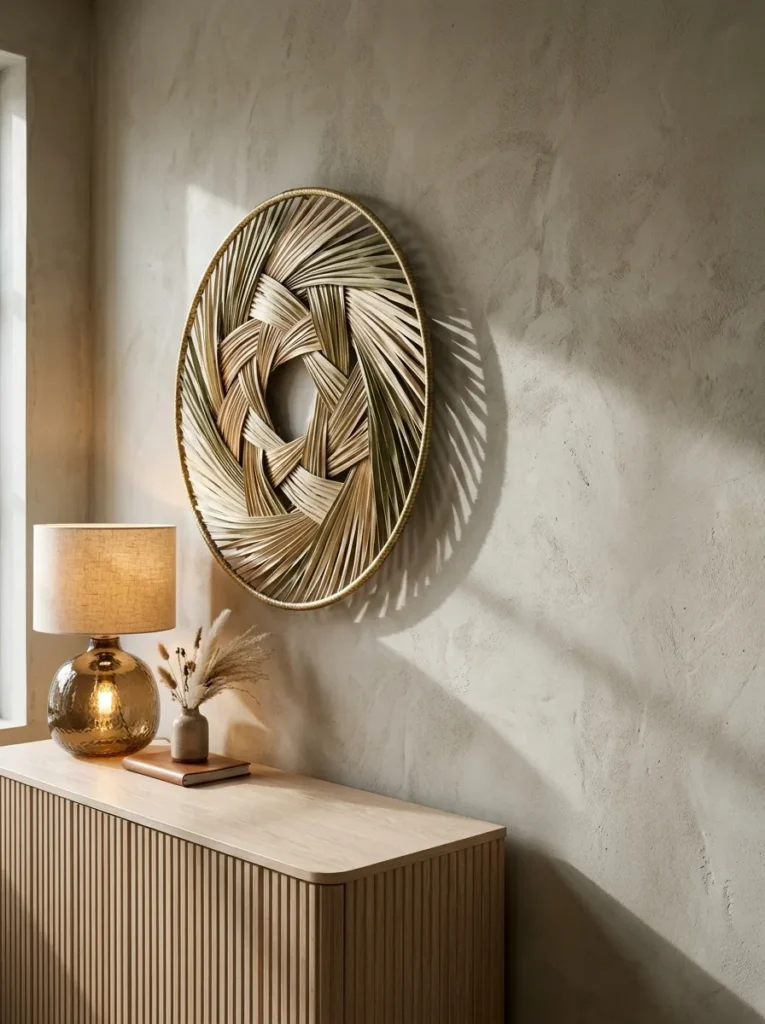
- A 22-inch hoop of six fronds woven onto a thin brushed-brass ring, hung slightly off-center
- Fluted pale white oak sideboard with softly curved corners
- Warm greige plaster wall, left completely bare around the hoop
- Smoked amber glass lamp with a warm 2200K bulb
- Standout detail: fronds woven in one direction like a pinwheel, so every tip curls the same way
Why this works: A hoop reads as modern art, not a wreath, when it is slim, off-center, and the only thing on the wall.
A guest once asked where I bought it, assuming it came from a gallery. It was six fronds and a metal ring. That reaction taught me that shape matters more than ingredients. Weave the fronds in one direction, like a pinwheel, so the tips overlap and curl the same way as they dry. Hang it slightly off-center above a fluted white oak sideboard, and let the warm greige plaster wall stay bare around it. The brushed-brass ring glints just enough to look finished. I’ve made versions with ten fronds, and they always looked fussy. Fewer fronds, cleaner circle, calmer room.
Lighting finishes the scene. Place a smoked amber glass lamp on the sideboard, fitted with a warm 2200K bulb, and the hoop’s shadow stretches across the plaster in the evening. During the day, window light from the side shows every vein in the fronds. Keep the sideboard styling to three pieces: the lamp, one low stoneware bowl, and nothing else. A hoop this size weighs under a pound, so a single sturdy picture hook is enough. Make it the Saturday before Palm Sunday, and by midweek it will have curled into a soft, textured shape worth keeping.
6. Backlit Sill Trio
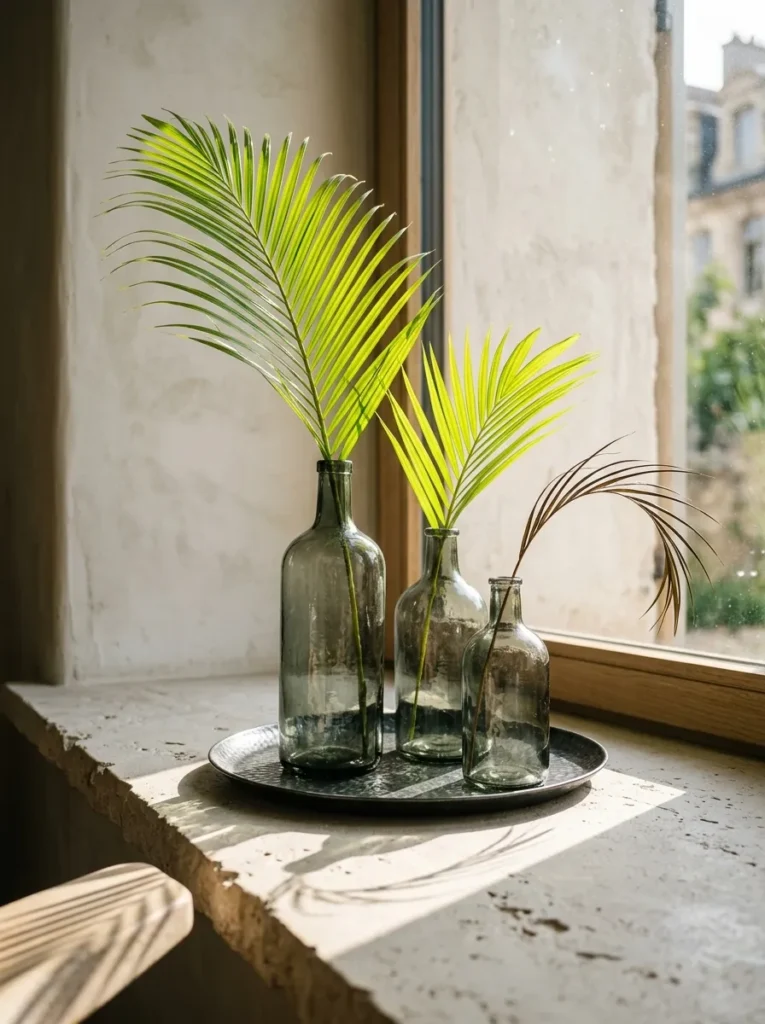
- Three smoked-glass bottles at 6, 9, and 12 inches, one frond in each
- Honed pale limestone sill, at least 5 inches deep
- Hammered pewter tray underneath to catch spills
- Strong morning light from behind turns the leaves translucent lime-green
- Standout detail: one frond stripped bare on its lower half, so its curved spine reads like a calligraphy stroke
Why this works: Backlight makes a frond translucent, so morning sun turns a single stem into the brightest, most detailed object in the room.
Backlight is the secret to this one. Palm leaflets are thin enough that morning sun passes through them, turning deep green to glowing lime and revealing every vein. Line three smoked-glass bottles of graduated height, 6, 9, and 12 inches, on a hammered pewter tray along a honed limestone sill. Place one frond in each. I’ve seen this work in a plain rental kitchen window and in a larger remodeled bay, and both looked intentional. Strip the lower half of one frond so its bare, curved spine reads like a single calligraphy stroke.
Sill depth decides everything. My husband measures first: under four inches, an opening window sash can knock bottles over, so I choose a sill of at least five inches or I keep the trio on the fixed side. He also checks that the sill is sealed. Sealed limestone shrugs off water rings, while bare painted wood does not. Set the pewter tray under the glass and spills never reach the finish. Move the trio inward overnight if the window runs cold. By dusk, switch to a single candle beside the tray.
7. Painted Arch Shelf
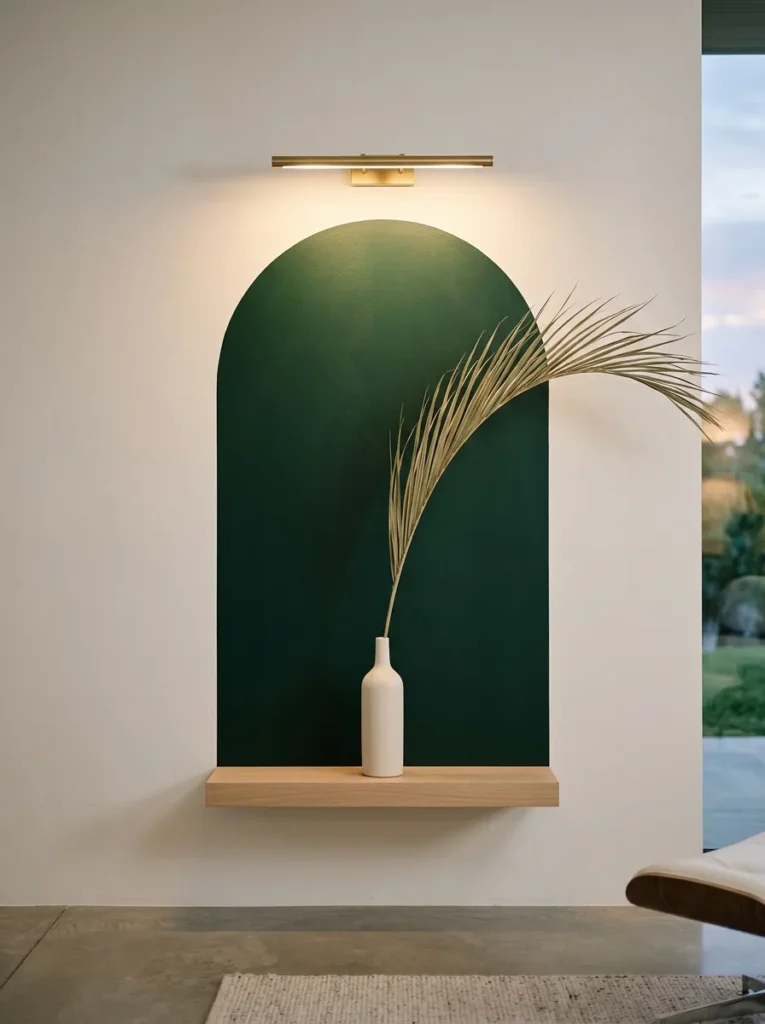
- A 30-by-50-inch arch painted in deep fir green on a warm white wall
- Floating pale oak shelf, 36 inches wide, at the arch’s base
- One tall frond in a hand-thrown ivory bottle vase
- Slim brushed-brass picture light above, with a 2700K bulb
- Standout detail: the frond’s tip curls past the arch edge and breaks the line
Why this works: A painted arch frames a single frond the way a gallery wall frames art, giving one stem the weight of a whole display.
A painted arch is an inexpensive architectural detail you can add in an afternoon. It costs one quart of paint and a roll of flexible tape. Paint a 30-by-50-inch arch in deep fir green on a warm white wall, then mount a pale oak shelf at its base. The color block does what a frame does: it tells your eye where to look. Place one tall frond in a hand-thrown ivory bottle, and let its tip curl past the arch’s edge. That small break in the line is what makes the whole picture feel alive instead of staged.
Here’s the painter’s trick for a clean curve. Drive a small nail at the midpoint where the curve begins, tie a string and a pencil to it, and swing the pencil to mark a perfect semicircle for the top. Tape the edge, seal it with the wall color first, then paint the green so the line stays crisp. Add a slim brushed-brass picture light above and the green looks different by the hour: flat and calm by day, velvety and saturated at night. Leave the wall around the arch empty. Restraint is what makes this look like quiet luxury.
8. Bedhead Frond Arc
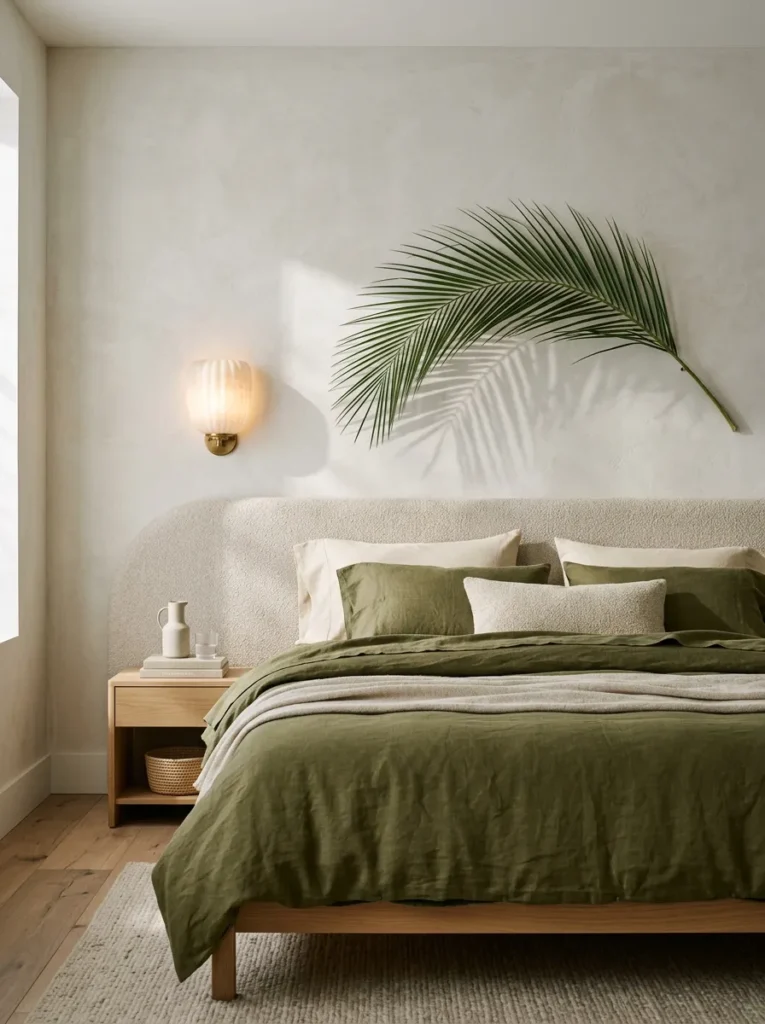
- One four-foot frond pinned in a wide arc above the bed with five fine pins
- Low, curved oatmeal wool headboard
- Pale stone-colored limewash wall, left bare
- Olive linen duvet to keep the green tonal
- Ribbed alabaster plug-in sconces with 2200K bulbs, one on each side
Why this works: One long frond pinned in a gentle arc reads as a line drawing on the wall, which is the quietest way to bring Palm Sunday into a bedroom.
I tried this in my own bedroom after a long week and was surprised by how calm it felt. One four-foot frond, five small pins, and a blank wall. That’s it. The frond arcs above the headboard like a pencil line, and because it is a single stem, it asks nothing of you. I chose a low oatmeal wool headboard, a pale stone-colored limewash wall, and an olive linen duvet, so the green stays quiet and tonal. In the morning light, the leaflets cast tiny, rhythmic shadows across the limewash, a detail you only notice when the room is still.
Mounting is simple. Lay the frond on the floor, curve it gently into an arc, and mark where it should touch the wall. Use five fine pins pushed through the stem into the limewash, spacing them evenly, and trim any leaflets that crowd the line. Add a pair of ribbed alabaster plug-in sconces at 2200K, one on each side, so the light is low and glowing at bedtime. Let the frond dry in place. Over three or four days it settles into a firmer, paler curve that is just as beautiful, and I would argue even more sculptural.
9. Parlor Palm Pair
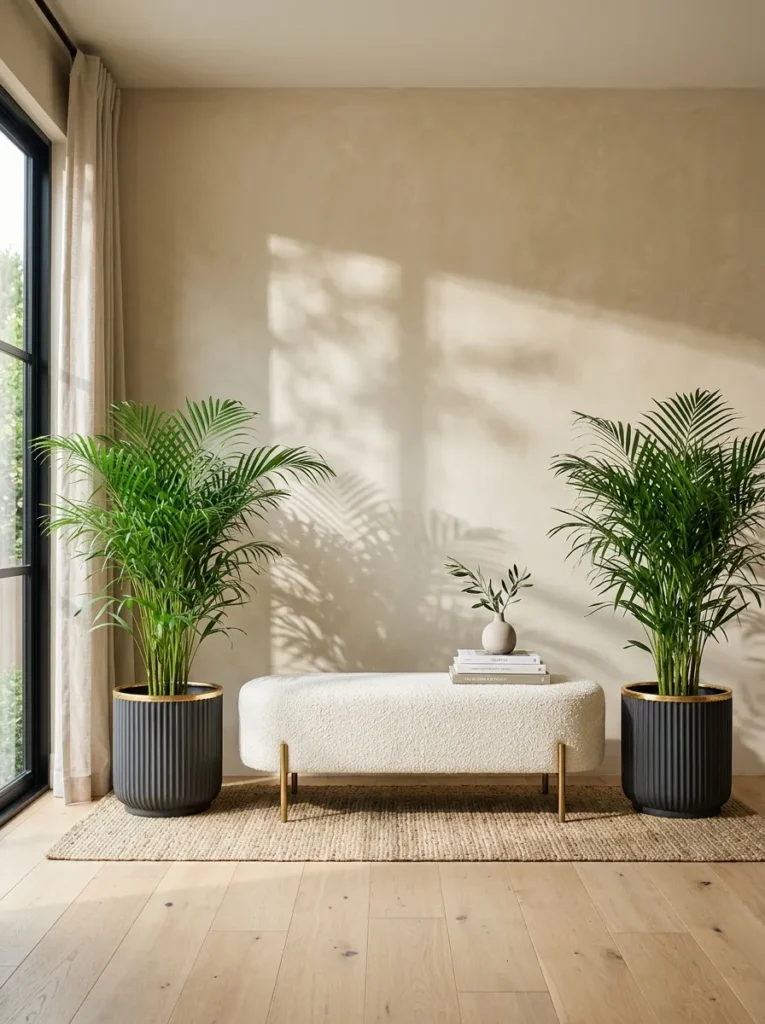
- Two living parlor palms, about three feet tall, in matching fluted charcoal ceramic planters
- Bone-white bouclé bench between them
- Warm oat plaster wall behind
- A single thin line of hand-gilded gold leaf around each rim
- Placed in bright, indirect light, out of direct sun
Why this works: Living parlor palms give a Palm Sunday display that lasts for years, because the plant stays green long after cut fronds have dried.
Cut fronds last days. A living palm lasts years. The parlor palm, Chamaedorea elegans, is one of the easiest palms to grow indoors in bright, indirect light, so two of them can anchor your Holy Week decor and still look good in June. Set two three-foot plants in matching fluted charcoal ceramic planters on either side of a bone-white bouclé bench against warm oat plaster. The symmetry feels calm and ceremonial, which suits the day. A thin hand-gilded line around each rim adds gold without any shine competing with the green.
Care is easy once you know the rules. Parlor palms burn in direct sun, so choose a spot with bright, indirect light, like a few feet back from an east-facing window. Water when the top inch of soil feels dry, and make sure the planter has a drainage hole inside a liner, since soggy roots are a common way these palms die. Wipe the leaves with a damp cloth. To gild the rims, brush on water-based size, wait until tacky, then press on gold leaf. Seal it with a clear matte varnish so it survives dusting.
10. Glass Cloche Plinth
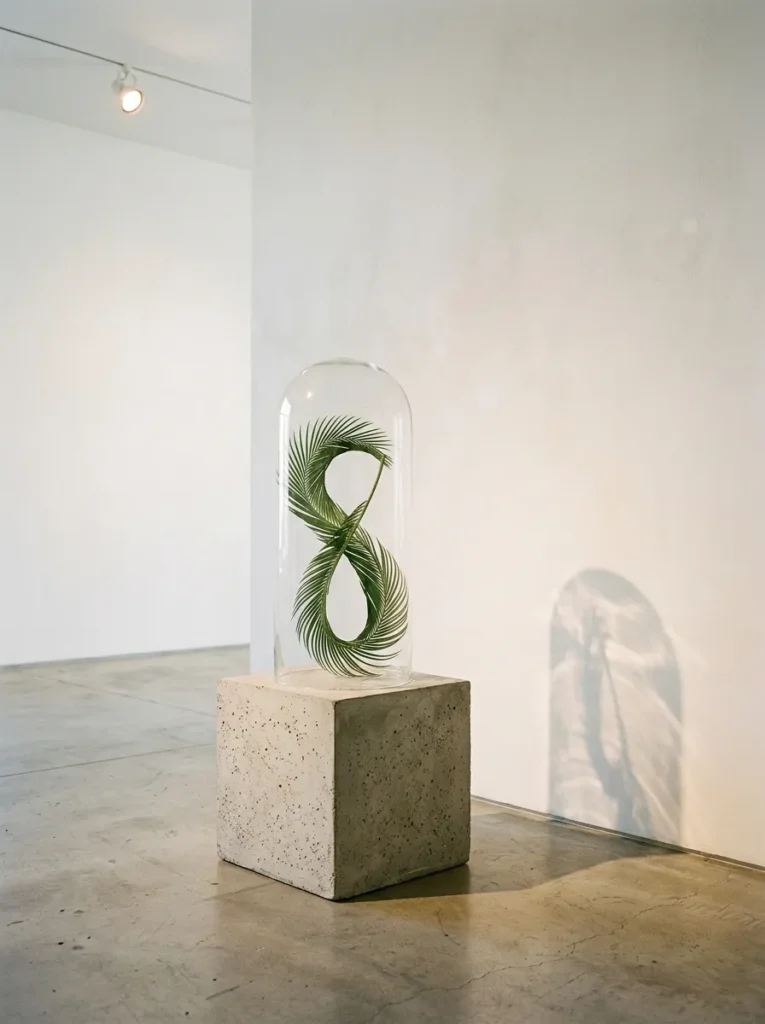
- 20-inch glass cloche over one frond coiled into a loose figure eight
- Pale gray cast-concrete plinth, 18 inches tall
- Warm white plaster wall, left bare
- One 2700K spotlight angled from the upper left
- Standout detail: a thin cork ring under the rim lets the glass breathe
Why this works: A glass cloche slows moisture loss around a cut frond, which keeps it supple longer and makes one stem look like a museum piece.
A cloche is the one tool that works with plant science instead of against it. Under glass, the air around a cut frond stays more humid, so water leaves the leaf more slowly and the blades stay supple and glossy longer. It also frames a single stem like a museum piece. Coil one soaked frond into a loose figure eight, set it on an 18-inch pale gray concrete plinth, and cover it with a tall glass cloche. Against a bare, warm white plaster wall, the cool concrete and green coil look calm, precise, and expensive without a single extra object.
Leave a small gap so the glass can breathe. Rest the cloche on a thin cork ring, or lift it for an hour each morning, because trapped moisture can spot the leaves or grow mold if sealed tight. A single 2700K spotlight angled from the upper left throws a crisp, elongated shadow onto the plaster, turning the coil into graphic art after dark. I’ve styled this in a hallway where nothing else was allowed to compete, and it held the eye from across the room. Expect the coil to relax over three or four days, which softens the line.
11. Stair Rail Frond Line
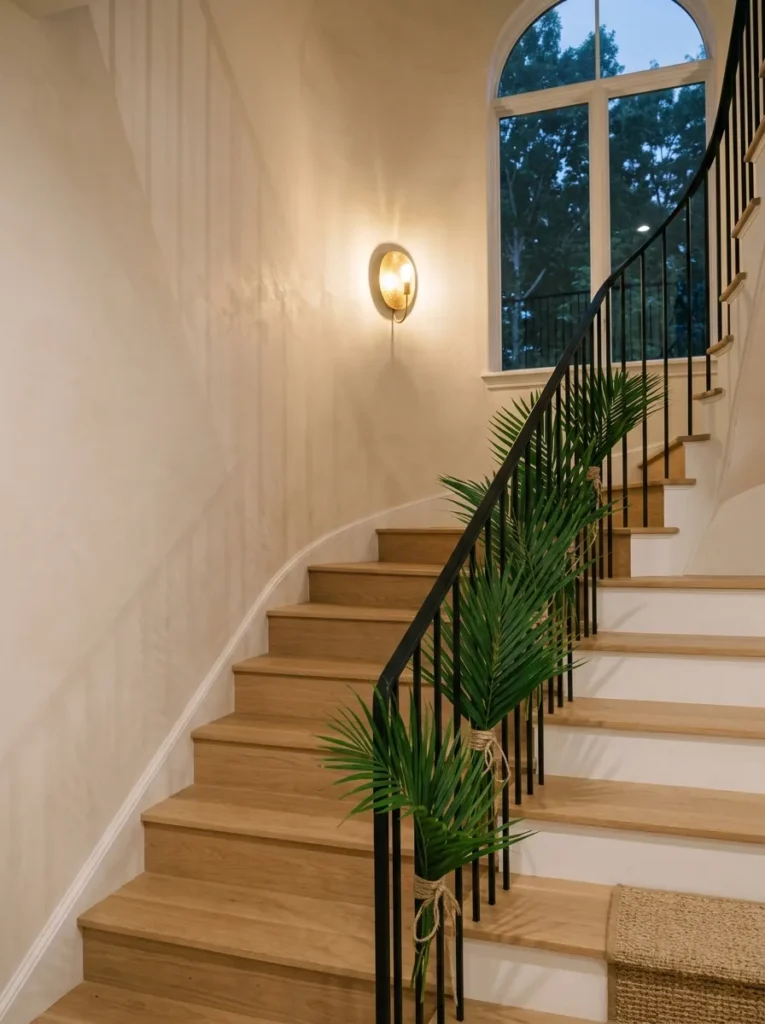
- Five fronds, each overlapping the one below like shingles, tips pointing uphill
- Matte black steel balusters against white oak treads
- Raw linen twine in flat knots on every third baluster
- Cream limewash wall on the opposite side
- Brass landing sconce with a 2400K bulb
Why this works: Fronds tied along the balusters follow the stairs’ rise, which turns a hallway everyone walks through into a quiet procession.
Palm Sunday is a procession, and a staircase is the most natural procession in a house. Tie five fronds along matte black steel balusters, each overlapping the one below like shingles, tips pointing uphill. The rise does the styling for you. Raw linen twine tied in flat knots every third baluster looks neat and keeps the green from sagging. Against white oak treads and a cream limewash wall, the black steel reads as a graphic line and the fronds as a soft, living ribbon. I’ve watched guests slow down on the first step just to look.
One rule matters more than style: never tie anything to the handrail itself. Building codes require a handrail to stay easy to grip, so attach every frond to the balusters and keep the rail clear. Keep fronds trimmed so no tip sticks out into the walking path, and skip this idea if small children or pets use the stairs unsupervised. At night, a single brass wall sconce on the landing, with a 2400K bulb, lights the line from above, and shadows climb the limewash step by step. Replace a frond or two on Wednesday to keep the line full.
12. Doorway Frond Crown
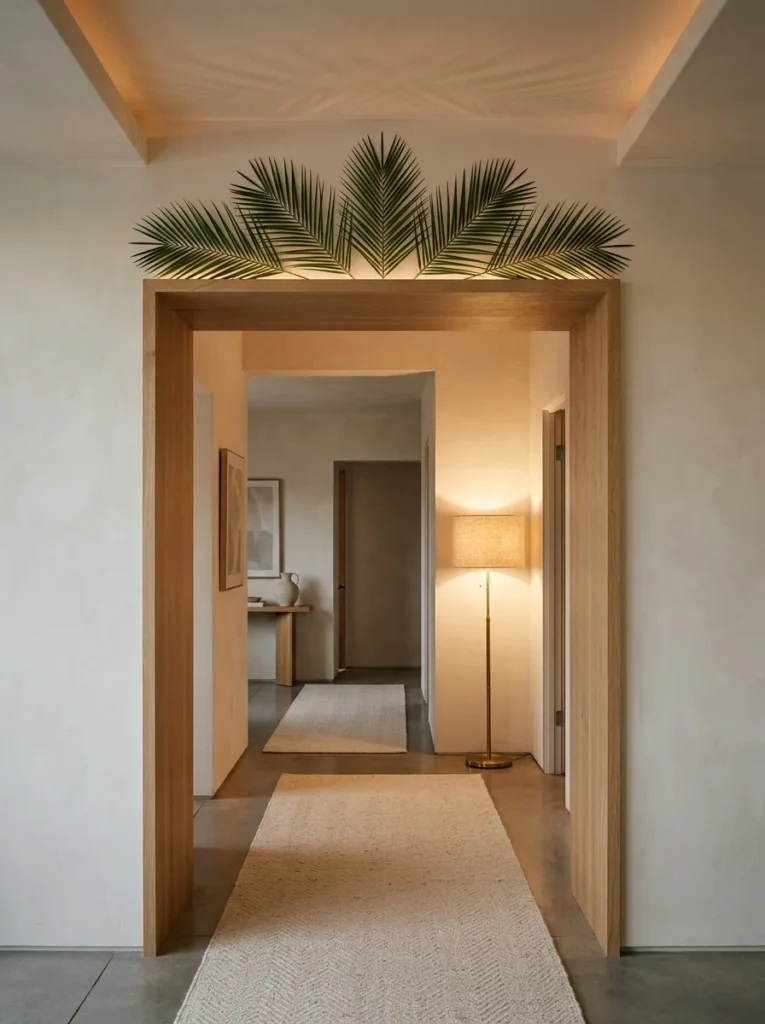
- Five fronds laid on the head casing of a wide interior doorway, fanning from the center outward
- Flat white oak head casing, at least three inches deep
- Bone plaster walls and a cream flatweave runner in the hall beyond
- Linen-shaded floor lamp in the next room for evening backlight
- Standout detail: nothing is nailed, taped, or visible, so the crest appears to rest in the air
Why this works: Laying fronds along the top of a doorway turns an everyday passage into a threshold, the most literal way to echo the day’s story.
The first time I laid fronds across a doorway, I held my breath. It looked like nothing, then like everything. Five fronds, resting on the flat white oak head casing, fan out from the center like a crest. No nails, no tape, nothing visible. Walk through the opening and you feel the shift: a threshold becomes a quiet welcome. Bone plaster walls and a cream flatweave runner in the hall beyond keep the setting hushed, so the green carries all the drama. It’s a nod to the palms laid along the road on the first Palm Sunday.
A few details keep it neat. Choose a doorway with a flat head casing at least three inches deep, since a narrow or sloped one lets fronds slide off. Lay the heaviest frond first, in the center, and layer lighter ones outward. Keep it above head height so nobody brushes the tips, and check that doors still swing freely. If the fronds shift, a pair of small clear clips holds them without marking the wood. At night, a floor lamp with a linen shade in the room beyond backlights the crest and leaves a soft, feathered shadow on the ceiling.
13. Terrazzo Island Sunburst
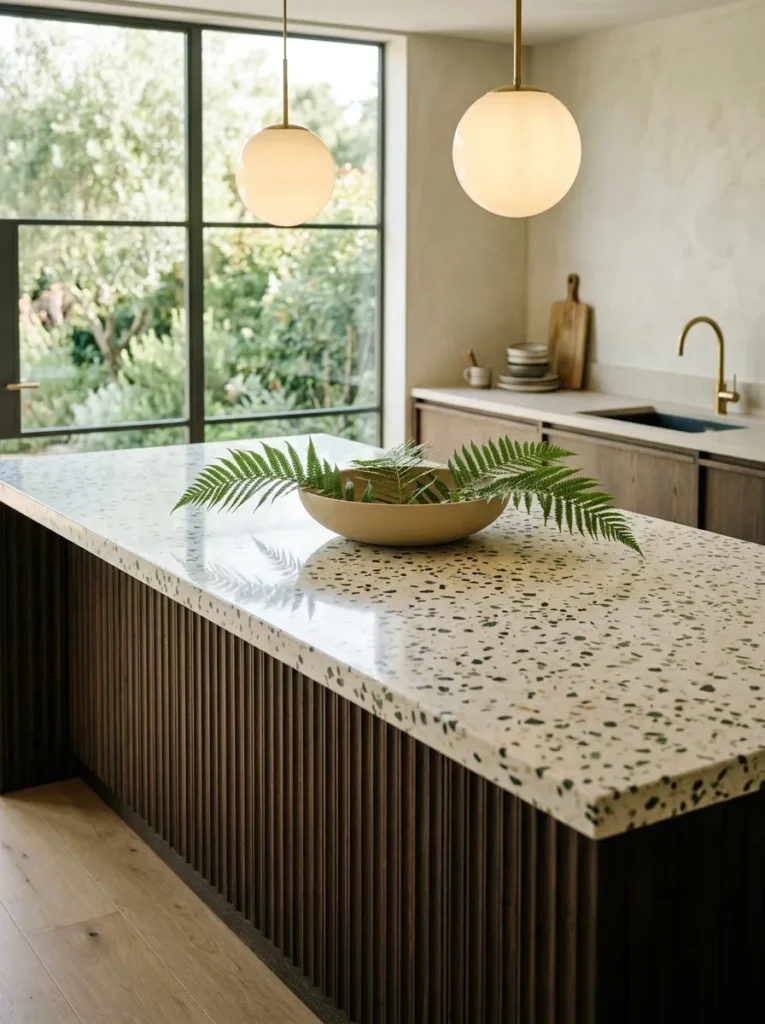
- Six fronds splayed in a low sunburst from a shallow 16-inch matte sand ceramic bowl
- Metal pin frog inside the bowl to hold each stem at an angle
- Ivory terrazzo island top with moss-green flecks
- Fluted smoked-oak island base
- Two hand-blown opal glass pendants at 2700K, hung 30 to 36 inches above the counter
Why this works: A low, wide sunburst keeps sightlines open across a kitchen island, so the arrangement adds drama without blocking conversation.
Kitchen islands need low, wide arrangements, because tall ones block the conversation that happens across them. A sunburst solves this. Splay five to seven fronds evenly outward from a shallow, 16-inch matte sand ceramic bowl so the whole shape stays under 14 inches high. A metal pin frog hidden in the bowl holds each stem at an angle, so nothing slumps. Against an ivory-and-moss terrazzo top and a fluted smoked-oak base, the radiating fronds read like a sculpture. Cut stems last longer standing in fresh water, so top it up daily.
I styled this on an island for a Palm Sunday brunch and noticed something useful: people kept reaching toward the fronds, so I moved it to the island’s far end, away from the prep zone. Two hand-blown opal glass pendants at 2700K, hung 30 to 36 inches above the countertop, wash the leaves in a soft, milky glow. Stools stay simple, in plain oak. In the morning, daylight from the window behind pulls out the terrazzo’s moss flecks. Keep knives, cutting boards, and food at least a foot from the fronds, since dried leaf bits can shed onto surfaces.
14. Charcoal Door Spine
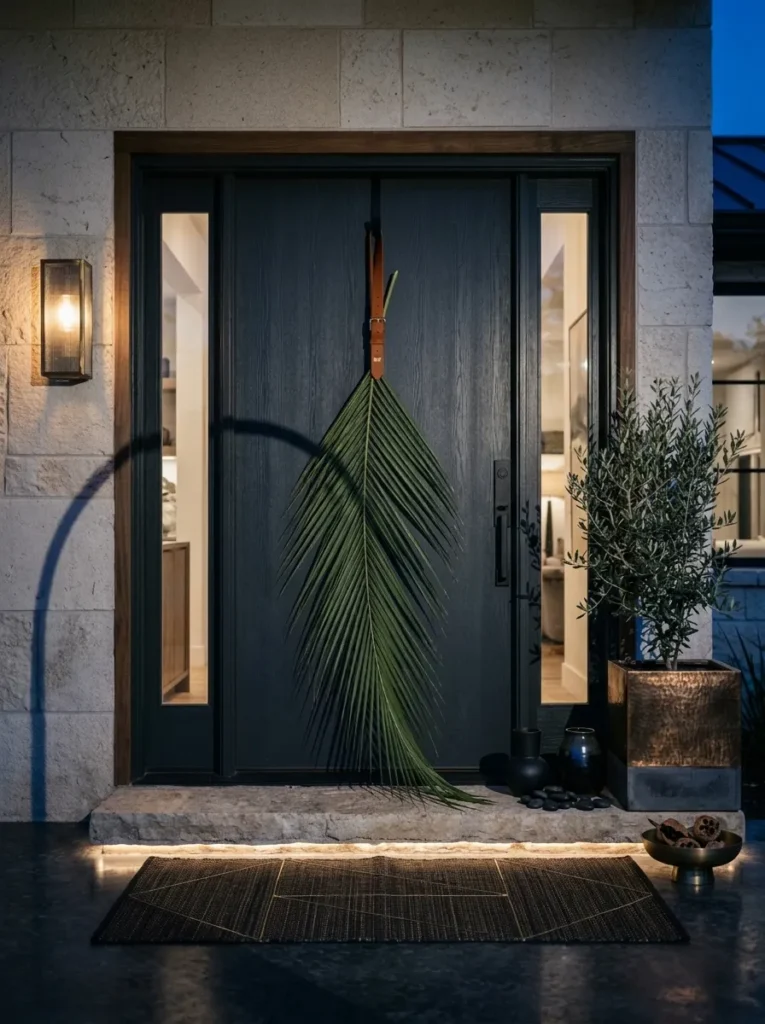
- One five-foot frond hung vertically down the center of a matte charcoal front door
- One-inch cognac leather strap looped over a slim, flat over-door hanger
- Honed limestone step below
- Warm 2700K wall lantern beside the door
- Standout detail: the frond’s curved tip points toward the ground, leaving the rest of the door bare
Why this works: One long frond on one dark door looks like a deliberate welcome, and restraint is what keeps it from reading as a seasonal display.
A front door is the first thing guests read, and one long frond says more than a wreath ever could. Hang a single five-foot frond down the center of a matte charcoal door, so its curved tip points toward the ground. Standard exterior doors are about 1¾ inches thick, which fits a slim over-door hook, so you never drill into the door. A cognac leather strap, one inch wide, loops over the hook and holds the stem. Against charcoal paint and a honed limestone step, the green, brown, and gray feel grown-up and restrained.
Austin sun changes the plan. On a west-facing door, a cut frond can dry within a day, so choose a covered entry, or swap in a fresh frond Wednesday morning. Use a flat, slim hanger so the door still latches and seals tightly. At dusk, a warm 2700K wall lantern beside the door washes the frond in amber light and throws a long, curved shadow across the charcoal paint. I like keeping the porch otherwise bare: one frond, one door, one light. That restraint is why it looks like quiet luxury, not a seasonal display.
15. Firebox Candle Glow — A Palm Sunday Decoration Idea for an Unused Fireplace
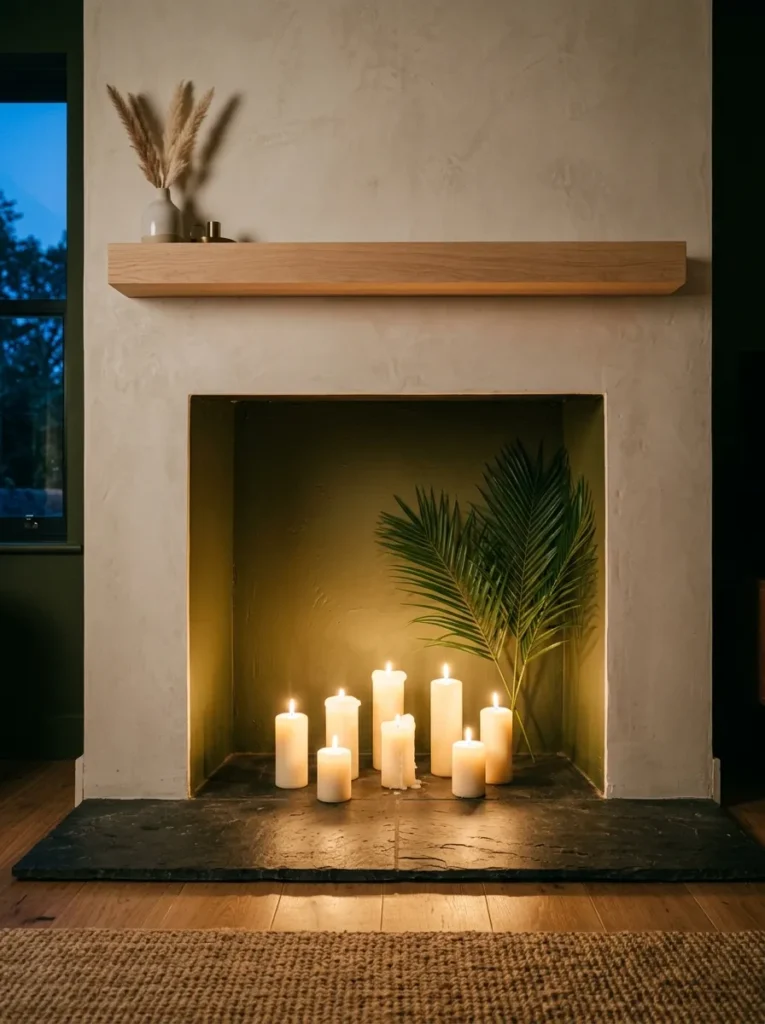
- Seven ivory pillar candles, 3 to 12 inches tall, staggered across the firebox’s slate floor
- Firebox interior in matte deep olive green, using high-heat paint
- Three tall fronds leaning in the back corner, at least 12 inches from any flame
- Bone plaster fireplace surround and a bare mantel above
- Standout detail: the dark firebox frames the flames like a stage while frond shadows sway on the olive walls
Why this works: A dark firebox frames candlelight like a stage, so a few pillars read as one dramatic scene instead of a scattered cluster.
My favorite way to end Palm Sunday is with candles in a fireplace that no longer gets used. I tried this the first spring in our Austin home, and I was surprised how it quieted the whole living room. Paint the inside of the firebox a deep olive green, then set seven ivory pillar candles of different heights on the firebox’s slate floor. The dark walls of the firebox frame the flames like a stage. Lean three tall fronds at the back corner, well away from the flames, so their silhouettes stand against the glow.
Safety comes first. Use this only in a fireplace you no longer burn in, with the damper closed, and keep fronds at least 12 inches from every flame. Dry leaves ignite easily. Use a high-heat matte paint on the firebox interior, and test candle stability on the slate before lighting. Pillars in ivory wax look best in odd numbers and staggered heights, from 3 to 12 inches. Light them at dusk and switch off the room lights. The glow flickers across the olive walls, and the fronds’ shadows lean and sway, like a quiet, slow-moving painting.
Styling Principles
Palm Sunday decor works when it looks planned for the week ahead, not just for Sunday morning. These principles hold across every idea above.
- Name one green. Pick a single tone per room, such as fir, moss, or olive, and repeat it in the fronds, the vase, or the linen. Two competing greens look accidental.
- Style for day three. Cut fronds curl by midweek, so choose shapes that look better curled: coils, hoops, loose sheaves, and laid runners. Plan one fresh swap on Wednesday.
- Keep pastels out. Deep greens, cream, ivory, and touches of gold separate Palm Sunday from the Easter display that comes a week later.
- Give each room one focal point. One frond arrangement per room reads as intention. Five reads as clutter.
- Light warmly and keep flames away. Use 2200K to 2700K bulbs, and keep every flame at least 12 inches from dry leaves.
- Leave empty space. Keep at least a third of any shelf, console, or mantel bare so a single stem can carry the scene.
FAQs
1. When is Palm Sunday? Palm Sunday falls on the Sunday before Easter and marks the start of Holy Week. The date changes every year with Easter, and in 2027 it lands on March 21 in the Western church calendar.
2. How do you decorate for Palm Sunday at home? Start with one deep green, such as fir or moss, and display fronds in two or three spots, like an entry console, a dining table, and a mantel. Add cream or ivory candles, natural textures like linen and stoneware, and plenty of empty space around each arrangement.
3. How long do palm fronds last indoors? Cut palm fronds typically begin drying and curling within two to three days. Keeping them away from heating vents and fireplaces, standing them in fresh water, or placing one under a vented glass cloche can slow the process. A living parlor palm lasts for years.
4. How do you keep palm fronds from drying out too fast? Place them away from forced-air vents, direct sun, and fireplaces, since heat and moving air pull moisture from the leaves fastest. Stand the stems in fresh water and top it up daily. If a frond curls anyway, treat it as part of the look and style around the curl.
5. What colors work for Palm Sunday decor? Deep greens, cream, ivory, and warm gold keep the focus on the palms themselves. Churches often use red or purple on this day, but at home a green-and-cream palette feels calm and keeps the display distinct from pastel Easter decor.
6. What should you do with palm fronds after Palm Sunday? Many churches collect old palms to burn for the following year’s Ash Wednesday ashes, so ask your parish before throwing blessed palms away. If you keep them, a dried frond or a small palm cross can stay in a shelf display or a dish until next spring.
Conclusion
Palm Sunday doesn’t need a big budget or a perfect plan. It needs one deep green, one meaningful focal point, and patience with the curl. These Palm Sunday decoration ideas show how one frond, a few candles, and a calm palette can turn any corner into something intentional. I’ve seen how small changes like these can transform a home in an afternoon.
Save this post on Pinterest so it’s ready when the week arrives, try one idea in your own space, and share it with a friend who loves a thoughtful home. Start small, and let the season show up beautifully.