15+ Stunning Indoor Plant Stand Ideas for Every Room
I used to think plant placement was purely about looks — until a fiddle leaf fig I’d set on the floor sulked for a year before I finally moved it onto a stand. Within weeks, it perked up. That’s when I started paying attention to why these indoor plant stand ideas actually work, not just how they photograph. Elevating a plant changes the angle it catches light from a window, improves airflow around the pot, and keeps curious pets away from species that are mildly toxic if chewed. Most plant styling content skips that reasoning entirely. This post doesn’t. Whether you’re working with a shaded hallway, a bright sunroom, or a humid bathroom, you’ll find a plant and stand pairing here that’s built around what the plant actually needs — not just what looks good in a photo.
Why Elevation Matters for an Indoor Plant Stand
Here’s something most plant advice skips entirely: where a plant sits matters almost as much as which plant you choose. Elevating a houseplant even 12 to 18 inches changes the angle it catches light from a window, lets air move around the pot instead of trapping humidity at soil level, and keeps drainage water off your floors. I learned this firsthand with a fiddle leaf fig that sulked on my living room floor for a year — it perked up within weeks of moving it onto a stand. If you’re still deciding which plants fit your space, our post on indoor plants that match your decor style is a good starting point. This post covers the other half: 15+ indoor plant stand ideas that give each plant the height, airflow, and placement it actually needs, organized by room.
1. Wood Ladder Corner Stand for Living Rooms
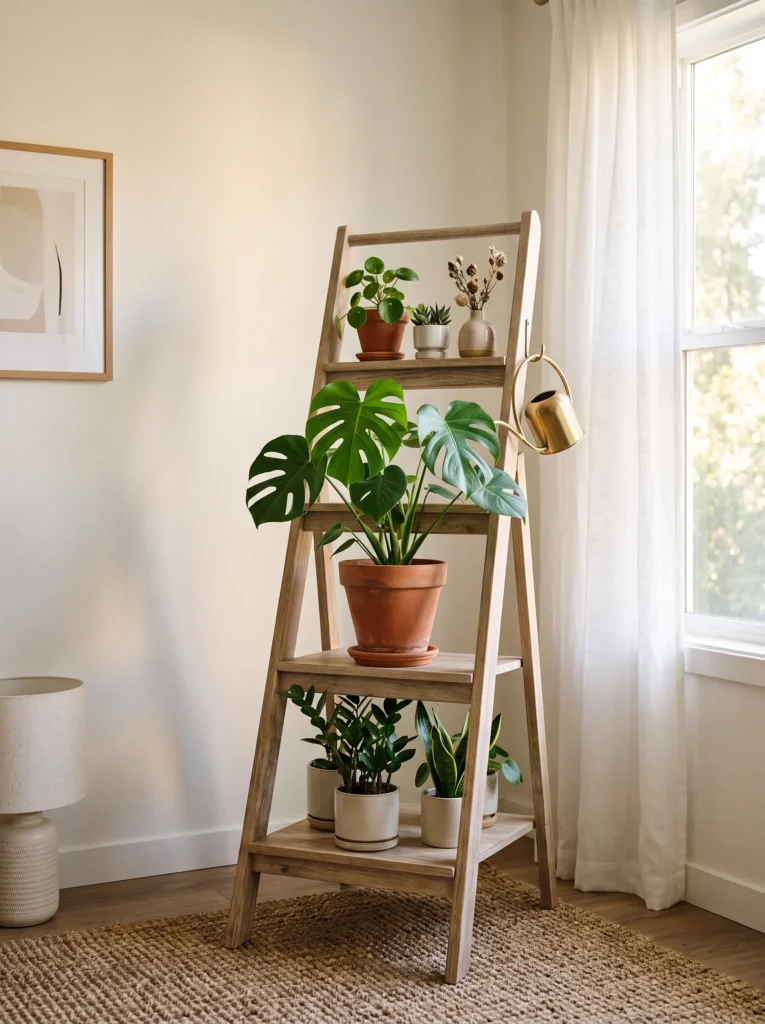
- Three-tier whitewashed oak ladder gives ascending height without crowding a living room corner
- Top tier catches the most direct light — ideal for a Monstera deliciosa, which needs bright, indirect exposure to fill out properly
- Wide-mouth terracotta planter lets excess water evaporate faster, which matters in Austin’s humidity
- Small brass hook on the top rung holds a slim watering can within reach
- Works especially well angled into a reading corner where the plant can lean into natural light without blocking a window
- Whitewashed finish keeps the stand from competing visually with the plant’s large, split leaves
Why this works: A tiered stand lets one plant occupy three different light zones at once, so lower leaves still get usable light instead of being shaded out by the canopy above.
Monstera deliciosa is one of the more light-sensitive popular houseplants, and most people don’t realize their plant is underperforming simply because of where it sits. A tiered wood stand solves this by placing the canopy closer to a window’s light path instead of catching only the dim scatter that reaches floor level. Whitewashed oak keeps the piece from competing visually with the plant’s large leaves, while the three-tier structure means smaller leaves near the base still receive usable light instead of being shaded out entirely by growth above them. It’s a simple height fix with a real, visible growth payoff over a few months.
In my experience, corners near a window are the most wasted real estate in a living room, and a ladder stand fixes that instantly. Placing it at a slight angle, rather than flush against the wall, lets light hit the plant from two directions instead of one. Pair it with a jute rug and linen curtains to keep the palette calm, and add a small brass hook on the top rung so a watering can stays within reach. This setup photographs beautifully in early morning light, and it holds up in daily life because everything the plant needs sits right where you’ll actually use it.
2. Marble Pedestal Corner Stand for Bedrooms
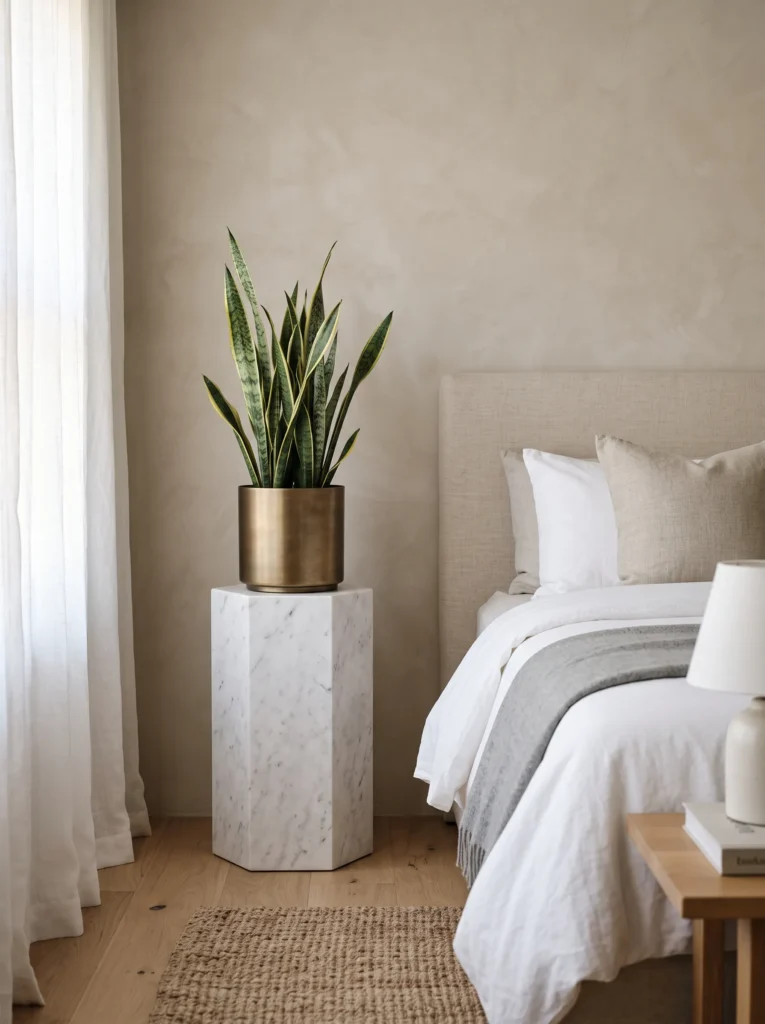
- Single honed marble pedestal, about 24 inches tall, holds one statement plant without crowding a nightstand
- Sansevieria tolerates low light and infrequent watering, making it the right pick for a bedroom corner with only filtered afternoon sun
- Elevating the plant off the floor keeps it out of reach of curious pets, since snake plant is mildly toxic if chewed
- Brushed brass planter rim echoes existing hardware without introducing a new metal tone to the room
- Round pedestal shape softens a bedroom otherwise full of straight-lined furniture
- Honed, not polished, marble keeps the surface from looking cold under warm bedroom lighting
Why this works: A snake plant on a pedestal reads as sculpture, not clutter, which is exactly the effect a small bedroom corner needs.
I put a marble pedestal in my own bedroom almost as an afterthought, and it’s ended up being the piece guests ask about most. Sansevieria doesn’t need much light or attention, which makes it one of the few plants that genuinely thrives in a bedroom corner most stands overlook entirely. Setting it on a 24-inch marble pedestal lifts the plant to eye level from the bed, so its architectural leaves actually register as part of the room’s design instead of disappearing into the floor. Honed marble, rather than polished, keeps the surface from looking cold under warm evening lighting.
Snake plant is mildly toxic to cats and dogs if ingested, so getting it up off the floor isn’t just a styling choice — it’s a practical one if pets sleep in the room. A brushed brass planter rim ties into cabinet hardware or a lamp base without adding a third metal finish to compete with. Keep the pedestal in a spot with filtered afternoon light rather than direct sun, since too much brightness can bleach the leaves over time. This is one of the lowest-maintenance setups in the entire list, which matters most in the room you actually rest in.
3. Macrame Kitchen Trailer Stand for Small Kitchens
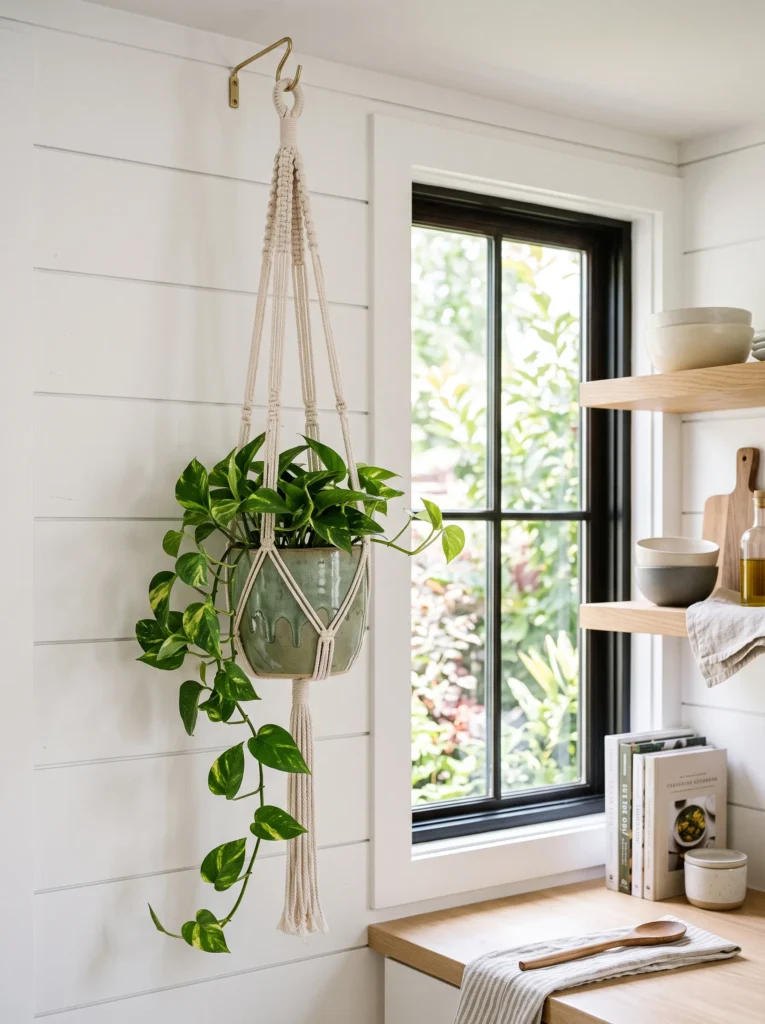
- Natural cotton macrame hanger keeps a trailing pothos vine near a kitchen window without taking up counter space
- Pothos grows fastest in bright indirect light, so a window-adjacent hanging spot supports better foliage growth than a shaded counter
- Pothos is mildly toxic to cats and dogs, so hanging it above counter height keeps curious pets and small kids away from the leaves
- My husband always tells clients to anchor a hanging planter hook into a ceiling joist, not just drywall — a watered pot can weigh 15 pounds or more
- Sage green drip-glaze ceramic planter picks up the vine’s color without matching it exactly
- Trailing length grows fast, so the vignette fills in and looks established within a few months
Why this works: Hanging a trailing plant at window height uses vertical space a countertop stand never could, while keeping curious pets safely out of reach.
Pothos is one of the fastest-growing trailing plants for a kitchen, and a macrame hanger is the one stand style that actually shows off that trailing habit instead of letting vines pool on a counter. My husband, who’s spent years hanging things heavier than they look, always tells people not to anchor a hanging planter straight into drywall. A watered pot in a ceramic planter can weigh well over 15 pounds, and drywall alone won’t hold that safely over time. Finding the ceiling joist first, even if the hook ends up a few inches off from where you’d planned, matters more than exact placement.
Pothos is also mildly toxic to cats and dogs, so keeping it well above counter height isn’t only about styling — it’s a genuine safety choice in a kitchen pets wander through often. A sage green drip-glaze ceramic planter complements the vine’s variegated leaves without matching them so closely that the whole vignette reads as flat. Position the hanger near, but not directly against, a window so the trailing vine gets bright indirect light throughout the day. Within a few months, the vines trail well past the pot, giving the corner a lived-in, established feel.
4. Concrete Cube Plant Stand for Bathrooms
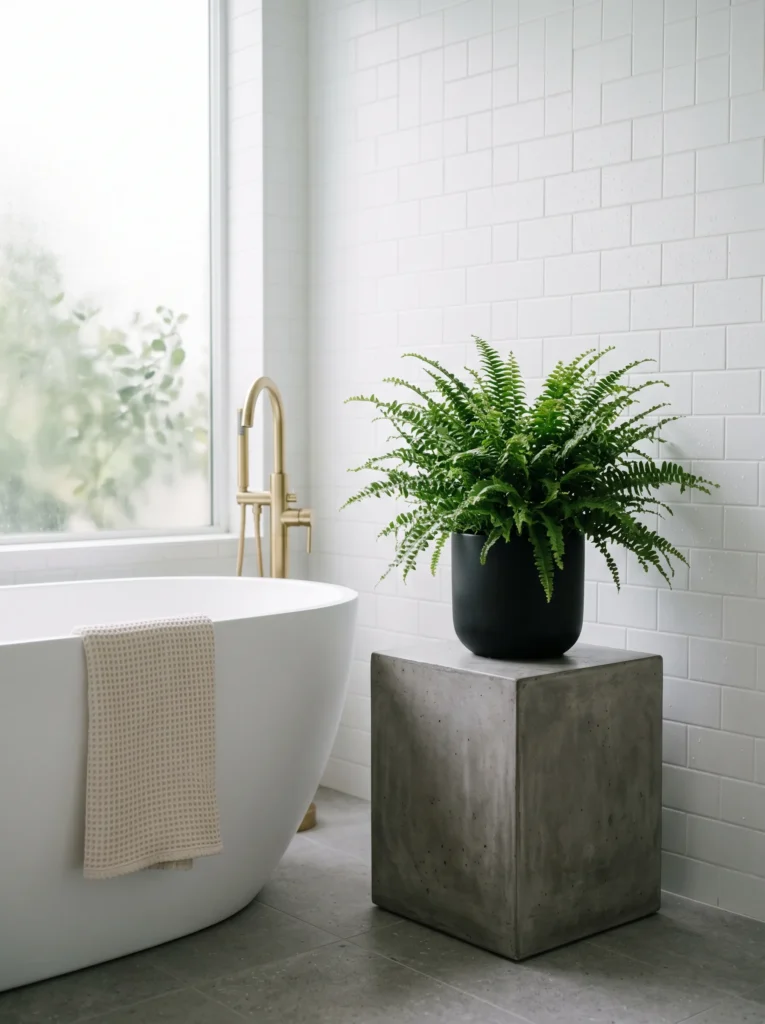
- Cast concrete cube, roughly 14 inches tall, lifts a fern out of splash range near a bathtub or shower
- Boston fern thrives in the humidity a bathroom naturally provides, but still needs airflow around its roots to avoid fungal issues
- Sealed concrete resists water staining better than raw wood, which matters in a room that stays damp for hours after a shower
- My husband seals every concrete piece he builds for bathrooms with a penetrating sealer before it ever touches water — untreated concrete will absorb moisture and eventually crack
- Matte black drainage tray underneath the pot catches overflow without needing a saucer
- Cube shape reads as modern and architectural rather than “spa decor”
Why this works: A sealed concrete cube handles bathroom humidity better than most stand materials, while still lifting the fern’s roots enough to prevent the soggy soil that causes root rot.
Boston fern is one of the few houseplants that genuinely prefers bathroom conditions, but most people set the pot directly on the floor or vanity, where standing humidity around the base invites fungal problems. A concrete cube solves this by lifting the pot just enough for air to circulate underneath, while the material itself shrugs off the daily condensation a wood or fabric stand would eventually warp or stain. At 14 inches tall, the cube also keeps the fern’s fronds out of direct splash range from a nearby tub, which extends how long the plant actually stays healthy in a humid room.
Concrete needs proper sealing before it goes anywhere near water, something my husband is particular about on every job that touches a bathroom. Untreated concrete is porous, and over months of daily humidity it will absorb moisture, stain, and eventually crack at the edges. A penetrating sealer applied before installation prevents all of that and keeps the surface looking clean for years. Pair the cube with a matte black drainage tray so overflow never touches the floor, and keep the whole vignette away from a heat vent, which can dry the fern out faster than the humidity can replenish it.
5. Iron Tripod Plant Stand for Home Offices
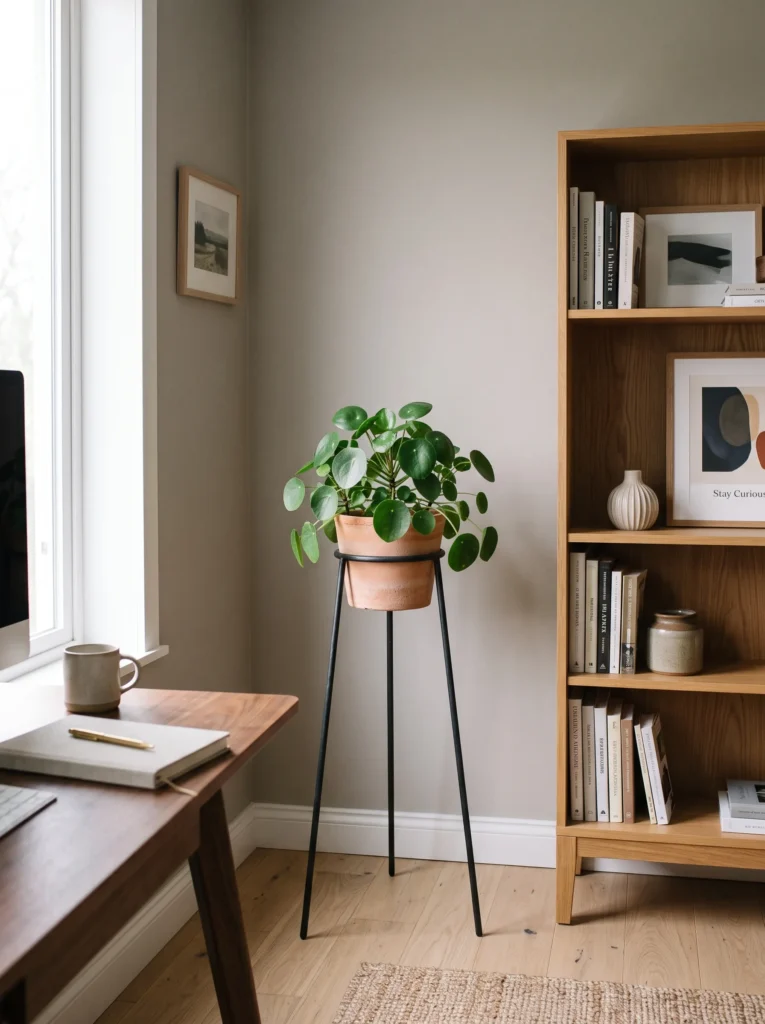
- Blackened iron tripod stand, roughly 30 inches tall, adds height to a home office corner without taking desk space
- Pilea peperomioides prefers bright indirect light and turns toward its light source, so rotating the pot weekly keeps growth even on all sides
- Slim tripod legs leave floor space visible underneath, which keeps a small office from feeling boxed in
- I moved my own office plant onto a tripod after realizing it had been growing lopsided on a low shelf for months, leaning hard toward the window
- Round terracotta planter in a raw, unglazed finish plays well against blackened metal without looking matched
- Positioned beside a bookshelf rather than the desk itself, so it doesn’t compete for attention during video calls
Why this works: A tripod’s open legs let a plant occupy a corner without the visual bulk of a solid stand, which matters most in a small home office.
I moved my Pilea onto a tripod stand after noticing it had been leaning hard toward the window for months, all its growth pulling to one side on a low shelf where I never thought to rotate it. Height alone didn’t fix that, but it made the problem obvious enough that I started turning the pot a quarter turn each week, and the plant filled back out within two months. A blackened iron tripod works especially well for this kind of plant because the open leg structure doesn’t block light from any angle, so even a partial turn still gives the whole plant something to grow toward.
Pilea peperomioides has become a popular office plant because it’s compact and forgiving, but it does need bright indirect light to keep its round leaves flat and full rather than curling. A tripod stand near, not directly beside, a window gives it consistent light without the harsh midday sun a desk surface might catch. The raw terracotta planter’s texture keeps the whole setup from looking too polished for a working room. Positioned beside a bookshelf instead of the desk, it adds presence to the space without ending up in the background of every video call.
6. Vintage Stool Landing Stand for Staircases
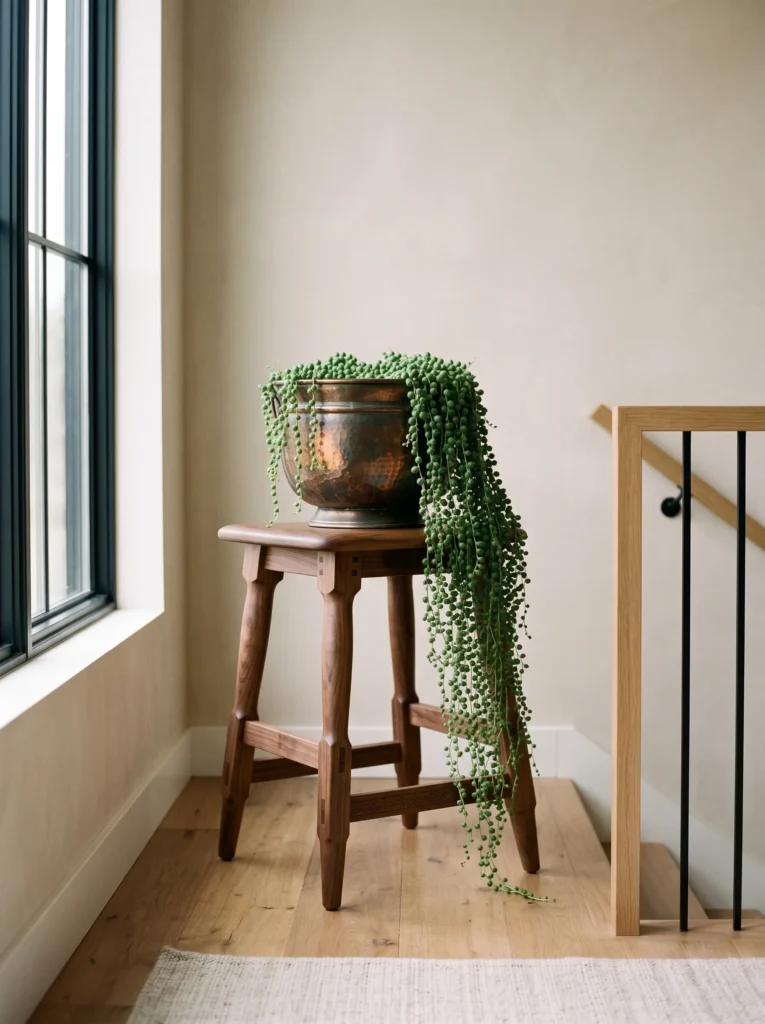
- Reclaimed wood step stool, repurposed as a plant stand, fits the narrow footprint of a staircase landing
- Senecio rowleyanum trails naturally over a stool’s edge, giving the landing movement without needing floor space for a trailing vine to spread
- Elevating a trailing plant above stair height keeps its long strands from becoming a tripping hazard on a narrow landing
- Weathered oak grain and visible tool marks give the piece more character than a new stand at a fraction of the cost
- Aged brass planter with a slightly oxidized finish suits the stool’s worn, lived-in texture
- Works best lit by a nearby window rather than overhead lighting, which flattens the plant’s rounded leaves
Why this works: Repurposing a step stool as a plant stand solves a real landing problem: it adds height and softness to an awkward, narrow space without requiring new furniture or floor room.
Staircase landings are some of the hardest spots in a house to style, because most furniture simply doesn’t fit the narrow, transitional footprint. A reclaimed step stool solves that instantly, since it was built for a small footprint in the first place. Senecio rowleyanum, commonly called string of pearls, trails naturally over the stool’s edge instead of needing to be trained or staked, which makes it one of the easier trailing plants to style well in an awkward spot. The stool’s worn oak grain and visible tool marks add texture that a brand-new stand simply can’t replicate.
Trailing plants on a landing need to be elevated well above stair height, since long strands hanging into a walkway become a genuine tripping hazard rather than a decorative detail. A stool at 18 to 20 inches keeps the vine clear of foot traffic while still letting it drape naturally. An aged brass planter, slightly oxidized rather than polished, suits the stool’s lived-in texture better than anything glossy would. Position the whole vignette near a window at the top or bottom of the stairs, since overhead lighting alone tends to flatten the plant’s rounded, bead-like leaves.
7. Rattan Tiered Entryway Stand
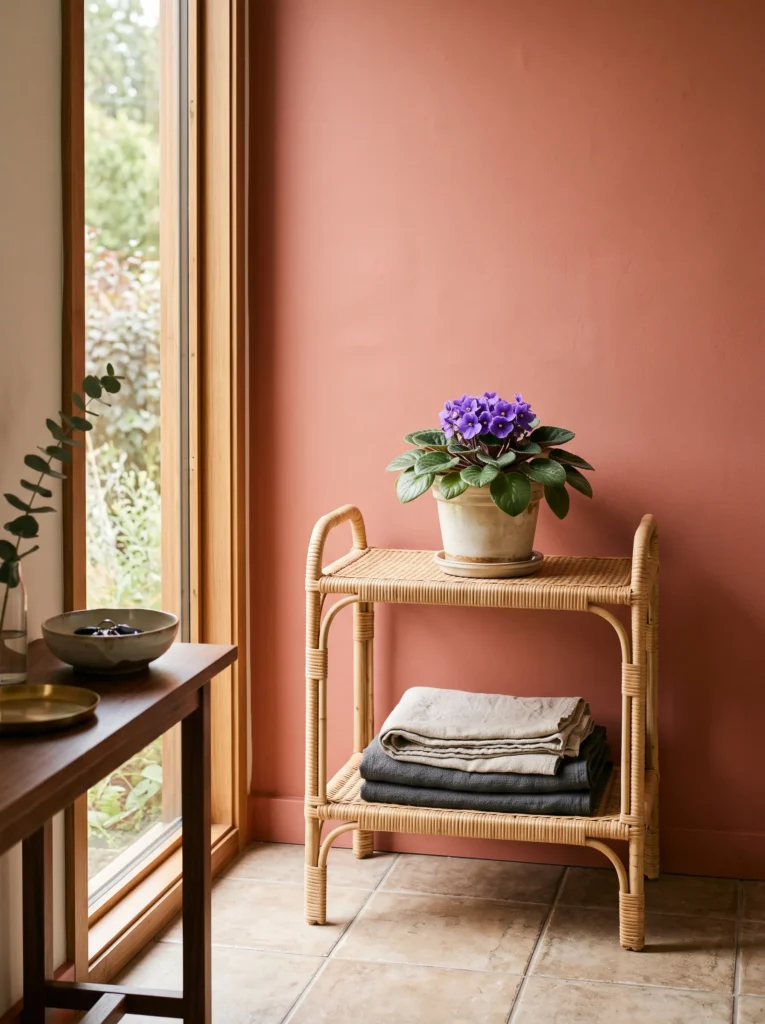
- Woven rattan two-tier stand brings warm, textured contrast to an entryway that’s often all hard surfaces — tile, a console, a mirror
- African violet blooms best under bright, indirect light and consistent warmth, which makes an entryway near a sidelight window a surprisingly good fit
- Top tier holds the violet; bottom tier holds a small stack of folded throws or a catch-all tray, so the stand earns its footprint
- Terracotta pink walls behind the stand pick up the violet’s purple blooms without matching them directly
- Rattan’s natural texture softens an entryway that otherwise leans heavily on straight lines and glass
- Rotate the violet a quarter turn every week or two to keep blooms facing outward, not toward the window
Why this works: Pairing a flowering plant with a two-tier stand gives an entryway color and texture in the same footprint most people reserve for a single console table.
Most entryway styling skips flowering plants entirely, usually because low light near a front door makes blooming difficult. African violets are the exception — they actually prefer moderate, indirect light rather than the harsh direct sun many other flowering plants need, which makes a sidelight window or transom exactly the right spot. Set on the top tier of a woven rattan stand, the violet gets height and visibility right where guests first look. The bottom tier isn’t wasted space either; it’s a natural spot for folded throws, mail, or a small catch-all tray, so the piece earns its place in a tight entry footprint.
I painted my own entryway a soft terracotta pink specifically because it plays so well against purple and green tones, and an African violet on a rattan stand turned out to be the piece that pulled the whole look together. The woven texture softens a space that’s usually all hard edges — tile floor, glass in the door, a mirror on the wall. Keep the stand a few feet back from direct afternoon sun, since too much heat will scorch the violet’s fuzzy leaves faster than low light will slow its blooming.
8. Walnut Console Stand for Dining Rooms
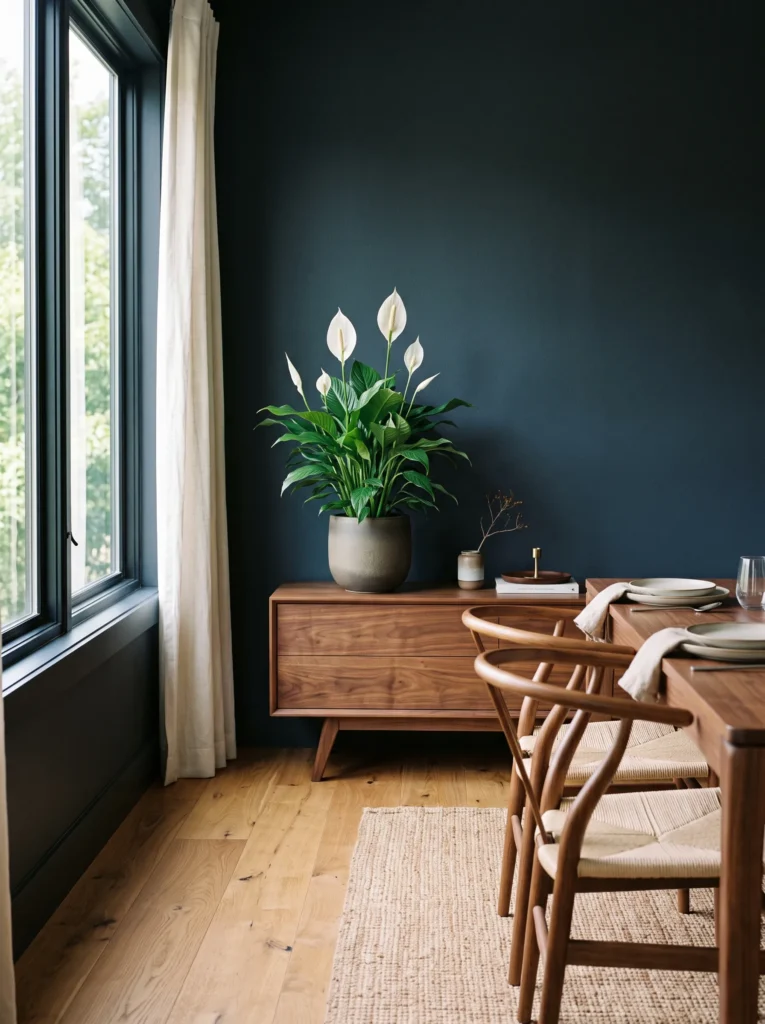
- Slim walnut console-style stand, low and long, runs beneath a dining room window instead of crowding the table
- Peace lily tolerates lower light better than most flowering houseplants, making it one of the few blooming options that suits a dining room’s often indirect lighting
- Deep charcoal blue wall behind the stand makes the peace lily’s white blooms and glossy green leaves stand out sharply
- Walnut’s reddish-brown grain warms up a room that leans cool and moody without introducing a competing color
- Long, low profile keeps sightlines open across the table, unlike a tall stand that would block dinner guests from seeing each other
- My husband built our dining console from leftover walnut flooring scraps — worth asking a contractor if they have offcuts before buying new lumber
Why this works: A low, horizontal stand solves the one problem tall plant stands create in a dining room: blocking sightlines across the table.
Dining rooms rarely get flowering plants because most people default to a tall stand that ends up blocking the view across the table during dinner. A low walnut console solves that by running horizontally along a wall instead of competing for vertical space. Peace lily is the right plant for this spot specifically because it tolerates the indirect, sometimes dim light a dining room gets on all but the sunniest days, and it still produces white blooms that most flowering plants simply can’t manage in that kind of light. Set against a deep charcoal blue wall, both the blooms and the glossy leaves read as sharp, intentional contrast rather than an afterthought.
My husband built our own dining console out of leftover walnut flooring scraps from a client job, and it’s become one of my favorite pieces precisely because the wood grain varies slightly from board to board. It’s worth asking a contractor or builder if they have offcuts before buying new lumber for a project like this — the character is better, and the cost is often next to nothing. Keep the peace lily’s soil slightly moist but never soggy, since overwatering is the most common reason its blooms fail to appear at all.
9. Iron Hairpin Stand for Sunrooms
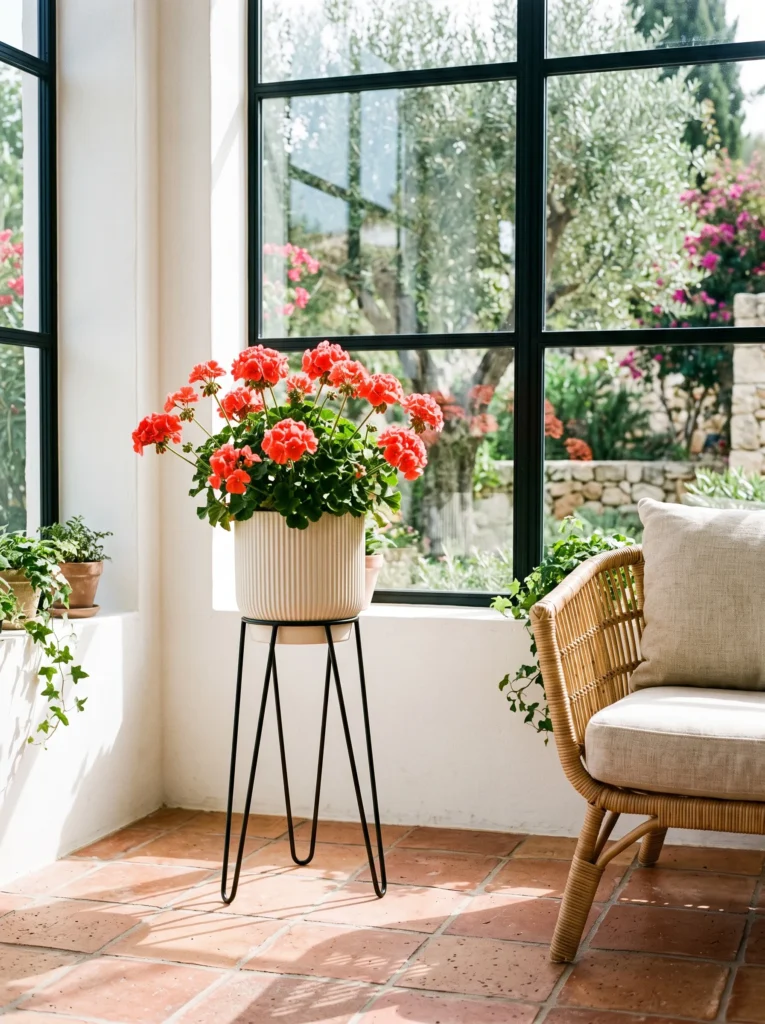
- Slim blackened iron hairpin-leg stand, mid-height, suits a sunroom’s already bright, plant-friendly light without adding visual bulk
- Geranium needs several hours of direct sun daily to bloom well, making a sunroom one of the only rooms in the house bright enough to support it consistently
- Warm terracotta and cream color palette echoes a Mediterranean sunroom feel without leaning into an overly literal theme
- Hairpin legs keep the stand visually light, which matters in a room already filled with windows, light, and often wicker furniture
- Cream ceramic planter with a slightly ribbed texture picks up the geranium’s coral-red blooms without competing with them
- Works well repeated in pairs flanking a sunroom daybed or window seat for symmetry
Why this works: Geraniums need more direct sun than almost any other common flowering houseplant, and a sunroom is often the only room in a house bright enough to keep them blooming reliably indoors.
Most flowering houseplants struggle indoors simply because they don’t get enough direct light, but geraniums are different — they genuinely need several hours of unfiltered sun to keep producing blooms, which rules out nearly every room except a true sunroom or south-facing window wall. A slim blackened iron hairpin stand suits that kind of space because it doesn’t add bulk to a room already busy with light, windows, and often wicker or rattan furniture nearby. The stand’s minimal footprint means the geranium itself, not the furniture holding it, stays the visual focus.
I’ve noticed geraniums are one of the few flowering plants that actually reward a little neglect — overwatering kills them far faster than underwatering does, and consistent direct sun matters more than fussy care. A cream ceramic planter with subtle ribbed texture complements the coral-red blooms without pulling attention away from them. For a sunroom with a daybed or window seat, try two matching stands positioned in pairs on either side; the symmetry reads as intentional rather than accidental, and it doubles the color impact without doubling the maintenance.
10. Iron Ring Stand for Hallways
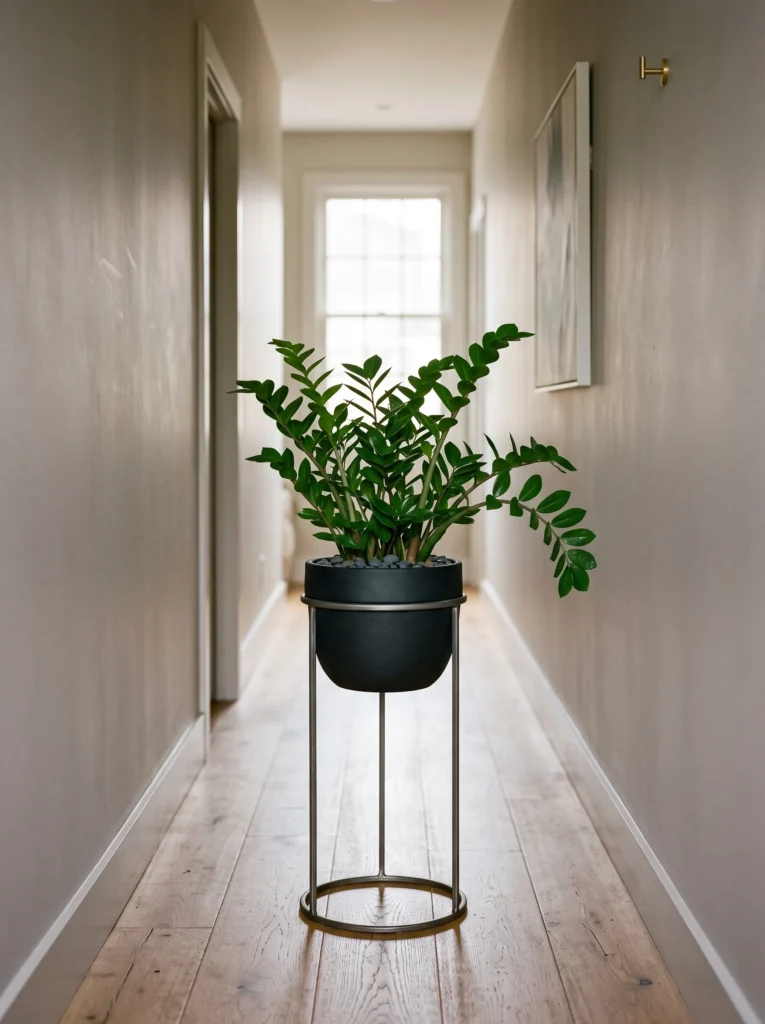
- Circular iron ring stand, unlacquered and slightly matte, holds a single plant at the center of a narrow hallway without blocking foot traffic
- ZZ plant tolerates the low, inconsistent light most hallways get, since it stores water in its rhizomes and doesn’t need frequent watering or bright sun
- Round base has no corners, which matters in a tight passage where furniture edges become a real bump hazard
- Natural iron finish, left slightly raw rather than powder-coated, develops a soft patina over time instead of chipping like painted metal
- Deep glossy leaves catch whatever light does reach the hallway, so the plant reads as intentional even in a dim corner
- Works well positioned where a hallway widens slightly, such as near a doorway, rather than in the narrowest stretch
Why this works: A ZZ plant survives in low light better than almost any other common houseplant because it stores water in underground rhizomes, which makes it one of the only plants that genuinely thrives in a dim hallway.
Hallways are notoriously hard to style because they’re narrow, low on natural light, and full of foot traffic, which rules out most plants and most furniture. ZZ plant solves the light problem on its own — it’s one of the few houseplants that actually tolerates weeks of dim, indirect light without dropping leaves or slowing its growth. A circular iron ring stand solves the traffic problem, since its round base has no sharp corners to catch a shoulder or a passing bag. Left in its raw, unlacquered state, the iron also won’t chip or scratch the way a painted finish eventually would in a high-traffic spot.
I’ve noticed most people skip plants in hallways entirely, assuming nothing will survive there, but a ZZ plant genuinely doesn’t mind being forgotten for a week or two. Its deep, glossy leaves catch even indirect light well enough to look full and healthy without a window nearby. Position the stand where the hallway widens slightly, such as near a doorway or a stairwell landing, rather than in the tightest stretch of the passage. That small placement choice keeps the plant from becoming an obstacle instead of a design detail.
11. Floating Shelf Stand for Reading Nooks
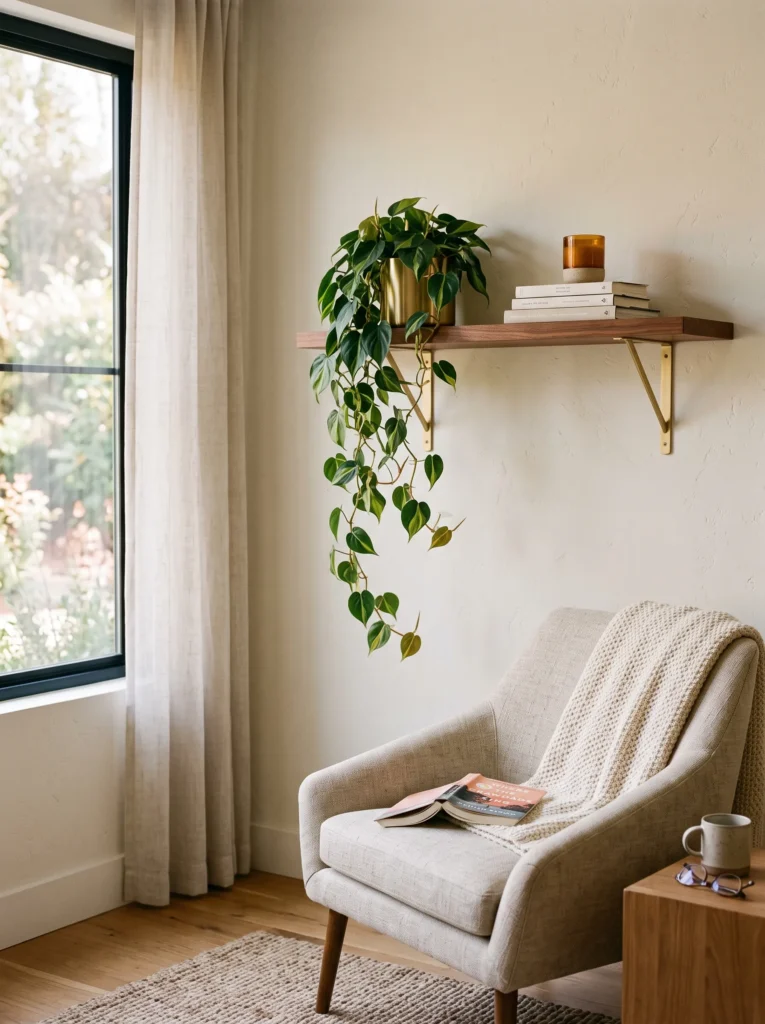
- Wall-mounted walnut floating shelf with slim brass brackets holds a trailing philodendron beside a reading chair, keeping the floor completely clear
- Philodendron tolerates lower light than a pothos and grows more slowly, which suits a reading nook that often sits farther from a window
- My husband insists on locating a wall stud before mounting any floating shelf meant to hold a watered plant — drywall anchors alone can fail under sustained weight over months, not just at install
- Warm walnut tone matches a reading chair’s wood frame without requiring a matching material elsewhere in the room
- Shelf mounted at eye level when seated, so the trailing vine becomes part of the view while reading, not something glanced at in passing
- Small brass planter with a narrow base fits the shelf’s depth without overhanging the edge
Why this works: Mounting a plant on the wall instead of a floor stand frees up the one thing a reading nook never has enough of: floor space for a chair, an ottoman, and a side table.
A reading nook rarely has room for a floor-standing plant stand once a chair, ottoman, and side table are accounted for, which is exactly why a wall-mounted shelf works so well here. Philodendron suits the spot because it tolerates lower, more indirect light than a pothos and grows slowly enough that its trailing vines won’t need retraining every few weeks. Mounted at eye level for someone seated in the chair below, the plant becomes part of the actual reading view rather than something noticed only in passing. Walnut ties naturally into a wood chair frame without forcing a second material into an already tight space.
My husband won’t mount a floating shelf meant to hold a watered plant without locating a stud first, and he’s seen enough failed installs to explain exactly why. A watered pot’s weight is constant, not occasional, and drywall anchors that hold fine for a picture frame can slowly work loose under that kind of sustained load over several months. Finding the stud, even if it shifts the shelf’s exact position by an inch or two, is worth it for a piece that’s going to stay loaded and stay put.
12. Iron Hoop Wall Planter for Kids’ Rooms
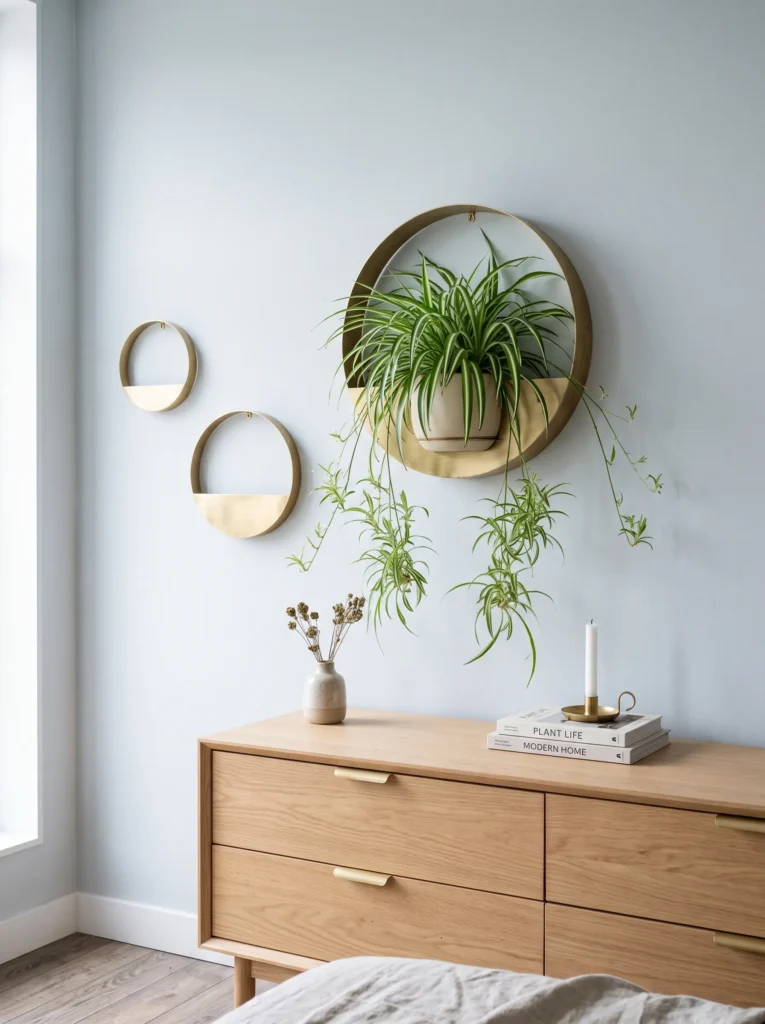
- Circular wall-mounted iron hoop, roughly 10 inches across, holds a spider plant just above a kids’ room dresser or a bathroom vanity
- Spider plant is non-toxic to cats and dogs, making it one of the few trailing plants safe to hang at a height curious pets or small kids could reach
- Hoop shape echoes a porthole window and works especially well repeated in a cluster of two or three at slightly staggered heights
- Wall mount keeps the plant fully off any surface, which matters in a kids’ room where dresser tops get used for everything except decor
- Spider plant produces small plantlets that dangle from the main plant, giving the hoop a naturally full, textured look within a season
- Thin iron frame in a soft brushed brass finish, rather than black, keeps the piece from reading too heavy on a light-colored wall
Why this works: A wall-mounted hoop keeps a trailing plant fully off any surface, which is the one placement rule that matters most in a room where dresser tops and vanities get used for everything except decor.
Spider plant is one of the only houseplants worth recommending for a kids’ room, since it’s non-toxic to both pets and children, which removes the usual worry about where to place a trailing plant within reach of small hands. A circular iron hoop mounted on the wall solves the placement question entirely by keeping the plant off any surface a dresser or vanity would otherwise need for actual daily use. The hoop’s brushed brass finish reads soft rather than heavy against a light wall, which suits a kids’ room’s usually brighter palette better than a black iron frame would.
I’ve seen this hoop style used in clusters of two or three at slightly staggered heights, and it reads far more intentional than a single hoop centered alone on a wall. Spider plants naturally produce small plantlets that dangle from the main rosette on their own little stems, so within a season, even one hoop starts to look genuinely full without any extra styling effort. Keep the cluster near, but not directly above, a light source, and rotate the pot occasionally so growth doesn’t lean permanently toward one side of the frame.
13. Brass Tripod Stand for Breakfast Nooks
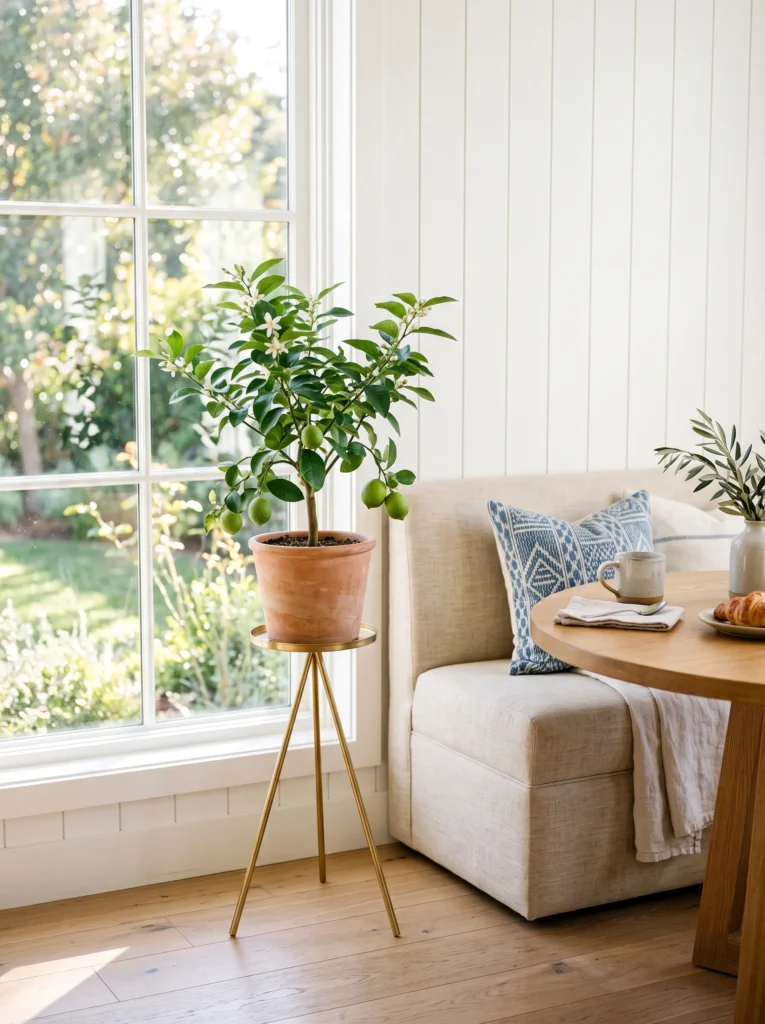
- Slim brass tripod stand, roughly 26 inches tall, holds a potted Meyer lemon tree in a breakfast nook that gets strong morning sun
- Meyer lemon needs six or more hours of direct light daily to fruit reliably indoors, making a bright breakfast nook one of the few spots in a house where it actually works
- Large terracotta pot on a brass tripod base keeps the tree’s weight off a built-in bench seat, which most breakfast nooks don’t have room to spare
- White beadboard wall behind the tree keeps the space feeling bright even when the tree’s dense foliage takes up real visual room
- My husband always tells clients to check pot weight before setting anything this size on a bench seat with limited support underneath — a fully grown citrus tree in soil can run 40 pounds or more
- Small fruit, even unripe, adds color a leafy houseplant alone never provides
Why this works: A citrus tree needs more direct sun than almost any indoor plant, and a breakfast nook is often the one spot in a house bright enough, and least in the way, to support one successfully.
Most people don’t consider a fruiting tree as part of indoor plant styling, assuming it needs a greenhouse rather than a corner of the kitchen. A Meyer lemon proves that wrong, as long as it gets six or more hours of direct sun a day, which a breakfast nook with south- or west-facing windows can usually provide. A brass tripod stand keeps the tree’s substantial weight off the bench seating itself, which matters more than it seems — a mature citrus tree in a full pot of soil is heavier than most furniture is built to hold indefinitely. The tree’s small, unripe fruit also adds a color note no leafy houseplant alone can replicate.
My husband checks the load rating on any bench or built-in before a client sets something this heavy on it, and citrus trees are one of the most common surprises he runs into. A fully grown Meyer lemon in soil and a ceramic pot can easily reach 40 pounds, which is more than many bench cushions or thin plywood tops were built to support long-term. A freestanding brass tripod solves that by distributing the weight to the floor instead. Keep the tree turned a quarter turn every couple of weeks so it doesn’t grow lopsided toward the window.
14. Ceramic Pedestal Stand for Home Libraries
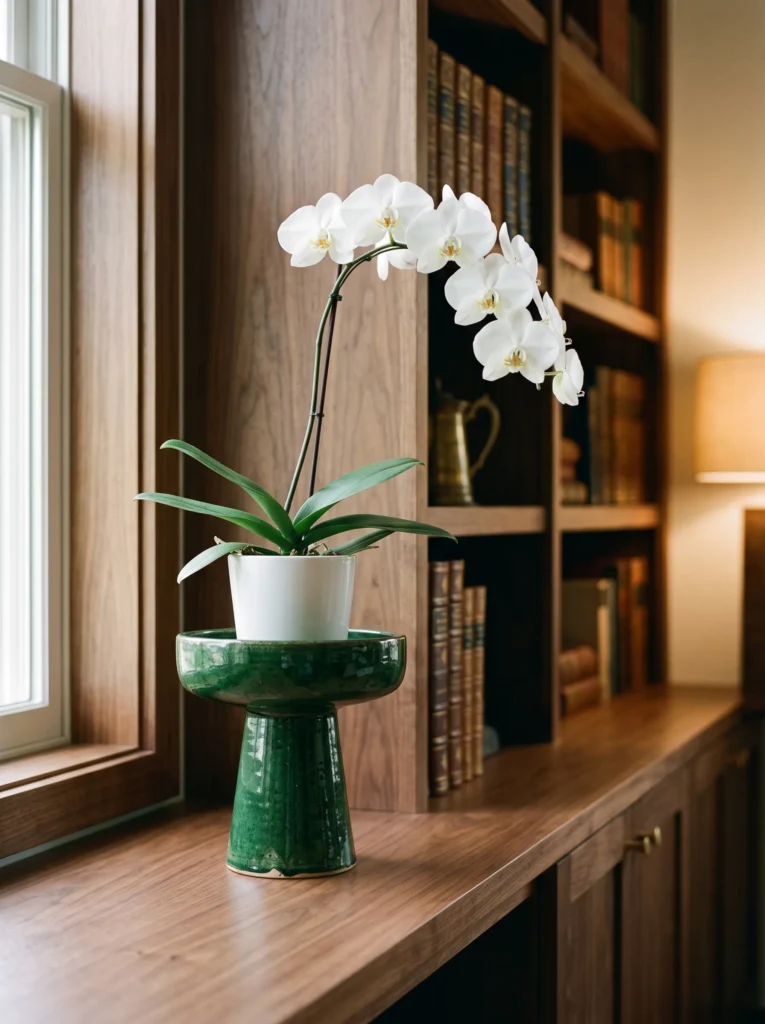
- Glazed deep green ceramic pedestal, about 20 inches tall, holds a phalaenopsis orchid on a built-in bookshelf’s lower ledge
- Orchid needs bright, indirect light and normally struggles in a library’s often shaded, book-filled shelving, so positioning it on the ledge nearest the room’s one window matters more than the stand itself
- Deep green glaze picks up the spines of leather-bound books without matching them exactly, keeping the pairing subtle rather than themed
- Pedestal’s rounded shoulder softens a shelf otherwise made up entirely of straight lines and right angles
- Orchid’s arching bloom stem needs a few inches of clearance above the pot, so leave the shelf above empty rather than crowding it with books
- Works well as a single statement piece rather than repeated, since a library’s visual weight already comes from the books themselves
Why this works: Orchids fail indoors more often from placement than from care, and a single well-lit shelf ledge does more for bloom health than any amount of watering attention.
A home library is one of the least likely rooms to successfully hold a flowering plant, since built-in shelving tends to create exactly the kind of shaded, enclosed light an orchid can’t tolerate. The fix isn’t a special stand — it’s positioning. A glazed ceramic pedestal on the shelf ledge nearest the room’s window gives the orchid the bright, indirect light it actually needs, while the pedestal’s height keeps the arching bloom stem clear of the shelf above it. Deep green glaze picks up the tone of leather book spines nearby without turning the pairing into an obvious theme.
I’ve noticed most orchid failures come down to placement rather than watering mistakes, and a library is a good example of how easy that mistake is to make. Tucking a beautiful orchid into a dim interior shelf, however visually tidy, all but guarantees it won’t rebloom. Choosing the one shelf that actually gets window light, even if it’s not the most central spot in the room, matters more than any fertilizer schedule. Leave the shelf directly above empty rather than stacking more books there, so the bloom stem has room to arch without bending against a hard edge.
15. Stone Plinth Stand for Mudrooms
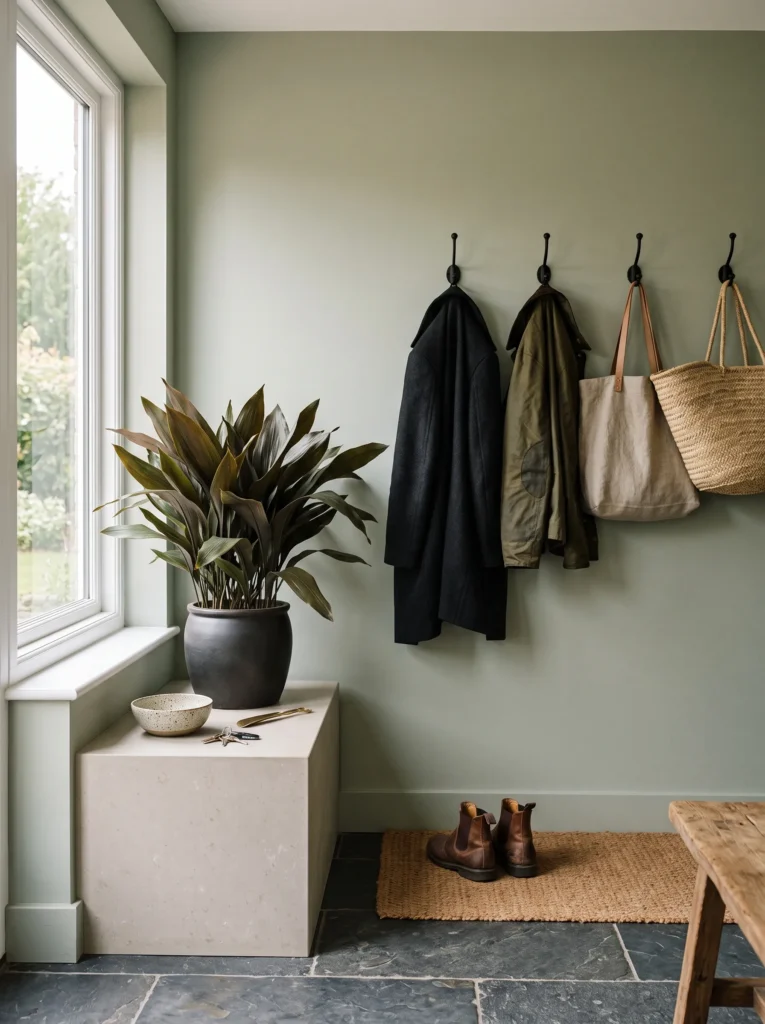
- Solid natural stone plinth, low and cube-shaped, holds a cast iron plant in a mudroom that sees dirt, wet boots, and constant traffic
- Cast iron plant tolerates neglect, low light, and temperature swings better than nearly any other houseplant, which makes it the rare plant that actually survives a mudroom
- Honed limestone surface handles scuffs and splashes without staining the way a wood or fabric stand would in the same spot
- Muted sage green wall behind the stand keeps the mudroom from feeling purely utilitarian
- Stone’s weight means the stand won’t tip or shift when bumped by a passing backpack or dog leash, which matters in a room this busy
- Deep bronze-green leaves hide dust and minor water spots better than a lighter-leafed plant would in a high-traffic spot
Why this works: A mudroom is the hardest room in a house to keep a plant alive in, and cast iron plant is one of the only species genuinely built to survive it.
Most rooms get styled with whatever plant looks best, but a mudroom needs to start from the opposite direction — what can actually survive daily traffic, temperature swings near an exterior door, and inconsistent light. Cast iron plant earned its name honestly; it tolerates all three better than nearly any other common houseplant, which makes it the rare flowering-adjacent option that doesn’t need special conditions to stay alive here. A low stone plinth suits the room for the same practical reason: its weight keeps it from tipping when bumped by a backpack, a dog leash, or a kid’s shoes on the way out the door.
Honed limestone handles the scuffs, splashes, and general wear a mudroom sees daily far better than a wood or fabric stand ever would, and it won’t stain the way porous materials do when exposed to wet boots or muddy paws repeatedly. A muted sage green wall behind the plinth keeps the room from reading as purely functional, giving it a bit of warmth without requiring delicate styling that wouldn’t survive the space anyway. This is one of the few plant vignettes on this list built entirely around durability first, aesthetics second.
16. Fluted Travertine Plinth Stand for Living Rooms
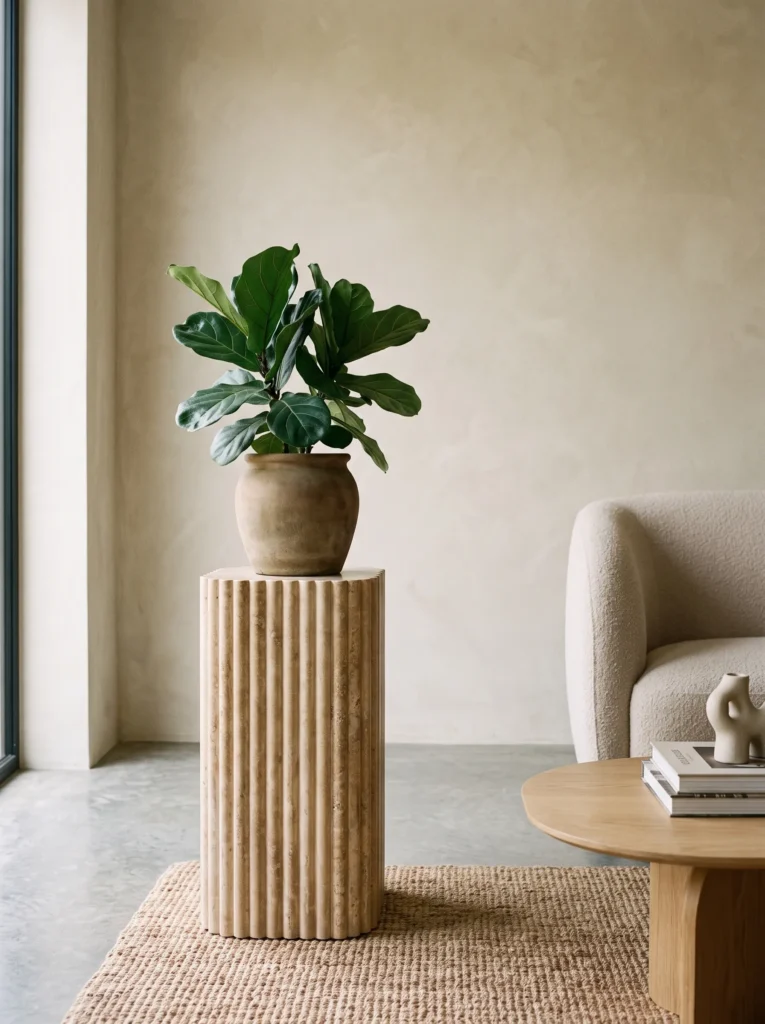
- Sculptural fluted travertine plinth, warm stone with soft ridged grooves, holds a fiddle leaf fig as a true architectural statement piece
- Fiddle leaf fig needs consistent bright light and hates being moved once settled, so this works best as a permanent living room anchor, not a rotating accent
- Fluted texture catches light differently throughout the day, giving the stand its own visual interest even before the plant is added
- Curved, organic silhouette breaks up a room otherwise full of straight-edged sofas and rectangular rugs — a deliberate 2026 shift away from boxy, matched furniture sets
- Warm putty-toned wall behind the plinth lets the stone’s natural veining stay the visual focus
- Pair with an unglazed clay pot in the same warm tone family so the whole vignette reads as one continuous material story, not separate pieces
Why this works: A sculptural stone plinth turns a plant stand into a piece of furniture in its own right, giving a living room an anchor that holds visual weight even on days the plant itself isn’t the focus.
Fiddle leaf fig has become almost a cliché in plant styling, usually shown on a plain wood stand that does nothing to elevate it. A fluted travertine plinth changes that completely — the stone’s soft, ridged grooves catch light differently depending on the hour, which means the stand itself has presence even before factoring in the plant. This curved, sculptural shape is where indoor plant stand styling is genuinely heading in 2026: away from matched, boxy furniture sets and toward pieces with real form. Placed as a permanent anchor rather than a rotating accent, it gives a living room a focal point that feels intentional and current, not borrowed from a decade-old Pinterest board.
Fiddle leaf fig is notoriously fussy about being relocated once it settles into a spot, dropping leaves in protest at even minor light changes. That makes a stone plinth the right long-term choice, since it’s heavy enough to stay put and substantial enough to anchor a corner permanently. Choose an unglazed clay pot in the same warm putty tone as the plinth so the two pieces read as one continuous material story rather than a stand and a pot styled separately. Keep the plant a few feet from a south-facing window, out of harsh direct midday sun.
17. Smoked Glass Riser Stand for Small Living Rooms
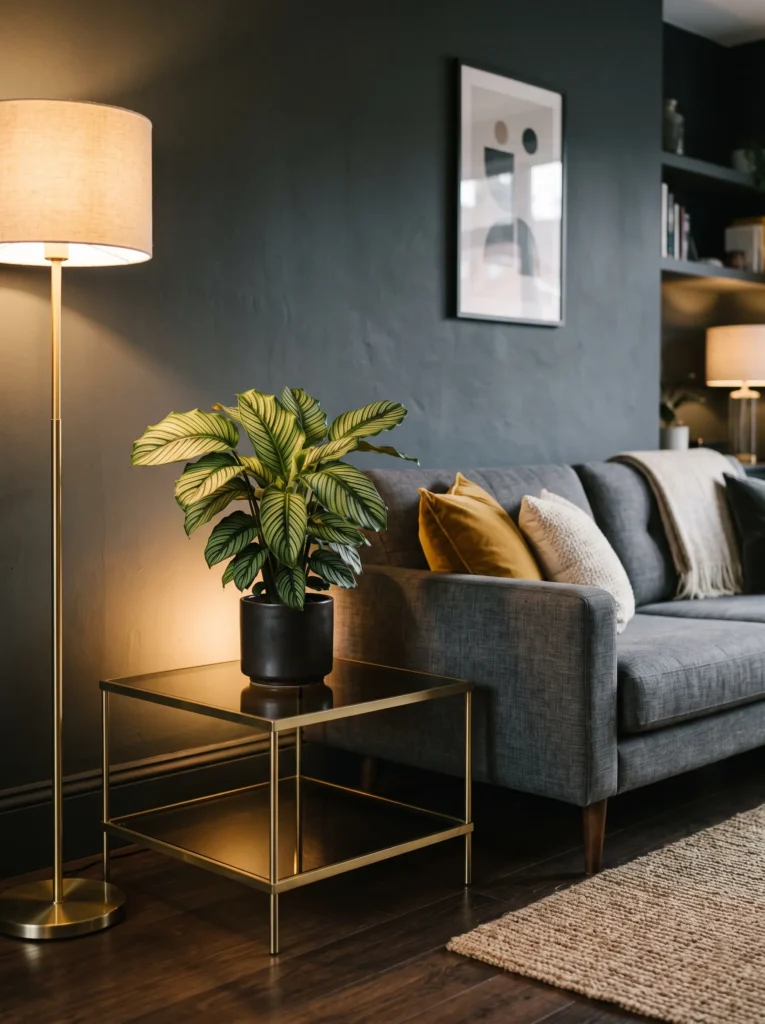
- Low smoked glass riser stand with a slim brass edge holds a calathea just above a coffee table’s sightline, adding height without visual bulk
- Calathea’s patterned leaves fold upward in the evening and flatten by morning, so a stand near ambient evening lighting shows off that movement rather than hiding it in a dark corner
- Smoked glass reflects color and light instead of absorbing it the way a solid wood or stone stand would, keeping a small living room feeling open
- Brass edge trim ties into other warm metal accents in the room without introducing a full brass stand’s visual weight
- Genuinely unexpected material choice for a plant stand — most people default to wood, stone, or metal and skip glass entirely
- Best used as a low side-table substitute beside a sofa rather than a traditional tall stand
Why this works: Glass is one of the only plant stand materials that adds height without adding visual weight, which is exactly what a small living room needs more of and less of at the same time.
Most plant stands solve the height problem by adding a solid, visible object to a room, but a smoked glass riser does the opposite — it lifts the plant while nearly disappearing itself. That matters most in a smaller living room, where every solid piece of furniture reads as visual weight, whether it’s a coffee table, a stand, or a bookshelf. Calathea suits this setup particularly well because its patterned leaves genuinely move throughout the day, folding upward in low evening light and flattening again by morning, and a glass riser near a lamp shows off that motion instead of burying the plant in a shadowed corner.
I’ve noticed glass gets overlooked almost entirely as a plant stand material, probably because it reads as fragile or impractical, but a low riser with a slim brass edge is sturdy enough for daily use and adds a genuinely modern edge most rooms are missing. It reflects ambient light rather than absorbing it the way wood or stone would, which keeps a compact living room feeling open instead of cluttered. Use it beside a sofa as a low side-table substitute, and keep the calathea’s soil consistently moist, since this plant is far less forgiving of dry spells than most others on this list.
You’ll Also Love:Indoor Plants That Match Your Decor Style
18. Boucle-Wrapped Iron Stand for Textured Corners
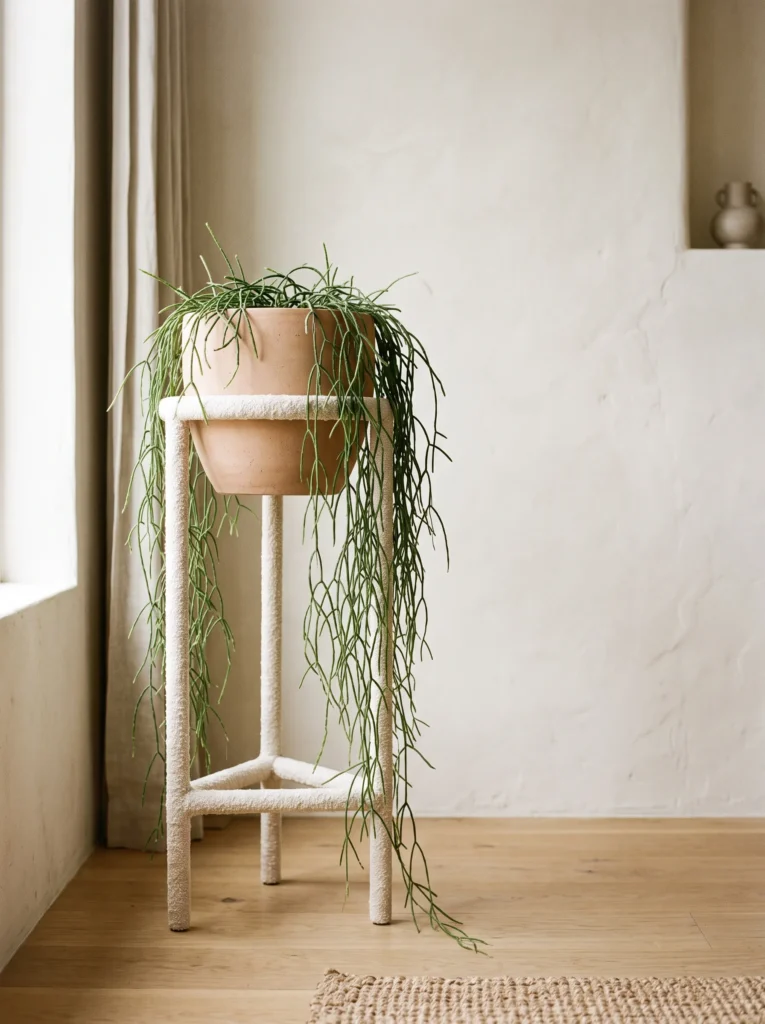
- Iron stand frame fully wrapped in cream boucle fabric, softening the material’s usual industrial edge into something tactile and current
- Rhipsalis trails in thin, textural strands rather than broad leaves, echoing the boucle’s looped texture instead of contrasting against it
- Genuinely unexpected pairing — upholstered plant stands are almost never seen in typical decor content, which makes this one of the more distinctive pieces in the whole list
- Cream-on-cream palette against a warm white wall keeps the piece feeling soft and current rather than themed or novelty
- Works best in a low-traffic corner, since fabric-wrapped furniture isn’t built for daily bumps the way iron or stone stands are
- Round terracotta planter in a matte bisque finish keeps the base grounded against the stand’s soft upper texture
Why this works: Wrapping an iron frame in boucle fabric turns a plant stand into a textile piece, pairing a trailing plant’s texture with the stand’s surface instead of simply setting one on top of the other.
Upholstered furniture almost never crosses into plant stand territory, which is exactly why a boucle-wrapped iron frame stands out as something genuinely different rather than another variation on wood or metal. Rhipsalis, sometimes called mistletoe cactus, trails in thin, looping strands that echo the boucle’s own looped texture, so the plant and the stand read as one cohesive material story instead of two separate elements competing for attention. That’s a level of intentional pairing most plant stand ideas skip entirely in favor of whatever stand happens to match the room’s existing wood tone.
That’s why many designers are starting to treat plant stands as textile opportunities rather than purely structural ones — the same way a boucle ottoman or a woven bench chair has become standard, a wrapped stand brings that same tactile softness to a corner that would otherwise be all hard surfaces. Keep this piece in a lower-traffic spot, since fabric wrapping isn’t built to withstand the daily bumps a bare iron or stone stand would shrug off without a mark. A matte bisque terracotta pot keeps the base visually grounded beneath the stand’s soft upper texture.
18. Curved Lacquered Plinth
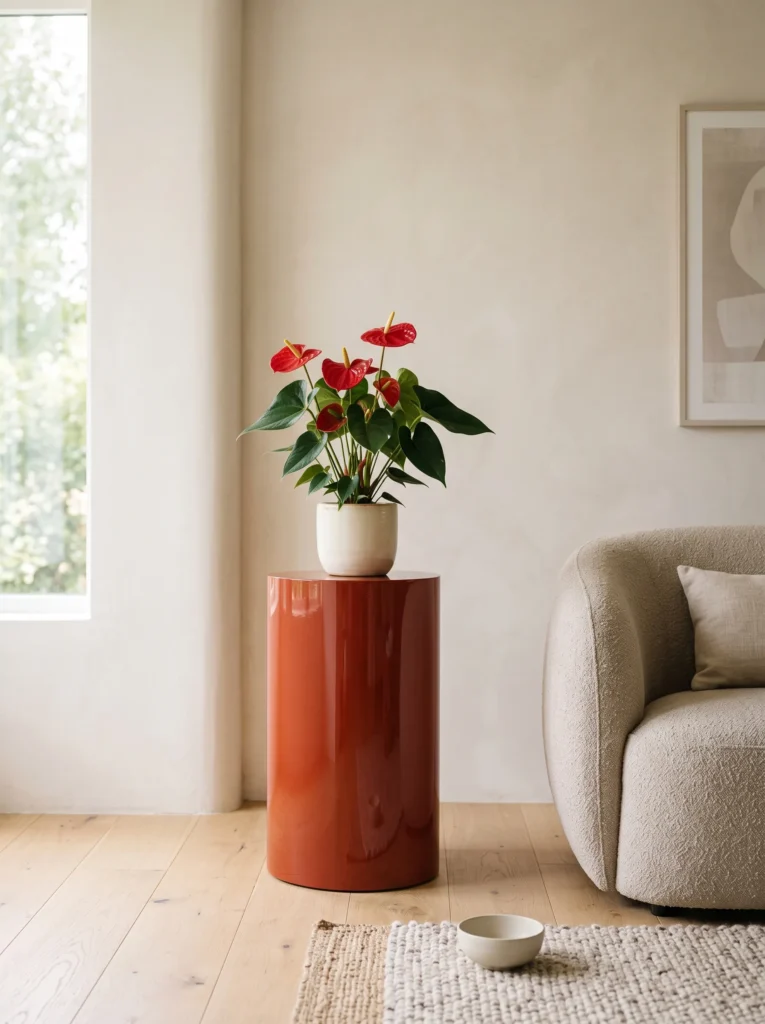
- High-gloss lacquered wood plinth in a deep terracotta red, with a soft curved silhouette, holds an anthurium as a bold color-forward statement
- Anthurium blooms nearly year-round under bright indirect light, giving a living room a consistent pop of waxy red or pink color most foliage plants can’t match
- Curved base breaks from the boxy, straight-edged stands still common in most decor content — a clear 2026 shift toward organic, sculptural furniture forms
- Lacquered finish reflects light in a way raw wood never does, adding a subtle glossy contrast against a room full of matte textures
- Genuinely unexpected color choice for a plant stand — most defaults sit safely in neutral wood or black metal, so a saturated lacquer reads as intentional and current
- Works as a true focal point rather than a supporting piece, so keep surrounding furniture and walls neutral to let it stand out
Why this works: A lacquered, curved plinth in a bold color turns the stand itself into the room’s focal point, letting a long-blooming plant carry color year-round instead of relying on seasonal styling changes.
Most plant stands default to neutral wood, black metal, or stone, which is safe but forgettable in a room that could use one genuinely bold element. A curved terracotta-red lacquered plinth flips that, becoming the room’s color anchor rather than a supporting piece. Anthurium is the right plant to pair with it because it blooms nearly year-round under bright indirect light, giving the vignette consistent color instead of the seasonal on-and-off most flowering plants require. The curved, sculptural base is also a deliberate departure from the boxy stands that have dominated plant styling for years, aligning instead with where furniture design is genuinely heading.
I’ve noticed that a single saturated color statement, done well, reads as far more intentional than a room full of matched neutral tones trying not to offend anyone. Keep the wall and surrounding furniture calm and neutral so the lacquered plinth and the anthurium’s waxy blooms get to do the visual work without competition. Wipe the lacquer with a soft, dry cloth rather than anything abrasive, since a high-gloss finish shows scratches far more visibly than a matte one would.
Indoor Plant Stand Styling Principles
Choosing the right plant stand isn’t about matching a room’s color palette first — it’s about matching the plant’s light and airflow needs to a spot in your home that can actually support them, then choosing a stand style second. A snake plant on a beautiful marble pedestal in a dark corner still won’t thrive if that corner gets zero natural light. Before picking a stand’s material or height, ask what the plant needs: does it want direct sun, bright indirect light, or does it genuinely tolerate shade? Does it need airflow around the pot, like a fern, or is it forgiving of stagnant humidity? Once the light and airflow question is settled, the stand’s height, material, and finish become a styling decision, not a survival one. Taller stands suit plants that need to reach closer to a window; low stands and risers suit plants already getting good light at floor or table height. Pairing a plant’s real needs with a stand’s real placement is what makes a vignette last past the first few weeks.
FAQs
Do plants really need to be elevated, or is it just a styling trend? Elevating a plant genuinely changes its light exposure angle relative to a window and improves air circulation around the pot, which reduces the humidity buildup at soil level that contributes to root rot and fungal issues.
What’s the best type of plant stand for homes with pets? Wall-mounted or hanging stands work best for plants that are toxic to cats and dogs, such as pothos, snake plant, and philodendron, since they keep the foliage out of reach without limiting light exposure.
What are the best plant stands for small spaces? Wall-mounted floating shelves, hoops, and slim tripod stands add height without taking up floor space, making them the most practical choice for small rooms, hallways, and landings.
Are budget-friendly plant stand options available, or do they need to be custom-built? Repurposed furniture, like a step stool or vintage crate, makes an effective and affordable plant stand, and often adds more character than a new piece at a fraction of the cost.
What plants work best on tiered stands? Trailing and cascading plants, such as pothos, string of pearls, and rhipsalis, look best on tiered stands because each tier gives the vines room to drape without tangling with the plant below.
How do I know if a wall-mounted plant stand is safe to install? A wall-mounted stand holding a watered plant should always be anchored into a ceiling or wall stud rather than drywall alone, since a watered pot’s sustained weight can work loose from drywall anchors over several months.
Conclusion
The right stand does more than lift a plant off the floor — it changes how much light it gets, how well its roots breathe, and how long it actually thrives in your home. That’s the real idea behind these indoor plant stand ideas: pairing the right material, height, and placement with a plant’s specific needs, room by room.
I’ve seen how much difference this makes firsthand, from a fern that finally stopped struggling in a bathroom to an orchid that rebloomed once it landed on the right shelf. Save this post before your next plant refresh, try one idea in a room that needs it, and pass it along to anyone whose plants keep quietly struggling for reasons they haven’t figured out yet.