15 Neutral Christmas Decor Ideas That Look Expensive
Picture a tree with no tinsel, no bright colors, and a room full of guests who still can’t stop looking. That is the quiet power of neutral Christmas decor ideas built on real materials. Wool, wood, fresh greenery, and warm light do more than any glitter ever could.
I’m Emily, and I learned this the slow way. I used to buy a new batch of ornaments every year, then wonder why my house never felt pulled together. What changed everything was choosing a short list of natural materials and letting texture, not color, carry the season. My plant science background taught me which botanicals hold up, and years around my husband’s construction projects taught me which materials are safe and sturdy.
In this post, you’ll find 15 complete scenes, from a sculpted noble fir to a birch log hearth. Each one names exact tones, bulb temperatures, and plants, so you can recreate it this weekend. If you want natural Christmas decor that looks designed, lasts for years, and never feels random, start here.Natural materials look timeless because they change on purpose. Real greenery, untreated wood, and wool develop texture and subtle variation that mass-produced synthetic decor cannot replicate, so they age as character rather than as wear. That is why a natural scheme bought once can be reused across many years without looking dated. Printed and glossy pieces do the opposite: they lock into the year they were made.
I learned this while packing up our decor one January in Austin. The wool stockings and wooden beads went back into the bin looking better. The shiny plastic bells looked tired. This post shows you how to build natural Christmas decor that earns its place, room by room, with exact materials, tones, and safety notes.
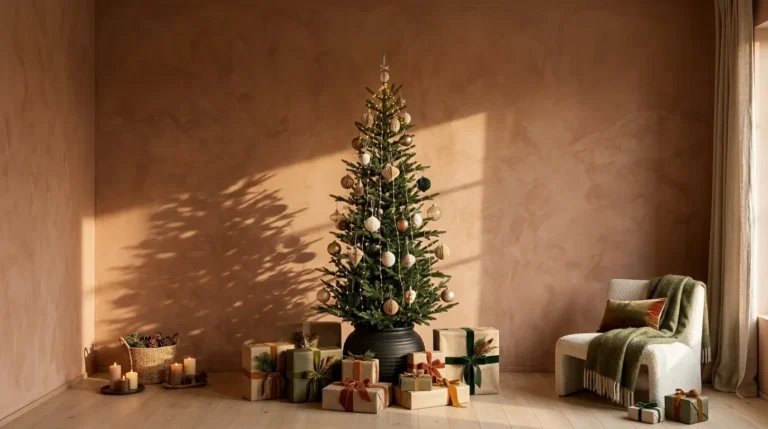
1. Sculpted Noble Fir — A Neutral Christmas Decor Idea for the Living Room
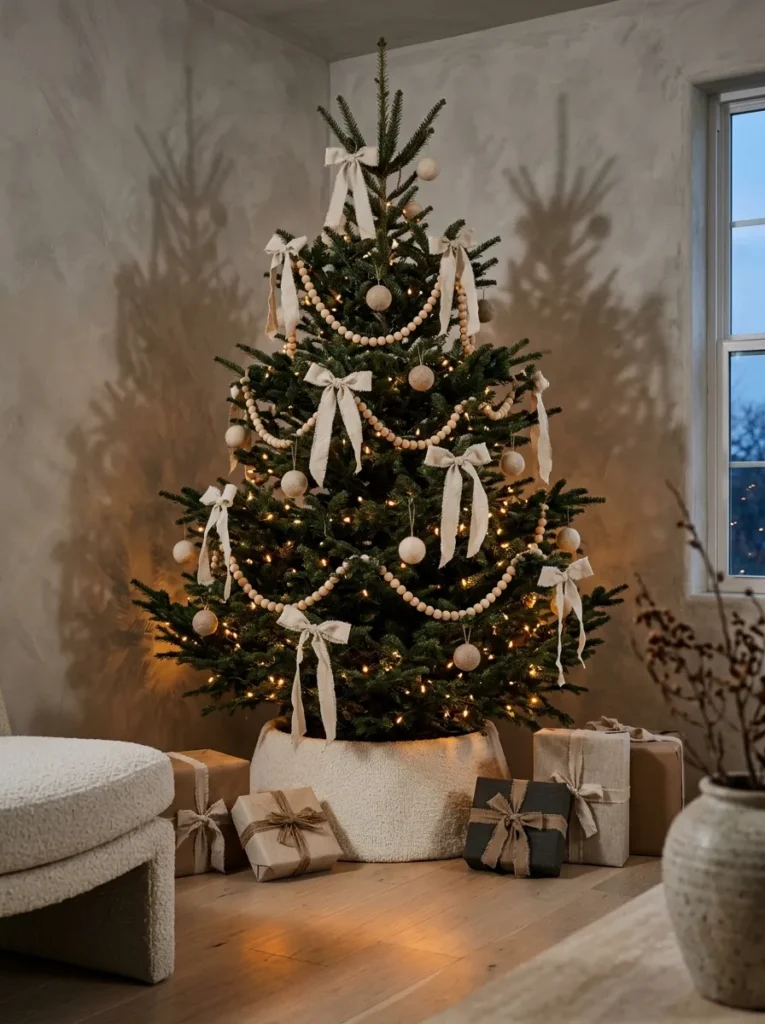
- Zone: Living room corner, 7.5-foot noble fir
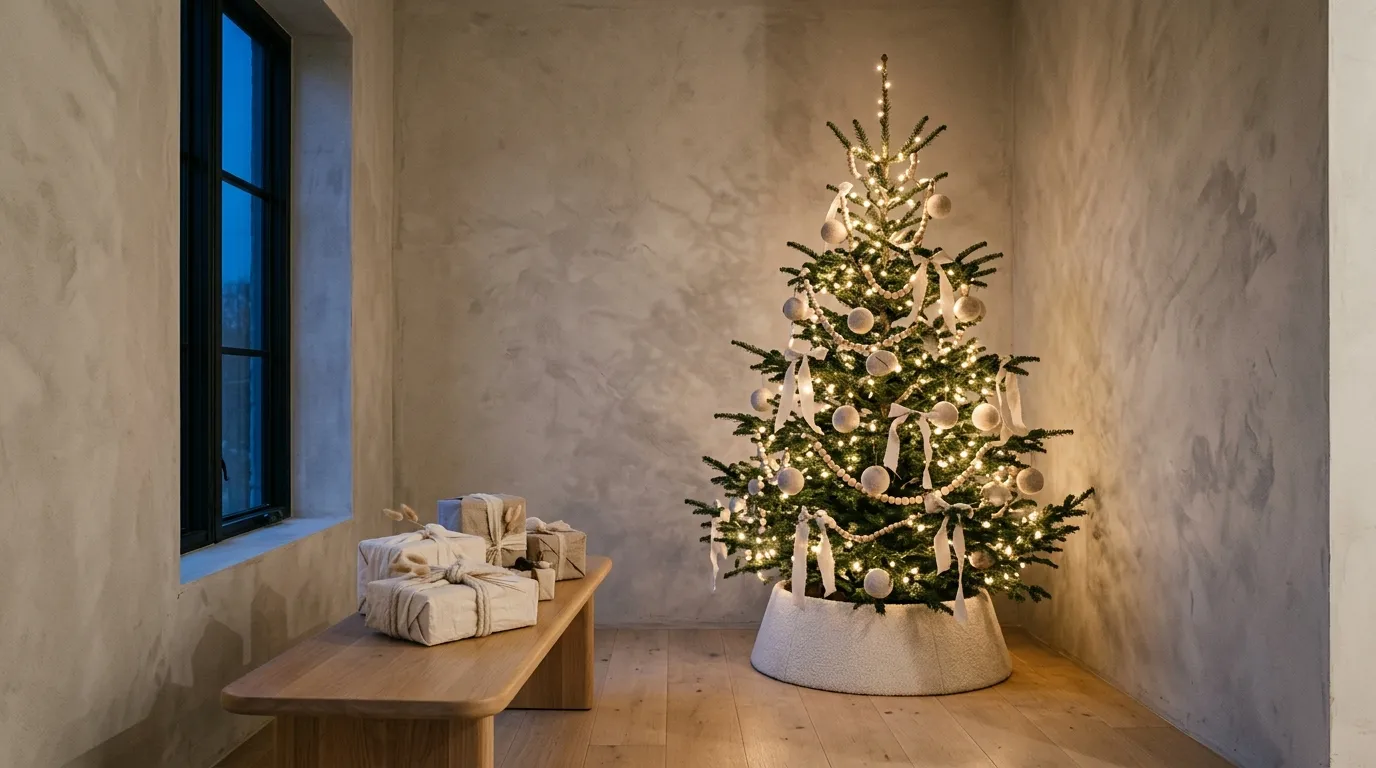
- Natural materials: Oversized undyed wool felt spheres, raw maple beads on jute cord, torn linen ribbon, curved wool bouclé collar
- Palette: Oat, bone, driftwood, sage-gray
- Lighting: 2700K warm white mini lights on brown wire
- Botanicals: Noble fir (Abies procera), fresh for 4–5 weeks with daily water; silver dollar eucalyptus tucked in, fresh for about a week, then dried and steady for months
- Texture contrast: Rough jute against polished maple
- Standout detail: Linen ribbon torn, not cut, so the threads fray into soft fringe
Why this works: A single-tone tree reads as sculpture because texture, not color, does the talking.
A tree with three materials and no shiny ornaments looks calmer and more expensive than one with twenty colors. Noble fir is the strongest base because its stiff, upswept branches carry heavy wooden beads without drooping, and its needles hold well when the trunk stays in water. Cut firs can drink roughly a quart of water per day for each inch of trunk diameter, so check the stand every morning. Keep it away from heat vents and fireplaces, because a dry tree ignites fast. Wrap the mini lights tightly along each branch first, then add beads and felt balls last.
Why does this version feel so finished? Because each material has a different surface. Raw maple beads are smooth and pale, jute is rough and fibrous, and wool felt is soft enough to swallow the light. Together they create depth without adding a single new color. Hang the felt balls deep inside the branches and the beads closer to the tips, so the eye travels in layers. Tear the linen ribbon into long strips and let the edges fray. Finish with a curved wool bouclé collar hiding the stand. From across the room, the tree reads as one sculptural shape.
2. Olive Branch Console
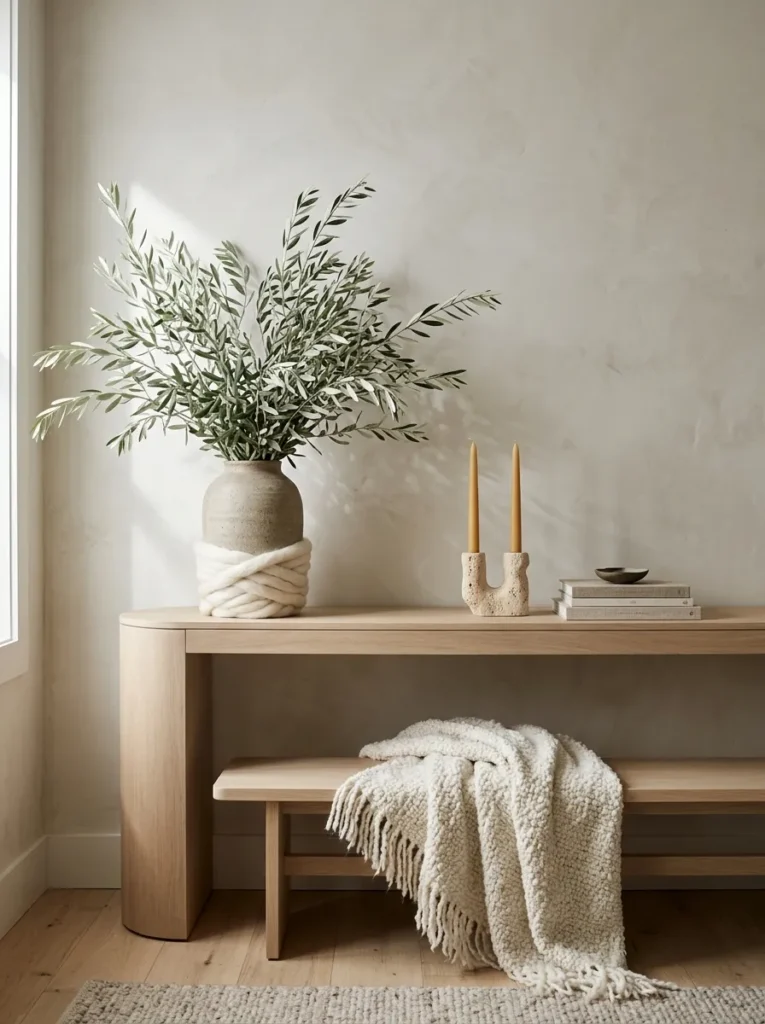
- Zone: Entryway console and bench
- Natural materials: Curved-front white oak console, unglazed stoneware vase, undyed wool roving, travertine candleholder, alabaster lamp
- Palette: Ivory, putty, silver-olive, pale oak
- Lighting: 2700K bulb in an alabaster lamp, plus beeswax taper flames
- Botanicals: Olive branches (Olea europaea), supple for 1–2 weeks in water, then dried in the vase with silver-green leaves intact
- Texture contrast: Rough wool roving against smooth ceramic
- Standout detail: A loose knot of raw wool roving tied around the vase neck like a scarf
Why this works: One tall branch arrangement gives an entry a focal point in under ten minutes.
The first thing I ever styled in our Austin entry was a plastic wreath, and I regretted it within a week. Guests walked past it without noticing. When I swapped it for a single stoneware vase of olive branches, three people stopped to touch the leaves. That tells you something. Olive foliage has a silver underside, thanks to tiny scales on the leaf that reduce water loss, and that soft flash of silver catches lamplight beautifully. Cut stems drink for one to two weeks, then dry in the vase and keep their shape. Recut the stems at a slant.
Picture the curved-front console from the front door. A stoneware vase about 30 inches tall holds twelve olive branches at uneven heights, its neck wrapped in a loose knot of undyed wool roving. Beside it, two beeswax tapers sit in a travertine holder, glowing under an alabaster lamp. A chunky wool throw drapes over the oak bench below. The rough wool against smooth ceramic is what guests notice, and it takes about ten minutes to set up. Keep the tapers at least a foot from the branches. Dried olive leaves are thin, and they catch quickly.
3. Backlit Citrus Table
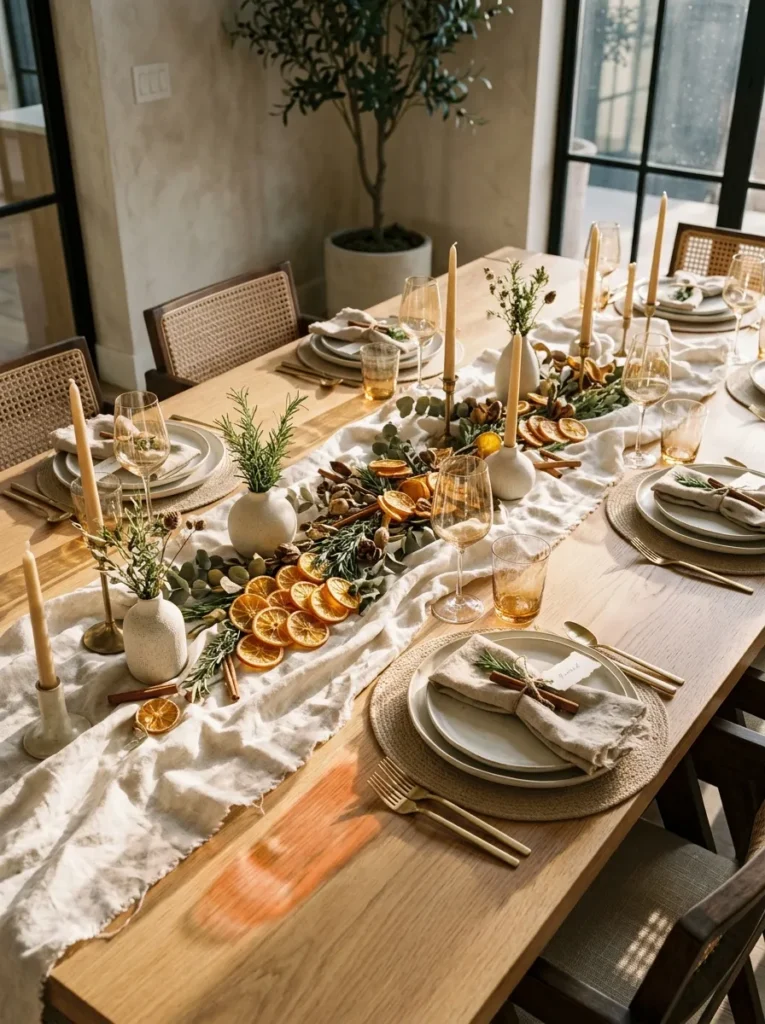
- Zone: Dining table
- Natural materials: Dried orange slices, cinnamon sticks, raw-edge flax linen runner, matte bone stoneware, white oak table
- Palette: Bone, flax, sand, toasted amber
- Lighting: 2700K pendant on a dimmer at about 40 percent, plus late-afternoon window light
- Botanicals: Navel orange (Citrus × sinensis) slices, good for the whole season and several more if stored dry; rosemary (Salvia rosmarinus), green for about a week in water, then dried and still fragrant
- Texture contrast: Crisp, translucent citrus against soft linen
- Standout detail: Slices laid overlapping like roof tiles down the runner so light passes through them
Why this works: Light passing through dried citrus adds a glow that no printed or plastic ornament can fake.
Dried orange slices glow like stained glass when light passes through them, which is why they work harder than any ornament. Slice navel oranges a quarter inch thick, pat them dry, and bake at 200°F for three to four hours, flipping once. I’ve found that slices much thinner than that curl and tear. Kept in dry air, they last the whole season, and stored in an airtight tin they return next year. Citrus peel contains flammable oils, something my husband, who builds homes for a living, points out, so keep slices at least twelve inches from any flame.
Set the table before dusk and watch what happens. A flax linen runner with raw edges runs 14 inches wide down the center, with overlapping orange slices laid like roof tiles along its spine. Sprigs of rosemary stay green in a bud vase for about a week, then dry and keep their scent. Matte bone stoneware plates sit on sand-colored placemats, and a dimmer holds the pendant at 2700K, around 40 percent. Cinnamon sticks tied to each napkin add warm color. The mix of crisp citrus and soft linen makes guests lean in and ask how you.
4. Cedar Ring Coffee Table
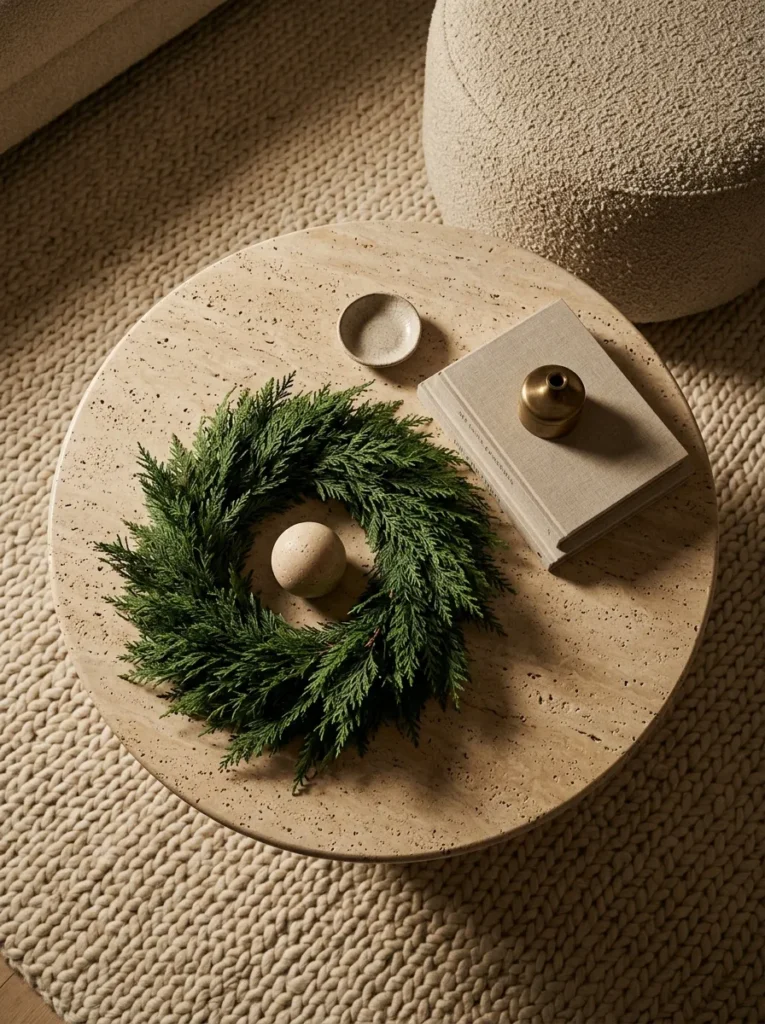
- Zone: Living room, round coffee table
- Natural materials: Honed travertine coffee table, matte travertine sphere, wool bouclé ottoman, cedar boughs
- Palette: Travertine cream, bone, oat, smoked oak
- Lighting: 2700K dimmable arc floor lamp
- Botanicals: Western red cedar (Thuja plicata) boughs, fresh for two to three weeks in a cool room, then dry crisp and shed lightly
- Texture contrast: Feathery cedar against cool, pitted stone
- Safety: Open flame kept at least 12 inches from cut evergreens
- Standout detail: A flat 14-inch cedar ring circling a single stone sphere
Why this works: A flat, low arrangement keeps a coffee table usable while adding the one thing stone lacks: soft texture.
A low, flat arrangement keeps a coffee table useful, and cedar is made for it. Western red cedar boughs are soft, feathery, and flexible, so they bend into a ring without snapping. Cut boughs stay fresh for two to three weeks in a cool room, then dry crisp and shed lightly. Lay a 14-inch ring flat on the table and leave the center open for a honed travertine sphere. Resin-rich evergreens burn quickly when dry, so keep open flame at least twelve inches away and replace the ring once needles turn brittle.
Texture does the work here. Feathery cedar looks almost blurred next to cool, honed travertine, and that contrast is what makes the table read as designed. Pair the table with an oat wool bouclé ottoman nearby, so soft and hard surfaces repeat across the room. A 2700K dimmable floor lamp arcing overhead throws gentle light across the ring and picks out the stone’s pitted grain. Lift the ring once a week to check for dropped needles. Cedar smells clean and resinous, which fills a living room without a single scented candle.
5. Pampas Bedroom Corner
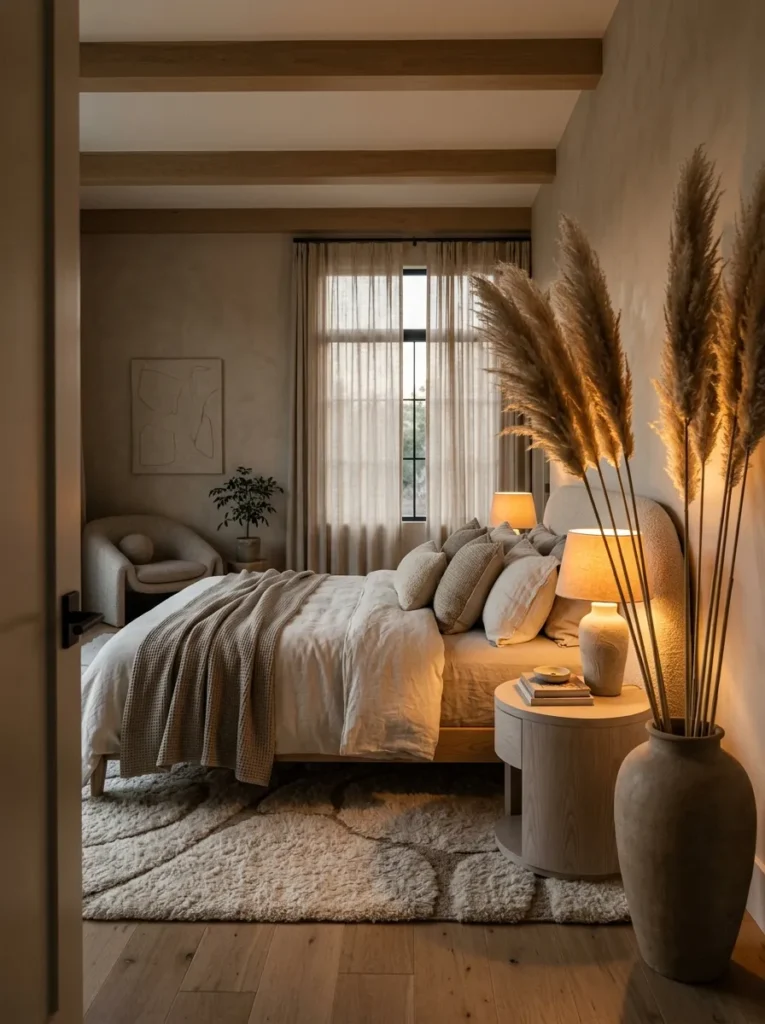
- Zone: Bedroom corner beside a curved bed
- Natural materials: Dried pampas plumes, oversized matte stoneware floor vase, wool bouclé headboard, linen duvet, round ash nightstand
- Palette: Ivory, oat, pale ash, mushroom
- Lighting: 2200K filament-style bulbs in ceramic bedside lamps
- Botanicals: Pampas grass (Cortaderia selloana), dried plumes that keep for a year or two
- Texture contrast: Airy plumes against dense wool bouclé
- Sourcing note: Buy from growers, since pampas is invasive in parts of the western U.S.
- Standout detail: Eleven plumes at graduated heights, the tallest near five feet
Why this works: Tall, airy plumes fill a corner with height and softness without adding clutter.
I once tucked pampas into a bedroom corner for a client and watched her stop mid-sentence in the doorway. That is the effect height has. Eleven plumes at graduated heights, the tallest near five feet, fill a corner the way a small tree would, but they stay light and airy. Pampas grass (Cortaderia selloana) is invasive in parts of the western U.S., so I always buy from growers instead of cutting wild stands. Dried plumes keep for a year or two. Shake them outside first, because they shed for the first few days.
Keep everything around the plumes quiet so their shape can lead. An ivory linen duvet and an oat wool bouclé headboard curve softly behind the vase, which is matte stoneware about 24 inches tall and wide enough to stay steady. A round pale ash nightstand holds a ceramic lamp with a 2200K filament-style bulb, giving the plumes a soft gold edge at night. The airy plumes against dense wool bouclé is the contrast you see first, and the combination feels like a boutique hotel suite, even in a small guest room.
6. Eucalyptus Spa Bath
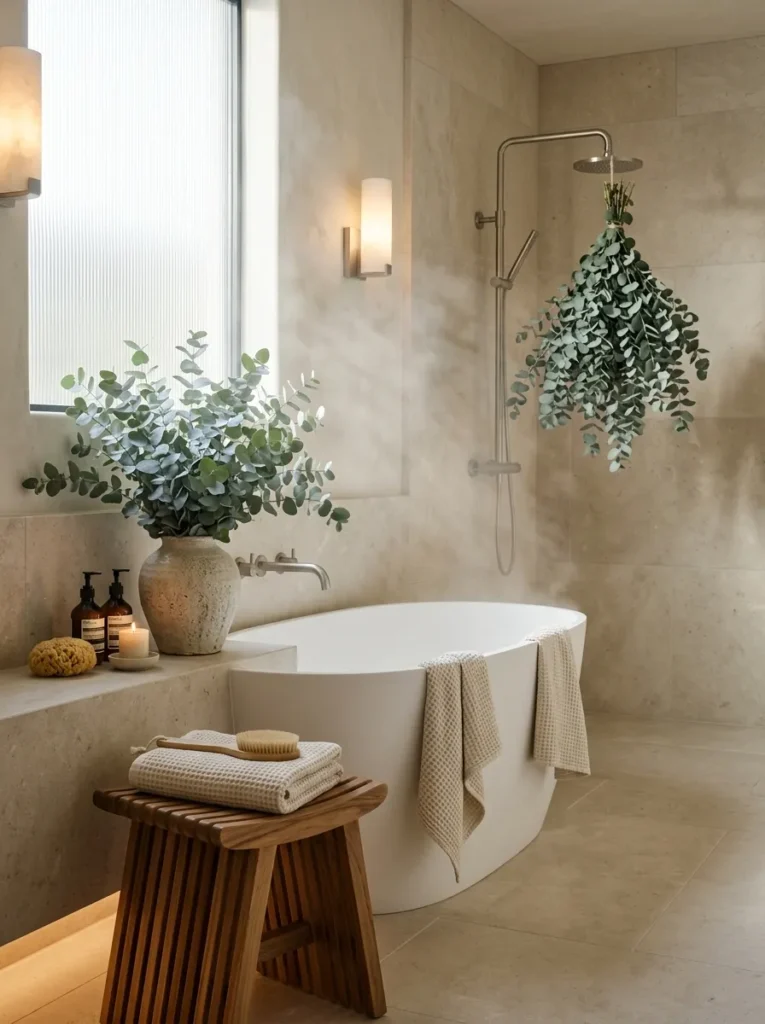
- Zone: Primary bathroom, shower and tub ledge
- Natural materials: Honed limestone ledge, slatted oak stool, waffle-weave linen towels, matte stoneware vase
- Palette: Bone, limestone, sage-gray, pale oak
- Lighting: 2700K sconces flanking the mirror
- Botanicals: Silver dollar eucalyptus (Eucalyptus cinerea), supple for one to two weeks hanging, then dried with leaves intact for months
- Texture contrast: Waffle linen against smooth honed limestone
- Ventilation: Exhaust fan run for 20 minutes after each shower
- Standout detail: A seven-stem bundle hung from the shower arm so steam releases the scent
Why this works: A hung eucalyptus bundle uses steam to release scent, so the plant works as both decor and fragrance.
Steam turns eucalyptus into a free diffuser. Hang a bundle of seven stems from the shower arm, away from the direct spray, and warm moisture releases the leaves’ oils. Silver dollar eucalyptus (Eucalyptus cinerea) stays supple for one to two weeks hanging, then dries and holds its round blue-gray leaves for months. I’ve tried it in our own guest bath, and the scent fades in about ten days, so I swap in fresh stems then. Bathrooms need airflow, so my husband always runs the exhaust fan for twenty minutes after a shower.
Build the rest of the room from stone and linen. A honed limestone ledge holds a matte stoneware vase with three more stems, which keeps the scent near your face when you bathe. Waffle-weave bone towels hang from a slim brushed nickel rail, and a slatted oak stool sits beside the tub. Sconces at 2700K flank the mirror and flatter skin and stone alike. Waffle linen against smooth honed limestone is the texture pairing that makes the whole bathroom feel like a boutique spa instead of a plain white box.
7. Limewashed Kitchen Shelves
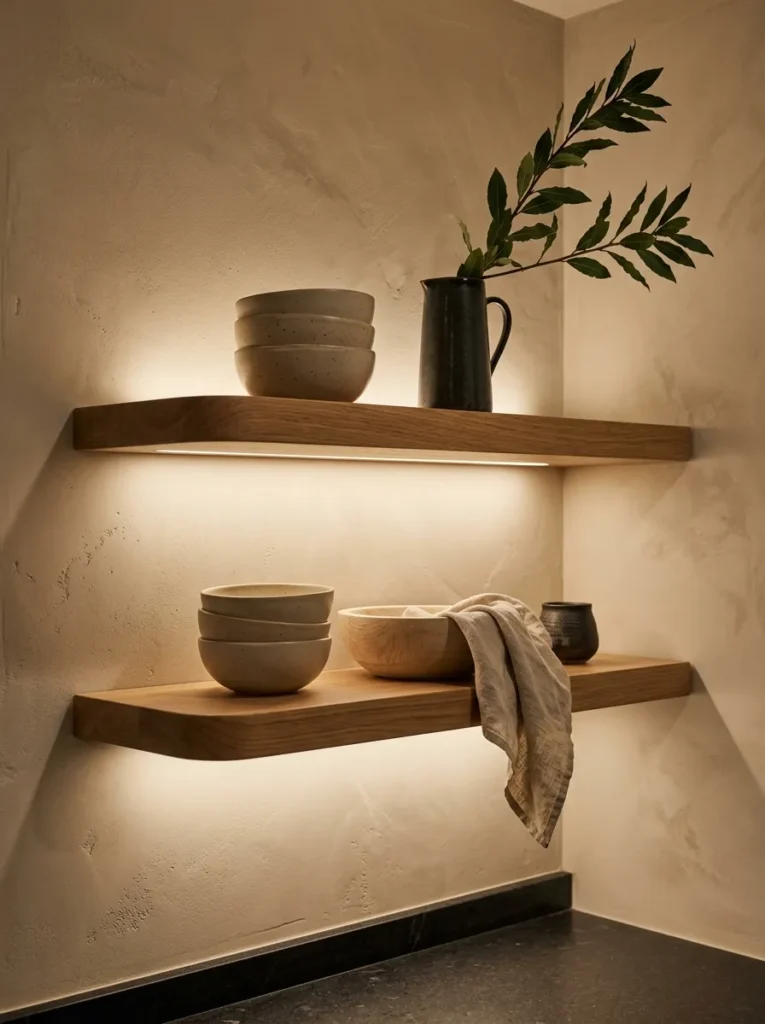
- Zone: Kitchen, two open floating shelves
- Natural materials: Thick rounded-edge white oak shelves, matte oat stoneware, raw ash bowl, oatmeal linen tea towel
- Palette: Putty, oat, bone, driftwood
- Lighting: 2700K LED strip tucked under the top shelf
- Botanicals: Bay laurel (Laurus nobilis), fresh for about two weeks in water, then dried with leaves intact for months
- Texture contrast: Raw-grained ash bowl against smooth stoneware
- Mounting: Shelves fastened into wall studs, not drywall alone
- Standout detail: One bay branch arcing past the shelf edge like a drawn line, against a putty limewashed wall
Why this works: A tight palette and one living branch turn everyday dishes into a styled display.
I used to think open shelves were for people who owned perfect dishes. Then I styled ours with nothing but matte oat stoneware, one ash bowl, and a single bay branch, and the whole kitchen looked edited. Bay laurel is the quiet hero here. Cut branches drink for about two weeks, then dry slowly and hold their leathery shape for months. Group three bowls and two cups on each shelf, leaving real gaps between them. Limewash the wall behind in putty so shadows look soft instead of harsh. A 2700K under-shelf LED strip adds a night glow.
Ten inches deep is the sweet spot for kitchen shelves, deep enough for dinner plates, shallow enough to stay sleek. Open shelves carry real weight, and my husband always fastens them into studs with long screws, never drywall anchors alone. A full shelf of stoneware can top 30 pounds. Set the raw ash bowl on the lower shelf, then fold an oatmeal linen towel over the rim. The rough grain beside smooth stoneware gives the eye something to read. Slide one bay branch into a narrow pitcher so it arcs past the shelf edge like a drawn line.
8. Paperwhite Window Bay
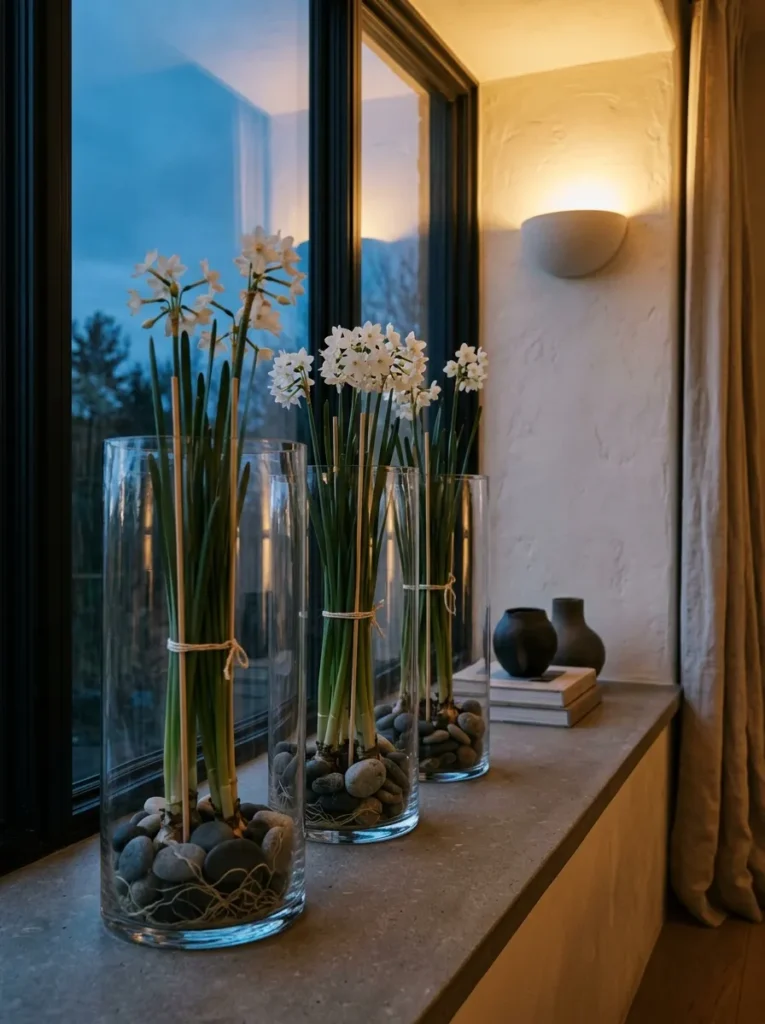
- Zone: Deep window ledge in the kitchen or living room
- Natural materials: Clear glass cylinders, gray river stones, cotton twine, plaster wall sconce
- Palette: Ivory, chalk, stone-gray, pale sage
- Lighting: Window light by day, 2700K plaster sconce bulb at night
- Botanicals: Paperwhite narcissus (Narcissus papyraceus), blooming about three to five weeks after planting, with flowers lasting one to two weeks
- Texture contrast: Rough river stone against clear glass
- Care note: Narcissus is toxic to cats and dogs, so place it on high ledges
- Standout detail: Roots visible through the glass, anchored in stones like living sculpture
Why this works: Forcing bulbs gives you real, living greenery that peaks right on schedule for Christmas.
Plant paperwhites in mid-November and they bloom right on time for Christmas. Set each bulb on a bed of river stones in a tall glass cylinder, add water just below the base, and place it in a bright window. Roots reach into the water within days. I’ve found that bulbs in water grow tall and floppy, so I add a thin twig or loop of cotton twine around the stems to keep them upright. Blooms last one to two weeks, and the fragrance is strong. Narcissus is toxic to cats and dogs, so keep these on high ledges.
Evening is when this window earns its place. A plaster sconce with a 2700K bulb washes the ledge in soft amber, and the clear glass catches each stem like a line drawing. Line up three cylinders in graduated heights, 10, 12, and 14 inches, and keep the stones gray and rounded. Rough stone against smooth glass gives the cream blooms a sculptural base. Pack three bulbs per cylinder for a fuller display. Protect bare wood ledges with a saucer, since standing water leaves rings. The whole display costs under 40 dollars and looks like a gallery piece.
You’ll Also Love: 15 Christmas Chalkboard Art Ideas: Simple, Festive & Fun
9. Muslin Wrapped Gifts
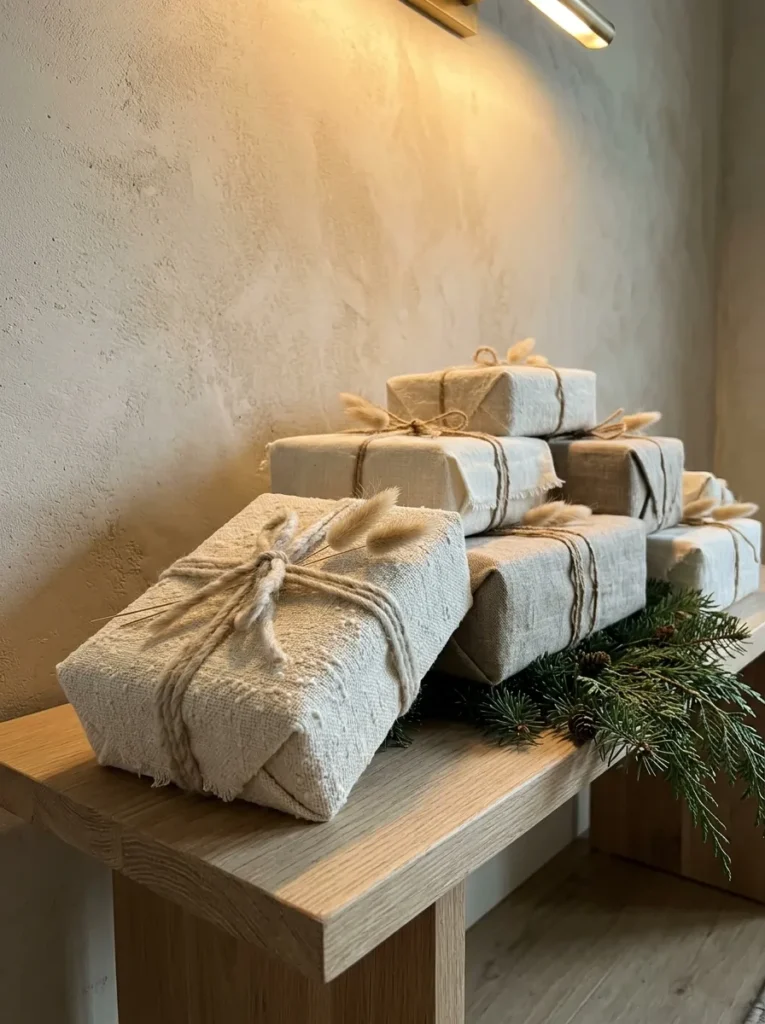
- Zone: Living room, gift display on an oak bench beside the tree
- Natural materials: Undyed cotton muslin, braided jute cord, wool yarn ties, kiln-dried white oak bench
- Palette: Ivory, flax, putty, walnut
- Lighting: 2700K picture light mounted above the bench
- Botanicals: Bunny tail grass (Lagurus ovatus), dried seed heads that keep for a year or two
- Texture contrast: Nubby muslin against smooth oak
- Sourcing: Kiln-dried untreated oak, never pressure-treated lumber indoors
- Standout detail: One bunny tail stem tucked under each wool yarn tie
Why this works: Matching all gift wrap to one tone family makes a pile of presents read as a designed display.
Matching wrapping paper is the cheapest design upgrade of the season. Undyed cotton muslin costs a few dollars a yard, tears into clean strips along the grain, and softens boxes into pillowy shapes that photograph well. Wrap every gift in the same fabric, then vary only the ties: braided jute, wool yarn, or linen ribbon. Because the base never changes, the pile reads as a composed display instead of a jumble. Wash and iron the muslin after the holidays and it works again next year, which makes the cost per use almost nothing.
Set the display on a kiln-dried white oak bench about 18 inches high, so gifts sit at a comfortable height without crowding the floor. My husband always warns clients to avoid pressure-treated lumber indoors, since it carries preservatives meant for outdoor use. Stack boxes in odd numbers, largest at the base, and tuck one bunny tail grass stem under each yarn tie. The fluffy seed heads add soft movement against smooth oak, and a 2700K picture light overhead makes the muslin glow like linen at dusk. Dried bunny tail keeps for a year or two.
10. Magnolia Stair Garland
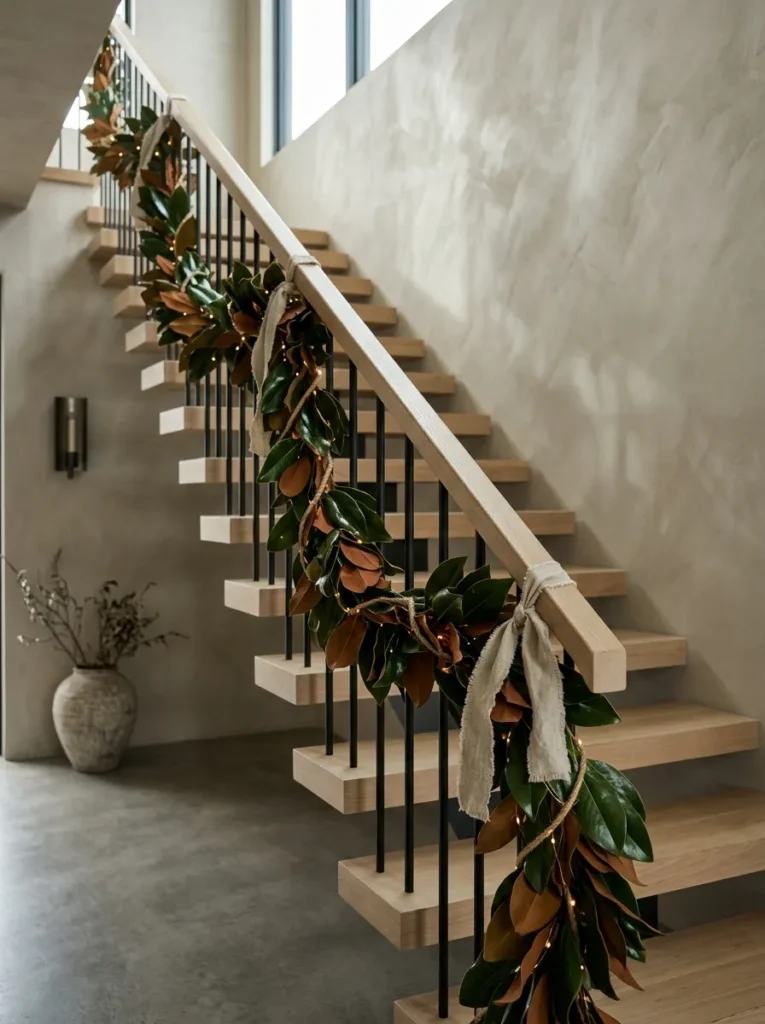
- Zone: Staircase banister, 10-foot run
- Natural materials: Southern magnolia leaves, hemp rope, cotton cord ties, pale oak handrail
- Palette: Olive-bronze, oat, putty, pale oak
- Lighting: Battery-powered 2700K micro LED wire threaded through the leaves
- Botanicals: Southern magnolia (Magnolia grandiflora), glossy and fresh for two to three weeks, then dried to bronze for months
- Texture contrast: Glossy leaf tops against suede-brown undersides and rough hemp rope
- Hanging: Soft cotton cord tied around the balusters, no nails in the handrail
- Standout detail: Every third leaf flipped so the suede-brown undersides show in a shingle pattern
Why this works: Magnolia leaves give a garland two finishes at once: glossy green and suede brown.
The first magnolia garland I made came from a tree in a neighbor’s yard, and I almost didn’t believe how good it looked. Southern magnolia leaves are glossy green on top and suede brown underneath, so one leaf gives you two finishes. Cut leaves stay fresh for two to three weeks, then dry to bronze and keep their shape for months. Wire stems onto a hemp rope in overlapping rows, like roof shingles, and flip every third leaf to show the brown side. Build it flat on the floor first, then lift it to the rail.
Weight is the part people skip. A 10-foot magnolia garland on rope can weigh six to eight pounds, which is enough to slide and pull on a stair rail. Tie it to the balusters with soft cotton cord every 18 inches instead of driving nails into the handrail, and the finish stays untouched. Thread a battery-powered 2700K micro LED wire through the leaves for a quiet glow on dark mornings. Hemp rope against glossy leaves gives the stairs texture from the bottom step to the landing, and the olive-bronze palette suits pale oak well.
11. Hydrangea Bookshelf
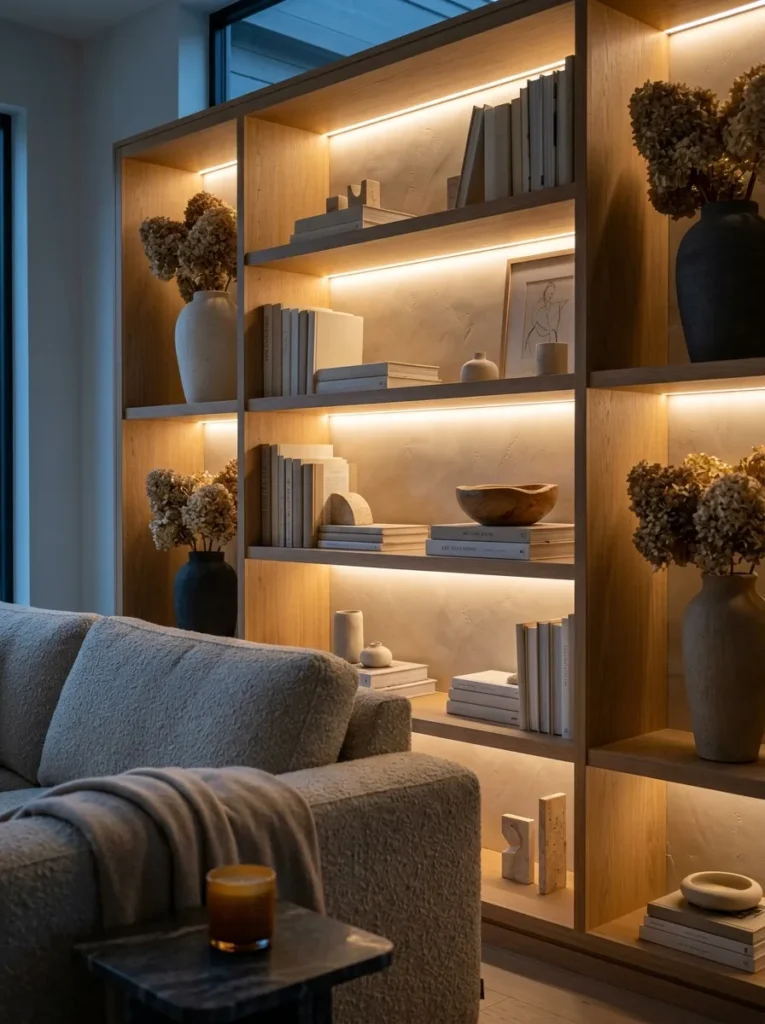
- Zone: Built-in bookshelf in the living room or home office
- Natural materials: Linen-bound books turned spine-in, matte ceramic vases, turned oak bowl, oak shelves
- Palette: Cream, oat, mushroom, pale oak
- Lighting: 2700K LED strips under each shelf edge
- Botanicals: Panicle hydrangea (Hydrangea paniculata), dried blooms that hold their cream color for a year or more
- Texture contrast: Papery petals against smooth glazed ceramic
- Shelf load: Hardcovers weigh about 20 pounds per linear foot, so long spans need a center support
- Standout detail: Book spines turned inward so cream page edges form one tonal block
Why this works: Turning book spines inward trades cluttered color for a calm block of cream.
Turning book spines inward is the fastest way to calm a shelf. Page edges are cream, oat, and ivory, so a row of them reads as one soft block of color instead of a patchwork of covers. Hardcovers weigh about 20 pounds per linear foot, so shelves spanning more than roughly 32 inches should have a center support or a thicker board, or they sag over time. Group the books in horizontal stacks of three or five, then break the rhythm with a gap. That gap is where a ceramic vase or oak bowl goes.
Now bring in the botanical. Panicle hydrangea blooms are made of papery sepals that dry on the stem, which is why they hold their cream color for a year or more. Cut stems when the blooms turn from white to blush-cream, strip the leaves, and stand them in a matte ceramic vase with no water. Place one tall vase at the end of each shelf. The papery petals against smooth glaze give each shelf a focal point, and 2700K LED strips under each shelf edge add a soft warm glow.
12. Rosemary Porch Steps
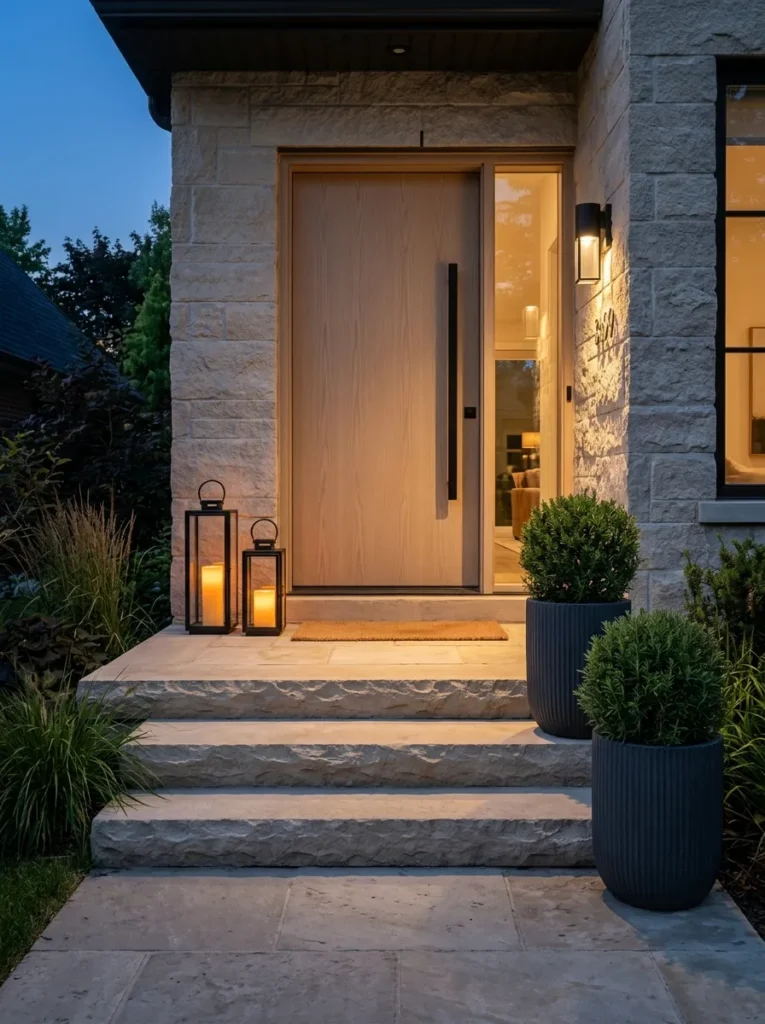
- Zone: Front porch, three limestone steps
- Natural materials: Limestone treads, fluted matte stoneware planters, pale oak and glass lanterns
- Palette: Limestone cream, bone, rosemary green, pale oak
- Lighting: 2200K flameless candle lanterns on the top tread
- Botanicals: Rosemary (Salvia rosmarinus) topiaries, living plants that stay green all season; cut sprigs last about a week in water
- Texture contrast: Rough-cut limestone against fluted, smooth stoneware
- Clear path: At least 36 inches of open tread width
- Standout detail: Two rosemary balls at graduated heights in planters at least 16 inches wide
Why this works: Living rosemary stays green all season, so a porch entry looks styled long after cut greenery fades.
Living plants earn a place on a porch that cut greenery never will. Rosemary is the one I trust in Austin, where it stays green through our mild winters and handles reflected heat off limestone. I trim mine into balls with sharp bypass pruners, taking no more than a third of the growth at once. A pair of topiaries in fluted stoneware planters gives you a symmetrical entry from December through spring, then keeps growing. Cut sprigs last about a week in water, so use trimmings in a bud vase indoors.
Steps are a path first and a display second. Keep at least 36 inches of open width on the treads, which is the standard minimum for a stair, and set planters on the outer edges. Place two tall lanterns with 2200K flameless candles on the top tread, tucked beside the door where nobody trips. Rough-cut limestone against fluted, smooth stoneware gives the entry real texture even in full afternoon sun. Water the rosemary only when the top inch of soil feels dry, since soggy roots kill it faster than cold does.
13. Norfolk Pine Reading Nook
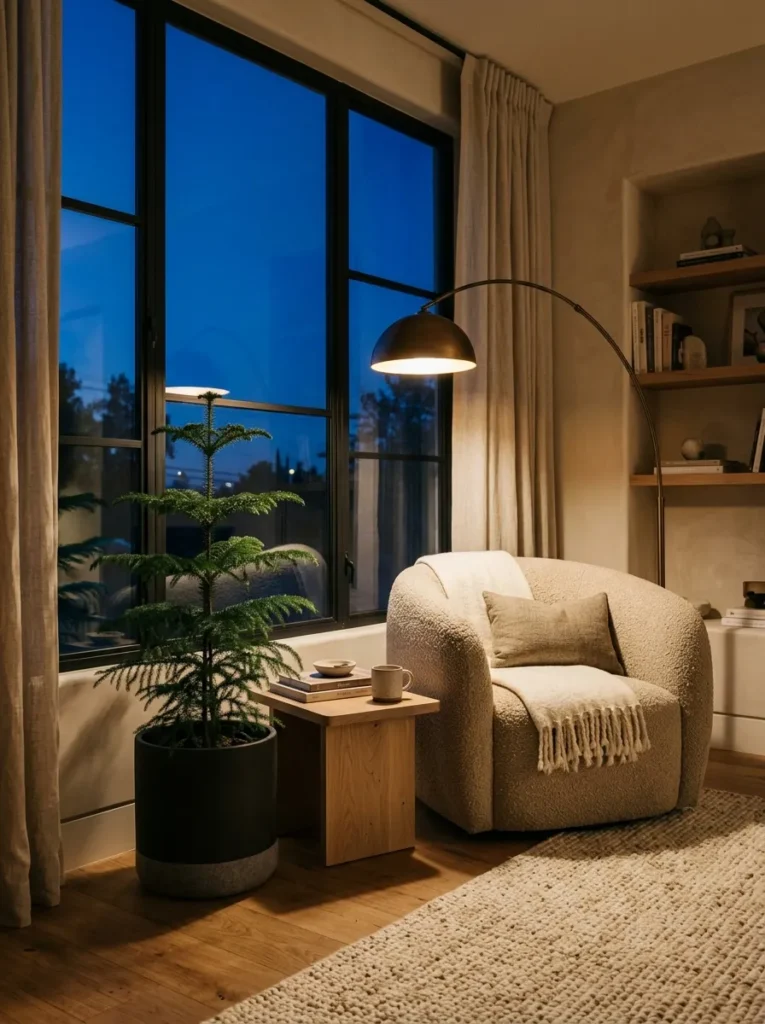
- Zone: Reading corner beside a window
- Natural materials: Curved oat bouclé chair, chunky ivory wool throw, felted wool collar, matte stoneware planter, pale oak side table
- Palette: Ivory, oat, dove-gray, pale oak
- Lighting: Arc floor lamp with a 2700K bulb
- Botanicals: Norfolk Island pine (Araucaria heterophylla), a living plant that lasts for years indoors with bright, indirect light
- Texture contrast: Soft wool against fine, feathery needles
- Care note: A quarter turn each week, water when the top inch of soil is dry
- Standout detail: A felted dove-gray wool collar around the base of the planter
Why this works: A living tabletop tree gives a reading corner a festive focal point that lasts well beyond the holidays.
My reading corner has had a Norfolk Island pine for three winters, and it has outlasted every cut tree I have bought. It is not a true pine. It is a tropical conifer, which is why it tolerates indoor temperatures of 65 to 75°F and needs bright, indirect light. Turn the pot a quarter turn each week so the branches grow evenly. Water when the top inch of soil feels dry. A two- to three-foot plant stays small enough for an end table, then keeps growing next year, so the purchase pays you back.
Build the nook around that little tree. A curved oat bouclé chair sits at an angle to the window, with a chunky ivory wool throw hung over one arm. The nursery pot slips inside a matte stoneware planter, with a collar of felted dove-gray wool around the base. A pale oak side table holds a mug and one small stack of books. An arc floor lamp with a 2700K bulb pools light over the chair. Soft wool against fine green needles is the contrast that makes the corner feel designed.
14. Russet Pear Sideboard
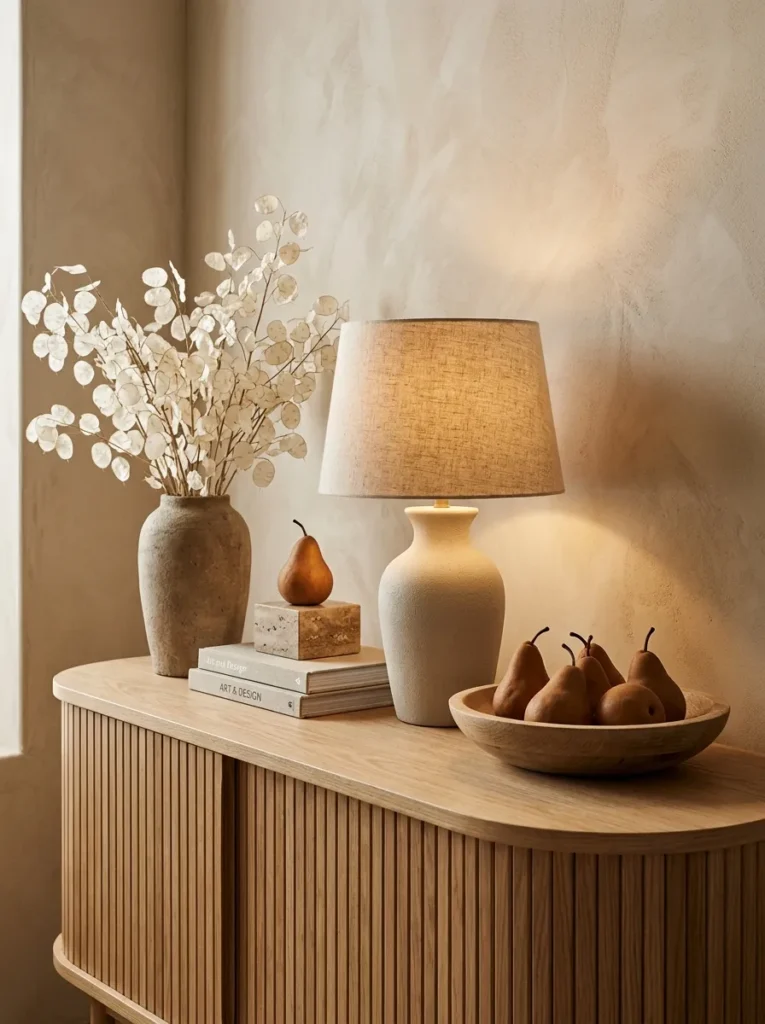
- Zone: Dining room sideboard
- Natural materials: Curved-front oak sideboard, shallow oak bowl, oak riser block, matte stoneware vase, linen lamp shade
- Palette: Russet, bone, oat, smoked oak
- Lighting: 2700K lamp with a linen drum shade
- Botanicals: Bosc pears (Pyrus communis), firm for five to seven days at room temperature; lunaria (Lunaria annua) pods, which dry on the stem and last for years
- Texture contrast: Suede-like russet pear skin against papery silver-white pods
- Shopping tip: Buy pears with stems intact a few days before guests arrive
- Standout detail: One pear balanced on a raw oak riser block above the others
Why this works: Fresh russet fruit adds real color to a neutral palette without a single printed or painted piece.
Fresh fruit is the easiest way to bring natural color into a neutral scheme, and Bosc pears are the best choice. Their russet-brown skin looks like suede, and they hold their shape longer than most fruit. At room temperature they stay firm for five to seven days, so shop a few days before guests arrive. Choose pears with stems intact and no bruises. Stack five in a shallow oak bowl, with a sixth on a small riser block. A tall vase of dried lunaria pods at the far end adds papery height and lasts for years.
Lunaria earns its place for good reason. Also called honesty, it grows flat seed pods that dry on the stem, and rubbing off the outer layers reveals a silver-white membrane that catches light like parchment. Place the tall vase at one end of a curved-front oak sideboard and the pear bowl at the other, with a 2700K linen-shaded lamp in the middle. Leave bare wood between each element so the pieces can breathe. Russet pear skin beside those pale membranes is the pairing guests notice first, and it keeps the whole sideboard from reading flat.
15. Birch Log Hearth — A Natural Christmas Decor Idea for a Cozy Fireplace
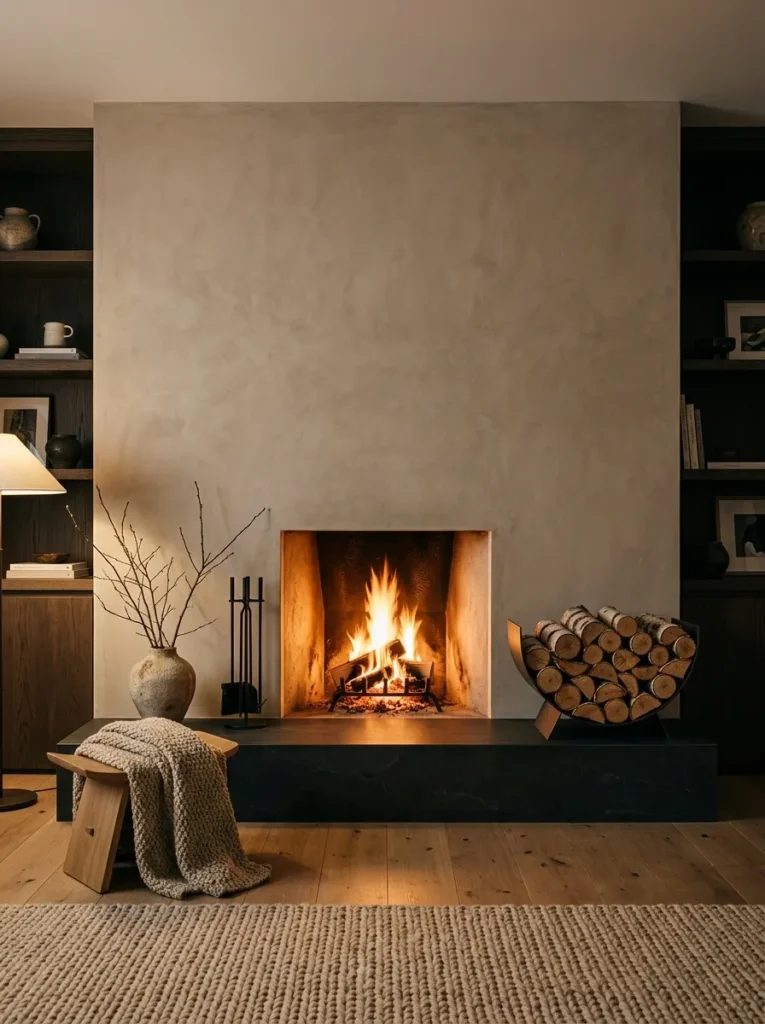
- Zone: Fireplace hearth and floor
- Natural materials: Silver birch logs, seasoned white oak logs, curved steel log rack, honed slate, oat wool throw, low oak stool
- Palette: Birch white, slate, oat, putty
- Lighting: Firelight plus a 2200K lamp across the room
- Botanicals: Dried lavender (Lavandula angustifolia), dries in about two weeks and keeps its scent for a year or two
- Texture contrast: Papery birch bark against honed slate
- Safety: Decor and firewood kept at least three feet from the fireplace opening
- Standout detail: Birch logs stacked bark-out in a curved rack
Why this works: A stack of white birch logs adds sculptural texture to a hearth while the fire does the glowing.
A fire is the best decor a hearth can have, and logs are the second best. Stack silver birch bark-out in a curved rack three feet to the side of the opening, and the white, papery bark reads like sculpture even when the fireplace is cold. I’ve noticed that bark-out stacks look neater, because the curled edges catch light. Birch burns fast and bright, so I buy a small bundle for display and keep seasoned oak, under 20 percent moisture, for actual burning. Firewood ignites easily, so the rack never sits closer than that.
Now add texture and scent. Tuck dried lavender (Lavandula angustifolia) into a stoneware jar on a wall shelf or the entry table, well away from the fire. Lavender dries in about two weeks and keeps its scent for a year or two, but dried stems ignite quickly, so distance matters. Honed slate underfoot and an oat wool throw folded over a low oak stool, also three feet back, complete the scene. Papery birch bark against cool, smooth slate gives the hearth contrast, and the whole corner reads as warm and quiet.
Styling Principles
Neutral stops looking flat the moment you stop asking color to do the work. Every scene above follows the same few rules.
- Layer three surfaces. Pair one rough, one smooth, and one soft or airy material in every scene: jute against maple, limestone against stoneware, wool against needles.
- Keep the palette to three or four tones. A neutral palette gains depth through texture, not color.
- Light everything at 2700K or warmer. Bulbs at 2700K and below keep oat, ivory, and bone looking creamy instead of gray.
- Add one living thing per room. Fir, rosemary, paperwhites, or a Norfolk Island pine bring scent and movement that synthetic pieces cannot.
- Leave bare space. Group items in odd numbers and leave open surface between groups so each texture can be seen.
- Respect distance. Keep dried botanicals and citrus at least 12 inches from open flame, and keep everything at least three feet from a working fireplace opening.
FAQs
1. How do I make neutral Christmas decor not look boring? Build depth with texture instead of color. Use three surfaces in every scene, such as rough jute, smooth ceramic, and soft wool, then add one living botanical like fir or rosemary. Vary heights, and light the room at 2700K so cream and oat tones glow.
2. How long do dried orange slices last? Dried orange slices last the whole holiday season in dry indoor air, and several years if stored in an airtight tin. Slice them a quarter inch thick and bake at 200°F for three to four hours. In humid rooms they can soften, so keep them away from steam and sinks.
3. What are the best natural materials for a Christmas tree? Start with a fresh noble fir, then decorate with wool felt balls, raw wood beads, jute cord, torn linen ribbon, and dried citrus. Noble fir has stiff branches that carry heavy natural ornaments without drooping. Skip glitter and glossy plastic, which fight the textured look.
4. How can I decorate with natural Christmas styling on a budget? Use what you can grow or forage. Clip bay, rosemary, or magnolia from your yard, bake your own orange slices, and wrap gifts in undyed muslin, which costs a few dollars a yard and can be washed and reused. Spend on one sculptural piece, like a stoneware vase, and let greenery fill the rest.
5. How do I make a neutral scheme feel festive? Add scent, living greenery, and warm light. Cedar, citrus, bay, and paperwhites bring a seasonal fragrance, while 2200K to 2700K bulbs and a few beeswax or flameless candles add glow. A single tall branch arrangement or a real tree signals Christmas even without red or gold.
6. Are dried botanicals safe near candles and fireplaces? Dried botanicals ignite quickly, so distance matters. Keep dried stems, citrus slices, and evergreen boughs at least 12 inches from a candle flame and at least three feet from a working fireplace opening. Use LED lights near greenery, and replace any branches that turn brittle.
Conclusion
You don’t need a bigger budget or a bolder palette to make Christmas feel special. You need good materials, honest texture, and warm light. Start with one idea from this list, whether that’s a pot of paperwhites or a bundle of olive branches, and let it set the tone. I’ve seen how small changes like these can transform a room, and the best neutral Christmas decor ideas only get better as the wool softens and the wood deepens.
Save this post on Pinterest, try one idea this week, and share it with a friend who loves a calm, beautiful home.