
15 Christmas Wreath Ideas for a Front Door That Stands Out
You hung the wreath. You added the ribbon. So why does your front door still look a little off?
Most of the time, the answer isn’t the decoration. It’s the size. These Christmas wreath ideas fix that problem first, then show you 15 modern designs with exact diameters, ribbon widths, color palettes, and door pairings, so you can recreate any look without guessing. From a velvet-bowed cypress ring on a lavender-gray door to a moss hoop on matte black, every idea is a complete picture.
I’ve hung, fixed, and re-hung more wreaths than I can count, and I’ve noticed that proportion changes everything. Save your favorites, because your door is about to look intentional.
A wreath that’s too small will undercut even the most expensive ornaments. The eye reads scale first and detail second. On a standard 36-inch door, anything under about 20 to 24 inches reads as undersized. That’s why so many beautifully decorated wreaths still look wrong once they’re hanging. My first wreath at our Austin house was a lovely 16-inch ring that looked like a dinner plate taped to a barn door. A Christmas door wreath looks intentional when it covers half to two-thirds of the door’s width, regardless of what’s pinned to it. This post fixes the sizing first, then walks through fifteen full designs with exact diameters, ribbon widths, and door colors.
1. Cranberry on Fraser Fir — A Christmas Wreath Idea with Classic Proportions
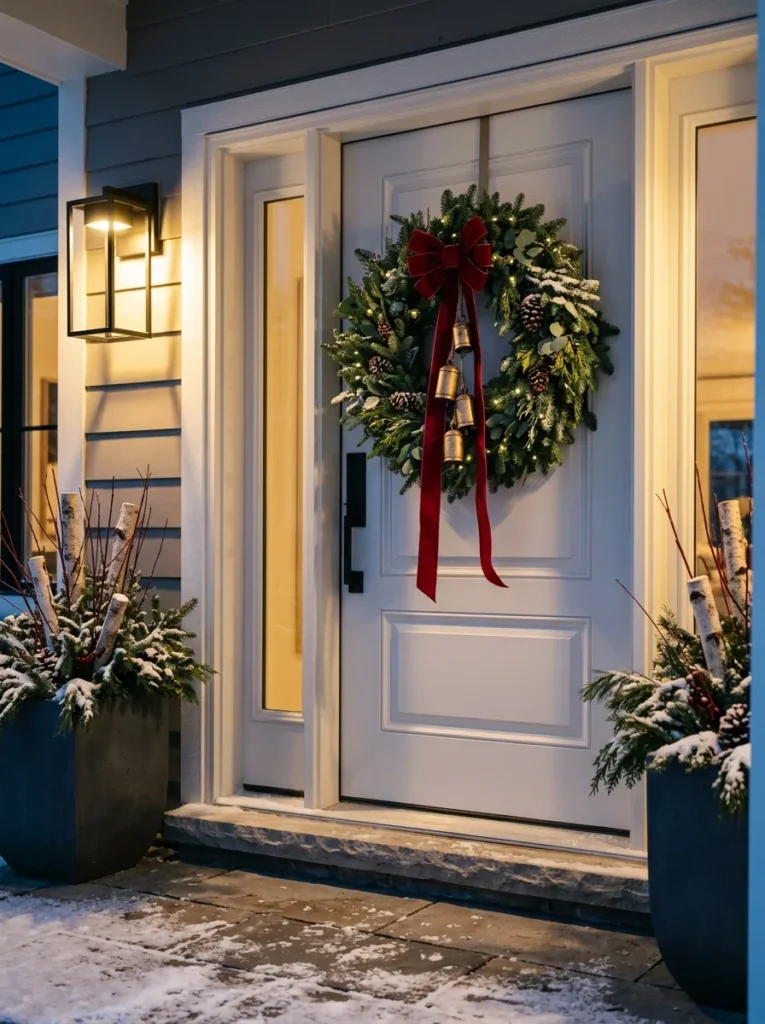
- Base: Fresh Fraser fir on a double-ring frame, dense on the outer edge, trimmed clean
- Size and proportion: 24-inch diameter on a 36-inch door, about two-thirds of the width
- Palette: Fir green, cranberry red, walnut brown, antique brass
- Ribbon: 2.5-inch wired cranberry velvet in a loose single-loop bow, 14-inch tails cut in an inverted V
- Botanicals: Winterberry (Ilex verticillata) in one off-center cluster at four o’clock, plus three eastern white pine cones
- Door pairing: Bone-white satin door
- Standout detail: One antique brass sleigh bell hung from the bow center on a leather lace
- Fresh vs. faux: Fresh smells incredible but starts drying in about 3 to 4 weeks in warm weather
Why this works: A 24-inch wreath on a 36-inch door fills about two-thirds of its width, the proportion that reads as intentional from the street.
A freshly cut Fraser fir wreath weighs more than most people expect, often 6 to 8 pounds once the stems are hydrated, and that number should decide your hardware before it decides your ribbon. Choose an over-the-door hanger rated for at least double that weight, and slip a strip of felt behind the hook so the metal never rubs satin paint. Fraser holds its needles better than most firs, and its stiff branches carry ornaments without drooping. In warm weather, expect pliable needles for roughly three to four weeks; in cold climates, much longer.
Against a bone-white satin door, the contrast does all the heavy lifting. Fir green and cranberry red are traditional for a reason, but walnut-brown pinecones and an antique brass bell keep the palette from turning candy-cane. The bow sits at the six o’clock position, loosely tied from 2.5-inch wired velvet with tails cut in an inverted V, and the bell hangs from its center on a leather lace. At 24 inches, the ring fills two-thirds of the door’s width, so even from the sidewalk you read it as a deliberate focal point rather than an afterthought.
2. Oversized Noir Ring
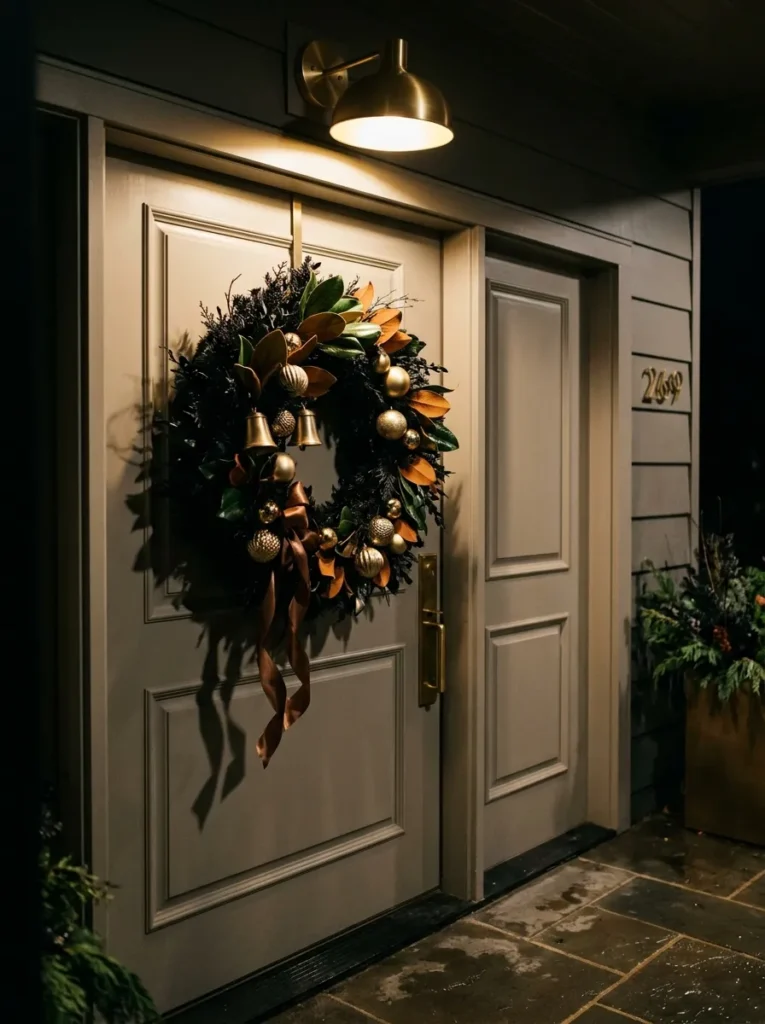
- Base: Faux, extra-full grade, matte black needles, double-layered
- Size and proportion: 28-inch diameter on a 36-inch door, about 78 percent of the width (a deliberate step past the usual two-thirds)
- Palette: Matte black, brushed brass, champagne, suede brown
- Ribbon: 4-inch wired black satin, spiraled through the wreath instead of tied, loose tails at nine o’clock
- Botanicals: Preserved southern magnolia leaves (Magnolia grandiflora) with brown suede undersides facing out
- Door pairing: Warm greige satin door with brushed-brass hardware
- Standout detail: Off-center cluster at four o’clock: two 5-inch matte black glass ornaments and one hammered brass
- Fresh vs. faux: Faux lasts for years but needs high density to look real in black
Why this works: Black faux greenery needs a higher fullness grade than green because dark needles absorb light and make sparse gaps read as holes.
I once hung a black faux wreath labeled ‘full’ on a pale door and watched it read as a sparse ring of pipe cleaners from the curb. Dark colors hide depth, so black needs more density than green does. Now I buy only extra-full grade, and I ask for the tip count because retailer labels like ‘full’ and ‘deluxe’ mean different things. A wreath built that way holds its shape for years, which is the advantage of faux over fresh: no 3-to-4-week countdown, just a dense matte ring that still looks sharp in year three.
Greige is a smarter backdrop for black than white, because the mid-tone door keeps the contrast crisp without making the wreath look like a hole. At 28 inches, this ring covers about 78 percent of a 36-inch door, a deliberate step past the usual two-thirds that works only when the door is flat and plain. The black ribbon spirals through instead of bowing, and preserved magnolia leaves show their brown suede undersides next to brushed-brass ornaments. Up close, the textures read as suede, satin, and metal; from the street, it reads as one bold circle.
3. Flocked Vertical Swag
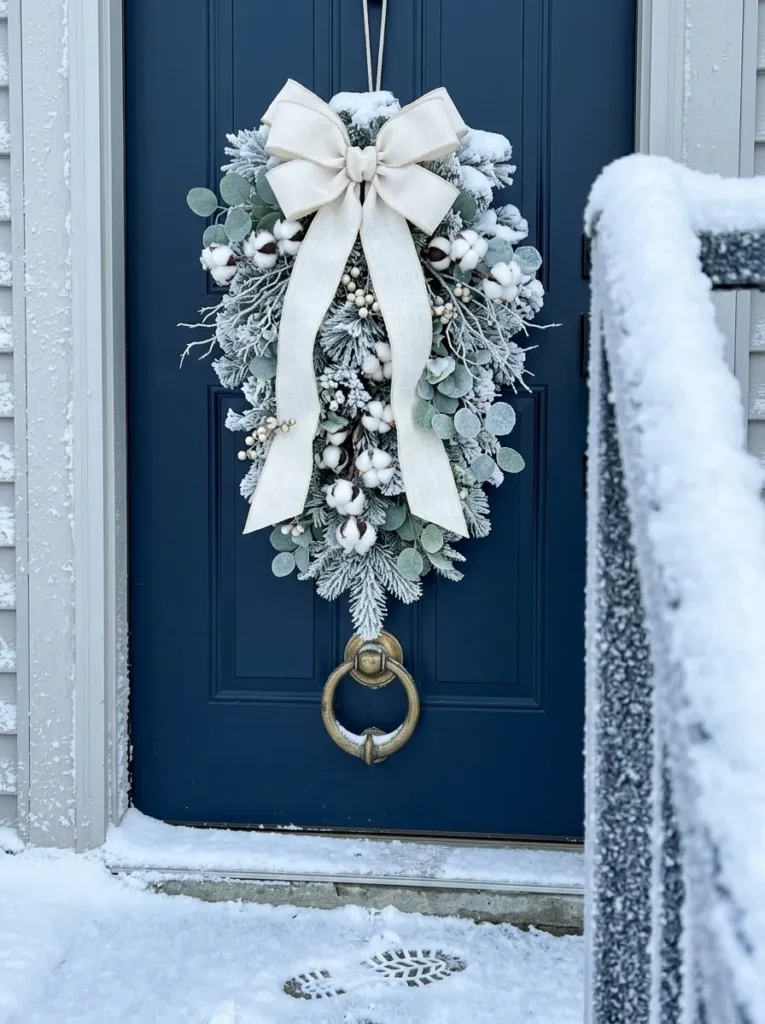
- Base: Faux flocked noble fir swag, full grade
- Size and proportion: 42 inches long by 14 inches wide, about half of an 80-inch door’s height
- Palette: Snow white, silver-sage, pearl, ivory
- Ribbon: 3-inch ivory washed-linen ribbon, doubled as the hanging loop, tails falling 24 inches and cut at an angle
- Botanicals: Silver dollar eucalyptus (Eucalyptus cinerea) and dried cotton bolls (Gossypium hirsutum)
- Door pairing: Ink-navy satin door
- Standout detail: Cotton bolls wired in a staggered cluster in the lower third, a nod to Texas fields
- Fresh vs. faux: Flocked faux keeps its snowy coat for years; a fresh swag starts drying within weeks
Why this works: A vertical swag looks balanced at roughly half the door’s height, about 40 inches on a standard 80-inch door.
A flocked swag only looks like fresh snowfall if the door behind it is dark, and ink-navy is my favorite way to prove it. White needles vanish against a white door, so the contrast does the work of drawing the eye. Fourteen inches wide by 42 inches long, it covers about half the door’s 80-inch height and leaves the navy visible on both sides, which suits a vertical shape better than a width rule. Silver dollar eucalyptus adds a gray-green layer, and dried Texas cotton bolls add soft, matte texture that I’ve seen guests stop to touch.
Where you hang a swag matters as much as how it looks. Adhesive hooks are the usual shortcut, but my husband, who builds homes for a living, warns they’re meant to be applied above roughly 50°F and often let go in a freezing snap, sometimes lifting paint. He uses a padded over-door hanger instead. Flocking sheds under rough handling, so lift the swag by its frame, not its tips, and store it upright in a box. Treated that way, it keeps its snowy coat for years, while a fresh swag starts drying out within three to four weeks.
4. Merlot Crescent
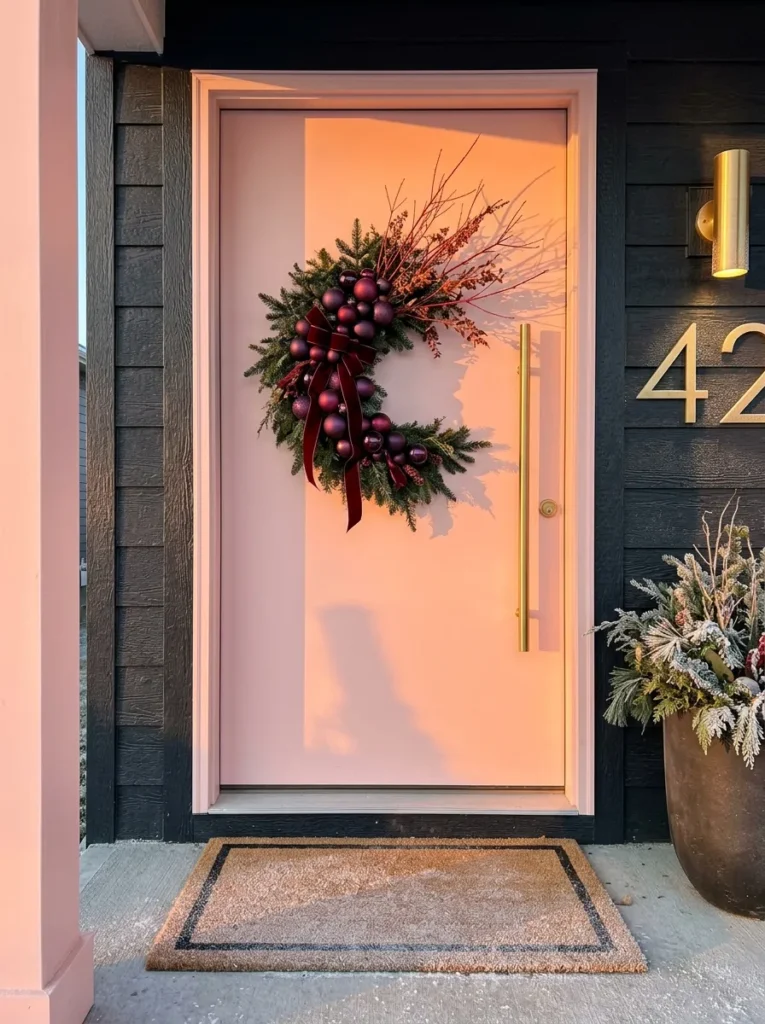
- Base: Fresh western red cedar (Thuja plicata) on a 24-inch ring, full along the lower left and tapering to bare wire at the upper right
- Size and proportion: 24-inch diameter on a 36-inch door, about two-thirds of the width
- Palette: Cedar green, merlot, plum, blush
- Ribbon: 4-inch merlot velvet, draped diagonally across the lower left and tucked behind the frame, no bow
- Botanicals: Red-twig dogwood stems (Cornus sericea) fanned 16 inches past the open end, plus three matte plum glass ornaments (4, 3, and 2 inches)
- Door pairing: Pale blush satin door
- Standout detail: The dogwood stems escape the ring like a comet tail
- Fresh vs. faux: Fresh cedar stays supple for about three to four weeks in cool weather, less in heat
Why this works: Keeping every tone in one color family makes a wreath read as a single bold shape from the street, which is what separates designed from decorated.
I used to think a pink front door and a red wreath couldn’t coexist, until I tried it on a friend’s entry in East Austin. The blush paint made the merlot velvet look deeper and richer, and the cedar green stopped it from reading sweet. Western red cedar helps too: its flat, fanned sprays are naturally elegant, and the foliage stays supple for about three to four weeks in cool weather, less in Texas heat. Because every tone, from plum glass to blush paint, sits in one color family, the wreath feels designed rather than decorated.
The crescent is where this design earns its keep. The 24-inch ring covers two-thirds of a 36-inch door, but the bare upper right opens the shape, so it feels lighter than a full circle. Three plum glass ornaments, 4, 3, and 2 inches wide, sit at the heaviest point of the cedar, graduating from large to small. Merlot velvet, 4 inches wide, drapes across the lower left without a bow, which keeps the silhouette sculptural. Red-twig dogwood stems escape past the open end, adding a scarlet line that catches porch light and ties the wreath to the blush door.
You’ll Also Love: 15 Neutral Christmas Decor Ideas That Look Expensive
5. Silver Pine Oval
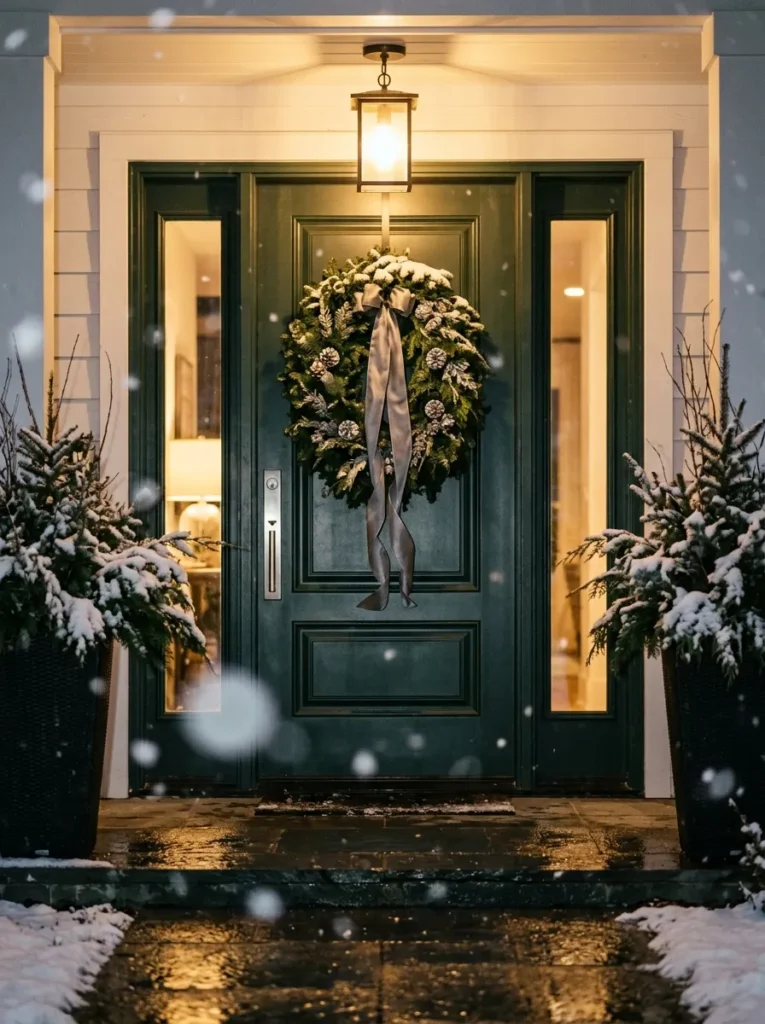
- Base: Fresh white pine (Pinus strobus), bundles wired in one direction onto an oval frame
- Size and proportion: 18 inches wide by 30 inches tall, half of a 36-inch door’s width and about 38 percent of an 80-inch door’s height
- Palette: Gray-green, pewter, silver, deep forest green (the door)
- Ribbon: 5-inch pewter silk taffeta, flat knot at the top, 35-inch tails falling through the open center, cut on the bias
- Botanicals: Silvery artemisia (Artemisia ludoviciana) sprigs and three 3-inch silver-leafed pine cones low on the left
- Door pairing: Deep forest-green satin door
- Standout detail: One pewter ribbon falling through the center like a plumb line
- Fresh vs. faux: Fresh white pine stays soft for about three to four weeks in mild climates
Why this works: A tall oval echoes the vertical lines of a door, so an 18-by-30-inch wreath fills the upper panel while staying at half the door’s width.
White pine is the quiet star of modern wreaths. Its needles are long, soft, and gray-green, grouped in bundles of five, which gives a wreath a feathery, almost brushed look that spiky firs can’t match. It also holds up well in cold weather, though expect about three to four weeks of freshness in mild climates. For this oval frame, wire the bundles in the same direction, all sweeping clockwise, so the finished shape reads as one smooth current. Gaps are the enemy, so overlap each bundle by about half, and keep the back as full as the front.
Picture a pewter ribbon falling straight down a deep green door, like a plumb line. That single vertical stroke is the whole design. The oval measures 18 inches wide by 30 inches tall, so it covers half the door’s width and clears the handle by a generous margin. Silver-leafed pine cones, three of them, sit low on the left, while silvery artemisia adds a dusty, moonlit texture. The 5-inch silk taffeta ribbon starts in a flat knot at the top, then falls 35 inches through the open center, trimmed on the bias, which keeps the line crisp.
6. Mirrored Copper Pair
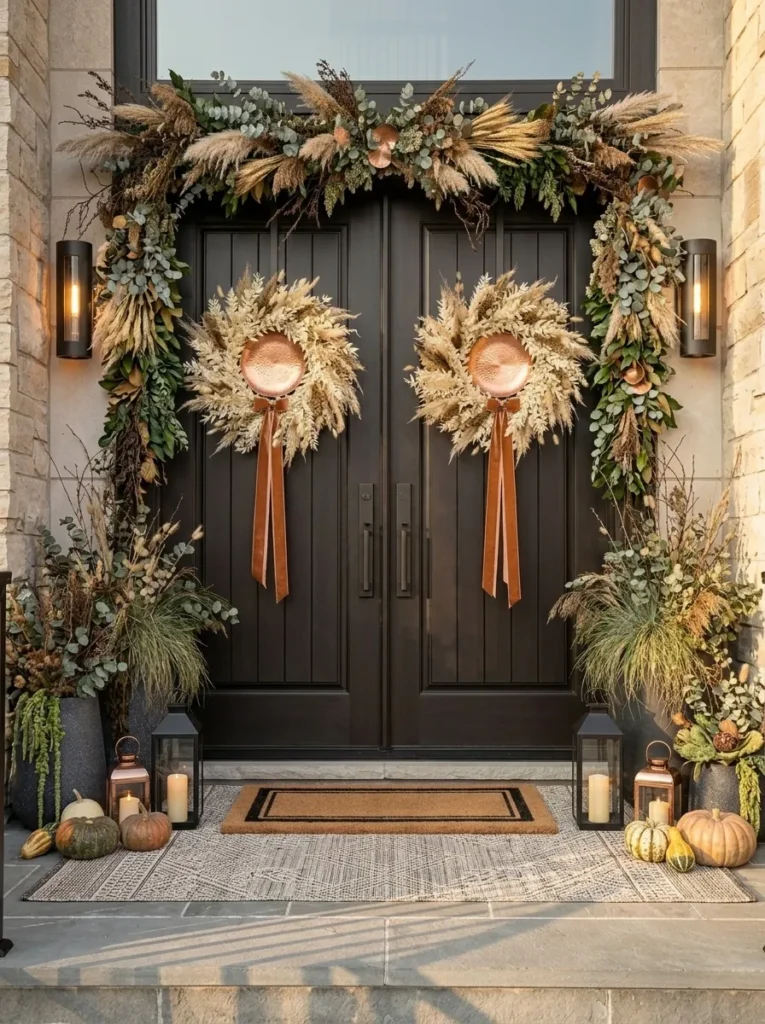
- Base: Preserved bleached ruscus (Ruscus aculeatus) on two 22-inch rings, covered-porch use
- Size and proportion: 22-inch diameter on each 36-inch door leaf, about 61 percent of each leaf’s width
- Palette: Burnished copper, cream, sand, espresso brown (the doors)
- Ribbon: 2-inch copper silk, flat knot at the bottom of each ring, 14-inch tails mirrored toward the center seam
- Botanicals: Dried bunny tail grass (Lagurus ovatus) tucked between the ruscus
- Door pairing: Deep espresso-brown double doors
- Standout detail: Three hammered copper discs (2 inches wide) per wreath, wired at mirrored heights
- Hardware: One solid brass hook per leaf, set 60 inches above the floor with a laser level
Why this works: Mirrored wreaths measured from the floor, not the door top, line up even when the porch or frame is slightly out of level.
Symmetry is easy to get wrong on double doors, because nothing about a house is perfectly level. When I helped style this entry, my husband skipped the tape measure and used a laser level, marking both hooks at exactly 60 inches from the porch floor. Door tops and thresholds rarely match, so measuring from the floor is the surest way the wreaths line up. Dried ruscus is light enough for one hook per door, but direct afternoon sun fades it within a season, so this pair belongs on a covered porch where it stays creamy for years.
Two wreaths, one mirrored composition, and suddenly an ordinary entry looks architectural. Each 22-inch ring covers about 61 percent of its 36-inch door leaf, and the hooks sit 60 inches off the floor. Copper silk ribbon, 2 inches wide, ties in a flat knot at the bottom of each ring, with 14-inch tails mirrored so they sweep toward the center seam. Cream ruscus and bunny tail grass keep the palette soft, while hammered copper discs flash like small coins. Against deep espresso doors, the burnished metal glows like candlelight and the cream reads as crisp relief.
7. Reindeer Moss Hoop
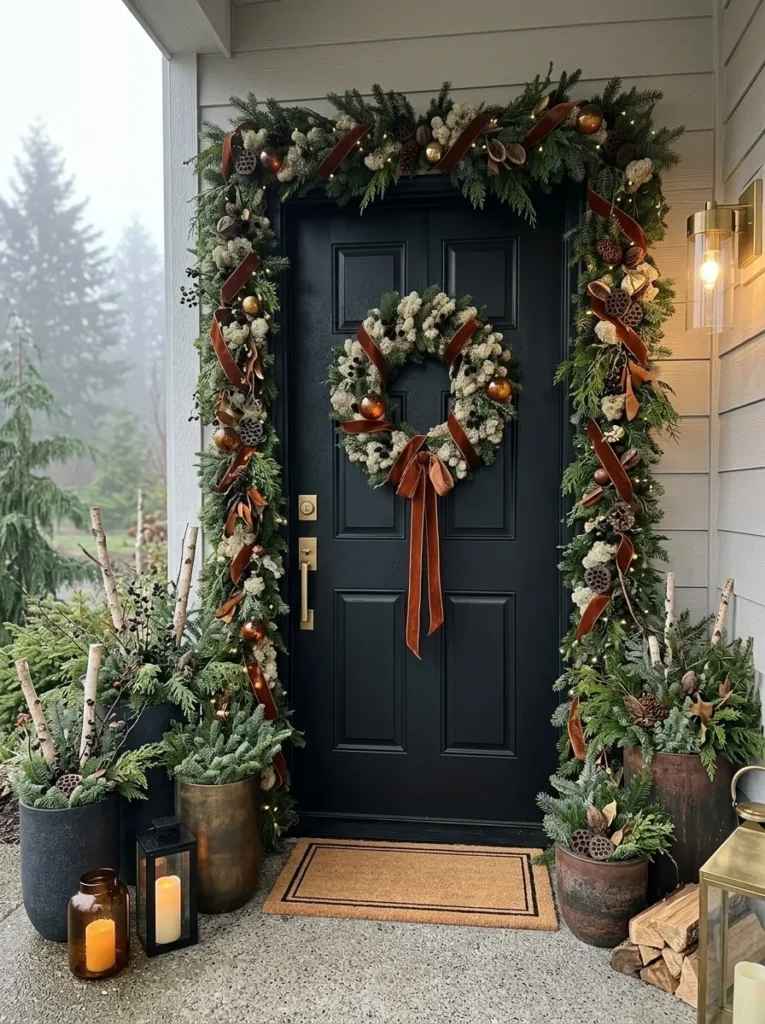
- Base: Preserved reindeer moss (Cladonia rangiferina) packed 4 inches deep onto a 22-inch ring
- Size and proportion: 22-inch diameter on a 36-inch door, about 61 percent of the width
- Palette: Moss green, bark charcoal, cinnamon, amber
- Ribbon: 1.5-inch cinnamon velvet, spiraled around the lower right third, ends tucked behind
- Botanicals: Fresh Norway spruce tips (Picea abies) tapering along the lower left, plus dried black alder cones (Alnus glutinosa)
- Door pairing: Matte black door
- Standout detail: One 4-inch hand-blown amber glass ornament hung off center on waxed black cord
- Fresh vs. faux: Preserved moss lasts for years but needs a roof overhead; the spruce tips stay fresh about three weeks and are easy to swap
Why this works: Lichen, spruce, and alder cones in matching gray-green tones give a wreath depth without color noise, so one amber ornament becomes the entire focal point.
Reindeer moss isn’t a moss at all. It’s a lichen, a partnership between a fungus and an alga, and it grows slowly in cold, open woodland. Florists preserve it in a glycerin-based solution, which keeps it soft and springy for years without watering. That’s the catch for porches: moisture can make preserved lichen limp and moldy, so hang this wreath only where a roof overhead keeps rain and sprinkler spray away. Packed four inches deep onto a 22-inch ring, it looks like a cushion of forest floor, and it’s lightweight enough for a single brass hook.
Think of it as a forest floor you can hang on your door. Against matte black paint, the moss reads as velvet, and the 22-inch ring covers about 61 percent of a 36-inch door. Norway spruce tips taper along the lower left, while tiny black alder cones add a speckled, nubbly texture. One band of 1.5-inch cinnamon velvet ribbon spirals around the lower right third, and a single 4-inch amber glass ornament hangs off center on waxed black cord. That one warm glow becomes the focal point, so the whole wreath feels quiet, tactile, and unmistakably Christmas.
8. Clipped Boxwood Square
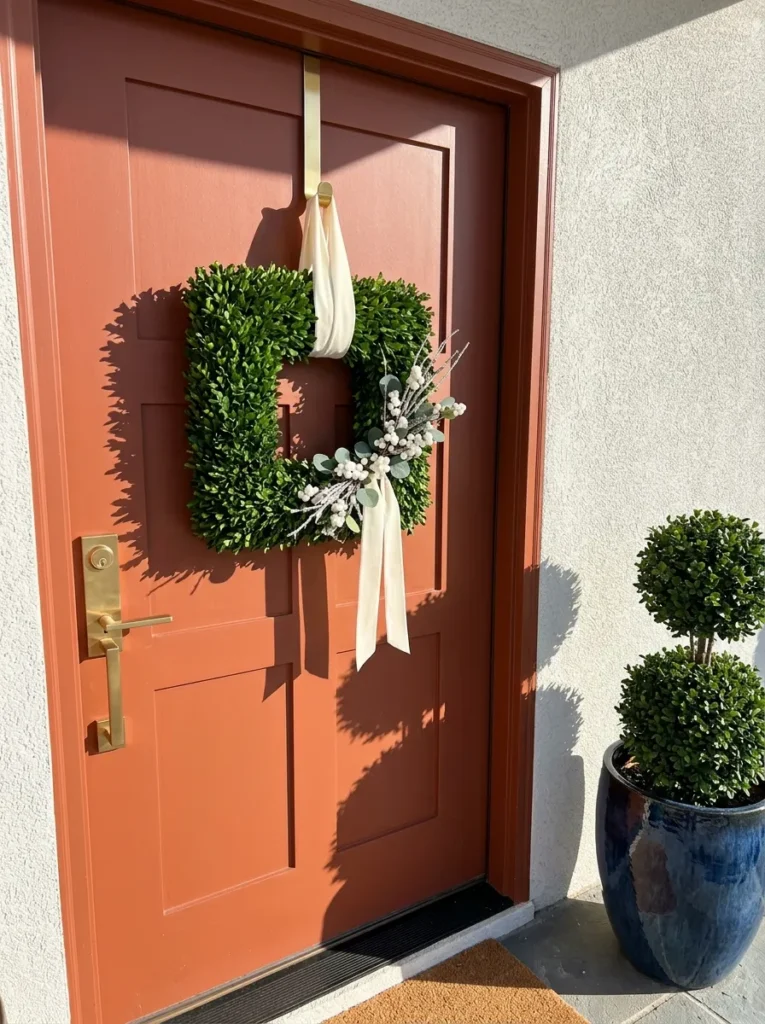
- Base: Faux boxwood (Buxus) panels on a 20-inch square frame, extra-full grade, UV-treated
- Size and proportion: 20-inch square on a 36-inch door, about 56 percent of the width
- Palette: Boxwood green, ivory, brushed brass, baked clay (the door)
- Ribbon: 3-inch ivory velvet, one flat loop at the upper left corner with no tails, wired in place
- Botanicals: Dried white snowberry (Symphoricarpos albus) sprigs along one diagonal, lower left to upper right
- Door pairing: Terracotta satin door
- Standout detail: Sharp square corners with snowberry running on a single diagonal
- Fresh vs. faux: Faux outlasts fresh by years, but only UV-treated foliage resists fading in direct sun
Why this works: A square silhouette repeats the straight lines of a door, so a 20-inch wreath feels built into the architecture rather than hung on top of it.
I tested a lot of faux boxwood before trusting it on a south-facing Austin door. The cheap panels faded to a dull olive within one season, which is why I now look for UV-treated foliage and the extra-full grade. Among all the Christmas wreath ideas I’ve tried, this square is the most forgiving: clipped edges hide gaps, and it never sheds on the welcome mat. Fresh boxwood would smell lovely, but it browns within about three to four weeks in warm weather, while a good faux panel keeps its crisp green for years.
Straight lines are the fastest way to make a wreath look modern. This one measures 20 inches square, covering about 56 percent of a 36-inch door, and its clipped boxwood edges echo the door’s panel lines. Against a baked-clay satin door, the green looks richer, while ivory velvet ribbon, 3 inches wide, forms one flat loop at the upper left corner. Dried white snowberry sprigs run along a single diagonal, adding soft pearly dots to all that sharpness. A brushed brass hook is the only metal you’ll see, which keeps the whole composition calm.
9. Ivory Hydrangea Hoop
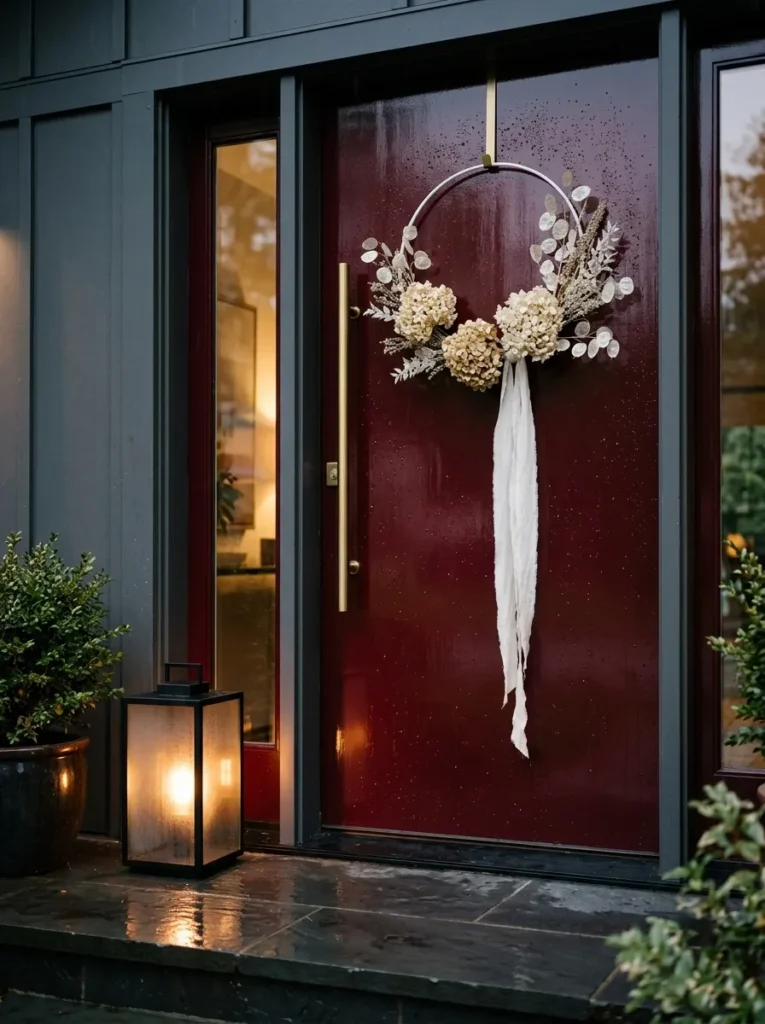
- Base: 24-inch powder-coated steel hoop in chalk white, left mostly bare
- Size and proportion: 24-inch diameter on a 36-inch door, about two-thirds of the width
- Palette: Chalk white, ivory, pearl, oxblood (the door)
- Ribbon: 3-inch ivory silk-satin, wrapped once around the lower left of the hoop, trailing 10 inches below
- Botanicals: Three dried white hydrangea heads (Hydrangea paniculata) and dried lunaria (Lunaria annua) sprigs
- Door pairing: Glossy oxblood lacquer door
- Standout detail: The bare upper two-thirds of the hoop frames the oxblood paint like a picture frame
- Hardware: One padded hook; wait about 30 days after painting before hanging
Why this works: Leaving most of a 24-inch hoop bare lets the door color show through the center, so the door itself becomes part of the design.
Glossy red doors show every scratch, and that’s the first thing my husband checks before he lets anyone hang a wreath. Paint feels dry in hours, but it can stay soft for about 30 days, so a hook or hanger pressed into it too soon leaves a lasting dent. If you’ve repainted for the season, wait out the cure, or use a padded over-door hanger with felt on both sides. Dried hydrangea and lunaria are feather-light, so even a slim steel hoop with a cluster of heads on one side hangs securely from one padded hook.
White against red is the oldest contrast in holiday decorating, so the trick is making it feel new. A 24-inch steel hoop, powder-coated in chalk white, covers two-thirds of a 36-inch door, and most of it stays bare. Three dried white hydrangea heads crowd the lower left, with paper-thin lunaria discs fanning above them. A 3-inch ivory silk-satin ribbon wraps the hoop once and trails 10 inches below it. Through the open center, the glossy oxblood door glows like a painting in a frame. It’s the quietest wreath here, and the one I’d save first.
10. Bay Laurel and Lemons
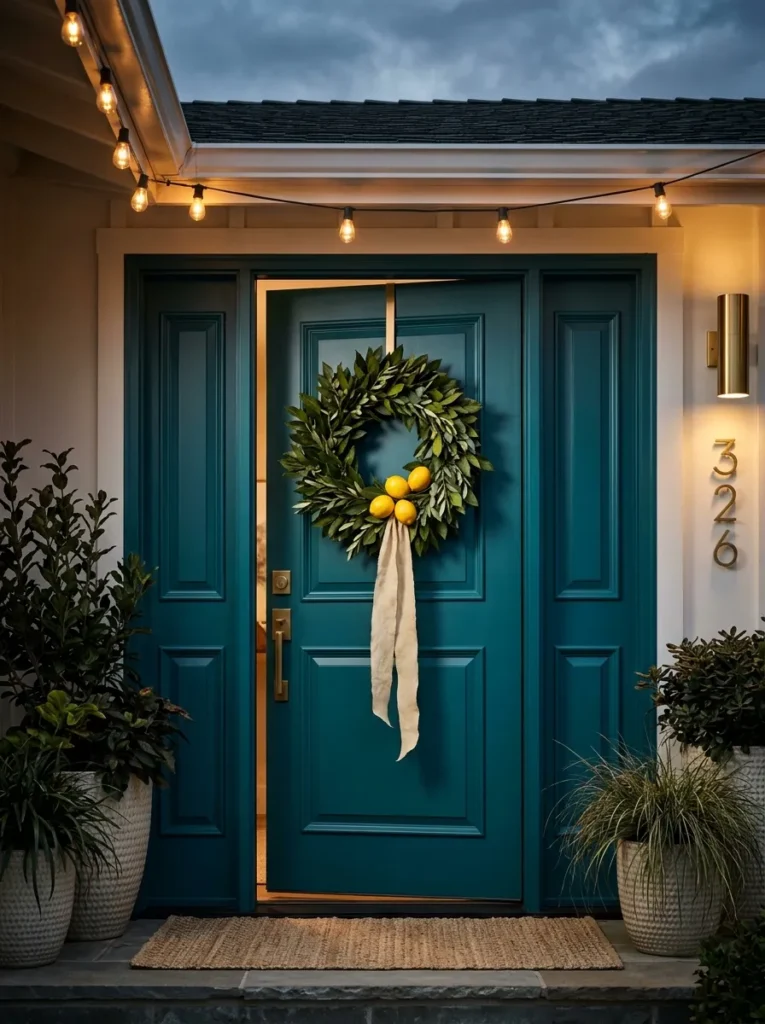
- Base: Fresh bay laurel (Laurus nobilis) stems wired onto a 24-inch ring, left open at the top in a four-inch gap like a crown
- Size and proportion: 24-inch diameter on a 36-inch door, two-thirds of the width
- Palette: Bay green, lemon yellow, parchment, deep teal (the door)
- Ribbon: 1.5-inch parchment silk, flat square knot at the bottom, 6-inch tails with frayed ends
- Botanicals: Three small whole Meyer lemons (Citrus × meyeri) on floral picks, plus the laurel itself
- Door pairing: Deep teal satin door
- Standout detail: A descending cluster of three lemons at five o’clock, with the open crown gap showing the teal paint
- Fresh vs. faux: Bay leaves dry gracefully and keep their scent; the lemons stay bright about two to three weeks
Why this works: One saturated accent, here lemon yellow against teal, gives a mostly green wreath a clear focal point without adding clutter.
A neighbor once asked if my wreath was real, because she could smell it from the sidewalk. That’s the bay laurel. Its leaves release a peppery, herbal scent when the sun warms them, and unlike fir, they dry gracefully instead of dropping, holding their shape and fragrance long after the wreath stops looking fresh. I’ve left a laurel ring up through January and watched it turn from deep green to soft olive without losing its form. Wire the stems in one direction, leave a four-inch gap at the top, and the crown shape does most of the styling for you.
Lemons and laurel are a pairing borrowed from the Mediterranean, and on a deep teal door they feel brand new. The 24-inch crown covers two-thirds of a 36-inch door, with its open top letting the teal paint breathe. Three Meyer lemons sit in a descending cluster at five o’clock, wired on floral picks so the stems stay hidden. A 1.5-inch parchment silk ribbon ties in a flat square knot at the base, its frayed tails brushing the lowest lemon. Expect the fruit to stay bright for about two to three weeks in cool weather, then swap in fresh ones.
11. Whitewashed Cone Sunburst
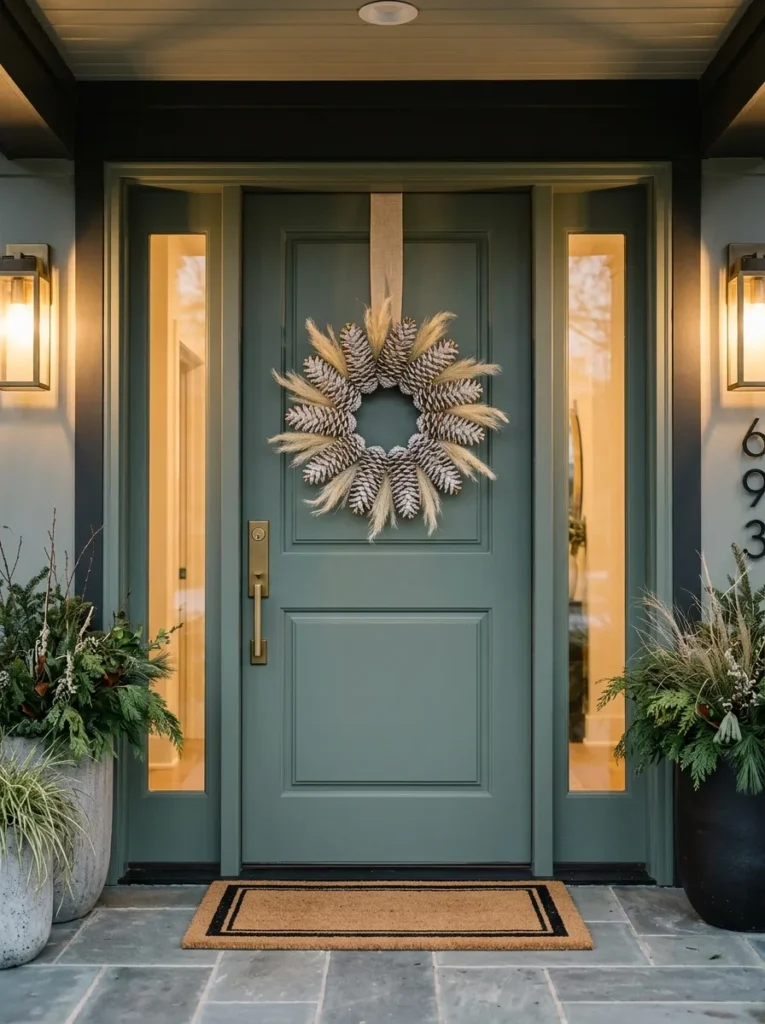
- Base: Loblolly pine cones (Pinus taeda), whitewashed and wired in three overlapping rings onto a 21-inch grapevine base
- Size and proportion: 21-inch diameter on a 36-inch door, about 58 percent of the width
- Palette: Whitewash, walnut, warm gray, brushed brass
- Ribbon: 2-inch oatmeal linen, folded into a hanging loop with one 12-inch tail
- Botanicals: Mexican feather grass (Nassella tenuissima) tufts tucked between the cone rings
- Door pairing: Sage-green satin door
- Standout detail: Inner-ring cone tips dipped in brushed brass so the center glints
- Preparation: Bake cones at 200°F for about 30 minutes to remove insects before using; they then last for years
Why this works: Overlapping cones in rings create a flat, radial pattern with real depth, so a 21-inch wreath reads as a sculptural sunburst from the street.
Pine cones come with hitchhikers. Before any cone goes on a wreath, bake it on a foil-lined sheet at 200°F for about 30 minutes. The heat kills insects and their eggs, melts surface sap, and opens the scales wider, which makes the cones look fuller. Loblolly pine (Pinus taeda), the Piney Woods native of East Texas, produces cones three to six inches long with sharp tips that take paint well. Brush on a one-to-one mix of white paint and water, wipe back with a rag, and let the walnut tone show through the cracks for a frosted, weathered finish.
Look closely and the whole wreath is repetition: one shape, rotated, layered, and stacked until it forms a sunburst. The 21-inch ring covers about 58 percent of a 36-inch door. Three rings of cones overlap like feathers, with the inner ring’s tips dipped in brushed brass so the center glints. Tufts of Mexican feather grass soften the edges with pale gold movement, and a 2-inch oatmeal linen ribbon folds into a hanging loop with one 12-inch tail. Against a sage-green satin door, the whitewashed cones look like frost on bark from the street.
12. Eucalyptus Chain Pendant
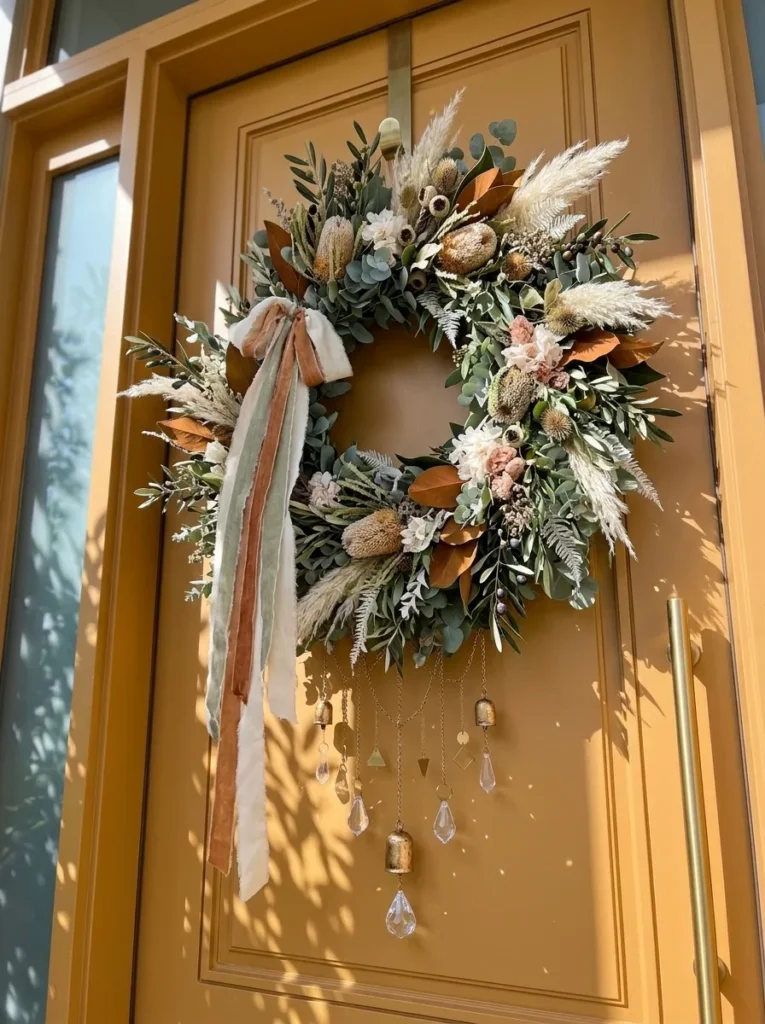
- Base: Preserved baby blue eucalyptus (Eucalyptus pulverulenta) on a 22-inch ring, kept slim at about 3 inches deep
- Size and proportion: 22-inch ring on a 36-inch door, about 61 percent of the width, with chains dropping 10 inches below
- Palette: Silver-blue, brushed brass, polished nickel, ochre (the door)
- Ribbon: 1-inch ivory silk, doubled into a flat hanging loop with no tails
- Botanicals: Preserved baby blue eucalyptus only, for single-species restraint
- Door pairing: Warm ochre satin door
- Standout detail: Three fine chains in brushed brass, polished nickel, and blackened steel, hanging at 6, 8, and 10 inches, each ending in a 1.5-inch clear glass teardrop
- Fresh vs. faux: Preserved eucalyptus holds its color for a season or more but drifts toward tan in sun and damp air
Why this works: Blue-gray foliage against a warm ochre door is a complementary pairing, so the wreath looks vivid without needing a single red or green accent.
Mixed metals only look intentional when you cap them at three. I learned that after a wreath of mine collected brass, gold, copper, silver, and chrome and looked like a hardware aisle. Here, brushed brass, polished nickel, and blackened steel are the limit, each in a different chain length so none competes. Preserved baby blue eucalyptus is the quiet base, light enough for a single padded hook. It keeps its silver-blue color for a season or more, but direct sun and damp air push it toward tan, so give it a covered porch.
Treat the wreath like jewelry and the door like velvet. The 22-inch eucalyptus ring covers about 61 percent of a 36-inch door, kept slim at 3 inches deep so the silver-blue leaves stay graphic. Three fine chains hang from the bottom at 6, 8, and 10 inches, each ending in a 1.5-inch clear glass teardrop that catches light like an icicle. A 1-inch ivory silk ribbon, doubled into a flat loop, hangs the ring without tails. Against a warm ochre satin door, the blue-gray and metal glow with a calm, expensive contrast.
13. Emerald Velvet Bow
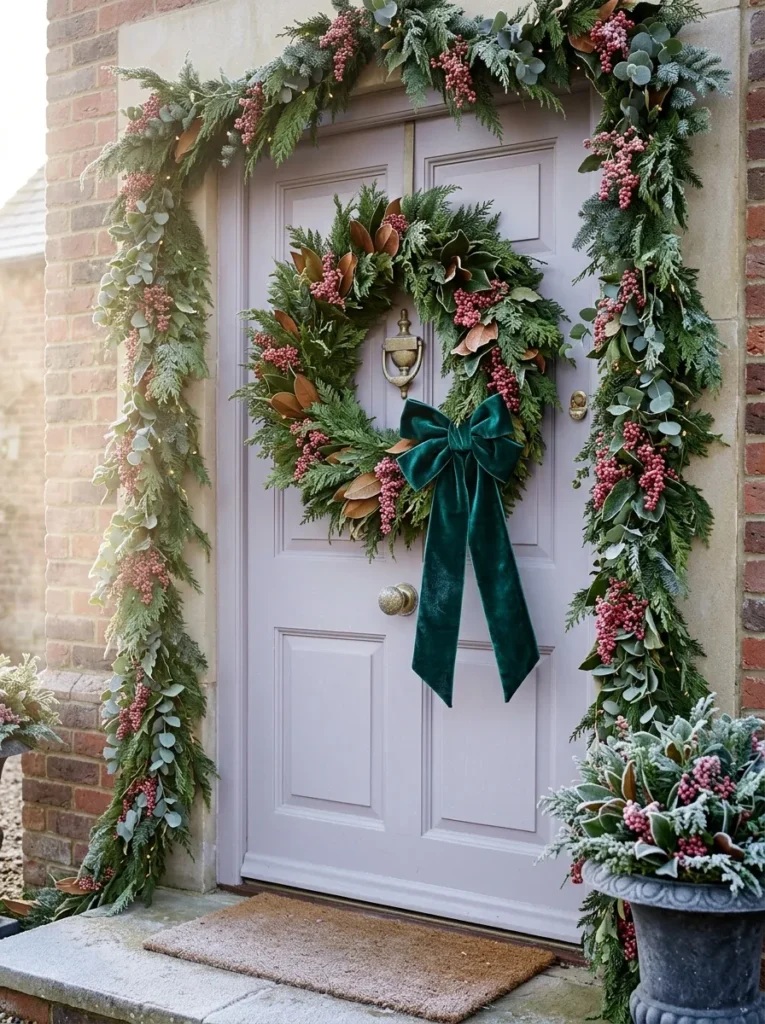
- Base: Fresh Leyland cypress (× Cuprocyparis leylandii) sprays on a 22-inch ring, soft and feathery
- Size and proportion: 22-inch diameter on a 36-inch door, about 61 percent of the width
- Palette: Cypress green, emerald, blush pink, lavender-gray (the door)
- Ribbon: 6-inch wired emerald silk velvet, structured double-loop bow with a folded center band, two 14-inch tails cut on the diagonal
- Botanicals: Dried pink peppercorn (Schinus molle) sprigs spilling beneath the bow
- Door pairing: Pale lavender-gray satin door
- Standout detail: The bow sits at four o’clock instead of the top, giving the ring a relaxed tilt
- Fresh vs. faux: Fresh cypress stays soft for about three weeks, and wired velvet holds its shape through damp mornings
Why this works: A bow roughly a quarter of the wreath’s diameter reads as the focal point, so the greenery behind it can stay quiet.
My first outdoor velvet bow collapsed overnight after a heavy dew, because I’d chosen soft ribbon with no wire in the edges. Now I only use wired velvet, at least 4 inches wide, because the wire lets you shape each loop and keeps it from wilting in damp air. A six-inch ribbon works best for a 22-inch ring, roughly a quarter of the wreath’s diameter. Fold a center band, pinch the loops tight, and bend the wire edges into a gentle curve. I’ve seen a well-wired bow hold its shape for the entire season, wind and all.
Make the bow the star and let the greenery stay quiet. The 22-inch cypress ring covers about 61 percent of a 36-inch door, and its feathery sprays read soft against pale lavender-gray paint. The 6-inch emerald velvet bow sits at four o’clock, not the top, which gives the wreath a relaxed, lived-in tilt. Two tails fall 14 inches on the diagonal, and dried pink peppercorn sprigs spill beneath the bow like a loose corsage. Emerald, cypress green, and blush make a calm, jewel-like trio that looks tailored at a glance instead of traditional.
14. Floating Ornament Ring
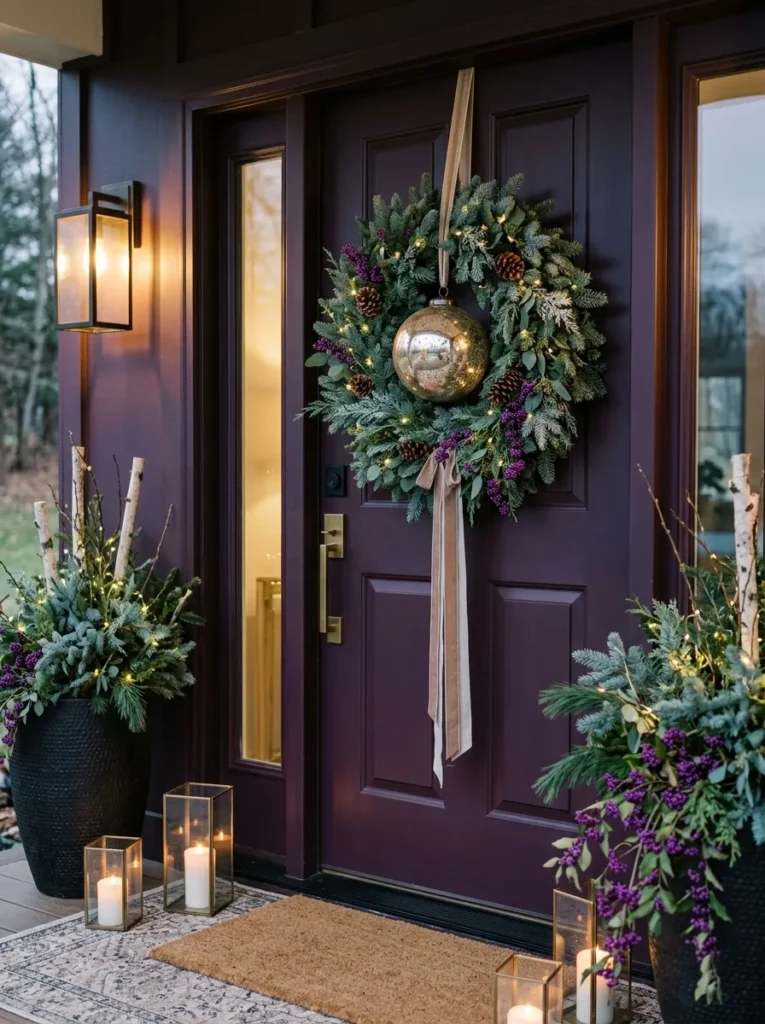
- Base: Fresh noble fir (Abies procera) on a 24-inch ring, packed 5 inches deep, leaving a 14-inch open center
- Size and proportion: 24-inch diameter on a 36-inch door, two-thirds of the width
- Palette: Noble fir blue-green, champagne, ivory, aubergine (the door)
- Ribbon: 5/8-inch ivory silk, doubled as a short hanger for the ornament, no bow
- Botanicals: Dried American beautyberry (Callicarpa americana) sprigs tucked in at the lower right
- Door pairing: Deep aubergine satin door
- Standout detail: One 6-inch champagne mercury glass ornament floating in the open center
- Fresh vs. faux: Fresh noble fir holds about four weeks in cold weather, closer to three in warm
Why this works: A single object suspended in the open center turns an empty wreath hole into a focal point, so the ring needs no extra ribbon or ornaments.
Noble fir (Abies procera) earns its reputation among growers. Its stiff, upswept branches carry heavy ornaments without drooping, and its blue-green needles keep their color and stay on the branch longer than most firs, often holding about four weeks in cold weather and closer to three in warm. For a ring this dense, those traits matter, because the band is packed five inches deep. The open center measures 14 inches across, which leaves plenty of room for a 6-inch ornament to swing gently without brushing the needles, even in a breeze.
Hang one object in the center, and the empty middle of a wreath becomes the main event. A 6-inch champagne mercury glass ornament floats inside the 24-inch ring, which covers two-thirds of a 36-inch door. It hangs from a 5/8-inch ivory silk ribbon, doubled and attached to a hidden loop of floral wire at the top of the ring. Dried American beautyberry sprigs, a Texas native with violet berries, tuck in at the lower right. Against a deep aubergine door, the champagne glass glows like a small moon from the driveway.
15. Variegated Holly Teardrop — A Christmas Wreath Idea for Tall Doors
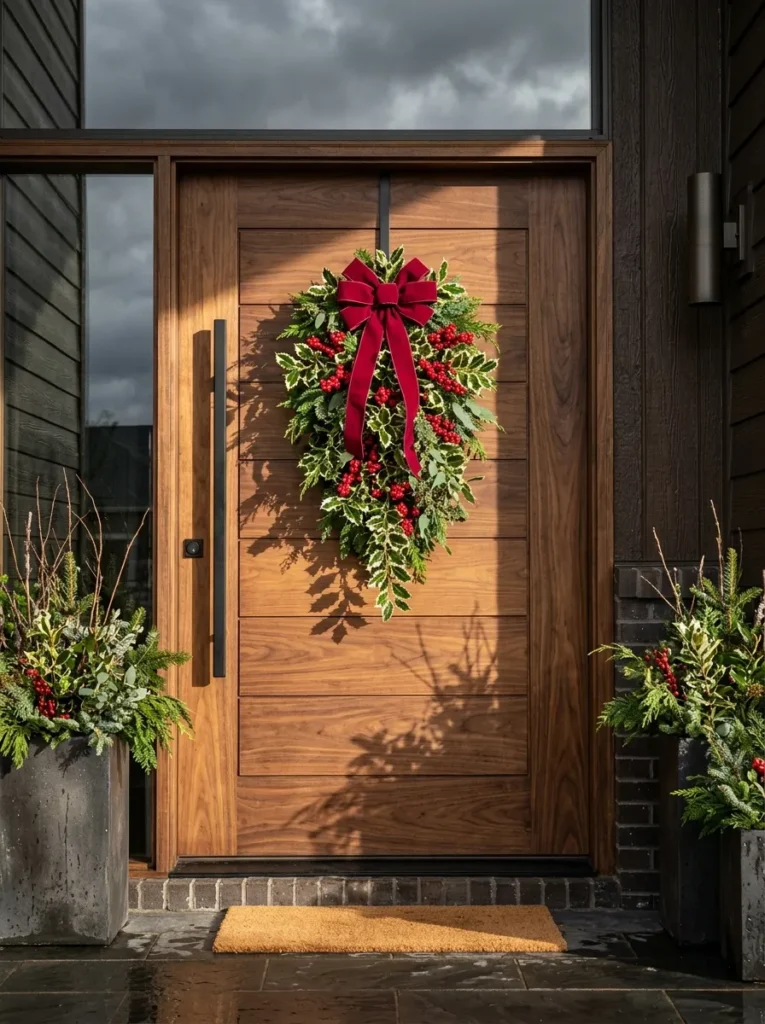
- Base: Fresh variegated English holly (Ilex aquifolium) on a teardrop frame, fuller at the base and tapering to a point
- Size and proportion: 18 inches wide by 30 inches tall, half of a 36-inch door’s width and about 38 percent of an 80-inch door’s height
- Palette: Holly green, cream variegation, berry red, walnut (the door)
- Ribbon: 1.5-inch berry-red silk taffeta, one flat bow at the tapered tip, two 8-inch tails
- Botanicals: Berried holly sprigs only, with berries clustered at the widest curve
- Door pairing: Natural walnut-stained wood door with a clear satin finish
- Standout detail: The red bow at the tip reads like a flame atop the teardrop
- Fresh vs. faux: Fresh holly stays glossy about three to four weeks in cool weather; the berries are mildly toxic if eaten
Why this works: Fuller at the bottom and narrow at the top, a teardrop keeps the visual weight low, which makes a 30-inch wreath feel stable on an 80-inch door.
Holly is dioecious, meaning each plant is either male or female, and only the females produce berries. That’s why berried sprigs cost more, and why a branch cut from a hedge often has none. English holly (Ilex aquifolium) stays glossy for about three to four weeks in cool weather, but its spiny leaves bite, so wear gloves while wiring. The berries are also mildly toxic if eaten, so hang it high enough that toddlers and pets can’t reach it. Cream-edged variegated leaves catch light better than plain green, which is why I choose them every time.
In holiday wreath styling, a teardrop is a wreath that has learned to stand tall. Measuring 18 inches wide by 30 inches tall, it covers half the door’s width and about 38 percent of its 80-inch height, tapering to a point. Holly sprigs sweep upward from a fuller base, with berries clustered at the widest curve. A 1.5-inch berry-red silk taffeta ribbon forms one flat bow at the tapered tip, with two 8-inch tails. Against a natural walnut door with a clear satin finish, the red berries look almost lacquered, and the grain adds warmth that paint can’t match.
Wreath Styling Principles
Every wreath in this post follows the same few rules, and they apply to any Christmas front door decor you plan. Learn them once, and you can build your own version with whatever greenery you can find.
- Size to the door, not the shelf. A wreath should cover roughly half to two-thirds of the door’s width, which means 18 to 24 inches on a standard 36-inch door. Go wider only on a flat, plain door, and leave at least 3 inches of paint visible on each side.
- Set the center near eye level. Hang the center at about 60 inches from the floor, then check it from the walkway, not the porch. A wreath that looks right at arm’s length can look too low from the street.
- Choose fresh or faux by how long you need it. A fresh evergreen wreath starts drying within about three to four weeks in warm weather and lasts longer in the cold, while a well-made faux wreath can last for years. Faux only looks convincing with a high fullness grade and UV-treated foliage. Preserved and dried materials fall in between, and they need a roof overhead.
- Limit the palette. Three or four named tones, one accent, and no more than three metals keep a wreath looking designed instead of crowded.
- Scale the ribbon. Ribbon width works best at about a quarter of the wreath’s diameter, such as a 6-inch velvet on a 22-inch ring. Wired ribbon holds its shape in damp air.
- Match the hardware to the weight. Choose a hook or hanger rated for at least double the finished weight, in solid brass or stainless steel, so it never rusts or stains your paint.
FAQs
1. What size wreath is best for a standard front door? For a standard 36-inch door, choose a wreath 20 to 24 inches wide, which covers roughly half to two-thirds of the door’s width. Anything under about 20 inches looks undersized from the street. On double doors, size each wreath to its own door leaf rather than to the full opening.
2. How long does a fresh Christmas wreath last? A fresh evergreen wreath typically stays supple for about three to four weeks in warm weather and can last longer in cold weather. Hanging it in shade, away from direct sun, slows drying. A light misting of the greenery every few days helps, but keep ribbon and preserved elements dry.
3. How do I hang a heavy wreath without damaging my door? Use a padded over-door hanger rated for at least twice the wreath’s weight. A fresh 24-inch fir wreath can weigh 6 to 8 pounds, so check the rating before you hang it. Avoid adhesive hooks in freezing temperatures, since most are meant for application above about 50°F, and wait about 30 days before hanging anything on freshly painted doors. Magnetic hangers only grip steel doors.
4. What are budget-friendly ways to elevate a store-bought wreath? Swap the original ribbon for 3-inch wired velvet or silk, remove cluttered picks, and keep one accent color. Then tuck in a few fresh or dried stems, such as eucalyptus, boxwood, or pine cones, for fullness. A little fresh greenery and a yard or two of good ribbon usually does more than adding extra ornaments.
5. How do I make a faux wreath look real? Start with an extra-full, UV-treated wreath, and judge it by tip count rather than the label on the tag. Fluff every branch outward in different directions, then tuck in a few real sprigs of cedar, pine, or eucalyptus to break up the uniform color.
6. How high should I hang a wreath on a front door? Center the wreath at about 60 inches from the floor, which is roughly eye level for most adults, and check it from the walkway. For a tall oval or teardrop, hang it so the lower tip clears the door handle by a few inches.
Conclusion
A great front door doesn’t need more decoration. It needs the right scale, a clear palette, and one detail that makes people look twice. Whether you choose a moss hoop, a holly teardrop, or a mirrored copper pair, these Christmas wreath ideas show how exact sizing and intentional color can transform an entry.
I’ve seen how small changes like these can completely change a house from the curb. Pick one idea this weekend, measure your door first, and try it. Save this post on Pinterest so you can find it later, and share it with a friend who’s ready to upgrade their porch.