20 Black Painted Fireplace Ideas for a Bold, Modern Look
A fireplace can either blend into a room or completely transform it. There’s rarely an in-between. That’s exactly why black painted fireplace ideas have become one of the most searched design upgrades this year, and after years spent around renovation sites with my husband, I understand why homeowners keep coming back to this look. It’s dramatic without being complicated, and it works in almost any home style, from cozy farmhouses to sleek modern lofts.
In my experience, the fireplace is often the one architectural feature people overlook when refreshing a room, even though it usually sits at the center of everything. A tired brick surround or an outdated mantel can quietly hold a whole space back, no matter how updated the furniture around it looks. I’ve noticed that once homeowners repaint this one feature, the entire room suddenly feels intentional, current, and pulled together.
What follows are twenty distinct ways to bring this look into your own home, each with its own finish, material pairing, and room style, so you can find the version that actually fits your space instead of forcing a trend that doesn’t.
1. Charcoal Limewash Finish — A Soft Black Painted Fireplace Idea
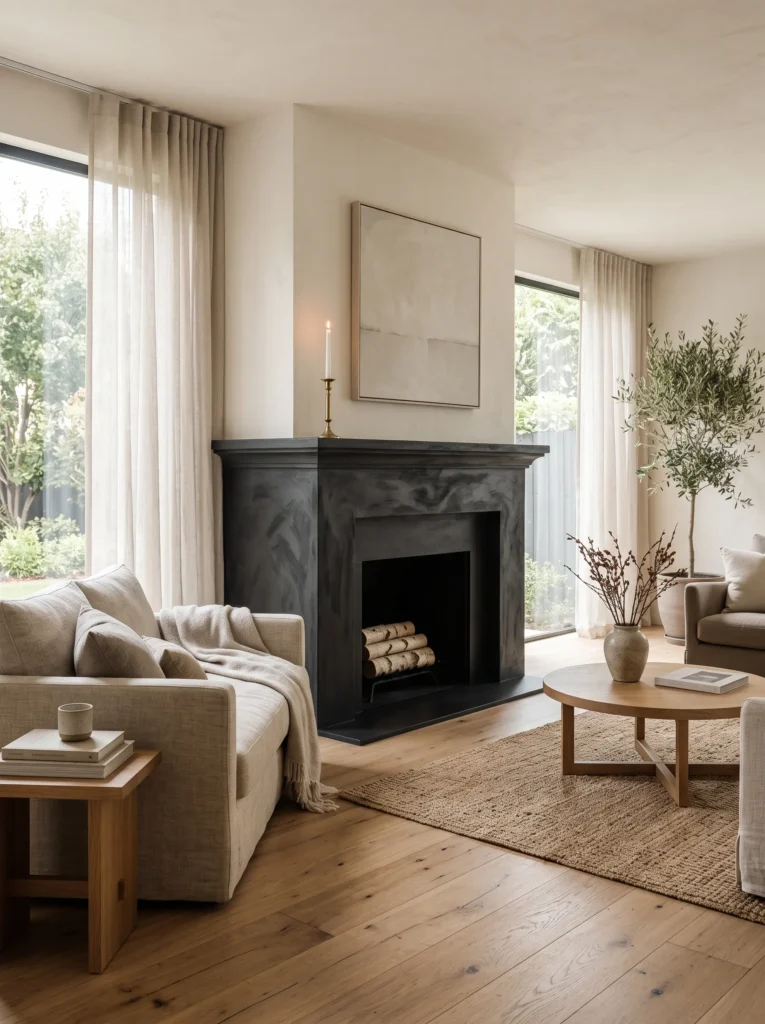
Room style: Warm minimalism, sun-washed living room with white oak floors
- Limewash gives the black a soft, cloudy depth instead of flat coverage
- Pairs beautifully with unlacquered brass candlesticks and a linen sofa
- Works best in rooms with lots of natural light to soften the tone
- Small upgrade: leave a few brush-stroke variations visible for texture
Why this works: Limewash absorbs and scatters light unevenly, so the black never looks harsh or one-note.
Some finishes shout. This one just settles into a room and lets everything else breathe. Charcoal limewash reads more like weathered stone than paint, which is exactly why it suits a warm minimalist space so well. Instead of a stark, graphic black, you get soft tonal shifts across the surface — deeper in the corners, lighter where the light hits. I’ve noticed this finish photographs beautifully at midday, when most black fireplace ideas actually look flat and lifeless on camera. It’s forgiving, textured, and never feels cold.
Pair it with raw linen upholstery and one brass object, nothing more. The restraint is the point. A limewashed mantel next to pale oak flooring creates a quiet kind of contrast — dark against light, rough against smooth — without a single loud gesture in the room. This is the finish I recommend to homeowners nervous about “going too dark.” It eases you in. The matte, chalky surface catches window light differently throughout the day, so the fireplace genuinely feels alive rather than static, which is rare for a painted surface.
2. Black Microcement Surround
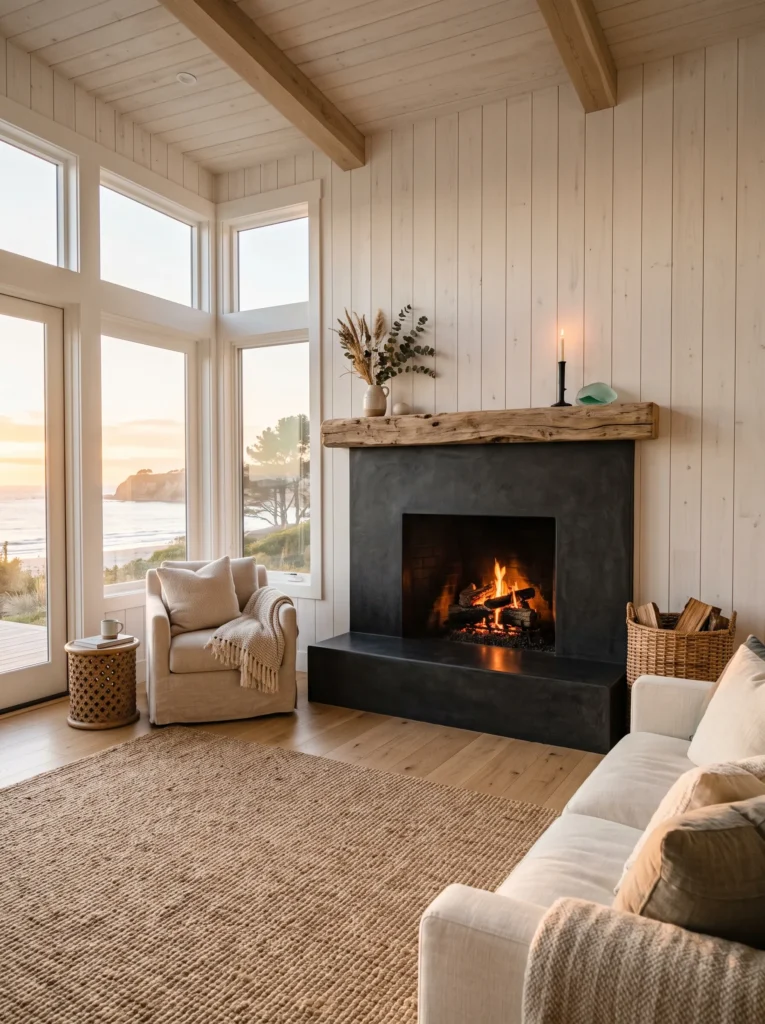
Room style: Modern coastal living room with whitewashed walls
- Microcement gives a seamless, almost sculptural look with zero grout lines
- Cool undertone pairs well with driftwood accents and woven jute
- Ideal for rooms that already lean airy and want one grounded element
- Small upgrade: extend the microcement slightly onto the hearth floor
Why this works: A continuous, joint-free surface reads as intentional and architectural rather than decorative.
Smooth surfaces tend to disappear into a room, but this one does the opposite. Black microcement has a matte, almost concrete-like finish that gives a fireplace real sculptural weight without any pattern or texture pulling focus. In a modern coastal space full of light woods and pale linens, this single dense, dark form grounds everything else. My husband’s crew has poured microcement on several renovation jobs, and the biggest lesson is patience — it needs multiple thin layers to cure evenly, or the finish shows inconsistent sheen once it’s sealed.
What surprises people most is how warm this cool-toned black actually feels once it’s styled. Against whitewashed shiplap and a jute rug, the surround stops feeling industrial and starts feeling coastal-modern instead. There are no seams, no grout, nothing to distract from the shape itself. Black painted fireplace ideas like this work particularly well in open-concept homes, where the fireplace has to hold its own visually from multiple angles across the living and dining space.
3. Blackened Plaster with Raw Ceiling
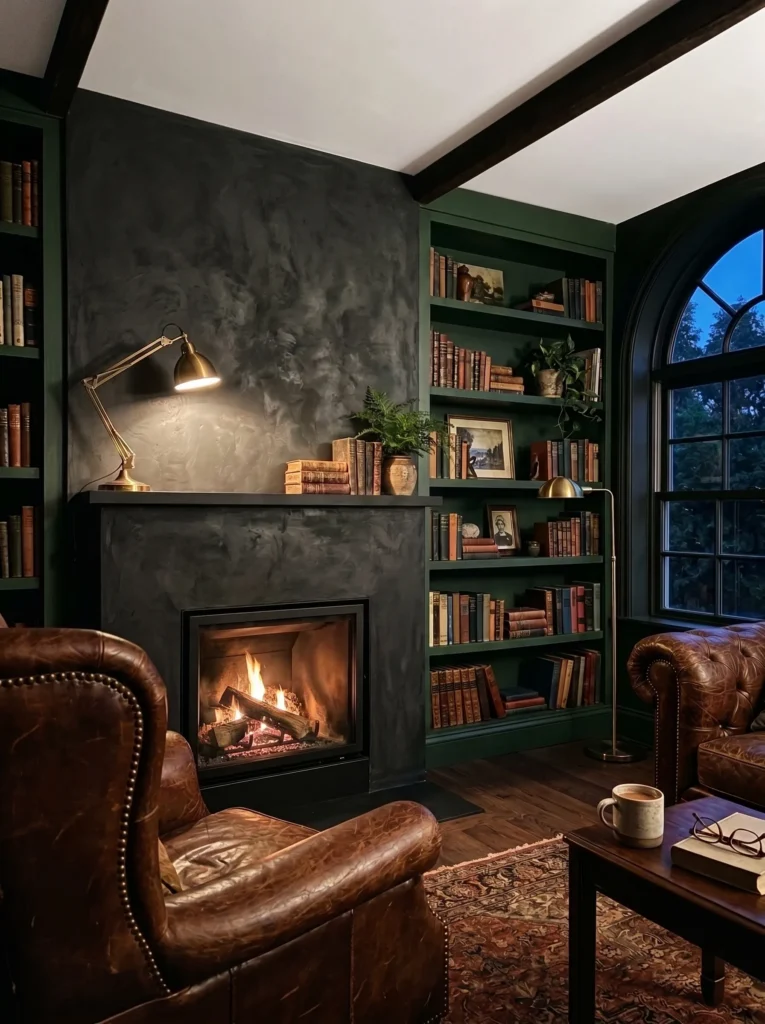
Room style: Dark academia study or reading nook
- Textured lime plaster gives visible hand-troweled marks across the surface
- Raw, unpainted plaster ceiling continues the material story upward
- Deep forest green bookshelves and aged leather balance the darkness
- Small upgrade: leave one section slightly under-troweled for shadow depth
Why this works: Matching rough textures on the fireplace and ceiling stops the black from feeling isolated as a single accent wall.
Most people paint a fireplace and stop there, but the real transformation happens when the surrounding surfaces join the conversation. Blackened plaster, hand-applied with visible trowel marks, gives this fireplace a raw, almost geological presence. Left exposed above it, an unpainted plaster ceiling mirrors that same rough texture, so the black doesn’t read as an isolated design choice — it reads as part of the room’s material logic. In a dark academia study lined with forest green shelving, that continuity matters more than the color itself.
I’ve tried this combination in a client’s reading nook, and the effect only worked once we stopped treating the fireplace as a standalone feature. Aged leather armchairs, brass reading lamps, and stacks of hardcover books all lean into the same worn, tactile mood. The plaster’s uneven surface catches warm lamp light unevenly at night, creating soft shadows that shift as you move through the room — something a flat painted finish simply can’t replicate in low light.
4. Matte Black with Fluted Wood Paneling
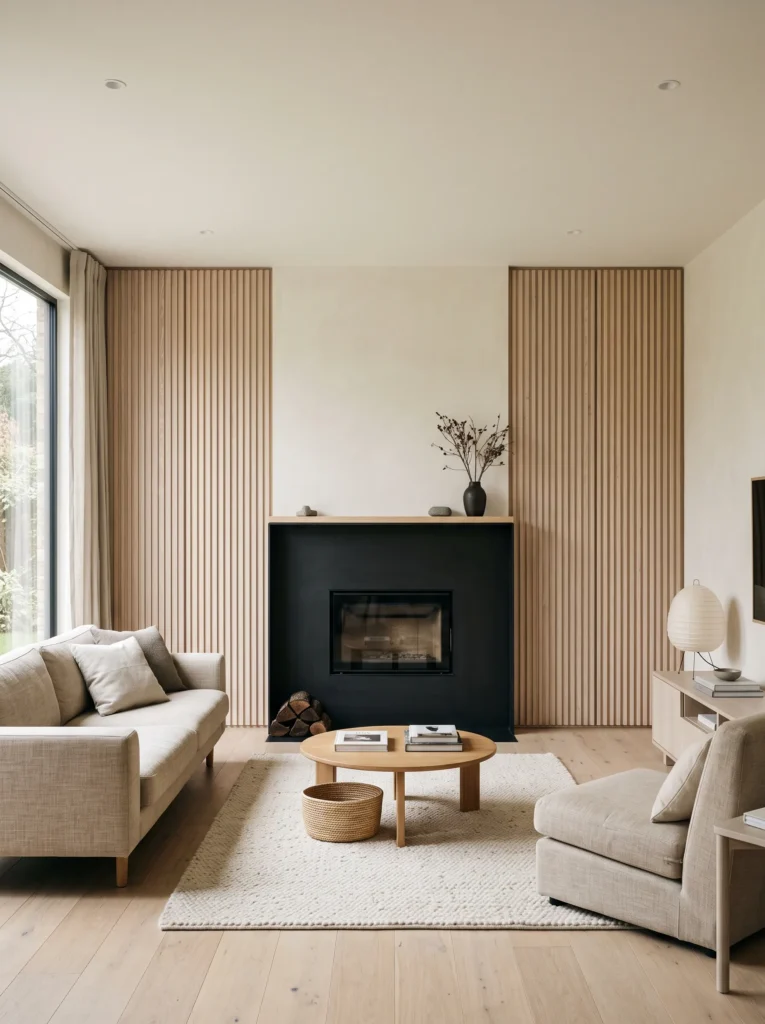
Room style: Japandi living room with natural ash wood tones
- Vertical fluting adds rhythm and softens the fireplace’s hard edges
- Matte black paint stays flat and non-reflective, unlike lacquered finishes
- Pale ash wood surround keeps the overall palette light despite the dark center
- Small upgrade: run the fluting only on the sides, leaving the face flat black
Why this works: Vertical lines draw the eye upward, making a low, wide fireplace feel taller and more architectural.
A fireplace doesn’t have to be loud to feel important. Here, flat matte black paint covers just the firebox surround, while fluted ash wood paneling wraps the sides in soft vertical grooves. That combination is central to Japandi design — minimal color, maximum texture. The fluting catches light differently depending on where you stand, creating subtle shadow lines that shift throughout the day. Meanwhile, the matte black stays completely still and non-reflective, which keeps the whole composition calm instead of busy or ornamental.
In my experience, this pairing works especially well in smaller living rooms where a glossy or textured black finish would feel too heavy. The pale wood does most of the visual lifting, while the black anchors it. Proportion matters here more than anything else — a fireplace that’s too tall relative to its fluted paneling can look top-heavy, so keeping the black portion compact is what makes this particular layout feel balanced and intentional rather than accidental.
5. Black Chalk Paint with Visible Brushwork
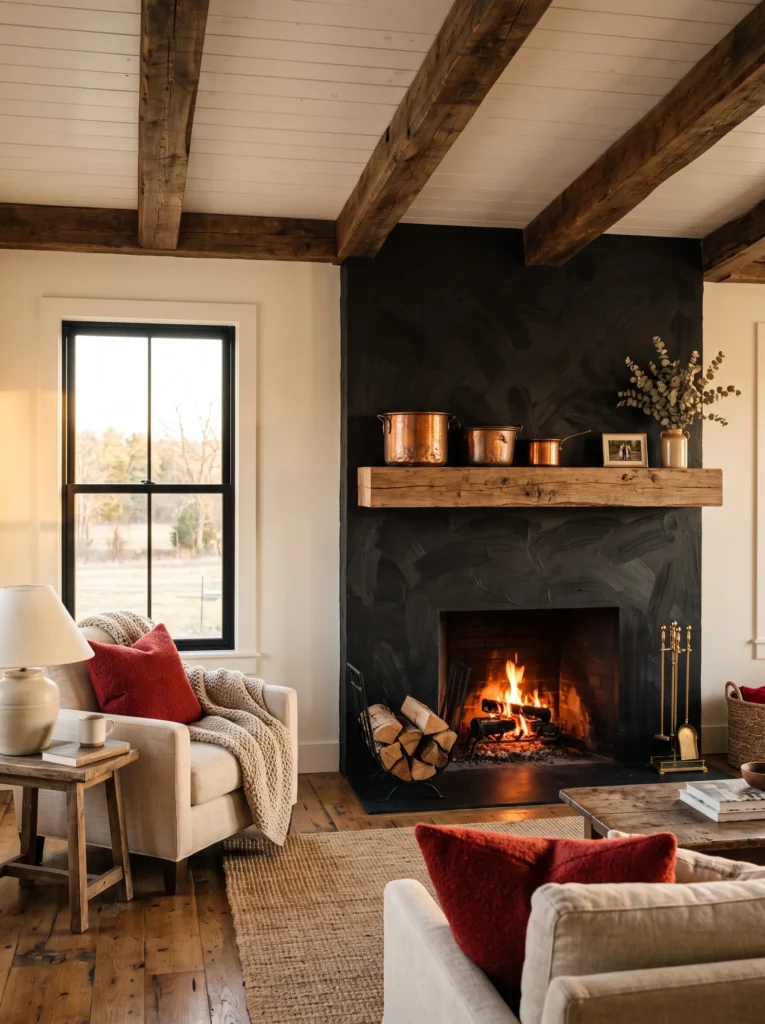
Room style: Farmhouse-modern hybrid with exposed ceiling beams
- Chalk paint dries to a chalky, non-glossy surface with visible brush texture
- Deep barn-red accent pillows and aged copper cookware nearby add warmth
- Exposed wood beams overhead tie the fireplace into the room’s rustic bones
- Small upgrade: apply two thin coats instead of one thick one for even texture
Why this works: Visible brushstrokes give an otherwise plain fireplace a handmade, lived-in quality that flat paint can’t achieve.
Not every black fireplace needs to look polished, and this one proves it. Chalk paint dries with a soft, powdery finish, and if you don’t sand it smooth afterward, the brushstrokes stay visible — faint ridges and texture that catch light at an angle. That imperfection is the whole appeal in a farmhouse-modern space with exposed beams overhead. My husband always tells clients that older homes with real wood beams need finishes with some texture, or everything ends up looking too new and mismatched against the original architecture.
Deep barn-red pillows and a scattering of aged copper cookware nearby keep the palette warm rather than stark. Black painted fireplace ideas like this one lean into imperfection rather than smoothing it away, which suits a farmhouse setting far better than a glossy or ultra-refined finish would. The texture also hides minor wall imperfections underneath, something worth knowing if you’re painting over an older, slightly uneven brick or plaster surface.
6. Black Zellige Tile Surround
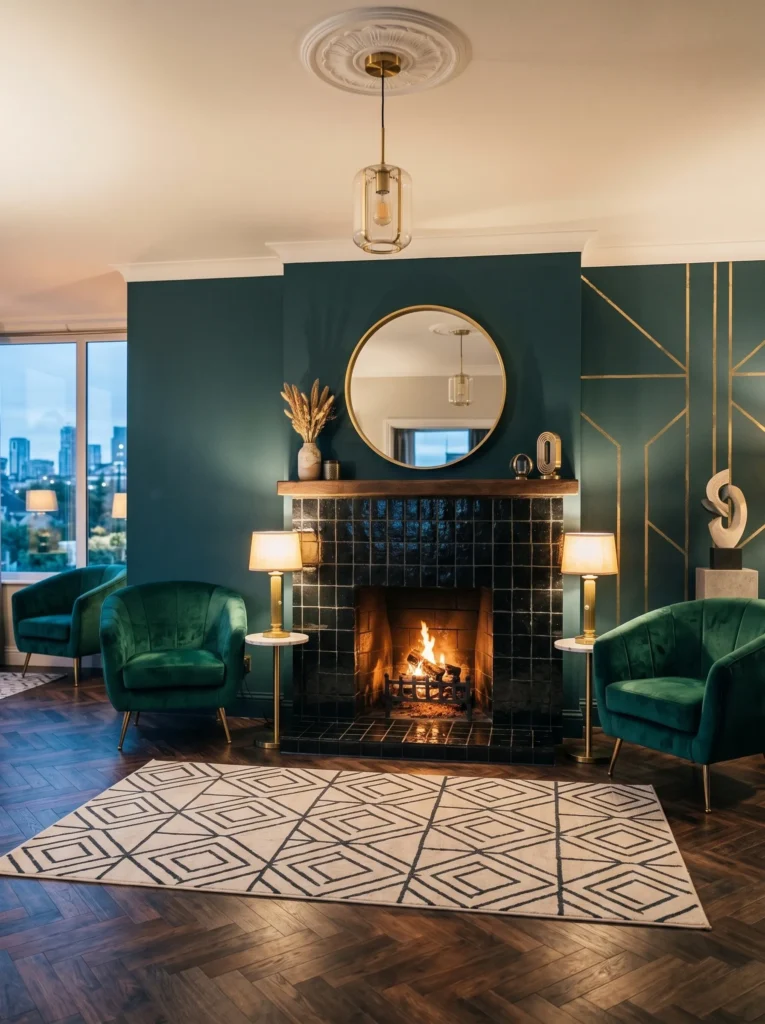
Room style: Art deco revival with jewel-toned upholstery
- Handmade zellige tiles have irregular glazing, so no two tiles reflect light the same way
- Emerald green velvet armchairs and gold-trimmed mirrors complete the deco mood
- Small variations in tile color add subtle depth without breaking the black palette
- Small upgrade: use a contrasting grout color like charcoal instead of matching black grout
Why this works: The uneven, glossy glaze on handmade tile catches and bounces light, giving a flat black surface real dimension and shine.
Some black surfaces are meant to be quiet, and others are meant to shimmer — this one belongs firmly in the second category. Black zellige tiles are hand-glazed, which means each piece reflects light slightly differently, giving the whole surround a subtle glimmer instead of one uniform dark block. Set against emerald velvet armchairs and a gold-trimmed mirror, the effect leans fully into art deco revival glamour. It’s a finish that rewards evening lighting, when lamp glow catches the glaze unevenly across the tiled surface.
I’ve noticed that homeowners drawn to this look usually already have jewel-toned furniture somewhere in the house — it just needs a dark, reflective anchor to pull everything together. Unlike matte finishes, zellige tile demands good lighting design nearby; a dim room won’t show off its texture. Pairing it with brass sconces on either side solves that problem while reinforcing the deco character the room is going for.
7. Soft Black Ombre Wash
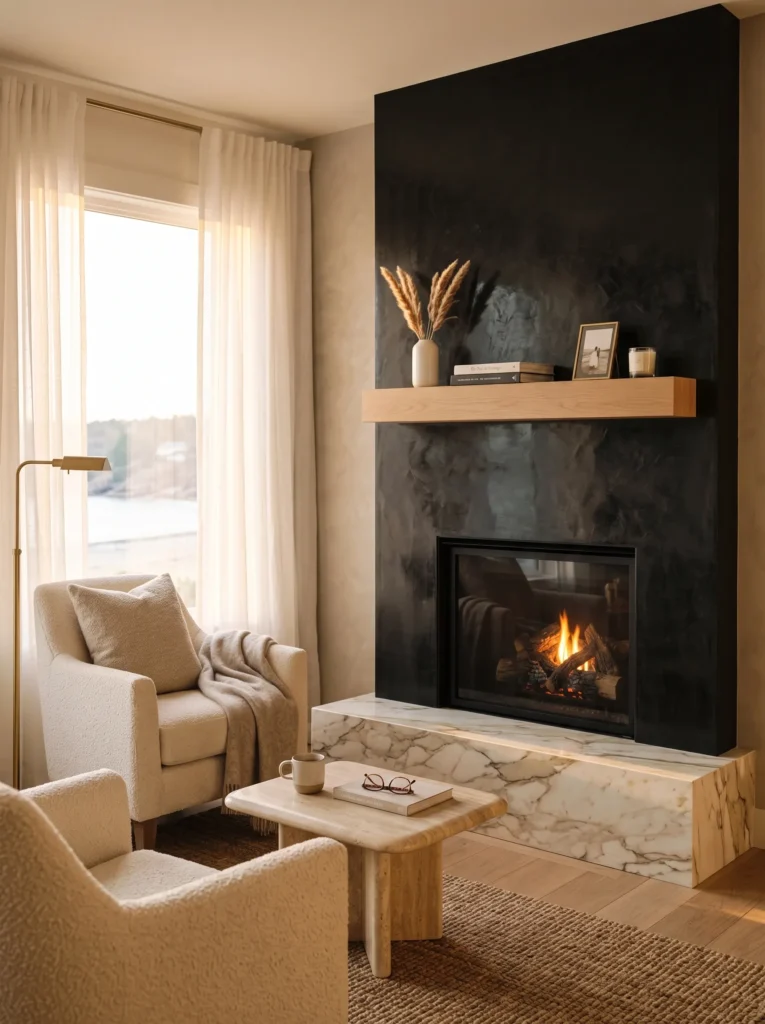
Room style: Modern coastal bedroom nook with a small reading fireplace
- Paint gradually darkens from soft charcoal at the base to near-black at the top
- Bleached driftwood mantel keeps the overall feel light and beachy
- Sheer linen curtains let diffused light interact with the gradient throughout the day
- Small upgrade: blend the ombre transition with a dry brush for a hazy edge
Why this works: A gradient finish avoids the visual weight of solid black, letting the fireplace feel like part of the wall rather than a heavy object sitting in front of it.
A solid black fireplace can feel like a slab dropped into a room, but a gradient softens that instantly. Here, the paint starts as a muted charcoal near the floor and deepens gradually toward true black at the top edge, blurred rather than sharply lined. In a coastal bedroom nook, that softness matters — nobody wants a stark, heavy focal point competing with a quiet reading corner. Diffused light through sheer linen curtains interacts with the gradient differently throughout the day, making the fireplace look subtly different at 9am versus 4pm.
This is one of the more forgiving black painted fireplace ideas for anyone unsure about going fully dark. The gradual transition gives your eye somewhere gentle to land instead of a hard color block. Paired with a bleached driftwood mantel and pale bedding nearby, the whole nook stays light and airy even with black as the dominant tone near the top. It’s proof that black doesn’t have to mean heavy.
You’ll Also Love: 25+ Modern Stone Fireplace Living Room Ideas to Copy
8. Black Venetian Plaster with Marble Hearth
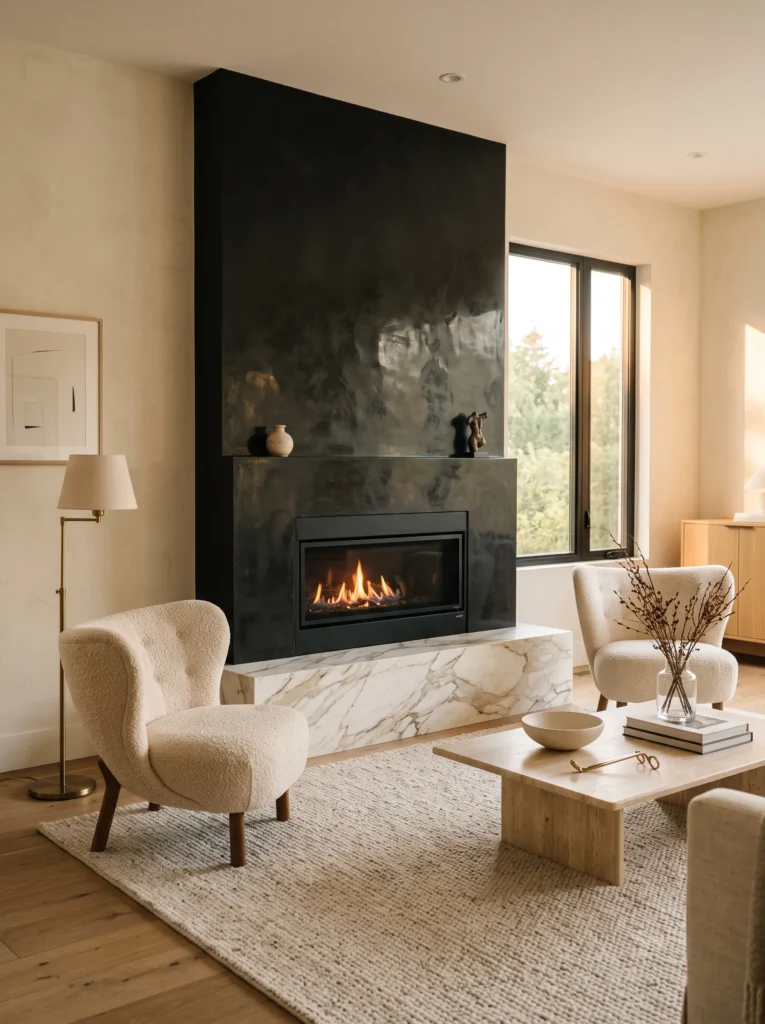
Room style: Warm minimalism with a Calacatta gold-veined marble hearth
- Venetian plaster has a subtle polished sheen, unlike flat matte finishes
- Warm gold veining in the marble hearth picks up the plaster’s faint reflectivity
- Cream boucle furniture keeps the palette soft despite the dark centerpiece
- Small upgrade: hand-polish the plaster with a trowel for a soft waxed shine
Why this works: The plaster’s slight sheen and the marble’s veining both reflect light, so the black anchors the room without absorbing all its brightness.
Polished black surfaces are trickier to pull off than matte ones, but done right, they add a quiet luxury that flat paint can’t match. Venetian plaster is troweled on in thin layers and burnished until it develops a soft, waxy sheen — not glossy, just faintly reflective. Set above a Calacatta gold-veined marble hearth, that subtle shine echoes the marble’s own reflectivity, tying the two materials together visually even though one is stone and the other is applied plaster. In my experience, this pairing photographs exceptionally well in natural light.
Cream boucle armchairs and a low travertine coffee table keep the surrounding palette soft, so the black plaster doesn’t overwhelm a warm minimalist space. This finish takes more skill to apply evenly than standard paint, so it’s worth hiring someone experienced with plaster technique rather than treating it as a weekend project. The result, though, is a fireplace that looks closer to a custom architectural feature than a simple paint upgrade.
9. Black Brick with Whitewashed Mortar
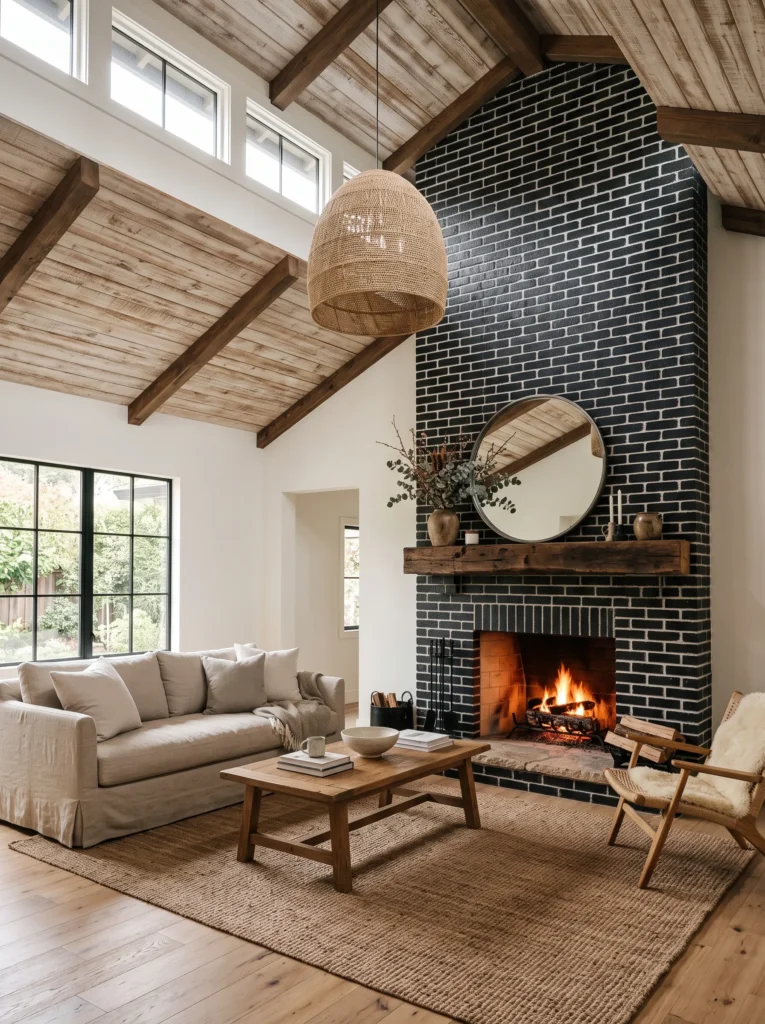
Room style: Modern farmhouse living room with vaulted ceilings
- Black-painted brick keeps individual brick texture and shadow lines visible
- Whitewashed mortar lines create a subtle grid pattern across the dark surface
- Vaulted wood ceilings and a large woven pendant light balance the tall wall
- Small upgrade: dry-brush the whitewash unevenly so some mortar lines stay darker than others
Why this works: Preserving brick texture under black paint keeps the surface visually active instead of flattening it into a solid block.
Painting brick black usually means covering its texture completely, but leaving the mortar lines whitewashed changes that entirely. Each brick edge stays visible beneath the black, creating a faint grid pattern across the surface that catches shadow differently depending on the light. In a modern farmhouse with vaulted ceilings, that texture matters — a totally flat black surface would look small under all that vertical space, but this one holds its own. My husband’s crew often points out that older brick needs a breathable mineral paint here, not standard latex, or moisture gets trapped behind the surface.
This is one of the more architecturally interesting black painted fireplace ideas because it respects what was already there instead of hiding it. A woven jute pendant light hanging nearby softens the tall wall, while natural wood ceiling beams keep the space feeling grounded despite its height. The whitewashed mortar lines are subtle, but they’re what stop this look from reading as one flat, heavy rectangle.
10. Blackened Steel Surround
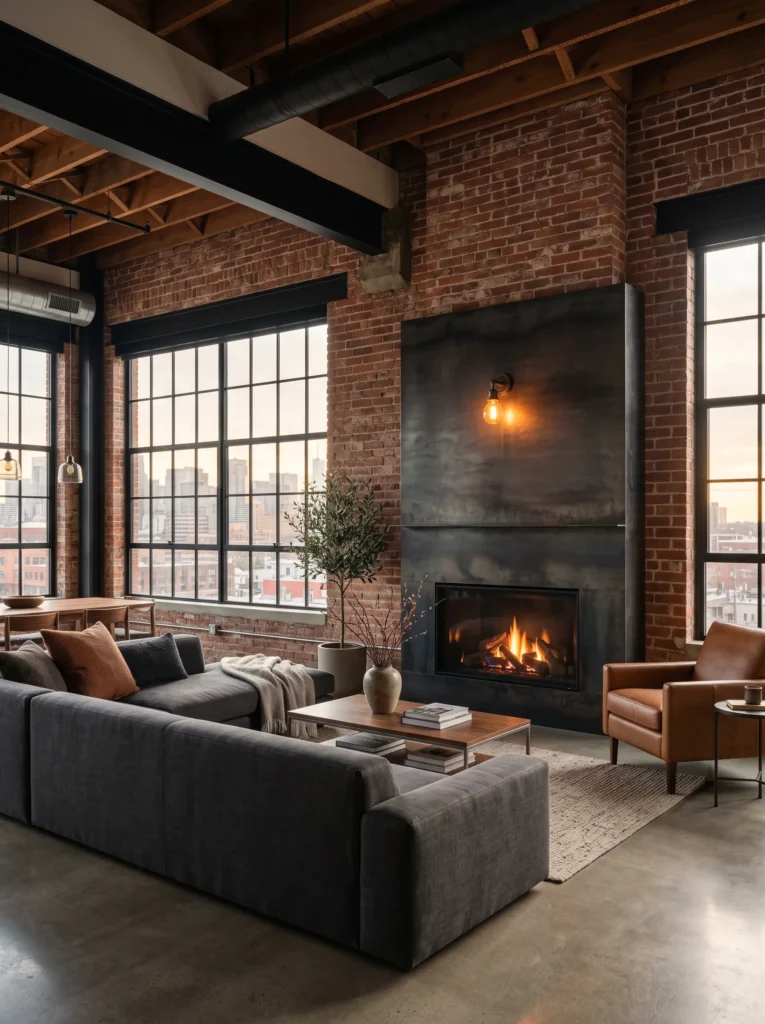
Room style: Industrial loft with exposed brick and concrete floors
- Blackened steel has a slightly variegated, hand-torched patina rather than uniform color
- Concrete floors and exposed brick walls already share the same raw material language
- A single Edison bulb sconce nearby adds warm contrast against the cool steel
- Small upgrade: leave faint heat-marks from the torching process visible instead of sanding them out
Why this works: Steel’s slight sheen behaves differently from painted surfaces under light, reading as industrial and structural rather than decorative.
Steel isn’t paint, but it belongs on this list because the visual result is so similar to a deep matte black finish, just with more depth. Blackened steel gets its color from a torching process, which leaves faint blue-gray and bronze undertones within the black rather than one flat tone. In an industrial loft with concrete floors and exposed brick, that variegation fits right in — everything in the room already has some kind of raw, unfinished quality to it. A single warm Edison bulb sconce nearby breaks up the coolness of the metal.
What makes this option different from painted finishes is durability near direct heat; steel handles proximity to flame without the touch-up concerns that come with painted surrounds. My husband always checks clearance codes before installing metal surrounds this close to an open firebox, since local building codes vary on how near combustible-adjacent materials can sit. It’s worth confirming with a licensed contractor before committing to this option.
11. Black and Terracotta Plaster Combo
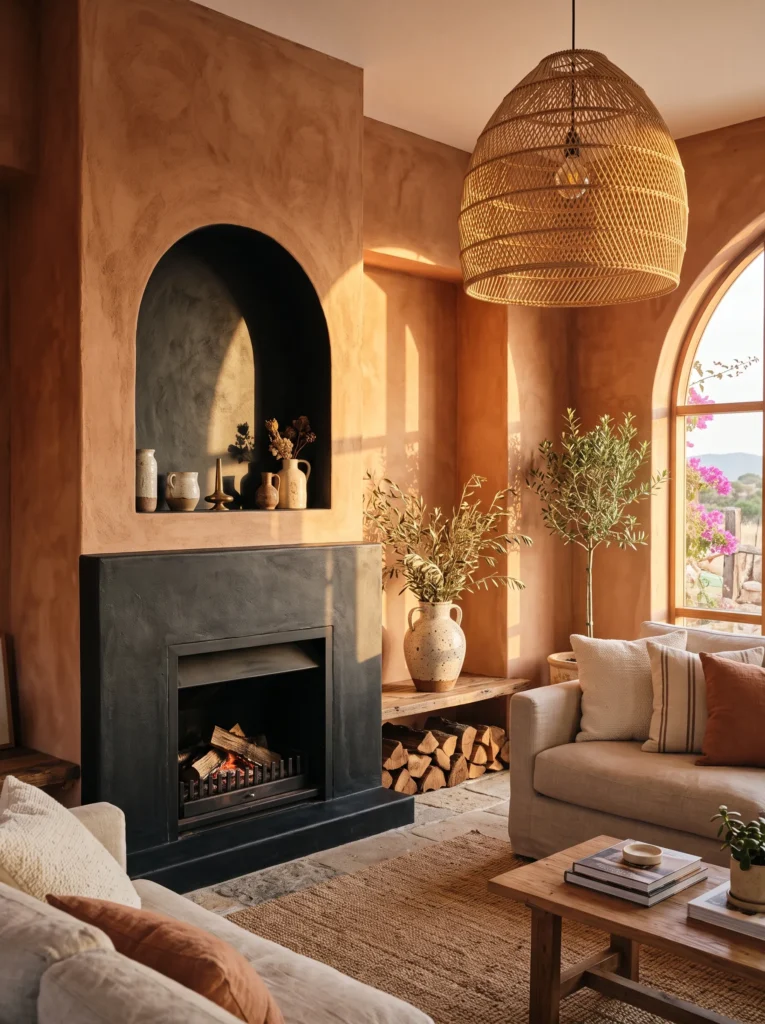
Room style: Mediterranean-modern living room with arched doorways
- Black plaster fireplace sits beside sun-baked terracotta-toned walls
- Arched niche above the mantel echoes the room’s Mediterranean architecture
- Woven rattan pendant and olive branches in a ceramic vase soften the palette
- Small upgrade: plaster the fireplace and the arch niche in the same black tone for continuity
Why this works: Pairing black with warm terracotta creates contrast through temperature, not just light versus dark.
Most black fireplace pairings lean cool — white walls, gray stone, pale wood. This one goes warm instead, and the shift changes everything. Set against sun-baked terracotta plaster walls, a black fireplace reads less like a stark contrast and more like a deep shadow within a sunlit room. An arched niche above the mantel, plastered in the same black tone, echoes the curved doorways found throughout Mediterranean-modern homes, tying the fireplace into the architecture rather than treating it as a separate feature bolted onto the wall.
I’ve noticed this specific color pairing works best in rooms that get strong, direct sunlight for at least part of the day, since terracotta needs warm light to really glow. A woven rattan pendant light and a ceramic vase of dried olive branches nearby keep the styling simple and unforced. Black painted fireplace ideas built around warm-toned surroundings like this one tend to feel more sun-drenched and lived-in than their cooler, more monochrome counterparts.
12. Black Slate Stacked Stone
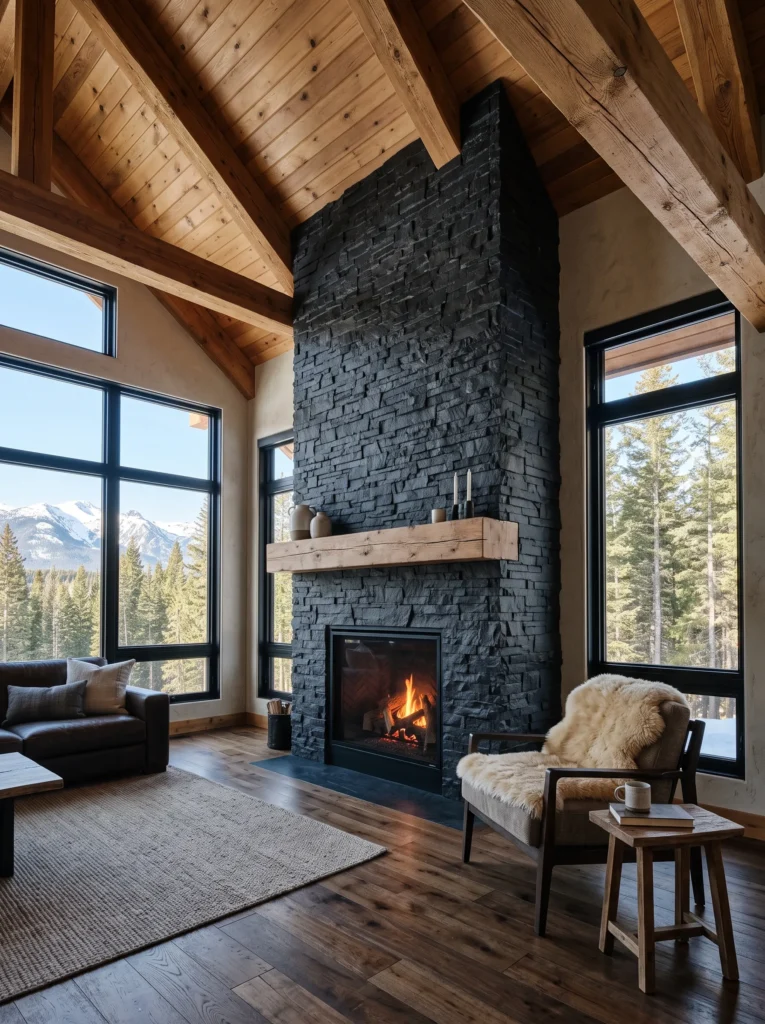
Room style: Mountain-modern cabin with floor-to-ceiling windows
- Stacked slate pieces vary slightly in size and thickness for an organic, uneven surface
- Cool black-gray tone pairs with knotty pine ceiling beams and a sheepskin throw
- Floor-to-ceiling windows flood the stone texture with shifting natural light
- Small upgrade: extend the stacked slate all the way to the ceiling instead of stopping at mantel height
Why this works: Natural stone’s irregular surface catches directional light unevenly, adding dimension that flat paint alone can’t replicate.
Stone brings something painted surfaces simply can’t — genuine, unrepeatable texture. Black slate, stacked in irregular pieces from floor to ceiling, creates a rugged focal wall that shifts in appearance depending on the time of day. In a mountain-modern cabin with floor-to-ceiling windows, that responsiveness to light is part of the appeal; morning sun rakes across the stone at a low angle, throwing small shadows into every gap and edge. Knotty pine ceiling beams overhead keep the material palette rustic and cohesive rather than cold or overly polished.
Full-height stacked stone is a bigger structural commitment than paint, so this is one to plan early with a contractor rather than retrofit later. My husband’s team always checks the wall’s load-bearing capacity before floor-to-ceiling stone gets added, since the material is genuinely heavy. Done right, though, it turns a fireplace into the room’s dominant architectural feature, not just a decorative accent within it.
13. Matte Black with Antique Brass Inlay
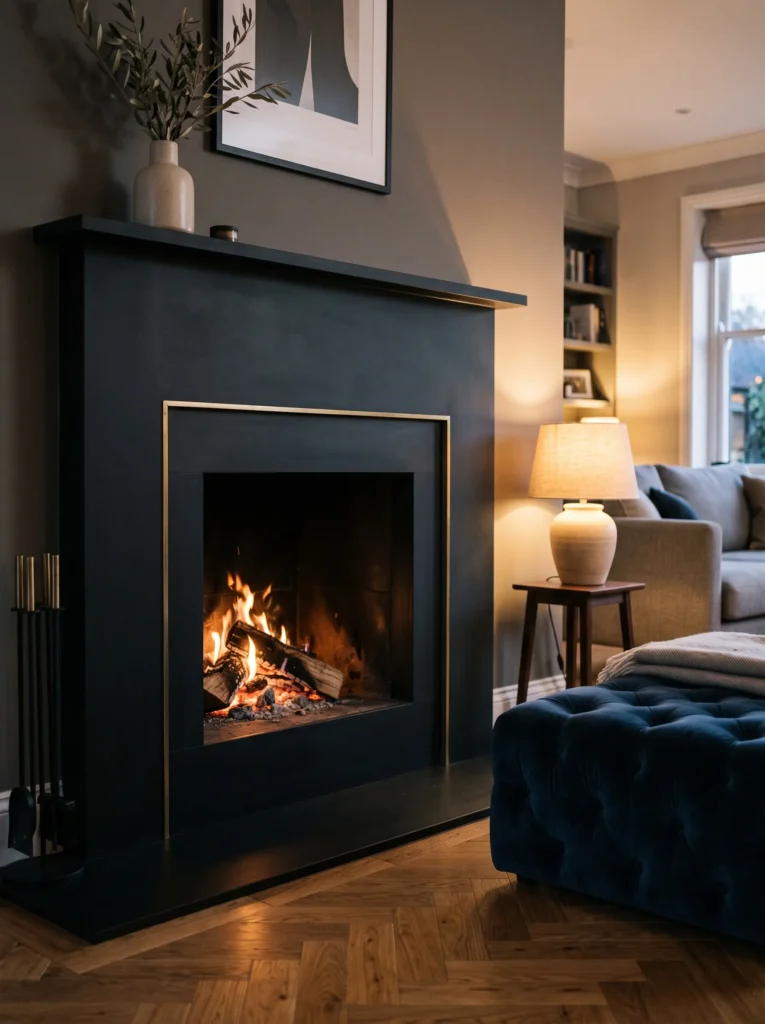
Room style: Traditional-meets-modern living room with herringbone wood floors
- Thin brass inlay strips trace the fireplace opening in a slim geometric border
- Matte black paint stays flat everywhere except the polished brass line
- Herringbone oak floors and a tufted velvet ottoman add classic warmth nearby
- Small upgrade: let the brass patina naturally instead of sealing it, so it darkens over time
Why this works: A single thin line of metallic contrast reads as intentional detail rather than decoration, guiding the eye along the fireplace’s actual shape.
Restraint is harder than people think, and this idea proves why one small detail can do more than an entire surface treatment. A slim strip of antique brass traces the outline of the firebox opening, set into an otherwise completely matte black surround. Everything else stays flat and unreflective, so that thin metallic line becomes the only thing catching light in the whole composition. Against herringbone oak flooring and a tufted velvet ottoman, the effect feels traditional-meets-modern, formal but not fussy.
In my experience, this detail works best when the brass is left unlacquered so it ages naturally rather than staying artificially shiny. A patinaed edge looks intentional and collected, like it’s always been there, while a bright polished strip can look almost costume-like against matte black. Black painted fireplace ideas that use metal this sparingly tend to age better stylistically too, since the black itself never goes out of fashion and the brass only gets richer with time.
14. Black Tadelakt with Curved Niche
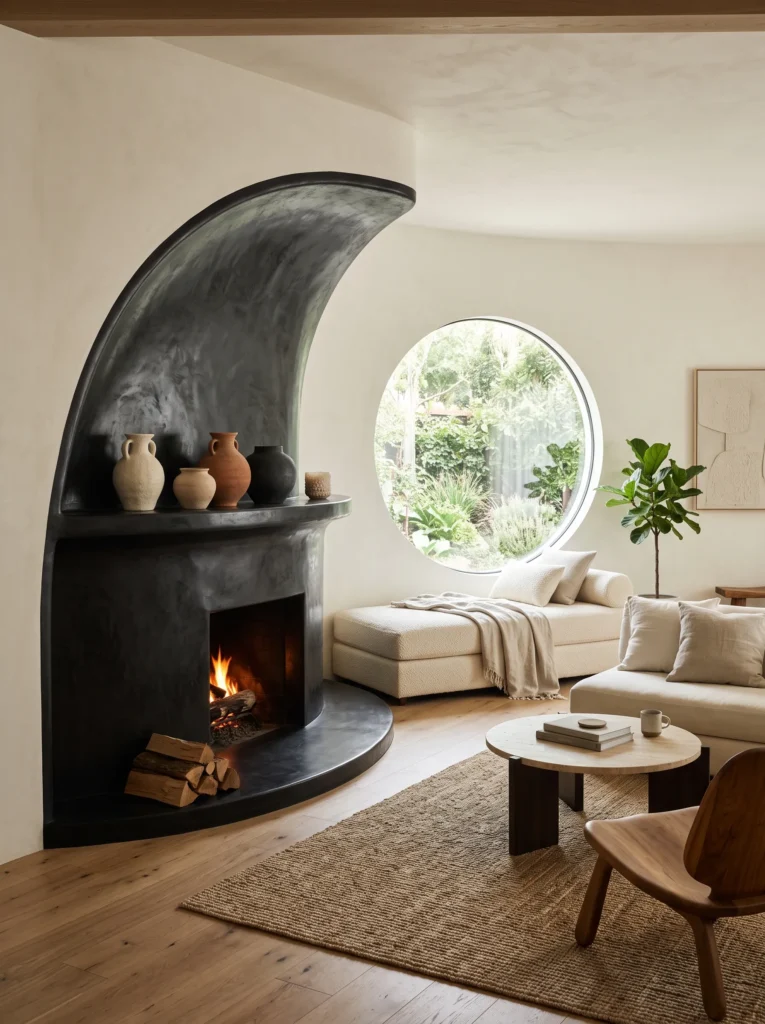
Room style: Organic modern living room with rounded archways
- Tadelakt plaster has a hand-polished, slightly waxy sheen unique to Moroccan technique
- Curved niche shape softens the fireplace against otherwise angular furniture
- Sculptural ceramic vessels and a bouclé daybed continue the room’s rounded forms
- Small upgrade: polish the tadelakt with a natural soap finish for subtle water resistance and shine
Why this works: Curved forms and a soft-sheen finish work together to counter the visual heaviness that flat, angular black surfaces usually carry.
Sharp corners make black feel heavier, so this idea removes them entirely. Tadelakt, a traditional Moroccan lime plaster, gets hand-polished into a smooth, slightly waxy surface, then shaped here into a rounded niche instead of a standard rectangular surround. That curve softens the whole fireplace, especially paired with sculptural ceramic vessels and a bouclé daybed nearby that repeat the same rounded language throughout the room. It’s a finish that photographs almost like sculpted stone rather than an applied surface.
I’ve tried recommending tadelakt to clients hesitant about dark, boxy fireplaces, and the curved shape usually changes their mind faster than the color does. Organic modern spaces rely on soft geometry to feel calm, and a black rectangle can disrupt that instantly. A rounded niche, by contrast, feels considered and continuous with everything around it, proving that the shape of a black fireplace matters just as much as the finish applied to its surface.
15. Black Shiplap with White Trim Contrast
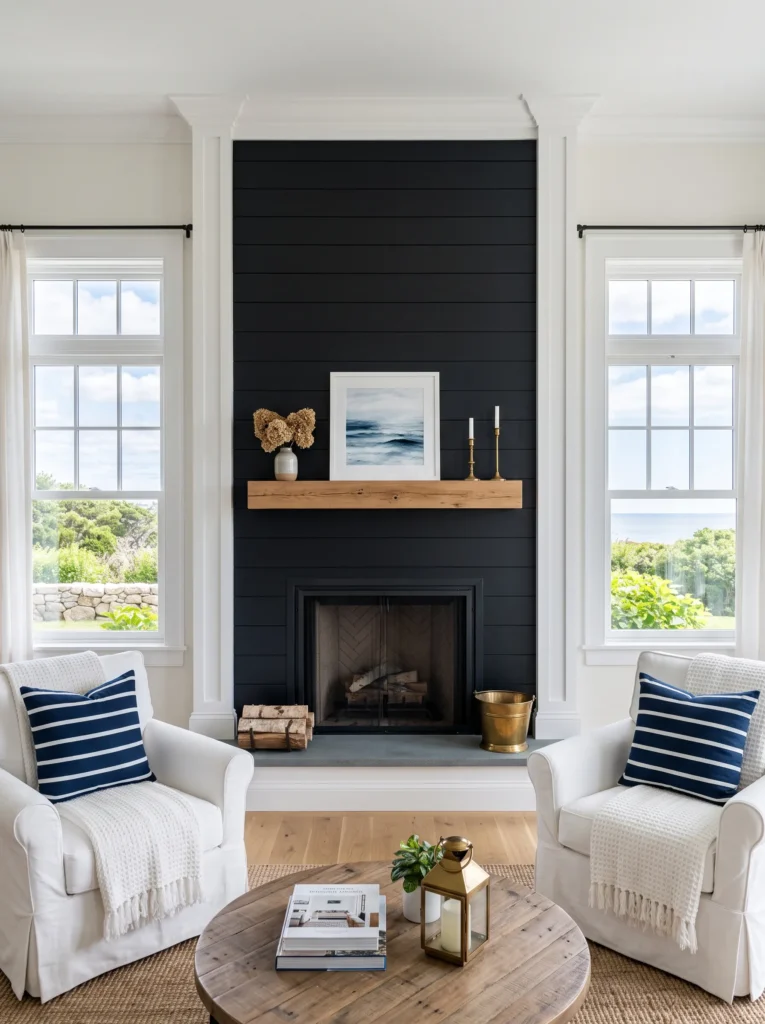
Room style: Coastal New England living room with crisp white millwork
- Horizontal black shiplap boards run floor to ceiling behind the firebox
- Crisp white trim frames the black panel like a picture frame border
- Navy and white striped textiles nearby reinforce the coastal New England feel
- Small upgrade: use a satin finish on the shiplap for subtle light reflection along each board’s edge
Why this works: A defined white border around a black panel creates deliberate contrast, framing the darkness instead of letting it bleed into the wall.
Framing changes how a color reads, and that’s exactly the trick here. Horizontal black shiplap boards run the full height of the wall behind the firebox, but crisp white millwork trim wraps around the entire panel like a border, containing the black within a clear, deliberate shape. In a coastal New England living room already full of white paneling, that framing keeps the black from feeling like an unplanned dark patch. Navy and white striped pillows nearby echo the same crisp, graphic contrast found in the trim.
This is one of the more classic black painted fireplace ideas for anyone who loves color drama but still wants a traditional, orderly feel underneath it. Satin-finish paint on the shiplap catches just enough light along each board’s edge to keep the texture from looking completely matte and flat. The white frame does the real work, though, turning what could be an overwhelming wall of black into a clean, gallery-like focal point instead.
16. Black Micro-Ribbed Plaster Panel
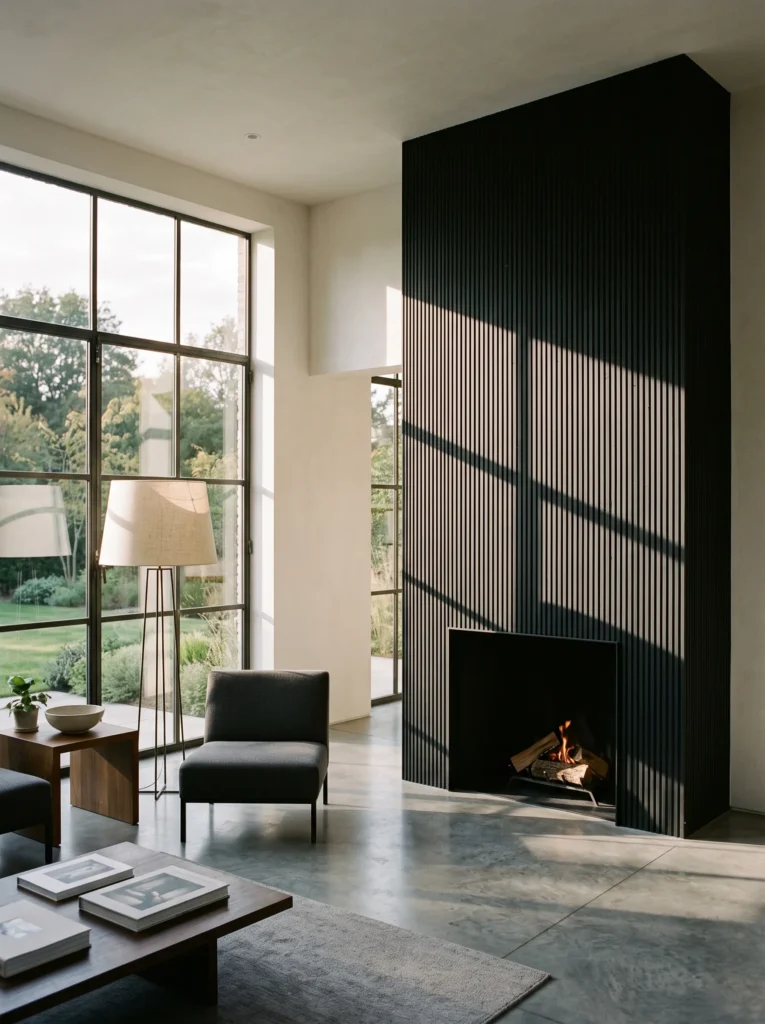
Room style: Contemporary minimalist living room with poured concrete floors
- Thin ribbed grooves run vertically across the plaster in a repeating pattern
- Poured concrete floors and unlacquered steel window frames match the industrial-minimal tone
- A single oversized linen lamp softens the otherwise hard material palette
- Small upgrade: keep the ribbing shallow rather than deep, so shadows stay subtle instead of dramatic
Why this works: Repeating micro-texture gives a flat black wall rhythm and depth without introducing any additional color.
Texture doesn’t need to be loud to be effective, and this fireplace is a good example of restraint doing the heavy lifting. Thin, shallow ribbing runs vertically across black plaster, catching light in narrow, repeating shadow lines rather than one dramatic pattern. Against poured concrete floors and steel-framed windows, the effect stays firmly contemporary minimalist, never veering into anything decorative or fussy. A single oversized linen floor lamp nearby is really the only soft element in the whole room.
In my experience, this kind of subtle ribbing photographs better than people expect, because the shadow lines shift noticeably depending on the time of day and angle of light. Midday sun flattens the texture almost completely, while low afternoon light makes each groove stand out sharply. That variability is part of what makes this finish interesting to live with long-term, rather than something that looks identical every time you walk past it.
17. Black Fireplace with Rattan Screen Accent
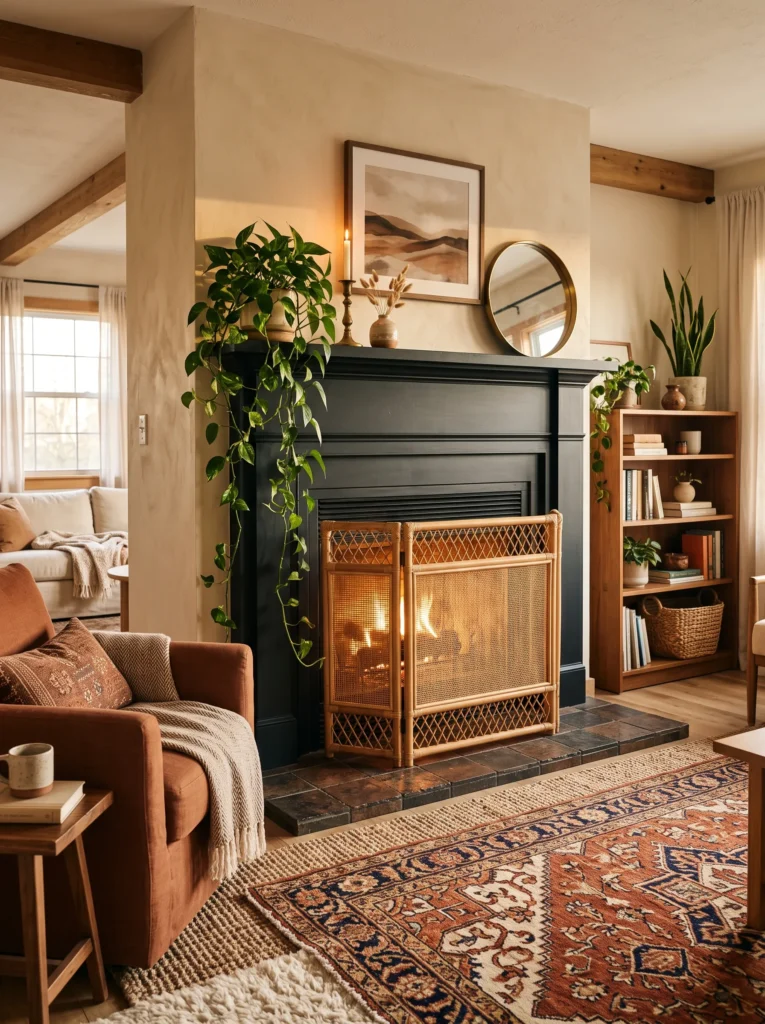
Room style: Bohemian modern living room with layered vintage rugs
- Woven rattan fire screen sits in front of an otherwise solid matte black surround
- Layered vintage rugs in rust and cream tones add pattern without competing for attention
- Trailing plants and a macramé wall hanging soften the fireplace’s hard edges
- Small upgrade: choose an open-weave rattan screen so firelight glow filters through the pattern
Why this works: Natural woven texture in front of a flat black surface adds warmth and softens what could otherwise feel like a stark, cold focal point.
Black and rattan sound like an unlikely pairing until you see how much warmth the weave adds to an otherwise cool, solid surface. A rattan fire screen sits directly in front of a matte black surround, its open weave letting firelight flicker through in small fragments once it’s lit. Layered vintage rugs in rust and cream tones scattered across the floor keep the bohemian modern space feeling collected rather than sparse. As someone with a plant background, I always tell readers that trailing pothos or ferns nearby complete this look better than any decorative object could.
This is a favorite among black painted fireplace ideas for renters or anyone hesitant to commit to a full stone or tile treatment, since the screen itself is removable and inexpensive to replace. The black surface stays simple and matte underneath, letting the rattan, plants, and layered textiles do the personality-building work instead. It’s an easy, low-cost way to soften a dark, graphic fireplace.
18. Black Fireplace with Floating Wood Mantel
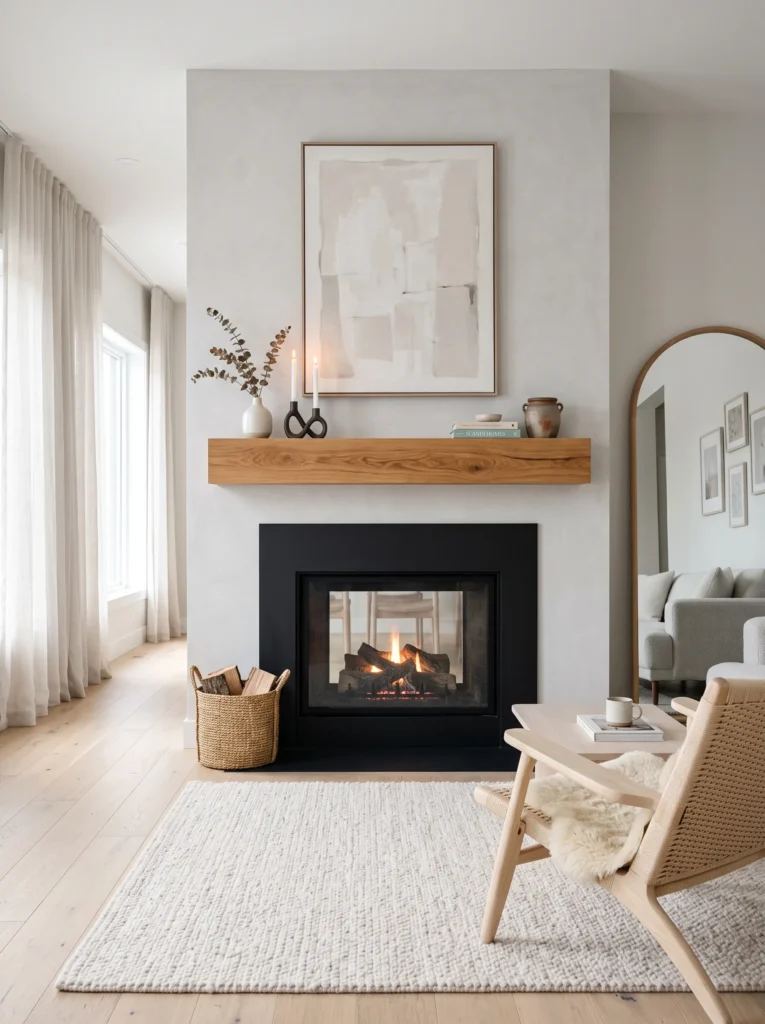
Room style: Scandinavian modern living room with pale birch furniture
- A thick floating oak mantel juts out from the flat black surround with no visible brackets
- Pale birch furniture and a wool bouclé rug keep the palette light around the dark anchor
- Simple ceramic bud vases on the mantel keep styling minimal and unforced
- Small upgrade: choose a mantel thickness of at least three inches so it reads as substantial, not flimsy
Why this works: A thick, unsupported mantel creates a strong horizontal line that breaks up the vertical weight of a solid black wall.
A floating mantel only works if it looks like it’s actually floating, which means thickness and clean installation matter more than people assume. Here, a solid oak slab juts out from a flat matte black surround with no visible brackets or supports, creating one strong horizontal line against an otherwise vertical, dark surface. In a Scandinavian modern living room built around pale birch furniture and a bouclé rug, that horizontal break keeps the black from feeling too heavy or dominant within the space.
My husband’s team hides the mounting hardware inside the wall itself using steel rods embedded during installation, which is what allows the mantel to appear unsupported. It’s a detail worth asking a contractor about directly, since a poorly installed floating mantel can sag over time. Styled simply, with just one or two ceramic bud vases, the mantel becomes the quiet detail that makes this fireplace feel deliberately architectural rather than accidental.
19. Black Fireplace with Fluted Plaster Columns
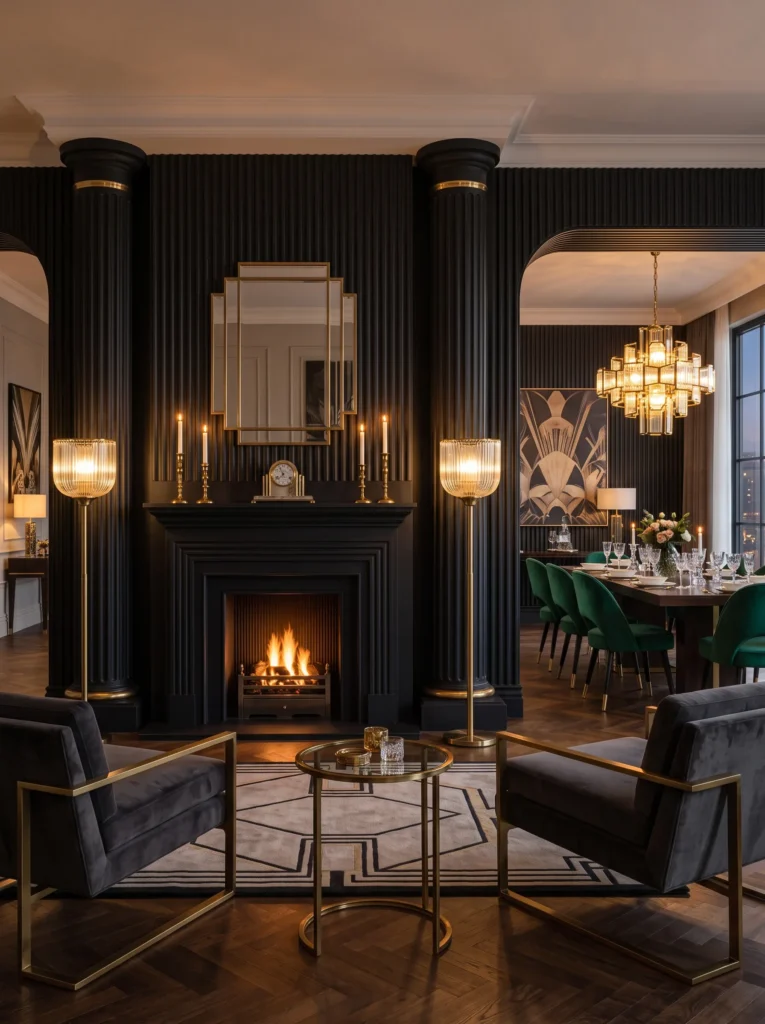
Room style: Art deco revival dining-adjacent living space with brass floor lamps
- Fluted plaster columns flank each side of the black firebox like architectural pilasters
- Deep emerald dining chairs visible nearby tie the space together across rooms
- Brass floor lamps with fluted glass shades echo the columns’ vertical grooves
- Small upgrade: paint the columns the same black as the surround for a unified, monolithic look
Why this works: Symmetrical fluted columns add formal architectural structure, giving the fireplace a presence closer to a building feature than a simple insert.
Symmetry reads as intentional, and few details signal that faster than a pair of matching columns. Fluted plaster columns flank this black fireplace on either side, painted the same deep black as the surround so the whole assembly reads as one unified, monolithic shape rather than separate parts. In an art deco revival space that opens toward a dining area with emerald velvet chairs, the columns echo classic 1920s architectural detailing without leaning into anything overly ornate or costume-like.
Brass floor lamps with fluted glass shades placed on either side pick up the same vertical groove pattern found in the columns, creating a subtle visual rhyme across the room. This is one of the more formal black painted fireplace ideas on this list, better suited to rooms with higher ceilings that can actually support columns without looking cramped. Done in a smaller space, the same detail would likely feel oversized rather than elegant.
20. Black Fireplace with Exposed Original Brick Hearth
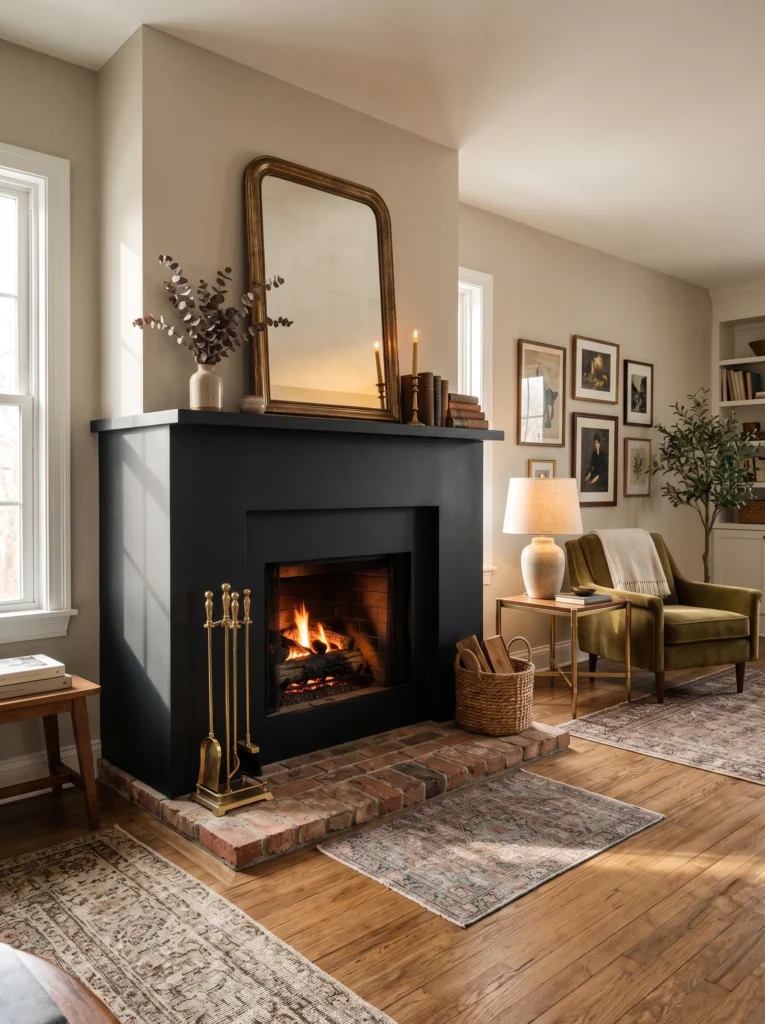
Room style: Eclectic vintage living room with mismatched antique furniture
- Original brick hearth left unpainted while the surround above is painted matte black
- Mismatched antique furniture pieces in varied wood tones add collected character
- Vintage brass fireplace tools and an heirloom mirror complete the eclectic feel
- Small upgrade: seal the unpainted brick hearth with a clear masonry sealer to prevent soot staining
Why this works: Leaving one original material exposed alongside new paint creates a visible timeline within the same fireplace, old and new coexisting deliberately.
Not every part of a fireplace needs the same treatment, and sometimes the most interesting choice is leaving something alone. Here, the brick hearth stays completely unpainted while matte black paint covers the surround above it, creating a clear visual break between old and new materials within a single feature. In an eclectic vintage living room full of mismatched antique furniture collected over years, that contrast fits the room’s whole ethos of layered history rather than a single cohesive design moment.
Before repainting a surround like this, my husband always checks whether the existing brick or plaster has any structural cracking or moisture damage hiding beneath old paint layers, since that affects prep work significantly. Vintage brass fireplace tools and an heirloom mirror leaning against the mantel finish the look without feeling staged. Among black painted fireplace ideas, this one requires the least material investment, since you’re really just painting what’s already there and leaving the rest untouched.
Final Thoughts
A fireplace shouldn’t be the one thing in your home you stop noticing. These black painted fireplace ideas prove how much personality, warmth, and architectural interest a single painted surface can bring back into a room. I’ve seen how a change this focused can shift the entire feel of a space, often more than a full furniture overhaul ever could. Whether you’re drawn to soft limewash or bold zellige tile, there’s a version here that fits your home and your comfort level with color.
Save this post so you can revisit it when you’re ready to start, and pass it along to anyone dreaming of a fireplace refresh of their own. Sometimes the boldest changes start with the smallest space in the room.
FAQs
1. What color goes best with a black painted fireplace? Warm neutrals like linen, oak, and brass tend to balance a black fireplace best, while cool tones like white oak or pale gray keep the look modern and light.
2. Is it expensive to paint a fireplace black? No — a basic matte black paint job is one of the most affordable updates on this list, while finishes like tadelakt, microcement, or steel cost more due to material and labor.
3. Do I need special paint for a brick or stone fireplace? Yes, older or porous brick usually needs a breathable, heat-resistant masonry paint rather than standard latex, so moisture doesn’t get trapped behind the surface.
4. Will a black fireplace make a small room feel darker? Not necessarily — pairing it with pale flooring, light furniture, and natural daylight (as seen in several ideas above) keeps a black fireplace from overwhelming a small space.
5. Which black painted fireplace idea works best for renters? The rattan fire screen accent (Idea 17) is the easiest to install and remove without permanent changes, making it ideal for rental homes.
6. How do I keep a black fireplace looking fresh over time? Matte and limewash finishes hide soot and minor smudges better than glossy finishes, and sealing hearths or brick helps prevent staining near the firebox.