15 Fall Vegetables Actually Worth Growing
Every fall, I watch people fill their carts with whatever looks prettiest, then wonder months later why half of it never made it to the table. If you’re searching for fall vegetables to grow that actually earn their space, that’s exactly the gap this list closes — no more inspiration without real payoff.
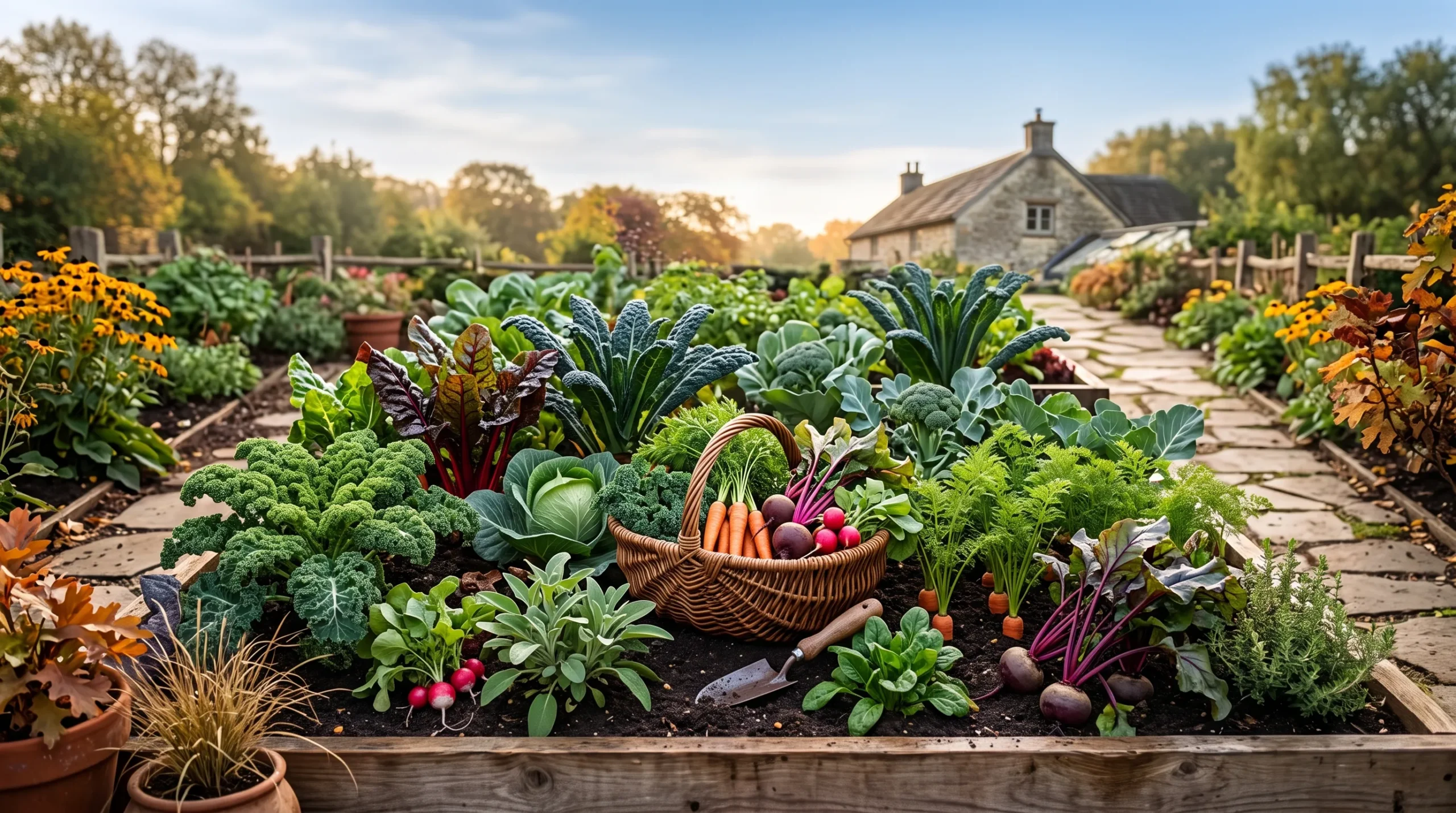
Each of these 15 picks works on three levels: genuine cost savings over store-bought produce, real botanical reasoning behind why fall suits it, and a fully styled growing setup that looks as good as it performs. I’ve grown most of these myself in our Austin garden, and a few — fennel and turnips especially surprised me more than anything in a typical spring bed ever has. Whether you’re working with one raised bed or a scattering of containers, there’s a genuine, worthwhile pick here sized to the space you actually have.
Before You Plant: A Real Decision Framework
Every fall, I watch people wander through the garden center grabbing whatever looks charming in a six-pack — a little kale here, some ornamental cabbage there — without asking the one question that actually matters: will I eat this? That’s the real decision point behind any good fall vegetable garden. Your space, your climate, and your actual eating habits should drive what goes in the ground, not what photographs well.
Here’s a number that changes how most people think about it: a $3 seed packet of most fall greens can realistically produce $20 to $40 worth of produce across a single season, which makes fall vegetables one of the best cost-to-yield ratios in home gardening, period. Austin’s mild fall stretches that window even further.
This list isn’t 15 pretty vegetables. It’s 15 fall vegetables to grow that actually earn their square footage — with the real numbers, the real care requirements, and honest notes on when to skip one entirely.
Spinach — Spinacia oleracea
- Scientific name: Spinacia oleracea
- Benefit: One $3 seed packet produces multiple cut-and-come-again harvests, easily replacing $15–20 of store-bought bagged spinach across a single season.
- Growing Conditions: Full sun to partial shade, consistent moisture, spacing 3–4 inches apart. Frost-tolerant down to roughly 20°F once established, with 37–45 days to first harvest.
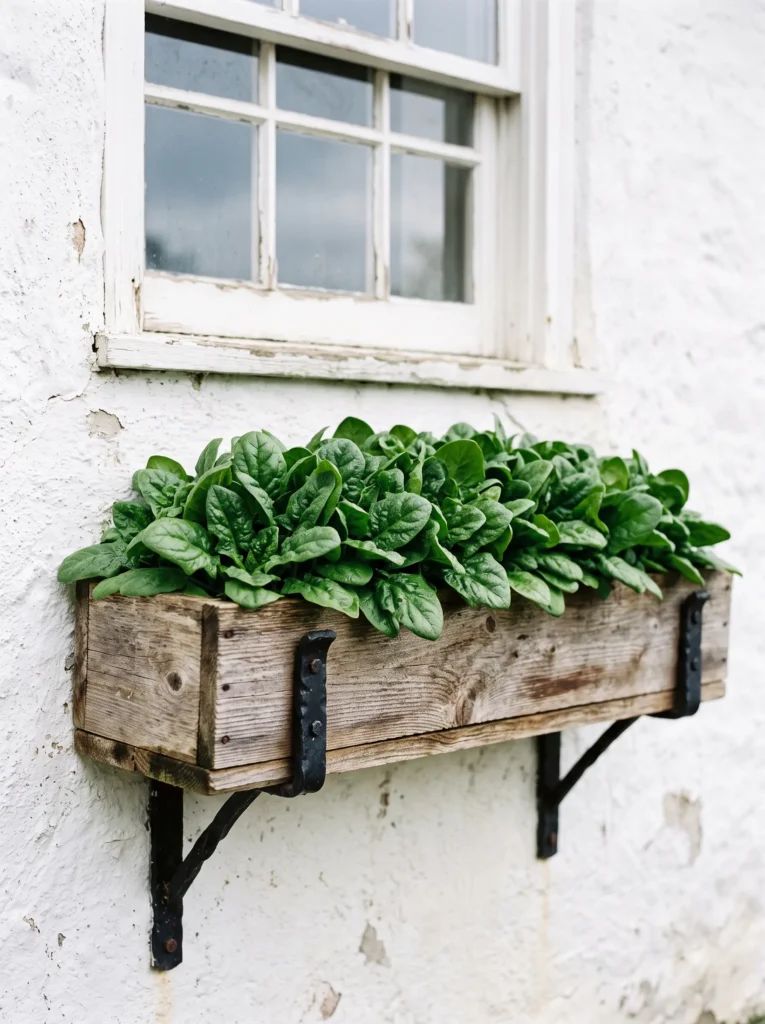
- Setup: Reclaimed cedar window box, wall-mounted at counter height with black iron brackets, minimum 8 inches deep for root room.
- Honest note: Skip this if your fall stays warm late into the season — spinach bolts fast once temperatures climb back above 75°F, and a bolted plant turns bitter overnight.
Why this works: Spinach’s flavor actually improves in cool weather, which is the opposite of most vegetables, making it one of the few crops that gets better the later you plant it.
I used to think spinach was a spring-only crop until my first fall harvest changed my mind completely. Spinach (Spinacia oleracea) actually prefers fall’s cooler temperatures over the wilting heat of a Texas spring, which means leaves grow sweeter, thicker, and far less prone to bolting. In my raised beds, a single fall planting kept producing baby leaves for cut-and-come-again harvests well into December, some years past the first light frost. It’s one of the fastest returns in the whole list — from seed to first salad in under six weeks, with almost no pest pressure once the weather cools.
A window box mounted at counter height turns spinach into something you actually use, not just admire from across the yard. I lined ours in reclaimed cedar with black iron brackets, and the contrast against a whitewashed exterior wall makes the deep green leaves the whole focal point. Because spinach stays compact and low, it never blocks a window view, which matters more than people expect once the box is installed. Harvesting becomes a five-second task on the way to the kitchen door, and that convenience is usually what determines whether a fall vegetable garden gets used through the season.
Carrots — Daucus carota subsp. sativus
- Scientific name: Daucus carota subsp. sativus
- Benefit: Cold-triggered sugar conversion makes fall-grown carrots noticeably sweeter than spring ones, with strong cost-per-pound value versus grocery store bunches.
- Growing Conditions: Full sun, deep loose soil, direct-seed only (carrots transplant poorly). Frost-tolerant well below 32°F once established, 60–80 days to maturity.
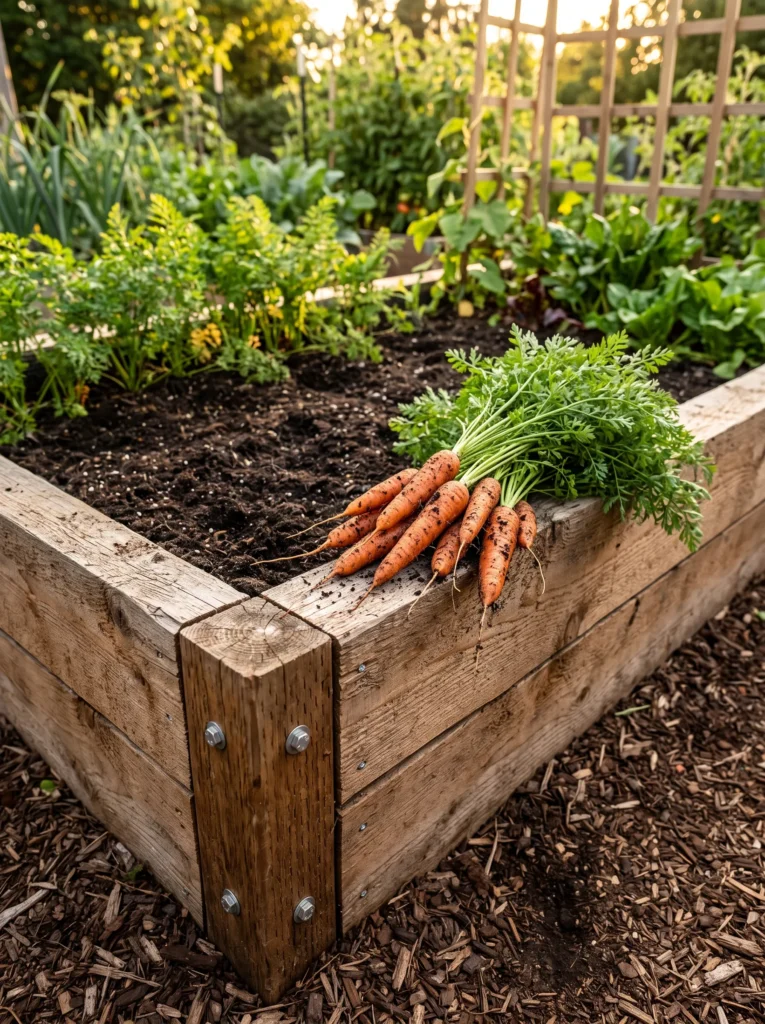
- Setup: Raised bed, minimum 12 inches of loose soil depth, built from rough-cut cedar planks lined with hardware cloth at the base.
- Honest note: Skip this if your soil is heavy clay and unamended — carrots fork and stunt badly in compacted ground.
Why this works: Carrots planted in fall develop sweeter flavor than spring-grown carrots because cold temperatures trigger the plant to convert starch into sugar.
Cold weather doesn’t just make carrots survive — it makes them taste better. Carrots (Daucus carota subsp. sativus) convert stored starches into sugars as a defense against freezing temperatures, which is why the same carrot pulled after a hard frost tastes noticeably sweeter than one harvested in warm soil. Texas A&M AgriLife Extension classifies carrots among the frost-tolerant fall crops that can handle temperatures well below 32°F once established. That science alone makes carrots one of the more compelling arguments for fall planting instead of waiting for spring, when the payoff never quite matches.
My husband’s rule for anything root-related is simple: give it depth or don’t bother. Carrots need at least 12 inches of loose, rock-free soil to grow straight, and a shallow raised bed is the single biggest reason home-grown carrots come out stubby or forked. We built ours from rough-cut cedar planks set two boards high, lined at the base with hardware cloth to block burrowing pests without blocking drainage. The result is carrots that pull cleanly from the soil in one motion, with none of the snapped tips that come from planting in a bed that’s too shallow.
Kale — Brassica oleracea var. acephala
- Scientific name: Brassica oleracea var. acephala (Lacinato/”dinosaur kale” variety)
- Benefit: One plant produces enough leaves for weekly meals across months, replacing repeated $3–4 grocery bunches through the entire cold season.
- Growing Conditions: Full sun, consistent water, spacing 12–18 inches. Cold-hardy into the upper 20s°F thanks to a thick, waxy leaf cuticle. 50–65 days to maturity.
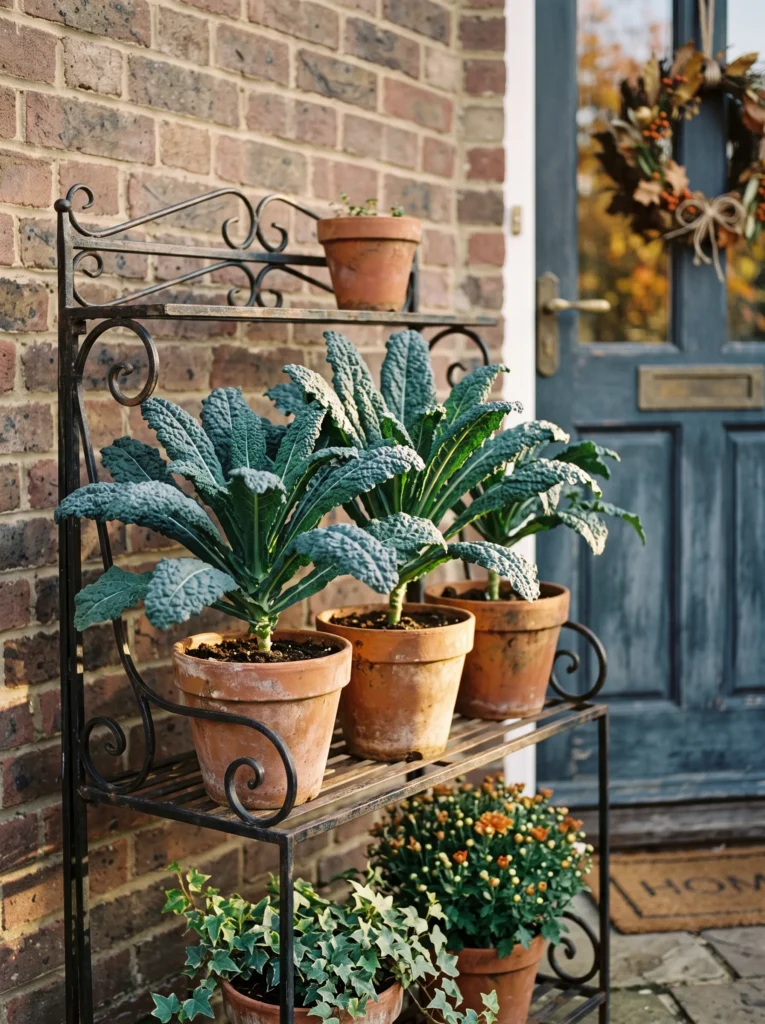
- Setup: Three-tier wrought iron plant stand with terracotta pots, staggered heights, positioned near a front entry.
- Honest note: Skip harvesting lower leaves too long and the stems turn leggy and bare — this one needs consistent, not occasional, picking.
Why this works: Kale’s thick, waxy leaf coating is a natural adaptation that lets it survive freezing temperatures other greens can’t, which is why it holds its shape and color long after a hard frost.
Lacinato kale earned its nickname “dinosaur kale” honestly — the deep blue-green, bumpy-textured leaves look almost prehistoric against a doorway, and I’ve had more guests ask about that planting than almost anything else near our entry. Kale (Brassica oleracea var. acephala) owes its cold hardiness to a thick, waxy leaf cuticle that protects cell walls from ice damage, which is why it often survives a light snow that would flatten more tender greens. That resilience makes it one of the lowest-maintenance vegetables on this entire list once the weather turns cold.
A three-tier wrought iron plant stand gives kale the vertical presence it needs without pretending it’s a climbing vine, which it isn’t. We set terracotta pots on each tier near the front door, staggering plant heights so the display reads full rather than sparse. One plant easily produces enough leaves for weekly meals for months, since regular harvesting from the bottom up keeps new growth coming. The one thing to stay ahead of: skip lower leaves too long and the stems turn leggy and bare, so harvest consistently rather than letting the plant sit untouched.
Garlic — Allium sativum
- Scientific name: Allium sativum
- Benefit: One $8 bag of seed garlic (8–10 cloves) can produce 8–10 full bulbs, each worth several dollars at a farmers market — a strong long-term yield ratio.
- Growing Conditions: Full sun, well-drained soil, cloves planted pointed-end up, 4–6 inches apart. Frost-tolerant, but not harvested until roughly 240 days after planting.
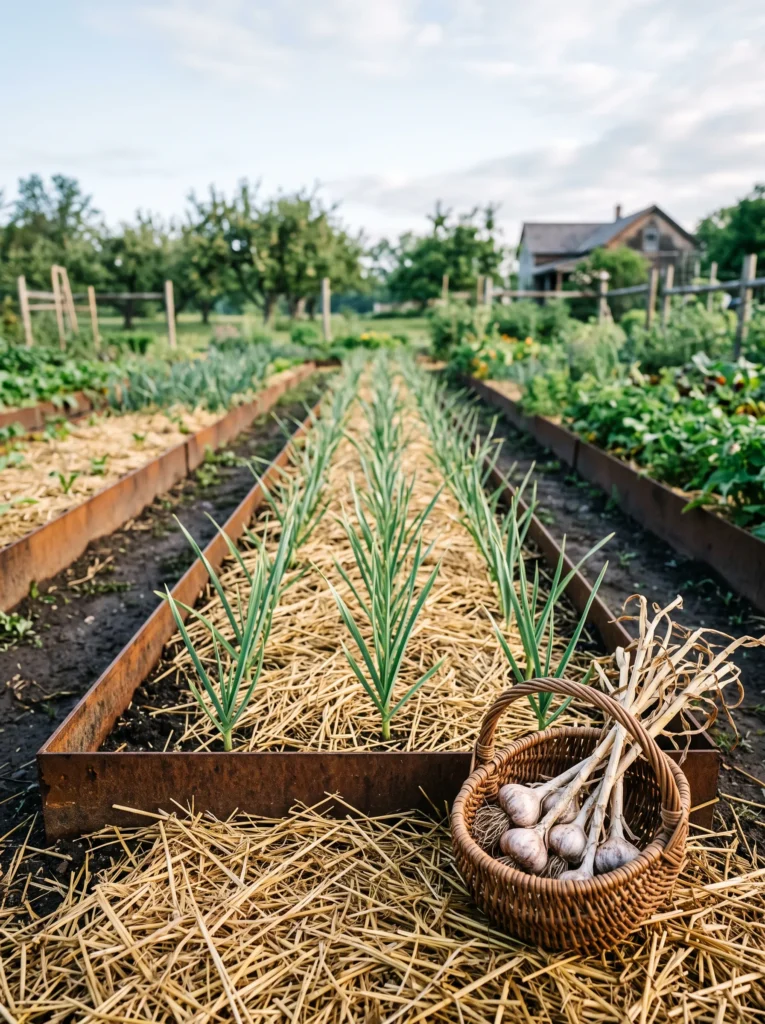
- Setup: In-ground row edged in weathered corten steel, heavily mulched with straw.
- Honest note: This isn’t a fall-harvest vegetable at all — it’s planted in fall and pulled the following summer, so skip it if you want quick results.
Why this works: Garlic planted in fall spends the winter forming its root system before going dormant, which is why it needs a cold season to develop properly and can’t simply be planted in spring for the same result.
Garlic is the one entry on this list that will test your patience, and it’s worth saying clearly upfront: this isn’t a fall harvest. Garlic (Allium sativum) is planted in October or November and doesn’t come out of the ground until the following June or July, needing that long, cold dormancy period to form proper cloves. Texas A&M AgriLife Extension lists garlic among the frost-tolerant crops suited to fall planting, but its timeline sets it apart from every other vegetable here. Plant it now, and you’re really gardening for next summer’s kitchen, not this season’s table.
We plant our garlic in a straight in-ground row edged with rusted corten steel, which holds a clean line through winter and slowly deepens in color as it weathers. Individual cloves go in pointed-end up, spaced about five inches apart, then get buried under a thick layer of straw mulch to insulate through freezes. One $8 bag of seed garlic typically produces eight to ten full bulbs, each worth several dollars at a farmers market, making the eventual yield well worth the long wait once you factor in true cost per bulb compared to store-bought.
Radishes — Raphanus sativus
- Scientific name: Raphanus sativus
- Benefit: Fastest payoff on this entire list — 21 to 30 days from seed to harvest, ideal for testing a new bed or teaching kids the full growing cycle.
- Growing Conditions: Full sun to light shade, loose sandy soil, spacing 2 inches apart. Tolerates light frost, 21–30 days to maturity.
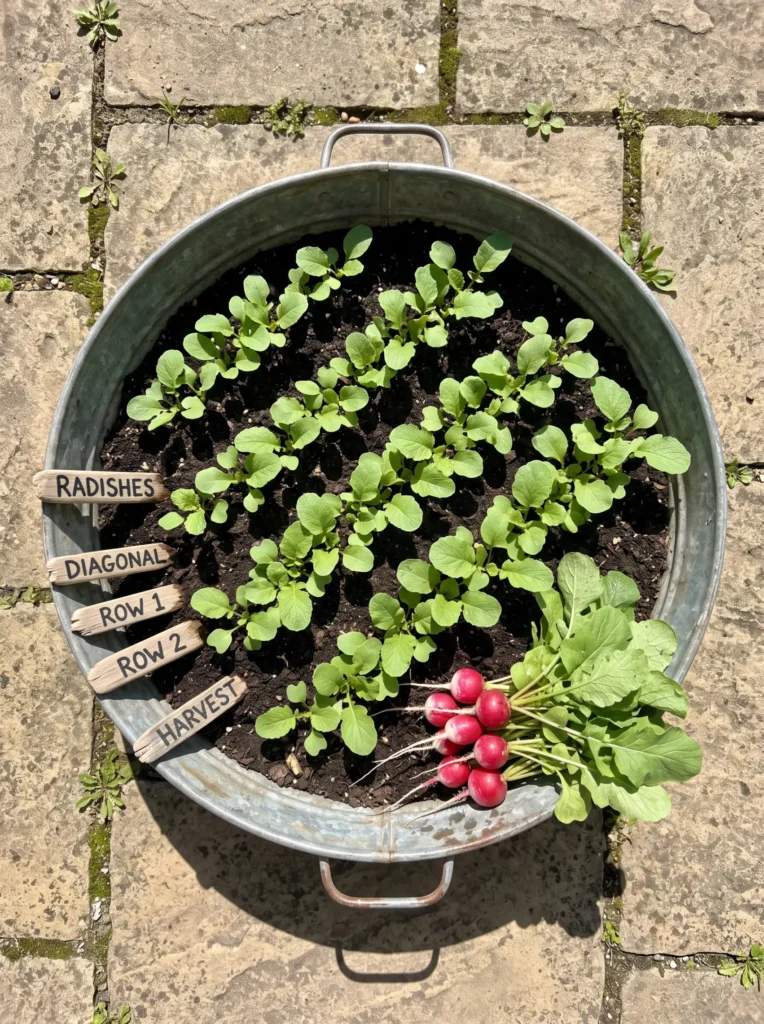
- Setup: Vintage galvanized washtub, diagonal succession rows, driftwood plant markers tracking sowing dates.
- Honest note: Skip stockpiling a big harvest at once — radishes turn woody and hollow within days of full maturity and don’t store well, so succession planting matters more than one large sowing.
Why this works: Radishes are one of the only fall vegetables that go from seed to harvest in under a month, making them the fastest way to see results in a new garden bed.
Radishes are the vegetable that finally convinced my kids gardening was worth the wait, mostly because the wait is almost nothing. Radishes (Raphanus sativus) go from seed to harvest in as little as 21 to 30 days, making them the fastest payoff on this entire list. I’ve started staggering plantings every ten days through fall, which keeps a steady supply coming instead of one overwhelming harvest all at once. That succession approach is the real secret to getting the most out of a small radish patch, and it’s the difference between a handful of radishes and a genuine steady supply.
We grow ours in a vintage galvanized washtub set on the patio, planted in diagonal rows so the pattern reads as intentional rather than accidental once the greens fill in. Driftwood plant markers track each sowing date, which matters more than it sounds like it should when you’re planting every ten days. The tub’s shallow depth is perfect since radish roots rarely need more than 6 inches of soil to form properly. Because they mature so fast, radishes are also forgiving for beginners — mistakes get corrected within weeks, not an entire growing season.
Broccoli — Brassica oleracea var. italica
- Scientific name: Brassica oleracea var. italica
- Benefit: Cold exposure sweetens the heads and avoids the bolting risk of spring planting; one plant produces a main head plus smaller side shoots for weeks afterward.
- Growing Conditions: Full sun, fertile well-drained soil, spacing roughly 18–24 inches. Cold-hardy to around 25°F once mature, 60–90 days to maturity depending on variety.
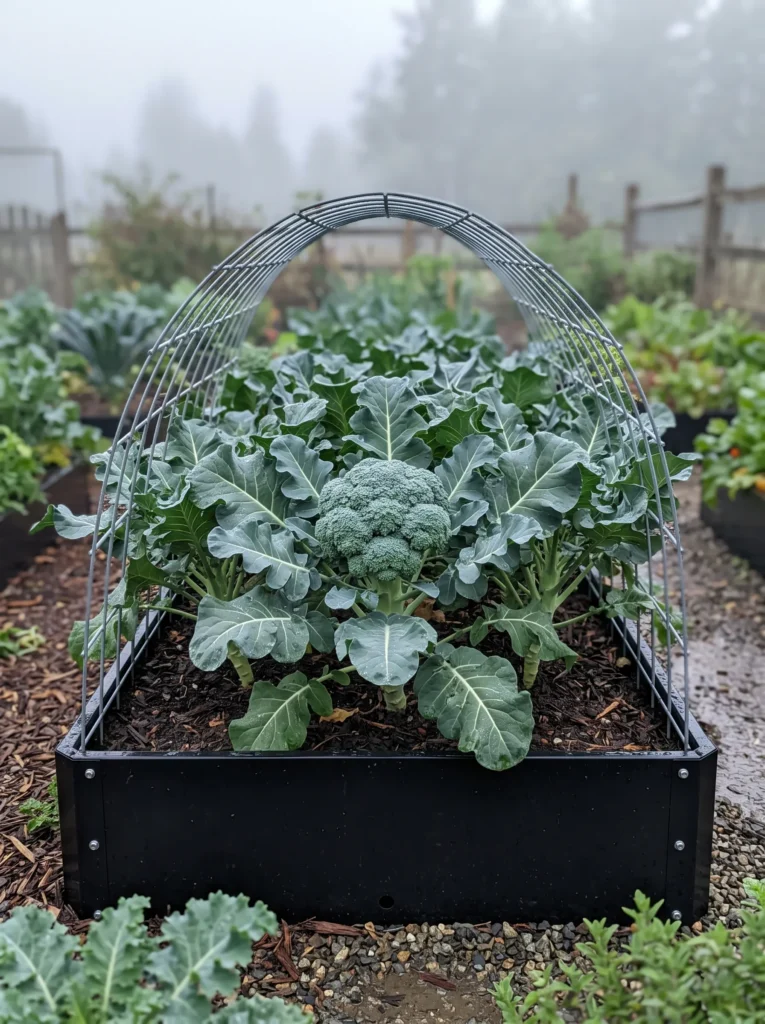
- Setup: Black powder-coated steel raised bed paired with a low, bent cattle-panel trellis for wind support.
Why this works: Cold exposure during head formation triggers broccoli to convert starches into sugars, which is why fall-grown heads taste noticeably sweeter than spring-grown ones.
Broccoli’s reputation as a fussy vegetable mostly comes from people planting it at the wrong time of year. Broccoli (Brassica oleracea var. italica) actually performs better in fall than spring in most climates, since heads forming during steady cool weather avoid the rapid bolting that ruins spring crops when a sudden heat spell hits. Michigan State University Extension notes that mature broccoli can withstand temperatures down to 25°F, and cold exposure during this period makes the heads noticeably sweeter. That single fact reframes broccoli from a finicky spring gamble into one of the most reliable fall crops available.
Tall brassicas like broccoli catch wind more than people expect, and a plant that topples mid-season rarely recovers a straight stalk. My husband’s fix for this in our own beds is a low cattle panel trellis, cut down and bent into a simple grid that plants can lean into as they grow, staked firmly at each corner. We paired it with a raised bed built from black powder-coated steel, which holds heat a little longer into fall evenings and helps stabilize soil temperature. The result is broccoli that stands upright through fall storms instead of sprawling across the bed.
You’ll Also Love:15 Fall Herbs to Grow for Fresh Flavor
Swiss Chard — Beta vulgaris subsp. vulgaris
- Scientific name: Beta vulgaris subsp. vulgaris
- Benefit: Continuous cut-and-come-again harvest for months from one planting, plus genuine ornamental value that reduces the need for separate fall flower plantings.
- Growing Conditions: Full sun to partial shade, spacing 6–12 inches, frost-tolerant into the low 20s°F, roughly 50–60 days to first harvest.
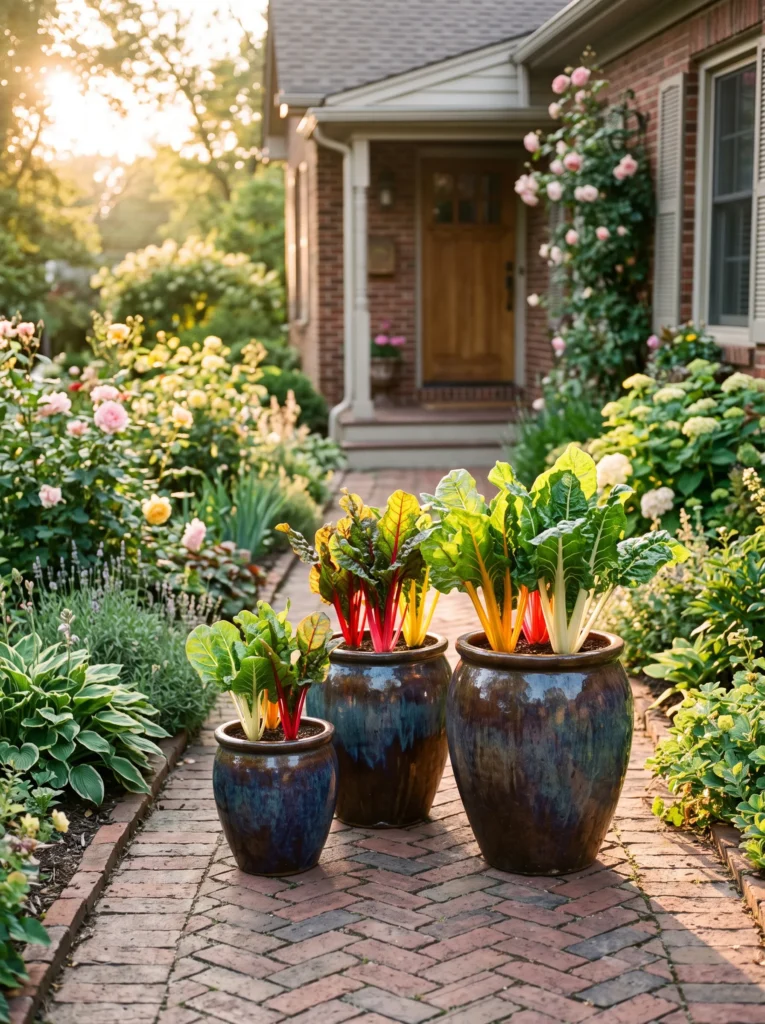
- Setup: Three graduating glazed ceramic urns, rainbow-stem variety clustered by color along a walkway.
- Honest note: Skip this if you’re not eating greens regularly — chard is prolific, and unused leaves turn tough and bitter fast if they sit too long before picking.
Why this works: Swiss chard and beets are genetically the same species, one bred for its root and one for its leaves, which is why chard channels all its energy into producing vividly colored, edible stems instead.
Few people realize Swiss chard and beets are technically the same species, bred apart over centuries for different purposes — one for its root, one for its leaves. Chard (Beta vulgaris subsp. vulgaris) channels all of that genetic energy into vibrant stalks instead, which is why a single row can look more like a floral border than a vegetable patch. I planted a rainbow variety along our front walkway almost as an experiment, and it’s outperformed most of our actual ornamentals for color through October and November. Cold weather only deepens the stem colors rather than fading them.
We clustered ours in a set of three large glazed ceramic urns in graduating sizes, positioned where afternoon light hits the stems directly and lets the color glow through. Ruby, gold, and white stalks planted together create natural variation without any extra styling effort required. Chard is also one of the more forgiving fall crops for harvest timing — outer leaves can be cut continually for months while the center keeps producing, so a single planting realistically feeds a household well past the first frost. It’s proof that a genuinely useful vegetable can also carry real ornamental weight.
Bok Choy — Brassica rapa subsp. chinensis
- Scientific name: Brassica rapa subsp. chinensis
- Benefit: Fast maturity (30–45 days for baby bok choy), mild crisp flavor, and a strong yield-to-space ratio for stir-fry cooking households.
- Growing Conditions: Full sun to partial shade, spacing 6 inches for baby plants, 12 inches for full-size. Tolerates light frost, bolts in sustained heat above 80°F.
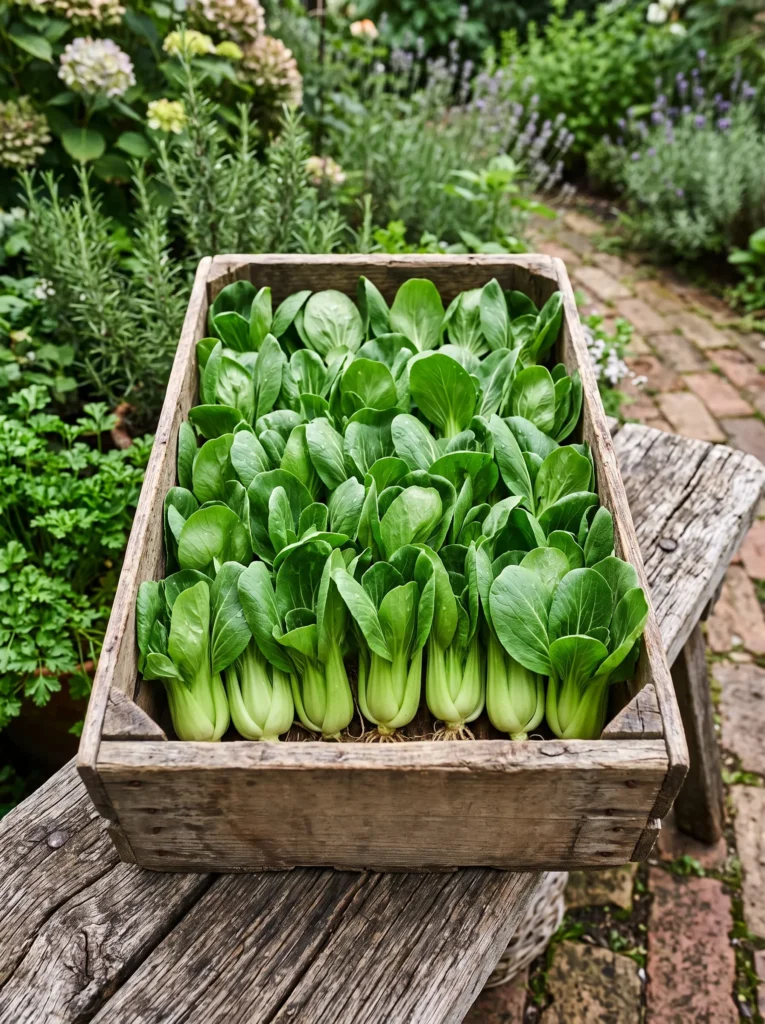
- Setup: Shallow, weathered wooden fruit crate lined with landscape fabric, kept portable.
- Honest note: Skip late planting in regions prone to a warm fall spell — bok choy bolts fast once temperatures climb back into the 80s.
Why this works: Bok choy is one of the fastest-maturing fall vegetables available, with baby varieties ready to harvest in as little as 30 days from seed.
Bok choy rarely makes typical fall vegetable lists, which is a genuine oversight given how well it performs in cool weather. Bok choy (Brassica rapa subsp. chinensis) matures fast, tolerates light frost, and has a crisp, mild flavor that holds up better in stir-fries than most people expect from a homegrown version. I added it to our fall rotation almost as an afterthought and ended up harvesting it more than nearly everything else in the bed, mostly because baby bok choy is ready in as little as 30 days. It’s become one of our most-requested crops at the dinner table.
We grow ours in a shallow, weathered wooden fruit crate lined with landscape fabric, which gives just enough depth for the compact root system while keeping the whole setup easy to move if an early cold snap threatens. Spacing plants about 6 inches apart in the crate keeps harvests staggered rather than all-at-once. The one thing to watch for is a warm spell — bok choy bolts quickly if fall temperatures spike back into the 80s, so skip late planting in regions where a true Indian summer is common, and get it in the ground as early cool weather allows.
Beets — Beta vulgaris subsp. vulgaris
- Scientific name: Beta vulgaris subsp. vulgaris
- Benefit: Dual harvest — both root and greens are edible from a single planting, an efficiency most gardeners overlook entirely.
- Growing Conditions: Full sun, loose stone-free soil, thinned to 3–4 inches apart for proper root sizing. Frost-tolerant into the 20s°F, 50–60 days to maturity.
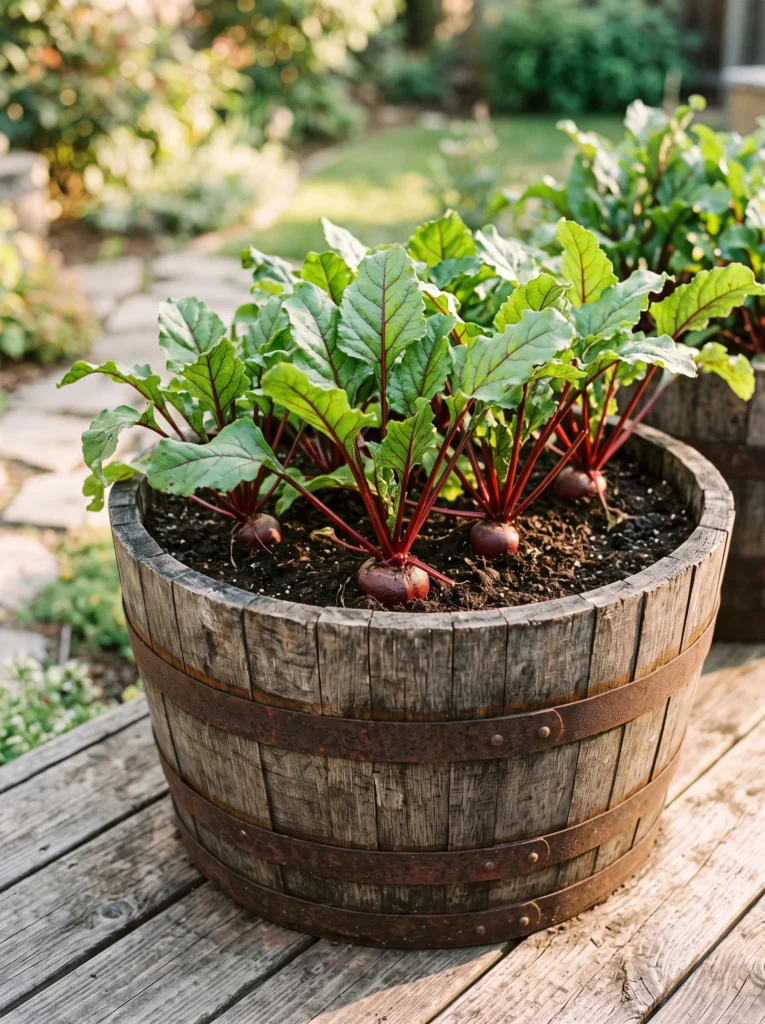
- Setup: Repurposed wine barrel, halved and drilled with drainage holes, filled with compost-amended soil.
- Honest note: Skip planting too densely — crowded beets fail to size up properly, so thin seedlings early even though it feels wasteful.
Why this works: Beets produce two harvestable crops from a single planting — the root and the greens — making them one of the most space-efficient vegetables in a fall garden.
Most gardeners plant beets for the root and either compost or ignore the greens, which means they’re leaving roughly half the harvest on the table. Beets (Beta vulgaris subsp. vulgaris) produce both an edible root and edible greens from a single planting, and the greens — closely related to chard — can be harvested in small amounts throughout the season without harming root development. That dual-purpose yield is one of the most overlooked value points in fall vegetable gardening, since a single row effectively produces two separate crops. Few other vegetables on this list offer that kind of built-in efficiency.
We grow ours in a repurposed wine barrel, cut in half and drilled with a dozen drainage holes across the base — a step my husband insists is non-negotiable, since standing water rots beet roots faster than almost anything else. The barrel’s natural curved shape and weathered oak tone give it a warmth that a plastic planter never quite matches. Beets need loose, stone-free soil to form evenly, so we mixed in extra compost before planting. One barrel comfortably holds a dozen plants, giving us both a steady root harvest and a rotating supply of greens for salads.
Cauliflower — Brassica oleracea var. botrytis
- Scientific name: Brassica oleracea var. botrytis
- Benefit: Mild, versatile flavor with consistently high store prices, making it one of the more cost-effective vegetables to replace with home growing.
- Growing Conditions: Full sun, consistent moisture (non-negotiable), spacing 18–24 inches, 50–80 days to maturity depending on variety.
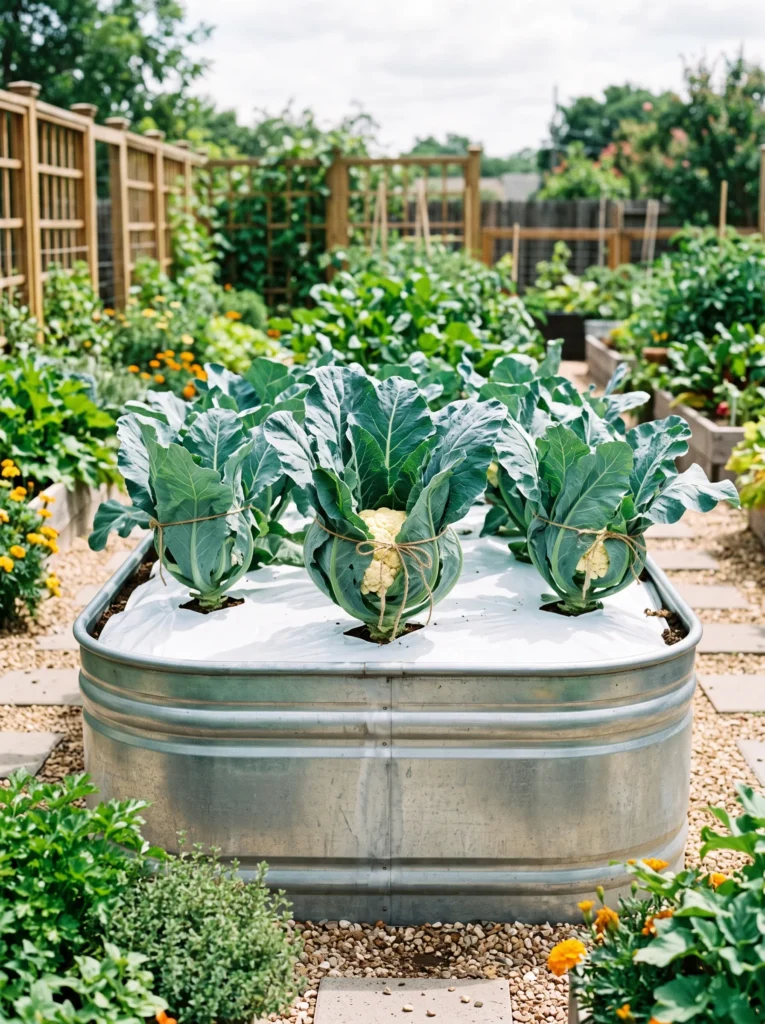
- Setup: Galvanized stock tank fitted with drip irrigation, topped with a white plastic mulch layer.
- Honest note: Skip this one if you can’t commit to consistent watering — inconsistent moisture is the single most common reason home cauliflower fails to form a proper head.
Why this works: Cauliflower heads need to be shielded from direct sunlight as they mature, which is why tying the outer leaves over the curd is the single most important step home growers skip.
Cauliflower has a reputation as the temperamental cousin of broccoli, and that reputation is mostly earned by one missed step: blanching. University of Maryland Extension recommends pulling the outer leaves up over the developing head and securing them once the curd reaches about two inches across, since sunlight causes the head to discolor and lose its clean white color. Cauliflower (Brassica oleracea var. botrytis) also demands more consistent moisture than its relatives — any interruption in watering during head formation can stall growth permanently. Get both of those right, and cauliflower stops being difficult.
We grow ours in a galvanized stock tank fitted with a drip irrigation line, which solves the consistent-moisture problem almost automatically once it’s set up. A layer of white plastic mulch across the soil surface keeps roots cool as fall days still run warm, and it reflects extra light back up into the plant. When each head reaches about two inches across, we loosely tie the outer leaves over it with garden twine, checking every few days until it’s ready to cut. The visual payoff is worth the extra step — a clean, snow-white head framed by wide blue-green leaves.
Lettuce — Lactuca sativa
- Scientific name: Lactuca sativa
- Benefit: Fastest, most forgiving crop for beginners; cut-and-come-again harvesting from one planting can supply salads for up to two months.
- Growing Conditions: Full sun to partial shade, shallow rooting (6 inches soil sufficient), spacing 6–8 inches. Tolerates light frost, 45–55 days to maturity (baby leaf faster, around 30 days).
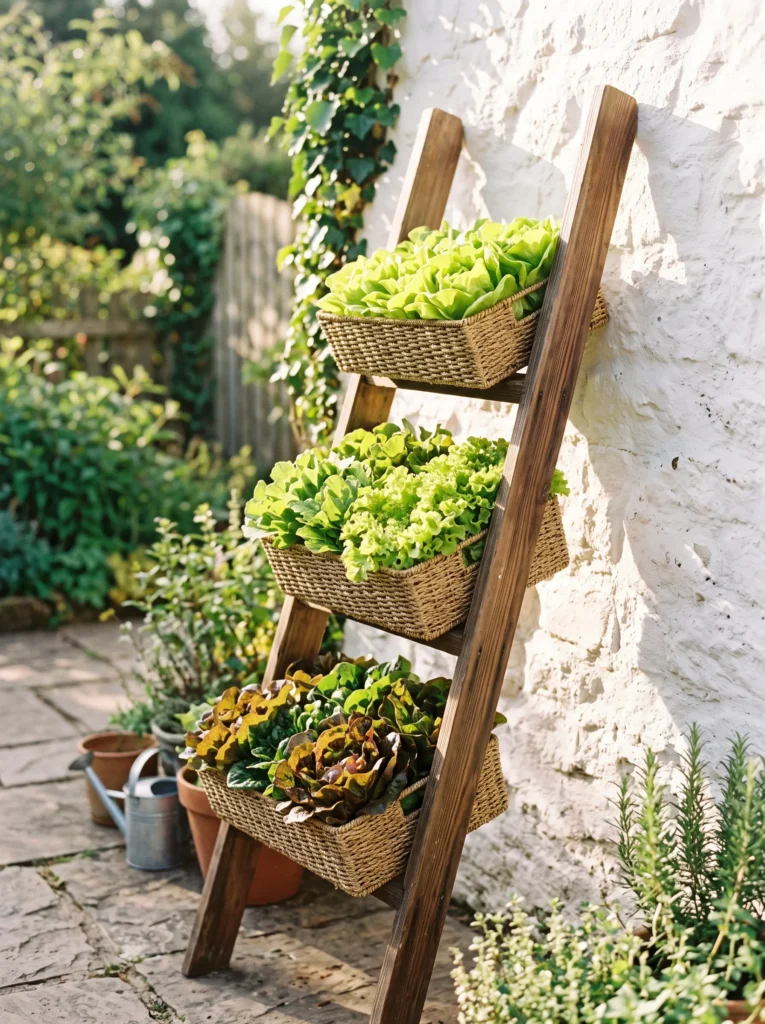
- Setup: Tiered cedar ladder shelf with basket-lined trays, staggered leaf colors.
- Honest note: Skip this if an unexpected warm spell is common in your area in early fall — lettuce bolts and turns bitter fast in sustained heat.
Why this works: Cut-and-come-again harvesting lets a single lettuce planting keep producing new leaves for weeks, since only the outer leaves are removed while the center continues growing.
Lettuce was the first thing I ever grew successfully, back before I knew anything about plant science, and it’s still the crop I recommend to anyone nervous about starting a fall garden. Lettuce (Lactuca sativa) germinates quickly, tolerates light frost, and forgives almost every beginner mistake short of drowning it. What surprised me most, even with a horticulture background, is how much faster leaf lettuce regrows after cutting compared to buying a single head at the store — one planting can realistically supply salads for two months straight if you harvest outer leaves instead of pulling the whole plant.
We built a tiered wooden ladder shelf out of leftover cedar fencing, leaning it against a sunny wall with a shallow basket-lined tray on each rung. Loose-leaf and butterhead varieties fill the baskets in staggered colors, from deep bronze to pale chartreuse, which reads more like a living centerpiece than a vegetable patch. Because lettuce roots stay shallow, the baskets only need about 6 inches of soil depth to perform well. The one thing to watch is heat — even a short warm spell in early fall can push lettuce to bolt and turn bitter, so shade cloth stays nearby.
Fennel — Foeniculum vulgare var. azoricum
- Scientific name: Foeniculum vulgare var. azoricum
- Benefit: Rarely grown at home despite being consistently pricier at the store than common vegetables; doubles as an architectural garden feature.
- Growing Conditions: Full sun, consistent moisture, loose soil, spacing 8–12 inches. Cool-season crop, roughly 60–90 days to bulb maturity.
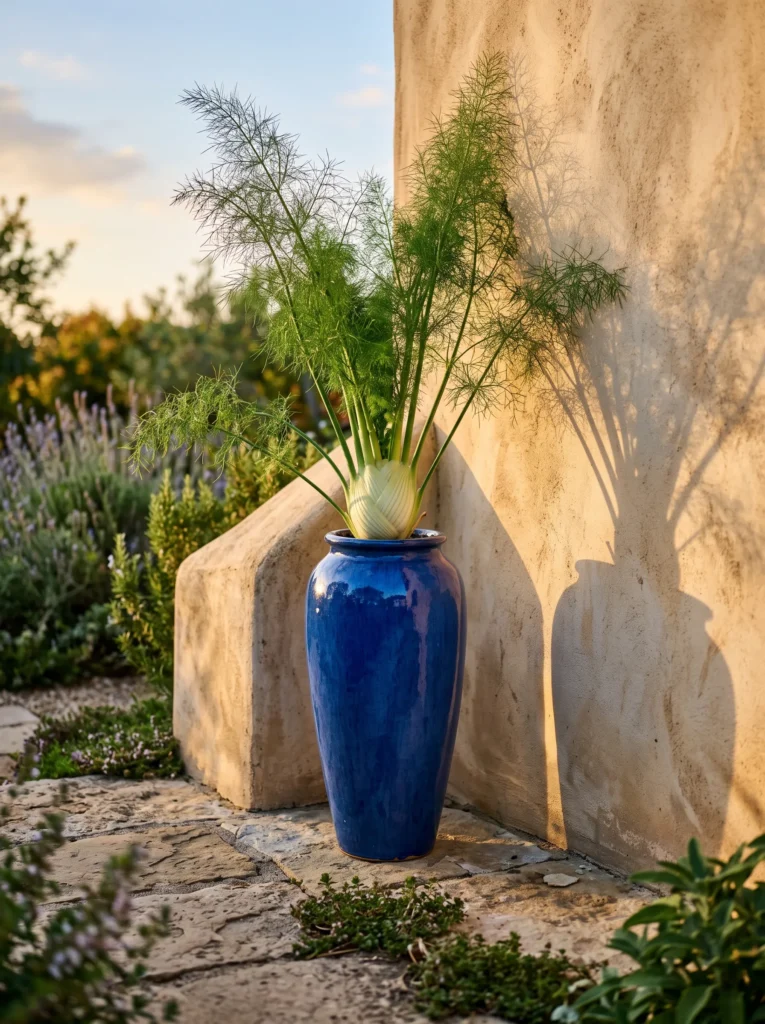
- Setup: Large glazed cobalt urn on a patio corner, positioned for height and movement.
- Honest note: Skip this if you don’t cook with fennel regularly — it’s a slower, more attention-demanding crop than most of this list, with smaller raw yield than something like lettuce or radishes.
Why this works: Florence fennel forms its edible bulb at soil level while its feathery fronds grow several feet tall, giving it a dramatic vertical presence unlike almost any other fall vegetable.
Fennel rarely appears on fall vegetable lists, which is a shame, since Florence fennel (Foeniculum vulgare var. azoricum) offers one of the most architecturally striking silhouettes of anything you can grow in a fall bed. The bulb forms at soil level while feathery, anise-scented fronds shoot several feet skyward, giving it presence more typical of an ornamental grass than a vegetable. It prefers the same cool fall conditions as its brassica neighbors but brings a completely different visual texture to the garden. I use it almost like a living sculpture at the back of a bed, functional and striking at once.
We grow ours in a large glazed cobalt urn positioned at the corner of the patio, tall enough that the fronds catch the evening breeze and cast moving shadows against the wall behind it. The bulb needs consistent moisture and loose soil to swell properly, so we water more attentively than most of the other crops in this list require. Harvest happens when the bulb reaches about 3 inches across; cut at soil level with the fronds trimmed for use in cooking. It’s one of the few fall vegetables that functions as a genuine focal point rather than a background crop.
Turnips — Brassica rapa subsp. rapa
- Scientific name: Brassica rapa subsp. rapa
- Benefit: Dual harvest of root and greens from one planting; greens are especially nutrient-dense, and roots mature quickly at 35–55 days.
- Growing Conditions: Full sun, loose well-drained soil, spacing 3–4 inches after thinning. Frost-tolerant, 35–55 days to maturity.
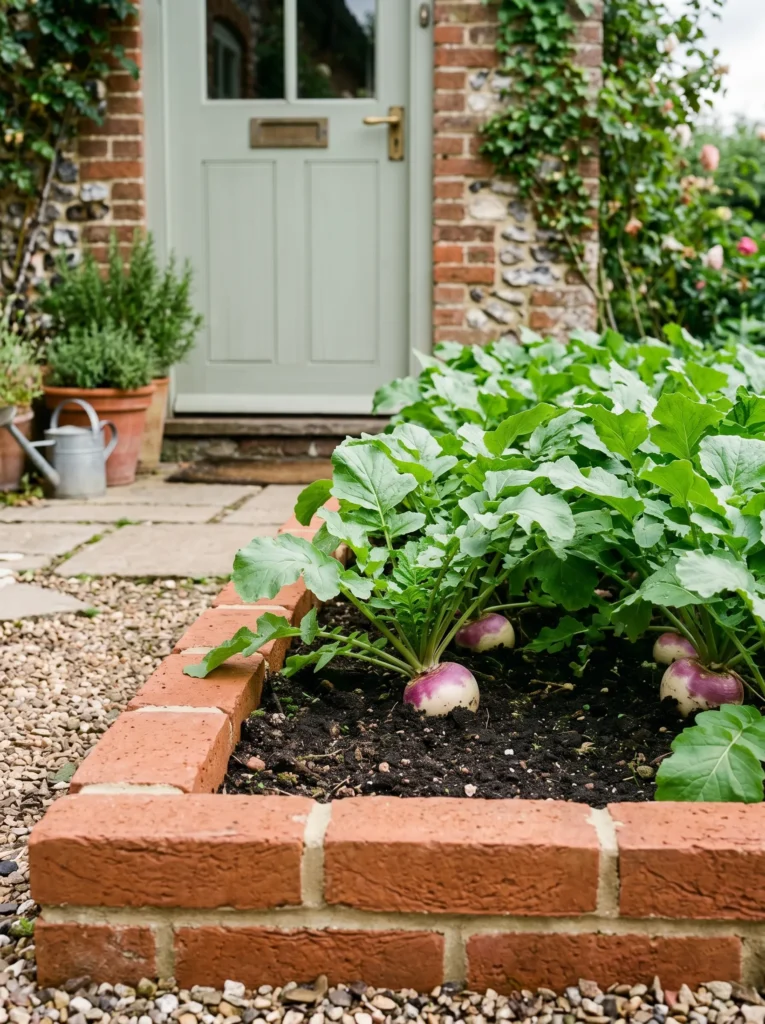
- Setup: Low brick-edged garden bed set on a compacted gravel base below the frost line.
- Honest note: Skip large maincrop varieties if space is tight — smaller salad turnip varieties mature faster and take up far less room for the same effort.
Why this works: Turnip greens carry more calcium and vitamin A than the root itself, making a single turnip planting genuinely two nutrient-dense crops in one.
Turnips get dismissed as an old-fashioned vegetable, but the numbers don’t support that reputation. Turnips (Brassica rapa subsp. rapa) mature in as little as 35 to 55 days, making them one of the fastest root vegetables on this list, and the greens — often thrown away — carry more calcium and vitamin A than the root itself. That makes a single turnip planting genuinely two crops in one, similar to beets, but with an even faster timeline to the first harvest. Few root vegetables offer that kind of speed for so little garden space.
We grow turnips in a low brick-edged bed near the kitchen door, which sounds simple until you learn there’s an actual trick to it. My husband set the brick course on a compacted gravel base below the frost line, since mortar joints crack and heave if the bed freezes and thaws directly on unstable soil. That small foundation step means the bed has held its shape for years without repointing. Turnips themselves need only loose, well-drained soil and consistent moisture to size up properly, and thinning seedlings early keeps the roots from crowding each other into odd shapes.
Brussels Sprouts — Brassica oleracea var. gemmifera
- Scientific name: Brassica oleracea var. gemmifera
- Benefit: One staked stalk can produce fifty or more sprouts across a season, with flavor that improves after light frost.
- Growing Conditions: Full sun, rich fertile soil, spacing 18–24 inches. Frost-tolerant, harvested bottom-up as sprouts mature, roughly 80–100 days to first harvest.
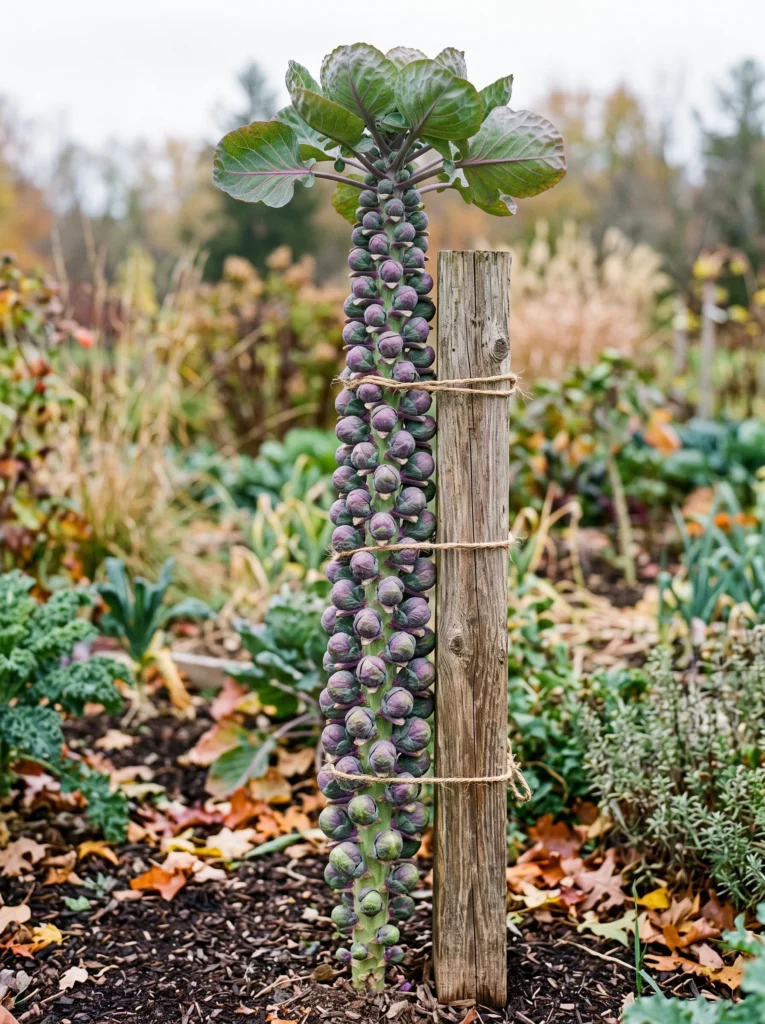
- Setup: Single stalk staked to a cedar post, purple ‘Rubine’ variety for visual color.
- Honest note: Skip this if you’re short on vertical space or patience — Brussels sprouts take longer than nearly everything else on this list and need a full season to reward you.
Why this works: Brussels sprouts grow as buds spiraling up a single stalk rather than as a bushy plant, giving them a sculptural, tiered form unlike almost any other fall vegetable.
Brussels sprouts might be the single most visually surprising vegetable on this entire list, and I’ve watched more than one guest do a double-take walking past our stalk in October. Brussels sprouts (Brassica oleracea var. gemmifera) grow as small buds spiraling up a single thick stalk, not as a low bushy plant the way most people picture them, which gives the whole plant an almost sculptural, tiered look as it matures. I planted a purple ‘Rubine’ variety two years ago specifically for that visual impact, and it’s become one of the most photographed corners of our fall garden.
We stake the stalk to a simple cedar post early on, since a plant loaded with maturing sprouts gets top-heavy and can lean or snap in fall wind. Sprouts mature from the bottom of the stalk upward, so we harvest the lower buds first and let the top continue developing for weeks longer. Cold weather actually improves the flavor here too — a light frost converts some of the plant’s starches to sugar, softening the slightly bitter edge sprouts are known for. One stalk, staked and left to mature fully, can produce fifty or more sprouts across a single season.
Cabbage — Brassica oleracea var. capitata
- Scientific name: Brassica oleracea var. capitata
- Benefit: Excellent post-harvest storage life, holding for weeks in a cool space, plus strong ornamental impact from colored varieties.
- Growing Conditions: Full sun, fertile well-drained soil, spacing 18–24 inches for full heads. Frost-tolerant, roughly 70–90 days to maturity.
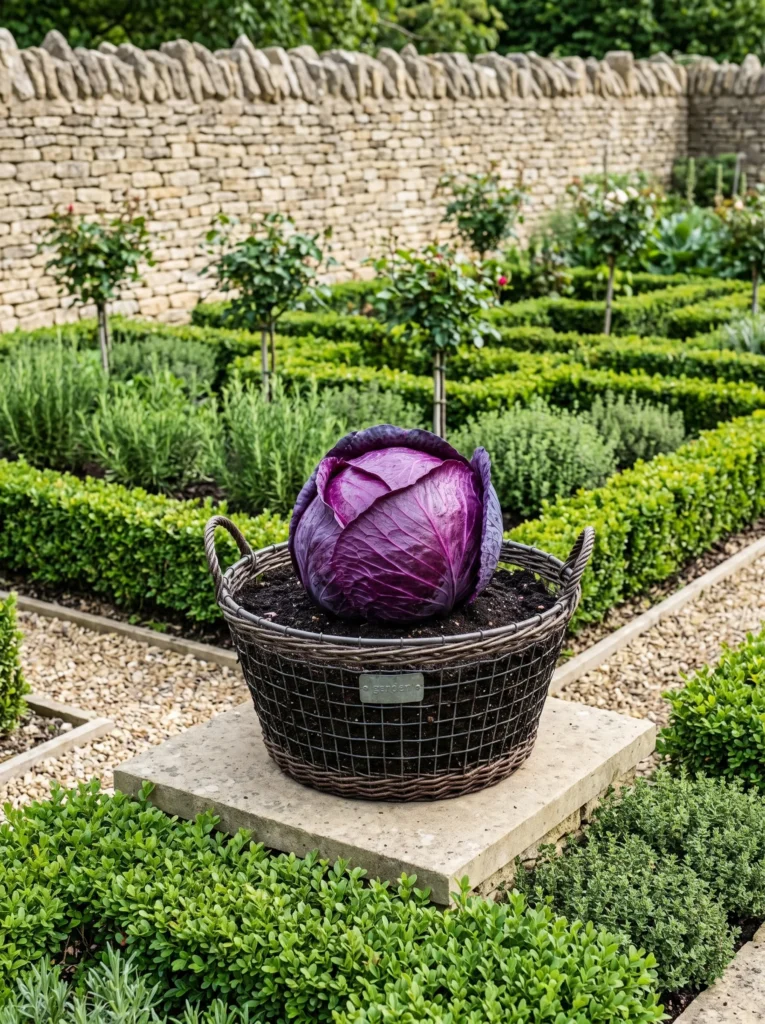
- Setup: Large woven metal basket planter, deep and heavy enough to anchor against wind.
- Honest note: Skip crowding plants closer than recommended spacing — it’s the single most common reason home-grown cabbage heads come out small and loose instead of tight and dense.
Why this works: Cabbage stores for weeks in a cool space after harvest, giving it one of the longest post-harvest shelf lives of any vegetable on this list.
Cabbage rarely gets credit for how visually dramatic it actually is, mostly because most gardeners default to plain green varieties and tuck them in a back row. Cabbage (Brassica oleracea var. capitata) forms tight, dense heads that hold their shape beautifully, and a deep violet-red variety like ‘Ruby Perfection’ looks closer to an oversized flower than a vegetable once it fills out. I moved ours to the front of a bed almost as an experiment in curb appeal, and it consistently draws more comments than plants I actually chose for looks.
We grow ours in a large woven metal basket planter, deep enough to give the root system room and heavy enough to anchor the plant against wind once the head fills in. Spacing matters more with cabbage than people expect — crowd the plants and heads stay small and loose instead of forming a tight, dense center. Cabbage also stores remarkably well once harvested, holding in a cool space for weeks longer than most fall vegetables on this list. Between the visual impact and the storage life, it earns its space even in a small garden.
Styling Principles: Choosing by Value, Not Just Looks
The temptation with any fall garden is to shop the way you’d shop for throw pillows — pick whatever looks good together and hope it works out. Vegetables don’t reward that approach the way decor does.
Before adding anything to a fall bed, run it through three questions: Will you actually eat enough of this to justify the space? Does it mature fast enough to be worth the wait, or does it need a full season of commitment? And does your climate’s timing actually support it, or are you fighting the calendar? A vegetable that fails any of those three tests is better left at the garden center, no matter how appealing the seed packet looks.
A fall garden built around real cost-per-plant value and genuine kitchen use will always outperform one built around visual appeal alone, even though the two goals aren’t mutually exclusive. The best entries on this list — turnips, beets, radishes — happen to earn their place on both counts at once. That’s not a coincidence. Vegetables that grow fast, store well, or double their yield tend to also be the ones with the most visual presence in a bed, since a thriving, well-timed plant simply looks healthier than a struggling one.
FAQ
Which fall vegetables actually save the most money to grow? Fast-maturing greens offer the strongest return — a $3 packet of radish, spinach, or lettuce seed can realistically produce $20 to $40 worth of produce across a season, since these crops regrow after cutting and mature in under six weeks.
How much space do I really need for a fall vegetable garden? A single 4-by-8-foot raised bed can comfortably support 6 to 8 of the vegetables on this list when spaced correctly, making a productive fall garden achievable even in a small backyard or side-yard corner.
Should I use seeds or transplants for fall crops? Root vegetables like carrots, beets, radishes, and turnips should always be direct-seeded, since their roots don’t recover well from transplant shock, while brassicas like broccoli, cauliflower, and cabbage generally establish faster and more reliably from transplants.
What’s a realistic yield to expect from a small fall garden? A well-planned 4-by-8-foot bed can realistically supply a household with weekly greens and root vegetables for two to three months, particularly with cut-and-come-again crops like lettuce, kale, and chard extending the harvest window.
Which fall vegetables tolerate frost the best? Kale, cabbage, Brussels sprouts, and carrots are among the most frost-hardy vegetables in a fall garden, with several actually improving in flavor after a light frost converts stored starches into sugar.
Is it too late to plant a fall vegetable garden if the weather has already turned cold? Fast-maturing crops like radishes, spinach, and baby lettuce can still be planted successfully as long as the soil isn’t frozen, since their short timeline to harvest works around a shorter remaining fall season.
Conclusion
A great fall garden isn’t about planting everything that looks appealing — it’s about choosing crops that actually earn their square footage, in flavor, savings, and style all at once. I’ve seen how swapping even two or three of these fall vegetables to grow into an existing bed changes how often you’re actually out in the garden, not just looking at it from the window.
Save this list before the season gets away from you, then pick one or two ideas to try first — a wine barrel of beets, a staked stalk of Brussels sprouts. Share it with a friend who’s been meaning to start their own bed. The payoff is worth it.