24 Outdoor Plant Stand Ideas That Beat the Weather
Outdoor plants deserve more than a pretty pot placed on a random stand. Sun, rain, humidity, wind, and seasonal temperature changes can quickly expose weak materials and poor drainage. The right setup needs to look beautiful while also handling the conditions of your specific outdoor space.
In this guide, you’ll find 24 outdoor plant stand ideas designed around real-world durability, from weather-resistant teak and powder-coated metal to concrete, cedar, galvanized steel, and modern recycled materials. Each idea pairs a specific stand with plants, planters, placement, and surrounding décor so you can recreate the look—not just save another pretty picture. Whether you’re styling a sunny patio, covered porch, garden path, balcony, or backyard, these designs make outdoor plant displays feel intentional and built to last.
Why Outdoor Plant Stands Need Different Considerations
Outdoor plant stands face conditions that indoor furniture simply does not: UV radiation, repeated wet-dry cycles, temperature swings, and, in colder climates, freeze-thaw stress. Untreated pine, unprotected metal, and porous materials can deteriorate surprisingly quickly when exposed to those cycles. Material selection is the single biggest factor determining how long an outdoor plant stand lasts. Elevation matters, too. Raising containers improves drainage and airflow beneath pots during rain-heavy periods, reducing the prolonged moisture that can contribute to root problems. It also places containers farther from some ground-dwelling pests. In other words, an outdoor stand needs to function as weather-resistant garden infrastructure, not simply outdoor furniture.
1. Teak Tiered Corner
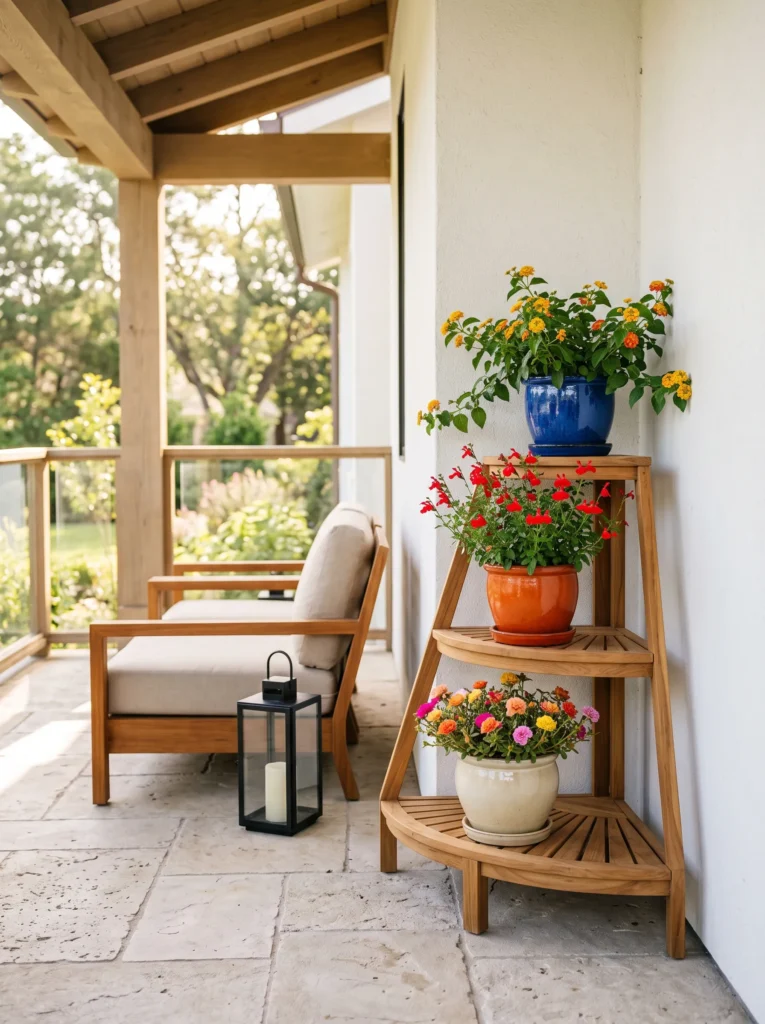
- Stand: Three-tier corner stand built from Grade A teak, finished with a UV-resistant exterior teak sealer.
- Structure: Approximately 30 inches wide × 30 inches deep × 42 inches high, with three staggered shelves and at least 8 inches between levels for airflow.
- Plants: Lantana camara, Salvia greggii, and Portulaca grandiflora for sunny, heat-tolerant planting.
- Planters: Frost-resistant glazed ceramic pots with large drainage holes.
- Placement: Full-sun covered porch beside a woven lounge chair.
- Surroundings: Limestone pavers, neutral cushions, and a simple outdoor lantern.
- Construction detail: Slatted shelves allow rainwater to escape instead of collecting beneath containers.
Why this works: Teak’s natural oils and dense grain make it substantially more suitable for repeated outdoor moisture than untreated pine. Teak is one of the woods I would choose first when a stand needs to remain outdoors year after year without looking overly rustic. Its natural oils help it resist moisture, while its dense grain handles changing humidity better than many inexpensive softwoods. In Austin’s intense summer sun, I prefer a UV-rated sealer because it slows the transition from golden brown to silver-gray and helps keep the surface more consistent. The slatted shelves are equally important: rain should never sit beneath ceramic containers. That small construction choice can make a beautiful stand considerably more practical.
For this porch arrangement, the three plants are deliberately different in form. Lantana supplies rounded clusters, autumn sage gives the middle tier a finer vertical shape, and moss rose spills gently toward the edge. I would keep the tallest pot on the lowest shelf so the composition remains visually grounded near the lounge chair. The teak tone also works naturally with limestone or light concrete paving without competing with the architecture. Because this is a covered porch, the plants receive protection from the heaviest rain while still getting enough direct light for strong flowering.
2. Powder-Coated Iron Arch
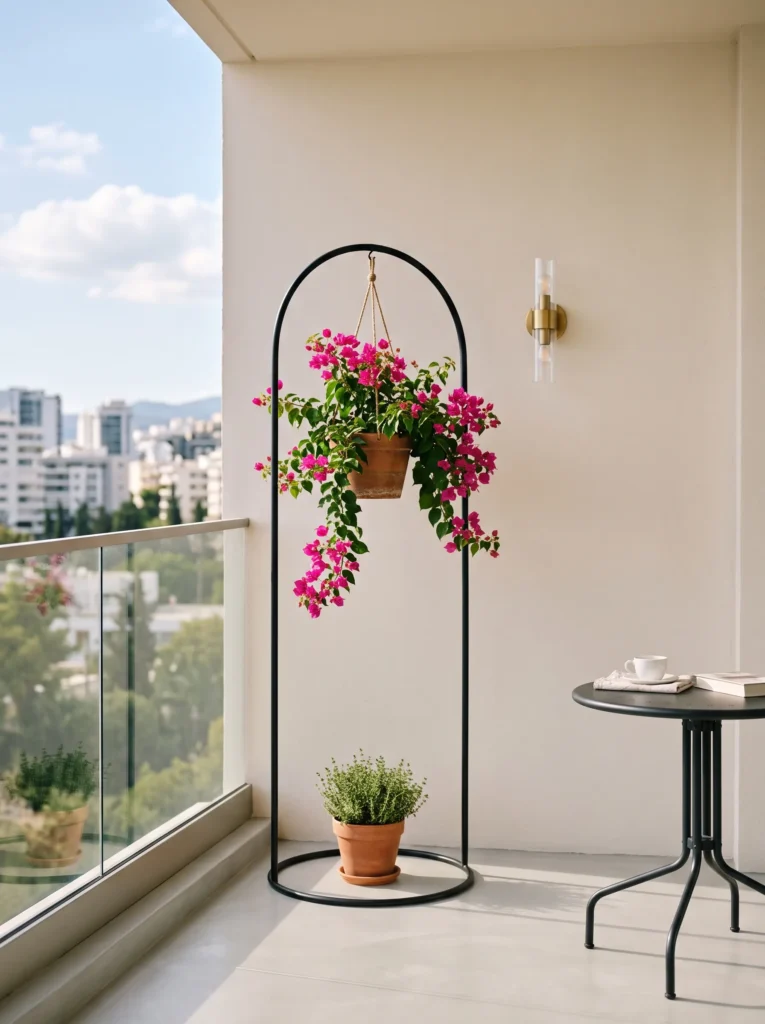
- Stand: Sculptural powder-coated iron frame with a matte exterior-grade black finish.
- Structure: 24 inches wide × 16 inches deep × 60 inches high, with two shelves and an integrated hanging bar.
- Plants: Bougainvillea glabra and Thymus vulgaris.
- Planters: UV-stabilized resin planters with drainage.
- Placement: Full-sun balcony against a wall.
- Surroundings: Slim black bistro table, pale concrete flooring, and warm-white wall lighting.
- Construction detail: Anchor the frame to the wall or floor where permitted to reduce movement in strong wind.
Why this works: Powder coating seals iron beneath a durable finish, dramatically reducing the exposed surface area where moisture can initiate rust. This is the type of stand I like for a balcony where floor space is precious but vertical space is available. Raw iron would be a poor choice here because recurring condensation and rain can quickly produce rust, particularly around welds and scratches. A properly powder-coated exterior finish gives the metal a much more durable protective barrier. The frame should still be inspected periodically for chips in the coating. If bare metal becomes visible, touching it up promptly is far easier than dealing with corrosion after it spreads beneath the finish.
The upper bougainvillea provides the dramatic vertical element, while thyme keeps the lower shelf visually quieter and useful for harvesting. I would not overload the hanging bar with a large ceramic planter; keeping the upper container lightweight reduces stress on the frame and its anchor points. My husband’s construction background has made me particularly cautious about tall outdoor pieces on exposed balconies. A beautiful display is not successful if wind can move it. Positioning this frame against a wall and securing it properly makes the arrangement feel intentional while protecting both the plants and surrounding furniture.
3. Concrete Cube Poolside
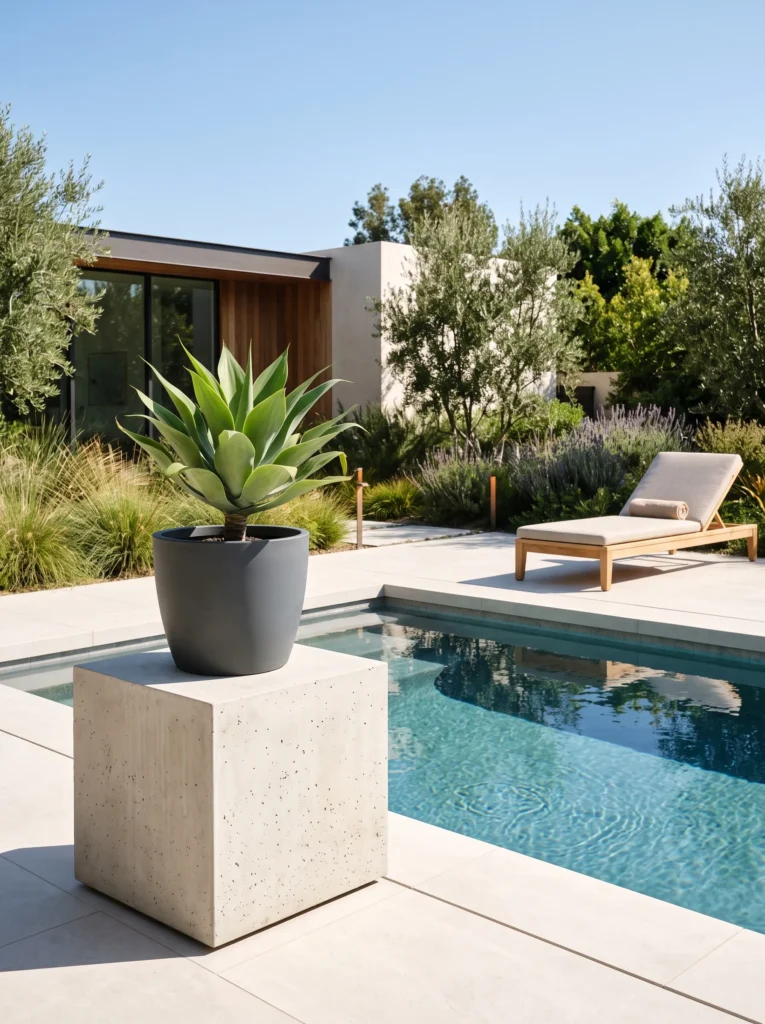
- Stand: Cast fiber-reinforced concrete cube with penetrating exterior masonry sealer.
- Structure: Low 18-inch-high × 18-inch-wide × 18-inch-deep solid cube.
- Plant: Agave attenuata.
- Planter: Lightweight fiberglass planter with concealed drainage.
- Placement: Full-sun poolside, several feet from the pool edge.
- Surroundings: Pale porcelain coping, low-profile teak chaise, and warm-white landscape lighting.
- Construction detail: Use a freeze-thaw-rated concrete formulation in climates where temperatures regularly drop below freezing.
Why this works: Concrete performs outdoors best when its mix, drainage, sealing, and freeze-thaw resistance are considered together rather than treated as cosmetic details. Concrete gives this arrangement a completely different visual language: low, monolithic, and almost architectural. It works particularly well beside a swimming pool because its visual weight balances pale paving and streamlined furniture. However, concrete is not automatically weatherproof simply because it is heavy. Repeated freezing and thawing can cause absorbed moisture to expand and contract inside porous concrete, eventually producing cracking or surface damage. A quality exterior sealer helps limit water penetration, while a properly formulated mix is especially important in regions where winter temperatures regularly fall below freezing.
The agave is intentionally planted in a lighter fiberglass container rather than directly inside the concrete cube. That reduces the amount of weight the stand must support and makes seasonal maintenance much easier. I would keep the cube several feet from the pool rather than placing it where swimmers constantly splash it. At night, a low landscape light positioned nearby can skim across the concrete surface without competing with the plant’s sculptural silhouette. The result is a poolside display that feels integrated with the hardscape instead of looking like a decorative accessory placed afterward.
4. Woven Crescent Console
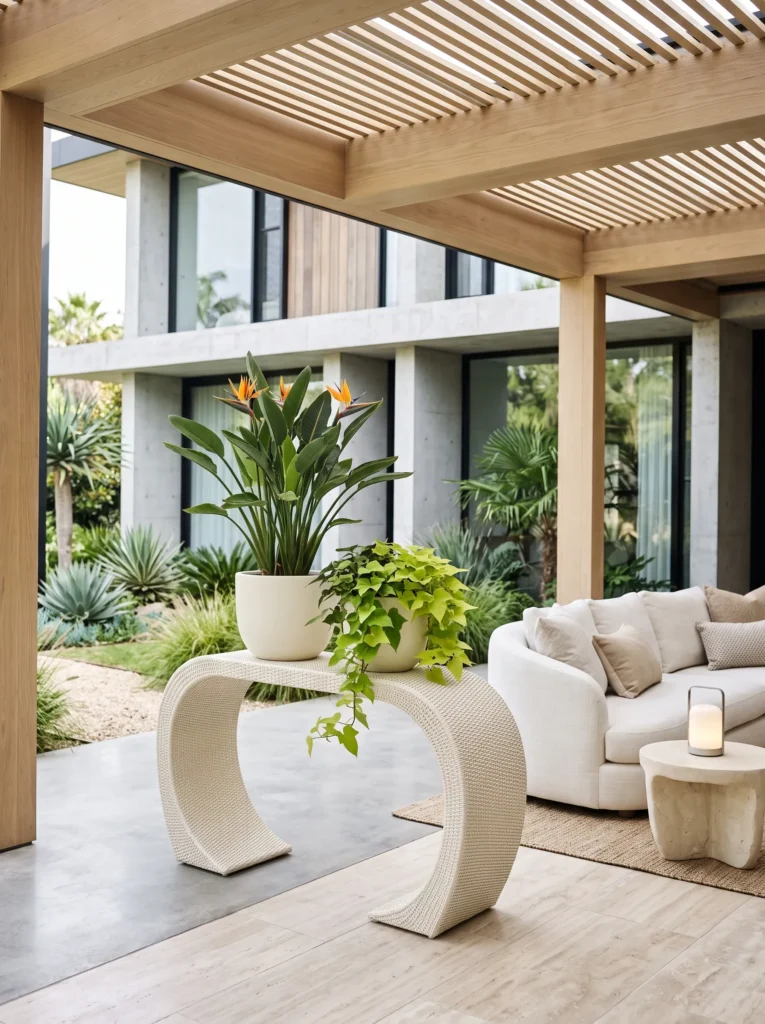
- Stand: Sculptural weather-rated synthetic rattan over an aluminum frame with UV-stabilized outdoor resin.
- Structure: 36-inch-high crescent console, 40 inches wide, with one lower shelf.
- Plants: Bird of paradise (Strelitzia reginae) and sweet potato vine (Ipomoea batatas).
- Planters: Lightweight ivory fiberglass planters with raised drainage feet.
- Placement: Covered patio receiving bright indirect light and gentle morning sun.
- Surroundings: Curved outdoor sofa, limestone side table, and soft-glow floor lantern.
- Construction detail: Keep the aluminum frame slightly elevated above the paving so water cannot remain trapped underneath.
Why this works: Outdoor-rated synthetic rattan resists UV exposure and moisture far better than untreated natural wicker. Synthetic rattan can look remarkably refined when the silhouette is modern rather than traditionally woven. I especially like a curved console here because it echoes the rounded lines increasingly appearing in contemporary outdoor furniture. Unlike natural wicker, properly rated synthetic fibers are designed to tolerate sunlight and repeated moisture without becoming brittle as quickly. The aluminum structure underneath also avoids the corrosion concerns associated with untreated steel. For a covered patio, this combination gives you the softness of woven texture without sacrificing practical durability. The ivory fiberglass pots keep the composition light against darker patio furniture and warm architectural surfaces.
Bird of paradise supplies the architectural height, while sweet potato vine softens the lower edge with trailing foliage. I would keep both containers on raised feet so water can escape freely after a storm. My husband’s construction perspective always makes me look at the bottom of outdoor furniture first: if the base sits flat against wet concrete, moisture has nowhere to go. Here, that small gap matters. Place the console behind seating rather than beside a walkway, where its curved profile becomes part of the furniture arrangement while the trailing vine remains safely away from foot traffic.
5. Cedar Slat Entry
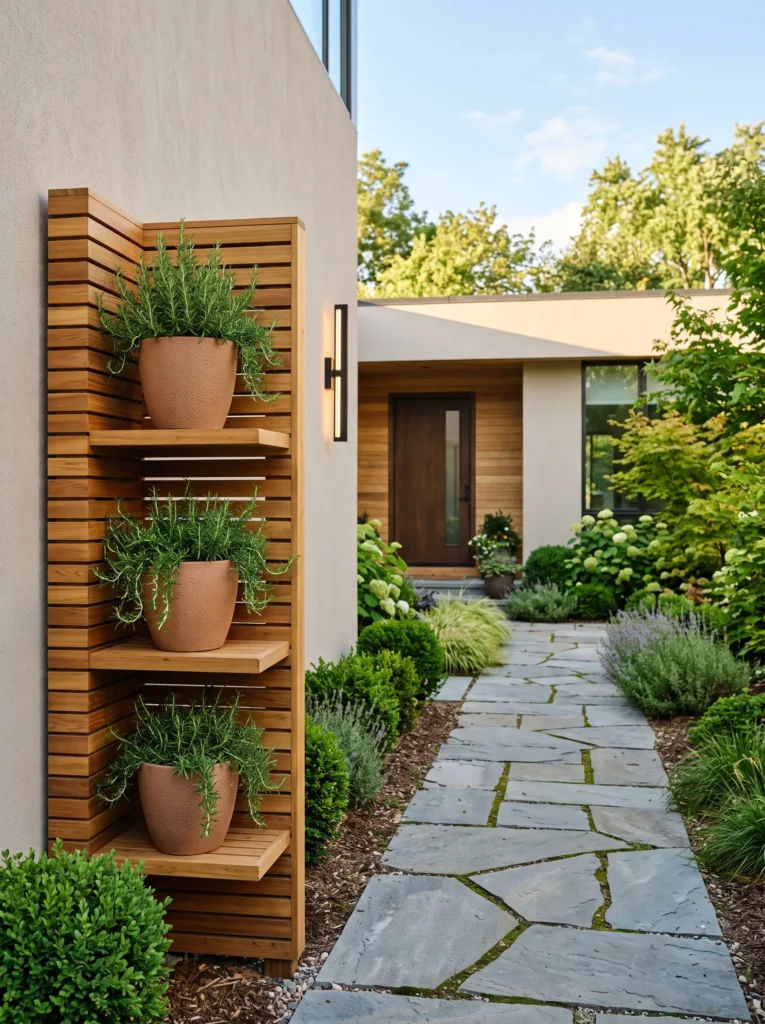
- Stand: Naturally weather-resistant western red cedar finished with penetrating exterior oil containing UV protection.
- Structure: Slim 48-inch-high vertical slat tower with three offset shelves.
- Plant: Rosemary (Salvia rosmarinus).
- Planters: Glazed terracotta-look composite pots with drainage holes and elevated feet.
- Placement: Open-air garden entryway with full sun.
- Surroundings: Bluestone path, clipped shrubs, and modern wall sconce.
- Construction detail: Use stainless-steel exterior fasteners and keep cedar separated from paving.
Why this works: Cedar naturally resists outdoor decay because its oils and cellular structure make it less hospitable to moisture and rot than untreated pine. A cedar stand feels particularly right near a garden entrance because the material belongs visually to the landscape without looking rustic. Western red cedar contains naturally occurring compounds that help it resist decay, although no outdoor wood should be considered maintenance-free. I prefer a penetrating exterior oil rather than a thick film finish because it allows the wood to weather naturally while offering additional UV protection. Stainless-steel fasteners are another worthwhile detail; ordinary fasteners can stain the wood or corrode over time. The result is a clean-lined plant tower that looks intentional beside contemporary stonework and restrained landscaping.
For this arrangement, repeated rosemary plants create rhythm rather than visual clutter. Their upright stems and fine foliage work beautifully against cedar’s horizontal grain, while the warm composite containers keep the display from feeling overly earthy. I would place the tallest rosemary on the bottom tier and progressively smaller plants above it, maintaining a stable center of gravity. This is also where my husband’s construction knowledge changes how I approach decorative pieces: an outdoor stand near an entry should never become a tipping hazard. A broad footprint, stainless hardware, and proper anchoring make the display considerably safer in strong weather.
6. Galvanized Garden Cart
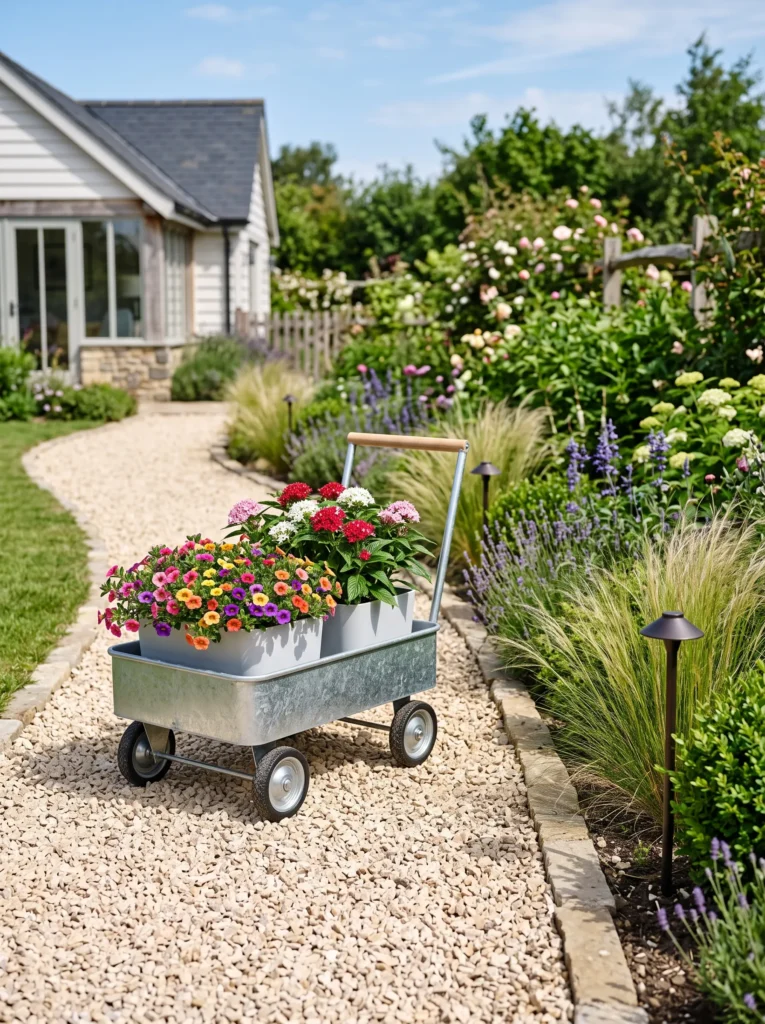
- Stand: Vintage-inspired galvanized steel garden cart with clear exterior corrosion-resistant coating.
- Structure: Compact 32-inch-high cart with deep planting tray and lower open frame.
- Plants: Calibrachoa hybrid and Pentas lanceolata.
- Planters: Molded resin containers nested inside the cart.
- Placement: Full-sun garden path.
- Surroundings: Gravel, ornamental grasses, and low-voltage path lighting.
- Construction detail: Lock or chock wheels on slopes to prevent shifting.
Why this works: Galvanized steel protects its underlying metal with a zinc coating, making it far more corrosion-resistant than untreated steel outdoors. A galvanized cart gives you the charm of a garden utility piece without requiring the stand itself to become the planter. That distinction matters because constantly wet soil can keep metal damp for long periods. I would place removable resin containers inside the cart instead, allowing water to drain independently and making seasonal plant changes much easier. The zinc coating on galvanized steel provides a protective barrier against corrosion, while the clear exterior coating adds another layer of defense against weathering. For a contemporary garden, the combination looks especially good against pale gravel and simple architectural planting.
The cart’s mobility is useful, but I would treat it as a movable garden feature rather than something that should roll freely whenever the wind picks up. On a level path, locking the wheels is usually enough; on a slope, a physical wheel chock is smarter. My husband’s construction background has made me particularly aware of how quickly a lightweight outdoor object can become unstable when loaded unevenly. Keep the heavier planter low and toward the cart’s center. The bright calibrachoa and upright pentas then become the colorful focal point without compromising the cart’s practical function.
7. Floating Stone Shelf
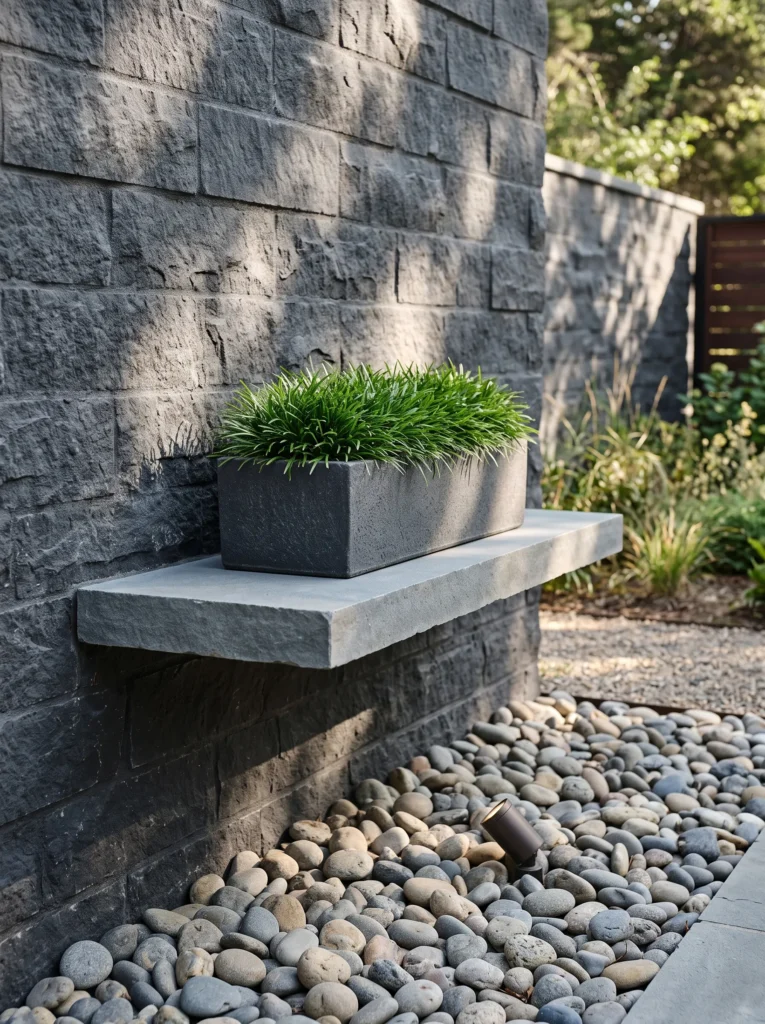
- Stand: Natural bluestone slab with penetrating breathable exterior stone sealer.
- Structure: Cantilevered 24-inch-wide × 14-inch-deep × 20-inch-high shelf with concealed galvanized-steel brackets.
- Plant: Dwarf mondo grass (Ophiopogon japonicus ‘Nana’).
- Planter: Stone-look fiberglass trough with concealed drainage.
- Placement: Shaded garden wall beneath a mature tree.
- Surroundings: Charcoal retaining wall, river stones, and ground-level lighting.
- Construction detail: Mechanically anchor brackets into structural masonry rather than decorative cladding.
Why this works: A properly sealed bluestone shelf handles outdoor moisture well while its concealed support keeps the display visually light. This is one of those setups where the plant stand almost disappears and the architecture becomes the display. Bluestone is naturally dense and well suited to outdoor environments, but sealing still matters because repeated moisture can encourage staining and freeze-thaw damage in colder climates. I would use a breathable penetrating sealer rather than a glossy surface coating. The concealed brackets also make a significant difference visually. Instead of another freestanding object competing with the garden wall, the shelf reads almost like a piece of built-in architecture.
Dwarf mondo grass is an intentional choice here because its narrow foliage complements the linear stone slab without becoming visually heavy. The low fiberglass trough keeps the overall load manageable while maintaining the appearance of a substantial stone planter. My husband’s construction background has taught me that cantilevered details deserve more attention than they receive in decorative projects: the bracket, anchor, wall substrate, and saturated planter weight all need to be considered together. This approach works particularly well beside a shaded pathway where subtle lighting can wash across the stone after sunset.
8. Copper Column Pair
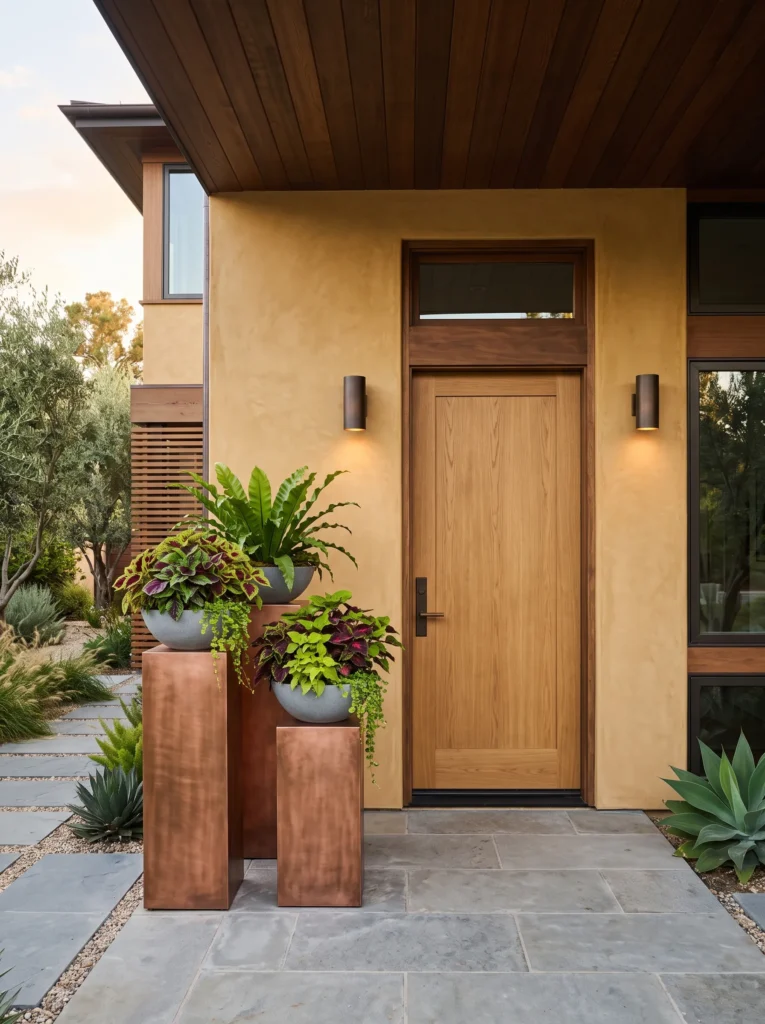
- Stand: Solid copper pedestal columns with brushed finish and clear exterior protective coating.
- Structure: Two 34-inch-high × 12-inch-square pedestals positioned asymmetrically.
- Plants: Bird’s-nest fern (Asplenium nidus) and Coleus scutellarioides.
- Planters: Marine-grade fiberglass bowls with integrated drainage.
- Placement: Covered outdoor entry with bright reflected daylight.
- Surroundings: Warm stucco wall, natural oak door, limestone threshold, and understated sconces.
- Construction detail: Keep copper isolated from incompatible metals and continuously wet masonry.
Why this works: Copper develops a protective patina outdoors, allowing its surface to weather while retaining its structural integrity. Copper is particularly beautiful when you let it age instead of trying to keep it permanently polished. Outdoors, the surface naturally changes through oxidation and develops a patina that can protect the underlying metal. For an entry arrangement, I prefer brushed copper because small scratches and gradual color changes become part of the finish rather than obvious flaws. The important detail is separating copper from incompatible metals and avoiding places where water continually collects. The fiberglass bowls also keep the planting weight reasonable while giving the columns a convincing stone-like visual mass without excessive structural load.
The plants bring a softer contrast to the copper. Bird’s-nest fern forms a broad architectural rosette, while coleus supplies colorful foliage at a slightly lower visual height. I would deliberately offset the two columns instead of lining them up symmetrically; that makes the arrangement feel more current and less like a formal hotel entrance. The warm metal also works beautifully with wood, limestone, and stucco. At night, the entry sconces should provide most of the illumination, allowing the copper to catch small highlights rather than turning the plant display into a brightly lit focal point.
9. Recycled Timber Bench
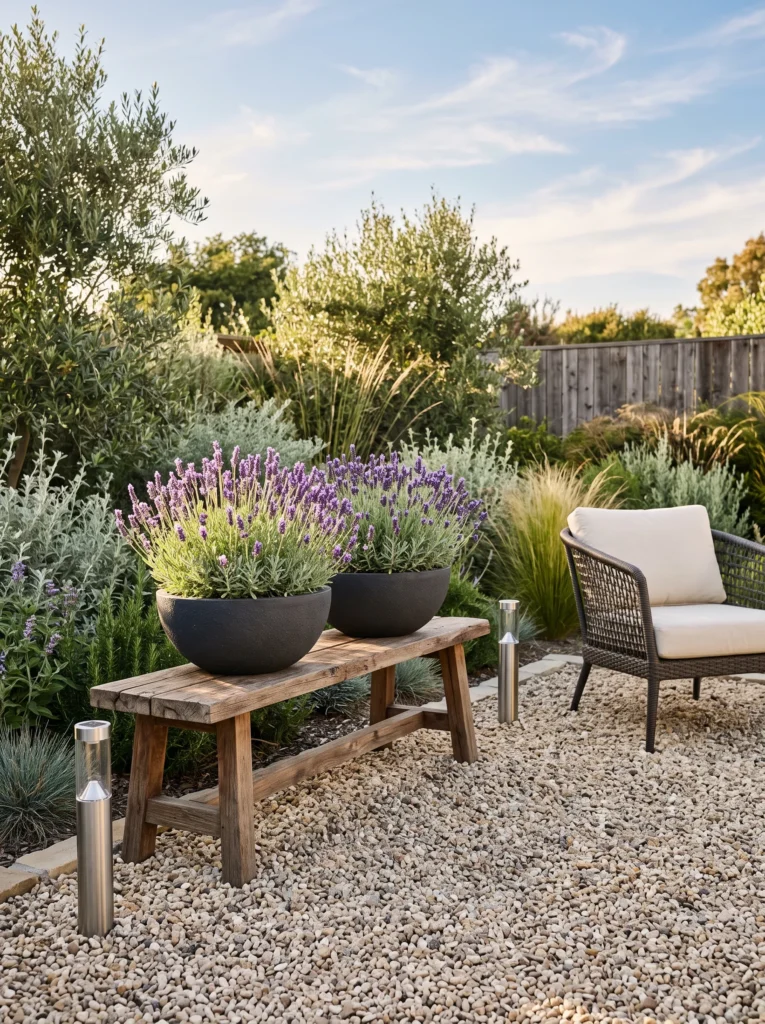
- Stand: Reclaimed exterior-grade hardwood structural timber treated with exterior wood preservative and UV-resistant oil.
- Structure: 42-inch-wide × 14-inch-deep × 18-inch-high bench-style platform.
- Plant: Lavender (Lavandula angustifolia).
- Planter: Fiberstone bowls with drainage holes and internal feet.
- Placement: Sunny side-yard terrace.
- Surroundings: Woven outdoor chair, decomposed-granite ground surface, and solar bollards.
- Construction detail: Use known exterior-grade timber and stainless-steel screws.
Why this works: A reclaimed hardwood stand can perform outdoors when the timber species, treatment, drainage, and hardware are all selected for exterior exposure. I love the idea of giving reclaimed timber a very clean second life rather than turning it into a deliberately distressed garden piece. The key is knowing what wood you are actually using. Reclaimed material is not automatically weather-resistant, so I would choose a naturally durable hardwood or professionally treated exterior-grade timber and avoid pieces with unknown chemical histories. The penetrating oil protects the surface without creating a thick film that can peel. Stainless-steel screws are another small upgrade that prevents premature hardware failure. With those details, the stand can look intentionally aged while still functioning as durable outdoor furniture.
Lavender is almost tailor-made for this low arrangement because its silvery foliage contrasts beautifully with dark reclaimed wood. The gravel setting reinforces its Mediterranean character while also providing excellent drainage around the containers. I would leave several inches between the two bowls so air can circulate and maintenance remains easy. A single woven chair nearby makes the area feel usable without crowding the planting. When evening arrives, small solar bollards can trace the edge of the gravel rather than spotlighting the plants. The entire composition stays restrained, letting texture and material quality do most of the decorating.
Image alt text: Reclaimed timber bench with lavender on terrace.
10. Sculptural Steel Loop
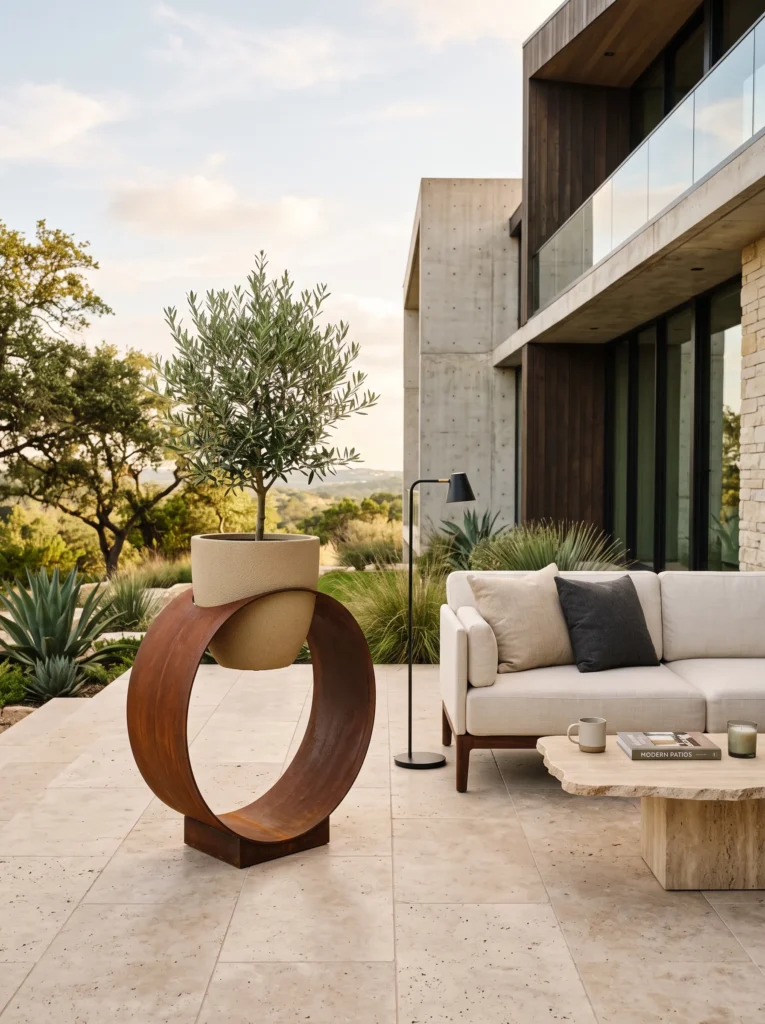
- Stand: Sculptural weathering steel with factory-applied clear rust-stabilizing finish.
- Structure: 38-inch-high circular loop, 22 inches wide, with recessed center platform.
- Plant: Dwarf olive (Olea europaea ‘Little Ollie’).
- Planter: Matte sand fiberglass cylinder with large drainage opening.
- Placement: Open-air patio corner with at least 6 hours of direct sunlight.
- Surroundings: Cream outdoor sofa, travertine coffee table, and sculptural floor lamp.
- Construction detail: Use discreet anchoring in areas with strong winds.
Why this works: Weathering steel forms a stable protective surface layer that slows deeper corrosion when its drainage and exposure conditions are appropriate. I wanted something for this kind of patio that felt more like sculpture than traditional garden furniture, and this simple steel loop does exactly that. The warm, naturally weathered surface looks beautiful against pale travertine and cream upholstery, especially once the afternoon sun catches the texture. I would not use this material where water continually collects, though. Weathering steel needs alternating wet and dry periods to develop its protective surface properly. Good drainage underneath the frame is therefore part of the design, not an afterthought. That balance between industrial metal and soft planting feels especially fresh to me.
The dwarf olive keeps the planting equally restrained. Its silvery foliage gives the dark steel something to contrast against without introducing another strong color. When we were thinking through outdoor furniture layouts at home, my husband’s construction perspective always brought the conversation back to stability: where will the weight sit, what happens when the pot is saturated, and could a strong Texas wind move it? Those questions matter here. A heavy frame, wide footprint, and correctly sized pot make this sculptural arrangement feel secure rather than precarious.
11. Cedar Hanging Frame
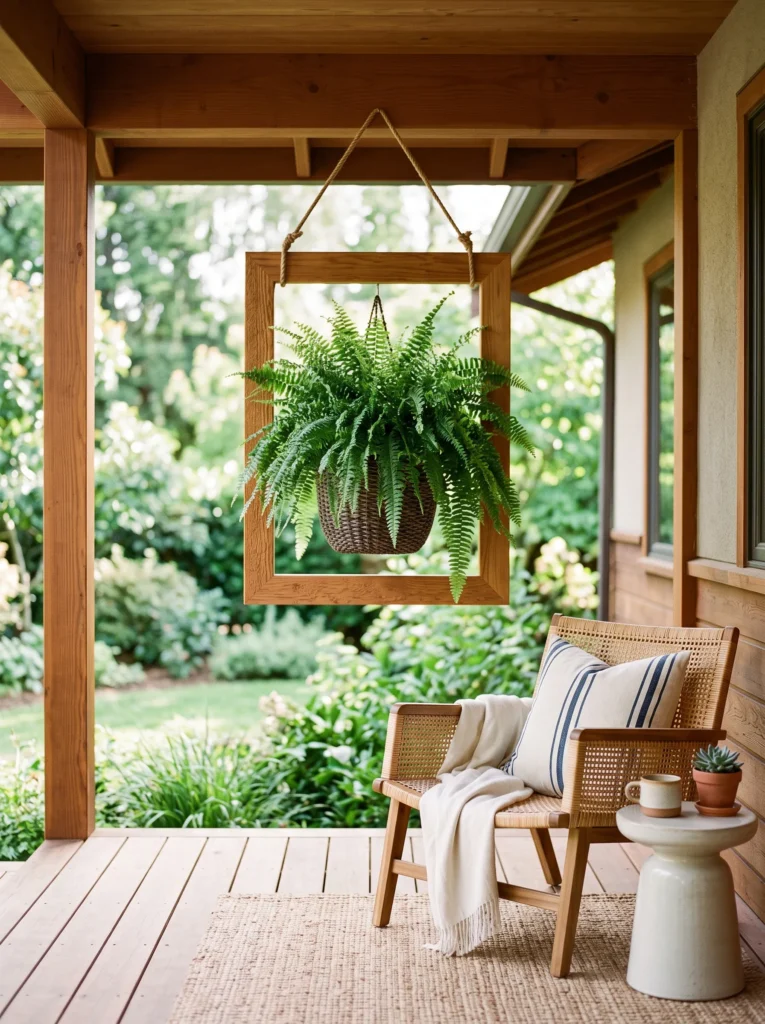
- Stand: Western red cedar hanging frame treated with exterior penetrating oil and UV-resistant finish.
- Structure: 58-inch-high × 30-inch-wide rectangular frame with suspended planter.
- Plant: Boston fern (Nephrolepis exaltata).
- Planter: Weather-resistant resin basket with drainage.
- Placement: Deep covered porch with bright filtered morning light.
- Surroundings: Rattan lounge chair, striped outdoor cushion, and ceramic side table.
- Construction detail: Use exterior-rated eye bolts and fasteners anchored into structural material.
Why this works: Cedar’s natural decay resistance makes it a strong choice for an outdoor hanging structure when moisture can drain freely. This is one of the pieces I would happily use on my own porch because it has the relaxed feeling of a hanging basket without looking like a collection of separate garden accessories. The cedar frame gives the fern a defined architectural outline, while its natural grain softens the harder lines of a porch railing or column. I like using penetrating oil on cedar rather than a glossy exterior finish because the wood still looks like wood. Over time, the surface can gradually weather while the structure remains protected from ordinary outdoor moisture.
Boston fern is also a plant I would reserve for this type of protected location. Unlike drought-loving patio plants, it appreciates consistent moisture and filtered light, making a covered porch a much better environment than an exposed sunny terrace. I learned to pay more attention to the plant’s actual conditions rather than simply choosing whatever looks good in a pot. That approach comes naturally from my plant-science background. Give the fern shade, airflow, and consistent moisture, and this simple hanging frame can stay lush without fighting the environment.
12. Concrete Garden Plinth
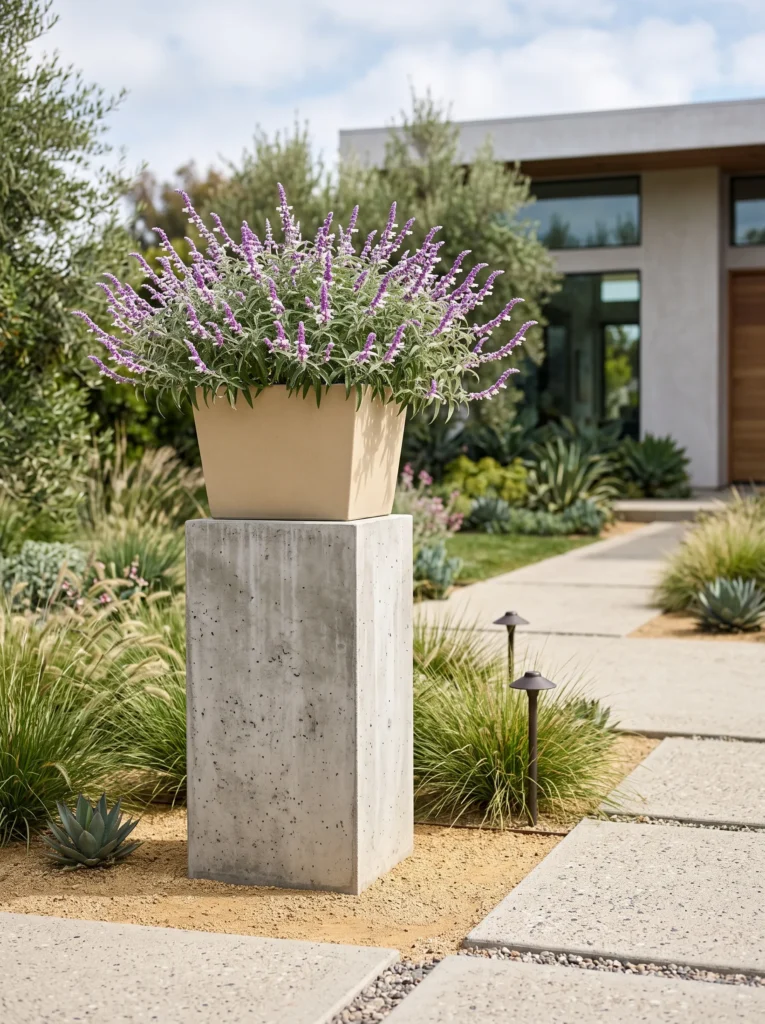
- Stand: Lightweight architectural concrete plinth with integral water resistance and matte masonry sealer.
- Structure: 36-inch-high × 16-inch-square monolithic pedestal.
- Plant: Mexican bush sage (Salvia leucantha).
- Planter: Tall fiberglass cylinder with concealed drainage.
- Placement: Full-sun garden path junction.
- Surroundings: Decomposed granite, ornamental grasses, and path lights.
- Construction detail: Set the plinth on a compacted, level base.
Why this works: A properly formulated and sealed concrete plinth provides excellent outdoor stability while resisting moisture-related surface damage. I have always liked using one strong vertical object in a garden rather than filling every corner with decoration. This concrete plinth gives a plant enough height to be noticed without needing a large stand or complicated tier system. The clean geometry also feels right with the modern landscaping we often see around newer Austin homes. I would specifically choose lightweight architectural concrete rather than an improvised concrete block because the finished surface is smoother and the formulation is better suited to decorative exterior use. A penetrating masonry sealer helps reduce water absorption and staining.
The Mexican bush sage is what keeps the plinth from feeling too formal. Its soft, silvery foliage and purple blooms spill naturally around the upper edge, creating movement against the rigid pedestal. I would keep the surrounding planting deliberately low so the plinth remains visible from the path. My husband’s construction work has also made me appreciate proper bases more than I once did. A tall outdoor object needs a level, compact foundation, especially when a saturated planter adds considerable weight. That little bit of preparation is what makes this display feel permanent rather than temporary.
13. Arched Cedar Pavilion
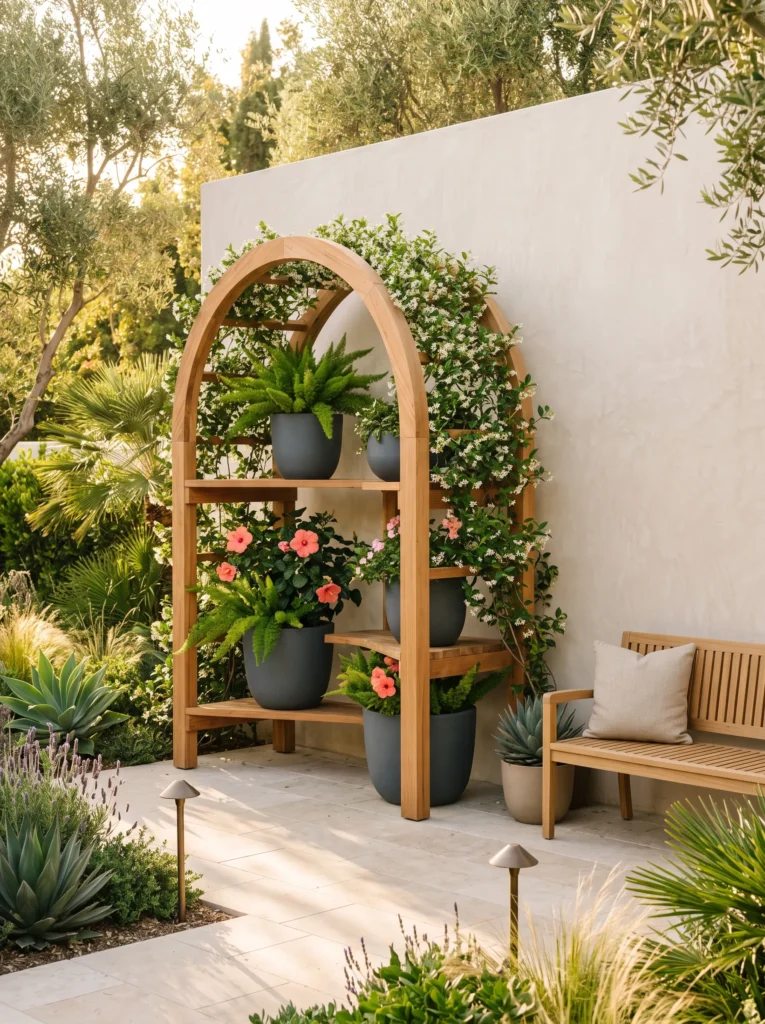
- Stand: Large cedar garden pavilion treated with penetrating exterior oil containing UV protection.
- Structure: 72 inches wide × 24 inches deep × 78 inches high, with three staggered shelves and curved overhead arch.
- Plants: Star jasmine (Trachelospermum jasminoides), Hibiscus rosa-sinensis, and Asparagus densiflorus.
- Planters: Oversized UV-stabilized fiberglass troughs with concealed drainage.
- Placement: Full-sun garden terrace against a plain stucco wall.
- Surroundings: Long teak bench, limestone pavers, and architectural uplights.
- Construction detail: Set vertical posts into concealed metal brackets anchored to stable footings.
Why this works: A wide cedar frame combines natural decay resistance with enough structural depth to support a substantial vertical planting display. This is the sort of plant stand I would choose when a garden needs one strong architectural moment rather than several small decorations. I love how the curved cedar top gives the structure a slightly softer silhouette while the broad shelves keep the overall composition modern. The scale is intentional: at nearly 6½ feet tall, it can visually connect a low garden bed with a taller exterior wall. Cedar is especially appropriate here because its natural resistance to decay gives it an advantage over untreated pine when exposed to outdoor moisture.
The star jasmine is the part that makes this arrangement feel alive over time. I would train just a few stems along the upper arch rather than covering the entire frame immediately. Beneath it, hibiscus provides large seasonal flowers while foxtail fern fills the lower tier with fine texture. In our own home projects, my husband’s construction experience has made me cautious about simply burying wood posts in the ground. A concealed metal footing keeps the cedar separated from persistently damp soil and makes the entire structure much more durable.
14. Bronze Grid Tower
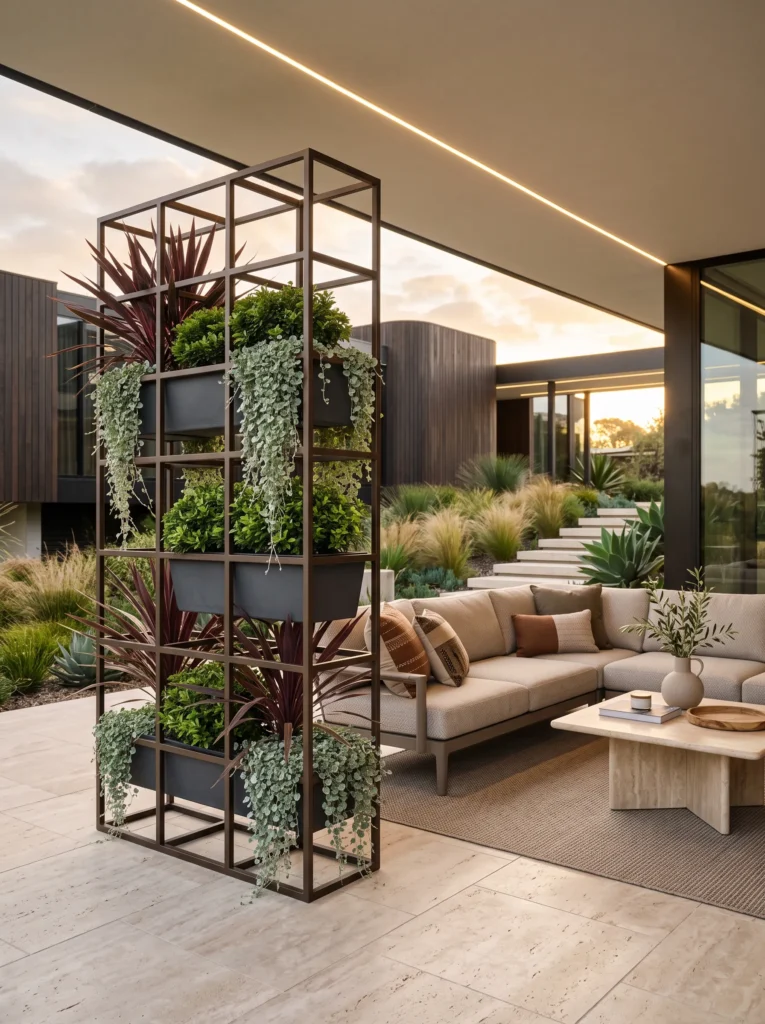
- Stand: Cast-aluminum frame with bronze-toned architectural powder coat rated for exterior UV exposure.
- Structure: 60 inches wide × 20 inches deep × 72 inches high, geometric grid with four integrated platforms.
- Plants: Cordyline australis, Pittosporum tenuifolium, and Dichondra argentea.
- Planters: Matte charcoal marine-grade fiberglass troughs.
- Placement: Open patio edge with bright sun and late-afternoon shade.
- Surroundings: Low outdoor sofa, travertine coffee table, and linear LED lighting.
- Construction detail: Anchor the lower frame to hardscape in windy locations.
Why this works: Exterior powder coating protects aluminum from UV exposure and surface oxidation while giving the large frame a consistent architectural finish. I wanted this one to feel almost like outdoor furniture rather than a traditional plant rack. The bronze grid has enough visual weight to anchor a large patio, but the open geometry prevents it from becoming a solid wall. Powder-coated aluminum is particularly useful for a structure this large because it provides strength without the considerable weight of steel. The bronze finish also works beautifully with travertine, charcoal upholstery, and warm outdoor lighting. Instead of hiding the stand behind plants, I would deliberately leave some grid openings empty so the architecture remains part of the composition.
The plant combination is intentionally sculptural. Cordyline gives the upper section height, pittosporum supplies dense rounded foliage, and silver ponyfoot can soften one lower edge without turning the structure into a jungle. I have found that large displays look more expensive when every shelf isn’t filled to capacity. Give the eye a few open spaces. For a piece this tall, anchoring is also essential. My husband’s construction background would make this non-negotiable on an exposed patio: the wider the structure and the taller the plants, the more seriously wind load needs to be considered.
15. Stone Staircase Stand
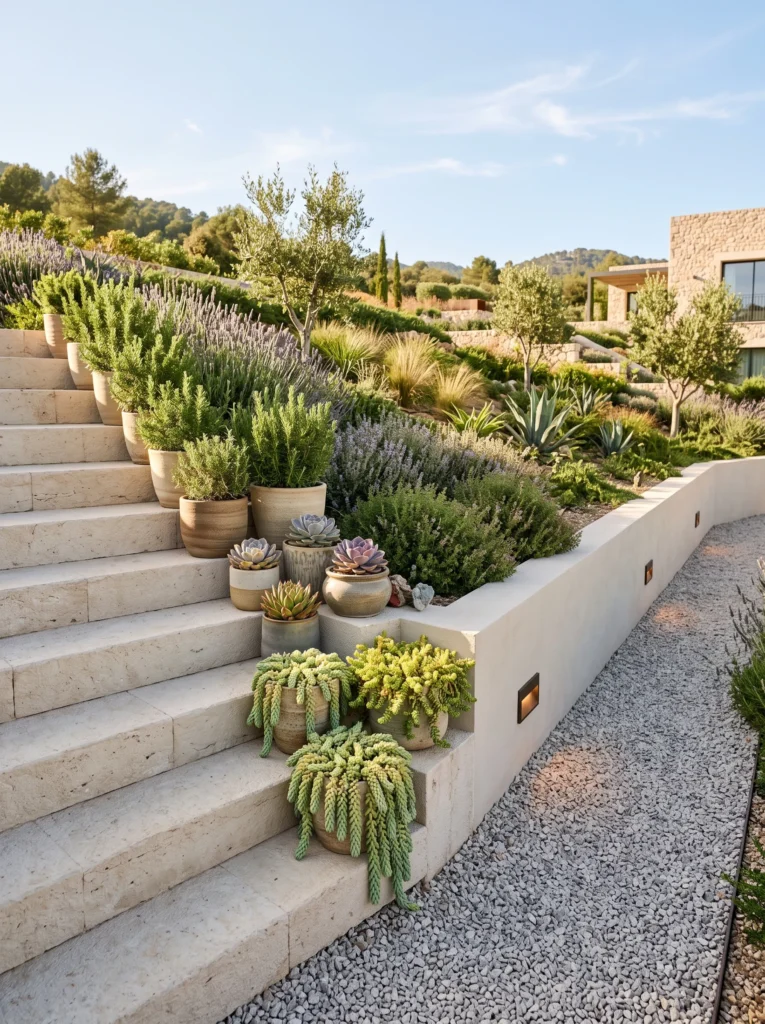
- Stand: Stacked natural limestone blocks with breathable penetrating stone sealer.
- Structure: Wide 84-inch × 30-inch stepped composition rising from 12 to 42 inches.
- Plants: Rosemary, Echeveria elegans, and Sedum rupestre.
- Planters: Frost-resistant stoneware pots with generous drainage.
- Placement: Full-sun garden slope beside a retaining wall.
- Surroundings: Limestone pathway, gravel mulch, and recessed step lighting.
- Construction detail: Compact and level each limestone course and provide drainage behind the structure.
Why this works: A stepped limestone structure turns elevation into drainage space while giving sun-loving plants several distinct planting levels. This is probably the most garden-like of the large stands, because it feels as though the architecture grew directly from the hardscape. I love using a stepped arrangement when a garden has a slight grade; instead of fighting the slope, the stand makes the change in elevation part of the design. Limestone also works beautifully with gravel, stucco, and pale paving. I would use a breathable penetrating sealer rather than a glossy finish so the natural variation remains visible. The broad footprint makes the composition feel substantial without relying on a tall, narrow frame.
The plants are deliberately drought-friendly because the site receives strong sun and the stepped construction encourages rapid drainage. Rosemary provides height and fragrance, echeveria gives geometric rosettes, and sedum gently spills toward the lower edge. This is the kind of planting combination I would recommend after thinking about the plants first and the styling second. My plant-science background makes me especially cautious about putting moisture-loving species into highly draining displays simply because they look pretty together. Here, every plant wants the same basic growing conditions, which makes maintenance much easier.
16. Terrazzo Crescent Rack
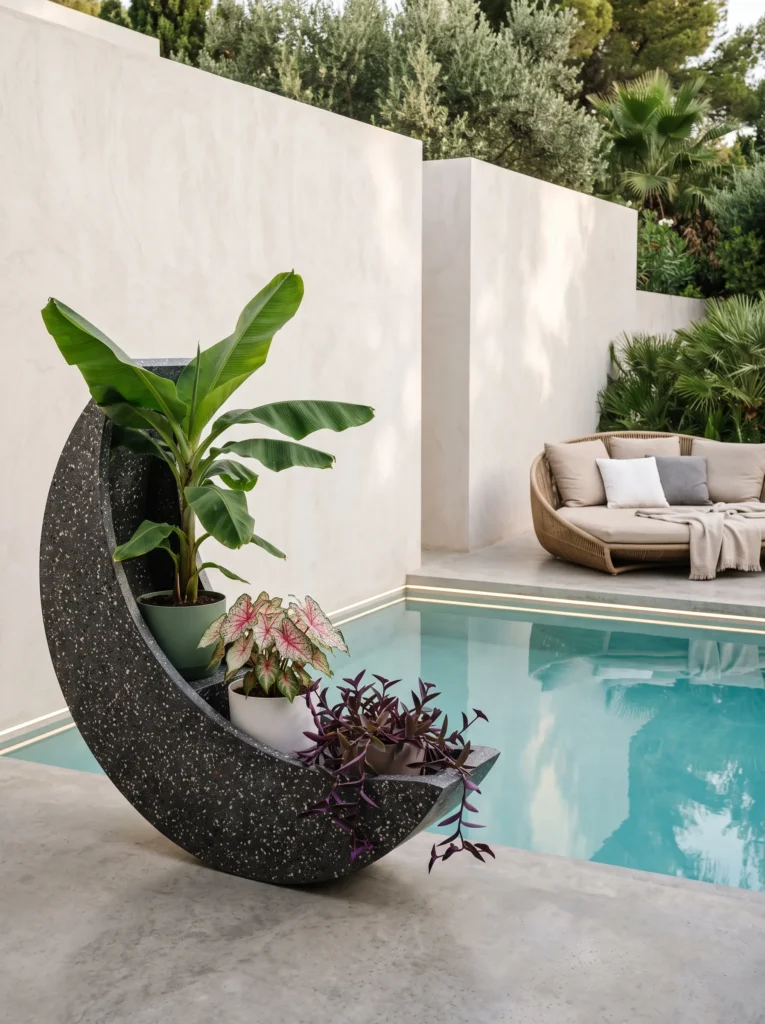
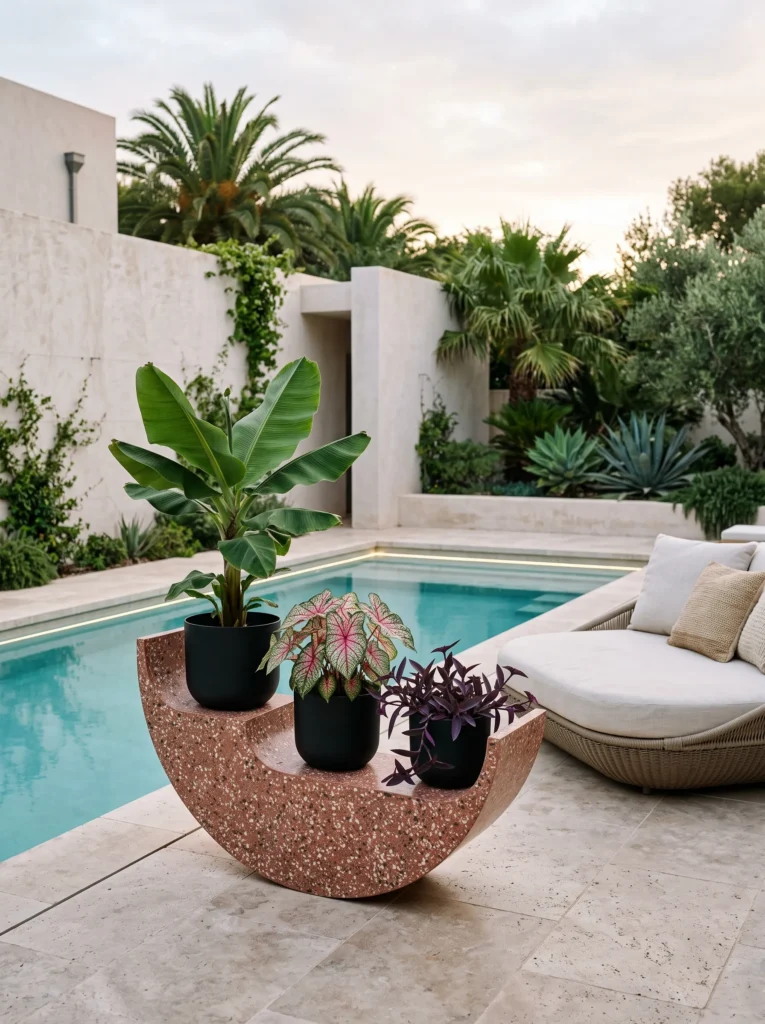
- Stand: Oversized exterior terrazzo with UV-stable penetrating sealer and honed surface.
- Structure: 66-inch-wide × 22-inch-deep × 60-inch-high crescent tower with three sweeping shelves.
- Plants: Banana (Musa basjoo), Caladium × hortulanum, and purple heart (Tradescantia pallida).
- Planters: Rotomolded polyethylene planters with internal drainage reservoirs.
- Placement: Pool courtyard with bright morning sun and filtered afternoon light.
- Surroundings: Pale plaster, curved outdoor daybed, limestone-look pavers, and recessed pool lighting.
- Construction detail: Keep the broad base fully supported on hardscape and provide drainage routes for each shelf.
Why this works: Exterior terrazzo combines mineral aggregate with a durable binder, creating a substantial outdoor surface that performs best when sealed and properly drained. I wanted this one to feel like a piece of contemporary sculpture rather than something you would normally call a plant stand. The sweeping crescent shape is especially beautiful beside curved pool furniture because the same visual language repeats without becoming overly coordinated. Terrazzo brings another layer of texture through its aggregate, but the honed finish keeps it sophisticated. I would choose an exterior-rated formulation rather than adapting an indoor terrazzo piece. That distinction matters when a surface will face intense sunlight, moisture, and repeated temperature changes throughout the year.
The banana creates the tall focal point, while caladium fills the middle level with broad patterned foliage and purple heart trails beneath it. I like this combination because the plants feel abundant without requiring flowers to carry the composition. At home, I tend to place large stands where they can be appreciated from more than one angle, and a pool courtyard is ideal for that. The curved rack can be seen from the daybed, pool, and adjacent walkway. Keep the largest pot low, too; saturated soil makes a large tropical container significantly heavier than it appears.
17. White Steel Atrium
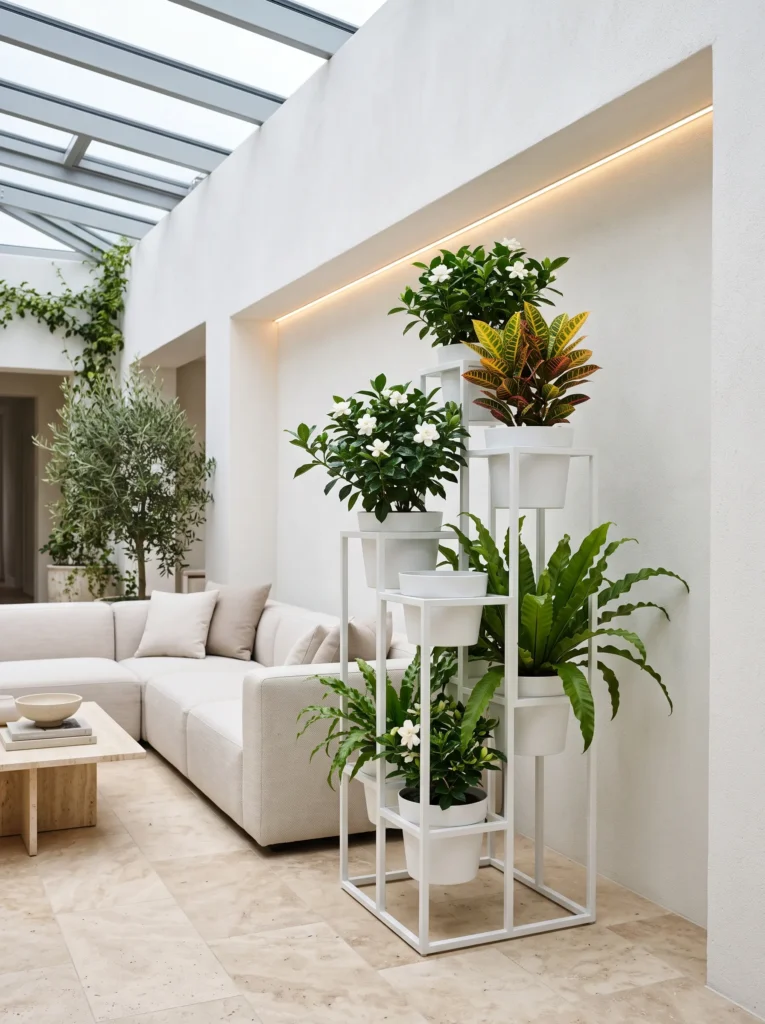
- Stand: Marine-grade stainless steel with brushed finish and clear exterior protective coating.
- Structure: 60 inches wide × 24 inches deep × 74 inches high, open rectangular atrium with four shelves.
- Plants: Gardenia jasminoides, Croton (Codiaeum variegatum), and hart’s-tongue fern (Asplenium scolopendrium).
- Planters: Matte high-density polyethylene planters in soft white.
- Placement: Bright covered courtyard with filtered sunlight.
- Surroundings: White stucco, pale outdoor sectional, travertine-look side table, and concealed strip lighting.
- Construction detail: Keep welded joints and drainage points clean and free of trapped debris.
Why this works: Marine-grade stainless steel offers strong corrosion resistance for humid outdoor settings while maintaining a crisp architectural appearance. I have a soft spot for white outdoor structures because they make foliage look almost graphic. This tall atrium would work particularly well in a courtyard where surrounding walls already provide architectural definition. Stainless steel gives the frame a cleaner appearance than painted metal, and the brushed finish prevents it from looking overly shiny in strong daylight. I would still choose a protective exterior coating in a humid setting because corrosion resistance does not mean complete immunity to environmental buildup. The open sides are equally important: air can move through the planting instead of creating a damp, stagnant pocket.
Gardenia provides fragrant white flowers, croton contributes warm foliage color, and the hart’s-tongue fern gives the lowest tier a quieter texture. I would avoid filling every shelf completely because the empty framework is part of the visual design. One lesson I have carried from watching construction projects is that large outdoor structures look better when their proportions are considered before decoration begins. Here, the frame is deliberately wider than it is deep, so it reads as an architectural screen rather than a bulky cabinet. At dusk, concealed lighting can softly outline the foliage without overwhelming the courtyard.
18. Recycled Plastic Wave
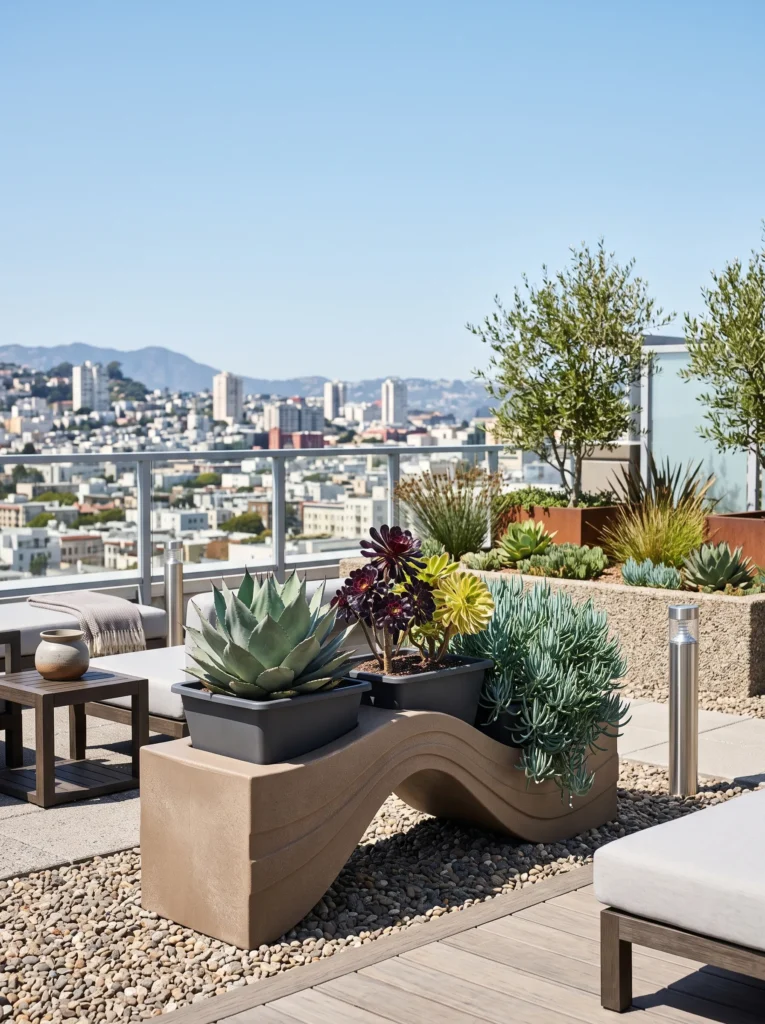
- Stand: Large-format recycled HDPE lumber with UV-stabilized exterior surface.
- Structure: 78 inches wide × 26 inches deep × 54 inches high, flowing three-level wave with wide planting bays.
- Plants: Agave parryi, Aeonium arboreum, and Senecio mandraliscae.
- Planters: Weather-resistant resin troughs with free-draining potting mix.
- Placement: Open rooftop terrace with full sun and strong wind exposure.
- Surroundings: Low-profile concrete-look seating, gravel-filled planters, and slim solar bollards.
- Construction detail: Use concealed mechanical anchors and distribute heavy planters evenly across the base.
Why this works: UV-stabilized HDPE does not rot, splinter, or rust like many traditional outdoor stand materials, making it useful for exposed garden structures. This is the piece I would choose for someone who wants something genuinely unexpected. The wave profile feels almost like landscape architecture, especially on a rooftop where there is no natural tree canopy to soften the hardscape. Recycled HDPE is particularly interesting because it can handle moisture without the rot concerns associated with untreated wood and does not require repainting when the surface inevitably gets wet. The material also has enough structural depth to create a substantial silhouette without making the stand visually heavy. I would keep the color restrained so the planting remains the star.
The plant palette is intentionally drought-conscious. Agave provides the strong central geometry, aeonium introduces rounded rosettes, and blue chalk sticks soften the lower edge with cool-toned foliage. On an exposed rooftop, however, wind becomes part of the planting design. I would never rely on a decorative stand simply sitting in place. My husband’s construction background has made anchoring a normal part of how I think about outdoor styling, especially when tall plants catch wind like sails. Keep the stand low, distribute the container weight evenly, and mechanically secure the base to the approved hardscape surface.
19. Cast-Stone Garden Spine
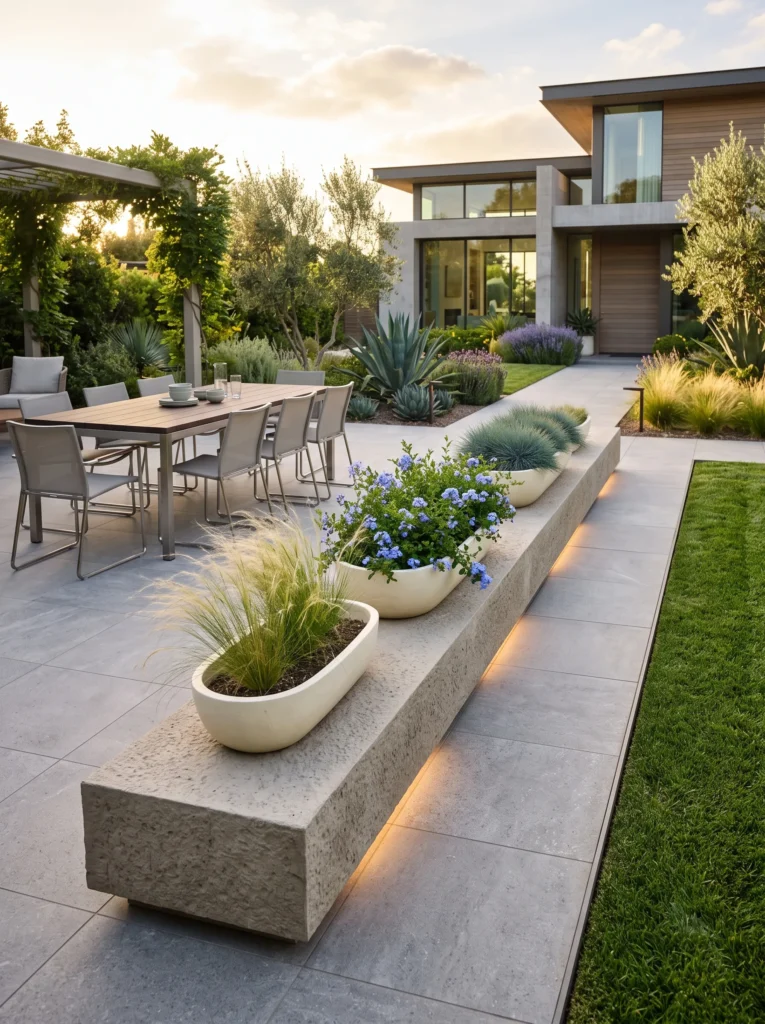
- Stand: Oversized cast stone with matte mineral finish and breathable exterior masonry sealer.
- Structure: 72 inches wide × 20 inches deep × 58 inches high with three asymmetrical platforms.
- Plants: Mexican feather grass (Nassella tenuissima), Cape plumbago (Plumbago auriculata), and blue fescue (Festuca glauca).
- Planters: Low ivory fiberglass troughs with concealed drainage.
- Placement: Full-sun backyard border between lawn and paved entertaining area.
- Surroundings: Outdoor dining table, porcelain pavers, and discreet uplighting.
- Construction detail: Place the long base on a properly compacted level footing with drainage directed away from joints.
Why this works: Cast stone provides the visual weight of masonry while a properly sealed exterior surface helps limit moisture absorption and weather-related deterioration. I wanted this design to feel almost like a low architectural wall that happens to contain plants. That approach works especially well in larger backyards because a tiny plant stand can disappear beside substantial furniture and hardscape. The long horizontal form visually connects the dining area with the lawn without blocking sightlines. I would keep the cast stone matte and slightly imperfect rather than highly polished. That restrained surface lets the grasses and foliage provide movement. It is also a material that feels naturally connected to a garden instead of looking like outdoor furniture placed on top of it.
The planting is intentionally loose around the rigid structure. Mexican feather grass gives the upper edge a fine, moving texture, cape plumbago contributes blue flowers, and blue fescue keeps the lowest level compact. When we work through outdoor layouts at home, I often start by asking where people will actually walk and sit before deciding where plants belong. Here, the stand stays along the perimeter, leaving the entertaining zone open. Evening uplights tucked several feet away can graze the cast-stone surface and grasses, making the entire structure feel integrated with the landscape.
20. Floating Oak Gallery
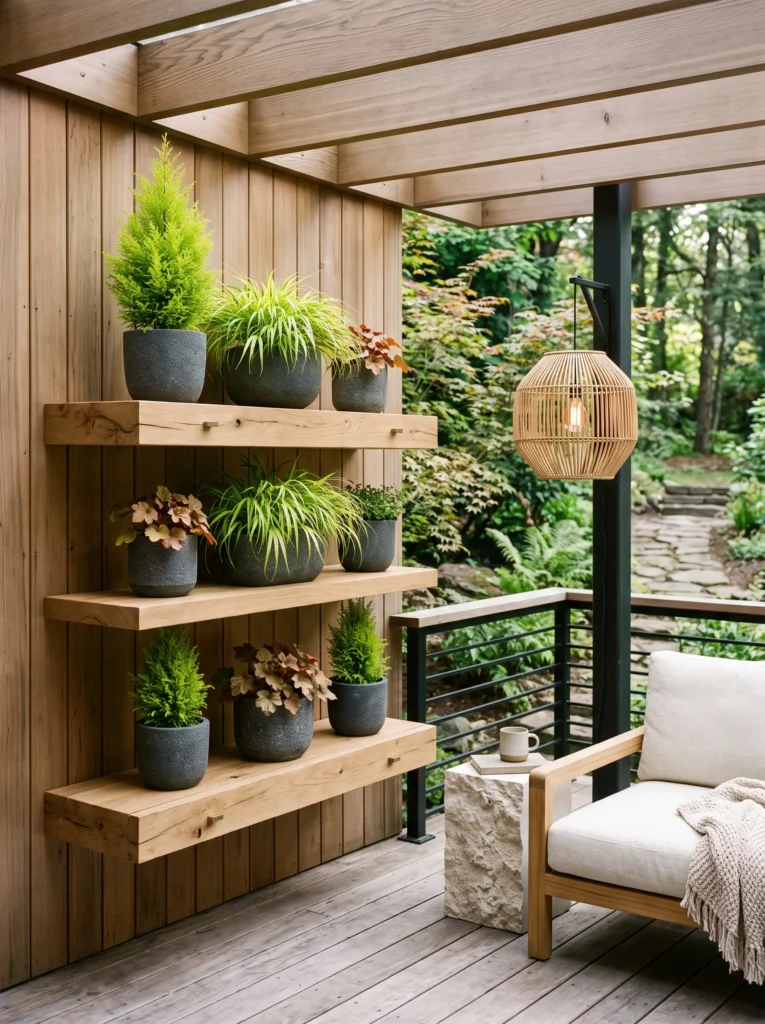
- Stand: White oak exterior-grade timber with marine-quality penetrating oil and UV-resistant finish.
- Structure: 64 inches wide × 18 inches deep × 64 inches high, with four floating offset shelves.
- Plants: Lemon cypress (Cupressus macrocarpa ‘Goldcrest’), Japanese forest grass (Hakonechloa macra), and Heuchera ‘Caramel’.
- Planters: Stone-finish composite planters with drainage holes and raised feet.
- Placement: Partially shaded covered deck.
- Surroundings: Deep outdoor lounge chair, limestone side table, and pendant lantern.
- Construction detail: Use stainless-steel exterior fasteners and deliberate air gaps between shelves.
Why this works: Exterior-grade white oak can perform outdoors when its finish, fasteners, drainage, and separation from standing moisture are carefully controlled. This is the kind of stand I would use when I want a large piece without making the deck feel crowded. Instead of a conventional ladder, the shelves appear to float across the frame, giving the whole structure a gallery-like quality. White oak has a beautiful grain that works particularly well with contemporary architecture, but it should never be treated like indoor furniture simply because it looks refined. The exterior oil needs periodic maintenance, and the wood should have room to dry after rain. Those practical details are what preserve the beautiful minimalist appearance.
I would keep the planting quieter here because the stand itself is visually strong. Lemon cypress gives the highest shelf a narrow vertical accent, Japanese forest grass spills gently sideways, and caramel heuchera provides a warm foliage note underneath. I have learned that large plant displays don’t necessarily need large numbers of plants. A few carefully chosen forms can look far more intentional than twelve unrelated pots. From the lounge chair, the staggered shelves also create different layers of foliage rather than one dense green mass, which makes the arrangement feel collected and architectural.
21. Travertine Archway
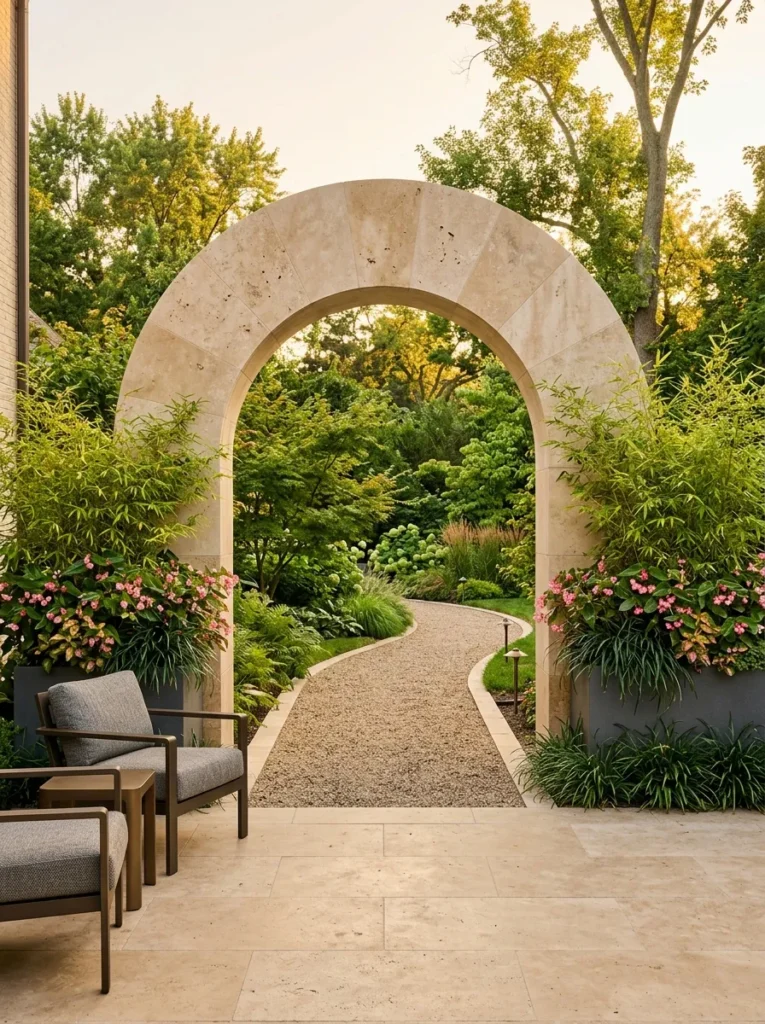
- Stand: Large travertine garden frame with honed exterior finish and breathable penetrating stone sealer.
- Structure: 70 inches wide × 24 inches deep × 76 inches high, broad rectangular arch with two lower shelves.
- Plants: Clumping bamboo (Bambusa multiplex ‘Golden Goddess’), Begonia ‘Dragon Wing’, and Liriope muscari.
- Planters: Tall fiber-reinforced composite containers with drainage reservoirs.
- Placement: Part-sun backyard transition between patio and garden path.
- Surroundings: Travertine patio, dark bronze outdoor chairs, gravel pathway, and concealed ground lighting.
- Construction detail: Use a stable compacted base and mechanically secured joints rather than loose stacking.
Why this works: Travertine’s dense mineral structure makes it suitable for outdoor architecture when its porous surface is properly sealed and protected from prolonged standing water. This would be my choice for a garden that needs a true destination piece. Rather than placing the stand beside the path, I would let it frame the path itself so the planting becomes part of the transition between two outdoor zones. Travertine brings enough visual substance to work with large patios and substantial architecture, yet its warm variation keeps it from feeling severe. I especially like the contrast between honed stone and dark bronze furniture. It feels current without depending on a short-lived decorating trend.
The golden bamboo gives the upper portion a soft screen-like quality, while dragon-wing begonia and liriope fill the lower shelves with different leaf shapes. I would keep the bamboo container generously sized so the plant has enough room to establish without becoming unstable. One thing I have become much more conscious of through my husband’s construction work is the difference between something that looks structurally sound and something that actually is. A large stone arch needs proper support, drainage, and secure connections. Once those are handled correctly, the planting can make the structure feel wonderfully effortless.
22. Sculptural Cedar Arc
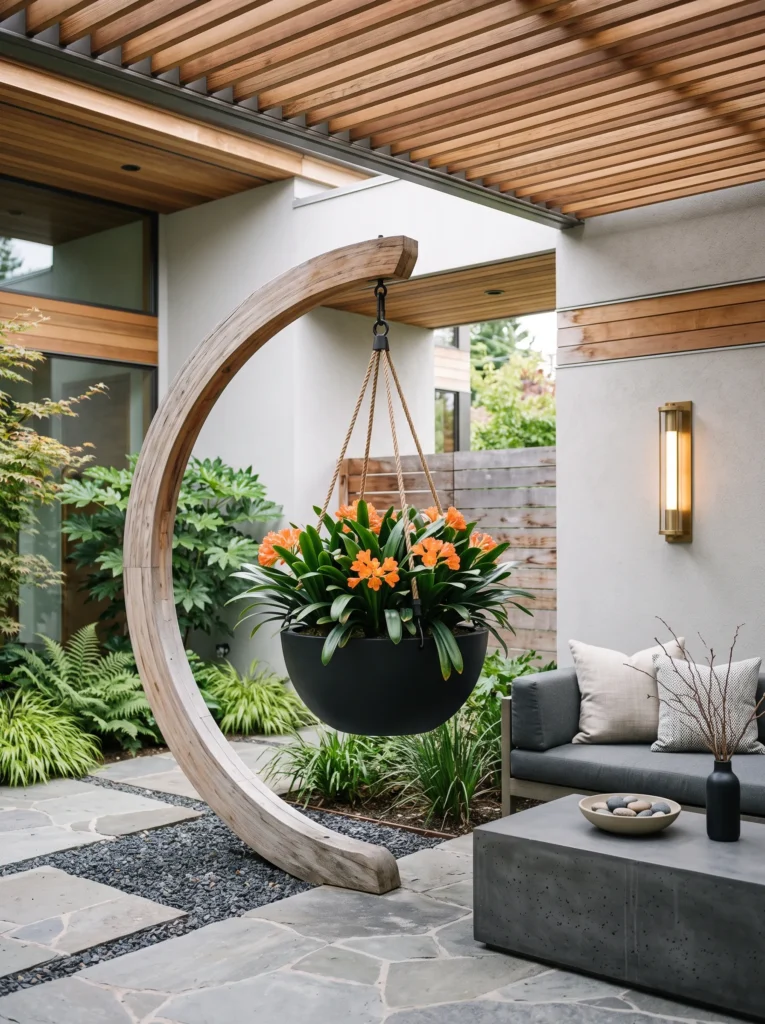
- Stand: Oversized cedar arc treated with UV-resistant penetrating exterior oil.
- Structure: 68 inches wide × 20 inches deep × 70 inches high, with two curved shelves.
- Plant: Clivia miniata.
- Planter: Matte-black fiberglass bowl with raised drainage feet.
- Placement: Covered courtyard protected from harsh afternoon sun.
- Surroundings: Low outdoor sofa, charcoal concrete side table, and warm architectural wall light.
- Construction detail: Use concealed stainless-steel brackets and anchor the lower frame where wind exposure is possible.
Why this works: A curved cedar frame softens a large outdoor composition while its natural decay resistance makes it practical for protected exterior spaces. I would use this piece when a courtyard needs something substantial but I don’t want another rectangular piece of outdoor furniture. The open center is important because it lets the architecture behind the stand remain visible, which keeps a large structure from feeling bulky. Cedar gives the frame warmth, while the black planter introduces just enough contrast to make the silhouette feel contemporary. In Austin, I also appreciate how a penetrating finish handles our strong sunlight better than a thick painted coating that can eventually crack or peel.
Clivia keeps the planting deliberately restrained. Its broad, glossy leaves have enough presence to hold their own against a large frame, while seasonal orange flowers can provide a beautiful color moment without requiring several different species. I would place the bowl slightly off-center rather than directly in the middle. That small asymmetry makes the arrangement feel designed rather than manufactured. The open shelf below can remain empty, allowing airflow around the planter and giving the eye a resting point. At night, a warm wall light behind the frame would outline the cedar without needing additional garden lighting.
23. Charcoal Metal Monolith
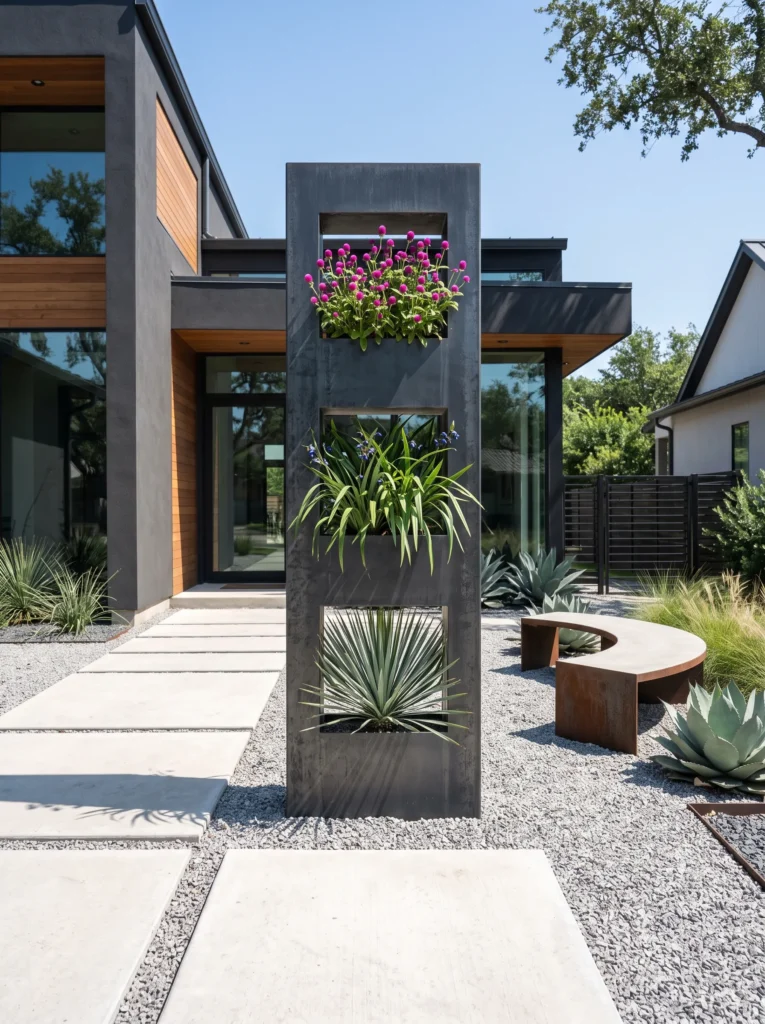
- Stand: Tall galvanized steel monolith with factory-applied charcoal exterior powder coating.
- Structure: 36 inches wide × 18 inches deep × 76 inches high with three recessed planter platforms.
- Plants: Yucca rostrata, Dianella revoluta, and Gomphrena globosa.
- Planters: Narrow fiber-reinforced concrete troughs with large drainage openings.
- Placement: Open front-yard courtyard with full sun.
- Surroundings: Concrete stepping slabs, ornamental gravel, and sculptural outdoor bench.
- Construction detail: Repair deep powder-coating chips promptly to protect exposed steel.
Why this works: Galvanized steel protected by an exterior powder coating offers two layers of defense against outdoor corrosion. This is the more dramatic option I would choose for a contemporary home with a strong architectural façade. The tall charcoal form behaves almost like a garden sculpture, while the recessed planting platforms keep the containers from visually protruding into the walkway. I like this approach because the stand doesn’t compete with the house; it reinforces its geometry. The combination of galvanized steel and powder coating is also practical for an exposed location. The zinc layer protects the steel beneath, while the exterior coating provides another barrier against sunlight and moisture.
The planting deliberately moves from architectural to delicate. Yucca creates the strongest vertical silhouette, dianella softens the middle tier with narrow arching leaves, and globe amaranth adds small rounded blooms lower down. I would leave generous spacing between the stand and the walkway because large plants need room to be appreciated from a distance. When I look at outdoor displays, I always ask whether they still work from the street rather than only from three feet away. This one does: the silhouette reads clearly even before the individual plants become visible.
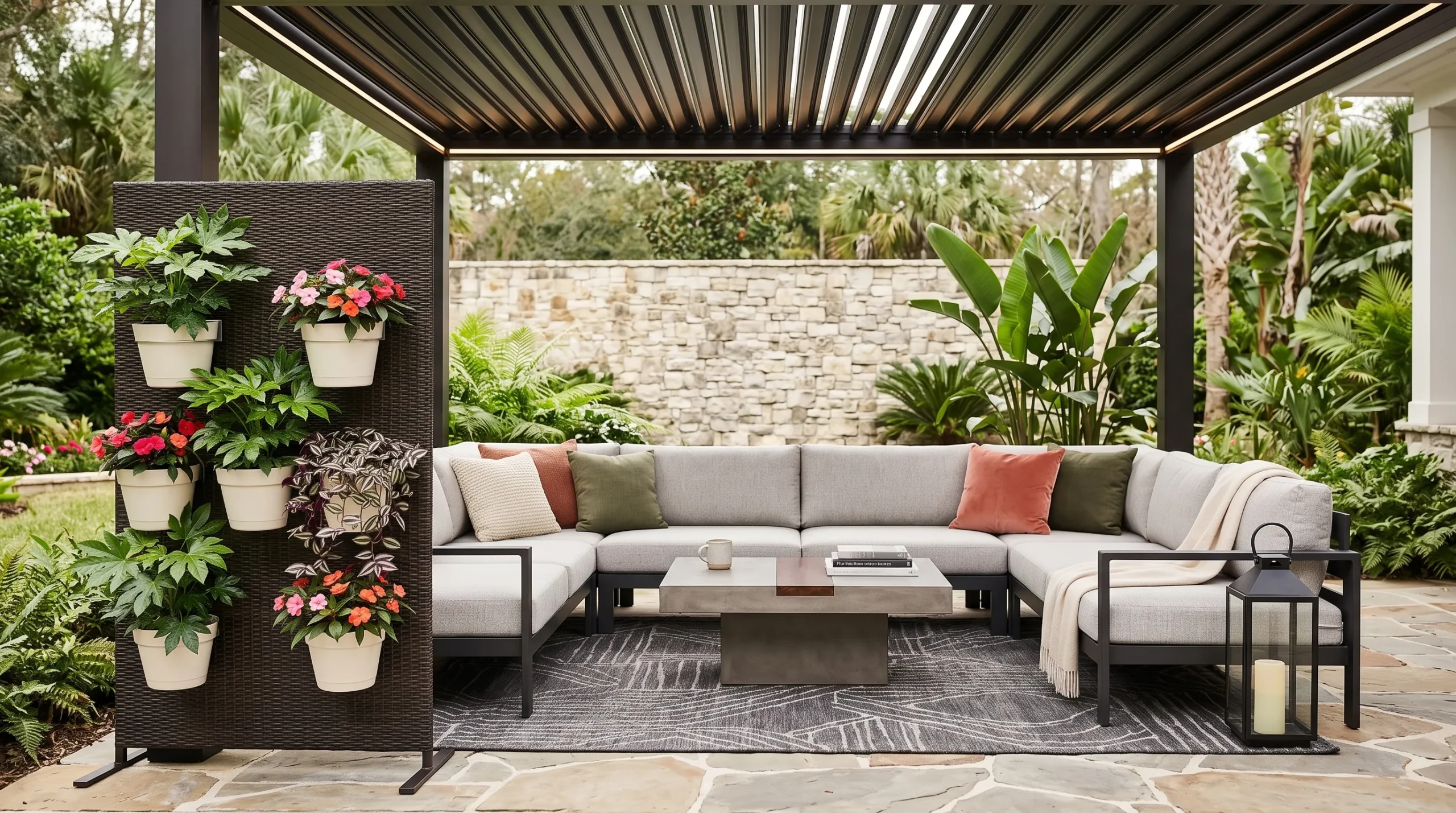
24. Layered Wicker Screen
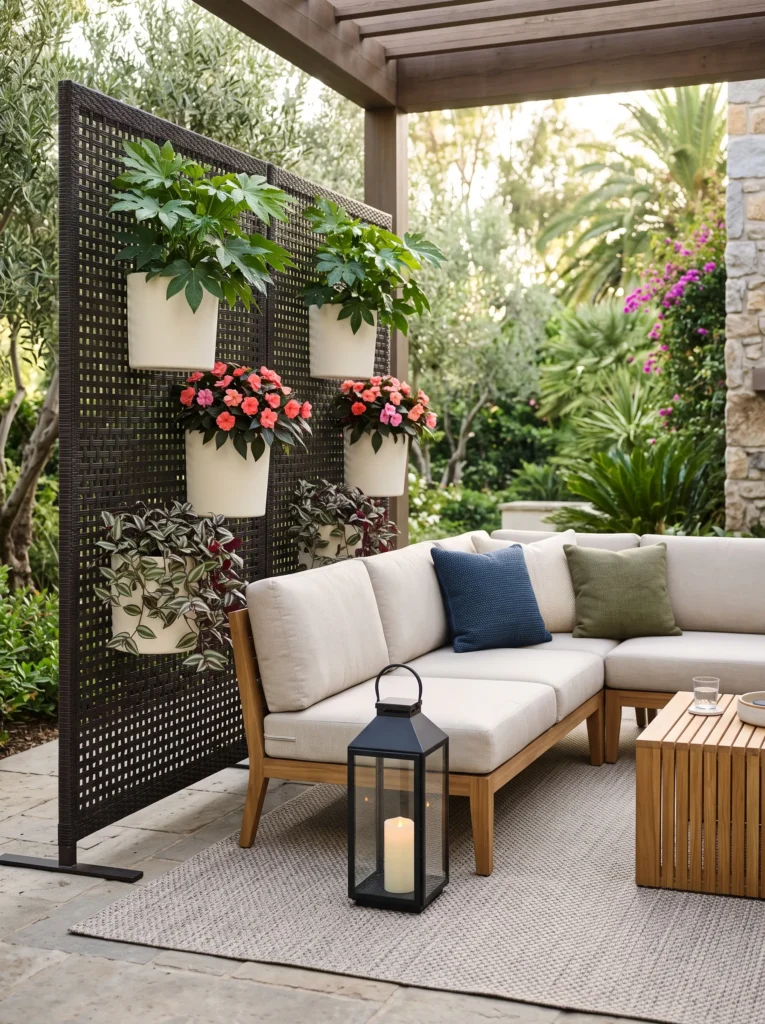
- Stand: Weather-rated synthetic wicker over aluminum with UV-stabilized outdoor resin.
- Structure: 74 inches wide × 22 inches deep × 68 inches high, layered screen with four offset shelves.
- Plants: Fatsia japonica, Impatiens hawkeri, and Tradescantia zebrina.
- Planters: Tall rotomolded resin containers in warm ivory.
- Placement: Shaded side patio with bright indirect light.
- Surroundings: Linen-look outdoor sectional, teak side table, textured outdoor rug, and oversized lantern.
- Construction detail: Elevate aluminum feet from paving and leave space behind the screen for ventilation.
Why this works: UV-stabilized synthetic wicker provides the woven appearance of rattan while resisting the moisture and sunlight that can damage untreated natural fibers. I wanted this one to feel softer and more residential than the metal monolith, which is why the woven surface matters. A large wicker screen can visually divide an outdoor room without becoming a solid privacy wall. The secret is choosing genuinely weather-rated synthetic fiber rather than ordinary decorative rattan. The aluminum frame underneath also keeps the structure lighter and more resistant to moisture-related deterioration. I would use this beside seating rather than along a narrow walkway, where its broad shape can function as both a planting display and a gentle visual boundary between outdoor zones.
Fatsia gives the upper shelves the broad, tropical foliage I want in a shaded setting, while New Guinea impatiens supplies flowers beneath it and wandering dude trails gently from one lower container. I particularly like this combination for covered patios because the plants appreciate protection from the harshest afternoon conditions. My own preference is to keep large displays slightly imperfect rather than filling every opening. Leave a few shelves visually quiet, and the wicker texture remains visible. That balance makes the piece feel like part of the furniture arrangement instead of a freestanding wall covered entirely in plants.
Styling Principles for Weatherproof Plant Stands
A beautiful outdoor plant stand should be chosen as carefully as a piece of patio furniture. I like to start with the location, exposure, and plant requirements, then choose the stand rather than working backward from appearance. Full-sun areas need materials and finishes that tolerate UV exposure, while covered patios allow you to use more delicate-looking materials with less direct weather exposure.
Choose materials for exposure
- Teak and cedar: Excellent wood choices because their natural properties make them more resistant to outdoor decay than untreated pine.
- Powder-coated metal: Look for genuine exterior-grade powder coating.
- Galvanized steel: The zinc coating protects the underlying steel from corrosion.
- Concrete and stone: Excellent for heavy, permanent displays, but porous materials still need appropriate sealing and drainage.
- Synthetic wicker: Choose UV-stabilized, weather-rated resin over aluminum.
- Recycled HDPE: Useful for highly exposed areas because it does not rot, splinter, or rust.
Think about drainage first
A plant stand should never become a reservoir for rainwater. Use pots with generous drainage holes, keep containers slightly raised from shelves, and avoid designs where water can become trapped beneath the planter. Good drainage protects both the plant and the stand.
For rain-heavy periods, elevated pots allow air to circulate underneath the container and help surfaces dry faster. This is especially important with large ceramic or concrete planters that can remain wet long after the surrounding patio has dried.
Match the stand to the plant
Think beyond color. Match the plant’s mature size, sunlight requirements, watering needs, and weight to the structure. A tall, top-heavy plant may require anchoring, while a moisture-loving fern belongs in a protected location rather than an exposed, full-sun stand. Drought-tolerant plants are generally easier to manage on highly exposed stands because they don’t require constantly wet soil.
Consider wind and weight
Large outdoor plant stands behave differently from small decorative tables. A tall frame with several large containers can catch significant wind. For substantial displays:
- Anchor tall structures to appropriate hardscape or structural surfaces.
- Keep heavier containers on lower shelves.
- Avoid putting the largest planter at the highest point.
- Use wide bases for freestanding designs.
- Consider the weight of wet soil, not just the empty planter.
- Leave enough room around the structure for maintenance and airflow.
This is one place where my husband’s construction background has changed how I decorate. A stand can be gorgeous, but if its proportions, anchoring, and weight distribution are wrong, it isn’t a successful outdoor design.
Style the whole zone
Don’t treat the stand as an isolated object. Repeat one or two materials already present in the space—such as teak, limestone, concrete, bronze, or black metal—so the planting feels connected to the architecture.
For a modern look, I prefer one large statement stand over several small pieces. Leave some negative space between containers, use plants with distinctly different forms, and let the stand’s material remain visible.
FAQ
What is the best material for an outdoor plant stand?
Teak, cedar, powder-coated aluminum or iron, galvanized steel, weather-rated synthetic wicker, concrete, and UV-stabilized HDPE are among the strongest choices. The best material depends on exposure. For intense sun, prioritize UV resistance; for wet climates, prioritize corrosion and moisture resistance; for freezing climates, consider freeze-thaw performance.
Do outdoor plant stands need to come inside for winter?
Not necessarily. A genuinely weather-rated stand can remain outdoors through winter, but the plants and containers may need different treatment. In freezing regions, bring frost-sensitive plants indoors and use frost-resistant planters. Concrete and ceramic pieces should be protected from prolonged water saturation followed by freezing.
What are the best stands for small patios or balconies?
Choose vertical, narrow designs such as ladder stands, corner towers, wall-mounted shelves, or slim architectural frames. Keep the footprint small but avoid making the structure excessively tall and top-heavy. On balconies, anchoring is especially important because wind exposure can be significantly greater than at ground level.
What are budget-friendly outdoor plant stand options?
A galvanized garden cart, reclaimed exterior-grade timber, simple cedar frame, or recycled HDPE stand can provide durability without requiring a high-end custom piece. The important thing is not simply finding inexpensive material; it is choosing something genuinely rated or suitable for outdoor exposure.
How do I prevent a metal plant stand from rusting?
Choose galvanized or properly powder-coated metal rather than untreated steel. Inspect the surface periodically for scratches or chips. Repair exposed areas promptly with an exterior-compatible touch-up coating, and prevent water from continually collecting around joints, feet, and drainage points.
How do I prevent a wooden plant stand from rotting?
Start with a naturally durable wood such as teak or cedar, use an exterior-rated penetrating finish when appropriate, keep the legs elevated from wet ground, and make sure water can drain freely beneath containers. Avoid trapping moisture between the stand and masonry or soil. Even naturally weather-resistant wood lasts longer when it can dry properly.
Final Thoughts
The best outdoor plant displays are not simply about finding a pretty place for a pot. The right stand considers weather exposure, material durability, drainage, plant needs, stability, and the way the entire outdoor space works together. A teak tiered stand may be perfect for a covered porch, while galvanized steel, concrete, or powder-coated metal can make more sense in a fully exposed garden.
I also believe the most successful displays leave a little room to breathe. Choose fewer, stronger plants, repeat materials already used in your patio or landscape, and give larger stands enough space to become part of the architecture. Whether you’re styling a small balcony, sunny patio, garden path, or expansive backyard, a weather-ready plant display should look beautiful today and still make sense after months of sun, rain, and changing seasons.
For more seasonal inspiration, explore our fall garden ideas and backyard landscaping ideas to create an outdoor space that transitions beautifully throughout the year.